



Abstract
The aim of the article is to discuss how and to what extent co-creation has the capacity to strengthen democratic legitimacy. By distinguishing between output-based and input-based co-creation, and by discussing types of legitimacy in relation to deliberative, participatory, and representative conceptions of democracy, the article points to potentials and pitfalls inherent in the idea of co-creation. Four examples from Denmark and Norway are used to illustrate the argument. In conclusion, the article points to main challenges associated with co-creation which deserves more research—particularly inequality of individual resources and the clash with the party-political system.
Keywords
Introduction
With new perceptions about how democratic systems are legitimized, to an increasing extent contemporary scholars tend to see policy making and participation as two sides of the same coin. While input in the form of political parties and elections used to be understood as the main source of legitimacy, scholars are now pointing to output in the form of service delivery and problem solving as an equally important dimension of legitimacy, arguing that “input” and “output” are inter-related dimensions of democratic legitimacy (Crozier, 2010; Peters, 2009; Pierre et al., 2017).
Such theoretical reflections on legitimacy are accompanied by many practical initiatives from public sector leaders in which participation and governance are linked together. Some have even argued that governance has become a driver for democratization (Warren, 2009). Democratic innovations, it is argued, are driven by administrators whose aim is to strengthen or ease the governance process (Eckerd & Heidelberg, 2020). There are many examples of such initiatives, for example public hearings, citizen budgeting, deliberative stakeholder meetings, citizen juries and, we will argue, most recently, co-creation.
There are multiple reasons why these arrangements can improve governance. For example, they can provide valuable input to the governance process, they can lessen the burden on public budgets, and they can prevent problems with the implementation of public policies. To what extent they also improve participation and democracy and increase legitimacy is a more open question that needs to be discussed and explored through empirical analysis. So far, only a limited number of such studies exist (Hertting & Kugelberg, 2018; Verschuere et al., 2018; Warren, 2009).
This article will be concerned with “co-creation,” which we see as one good example of governance-driven democratization (Warren, 2009), and which can potentially address both the input and output side of the policy circle (Dye, 2017). Co-creation is a governance-driven reform idea that has the potential to strengthen democracy and legitimacy, but it also involves risks and pitfalls we need to be aware of.
Co-creation is a broad and weakly developed concept, which may be one reason why leaders in the public sector find it attractive. In many countries, the native words used to express co-creation were almost unknown until recently. In a short space of time, however, these words have developed into a much used and, among many, highly praised reform idea (Røiseland & Lo, 2019). Still, there is probably less agreement among public sector leaders and staff about what co-creation means in practical terms (Horsbøl, 2019), and even among public sector scholars, “co-creation” seemingly is in its conceptual infancy (Voorberg et al., 2015).
The aim of this article is to critically discuss the relationship between co-creation and democratic legitimacy by linking together different strands of literature dealing with co-creation, democracy, and legitimacy (Beetham, 1991; Crozier, 2010; Gilley, 2009; Scharpf, 1999). The article will highlight two fundamentally different types of co-creation—output-based versus input-based. By relating these types to legitimacy and different conceptions of democracy, the article will illustrate that potentials as well as pitfalls associated with the two types of co-creation depends on where one stand in democratic theory. Expressing the aim of the article in the form of a question, the article aims to answer the following:
- How do different types of co-creation relate to legitimacy, and what are the main potentials and pitfalls of co-creation for democratic legitimacy?
We will elaborate on “co-creation” in the next section, where two types of co-creation will be developed. Output-based co-creation refers to concrete problem-solving or practical service delivery. It resembles, or perhaps is, a classic type of interaction between the public sector and citizens and/or civil society. Co-creation of this type will largely correspond to “co-production.” The second type of co-creation, input-based co-creation, relates to policy design and policymaking, pointing to patterns of interaction in which citizens and/or civil society are actively drawn into processes of problem definition, policy design, and decision-making.
The two different types of co-creation are not just arrangements that can improve governance, they also allow for participation, and are in some way relevant to democracy and legitimacy. To what extent, and in what way, can differ significantly, however. At the conceptual level, to a large extent the evaluation of co-creation will depend on how democracy is understood. We will therefore, in section three, develop some theoretical expectations about co-creation and legitimacy within three different conceptions about democracy.
In the empirical part of the article, we will provide a set of examples from Danish and Norwegian local government. The reason for illustrating the argument by examples from these two countries is partly practical. However, these two countries are interesting cases for other reasons as well. Public sector leaders in both countries have in recent times embraced co-creation as a new governance idea, while at the same time both countries have a strong and well-established public sector rooted in ideas that are pointing in a different direction compared to co-creation, among these an emphasis on professional knowledge and professional leadership and a tradition for sovereign political leadership (Knutsen, 2017).
Each type of co-creation will be exemplified by one Danish and one Norwegian example. These examples will be used to illustrate the discussion about the potentials and pitfalls of co-creation for democratic legitimacy. The article concludes by pointing to two fundamental problems, and how they raise questions that can be addressed in future research in this field.
Co-creation and Democratic Legitimacy
In many Western countries, the Nordic welfare states included, it is argued that we are witnessing a gradual, although incomplete, shift in the perception of the role of citizens in public governance. In recent times, this has often been referred to as “co-creation.” This new public sector concept is a bricolage of ideas and theories taken from public service management, urban planning, and innovation (Brandsen & Honingh, 2018; Lund, 2018). However, the concept of co-creation originates in marketing theory and the idea that value is created in the interaction between a provider and a consumer. Typical examples would be tourism, social media, “Web 2.0” and similar types of consumer-producer interactions (Payne et al., 2008; Ramaswamy & Ozcan, 2014). The “co” of co-creation indicates that a collaborative process involving different kinds of actors and resources is taking place, while “creation” tells us that something is achieved that would otherwise not have been realized.
Despite its origins in the private sector, it is argued that the concept of co-creation is also relevant to the public sector. As noted by Osborne et al. (2016), the public sector is dominated by the production of services that, because of their discretionary and intangible nature, provide excellent conditions for co-creation. In many cases, the solution to public problems also depends on interaction between public actors and citizens, civil society, and private companies (Torfing et al., 2019). Whereas citizens were previously perceived as passive clients or demanding customers, they are now increasingly viewed as active and responsible partners in public governance and service provision (Ansell & Torfing, 2021; Pestoff, 2009; Torfing et al., 2019).
“Co-creation” belongs to a family of concepts commonly used to describe newer trends in governance and public problem solving, similar concepts are for example co-production, interactive governance, collaborative governance, and social innovation. Among scholars each and one of these concepts frame their own academic discourses. However, at closer look one will also find a significant overlap where the same authors are “traveling” between different concepts, but still within the same conceptual family. It is not easy, therefore, to delimit the relevant literature on co-creation. Still one can argue that “co-creation” catches something that is missing out in other conceptual approaches. For example, it is argued that since co-creation originates in the private sector, there is a huge private sector literature that, with some adjustments, can be applied also to the public sector (Osborne et al., 2016). Secondly, it is argued that even though co-creation is a collaborative process, it has some crucial and constitutive features that is less emphasized in collaborative governance, like distributed problem-solving where all kinds of actors can take the initiative (Ansell & Torfing, 2021, p. 55), or a search for innovative solutions to societal challenges (Torfing et al., 2021). While a concept such as “collaborative governance” clearly recognizes the importance of multi-actor collaboration, one can argue it does not bring out the potential link between collaboration and innovation, and the literature tend to see collaboration as convened and facilitated by public agencies (Bommert, 2010; Torfing et al., 2019).
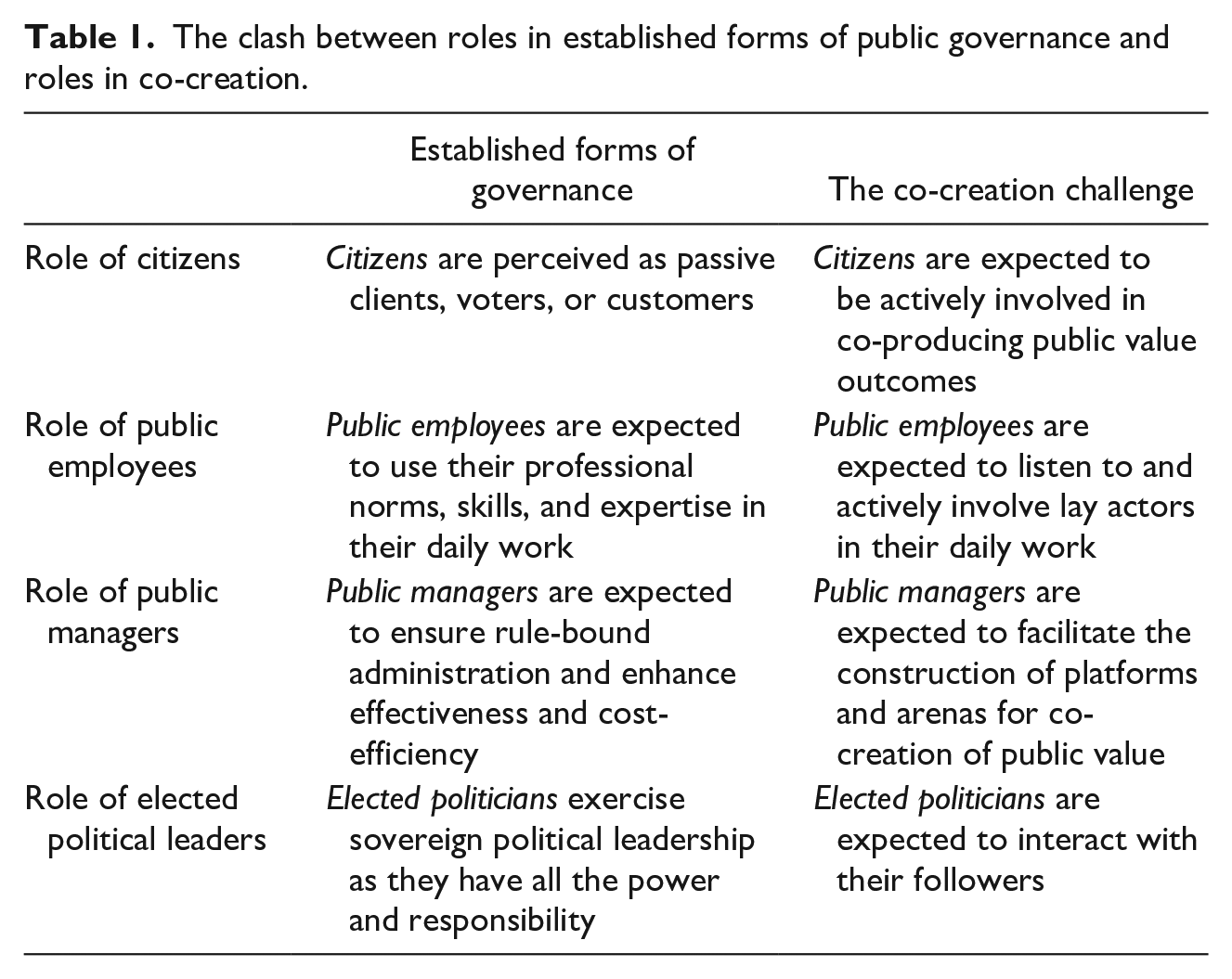
New ideas about governance, regardless of how we conceptualize them, do not fully replace existing ideas, rather they co-exist with ideas rooted in Classical Public Administration and New Public Management (Osborne, 2010). Such co-existence is not necessarily peaceful since co-creation tends to problematize and clash with cherished norms and values, and institutionalized government practices. For example, as summed up in Table 1, while co-creation would expect citizens to be actively involved in the co-production of public value, established forms of governance tend to see citizens as passive clients, voters, and customers. And while the established governance form expects public employees to apply their professional expertise, co-creation means they should listen to and actively involve lay actors in their daily work. For public managers, the conflict between established forms and co-creation is about ensuring rule-bound, effective and efficient administration, versus facilitating platforms and arenas for co-creation. For political leaders, co-creation poses challenges since the established political system expect them to exercise sovereign political leadership, while taking the idea of co-creation seriously, political leaders should be in close interaction with their followers.
The clash between roles in established forms of public governance and roles in co-creation.
Co-creation can be defined as a process through which public and private/civil actors attempt to solve a shared problem, challenge, or task through a constructive exchange of different kinds of knowledge, resources, competences, and ideas (Torfing et al., 2019). Obviously, co-creation is a broad concept, covering many possible interactions between the public sector and its citizens. Co-creation can arise in the early stages of a policy process in which problems are detected and defined (co-initiating), in the stage where solutions and belonging tools are identified and selected (co-design), or in the process where actions are taken (co-implementation) (Lund, 2018; Torfing et al., 2019). Co-creation can mean types of interactions that are well known, and which do not significantly challenge existing types of governance practices and routines. In that case, co-creation largely overlaps with co-production (Alford, 1998; Alford & Freijser, 2018). In contrast to these rather classic forms of co-creation, there are also more radical types that, to a significant extent, challenge existing forms of governance and democratic participation, for example interactive forms of leadership and governance arrangements where citizens and groups of citizens are allowed to play an active role in a balanced relationship with political and administrative leaders (Røiseland & Vabo, 2016; Torfing et al., 2012, 2019).
Co-creation can increase the legitimacy of public government, is a common claim in the belonging literature (Fledderus, 2018; Voorberg et al., 2015, p. 1349). Following Gilley (2006: 502), we understand “legitimacy” to mean the “endorsement of the state by citizens at a moral or normative level.” Thus legitimacy is conceptually distinct from political support, which can be related either to the state or to the current government. The very core of legitimacy, understood as an individual quality, is that citizens are willing to accept decisions and actions in the name of the public even if they do not correspond with their individual preferences or objectives (Beetham, 1991; Gustavsen et al., 2014).
Even if the phenomenon itself can be fairly delimited and defined, the literature and perspectives on legitimacy are manifold and complex. In an extensive analysis, Gilley (2009) distinguishes between different schools based on how they understand the processes which produces legitimacy (Gustavsen et al., 2014). While for example the “development school” points toward the organization, production, and distribution of material well-being in a society, the “democratic school” understands legitimacy as a product of civil, social, and political rights. By definition, co-creation is a type of participation, and as such resembles the “democratic school.” However, co-creation is also about creating something, for example a specific solution to a problem or a broader strategy, and therefore also relates to the “development school.” In the following discussion we will compare cases that promote participation in different stages in a policy process, and which also intend to produce an outcome. Therefore, potentials and challenges related to legitimacy can root in participation as well as the end result, hence both the mentioned schools will be relevant for our study.
One way to strengthen legitimacy is to see implementation not as a public, professionalized, and value-free process, but rather as an arena for co-creation where citizens are actively involved in the delivery of services and the solutions of problems. (Anheier, 2015; Bovaird, 2007; Pestoff, 2014; Voorberg et al., 2015). In addition, it is also claimed that co-creation on the input side of the policy circle can increase legitimacy. This is a common claim in the literature on, for example, “interactive governance” and “interactive political leadership” (Nabatchi & Amsler, 2014; Sørensen & Torfing, 2019a; Sørensen et al., 2020). In both cases co-creation would not only increase legitimacy through better public actions and services, but also through the participation of relevant actors and stakeholders.
In the following discussion, we will make a simple distinction between output- and input-based co-creation, as illustrated in Figure 1. Output-based co-creation is closely linked to the delivery of services and daily running of the public sector, and administrative staff and professionals will be the most important actors from the public side. The aim of such co-creation would for example be to help citizens master their lives and encourage them to co-create the services they are offered by the public sector. This well-known, everyday phenomenon in the public sector (type D in figure), whereby end-users contribute to the production and delivery of a particular service, includes practical examples such as pupils doing their homework at school, patients doing some prescribed physical exercises after a knee operation, or creating an online job search profile at the local job center (Alford, 1998; Torfing et al., 2019). One can also imagine examples where citizens do not just co-produce their own welfare services, but also create value for other citizens through voluntary work carried out in close cooperation with public professionals and leaders (type C).
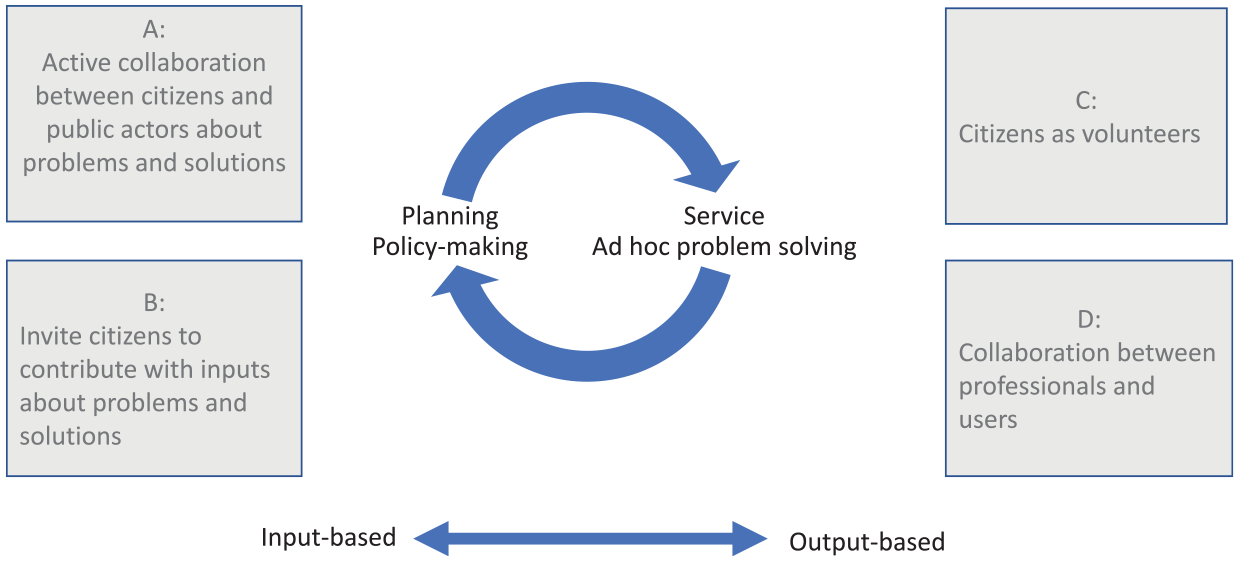
Two types of co-creation and four examples.
Input-based co-creation is linked to planning and policy development and includes all forms of co-creation where citizens or groups of citizens become involved in policy initiation, policy design, and decision-making. This type of co-creation involves political leaders, and it could mean that individuals or organized groups of citizens provide inputs to the design of new tasks and solutions through crowdsourcing, focus-group interviews, written consultations, and public hearings that allow input (type B). However, this could also take a more radical and interactive form (type A), where public and private actors engage in a mutual and balanced dialog aimed at designing new and better solutions and coordinating their implementation (Flinders et al., 2016; Torfing et al., 2019).
The four examples displayed in Figure 1 have in common that they to a certain extent satisfy the definition of co-creation set out above, but they may also differ in the status citizens are given via-a-vis the public. While example A would allow for collaboration among equal parts, B, C, and D would commonly be collaborations convened and facilitated by the public.
Ideas About Democracy and Legitimacy
The two main forms of co-creation described above have, from a theoretical perspective, a potential to increase democratic legitimacy. However, discussing democratic legitimacy without clarifying what we mean by democracy will likely be a less useful exercise. The following reflections on democracy is important since “democracy” is an idea that can mean different things, and how we understand democracy influences how we see potentials and pitfalls related to legitimacy. In this section we will explore, on theoretical grounds, the relationship between the two types of co-creation and legitimacy, given three different democratic contexts—deliberative, participatory, and liberal.
Classic literature tends to distinguish between direct forms of democracy in which individual citizens vote on an issue, and representative systems, in which elected leaders make decisions on citizens’ behalf. These two main forms are supplemented by ideas about the widest possible participation, referred to as participatory democracy, and ideas about reaching decisions through discussion and argumentation, referred to as deliberative democracy. In the practical world, these types of democracy tend to be mixed, and there is hardly any system that is based solely on one of the types. Among scholars, it is therefore argued that contemporary types of governance and participation need to be evaluated in relation to hybrid forms, such as “strong democracy” (Barber, 2003), or “interactive democracy” (Rosanvallon, 2011), “hybrid democracy” (Sørensen & Torfing. 2019b).
In the following analysis, we take a different approach, developing different conceptions of democracy as ideal types, inspired by the analytical method suggested by Max Weber (Ringer, 1997, p. 102). The fundamental idea is that the more different conceptions of democracy are developed as ideal types, the more will the potentials and pitfalls of co-creation become apparent. Since, by definition, the idea of direct democracy is less relevant to co-creation, it is not discussed in the following.
Starting with deliberative democracy, there are certainly strong links between co-creation and this conception of democracy, which took shape in the early 1980s (Floridia, 2017, p. 5; Dryzek, 1987; Forrester, 1999). The idea of deliberative democracy takes as its point of departure the process whereby ideas, conceptions, and solutions are developed. However, although the literature about deliberation mentions many successful “one-off” experiences of deliberative participation, there are few examples of institutionalized routine practices (Lewanski, 2013). In the practical world, such initiatives tend to be either too closely linked to the authorities, leading them into problems of co-optation, or too decoupled from the authorities, leaving them with less impact (Setälä, 2017).
In contrast, participatory democracy is mostly concerned with the early involvement of all types of stakeholders—for example individual citizens, NGOs, and private companies—in the development, determination, and implementation of public policies (Pateman, 1970). Such participation will allow both the lay public and stakeholders to be involved in exploring policy problems, developing solutions, and making political decisions (Klijn & Koppenjan, 2000, pp. 368–369; Mayer et al., 2005, p. 180).
Last, but not least, so-called liberal democracy is a cornerstone of most constitutions in democratic states (Barber, 2003). The very essence of this conception of democracy is to have representatives who make decisions and develop policies on citizens’ behalf. Through elections, voters choose among politicians or parties that represent their interests. This system of governance resembles the market in many ways, with the voter as the customer and the politicians as the entrepreneurs “selling” packages of political goods (Dahl, 1956; Macpherson, 1979).
Co-creation is related to all these conceptions of democracy, but in different ways, as illustrated in Table 2. Starting with output-based co-creation, this is a type of interaction that, seen from the perspective of deliberative democracy, allows for deliberation. However, the problems or questions in a case will be at the micro-level and will be related to individual needs or the needs of a smaller group. Seen from the perspective of participatory democracy, this type of co-creation allows for more participation. More citizens become engaged, but mostly based on their personal needs, or the needs of local groups. Seen in relation to the conception of liberal democracy, output-based co-creation will be relevant since this type of interaction can improve the quality of services as experienced by the user. In addition, one can also imagine this type of co-creation to have an indirect impact on the input-side. When problems are solved through interactions between administrative staff and users or citizens, this will likely reduce the agenda for elected politicians and administrative leaders, allowing elected leaders to concentrate their efforts more effectively on fewer issues.
Relationships between co-creation and democratic legitimacy.
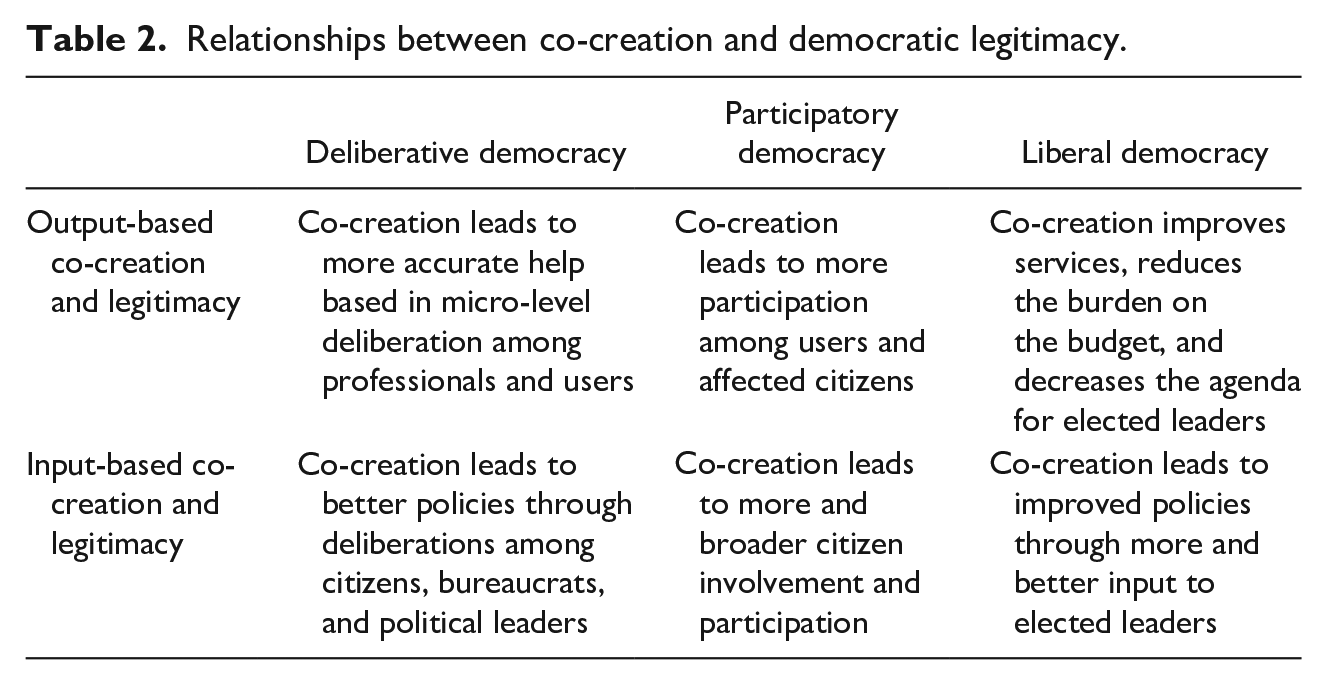
Moreover, input-based co-creation serves different functions in the three different conceptions of democracy. Starting with deliberative democracy, input-based co-creation will lead to deliberation among a set of actors, and how co-creation is organized will influence the type and number of voices included in the process. Seen from the perspective of participatory democracy, input-based co-creation is an arena for participation that allows citizens to raise their voices and possibly have a say in the development of public policies. Depending on how co-creation is organized, this arena can enable wide participation, although in most cases only a limited number of citizens will have this opportunity. Lastly, seen from the perspective of liberal democracy, the value of input-based co-creation lies in the input and information these arrangements can provide for elected leaders. More and better input will improve the decisions taken by sovereign elected leaders.
Four Examples of Output- and Input-Based Co-creation
The aim of this section is not to provide a full empirical analysis. Rather, our intention is to enrich the discussion using four real-world examples of co-creation, which will be used to exemplify the possible potentials and pitfalls we discuss in the next section. The four cases are taken from Denmark and Norway, two countries traditionally understood as “most similar systems.” Both countries belong to a common governance tradition whereby the municipalities are the core welfare providers under a universal and national welfare state regime (Heinelt et al., 2018; Knutsen, 2017). Local government functions are very similar, but with a few differences which however do not influences on the analysis below (Lo & Røiseland, 2021).
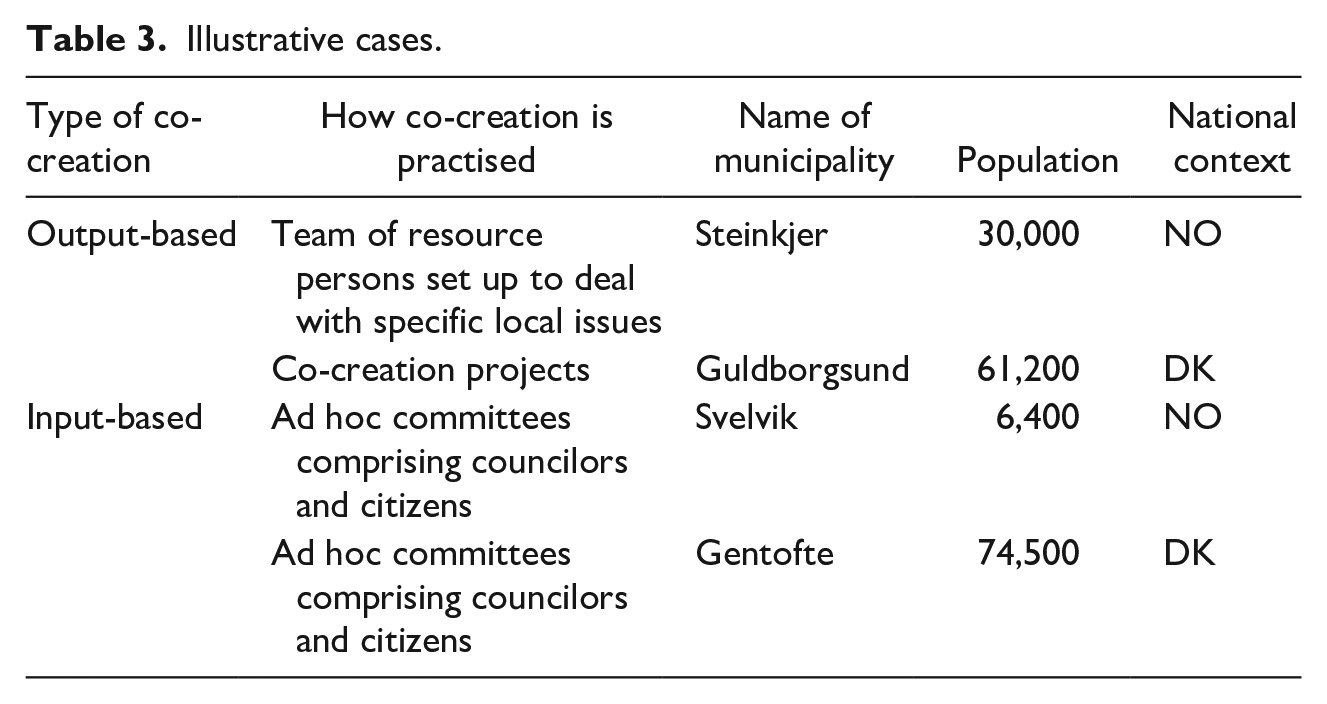
The cases (see Table 3) were obtained during a mapping of Danish and Norwegian municipalities that had taken extraordinary steps to strengthen their political leadership (Lo & Røiseland, 2021). Some of these municipalities were using co-creation practices as their strategy, and four are used as examples below. These four cases were selected due to their richness in information, which we saw as more important rather than striving for some form of representativeness. We consider this strategy to correspond to what Seawright and Gerring (2008) conceptualize as the “influential” cross-case method of case selection, where the selected cases contain some influential configurations of possible relevant variables, while not necessarily being representative as such. Table 2 provides an overview of the selected cases.
Illustrative cases.
Data consists of available evaluation reports combined with 26 hour-long interviews with the municipal Mayor, its CEO, and politicians, bureaucrats and citizens that were involved in the four examples of co-creation. The interviews were transcribed and analyzed using the software package NVivo.
Output-Based Co-creation
A Norwegian example of output-based co-creation is the municipality of Steinkjer. In this case, co-creation does not involve the elected leaders directly, but more participation by citizens is still expected to increase the potential for political leadership. The initiative was taken because of concerns about the lack of coordination of services, planning, and regulation in the many rural localities this municipality serves. The basic idea was to develop a more holistic and place-based perspective compared to the more functional perspectives of the municipal administration, which would make it possible to take advantage of all sorts of local resources. To involve local and civil resources, a procedure was established for dealing with local problems or challenges that were reported to the municipal organization. It depended on the existence of a local network comprising contact persons and civil organizations. Once this framework was in place, the municipality of Steinkjer would set up a committee to deal with the reported issue. This committee would bring together all kinds of resources, such as members of local voluntary organizations, leaders from the local school, experts from the municipal administration, and citizens with a special interest or expertise. The committee would then explore the problem/challenge, work out a set of possible solutions, and, to the extent possible, implement these solutions jointly using local resources. All this happens without the participation of elected politicians, and many problems are solved using this procedure before they end up on the “political table.”
A corresponding Danish example of output-based co-creation is the municipality of Guldborgsund. In this case, it is not so much a question of utilizing existing networks as in the above case. Rather, the aim is to promote the establishment of new networks in local communities, and to reduce the financial burden on the local government organization. This was important since Guldborgsund was facing a number of structural challenges, with many poorly educated inhabitants, high expenditure on support, a low tax base, high spending requirements, and one of the country’s worst ratios between tax and service levels. In the early 2010s, the municipality was in deep crisis, with a decreasing population, job losses, and economic depression—the problems were so bad that the municipality was close to being placed under administration. Following the implementation of a broad political agreement, in which major savings and welfare priorities were agreed, a politically initiated process of co-creation was initiated. In this context, co-creation was seen as a way of bringing the community and politicians closer together with respect to immediate welfare needs. The goal of the process was to mobilize the resources and desires of the local community by increasing involvement in, and the co-creation of, welfare solutions. The process, which was politically initiated, largely proposed an approach that allows citizens, employees, businesses and associations to start and run initiatives, and projects they are passionate about. A follow-up learning process called “100 Days of Co-creation” was initiated, in which existing initiatives were collected in order to enlarge and disseminate the idea of co-creation. It was important in this context that co-creation initiatives were initiated and run by citizens, enthusiasts, and volunteers. Two such examples are the “adopt a tree” and “life for bulbs” initiatives, where citizens took responsibility for looking after parts of green areas in their neighborhoods.
Input-Based Co-creation
In the Danish municipality of Gentofte, following several years of experiments in citizen engagement, the local council discussed the need for institutional reform of political working conditions. A new model was debated, amended and finally approved by the local council in 2015, and which is a good example of input-based co-creation. The goal of the new model was to improve governance capacity by expanding the knowledge basis of the local councilors and providing better opportunities to develop policy solutions in close dialog with local citizens and stakeholders. The model was therefore expected to increase democratic participation. The council established 8 ad hoc committees, called task committees, each consisting of 5 councilors and 10 appointed citizens. The ad hoc committees were assisted by three to four administrators who acted as facilitators and resource persons. A mandate for each ad hoc committee was discussed and approved by the city council. The mandate, including a call for citizens who matched the pre-formulated competence profiles, was widely advertised. In the call for participants, citizens were urged to register on the municipal website if they were interested in participating in one of the ad hoc committees and to explain why they believed that they matched one or more of the competence profiles. Based on this process, the city council appointed citizens and councilors to the eight ad hoc committees. The evaluation of this initiative shows that, among the involved actors, there was a widespread feeling that the ad hoc committees helped to increase the capacity of the local government and increase democratic participation (Sørensen & Torfing, 2016).
A corresponding Norwegian example is found in the municipality of Svelvik. This input-based co-creation initiative was inspired by the Danish experience described above. Svelvik took a more modest approach than Gentofte. The standing committees were not replaced by ad hoc committees, even though the standing committees met less frequently than they used to. In addition, only three ad hoc committees were established, compared to eight in Gentofte. One of the committees in Svelvik drew up a plan for outdoor recreation, a second proposed a strategy for reputation and brand management prior to an upcoming municipal merger, while the third proposed a strategy for welfare technology. All 3 committees had 15 members, 5 of whom were local council members and 10 were citizens recruited based on a pre-defined special competence. Administrative staff, who would normally prepare such reports and proposals, acted as facilitators for the ad hoc committees, as in the Danish case. The evaluation of the experiment in Svelvik found that, for many of the involved actors, this new institutional setup created a different kind of political debate, allowing elected political leaders to actively deal with problem definition and to develop solutions and strategies together with citizens. In that respect, the experiment was considered a success (Torfing et al., 2017).
Co-creation and Democratic Legitimacy—Potentials and Pitfalls
Scholars tend to argue that co-creation has the capacity to increase legitimacy, but few have studied how different types of co-creation impact on different types of democratic legitimacy. The aim of the following section is to suggest and outline these relationships.
The four examples mentioned above are, we suggest, good examples of how the idea of co-creation can be translated into practical arrangements, either on the output side or input side. The aim of this section is to critically assess under which conditions co-creation can strengthen legitimacy. The following is not an empirical analysis of the four examples, but, to the extent possible, they will be used to illustrate the various potentials and pitfalls.
The three conceptions of democracy outlined above give different answers to questions about the potentials and pitfalls of co-creation in relation to legitimacy. Table 4 provides an overview of the most important potentials and pitfalls that we identified in our illustrative cases.
Strengthening legitimacy through co-creation—potentials and pitfalls identified in illustrative cases.
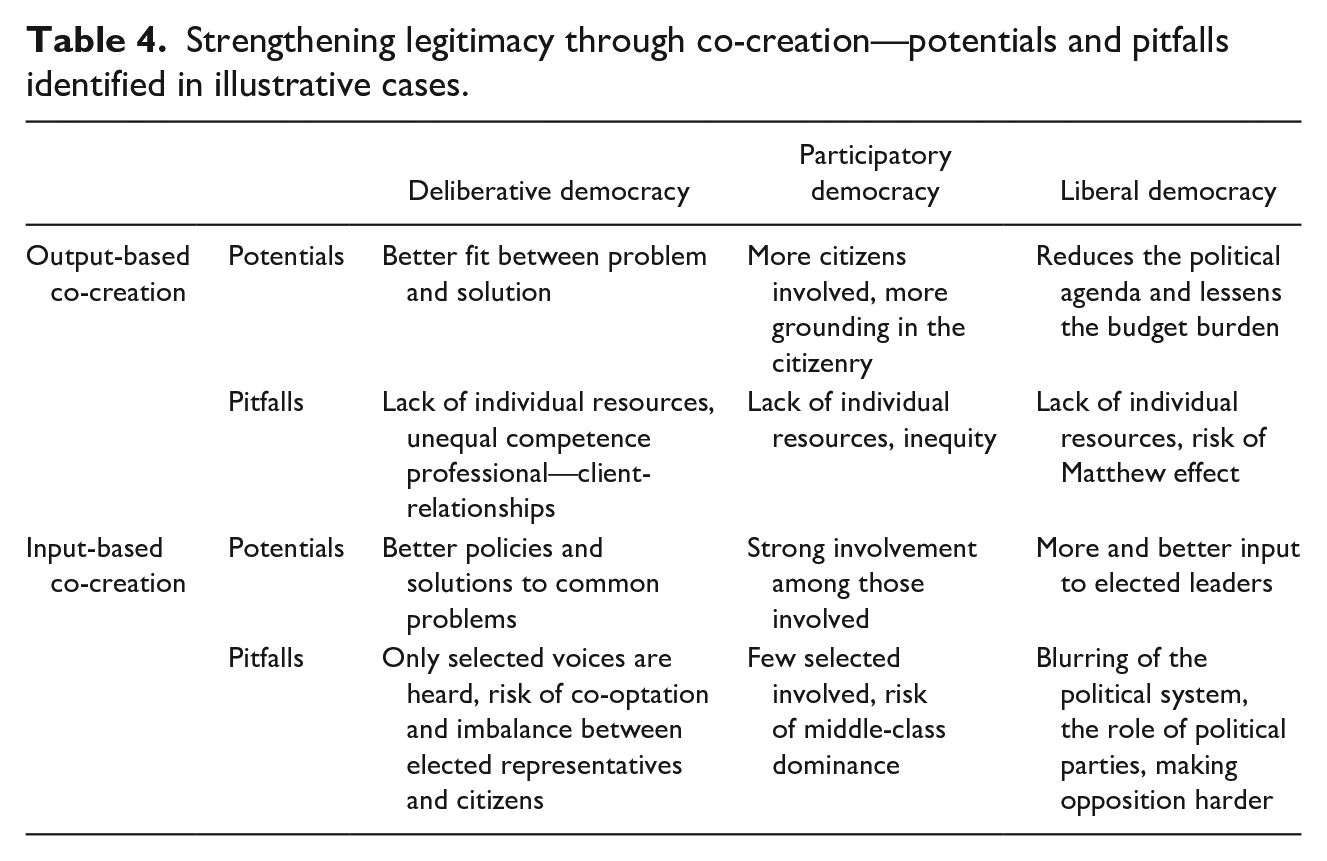
On the positive side, output-based co-creation has the potential to improve problem solving, get more citizens involved and to reduce the burden on public budgets. For example, taking a deliberative democratic ideal as the point of departure, output-based co-creation means that those most strongly affected are also those who become most involved in finding a solution. This idea is clearly reflected in the example from Steinkjer, where an arrangement has been established whereby different local resources are mobilized to deal with a local problem. In this case, we can envisage that the best of all possible solutions will rely on a unique combination of municipal and local resources and people.
From the perspective of participatory democracy, output-based co-creation will allow more citizens to be involved in public value creation, and thereby have a stronger grounding in the citizenry. Among the examples above, this is most clearly illustrated in Guldborgsund, where the goal was to involve as many as possible during the “100 days of co-creation.”
A third potential of output-based co-creation relates to liberal democracy, and the possibility of using co-creation to reduce the economic and political burden created by too many challenges and problems. Limiting political leaders’ agenda will increase legitimacy since representatives will be able to provide workable solutions to a limited set of problems, rather than having to spread too limited resources over too many problems. In both the two examples of output-based co-creation presented above, this is a clear ambition. Both Steinkjer and Guldborgsund are endeavoring to develop arrangements that can lead to problem-solving before problems reach the political table. By using this strategy, they hope to reduce the burden on municipal budgets and personnel.
The legitimacy potential of input-based co-creation relates to an improvement in policies, either by improving input to elected leaders or through more direct citizen involvement in policy processes. From the perspective of deliberative democracy, input-based co-creation enables a set of citizens to be included in discussing and developing possible solutions to common problems. In both of the above examples where input-based co-creation brought together elected politicians and citizens in temporary committees, this is the main intention. In both Gentofte and Svelvik, there is a strong belief that involving citizens and enable dialog between selected citizens and political leaders improves the quality of problem solving, and thereby increases legitimacy.
In both Gentofte and Svelvik, we also see ideas relating to participation and participatory democracy. Strong involvement by a set of citizens is seen as a value in itself. Even if the temporary committees do not involve a large number of citizens, one can imagine that, in the longer run, the more citizens who become involved, the more citizens will have ownership of the policy, which is believed to increase legitimacy.
Seen from the perspective of a liberal, representative ideal, the potential of input-based co-creation lies in improving the input to elected leaders. In both Svelvik and Gentofte, formal decisions must be taken by the elected council. We can regard the output from the committees, where elected leaders and citizens co-create, as an arrangement that ensures that the council receives better input before making its formal decisions, as compared to a situation where the input comes from the municipal administration or a committee of elected politicians.
Even if there certainly are potentials, there are also risks and pitfalls associated with co-creation. One important problem is related to the unavoidable fact that resources and competencies are unequally distributed among citizens, which is a common criticism in the literature on participatory forms of governance (Hertting & Kugelberg, 2018; Michels & Binnema, 2018; Nabatchi & Amsler, 2014).
In output-based co-creation, inequality of resources and competencies means that many citizens will not be able to play an active part in co-creation, possibly leading to a Matthew-effect whereby co-creation benefits those who are already well off, and to a widened gap between the “advantaged” and the “disadvantaged.” Especially when co-creation takes the form of a relationship between an individual professional and an individual citizen, this may be a problem. On the other hand, the above examples from Guldborgsund and Steinkjer are more about collective problem-solving in a locality or a community. In these cases, it is conceivable that the output of the co-creation will also benefit those citizens who for various reasons cannot take part in the creation of value.
A second pitfall associated with input-based co-creation concerns admission to the co-creation process. Understood as a form of deliberative democracy, input-based co-creation can hardly involve all possible citizens. A mechanism for selection must be in place, such as a lottery, self-selection, or selection carried out by others. In the two above examples of input-based co-creation, both Gentofte and Svelvik base their selection of candidates on a mixture of self-selection (citizens announce their candidacy) and selection (public leaders select members from among the candidates). The idea of this procedure is to ensure that the most important resources and voices are involved. However, on grounds of principle, one can hardly define “most important” prior to the process itself. Certainly, there is a risk of strategic selection that does not live up to the deliberative standards set out in the academic literature (Christensen et al., 2017; Elstub, 2018; Fung, 2006, p. 66).
Moreover, seen from the perspective of participatory democracy, the selection of a smaller set of citizens is a problem. Due to the search for the most important resources and voices, the risk of turning this arrangement for participation into a middle-class-arena is a valid concern.
Finally, input-based co-creation is a type of public sector-citizen interaction that breaks with established forms of participation and interaction, and with the established representative system. In many countries, not least the Nordic, political parties are the arenas through which citizens are expected to be actively involved and linked to their representatives. Even though political parties have in most cases lost their role as mass movements, there are few obvious replacements for them today. Therefore, developing policies through co-creation is a challenge for political parties, and party leaders will be less than enthusiastic about co-creation, and possibly even view input-based co-creation as a threat. In the two examples above, where the committees consist of elected politicians and selected citizens, the committees have a mandate to propose new solutions to problems and challenges. These committees are poor arenas for, for example, exercising continuous and systematic political opposition, which is an important dimension of a liberal, representative system.
Conclusion
This article has explored the relationship between co-creation and legitimacy. By distinguishing between output-based and input-based co-creation, the article has argued that how we understand legitimacy differs depending on how we conceptualize democracy. Both the potentials and pitfalls in relation to legitimacy depend on the extent to which we, by democracy, mean deliberation, participation, or representation. Two examples of both types of co-creation were used to illustrate and enrich the discussion about the potentials and pitfalls of co-creation for legitimacy.
Two problems stand out as particularly important when discussing co-creation and democratic legitimacy. The first relates to the lack of individual resources among large groups of citizens, which will prevent many from taking part in co-creation. With minor variations, this is a challenge regardless of how we choose to conceptualize democracy. At present, there is no reason to regard co-creation as a type of citizen participation that embraces all kinds of citizens. On the contrary, it can be argued that unequal opportunities and processes of exclusion and marginalization due to a lack of individual resources is a more universal problem for democracies, which also gives rise to varying opportunities among citizens in connection with classic in-house service production. In any case, this is also, at least in theory, a solvable challenge. However, we need more research on procedures and actions that can strengthen and build resources for co-creation among less advantaged citizens, which so far har largely been neglected in the literature (Reitan, 2019; Steen & Tuurnas, 2018; Verschuere et al., 2018). This is also pointing at a more practical concern. Every co-creation initiative, to become acceptable in terms of democratic legitimacy, needs to have a plan or strategy for how to include less resourceful citizens.
A second challenge is the uneasy relationship between input-based co-creation and liberal democracy. As long as representative assemblies are organized around political parties, input-based co-creation will be an alternative and competing channel for policy development that represents a different and challenging principle. Even though it can be argued that political parties have lost their role as mass movements, political parties do still exist. Political parties are strongly linked to the representative system, and they form the traditional framework for developing new ideas, political programs, and manifestos (Copus & Erlingsson, 2012; Mair, 1995). Replacing political parties with input-based co-creation is perhaps possible, but it will entail some important losses, since it is hard to imagine that systematic, long-term opposition can be maintained in a system based on input-based co-creation. Clearly this is a field where co-creation scholars need to pay more attention to political parties. For example, to what extent is it possible to renew political parties as mass movements through reforms inspired by new types of participation, including co-creation (Anheier, 2015)? Or, conversely—to what extent can co-creation replace the various roles of political parties, such as recruitment to councils, internal coordination among councilors, and political opposition (Copus & Erlingsson, 2012)?
We conclude that output-based co-creation has the capacity to strengthen legitimacy, despite problems relating to citizens’ unequal competencies and personal resources. Such problems could potentially be resolved through, for example and as mentioned, professional support. It is a more open question whether input-based co-creation can strengthen legitimacy, since, in this case, there are inherent and potentially unsolvable conflicts between co-creation and the classic representation system based on political parties.
Footnotes
Declaration of Conflicting Interests
The author(s) declared no potential conflicts of interest with respect to the research, authorship, and/or publication of this article.
Funding
The author(s) disclosed receipt of the following financial support for the research, authorship, and/or publication of this article: The author acknowledge the support of grants from the Research Council of Norway (#300761).
