




Abstract
Transparency is an intrinsic value of democratic societies. Within the literature, there is an emphasis on access to information and the availability of information in relation to transparency. This study, however, takes a communicative approach to government transparency. It focuses not only on information access and sharing but also on how information is shared and to whom it is communicated. Within government agencies, government communication officials or public affairs officers are one of the central figures in information sharing with stakeholders and citizens. Yet, so far, little is known about how they perceive and implement transparency initiatives. This study aims to enhance our understanding of proactive government transparency and the value of communication by developing a model that explains the role of government communication officials in the implementation of transparency practices. The explanatory model is tested in two democratic countries: the United States and the Netherlands. An online survey shows that government communication officials in the United States and the Netherlands can enhance but also occasionally distort transparency. Furthermore, some differences were found between the countries: Americans are more involved in the proactive disclosure of information than Dutch government communicators.
Introduction
Recent decades have witnessed important contributions to our understanding of government transparency and its effects. However, in many ways we have yet to scratch the surface (Meijer, 2012). In much of the literature on transparency, an automatic link is assumed from transparency to increased accountability or trust. Or, as was put by President Obama, “A democracy requires accountability and accountability requires transparency” (White House, 2009). However, this link is not as straightforward (Brandsma, 2012, Grimmelikhuijsen & Meijer, 2014). Unless the information that is disclosed can be followed, understood, and assessed by its audiences, it may not provide evidence for placing trust in government agencies (O’Neill, 2006). Therefore, more recently, public administration scholars have started to argue that a focus on information access or disclosure within the transparency realm is not enough (Brüggemann, 2010; Darbishire, 2010; O’Neill, 2006; Weil, Fung, Graham, & Fagotto, 2006). This focus tends to overlook the value of communication.
This study uses a communication approach to analyze transparency. It focuses not only on information access and sharing but also on how information is shared, to whom it is communicated, and whether opportunities for participation and feedback by external actors are stimulated. Transparency in this article is defined as the availability of information about an organization or actor allowing external actors to monitor the internal workings or performance of that organization (Grimmelikhuijsen, 2012).
Encouraging and facilitating effective communication practices within a government agency can be seen as the responsibility of the communication staff working at the Department of Communications or Public Affairs (Fairbanks, Plowman, & Rawlins, 2007). Government communicators are government employees or contractors at the local, state, or federal level, whose primary responsibilities are communicating internally and externally to various publics regarding agency/department office policies, decisions, and actions and/or guiding communication strategy (Liu, Horsley, & Levenshus, 2010). Requests under freedom of information laws (FOIs) may be directed through or otherwise involve a government communication official (Ēdes, 2000). However, tensions might arise between regulations that provide rights of full access to information and possible efforts to withhold information and giving it a certain “spin” (Brüggemann, 2010). Communicators could therefore, facilitate or hinder transparency efforts. Yet, so far few studies have specifically focused on government communication officials and their involvement in transparency efforts.
In this study, the role of government communicators in two countries will be analyzed: the United States and the Netherlands as part of the European Union. The countries are similar in that they are both early adopters of FOIs and they both have a long transparency tradition. At the same time, they are different in terms of their transparency regime (Ruijer & Meijer, forthcoming). The research question in this study is as follows:
This study aims to contribute to the public administration literature by enhancing our understanding of transparency in general and the role of communication officials in the implementation of transparency initiatives in particular, for example, the proactive release of documents to the press, proactively placing documents on the agency’s website, or making information available proactively via traditional media channels or social media. An explanatory model will be developed that could be relevant for other democratic countries developing transparency initiatives. Furthermore, this study is relevant for government agencies that would like to efficiently implement transparency policies to enhance accountability.
This article is structured as follows. First, based on both the public administration and communication literature, the relation between government communication and transparency will be explored, resulting in a model. Following, the model will be tested empirically in two countries, thereby allowing a comparison between the two groups. Finally, conclusions will be drawn.
Proactive Transparency and Communication
To better able to understand the role of government communicators in the implementation of transparency initiatives, this section will start by exploring the relation between transparency and communication. According to Brüggemann (2010), transparency rules and communication activities should be viewed as both belonging to information policy. Communication activities can be analyzed “as being part of the implementation of a policy governing all activities related to the exchange of all sorts of information, facts as well as opinions, between a public body and its environment” (Brüggemann, 2010, p. 7). Transparency rules, however, “define the right of the citizens to access all sorts of sources and not only the purposefully prepared messages of PR agents” (Brüggemann, 2010, p. 7). FOIs are often called the backbone of transparency (Grimmelikhuijsen, 2012). Increasingly these laws not only focus on reactive or passive release but also on proactive disclosure (Darbishire, 2010). Proactive disclosure refers to information that is made public at the initiative of a government body, without a request being filed (Darbishire, 2010; Wopereis, 1996). Examples of proactive release are press releases or posting documents online (Piotrowski & Van Ryzin, 2007).
In the literature, both strengths and weakness of the proactive disclosure of information can be found. Darbishire (2010) argues that proactive disclosure ensures that the public is informed about the laws and decisions that affect them. It facilitates more accountable spending of public funds and promotes integrity in government (Darbishire, 2010). At the same time, scholars warn for an information overload: “Information overload corrupts wisdom and knowledge and descends to spin and spam. Most dramatically openness involving too much access to information could endanger public and national security” (Birkenshaw, 2006, p. 51). Furthermore, with proactive disclosure, governments decide on the way in which information is collected, processed, and published (Van den Burg, 2004). In its extreme form it could lead to propaganda, thereby ignoring the generally accepted norms of communication such as truthfulness and a minimum of respect toward diverging opinions (Brüggemann, 2010). The opposite of transparency is considered secrecy (Balkin, 1999). Secrecy refers to intentional concealment and denotes the methods used to conceal, such as codes or disguises (Bok, 1982). According to Balkin (1999) “governments and politicians can manipulate the presentation and revelation of information to achieve the same basic goals as a policy of secrecy and obfuscation” (p. 394). They can withhold important information, give partial information, or distort information (Rawlins, 2009). Therefore, it is important to analyze how information is released by government organizations.
Within a government agency, the communications/public affairs department spends significant amount of time and resources to improve communication between the organization and stakeholder publics (Kim, Park, & Wertz, 2010). It is the task of communications not only to provide information to stakeholders but also to protect the organizational privacy to ensure control about what information circulates about the organization. Tensions might arise between regulations regarding the access of information and possible efforts to withhold information (Brüggemann, 2010). Heise (1985) proposes in his prescriptive public communication model that government communication officials should make available publicly all legally releasable information whether positive or negative in nature in a manner that is accurate, timely, balanced, and unequivocal. Officials would seek to facilitate accurate, systematic, and timely feedback on public policy issues from the entire community that they serve. In this line, Rawlins (2009) argues, “organizations that strive to be transparent are willing to be held accountable to their publics, and respect their publics’ autonomy and ability to reason enough to share pertinent information” (p. 78). Rawlins developed a quantitative measurement tool that allows stakeholders to evaluate transparency of an organization. He focuses on transparency efforts that could fall under the control of communication officials, thereby giving them direct contributions to the organization’s reputation. It simplifies the complex construct of transparency into the communication efforts: participation, substantial information, accountability, and secrecy.
Until recently, within the field of public administration, communication had no major part within contemporary public administration pedagogy, even though communication is integral to the conduct of public administration (Lee, 2008). The focus within the field is on the relation between government agencies and the media (Fredriksson, Thomas, & Pallas, 2015; Liu, Horsley, & Yang, 2012; Mulgan, 2014), and less on the role of individual government communication officials in specific transparency activities. Yet, Fredriksson et al. (2015) conclude in their study regarding the mediatization of government agencies that next to agency structures, individuals matter. Furthermore, within the field of communication, “there is minimal theory-driven research in this vital field, as the prevailing research has not explored government communication on its own merit but instead has studied government within the scope of corporate communication theory and practice” (Horsley, Liu, & Levenshus, 2010, p. 269), whereas public relations models do not adequately fit the unique attributes of the public sector (Liu et al., 2010). Liu et al. (2010) distinguish in their model “the government communication decision wheel” specific environmental attributes that affect which channels and dissemination strategies government communicators select, such as federalism, legal framework, politics, and resources. The model does not specifically focus on transparency. However, the authors do find that because of legal frameworks such as the Freedom of Information Act (FOIA), government is often not able to communicate fully and openly. Due to time and financial constraints, government communicators often do not release all information proactively but in fact wait for the media and public to request specific information.
An exploratory qualitative study by Fairbanks et al. (2007) focuses on how government communicators value transparency and on the organization in which they operate. Their study resulted in a “three-dimensional model of transparency in government communication.” In this model, the commitment to transparent communication is influenced by three key elements: communication practices, organizational support, and the provision of resources. They find that personal convictions influence transparency. Furthermore, to achieve transparency, government communicators must adopt practices that promote open information sharing. These include working to enhance agency relationships with the public and working with managers to create an organization that supports transparency. This can be achieved by providing communicators a seat at the management table and improving internal organizational communication. Finally, communicators must have the time, staff, and money needed to communicate in transparent ways. By contrast, Hawes (2010) who builds on Fairbanks model does not find that personal convictions impact overall transparency of city government communicators but that organizational support does.
In sum, in the literature we find some evidence that several factors impact the implementation of transparency practices e.g. the way individual government communicators value transparency, the support they receive from the organization in which they operate, and FOIs. However, the evidence is not unequivocal. Furthermore, the models described above were developed and tested in the United States. In this study, a new model will be developed and it will be tested among government communicators in two countries: the United States and the Netherlands. The two cases are similar (A. L. George & Bennett, 2005) in that they have been frontrunners in the transparency movement and both have a long transparency tradition (Ruijer & Meijer, forthcoming). Building on the work by Ruijer & Meijer (forthcoming), the two countries are, however, different in their transparency regime. The United States can be characterized as having a rules-based transparency regime, whereas the Netherlands has a principles-based regime (Ruijer & Meijer, forthcoming). A rules-based approach is more explicit, detailed, and prescriptive. It tends to focus on detection, and on compliance (Arjoon, 2006; Burgemeestre, Hulstijn, & Tan, 2009). A principles-based approach is more implicit and emphasizes “doing the right thing” (Arjoon, 2006). By focusing on two countries, it will be possible to not only examine possible similarities but also detect differences between the two groups that might be in line with the principles- and rules-based distinction.
Toward a Model
As outlined above, Liu et al. (2010) find that legal frameworks such as FOIA influence government communication practice. In this study, it will be further explored whether knowledge of these rules influences the way communicators value proactive transparency. Value refers to personal values or attitude of government communicators toward transparency for organizational transparency (Fairbanks et al., 2007). This leads to the following hypothesis:
Second, the three-dimensional model of government communication (Fairbanks et al., 2007) shows that organizational factors and resources impact the degree to which organizations are transparent and how government communicators release information to stakeholders. Fairbanks et al. (2007) specifically focus on the impact of managers who set the tone on how an agency operates. Furthermore, there is the agency communication structure, for example, whether an agency does a poor or good job on making the information available to communicators, otherwise they cannot release the information to external audiences. Finally, it is analyzed whether there is political support for proactive transparency (Fairbanks et al., 2007). Hence, the following hypothesis can be formulated:
Third, the way communicators value transparency impacts their involvement, their individual efforts in their daily practice of actually getting information out to the public (Fairbanks et al., 2007). This leads to the following hypothesis:
Fourth, as pointed out above, transparency could benefit from a two-way flow of information (Heise, 1985). Government communicators can encourage the solicitation of participation and feedback from stakeholders. It is argued that just giving information does not necessarily constitute transparency; information needs to be understood as well. This is where the communication field can help by using substantial and accountable information (Rawlins, 2009), and by making sure the information reaches audiences. However, government communicators can also hinder transparency by using spinning techniques such as leaving out important details or distorting information (Rawlins, 2009). The expectation is that government communicators who value transparency might use more substantial and accountable information, will solicit more feedback and participation, and will be less inclined to use spinning techniques. This results in the following hypotheses:
Based upon the literature and hypotheses, an explanatory model (Figure 1) can be constructed that enhances our understanding of the role of government communicators.
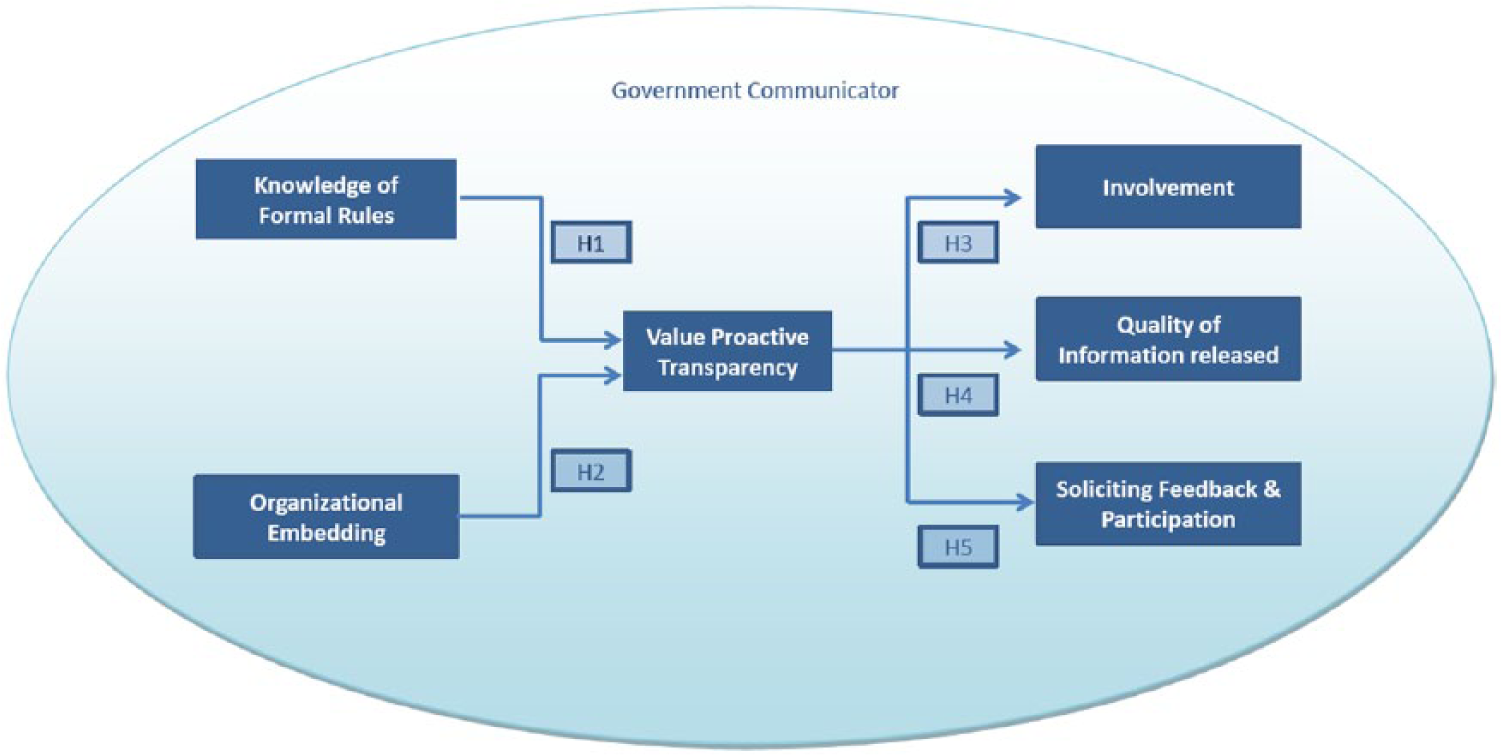
The role of government communicators in the implementation of transparency initiatives.
Research Design and Method
A web-based survey with a cross-sectional design was used for testing the model. This design is often identified with survey research focused on describing the pattern of relation between variables, but causal relationships cannot be determined (Frankfort-Nachmias & Nachmias, 2008). The variables will be discussed below.
Independent Variables
The independent variable knowledge of formal rules in the model consists of rules regarding proactive transparency as laid down in the US FOIA or Open Government initiatives and the Dutch Public Access Act (Wet openbaarheid van bestuur, Wob). Because the formal rules are country specific, the survey questions are slightly different for the two countries. Even though the Netherlands is part of the Global Open Government partnership, no questions were asked regarding Open Government because the project was in a very early stage at the time of the research. The specific items can be found in Appendix A.
The concept organizational embedding consists of two independent variables: “organizational support” and “resources.” The variables are measured using the items that were used and validated by Hawes (2010), who builds on the three-dimensional model of Fairbanks et al. (2007). For organizational support, the items based on a Likert-type scale include the impact of managers on transparency within an organization, formal and informal rules regarding proactive transparency within the agency and agency communication structure and political support. For resources, the items include budget and staff for proactive transparency initiatives (Appendix A).
Dependent Variables
Fairbanks et al. (2007) describe the value of transparency as the belief in transparency. The concept “value” consists of two variables “value generic” and “value specific” referring to evaluative statements regarding proactive transparency. The generic statements on proactive transparency were based on statements made by Darbishire (2010). She describes in her research that proactive disclosure ensures that members of the public are informed about the laws and decisions that affect them and facilitates more accountable spending. Moreover, the dissemination by public bodies of information about how they function helps the public access government services and ensures that the public has the information needed to participate. The specific evaluative statements regarding proactive transparency refer to how important it is to release information regarding the internal workings of the organization: decision process, policy implementation and policy outcome, and budget and subsidies as adapted from Grimmelikhuijsen (2012; Appendix A). Finally, it should be noted that the two variables associated with “value proactive transparency” are both dependent and independent variables in the model.
The concept involvement consists of two variables: “reported proactive disclosure” and “involvement internal workings.” Reported proactive disclosure is measured by the extent to which government communicators consider proactively disclosing information to be part of their daily practice, and whether they help others in the organization with the proactive release of information (Hawes, 2010). In addition, it was measured to what extent government communicators are actually involved in releasing information about the internal workings and performance of the government. The internal workings and performance concern the different policy stages and budget (Darbishire, 2010; Grimmelikhuijsen, 2012).
The concepts “quality of information” and “soliciting feedback and participation” are based on the four transparency efforts distinguished by Rawlins (2009), the variables substantial information, accountable information, spin, and participation. Substantial information is information that is complete, relevant, understandable, timely, and accurate (Rawlins, 2009). Accountable information refers to providing balanced information, admitting mistakes, being forthcoming with information, and being open for criticism (Rawlins, 2009). As pointed out, communication professionals can also constrain transparency and in fact add to secrecy by hiding information or delaying its release (Coombs & Holladay, 2007). Instead of the term secrecy, in this study the term spin is used. In this study, spin focuses on “withholding important information, giving partial information or distorting information” (Rawlins, 2009, p. 78). In addition, the term “highlighting information” is used, emphasizing the positive elements or emphasizing some elements more than others. Finally, in this article transparency is seen as a two-way process. Outside actors or participants should be able to voice their opinion. The variable participation measures whether government communicators facilitate the two-way process. It was asked whether respondents ask for feedback from stakeholders about the quality of the information provided, whether they stimulate that opinions are asked before decisions are made, and whether suggestions are incorporated into policy and action (Rawlins, 2009).
Data Collection
The survey was developed in English and Dutch and adapted from Rawlins’s (2009) transparency tool, Hawes’s (2010) instrument, and Fairbanks et al. (2007) three-dimensional transparency model. A draft of the web-based survey was reviewed and pretested by 15 academic and field experts in both the Netherlands and the United States. A modified version of Dillman’s (2007) tailored design method was used for the dissemination of the web-based survey (Liu et al., 2010). First, an email was sent with a brief pre-notice letter, followed by an email with a detailed cover letter and link to the online survey. 1
The population consisted of government communicator officials, working at the communications department or public affairs department at the federal level in the United States and the central level in the Netherlands. To obtain a sampling frame, the Online Leadership Directories of the Federal Government 2 was used in November 2012 to identify communication officials from federal agencies. When using the term “communications,” the book identified 2,258 people working in the field of communications. However, upon closer examination not all participants qualified according to the definition of a government communicator. Moreover, when the pre-notice email without the link to the survey was sent out, it became clear that some email addresses were incorrect. The database was, therefore, randomly checked for accuracy by comparing the names in the database with the government communication officials mentioned on agency’s websites. Eventually this led to a database of 1,393 people. All these government communication officials received an email with a link to the survey. One hundred sixty-nine people ultimately responded, a response rate of 12%. 3 One reason for the low response rate could be the quality of the database. A meta-analysis by Shih and Fan (2009) consisting of a quantitative comparison of mail and web survey response rates showed that the response rate in this study is low but not uncommonly low compared with other studies. This may affect the external validity of the study. However, it should be kept in mind that this study foremost has an explanatory character.
In the Netherlands, no such database exists. Therefore, a database with central government communicators was created by looking up government communicators on the ministry’s website. However, the government communicators mentioned on websites turned out to be mainly press officers. To get a broad range of government communicators, the individual ministries were approached as well with the question whether they would like to participate. All but one ministry was willing to participate. The final database consisted of 169 government communicators. In addition, the Academia of Federal Government Communicators was approached. The Academia generously announced the survey in their monthly newsletter twice. Furthermore, eventually 68 people responded, a response rate of 37%. The higher response rate in the Netherlands compared with the United States’ response rate could be due to the fact that a more targeted database was created and the endorsement by the Academia. The number of respondents in the Netherlands is one third the number in the United States. However, by looking at the estimated total number of officials in each country, the percentage of respondents is about the same. 4 In both countries, the survey was online for 2.5 months from January until March 2013 and four reminders were sent out.
Data Analysis
To test how American and Dutch governments perceive proactive transparency and how their perception influences the way they implement proactive transparency in their daily practice, four analyses were carried out. First, descriptive statistics were conducted (D. George & Mallery, 2009). 5 Second, independent samples t tests were conducted based on the survey items to analyze possible differences between the countries. Third, to analyze whether the indicators were indeed dimensions of the concepts as defined in the model, an exploratory factor analysis (Tabachnick & Fidell, 2007) 6 was conducted in SPSS using principal components analysis with Varimax rotation. 7 The total database of both Dutch and American respondents equals 194 respondents. 8 The eigenvalue 9 for extraction was set at greater than 1, meaning that only those factors will be retained. In addition, only the items were retained if the item loadings exceeded .44 for at least one factor; second, there needed to be a minimum of difference of .1 between items in factor loadings (Rawlins, 2009).
Following these, newly computed variables were used in the last step of the data analysis: a MANCOVA was conducted in SPSS. MANCOVA is the most suited analysis in this study. MANCOVA investigates group differences among several dependent variables while also controlling for covariate(s) that may influence the dependent variables (Mertler & Vannatta, 2002). Moreover, the variables in the model concern an emergent variable system: meaning that the variable construct is the resultant composition of the outcome. This, according to Cole, Maxwell, Arvey, and Salas (1993), would make MANCOVA the preferable option compared with, for example, structural equation modeling. A limitation of using multivariate statistics, however, is that, it further decreases the sample size, which may cause the survey results to have lower power in detecting significant differences (Tabachnick & Fidell, 2007). The data were checked for multicollinearity: The dependent variables in the model are conceptually related and the pattern of correlations between the different variables showed correlations within the moderate range.
Study Findings
Respondents’ Demographics
Respondents who filled out the survey are communication directors, public affairs officers, and press officers. They interact mostly with the general public, the media, not-for-profit organizations, and private sector organizations. They make information proactively available on the agency’s website, to the press, via social media, and through public information campaigns. They are also involved in writing communication strategies to make information available proactively and in the release of high value data sets (open data). American respondents indicate more often to be involved with the release of open data sets (38%) than Dutch communicators (14%). American respondents are mostly bureaucrats (95%) and only a few of them were political appointees (5%; Table 1). In the Netherlands, this question was not asked because federal agencies do not have political appointees. In the United States, 49% worked at an agency’s headquarters, 28% at an agency, and 18% at an independent agency. In the Netherlands, most respondents, 82%, worked at a ministry and 16% at an agency. On average, American respondents have worked for their current agency for 12 years and Dutch respondents for 8.6 years. Eighty-five percent of the American respondents are older than 40 and 74% of the Dutch are older than 40.
Descriptives.
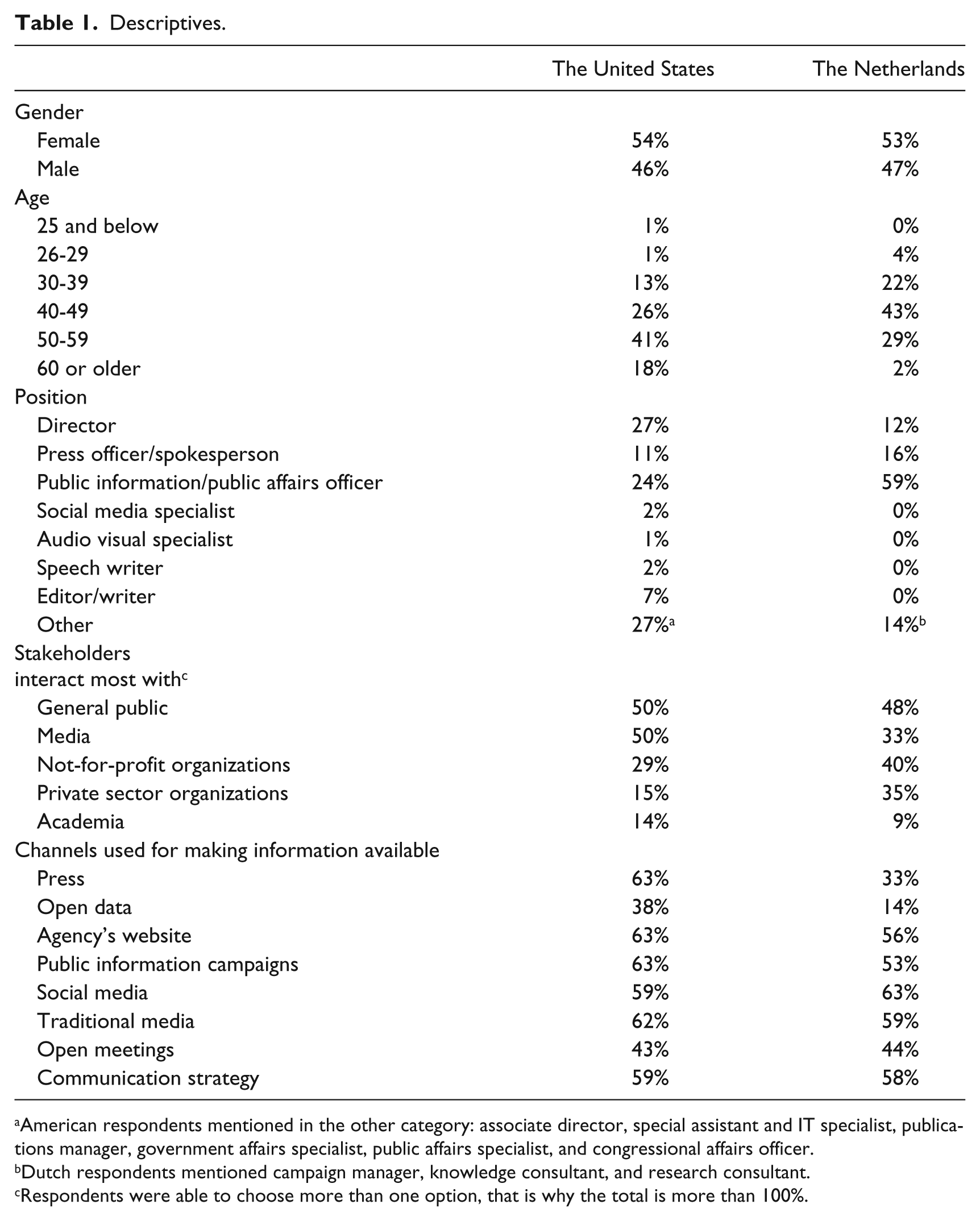
American respondents mentioned in the other category: associate director, special assistant and IT specialist, publications manager, government affairs specialist, public affairs specialist, and congressional affairs officer.
Dutch respondents mentioned campaign manager, knowledge consultant, and research consultant.
Respondents were able to choose more than one option, that is why the total is more than 100%.
Comparing Groups With Descriptive Statistics and t Tests
Dependent variables
Before testing the model, the responses were examined related to the different variables and possible differences between the American and Dutch communicators were analyzed.
Knowledge
The knowledge communicators have of the formal rules differed significantly. An independent samples t test showed that Americans score statistically significantly higher (M = 1.9124, SD = 0.87845) on their knowledge of formal rules than do Dutch government communicators (M = 1.12281, SD = 1.14981), t(84.45) = 4.013, p = .000.
Organizational embedding
Government communicators help others in their government agency understand the importance of proactive transparency and are invited by their management to join in activities regarding proactive transparency (Appendix A). The independent samples t tests showed that American respondents (M = 4.0620, SD = 1.11) statistically significantly agree more with the item that the agency’s management invites their work unit to join in initiatives regarding making information available proactively to the public than Dutch respondents (M = 3.5319, SD = 1.21317), t(174) = 2.654, p = .009. Dutch government communicators agree statistically significantly more strongly (M = 3.3182, SD = 1.09487) that there is enough budget for making information available proactively than American government communicators (M = 2.7970, SD = 1.30709), t(175) = −2.382, p = .018. They also agree more (M = 3.5849, t = 1.13398) that there is enough staff compared with Americans (M = 3.0373, SD = 1.35117), t(112.880) = −2.813, p = .006.
Independent variables
Value
Most government communicators in the two countries value and underline the importance of proactive transparency. The independent samples t test showed that American government communicators (M = 3.8797, SD = 1.06627) agreed statistically significantly, t(186) = 2.022, p = .045, more than Dutch government communicators (M = 3.5273, SD = 1.13618) with the statement that making information available proactively facilitates more accountable spending of public funds.
Involvement
The independent samples t test showed significant statistical differences on almost all items. Americans agree more (M = 4.39, SD = 0.881) to the statement that making information available proactively is part of their daily practice than Dutch government communicators (M = 3.57, SD = 1.312), t(82.81) = 4.044, p = .000. American government communicators also agree more (M = 4.3881, SD = 0.84880) that they help others within the organization understand the importance of proactive transparency than Dutch government communicators (M = 3.6667, SD = 1.31752), t(71.416) = 3.724, p = .000, and agreed more (M = 2.7463, SD = 1.30174) to being regularly involved in FOIA requests than Dutch government communicators (M = 2.1064, SD = 1.41781), t(179) = 2.833, p = .005. Furthermore, the test also showed that Americans contribute significantly more often to making information available proactively regarding decision-making process, implementation, evaluation, and budget than Dutch government communicators.
Quality of the information
The majority of the government communicators indicated to provide substantial information: that is accurate, relevant, complete, and easy-to-find information. Some empirical support was also found for the claims in the literature that communication can hinder transparency. The majority in both countries indicated to sometimes specifically highlight the positive elements in the information provided (Americans 81.4% and Dutch 64.2%) and to highlight certain elements more than others (framing, Americans 71.2% and Dutch 76.9%). In addition, even though the majority of the respondents indicated to (strongly) disagree with techniques to hinder transparency, such as leaving out important details, or providing a lot of information to conceal controversial issues, a few respondents indicated that this does happen. The independent samples t tests showed some significant differences between the countries. American government communicators (M = 4.6429, SD = 0.52861) agree significantly, t(171) = 5.015, p = .000, more than Dutch government communicators (M = 4.1569, SD = 1.15723) with the statement that their unit provides information that is accurate and with the statement that their unit provides information that is complete (United States: M = 4.333, SD = 0.82946; the Netherlands: M = 3.5962, SD = 0.70349), t(78.382) = 4.505, p = .000. American government communicators statistically significantly, t(164) = 4.852, p = .000, agree more (M = 3.6750, SD = 1.02213) that their unit is forthcoming with providing information even if it is damaging to the organization than Dutch participants (M = 2.8043, SD = 1.06707). Yet at the same time, Americans statistically significantly, t(81.693) = 2.721, p = .008, agreed more (M = 4.1138, SD = 0.82946) with the statement that their work unit sometimes specifically highlights the positive elements in the information provided than Dutch government communicators (M = 3.6471, SD = 1.07375).
Feedback and participation
Government communicators indicated that participation by stakeholders is solicited by, for example, stimulating that opinions of stakeholders are asked before decisions are made by the agency. No significant differences were found between the countries.
Model Testing
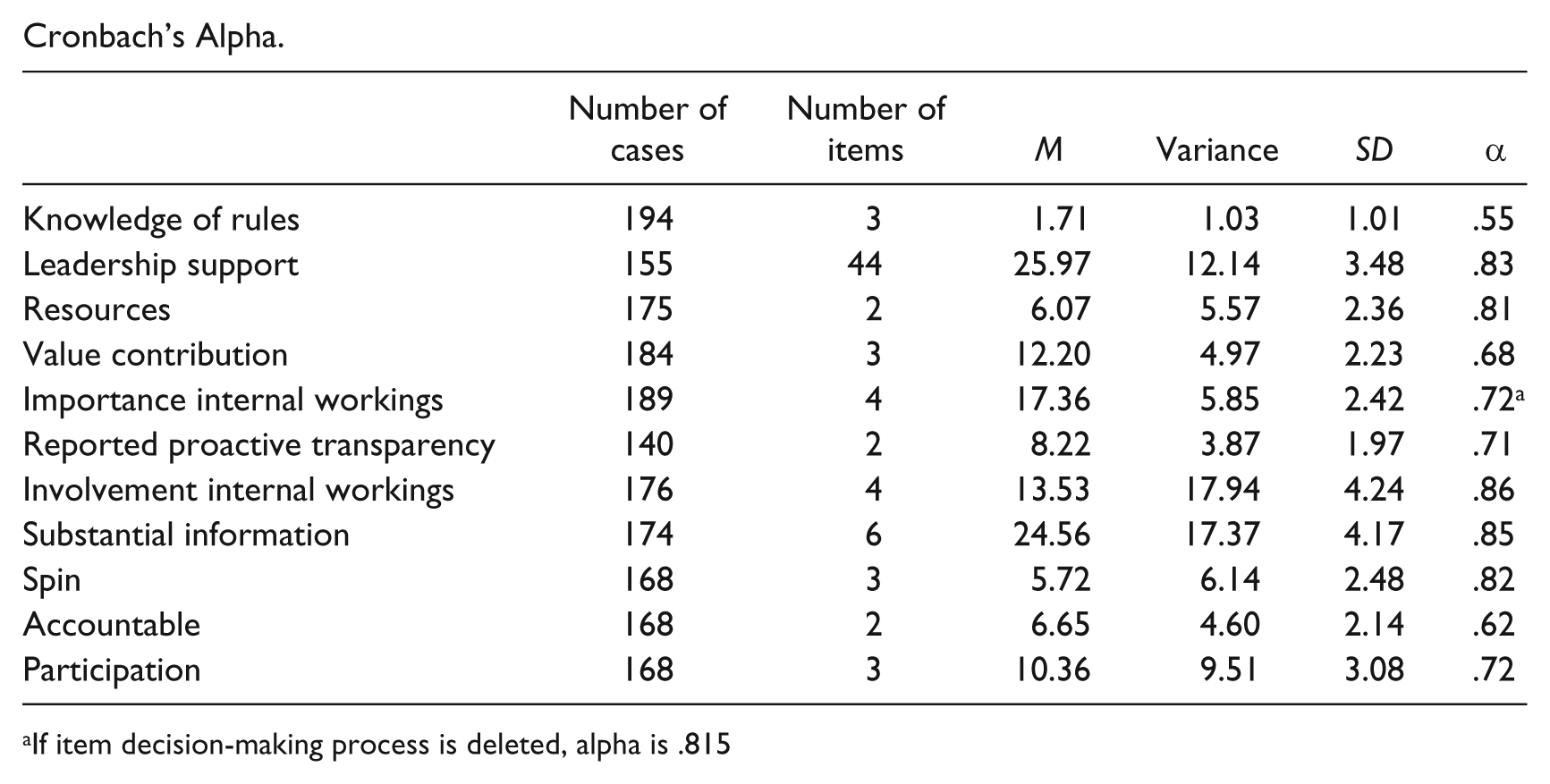
A principal components analysis was conducted that resulted in item reduction and new variables were created. Cronbach’s alpha of the newly created variables can be found in Appendix B. 10 The newly created variables served as input for MANCOVA.
Additional Explanations
Finally, additional MANCOVA analyses were conducted to examine other possible significant effects in the model. First of all, analyses were conducted with background (gender and age) and institutional variables (type of agency and type of function) statistics. No effects were found for the background statistics, except for age (Wilks’s lambda = .854, df = 8, p = .047) the MANCOVA analyses found a significant effect in relation to Hypothesis 3, regarding the way government communicators value proactive transparency and the implementation of transparency activities. Regarding the institutional variables, no statistical effects were found except for type of agency (Wilks’s lambda = .927, df = 2, p = .024) and type of job (Wilks’s lambda = .702, df = 16, p = .004) in relation to Hypothesis 3. No significant interaction effects were found between these variables and country, except for age and country in relation to Hypothesis 3.
Following, the concept “value” was left out of the model and it was examined whether “knowledge” has a direct effect on “involvement,” “the quality of information,” or “feedback and participation,” but no effects were found, except for “knowledge” and “involvement” (p = .034). Last, it was analyzed whether organizational embedding had a direct effect on these variables. Remarkably, the overall model showed a significant effect for “country” (Wilks’s lambda = .752, df = 6, p = .001), “organizational support” (Wilks’s lambda = .572, df = 6, p = .000) and “resources” (Wilks’s lambda = .856, df = 6, p = .045) with Box’s M value being 29.86 and non-significant (p = .179). The between-subjects test shows that in line with earlier results of the independent samples t test, there is a significant difference (Table 2 in bold) for “country” and “involvement,” “accountable,” and “substantial information,” with Americans scoring higher, on these variables. The between-subjects test also showed that there is a significant difference for “resources” and “reported proactive disclosure.” Furthermore, the parameters indicated a positive effect for “organizational support” and “reported proactive transparency,” “involvement,” “substantial,” “accountability,” “feedback and participation,” and a negative relationship for spin (Table 2).
Revised Model.
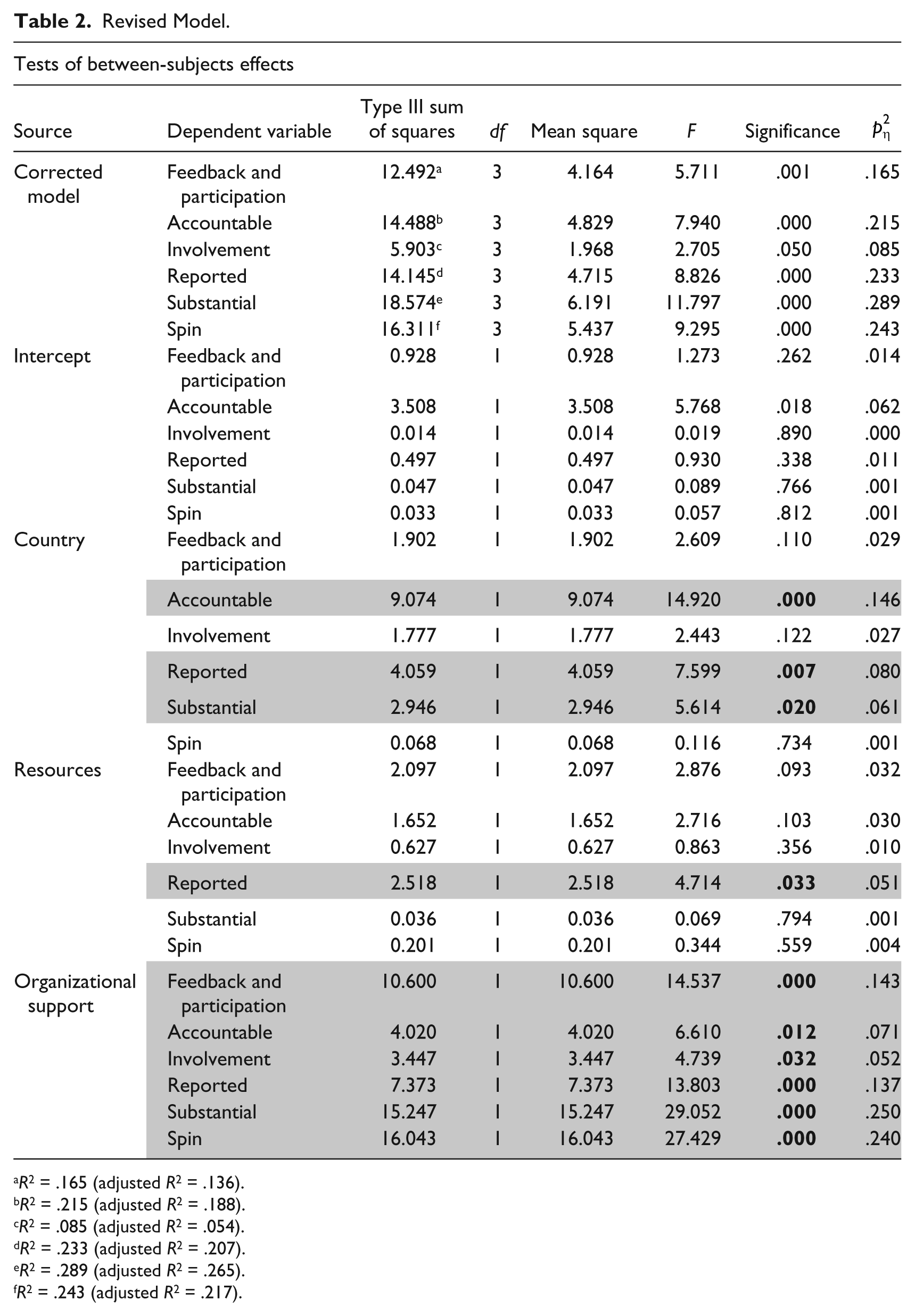
R2 = .165 (adjusted R2 = .136).
R2 = .215 (adjusted R2 = .188).
R2 = .085 (adjusted R2 = .054).
R2 = .233 (adjusted R2 = .207).
R2 = .289 (adjusted R2 = .265).
R2 = .243 (adjusted R2 = .217).
Figure 2 shows the significant relationships found in the explanatory model.
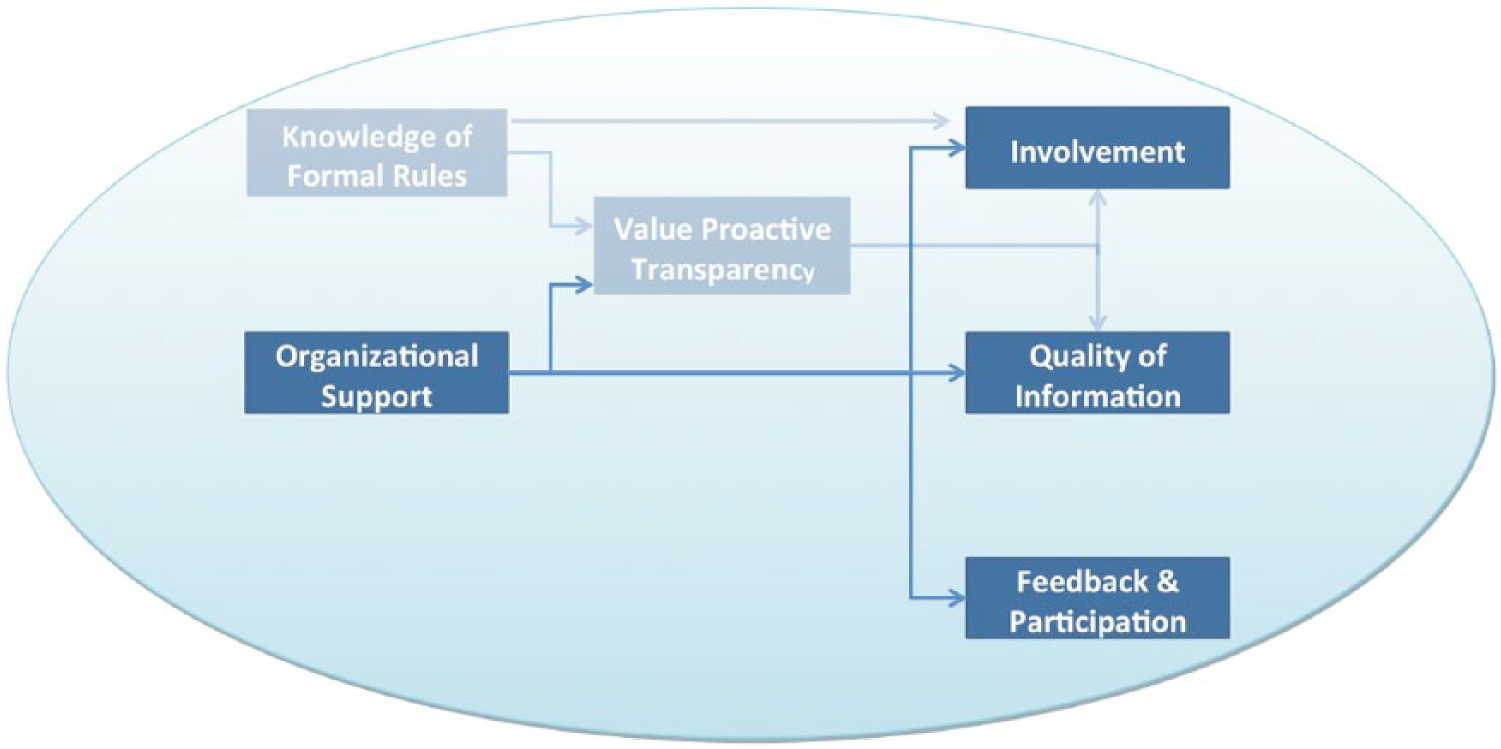
Revised model: The role of government communicators in the implementation of transparency initiatives.
Conclusion and Discussion
This study took a communication approach to transparency. It contributed to the public administration literature by showing that when studying government transparency, the role of government communicators should not be ignored. The study relied on the government communicators’ view on proactive transparency. This method is an efficient way to ascertain respondents’ attitudes and values. Even so, the respondents might have answered in a socially desirable way and, therefore, more sensitive issues such as the use of spinning techniques might be higher than reported. Furthermore, the response rate and use of multivariate statistics may have caused the survey results to have low power in detecting significant differences. A larger sample would have enhanced the external validity of this study. However, this study had a foremost explanatory nature. Despite these limitations, some important conclusions can be drawn based on the findings.
First of all, regarding the research question, the findings showed that government communicators who perceive proactively transparency as more important are also more involved in disclosing information regarding the internal workings of the agency. They are more likely to release substantial and accountable information in their daily practice. Furthermore, government communicators are enhancing transparency by making information more understandable, relevant, and findable for stakeholders. They stimulate that opinions of stakeholders are asked before decisions are made by the agency. At the same time, some empirical support was also found of communicators withholding information or giving only part of the story. Specifically highlighting positive elements or highlighting certain elements (framing) more than others appeared to be common practice. In general, there is inevitable tension between transparency and secrecy (Bok, 1982). And, whether these found practices can be considered ethical or have the potential of propaganda, political communication along partisan lines, or secrecy, requires further in-depth analysis. As Weaver, Motion, and Roper (2006) point out this issue will have to
be assessed in relation to the context in which it is practiced, the ends to which it is used, the quality of transparency in terms of the persuader’s openness about the “ends” they are seeking to achieve, and, as far as one is able to judge, the consequences of those ends. (p. 13)
Second, this study adds to Fairbanks’s et al. (2007) three-dimensional model that even though the perceptions of communication officials are indeed important, organizational support seems to be the stronger predictor. In organizations supportive of proactive transparency, government communicators will provide more substantial and accountable information and are less likely to use spin techniques. Government communicators working in these agencies are also more likely to solicit feedback and participation from stakeholders. In addition, the findings showed that communicators who value proactive transparency working within agencies, are more likely to proactively disclose information in their daily practice than communicators working at government headquarters. This might be due to the difference in tasks of the type of organization. Thus, organizations matter. An organization that supports proactive transparency helps in reaping the benefits but also in managing the possible harms of communication.
Last, the model was tested in two countries to strengthen the model. The United States and the Netherlands both have a long transparency tradition but their transparency regime differs (Ruijer & Meijer, forthcoming). The survey showed that Americans knew more about the proactive transparency rules and provided more substantial and accountable information, which is in line with a rules-based transparency regime. Furthermore, Americans are more involved in proactive disclosure and internal workings than Dutch government communicators. A possible explanation for this difference might be the push for Open Government by the Obama administration. In addition, American respondents more often indicated that they do not have enough budget and staff to make information available proactively. This is in line with Liu et al. (2010) and Cooper’s findings. Cooper (2011) argues that the capacity crisis in the federal U.S. government has been looming for decades. He points out that the capacity deficit affects the ability to govern. It is therefore important to point out that proactive transparency activities, facilitated by new technologies, requires ongoing support and new demands and responsibilities from the staff (Cooper, 2011).
The explanatory model developed in this study enhanced our understanding of the role of government communication officers in an organizational context, regarding the implementation of transparency initiatives. The model was tested in two countries and could be useful for other countries participating in the Open Government Partnership or implementing transparency initiatives.
Footnotes
Appendix A
Appendix B
Cronbach’s Alpha.
| Number of cases | Number of items | M | Variance | SD | α | |
|---|---|---|---|---|---|---|
| Knowledge of rules | 194 | 3 | 1.71 | 1.03 | 1.01 | .55 |
| Leadership support | 155 | 44 | 25.97 | 12.14 | 3.48 | .83 |
| Resources | 175 | 2 | 6.07 | 5.57 | 2.36 | .81 |
| Value contribution | 184 | 3 | 12.20 | 4.97 | 2.23 | .68 |
| Importance internal workings | 189 | 4 | 17.36 | 5.85 | 2.42 | .72 a |
| Reported proactive transparency | 140 | 2 | 8.22 | 3.87 | 1.97 | .71 |
| Involvement internal workings | 176 | 4 | 13.53 | 17.94 | 4.24 | .86 |
| Substantial information | 174 | 6 | 24.56 | 17.37 | 4.17 | .85 |
| Spin | 168 | 3 | 5.72 | 6.14 | 2.48 | .82 |
| Accountable | 168 | 2 | 6.65 | 4.60 | 2.14 | .62 |
| Participation | 168 | 3 | 10.36 | 9.51 | 3.08 | .72 |
If item decision-making process is deleted, alpha is .815
Acknowledgements
The author would like to thank Stephan Grimmelikhuijsen, Albert Meijer, and Jason Arnold for their valuable comments. Statistical help was received from Virginia Commonwealth University Statistical Consulting Services.
Declaration of Conflicting Interests
The author(s) declared no potential conflicts of interest with respect to the research, authorship, and/or publication of this article.
Funding
The author(s) received no financial support for the research, authorship, and/or publication of this article.