




Abstract
Background
Intensive care unit (ICU) hospitalizations of very old patients with acute respiratory infection have risen. The decision-making process for ICU admission is multifaceted, and the prediction of long-term survival outcome is an important component. We hypothesized that data-driven algorithms could build long-term prediction by examining massive real-life data. Our objective was to assess machine learning (ML) algorithms to predict the 1-y survival of very old patients with severe respiratory infections.
Methods
A national 2011–2020 study of ICU patients ≥80 y with respiratory infection was carried out, using French hospital discharge databases. Data for the training cohort were collected from 2013 to 2016 to build the models, and the data of patients extracted in 2017 were used for external validation. Our proposed models were developed using random forest, logistic regression (LR), and XGBoost. The optimal model was selected based on its accuracy, sensitivity, specificity, Matthews coefficient correlation (MCC), receiver-operating characteristic curve (AUROC), and decision curve analysis (DCA). The local interpretable model-agnostic explanation (LIME) algorithm was used to analyze the contribution of individual features.
Results
A total of 24,270 very old patients were hospitalized in the ICU for respiratory infection (2013–2017) with a known vital status at 1 y. The 1-y survival rate was 41.3% (median survival: 3 mo [2.7–3.3]). Of the 3 ML models tested, LR exhibited promising performance with an accuracy, sensitivity, specificity, MCC, and AUROC (95% confidence interval) of 0.65, 0.76, 0.60, 0.27, and 0.70 (0.69–0.72), respectively. LR achieved an AUROC of 0.70 (0.68–0.71) in external validation by temporal splitting. LR demonstrated higher net benefits across a range of threshold probability values in DCA. The LIME algorithm identified the 10 most influential features at an individual scale.
Conclusions
We demonstrated that a ML model has the potential to predict long-term outcomes for very old patients with acute respiratory infections. As a proof of concept, we proposed a program that acts as an “explainer” for the ML model. This work represents a step forward in translating ML models into practical, transparent, and reliable clinical tools to support medical decision making.
Highlights
The decision to admit a very old patient to the ICU is one of the most complex challenges faced by intensivists, often relying on subjective judgment.
In this study, we evaluated the efficacy of machine learning algorithms in predicting the 1-y survival rate of critically ill very old patients (≥80 y) with severe respiratory infections, using data available prior to the admission decision.
Our findings demonstrate that machine learning can effectively predict long-term outcomes in very old patients. We used an innovative approach that aims to support medical decision making about admission in ICU.
This is a visual representation of the abstract.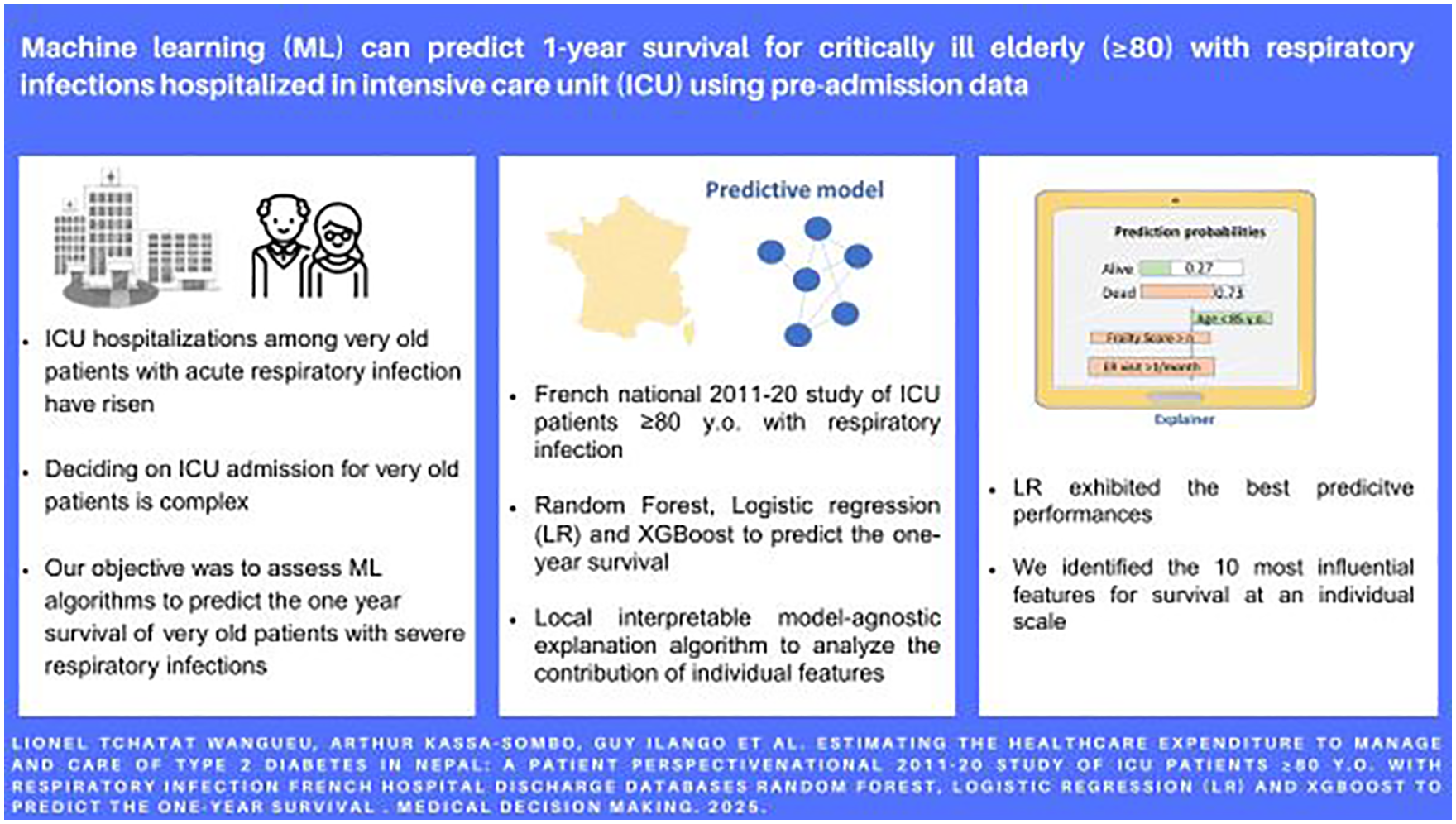
Keywords
Get full access to this article
View all access options for this article.
References
Supplementary Material
Please find the following supplemental material available below.
For Open Access articles published under a Creative Commons License, all supplemental material carries the same license as the article it is associated with.
For non-Open Access articles published, all supplemental material carries a non-exclusive license, and permission requests for re-use of supplemental material or any part of supplemental material shall be sent directly to the copyright owner as specified in the copyright notice associated with the article.
