




Abstract
Background
Nudges have been proposed as a method of influencing prescribing decisions.
Purpose
The purpose of this article is to 1) investigate associations between nudges’ characteristics and effectiveness, 2) assess the quality of the literature, 3) assess cost-effectiveness, and 4) create a synthesis with policy recommendations.
Methods
We searched health and social science databases. We included studies that targeted prescribing decisions, included a nudge, and used prescribing behavior as the outcome. We recorded study characteristics, effect size of the primary outcomes, and information on cost-effectiveness. We performed a meta-analysis on the standardized mean difference of the studies’ primary outcomes, tested for associations between effect size and key intervention characteristics, and created a funnel plot evaluating publication bias.
Synthesis
We identified 21 studies containing 25 nudges. In total, 62 of 85 (73%) outcomes showed a statistically significant effect. The average effect size was −0.22 standardized mean difference. No studies included heterogeneity analyses. We found no associations between effects and selected study characteristics. Study quality varied and correlated with study design. A total of 7 of 21 (33%) studies included an evaluation of costs. These studies suggested that the interventions were cost-effective but considered only direct effects. We found evidence of publication bias.
Limitations
Heterogeneity and few studies limit the possibilities of statistical inference about effectiveness.
Conclusions
Nudges may be effective at directing prescribing decisions, but effects are small and health effects and cost-effectiveness are unclear. Future nudge studies should contain a rationale for the chosen nudge, prioritize the use of high-quality study designs, and include evaluations of heterogeneity, cost-effectiveness, and health outcomes to inform decision makers. Moreover, preregistration of the protocol is warranted to limit publication bias.
Highlights
Nudging as a method to improve prescribing decisions has gained popularity during the past decade.
We find that nudging can improve prescribing decisions, but effect sizes are mostly small, and the size of derived health outcomes is unclear.
Most studies use feedback and error-stopping nudges to target excessive opioid or antibiotic prescribing, making heterogeneity analyses across nudge types difficult.
Further research on the cost-effectiveness of nudges and generalizability is needed to guide decision makers considering nudging as a tool to guide prescribing decisions.
This is a visual representation of the abstract.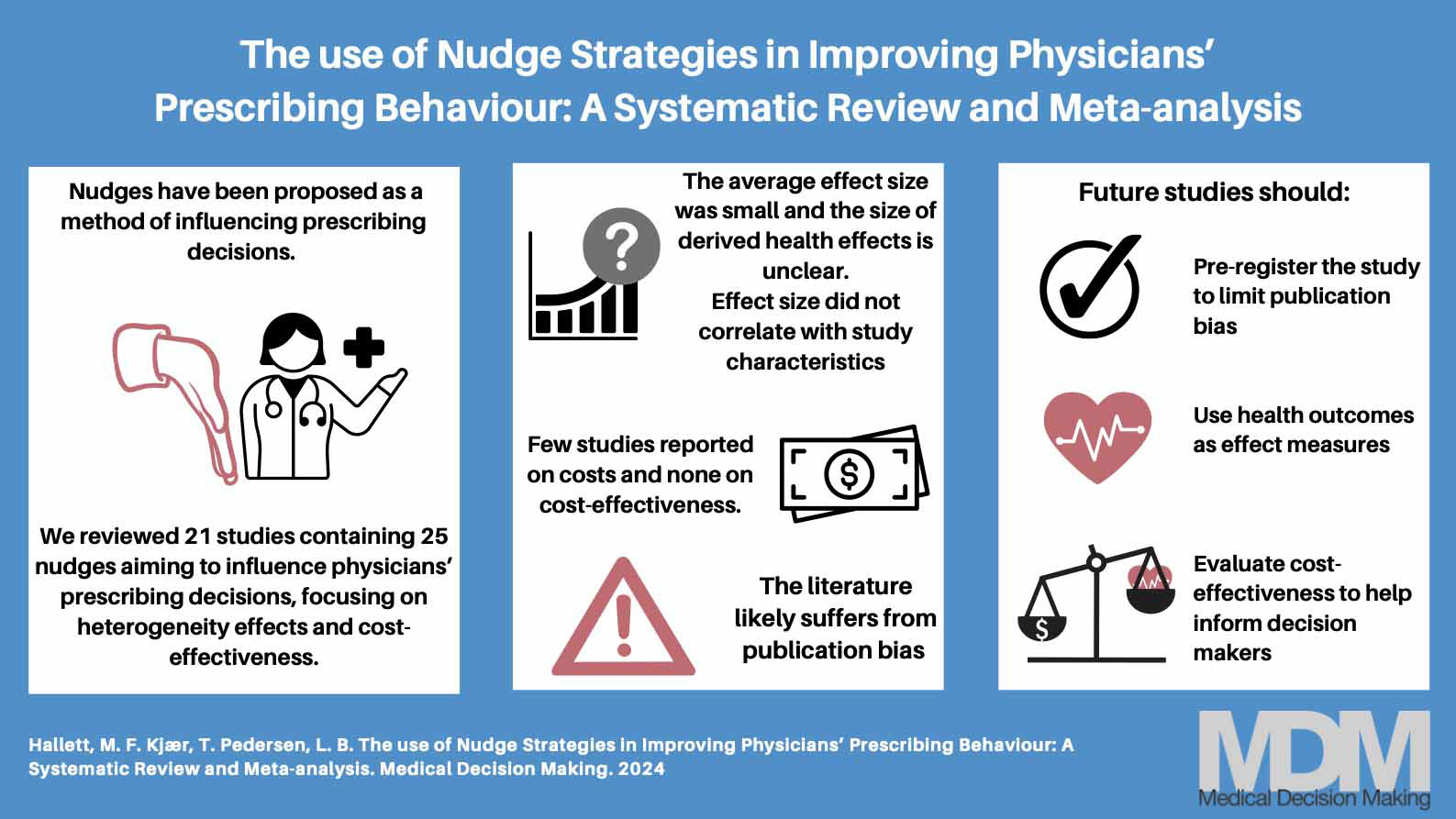
Keywords
Get full access to this article
View all access options for this article.
References
Supplementary Material
Please find the following supplemental material available below.
For Open Access articles published under a Creative Commons License, all supplemental material carries the same license as the article it is associated with.
For non-Open Access articles published, all supplemental material carries a non-exclusive license, and permission requests for re-use of supplemental material or any part of supplemental material shall be sent directly to the copyright owner as specified in the copyright notice associated with the article.
