




Abstract
Academic pressure is increasingly recognized as a factor in declining adolescent mental health, yet this phenomenon remains underexplored among early adolescents in primary education. This study investigates sources of academic pressure among 585 Dutch students (286 boys, 294 girls; aged 11–12) in their final year of primary school, and examines its associations with sex, social connectedness, and mental health. One in six students reported experiencing academic pressure, primarily due to homework or school demands. Academic pressure was already linked to mental health concerns at this age, with no sex differences observed. Higher levels of school belonging and family support were associated with lower academic pressure. However, the hypothesized moderating role of social connectedness was not confirmed: students under high pressure reported more psychosomatic complaints regardless of support levels. These findings underscore the need to monitor academic pressure and its mental health correlates in primary school.
Alarming trends in adolescent mental health have been documented by several (inter)national reports (e.g., Collishaw, 2015; Potrebny et al., 2017). Globally, it is estimated that approximately 34% of adolescents are affected by depression, anxiety, or other internalizing symptoms (Shorey et al., 2022), with onset typically occurring during early adolescence (i.e., the transition from childhood to adolescence). This developmental stage involves significant social, biological, and morphological changes that predispose early adolescents to a range of mental health concerns (Rapee et al., 2019). A well-supported explanation for the high onset rates of mental health issues in early adolescence is found in vulnerability-stress models. These models link exposure to stressful events with an increased risk of developing mental health concerns (Gladstone et al., 2021). Investigating modifiable risk factors, such as stressors, during this transitional period is crucial for informing preventative interventions and public health policies.
One key source of stress in early adolescence is academic pressure. Academic pressure can be defined as distress in the educational context caused by anticipated or possible academic challenges or failure (Deb et al., 2015). It can be seen as a consequence of an imbalance between school demands and available resources (Löfstedt et al., 2020). Examples of influences of academic pressure include excessive parents or teachers’ expectations, students’ own performance-related expectations, and overload of examinations or homework.
Given that (early) adolescents spend a considerable amount of their time at school, it is not surprising that academic pressure is considered a risk factor for their mental health. The “educational stressors hypothesis” suggests that the rise in mental health problems among adolescents can be attributed, in part, to increased stressors related to school and education (Högberg, 2021). Indeed, evidence from two large survey-studies shows that adolescents identify academic pressure as a significant factor affecting their mental health (Fildes et al., 2014; YoungMinds, 2019). Moreover, there are indications that the rising rates of mental health problems coincide with an increase in academic pressure among adolescents (Löfstedt et al., 2020). In a recent systematic review Steare et al. (2023) reported consistent significant positive associations between measures of academic pressure and various mental health outcomes in adolescents in secondary school, raising international concern about the potential mental health consequences of academic pressure.
That academic pressure and its impact on mental health should be a priority on the research agenda in both primary and secondary education is confirmed by the most recent Dutch HBSC report (Boer et al., 2022) showing that self-reported academic pressure among Dutch primary and secondary school students has tripled in the last twenty years. This increase is based on students’ responses to a general item asking how much pressure they experience due to schoolwork. It reflects students’ overall sense of academic pressure, which may stem from various sources, including homework load, parental or teacher expectations, or pressures related to educational transitions. While the association between academic pressure and mental health has been thoroughly investigated in adolescents in secondary school, there remains a significant gap in the literature regarding this topic for early adolescents in primary education.
First of all, we know that already one in five Dutch primary school students experience academic pressure and that having to make decisions about secondary school contributes to the academic pressure they are experiencing (Boer et al., 2022). However, the report did not investigate if other sources of academic pressure, like teacher and parent expectations or an excessive number of tests, assessments, and homework assignments, also play a role. These sources have been identified for older students in secondary school (Boer et al., 2022), but we do not know yet if they also contribute to students’ experienced academic pressure in primary school. Recognizing the sources to which early adolescents attribute their academic pressure is a crucial first step in informing prevention/intervention programs targeting academic pressure.
Second, only two studies looked at the association between academic pressure and mental health in primary education and both were conducted in an East Asian educational context with a strong focus on parental academic pressure (Leung et al., 2010; Leung & He, 2010). Therefore, it remains unclear whether there already is an association between academic pressure and mental health for early adolescents in primary school in Western educational contexts.
Important to note is that, early adolescence, and particularly the final year of primary education, marks a developmental and educational transition. In the Netherlands, this year is largely devoted to preparing students for secondary education, including increased academic expectations, larger volumes of learning material, and a greater emphasis on planning and self-regulation. Students also complete high-stakes assessments, such as the track recommendation and the national standardised test, which influence secondary track placement. Given these unique features, it is essential to understand the extent to which early adolescents experience academic pressure from these demands, and whether such experiences are associated with their mental health.
Finally, given that so many students are struggling with academic pressure and its impact on mental health throughout their school career, there is a need for early identification of at-risk students and targeted prevention/intervention programs. Previous research in secondary school has shown that girls might be an at-risk group for experiencing more academic pressure (e.g., Redmond et al., 2022), but also that their mental health might be affected more by experienced academic pressure (e.g., Chyu & Chen, 2022). It is unclear if these sex differences are already present in primary school. Additionally, there is evidence that a higher level of social connectedness (i.e., support from peers, parents and teachers) is associated with fewer mental health complaints in secondary school students (Kjellström et al., 2017). The latter raises the question whether social connectedness can moderate the potential negative effects of academic pressure on mental health in early adolescents in primary school. Put differently, it has not been systematically examined if sex and aspects of social connectedness explain to what extent early adolescents in primary school experience academic pressure, nor is it clear if sex and aspects of social connectedness are associated with the extent to which academic pressure is associated with mental health among early adolescents in primary school. Therefore, in this paper, we examine the associations between academic pressure, mental health, sex and social connectedness in early adolescence, using recently collected quantitative data among ∼600 pupils from 54 primary schools in the Netherlands.
Sex Differences in Academic Pressure and Its Association With Mental Health
Two theoretical models have been proposed to explain the role of sex in academic pressure and its association with mental health: the mediational-stress exposure model and the moderational-stress reactivity model. In the mediational-stress exposure model, sex is conceptualised as a predictor of academic pressure. This model posits that girls experience higher levels of academic pressure than boys and, as a result, are also more likely to experience mental health problems (Hankin et al., 2007).
Several mechanisms have been suggested to explain sex differences in experiences of academic pressure. Biological factors, such as hormones, influence emotional and cognitive functioning in both boys and girls. Differences in hormonal profiles, developmental timing, and fluctuations may contribute to sex-specific patterns in stress experience and emotion regulation (ter Horst et al., 2011). In addition, societal and parental expectations might also differ by gender. For example, research shows that teachers’ implicit gender-related stereotypes can shape differential expectations for male versus female students (Chalabaev et al., 2009), which may contribute to differences in perceived academic pressure across genders. Finally, girls generally display higher levels of conscientiousness (Verbree et al., 2022), academic engagement (Lam et al., 2012), and compliance with school norms than boys (Heyder et al., 2020). These behavioral tendencies often lead teachers and parents to perceive girls as more academically responsible, which can strengthen both external expectations and girls’ own internal standards. Girls also report more school anxiety and concerns about performance (Putwain & Daly, 2014), which may contribute to their higher levels of self-imposed academic pressure.
In contrast, the moderational-stress reactivity model conceptualises sex as a moderator of the association between academic pressure and mental health. The model suggests that girls respond with higher levels of mental health problems to academic stress than boys (Rudolph, 2002). Several mechanisms have been proposed to account for this differential vulnerability. Stress reactivity is relevant for both sexes and evidence suggests that sex-related differences in hormonal regulation may influence how adolescents respond to stressors. For example, fluctuations in estrogen can affect stress reactivity and emotional regulation, potentially making girls more susceptible to stress-related mental health issues (Stroud et al., 2002). In addition, girls are more likely than boys to engage in ruminative coping styles, which may amplify the impact of academic stress on mental health (Nolen-Hoeksema, 2001).
Empirical findings provide support for both theoretical models. Studies consistent with the mediational-stress exposure model have shown that girls report higher levels of academic pressure and that academic pressure is assocatied with poorer mental health outcomes (e.g., Lönnfjord & Hagquist, 2020; Redmond et al., 2022). However, other studies conducted among secondary school students did not find sex differences in academic pressure, while showing that girls who experience academic pressure are more vulnerable to experiencing mental health problems, thereby supporting the moderational-stress reactivity model (Chyu & Chen, 2022; Liu et al., 2020).
Importantly, most of this evidence is based on international samples (i.e., Sweden, Australia, England, Spain, China and Hong Kong) and largely focuses on adolescents in secondary education. Evidence from the latest Dutch HBSC-report indicates that Dutch girls in secondary education experience 1.5 to 2 times more academic pressure than boys, whereas no sex differences in academic pressure were observed among children in primary education (Boer et al., 2022). This finding suggests that sex differences in exposure to academic pressure may emerge later in adolescence.
Taken together, the existing literature provides evidence for both mediational and moderational pathways, but also indicates that these processes may depend on developmental stage and educational context. Given that the present study focuses on Dutch early adolescents in primary education, an age group for which sex differences in academic pressure are not consistently observed, we primarily focus on the moderation-stress reactivity model. Specifically, we hypothesize that girls and boys in Dutch primary education do not differ in levels of self-reported academic pressure, but that the association between academic pressure and mental health is stronger for girls than for boys.
Social Connectedness as a Protective Factor
Social connectedness is an aspect of overall health and wellbeing that stems from connection and relationships. Lee and Robbins (1995) define social connectedness as the experience of belonging to a social relationship or network. For (early) adolescents, being socially connected requires cultivating bonds with family, friends, classmates and teachers, but also includes school belonging and feeling supported.
A few studies investigated individual aspects of social connectedness (e.g., school climate, teacher connectedness) and their role for academic pressure and for the association between academic pressure and mental health problems. We discuss each of these individual aspects in the following paragraphs.
Since (early) adolescents spend a considerable amount of their time at school, the school climate could be both a risk or a protective factor for academic pressure. For example, Liu and Lu (2012) operationalised school climate with a 23-item scale measuring student’s perceptions of the teacher-student relationship, student-student relationship, achievement orientation and disciplinary harshness. They concluded that school climate moderates the relationship between academic pressure and mental health in secondary school. Eriksson and Sellström (2010) operationalised school climate as academic pressure on the school level and found that in secondary school classes with high demands, the odds of having mental health problems were 50% higher than in secondary school classes with low demands. They stress that when academic achievement was greatly emphasized in classrooms, academic pressure was more likely to increase mental health problems. Finally, Torsheim et al. (2003) used their own Teacher and Classmate Support Scale to look at the classroom climate in secondary education and found a complex pattern of reciprocal relationships among academic pressure, school climate and mental health problems across time. They argue that academic pressure, school climate and mental health problems should be seen as mutually dependent factors. It should be noted that school climate is a broad concept that encompasses many different school factors that play a role in how children experience their time at school. Therefore, it was not surprising that school climate was operationalised differently in each study and that very specific aspects of school climate were targeted.
Two studies specifically looked at teacher connectedness. On the one hand, Nygren and Hagquist (2019) concluded that teacher support did not affect the relationship between academic pressure and mental health in secondary school students. Moksnes et al. (2016), on the other hand, found that stress within the teacher interaction was associated with more mental health problems. However, when controlling for academic pressure, this association was no longer significant.
To our knowledge only one study looked at peer support as a protective factor for the impact of academic pressure on mental health. However, their findings provided no support for the buffering effects of social support of peers on the relationship between academic pressure on mental health in secondary school students (Ringdal et al., 2020).
More empirical evidence is available for the role of family support. Results of Leung et al. (2010) indicated that academic pressure is related to poor mental health of primary school students and that parental emotional support acted as protective factor for mental health. However, the opposite was found for informational parental support: it heightened mental health issues during periods of high academic stress. A possible explanation is that students seemed to perceive their fathers’ guidance on effective study habits and encouragement to study as extra pressure, which negatively impacted their mental health. Quach et al. (2015) concluded that greater parental warmth reduced the negative effects of parental academic pressure on secondary school students’ mental health. Finally, Fu et al. (2022) found a positive association between academic pressure and mental health for secondary school students that was partially mediated by parent-child communication and interaction.
Overall, it can be argued that there are some indications in the literature that school climate and family support play a significant role in the relationship between academic pressure and mental health in adolescents in secondary school. There is not enough evidence, however, about the role of school belonging, teacher, or peer connectedness. Moreover, only one of the previous studies included early adolescents in primary school. On top of that it is not clear if social connectedness also acts as a protective factor for experiencing academic pressure as such.
In the present study, we study four aspects of social connectedness: school belonging, student-teacher connectedness, peer support and family support. We hypothesize that social connectedness is a protective factor for academic pressure. Some aspects of social connectedness are potentially more pivotal than others. More specifically, we expect a negative association between student-teacher connectedness and academic pressure, since students with a higher student-teacher connectedness may be less likely to be affected by unrealistic teacher expectations. Similarly, we expect a negative association between family support and academic pressure, since students with higher family support may be less affected by unrealistic parent expectations. Additionally, we hypothesize a moderational role for all four social connectedness aspects, since it can be expected that the association between academic pressure and mental health is weaker when students feel like they belong in the school environment, are connected to teachers and supported by family and peers.
The Present Study
The present study aims to contribute to the gaps in the literature regarding academic pressure in early adolescents in primary school using data from the EPoSS (Early Predictors of School Succes) project that investigates the relationships between physical, mental and social health and academic achievement in a large sample of primary and secondary school students in the Netherlands. We answer four research questions (RQ): (RQ1) To what extent do early adolescents experience academic pressure and what sources explain this pressure?; (RQ2) To what extent are sex at birth and various aspects of social connectedness related to academic pressure?; (RQ3) To what extent is academic pressure related to mental health, operationalized as having psychosomatic complaints and general life satisfaction?; and (RQ4) To what extent is the relationship between academic pressure and mental health moderated by sex at birth and various aspects of social connectedness?
Methods
Participants and Procedure
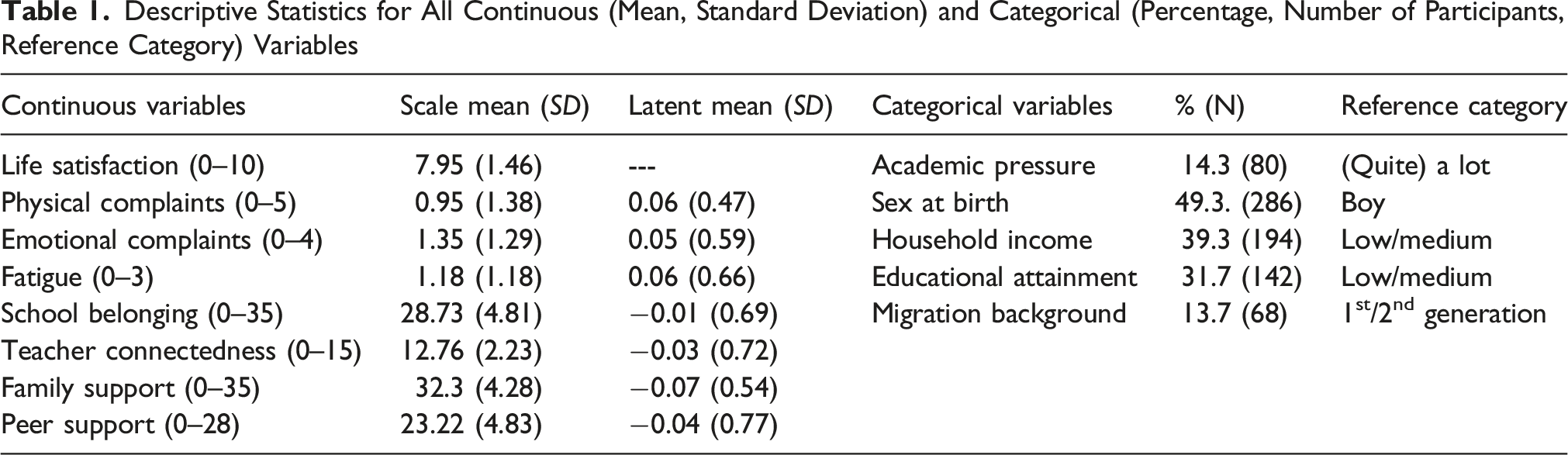
This study uses data of the Dutch EPoSS project, a cross-sectional study about the relationships between physical, mental and social health and academic achievement. Data collection took place in the first half of 2024 in fifty-four primary schools from all twelve different geographical regions in the Netherlands. Parents/caregivers of students in their final year of primary education (i.e., 11-to-12 year-olds) had to provide active informed consent (IC) for their child. Students completed a digital survey during school hours, that took approximately 30 minutes. An English translation of the survey questions relevant for the present study is reported in Appendix A (Table A1). In total, we obtained 647 surveys, of which 62 had to be excluded (i.e., duplicates, wrong grade, no consent and surveys without any data). This led to a final sample of 585 participants (286 boys, 294 girls, 5 children indicated they rather not share information about sex at birth with us). Participants had a mean age of 11.35 years (SD = 0.51); most were 11 (63.7%) or 12 (34.6%), with smaller proportions aged 10 (0.9%) or 13 (0.9%). Statistics Netherlands (CBS) securely stored the encrypted data and allowed for individual linkage with the data of the Netherlands Cohort Study on Education (NCO; Haelermans et al., 2020). For the present study we use information about household income, educational attainment and migration background from the most recent NCO dataset (2021-2022). Within our sample the majority of students (68.3%) have at least one parent with a high level of educational attainment, while 29.2% have at least one parent with medium educational attainment and only 2.5% have both parents with low educational attainment. Similarly, most students have a high (60.7%) or medium (38.7%) household income, while only 0.6% have a low household income. Only 13.7% of the participants have a first- or second-generation migration background. Compared to national Dutch statistics, our sample is characterized by an overrepresentation of adolescents from highly educated and higher-income households, and an underrepresentation of students with a migration background (CBS, 2024). This limits the generalizability of our findings to the broader Dutch adolescent population.
Measures
Academic Pressure
We use the same measure for academic pressure as the international studies from HBSC (Health Behaviour in School-aged Children; Boer et al., 2022). The amount of experienced academic pressure is captured by one multiple choice question: “How much pressure do you experience because of your schoolwork?” Answers are given on a 4-point Likert scale: 0 (“no pressure”), 1 (“a little pressure”), 2 (“quite a lot of pressure”) and 3 (“a lot of pressure”).
Seven other questions capture what situations students attribute their experienced academic pressure to: ”How much pressure did you have in the last six months because of (1) having to learn something you don’t understand, (2) teachers that expect too much of you, (3) parents that expect too much of you, (4) keeping up with school demands, (5) having to make decisions about secondary school, (6) not having enough free time, and (7) having too much homework?” Students give their answers on the same 4-point Likert scale that is used for the general academic pressure question. A binary recoding is applied for each item with 0 being equal to experiencing “no or a little bit of pressure” and 1 being equal to experiencing “quite a lot or a lot of pressure”. This binary classification is also utilized by HBSC (Boer et al., 2022).
Mental Health
We measure mental health as a broad construct and include a general life satisfaction measure combined with questions about 12 different psychosomatic complaints.
General life satisfaction is measured by asking students to rate their current life on a scale from 0 to 10, where 0 represents the worst life imaginable, and 10 represents the best life imaginable. General life satisfaction captures wellbeing across a broad spectrum, from very positive to very negative. Good construct validity for this continuous outcome in primary school children is supported (Huebner, 2004).
Additionally, information about the frequency of experiencing 12 psychosomatic complaints is collected (i.e., headache, stomach ache, backache, being unhappy, being irritated, feeling nervous, feeling dizzy, feeling nauseous, difficulty concentrating, difficulty falling asleep, bad sleeping and daytime fatigue). Students are asked to indicate how often they suffered from these complaints in the last six months on a five-point Likert scale with response options: “almost never or never”, “almost every month”, “almost weekly”, “more than weekly”, “almost every day”. Each complaint was then recoded into a binary variable, where a value of 1 indicates experiencing the complaint more than weekly. These questions and the binary classification are also used in the Health Behaviour in School-aged Children (HBSC) study (Boer et al., 2022). Binary classification of these questions is commonly used in psychosomatic research, as experiencing such complaints on a near-daily basis reflects a substantially different level of severity and clinical relevance compared to occasional or monthly occurrences (Haugland & Wold, 2001). Confirmatory Factor Analysis showed good fit for a three-factor model comprising Physical Complaints, Emotional Complaints and Fatigue as latent variables (CFI = .990, TLI = .987, RMSEA = .034, SRMR = .047). The composite reliability values for the three latent constructs ranged from .65 to .77 indicating acceptable internal consistency. See Appendix B for full model information. The latent scores served as the primary outcomes in subsequent analyses.
Sex at Birth
Sex at birth was assessed using a self-report item asking students: “Were you born as a boy or a girl?” Response options were: “boy”, “girl”, “I’d rather not say”. Responses of “I’d rather not say” (N = 5; <1.0%) were treated as missing in the analyses.
School Connectedness
Two aspects of school connectedness were assessed: school belonging and teacher connectedness. School belonging refers to the extent to which students feel personally accepted, respected, included and supported by others in the school social environment (Goodenow, 1993). It is measured by a set of eight statements (e.g., “I feel safe at school”) and each statement is rated on a 5-point Likert scale ranging from 1 (“I completely agree”) to 5 (“I completely disagree”). Positively worded items were reverse coded. Student-teacher connectedness refers to the perception of a teacher as caring, respectful and willing to listen to their students (García-Moya et al., 2018). Three positively worded statements (e.g., “My teacher accepts me the way I am”) are included in the survey and each statement is rated on a 5 point-Likert scale ranging from 1 (“completely agree”) to 5 (“completely disagree”). Confirmatory Factor Analysis showed good fit for a two-factor model comprising School Belonging and Teacher Connectedness as latent variables (CFI = .983, TLI = .975, RMSEA = .085, SRMR = .045). During model evaluation, one indicator (“Enjoy”) was removed from the School Belonging construct due to poor loading and to improve overall model fit. The composite reliability values for the two latent constructs were .79 and .86, indicating good internal consistency. See Appendix B for full model information. The latent scores served as the primary outcomes in subsequent analyses.
Social Support
Two aspects of social support were assessed: peer support and family support. Peer support is defined as social and emotional support provided by individuals in equal standing (i.e., other students or friends from the same age outside of school; Solomon, 2004). Four items about peer support are included in the survey (e.g., “I can count on my friends when something goes wrong”) and rated on a 7-point Likert scale from 1 (“completely disagree”) to 7 (“completely agree”). Family support refers to the social and emotional support received from members of the family. Five items about family support are included in the survey (e.g., “My family members try their best to help me”) and are rated on a 7-point Likert scale from 1 (“completely disagree”) to 7 (“completely agree”). Confirmatory Factor Analysis showed good fit for a two-factor model comprising Peer Support and Family Support as latent variables (CFI = .995, TLI = .993, RMSEA = .043, SRMR = .034). The composite reliability values for the two latent constructs was .82, indicating good internal consistency. See Appendix B for full model information. The latent scores served as the primary outcomes in subsequent analyses.
Covariates
All analyses are adjusted for three covariates: household income (low/medium or high), highest educational attainment of the parents (low/medium, high) and migration background (i.e., being a first or second generation migrant; yes or no).
Statistical Analysis
Data cleaning, variable recoding and descriptive statistics are conducted with IBM SPSS Software version 30.0.0, while imputation and all other analyses are completed with RStudio version 4.4.0. Missing values are addressed with a multiple imputation technique with 5 imputations and 30 iterations, using the R mice package (van Buuren & Groothuis-Oudshoorn, 2011). For RQ1 descriptive statistics (frequency tables) reveal sources that students attributed their academic pressure to. Binary logistic regressions are used to look at sex at birth differences in academic pressure. To answer RQ2, we investigate sex at birth and aspects of social connectedness as predictors of academic pressure, using a multilevel (mixed-effects) logistic regression. For RQ3, we use multilevel linear and logistic regressions to look at the associations between academic pressure and several measures of mental health (i.e., three dimensions of psychosomatic complaints and life satisfaction). In RQ4, we examine the moderating effects of sex at birth and social connectedness for the association between academic pressure and mental health. To do this, we add sex at birth and four aspects of social connectedness (school belonging, teacher connectedness, peer support and family support) as predictors to the regression models of RQ3, with a specific interest in the interaction effect of these variables with academic pressure. Each interaction effect is tested separately and results are considered significant at the p < .05 level. Even though all analyses were specified a priori, we applied Bonferroni-Holm corrections to account for multiple testing (Holm, 1979). All previously mentioned analyses control for sex at birth, highest parental educational attainment, household income and migration background. Additionally, all regression analyses accounted for nesting of students within schools by including random intercepts for schools. Althoug school-level effects were not of substantive interest, this multilevel approach was used to appropriately account for the hierarchical data structure (i.e., non-independence of observations) and obtain correct standard errors.
Results
Academic Pressure (RQ1)
Descriptive Statistics for All Continuous (Mean, Standard Deviation) and Categorical (Percentage, Number of Participants, Reference Category) Variables
Frequency Table of the Different Sources for Experiencing Academic Pressure and Results of Binominal Logistic Regression for Sex Differences
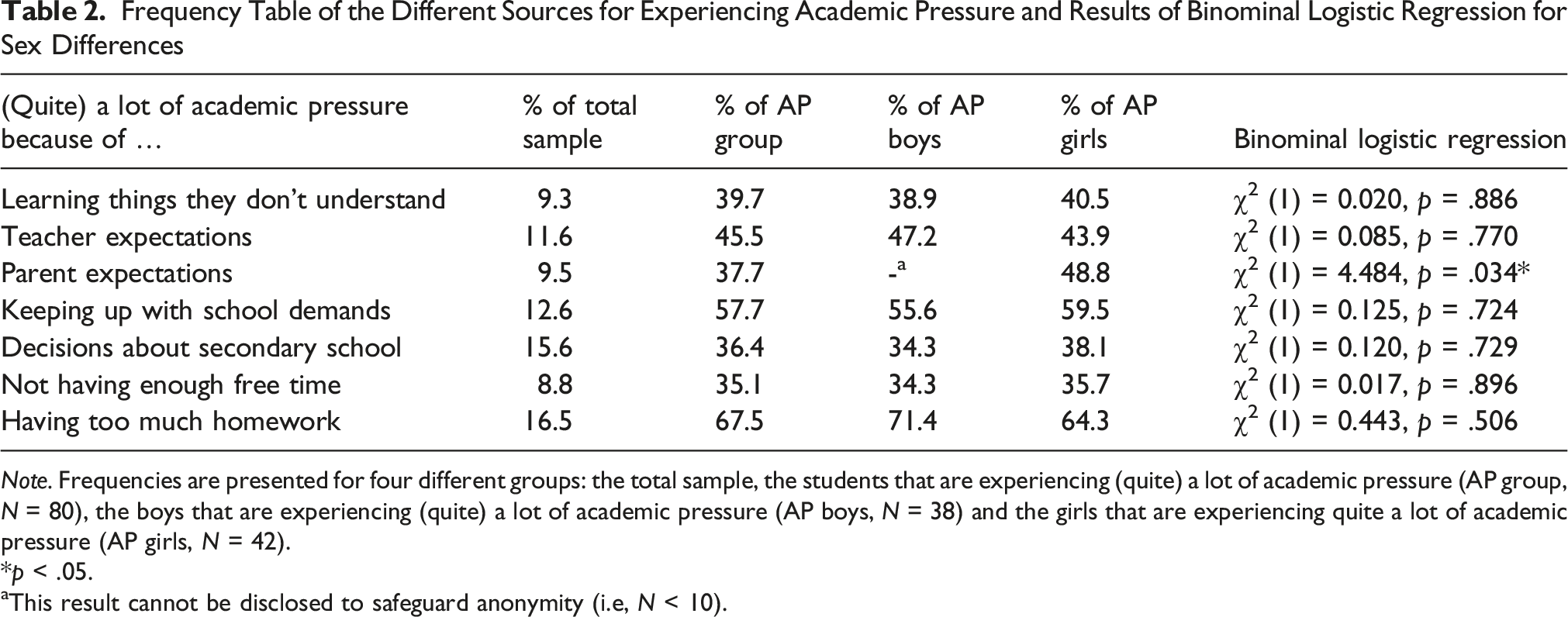
Note. Frequencies are presented for four different groups: the total sample, the students that are experiencing (quite) a lot of academic pressure (AP group, N = 80), the boys that are experiencing (quite) a lot of academic pressure (AP boys, N = 38) and the girls that are experiencing quite a lot of academic pressure (AP girls, N = 42).
*p < .05.
aThis result cannot be disclosed to safeguard anonymity (i.e, N < 10).
Sex at Birth and Social Connectedness as Predictors of Academic Pressure (RQ2)
Multilevel Logistic Regression With Random Intercepts for Schools and Academic Pressure as an Outcome Variable. Covariates Were Included Into the Model
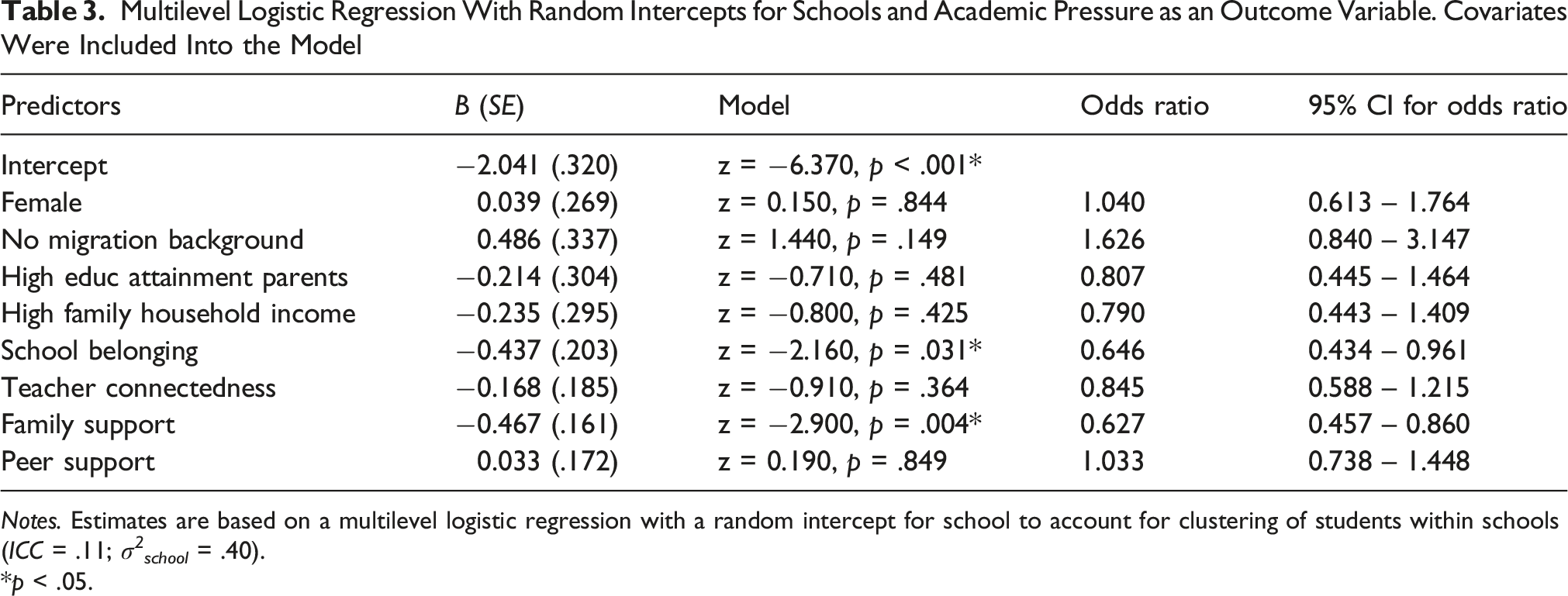
Notes. Estimates are based on a multilevel logistic regression with a random intercept for school to account for clustering of students within schools (ICC = .11; σ 2 school = .40).
*p < .05.
The Association Between Academic Pressure and Mental Health (RQ3)
Multilevel Linear Regression With Academic Pressure as a Predictor of Mental Health Outcome Variables (Random Intercepts for Schools)
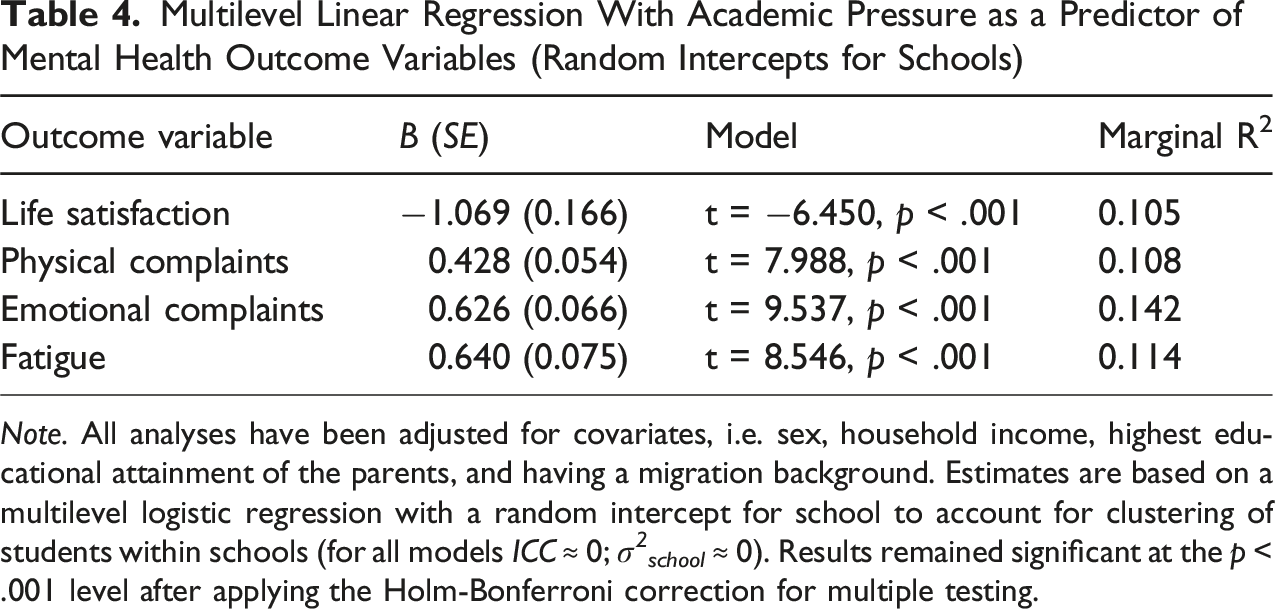
Note. All analyses have been adjusted for covariates, i.e. sex, household income, highest educational attainment of the parents, and having a migration background. Estimates are based on a multilevel logistic regression with a random intercept for school to account for clustering of students within schools (for all models ICC ≈ 0; σ 2 school ≈ 0). Results remained significant at the p < .001 level after applying the Holm-Bonferroni correction for multiple testing.
For life satisfaction, there was a significant negative association with academic pressure (B = −1.069, SE = 0.166, t = −6.450, p < .001). Students with (quite) a lot of academic pressure reported, on average, 1.07 points lower life satisfaction on a 0-10 scale. Given the observed variability in life satisfaction (SD = 1.46), this corresponds to a difference of approximately 0.73 standard deviations in life satisfaction, representing a substantial difference relative to the observed variability in life satisfaction. All the abovementioned effects remained significant at the p < .001 after applying Bonferroni-Holm corrections.
Sex at Birth and Social Connectedness as Moderators (RQ4)
Moderation effects of sex at birth and four aspects of social connectedness were investigated by including interaction terms in the regression models examining the association between academic pressure and mental health outcomes (see results for RQ3). A summary of the regression analysis is provided below; detailed results are reported in Appendix D (Tables D1-D4).
There was no evidence that sex at birth moderated the relationship between academic pressure and any of the mental health outcomes, as all interaction effects were non-significant.
Regarding social connectedness, interaction effects were specifically examined for each of the four mental health outcomes. For life satisfaction, one interaction effect reached statistical significance. Specifically, the interaction between academic pressure and family support (B = 0.512, SE = 0.260, t = 1.970, p = .049), suggesting that the negative impact of academic pressure on life satisfaction may be buffered by higher levels of family support (see Figure 1). Remarkably, while there is a significant gap in general life satisfaction between early adolescents with and without academic pressure at low levels of family support this gap becomes negligible at higher levels of these social connectedness factors. It should be noted that this interaction effect is no longer significant after applying Bonferroni-Holm corrections for multiple testing, even though all analyses were specified a priori. Interaction effects of academic pressure and family support on life satisfaction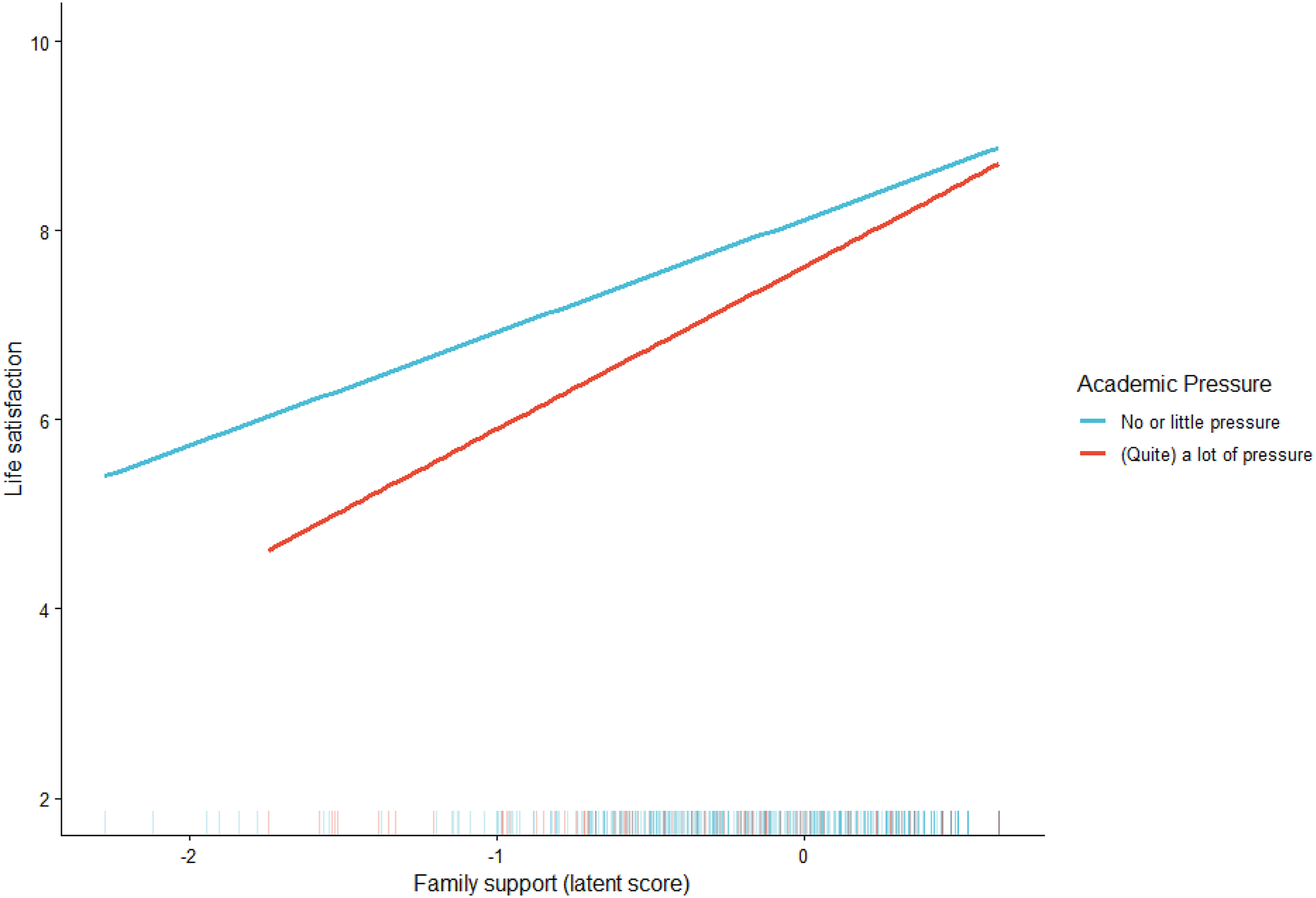
For the three dimensions of psychosomatic complaints (i.e., physical complaints, emotional complaints, and fatigue) none of the interaction effects between academic pressure and the social connectedness variables reached statistical significance.
It should be noted that direct effects of academic pressure and all four social connectedness variables (i.e., school belonging, teacher connectedness, family support, and peer support) were observed across all mental health outcomes.
Discussion
The present study underscores the importance of having attention for academic pressure and its impact on mental health already in early adolescence when students are still in primary school. Results show that approximately 1 out of 6 primary school students in the Netherlands is already experiencing (quite) a lot of academic pressure. This aligns with the latest HBSC report showing that approximately 1 out of 5 primary school students experiences (quite) a lot of academic pressure (Boer et al., 2022).
While HBSC reports that primary school students mention having to make decisions about secondary school as a source for their experienced academic pressure (Boer et al., 2022), our results point to other potential sources. Up to two-thirds of primary school students that are experiencing academic pressure attribute it to having too much homework and keeping up with school demands. Additionally, almost half of them report unrealistic teacher expectations as a source. Identifying sources of academic pressure can be a first crucial step in assisting early adolescents in primary school in coping with their experiences of academic pressure.
Remarkably, the increase in Dutch primary school children reporting high levels of academic pressure is not mirrored by a corresponding rise in academic demands reported by school principals and teachers. Reports from the TIMSS & PIRLS International Study Center show that emphasis on academic success reported by principals has remained stable between 2015 and 2023 for primary schools in the Netherlands (Kelly et al., 2020; Mullis et al., 2016; von Davier et al., 2024). Then how can we explain why (early) adolescents are experiencing such high levels of academic pressure? One potential (partial) explanation can be that (early) adolescents have become more articulate in expressing their psychological stress, facilitated by increased awareness for and reduced stigma surrounding socio-emotional wellbeing (DeLuca, 2019). Another hypothesis is that the increase in experienced academic pressure is not necessarily due to higher school demands, but rather an increase in overall life demands (e.g., excelling in hobbies or sports, family obligations, etc.), which makes it difficult for (early) adolescents to keep up and prioritize their time. The study of Wilhsson et al. (2016) in which students indicate that there are not enough hours in the day to meet the demands of school while also creating meaningful and relaxing leisure time, lends support to the latter hypothesis. However, this idea of an increasing tempo of life (also referred to as the speed-up society) is not supported by time use data in adults from 2000-2015, that indicate that there is no increase in time intensity or subjective time pressure (Sullivan & Gershuny, 2017).
While school principals and teachers do not report an increase in academic demands for primary school students, it should be noted that there have been some noticeable changes in school demands for primary school students in the Netherlands in the last two decades. For instance, while there used to be only one national standardized assessment at the end of primary school, students are currently doing standardized assessments yearly. Furthermore, policies around homework, which has been identified as an important source for experiencing academic pressure, vary greatly between schools and even between teachers. An excess of homework can potentially put students at risk for experiencing academic pressure, especially for students who are already struggling to keep up with school demands. Remarkably, a country with few homework and no standardized testing in primary school stood out in the PISA 2018 study. Finland, one of the world’s top-performing countries, is the only country to achieve both high reading performance and high levels of life satisfaction (Ahonen, 2021). Future research should not merely focus on the effectiveness of homework and standardized testing, but should also take into account the consequences for (early) adolescents’ experienced academic pressure.
Moreover, an abundance of evidence supports an association between academic pressure and several mental health outcomes in adolescents in secondary school (for an overview see Steare et al., 2023). The present study addresses a significant gap in the current literature regarding this phenomenon in early adolescents in primary school. In line with expectations, we find a negative association between academic pressure and general life satisfaction, alongside positive associations between academic pressure and all three domains of psychosomatic complaints (i.e., physical complaints, emotional complaints and fatigue). Our results bring forward that experiencing academic pressure in early adolescence is already related to experiencing a broad spectrum of psychosomatic complaints and a lower rating of general life satisfaction.
The abovementioned results highlight the importance of raising awareness among students, parents and teachers around academic pressure and its consequences for mental health already in early adolescence. On top of that, there is a need for early identification of students that are experiencing academic pressure and development of early prevention/intervention programs targeting academic pressure. One of the goals of the present study was to investigate if sex and factors of social connectedness are associated with academic pressure and potentially moderate the relationship between academic pressure and mental health. These results can be crucial to assist in early identification and to inform the development of prevention/intervention programs.
Similar to the HBSC report (Boer et al., 2022) and in line with our hypothesis, we find no sex differences in experiencing academic pressure in primary school. Contrary to our expectations, we reject our hypothesis that sex acts as a moderator in the relationship between academic pressure and mental health. While we expected to find a stronger association between academic pressure and mental health for female primary school students than for male primary school students, we find no differences between the two groups. Put differently, both the mediational-stress exposure model (Hankin et al., 2007) and the moderational-stress reactivity model (Rudolph, 2002) are not applicable for Dutch primary school students. However, there is one difference for boys and girls, more specifically in parent expectations as a source for academic pressure. Half of the girls reports experiencing (quite) a lot of academic pressure because of parent expectations, while this is only the case for a quarter of the boys. One possible reason for these differences between boys and girls is that socially constructed gender norms (like the belief that girls should be cute, nurturing and perfect, while boys should be brave, innovative and strong) conflict with the demanding academic environment in schools, especially for girls. This can lead to girls experiencing a lot of pressure to perform perfectly and meet high academic standards (Stentiford et al., 2021). Future research should investigate why sex differences in academic pressure start appearing in secondary education, while they are not yet present in late primary education. Additionally, it is yet unclear why young girls’ experiences with academic pressure are impacted more by parent expectations compared to boys.
Another important goal of this study is to look at several aspects of social connectedness as predictors for academic pressure. We hypothesized that higher levels of social connectedness are associated with lower experiences of academic pressure (e.g., Fu et al., 2022). Our results confirmed that both school belonging and family support were significantly associated with academic pressure. Students who reported a stronger sense of school belonging or higher levels of family support had lower odds of experiencing high academic pressure. This suggests that school belonging (i.e., the extent to which students feel personally accepted, respected, included and supported by others in the school social environment) and the support experienced from family members can act as a potential barriers for already experiencing (quite) a lot of academic pressure in primary school. Our results are in line with results of Liu and Lu (2012) and Torsheim and colleagues (2003) who also found that a more general measure of school climate is associated with academic pressure in secondary school students. We acknowledge that aspects like teacher connectedness and classmate connectedness contribute to school belonging and therefore, we do not intend to put school belonging forward as the only school factor that is important in the prevention of academic pressure, but propose a more holistic approach where the goal is that (early) adolescents feel safe, understood and welcome at school and feel connected to their teachers and classmates, which then in turn could be beneficial for the level of academic pressure they are experiencing.
Finally, we explore various aspects of social connectedness as moderators in the association between academic pressure and mental health. First of all, we find that family support appears to close the gap in general life satisfaction between students with (quite) a lot and with a little or without academic pressure. Put differently, family support acts a protective factors for the impact of academic pressure on life satisfaction of early adolescents in primary school. Second, we found no significant interaction effects for academic pressure and social connectedness factors for the three dimensions of psychosomatic complaints. Early adolescents that are experiencing (quite) a lot of academic pressure, regardless of the level of social support they are receiving, have higher odds of experiencing psychosomatic complaints more than weekly. It seems that academic pressure wipes out the positive effects of social connectedness on experiencing mental health complaints. Taken together, the expected positive effects of social connectedness as a moderator for the relationship between academic pressure and its impact on mental health are only minimally present. When early adolescents are experiencing high levels of academic pressure, they are at higher risk of experiencing psychosomatic complaints. This suggests that, alongside broader efforts to promote and protect youth mental health, academic pressure itself should be addressed as an important risk factor in early adolescence.
Limitations
Several limitations of our study should be acknowledged. First, while our overall sample size is considerable, the subgroup of students experiencing high levels of academic pressure is relatively small (N = 80) compared to those experiencing little or no pressure (N = 505). This imbalance may have affected the reliability of our estimates for the high-pressure group. Second, the underrepresentation of schools from lower socioeconomic background in our sample and the requirement of active parental informed consent has contributed to the underrepresentation of students from lower socioeconomic backgrounds within our sample, potentially limiting the generalizability of our finding to this demographic. Third, there is limited variability in the social connectedness variables among our participants, with Dutch primary school students typically scoring relatively high on all social connectedness measures, and overall levels of well-being are high among Dutch children (UNICEF, 2013). This homogeneity may have constrained our ability to detect large differences or effects related to social connectedness. Fourth, the indicators to measure mental health in our study are specific aspects that do not capture the full spectrum of mental health. Utilizing other more comprehensive measures, such as the Strengths and Difficulties Questionnaire (SDQ) or the Revised Child Anxiety and Depression Scale (RCADS), might have yielded different results. In addition, all constructs were assessed exclusively through student self-report. Although self-perceptions are highly relevant for understanding adolescents’ subjective experiences, these measure are inherently subjective and may be influenced by factors such as mood, response style, or social desirability. Finally, the cross-sectional design of our study precludes the determination of causality. While our findings suggest that academic pressure is negatively associated with mental health, it is also plausible that this relationship is bidirectional and that students with poorer mental health are experiencing more academic pressure. These limitations highlight areas for future research and suggest caution in the interpretation and generalization of our findings.
Conclusion
The transition from childhood to adolescence typically predisposes early adolescents to a range of mental health concerns. One key source of stress in early adolescence is academic pressure. Substantial numbers of early adolescents in primary school are already experiencing academic pressure, mainly due to struggling with the homework load and keeping up with school demands. Moreover, academic pressure is already associated with mental health (complaints) in primary school, but at this young age there are no sex differences. These results raised the question of how to best tackle academic pressure and its impact on mental health in early adolescents. Our study implies that a higher level of school belonging (feeling safe, understood and connected at school) and family support may act as a protective factor against experiencing academic pressure. On top of high levels of family support seem to close the gap in general life satisfaction between students with (quite) a lot and with a little or without academic pressure. However, the hypothesized positive moderational effect of social connectedness in the relationship between academic pressure and mental health complaints did not come forward. Regardless of their social support network, students that are experiencing high levels of academic pressure, are at higher risk of experiencing psychosomatic complaints. This suggests that, alongside broader efforts to promote and protect youth mental health, academic pressure itself should be addressed as an important risk factor in early adolescence. Therefore, researchers, policymakers and schools should focus on early identification of at-risk groups and on the development and implementation of prevention/intervention programs that aim to reduce academic pressure, while simultaneously supporting youth mental health. Findings from this research can guide strategies to monitor and reduce academic pressure, helping to protect mental health during the formative early adolescent years.
Supplemental Material
Supplemental Material - Understanding Academic Pressure in Primary School: Associations With Mental Health and Social Connectedness
Supplemental Material for Understanding Academic Pressure in Primary School: Associations With Mental Health and Social Connectedness by Elien Vanluydt, Philippe Delespaul, Polina Putrik, Thérèse van Amelsvoort, Mark Levels, and Tim Huijts in The Journal of Early Adolescence.
Footnotes
Acknowledgements
Results based on calculations by Maastricht University using non-public microdata from Statistics Netherlands. Under certain conditions, these microdata are accessible for statistical and scientific research. For further information:
Ethical Considerations
The study was approved on 16/11/2023 by the Ethical Review Committee Inner City faculties of Maastricht University [ERCIC_503_16_11_2023].
Consent to Participate
Informed consent was obtained from all participants involved in the study, combined with a parent or caregiver consent if participants were younger than 16.
Author Contributions
Conceptualization, E.V. and T.H.; methodology, E.V. and T.H. ; formal analysis, E.V.; writing—original draft preparation, E.V.; writing—review and editing, E.V., P.D., P.P., T.A., M.L., and T.H.; visualization, E.V., P.P.; supervision, T.H.; project administration, T.H.; funding acquisition, T.H., M.L., and P.D. All authors have read and agreed to the published version of the manuscript.
Funding
The authors disclosed receipt of the following financial support for the research, authorship, and/or publication of this article: This research was supported by the National Educational Research Organisation (NRO) [grant number 40.5.21325.004].
Declaration of Conflicting Interests
The authors declared no potential conflicts of interest with respect to the research, authorship, and/or publication of this article.
Data Availability Statement
The survey data that support the findings of this study can be made available by the authors upon reasonable request, under strict conditions. Registry data regarding socioeconomic status and migration background were obtained from the Netherlands Cohort Study on Education (NCO). Under certain conditions, these microdata are accessible for statistical and scientific research. For further information:  .
.
Supplemental Material
Supplemental material for this article is available online.
Author Biographies
References
Supplementary Material
Please find the following supplemental material available below.
For Open Access articles published under a Creative Commons License, all supplemental material carries the same license as the article it is associated with.
For non-Open Access articles published, all supplemental material carries a non-exclusive license, and permission requests for re-use of supplemental material or any part of supplemental material shall be sent directly to the copyright owner as specified in the copyright notice associated with the article.
