




Abstract
This study investigated bidirectional relationships between multidimensional Chinese parental psychological control (PC), specifically relational induction (guilt/shame tactics emphasizing family sacrifices/reputation), social comparison shame (unfavorable comparisons with others), and harsh control (hostility/rejection), and adolescent psychological, behavioral, and academic outcomes. Data from 1,309 adolescents (Mean age = 13.73, SD = 1.17; 53.78% boys) across three waves were analyzed using Random Intercept-Cross-Lagged Panel Models. Between families, harsh control was associated with poor outcomes in all domains. Within families, parental relational induction predicted increased adolescent mental health problems and decreased school engagement, parental social comparison shame predicted reduced adolescent life satisfaction, whereas parental harsh control unexpectedly predicted higher school engagement among adolescents over time. Bidirectional analyses revealed that adolescent maladjustment (e.g., mental health issues and low school engagement) also predicted subsequent increases in perceived PC. Findings challenge assumptions about cultural adaptiveness, revealing nuanced risks in prevalent PC practices.
Introduction
Adolescence is recognized as a critical period for identity formation and the increasing need for autonomy and independence (Erikson, 1968), a developmental period during which parental controlling behaviors may be more detrimental than in earlier developmental stages (e.g., childhood). Adolescents are also more susceptible to internalizing problems and disorders relative to younger children (Kessler et al., 2005). Thus, the effect of dysfunctional parental control, particularly psychological control (PC), on developmental outcomes among adolescents has long been a focus in the literature (Basili et al., 2021; Hoeve et al., 2009; Lansford, 2022; Leung & Shek, 2020). PC has been conceived as unwarranted parental practices that manipulate adolescents’ cognitive and emotional processes, often prioritizing parental dominance over adolescent developmental needs and having negative implications in adolescent development (Soenens & Vansteenkiste, 2010). However, empirical findings regarding its effect on various adolescent outcomes have been mixed. Cultural differences in parental PC conceptualization and varying outcome indicators may contribute to this inconsistency. The present study focused on the dimensions of Chinese parental PC and its longitudinal and within-family versus between-family effects on the psychological, behavioral, and academic functioning of Chinese adolescents.
Conceptualization of Multidimensional PC and Its Effects on Adolescent Outcomes in Chinese Contexts
Barber’s (1996) seminal work defined parental PC as a type of maladaptive parenting practice that “potentially inhibits or intrudes upon psychological development through manipulation and exploitation of the parent–child bond (e.g., love withdrawal and guilt induction), negative, affect-laden expressions and criticisms (e.g., disappointment and shame), and excessive personal control (e.g., possessiveness, protectiveness)” (p. 3297). Since then, this conceptualization has been widely adopted in PC studies. Despite the emphasis on PC’s complexity and multi-faceted nature that manifests in specific forms of parental controlling behavior, empirical studies typically measured parental PC as a unidimensional construct, using a holistic score derived from global measures, including the most frequently cited 8-item Psychological Control Scale–Youth Self-Report (PCS-YSR; Barber, 1996) and its translated and adapted versions (e.g., Bacikova-Sleskova et al., 2024; Rogers et al., 2020; Zhu & Shek, 2021).
According to self-determination theory (SDT), parental PC is by definition manipulative and coercive and thus violates the child’s three basic psychological needs, namely autonomy (behaving in freely chosen and volitional ways), competence (a sense of efficacy in completing tasks and achieving goals), and relatedness (a feeling of connection with important others), leading to low intrinsic motivation and self-worth, feelings of failure, maladaptive emotional and behavioral responses, and difficulties in adaption and coping (Ryan & Deci, 2017; Soenens & Vansteenkiste, 2010). Across Western cultures, the unidimensional approach links parental PC to disruptions in adolescent functioning, particularly their self-development, emotional states, psychosocial well-being, and behavioral adjustment (Chyung et al., 2022; Pinquart, 2017; Yan et al., 2020).
Unidimensional operations typically employ short scales (e.g., PCS-YSR and other adapted measures) consisting of no more than 10 items, which arguably tap common or even fundamental domains of parental PC. Nevertheless, they only cover a few selected aspects of parental PC (e.g., constraining verbal expressions and personal attacks) rather than its full conceptual range. For example, shaming and guilt induction, which are commonly used by Asian parents (Fung & Lau, 2012), are excluded in PCS-YSR. The narrow scope of items also hinders the effective factorial assessment of possible distinct dimensions of parental PC. Barber et al. (2012) commented that “there is ample need for refinement both in terms of conceptualization and measurement” (p. 274). They considered PC as not only manipulation and coercion, but also intrusion into the personal domain and disrespect, the latter of which was not fully captured by PCS-YSR. They further developed a new subscale, the “Psychological Control–Disrespect Scale,” to assess disrespect for individuality (e.g., unfavorable comparison with others and ignorance), which represents a psychometrically distinct dimension from that measured by PCS-YSR. Progress in refining the understanding and operation of PC also includes separating the dependency-oriented PC (i.e., parental attempts to make children psychologically and emotionally dependent on their parents) and the achievement-oriented PC (i.e., excessively high parental expectations for children’s achievement) as distinct dimensions (Soenens et al., 2010).
The initial unidimensional conception of PC and the aforementioned efforts to define multidimensional PC did not account for culturally distinct meanings and functions of parental PC. Choe et al. (2023) noted that intrusiveness and emotional manipulation are culturally sensitive concepts whose meanings may vary across cultures. For example, in China, where Confucian values (e.g., parental authority and the child’s filial piety) and collectivism (parent–child interdependence) shape parenting and parent–child interactions, parents are normatively more involved in managing their children’s lives to ensure their healthy adjustment and compliance with family obligations and social expectations (Ng & Wang, 2019). Thus, Chinese parenting is often characterized by heightened control and relationship-oriented practices (e.g., shared shame), which are considered coercive PC tactics in Western cultures, but are not necessarily indicative of parental negativity and rejection in China (Chen et al., 2016).
Grounded in the cultural concerns of parental PC, scholars have highlighted its nuanced distinctions in the meanings and functions of individual dimensions in Chinese contexts. Notably, researchers have distinguished Chinese parents’ relationship-oriented PC practices (e.g., guilt induction and shared shame) from harsh forms of PC (e.g., Fung & Lau, 2012; Rudy et al., 2014). On the one hand, harsh PC tactics, such as constraining verbal expression, invalidation, and personal attack that are typically measured by PCS-YSR, represent universally harmful practices that indicate parental hostility and rejection. According to the aforementioned SDT, the harsh PC is typically needs-frustrating, implicitly or explicitly forcing children to change their thoughts, feelings, and behaviors to conform to parental demands, thereby impeding their psychological needs, self-functioning, and healthy adjustment (Barber et al., 2012; Cheah et al., 2019).
On the other hand, Chinese parents’ PC often manifests through relational (e.g., shaming) and guilt-inducing practices (e.g., invoking familial sacrifice)—practices that emphasize parental involvement, emotional interdependence, and parent–child interconnectedness, which may be perceived as normative and care-oriented rather than overtly coercive (Chen-Bouck & Patterson, 2021). Unlike Western contexts, where relational tactics like guilt induction correlate strongly with parental harshness (e.g., parental rejection), Chinese relational induction coexists less consistently with harmful strategies, reflecting its embeddedness in filial piety and intergenerational obligations (Fung & Lau, 2012). From the perspective of SDT, while the relational PC also exerts pressure on children to change to comply with family obligations and social expectations, it does not inherently convey parental rejection or devaluation in collective Chinese cultural contexts (Li et al., 2004; Yu et al., 2015), where relational obligations are socially endorsed, thereby being less harmful to adolescents’ psychological needs and healthy development.
Related work also differentiated two distinct forms of shaming, a typical PC strategy used by Chinese parents: shared shame and social comparison shame (Fang et al., 2022; Helwig et al., 2014). Shared shame emphasizes family honor and collective responsibility, such as when parents say, “Your poor performance would damage the family’s honor,” linking a child’s behavior to the family’s reputation. Rooted in Confucian values, this practice is often seen as a way to teach respect for family duties and societal norms, and it may even foster empathy by raising awareness of how the child’s actions affect others, especially parents. In contrast, social comparison shame uses unfavorable peer comparisons (e.g., “My parents ask me why I cannot be as good as other children”) to criticize children and express parental dissatisfaction. While normalized in China’s culture of “face” (mianzi), this tactic often backfires—children interpret it as personal rejection, leading to resentment, anxiety, or damaged parent-child relationships (Barber et al., 2012; Fang et al., 2022). Repeated comparisons may make a child feel “not good enough,” fueling defiance or low self-appraisals. Using the SDT lens, unlike shared shame, social comparison shame is more likely to undermine children’s psychological needs of competence, autonomy, and relatedness and result in frustration and maladjustment by positioning their self-worth relative to external standards, pressuring self-improvement, and expressing parental dissatisfaction, particularly during adolescence, when sensitivity to social evaluation is heightened (Cao et al., 2025; Fang et al., 2022). The differences between the two forms of shaming highlight that even culturally embedded practices can have different meanings and influences.
Emerging empirical evidence supports the above theoretical differentiation of the individual dimensions of Chinese parents’ PC. For example, Fang et al. (2022) found that relationship-oriented PC (e.g., guilt induction) showed no significant links to adolescent depression, life satisfaction, or academic functioning over time. In contrast, parental social comparison shame and harsh PC consistently predicted worsening depression and reduced life satisfaction among adolescents, aligning with cross-cultural evidence of their harm (Barber et al., 2012). Notably, Zhu et al. (2023) empirically established a three-dimensional framework of Chinese parents’ PC, including harsh PC (e.g., love withdrawal, personal attack, criticisms, and ignorance), relational induction (e.g., shared shame and guilt induction), and social comparison shame (e.g., unfavorable comparison between the child and others), through rigorous procedures of item construction, exploratory factor analysis (EFA), and confirmatory factor analysis (CFA). Their work empirically confirmed social comparison shame as a unique dimension distinct from shared shame, reflecting China’s socio-cultural emphasis on moral guidance and familial obligations (Chao & Tseng, 2002). They also found that relational induction had adaptive or neutral predictive effects on youth psychological well-being, whereas harsh PC robustly predicted adolescent depression. Their validation of parental social comparison shame as a standalone dimension also linked it to lower adolescent life satisfaction, mirroring findings that peer comparisons and/or perceived shame erode youth self-worth (Hamwey & Whiteman, 2021). Nevertheless, other research noted that even culturally adaptive practices may carry risks in modern China, as rapid social development and individualistic values heighten adolescents’ concerns about autonomy, potentially reframing relational induction as coercive (J. Xu, Chen, et al., 2024).
In sum, the three-dimensional framework of PC offers a nuanced conceptual lens for understanding the culturally embedded, differential forms of parental PC practices and their unique associations with adolescent development outcomes in Chinese culture. While a growing body of research has advocated the multidimensional approach in PC studies (e.g., Fang et al., 2022; Xu et al., 2020; Zhang & Wang, 2024; Zhu et al., 2023), they primarily focused on psychological outcomes (e.g., life satisfaction and depression), leaving behavioral and academic effects underexplored or inconsistently reported, with some exceptions (e.g., Xu et al., 2020; Zhang & Wang, 2024). In addition, critical gaps persist in these studies. First, while studies overwhelmingly emphasize parental influences, they largely neglect child effects, although exceptions exist. For example, Xu et al. (2020) demonstrated that adolescents’ adaptive learning beliefs, strategies, and behaviors predicted a significant decrease in parental PC in one year, suggesting bidirectional dynamics. There is also a need to separate within-family (i.e., temporal fluctuations within families; “do increased parental PC predict poorer adolescent outcome later?” or vice versa) from between-family effects (i.e., differences in average levels of adolescent outcomes between families; “do adolescents in families with lower parental PC have better outcomes?”) when examining reciprocal relationships between PC and adolescent outcomes. Second, most studies focused on maternal PC or parental PC in general, with few separating the two parents. Relying on a single parental figure might fail to capture potentially distinct maternal and paternal effects. To advance understanding of parental PC’s role in adolescent development, investigations of bidirectional effects and separate maternal and paternal PC are necessary.
Bidirectional Relationship Between Parental PC and Adolescent Development
While recent meta-analytic evidence generally supports a positive link between parental PC and adolescents’ adverse developmental outcomes, the majority of the studies included are cross-sectional and often adopt a unidirectional framework, emphasizing parental influence on adolescent outcomes while neglecting reciprocity in parent-child dynamics (Bradshaw et al., 2025; Chyung et al., 2022; Salaam & Kyere, 2025). This risks overestimating parental effects and obscuring adolescents’ role in shaping caregiving. Correlational findings cannot confirm whether parental PC causes adolescent maladjustment or whether adolescents’ symptoms elicit stricter parental control. The depression-distortion hypothesis suggests that adolescents with mental health struggles may interpret parental behaviors more negatively, inflating their perceptions of parents’ PC (Laird & Frazer, 2019; Rudolph & Flynn, 2007). Some studies found that adolescents with higher initial internalizing problems and relational aggression later reported increased parental PC (Kaniušonytė & Žukauskienė, 2016; Yu et al., 2021; Zhu & Shek, 2020), suggesting child distress may provoke more perceived intrusive parenting. Another potential mechanism of adolescent effect is that parents may escalate control in response to their child’s observable or externalizing problem behaviors, such as delinquency or academic disengagement (Moilanen et al., 2009; Reitz et al., 2006; Zhu & Shek, 2020). These dynamics highlight a feedback loop: adolescents’ symptoms shape their perceptions of parenting, while parents adjust their strategies based on child behaviors. Without accounting for reciprocity through longitudinal designs, studies risk misattributing adolescent distress solely to parenting.
A handful of studies that have examined the reciprocal relationship between parental PC and different adolescent developmental outcomes show mixed findings, with unidirectional parent effects (Gao et al., 2022), unidirectional child effects (e.g., Otterpohl & Wild, 2015), bidirectional effects (e.g., Janssens et al., 2017; Lin et al., 2020), or insignificant effects (e.g., Otterpohl & Wild, 2015). On the one hand, most studies utilized traditional cross-lagged analyses that conflate within-family processes (temporal fluctuations) with between-family differences (stable traits or contextual factors). Separating these levels is crucial to clarify how changes in parental PC and adolescent outcomes interact over time.
To disentangle these effects, the present study integrated a Random-Intercept Cross-Lagged Panel (RI-CLPM) design. The RI-CLPM distinguishes between stable between-family differences (e.g., socioeconomic factors and broader cultural norms) and dynamic within-family processes (e.g., fluctuations in parenting strategies relative to a family’s baseline; Hamaker et al., 2015; Yang et al., 2025). Between-family differences reflect trait-level characteristics, such as enduring cultural or contextual influences, that shape how parental PC is enacted across households. Within-family effects isolate how deviations from a family’s typical parental PC levels predict subsequent changes in adolescent adjustment, offering stronger causal inference. Prior research conflating these levels obscures whether observed associations stem from cross-family comparisons or intra-family dynamics. For example, daily diary studies that differentiated these effects found that adolescent-driven processes (e.g., symptom-driven increases in parental PC) predominated within-family analyses but not between-family models (van der Kaap-Deeder et al., 2023; Xu & Zheng, 2023). However, their short-term designs (7-30 days) cannot elucidate whether daily interactions accumulate into enduring developmental trajectories. Our study extended prior work by examining bidirectional effects over a longer timescale (6-month intervals) and addressing gaps in understanding long-term parent-adolescent reciprocity.
Adolescent Developmental Outcomes in Different Domains
On the other hand, the aforementioned inconsistent findings regarding the bidirectional relationship between parental PC and adolescent outcomes also suggest that the direction and magnitude of the relationship may depend on the specific outcome measure, including psychological (internalizing/ill-being symptoms and well-being), behavioral (externalizing and prosocial behaviors), and academic measures. Previous studies have found that parental PC is particularly predictive of adolescents’ psychological problems, possibly arising from eroded internal volition and self-worth (Salaam & Kyere, 2025; Yan et al., 2020). Longitudinally, parental PC has been shown to prospectively predict increases in mental health issues (e.g., depression and anxiety) over intervals of six months to one year (Xie et al., 2025; Zhou et al., 2024). In contrast, whether adolescents’ internalizing symptoms predict subsequent increases in parental PC remains unclear, as studies are relatively scarce and the existing results are mixed. Using multi-wave data, Werner et al. (2016) found that adolescents’ depressive symptoms predicted higher levels of maternal PC one year later, and short-term increases in adolescents’ anxiety symptoms were also found to predict stronger parental PC over a two-week interval (Šutić et al., 2025). However, a five-wave longitudinal study among adolescents did not observe significant child-to-parent effects (Zhou et al., 2024). Given the inconclusive picture, more studies on the bidirectional relationship between parental PC and adolescent mental health issues are needed.
According to Bradshaw et al.’s (2025) meta-analysis on the relationship between parental PC and child development, studies on children’s well-being are far fewer than those on ill-being. They also found that while parental PC was robustly correlated with children’s ill-being to a moderate extent (e.g., depression and anxiety; r = 0.26), its association with well-being (e.g., life satisfaction) was smaller yet statistically significant (r = −0.18). Furthermore, the association between parental PC and adolescent well-being, such as life satisfaction, has been mainly examined in cross-sectional studies or as the parent-driven effect in some longitudinal studies, leaving the reciprocal relationship understudied (Bradshaw et al., 2025; Deng et al., 2024). With limited exceptions, Shek (2007) reported a significant bidirectional relationship between parental PC and adolescents’ well-being one year later. However, after controlling for between-person associations, Deng et al. (2024) only identified a stable cross-lagged effect from adolescent well-being to perceived parental PC. Nevertheless, Deng et al. (2024) employed a unidimensional operation of parental PC and did not differentiate between paternal and maternal PC.
Adolescents may display outward-directed behaviors as a result of unmet psychological needs due to parental PC. Previous studies have also suggested that parental PC is reliably associated with adolescents’ behavioral outcomes, such as a broad range of externalizing problems (e.g., antisocial behavior, conduct problems, aggression, and bullying) and prosocial behavior (Fu et al., 2022; Pinquart, 2017). Nevertheless, the lack of longitudinal studies investigating the reciprocity of the association is a limitation commonly noted across studies, including meta-analyses (Yan et al., 2020). Although longitudinal studies have also yielded significant parent-driven or child-driven prospective effects (Agalar et al., 2025; Basili et al., 2021; Gulseven et al., 2025), the limited number of cross-lagged analyses yielded mixed findings. For example, some studies identified significant bidirectional effects between parental PC and adolescents’ aggressive and rule-breaking behavior (Chen et al., 2020; He et al., 2019). However, other studies (e.g., Fu & Zhang, 2020; Otterpohl & Wild, 2015) did not observe significant cross-lagged effects between parental PC and adolescents’ prosocial and problem behaviors. Overall, it is possible that parental PC and adolescents’ behavioral adjustment may mutually reinforce one another over time. Given the insufficient findings, especially those that disentangle between-family and within-family effects, more studies are warranted.
In the academic domain, prior research generally supports a negative association between parental PC and adolescents’ academic functioning (e.g., engagement and motivation) and achievement, especially in the Western context (Fang et al., 2022; Pinquart, 2016). Despite the similar significant association in cross-sectional studies (Lu et al., 2017; Yau et al., 2022), longitudinal findings in Chinese samples are more mixed. Some studies have documented significant negative prospective effects of parental PC on subsequent academic functioning and achievement (Fang et al., 2022; L. Xu, He, et al., 2024), whereas other studies have reported null effects (Fu & Zhang, 2020; Wang et al., 2007). Less attention has been paid to potential child-driven effects in the academic domain and the bidirectional relationship. One exception is Xu et al.’s (2020) study, which found that parental PC significantly predicted an increase in students’ maladaptive academic functioning (but not a decrease in adaptive academic functioning) one year later, and students’ adaptive (but not maladaptive) academic functioning significantly predicted subsequent parental PC.
To sum up, the existing findings regarding the reciprocal relationship between parental PC and adolescent development across various outcome domains in Chinese contexts remain largely inconclusive. In particular, very few studies have considered the multidimensionality of parental PC, multiple outcome measures, and the distinction between within-family and between-family effects.
The Present Study
To address the gaps in understanding the multidimensionality, cultural specificity, and bidirectional dynamics of parental PC, the present study aimed to advance a comprehensive analysis of Chinese parents’ PC by (1) considering three culturally salient PC dimensions (relational induction, social comparison shame, and harsh control); (2) assessing developmental outcomes across psychological, behavioral, and academic domains; (3) evaluating bidirectionality in parent-child effects to disentangle whether parental PC predicts adolescent maladjustment or vice versa; and (4) differentiating within-family effects from between-family effects.
Based on the aforementioned elaborations, we first hypothesized that culturally distinct dimensions of parental PC—harsh control, relational induction, and social comparison shame—would have different effects on adolescent outcomes, with higher levels of harsh control exhibiting the strongest associations with poorer adolescent outcomes, followed by social comparison shame, and relational induction having weak or even nonsignificant associations. Second, such differentiated associations were expected to be observed at both between-family and within-family levels. Third, in addition to parent-driven effects, we expected child-driven effects (i.e., bidirectional dynamics), in which high adolescent maladjustment would prospectively predict increased parental PC across all dimensions. Finally, given the limited evidence directly comparing the links between parental PC and adolescent development across outcome measures in a single study, we sought to explore potential differences in the hypothesized bidirectional relationships across adolescent psychological, behavioral, and academic outcomes without making any specific expectations.
Method
Participants and Procedures
This study was reviewed and approved by the Institutional Review Board at The Hong Kong Polytechnic University (Reference number: HSEARS20220427002 for the baseline survey and HSEARS20230516001 for the follow-ups).
The present study employed a purposive sampling strategy to recruit schools first, then students through the participating schools. We invited five public secondary schools in different cities in the Chinese mainland, where the corresponding author had previously conducted teacher-training workshops and established collaborative relationships. Three of them (two in Jiujiang, Jiangxi Province, East China, and one in Chongqing, Southwest China) provided consent to participate in the present study. With the school principals’ endorsement, a designated teacher at each school received online training on obtaining parental consent and collecting data. Teachers then randomly invited several classes from grades 7, 8, and 10 to join the study. Grades 9, 11, and 12 were excluded due to tighter study schedules. Headteachers of the invited classes also received online training before helping obtain parent consent and administering questionnaires. Parent consent was obtained via a letter (i.e., parental notice) delivered by schools. According to the schools’ feedback, all parents provided consent for their adolescent children’s participation. As such, a total of 1,309 students were invited, and all participated in the present study.
Student questionnaires were administered by headteachers in classrooms. Before each wave, students were well informed about the survey’s purpose, voluntary participation, confidentiality, and their right to withdraw at any time without negative consequences. They were also instructed to respond honestly based on their own perceptions without discussing questions with classmates. After signing the consent form, paper questionnaires were distributed to students, who were given sufficient time to complete them. Data were collected on three occasions (Time 1, Time 2, and Time 3) at six-month intervals. Two attention check questions (e.g., “Please choose ‘strongly agree’ for this question”) were included. Adolescents who failed these checks were excluded as invalid cases, a common method to ensure data quality (Zhou et al., 2024).
Among the 1,309 participating adolescents, some were absent from data collection due to sick leave, personal issues, other school activities, or transfers to another class or school (especially at Time 3). A total of 1,223 (response rate = 93.43%), 1,140 (response rate = 93.35%), and 1,166 adolescents (response rate = 89.08%) responded to the questionnaires at the three occasions, respectively. Among these responses, 1,164 (valid rate = 95.18%), 1,140 (valid rate = 93.29%), and 1,103 (valid rate = 94.60%) were valid (i.e., they answered the two attention check questions correctly).
Missing values across variables and time ranged between 11.23% and 17.80% among the 1,309 participants. Little’s Missing Completely at Random (MCAR) tests showed that missing data were missing completely at random at Time 2, but not at Time 1 and Time 3. To further investigate the impact of missingness, we compared participants who provided valid responses across all three waves (i.e., complete group, n = 895) with those who provided valid responses at only one or two waves (i.e., incomplete group, n = 414). T-tests or chi-square tests revealed no significant differences in age, perceived family socioeconomic status (1 = lowest level, 10 = highest level), and percentage of only-child participants between the complete and incomplete groups. There was a larger proportion of male students in the incomplete group (66.43%) than in the complete group (47.93%, χ2 = 38.94, p < .001). Additional multivariate analysis of variance (MANOVA) revealed that the incomplete group reported higher paternal relational induction (F = 5.31, p = .02, η p 2 = .01), paternal harsh control (F = 5.50, p = .02, η p 2 = .01), and conduct problems (F = 5.71, p = .02, η p 2 = .01) compared to the complete group at baseline (Time 1). No significant differences were identified on other key measures at baseline.
Because gender was treated as a covariate and the effect sizes of differences in the three key variables were small, all 1,309 adolescents were included in the final analyses to maximize data use (Muthén & Muthén, 2019). The full information maximum likelihood (FIML) approach was adopted to handle missing values (see the Data Analysis section for more details; Hirose et al., 2016). Among the participants, 53.78% were boys, and 24.83% were only children. At Time 1, 47.14% were in Grade 7, 29.87% in Grade 8, and 22.99% in Grade 10, with a mean age of 13.73 years (SD = 1.17; age range = 11–16 years).
Measures
Measures included adolescent perceptions of parental PC and developmental outcomes, encompassing psychological (mental health issues and life satisfaction), behavioral (prosocial behavior and conduct problems), and academic indicators (school engagement). Results of confirmatory factor analyses (CFA) and related psychometric properties (e.g., average factor loading, composite reliability, average variance extracted) are presented in Table S1 in the Supplemental Materials. Measurement invariance tests across the three time points are outlined in Table S2.
Parental PC
Maternal and paternal PC were measured using the Chinese Parental Psychological Control Scale (CPPCS), which has demonstrated good psychometric properties (e.g., reliability and validity) in previous research (Zhu et al., 2023). Both paternal and maternal subscales consisted of 30 items, each covering three dimensions. Specifically, relational induction (12 items) encompasses tactics of guilt induction and shared shame, focusing on family obligations and the impact of misbehavior on others and family’s reputation (e.g., “My Father/Mother tells me that if I misbehave, people will think they are not good parents”). Social comparison shame (6 items) refers to tactics that involve comparing children unfavorably with others, highlighting their shortcomings (e.g., “When I misbehave, my father/mother tells me that I am not as good as other children”). Harsh PC (12 items) refers to domineering control and potential rejection toward children, such as invalidation, love withdrawal, and personal attack (“My Father/Mother acts cold and unfriendly if I do something they do not like”). Adolescents responded to maternal and paternal subscales separately on a five-point scale (1 = never to 5 = always). In the present study, the three-dimensional structure fitted the data well for both maternal and paternal subscales, with adequate psychometric properties (see Table S1 in supplementary materials). This factorial structure was also invariant across the three waves (see Table S2 in the Supplemental Materials).
Mental Health Issues
Adolescents’ mental health issues were measured by the 21-item Depression Anxiety and Stress Scale-21 (DASS-21; Lovibond & Lovibond, 1995), which has been validated among Chinese adolescents (Ho et al., 2022). It assessed three types of emotional distress, including depression (seven items, e.g., “I felt downhearted and blue”), anxiety (seven items, e.g., “I felt I was close to panic”), and stress (seven items, e.g., “I found it difficult to relax”) symptoms in the past week on a four-point scale (0 = never to 3 = almost always). In the present study, the three-factor latent structure demonstrated good model fit with adequate psychometric properties (see Table S1 in the Supplemental Materials) and longitudinal invariance (see Table S2 in the Supplemental Materials).
Life Satisfaction
Life satisfaction was measured using the Chinese Satisfaction with Life Scale (Zhu & Shek, 2020), which includes five items assessing participants’ subjective appraisals of their overall quality of life (e.g., “The conditions of my life are excellent”). A seven-point reporting scale (1 = strongly disagree to 6 = strongly agree) was used. In the present study, the one-factor structure of life satisfaction was established, with adequate psychometric properties and longitudinal invariance (see Tables S1 and S2 in the Supplemental Materials).
Prosocial Behavior and Conduct Problems
Adolescents’ prosocial behavior and conduct problems were assessed using two respective subscales from the Strengths and Difficulties Questionnaire (SDQ; Goodman, 1997), which demonstrated sufficient reliability in previous research on Chinese adolescents (Jiang & Ngai, 2020). Sample items include “I am helpful if someone is hurt, upset, or feeling ill” (prosocial behavior) and “I often have temper tantrums or hot tempers” (conduct problems). Following common practices in previous literature (e.g., Zheng & Chen, 2025), one reversely-coded item (“I usually do as I am told”) for the conduct problems subscale was removed from the final analyses due to low factor loadings. The final subscales consisted of five and four items, respectively, rated on a six-point scale (0 = not true at all to 5 = certainly true). The two-factor structure was established in the present study (see Tables S1 and S2 in the Supplemental Materials).
School Engagement
School engagement (or academic engagement in some studies) refers to students’ actions, feelings, and thoughts toward their learning, which manifests typically in three components: behavioral (students’ actions and practices toward learning), emotional (students’ affective experiences related to learning and school activities), and cognitive engagement (students’ intellectual investment in learning and academic tasks; Fredricks et al., 2004). These three components are dynamically embedded within the student and jointly determine the quality of his or her interactions with learning activities and academic tasks. School engagement, with its reliable predictive effect on students’ academic performance and achievement, has been widely used to indicate students’ academic outcomes (e.g., Dixson et al., 2025; Wang & Eccles, 2013). In the present study, school engagement was assessed by the 16-item revised Student Engagement Questionnaire (Wang et al., 2019), which taps into the three components: behavioral engagement (e.g., “I try hard to do well in school”), emotional engagement (e.g., “I like what I am learning in school”), and cognitive engagement (e.g., “When I study, I try to connect what I am learning with my own experiences”). Participants indicated their agreement on a five-point reporting scale (1 = not like me at all to 5 = very much like me). The three-factor latent structure fitted the present data well, with sufficient psychometric properties and longitudinal invariance (see Tables S1 and S2 in the Supplemental Materials).
Covariates
In the present study, adolescent age, gender, subjective family socioeconomic status, and whether the adolescent was an only child were included as covariates.
Data Analysis
As all data were collected using self-report questionnaires, which may result in common method bias. Thus, Harman’s single-factor test was performed to assess this issue prior to data analysis. Results showed that a single factor accounted for 29.39%, 29.96%, and 38.40% of the variance at the three waves, respectively, which were below the recommended threshold of 50% (Kock, 2020; Ooi et al., 2023). The results suggested that the common method bias was not a major concern in the present study.
Data analysis was performed using IBM SPSS Statistics Version 29.0 (e.g., missing value analysis, descriptions, and correlations) and Mplus Version 8.5 (e.g., CFA and RI-CLPM). When performing CFA and testing hypothesized longitudinal associations between parental PC and adolescent outcomes, the robust maximum likelihood estimator (i.e., MLR) was employed to mitigate the potential influence of non-normality, and the full information maximum likelihood (FIML) approach was adopted to handle missing values. According to Hirose et al. (2016), the FIML method is reliable for up to 50% missing data, and it does not require missingness to be completely at random. The use of MLR with the FIML method was considered effective for the present study (11.23% to 17.80% missing across waves), as it could improve parameter-estimation robustness while also maintaining optimal statistical power by retaining all available data. This method has been recommended and widely adopted in previous longitudinal research, where data attribution is common (e.g., Newman, 2014; Zhang et al., 2025).
To examine the longitudinal associations between parental PC and adolescent outcomes, we tested RI-CLPMs, which reduce potential bias in traditional cross-lagged panel models (CLPM) by separating between-individual variance from within-individual dynamics. This analysis investigates unique lagged effects between variables while controlling for between-individual correlations, within-individual stabilities, and concurrent correlations. Each adolescent outcome was tested in a separate model. Model fits were evaluated by Chi-square (χ2), comparative fit index (CFI), and root mean square error of approximation (RMSEA). Model fit was acceptable when χ2/df ≤ 5, CFI ≥.90, and RMSEA ≤.08 (Kline, 2015). The covariates mentioned before were controlled in all the tested RI-CLPMs.
To simplify model estimation, constraints were added to RI-CLPMs. First, all cross-lagged paths and within-individual stabilities were freely estimated, and these were considered the basic models (Model 1). Second, constraints were added sequentially: all cross-lagged paths fixed to be time-invariant (Model 2), all stability paths fixed to be time-invariant (Model 3), and both cross-lagged and stability paths fixed to be time-invariant (Model 4). We conducted the Satorra-Bentler chi-square (S-B χ2) difference test to determine whether adding constraints would significantly worsen model fit. However, the S-B χ2 difference test can be sensitive to sample size and may be too strict. Thus, we also examined changes in CFI (ΔCFI >.01) and RMSEA (ΔRMSEA >.015) as indicators of worse fit (van Laar & Braeken, 2022). If fixing certain paths to be time-invariant did not worsen the model fit, the constrained model was retained to test our hypotheses. This approach reduces the number of parameters, making the model more parsimonious and easier to interpret (Hihara et al., 2021). It has been adopted in previous research (e.g., Becht et al., 2017).
Results
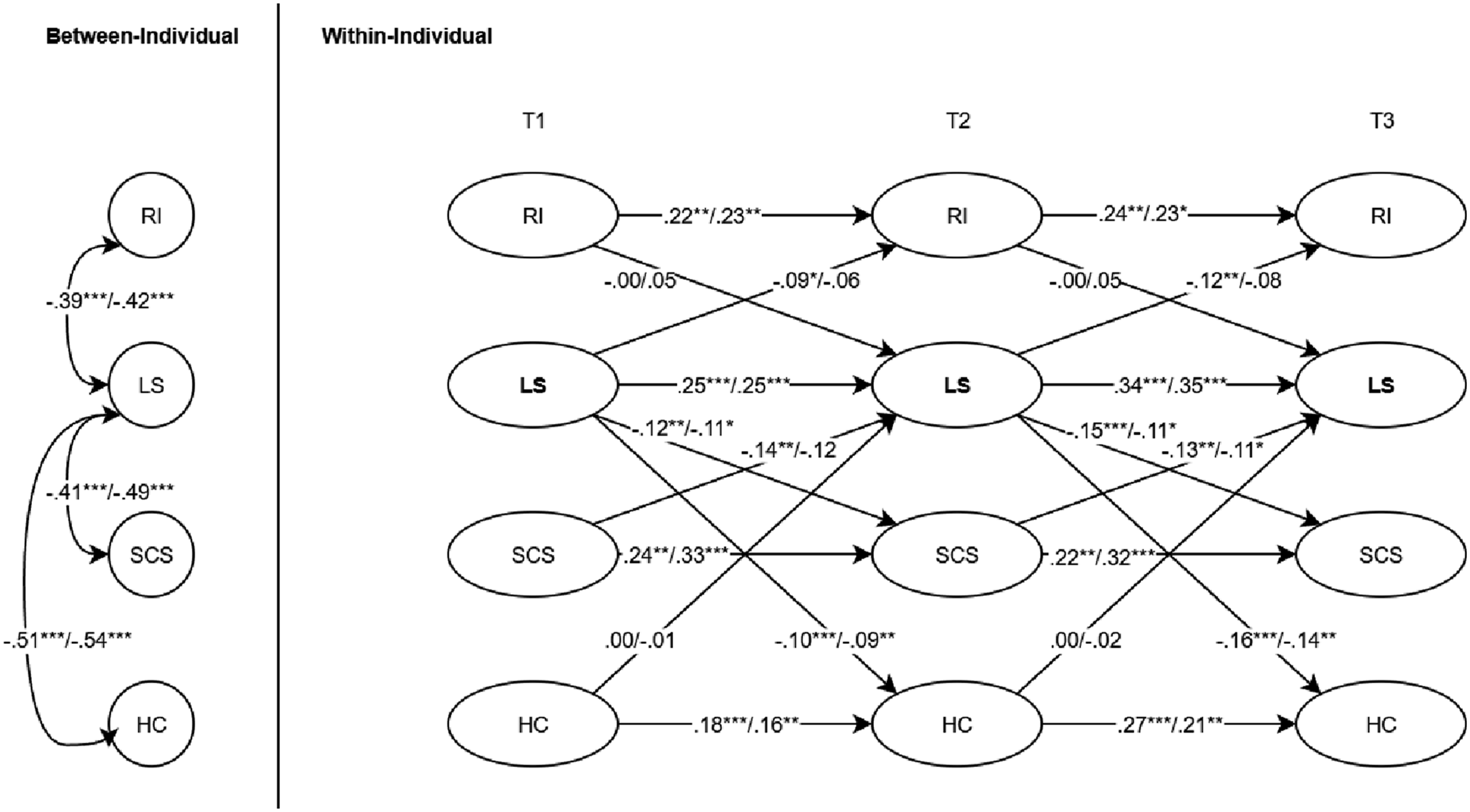
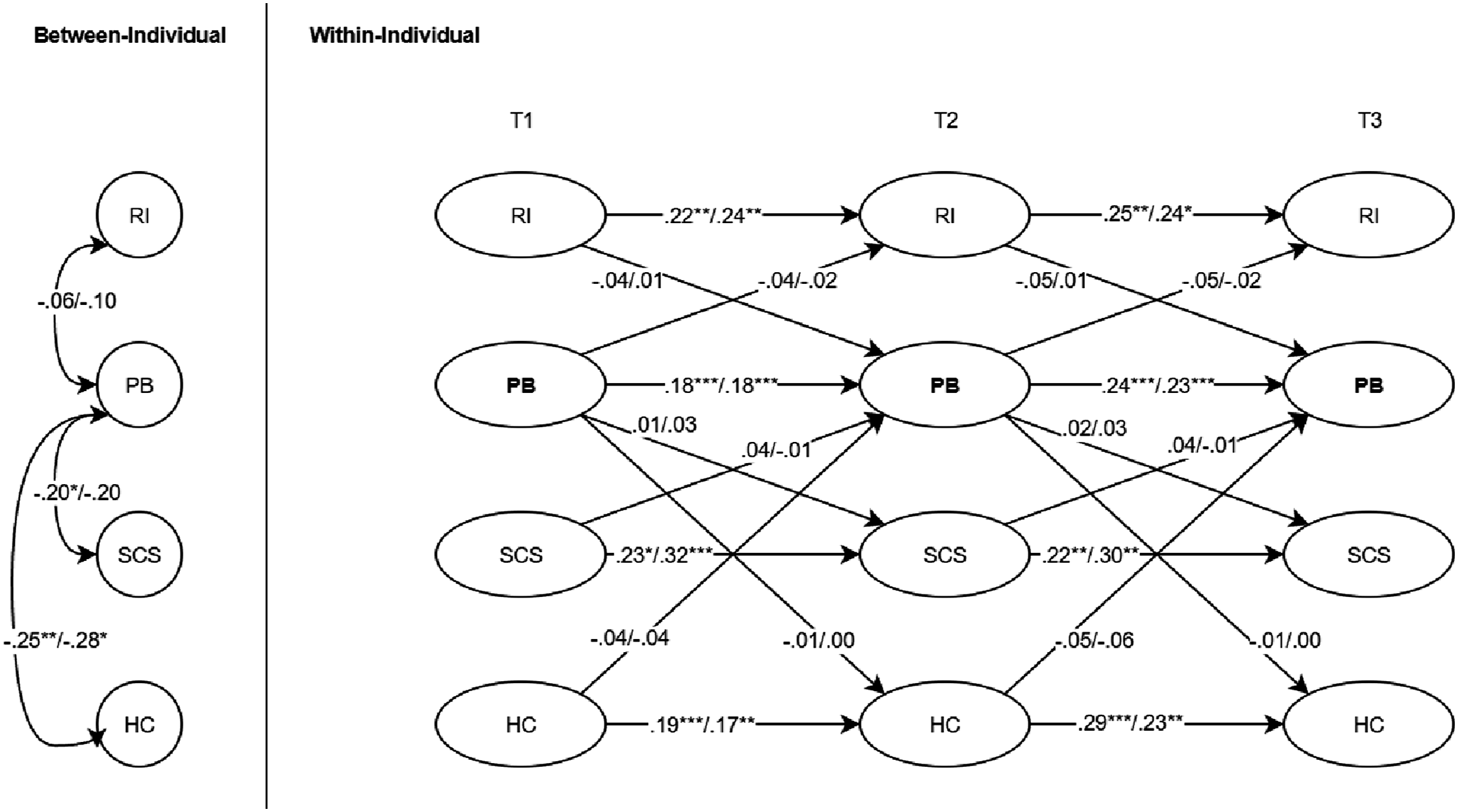
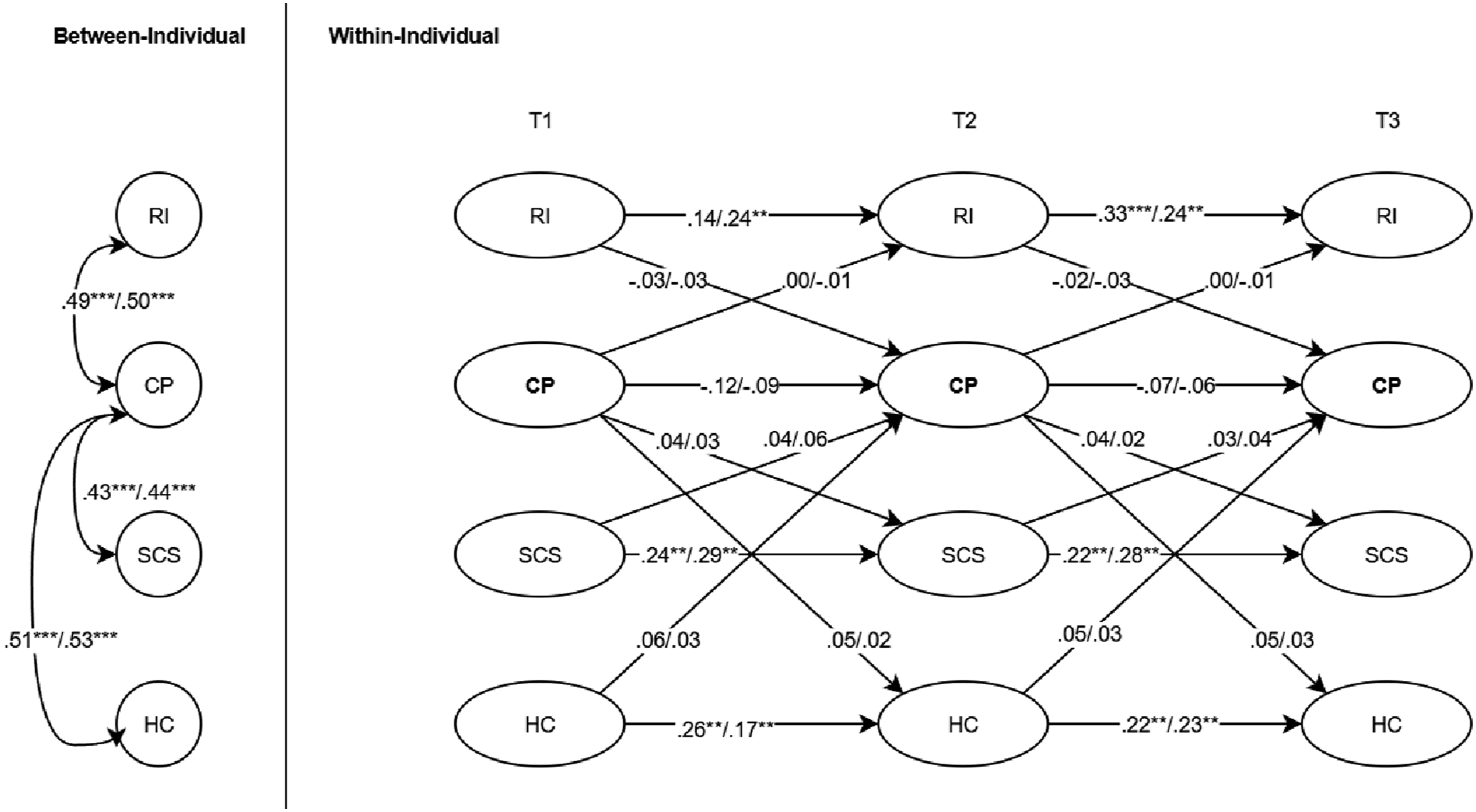
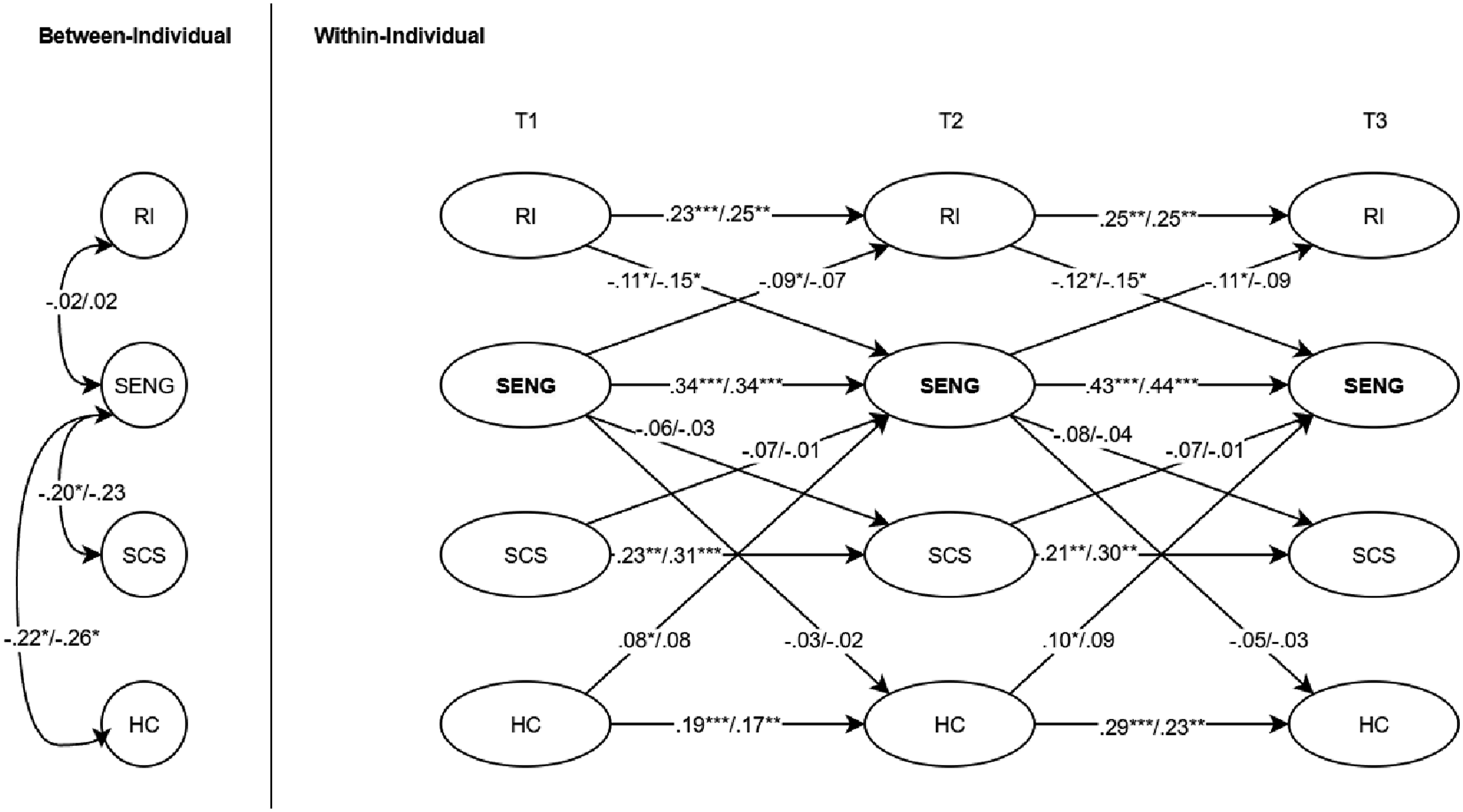
Bivariate correlations between variables at Time 1 are shown in Table S3 in the Supplemental Materials. To examine the longitudinal associations between parental PC and adolescent outcomes, we compared the freely estimated RI-CLPMs and constrained models. Model 4, with cross-lagged and stability paths fixed to be time-invariant, was retained (see Table S4 in Supplemental Materials). Results from the final RI-CLPMs are shown in Figure 1 (mental health issues), Figure 2 (life satisfaction), Figure 3 (prosocial behavior), Figure 4 (conduct problems), and Figure 5 (school engagement). RI-CLPM on psychological control dimensions and adolescent mental health issues. RI-CLPM on psychological control dimensions and adolescent life satisfaction. RI-CLPM on psychological control dimensions and adolescent prosocial behavior. RI-CLPM on psychological control dimensions and adolescent conduct problems. RI-CLPM on psychological control dimensions and adolescent school engagement.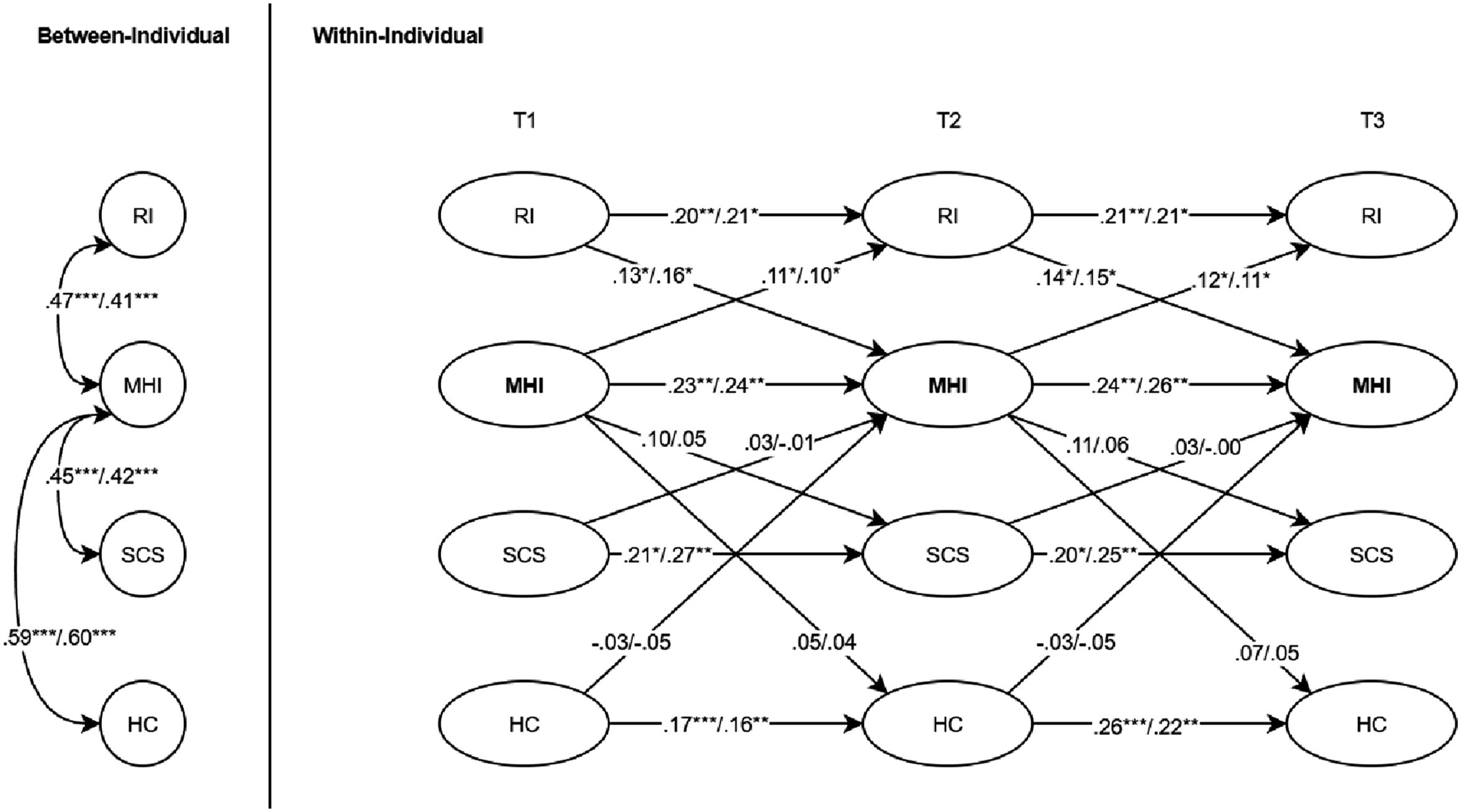
Between-Family Effects
At the between-family level, maternal and paternal relational induction were both positively associated with adolescents’ mental health issues (Figure 1), negatively with adolescents’ life satisfaction (Figure 2), and positively with adolescents’ conduct problems (Figure 4). No significant between-family correlations were found for parental relational induction with adolescent prosocial behavior (Figure 3) or school engagement (Figure 5).
Both maternal and paternal social comparison shame were positively associated with adolescent mental health issues (Figure 1), negatively with adolescent life satisfaction (Figure 2), and positively with adolescent conduct problems (Figure 4). Maternal social comparison shame was also negatively associated with adolescents’ prosocial behaviors (Figure 3) and school engagement (Figure 5), while paternal associations were non-significant.
Both parents’ harsh control was positively associated with adolescents’ mental health issues (Figure 1) and conduct problems (Figure 4), while negatively associated with adolescents’ life satisfaction (Figure 2). Maternal, but not paternal, harsh control was negatively associated with adolescents’ prosocial behavior (Figure 3) and school engagement (Figure 5).
Within-Family Lagged Effects
Parent Effect
After controlling for other associations, within-family lagged effects showed some differences. Maternal and paternal relational induction both positively predicted mental health issues (Figure 1) and negatively predicted school engagement (Figure 5) among adolescents over time. Relational induction did not significantly predict other adolescent developmental outcomes (Figures 2–4).
Maternal social comparison shame negatively predicted adolescents’ life satisfaction over time, whereas paternal social comparison shame negatively predicted adolescent life satisfaction from Time 2 to Time 3 but not from Time 1 to Time 2 (Figure 2). Neither parent’s social comparison shame significantly predicted other adolescent outcomes.
Harsh control did not significantly predict adolescents’ outcomes, except for school engagement, where the results showed an opposite direction from the between-family effect. Specifically, maternal harsh control positively predicted adolescent school engagement, while paternal harsh control did not (Figure 5).
Adolescent Effect
Adolescents’ mental health issues positively predicted both maternal and paternal relational induction but not parental social comparison shame or harsh control over time (Figure 1). Youth life satisfaction negatively predicted all three maternal PC dimensions, paternal social comparison shame, and paternal harsh control but not paternal relational induction (Figure 2). Youth school engagement negatively predicted maternal (but not paternal) relational induction, with no significant predictions on other parental PC dimensions (Figure 5). There were no significant predictive effects of adolescent prosocial behavior and conduct problems on any parental PC dimensions (Figures 2 and 3, respectively).
Discussion
This longitudinal study examined how individual dimensions of Chinese parental PC (relational induction, social comparison shame, and harsh control) were differentially associated with adolescent outcomes over time, distinguishing within-family temporal dynamics from between-family associations. Our findings revealed nuanced mechanisms underlying these dimensions, challenging oversimplified classifications of parental PC practices as purely adaptive or maladaptive.
Differential Effects of Parental PC Dimensions
Between-Family Effects
Most previous studies have identified between-family associations between parental PC and adolescent developmental outcomes, but with inconsistent findings. Our results generally support the hypothesis that the three parental PC dimensions are differently associated with adolescent outcomes, depending on the outcome measures. All PC dimensions showed significant positive associations with adolescents’ mental health problems and conduct problems, and negative associations with youth life satisfaction. These patterns align with prior evidence linking parental PC to adolescent maladjustment (Basili et al., 2021; Lansford, 2022; Leung & Shek, 2020). Maternal and paternal PC associations were largely comparable, supporting the notion that both mothers and fathers play essential roles in adolescent development (Zhang & Wang, 2024). This also aligns with recent suggestions that gender differences in parenting roles may be diminishing as more mothers work and more fathers take on caregiving (Hou et al., 2020).
Furthermore, harsh control and/or social comparison shame showed stronger negative associations with youth prosocial behaviors and school engagement than relational induction. These findings are consistent with research that distinguishes harsh control (universally detrimental) from more culturally normative PC practices (Fang et al., 2022; Zhu et al., 2023), but in contrast to the literature that frames social comparison shame as less detrimental than overtly punitive practices (Fung & Lau, 2012). This discrepancy may reflect contextual or cultural differences in how adolescents perceive and internalize socially comparative shaming, particularly when measured separately for mothers and fathers.
Our analysis revealed parental gender effects for youth prosocial behavior, conduct problems, and school engagement, with maternal PC showing stronger associations than paternal PC. For example, maternal social comparison shame and harsh control showed negative associations with adolescent prosocial behaviors, while only paternal harsh control showed comparable associations. The existing literature that differentiates between maternal and paternal PC has also reported stronger maternal effects (Luebbe et al., 2014; Shek & Law, 2014). However, these studies assessed limited outcomes solely in either psychological or behavioral domains, whereas our integration of psychological, behavioral, and academic domains clarifies nuanced discrepancies in parental influence. Overall, between-family associations in our study largely align with prior findings. The differential effects of parental PC dimensions, particularly the pronounced detriment of harsh control and social comparison shame, highlight the need to re-examine assumptions about their relative impacts. By incorporating different parental PC dimensions and both adolescent-reported maternal and paternal PC, our study provided a framework to reconcile mixed results from earlier work.
Within-Family Effects
At the within-family level, differential patterns were found. Parental relational induction predicted increased mental health problems and reduced school engagement among adolescents over time, though it showed no significant associations with adolescent life satisfaction, prosocial behavior, or conduct problems. These within-family effects contradict prior work framing relational induction as less detrimental or even adaptive in Chinese contexts (e.g., Chen-Bouck & Patterson, 2021; Zhu et al., 2023). The results yet align with the recent notion that even culturally normative parental practices carry risks in modern China. As Chinese adolescents increasingly prioritize autonomy (Chen-Bouck & Patterson, 2021), parental appeals to familial obligations may be reinterpreted as implicit criticism. Notably, the within-family effects of maternal and paternal relational induction may be amplified in academic contexts, as they diverge from the non-significant between-family patterns and predict decreased school engagement among adolescents. Rising societal competition intensifies parental pressure to secure adolescents’ success, especially academic success (Gu, 2021; Su & Liu, 2021). When adolescents perceive themselves as failing to meet their parents’ standard academically, they might internalize guilt, exacerbating psychological distress and disengagement from school. However, the nonsignificant association with life satisfaction may suggest that within-family shifts in relational induction do not undermine adolescents’ overall evaluations of their lives. Life quality evaluations may still be influenced by broader and more stable factors that are less reactive to short-term parenting shifts or buffered by external factors (e.g., peer support, extracurricular achievements). Comparatively, the significant associations at the between-family level suggest that adolescents from families with generally higher emphasis on relational induction tend to report lower well-being. The limited within-family association between parental relational induction and adolescent behavioral outcomes underscores its domain specificity: while it is potent in predicting psychological states, its effect on overt behaviors appears constrained.
While prior research suggests that parental social comparison shame is less detrimental than overtly harsh control practices (Fung & Lau, 2012), our findings revealed context-dependent nuances. Between families, parental social comparison shame demonstrated broad associations with youth mental health problems, conduct problems, and life satisfaction, paralleling the effects of parental harsh control. Within families, however, it uniquely predicted diminished adolescent life satisfaction, with no significant links to adolescent mental health issues, conduct problems, or school engagement. Maternal social comparisons often target children’s personal traits, academics, and peer relationships, undermining self-worth across domains (Zong & Hawk, 2025). This cross-domain focus may prompt adolescents to internalize comparisons, especially those from the most significant others (i.e., mother as the primary socialization agent in general), leading to global dissatisfaction with themselves and their lives (Cao et al., 2025). Nevertheless, the stress-buffering effect of peer support (Rueger et al., 2016) suggests that the increasing influence of peers during adolescence may buffer the negative impact of maternal social comparison on adolescents’ feelings about their lives (e.g., group-based belonging could attenuate this effect), which would be a promising future research direction.
However, the absence of within-family links to adolescents’ behavioral or emotional dysregulation among adolescents may reflect divergent coping strategies. While some adolescents might experience distress, others might perceive it as inspiring and motivating if they interpret it positively. Unlike guilt induction, which may motivate reparative actions, social comparison shame erodes adolescents’ overall life content without necessarily triggering behavioral or emotional dysregulation. The harms of parental social comparison shame may manifest differently at different analytical levels. While its between-family effects parallel harsh control in breadth, its within-family impact is specific to diminished life satisfaction. This context dependence suggests that dyadic dynamics may temper the intrafamilial expression of social comparison shame. For example, in families with strong parent-child bonds or a history of constructive feedback, social comparison shame might be interpreted as context-specific guidance rather than global devaluation. When interpreted in this way, its negative effects could be mitigated (Cao et al., 2025; Cheah et al., 2019). Furthermore, cultural acceptance of comparison practices within a family could normalize social comparison shame, potentially reducing its perceived harm on symptom-based outcomes.
Indeed, recent research indicates that parental social comparison may not always be detrimental. When parents frame comparisons with benign intention and adolescents perceive them as upward identification (focusing on similarities with better performers), it can inspire motivation, self-improvement, higher academic self-efficacy, and less self-handicapping (Collie et al., 2020; Xing et al., 2022). Adolescent resilience may also play a key role: even when parental social comparison is perceived as negative, adolescents might minimize disruptions to their mental health and behavior while still internalizing broader life dissatisfaction. In China’s face-conscious cultural context, this parenting practice clashes with adolescents’ developmental need for autonomy and social respect. Public comparisons risk magnifying humiliation within familial hierarchies. When mothers critique core aspects of their children’s identity, they risk estrangement and a decline in self-esteem. Thus, while social comparison shame may appear “softer” than harsh control, its harm is both context-specific and culturally moderated. The specific mechanisms proposed here, including the moderating roles of relational history, cultural acceptance, and adolescent resilience, represent novel interpretations that require further empirical validation (Xing et al., 2022).
Our findings reveal that parental harsh control also exerted its influence differentially across analytical levels: while its association with adolescents’ psychological outcomes manifested primarily at the between-family level, its mixed and sometimes seemingly adaptive effects on youth behavioral outcomes operated at the within-family level. Consistent with prior research (Basili et al., 2021; Hoeve et al., 2009), between-family analyses revealed that parental harsh control was associated with all adverse adolescent outcomes (e.g., mental health issues, conduct problems), underscoring its systemic harm in families that rely heavily on punitive practices. However, within-family analyses yielded paradoxical patterns: maternal harsh control predicted increased adolescent school engagement over time, whereas the between-family correlation was negative. This contradiction challenges prevailing assumptions that parental harsh control uniformly undermines functioning, suggesting its consequence may depend on which developmental outcome domain is prioritized. This pattern also reflects Simpson’s paradox, where associations reverse across analytical levels (Aunola et al., 2013; Rekker et al., 2017). Maternal harsh control was linked to higher adolescents’ school engagement within families (e.g., adolescents working harder in response to maternal criticism or investing more in schools to cope with a hostile home environment), but adolescents from families with chronically harsher control (between-family level) showed lower engagement overall. Critically, this reversal highlights how analytical levels shape interpretations: while within-family effects might suggest short-term behavioral adjustments (e.g., increased effort), between-family patterns reveal broader and long-term risks associated with punitive parenting climates.
The seemingly “adaptive” within-family effect must be interpreted through the lens of cultural dynamics in Chinese societies, where academic achievement is intensely emphasized (Zhang, 2020). Parents may employ harsh control to convey high expectations and family rules, with adolescents interpreting criticism as a signal to comply behaviorally and avoid punishment or disapproval (Cheung & Pomerantz, 2012). For example, adolescents fearing parental hostility over poor grades associated with insufficient learning engagement may increase their effort in school, explaining the positive link between harsh control and school engagement. These behavioral-level gains mask significant costs: chronic stress, diminished intrinsic motivation, and decreased academic achievement (L. Xu, He, et al., 2024). These risks are corroborated by our between-family findings, which consistently link harsh control to poorer mental health and lower life satisfaction in the long run (Ng & Wei, 2020). Thus, while parental harsh control might appear effective in specific contexts, its benefits are fragile, context-bound, and counterbalanced by psychological harm. These findings caution against conflating behavioral compliance with holistic well-being, urging further investigation into the disconnect between short-term behavioral outcomes and long-term psychological costs.
Adolescent Effects on Parental PC
The bidirectional associations between adolescent functioning and parental PC dimensions underscore the importance of considering adolescent-driven effects. For example, adolescent-reported mental health problems positively predicted their subsequent perceptions of both maternal and paternal relational induction. This aligns with the depression-distortion hypothesis (Rudolph & Flynn, 2007), wherein adolescents with heightened mental health struggles, such as anxiety or depressive symptoms, may interpret parental communication through a lens of negativity, amplifying their perception of guilt-based tactics. Similarly, lower adolescent-reported life satisfaction was associated with higher perceived maternal and paternal social comparison shame and harsh control over time. This suggests that adolescents who are more dissatisfied with life may be more likely to overinterpret parental comparisons as devaluation or disrespect, even when parents intend them as motivational. They may also consider parents utilizing too many manipulative or coercive behaviors. These patterns highlight how adolescent distress may distort interpretations of parental behavior, inflating perceived PC, consistent with previous findings that internalizing problems predict increased perceived intrusive parenting (Kaniušonytė & Žukauskienė, 2016; Yu et al., 2021; Zhu & Shek, 2020).
The predictive effect of adolescent outcomes on perceived PC may also reflect parental reactivity or adjustment of their control tactics based on adolescents’ observable behaviors. For example, adolescents’ school engagement negatively predicted maternal relational induction over time, suggesting that mothers may escalate guilt-inducing tactics when they notice a decline in their child’s academic effort. Parents appear to intensify PC in response to academic disengagement, reflecting cultural pressures to enforce compliance with educational expectations (Cheung & Pomerantz, 2012) and demonstrating how parents escalate control in reaction to externalizing problems (Moilanen et al., 2009; Reitz et al., 2006; Zhu & Shek, 2020). Such effects may be more accurately captured through the use of multiple reporters. Future research should address this potential perceptual gap by employing multi-informant designs to determine whether adolescent disengagement truly elicits parental reactions or reflects perceptual biases.
Strengths, Limitations, and Future Directions
This study has several key strengths. First, the multidimensional approach to parental PC allowed for nuanced investigation and comparisons of individual PC dimensions. Second, the longitudinal design enabled evaluation of bidirectionality in parent-child effects, disentangling whether parental PC predicts adolescent maladjustment or vice versa, clarifying transactional pathways. Third, the use of RI-CLPM to disentangle within-family fluctuations (e.g., time-specific changes in parenting tactics) from between-family differences (e.g., stable family-level norms) resolved analytical ambiguities. Fourth, the assessment of outcomes across psychological (e.g., mental health problems, life satisfaction), behavioral (e.g., conduct problems, prosocial behaviors), and academic (i.e., school engagement) domains allowed us to determine whether PC dimensions exert universal or domain-specific effects. Together, these strengths provide a nuanced, ecologically valid framework for understanding how psychological control operates across temporal and developmental dimensions.
Despite these strengths, several limitations merit attention. First, the study did not account for broader family dynamics (e.g., marital quality, coparenting interactions) or individual moderators (e.g., adolescent resilience, parental authoritarian traits) that may shape PC’s associations with developmental outcomes. Prior research highlights partner effects in PC: for instance, marital dissatisfaction is directly linked to more negative parenting and a poorer parent-child relationship (Wang et al., 2024). In addition, we did not distinguish between the perceived PC of biological parents and that of stepparents. Previous research also reported that children living with biological parents have different developmental outcomes from those in stepparent families (Nicholson et al., 2002). Future studies should investigate how coparenting dynamics (e.g., alignment or discord in control tactics) and family structure (e.g., biological parents versus stepparents) moderate the effect of PC.
Second, our reliance on adolescents’ self-reports of both parental PC and developmental outcomes is a limitation that may introduce bias. Previous studies generally found that child-perceived parental PC is higher than parents’ self-reported PC, and that the former shows a stronger association with child developmental outcomes than the latter (Hou et al., 2020; Salaam & Kyere, 2025). It can be argued that it is how adolescents perceive and experience parents’ socialization (e.g., PC) that shapes their development, and thus adolescents’ self-reports have been widely used as a valid data collection method in youth research and family studies (Cao et al., 2025; Salaam & Kyere, 2025). Nevertheless, including both adolescents and parents (e.g., mothers, fathers, or both) as informants can incorporate multiple perspectives within the family and offer a more balanced investigation. In addition, solely relying on adolescents’ self-reports may risk overlooking objective behavioral markers (e.g., teacher observations). Nuanced constructs like school engagement require finer-grained measurement to distinguish between behavioral compliance and emotional investment. Thus, future research could employ mixed-method designs (e.g., observational assessments and daily diaries) and include parent-reported measures, thereby providing a more comprehensive understanding of family dynamics and helping address potential perceptual gaps between parents and adolescents.
Third, although we interpreted our findings through culturally unique interpretations of different parental PC dimensions, especially relational induction and social comparison shame, we did not measure adolescents’ actual appraisals of these dimensions and thus could not test our explanations. Previous research reported that adolescents may differ in their ways of interpreting and coping with parental PC, and adolescents’ positive attributions of some parental PC tactics would mitigate their negative effects on adolescent development (Cheah et al., 2019; Smetana et al., 2021). It is possible that adolescents’ interpretations of parents’ intentions (benign and good for children versus negative and disrespectful) behind their social comparison shame contribute to the present complex and context-dependent findings on social comparison shame’s association with adolescent developmental outcomes. Built on our multidimensional operation of parental PC, future research will benefit from directly investigating how adolescents’ appraisals of these dimensions may moderate the link between parental PC dimensions and adolescent outcomes.
Fourth, while some of our findings support the argument that relational PC might be less harmful and even beneficial to children’s development in interdependent cultures, such as in China (Fung & Lau, 2012), other findings suggest that even culturally acceptable PC practices also carry risks to adolescent development in contemporary China (Su & Liu, 2021). One essential factor that may account for such variations in the association between parental PC and adolescent developmental outcome is adolescents’ endorsement of traditional interdependent cultural norms and cultural values. For example, a recent study reported a significant moderation effect of adolescents’ beliefs about reciprocal filial on the relationship between parental social comparison shame and adolescent meaning in life (Cao et al., 2025). Thus, with rapid development in China, a promising future research direction is within-culture heterogeneity in Chinese adolescents’ susceptibility to parental PC, given their differing endorsement of cultural values and family obligations. Investigation of cultural moderators will advance culturally informed models of parental PC and its developmental consequences.
Fifth, the present study involved only Chinese adolescents recruited from three public secondary schools, using a purposive sampling strategy. On the one hand, the present findings on the association between parental PC and adolescent outcomes may not reflect the dynamics among younger children, who lack the same protective factors as adolescents (e.g., peers and activities outside the home) and may thus be more vulnerable to maladaptive parenting practices, such as harsh PC. Meanwhile, a competing hypothesis is that younger children are more likely to depend on their parents and have lower needs for autonomy and independence than adolescents, and thus are less affected by controlling tactics. Given the different possibilities, further research will certainly benefit from involving more diverse samples (e.g., children and adolescents) and from comparing the links between parental PC and developmental outcomes across these samples. On the other hand, a sample from a limited number of schools may have insufficient representativeness, limiting the generalizability of the findings. For example, the present sample of adolescents demonstrated relatively low levels of mental health issues and conduct problems across waves. In addition, missing data across variables due to adolescents’ absences, non-responses, and invalid responses were not missing completely at random at all waves. Therefore, future research should aim to replicate this study with diverse populations (e.g., children, adolescents, and emerging adults across multiple Chinese communities or even in other cultures) and among adolescents who evidence a greater range of adjustment to further verify the present findings.
Conclusion
This study investigated the longitudinal and bidirectional dynamics between three dimensions of parental PC (relational induction, social comparison shaming, and harsh control) and adolescent adjustment across psychological, behavioral, and academic domains in Chinese families. Key findings revealed that even culturally normative parental practices like relational induction and social comparison shame predicted heightened psychological distress among adolescents over time, while parental harsh control demonstrated paradoxical short-term compliance coupled with long-term harm to adolescents. Bidirectional analyses further uncovered transactional pathways, where adolescent maladjustment (e.g., low school engagement) elicited increased perceived parental PC, perpetuating cycles of family stress. Theoretically, this work advances parenting research by disentangling within-family temporal fluctuations from between-family differences using RI-CLPM, resolving ambiguities inherent to static or culturally decontextualized frameworks. It also challenges assumptions about “adaptive” PC tactics, demonstrating that practices like social comparison shame, despite their cultural prevalence, carry hidden psychological costs. Practically, these findings urge parents and practitioners to critically evaluate compliance-driven strategies, advocating instead for autonomy-supportive approaches that balance cultural expectations with adolescents’ emotional well-being—for instance, fostering cooperation through shared goals rather than guilt-based coercion.
Supplemental Material
Supplemental Material - Longitudinal Relationships Between Parental Psychological Control Dimensions and Adolescent Developmental Outcomes in the Chinese Mainland: Random-Intercept Cross-Lagged Panel Models
Supplemental Material for Longitudinal Relationships Between Parental Psychological Control Dimensions and Adolescent Developmental Outcomes in the Chinese Mainland: Random-Intercept Cross-Lagged Panel Models by Xiaoqin Zhu, Wenqing Zong, Xiaohong Luo, Liechuan Cui, Kaiji Zhou in The Journal of Early Adolescence
Footnotes
Acknowledgments
We would like to thank all participating schools and adolescent participants, as well as their parents, who gave great support to this study.

Ethical Considerations
This study was reviewed and approved by the Institutional Review Board at The Hong Kong Polytechnic University (Reference number: HSEARS20220427002 for the baseline survey and HSEARS20230516001 for the follow-ups).
Consent to Participate
Consent was obtained from all participating schools, participating students, and their parents.
Consent for Publication
Written informed consent for publication was obtained from all participating schools, the participating students, and their parents.
Author Contributions
The contributions of the authors during the submission process were as follows: XZ: Conceptualization, Methodology, Investigation, Data Curation, Writing - review & editing, Supervision, Funding Acquisition. WZ: Methodology, Data Curation, Formal Analysis, Writing - original draft, Writing - review & editing. XL: Data Curation, Writing - original draft. LC: Writing - review & editing. KZ: Writing - original draft. All authors have agreed to the final submitted version.
Funding
The authors disclosed receipt of the following financial support for the research, authorship, and/or publication of this article: The work described in this paper was partially supported by a grant from the Research Grants Council, University Grants Committee (Grant Number: PolyU 25609723) and a departmental grant from The Hong Kong Polytechnic University (Grant Number: P0046167) granted to the corresponding author.
Declaration of Conflicting Interests
The authors declared no potential conflicts of interest with respect to the research, authorship, and/or publication of this article.
Data Availability Statement
The data that support the findings of this study are available on request from the corresponding author. The data are not publicly available due to ethical restrictions.
Supplemental Material
Supplemental material for this article is available online.