




Abstract
Educational attainment and job satisfaction are crucial milestones for a successful transition to adulthood. Parental knowledge of their adolescents’ lives may promote a positive trajectory toward such outcomes. However, the longitudinal associations between parental knowledge, educational attainment and job satisfaction might differ depending on the family context or on youth personal assets. Thus, this study examined potential moderators of these associations. The sample included 818 American youth recruited in early adolescence (M age = 12.20 years, 46% girls, 43.5% European Americans, 27.6% African Americans, 28.9% Multiethnic or other) and followed up through adulthood (M age = 28.93 years). Path analyses showed that parental knowledge predicts educational attainment among youth with higher academic achievement and those with lower levels of positive family relations. Parental knowledge was unrelated to job satisfaction. Results reveal the complex mechanisms through which family factors and personal assets interact while predicting a successful transition to adulthood.
Completing education and entering the labor market are widely recognized developmental milestones of adulthood (Cepa & Furstenberg, 2021). Educational attainment, which refers to the highest level of education an individual has successfully completed, is related to upward social mobility, happiness, and better physical and mental health (Araki, 2022; Johnson et al., 2022; Nikolaev, 2018). Moreover, self-perceptions of thriving at work are positively correlated with health, work engagement, and negatively related to burnout (for a meta-analysis, see Kleine et al., 2019). Given the benefits of educational attainment and job satisfaction, it is essential to examine their antecedents during early adolescence, when key predictors can be targeted by early interventions.
In particular, parent-child relationships could be an important target, as they play a crucial role in youth educational pathways and vocational choices (for a meta-analysis, see Barger et al., 2019). Furthermore, early adolescence is an important period for the development of independence (Branje, 2018). Thus, parents need to learn how to give their adolescent the right amount of freedom while remaining informed of their activities, friendships, and whereabouts—a concept known as parental knowledge (Pelham III et al., 2024). Building such parental knowledge during early adolescence is essential as the family prepares for the youth’s successful transition to adulthood a few years later. In fact, parents are still a valued source of support for important life decisions like academic programs or career choices (Ahn et al., 2023), hence the importance of staying well informed of their child’s activities and preferences. Moreover, emerging studies suggest that the benefits of parental knowledge may be stronger in specific contexts (e.g., when paired with positive family relations; Afia et al., 2019; Lowe & Dotterer, 2013). Parental knowledge is also particularly useful for parents when youth face difficulties that require closer monitoring and more guidance (Omer et al., 2016). Thus, this study aims to examine potential moderators of the links between parental knowledge, educational attainment, and job satisfaction.
The Importance of Parental Knowledge During Early Adolescence
Examining parent-child relationships in early adolescence is necessary to develop targeted parenting interventions and prevent potential long-term deleterious consequences of psychosocial and school maladjustment that can occur in the middle school years. Early adolescence is characterized by high neural plasticity and numerous physiological changes due to puberty onset (Sisk & Gee, 2022). Thus, several risk-taking behaviors can emerge during early adolescence, including binge-drinking, cannabis use, vaping and smoking, and risky sexual behaviors (for a review, see Willoughby et al., 2021). Such risk-taking behaviors can drive adolescents away from successful adjustment during the adolescent years, and this is why parental knowledge is particularly important at this age. In other words, parents play an essential role, as youth continue to learn how to navigate their sociocultural environment and are still highly sensitive to their caregiving environment (for a review, see Cheng et al., 2024).
Different concepts and measures associated with parenting have been developed and used to help understand how parents of young adolescents can help prevent misbehavior and promote positive youth adjustment (for reviews and meta-analyses, see Dittus et al., 2015, Pelham III et al., 2024; Yap et al., 2017). Relatedly, Pelham III et al. (2025) published a theory to explain how parental monitoring influences youth behavior. Parental monitoring refers to the behaviors that parents perform to gain information about their child’s life and activities, such as asking their youth for information, rule setting, and observation. Monitoring behaviors can increase youth’s sense of social support and improve the parent-youth emotional bond, which, in turn, should increase youth disclosure and, ultimately, parental knowledge. According to Pelham III et al.’s (2025) theoretical model, parental knowledge, which corresponds to what parents learn about their youth’s whereabouts, friendships, and activities, allows parents to adapt their behaviors to adolescents’ needs (e.g., providing positive reinforcement, social support, or punishment).
Because prior research has often confounded the concepts of parental knowledge and parental monitoring, it is necessary to consider empirical research on parental monitoring to inform current studies of parental knowledge as a predictor of youth development (Pelham III et al., 2024). Studying parental knowledge, as is the case in the present study, helps better understand the role of parents in positive youth development at a global level, regardless of the specific parental monitoring behaviors that nurtured parental knowledge. In sum, both concepts are strongly tied to one another, and a review of results pertaining to both parental monitoring and knowledge provides useful background information for the current study.
Studies show that parental monitoring behaviors tend to decrease during adolescence, which implies that parental knowledge might decrease too (for a meta-analysis, see Lionetti et al., 2019). This normative process may occur because youth gain independence, share less information about their lives, and therefore, negotiation and conflicts are expected in the parent–child relationship (Branje, 2018). It is important, however, that parents stay involved in their adolescents’ lives and maintain a positive relational climate because this context is known to promote parents’ knowledge through youth’s self-disclosure, and this knowledge is crucial for parents to provide their youth with adequate guidance and external regulation (e.g., setting limits and rules; Fosco & LoBraico, 2019). Most extant studies on parental knowledge focused on the prevention of negative outcomes during adolescence (e.g., substance use, affiliation with deviant peers; Omer et al., 2016; Pelham III et al., 2024). Relatedly, some studies have examined the potential long-term effects of parental monitoring and knowledge during early adolescence. One prospective longitudinal study showed that parental knowledge during early adolescence was related to less deviant peer affiliation, and indirectly to lower substance use in late adolescence (Van Ryzin et al., 2012). Another longitudinal study suggested that parental monitoring through rule setting during early adolescence was associated with reduced problem drinking and fewer sexual partners in early adulthood, albeit only among men (Roche et al., 2008). Although limited, extant studies suggest that parental knowledge may have long-term consequences on youth development by reducing problematic behaviors. However, less is known about the associations between parental knowledge, educational attainment, and job satisfaction.
Parental Knowledge, Educational Attainment, and Job Satisfaction
Parents can promote educational attainment during adolescence by using their parental knowledge and monitoring strategies to help their youth focus on their schooling (Afia et al., 2019). School transitions that occur during early adolescence can significantly affect youth academic success in the long term, as they come with particular social challenges, such as changes in social networks. The transition from elementary to middle school is associated with higher levels of school-related issues and truancy (for a systematic review, see Jindal-Snape et al., 2020). Given that school-related problems may persist over time, parental knowledge during early adolescence may promote higher educational attainment and job satisfaction in adulthood by preventing immediate school problems, maladaptive behaviors, and dropping out. Previous work suggests that parental monitoring behaviors are also positively related to autonomous school motivation and engagement, aspirations, self-efficacy, and academic achievement; these outcomes, in turn, are known predictors of postsecondary education enrollment (Affuso et al., 2023; Cimon-Paquet et al., 2023; Hill & Wang, 2015). Ultimately, these studies suggest that the parental knowledge gained through various monitoring behaviors could help parents guide their adolescents toward a successful educational outcome by adulthood.
Similarly, several parenting behaviors are known to predict career development during adolescence (Ahn et al., 2023). Parental knowledge of their youth’s lives during early adolescence may help parents foster positive career outcomes. In fact, parents who make efforts to stay informed of their youth’s interests and preferences should be better prepared to provide appropriate information and support their decision-making process throughout their educational pathway, allowing them to focus on their interests, develop higher academic aspirations, and foster engagement and achievement towards a satisfying career (Hill & Wang, 2015). However, associations between parental knowledge and job satisfaction have not yet been studied. One longitudinal study showed that other types of positive parenting behaviors (i.e., parental involvement, expectations, and support) in middle and high school were related to higher educational attainment, which in turn, was related to higher job satisfaction, both measured simultaneously in adulthood (ages between 24 and 32; Gordon & Cui, 2015). Another longitudinal study spanning adolescence and early adulthood revealed that positive family relationships were associated with career adaptability (i.e., academic performance, sense of control, and self-worth), which in turn, was related to higher occupational prestige (Sun et al., 2020). To our knowledge, this study is the first to explore parental knowledge during adolescence and its relation to job satisfaction in early adulthood.
The Context of Parental Knowledge Matters
The theoretical model of parental monitoring (Pelham III et al., 2025) posits that there is considerable variability in how parental knowledge may reduce teen misbehaviors. Notably, several parent, adolescent, and family characteristics have been shown to moderate the potential effects of parental monitoring and parental knowledge. Therefore, it is important to examine possible moderators of the links between parental knowledge and adult outcomes, such as educational attainment and job satisfaction.
Family Relations as a Moderator
Considerable efforts have been invested in understanding the broader family contexts in which parental knowledge is most effective. On the one hand, evidence suggests that parental monitoring behaviors and knowledge during the high school years are most effective in promoting adolescent adjustment (i.e., lower problematic behaviors, higher subjective well-being, school motivation, and self-esteem) when they occur in a positive relational climate (e.g., warmth and autonomy support; Lowe & Dotterer, 2013; Rodríguez-Meirinhos et al., 2020). When parents use monitoring behaviors in a negative relational climate (e.g., harsh parenting), youth may react negatively as they perceive their parents’ monitoring behaviors as intrusive (LaFleur et al., 2016; Lowe & Dotterer, 2013). On the other hand, parental knowledge could compensate for a negative relational climate (Afia et al., 2019). In all, few studies focusing on the interaction between parental involvement and positive family environments included educational outcomes, such as attainment, and studies examining how different aspects of parenting during adolescence interact to predict job satisfaction are scarce. Despite some divergent results, extant studies mostly suggest that parental knowledge is more effective in preventing misbehavior when combined with positive family relations, as parental behaviors may be perceived more positively by their youth (Lowe & Dotterer, 2013; Rodríguez-Meirinhos et al., 2020). We thus hypothesized that the link between parental knowledge and educational attainment would be stronger among families with positive family relations.
Family Socioeconomic Status as a Moderator
Family SES is consistently related to higher youth educational attainment and positive career outcomes (Heisig et al., 2020; Hu et al., 2022). Parents who did not graduate from college or complete vocational training may experience difficulties in guiding their youth through the school system and may not have the social network to help their youth integrate professional circles leading to high-quality jobs. Parental knowledge may be more effective in promoting higher educational attainment and job satisfaction in a higher-SES context, as parents may have more financial and social resources to guide their youth if they need help. Empirical results appear to support this hypothesis, as among K-12 students, the association between parental involvement and academic achievement is stronger among families with higher SES (see Tan et al., 2020 for a meta-analysis). In contrast, Pelham III et al.’s (2025) model suggests that parental monitoring may be especially useful in low-SES families, as youth may be exposed to higher levels of parental unemployment, substance use, community violence, and deviant peers. In this context, parental knowledge could motivate parents to implement strategies to prevent their youth from getting involved in activities that may preclude them from focusing on their studies. To our knowledge, empirical studies have not yet investigated the moderating role of family SES in the association between parental knowledge during early adolescence and the outcomes of interest to this study (i.e., educational attainment and job satisfaction). Because extant empirical and theoretical work suggests divergent predictions for the role of SES, we were unable to settle on a specific hypothesis regarding its potential role as a moderator of the associations between parental knowledge and educational attainment or job satisfaction. The moderating effect will thus be tested but remains exploratory.
Academic Achievement as a Moderator
A critical individual characteristic to consider while studying educational attainment and job satisfaction is academic achievement (Benner et al., 2021). Youth with low academic achievement are at high risk of school dropout (Ogresta et al., 2021). In contrast, youth with high levels of academic achievement have more opportunities to access postsecondary schooling and a more comprehensive range of career choices. For adolescents with higher academic achievement, the link between parental knowledge and educational outcomes may be weaker than among youth with lower academic achievement, as the latter may need more parental involvement and guidance. Supporting this hypothesis, a population-representative twin study revealed that the shared family environment (including emphasis on education and financial resources) was a stronger predictor of adult educational attainment for youth who presented a lower intelligence quotient (Johnson et al., 2009). Moreover, another study revealed that the association between parental monitoring and academic achievement a year later was stronger for low-achievers than for high achievers (Hill & Wang, 2015). Considering extant studies, we expected that the link between parental knowledge and educational attainment would be stronger among youth with lower academic achievement.
Additional Individual Characteristics to Consider
Some individual characteristics are associated with successful educational pathways, such as gender and ethnicity. In the United States, women now reach, on average, higher levels of education than men (Juszkiewicz, 2020). Despite considerable efforts, racial disparities persist in school systems, as African Americans have lower educational attainment than European Americans (National Center for Education Statistics, 2023). Evidence also suggests that African Americans have lower career satisfaction (Gordon & Cui, 2015). Studies investigating the association between parental knowledge and educational outcomes found that it does not vary across genders (Affuso et al., 2023; Lowe & Dotterer, 2013).
The Current Study
The theoretical model of parental monitoring suggests that parental knowledge promotes youth adjustment during early adolescence, a developmental period when many changes occur, including an important school transition and neurobiological changes, and which sets the stage for adult adjustment in key life domains, such as education and employment (Pelham III et al., 2025). Moreover, this theoretical model suggests that long-term impacts of parental knowledge depend on the context in which such knowledge develops. This study aimed to examine whether parental knowledge that develops in early adolescence may predict educational attainment and job satisfaction in adulthood, and to explore the moderators of these associations. More specifically, positive family relationships, family SES, and academic achievement during middle school were considered as potential moderators.
The conceptual model is displayed in Figure 1. Based on previous studies, we expected that parental knowledge would be positively related to educational attainment (Hypothesis 1). Moreover, we expected the link between parental knowledge and educational attainment to be stronger in families with higher levels of positive family relations (Hypothesis 2). We did not have a specific hypothesis regarding the potential moderating role of family SES in the association between parental knowledge in adolescence and adult outcomes (educational attainment and job satisfaction) because of the mixed evidence from previous studies. However, the link between parental knowledge and educational attainment was expected to be stronger among adolescents with lower academic achievement (Hypothesis 3). Given that the extant literature on early antecedents of job satisfaction is meager, we conducted exploratory analyses to examine if parental knowledge related to later job satisfaction, as is the case with similar parenting constructs that are also related to positive academic variables. Conceptual model.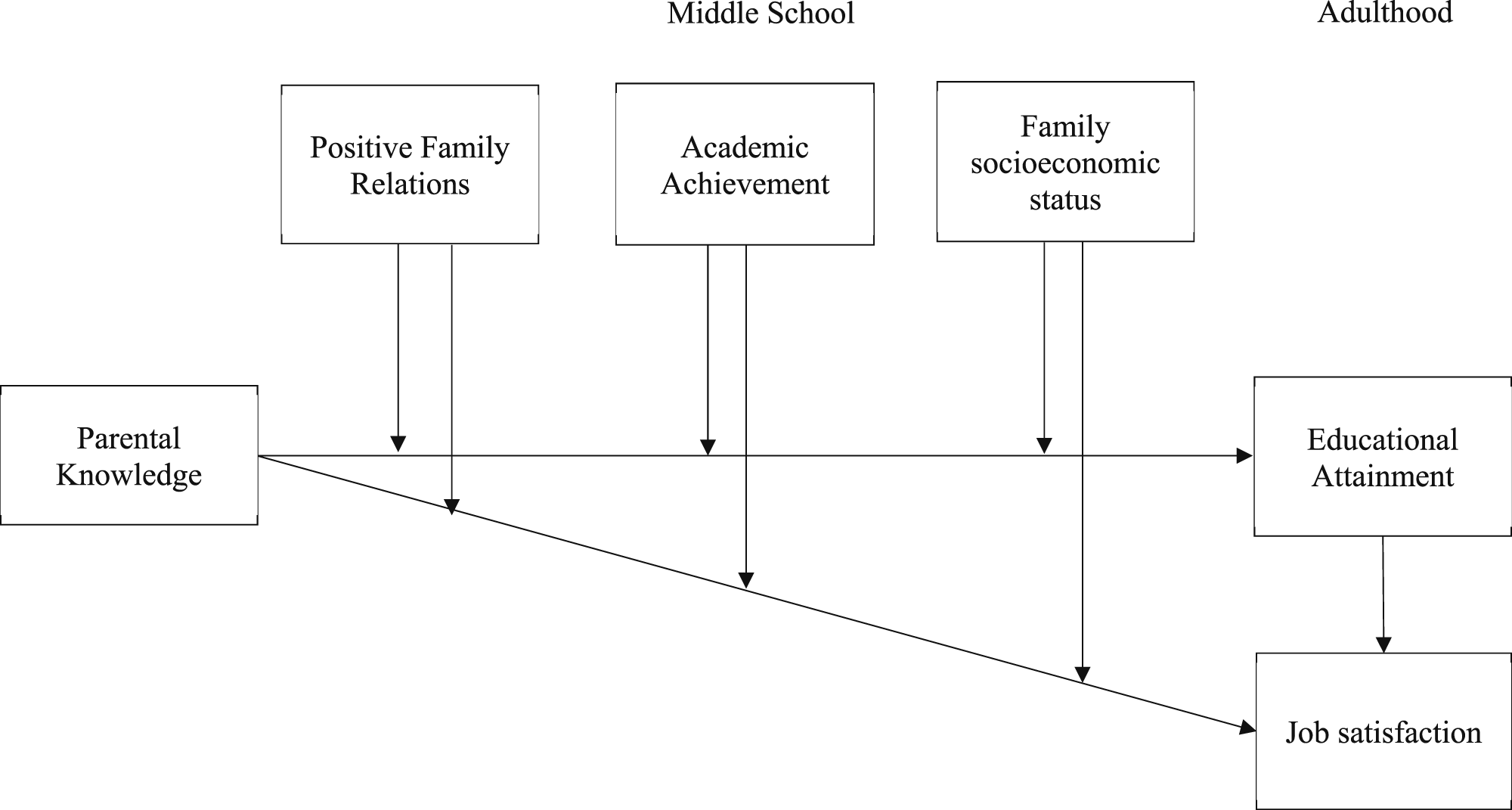
Method
Participants and Procedure
Participants were recruited as part of the Project Alliance, a larger longitudinal project that was developed in an ethnically diverse, predominantly lower-income, metropolitan community in the United States (Véronneau et al., 2014). The current study uses data from 818 participants (376 women, 442 men) who were recruited between 1996 and 1998 in three public middle schools when the youth were in Grade 6 (M age = 12.20 years, SD = 0.37). Gender was assessed by self-reports and coded as 0 (boy) and 1 (girl). Among this sample, 43.5% identified as European Americans, 27.6% as African American, 5.4% as Asian American, 2.2% as Native American, 1.0% as Pacific Islander, 12.8% as multiracial or other, and 7.5% as Latinx. The larger longitudinal project includes several waves of data from middle school to adulthood. The early adolescence waves of data were selected, as parental knowledge is expected to be especially important during this developmental period marked by physiological and social changes (Cheng et al., 2024; Willoughby et al., 2021). Moreover, the last wave of data was selected to assess educational attainment and job satisfaction to ensure that most participants had completed their education.
Participants were included in the current study if they declared that they had a job (n = 575), or if they had missing data on the employment status and job satisfaction variables (n = 243), as participants with occasional missing data can still contribute valuable information to the overall model estimation using the full information maximum likelihood estimator. Participants were excluded from this study if they declared that they were unemployed (n = 179), considering that job satisfaction was a focal variable. Among participants who declared being employed, 77.5 % were working full-time and 22.0% were part-time workers. Of note, 21.6% had a job that was not linked to their long-term career objectives, 23.9% reported they would not continue as a long-term career, but their job provided, 41.9% thought they would probably continue as a long-term career, and 12.6% did not know if their primary job was related to their future work. On average, participants had been working at their job for 3.03 years (SD = 2.89).
Descriptive Statistics and Bivariate Correlations Between all Variables
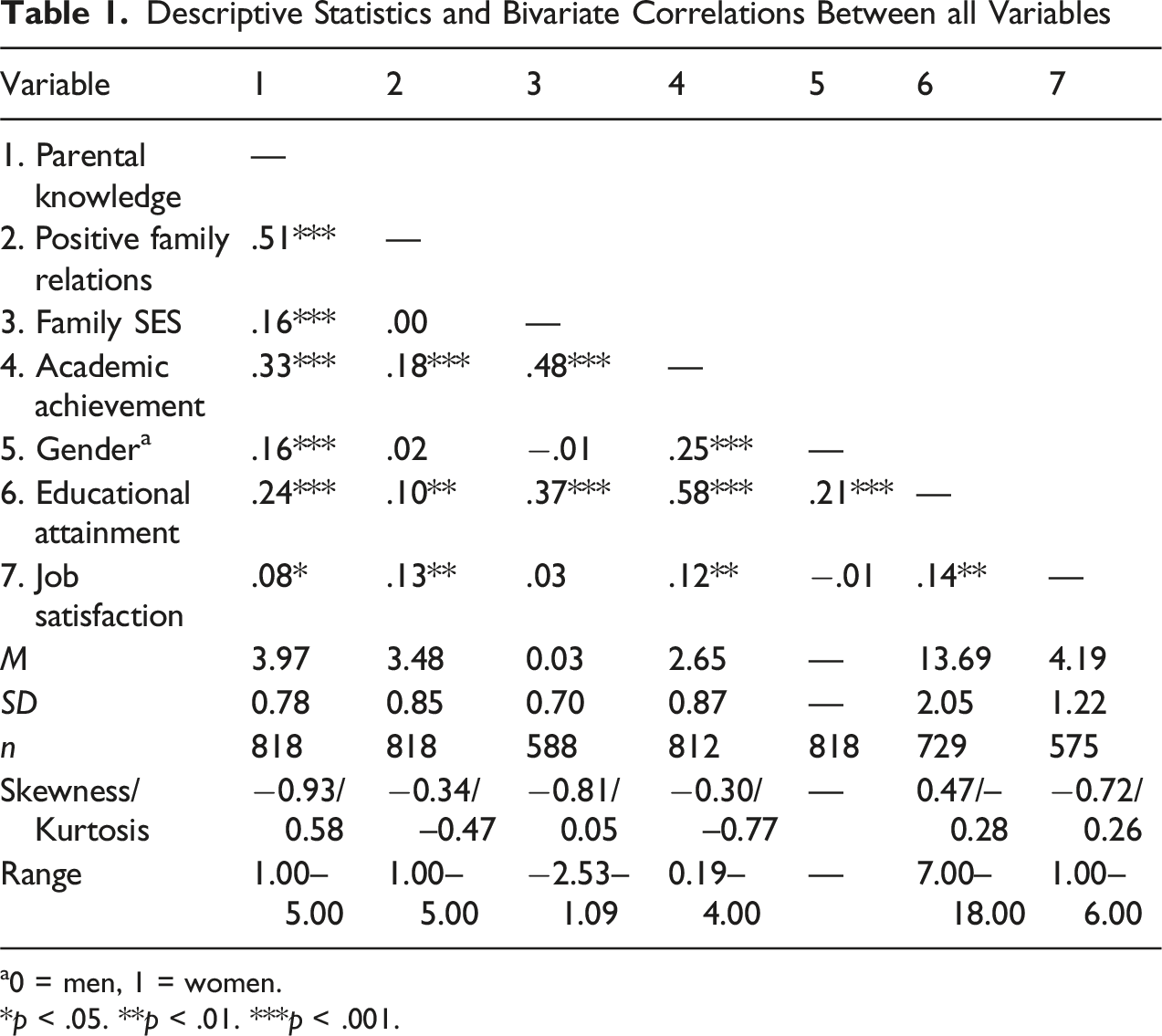
a0 = men, 1 = women.
*p < .05. **p < .01. ***p < .001.
Measures
Parental Knowledge
Parental knowledge was assessed when participants were in Grades 6, 7, and 8, using five items. In the first four items, participants reported how often their parents knew (a) what they were doing away from home, (b) where they were after school, (c) what their plans were for the next day, and (d) what their interests, activities, and whereabouts were. The fifth and final item was “In the last two days, how often did at least one of your parents know where you were and what you were doing?” Answers varied from 1 (never or almost never) to 5 (always or almost always). A mean score was computed for each time point (αs = .85–.87), and they were combined into an average score representing middle school parental knowledge, rs = .37–.53, p < .001.
Positive Family Relations
Positive family relations were assessed when participants were in Grades 6, 7, and 8. The scale (Metzler et al., 1998) is an indicator of the general family climate, reflecting whether the adolescent enjoyed being with their family and whether their parent(s) showed interest in their activities. Participants rated six items about their relationship with their parents over the last month, including “My parent(s) trusted my judgment”, “I really enjoyed being with my parent(s)”, and “There was a feeling of togetherness in our family” with a Likert scale ranging from 1 (never true) to 5 (always true). A mean score was computed for each time point, αs = .89–.90, and they were combined into an average score representing positive family relations during middle school, rs = .39–.52, p < .001.
Family Socioeconomic Status
A family socioeconomic status (SES) index was created using parental reports of their income, family housing status, household income, financial aid, and employment status. All variables were standardized and subsequently merged (α = .75). Family SES was measured when youth were in Grade 11 given that it was the first time that this questionnaire was filled out by all parents. Parent reports were not available during middle school. Yet, family SES is rather stable over time and tends to be more accurate when reported by parents than by youth (Ensminger et al., 2000).
Academic Achievement
Academic achievement was obtained through the students’ school records in Grades 6, 7, and 8. Their cumulative grade point average (CGPA) was computed if participants had valid data for at least one of the assessments (Grades 6, 7, and/or 8). Scores vary between 0 (F) and 4 (A).
Educational Attainment
Participants’ highest level of education was assessed during adulthood by asking, “What is the highest level of education you have completed?” Participants answered using a Likert scale ranging from 1 (7 th grade or less) to 8 (graduate professional training, graduate degree). The level of education was then converted into years to obtain a continuous score. To maximize accuracy, data from the last wave of data collection was used. However, if data were not available at 29 years of age, information from a previous wave occurring from ages 23 to 28 years old was used.
Job Satisfaction
Job satisfaction was also assessed at the last wave using a Likert Scale ranging from 1 (extremely dissatisfied) to 8 (extremely satisfied). A single item was used to assess job satisfaction, asking, “All things considered, how satisfied are you with your job as a whole?” Research has shown that this single item assesses job satisfaction and has adequate psychometric properties (Dolbier et al., 2005).
Analytic Plan
Descriptive statistics and bivariate correlations between all variables were examined. Then, path analyses were conducted in Mplus 8.6 (Muthén & Muthén, 2017). Goodness of fit was considered adequate if the Comparative Fit Index (CFI) was above .95, if the Tucker and Lewis Index (TLI) was above .90, and if the Root Mean Square Error of Approximation (RMSEA) was below .05 (Grimm et al., 2017).
The first path model included all the middle school antecedents (i.e., parental knowledge, positive family relations, family SES, gender, and academic achievement), educational attainment, and job satisfaction. Next, to test for hypothesized interactions between parental knowledge and other exogenous variables (i.e., positive family relations, family SES, and academic achievement), these variables were standardized, and their interaction terms were computed. In the second conditional model displayed in Figure 1, six interaction effects were included simultaneously to avoid inflation of the type I error rate. In the third and final model, only the interaction effects significantly related to at least one of the outcomes (i.e., educational attainment or job satisfaction) were retained. As per recommended practices, this analytic strategy was selected to reduce the possibility of misleading interpretations or confusion regarding main and simple effects (Lorah, 2020). When the interaction term was significantly related to one of the outcomes, the interaction was decomposed (moderators at ± 1 SD) to examine simple effects.
Multiple group analyses were then conducted to identify potential differences according to gender, ethnicity, and random assignment to a family-centered intervention group. For ethnicity, only European American and African American youth were considered in the analyses, as the sample sizes were insufficient for other ethnicities. The CFI was used to compare a constrained model, where regression paths estimates were forced to be equal across groups, and an unconstrained model, where all estimates were allowed to vary. The CFI difference (Δ) was used as an approximate measurement invariance index and preferred to a Δ χ2 test because of the large sample size. The Δ CFI was significant if greater than or equal to .01 (Cheung & Rensvold, 2002). If the Δ CFI was significant, follow-up analyses were conducted by constraining each regression path sequentially. Then, each model was compared with its associated unconstrained model.
Missing Data
The frequency of missing data is presented in Table 1. Missing data varied between 0% and 29.8% of the sample. During middle school, participants with missing data reported lower parental knowledge, t (413,89) = 4.12, p < .001, had lower family SES, t (586) = 2.66, p < .008, and obtained lower academic achievement, t (810) = 7.02, p < .001. Boys also had more missing data than girls, χ2 (1) = 28.11, p < .001. Missing data were considered missing at random given that predictors of missingness were identified (i.e., parental knowledge, family SES, academic achievement, and gender). Therefore, missing data were handled using the full information maximum likelihood estimator (FIML) in Mplus. As recommended by Enders (2022), predictors of missingness were included in the final models. This procedure allowed us to maximize statistical power and avoid listwise deletion. Discarding data induces several biases in the estimation, given that it often leads to the exclusion of vulnerable populations (Dong & Peng, 2013).
Results
Preliminary Analyses
Descriptive statistics and bivariate correlations between all variables are displayed in Table 1. All variables showed adequate variability and were normally distributed, with indices of skewness and kurtosis lower than |1.0|. Parental knowledge and family SES had univariate outliers (< 5%) and thus, they were winzorized. There were no multivariate outliers in the dataset. Most variables were positively and significantly intercorrelated. Of interest, parental knowledge was moderately associated with educational attainment, r = .24, p < .001 and had a small association with job satisfaction, r = 0.08, p = .050 in bivariate correlations. Only positive family relations were uncorrelated with gender and family SES. In addition, gender was not related to job satisfaction.
Main Analyses
Regression Coefficients From the Path Analysis
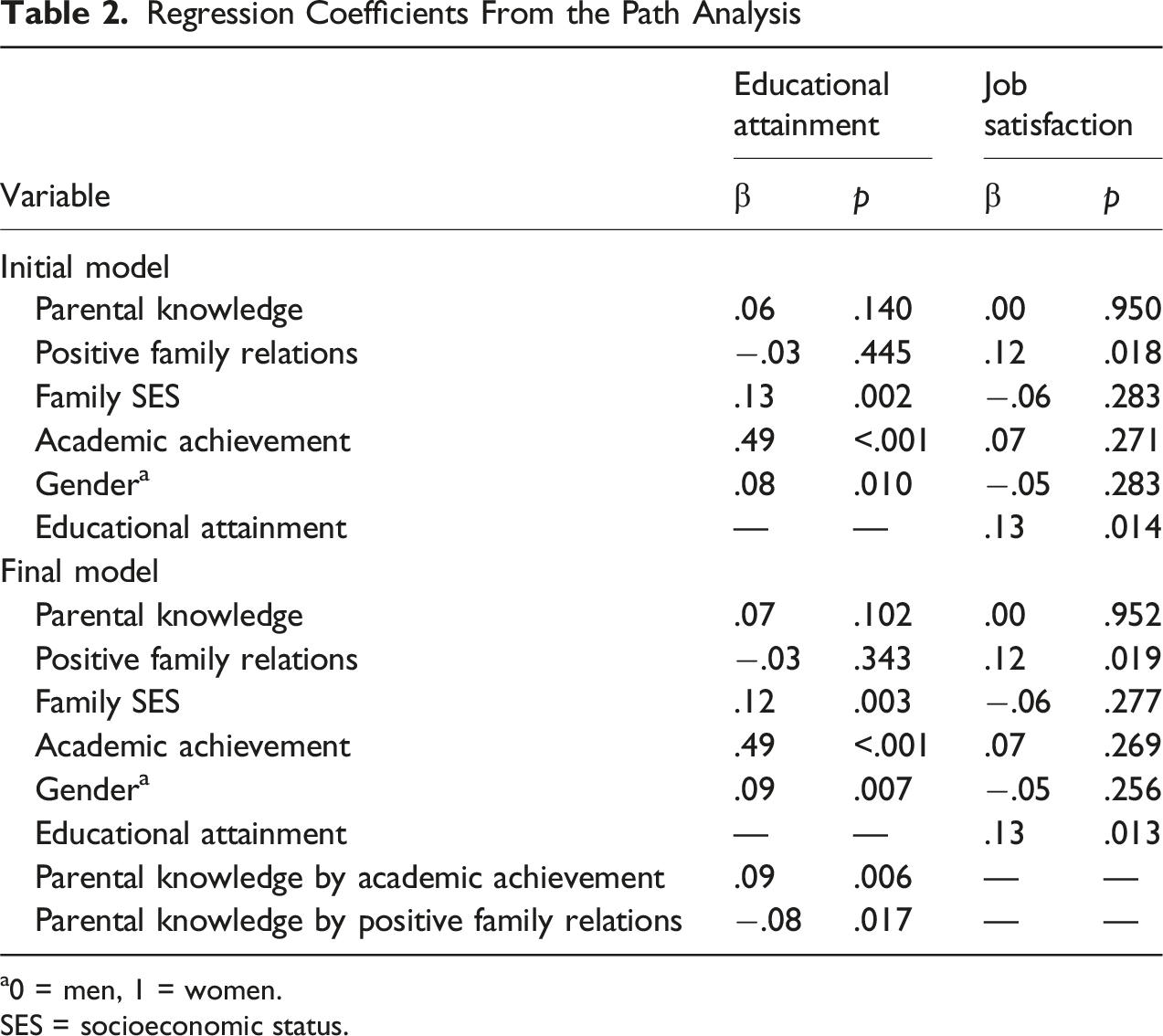
a0 = men, 1 = women.
SES = socioeconomic status.
To examine possible moderation effects, the second model tested a path analysis, including six interaction effects, as displayed in Figure 1. Again, there were no model fit indices available given that the model was saturated. Positive family relations moderated the link between parental knowledge and later educational attainment, β = −.08, p = .018. Family SES did not moderate the link between parental knowledge and educational attainment, β = −.03, p = .436. Finally, academic achievement was a moderator of the link between parental knowledge and later educational attainment, β = .11, p = .006. Neither positive family relations, family SES, nor academic achievement moderated the association between parental knowledge and job satisfaction, ps > .192.
A third and final model was conducted, including all the main effects and the two interaction effects that were significantly related to educational attainment. All the regression coefficients from the path analyses are presented in Table 2. All model fit indices were excellent, χ2 (2) = 2.61, p = .272, CFI = 0.99, TLI = 0.99, RMSEA = .02 [.00−.08], p = .759, SRMR = .011. All the antecedents included in the final model explained a significant amount of variance: 36.7 % for educational attainment and 4.2 % for job satisfaction, ps < .015. Consistent with findings from the previous model, parental knowledge was not associated with educational attainment, β = .07, p = .102. Yet, positive family relations still moderated the link between parental knowledge and later educational attainment, β = −.08, p = .017, as was the case in the previous model. Thus, even though parental knowledge was unrelated to educational attainment at mean levels of positive family relations, this association was significant among youth who had low levels of positive family relations (−1 SD), β = .14, p = .002. Parental knowledge was, however, unrelated to educational attainment among youth who had high levels of levels of positive family relations (+1 SD), β = −.01, p = .844.
Again, in line with the previous model, the final model showed that academic achievement was still a moderator of the association between parental knowledge and educational attainment, β = .09, p = .006. Thus, despite parental knowledge being unrelated to educational attainment at mean levels of academic achievement, post hoc analyses revealed that the association between parental knowledge and educational attainment was significant among youth who had high levels of academic achievement (+1 SD), β = .15, p = .007. In contrast, it was not significant among those who had low levels of academic achievement (−1 SD), β = −.02, p = .616.
The main effects from the final model suggest that family SES and gender were positively related to educational attainment, β = .12, p = .003, and β = .09, p = .007. Only positive family relations and educational attainment significantly predicted job satisfaction, β = .12, p = .019, and β = .13, p = .013. Intercorrelations between middle school variables were included in the final model. Parental knowledge was positively associated with positive family relations, r = .51, family SES, r = .16, academic achievement, r = .33, and gender, r = .16, all ps < .001. Positive family relations were not associated with family SES, r = .00, p = .995, nor gender, r = .02, p = .634, but were positively related to academic achievement, r = .18, p < .001. Academic achievement was positively related to family SES, r = .48, and gender, r = .25, all ps < .001. Family SES was unrelated to gender, r = −.01, p = .768.
Finally, multiple group analyses revealed that the model was invariant across intervention groups, Δ CFI = 0.001, and genders, Δ CFI < 0.001, but varied across ethnicities, Δ CFI = 0.068. Follow-up analyses revealed that the association between family SES and educational attainment was only significant among European Americans, β = .26, p < .001; not among African Americans, β = −.01, p = .880.
Supplemental Analyses
Data was reanalyzed among a subsample of participants, after excluding those who did not have any valid data for employment status or job satisfaction, n = 575. Most results revealed minimal changes; however, the interaction term between positive family relations and parental knowledge was not associated with educational attainment (see Supplemental Materials).
Discussion
Extant scientific literature on parental knowledge in early adolescence focuses primarily on how parents can prevent misbehavior (Pelham III et al., 2025). Yet, an increasing number of empirical studies suggest that parental knowledge that is built up from their monitoring may also promote optimal educational pathways among youth and help prepare them for a harmonious transition to the job market. However, prospective studies examining long-term outcomes of parental knowledge during early adolescence are scarce. Thus, this study examined middle-school antecedents of educational attainment and job satisfaction in adulthood using data spanning over 15 years. The goal of this study was to investigate the associations between parental knowledge in early adolescence and educational attainment and job satisfaction in adulthood, and to examine potential moderators of these associations (i.e., positive family relationships, family SES, and academic achievement). The association between parental knowledge and educational attainment was significant among families with low levels of positive family relations and among adolescents presenting high academic achievement. Even though parental knowledge in early adolescence did not predict job satisfaction, an unexpected association emerged between positive family relationships and this outcome.
Main Effects
Contrary to the first hypothesis, parental knowledge was not directly related to educational attainment nor to job satisfaction in the final model. Although parental knowledge was associated with educational attainment in bivariate correlations, this relation did not remain significant while controlling for positive family relations, family SES, academic achievement, and gender. Nonetheless, this overall lack of significant relation between parental knowledge and educational attainment can be nuanced by the moderation effects described below. As suggested in the theoretical model of parental monitoring (Pelham III et al., 2025), our results reveal that the effects of parental knowledge may vary depending on the broader context of the parent-youth dyad and on youth characteristics.
Positive Family Relations as a Moderator
The second hypothesis was that parental knowledge would be more effective when combined with positive family relations. Yet, this hypothesis was not confirmed given that parental knowledge was only effective in promoting educational attainment among youth with low levels of positive family relations. In addition, the interaction between parental knowledge and positive family relations did not predict job satisfaction. These findings contrast with other studies showing that parental knowledge or monitoring is more effective in promoting educational and psychological adjustment in the context of parental warmth (LaFleur et al., 2016; Lowe & Dotterer, 2013; Rodríguez-Meirinhos et al., 2020).
Parental knowledge may be less relevant for educational attainment in families with the most positive family relations because parental encouragement and discussions are the parenting factors that are most strongly associated with educational attainment (for a meta-analysis, Barger et al., 2019). In contrast, family conflicts during adolescence are associated with lower educational aspirations and, in turn, lower educational attainment (Martin et al., 2015). Harsh and controlling parenting behaviors are also related to lower academic achievement (for a meta-analysis, see Pinquart, 2016). If parents continue to maintain adequate levels of parental knowledge by staying informed about their youth’s lives despite their low levels of positive family relations, they may thereby encourage them to focus on their studies (Afia et al., 2019). In fact, according to Pelham III et al.’s (2025) theoretical model, parental knowledge of youth’s lives, friendships, and activities may also be interpreted by youth as parental interest, care, and social support. Thus, parental knowledge may act as a protective factor when family relations are not generally positive.
Family SES as a Moderator
There was no specific hypothesis regarding the potential moderating role of family SES, due to diverging results in past research. Findings revealed that there was no significant interaction between parental knowledge and family SES while predicting neither educational attainment nor job satisfaction. Our results contrast with a meta-analysis showing that the links between general parental involvement and academic achievement are stronger in high-SES families (see Tan et al., 2020). However, at least another study did not find that the link between parental monitoring and academic success varied across neighbourhood disadvantage (Lopez-Tamayo et al., 2016). The lack of significant interaction in the current study suggests that parental knowledge does not relate to educational attainment in families with higher socioeconomic status, nor lower socioeconomic status. It may be that parental knowledge is not sufficient to compensate for well-documented risk factors associated with school dropout among families with lower family SES (e.g., substance use, community violence, and deviant peers; Pelham III et al., 2025). Relatedly, the additive value of parental knowledge may not be significant, over and above the protective factors associated with a higher SES (Tan et al., 2020). As suggested by the results obtained in this study, other contextual factors may also be more important to consider, such as personal characteristics and family relations.
Academic Achievement as a Moderator
The third hypothesis stipulated that the link between parental knowledge and educational attainment would be stronger among adolescents with lower levels of academic achievement. Again, contrary to this hypothesis, youth with high academic achievement were the only ones to benefit from parental knowledge with regards to educational attainment. The interaction between parental knowledge and academic achievement did not predict job satisfaction. Results contrast with previous evidence that the family environment (e.g., parental monitoring behaviors, emphasis on education and financial resources) was more strongly related to academic success among low achievers (Hill & Wang, 2015; Johnson et al., 2009). It may be that high-achieving youth whose parents develop high parental knowledge benefit from the accumulating individual and environmental assets that allow them to reach their full potential in the school system. Relatedly, another study found that the association between parental educational expectations and educational attainment is stronger among high-achieving youth (Benner et al., 2016).
It may also be that for low-achieving youth, parental involvement needs to be active (e.g., guidance in school-related tasks) and focus on school self-efficacy and success expectations, to foster educational success. For high-achieving students, a more distant involvement, as captured by the parental knowledge measure, may be most helpful in preparing adolescents to acquire the level of autonomy they will need as adults in school and work settings.
Gender and Ethnic Differences
Multiple group analyses revealed that the association between parental knowledge and educational attainment did not vary across genders or ethnicities. This finding is coherent with those from previous studies, which did not report any gender differences in the associations between parental knowledge and educational attainment (Affuso et al., 2023; Lowe & Dotterer, 2013). With regards to differences across ethnicities, there was no difference in the associations between parental knowledge and adult outcomes (i.e., educational attainment and job satisfaction). This result contrasts with evidence showing that parental monitoring and parental knowledge are especially important among minority groups (Lopez-Tamayo et al., 2016; Lowe & Dotterer, 2013).
Unexpected Antecedents of Job Satisfaction
Neither positive family relationships, family SES, nor academic achievement was a moderator of the association between parental monitoring and job satisfaction. Results suggest that positive family relations are a more promising explanatory mechanism of adult job satisfaction than parental knowledge. In fact, a positive relational climate proved to be more important than parental knowledge in predicting job satisfaction in the current sample, even after controlling for participants’ educational attainment.
These results are in line with a previous study suggesting that positive parenting (i.e., parental involvement, expectations, and support) in middle and high school was related to higher educational attainment and to higher job satisfaction, both measured simultaneously in adulthood (ages between 24 and 32; Gordon & Cui, 2015). Another longitudinal study also revealed that positive family relationships during adolescence were associated with career adaptability (i.e., academic performance, sense of control, and self-worth) and with higher occupational prestige in adulthood (Sun et al., 2020). Youth with higher levels of positive family relations may develop their “authentic inner compass” and make choices that are in line with who they are and what they value (Assor et al., 2020). Thus, how much parents know about their adolescent’s life, activities and relationships may not be as important in supporting their future job satisfaction as parents’ encouragement for their adolescent to find a job they will enjoy and find meaningful, notwithstanding the required education.
Findings further suggest that the link between educational attainment and job satisfaction was positive but small. This effect size is consistent with a meta-analysis that found an effect size close to zero between educational attainment and job satisfaction (Solomon et al., 2022). Individuals who have higher educational attainment tend to have access to more resources, income, and autonomy. Yet, they also have greater job demands, including stress and pressure, which hinder job satisfaction. In all, these findings suggest that for some adolescents, college is simply not the best option to promote job satisfaction and is not the sole predictor of job satisfaction.
Strengths and Limitations
The main strength of this study is its longitudinal and multi-informant design spanning over 15 years. The study includes questionnaires filled out by adolescents and their parents, and report cards from the schools. The research design allowed us to examine several developmental periods, and it extends previous studies by including not only educational attainment but also job satisfaction in adulthood. Furthermore, the sample size is large, and attrition rates are remarkably low.
Notwithstanding its strengths, this study also has some limitations. Although parental knowledge is a relevant global concept to understand how parents may contribute to their child’s development and long-term adjustment, future studies should also measure the parental monitoring processes that helped yield such knowledge. In fact, parents gather information about their adolescents’ relationships and whereabouts in numerous ways, including parental solicitation, parental rules, discussions with other adults in their youth’s lives, and through adolescents’ disclosure (for a review, see Pelham et al., 2024). Accordingly, future studies should include parental reports of monitoring behaviors and family relationships. Teacher reports of youth behaviors in school could also be included to provide insights into youth educational pathways. Relatedly, several school-related behaviors are related to educational attainment and were not included in this study, including youth affective, cognitive, and behavioral engagement (Archambault et al., 2022). In the current study, unemployed participants were excluded from the main analyses and data were collected in one urban area in the United States, which may preclude the generalizability of the findings to individuals who are unemployed and those from other geographic areas or rural settings. The sample was diverse, yet the small sample size of most minority groups only allowed us to examine group differences between European American and African American youth. It would be important to study the links between parenting practices and long-term educational attainment and job satisfaction in additional ethnic groups in the future.
Conclusion
Obtaining a qualifying diploma and completing a successful transition to the workforce are important milestones in youth development. Yet, studies that investigate individual and family factors leading to successful educational outcomes and job satisfaction have rarely examined them during early adolescence, and few have tested their interactions. Therefore, this study contributes to a better understanding of the role of parental knowledge during middle school in promoting educational attainment and job satisfaction in adulthood. Findings highlight that it is essential to consider the broader family relational context and adolescents’ academic achievement when examining the developmental processes that support educational attainment and job satisfaction. This study underscores the importance of programs that promote parental knowledge in families where positive family relationships are difficult to build, and to support academic achievement in middle school. Also, interventions that can improve family dynamics during early adolescence appear to have the potential for long-lasting effects and, thus, for promoting long-term educational attainment and job satisfaction.
Supplemental Material
Supplemental Material - Unpacking Moderators in the Path From Parental Knowledge to Educational Attainment and Job Satisfaction: A 15-Year Longitudinal Study
Supplemental Material for Unpacking Moderators in the Path From Parental Knowledge to Educational Attainment and Job Satisfaction: A 15-Year Longitudinal Study by Catherine Cimon-Paquet, Thao Ha, Marie-Hélène Véronneau in The Journal of Early Adolescence.
Footnotes
Author’s Note
This study was not preregistered. Study materials and study analysis code are available upon request.
Acknowledgements
We gratefully acknowledge the Project Alliance staff, Portland Public Schools, and participating families. We are also thankful for Dr. Thomas Dishion, who conceived the Project Alliance study, obtained initial funding, and supervised the data collection.

Ethical Considerations
The research protocol complied with the American Psychological Association’s ethical standards in the treatment of participants. It was approved by the research ethics committee of the University of Quebec in Montreal, Canada (certificate #2017-615). Neither my co-authors nor I have any conflicts of interest.
Consent to Participate
Adolescents provided written consent.
Author Contributions
C.C.P. planned and conducted the analyses, interpreted the results, and drafted all sections of the manuscript; T. H. took part in interpreting the results and edited the draft; M.H.V. is the senior author on this study; she obtained the funding for secondary data analysis, took part in planning the analyses and interpreting the results, and edited the draft.
Funding
The authors disclosed receipt of the following financial support for the research, authorship, and/or publication of this article: This work was supported by doctoral fellowships from the Faculty of Social Sciences at the University of Quebec in Montreal, the Québec Research Funds – Society and Culture (2021-B2Z-281986) and the Social Sciences and Humanities Research Council (207-2021-2022-Q1-02294) awarded to CCP; by grant DA07031 from the National Institute on Drug Abuse and grant AA022071 from the National Institute on Alcohol Abuse and Alcoholism awarded to TH; and by the Québec Research Funds – Society and Culture, Research Team Support grant (2023-SE3-315353), the Québec Research Funds – Health Research Scholar award Junior 1 and 2 (26858 and 266652) and Eunice Kennedy Shriver National Institute of Child Health and Human Development grant (HD62753) awarded to MHV. The content is the responsibility of the authors and does not necessarily reflect the views of the National Institute on Drug Abuse or the National Institute on Alcohol Abuse and Alcoholism.
Declaration of Conflicting Interests
The authors declared no potential conflicts of interest with respect to the research, authorship, and/or publication of this article.
Data Availability Statement
The datasets analyzed during the current study are not publicly available. The data are available from the corresponding author on reasonable request.
Supplemental Material
Supplemental material for this article is available online.
Author Biographies
References
Supplementary Material
Please find the following supplemental material available below.
For Open Access articles published under a Creative Commons License, all supplemental material carries the same license as the article it is associated with.
For non-Open Access articles published, all supplemental material carries a non-exclusive license, and permission requests for re-use of supplemental material or any part of supplemental material shall be sent directly to the copyright owner as specified in the copyright notice associated with the article.
