




Abstract
Despite evidence that early anti-social behaviours can persist and escalate into adulthood, understanding of how these behaviours present in early adolescence and the associated factors, is limited. Using secondary data from 11,868 9-to-10-year-olds recruited to the Adolescent Brain Cognitive Development study, we applied latent class analysis (LCA) to 20 items from the parent-rated Child Behaviour Checklist. Three classes were identified: Rule-abiding (66.52%), Infrequent-disobedient (27.85%) and Frequent-delinquent (5.63%). The socio-demographic composition of these classes varied based on sex, ethnicity and household income. A multinomial regression demonstrated that, while the classes were mostly associated with independent sets of factors, there was some commonality in factors associated with increased anti-social behaviour, including the presence of parental mental disorders, increased parental transgressive behaviour and family conflict. Generally, environmental factors were more strongly associated with class membership than psychological factors. These findings can be used to inform the development of targeted preventative policies and interventions.
Keywords
Introduction
The term anti-social behaviour (ASB) describes actions which are counter-normative or socially unacceptable (Acquaviva et al., 2018), including relatively minor infringements (e.g. lying or dropping litter), through to more serious offences, such as breaking the law. ASBs have been linked with adverse outcomes across the lifespan including poor mental health and substance dependence (Moffitt et al., 2002; Tan & Haining, 2016). Although most ASBs displayed early in development tend to be minor in nature (e.g., disruptive and troublesome behaviour), these can escalate to more serious ASB later in development (Nagin & Tremblay, 1999). It is therefore important to understand how different ASBs cluster in early adolescence, the socio-demographic composition of different behavioural profiles, and to identify associated risk and protective factors, which can inform targeted preventative interventions at an early stage in development.
Patterns of Delinquency
Person-centred approaches have been used to understand how ASBs cluster to identify distinct subgroups in cross-sectional (e.g., latent class analysis; Barnes et al., 2012) and longitudinal (e.g., group-based trajectory modelling and latent transition analysis; Childs & Sullivan, 2013; Evans et al., 2016; Bright et al., 2017; SooHyun et al., 2023) data. Unlike variable-centred techniques that assume behaviours cluster in the same way across individuals (Brown, 2015), these methods assume that relationships between behaviours (in this case ASBs) may differ across individuals. They exploit this heterogeneity to define subgroups, or classes, for whom the behaviours cluster in maximally similar ways within the class, but differently to individuals in other classes (Retzler et al., 2023).
Many of the studies using person-centred approaches in cross-sectional data have measured ASB in adolescent groups considered at-risk according to already-known factors (e.g. individuals in correctional facilities, or with proven offences; Odgers et al., 2007; Mulder et al., 2012; Ang et al., 2020), where most classes are characterised by relatively serious ASB (such as violent and sexual offences; Mulder et al., 2012), and a frequent endorsement of ASB is displayed in general (Ang et al., 2020). On the other hand, studies that have used community samples, which may offer a broader understanding of how ASB is represented in the general population (Ang et al., 2020; Barnes et al., 2012; Chiang et al., 2020; Childs & Ray, 2015; Connell et al., 2011; Cui et al., 2024; Goings et al., 2022; Hasking et al., 2011; Park & Kim, 2020; Picoito et al., 2021) have reported a larger range of classes with a higher endorsement of infrequent and relatively minor ASB (e.g., cheating and truancy; Cui et al., 2024). Most identified a 3-class model as the best-fitting (Ang et al., 2020; Barnes et al., 2012; Cui et al., 2024; Goings et al., 2022; Hasking et al., 2011; Park & Kim, 2020) but this varied between 2 (Chiang et al., 2020) and 4 classes (Childs & Ray, 2015; Connell et al., 2011; Picoito et al., 2021). Typically, the largest proportion of the sample have been allocated to a class characterised by a low likelihood of ASB (e.g., “Low-rate offenders”; Barnes et al., 2012, “Rule-breakers”; Hasking et al., 2011, “Low risk”; Park & Kim; 2020, “No involvement”; Goings et al., 2022, “Normative class”; Cui et al., 2024, “Low delinquency”; Chiang et al., 2020, “Low/risk abstainers”; Childs & Ray, 2015, “Normative”; Picoito et al., 2021), with only two studies reporting instead, that the most common allocation was to classes characterised by a high frequency of relatively minor ASBs (e.g., “Minor antisocial problems”; Ang et al., 2020, “Mild ASB”; Connell et al., 2011).
The behavioural profiles of classes showing greater likelihood of ASB vary in nature across studies and seem to be somewhat dependent on the type and number of ASBs measured. For example, some studies measured a small number of ASBs (Chiang et al., 2020; Park & Kim, 2020; Picoito et al., 2021), or more serious ASBs only (Connell et al., 2011; Goings et al., 2022). Of studies that have investigated a wide range of ASBs of varying seriousness, some commonalities in class characteristics can be observed. For example, several studies identify a class characterised by frequent engagement in behaviours that may affect relationships, but that do not have a direct or tangible impact on individuals. This includes a “Moderate-rate offenders” class characterised by lying and being disruptive (Barnes et al., 2012), a “Borderline class” that showed gaming addiction (Cui et al., 2024), and a “Minor ASB” class that displayed swearing, arguing and teasing (Ang et al., 2020). At the other end of the spectrum, a number of studies identify a class to which the lowest proportion of the sample is assigned, in which there is an increased likelihood of a relatively high frequency of all ASBs, including those that have a more serious and direct, physical or tangible effect on individuals. This includes a “High-rate offenders” class that displayed vandalism, lying, stealing, physical altercations and disruptiveness (Barnes et al., 2012), a “Deviant class” characterised by theft, vandalism, fighting, fraud, gaming addiction, cheating, running away, truancy, substance use and gambling (Cui et al., 2024), and a “Major delinquents” class that showed substance and pornography use, truancy, trespassing, stealing, fighting, vandalism, insulting people, causing a disturbance, fire-setting, lying, having sexual intercourse and public indecency (Hasking et al., 2011). However, some findings seem to be study-specific; only Hasking et al. (2011) identified a “Minor delinquents” class that displayed behaviours that were somewhat more serious, such as drinking alcohol and trespassing. Likewise, Ang et al. (2020) was the only study to find that the most populated class showed a high frequency of ASBs, albeit of relatively minor nature, including rule-breaking, lying, cheating, arguing, meanness, destroying own things, disobedience and teasing others (“Moderate ASB”; Ang et al., 2020).
In these studies, the samples are typically recruited as part of longitudinal studies (Barnes et al., 2012; Chiang et al., 2020; Childs & Ray, 2015; Connell et al., 2011; Goings et al., 2022; Park & Kim, 2020) or via local schools (Ang et al., 2020; Cui et al., 2024; Hasking et al., 2011) and cover a broad age range rather than focussing specifically on early adolescence; from ages 11 to 21 (Barnes et al., 2012), 12 to 17 (Cui et al., 2024; Hasking et al., 2011) and 12 to 22 (Ang et al., 2020). Given evidence that the frequency and type of engagement in ASB changes at different periods in adolescence (Bright et al., 2017), research that is adequately powered to focus on the profiles of ASB and their associated correlates early in adolescence may advance understanding of early patterns and help inform preventative intervention.
While research has indicated particular socio-demographic characteristics are associated with ASB, we must acknowledge the role that cultural and historical context play in producing such patterns (Kaufman, 2007). Evidence indicates that profiles characterised by minor and serious ASB are more common in males than females (Barnes et al., 2012; Connell et al., 2011). Research assessing ethno-racial categories shows that in US samples, in general, compared to being White, being Black (Sohoni et al., 2021; Watts & McNulty, 2015), Hispanic and Native American (McNulty & Bellair, 2003; Sohoni et al., 2021; Watts & McNulty, 2015), has been associated with greater ASB. However, there is nuance to such patterns. Compared to White individuals, Black individuals may be more likely to abstain from ASB in general, but where Black individuals do engage in ASB these behaviours are claimed to be more diverse, frequent and serious (e.g., violence and theft; Childs & Ray, 2015). Interestingly, Asian individuals may be at a similar (Sohoni et al., 2021) or lower risk (McNulty & Bellair, 2003) of engaging in ASB in general compared to White individuals. Findings further demonstrate that living in a low-income household has also been associated with increased ASB generally (Hoffmann et al., 2020). While we do not consider such socio-demographic factors, which are intertwined with cultural and historical context, as independent causal factors in ASB, we do, nonetheless, see benefits of understanding the socio-demographic composition of groups who differ in their expression of ASB for targeting interventions appropriately.
Predictors of Delinquency
Two prominent theories have highlighted a range of environmental and psychological factors that may drive the development of ASB. Moffitt (1993) proposed the Developmental Taxonomy theory of ASB that highlights the interaction between a criminogenic environment and neuropsychological problems, and how these are associated with ASB across the life-course. The Integrated Cognitive Antisocial Potential theory (ICAP; Farrington, 2020), on the other hand, considers the basis for ASB to be influenced by relatively stable long-term factors which are predominantly environmental or trait-based in nature, that increase an individual’s antisocial potential. This potential may then be released as ASB due to fluctuating changes and influences in their social environment that affect the individual in the short-term; and this is where differences in cognitive capabilities may further increase the likelihood of an outcome of ASB.
Research has supported the association between environmental influences and ASB. Many of the environmental factors highlighted in these theories are proximal factors related to the immediate environment. Associations with specific types of ASB have been observed, including increased conflict between family members (e.g., child-parental conflict) with ASB such as frequent rule-breaking, lying or cheating, swearing, arguing, meanness to others, destroying own things, and disobedience (Ang et al., 2020), decreased parental warmth relating to non-habitual alcohol use (Park & Kim, 2020), increased school attachment relating to a low frequency of ASB (Connell et al., 2011), decreased school belonging relating to frequent stealing, vandalism, fighting, fraud, gaming addition, cheating, running away, truancy, drinking alcohol, smoking and gambling (Cui et al., 2024), and exposure to deviant or anti-social behaviour relating to frequent acts of threatening people, fighting, stealing and police contact (Connell et al., 2011). Other, more indirect or distal environmental factors have also been associated with increased ASB in a broader sense, such as household financial hardship (Gold, 2020), living in a neighbourhood perceived to be unsafe (Hartinger-Saunders et al., 2012) and a parent with mental ill-health or criminal history (Athanassiou et al., 2023).
Both theories also recognise the important contributions that psychological traits and capabilities play in the development of ASB. In particular, Moffitt (1993) claims that disruption in neural development can cause impaired neuropsychological functioning that contributes to ASB, and this perspective is supported by evidence of relationships between poorer neuropsychological test performance and increased ASB. In particular, studies of executive function have demonstrated that inhibitory control (to refrain from acting on impulse and use attention to behave appropriately) relates to minor and general ASB (Pihet et al., 2012; Schoemaker et al., 2012), working memory (to temporarily hold items in short-term memory at the same time as processing information) relates to ASB in general (Schoemaker et al., 2012) and cognitive flexibility (to effectively shift attention between different tasks) relates specifically to serious ASB (Nikulina & Widom, 2019). Beyond executive function, there is evidence for a role of other cognitive abilities, such as verbal intelligence with ASB in general (Parker & Morton, 2009), fluid intelligence with physical violence (Huepe et al., 2011), and episodic memory with lying (Fabro & Crescentini, 2018). Processing speed has been associated with psychopathology but not ASB specifically (Kramer et al., 2023). While studies of ASB in specific contexts (e.g. detention centre; Parker & Morton, 2009) have identified relationships between individual psychological factors and types of ASB, in the wider population it remains unclear whether distinct psychological factors relate to distinct patterns of ASB, or whether patterns are more domain-general – for example, does lower cognitive flexibility increase the risk of ASB in general or does it increase the likelihood of, say, reactive aggression? With a wide range of psychological measures, the ABCD study provides a unique opportunity to assess the specificity of relationships between psychological traits, cognitive skills and patterns of ASBs in the general population. Farrington (2020) takes a somewhat different perspective on the ways in which psychological factors influence antisocial potential in the ICAP theory. Impulsivity is proposed as one of the relatively stable long-term factors that increases antisocial potential; and certainly, trait-based assessments have shown reduced behavioural inhibition and increased sensation seeking have been linked to bullying (Basharpoor et al., 2013). The ICAP theory suggests that at a cognitive level, processing capabilities may affect ASB based on how they affect the individual’s short-term decision-making within a situation, and the extent to which behaviour is reinforced. For example, limits in episodic memory may affect the extent to which an individual is able to recall the behaviours and consequences from similar situations, challenges in working memory or cognitive flexibility may affect how easy an individual finds it to switch between different behavioural options and adapt their behaviour to different situations, poor inhibitory control may affect the extent to which someone can self-regulate, while low verbal intelligence may limit an individual’s confidence, ability or inclination to articulate and negotiate a non-aggressive solution.
Although there is converging evidence that supports the links between ASB and numerous factors identified in these theories, the relative importance of environmental versus psychological factors remains unclear, and our understanding of the specificity of associations with particular factors – psychological traits and capabilities especially – and ASB is limited. Indeed, to date, resource constraints have limited the extent to which studies can include comprehensive assessment of environmental factors and personality factors together with a battery of performance-based measures of cognition in large samples.
The Current Study
The ABCD (Garavan et al., 2018) dataset provides a unique opportunity to examine this topic due to the magnitude of the sample, the recruitment approach, and the wide array of measures included. At baseline, this dataset included measures of behaviour, psychological abilities and traits, and environmental factors from over 11,000 young people. The current study aimed to use a data-driven person-centred approach to provide novel insights into the patterns and predictors of ASB in youth aged 9–10 years. By examining a large, contemporary community sample who were recruited to be representative of the general population in the US, the study aimed to provide insight into how ASBs occur at an early stage in adolescence, in individuals who may not have yet interacted with the legal system, and identify those most at risk. We used a measure that also captures less serious (and non-criminal) behaviours which are more likely to be observed among the general population, to examine whether classes of ASB differ not only in frequency, or seriousness, but also in nature (e.g. classes where behaviours are predominantly instrumental such as cheating or lying for personal advancement, vs. classes where behaviours are predominantly physical and victim-focussed, such as violence; Barnes et al., 2012). This also allows us to identify how relatively minor ASBs may cluster with more serious ASBs.
We then sought to understand the relative importance of both environmental and psychological factors for predicting class membership, incorporating a wide range of factors highlighted in prior theories and research within the same analysis. This aimed to reveal where preventative approaches may be best focussed by highlighting potential risk and protective factors, which are necessary to inform effective intervention (Gubbels et al., 2024), and advance understanding about the relative specificity of associations between cognitive skills and ASB.
The current study, therefore, had interlinked research questions that aimed to provide insight into (i) the presence of ASB in a community sample of early adolescents, (ii) who would be most likely to benefit from targeted interventions, and (iii) which factors may serve as effective targets for preventative policies or interventions. Specifically, we asked the following: 1. Using a person-centred analysis approach, what latent classes of early adolescent ASB can be identified and what is the socio-demographic composition of each? 2. What is the relative contribution of environmental and psychological factors to predicting membership of each class?
Method
Data and Sample
The current study used data extracted from the Adolescent Brain Cognitive Development study (ABCD; Garavan et al., 2018) downloaded from the ABCD Study data repository (NIMH data archive; nda.nih.gov; curated release 3.0). The ABCD study aimed to collect baseline measures of neurocognitive development in individuals at 9–10 years of age (note that a very small proportion had reached their 11th birthday at the time of testing; n = 129). To maximise the sample for LCA analysis, data were downloaded for all participants with complete Child Behaviour Checklist (CBCL; Achenbach & Rescorla, 2001) data at baseline (n = 11,868). The regression analysis included all of those who had complete data for the environmental and psychological variables (n = 8598). Participant flow for inclusion at each stage of analysis can be found in online resource Figure SA1. The demographic composition of participants available at each stage of analysis are available in online resource Table SA1.
The ABCD study received ethical approval from the University of California Institutional Review Board and our secondary analysis was approved by the host institution. A record of the NDA study created for this project can be found at: https://doi-org./10.15154/nqnw-0y04.
Measures
ASB Measure
The ABCD Parent Child Behavior Checklist (CBCL; Achenbach & Rescorla, 2001) was used to measure ASB. This is a parent-reported measure of behavioural and emotional problems in children and adolescents. Twenty variables from the CBCL were manually selected as indicator measures of ASB ranging from disobedience to physically attacking people (see Online Resource Table SA2). Responses ranged from zero (not true) to 2 (very true). Higher scores indicated a higher likelihood of a behaviour. Reliability for this measure was calculated as high (α = .84).
Demographic Measures
Measures of sex, age, ethno-racial category and household income were obtained from the ABCD Demographics survey (Barch et al., 2018). Participant sex was reported as Male or Female, and age was reported in months. Ethno-racial categories described in Barch et al. (2021) were representative of ethnic and racial identities of preadolescents in the US, reported as: Hispanic (regardless of any other racial or ethnic identity reported), non-Hispanic White, non-Hispanic Black, non-Hispanic Asian, non-Hispanic Native American/Alaska, non-Hispanic Multi-Racial, and additional or unknown race (including Native Hawaiian, Pacific Islander, Guamanian, Samoan, Other Race, no race reported). Annual household income was reported as equal to or under $49,999, $50,000-$99,999, $100,000-$199,999, equal to or over $200,000, or chose not to report.
Environmental Measures
Eight different scales were used to measure factors relating to family, neighbourhood and school environment. Parental control was measured using the ABCD Parental Monitoring Survey (PMS; Karoly et al., 2016). Responses ranged from 1 (almost always) to 5 (never) and higher scores indicate decreased parental control. Parental warmth was measured using the ABCD Children’s Report of Parental Behavioral Inventory (CRPBI; Schaefer, 1965). Responses ranged from 1 (not like him/her) to 3 (a lot like him/her) and higher scores indicate increased parental warmth. The ABCD Youth Family Environment Scale-Family Conflict Subscale modified from PhenX (FES; Moos & Moos, 1976; Hamilton et al., 2011) was used to measure family conflict. Responses ranged from zero (false) to 1 (true) and higher scores indicate increased family conflict. School risk and protective factors were measured using the ABCD School Risk and Protective Factors Survey (SRPF; Hamilton et al., 2011) which measured factors relating to enjoyment and connection to school. Responses ranged from 1 (strongly disagree) to 5 (strongly agree) and higher scores indicated increased school protective factors. Neighbourhood safety was measured using the ABCD Parent Neighborhood Safety/Crime Survey modified from PhenX (NSC; Mujahid et al., 2007; Hamilton et al., 2011). Responses ranged from 1 (strongly disagree) to 5 (strongly agree) and higher scores indicated increased perceptions of neighbourhood safety. Reliability for each measure was calculated and this ranged from acceptable to very good (α = .71 to .86). In the absence of specific measure of parental criminal history, an item from the ABCD Family History Assessment (Barch et al., 2021; Rice et al., 1995) was used to measure parental transgressive behaviour. It asked whether parents had struggled to hold down a job, had got into fights, or had trouble with the police or law. Responses ranged from 1 (yes) to zero (no) and higher scores indicated increased transgressive behaviour. Parental mental health was measured using the ABCD Parent Diagnostic Interview for DSM-5 Full (KSADS-5; Kobak & Kaufman, 2015). Parents who reported one or more mental health conditions were given a score of ‘1’. Financial hardship was measured using items from the ABCD Parent Demographics Survey (Barch et al., 2018), including whether parents in the past twelve months struggles to afford food, a telephone service, or rent/mortgage, were evicted as a result of not paying rent/mortgage, had gas/electric turned off due to not paying bills, or avoided going to the hospital or dentist due to not being able to afford medical bills. The presence of each item was scored with ‘1’ and an overall score was provided based on the sum of scores from each item. Higher scores indicate increased financial hardship.
Psychological Measures
Three measures of executive functions were included. The NIHTB Flanker Task (TFT; Eriksen & Eriksen, 1974) measured inhibitory control and attention in which participants indicate the left/right orientation of a stimulus presented centrally, whilst inhibiting attention to other stimuli. The NIHTB Dimensional Change Card Sort Test (DCCS; Zelazo et al., 2013) measured cognitive flexibility with participants sorting cards based on one dimension (e.g., colour) and then being instructed to switch to sorting based on a different dimension (e.g., shape). For both tasks the “raw” score was used, which is computed as a measure of overall performance based on trial-level accuracy and response time as described in Luciana et al. (2018). To measure working memory, we used the NIHTB List Sorting Working Memory Test (TLSWMT; Tulsky et al., 2014) which required participants to sort and sequence visual and auditory stimuli based on a specific criterion (e.g., size). A score was calculated based on the number of correct items recalled across two trials (Luciana et al., 2018).
Other cognitive functions were also measured through task performance. Episodic memory was measured using the NIHTB Picture Sequence Memory Test (TPSMT; Bauer et al., 2013) which required respondents to recall illustrated objects and activities presented in a particular order with the series presented increasing in length. Participants scores were calculated based on the cumulative number of adjacent pairs of pictures correctly remembered over three learning trials. Visual processing speed was measured through the NIHTB Pattern Comparison Processing Speed Test (TPCPST; Carlozzi et al., 2015). Participants were required to identify whether two visual patterns were identical, and the score was calculated based on the number of correct items completed in 90 seconds. To measure verbal intelligence, we used the NIHTB Picture Vocabulary Test (TPVT; Gershon et al., 2013) which required participants to listen to a word and match it to one of four pictures based on how closely it matched the word. Words differed in difficulty and the task was scored based on the number of pictures selected correctly. Fluid intelligence was measured through the automated version of the Matrix Reasoning subtest from the Wechsler Intelligence Test for Children-V (Wechsler, 2014). Higher scores indicate higher fluid intelligence. Reliability of these measures has been reported as ranging from moderate to good (ICC range = .66 to .85; Watkins & Smith, 2013; Gershon et al., 2014; Karr et al., 2024).
The ABCD Youth Behavioral Inhibition/Behavioral Approach System scales modified from PhenX (BIS/BAS; Carver & White, 1994; Hamilton et al., 2011) were used to measure two of the systems thought to underlie behaviour; the behavioural inhibition system (BIS) and the behavioural approach system (BAS) which help us to avoid aversive situations (BIS) and move toward appetitive situations (BAS). Responses ranged from zero (not true) to 3 (very true). Higher scores on each scale indicate a higher propensity of behaviour. Reliability for the BIS scale (α = .68) and three subscales for the BAS has been reported as ranging from acceptable to very good (α = .69 to .82; Paglaccio et al., 2016).
Statistical Analysis
3-Step Latent Class Analysis & Multinomial Regression
A 3-step method (Asparouhov & Muthén, 2014) was utilised in Mplus (version 7.11; Muthén & Muthén, 1998-2011) to identify latent classes of ASB and factors associated with each class. First, a Latent Class Analysis (LCA) was performed which analysed response patterns to indicator variables of ASB to identify latent (unobservable) subgroups within the sample (Weller et al., 2020). A three-response option format from the CBCL was used without binarizing the responses (Chiang et al., 2020). As a second step, the LCA model estimated the probability of class membership for each individual and on this basis assigned participants to the most likely class. Nine LCA models were computed for two to ten classes with a maximum of 500 iterations each (See Online Resources Table SA3 and Figure SA2). Model fit indices were compared to identify the best fitting model. These included the Bayesian Information Criterion (BIC; Schwarz, 1978), adjusted Bayesian Information Criterion (aBIC; Sclove, 1987), and Akaike Information Criterion (AIC; Akaike, 1987), where lower values indicate a better model fit (Weller et al., 2020), and the log-likelihood (LL; Linzer & Lewis, 2011), where higher values indicate a better model fit. Entropy was calculated as this determines how accurately a model distinguishes classes; a value of above .8 is desirable (Shannon, 1948; Weller et al., 2020). In addition, we also considered the average posterior probabilities of each class (Weller et al., 2020) where a cut-off value of above .8 is acceptable and a value closer to 1 is more desirable (Muthén & Muthén, 2000).
For the third step, a multinomial logistic regression was performed to identify the extent to which environmental and psychological factors were associated with class membership whilst accounting for misclassification error calculated in step two (Asparouhov & Muthén, 2014). This compared three classes, and the class characterised by least frequent or serious ASB was set as the reference class. There were 8 environmental and 9 psychological factors entered in the model. There were no strong correlations between covariates (all r’s < .5), and tolerance (T >.6) and VIF (VIF <2) values were above and below established cut-offs, respectively, indicating that multicollinearity was not a problem (see online resources Table SA4 and SA5).
Socio-Demographic Composition
Other analyses were performed in R (version 4.1.2; R Core Team, 2021). A one-way analysis of variance was run to determine whether the mean age between each class was significantly different, and three chi-squared analyses were used to identify significant associations between class membership, biological sex, ethno-racial identity and household income.
Results
Patterns of Delinquency
Model Fit Statistics
Based on the model fit statistics a three-class model was chosen. Information criteria such as the BIC, aBIC and AIC attempt to avoid overfitting by penalising additional model parameters and are thus prioritised over the other metrics. Whilst the BIC decreased until the six-class model, the AIC until the ten-class model, the aBIC until the eight-class model, and the log-likelihood increased until the ten-class model, there was a distinct elbow in these metrics for the three-class solution indicating diminishing returns from more complex models (Sinha et al., 2021). Entropy was acceptable for all models ranging from two-class to ten-class. The lowest average posterior probabilities were well above the acceptable value of .8 for the three-class model (M = .89, SD = .15).
Class Assignment
Participants in class 1 (66.52%) showed very high probabilities of never engaging in all ASBs and were labelled the Rule-abiding class (see Figure 1). Class 2 (27.85%) was characterised by high probabilities of never engaging in most ASBs yet high probabilities of sometimes displaying some minor ASB such as lying or cheating, disobedience at home and rule-breaking. This was labelled the Infrequent-disobedient class. Class 3 (5.63%) was characterised by high probabilities of sometimes displaying rule-breaking, destroying their own and others’ things, disobedience at home and school, and lying or cheating. This class also showed moderate probabilities of sometimes displaying more serious behaviours such as cruelty, bullying and meanness to others, fighting, physically attacking people, stealing at home, swearing and threatening people. However, high probabilities of never demonstrating some of the more serious or illegal behaviours, including animal cruelty, drinking alcohol, playing with sex parts in public, fire setting, skipping school and vandalism, were also evident in this class. This was labelled the Frequent-delinquent class. Item response probabilities for each indicator variable based on membership of classes (Frequent-delinquent; top, Infrequent-disobedient; middle, Rule-abiding; bottom) created using R (version 4.1.2; R Core Team, 2021).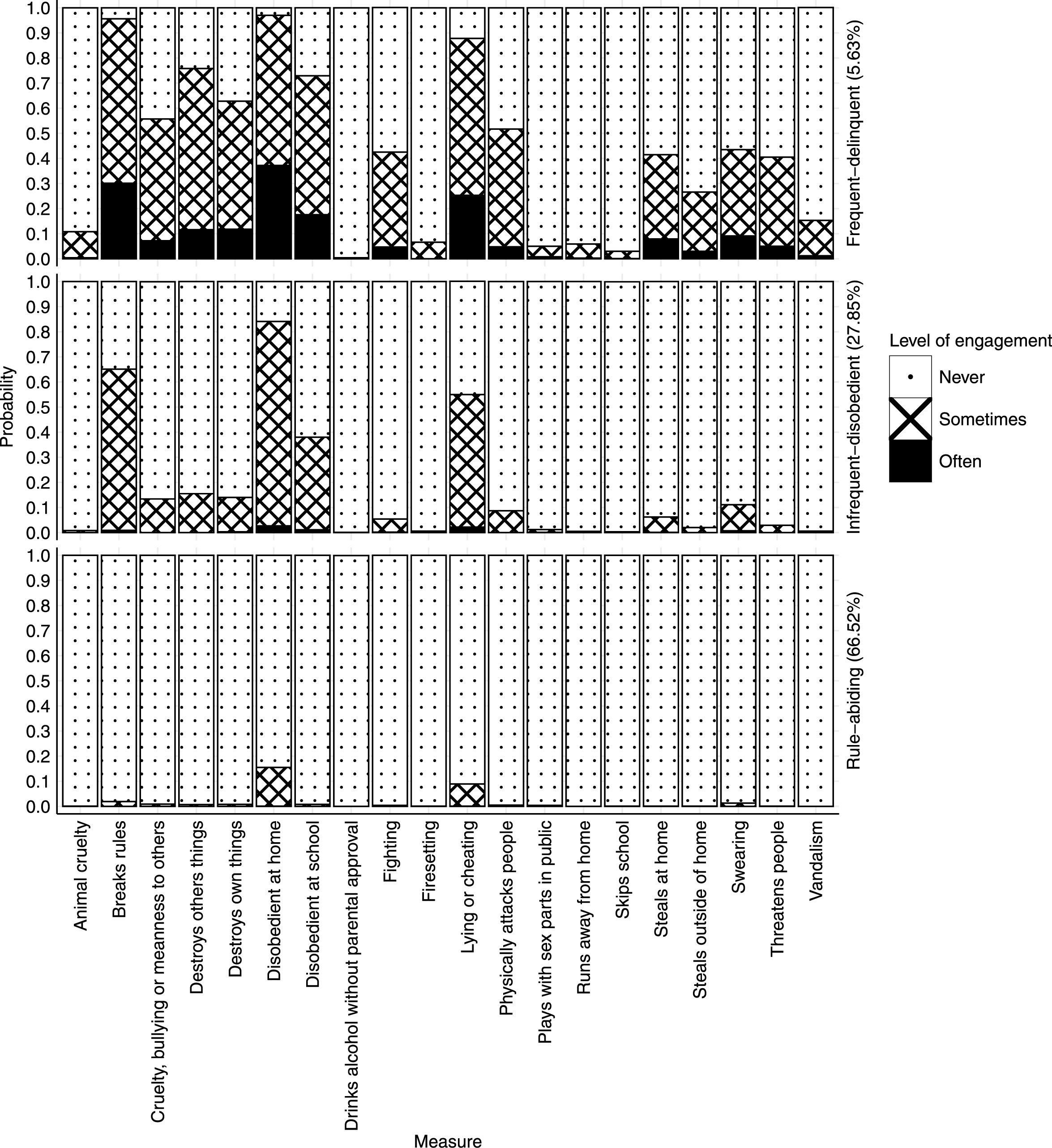
Socio-Demographic Composition
Sample Characteristics Based on sex, Age, Ethno-Racial Category, and Household Income.
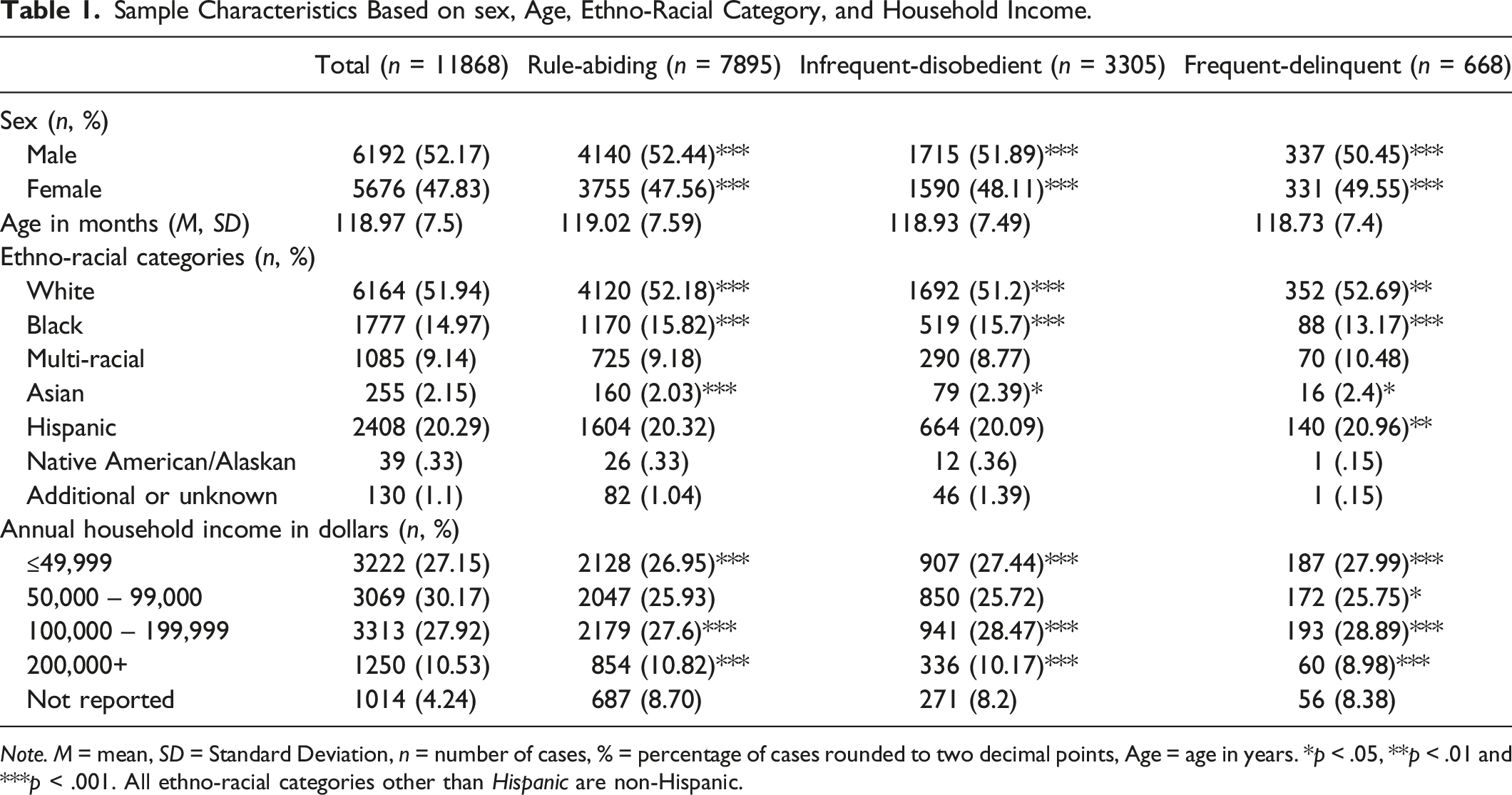
Note. M = mean, SD = Standard Deviation, n = number of cases, % = percentage of cases rounded to two decimal points, Age = age in years. *p < .05, **p < .01 and ***p < .001. All ethno-racial categories other than Hispanic are non-Hispanic.
In the Rule-abiding class, there was an overrepresentation of females, people from non-Hispanic White and Asian ethno-racial categories, and those with a household income of over $100,000. There was an underrepresentation of males, those from non-Hispanic Black ethno-racial backgrounds, and individuals with a household income under $50,000.
In the Infrequent-disobedient class, there was an overrepresentation of males, those of non-Hispanic Black ethno-racial identities, and those with a household income under $50,000. There was an underrepresentation of females, those of a non-Hispanic White and Asian ethno-racial identity and those with a household income above $100,000.
Patterns were similar in the Frequent-delinquent class to those in the Infrequent-disobedient class, although in addition, those of Hispanic ethno-racial identity and individuals with a household income over $50,000 were also underrepresented.
Factors Associated with Class Membership
Coefficients and Odds Ratios Based on Three Binomial Regression Models and Their Effects on Latent Class Membership.
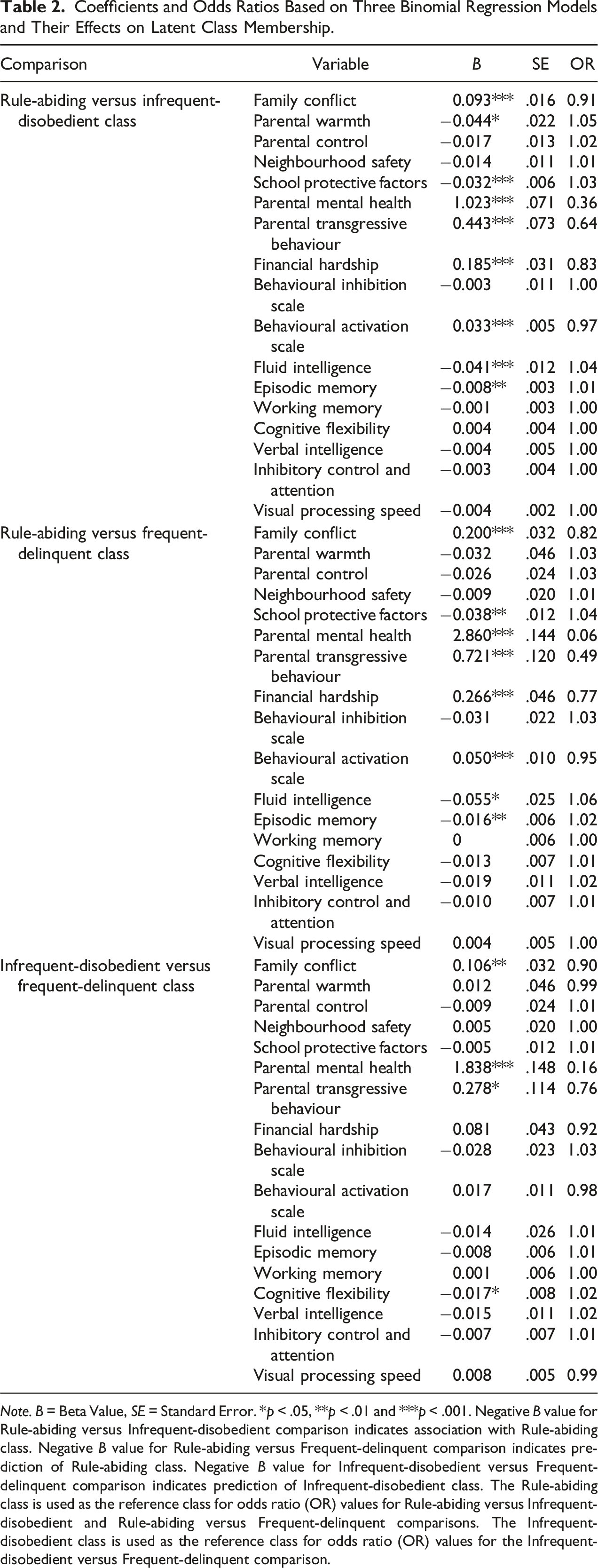
Note. B = Beta Value, SE = Standard Error. *p < .05, **p < .01 and ***p < .001. Negative B value for Rule-abiding versus Infrequent-disobedient comparison indicates association with Rule-abiding class. Negative B value for Rule-abiding versus Frequent-delinquent comparison indicates prediction of Rule-abiding class. Negative B value for Infrequent-disobedient versus Frequent-delinquent comparison indicates prediction of Infrequent-disobedient class. The Rule-abiding class is used as the reference class for odds ratio (OR) values for Rule-abiding versus Infrequent-disobedient and Rule-abiding versus Frequent-delinquent comparisons. The Infrequent-disobedient class is used as the reference class for odds ratio (OR) values for the Infrequent-disobedient versus Frequent-delinquent comparison.
Discussion
Key Findings
Using a person-centred approach, the current study identified three classes of ASB among youth, which were distinct from one another in relation to the type and frequency of ASB; Rule-abiding, Infrequent-disobedient and Frequent-delinquent. Socio-demographic characteristics that were overrepresented in the Infrequent-disobedient and Frequent-delinquent classes were largely in accordance with prior research in US-based samples, and provide indications of which groups of people may benefit most from preventative approaches. Although there was some commonality in factors associated with increased ASB, which included the presence of parental mental disorders, increased parental transgressive behaviour and family conflict, the classes were mostly associated with independent sets of factors.
Patterns of Delinquency
Labelled as Rule-abiding, Infrequent-disobedient and Frequent-delinquent, the classes identified were consistent with some studies identifying three (Ang et al., 2020; Barnes et al., 2012; Cui et al., 2024; Goings et al., 2022; Hasking et al., 2011; Park & Kim, 2020) classes. As expected, there were clear differences in the profiles of our classes compared to studies using at-risk samples (Ang et al., 2020; Mulder et al., 2012; Odgers et al., 2007), with lower overall levels of ASB found in this study. Through the use of a measure that allowed us to capture variation in ASB that are relatively minor and common among the general population, we identified classes that were differentiated based on the type and frequency of ASB.
Reassuringly, and consistent with prior literature using student and community samples (Barnes et al., 2012; Chiang et al., 2020; Childs & Ray, 2015; Cui et al., 2024; Goings et al., 2022; Hasking et al., 2011; Park & Kim; 2020), we found that most youth were allocated to the class labelled Rule-abiding, which displayed a very high probability of never engaging in all ASB. A smaller portion of youth were allocated to the class labelled Infrequent-disobedient, with low probabilities of engaging in most ASB, particularly those that are more serious, but a high propensity to sometimes engage in less serious behaviours including disobedience, lying or cheating, and rule-breaking. This is consistent with other studies that identified a class characterised by a high likelihood of more subtle ASB that may affect relationships, but that do not have a direct or tangible impact on individuals (Ang et al., 2020; Barnes et al., 2012; Cui et al., 2024). As early engagement in less serious behaviours can predict more frequent and serious offending at a later stage in development (Nagin & Tremblay, 1999), this group may benefit from targeted intervention.
A minority of youth were allocated to a class labelled Frequent-delinquent. This was characterised by high probabilities of sometimes displaying some ASB such as rule-breaking, destroying their own and others’ things, disobedience at home and school, and lying or cheating, and moderate probabilities of sometimes fighting, stealing at home, and physically attacking and threatening people. The likelihood of often engaging in most behaviours was low, apart from disobedience at home which was moderate. This does not align with most studies which have identified a class which displays frequent engagement in ASB with overt, direct, physical or tangible impact on victims (Barnes et al., 2012; Cui et al., 2024; Hasking et al., 2011). This demonstrates the value of a dataset that includes such a large sample of individuals early in their adolescent development, while most studies have included samples that extend throughout the adolescent period. We speculate that at the ages of 9 and 10, engagement in harmful victim-directed ASB may be low due to limited autonomy and independence to engage in ASB, or immature cognitive ability that prevents the planning of, and engagement in such acts. However, as this class still displays a moderate likelihood of engaging in more serious ASB and may be at risk of becoming life-course offenders (Moffitt, 1993), it may benefit the most from intervention.
We acknowledge that individuals with certain demographic identities may be at risk of engaging in ASB due to the role of historical and cultural factors (e.g., Black individuals living in Western societies may experience criminogenic conditions due to extreme poverty and family disruptions; Kaufman, 2007). The socio-demographic composition of each class was consistent with studies linking male sex (Barnes et al., 2012; Connell et al., 2011) and Black ethno-racial background (Sohoni et al., 2021; Watts & McNulty, 2015) to ASB. Our findings were also consistent with previous work showing that individuals from households with lower incomes were more likely to engage in ASB (Hoffmann et al., 2020). However, contrary to previous studies (McNulty & Bellair, 2003; Sohoni et al., 2021; Watts & McNulty, 2015), there was no over-representation of Hispanic, Multi-Racial or Native American/Alaskan individuals in ASB classes. In fact, Hispanic individuals were less likely to engage in more frequent and serious behaviours. To address the overrepresentation of male, Black, individuals from low household incomes in ASB classes, even at this early stage of adolescence, the implementation of community-level interventions that target the upstream factors we found to be important, like parental mental health and behaviour, should be explored. Black individuals are more likely to live in under-resourced communities where they are exposed to violence, which itself is associated with higher likelihood of poor mental health (Walker et al., 2024) and transgressive behaviour (Motley et al., 2017) in young adults, many of whom will become, or already be, parents. Therefore, preventative interventions that seek to support targeted community-level transformation, such as the Communities That Care programme (CTC; Hawkins et al., 2008), may be effective in reducing the emergence of ASB in these groups.
Factors Associated with Class Membership
Our findings revealed that, compared to psychological factors, class membership was associated with a greater number of environmental factors, and in general, associations with these factors were stronger. This aligns with the ICAP theory, which highlights how various environmental factors influence long-term antisocial potential. Accordingly, it may be that while psychological factors can affect the way individuals process and act on information, the extent to which these result in ASB depends more on the social context. For example, an individual who struggles with inhibitory control may find it more difficult to withhold inappropriate responses, but those responses may only result in behaviour considered anti-social (e.g., fighting or swearing), if they regularly experience situations where they are provoked. Indeed, evidence shows that at age nine to ten, individuals are highly receptive to environmental cues (Hoffman, 2000).
We identified three specific factors that significantly differentiated all class comparisons. We found that absence of parental mental health difficulties increased the odds of being in the Rule-abiding class relative to the Infrequent-disobedient class by 64% (OR = 0.36) and the Frequent-delinquent class by 94% (OR = 0.06), and the Infrequent-disobedient class relative to the Frequent-delinquent class by 84% (OR = 0.16). In addition, decreased parental transgressive behaviour increased the odds of being in the Rule-abiding class relative to the Infrequent-disobedient class by 36% (OR = 0.64) and the Frequent-delinquent class by 51% (OR = 0.49), and the Infrequent-disobedient class relative to the Frequent-delinquent class by 24% (OR = 0.76). We further discovered that decreased family conflict increased the odds of being in the Rule-abiding class relative to the Infrequent-disobedient class by 9% (OR = 0.91) and the Frequent-delinquent class by 18% (OR = 0.82), and the Infrequent-disobedient class relative to the Frequent-delinquent class by 10% (OR = 0.90). These findings support research that indicates parental mental disorders, and transgressive behaviour is associated with ASB in general (Athanassiou et al., 2023), and align with research that shows exposure to ASB is associated with patterns of minor (e.g., lying; Ang et al., 2020) and serious ASB (e.g., threatening people, fighting, stealing and police contact; Connell et al., 2011). Indeed, both the ICAP and dual taxonomy theory highlight the importance of social learning through the observation of deviant parents in contributing to ASB. Given how influential these factors are (increasing risk of allocation to a higher ASB class by as much as 94%), we suggest interventions such as Family Talk therapy (Furlong et al., 2024) should be prioritised in order to improve family communication and enhance understanding around mental illness, and how this may affect children.
Other environmental factors differentiated the Infrequent-disobedient and Frequent-delinquent class from the Rule-abiding class. We discovered that increased school protective factors increased the odds of being in the Rule-abiding class relative to the Infrequent-disobedient class by 3% (OR = 1.03) and the Frequent-delinquent class by 4% (OR = 1.04), and that decreased financial hardship increased the odds of being in the Rule-abiding class relative to the Infrequent-disobedient class by 17% (OR = 0.83) and the Frequent-delinquent class by 23% (OR = 0.77). This is consistent with findings that show financial hardship is associated with ASB in general (Gold, 2020), and that decreased school attachment is associated with patterns of serious ASB (e.g., threatening behaviour, fighting, stealing and police contact; Connell et al., 2011). It may be that prevention of ASB can be supported indirectly through interventions that focus on helping individuals manage and understand their finances more effectively, such as the FinSoc intervention (Kaittila et al., 2024), or those that make students feel valued and improve school performance and thereby promote school protective factors, such as self-affirmation interventions (Escobar-Soler et al., 2024). Interestingly, while most of the environmental factors that differentiated the Rule-abiding class from the classes with ASB present were the same, increased parental warmth increased the odds of being in the Rule-abiding class relative to the Infrequent-disobedient class by 5% (OR = 1.05), but this was not significantly associated with the Frequent-delinquent class. This implies that reduced parental warmth may be associated with patterns of less serious behaviours, but has no association with more frequent, serious behaviours.
Examination of the psychological factors that differentiated the Infrequent-disobedient and Frequent-delinquent class from the Rule-abiding class, advances our understanding of presence versus absence of ASB in early adolescence. In terms of traits, low behavioural activation, a tendency not to seek sensation/reward, increased the odds of being in the Rule-abiding class relative to the Infrequent-disobedient class by 3% (OR = 0.97) and the Frequent-delinquent class by 5% (OR = 0.95). At the cognitive level, higher fluid intelligence and episodic memory increased the odds of being in the Rule-abiding class relative to the Infrequent-disobedient class by 4% and 1%, respectively (fluid intelligence OR = 1.04; episodic memory OR = 1.01), and the Frequent-delinquent class by 6% and 2%, respectively (fluid intelligence OR = 1.06; episodic memory OR = 1.02). These findings provide support for both the dual taxonomy account, whereby deficits in cognition may increase the risk of ASB (Moffitt, 1993), and the ICAP theory in which cognitive processes can influence a decision to engage in ASB (Farrington, 2020). Furthermore, these findings align with research that shows psychological factors are related to the general presence of ASB (Basharpoor et al., 2013; Fabro & Crescentini, 2018; Huepe et al., 2011); yet these factors did not affect the odds of class membership to as great an extent as the environmental factors. Although there is growing evidence of successful near-transfer from cognitive interventions, for example mindfulness interventions improving episodic memory (Brown et al., 2016), and cognitive training exercises enhancing fluid intelligence (Peng et al., 2017), research is needed to assess the extent to which they may sufficiently improve psychological capacity enough to transfer to positive impacts on ASB, particularly given the small effects we observed.
Contrary to our expectation, executive functions did not differentiate either of the ASB classes from the Rule-abiding class. One reason for this could be that at this stage of development, cognitive functions are still maturing (Best et al., 2009) and for some of those in ASB classes, low scores may reflect a trajectory of poor cognitive function and underlying pathology, while for others in the Rule-abiding class, low scores reflect relative immaturity in cognitive development which is unlikely to persist. Longitudinal research is required to provide further insight. It should be noted, however, that one executive function was found to have a small effect on the odds of membership of the Infrequent-disobedient relative to the Frequent-delinquent class. Decreased cognitive flexibility, which has been previously linked with serious ASB (Pihet et al., 2012), was the only psychological factor that differentiated between the two classes in which some ASB was present, increasing the odds of being in the Frequent-delinquent class relative to the Infrequent-disobedient class by 2% (OR = 1.02). This could reflect a tendency among individuals with limited cognitive flexibility who are already engaging in ASB, to persist and even escalate delinquent behaviour due to difficulty considering and switching to alternative courses of behaviour (Pihet et al., 2012). Interventions that focus on task-switching to improve cognitive flexibility (Dörrenbächer et al., 2014) may be an interesting avenue for future research into targeted interventions among youth already demonstrating ASB, with a particular focus on ways to achieve transfer of cognitive flexibility to real-world behavioural scenarios.
Strengths, Limitations and Future Directions
The ABCD dataset provides the opportunity to investigate ASB in a large dataset of youth recruited to be representative of young people in the US, to inform development of targeted preventative approaches. Whilst previous research using person-centred approaches has often utilised measures only suitable for offender subgroups (e.g., Mulder et al., 2012), the CBCL measure used here is suitable for use with the general population, incorporating a range of behaviours that differ in seriousness. However, the study is not without its limitations; For example, the CBCL is based on parent-report which may underestimate the frequency of ASB. Yet, there is evidence for a high level of parent-adolescent agreement when reporting adolescent emotional and behavioural problems (Wang et al., 2014). We further note the use of a cross-sectional design does not determine causal effects and that there is a possibility of bidirectional effects with ASB classes and associated factors. In addition, the conclusions we could reach were limited by what was available in the dataset. For example, factors that could have influenced ASB were not available at baseline (e.g., peer influence), and the small sample size of some ethno-racial categories (e.g., Native American/Alaskan) may have limited the statistical power to detect differences between groups. Future research should make use of subsequent releases to study the trajectories of ASB across adolescence and their correspondence to Moffitt’s (1993) observations of life-course-persistent versus adolescent-limited ASB.
Conclusion
Our analysis in a large US sample, found that early in adolescence, most youth (66.52%) rarely engage in ASB, some (27.85%) engage infrequently in less serious behaviours, and a minority (5.63%) engage more frequently in ASB including some that are more serious. Understanding of these classes may enable us to identify those in need of intervention going forward.
Environmental factors were more strongly associated with class membership than psychological factors in general, although some psychological factors including behavioural activation, fluid intelligence and episodic memory were useful in differentiating the ASB classes from the Rule-abiding class and may provide useful targets for future interventions.
Supplemental Material
Supplemental Material - Identifying Classes and Correlates of Anti-social Behaviour in Early Adolescence
Supplemental Material for Identifying Classes and Correlates of Anti-social Behaviour in Early Adolescence by Luke W. Laban, Wesley Harmer, Jenny Retzler, and Chris Retzler in The Journal of Early Adolescence
Footnotes
Declaration of Conflicting Interests
The author(s) declared no potential conflicts of interest with respect to the research, authorship, and/or publication of this article.
Funding
The author(s) received no financial support for the research, authorship, and/or publication of this article.
Materials and/or Code Availability
Ethical Statement
Data Availability Statement
Data used in the preparation of this article were obtained from the Adolescent Brain Cognitive DevelopmentSM (ABCD) Study (https://abcdstudy.org), held in the NIMH Data Archive (NDA). This is a multisite, longitudinal study designed to recruit more than 10,000 children age 9–10 and follow them over 10 years into early adulthood. The ABCD Study® is supported by the National Institutes of Health and additional federal partners under award numbers U01DA041048, U01DA050989, U01DA051016, U01DA041022, U01DA051018, U01DA051037, U01DA050987, U01DA041174, U01DA041106, U01DA041117, U01DA041028, U01DA041134, U01DA050988, U01DA051039, U01DA041156, U01DA041025, U01DA041120, U01DA051038, U01DA041148, U01DA041093, U01DA041089, U24DA041123, U24DA041147. A full list of supporters is available at https://abcdstudy.org/federal-partners.html. A listing of participating sites and a complete listing of the study investigators can be found at https://abcdstudy.org/consortium_members/. ABCD consortium investigators designed and implemented the study and/or provided data but did not necessarily participate in the analysis or writing of this report. This manuscript reflects the views of the authors and may not reflect the opinions or views of the NIH or ABCD consortium investigators. The ABCD data repository grows and changes over time. The ABCD data used in this report came from NIMH data archive;  ; curated release 2.0.
Supplemental Material
Supplemental material for this article is available online.
Author Biographies
References
Supplementary Material
Please find the following supplemental material available below.
For Open Access articles published under a Creative Commons License, all supplemental material carries the same license as the article it is associated with.
For non-Open Access articles published, all supplemental material carries a non-exclusive license, and permission requests for re-use of supplemental material or any part of supplemental material shall be sent directly to the copyright owner as specified in the copyright notice associated with the article.
