




Abstract
During early adolescence, individuals can refine their use of cognitive reappraisal as an emotion regulation strategy while experiencing instability of psychological well-being through changes to positive affect, negative affect and life satisfaction. This scoping review aimed to identify and summarise the key findings from studies that have examined early adolescent cognitive reappraisal and psychological well-being. Using Arksey and O’Malley’s scoping review methodology, this review yielded 63 studies; 58 studies found a positive relationship between cognitive reappraisal and psychological well-being. Most studies that examined age found no association between the frequency of reappraisal use and age. Findings connected to sex differences and contrasts between discrete emotions were inconsistent. The positive association between cognitive reappraisal and well-being indicates that cognitive reappraisal should be actively promoted in youth contexts. Future research should specify the direction of this relationship, how it develops and how effective the relationship is across sexes and discrete emotions.
Introduction
Early adolescence is a developmental stage that involves significant life events such as puberty, secondary school and new relationships (Lee et al., 2014). The magnitude of change across several life domains can increase emotional lability during this period (Bailen et al., 2018). Some adolescents flourish during this time, acquiring skills and mental resilience, but those with low change tolerance and less developed social-emotional capacity have an increased risk of poor psychological well-being (PWB; Rapee et al., 2019). PWB can be defined as an evaluation of one’s own life, both cognitively through life satisfaction, and affectively in terms of positive and negative affect (Diener et al., 2017). Positive affect includes emotions and moods experienced when things are going well such as joy and contentment, whereas negative affect includes emotions such as anger, and longer-lasting moods such as depression and anxiety. This is distinct from psychopathology (Campbell & Osborn, 2021) as it emphasises subjective interpretation rather than objective measures of well-being, which removes the impact of cultural or goal-related expectations (Diener et al., 2017). Early adolescence can be a sensitive developmental window for PWB due to the instability of negative affect, positive affect and life satisfaction (Goldbeck et al., 2007; Maciejewski et al., 2015; Schneiders et al., 2006). The transition into adolescence also coincides with an increased desire to demonstrate independence among peers, resulting in a decline in social support-seeking from early to mid-adolescence and a need for more independent emotion regulation (Eccles & Roeser, 2011; Cole & Hollenstein, 2018).
Emotion Regulation
Emotion regulation (ER) is the response exerted to manage and modify the influence and duration of emotions to accomplish goals (Thompson, 1994). Gross’ ER process model (1998) states that ER is an iterative process that can be engaged at one or more of the stages of situation selection, situation modification, attention reorientation, reappraisal or response to the emotion-evoking stimulus. During early adolescence, brain maturation increases ER capabilities (Schäfer et al., 2017). In contrast to ER strategies typically used in late childhood such as distraction and familial support-seeking, early adolescents begin using more cognitive strategies such as cognitive reappraisal (McRae, Gross, et al., 2012; Skinner & Zimmer-Gembeck, 2007).
Cognitive Reappraisal
Cognitive reappraisal (CR) is an ER strategy that involves changing one’s understanding of an emotion-evoking stimulus to alter affective response (Sheppes & Gross, 2011). CR use has demonstrated negative associations with negative affect and positive associations with positive affect and life satisfaction (Hu et al., 2014). This association with PWB is particularly salient during adolescence as the relationship between CR use and internalising symptoms is stronger for adolescents compared to children (Compas et al., 2017). Previous meta-analyses have examined the relationship between ER and psychopathology (Compas et al., 2017; Schäfer et al., 2017), and the development of CR in childhood and adolescence (Willner et al., 2022), but reviews have not specifically examined the relationship between CR and PWB during early adolescence, nor have they focused on positive well-being outcomes.
Cognitive Reappraisal and Psychological Well-Being
There are clear relationships between different ER strategies and psychopathology during adolescence (Cai et al., 2021; Compas et al., 2017; McLaughlin et al., 2011) but CR also has the unique ability to improve positive well-being outcomes (Daniel et al., 2020). In fact, CR use has been more effective at upregulating positive well-being compared to downregulating negative well-being outcomes among adults (King & dela Rosa, 2019). This capacity to upregulate positive emotions can, in turn, reduce negative affect (Silton et al., 2020). Understanding factors associated with positive well-being measures gives insight into how we can prevent future mental health problems by promoting well-being (Lyumbomirsky et al., 2005).
Understanding this relationship during early adolescence is particularly important because brain maturation during this developmental phase contributes to the sophistication of CR, evaluations of the self and the emergence of life satisfaction (Diener et al., 2017; Harter, 2003; Willner et al., 2022). Previous adolescent ER research has focused on the relationship between CR and psychopathology because early adolescence produces the highest onset of mental illness (Allen & Nelson, 2018; Scheiner et al., 2022). However, CR research that also explores associations with positive affect and life satisfaction not only better encompasses a broader definition of PWB but also underscores the relationship between CR and happiness and fulfilment (Diener et al., 2017).
Challenges
Several aspects of research to date present challenges to a clear understanding of how CR and PWB are related. Although not exhaustive, some include how CR is measured, age differences, sex differences and effectiveness across discrete emotions (Willner et al., 2022; Zenman et al., 2006).
Differences Across Cognitive Reappraisal Measures
Previous research has used a range of CR measurements, including self-report, experimental inducement and experience sampling methods. The presence of an association may differ according to the type of CR measure. For example, Suksasilp et al. (2021) found no relationship between self-reported CR use and experimentally induced CR. De Witte et al. (2017) found a significant relationship between experimentally induced CR and anxiety, whereas another study found no correlation between self-reported CR use and anxiety (Weissman et al., 2019). Clearly describing the association of CR measurement and PWB will enable the development of more detailed models of how CR relates to PWB in early adolescence.
Age Differences
CR activates areas of the prefrontal cortex associated with verbal working memory and cognitive control (Giuliani & Pfeifer, 2015; Schweizer et al., 2020). This implies that the maturation of the prefrontal cortex during early adolescence facilitates greater use of CR (Vijayakumar et al., 2014). In contrast to cross-sectional studies that posit a continuous increase in CR use with age (McRae, Gross, et al., 2012; Thomsen, 2016), a longitudinal study found that CR use declined as adolescents aged (Gullone et al., 2010). Instead, neuroimagery studies show that CR effectiveness or efficiency increases over time (Guassi-Moreira et al., 2019; Silvers et al., 2012). As such, accounting for age may help further clarify the relationship between CR and PWB.
Sex Differences
There may also be sex differences in the use and effectiveness of CR. Girls hit puberty earlier than boys (Sørensen et al., 2012), and there is evidence that girls have earlier brain maturation and different brain activation during CR use compared to boys (Steinberg & Morris, 2001; Vijayakumar et al., 2014; McRae et al., 2008). Based on this evidence, girls could be more likely than boys to develop CR capabilities at an earlier age. Gullone et al. (2010) found small but significant sex differences in CR use, whereby girls used CR more than boys, yet other studies have found no sex differences (Thomsen, 2016; Crockett et al., 2020). Nonetheless, girls using CR more does not indicate increased effectiveness for girls compared to boys. For example, girls have demonstrated worse PWB during early adolescence (Mezulis et al., 2010) and two studies found that CR helped reduce internalising symptoms for boys but not girls (Arora & Dhillon, 2017; Garnefski et al., 2005). Untangling sex differences would provide better insight into CR effectiveness.
Differences Across Discrete Emotions
Finally, discrete emotions differ in how they are exerted, their physiological characteristics and how they manifest (Harmon-Jones et al., 2017). Zimmerman & Iwanski (2014) have posited that the use and effectiveness of some ER strategies develop in an emotion-specific manner. Regarding CR, one study demonstrated that early adult CR use was dependent on what emotion was being regulated (Vishkin et al., 2019). Adult CR was also found to be negatively associated with depressive symptoms but had a non-significant relationship with anxiety symptoms (Aldao et al., 2010). During early adolescence, increases in emotional lability could influence the use and effectiveness of CR on different emotions (Zimmermann & Iwanski, 2018). A specific examination of the effectiveness of CR on discrete emotions will further explain the relationship between CR and PWB.
This Study
In summary, early adolescence is a sensitive developmental period for both CR and PWB, but a review is yet to synthesise this relationship during early adolescence. This research aims to review and reflect on the literature concerning adolescent CR, and its relationship with PWB, and to advise future research in the area. The purpose of this scoping review is (a) to provide an overview of empirical studies regarding the relationship between CR and PWB during early adolescence and (b) to examine how this relationship might differ across different measures of CR, age, sex and discrete emotion.
Research Questions
1) Is there a relationship between CR and PWB during early adolescence? 2) Does the relationship differ across CR measures? 3) Does the relationship differ across ages? 4) Does the relationship differ across sexes? 5) Does the relationship differ across discrete emotions?
Method
Study Design and Protocol
This study’s protocol was conducted using Arksey and O’Malley’s methodological framework (2005): (1) Identification of research question; (2) Identification of relevant studies (3) Selection of studies included (4) Charting of data (5) Collating, summarizing, and reporting. This was further refined by the Joanna Briggs Institute (Peters et al., 2015) and the current Preferred Reporting Items for Systematic Reviews and Meta-analyses Extension for Scoping Reviews (PRISMA-ScR; Tricco et al., 2018). This review was preregistered with PsychArxiv (https://doi.org/10.31234/osf.io/k3rs2).
Eligibility Criteria
The following criteria determined the selection of studies included in the scoping review: (1) In accordance with the United Nations International Children’s Education Fund’s definition of early adolescence (2011), any studies with a mean sample age greater than 10 years and less than 15 years (2) Studies that included non-at-risk and non-clinical populations to focus on typical development (3) Studies that used the Emotion Regulation Questionnaire (ERQ; Gross and John, 2003), the Emotion Regulation Questionnaire for Children and Adolescents (ERQ-CA; Gullone & Taffe, 2012), the Cognitive Emotion Regulation Questionnaire (CERQ; Garnefski et al., 2002), and the Cognitive Emotion Regulation Questionnaire for kids (CERQ-K; Garnefski et al., 2007). Only these measures were included because they are consistently used and well-validated. A CR developmental review found that 88% of studies that used self-reported CR among adolescents utilised those measures (Willner et al., 2022). Experimentally induced CR and experience sampling methods were also included to compare differences between CR measures. (4) Studies with at least one validated self-report measure of positive affect, negative affect and/or life satisfaction to represent Diener’s definition of PWB (2017). Studies that only measured externalising symptoms were excluded because there is no evidence base for a relationship between CR and externalising symptoms (Garnefski et al., 2005). (5) Studies in English.
Information Sources and Search Strategy
A three-step search strategy was conducted to identify published and unpublished research that examined adolescent CR and PWB. First, an initial limited search of PsychInfo was implemented to identify relevant articles. The text words used in the initial search articles helped develop the specific search terms for the full search strategy. In December 2021 and again in June 2022, PsychArticles, PsychINFO, ERIC, Education Full Text and Education Source databases were used to extract relevant published literature in the full search. NICE-UK and OpenGrey were also used to source unpublished/grey studies. The search was limited to peer-reviewed articles, dissertations and theses written in or translated into English. The search was also supplemented by reviewing the reference sections of published review papers in the area. The final search strategy is presented in Appendix A.
Study Selection Process
Following the search, all identified records were uploaded to Endnote X9 and all duplicates were removed. All records were then imported into Rayyan for screening and full study selection (Ouzzani et al., 2016). The first author (CS) screened the titles and abstracts and sorted them according to the eligibility criteria. A second reviewer then blindly screened 40% of the titles and abstracts. Any uncertainty regarding eligibility was discussed by the reviewers until a consensus was met. Where consensus was not met between the two reviewers, a third reviewer aided consensus. There was adequate agreement on the title and abstract screening, based on Cohen’s Kappa coefficient (Cohen, 1960) (κ = .80, p < .001). Once potentially relevant papers were retrieved, CS screened full texts and a second reviewer blindly evaluated 50% of full texts per the inclusion criteria. The reviewers achieved adequate agreement on full-text screening (κ = .72, p < .001). Discrepancies about eligibility criteria were discussed between the reviewers and full consensus was met. The results of the search and the study inclusion process were presented in a PRISMA-ScR flow diagram (Tricco et al., 2018; Moher et al., 2009) (see Figure 1). Flow diagram of the progression of information through the scoping review.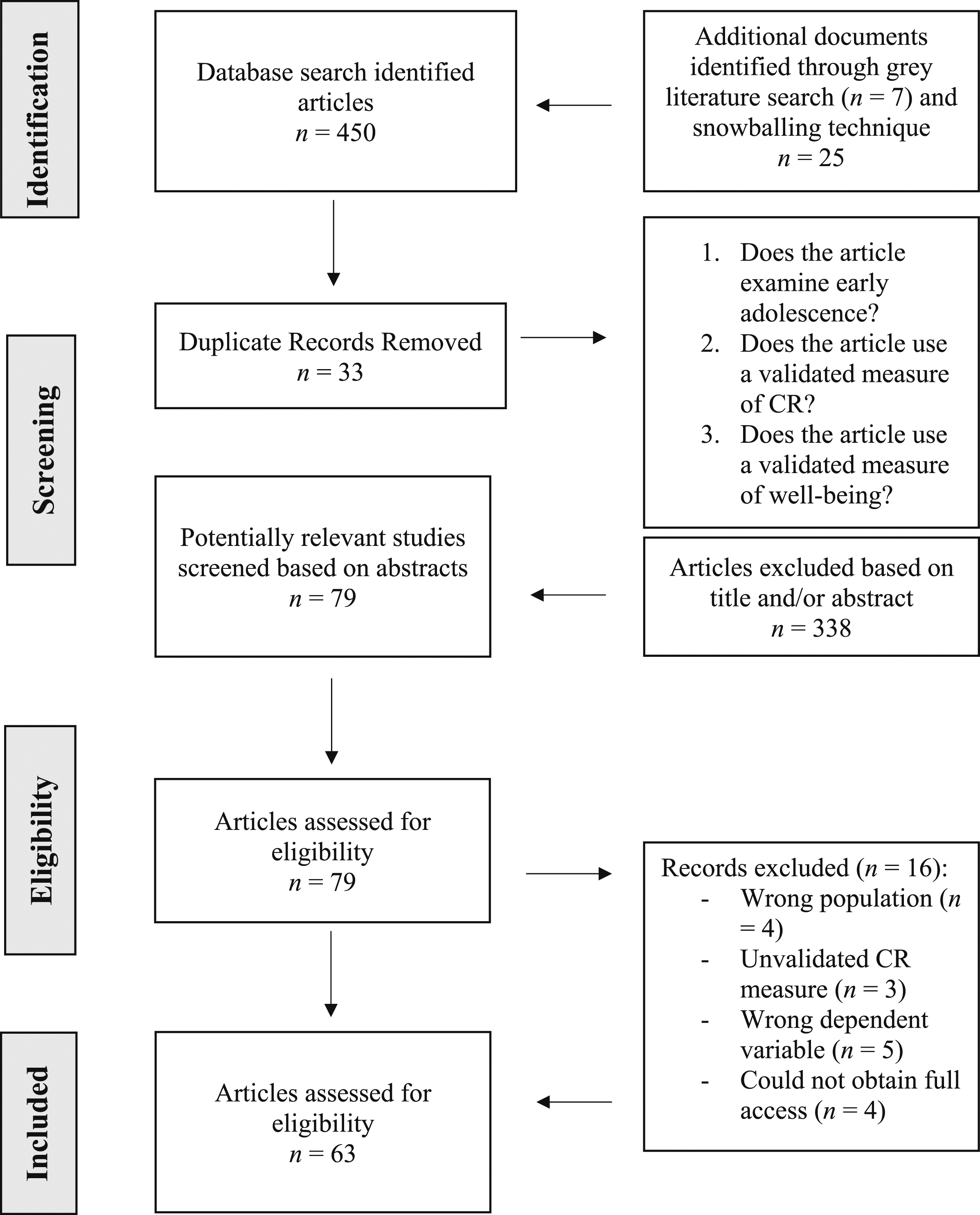
Data Items and Extraction Process
CS extracted data from the selected papers using Microsoft Excel. Each suitable study was coded for year and country of publication, CR measure, PWB measure, sample size, age range, research design, key findings, and limitations. The scoping review included a data extraction form developed by the reviewers and based on methods recommended by Peters et al. (2017) (see Appendix B). CS contacted four authors via ResearchGate and email to source unavailable full texts, but all requests were unsuccessful.
Methodological Quality Appraisal
Each potentially suitable study was evaluated using the AXIS quality appraisal tool (Downes et al., 2016). Although not typical of a scoping review, this tool facilitated mapping and synthesis (Levac et al., 2010). The AXIS is a critical appraisal tool for cross-sectional studies that was developed using a multi-modal evidence-based approach (see Appendix C). The AXIS is appropriate in this scoping review because most studies reviewed were cross-sectional and it gives insight into quality assessment for future research. It contains 20 questions that address the subsections of aims/objectives, methodological rigour, analysis, results, limitations, conclusions, funding sources/conflicts of interest and ethics. As the tool does not provide a numerical scale for assessing study quality, a degree of subjective assessment is needed. CS carried out the study quality assessment and this was reviewed by the other authors.
Synthesis
The extracted data is presented in tabular form and incorporates the objectives of the scoping review (see Supplemental Material A). Along with a quantitative analysis using descriptive methods (i.e., frequencies, summary statistics), a narrative synthesis linked to the table and focused on providing: (1) a description of the relationship between CR and PWB during early adolescence; (2) if the relationship between CR and PWB differs across CR measure, age, sex, and type of emotion; (3) future directions for studies in the area. This was achieved by summarizing the literature according to the characteristics of the studies, comparators, and key findings.
Results
Study Characteristics
After deleting duplicates and screening for eligibility criteria, the search yielded 63 studies (see Figure 1). There were three dissertations and 60 published journal articles. The studies took place in America (k = 16), Holland (k = 9), China (k = 7), Australia (k = 6), Canada, (k = 5), Belgium, Spain, Taiwan, the United Kingdom (all k = 3), Argentina, Estonia, Iran, Italy, Norway, Portugal, Romania and Switzerland (all k = 1). There were 40 cross-sectional studies, 12 longitudinal studies and 11 experimental pre-post-test studies, published from 2001–2022 (see Supplemental Material A).
Research Question 1: The Relationship Between CR and Psychological Well-Being
The review found that 58 out of 63 studies showed a significant relationship between CR and PWB. Of these 58 studies, 33 studies found a correlation between CR use and PWB, 14 studies found that CR use was a significant predictor of PWB, and 11 studies reported that trained CR improved PWB via an experimental design. Overall, most studies (n = 56) examined negative affect or psychopathology, six studies investigated positive affect, one study examined life satisfaction and three studies measured both positive and negative affect. All seven studies investigating the relationship between CR and positive affect, or life satisfaction found a positive relationship. The four studies that did not find a relationship between CR use and PWB all explored negative affect. Measures of negative affect included depressive symptoms, anxiety symptoms, psychological distress, emotional problems, internalising problems, disgust, shame, guilt and fear. Positive measures included positive traumatic growth, positive affect and life satisfaction. This demonstrates a clear positive association between CR and PWB during early adolescence.
Research Question 2: CR Measure Differences
Concerning CR measure, 46 studies used self-reported CR, twelve studies used experimentally induced CR and five studies used experience sampling methods. For self-reported CR use, a significant relationship was found in all eleven studies that used the self-reported CERQ, and all thirteen studies that used the ERQ-CA. Four out of 22 studies that used the ERQ found a non-significant relationship (Cerruti et al., 2017; Flouri & Panourgia, 2014; Hsieh & Stright, 2012; Weissman et al., 2019). All studies that used experience sampling methods found significant relationships between CR use and PWB. Of the twelve studies that used experimentally induced CR, one did not find a significant relationship (Rodman et al., 2019). Therefore, CR was significantly associated with PWB, regardless of whether CR was self-reported, experimentally induced or measured via experience sampling methods.
Research Question 3: Age Differences
Fifteen studies examined correlations between CR use and adolescent age. One study found a small negative correlation between CR use and age but fourteen studies, including four longitudinal studies, found no significant association (see Supplemental Material B). Two studies investigated CR effectiveness across early adolescent age. Pitskel et al. (2011) examined how age influenced the regulation effectiveness of disgust via self-report and neural fMRI activity. Neuroimgagery demonstrated that CR effectiveness improved with age but there was no relationship between self-reported CR effectiveness and age. Theurel and Gentaz (2018) tested age differences in self-reported CR use and CR effectiveness via experimentally induced CR of emotionally charged pictures. They also found that CR effectiveness increased with age but found no relationship between CR use and age. This evidences an association between age and CR effectiveness, but not CR use.
Research Question 4: Sex Differences
Eleven studies examined the relationship between CR use and sex (see Supplemental Material C). Six studies found no significant correlation and four studies using t-tests or ANOVAs found no sex differences in CR use. One longitudinal study found that CR use was significantly higher for girls at four different time points (DeFrance et al., 2018). Eleven studies investigated if CR effectiveness differed across sexes. All studies examined negative affect and one study also measured positive affect. Out of the eleven studies, five found sex differences and six found no sex differences. Of the five studies that found sex differences, two studies found sex differences in CR effectiveness whereby girls were better at CR regulation compared to boys (Ford et al., 2018; Vestad et al., 2021). Three studies then found a sex difference; although these were not consistent by sex; Two studies found that CR was effective for girls but not boys (Yeh et al., 2017; Ogbaselase et al., 2020) whereas one study found that taught CR only benefitted boys’ regulation of depressive symptoms (Lee et al., 2020). Altogether, there are mixed findings but if sex differences do exist, previous research leans towards CR effectiveness being greater for girls.
Research Question 5: Discrete Emotion
Fear, disgust and shame were each examined once in separate studies, which prevented the formulation of conclusive findings. In contrast, 17 studies investigated depressive and anxiety symptoms together, which prompted a concentrated analysis of these domains (see Supplemental Material D). Nine studies examined correlations between CR use and depression and anxiety symptoms. Two studies found a correlation between CR use and depressive symptoms but not anxiety symptoms, one study found a correlation between CR use and anxiety symptoms but not depressive symptoms, and six studies found correlations between CR use and both anxiety and depressive symptoms. Eight studies examined CR effectiveness across depressive and anxiety symptoms. Of these eight studies, three studies found that CR was a significant predictor of depressive symptoms but not anxiety symptoms (DeFrance & Hollenstein, 2021; Eastabrook et al., 2013; Garnefski et al., 2002), two studies found that CR use was a significant predictor of anxiety-related symptoms but not depressive symptoms (Garnefski et al., 2007; Theurel & Gentaz, 2018) and three studies found that CR was a significant predictor of both (DeFrance & Hollenstein, 2022; Garnefski & Kraaij, 2014; Kuhlman et al., 2021). Overall, there is inconclusive evidence that CR effectiveness differs across these discrete emotions.
Discussion
This review aimed to examine the relationship between CR and PWB during early adolescence. CR use was consistently associated with lower negative affect and higher positive affect and life satisfaction. Non-significant relationships could be explained by studies using the self-reported adult version of the ERQ, which has not been validated among children, rather than the ERQ-CA (Gullone & Taffe, 2012). Most studies examined negative affect but every study that examined positive affect or life satisfaction found a significantly positive association. Future CR research should therefore consider positive PWB indicators.
Sixteen studies reported CR as a significant predictor of PWB and eleven studies found PWB improvements via instructed/trained CR. This indicates that CR could predict PWB. McLaughlin et al. (2011) similarly found that emotion dysregulation predicted psychopathology, but psychopathology did not predict emotion dysregulation. Another study found that formerly depressed adults could use CR as effectively as a non-clinical population (Ehring et al., 2010). However, this claim should be approached with caution because most studies did not examine if PWB predicted CR. Moreover, CR use does not imply that early adolescents can successfully identify moments when they should use CR, nor does it indicate that they will choose CR over other ER strategies (McRae & Gross, 2020; Williams & McGillicuddi-DeLisi, 1999). Experimental studies provide useful evidence but experimentally induced CR does not always equate to CR use in real-life settings (Theurel & Gentaz, 2018). Instead, factors such as emotional intensity often determine the likelihood of CR use (Sheppes et al., 2011), which implies a bidirectional relationship. Taken together, this review provides evidence for a positive relationship between CR and PWB but more longitudinal research is needed to determine directionality.
Age
Previous research has posited that adolescents have a greater capacity to use CR as they age because of increased brain development, and more experience using CR (Gullone et al., 2010). This review found that CR use is unlikely to increase with age during early adolescence; only one study found a positive association between CR use and age, compared to fifteen studies that refuted this claim. This contrasts with two previous studies showing that the use of reappraisal coping measures increased with age (Valiente et al., 2015; Tu et al., 2016). Perhaps CR use increases during late childhood but then varies between individuals in early adolescence.
There were also mixed findings for CR effectiveness improving with age, with two studies supporting the relationship and one experiment contradicting it. There is evidence that CR’s ability to reduce negative affect increases with age (Silvers et al., 2017), and research where age does not influence CR effectiveness (Davis, 2016). These inconsistent findings could be explained by the conceptual constraint between CR use and CR effectiveness discussed previously. CR use does not always equate to CR effectiveness and a more viable explanation is that those who regularly use CR improve their effectiveness over time. Willner et al. (2022) also state that there is clearer evidence that CR effectiveness improves with age when examining neural measures during CR tasks. For example, one study found that age did not influence self-reported CR effectiveness, but it did impact neural CR effectiveness (Pitskel et al., 2011). The authors state that this could be because self-reported measures are influenced by social desirability whereas neural measures are more objective. This review’s variability in mean ages and age ranges also reduces external validity. Despite limiting the developmental stage to early adolescence, variability could still exist between 10 and 15 years. For example, Compas et al. meta-analysis (2017) found that age moderated the relationship between ER and internalising symptoms, while another meta-analysis did not (Schäfer et al., 2017). Moreover, all studies that examined age and CR effectiveness were cross-sectional. Longitudinal studies would provide more accurate developmental trends. In summary, CR use does not increase with age and there is stronger evidence for CR effectiveness increasing with age.
Sex
There were inconsistent findings regarding sex differences in CR effectiveness. Six studies found no sex difference and five studies found a sex effect, with four studies finding the relationship beneficial to girls and one study displaying the opposite effect. One study showed that girls might use CR more, but this does not lead to improvements in PWB (DeFrance et al., 2018). This is supported by previous neuroimaging research, which found that girls, but not boys, who demonstrated greater neurological effort trying to use CR had an increased likelihood of internalising symptoms (Colich et al., 2017). One explanation for this could be puberty, which has been found to influence both ER and PWB (Mendle, 2014; Vijayakumar et al., 2014). As on average, girls commence puberty earlier than boys, the development of the prefrontal cortex happens at a slightly younger age, meaning girls may have the ability to use CR at an earlier age than boys (Blakemore et al., 2010). However, this could also increase the risk of rumination use, which could reduce CR effectiveness (Ford & Troy, 2019). For example, one study found a positive correlation between CR and rumination (DeFrance & Hollenstein, 2022). While CR is often described as adaptive and rumination maladaptive, both are thought-based strategies (Peuters et al., 2019). These strategies diverge as CR stops after successful affect regulation while rumination continues, but some adolescent girls might be unable to make this distinction. Overall, there is no substantial evidence for sex differences in the relationship between CR and PWB.
Discrete Emotions
Regarding discrete emotions, seventeen studies examined depressive and anxiety symptoms, which led to a focused observation of these two areas. The most common finding was that CR was associated with both depressive and anxiety symptoms but these results were mixed. Furthermore, only four studies primarily aimed to examine the effectiveness of CR on discrete emotions. These mixed findings could be due to a change in CR effectiveness from early to mid-adolescence. One longitudinal study found no correlation between CR and depressive symptoms over four time points from 12 to 15 years except for the final time point (DeFrance et al., 2018). Furthermore, Shapero et al. (2016) found a relationship between CR and depression but not anxiety in a mid-adolescent population and Zimmerman and Iwanski (2014) found a decline in adaptive ER from early to middle adolescence for sadness but not fear, implying that less CR effort was needed. CR seems to be effective at regulating both depressive and anxiety symptoms in early adolescence but this research supports the idea that CR could be more effective at regulating specific emotions at certain ages (Zimmerman & Iwanski, 2014).
Quality Assessment
Overall, the study quality in this review was above average standard; nearly all studies clearly defined their aims, design and limitations, and used an appropriate population base. However, most studies had a moderate risk of bias because they failed to report justification for sample sizes (78%), effect sizes (51%) and information about non-responders (78%). Few studies also took advantage of multiple reporters to improve validity and there was variation between well-being measures and an overdependence on self-report measures.
Limitations
The review only included the most used self-reported CR measures, which may have resulted in the omission of other validated CR self-report measures and coping measures that have conceptual overlap with CR (Skinner & Zimmer-Gembeck, 2007). For example, Flouri and Mavroveli (2013) found a positive correlation between CR and active coping. However, CR was solely included because it is more related to upregulating positive emotions compared to secondary control coping (Andreotti et al., 2013). The CR scales also measured different constructs whereby the ERQ used CR, whereas the CERQ used positive reappraisal. Studies that used experimentally induced CR also failed to account for habitual CR use and ER strategy switching during tasks (Rood et al., 2012; Theurel & Gentaz, 2018).
ER is context-dependent and influenced by several variables that this review did not consider. For example, adolescents regulate emotions differently in public and private settings (Zimmerman & Iwanski, 2018). Life experience could also influence CR; the more life experiences an individual has, the greater the flexibility to engage in situation reinterpretation. Other confounds could be socioeconomic status (Herd et al., 2020), culture (Willner et al., 2022), biological reactivity (Shapero et al., 2016), emotion intensity (Hiekkaranta et al., 2021), controllability (Troy et al., 2013) and affective control (Schweizer et al., 2020). However, this review’s studies accounted for adverse life experiences (Boyes et al., 2016) and emotional awareness (Eastabrook et al., 2013), and still found significant relationships.
Another important concept to consider is polyregulation, whereby adolescents benefit from a repertoire of ER strategies (Lougheed & Hollenstein, 2012). While one ER strategy might be more effective than another at regulating PWB, individuals use multiple ER strategies in everyday life. One study reported that when CR was used alongside other adaptive ER strategies such as distraction, the effect of CR on PWB was significant, however, when used alone, it was not (Compas et al., 2017). Nevertheless, individual investigation of CR is still pertinent in early adolescence compared to older age groups because of greater limitations in ER strategy choice and increased dependency on specific strategies due to neurological underdevelopment (Zimmerman & Iwanski, 2014). Isolating CR effectiveness validates the inclusion of CR into a beneficial repertoire.
Future Directions
With clear evidence that CR is positively associated with PWB, future studies should examine if psychoeducational programs that teach CR impact PWB (Rood et al., 2012; Morrish et al., 2018; Ng et al., 2018). Two studies from this review effectively used experimentally induced CR within educational settings (Lee et al., 2020; Wante et al., 2018). Improving PWB through educational interventions could be foundational research that combats adolescent developmental psychopathology (Gilbert, 2012).
To better understand age differences, typical development and the directionality of the relationship between CR and PWB, future studies should differentiate between CR use and CR effectiveness by using longitudinal research and experience sampling methods (McRae, 2013; Silvers & Guassi Moreira, 2019). It would also be useful to delineate between types of CR; Distancing and reinterpretation are two CR sub-variants that have demonstrated different psychological outcomes (McRae, Ciesielski, & Gross, 2012; Oschner et al., 2004).
Reappraisal effectiveness should be understood alongside alternative ER strategies such as rumination, and other possible moderators. While great advances have been made in this area (DeFrance & Hollenstein, 2022), two typical transitions during adolescence are puberty and middle/secondary school. As these transitions require adaptation and change, they can be experienced as stressful and could lead to increased use of certain ER strategies (McLaughlin et al., 2015). These points would clarify what contexts make CR effective during early adolescence. Accounting for puberty and rumination could also explain sex differences in CR effectiveness whereas the comparison of emotional states other than depressive and anxiety symptoms would allow a more in-depth examination of CR effectiveness across discrete emotions.
CR use is not universally beneficial (Ford & Troy, 2019) and elucidating when age, gender and discrete emotions impact the relationship between CR and PWB would highlight the who, when and how of intervention effectiveness. For example, girls hit puberty earlier than boys, which could mean that CR education could be more effective for early adolescent girls.
Conclusions
This review demonstrates a positive relationship between CR and PWB during early adolescence. Minimising the age range to early adolescence does not clarify inconsistent findings regarding age, sex and discrete emotion, which highlights the need for future CR research that is longitudinal, and considerate of contextual factors such as puberty, brain development and polyregulation.
Supplemental Material
Supplemental Material - The Relationship Between Cognitive Reappraisal and Psychological Well-Being During Early Adolescence: A Scoping Review
Supplemental Material for The Relationship Between Cognitive Reappraisal and Psychological Well-Being During Early Adolescence: A Scoping Review by Christopher Shum, Samantha Dockray and Jennifer McMahon in The Journal of Early Adolescence
Footnotes
Acknowledgements
We are grateful to Brooke McMullan for acting as a second reviewer in the abstract and full-text screening processes. Special thanks are extended to the staff at the University of Limerick Library for their valuable insights during the review search. Additionally, we thank the anonymous journal reviewers and the editor, Dr. Alexander T. Vazsonyi for constructive comments on an earlier draft.
Declaration of Conflicting Interests
The author(s) declared no potential conflicts of interest with respect to the research, authorship, and/or publication of this article.
Funding
The author(s) received no financial support for the research, authorship, and/or publication of this article.

Supplemental Material
Supplementary material for this article is available online.
Appendix A
Appendix B
Appendix C
Author Biographies
References
Supplementary Material
Please find the following supplemental material available below.
For Open Access articles published under a Creative Commons License, all supplemental material carries the same license as the article it is associated with.
For non-Open Access articles published, all supplemental material carries a non-exclusive license, and permission requests for re-use of supplemental material or any part of supplemental material shall be sent directly to the copyright owner as specified in the copyright notice associated with the article.
