




Abstract
Identity research focuses on multiple processes capturing how adolescents form and maintain a sense of self. However, identity content (the “what” of identity) might impact associations between identity and the association with well-being. We examined this potential role of content (i.e., valence and life domain) in two studies, focusing on autobiographical reasoning in written narratives (i.e., self-event connections), educational identity commitment and exploration processes, and measures of general and domain-specific functioning. Study 1 (N = 180, Mage = 14.7) and Study 2 (N = 160, Mage = 13.1) provided little evidence for the hypothesized role of identity content, but moderation analyses in Study 1 showed that self-event connections were more strongly related to life satisfaction in narratives about relational events than other events. These findings suggest a more fine-grained approach is needed to capture the role of identity content.
Keywords
Introduction
Like many adolescents, Cady H. frequently engages with the question of who she is. Cady was homeschooled for the entirety of her primary and a part of her secondary education. When her parents decided to move back to their home country, their daughter was placed in a local secondary school where she faced the difficult task of figuring out who she was in a context where other students had already made friends and formed cliques. Cady first became friends with several outcasts and then, when given the chance, started to spend time with the popular students. After a falling out with both cliques of peers and the realization that neither group fitted well with who she wanted to be, she pursued her interest in math and fell in with a crowd of peers with a similar interest. 1
To answer the question of who Cady is – of what her identity is – we could focus on different elements emphasized in different research traditions. Should we look at her commitment to doing what she finds interesting, and the degree to which she first explored different cliques and their values and beliefs before rejecting them? Should we consider Cady’s ability to create a cohesive and integrated life story (or narrative identity), explaining how her exploration of different cliques and the falling out with her peers led her to hold true to her own interests? We could also look at whether aspects of her lived experience are actively linked to who Cady has become as a person, for instance her choice to value her own interests over trying to fit in. As can be seen in the example of Cady H., content is interwoven with the commitment and exploration processes and narrative process of autobiographical reasoning that are thought to capture identity. e.g., what it means for someone to have explored might depend on what options they considered, such as whether they explored two relatively normative friend groups (e.g., the outcasts and the popular students) or more deviant friend groups (e.g., youth who engage in criminal activities). To understand whether someone integrated their lived experience into their sense of self, we need to know what their lived experience is and which components of the experience are interweaved with which parts of the self. Yet, identity research often solely focuses on abstract identity commitment and exploration processes or autobiographical reasoning, neglecting what they are about. This neglect could be an explanation for some of the unclarity about the importance of narrative identity for well-being, and of the relations of autobiographical reasoning with commitment and exploration processes. We therefore conducted two studies to examine the potential role of content when considering autobiographical reasoning and identity commitment and exploration processes in the critical developmental phase of early adolescence.
Linkages of Autobiographical Reasoning with Adolescent Well-Being
Identity formation is considered the key developmental task that youth need to tackle in adolescence (Erikson, 1950, 1968) and reflects the broad question of “Who am I?”. It encompasses a broad range of processes that contribute to adolescents’ responses to this question as well as the responses themselves (for a comprehensive overview of all the processes, see e.g., the handbook on identity theory and research by Schwartz et al., 2011). Identity formation tends to gain importance after the transition to secondary school in early adolescence, when youth increasingly start thinking about and making choices regarding what they find interesting and important in life. Within the concept of identity, different research traditions have focused on different aspects and processes.
In the narrative identity tradition, identity can be understood as an internalized life story (McAdams, 2001, 2013), measured through a narrative identity interview or writing prompt. In adolescence, youth start to integrate stories about their experiences into a broader life story or narrative (Habermas & Bluck, 2000). An important aspect of this narrative identity is the use of autobiographical reasoning, or adolescents’ attempts to link together their past, present, and future into one cohesive and continuous narrative (Habermas & Bluck, 2000; McAdams, 2001). Autobiographical reasoning allows individuals to link different life experiences to how they have become the person they are, and give personal meaning to these experiences. It thus is vital to the creation of the life story. One way in which adolescents can achieve this within the context of narratives about a single experience is by making self-event connections, which describe whether that experience is explicitly tied to an aspect of the self (Pasupathi et al., 2007).
Self-event connections have been associated with well-being (e.g., McLean et al., 2010; Van Doeselaar et al., 2020), such that adolescents who are able to make one or more connections in a single narrative on average report higher well-being. The idea is that this is because these connections contribute to a cohesive narrative identity and therefore give adolescents a sense of self-continuity (Habermas & Köber, 2015). Thus, we may expect consistent positive associations of linking events to one’s self, which contributes to a cohesive narrative identity, with well-being. However, some studies report non-significant or negative associations of self-event connections with well-being, as is discussed below.
Bridging the Gap: Autobiographical Reasoning, Identity Commitment and Exploration Processes, and Well-Being
Another way to conceptualize identity and to understand the formation process is through identity commitment and exploration processes as measured with questionnaires. Exploration of different identity options captures the process of searching for an identity, whereas commitment captures the process of making an identity choice (Marcia, 1966). Although autobiographical reasoning and identity commitment and exploration processes both reflect ways through which exploration takes place and through which commitments are expressed and integrated with each other (McLean & Pasupathi, 2012), the evidence for their interrelation is mixed. For instance, youth who engaged in little autobiographical reasoning had a somewhat greater likelihood of being in identity statuses characterized by lower identity commitment and exploration (McLean & Pratt, 2006). Similarly, adolescents’ autobiographical reasoning was weakly associated with commitment and exploration processes (Van Doeselaar et al., 2020). Others, however, have found no evidence for links between autobiographical reasoning and commitment and exploration processes (e.g., De Moor, 2023; Den Boer et al., 2023).
In part, the inconsistent findings may reflect the lack of shared-method variance in the studies combining narrative data and questionnaire data, which avoids artificial covariation based on the use of the same measurement instrument, filled out by the same person (Podsakoff et al., 2003). In addition, such mixed-methods studies often had relatively small samples, resulting in small effects not always being detected. Another factor contributing to the seeming independence of autobiographical reasoning and identity commitment and exploration processes might be differences in their content.
Elements of identity in different life domains can develop quite independently (Goossens, 2001). For example, adolescents may start to think about who they are in the educational domain, but not (yet) in the relational domain (Hatano et al., 2020). Thus, it seems vital to consider the valence and life domains of identity content when examining such associations. Specifically, autobiographical reasoning and commitment and exploration processes may be more strongly associated with each other when they apply to the same life domain (e.g., relationships, education) instead of different domains. Past research provided some preliminary insights on how autobiographical reasoning and commitment and exploration processes may differ across life domains. For instance, adolescents were more likely to engage in autobiographical reasoning in their narratives when they were talking about religion, occupation, and sex roles, compared to when they were talking about topics such as family and politics (McLean, Syed, & Shucard, 2016). Also, a study in adults found that themes of agency (i.e., reflecting high autonomy and an internal locus of control) were more prevalent for narratives in the professional domain and themes of communion (i.e., reflecting connection to and union with others) were more prevalent for narratives in the relational domain (Dunlop et al., 2014). Furthermore, some findings among adults suggest that engagement in exploration processes was associated with greater content differentiation in narratives (Syed & Azmitia, 2010) and less traditional narratives (McLean et al., 2017), emphasizing the meaningful ways in which autobiographical reasoning and identity commitment and exploration processes may be linked.
Accounting for identity content can also facilitate the understanding of linkages of autobiographical reasoning with well-being. Self-event connections are generally associated with better well-being (e.g., see Branje et al., 2021 for a recent overview), because they are reflective of a clearer sense of self and a greater ability to make sense of experiences. For example, in a study of youth in early, mid-, and late adolescence, making self-event connections that explained change in the self was related to higher well-being across adolescence (McLean et al., 2010). However, associations of autobiographical reasoning with well-being are far from perfect (e.g., β < .40, although more often <.20; McLean et al., 2020). In part, this may be because a more developed narrative identity, partly indicated by making self-event connections, is not always beneficial. For instance, engaging in sophisticated autobiographical reasoning processes may not be associated with high well-being in all developmental periods (e.g., early adolescence; McLean et al., 2010; McLean & Mansfield, 2011) and for all adolescents (e.g., for youth with severe psychopathology; De Moor et al., 2021a), because use of autobiographical reasoning may also stem from the need to integrate extremely negative or even traumatic events into one’s life story.
Thus, how adaptive it is to make self-event connections may depend on the valence of what adolescents make connections to. Making self-event connections may be particularly important for negative events, as it may lessen the negative affect associated with the event (McLean & Fournier, 2008). At the same time, integrating highly negative or even traumatic events into one’s life story may be related to lower well-being (Berntsen & Rubin, 2007), because the event may gain a central role in and may even disrupt the narrative identity. There may also be differences in the positivity versus negativity (i.e., valence) of the content adolescents choose to identify with, which may be associated with their well-being (e.g., Holm & Kirkegaard Thomsen, 2018; Merrill et al., 2016). Some individuals may for example strongly identify with social roles opposing societal expectations (Hihara et al., 2018) or with their psychopathology (Cruwys & Gunaseelan, 2016), which may be related to poorer outcomes than a less strong identification with these contents or compared to adolescents who identify with more positive content (Klimstra & Denissen, 2017). We may expect certain connections (e.g., “this event showed me that I can do things when I put my mind to it”) to be more beneficial than other connections (e.g., “this event made me distrustful”). Identity content might moderate the associations of self-event connections with adjustment and may thus provide insight into the adaptiveness of autobiographical reasoning. Therefore, considering the life domain of self-event connections as well as the positivity versus negativity (i.e., valence) as a measure of content may be an important step in gaining a more fine-grained understanding of associations of autobiographical reasoning with well-being.
The Current Study
Starting from early adolescence, youth face the vital task of figuring out who they are. Autobiographical reasoning, an aspect of narrative identity measured with an interview or writing prompt, has been associated with well-being outcomes (e.g., Branje et al., 2021). However, the positivity versus negativity of this link is not entirely clear. Moreover, findings regarding associations between autobiographical reasoning and identity commitment and exploration processes as measured with a questionnaire are mixed, possibly in part because previous studies often did not consider the content of identity. We aimed to improve the understanding of associations between autobiographical reasoning and identity commitment and exploration processes in early adolescence and give further insight into when making self-event connections may be related to higher or lower well-being. For this purpose, we conducted two studies to investigate the importance of including the life domain and valence of the content.
First, in a sample of adolescents in secondary school, we studied their narratives about a turning point in their lives. We examined whether the association of self-event connections with a measure of general well-being, life satisfaction, one year later was dependent on the life domain and valence of the self and the turning point event in the narrative. These data were particularly well-suited for this purpose, as adolescents were allowed to write about a self-relevant turning point in any life domain. As a result, we could compare adolescents who focused on different domains in their narratives. We expected that making self-event connections would be linked to higher life satisfaction for positive self or event valence and to lower life satisfaction for negative valence. Adolescents spend most of their time in school and with peers, and identity questions are also most salient in these domains during adolescence (Heaven et al., 2008). Therefore, we also examined the association of self-event connections with domain-specific life outcomes, academic performance and perceived friendship quality, for different self and event life domains and valence. We expected stronger associations of self-event connections with well-being when the life domain of the self or event in the narrative matched the life domain of well-being (e.g., educational-educational) and weaker or even no significant associations when they did not match (e.g., relational-educational).
Second, in a sample of adolescents who recently made the transition from primary to secondary school, we similarly examined the association between self-event connections and well-being, and the role of life domain and valence therein. The advantage of this dataset was that all narratives were more easily comparable as they were written about the same event (i.e., the transition from primary to secondary school) and in the same life domain (i.e., educational domain). We again examined the relation of self-event connections with both general well-being and educational and relational functioning. Given that we examined the presence of self-event connections in a narrative about the transition to secondary school, we expected a stronger association with educational functioning than with general well-being and relational functioning. Additionally, in this sample we investigated the correspondence between self-event connections coded in a short interview and identity commitment and exploration processes as measured with a questionnaire. Given that both the interview and the questionnaire focused on the educational domain, we expected greater agreement than was found in previous studies, evidenced by at least medium effect sizes. We expected that adolescents who make self-event connections would have higher levels of educational commitment and exploration, and lower levels of educational self-doubt and reconsideration. In a second step, we accounted for the valence of the connection. We hypothesized that adolescents who made a self-event connection of negative valence would have lower levels of commitment and exploration, and higher levels of reconsideration. We expected adolescents who made neutral- and especially positive-valence connections to have higher commitment and exploration, and lower reconsideration. The research questions, hypotheses, and analyses of the current study were pre-registered at https://osf.io/n7zay.
Study 1
Method
Participants and Procedure
Data from the longitudinal sample of Project-Me were used in Study 1. The total study consisted of four annual measurement occasions, the first of which occurred in late 2015-early 2016. At the first measurement occasion 1941 adolescents participated. Of these adolescents, 349 were also included in the longitudinal part of the study. We used narrative data from Wave 1 and well-being and functioning data from Wave 2. Excluding participants without narrative data (n = 363; 50 had stopped before and 313 purposefully skipped the turning point narrative) and participants who did not fill in the well-being and functioning questionnaires (n = 1398) resulted in a final sample of 180 participants. The adolescents in the sample were on average 14.7 years-old (SD = .68, range = 13.0–16.7) at Wave 1, 102 (56.7%) of which identified as girls and 78 (43.3%) as boys. During Wave 2, participants reported on the ethnic group which they identified with most. Of the participants, 95.0% identified as Dutch, with 0.6% identifying most as Surinamese or Antillean, 0.6% as Moroccan, 0.6% as Turkish, and 3.3% with another group.
Compared to all participants who participated at Wave 1, youth in our longitudinal sample on average made more self-event connections, t(1,576) = −3.10, p = .002. This was unlikely to be due to age or gender differences between included and excluded adolescents, as the included sample did not differ from the full Wave 1 sample in terms of age, t(228.83) = .14, p = .890, and gender, χ2(1) = 1.08, p = .299. Youth in the longitudinal sample were more often in the academic educational track, χ2(4) = 82.62, p < .001. Given that education level is related to stronger commitments and less reconsideration of commitments (e.g., De Moor et al., 2019; Van Hoof & Raaijmakers, 2002), it is possible that the differences in educational track may partly explain differences in the likelihood of making self-event connections. General well-being and educational functioning measures were not included in the Wave 1 questionnaire and differences therein could therefore not be tested.
For the project, various secondary schools in the south of the Netherlands were approached. Seven schools decided to collaborate. Two weeks before data collection of Wave 1 commenced, parents of potential participants received a letter with information on the study and on how to opt their child out of participation. To participate in Wave 1, parents had to provide passive consent and adolescents had to provide active consent. Of the 2130 adolescents across the seven schools, 91% agreed to participate. Data collection during Wave 1 occurred in classrooms during one class hour (45 or 50 minutes) and was supervised and guided by trained graduate students. Participants filled out questionnaires and wrote a turning point narrative on a computer. Participants were allowed to stop with the questionnaire after the allotted hour. They received no incentive for participation. Participants were contacted again for Wave 2 approximately one year after Wave 1. If adolescents agreed to participate, parents were asked to provide active consent when their children were younger than 16 years old, and passive consent when their children were 16 years old or over. Participants completed the questionnaire during their own time and received €5 for their participation. Project-Me received ethical approval in December 2015 (protocol number: EC-2015.49) from the local ethical review board at Tilburg University. The anonymized Project-Me data used in the present study (i.e., without identifier, gender, age, and education variables) is available at https://osf.io/58xtc/.
Measurement Instruments
Self-Event Connections
Several narrative processes were coded in written turning point narratives from Wave 1 (for the English language prompt, see McLean et al., 2010, as adapted from McAdams, 2008). To obtain these narratives, adolescents were asked to write about a moment in their lives that they considered a turning point in their understanding of themselves. They were asked to describe what had happened, when it happened, who was involved, and what they were thinking and feeling during the event. They were also requested to write why the event was important and what it may say about them and their personality. On average, narratives were 137.6 words long (range: 4–376 words).
The narratives were coded by trained graduate and undergraduate students for self-event connections using the coding system developed by Pasupathi et al., (2007; and adapted by Lilgendahl & McLean, 2020). Following this system, the presence of one or multiple self-event connections was coded when adolescents made explicit connections between the event and the self. These connections could reflect illustration/explanation (i.e., the event explains or illustrates an aspect of the self), dismissal (i.e., the connection is made to clarify to the listener that the event does not reflect the self), causation (i.e., the event brought about a change in the adolescent), or revelation (i.e., the event revealed a previously unknown but already existing part of the self). Self-event connections were only coded when these links were explicitly stated in the text and linked the event to the current self.
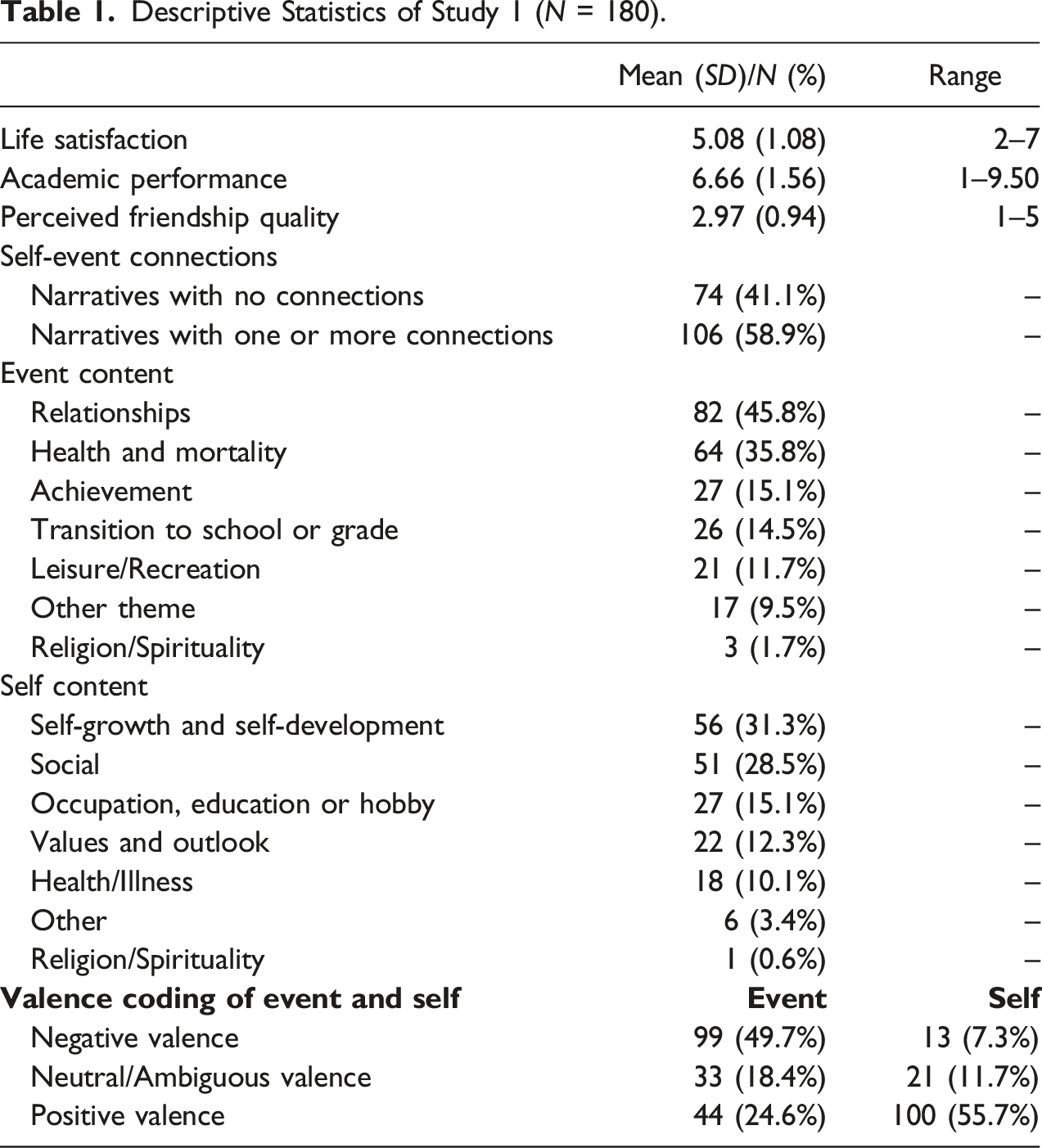
Groups of three coders coded the narratives for the absence or presence of each of these four types of connections. Each coder first determined their code(s) per narrative independently and the initial codes of all three coders on the presence/absence of self-event connections had an interrater reliability of Fleiss’ κ = .61 (71.7% interrater agreement across all three coders). Discrepancies were then discussed until consensus was reached. These consensus-based codes were used in our analyses. Given that the number of connections made was not normally distributed (i.e., most participants made either no or one self-event connection; 41.1% and 48.9%, respectively), we transformed the self-event connection codes into a dichotomous variable indexing whether or not self-event connections were made in the narrative (i.e., 0 or 1). 2
Content: Self and Event Valence and Life Domain
Next, each narrative was coded for the valence and life domain of the content, each by two independent coders. Valence and life domain were determined separately for the “self” and the “event” in the narrative. Valence was decided following the participants’ own perspective in the narrative, based on their description of the event, unless this differed substantially from what would generally be perceived as positive or negative (e.g., when an adolescent considered obsessive-compulsive behavior as gaining control) or if their perspective was unclear (e.g., a participant describes an event but not how they experienced it). In such cases, the coders decided on the most-fitting valence, based on general societal norms. Valence was scored across all elements of the self or event across the narrative, resulting in one self valence and one event valence score per narrative. Valence was coded as being negative (−1), neutral or ambiguous (0), or positive (1). Examples of negative, neutral/ambiguous, and positive aspects of the self are “being insecure”, “learning not everyone can be trusted”, and “becoming more conscientious”, respectively. Examples of negative, neutral/ambiguous, and positive events are “losing a beloved grandparent”, “making the transition to a new school”, and “winning a sports match”.
We used coding systems for self and event domain that were based on work by McLean, Syed, Yoder, and Greenhoot (2016) and Weststrate et al. (2018), respectively. Specifically, we drafted a coding system for the life domains of self and event content based on the categories of these existing systems used in adults and made minor adjustments to make the categories more fitting for our adolescent sample. Next, we tested the system on 30 narratives that were not included in our analyses (because the participants who wrote them did not meet aforementioned inclusion criteria) and made several minor adjustments (e.g., we combined all relationship self content into one “relational” category). The resulting systems were used to code all narratives included in the study.
Elements of the event were only considered as part of content when they were more than background to the story. To evaluate this, coders had to evaluate whether the element could be interchanged with another without changing the plotline of the story. For instance, if the location of meeting one’s romantic partner could be changed from a church to a birthday party without the story playing out differently or lacking important nuance, then the location should not be coded as content.
For the domain of self and event content, the coders could choose out of a total of eight and seven substantial content domain codes, respectively. For self content, these were: occupation/education/hobby, relational, religion/spirituality, politics, values/outlook, health/illness (physical and/or psychological), gender/sex(roles)/sexuality, and self-growth/self-development. The possible content domains for events were achievement, transition to school or grade, relationships, religion/spirituality, sex/sexuality, health/mortality, and leisure/recreation. In addition, each coding system had a category of “other”, which could be used when there was content that could not be captured by any of the other codes (making the total of content codes nine and eight, respectively). Per narrative, the coders could decide on zero, one, or more content domain scores, with a possible total of nine and eight codes for self and event content, respectively. In practice, no more than three content domain codes were assigned per narrative.
Each narrative was first coded independently by two coders on valence and content domain. The coders had weekly meetings to discuss discrepancies in their codes. Interrater reliability for the pre-consensus codes was acceptable for self and event valence (ICC = .88, 81.1% agreement and ICC = .84, 80.6% agreement) and for self and event content domain (κ = .81, 66.8% agreement and κ = .80, 70.9% agreement 3 ). The self-event connections coding system can be found at https://osf.io/tnyaf/. The coding systems for valence and content domain can be found on the OSF page of the present study: https://osf.io/58xtc/.
General Well-Being and Domain-Specific Functioning
Well-being and functioning were assessed at Wave 2. To capture general well-being, mean scores across four of the original items of the Satisfaction with Life Scale (Diener et al., 1985) were used (as used in Cheung & Lucas, 2014). The items (answered on a scale from 1 = completely disagree to 7 = completely agree) were “In most ways my life is close to ideal”, “The conditions of my life are excellent”, “I am satisfied with my life”, and “So far I have gotten the important things I want in life”. The scale had acceptable internal consistency, with an omega total of .80. As a measure of educational domain-specific functioning, academic performance was assessed with two items based on suggestions by the Central Institute for Test Development [CITO] in the Netherlands: “In the past year, how was your school performance?” and “In the past year, how did doing your homework go?”. These items were answered on a scale from 0 (very bad) to 10 (very good), and were combined into one mean score of academic performance (inter-item correlation of r = .47). Perceived friendship quality was assessed as a relational domain-specific functioning measure with the Network of Relationships Inventory – Behavioral System Version (NRI-BSV; Van Aken & Hessels, 2012; Furman & Buhrmester, 2009). Scores on the items from all positive friendship quality subscales (12 items in total, from the “provides safe haven”, “provides secure base”, “seeks safe haven”, and “seeks secure base” scales) were combined. The items were answered on a Likert scale ranging from 1 (little or none) to 5 (almost always) 4 . The perceived friendship quality scale showed good internal consistency, with an omega total of .94. Higher mean scores on these constructs reflected more life satisfaction, better academic performance, and better perceived friendship quality.
Analytical Plan
The associations between autobiographical reasoning and well-being were estimated using zero-order correlations between the presence of self-event connections and life satisfaction, academic performance, and perceived friendship quality. Next, we examined these associations in greater detail by differentiating distinct elements of the self-event connections. Specifically, we report the correlation separately for negative, neutral/ambiguous, and positive valence of the self and of the event, and for each of the content domains of the narrative. In practice, we ran the correlations separately for 6 (out of 9) self content domains and 6 (out of 8) event content domains, because some domains were not used or used too little (e.g., religion/spirituality was only coded once for self content). Because multiple content domains could be present within a single narrative, some narratives were included in more than one analysis 5 .
In addition to these pre-registered analyses, we conducted several sets of hierarchical path models to examine whether content domain moderated the association between autobiographical reasoning and well-being. This also allowed us to control for the effects of other variables and be able to utilize the full sample size. We first estimated a model with self-event connections as predictor of the measures of well-being and functioning. Next, we added content domain or valence as dummy variables to the model. Specifically, for valence we added dummies for positive or negative valence to the model, with neutral/ambiguous valence being the reference category. For self and event content domain, in line with the domain-specific measures of functioning, we added dummies for educational (i.e., self content: occupation/education/hobby; event content: achievement, transition to school or grade) and relational (i.e., self content: relational; event content: relationships) content. All other content (e.g., religion/spirituality codes) was used as the reference category. In the third step, we included interaction terms of each of these dummies with making a self-event connection in the model. Due to the large number of correlation and regression coefficients tested, we used a more conservative alpha level of p < .01. Effect sizes were evaluated using rules of thumb for psychological research by Funder and Ozer (2019). Data preparation and analysis were conducted in R (R Core Team, 2021).
Results
Descriptive Statistics and Correlations
Descriptive Statistics of Study 1 (N = 180).
Correlations Between Self-Event Connections and General Functioning and Domain-Specific Functioning in Study 1 (N = 180).
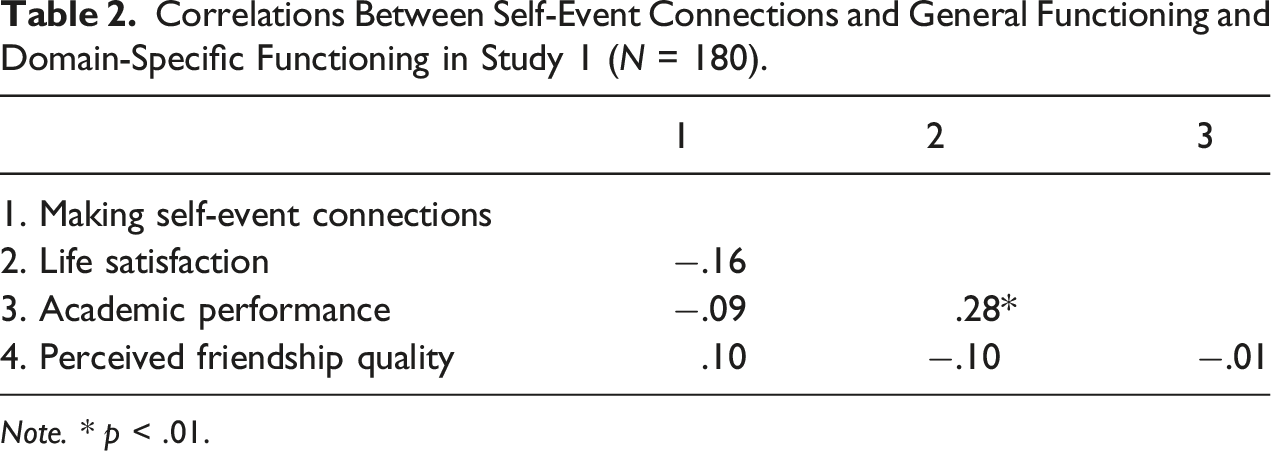
Note. * p < .01.
Post-Hoc Hierarchical Moderation Models
To make use of the full sample and control for the effects of other variables, additional path models were estimated with the well-being and functioning variables as outcomes and making self-event connections as predictor. In a second and third step, we added dummy variables of positive and negative self or event valence or of educational and relational self or event content domains, and the interaction of these dummy variables with making self-event connections, respectively. 6 For self valence, there were no significant main or moderation effects (Table S5). Although not meeting the stipulated threshold, the interaction effect of positive self valence with making self-event connections on perceived friendship quality was substantial (large effect) and had a p value below .05 (p = .038). This effect indicated that adolescents who made self-event connections reported higher perceived friendship quality in particular when the self content in the narrative was positive. For event valence, too, no predictive effects reached the threshold of significance at p < .01 (Table S6). The negative event valence dummy had a substantial (large) negative effect on academic performance and was p < .05 (p = .041), signifying that youth writing about negative events reported lower academic performance.
For the model with self content domains, there was one significant effect (Table S7). Specifically, although making self-event connections was not a significant predictor in the model without the dummy variables, in the model including the dummy variables self-event connections were associated with lower life satisfaction (medium effect). Furthermore, not meeting the stipulated threshold, there was a substantial (medium) effect of relational self content on life satisfaction, which had a p below .05 (p = .020). This effect indicated that adolescents writing about relational aspects of the self on average reported higher life satisfaction. None of the interaction effects or the effects on academic performance or perceived friendship quality were significant.
Finally, for the event content domain, there were several significant associations (Table S8). As in the model including valence, there was a significant association of self-event connections with life satisfaction (large effect size; p < .001). However, there was a significant moderation of this effect, so we cannot interpret the main effect. Specifically, making self-event connections was particularly linked to higher life satisfaction when adolescents wrote about events related to relationships (large effect, p = .007). Furthermore, writing about events with relational content was related to lower academic performance (large effect, p = .006). Although above our set threshold, there was also a substantial (large) moderation effect of relational event content on the association between making self-event connections and academic performance, which was below p = .05 (p = .013). This indicated that adolescents who made self-event connections reported better academic performance in particular when discussing relational events. Again, there were no effects on perceived friendship quality.
Study 2
Method
Participants and Procedure
Study 2 used data of the longitudinal INTRANSITION project, which followed youth in the year before and after they made the transition to secondary school. In total, 244 youth, one of their parents, and (optionally) a friend participated in the study. There were four assessments that were evenly spread out across two years (i.e., in the fall/winter 2019, spring/summer 2020, fall/winter 2020, and spring/summer 2021). The present study used data on autobiographical reasoning from an interview and identity commitment and exploration processes as measured through a questionnaire on Wave 4, which resulted in a total of 160 participants. Adolescents had a mean age at this wave of 13.08 (SD = .46, range = 12.1–15.8), and 86 identified as girls (53.8%; boys: n = 74, 46.2%). The vast majority identified as Dutch (n = 155, 96.9%); the remainder of the sample identified as Moroccan (n = 1), Surinamese (n = 2), or other (n = 2). Additionally, 72 adolescents reported a second group with which they identified, for which the most common was Dutch-identifying adolescents also identifying as Moroccan (n = 41). Our sample did not differ significantly from the complete study sample of 244 participants in terms of age, gender, identification with commitment, exploration in breadth, exploration in depth, self-doubt, general well-being or perceived friendship quality at Wave 1 (t(239) = 1.59, p = .112, χ2(1) = 2.23, p = .135, t(228) = −1.03, p = .303, t(228) = .39, p = .697, t(228) = −.23, p = .820, t(228) = −.18, p = .856, t(240) = 1.11, p = .268, and t(102.63) = −.67, p = .505, respectively).
Participants were recruited via primary schools in the Netherlands. Most participating schools were in the Utrecht area (central part of the Netherlands), but we also recruited in the eastern, western, and south-eastern parts of the country. In line with the European General Data Protection Regulation (GDPR), schools sent information about the study to parents and students upon which parents and students could volunteer to participate. Participants could only join if they were in the final year of primary school at the time of the first measurement wave. They were asked to participate with one of their parents and to invite a friend at each wave. During Wave 4, there were (online) home visits in which adolescents were interviewed about the transition to secondary school. In addition, adolescents filled out an online questionnaire. Participants received €10 compensation per online questionnaire and an additional €10 for participating in observation tasks. If they participated at all waves, they received an additional €5 after the fourth and final wave. The INTRANSITION project was funded by the European Research Council (number: ERC-2017-CoG – 773,023 INTRANSITION) and approved by the local ethical review board at Utrecht University in February 2019 (protocol number: FETC18-135). The anonymized INTRANSITION data are made available on the project OSF page: https://osf.io/58xtc/.
Measurement Instruments
Self-Event Connections and Connection Valence
Narrative processes were coded in the transcripts of an interview about the school transition during Wave 4. During the interview, participants were asked “To what extent does your school fit you?”, “How do you think the transition has affected your life?”, and “To what extent do you think the transition to secondary school has affected you, e.g. who you are, what you find important, and how you behave?”. Responses to these questions were coded for the presence or absence of connections between the event and the self (i.e., self-event connections; Pasupathi et al., 2007) and valence of the self-event connection (i.e., negative, neutral/ambiguous, positive). On average, participant descriptions in the interview were 353.3 words long (range: 50–1327 words).
We used the same coding system for self-event connections as in Study 1 (available at https://osf.io/tnyaf/). Again, four types of connections were coded: explain/illustrate, dismiss, causation, and revelation. Then, we coded the positivity versus negativity of the connection for each coded self-event connection (in contrast to Study 1, where the valence of all aspects of the self in the narrative were coded). As in Study 1, the perspective of the adolescent was taken unless this perspective was substantially different from what would be considered positive according to general societal norms. All transcripts were coded by one undergraduate and one graduate student, who were trained to use the self-event connection system with example narratives. They coded each transcript independently and had weekly meetings to discuss discrepancies until consensus was reached. The consensus-based codes were used in the analyses. For the present study, we used a dichotomous variable which indicated whether or not any self-event connections were present in the interview (i.e., 0 or 1), given that the distribution of connections was not-normally distributed (e.g., 40.0% of participants made no self-event connection and 36.9% made one self-event connection). Self-event connection valence was coded as −1 (negative), 0 (neutral/ambiguous), and 1 (positive). Pre-consensus interrater reliability for coding of the presence or absence of self-event connections was near acceptable with a Cohen’s κ = .66 (83.8% agreement). Reliability was acceptable for the coding of the valence of these connections (ICC = .85).
Educational Identity Commitment and Exploration Processes
Educational identity commitment and exploration processes were assessed at Wave 4 using the Educational Identity Processes Scale (EIPS; Christiaens et al., 2022), which captures identity development specifically in the context of the school transition. The questionnaire was based on the Dimensions of Identity Development Scale (Luyckx et al., 2008), the Utrecht-Management of Identity Commitments Scale (Crocetti et al., 2008), and the Vocational Identity Status Assessment (Porfeli et al., 2011). The questionnaire has pre-transition (22 items) and post-transition (18 items) versions. The post-transition version that was used for the present study consists of five subscales: identification with commitment (4 items), exploration in breadth (3 items), exploration in depth (5 items), self-doubt (3 items), and reconsideration (3 items). The items were rated on a scale from 1 (completely disagree) to 5 (completely agree). Higher scores indicated higher levels on each of the educational identity dimensions. Internal consistency of each of the subscales was good, with omega total scores of .88, .88, .80, .88, and .95, respectively. More information on the validity and reliability of the EIPS can be found in Christiaens et al. (2022).
General Well-Being and Domain-Specific Functioning
General well-being was captured with the Cantril Ladder (Cantril, 1965), which asked adolescents to rate how well they felt in general by choosing a number from 1 (meaning it was going very badly with them) to 10 (meaning it was going well with them). Two items based on suggestions from CITO were again used as a measure of academic performance, but differed from those used in Study 1 in that they referred to performance during the past week (rather than during the entire school year). Items were rated on a scale from 1 (very poor/poorly) to 5 (very well) and combined into one mean score of academic performance (inter-item correlation: r = .44). To assess perceived friendship quality, we combined scores from all positive subscales of the Network of Relationships Inventory (NRI; Furman & Buhrmester, 1985; Bukowski et al., 1994): companionship, help, security, and closeness. Items (e.g., “How often do you feel admired and respected by your friend?”) were answered on a scale from 1 (never) to 5 (very often). The scores on the perceived friendship quality scale had good internal consistency (omega total across all subscales = .89).
Analytical Plan
Similar to Study 1, we examined the correlations of self-event connections with general well-being, academic performance, and perceived friendship quality. Next, we examined the correlation of each subscale of the EIPS with self-event connections made in the interview. Lastly, we split our observations between the types of valence of the self-event connections, and reran the correlations for only the self-event connections that were negative, neutral, and positive. Because some interviews contained connections of different valences, they were included in more than one rerun. As in Study 1, we used a more conservative alpha level of p < .01 and evaluated effect sizes using guidelines by Funder and Ozer (2019). All analyses were conducted in R (R Core Team, 2021).
Results
Descriptive Statistics and Correlations
Descriptive Statistics for Study 2 (N = 160).
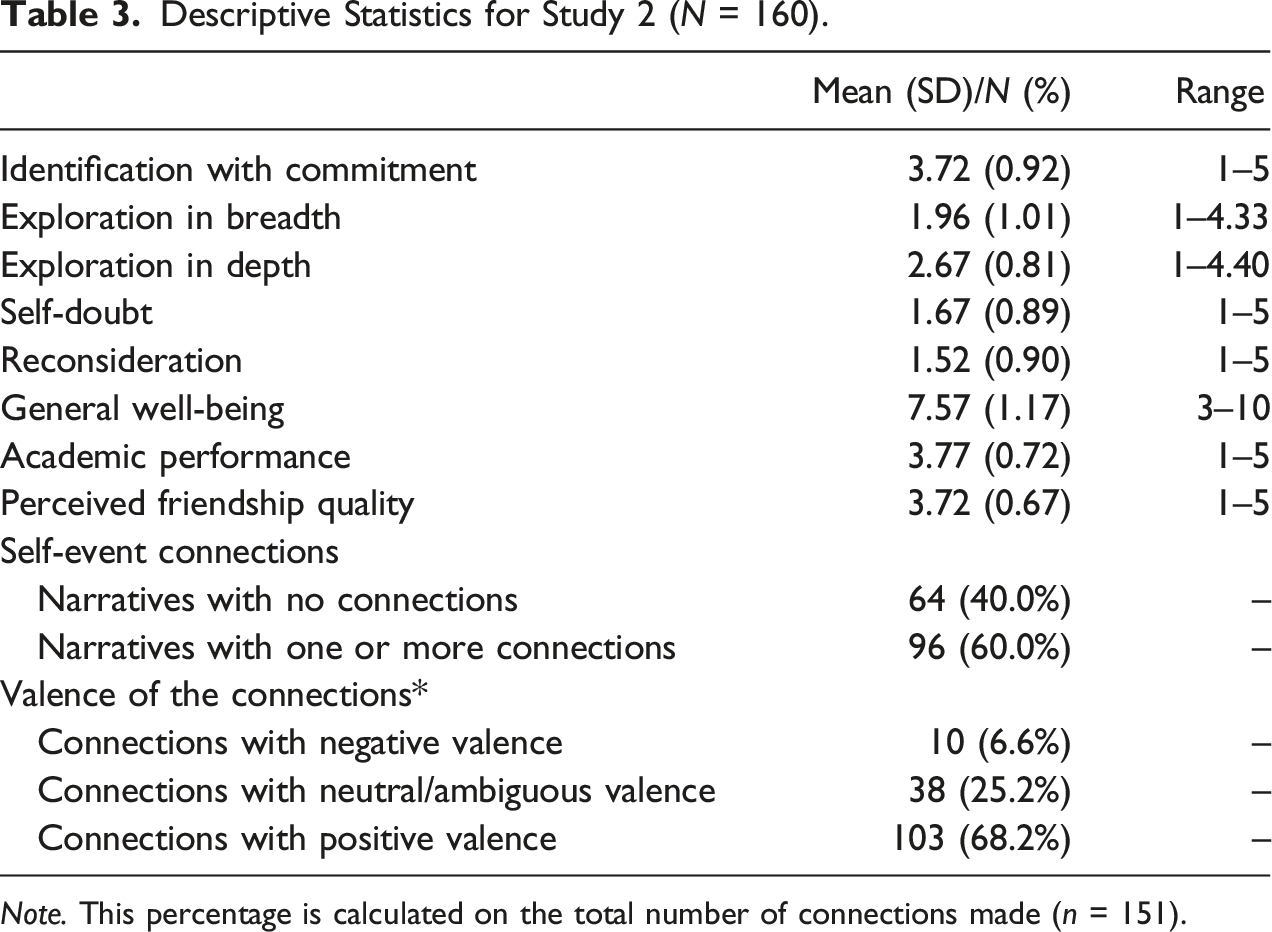
Note. This percentage is calculated on the total number of connections made (n = 151).
Correlations Between Self-Event Connections and General Well-Being and Domain-Specific Functioning in Study 2 (N = 160).
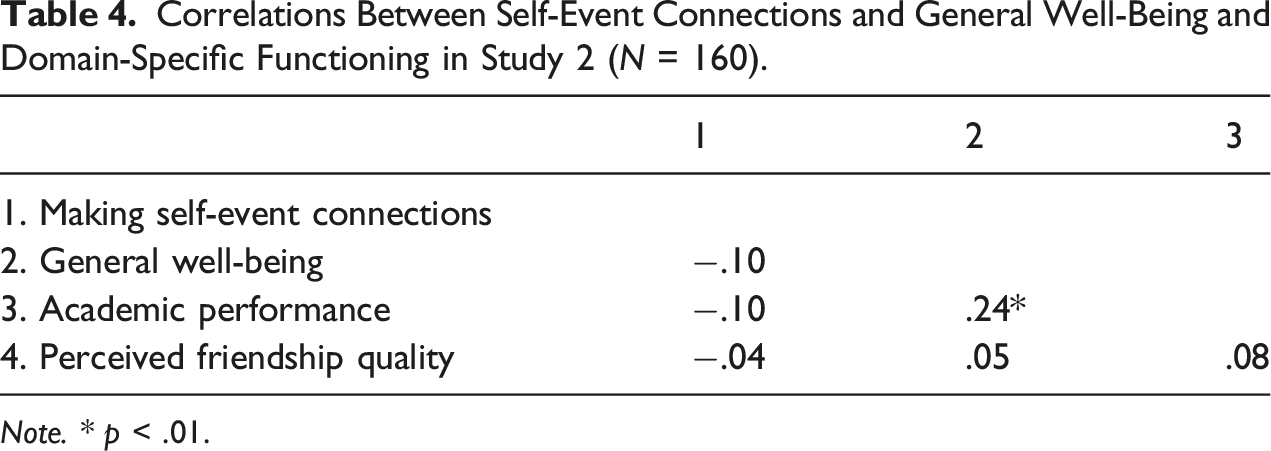
Note. * p < .01.
Correlations of the Educational Identity Processes Scale Subscales With Self-Event Connections and Valenced Self-Event Connections in Study 2 (N = 160).
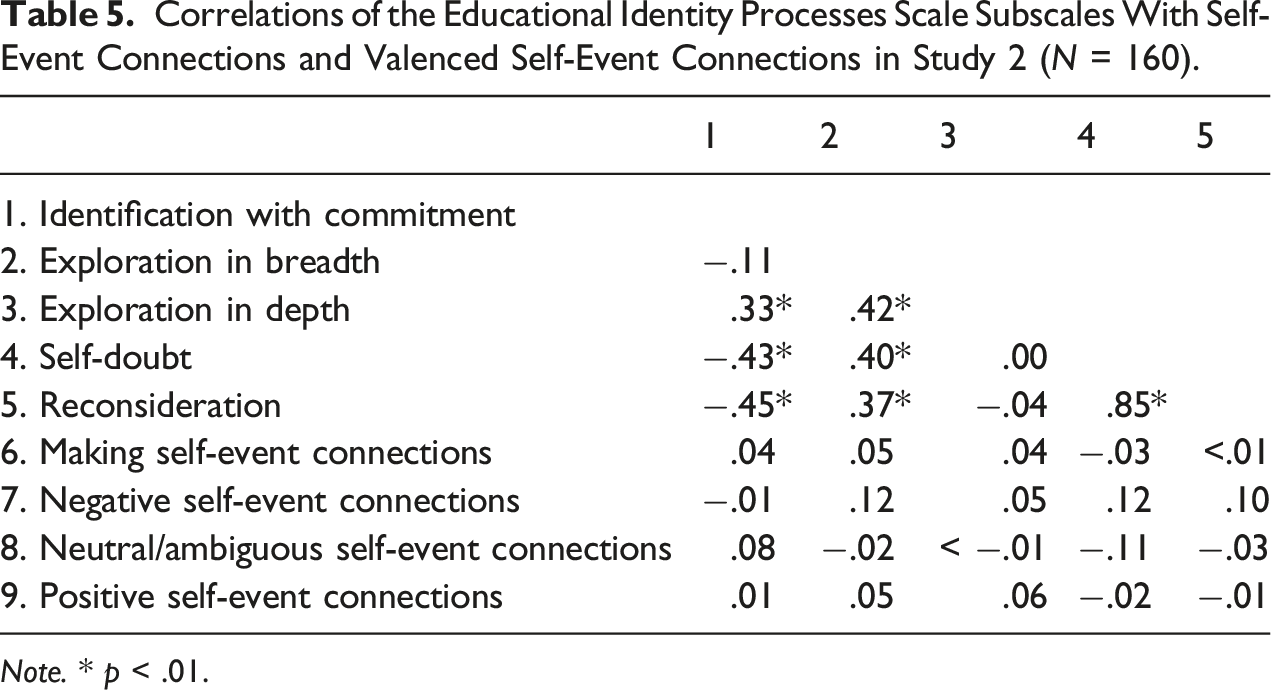
Note. * p < .01.
Discussion
Identity development is a major developmental task that gains in importance from early adolescence onwards (Erikson, 1950, 1968). However, the associations of the narrative process of autobiographical reasoning with developmental outcomes and between processes derived from different approaches to identity research are far from perfect, which might be in part because the content often is not considered. In the present work, we examined the role of the life domain and valence of content in the associations of self-event connections as an application of autobiographical reasoning with identity commitment and exploration processes, and with well-being in two datasets. In Study 1 we found some support for the role of content in the association between self-event connections and well-being and functioning, but Study 2 evidenced no support for content in this association or in the association between self-event connections and identity commitment and exploration processes.
Linkages of Autobiographical Reasoning with Adolescent Well-Being
Study 1 provided limited support for a role of content in the association of making self-event connections in turning point narratives with well-being, academic performance, and perceived friendship quality. The support for the role of content we found was mostly limited to the post-hoc moderation analyses. Specifically, in the correlation analyses, making self-event connections was associated with lower life satisfaction for adolescents who were discussing health and mortality-related content. In the moderation analyses, making self-event connections for positive self content and relational events was related to better well-being outcomes. Moreover, discussing positive content, regardless of whether adolescents made self-event connections, was associated with higher well-being. Thus, this suggests that autobiographical reasoning about more positive things but also just writing about more positive things in general is associated with better well-being in different domains. Interestingly, however, this appeared to be more true for general life satisfaction and academic performance and less so for perceived friendship quality.
The findings linking valence to well-being outcomes are in line with previous research in adults, showing that individuals who make self-event connections based on positive self content report better outcomes than individuals with negative self-event connections (Holm & Kirkegaard Thomsen, 2018; Merrill et al., 2016). Moreover, our findings are similar to those obtained in work among adolescents and young adults with severe psychopathology, where writing about negative events was also related to poorer functioning (De Moor et al., 2021a). Furthermore, our findings extend existing knowledge by showing that these patterns are also visible in early and mid-adolescence, and that it seems possible to distinguish more positive (vs. more negative) life domains in the narratives of youth. However, some caution should be taken with interpreting the moderation results as no hypotheses were pre-registered for these analyses and the small sample size may have increased the likelihood of false positives. A post-hoc power analysis indicated that we had enough power to detect medium effects (with alpha set to .01, desired power at .80, and at most 5 predictors per outcome variable), but not small effects (required sample of 588 participants; Faul et al., 2007). Caution is especially needed for effects that were substantial but not statistically significant.
In the correlation analyses of Study 2, we found that across outcomes, adolescents who made self-event connections did not report better or worse well-being or functioning. The absence of an association between self-event connections and well-being is not in line with theory on narrative identity (Habermas & Bluck, 2000; McAdams, 2001) or previous research linking narrative processes to higher well-being (e.g., Branje et al., 2021), which links autobiographical reasoning to better developmental outcomes because of its function facilitating a cohesive sense of identity.
There are several possible reasons for why the outcomes of Study 2 differ from those reported in previous studies and those from Study 1. Very practically, the size and homogeneous composition of the sample may have resulted in an underestimation of existing effects. Adolescents who participated in the INTRANSITION project generally had relatively high socioeconomic status and high levels of well-being. Regarding sample size, although a sample of 160 participants provides sufficient power (i.e., .80) to detect correlations of .22 (medium effect) or larger, the sample size was insufficient to detect smaller effects. Thus, future studies should aim to include a larger and more diverse sample. Furthermore, and more conceptually, it is possible that differences in youth’s autobiographical reasoning are not captured fully in their written narration of a single event. Firstly, past research has evidenced large intra-individual variability in the narration of different events (e.g., McLean et al., 2017), suggesting that we may need more narratives to get a better view of adolescents’ dispositional tendency for autobiographical reasoning. Secondly, however, it is important to consider that written narratives, as a whole, may limit some adolescents more than others in their narration style, for instance due to the inherent writing component. For those adolescents, expressing their identity may be more easy in other formats, and it is important to realize that by limiting ourselves to a single method we may miss information (Rogers et al., 2021). Thus, future research should also consider other methods of collecting identity-relevant information.
However, it is also possible that at the age of thirteen, autobiographical reasoning may not yet serve the positive function it has in later adolescence and beyond. Previous work has suggested that linking events to the self may indeed be maladaptive in early adolescence (McLean et al., 2010; McLean & Mansfield, 2011). This could be the case because autobiographical reasoning has not yet fully developed and is thus effortful; use of this skill may therefore not yet be developmentally appropriate and point to the experience of extremely negative events that necessitate the use of this narrative skill. It is possible that our study has captured youth at exactly that time where making self-event connections is not uniformly positively or negatively associated with well-being for all adolescents. A developmental perspective on how the association between identity and well-being unfolds over time would be necessary to test this notion. This might also imply that the way the educational system in the Netherlands emphasizes adolescents’ own autonomy in the choice for a secondary school and educational profile is not entirely developmentally appropriate, and may even be harmful. As the choice for one’s education requires adolescents to think about what they are good at, enjoy, and find important, it may be asking a level of introspection that they are not ready for.
Notwithstanding potential issues of power, the scarcity of significant findings in Study 2 combined with the findings from Study 1 when using a moderation approach suggests that a more fine-grained approach is needed to capture content than a focus on life domain in which events takes place can provide. For instance, we may need to know what elements of the grade or school transition feature in adolescents’ narratives to get a better sense of how they impact the association between identity and well-being.
Autobiographical Reasoning and Identity Commitment and Exploration Processes
Different approaches of identity are supposed to reflect different but related elements of an underlying sense of early-adolescent identity. For individual adolescents, narratives may be one way through which they explore new identities and reflect on their existing commitments (McLean & Pasupathi, 2012). However, past work has reported mixed findings regarding relations between identity commitment and exploration processes measured with questionnaires and identity as measured through narratives (e.g., De Moor, 2023; Den Boer et al., 2023; McLean & Pratt, 2006; Van Doeselaar et al., 2020). In line with this work, Study 2 showed no evidence that adolescents who identified more with their educational commitments and engaged in more educational exploration and less in educational reconsideration, were more likely to make self-event connections in their narratives about their school transition.
The lack of support we found for associations between autobiographical reasoning identity commitment and exploration processes may reflect the specific context in which these adolescents reside. That is, the youth in this sample only just started secondary school. Past work on educational identity commitment and exploration processes around this transition has shown that change during this period, and particularly during its runup, may be quite similar for most adolescents in part due to strong situational constraints regarding how adolescents ought to change (De Moor et al., 2022a, 2022b). In particular, the transition to a new school may require nearly all adolescents to explore school options and eventually pick one of those options. In addition, the normativity of change observed elsewhere and the absence of links between different measures of identity found in Study 2 may be reflective of the age at which youth were assessed. Specifically, during this time the first steps of identity development are undertaken and the first identity commitments pop up. At the same time, we may see that these commitments are not preceded by a process of exploration (reflecting a status of identity foreclosure; Marcia, 1966), and are relatively fragmented and lack integration of different identities across time and context (Syed & McLean, 2016). Like identity, such ego integration takes shape across adolescence, and is further developed in older compared to younger adolescents (e.g., Van Hoof & Raaijmakers, 2002). Thus, it may be that a lack of integration between autobiographical reasoning and identity commitment and exploration processes explains the absence of an association between the two during the aftermath of the educational transition. Again, this raises the important practical question of whether and to what extent adolescents should be encouraged to autonomously make identity-relevant (educational) choices. In any case, more attention to supporting adolescents while they explore their options and make such choices seems vital.
Importantly, the lack of significant associations between autobiographical reasoning and identity commitment and exploration processes is also at odds with our hypothesis that these associations would be stronger than in previous studies if these would both be focused on the school transition. This could suggest that such a domain match and even content more generally may not matter after all. However, it is important to keep in mind that even within these life domain-focused measures, there was room for interpretation. This is most evident in the narrative interview; although the interview centered around the school transition as a major life event, the impact of that event could and was indeed described across life domains. For instance, adolescents described how the transition had impacted their educational environment (e.g., having to do more homework), but also their relational (e.g., friends going to other schools, making new friends) and personal sphere (e.g., becoming more mature, becoming a moody teenager). Therefore, in future work it is vital to take a more fine-grained view on what identity is about, focusing also on the specific content of the event and identity in the narrative and how content in different life domains is integrated with each other. This is important given that identity integration across contexts is thought to be key to psychological well-being (Syed & McLean, 2016).
Strengths and Limitations
In the present work, we made an argument for a greater focus on content in identity research in adolescence and examined the merits of such an approach in two empirical studies. Specifically, we coded turning points narratives on not just self-event connections, but also the valence and life domains of the self and events. Furthermore, by employing two different samples with different study designs and different measures, we provided a more robust, generalizable test of the importance of valence and life domains.
Nevertheless, the findings from the conducted studies should be interpreted in light of some limitations. First, the samples we used were relatively small, and homogenous in terms of socioeconomic and ethnic background and levels of overall well-being. The broader context in which an individual and their identity are situated provides important clues about how identity should be understood (Galliher et al., 2017; Spencer, 1995). For instance, being a loner or becoming more mistrustful after certain events may in some contexts be a logical and even adaptive response to the situation, whereas identifying as a motivated student or believing that one can control situations may in certain contexts be maladaptive. A more diverse sample may shed more light on the role of identity content across different contexts.
Second, content was operationalized as the life domains in which the event and self were situated and valence. However, as was also hinted at above, this focus may still be quite broad. In addition to the life domain being too broad, it may simply also not have been considered relevant by each adolescent. That is, in Study 2 the narrative identity interview was focused on the school transition, thus forcing adolescents to talk about this particular moment. It is possible and even plausible that some adolescents may not consider this transition relevant to their identity. With that in mind, the approach in Study 1 may be better suited to capturing content that was considered relevant by the adolescents themselves. At the same time, having adolescents discuss any event that they consider relevant may present problems, as the content may differ markedly from narrative to narrative. As can be concluded from this, capturing the content of identity is a complex endeavor (as has also been noted elsewhere; Galliher et al., 2017). To come closer to what adolescents deem most relevant, future work should consider inductive coding of narrative data (e.g., as applied in Johnson et al., 2022 and in the context of ethnicity-related narratives in Syed & Azmitia, 2010). This work should additionally aim to capture adolescent identity across multiple contexts and domains of life and examine aspects of saliency and valence to get a better sense of where identity content is centered and how it is related to well-being. Such an approach may get closer to capturing actual content and improve knowledge on what adolescents themselves emphasize in their identity.
Conclusion
Creating a sense of identity is an integral task from early adolescence onwards and represents the challenge of creating a continuous and coherent self-view out of a multitude of thoughts, behaviors, and experiences. Yet, research on adolescent identity has often focused on the narrative process of autobiographical reasoning and identity commitment and exploration processes, without accounting for what they are about. In the present study, we argued for a greater focus on identity content, but showed in two studies that this focus may not be so straightforward to put into practice. Although we found some evidence that the life domain of identity and the event in the narrative may moderate associations of self-event connections with well-being, this evidence was by no means conclusive. Rather than proof that content does not matter all that much after all, it is our hope that these preliminary attempts at capturing content will serve as impulses to deepen thinking about what identity content is and how to best capture it.
Supplemental Material
Supplemental Material- Who am I? Studying Autobiographical Reasoning, Identity Commitment and Exploration Processes, and Narrative Content in Unison
Supplemental Material for Who am I? Studying Autobiographical Reasoning, Identity Commitment and Exploration Processes, and Narrative Content in Unison by Elisabeth L. De Moor, Theo A. Klimstra, Lotte Van Doeselaar, and Susan Branje in The Journal of Early Adolescence
Footnotes
Declaration of Conflicting Interests
The author(s) declared no potential conflicts of interest with respect to the research, authorship, and/or publication of this article.
Funding
The author(s) disclosed receipt of the following financial support for the research, authorship, and/or publication of this article: De Moor and Branje and the INTRANSITION data collection were supported by a grant of the European Research Council (ERC-2017-CoG-773,023 INTRANSITION).

Supplemental Material
Supplemental material for this article is available online.
Notes
Author Biographies
References
Supplementary Material
Please find the following supplemental material available below.
For Open Access articles published under a Creative Commons License, all supplemental material carries the same license as the article it is associated with.
For non-Open Access articles published, all supplemental material carries a non-exclusive license, and permission requests for re-use of supplemental material or any part of supplemental material shall be sent directly to the copyright owner as specified in the copyright notice associated with the article.
