




Abstract
One’s attachment style forms early in life and can aid in dealing with future setbacks. Equally, Coping and resilience are two specific psychological mechanisms that form how one deals with problems and recovers from stressful situations. These three concepts are well-known interrelated concepts within psychology but to what extent they overlap is still unclear. The present study investigated attachment, resiliency and coping using structural equation modeling. Participants (N = 390), aged between 9 and 12 y old, completed an paper survey including Experiences in Close Relationship-Revised questionnaire (ECR-RC-12), Resiliency Scales for Children & Adolescents (RSCA), and the Brief-CPE (Coping Orientation to Problems Experienced). Path analysis revealed strong associations between attachment and resiliency as well as strong associations between resiliency and coping. Specifically, the predictive value of anxious attachment on resiliency was seen for all three resiliency sub-scales. However, the predictive value of avoidance attachment on resiliency was only revealed for two of the resiliency sub-scales. The two resiliency protective factors (sense of mastery and sense of relatedness) have a positive predictive value for three coping strategies. Equally, the resiliency risk factor (emotional reactivity) also positively predicted two coping strategies. The current findings demonstrate clear associations between these three concepts. Equally, the theoretical connections are discussed in light of these findings. Equally, stemming from this study, clinical implications are discussed that can inform practice in terms of approaching psychopathologies from different angles (resilience, coping, and attachment) as well as, the development of coping and resilience skills in order to support healthy development.
When a child is having an argument with a friend and is struggling to deal with this situation, faces many choices. Will they end up asking their parent(s) for help, or will they try and come up with some other ways themselves, and does their relationship with their parents even allow them to see that as a possibility? How they choose to cope with this situation stems from a lifetime of interactions with others and their assessment of what is dangerous or safe both in terms of physical and psychological security.
Introduction
Adolescence is a transitional phase of growth and development that is characterized by many psychological, biological as well as social transitions (Graber & Petersen, 1991; Petersen et al., 1991; Rich, 2003). The role of peers becomes more prominent in terms of self-development (Furman & Buhrmester, 1992; Godor et al., 2020) as well as, adolescents begin to develop more complex social skills, feelings of personal competence, identity, as well as, start to gain a sense of independence through these social interactions with peers (Furman & Buhrmester, 1992; Greca & Harrison, 2005). Within this developing social context, the ability to develop certain cognitive or behavioral efforts to deal with problems becomes increasingly important. In this context, the creation and maintenance of positive peer relations becomes a primary social task for adolescence (Inderbitzen, 1994). Social competency is generally seen as a protective factor which is linked to one’s increased ability to deal with social and academic challenges (Griffin et al., 2006). Griffin et al. (2006) also asserts that social competency is a multidimensional construct. Having said this, social competency, in order to create and maintain positive peer relations, can be seen as a combination of and founded in the cognitive or behavioral efforts one chooses in order to withstand a stressor (resiliency) or manage that stressor (coping).
This being said, the early emotional connections that individuals create with significant others in their life have long-lasting effects on their development throughout the years in terms of their attachment style. Equally, there are life-long social, emotional, personal, and professional relationships, physical and psychological health, and stress regulation implications rooted in one’s attachment style (Benoit, 2004; Rees, 2005). Taking this into account, the activation of certain cognitive and behavioral efforts in order to deal with problems can be framed in terms of a capacity to withstand a stressor (resiliency) as well as, the management of that stressor (coping), however, these cognitive and behavioral efforts are founded in and informed by one’s attachment style.
Attachment
The early emotional connections that individuals create with significant others in their life can have long-lasting effects on their development throughout the years. Even though how one is “attached’ to others plays a role in all phases of life, the fundamental elements that mold one’s attachment begin to form during infancy (Bowlby, 1969). Attachment theory was first conceptualized by Bowlby (1969, 1973, 1980) and is currently regarded as “one of the last of the grand theories of human development that still retains an active research tradition” (Duschinsky, 2020, p. vii). Bowlby defines attachment as a lasting psychological connectedness (1969). This theory is built upon Bowlby’s investigation of “the child’s tie to his mother” and he postulates that attachment behavior aim to maintain proximity to the mother as a practicable outcome (1969). Following Bowlby’s work, attachment theory was further developed and empirically grounded by Ainsworth in the Strange Situation Procedure (SSP) (Ainsworth et al., 1978; Van Rosmalen et al., 2015), wherein infants’ reactions to their caregiver are assessed upon the departure of and reunion with that caregiver. This has resulted in attachment being viewed as containing three distinct ‘patterns’ or categories: secure, avoidant, and anxious. Specifically, securely attached infants tend to explore when their caregiver is present, they tend to cry less and look for support and comfort from their caregivers upon their return (Ainsworth et al., 1978). Avoidantly attached infants, upon the return of the caregiver, do not seek contact. They are generally focused on the environment and continue to explore independently (Waters & Valenzuela, 1999). Anxiously attached infants become inconsolable at separation and do not allow comforting upon the caregiver’s return. There is also a lack of attention to the environment or exploration. Although Ainsworth’s tripartite division in groups of secure, avoidant, and anxious attached children is widely accepted, Duschinsky et al. (2021) note that attachment concepts are used in various ways depending upon the domain that they are being employed (popular discourses, developmental science, social psychological science, psychiatric diagnosis, psychotherapy, and child welfare practice). This can lead to confusion and even hamper future cooperation and research (Duschinsky et al., 2021). This paper will conceptualize attachment in terms of two dimensions, namely attachment anxiety and attachment avoidance (Mikulincer & Shaver, 2007).
There are life-long implications rooted in one’s attachment style that affect social, emotional, personal, and professional relationships, physical and psychological health, and stress regulation (Benoit, 2004; Rees, 2005). These developments are strongly rooted in the notion of what the child has come to learn over time as to what is safe or dangerous. The relationships that one undertakes later in life also have as their foundation the notion of security, however, these relationships will still be perceived through the lens of the accumulated attachment experiences undergone throughout one’s life. In adulthood, Main et al. (1985) assert that this is a conceptual move from attachment to “the level of representation” or attachment style. One’s attachment style will influence one’s perception, either positive or negative, of oneself as well as, others and the actions of the self and others. This perceptual judgment results in varying degrees of anxiety, dependence, and avoidance of one’s actions and thoughts. In other words, the initial attachment experiences that the infant has undergone with their caregiver lay the foundation in terms of the feeling of trust in the caregiver, but also later in the world writ large. This foundation serves to create the building blocks of one’s perception in terms of having a positive or negative view of self and others (Atwool, 2006) as well as, forming the roots for self-efficacy (Bender & Ingram, 2018). Having said this, one’s attachment style can aid in dealing with future setbacks (Mikulincer & Florian, 1998). Marriner et al. (2014) have demonstrated that securely attached adults experience less stress and employ higher levels of proactive coping strategies. Additionally, these adults also report higher levels of resiliency characteristics. In other words, one’s (secure) attachment style in adulthood can lead to more productive coping and higher levels of resiliency characteristics in dealing with stressful situations.
Resilience
The concept of resiliency is generally defined as the capacity of a dynamic system to withstand or recover from significant challenges that threaten its stability, viability, or development (Masten, 2018). Prince-Embury and Saklofske (2013) propose a model of resiliency comprised of three central elements: sense of mastery (optimism, self-efficacy, and ability to learn from one’s mistakes), sense of relatedness (comfort, trust, and perceived access to support from others), and emotional reactivity (sensitivity and intensity of reaction, recovery time needed, and impairment while emotional). These elements can be further characterized as either a protective factor (sense of mastery and sense of relatedness) or a risk factor (emotional reactivity). Sense of mastery and sense of relatedness are characteristics that decrease the chance that life experiences or events will negatively affect one’s development. In other words, protective factors are characteristics that can act as a buffer against negative life experiences (Rak & Patterson, 1996; Walsh et al., 2020). Whereas risk factors can increase the chance that life experiences or events will negatively affect one’s development. The presence of these risk factors can lead to negative outcomes in terms of social or health problems such as difficulty establishing a career or finding stable employment (Forrest-Bank et al., 2015). For instance, Zolkoski and Bullock (2012) report higher levels of divorce rates and teenage pregnancy as potential negative effects of the presence of risk factors.
Coping
Whereas resiliency is generally viewed as a characteristic that either protects or forms a risk to development, coping can be defined as how one deals with stressful situations (Folkman, 2013; Skinner et al., 2003). Lazarus and Folkman (1984b) have framed coping as both “cognitive and behavior” efforts to manage external demands that are perceived as being “taxing” or potentially surpassing one’s resources. How one chooses to cope with stressful situations is generally defined as a ‘coping strategy. Throughout the years, there have been many different categorizations of the various coping strategies (Skinner et al., 2003) such as engagement versus disengagement coping or problem-focused versus emotion-focused coping (see detailed reviews by Compas et al., 2001; Skinner et al., 2003). This parsimonious approach can also be seen as a manner to better answer various questions about how individuals deal with stressful situations rather than a full representation of the structure of coping (Van der Hallen et al., 2020). However, the activation of these coping strategies remains dependent upon one’s cognitive appraisal of the situation combined with an assessment of one’s resources, as well as, the emotional state of the individual at the time of the stressful event (Baumstarck et al., 2017; Folkman & Moskowitz, 2000; Holahan & Moos, 1987; Lazarus & Folkman, 1984a).
Attachment and Resiliency
The long-term impact of early attachment experiences can be explained by the concept of “internal working models” (Bowlby, 1969; 1973; 1980). These internal working models act as a guide or assessment mechanism to address basic elements of either a situation or the “other.” Elements such as emotional availability, a feeling of worthiness, perceived dependability, and stability in trust (Atwool, 2006) are constructed from attachment experiences and form these internal working models. Subsequently, these models are used to assess future interactions and relationship development. The circumstances for these building blocks to develop are similar for both attachment and resiliency, yet the question remains as to causation. The assertion in this paper is that there is a primary aspect to attachment that subsequently influences one’s ability to develop resiliency – an assertion that will be explicitly tested in this paper. In other words, in infancy, the creation of both an attachment style, as well as its subsequent internal working models are such that they form the foundation for the potential for specific resiliency characteristics to develop. For instance, Masten and Coatsworth (1998) assert that self-regulation is one of the fundamental development tasks in infancy and this process is closely related and stems from the quality of the attachment relationship. Equally, in later years, a sense of competency and problem-solving abilities have also been linked to the quality of the attachment relationship (Cohn, 1990; C. George & Solomon, 1989; Matas et al., 1978). Specifically for anxious attachment, it has been reported that there is a strong connection between attachment styles and emotional regulation strategies specifically in terms of perceived social support and its role in dealing with stressful situations (Cruz-Vargas & Sánchez-Aragón, 2021). In other words, an anxious attachment style influences one’s perceived resiliency in terms of seeking social support and regulating emotions. Specifically for avoidant attachment, holding a fear of intimacy or fear of dependence potentially results in one not being able to or not desiring social contact rich enough to act as a buffer in stressful times since issues concerning relatedness are generally met with avoidant defenses (Blatt & Levy, 2003; Kim, 2005).
The recent academic literature has begun to explore the relationship between attachment and resiliency. Darling Rasmussen et al. (2019) report in their meta-analysis, “Exploring attachment as a core feature of resilience,” that secure attachment is associated with the presence of resilience (r = .20 to .57). Specifically looking at parental attachment and resilience, Guo (2019) reports that maternal attachment is positively associated with resilience.
Resiliency and Coping
There is an emerging research focus on investigating the interconnections between resiliency and coping (see Chen et al., 2019; Garrido-Hernansaiz et al., 2020; Godor & Van der Hallen, 2021; Leipold et al., 2019; Parviniannasab et al., 2021; Van der Hallen et al., 2020). Employing a network theory approach, Van der Hallen et al. (2020) report strong associations between coping and resiliency. For example, the use of social support was positively associated with the protective factor of having social support and active coping strategies were associated with the protective factor of goal efficacy. Interestingly enough, there was a negative association between self-blame and goal efficacy. Additionally, Leipold et al. (2019) investigated the role of coping strategies and well-being. They report that support-seeking and meaning-focused coping acted as buffers between stressful situations and well-being. If resiliency is framed in terms of a capacity to withstand a stressor and coping is defined as cognitive and behavioral efforts to manage that stressor, then there must be some attribution of these capacities to withstand that lead to the activation of certain cognitive and behavioral efforts. Previous studies have demonstrated linkages between self-efficacy and problem-solving (M. Li et al., 2018; Parto & Besharat, 2011) and between optimism and positive thinking (Seligman, 2007). In other words, certain capacities to withstand (i.e., self-efficacy and optimism) lead to the utilization of specific cognitive or behavior efforts (i.e., problem-solving and positive thinking). Additionally, having a certain capacity to withstand a stressor in terms of social support has been demonstrated to be connected to certain cognitive efforts such as denial or behavioral efforts such as to diminish substance use or illicit activity (Fondacaro & Moos, 1987; Lakey & Heller, 1988). Conversely, linkages have been demonstrated between emotional reactivity (resilience risk factor) on the one hand and the lack of utilization of support-oriented coping and employment of destructive coping styles on the other hand (Oniszczenko & Laskowska, 2014).
In a network analysis exploring resiliency and coping, Van der Hallen et al. (2020) report that resiliency and coping are “distinct, yet clearly related constructs” (2020, p. 489). Specifically for adolescents, J. Li et al. (2020) report the effects of life events predict resilience, positive coping style, and negative coping style. Equally, Konaszewski et al., (2021) report both the positive effects of resiliency on juvenile’s mental health and the mediating role certain coping strategies in the relationship between resilience and mental well-being.
Research Question
The current study aims to identify and test the interrelationships among attachment, resiliency, and coping. Taking into account that the building blocks for attachment start early in life and the increasing importance of the creation and maintenance positive peer relations in adolescence combined with the notion that the foundations of that competency is a multidimensional construct encompassing attachment, resiliency and coping, this research project focuses on young adolescents to assess the potential beginnings of the interconnections between attachment, resiliency, and coping. While it would be of interest to the individual levels of the various resiliency characteristics, as well as, the more utilized coping strategies within this population, this research aims to gain a deeper insight as to how these concepts are interrelated.
The core research questions guiding this research can be stated as follows: 1. What elements of attachment predict resiliency? 2. What elements of resiliency predict coping?
More specifically, the study aimed 1. To determine how avoidant and anxious attachment are related to the three factors of resiliency: sense of mastery, sense of relatedness, and emotional reactivity. 2. To determine how sense of mastery, sense of relatedness, and emotional reactivity are related to social support, positive thinking, problem solving, and avoidance.
Method
Procedure
Primary school-aged children (9 – 12 years of age, N = 390, ♂ = 196, ♀ = 190, missing = 4) participated in a series of educational lessons focusing on coping and resiliency. Primary schools were recruited through the university’s outreach department. Participating schools received all classroom materials and a student teacher from the university assisted in the execution of the program. These lessons were developed in the framework of explorative learning; children, through group exercises and mini-research questions, explored the notion of how they as well as, their classmates cope in difficult situations. Equally, children learned and then applied within these lessons the “stop light model” (e.g., red light: what emotion am I feeling; yellow light: how can I deal with the situation; and green light: which strategy works best for you). This activity aided children in exploring which coping strategies they use as well as, the effectivity of those employed strategies. As final activity, students conducted a mini-research wherein they created a graphs and charts presenting which coping strategies were used by their peers. These “findings” were presented to the both of the lead investigators in this research project. Students completed a survey that included the following three scales: Experiences in Close Relationship-Revised questionnaire (ECR-RC-12), Resiliency Scales for Children & Adolescents (RSCA), and the Brief-COPE. This study was approved by the institutional ethical committee, EC-DPECS, of the Erasmus University of Rotterdam, Netherlands. Written parental consent was obtained prior to the commencement of the study. Due to data privacy concerns, no demographic information was collected about the participants.
Instruments
Experiences in Close Relationship-Revised questionnaire (ECR-RC-12)
The ERC-RC contains 12 items that aim to investigate attachment in individuals. For this study, participants were asked to fill in this questionnaire keeping their relationship with their mother in mind. For participants that were unable to consider their mother, they were requested to keep a caregiver in mind. This 12-question instrument contains two sub-scales (avoidant and anxious with six questions each). Two of the six avoidant questions were positively stated and needed to be reversed in the final data set. This instrument employs a seven-point Likert scale with anchors: 1 (completely disagree) to 7 (completely agree). For each of the sub-scales, sum scores were calculated. Reliability estimates for the sub-scale attachment anxiety α = .82 to .94 and for attachment avoidance α = .64 to .92 (Skoczeń et al., 2019).
Resiliency Scales for Children & Adolescents (RSCA)
The RSCA contains 64 items that assess personal resiliency in three major categories: sense of mastery (20 items), sense of relatedness (24 items), and emotional reactivity (20 items) (Prince-Embury, 2008; Prince-Embury & Saklofske, 2013). The sense of mastery scale consists of three subscales: Optimism, Self-efficacy, and Adaptability. The sense of relatedness scale consists of four subscales: Trust, Perceived Social Support, Comfort, and Tolerance. The emotional reactivity scale consisted of three subscales: Sensitivity, Recovery, and Impairment. This instrument employs a Likert scale with anchors: 0 (never) to 4 (almost always). Reliability estimates, as reported in a technical manual (Prince-Embury, 2007): sense of mastery α = 85 to .89, sense of relatedness α = 89 to .91, and emotional reactivity α = .90 to .91.
Brief-COPE
An abbreviated version of the COPE (Carver et al., 1989; Carver, 1997) was employed to investigate participants’ coping strategies. This self-report questionnaire has been developed to investigate coping responses along 14 two factor item subscales: Use of Emotional Support, Use of Instrumental Support, Venting, Religion, Active Coping, Planning, Self-Distraction, Behavioral Disengagement, Denial, Substance Use, Self-Blame, Positive Reframing, Humor, and Acceptance. This instrument employs a four-point Likert scale with anchors: 0 (I haven’t been doing this at all) to 3, (I’ve been doing this a lot). The Brief-COPE has been reported as having good internal consistency (α = .64 to .82; Baumstarck et al., 2017; Wang et al., 2018).
A four-factor model of coping comprising all 14 subscales of coping was employed in this study (Baumstarck et al., 2017). This leads to the following sum scores being created: Social Support (religion, instrumental support, venting, and emotional support), Positive Thinking (acceptance, humor, and positive reframing), Problem Solving (planning and active coping), and Avoidance (behavior disengagement, substance abuse, denial, and self-distraction).
Data-Analysis
Descriptive Statistics Per Scale.
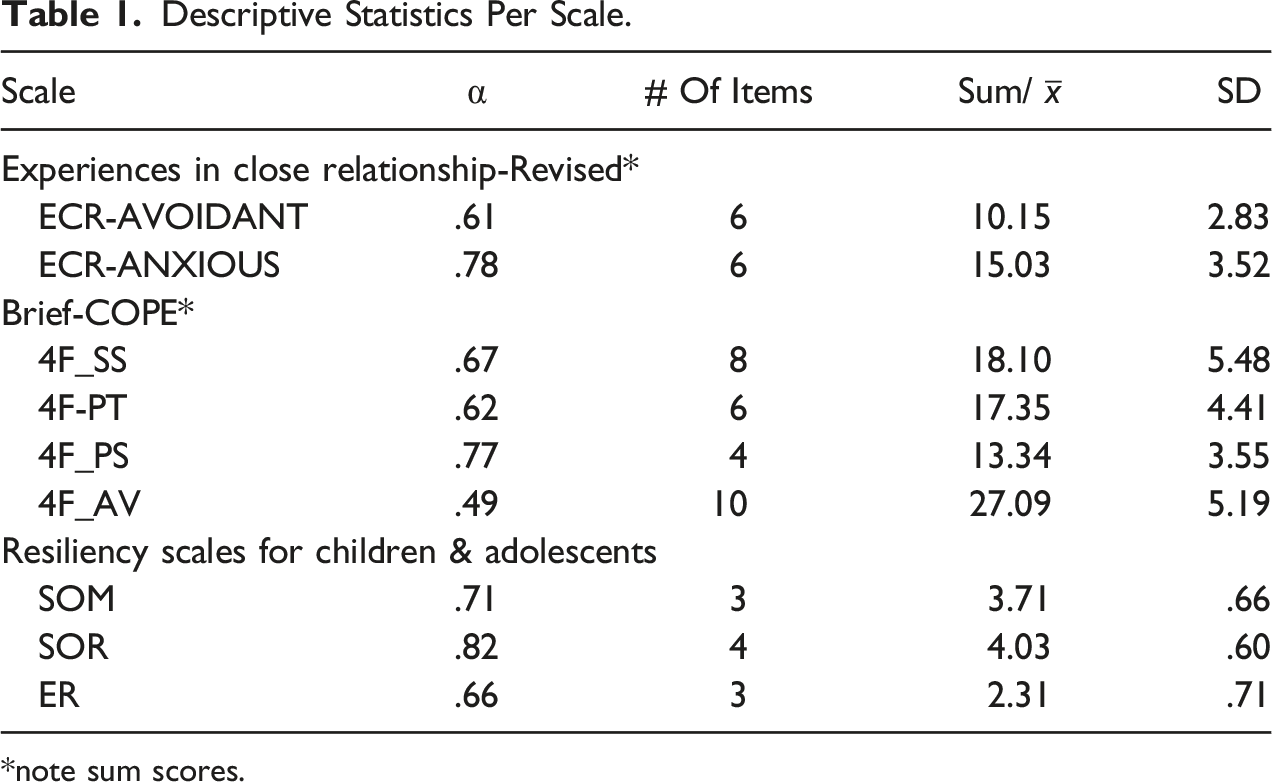
*note sum scores.
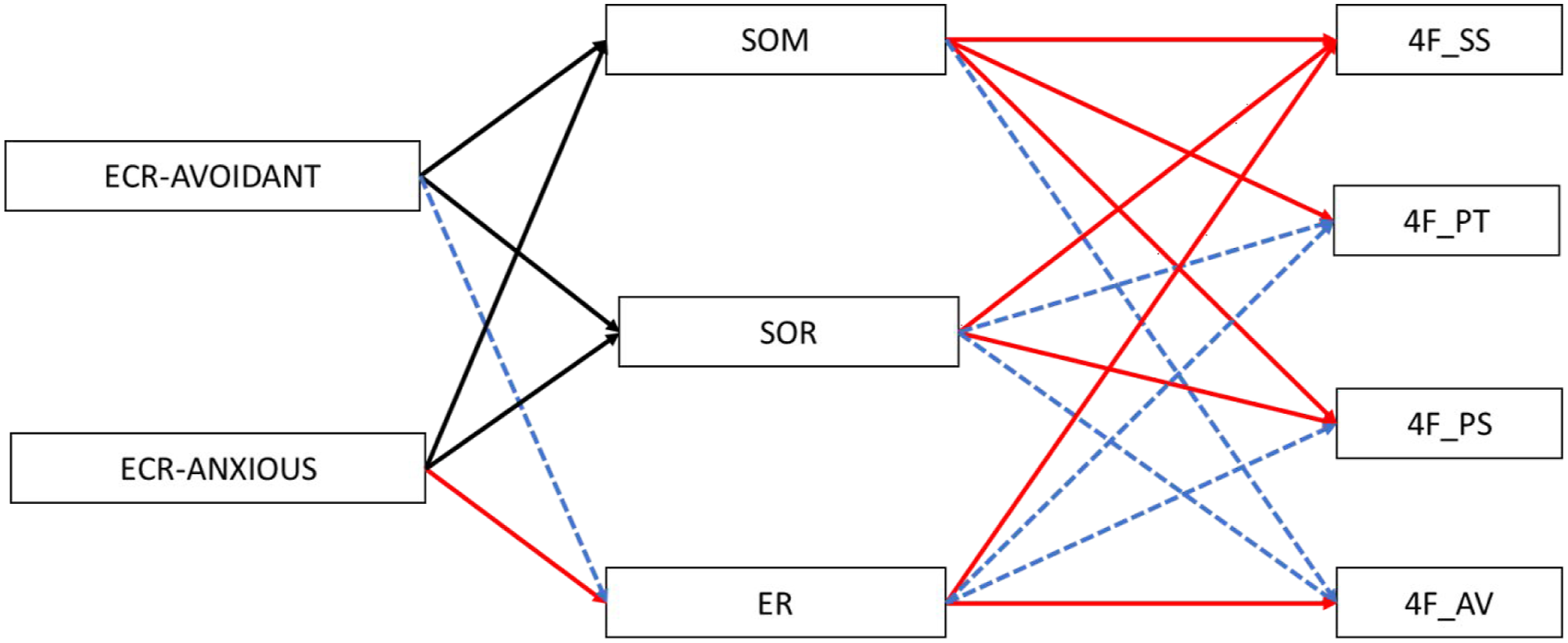
Path analysis testing attachment, resiliency and coping.
Model Analysis
To investigate the research question, the complete model was entered into AMOS to test the predictive value of the two elements of attachment on resiliency and test the predictive value of the three elements of resiliency on coping. When analyzing the predictive value of attachment on resiliency, tests revealed that anxious attachment style had a positive significant predictive value for emotional reactivity (CR = 4.68, p < .001). Conversely, anxious attachment style had a significant negative predictive value for both sense of mastery (CR = −2.36, p = .018) and sense of relatedness (CR = −3.48, p < .001). Tests revealed that avoidance attachment had a negative significant predictive value for both sense of mastery (CR = −6.21, p < .001) and sense of relatedness (CR = −5.87, p < .001) but did not significantly predict emotional reactivity (p > .05).
When analyzing the predictive value of resiliency on coping, tests revealed that sense of mastery had a positive significant predictive value for social support (CR = 2.20, p = .028), positive thinking (CR = 3.05, p = .002), and problem solving (CR = 7.63, p = .001) but did not significantly predict avoidance (p > .05). Tests revealed that sense of relatedness had a positive significant predictive value for support (CR = 2.36, p = .019), and problem solving (CR = 3.39, p = .019) but did not significantly predict positive thinking (p > .05) or avoidance (p > .05). Tests revealed that emotional reactivity had a positive significant predictive value for avoidance (CR = 5.36, p = .001) and social support (CR = 4.01, p = .001) but did not significantly predict positive thinking (p > .05) or problem solving (p > .05).
Discussion
The fundamental elements that mold one’s attachment begin to form during infancy (Bowlby, 1969) and play a from the cradle to the grave. These developments are strongly rooted in the notion of what the child has come to learn over time as to what is safe or dangerous. These early emotional connections that one creates have significant long-lasting developmental effects throughout the years in terms of social, emotional, personal, and professional relationships, physical and psychological health, as well as stress regulation (Benoit, 2004; Rees, 2005). Having said this, one’s attachment style can aid in dealing with future setbacks (Mikulincer & Florian, 1998). This assertion directly links attachment to resiliency or one’s capacity to withstand or recover from significant challenges that threaten its stability, viability, or development (Masten, 2018). Resiliency is generally conceptualized as a factor that either functions as a protective or risk to one’s development. However, positive development is not assured solely by the possession of these resiliency factors but needs to be complemented by certain cognitive and behavioral efforts undertaken to manage a stressor. Lazarus and Folkman (1984) have framed the concept of coping as both “cognitive and behavior” efforts to manage external demands that are perceived as being “taxing” or potentially surpassing one’s resources.
Having said this, this study aimed to identify and test the interrelationships between attachment, resiliency, and coping. Given that the building blocks for attachment start early in life, this research project focused on young adolescents to assess, at that age, the potential beginnings of the interconnections between attachment, resiliency, and coping.
What Elements of Attachment Predict Resiliency?
Anxious Attachment and Resiliency
This study demonstrated the role anxious attachment can play in regulating one’s emotions and thus potentially leading to higher levels of emotional reactivity. This is in line with previous research that linked attachment styles and emotional regulation strategies (Cruz-Vargas & Sánchez-Aragón, 2021). This finding clearly shows that the early experiences in infancy that form one’s attachment and subsequent “internal working models” (Bowlby, 1969; 1973; 1980) are linked to a lack of resiliency later in life culminating in the risk factor of emotional reactivity (Supkoff et al., 2012). Characterized as inconsolable at separation in the SSP (Ainsworth et al., 1978), anxious individuals appear not able to develop effective emotional responses in terms of intensity of reaction, recovery time, and impairment during emotional episodes, possibly due to hyperactivation of fears of separation (Campbell & Marshall, 2011). Anxious individuals can perceive this separation as evidence of a lack of personal worthiness (Yue & Stefanone, 2021) and an over-reliance on others when in need of comfort (Atwool, 2006). Building on the feeling of unworthiness, anxious attachment is also rooted in questioning the trust in oneself (Nowalis et al., 2022) and others and forms a potential risk for one’s sense of mastery due to the realization that one is dependent on others (Çelikbaş & Yalçınkaya-Alkar, 2022). This study demonstrated a negative relationship between anxious attachment and sense of mastery. In other words, if one’s internal working model is based upon a lack of trust in both oneself and others, this appears to influence the levels of self-efficacy, optimism as well as a general belief that one can influence their future (Szepsenwol & Simpson, 2019). Moreover, this questioning of trust and perception of threats forms a risk to one’s sense of relatedness, for the internal working model deems others to be untrustworthy or unstable (Baldwin et al., 1996; Szepsenwol & Simpson, 2019). Equally, this study demonstrated a negative relationship between anxious attachment and sense of relatedness. Stemming from the SSP is the characterization of anxious individuals rejecting the caregiver post-separation (Dagan & Sagi-Schwartz, 2020). These early experiences seem to influence an anxious individual’s sense of relatedness grounded in the early experiences of the infant which have built a lack of perceived dependability and stability (T. George et al., 2020) and trust (Atwool, 2006) concerning the caregiver and that this leads to challenges in seeking or cultivating social relationships. In other words, the individual finds difficulties in creating social relationships due to an underlying lack of confidence in the other due to concerns of trust, tolerance, support, and comfort.
Anxious Attachment and Resiliency; Implications for Adolescence
The demonstrated negative relationship between anxious attachment and the resiliency factor sense of relatedness can form a possible social obstacle in adolescence. In this development phase, wherein the creation and maintenance of peer relations becomes so crucial, having anxious attachment might impede this process in terms of one’s anxious attachment leading to lower levels of the four sub-concepts of sense of relatedness: trust, perceived social support, comfort, and tolerance. These four elements are crucial for the establishment of positive social connections. Specifically in the current study, adolescents with higher levels of anxious attachment generally will have lower levels of trust in and tolerance of their peers. Additionally, this study demonstrated a negative relationship between anxious attachment and sense of mastery. This lack of sense of mastery specifically in terms of lower levels of self-efficacy and optimism might actually impede adolescents in undertaking or attempting to create new social relations. This may be in part due to a sense of lack of personal worthiness (Yue & Stefanone, 2021) rooted in questioning the trust in oneself (Nowalis et al., 2022).
Avoidant Attachment and Resiliency
Avoidantly attached infants, upon the return of the caregiver, do not seek contact. They are generally focused on the environment and continue to explore independently (Waters & Valenzuela, 1999). Mikulincer and Shaver (2007) note that avoidance is based upon distrust of others and their intentions, but also can form a challenge to one’s self-esteem. In line with these findings, the current research demonstrates that higher levels of avoidant attachment lead to lower levels of sense of mastery. Having said this, avoidance might form an obstacle to developing a sense of mastery since this is built upon trusting in one’s ability to perform a task. Equally, this study demonstrated that avoidant attachment is negatively related to one’s sense of relatedness. Avoidant individuals hold a fear of intimacy or fear of dependence due to their early emotional connections with their caregivers. They feel uncomfortable getting close to others due to potential dependency issues (Çelikbaş & Yalçınkaya-Alkar, 2022). While this negative relationship is a similar outcome to anxious attachment, the roots of this are highly different. Avoidant individuals may attempt to inhibit their emotional reactions and thus attempt to diminish unwanted attachment needs or desires towards others. This evading of attachment might be grounded in the perceived threat of rejection, betrayal, and separation by an attachment figure (Mikulincer & Shaver, 2019) rooted in past experiences. Specifically looking at emotional reactivity, this study demonstrated that there was no significant relationship between avoidant attachment and emotional reactivity. This relationship can be partially explained by what Darling Rasmussen and colleagues (2019) describe when avoidants attempt to “downregulate their emotional expression and behavior in an effort to deny their attachment needs” (Darling Rasmussen et al., 2019, p. 122) thus acting as a buffer towards mitigating the risk of emotional reactivity. Combining these ideas with those reported above it can be stated that the inhibition of one’s emotional reactions to avoid attachment functions as both a risk factor for relatedness and at the same time a protective factor toward emotional reactivity (Darling Rasmussen et al., 2019; Mikulincer & Shaver, 2019).
Avoidant Attachment and Resiliency; Implications for Adolescence
Similar in functioning to anxious attachment, higher levels of avoidant attachment leads to lower levels of sense of mastery, thus forming the same potential threat to the creation and maintenance of peer relations. However, the etiology is dissimilar. Avoidant attachment is rooted in the distrust of others and their intentions. Having said this, avoidant adolescents will need to overcome their fears and distrust in order to establish peer relations. However, in overcoming this fear, avoidant adolescents are faced with the uncomfortable feeling getting close to others due to potential dependency issues (Çelikbaş & Yalçınkaya-Alkar, 2022). Besides these social relations challenges for adolescents, adolescents’ mental health (Konaszewski et al., 2021) can be influenced by one’s resiliency. Since the roots of resiliency are founded in one’s attachment style, this should be taken into consideration as a potential threat to both adolescents’ level of social competency and mental health.
What Elements of Resiliency Predict Coping?
Polarity of Attachment or Separation
Both anxious and avoidant attachment has a negative predictive value for both sense of mastery and sense of relatedness. However, while this relationship is similar, it can be argued that the potential catalyst for this relationship could be rooted in the notion of the polarity of attachment. Blatt and Levy (2003) posit that there always exists a polarity in attachment theory between the concepts of “attachment or separation.”
For anxious individuals, the anxiety of “separation” (or perceived separation) appears to form a deep-rooted distrust (Mikulincer & Shaver, 2007) as to the constancy of the “other.” Specifically focusing on sense of mastery, anxious individuals may hold a lower self-image stemming from their feeling of inadequacy due to not being able to self-regulate (Cruz-Vargas & Sánchez-Aragón, 2021) their own emotions, and thus their realization (conscious or unconscious) that they are dependent upon others (Çelikbaş & Yalçınkaya-Alkar, 2022). Specifically for relatedness, anxious attachment forms the roots of perceived instability in social relations in terms of lack of trust, worthiness, or stability in what is safe in the world (Atwool, 2006). However, anxious individuals do have the desire to attach to and trust others as well as themselves, but they seem to lack confidence in those relationships since they view others as easily changeable and thus unsafe (T. George et al., 2020).
For avoidant individuals, the anxiety of “attaching” appears to form a deep-rooted distrust of the availability of the “other” (Mikulincer & Shaver, 2007). Their early life experiences have formed the belief that others are not attentive to their needs or that caregivers have rebuffed them when expressing their needs (Blatt & Levy, 2003). Avoidant individuals generally hold a positive self-image built upon past experiences of having to self-regulate due to their perception that caretakers are unable to meet their needs (Stevens, 2014). However, their sense of mastery may be endangered by doubting their own value through their earlier perceptions of their caretaker’s unavailability/inattentiveness to meet their needs, thus leading to the questioning of their self-worth (Nowalis et al., 2022). However, avoidant individuals do have the desire to attach to and trust others as well as themselves but have an underlying belief that they are not worthy to receive this attention (Yue & Stefanone, 2021). For sense of relatedness, anxious individuals perceive others as unstable or unpredictable thus leading to potential challenges with social relations. For avoidants, challenges with social relations may stem from an internal working model formed early in life that the “other” will not respond to their needs (Atwool, 2006). This unresponsiveness can lead to the image of others that is generally negative.
Sense of Mastery and Coping Behavior
As stated above, positive development is not assured solely by the capacity to withstand a stressor but needs to be complemented by undertaken cognitive and behavioral efforts to manage that stressor. This study demonstrated that a capacity to withstand in terms of sense of mastery (optimism, self-efficacy, and adaptation) leads individuals to choose specific cognitive or behavioral efforts such as positive thinking, problem-solving, or seeking out social support. The current study demonstrates the function self-efficacy has in undertaking certain cognitive and behavioral efforts (problem-solving) when trying to manage (coping) a stressor. Specifically, Li and colleagues (2018) have reported that self-efficacy mediates the relationship between stress and problem-solving. Equally, Van der Hallen et al. (2020) exploring resiliency and coping through network analysis, report a linkage between active coping and goal efficacy and state: “the choice to deal with things actively is intertwined with our self-confidence and belief in the ability to perform certain tasks” (Van der Hallen et al., 2020, p. 491). Specifically for optimism, Yang and Ha (2019) report a significantly positive relationship to problem-focused coping. However, the opposite is also true; lower levels of optimism (pessimism), self-efficacy, or adaptation led to not choosing specific cognitive or behavioral efforts such as positive thinking, or problem-solving. Anzaldi and Shifren (2019), report a negative relationship between pessimism and both emotion-focused and problem-solving coping. and assert that both “optimism and pessimism play equally important roles in understanding” coping strategies (2019, p. 244). Additionally, Aspinwall specifically notes that a “pessimistic explanatory style” (Seligman, 2007) has been linked to ineffective and destructive coping.
Sense of Mastery and Coping Behavior; Implications for Adolescence
This study demonstrated that a capacity to withstand in terms of sense of mastery (optimism, self-efficacy, and adaptation) leads individuals to choose specific cognitive or behavioral efforts such as positive thinking, problem-solving, or seeking out social support. For adolescents that are developing a more social life, having higher levels of sense of mastery can lead to higher levels of seeking social support. In other words, adolescents with higher levels of optimism, self-efficacy, and adaptation generally will employ coping strategies that may strengthen their peer relations. This may be due to adolescents’ “self-confidence and belief in the ability to perform certain tasks” (Van der Hallen et al., 2020, p. 491).
Sense of Relatedness and Coping Behavior
This study also demonstrated a positive relationship between one’s sense of relatedness with specific cognitive or behavioral efforts. This means seeking social support and engaging in problem-solving behavior is related to a capacity to withstand that is rooted in social relatedness in terms of perceived comfort, trust, and access to support from others. Specifically investigating trust as a component of relatedness, Reimer (2020) reports that building a trusting relationship between teachers and students can facilitate students toward more problem-focused coping strategies in a classroom setting. Tolsdorf (1976) reports that the perceived value and strength of one’s “network” influence one’s coping styles. Moreover, they report that the strength of one’s sense of relatedness resulted in individuals choosing certain coping responses: individual activation and network activation (Network mobilization is described as seeking out members of your network for advice and support. Individual mobilization is described as cognitive efforts at problem-solving). These results are in line with the current study’s results where one’s sense of relatedness positively predicts specific coping strategies: seeking social support and problem-solving. Equally, Alonso-Tapia et al. (2019), while specifically investigating the relationship between resilience and coping and several different adversities (health, finances, or friendships), reports a positive relationship between sense of relatedness and both problem-focused and social-focused coping. However, Alonso-Tapia et al. (2019) also notes that this relationship varies depending upon the type of adversity (stressor) faced. In other words, having a sense of being able to undertake behavior efforts such as problem-solving seems to stem from one perceiving a certain level of social relatedness in terms of trust, tolerance, support, and comfort. In other words, individuals, to manage a stressor, will most likely seek social support and engage in problem-solving if they feel they are socially connected and can access this network.
Sense of Relatedness and Coping Behavior; Implications for Adolescence
This study also demonstrated a positive relationship between one’s sense of relatedness with specific coping strategies such as social support and engaging in problem-solving behavior. Both of these behaviors can be seen a potential coping strategies that increase positive aspects of peer relations. For example, by trying to manage a stressor by trying to solve the problem will most likely lead to more positive peer interactions than using avoidance based coping strategies. Moreover, these coping strategies are related to a capacity to withstand that is rooted in social relatedness in terms of perceived comfort, trust, and access to support from others. These factors are essential for the formation of healthy social relationships.
Emotional Reactivity and Coping Behavior
Furthermore, one’s capacity to withstand might be threatened by certain risk factors such as emotional reactivity (sensitivity and intensity of reaction, recovery time needed, and impairment while emotional). In this study, there are specific cognitive or behavior efforts that one employs that stem from emotional reactivity. Aspinwall (2001) has reported the relationship between emotional regulation and seeking social support, stating that during times of stress, individuals with high levels of emotions seek social support to receive general information about that stressor (information support), assistance in assessing the situation (appraisal support) and concrete assistance (tangible aid). Specifically focusing on avoidant coping strategies and emotions, Clauss et al. (2020) assert that these strategies will be employed to “provide short-term relief from these negatively evaluated internal experiences” (2020, p. 397). In other words, emotional reactive (sensitivity and intensity of reaction) individuals will most likely engage in “cognitive and behavior” efforts that aim to circumvent or reduce their uncomfortable feelings. However, it should be noted that contrary to Alonso-Tapia et al. (2019), the current study reveals two dissimilar findings: no significant relationship between emotional reactivity and problem-focused coping was revealed and whereas the current study revealed a positive relationship between emotional reactivity and social support Tapia reported a negative relationship. In summary, emotional reactivity led to choosing cognitive or behavioral efforts such as self-distraction, denial, substance use, behavioral disengagement, and self-blame. Additionally, emotional reactivity also led to higher levels of seeking social support. This means that individuals with higher levels of emotional reactivity employed efforts such as emotional support, use of instrumental support, and venting to manage their stressors.
Emotional Reactivity and Coping Behavior; Implications for Adolescence
In this study, there are specific cognitive or behavior efforts that one employs that stem from higher levels of emotional reactivity. Emotional reactivity led to choosing cognitive or behavioral efforts such as self-distraction, denial, substance use, behavioral disengagement, and self-blame. For positive development in adolescents, these coping strategies might actually have an negative effect upon one’s self-esteem and confidence. Equally, self-distraction, denial, substance use may also have a negative impact on one’s peer relations. For example, contrary to the positive relationship of trying to solve the problem among peers (sense of relatedness), denial of the problem and engaging in self-distraction strategies will most likely not enhance peer relations. Additionally, emotional reactivity also led to higher levels of seeking social support in terms of emotional support, instrumental support, and venting to manage their stressors. However, in creating and maintaining peer relations, when one seeks social support that is strongly rooted in an emotional reactive state, they will generally rely on the coping strategies emotional support or venting, this may form an imbalance in the peer relationship.
Clinical Implications and Interventions
The current results may be of particular interest to clinicians working in the field of (child) mental health care. Clinical interventions targeting resilience, coping or attachment have received much attention over the years. In fact, while interventions targeting resilience and coping have been around since the early ’90s, attachment-based (psycho)therapeutic interventions have gained popularity in more recent years (G. M. Diamond, 2014; Liu et al., 2020; Marmarosh, 2015). The results of the current study support the need for interventions targeting resilience, coping, and, especially, attachment. Moreover, the current findings highlight the interconnectedness of resilience, coping, and attachment, suggestive of the fact that when people seek help their difficulties can most likely be approached from different angles. Such emphasis on coping and resilience skills – as key concepts central to healthy development - is in line with the growing (international) trend to consider cognitive behavioral therapy (CBT) first-line treatment for a wide range of (mild) psychopathologies and disorders (Arch & Craske, 2009; David et al., 2018). That being said, the current results also highlight the need to look beyond the surface, that is, the current results highlight how coping is rooted in resiliency and attachment and the internal working model seems to play a key role in this relationship. As such, clinicians are encouraged to not merely consider actions, behavior, and cognitions (the ABCs of CBT) when providing mental aid, but to assess the underlying beliefs of self and others, as typically considered in more attachment-based paradigms such as attachment-based family therapy (ABFT) (G. Diamond et al., 2016). In sum, the complexity of the current findings highlights the importance of a service-centered approach to go hand-in-hand with or be supplemented by a person-centered, client-centered approach, sensitive to individual differences (Whalley Hammell, 2015).
Conclusion
The current study has strongly demonstrated both theoretically as well as empirically the interconnected relationships to be found among attachment, resilience, and coping in young adolescents. An exploration of the foundations of resilience has been explored by starting with one’s attachment style. The building blocks of how one eventually chooses to manage stressors can be traced back to the elements of resiliency which are in turn rooted in those early interactions with our caregivers. These interactions with caregivers form the eventual internal working models that help us navigate and evaluate future events. The factors for resilience are developed through the exercising of these internal working models throughout life. Building on this foundation, the cognitive and behavioral efforts that we choose to undertake to manage stressors are equally built upon their building blocks: resiliency. In other words, how we choose to cope with a situation is embedded in our personally developed resiliency which in turn was formed by what we learned to be safe or dangerous as a child. This is the polarity that is central in attachment theory: attachment and separation. However, there are several ways of viewing this polarity: trust or distrust, self-reliance or other-reliance, block or inhibit emotions, moving towards or moving away, and deactivating or hyperactivation. However, all of these polarities are rooted in one’s perception of safety grounded in one’s early experiences.
Limitations and Future Research
In the current study, a limitation due to the study’s design can be identified. The causal relationships were examined within a single study and one data collection point. Future research may be better informed by a longitudinal approach to measure constructs in different time periods. Additionally, the target population was limited in the sense that it was mainly comprised of primary school-aged children from inner-city schools. This over representation may decrease the generalizability of the current study’s findings. Future research might be better informed by a more representable sample of primary school-aged children. Lastly, the current study relies solely upon self-reported data. This validity of the current data could be negatively influenced by several factors such as; children’s’ selective memory, exaggeration in terms of children’s’ potential desire to choose socially acceptable answers, and the complexity of the employed instruments themselves. While these instruments were developed for this age group and were subject to a valid translation process, some concepts and questions might not be fully culturally relevant or contain language that is of a different level.
Footnotes
Acknowledgments
The authors would like to acknowledge the work of Iris van Elst en Sterre Willemse in contributing to this article through their Master’s thesis focus.
Declaration of Conflicting Interests
The author(s) declared no potential conflicts of interest with respect to the research, authorship, and/or publication of this article.
Funding
The author(s) received no financial support for the research, authorship, and/or publication of this article.
