




Abstract
During early adolescence children are increasingly using their smartphones not only throughout the day, but also before or even during the nighttime. Prior research has revealed that children’s school performance might suffer because of late-night smartphone use. To gain a further understanding of the consequences of nighttime smartphone use on school performance, this study set out to examine whether children’s nighttime smartphone use is associated with children’s attentional problems over time and with their achieved and subjective school performance. We tested these associations using a two-wave panel study among children aged 10–14 years and one of their parents (parent-child pairs, N Time2 = 384). The findings revealed that children’s nighttime smartphone use was positively related to parent-reported perceptions of children’s attentional problems over time which were negatively related to both subjective and achieved school performance. We discuss the implications of these results for the regulation of children’s smartphone use at night.
Keywords
Introduction
Almost constant use of smartphones has led children to actively engage with their devices before or even during nighttime. In fact, a recent systematic review and meta-analysis revealed that young people spent 162 minutes on screens before the pandemic (Madigan et al., 2022), whereas previous reports on nighttime smartphone use revealed that 29% of teens keep their smartphone in bed, and 36% check their smartphone at least once at night (Common Sense Media, 2019). The active use of the mobile device in terms of receiving and sending text messages, as well as checking, commenting, and posting on social media accounts, is defined as mobile phone use after the lights are out (Van den Bulck, 2007). In this study, we define nighttime smartphone use as active engagement with the smartphone while being in bed right before going to sleep, which researchers consider problematic because it can displace (Exelmans & Van den Bulck, 2017) or even reduce sleep time (Rod et al., 2018). However, positive outcomes of nighttime smartphone use might reflect through increased social contact, which reduces feelings of loneliness. Recent studies suggest that young people’s smartphone engagement with social contacts might have a beneficial effect that “overrides the negative consequences of having disturbed sleep” (Dissing et al., 2022, p. 6). Nevertheless, since sleep is a paramount factor during children’s development, sleep deficit could have detrimental consequences for children’s physical and psychological well-being (Chaput et al., 2016; Dana et al., 2022; Lemola et al., 2015; Woods & Scott, 2016).
One primary negative outcome of frequent sleep interruptions are difficulties with sustained attention during the day (Dahl, 1996). Sleep and attentional problems are even so highly intertwined that it becomes indistinguishable if a child expresses symptoms of sleep deprivation or of attention deficit disorder (for review, see Dahl, 1996). As a consequence of inadequate sleep, children’s school performance might suffer (Dewald et al., 2010; Shochat et al., 2014). These negative outcomes reported from previous research have led many Asian countries (e.g., China, Korea, Thailand, Vietnam), where smartphone gaming is prevalent, to impose an online game curfew for minors to avoid media-induced sleep displacement (Lee et al., 2017).
Nighttime smartphone use, in combination with lower attention during the day, might negatively influence children’s school performance. As a way of preventing negative outcomes on school performance, France introduced a ban on smartphone use in high schools, intending to improve students’ educational performance (Ledsom, 2019). However, there is no clear research evidence about whether smartphone use is a predictor of lower school performance. Most of the research on smartphone use and academic functioning to date has been cross-sectional in nature (Amez & Baert, 2020; Baert et al., 2020). Only in one study, longitudinal data on college students’ smartphone use and exam scores were collected, and the study findings showed a negative effect over time (Amez et al., 2021).
To address this critical research gap, we used data from a two-wave panel survey of children between 10 and 14 years, along with one of their parents, to examine children’s nighttime smartphone use, parent-reported children’s attentional problems, and their association with children’s subjective and achieved school performance over time. By controlling for baseline measures, our longitudinal model allows to draw conclusions about the time order and directionality of these proposed associations.
Children’s Nighttime Smartphone Use and Attentional Problems
Children in the US aged 10–13 years spend, on average, 1.8 hours per day with TV or video games, and another 2 hours with a smartphone or tablet (Twenge et al., 2019), while data from Germany shows that children and adolescents aged 6–18 years spend an average of 1.85 hours per day on the Internet (Rohleder, 2022) with smartphones and tablets as the most common devices they use. Parents, the general public, and scholars are oftentimes concerned about the effects of screen time on children’s social and cognitive development. This concern is especially relevant when children use their devices during the night.
The mechanism by which nighttime smartphone use is thought to cause daytime attentional problems is sleep restriction or reduced sleep quality (Li et al., 2019). Sleep is of fundamental importance for children’s overall development (Chaput et al., 2016) and particularly relevant to maintain sustained attention (de Bruin et al., 2017; Lim & Dinges, 2010). Scholars have even argued that the symptoms of attention deficit disorder can hardly be distinguished from the symptoms of sleep deprivation (Dahl, 1996). Yet, most adolescents report a lower than optimal sleep duration on weekdays (e.g., King et al., 2014). In children over the age of 10, the smartphone is considered the most important reason for reduced sleep time (Twenge et al., 2019).
Theoretically, nighttime smartphone use leads to attentional problems via three different pathways (Cain & Gradisar, 2010). The first pathway is via sleep displacement: Media use displaces, delays (Hisler et al., 2020; King et al., 2014; Lemola et al., 2015), or interrupts (Cain & Gradisar, 2010; Foerster et al., 2019) sleep time. Such displacement, delay, or disruption of sleep can happen due to the specific features of smartphone devices: Smartphones can light up or make a sound as a signal of a new notification. This signal might trigger nighttime smartphone use. Nighttime engagement with mobile phones refers to the active use of the device in terms of receiving and sending text messages as well as checking, commenting, and posting on social media accounts (Van den Bulck, 2007).
According to the second pathway, media use with its stimulating contents and the fast pace increases psychological and physiological arousal (Lang et al., 2000). At night, increased levels of arousal can impair sleep. However, in the long term, children become habituated to the fast pace, which may result in decreased baseline arousal and reduced vigilance (Nigg, 2006)–a process that has been labeled as the fast-pace arousal-habituation hypothesis (Beyens et al., 2018).
As for the third pathway, the bright light (Higuchi et al., 2005) or electromagnetic radiation (Loughran et al., 2005) of electronic devices can change sleep architecture. All three pathways might explain how nighttime smartphone use might impair cognitive performance over time.
The empirical evidence on this topic, however, is inconsistent. A meta-analysis of 45 studies found a small but significant association between general screen media use and attentional problems (Nikkelen et al., 2014). Moreover, past research has shown that media multitasking and attentional problems were strongly related especially among early adolescents (Baumgartner et al., 2018; Rogobete et al., 2021). Smartphone use, in particular, interferes with immediate attention to and performance on ongoing tasks (van der Schuur et al., 2015; Wilmer et al., 2017). Even more specifically, nighttime smartphone use negatively correlates with daytime cognitive dysfunction (Demirci et al., 2015; Green et al., 2018). A meta-analysis by Carter et al. (2016) concluded that nighttime electronic media use was associated with decreased sleep quantity and quality and with increased daytime sleepiness (for additional reviews, see Bartel et al., 2015a; Hale & Guan, 2015).
However, whether children’s (nighttime) smartphone use impairs cognitive performance over time remains unclear because cross-sectional evidence dominates the field (Nikkelen et al., 2014; Wilmer et al., 2017). Thus, the direction of the effect could be reversed (Bartel & Gradisar, 2017). In fact, those who already have attentional (or sleeping) problems might increasingly turn to media (Eggermont & Van den Bulck, 2006; Exelmans & Van den Bulck, 2016).
Longitudinal evidence on (nighttime) media use and attentional problems (or sleep) is scarce (Nikkelen et al., 2014). The results of one longitudinal survey suggest that children’s exposure to television corresponds to attentional problems over time (Christakis et al., 2004). The longitudinal evidence on media use and sleep is mixed, too. Two panel surveys with children and adolescents found that media use was related to sleep problems over time (Johnson et al., 2004; Nuutinen et al., 2013). However, the result of a panel survey among university students revealed a reversed effect: Sleep problems were related to media use over time (Tavernier & Willoughby, 2014). Longitudinal evidence about nighttime smartphone use and attentional problems is still lacking.
We addressed this lacuna using a two-wave panel survey with children between 10 and 14 years of age. Yet, instead of researching consequences of nighttime smartphone use on children’s self-reported attentional problems or sleep, we chose to examine parent-reported attentional problems of their children. We based this decision on two reasons: First, sleep parameters and attentional problems are highly intertwined. Sleep deprivation symptoms strongly resemble the symptoms of attention deficit disorder to the point where it becomes indistinguishable if a child expresses symptoms of one or the other (for review, see Dahl, 1996).
Second, children’s self-report measures of attention and sleep can be unreliable: Overnight smartphone use did not correlate with self-reported sleeping problems or subjectively feeling tired (Rod et al., 2018). In line with that reasoning, an intervention decreasing adolescents’ screen time at night related to an earlier sleep onset time but was not related to self-reported daytime fatigue or mood (Perrault et al., 2019). However, using an implicit psychomotor reaction time task, the authors showed that less nighttime media use was related to a higher daytime vigilance. Additionally, Appleton and colleagues (2020) found that sleep-disrupting nighttime technology use related to daytime attentional problems at work and in traffic—and this effect was especially pronounced among those not perceiving and reporting a sleep problem. For these reasons, we refrained from children’s self-reports of attention and relied instead on parent-reported attentional problems of children.
Based on sleep displacement theory (Exelmans & Van den Bulck, 2017), the fast pace arousal-habituation hypothesis (Beyens et al., 2018), and the available empirical evidence (Carter et al., 2016; Wilmer et al., 2017), we postulate our first hypothesis:
Children’s nighttime smartphone use will be positively associated with parent-reported children’s attentional problems over time.
Children’s Attentional Problems and Subjective School Performance
If children have attentional problems during the day, they likely also experience problems when doing homework or concentrating in class, which may, in turn, influence their school performance. Theoretically, attention is—together with storage-memory and speed-response time—one of the three conditions of information processing (Wickens & McCarley, 2008). We need attention to process information in working memory, store data in long-term memory, and retrieve information (Wickens & McCarley, 2008). Attention can be classified into selective, divided, and sustained (or focused) attention (Schmeichel & Baumeister, 2010).
Sustained attention is one of the main predictors of academic performance; it even predicts school performance beyond intelligence and parent socioeconomic status (Steinmayr et al., 2010). Sustained attention means “focusing attention on a stimulus or activity for an extended period of time” (Schmeichel & Baumeister, 2010, p. 31). In the classroom, children with attentional problems shift their attention away from teaching and therefore underperform on tests of educational achievement or self-perceived learning outcomes (Wei et al., 2012).
Empirical evidence confirms that attentional problems are negatively linked to academic achievement over time: A meta-analysis of 101 longitudinal studies found a strong association of other-reported attentional problems (ADHD symptoms or clinical diagnosis) with poor school achievement two or more years later (Erskine et al., 2016). Research has shown that it is precisely the inattention and not the hyperactivity that predicts children’s school performance (Pingault et al., 2011; Rigoni et al., 2020). However, in their meta-analysis Erskine and colleagues (2016) compared individuals with ADHD symptoms or with an ADHD diagnosis to children without any attentional problems and calculated odds ratios for binary outcome measures (i.e., high school completed vs. failed or suspended vs. not suspended)—which presents a methodological limitation regarding the sample. Besides attentional problems, non-academic reasons for dropping out of school or suspension might be even more important.
Given the shortcomings in the measures of academic achievement in previous research, we add to the literature by employing a more nuanced measure of academic school performance to test if attentional problems are related to school performance in a non-clinical community sample. To do so, we asked children to self-assess their subjective school performance. Research has shown that the subjective perception of one’s cognitive performance (i.e., competence beliefs or ability self-concept) is a legitimate indicator of school performance (Steinmayr et al., 2014; Trautwein et al., 2006). Furthermore, previous research has established a negative association between children’s attentional problems and their school performance (e.g., Erskine et al., 2016; Steinmayr et al., 2010). Accordingly, we hypothesize:
Parent-reported children’s attentional problems will be negatively associated with children’s subjective school performance over time.
Children’s Attentional Problems and Achieved School Performance
In order to arrive at valid conclusions about school performance, scholars emphasize the importance to include different indicators of performance (Lauermann et al., 2020). Therefore, we contextualized children’s subjective school performance with teacher-rated grading performance. Although subjective perceptions of academic performance longitudinally predict academic achievement (Trautwein et al., 2006), self-assessment of academic performance alone can provide a biased perspective. The reason for the bias is that chronic self-views can be overly positive or negative (Ehrlinger & Dunning, 2003). In early adolescence, self-assessments of academic competence start suffering from systematic bias: Around the age of 10, boys begin to over- and girls begin to underestimate their competence. This gendered bias further increases with age (Cole et al., 1999).
Thus, to arrive at a more balanced view, we controlled for children’s gender and age and included teacher-given grades as an additional measure of children’s learning outcomes. Teacher-given grades may add a different layer to and reflect a more “objective” view of school performance than self-assessments. Importantly, the three variables parent-reported children’s attentional problems, child-assessments of school performance, and teacher-given grades all express children’s cognitive functioning—through the perspectives of different informants. Expressing the same construct, they should be highly correlated. Based on extant research (e.g., Erskine et al., 2016), we postulate our final hypothesis:
Parent-reported children’s attentional problems will be negatively associated with achieved school performance over time.
Method
We carried out a two-wave panel survey among children (10–14 years) and one of their parents. The present study is one part of a larger project on parent-child data about their smartphone use. The data of the present study are available at the following link: https://osf.io/RKHWB/. A private polling institute collected the data in a 4-month interval, which is commonly used for two-wave panel designs in this research area (Van der Schuur et al., 2019; Yao & Zhong, 2014). We chose a 4 month time interval to (1) ensure high retention rate and (2) detect behavioral changes regarding smartphone and social media use as well as psychological and academic outcomes. The first survey wave (Time 1 = T1) was administered in September 2018, and the second wave (Time 2 = T2) was conducted in January and February 2019. We collected a quota sample based on parents’ age and gender in Germany. We had two prerequisites for participation in the online survey. First, parents had to have a child between 10 and 14 years with whom they lived together in the same household. Second, only those children who owned a smartphone could take part in the online survey. Before starting with the questionnaire, parents were asked to provide informed consent to continue with the survey, and they also consented to allow their children to participate in the survey. In the first part of the online survey, parents filled out the questionnaire and were asked to pass it on to their child. Children then answered the second part of the questionnaire.
In total 822 parent-child pairs took part at T1 (parents: 57.2% mothers, Mage = 42.94 years, SD = 7.10; children: 51.1% girls, Mage = 12.09, SD = 1.37) and 384 parent-child pairs took part at T2 (parents: 53.4% mothers, Mage = 43.57 years, SD = 6.89; children: 46.6% girls, Mage = 12.37, SD = 1.48). The attrition rate was 47.2% for the second wave. To test whether there were any differences between the participants who dropped out after the first wave, we conducted univariate analyses. We found no difference regarding parental age (F (1, 820) = 1.25, p = .264, η2 = 0.00), education (F (1, 820) = 2.43, p = .119, η2 = 0.00), income (F (1, 820) = 2.88, p = .090, η2 = 0.00), and their child’s attentional problems (F (1, 820) = 0.39, p = .529, η2 = 0.00). However, mothers were slightly more likely to drop out of the study than fathers, χ2 (1, n = 822) = 4.23, p = .040. It is important to note that more mothers than fathers took part in the first wave, so we did not regard this dropout as particularly problematic. Children who dropped out did not differ with regard to their age (F (1,820) = .64, p = .426, η2 = 0.00), nighttime smartphone use (F (1, 820) = 3.11, p = .078, η2 = 0.00), subjective (F (1, 820) = 1.15, p = .283, η2 = 0.00), or achieved school performance (F (1, 820) = 0.52, p = .470, η2 = 0.00). Also, girls were significantly more likely to leave the survey after the first wave than boys, χ2 (1, n = 822) = 5.79, p = .016, which means that girls were slightly underrepresented at T2.
Measures
All items are reported in the supplementary file (Supplementary Appendix A). We measured children’s nighttime smartphone use with four items (α = 0.85) from Van den Bulck’s (2007) scale on mobile phone use after lights out and adapted it to the context of smartphone use. We assessed parent-reported children’s attentional problems with three items (α = 0.92) based on the inattentiveness subscale of the ADHD scale (Kessler et al., 2005), adapted from Lloyd and Hastings (2009). We measured subjective school performance using children’s self-assessment of their general school achievements with two items (α = 0.93 at T1, α = 0.91 at T2). We measured achieved school performance based on children’s grades in three subjects: German, English, and mathematics. The majority of children (40%) indicated having grade 2 in all three courses. We recoded the grades so that a higher score means higher performance (α = 0.71 at T1, α = 0.65 at T2).
We controlled for frequency of social media use with five items (α = 0.68; M = 3.17; SD = 1.06), children’s age, gender (coded 0 = boys, 1 = girls), and education (5.2% in elementary school, 10.2% in middle school, 29.9% in secondary school, and 39.1% in high school; dummy variable with 1 = lower secondary academic school and 0 = other school types) as well as parents’ age, gender (coded 0 = father, 1 = mother), education (53.5% indicated low education without university or collage degree and 46.5% indicated high education including university and college degree), and income (28.7% with moderate income from 2.041 € to 3.280 €, and 39.4% with high income from 3.281 € to 4.961 € and above).
Table A1 shows mean values, standard deviations, range, and the correlations of all main variables.
Data Analysis
We analyzed the data using Structural Equation Modeling (SEM) in the R-package lavaan (Rosseel, 2012), using Maximum Likelihood estimation in an auto-regressive model. To ensure that our longitudinal effects are not confounded by mere covariances, we controlled for levels of the outcome at T1 when predicting the outcome at T2, e.g., children’s nighttime smartphone use at T1, in order to predict the change in levels of the outcome over time, e.g., children’s nighttime smartphone use at T2. We tested all associations via the time lag between T1 and T2. In addition to the autoregressive paths, we controlled for parents’ gender, age, education, and income as well as children’s gender, age, educational level, and social media use. The error terms of latent constructs were allowed to correlate between the two time points (e.g., the error terms of attentional problems at T1 and attentional problems at T2).
To deal with missing data from participants that dropped out after the first wave, we used the Full Information Maximum Likelihood (FIML) procedure, which accounts for values that were missing at random (Enders & Bandalos, 2001). To determine the model fit, we used the chi-squared to degrees of freedom ratio (χ 2 /df), the comparative fit index (CFI), the Tucker-Lewis-Index (TLI), and the root mean square error of approximation (RMSEA). In general, CFI or TLI higher than 0.95 and RMSEA values lower than .05 indicate a good model fit (Hu & Bentler, 1999), while CFI or TLI higher than 0.90 and RMSEA values lower than .08 indicate an acceptable model fit (Byrne, 2010). The dataset is available on the Open Science Framework (https://osf.io/RKHWB/).
Results
Measurement Invariance
To test for longitudinal measurement invariance, we constrained all factor loadings of the same constructs across measurement occasions (i.e., T1 and T2) as equal to establish metric invariance (Vandenberg & Lance, 2000). The constrained model revealed a very good fit: CFI = 1.00; TLI = 1.00, χ 2 /df = 1.16; p = .070; RMSEA = 0.03, 90% CIs [0.02; 0.03]. We found no significant difference between the latent means of children’s nighttime smartphone use between T1 and T2 (p = .723), parent-reported children’s attentional problems between T1 and T2 (p = .090), children’s achieved school performance between T1 and T2 (p = .257), which confirms metric and scalar invariance of these constructs. However, for subjective school performance, the latent mean comparison was significant (p < .001). After releasing one item of subjective school performance, a nested model comparison showed no significant difference between the unconstrained and the constrained model (Δχ 2 = 18.99, df = 11, p = .061). Thus, our measurement model revealed partial metric variance for subjective school performance and full metric invariance for all other constructs.
Structural Equation Model
To test our hypotheses, we conducted a Structural Equation Model (SEM) with a Maximum Likelihood Estimator and we used Full Information Maximum Likelihood (FIML) for missing values. Table A2 and Figure A1 show the findings of this analysis. The model revealed an acceptable fit: CFI = 0.92; TLI = 0.90, χ 2 /df = 2.70, p < .001; RMSEA = 0.05, 90% CIs [0.04; 0.05]. We also ran the structural equation model without the first item of our nighttime smartphone use scale. Removing the first item about receiving messages on the smartphone improved the model fit: χ2/df = 2.13; CFI = 0.95. TLI = 0.94; RMSEA = 0.04; 90% CIs [0.03; 0.04], while all results remained unchanged. However, we decided to keep all four items of the nighttime smartphone use scale for consistency with prior research (Van den Bulck, 2007).
In line with our first hypothesis, we found that nighttime smartphone use at T1 was significantly associated with parent-reported children’s attentional problems at T2, b = 0.09, SE = 0.04, β = 0.11, p = .034. Therefore, H1 was confirmed.
Regarding our second hypothesis, we found that parent-reported children’s attentional problems at T1 were negatively related to children’s subjective school performance at T2, b = −0.12, SE = 0.03, β = −0.17, p < .001. Thus, H2 was supported.
In the third hypothesis, our results showed that parent-reported children’s attentional problems at T1 was significantly associated with lower achieved school performance at T2, b = −0.11, SE = 0.03, β = −0.20, p = .002. Thus, H3 was also supported.
Among the covariates, we found that more frequent social media use at T1 was related to higher nighttime smartphone use at T2, b = 0.32, SE = 0.06, β = 0.34, p < .001 and children’s age at T1 was related to lower parent-reported children’s attentional problems at T2, b = −0.08, SE = 0.03, β = −0.09, p = .021. We additionally examined the direct effect of nighttime smartphone use on children’s school performance. We found a direct positive relationship of children’s nighttime smartphone use with achieved school performance, which we had not hypothesized, b = 0.07, SE = 0.03, β = 0.16, p = .020.
Overall, all predictors in the model explained 37% of the variance in children’s nighttime smartphone use, 65% of the variance in parent-reported children’s attentional problems, 53% of subjective school performance, and 67% of the variance in achieved school performance.
Additional Analyses
We tested the reverse effects of achieved school performance on nighttime smartphone use to explain the positive effect. We found no significant association between achieved school performance at T1 and nighttime smartphone use at T2, b = −0.02, SE = .10, β = −0.01, p = .812. That is, we could not confirm the reinforcing effect over time. Children who are objectively better in school are not more likely to use the smartphone at night.
Lastly, we conducted an additional regression analysis with separate social media channels to detect which platforms are positively related with nighttime smartphone use over time. The findings show that Facebook use (b = 0.07, SE = 0.03, β = 0.10, p = .021) and Snapchat use (b = 0.10, SE = 0.04, β = 0.14, p = .012) at Time 1 have a significant positive relationship with nighttime smartphone use at Time 2, while controlling for other social media platforms and demographics.
Discussion
Children’s round-the-clock smartphone use has intensified in recent years (Twenge et al., 2019). Not only are children getting their first smartphones earlier, but they are also increasingly using them during the night. Given that smartphones are dominant in children’s lives, it becomes relevant to examine the effects smartphones might have on their development and academic success. However, the majority of previous research on this topic is cross-sectional, which provides only correlational evidence (Wilmer et al., 2017). This caveat makes longitudinal research a clear necessity. Therefore, we have conducted a two-wave panel survey among parent-child pairs and tested the associations between children’s nighttime smartphone use, attentional problems, and school performance over time by controlling for the baseline measures of prior states.
Our findings revealed various negative associations of nighttime smartphone use over time. The results showed that children’s nighttime smartphone use was associated with attentional problems over time. In line with evidence from previous correlational studies, nighttime smartphone use possibly interfered with parent-reported daytime cognitive functioning of children (Demirci et al., 2015; Green et al., 2018; Wilmer et al., 2017). Based on our longitudinal findings, receiving and sending text messages or checking, commenting, and posting on social media during nighttime, was associated with attentional problems during the day. This finding is not surprising because nighttime use can displace and interrupt sleep due to specific smartphone features: Smartphones light up or produce sounds even when not in use, reminding children to check and engage with them before or during the nighttime.
Moreover, we found a direct positive association between our control variable social media use and nighttime smartphone use. Children who use many different social media channels are more likely to use their smartphones at night. As extant research has explained, nighttime smartphone use is stimulating and arousing, thus it could displace (Hisler et al., 2020; King et al., 2014; Lemola et al., 2015) or interrupt sleep time (Cain & Gradisar, 2010), resulting in poor sleep quality (Woods & Scott, 2016). Especially for children above 10, smartphones were shown to reduce sleep time (Twenge et al., 2019). Our additional analysis revealed that Facebook and Snapchat were positively related to nighttime smartphone use. Both platforms are highly interactive and focus on self-presentations and chatting. As such, our results confirm recent suggestions that social interactions through social media increase night use (Scott & Woods, 2019). For instance, studies focusing on specific social media platforms show that under certain conditions, exposure to Facebook might lower sleep quality (Bowler & Bourke, 2019). Similarly, engaging in electronic media use for texting and Facebook and Twitter use has been found to relate to sleep dysfunctions (Bhat et al., 2018). A theoretical explanation for these findings might be provided by stress-strain-outcome theory suggesting that excessive smartphone-based social media use at night is positively related to poor sleep quality, thereby relating to cognitive function depletion (Luqman et al., 2021). Thus, we could confirm the main theoretical assumptions and prior empirical findings that nighttime smartphone use was positively associated with attentional problems over time. This result suggests that postponed and impaired sleep may be harmful to children’s cognitive development in the long-term.
In line with previous research (Erskine et al., 2016), we found children’s attentional problems was related to school performance over time. Children’s attentional problems reported by parents was negatively associated with both subjective and achieved school performance over time, showing a strong relationship with child-reported school success and teacher-given grades. Theoretically, our finding underscores the role of sustained attention for school performance (Rigoni et al., 2020; Steinmayr et al., 2010). This finding also has practical relevance because children’s school achievements shape their long-term academic success and career development plans. Therefore, these results should be taken seriously, not just from the parental perspective, but also from educational institutions and teachers.
Interestingly, parent-reported children’s attentional problems had a stronger association with subjective than achieved school performance. This finding suggests that children’s own competence beliefs are more sensitive to parent-reported children’s attentional problems than teacher-given grades. As another important result, our additional finding revealed a direct association between children’s nighttime smartphone use and achieved school performance over time. However, contrary to our expectations based on previous research (Amez et al., 2020), this association was positive: Using the smartphone at nighttime was related to higher school performance. One possible reason could be that children use their smartphones at night for talking and chatting on social media about school-related content and topics (e.g., Gikas & Grant, 2013) that could have positive outcomes in terms of social benefits (Dissing et al., 2022). Among some pupils, nighttime smartphone use seems not to create attentional problems but instead ensures better school grades. Media often have very different effects on different types of children (Piotrowski & Valkenburg, 2015)—particularly regarding media effects on ADHD-related behaviors (Beyens et al., 2018). Although we did not measure pre-existing ADHD states, extant research points in the direction of poorer sleep quality among adolescents with ADHD, especially when they engage with various media during nighttime (Becker & Lienesch, 2018). Moreover, comparative research has shown that technology use among ADHD adolescents largely surpasses technology use among adolescents without ADHD conditions, linking it to greater sleep problems (Bourchtein et al., 2019). These findings suggest that even for those with ADHD diagnosis, nighttime smartphone use is associated with school performance in a negative way. To be able to discriminate the differential effects on different groups of children, future research should include further moderators, analyze individual slopes (e.g., Kühnel et al., 2020), and employ more sensitive measures to gauge specific use of the smartphone for school-related activities, i.e., information-seeking and learning.
Additionally, it is relevant to note that the pandemic period brought forward different school configurations that transferred to virtual learning, causing a giant increase in students’ screen-time activities. Parents have reported concerns due to higher screen time during lockdowns (Pew Research Center, 2022) and one comparative study, which was conducted “before” and “during” the pandemic, demonstrated significant changes in adolescents’ smartphone use and lower sleep quality, health-related quality of life, and physical activity (Dana et al., 2022). Therefore, there is reason to believe that increases in technology use due to external predicaments might be related to negative outcomes on several aspects of adolescents’ lives.
Practical Implications
Our study bears important implications for parents, educators, and teachers as well as policymakers and researchers. First, there are several ways parents could mitigate the negative outcomes of nighttime smartphone use on attentional problems and school performance. To prevent or avoid harmful outcomes, it seems necessary to actively talk to and advise children about using smartphones responsibly and raise their awareness about negative consequences. However, research shows that active parental mediation might not always be successful due to parents’ lack of digital skills (Rodríguez-de-Dios et al., 2018). Thus, another strategy parents could engage in is ‘participatory learning’ that refers to parents and children jointly acquiring learning digital skills by interacting with digital media (Rodríguez-de-Dios et al., 2018). On a practical level, parents could implement specific rules on when and how to use smartphones before or during the nighttime. To reduce and control children’s nighttime smartphone engagement, parents could set up limits and disable smartphone applications before nighttime to ensure fewer sleep interruptions and better sleep quality (e.g., Li et al., 2015).
Not only parents but also educators could help children with understanding and regulating their smartphone use. With classes on digital literacy, educators can guide children and adolescents with their smartphone use by providing relevant information that facilitates children’s emancipatory smartphone handling. In order to improve children’s school performance, parents and teachers can do interventions improving sustained attention (for an overview see Purdie et al., 2002).
Lastly, on the institutional level, policymakers should actively promote better implementation of digital literacy programs in school curriculums. Developing evidence-based school curricula should be an important step forward. In that vein, digital media experts would be relevant agents who inform and educate both parents and teachers and provide educational seminars well as digital training programs.
Limitations
The present study contains several limitations. Our research relied on self-reports for measuring children’s nighttime smartphone use, social media use and achieved school performance, which are prone to memory biases and socially desirable answers from children. Thus, we tried to avert this limitation by measuring school grades and parent-reported attentional problems of children to ensure a more objective perspective.
Furthermore, we did not measure the content of smartphone use children engage with during nighttime. Children might use their smartphones and social media channels for learning, sharing school-related content, or exchanging text messages with peers about various topics. However, at the same time, these situations might result in attentional problems due to insufficient sleep. Future research should further investigate the specifics of the content of nighttime smartphone use and its potential association with school performance.
Regarding our data collection, we had two prerequisites for participants’ inclusion in the panel survey. However, we did not account for potential other criteria, such as the pre-existence of an attention deficit disorder or other learning difficulties. Pre-existence of an attention deficit disorder or other learning difficulties should be considered when conducting similar studies about school performance, especially with vulnerable populations, such as children and preadolescents. Commonly used exclusion criteria for attention deficit hyperactivity disorder are based on below-average intelligence quotient (IQ) scores and/or learning disabilities (Mackenzie & Wonders, 2016). Unfortunately, we did not measure these constructs in our panel survey, thus we could not exclude participants post hoc. Our measure of attentional problems is based on the inattentiveness dimension of attention deficit disorder short screening self-report scale in the general population (Kessler et al., 2005). We did not include all items that define clinically significant symptom levels. Future studies should consider participants that have officially diagnosed attention deficit disorder. Lastly, we had a high attrition rate in our second wave. We addressed this drawback by conducting our analysis with the Full Information Maximum Likelihood estimator to account for missing data. From a methodological perspective, we conducted a two-wave panel study with a relatively short time interval of 4 months. Future research should consider longer time intervals that allow studying how smartphone use interacts with developmental changes over time. Furthermore, with two panel waves, we cannot account for a mediation path between our main variables over time. To estimate a possible mediation, future research should aim to test these associations in a three-wave panel with longer time intervals. Finally, although we control for prior levels of the dependent variables, our design does not lend itself well for causal inferences. Researchers should follow up on our study with controlled experiments, which due to randomization allow ruling out third variables. However, our study is methodologically superior to previous cross-sectional studies because it emphasizes the importance of longitudinal data in correlational research. By conducting two panel waves, we could, for the first time, show the temporal order and the directionality of the proposed associations over time.
Conclusion
Smartphones are prevalent in children’s lives, and therefore, it is of utter importance to understand the effects of their use and prevent potential harm. In this longitudinal study, we demonstrated that nighttime smartphone use may be particularly harmful to children’s development because not having sufficient time to rest from technology was associated with attentional problems, which were negatively related to both subjective and achieved school performance over time. Although we found a direct longitudinal positive relationship between nighttime smartphone use and achieved (but not subjective) school performance, we cannot know whether this result applies to all children, or whether it depends on other individual or school-related factors. Thus, future studies should investigate person-specific effects (Valkenburg et al., 2021). Nighttime smartphone use may even help, but the mere frequency of use may harm school performance possibly due to attentional problems during the day. Future research should investigate which children benefit from nighttime smartphone use and which children are at risk for negative school performance. Nevertheless, to mitigate negative outcomes, parents have a crucial function in identifying their child’s attentional problems. They can enhance their children’s focus by ensuring optimal nighttime smartphone use and providing effective home learning environments (Taylor et al., 2004).
Supplemental Material
Supplemental Material - Distracted Children? Nighttime Smartphone Use, Children’s Attentional Problems, and School Performance Over Time
Supplementary Material for Distracted Children? Nighttime Smartphone Use, Children’s Attentional Problems, and School Performance Over Time by Anja Stevic, Desirée Schmuck, Marina F. Thomas, Kathrin Karsay, and Jörg Matthes in The Journal of Early Adolescence.
Footnotes
Declaration of Conflicting Interests
The author(s) declared no potential conflicts of interest with respect to the research, authorship, and/or publication of this article.
Funding
The author(s) disclosed receipt of the following financial support for the research, authorship, and/or publication of this article: This work was supported by the Sparkling Science Programme of the Austrian Federal Ministry of Education, Science, and Research under Grant SPA 06/109.

Supplemental Material
Supplemental material for this article is available online.
Appendix
Means, Standard Deviations, and Zero-Order Correlations of the Manifest Key Variables, N = 384. Note. *p < .05, **p < .01, ***p < .001; T1 = Time 1, T2 = Time 2.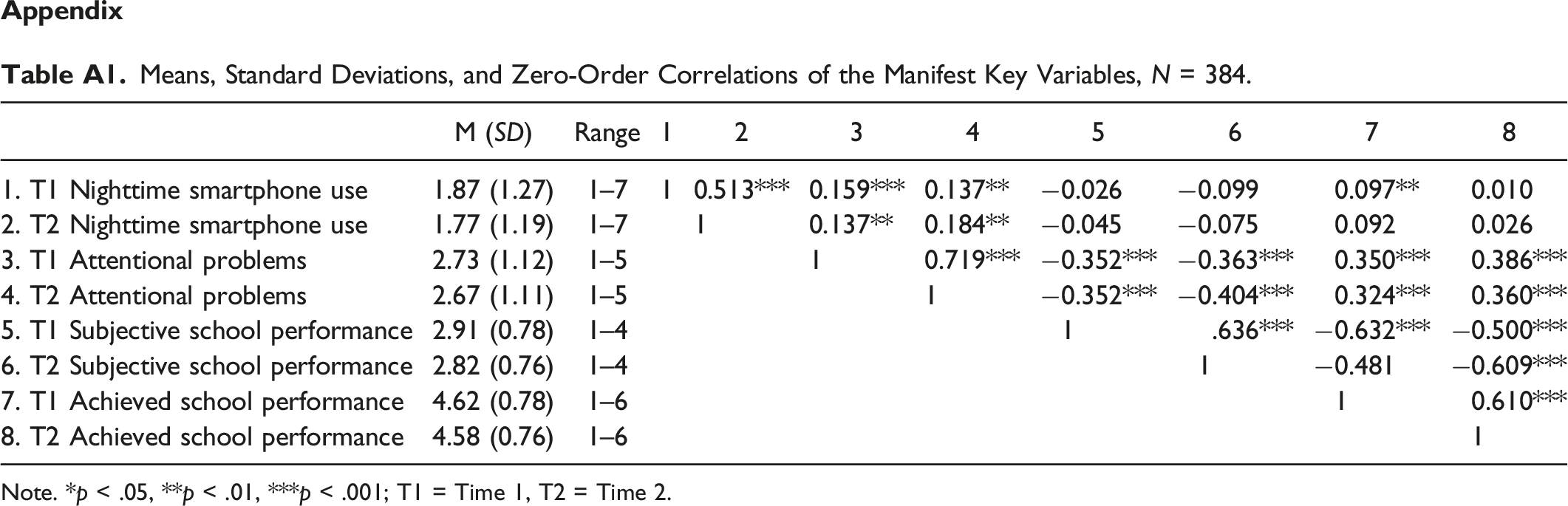
M (SD)
Range
1
2
3
4
5
6
7
8
1. T1 Nighttime smartphone use
1.87 (1.27)
1–7
1
0.513***
0.159***
0.137**
−0.026
−0.099
0.097**
0.010
2. T2 Nighttime smartphone use
1.77 (1.19)
1–7
1
0.137**
0.184**
−0.045
−0.075
0.092
0.026
3. T1 Attentional problems
2.73 (1.12)
1–5
1
0.719***
−0.352***
−0.363***
0.350***
0.386***
4. T2 Attentional problems
2.67 (1.11)
1–5
1
−0.352***
−0.404***
0.324***
0.360***
5. T1 Subjective school performance
2.91 (0.78)
1–4
1
.636***
−0.632***
−0.500***
6. T2 Subjective school performance
2.82 (0.76)
1–4
1
−0.481
−0.609***
7. T1 Achieved school performance
4.62 (0.78)
1–6
1
0.610***
8. T2 Achieved school performance
4.58 (0.76)
1–6
1
Structural Equation Model With Autoregressive Effects Based on Full Information Maximum Likelihood Estimation. Note. T1 = Time 1. T2 = Time 2. aMale is reference category. bLow income is reference category. *p < .05; **p < .01; ***p < .001.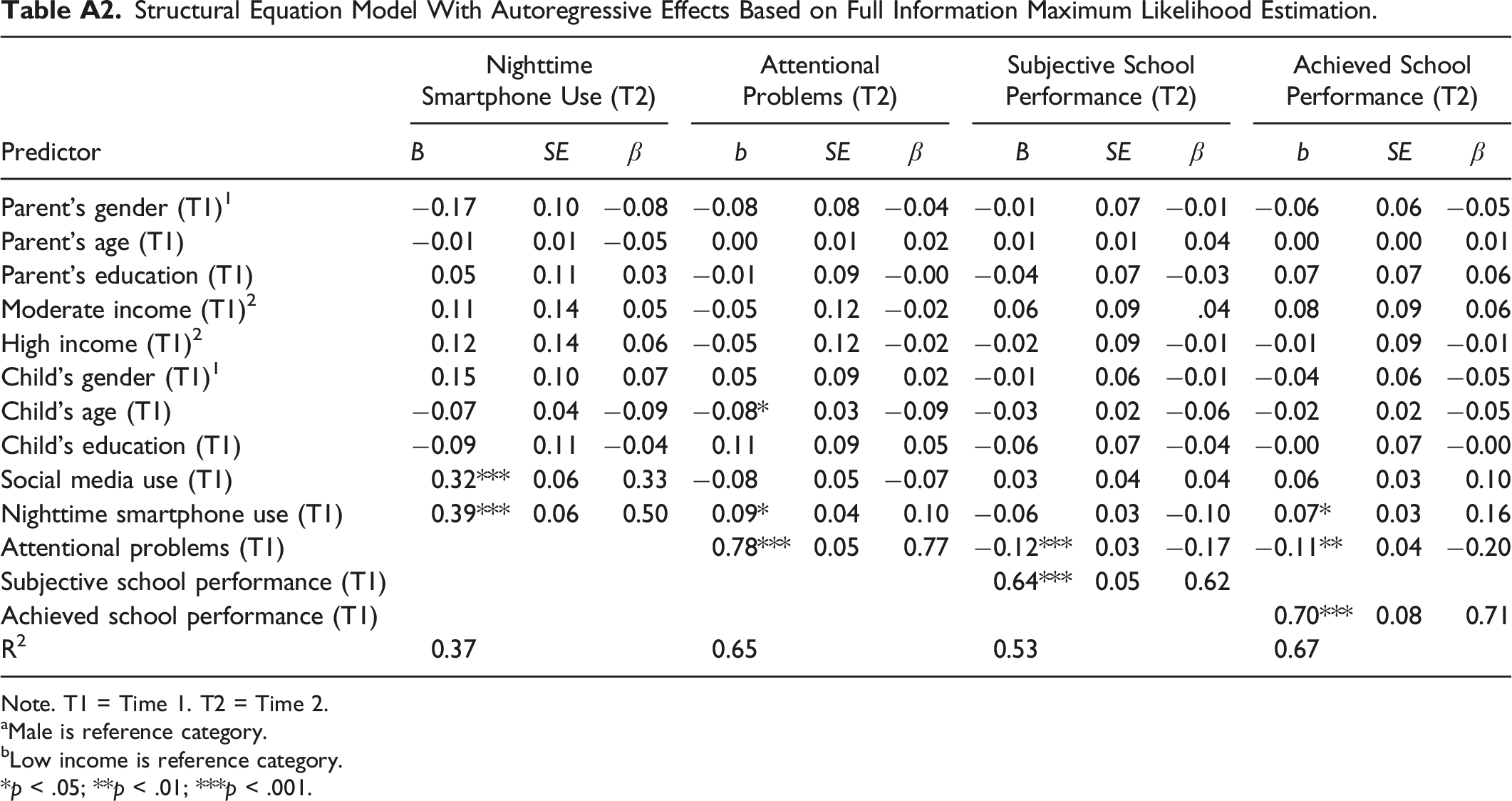
Predictor
Nighttime
Attentional
Subjective School Performance (T2)
Achieved School Performance (T2)
B
SE
β
b
SE
β
B
SE
β
b
SE
β
Parent’s gender (T1)1
−0.17
0.10
−0.08
−0.08
0.08
−0.04
−0.01
0.07
−0.01
−0.06
0.06
−0.05
Parent’s age (T1)
−0.01
0.01
−0.05
0.00
0.01
0.02
0.01
0.01
0.04
0.00
0.00
0.01
Parent’s education (T1)
0.05
0.11
0.03
−0.01
0.09
−0.00
−0.04
0.07
−0.03
0.07
0.07
0.06
Moderate income (T1)2
0.11
0.14
0.05
−0.05
0.12
−0.02
0.06
0.09
.04
0.08
0.09
0.06
High income (T1)2
0.12
0.14
0.06
−0.05
0.12
−0.02
−0.02
0.09
−0.01
−0.01
0.09
−0.01
Child’s gender (T1)1
0.15
0.10
0.07
0.05
0.09
0.02
−0.01
0.06
−0.01
−0.04
0.06
−0.05
Child’s age (T1)
−0.07
0.04
−0.09
−0.08*
0.03
−0.09
−0.03
0.02
−0.06
−0.02
0.02
−0.05
Child’s education (T1)
−0.09
0.11
−0.04
0.11
0.09
0.05
−0.06
0.07
−0.04
−0.00
0.07
−0.00
Social media use (T1)
0.32***
0.06
0.33
−0.08
0.05
−0.07
0.03
0.04
0.04
0.06
0.03
0.10
Nighttime smartphone use (T1)
0.39***
0.06
0.50
0.09*
0.04
0.10
−0.06
0.03
−0.10
0.07*
0.03
0.16
Attentional problems (T1)
0.78***
0.05
0.77
−0.12***
0.03
−0.17
−0.11**
0.04
−0.20
Subjective school performance (T1)
0.64***
0.05
0.62
Achieved school performance (T1)
0.70***
0.08
0.71
R2
0.37
0.65
0.53
0.67
Estimates represent unstandardized predictors. Rectangles represent manifest, ovals latent variables; Model Fit: CFI = 0.92; TLI = 0.90, χ2/df = 2.70, p < .001; RMSEA = 0.05, 90% CIs [0.04; 0.05]; non-hypothesized, non-significant relationships, covariances and error terms are omitted from the model due to clarity reasons. Error terms between Time 1 and Time 2 within the same construct were correlated.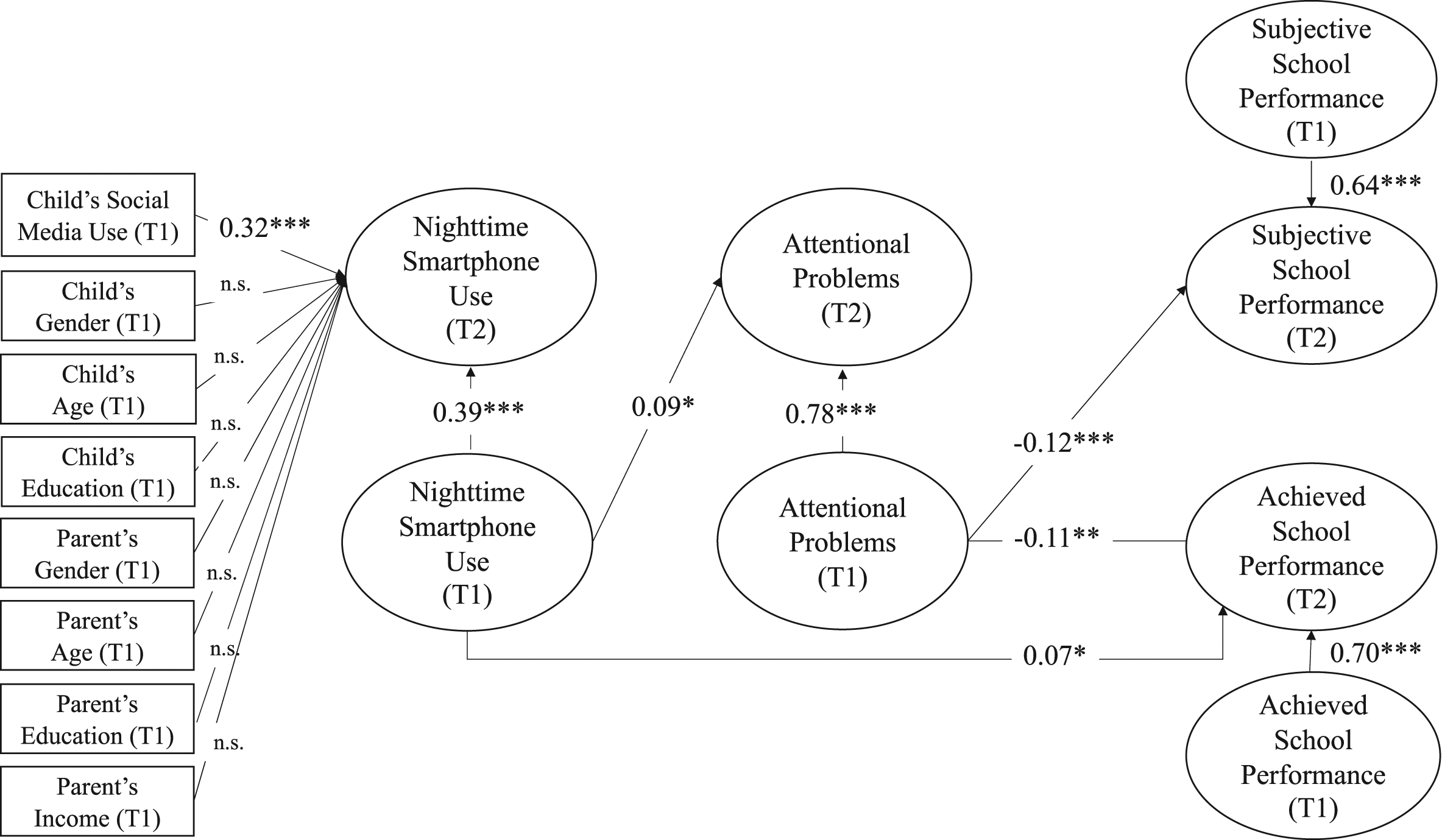
Author Biographies
References
Supplementary Material
Please find the following supplemental material available below.
For Open Access articles published under a Creative Commons License, all supplemental material carries the same license as the article it is associated with.
For non-Open Access articles published, all supplemental material carries a non-exclusive license, and permission requests for re-use of supplemental material or any part of supplemental material shall be sent directly to the copyright owner as specified in the copyright notice associated with the article.
