




Abstract
Social media addiction (SMA) is considered a risk factor for aggressive behaviors in adolescents, while its underlying mechanisms remains unclear. In this study, we investigated the possible mediating roles of nighttime social media use and sleep quality in the relationship between SMA and aggressive behaviors. A sample of 773 Italian secondary school students (49.9% female, age range = 11–15 years) completed a self-report questionnaire that included information on SMA, nighttime social media use, sleep quality, and aggressive behaviors. Results indicated that SMA was positively associated with aggressive behaviors. In addition, SMA was positively related to nighttime social media use and negatively related to sleep quality. Nighttime social media use was associated with a poorer sleep quality, which in turn associated with more aggressive behaviors. Analyses indicated that both nighttime social media use and sleep quality were mediators in the relationship between SMA and aggressive behaviors in adolescents.
Keywords
Introduction
Social media use is considered a normal behavior and part of an individual’s daily life especially among adolescents who use social media often (Marengo et al., 2018, 2021, 2022), while it can also become too frequent and cause addictive-like symptoms. Researchers and clinicians refer to this addictive-like social media use as social media addiction (SMA) or problematic social media use (D’Arienzo et al., 2019; Griffiths & Kuss, 2017).
To date, there is no broad consensus in the literature on the definition of addictive social media use. The term “addiction” and the potentially addictive nature of social media are controversial. Indeed, according to some authors, it is unclear what characteristics or activities make social media potentially addictive, and they believe that the term “addiction” may prematurely pathologize a normal human behavior (Carbonell & Panova, 2017; Lee et al., 2017; Montag et al., 2021). Although individuals with high levels of SMA have more social media use, the high frequency of social media use is not sufficient to define such behavior as problematic. Therefore, in this study, we will refer to SMA as excessive or problematic behavior when using social media: a behavior characterized by addictive symptoms and self-regulatory difficulties that lead to negative consequences for psychological functioning, interpersonal relationships, and some domains of daily life (Griffiths, 2013, Griffiths et al., 2014; Marino et al., 2018, 2020).
Based on the model of behavioral addiction proposed by Griffiths (2013) and Griffiths et al. (2014), SMA can be conceptualized using six core characteristics: tolerance, withdrawal, preoccupation, neglect of other activities, subjective loss of control, and persistent use despite signs of harm. It is estimated that 2.6–14% of adolescents are at risk of SMA (Bányai et al., 2017; Boer et al., 2020; Mérelle et al., 2017; Wartberg et al., 2020), and Italians tend to be among those reporting a higher risk than many other countries (Boer et al., 2020). Women (Bányai et al., 2017; Mérelle et al., 2017) and younger people (Wartberg et al., 2020) appear to have higher risk of SMA. In addition, research shows an association between SMA and increased psychological stress and more negative developmental outcomes in adolescents (Huang, 2020). Among previous studies, some authors have noted a possible link between SMA and aggressive behaviors in adolescents, which needs further investigation.
Social Media Addiction and Aggressive Behaviors in Adolescents
Aggression among adolescents is considered a social problem, particularly in the education and school systems (Longobardi et al., 2020, 2019), and it tends to associate with poorer developmental outcomes not only for victims (Fabris et al., 2021; Prino et al., 2019) but also for the perpetrators themselves (Estévez López et al., 2018). Several longitudinal studies (Gámex-Guadix et al., 2016) and cross-sectional studies (Agbaria, 2021; Brighi et al., 2019; Casas et al., 2013; Chu et al., 2021; Lim et al., 2015) suggest a relationship between excessive Internet use, including SMA (Kircaburun, 2016), and aggressive behaviors in adolescents and young adults. Notably, this relationship appears stronger among early adolescents (Ko et al., 2014). Adolescents with high levels of SMA may attempt to use social media as a coping mechanism for real-life problems and to gain a sense of social support, belonging, and connection to others (Badenes-Ribera et al., 2019; Longobardi et al., 2020). However, it is possible that the deficits in social skills often exhibited by adolescents with SMA may also recur in the online environment and negatively affect the quality of interactions online, which impacts their feelings of loneliness and psychological distress (Dredge & Schreurs, 2020). Furthermore, constant use of social media may increase the risk of victimization (Longobardi et al., 2020, 2021, 2022) and fuel feelings of frustration and envy through constant social comparisons (Radovic et al., 2017). In this sense, the online environment may increase psychological stress and frustration among adolescents and eventually contributes to an increased risk of aggressive behaviors.
In addition, increased hostility seems associated with increased SMA. It is possible that SMA causes the adolescent to isolate him/herself from the real world, which can lead to criticism from parents, friends, and teachers. This criticism can be internalized and feed hostility and negative feelings that can lead to aggressive behaviors. Along these lines, some research (e.g., Ko et al., 2014) shows that adolescents with Internet addiction tend to have lower frustration tolerance. According to frustration-aggression theory (Berkowitz, 1989), individuals who feel frustrated are more likely to resort to maladaptive behaviors, particularly aggressive behaviors. Overall, SMA may be associated with increased negative feelings, higher frustration, and lower psychological well-being, and thus may act as a risk factor for aggressive behaviors (Agbaria, 2021). In this vein, a longitudinal study (Fitzpatrick & Boers, 2021) found that media use, especially the exposure to the Internet and online games, could undermine the development of empathic and prosocial behaviors, probably due to reduced face-to-face interactions.
Although a growing body of work has addressed the relationship between SMA (and other Internet-related addictions) and aggressive behaviors in adolescents, little has been studied in terms of its underlying mechanisms (e.g., the mediating factors). Therefore, our study aims to explore the possible mediating roles of nighttime social media use and sleep quality in the relationship between SMA and aggressive behaviors in adolescents.
Social Media Addiction, Nighttime Social Media Use, and Sleep Quality
Adolescents with high levels of SMA tend to use social media and smartphones for extended periods of time (Kircaburun, 2016), which may affect their circadian rhythm and their sleep quality. In this study, we refer to the concept of sleep quality as a subjective measure of sleep satisfaction based on the presence of sleep disturbance. Previous studies suggest a link between excessive Internet use (Yang et al., 2020) or excessive media device use (Barlett et al., 2012) and a decline in sleep quality, while fewer studies have specifically examined social media use (Woods & Scott, 2016). This is a limitation considering that social media use is one of the main online activities among adolescents and that social media use, compared to other Internet-related activities, may have its specific characteristics and possibilly different underlying psychological mechanisms of effects on adolescents (Schemer et al., 2021; Yıldız Durak, 2020). Although SMA is a specific subtype of Internet addiction, it is possible that the motivations of social media use are different from the motivations that drive other potentially addictive online behaviors such as online gaming, shopping, or consuming pornographic material online. For example, some theorists (e.g., Caplan, 2006) suggest that adolescents and adults with poor social skills and difficulties in interacting with each other may prefer online communication to face-to-face communication. This preference, along with unmet relationship needs, may be a greater predictor of the development of SMA than other forms of Internet addiction. These characteristics and motivations make it interesting to study social media use separately, particularly problematic social media use, and its relationship with sleep quality. In fact, incoming notifications can directly disrupt sleep if activated during nighttime and they can also tempt one to constantly check social media because of the fear of missing something (Woods & Scott, 2016). Some studies with adolescent participants in different parts of the world suggest an association between excessive or problematic social media use and poor sleep quality (Alonzo et al., 2021; Charmaraman et al., 2021; Scott and Woods, 2018), however, we have very little information about the possible relationship between SMA and nighttime social media use and their potential impacts on sleep quality. In this direction, Woods and Scott (2016) found in a sample of adolescents that nighttime social media use was more likely to negatively affect adolescents’ sleep quality and psychological well-being compared to overall social media use. Exposure to screen media before bedtime can interfere the process of melatonin production and incoming notifications can interrupt sleep, which together explain the association between nighttime social media use and poor sleep quality (Woods & Scott, 2016). In addition, interactions on social media tend to increase arousal in adolescents affecting various aspects of sleep behavior and may thus decrease sleep quality (Lin et al., 2021). Some evidence suggests that adolescents may have difficulty disengaging from social media at night because they want to stay connected with others and do not want to be offensive or rude by not responding and, thus, continuing nighttime interactions on social media. They may fear consequences for their offline relationships, such as fear of being excluded or experiencing social disapproval if they withdraw from the online world (Scott et al., 2019, 2021). This is particularly relevant for adolescents with high levels of SMA, considering that problematic social media use may be a strategy to regulate mood, to compensate for the need to connect, and to reduce the fear of missing out (Fabris et al., 2021; Longobardi et al., 2020; Marengo et al., 2021). These difficulties of disengaging from social media among adolescents may increase their social media use at night in bed, which may further negatively impact their sleep quality (Scott et al., 2019, 2021). However, no study has specifically examined SMA and its relationship with adolescents’ nighttime social media use and sleep quality. We therefore hypothesize that adolescents with high levels of SMA are more likely to use social media at night, and that SMA via this route correlates with poorer sleep quality.
Poor Sleep Quality and Aggressive Behaviors
Sleep quality is an important element for socioemotional adjustments and positive academic outcomes in adolescents (Shimizu et al., 2020). Several studies suggest an association between poor sleep quality and aggressive behaviors in adolescents (Krizan & Herlache, 2016; Shimizu et al., 2020). Poor sleep quality could increase the risk for aggressive behaviors through three possible pathways (Krizan & Herlache, 2016; Shimizu et al., 2020): First, from an emotional perspective, poor sleep could cause emotional dysregulation and increase levels of anger and irritability. Second, from a cognitive perspective, a negative view of others and events could develop because of poor sleep. Third, from a behavioral perspective, the ability to control aggressive impulses and actions could decrease when having a poor sleep. In general, the literature appears to support a link between poor sleep quality and increased aggressive behaviors in adolescents. Considering that both poor sleep quality and aggressive behaviors are associated with more negative developmental outcomes and psychological distress in adolescents, it is important to investigate the possible association between sleep quality and aggressive behaviors and identify risk factors for them in order to develop better prevention/intervention strategies.
The Current Study
The aim of this study was to investigate the possible relationship between SMA and aggressive behaviors, as well as the underlying mechanisms (i.e., the possible mediating roles of nighttime social media use and sleep quality), in early adolescents. Specifically, we hypothesized that SMA directly predicted more aggressive behaviors in adolescents, and that SMA could positively and indirectly influence aggressive behaviors through more nighttime social media use and poor sleep quality. We further hypothesized that nighttime social media use might lead to higher levels of aggression behaviors through poor sleep quality. The study focuses on early adolescence, not only because this is the time when adolescents receive their first smartphone, but also because it is a critical developmental period when social media use is increasing and, more importantly, when aggression behaviors tend to peak.
Method
Participants
The participants were 773 secondary school students, including 386 females (49.9%). These students were from three different grades of secondary school: grade 6 (n = 273, 35.3%), grade 7 (n = 260, 33.6%), and grade 8 (n = 240, 31.0%). Monte Carlo power analysis for indirect effects was performed, and the result showed that with a sample size of 773, the power ranged from .91 to .99. They had a mean age of 12.34 (SD = .96) and were between 11 and 15 years old. Most of the students were Italian (n = 725, 93.8%), while the others were immigrants of different nationalities (e.g., Morocco, Albania, Romania, etc.). All participants could fully read and understand Italian. They owned their own smartphones.
Measurement
Addiction to Social Media
The Italian version (Monacis et al., 2017) of the Bergen Social Media Addiction Scale (BSMAS) (Andreassen et al., 2016) was used to measure participants’ SMA in the past year. The BSMAS was developed based on the six core elements of addiction: salience, mood change, tolerance, withdrawal, conflict, and relapse. There are six items (e.g., “hai sentito il bisogno di usare sempre di più i social media?” [Have you felt the need to use social media more and more?]) in the Italian version of the BSMAS (Monacis et al., 2017). Participants rated on a five-point scale (from 1 = Never to 5 = Very often). The sum of the ratings of all items was calculated as the final score (from 6 to 30), with a higher score reflecting a higher level of SMA. The internal consistency of the BSMAS was good in the present study: Cronbach’s alpha = .75.
Nighttime Social Media Use
Nighttime social media use was measured using the Nighttime Specific Social Media Use Scale (NSSMUS) (Woods & Scott, 2016). The NSSMUS consists of seven items that measure frequency of social media use before bed, perceived sleep delay due to social media use, etc. Examples of the items include “In the past month, how often have you used social media in bed?” (six-point scale, 0 = Never, 5 = Daily) and “How often are you awakened by social media notifications during sleep?” (seven-point scale, 0 = Never, 6 = More than once per night). Scores on all items were summed to produce the final score (ranging from 0 to 31), with a higher score reflecting greater nighttime social media use. Internal consistency of the NSSMUS was good in the present study: Cronbach’s alpha = .74. We ran the CFA in Mplus with BSMAS and NSSMUS and loaded all their items on one factor. The results showed that they did not measure the same factor (χ2/df = 10.78, RMSEA = .11, 95% CI for RMSEA: .105–.120, CFI = .76, SRMR = .08).
Sleep Quality
The adapted version of the Adolescent Sleep-Wake Scale (ASWS) (LeBourgeois et al., 2005) was used to measure students’ sleep quality. This adapted version of the ASWS contains 10 questions (e.g., “In the morning, I wake up and feel ready to get up for the day.”). Participants rated on a six-point scale (from 1 = Never to 6 = Always). The mean of all ratings was calculated as the final score (ranging from 1 to 6), with a higher score representing better sleep quality. The internal consistency of the ASWS was good in the present study: Cronbach’s alpha = .80.
Aggressive Behaviors
Aggressive behaviors were measured using a 36-item self-report instrument (Little et al., 2003). This instrument measured both overt aggression and relational aggression. Examples of the items include: “I often start fights to get what I want” (overt aggression) and “I often tell my friends to stop liking someone to get what I want” (relational aggression). All items were rated by students on a four-point scale (1 = Strongly disagree, 4 = Strongly agree). The sum of the scores of all items was calculated as the final score (ranging from 36 to 144), with a higher score reflecting a higher level of aggressive behaviors. In the present study, this instrument showed good internal consistency: Cronbach’s alpha = .91.
Procedure and Ethical Approval
Students were recruited using convenient sampling method. Trained research assistants visited the schools. Prior to data collection, all participants were required to complete an informed consent form. Parents of the students were also informed and could decline their children’s participation. Participants were told that they were invited to participate a survey about social media. Students had to complete the questionnaire in the classroom, which took about 20 minutes. During this time, they could ask the research assistants if they had any questions about the questionnaire. Participants were told that they could drop out at any time if they felt uncomfortable or offended by the questions. Anonymity was assured and data was used for research purposes only. The Institutional Review Board of the college to which the authors belong approved this procedure (n. 215970). The ethical regulations of the Italian Society of Psychology were strictly followed.
Data Analysis
Data analysis was performed in SPSS 26 (IBM, Armonk, NY, USA). First, descriptive and correlative analyses were performed. Then, the PROCESS macro (Model 6, Hayes, 2017) for SPSS was used to examine the mediating role of nighttime social media use and sleep quality in the relationship between SMA and aggressive behaviors. Finally, to further confirm the possible mediating pathways and assess the indirect effects, a bootstrapping procedure was used. The bootstrapping sample size was 5,000, drawn from the original sample by sampling with replacement. This procedure is commonly used to construct the confidence interval (CI) for indirect effects and no assumptions are made about the shape of the sampling distribution (Hayes, 2017). The indirect effect is considered non-significant if the value zero is included in the 95% CI.
Results
Correlations and Descriptive Statistics
Means, Standard Deviations, and Correlations of the Variables (N = 773).
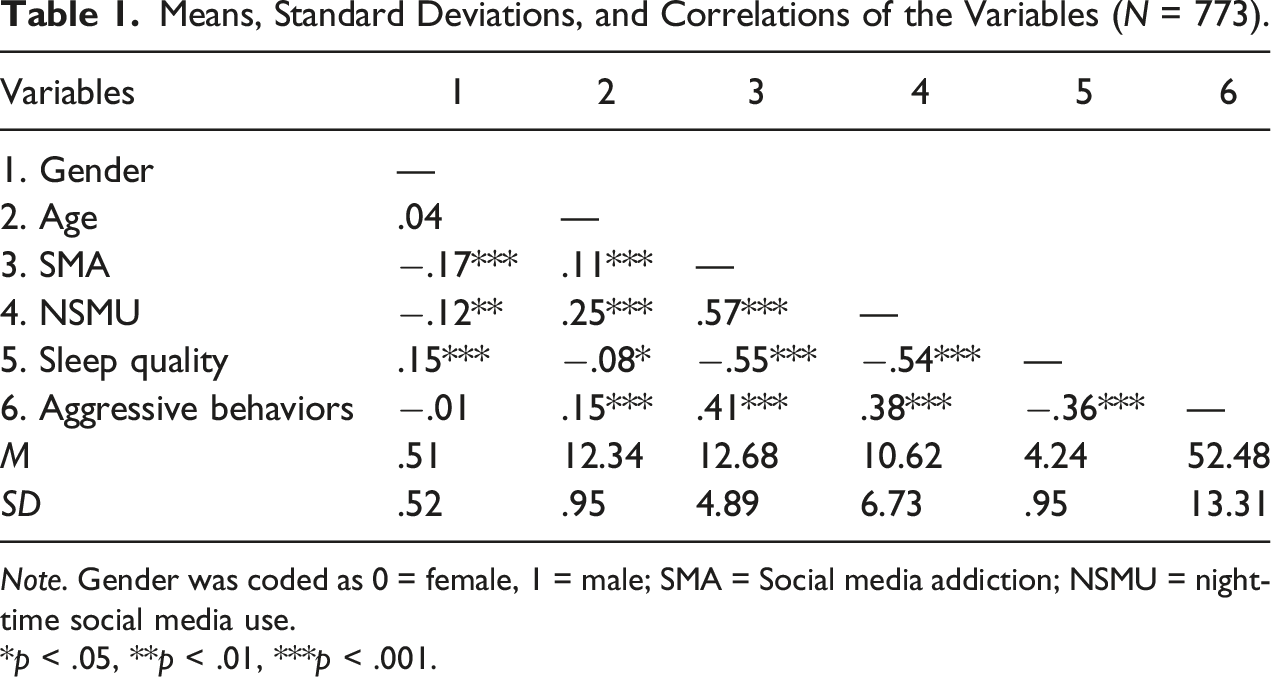
Note. Gender was coded as 0 = female, 1 = male; SMA = Social media addiction; NSMU = night-time social media use.
*p < .05, **p < .01, ***p < .001.
Testing the Mediated Associations
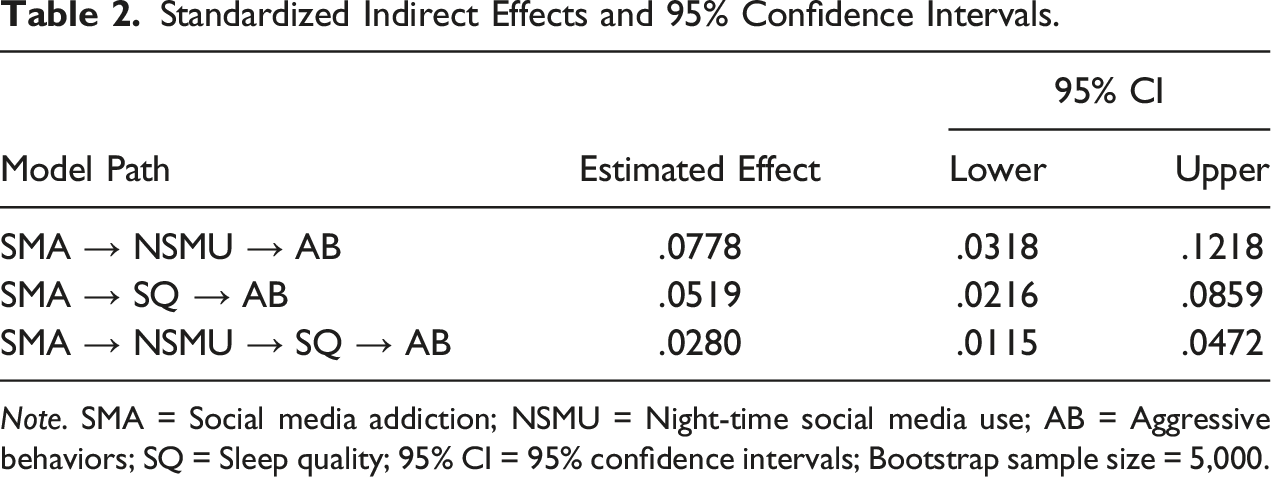
The hypothetical mediation model was investigated using PROCESS macro (Model 6). As shown in Figure 1 and Table 2, all indirect effects of the hypothesized model were significant. In particular, social media addiction was positively related to nighttime social media use (β = .54, p < .001), which in turn was positively correlated with aggressive behaviors (β = .14, p < .001). The indirect effect of nighttime social media use between SMA and aggressive behaviors was significant (estimated effect = .078, 95% CI = [.032, .122]), suggesting that nighttime social media use was a significant mediator. In addition, sleep quality was negatively predicted by SMA (β = −.35, p < .001), and aggressive behaviors was negatively predicted by sleep quality (β = −.15, p < .001). The indirect effect of SMA on aggressive behaviors through lower sleep quality was significant (estimated effect = .052, 95% CI = [022, .086]), demonstrating the significant mediating role of sleep quality. Finally, nighttime social media use also negatively predicted sleep quality (β = −.35, p < .001). This suggests that the chain mediation effect of nighttime social media use and sleep quality in the relationship between SMA and aggressive behaviors was also significant (estimated effect = .028, 95% CI = [.012, .047]). The residential direct effect remained significant even after controlling for mediating variables (β = .25, p < .001). The mediation model.Note. Student’s gender and age were included as controlled variables but they not illustrated in the figure to make the picture concise, and there is no significant difference between the models with or without these controlled variables. All the regression coeffients are standardized. ***p < .001. Standardized Indirect Effects and 95% Confidence Intervals. Note. SMA = Social media addiction; NSMU = Night-time social media use; AB = Aggressive behaviors; SQ = Sleep quality; 95% CI = 95% confidence intervals; Bootstrap sample size = 5,000.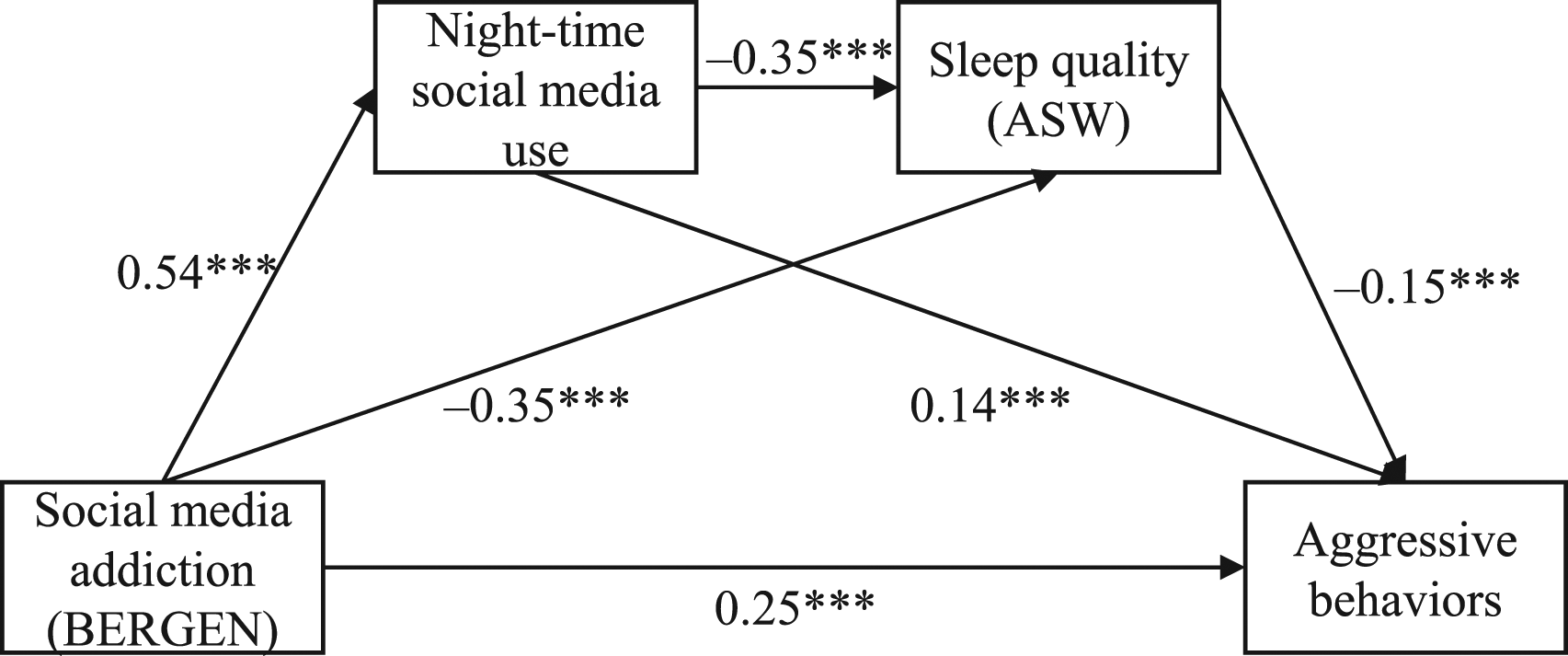
Discussion
The aims of the present study were to extend current knowledge on the possible association between SMA and aggressive behaviors in early adolescence and to explore the possible mediating roles of nighttime social media use and poor sleep quality. Our results showed that SMA was positively associated with aggressive behaviors in adolescents. This appears consistent with previous literature showing that problematic use of social media (Kirkaburun et al., 2019) and Internet addiction in general (Agbaria, 2021; Brighi et al., 2019; Casas et al., 2013; Chu et al., 2021; Gámex-Guadix et al., 2016) are associated with aggressive behaviors in adolescents.
Previous studies mainly focused on the general problematic Internet use, while less research conducted specifically on social media use. This is a limitation considering that social media is prevalent during adolescence and young adolescents are becoming increasingly autonomous in their use of technology to interact with others. Moreover, social media have different characteristics and the underlying psychological motivations for adolescents to use it may also differ compared to other online activities. Although there is evidence of an association between aggression and SMA or other Internet-related addictions, little research has been conducted on the possible mediating factors involved. In this vein, our research highlighted the possible roles of nighttime social media use and poor sleep quality in mediating the relationship between SMA and aggressive behaviors among early adolescents.
Our results suggest that adolescents at risk for SMA tend to use more social media at night which further appears to be associated with decreased sleep quality. SMA adolescents tend to use the Internet and social media more than others, and it is possible that this behavior increases during free time, such as at night before bedtime. Consistent with this, we found a positive relationship between SMA and nighttime social media use that had not been previously established. Some evidence suggests that adolescents have difficulties in disengaging from social media at night because of the fear of missing out on new content online and also because of the fear of being rejected in real-life contexts if they are seen as unavailable or unfriendly in online communication (Scott & Woods, 2018). These difficulties might be particularly pronounced for SMA at-risk adolescents, considering that a higher need to belong and a greater fear of missing out appear to characterize these adolescents (Fabris et al., 2021; Marengo et al., 2021). Therefore, the SMA at-risk adolescents may use more social networks during the night, resulting in lower sleep quality. Our findings are consistent with previous literature showing a negative relationship between SMA and sleep quality (Alonzo et al., 2021; Charmaraman et al., 2021; Lin et al., 2021; Scott and Woods, 2018).
Our results also show that increased nighttime social media use is associated with lower sleep quality, which in turn is further associated with increased risk for aggressive behaviors. Sleep quality is a possible mediating factor between SMA and aggressive behaviors. Adolescents with high levels of SMA tend to report poorer sleep quality, which in turn is negatively associated with aggressive behaviors. Several studies have indicated that poor sleep quality is associated with increased risk of aggressive behaviors and externalizing disorders in children and adolescents (Krizan & Herlache, 2016; Shimizu et al., 2020). Thus, our findings are in line with previous literature. Low sleep quality could predict higher level of aggressive behaviors in several ways (Krizan & Herlache, 2016). For example, poor sleep quality could promote feelings of frustration, anger, and hostility, a tendency to negatively evaluate others and events, lower emotional regulation, and higher impulsivity. These feelings may further lead to an increased risk for aggressive behaviors in both online and offline settings.
Limitations and Future Directions
The results of this study must be interpreted with carefulness since there are several limitations. First, our sample is a convenience sample recruited from northern Italy. This undermines the generalizability of the results to the early adolescents from other areas in Italy or to adolescents from other cultures. Future studies should recruit representative samples from the Italian population in different areas or even from the population in other countries to further validate/replicate our model to explore the influence of possible cultural factors. Second, it should be noted that the sleep quality in this study was measured by self-report scale as the subjective perceptions for the past month. On one hand, objective and subjective sleep measures may reflect different chiaracteristics of sleep and different aspects of the sleep experience (Gregory & Sadeh, 2012) and that these differences may impact the final model of the variables studied in this research. Future studies could supplement self-report instruments with objective measures of sleep duration and sleep quality, such as actigraphy and polysomnography. On the other hand, measuring the subjective-recall general sleep quality in the past month may only reflect the general or mid/long-term relationships of the studied variables. These relationships identified in the current research should be further explored in future studies using measurement methods with smaller time intervals (e.g., daily diary) to investigate their short-term/immediate associations. Third, our study is a cross-sectional study. Cross-sectional mediation designs are biased to establish temporal order among variables (Maxwell & Cole, 2007). Therefore, we cannot draw conclusions about the causal relationships between the studied constructs. Longitudinal/experimental studies are needed to clarify this aspect. Fourth, only self-report instruments were used in the study, which is a limitation given the effects of social desirability, memory, and text comprehension. Multi-informants and other quantitative/qualitative assessment techniques could be incorporated into future research designs. Finally, this study only focused on the relationship between SMA and general aggressive behaviors, and its mediating mechanisms. Future studies could explore the associations between specific social media platforms most commonly used by adolescents and different subtypes of aggressive behaviors, as well as the potential individual differences in these relationships.
Practical Implications
Our study has several potential practical implications. From a psychological assessment perspective, it is important to examine the social media use and sleep quality in adolescents with aggressive behaviors, particularly whether excessive and problematic use is present and to what extent social media is used at night. In addition, among adolescents with problems related to SMA or poor sleep quality, it may be important for us to examine their social behaviors and pay attention to their aggressive behaviors. Finally, education about social media use and sleep hygiene may be added to peer aggression prevention/intervention programs. It may help reduce adolescents’ aggressive behaviors and eventually improve adolescents’ psychological well-being to inform and educate adolescents, parents, and educators about the relationship between social media use, sleep hygiene, and aggressive behaviors.
Conclusion
In conclusion, adolescents at risk for SMA tend to use social media more frequently at night and thus having poorer sleep quality, which may further increase their likelihood of aggressive behaviors. This research contributes to our understanding of the possible association between SMA and aggressive behaviors in young adolescents by identifying nighttime social media use and sleep quality as possible mediators.
Footnotes
Declaration of conflicting interests
The author(s) declared no potential conflicts of interest with respect to the research, authorship, and/or publication of this article.
Funding
The author(s) received no financial support for the research, authorship, and/or publication of this article.
