



Abstract
This study explored an individual variation in perceived social support from teachers, peers, and guardians and their association with experienced study engagement and study burnout. Two cohorts of students participated in the study: fourth graders from primary school (age 10, n = 2401) and seventh graders from lower secondary school (age 13, n = 1529) in Finland. The analysis was conducted using latent profile analysis. Several equivalent profiles with different configurations of perceived social support from three sources were identified in both age groups. The profiles differed from each other in terms of study engagement and study burnout. Moreover, social support from different sources had somewhat different functions on students’ study wellbeing, although teacher and peer support seemed to play particularly central roles.
It is well-known that social support has beneficial effects not only for school achievement but also for promoting students’ study wellbeing at school (e.g., Liu et al., 2016; Salmela-Aro & Upadyaya, 2014; Wang & Eccles, 2012). For example, students who perceive that social support is available when needed are most likely to perceive schoolwork as meaningful and experience joy of learning (Furrer & Skinner, 2003; Ulmanen et al., 2016a; Wentzel et al., 2017). Conversely, students with a sense of lack of social support are at risk of disengaging from studying and suffering study burnout symptoms (Salmela-Aro et al., 2008; Skinner et al., 2008; Virtanen et al., 2018).
Teachers, guardians, and peers typically provide the primary sources of support for promoting students’ positive school experiences (Estell & Perdue, 2013; Kiefer et al., 2015; Wentzel, 1998; Wentzel et al., 2016). However, the nature of different sources of support ranges according to their dynamics and tasks (Hombrados-Mendieta et al., 2012; Tardy, 1985). As an example, being providers of practical assistance and emotional needs, guardians offer core support for the overall development of students, also influencing students’ emotions and attitudes towards studying (Raudino et al., 2013; Ruhl et al., 2015). Teachers, on the other hand, represent an institutional role providing the frameworks and contents for the study as well as shaping the learning atmosphere at school (Lickona, 1997; Stornes et al., 2008). Last, shared social support among peers is more reciprocal and plays a significant role especially in terms of socialization among students (Brown & Larson, 2009; Ulmanen et al., 2014). Due to the varied roles associated with teachers, peers, and guardians, it is worth asking whether students’ experience of school-related social support varies depending on the source of support and, moreover, whether one source of support compensates for the lack of support experience from other sources in terms of students’ study wellbeing.
In past studies social support from different sources has been considered mostly separately. This means that studies have examined the isolated role of teachers, peers, and guardians in students’ study wellbeing, but understanding of the simultaneous impact and internal dynamics of various sources of support has not been obtained. Studies examining students’ experience of different sources of social support simultaneously are very rare (see Ciarrochi et al., 2017; Furrer & Skinner, 2003; Scholte et al., 2001). In this study, we used latent profile analysis (LPA) to identify different social support profiles of students based on students’ perceived social support from teachers, guardians, and peers. Moreover, we examined the common and compensatory effects of different sources of social support on students’ perceived study engagement and study burnout. In order to understand the importance of different sources of support at different developmental phases and at different stages of the school path, we conducted the study separately among Finnish primary and lower secondary school students. We examined whether similar structures of social support profiles occur at different stages of the school path. Fourth (age 10, n = 2401) and seventh grade students (age 13, n = 1545) in Finnish comprehensive schools participated in the study.
School-Related Social Support
School-related social support refers to the social resources perceived to be available and used by students (Cohen et al., 2000), which contributes to the individuals’ study wellbeing and buffers against potential negative individual or environmental factors (Cohen & Syme, 1985). The importance of social resources is also emphasized in self-determination theory, whereby social support is a key factor in the realization of an individual’s basic psychological needs and in promoting the experience of wellbeing (Ryan & Deci, 2000; Wentzel et al., 2016). For example, a supportive and caring social context promotes students’ sense of belonging, which in turn facilities students’ study engagement (Eccles et al., 1993; Eccles & Roeser, 2011).
In earlier studies, social support has been typically structured as a multidimensional structure that includes several forms of social support. In particular, emotional and informational support are essential factors contributing to students’ study wellbeing (Liu et al., 2016; Ulmanen et al., 2016a; Wentzel et al., 2017). Caring, trust, encouragement and treating others respectively and fairly characterize emotional support, while advice, feedback, affirmation, and problem-solving characterize informational support (e.g., House, 1981; Malecki & Demaray 2002).
The research on peer support shows that peers are an important resource for students’ study wellbeing (Estell & Perdue, 2013; Jiang et al., 2013; Juvonen et al., 2000; Kiefer et al., 2015; Liu et al., 2016; Urdan & Schoenfelder, 2006; Wentzel et al., 2016). Emotional and informational support shared among peers facilitates students valuing of schoolwork and triggers positive emotions while studying (Ulmanen et al., 2016a; Wang & Eccles, 2012). Moreover, there is tentative evidence suggesting that peer support is necessary for students’ experience of the joy of learning (Furrer & Skinner, 2003; Ulmanen et al., 2016a), while a lack of peer support can have a destructive long-term effect on student wellbeing (Juvonen et al., 2000; Rubin et al., 2015). However, if the focus of the shared support among peers is in contradiction with academic goals set by the school, perceived support may facilitate students’ sense of belonging, but disengages from studying (e.g., Ryan et al., 2001; Ulmanen et al., 2016a; Wang & Eccles, 2012). For example, to fulfill their need for a sense of belonging among peers, students may support and encourage each other in disruptive behavior as well as in maintaining negative attitudes toward schoolwork (Ulmanen et al., 2014, 2016a). Accordingly, via shared support among peers, students not only attempt to seek support for schoolwork but also aim to meet their fundamental need for a sense of belonging among peers. Therefore, it is essential to understand how to reinforce peer interaction that simultaneously targets learning activities and contributes to students’ sense of belonging.
Studies of the importance of teacher support for students’ adjustment to school are consistent throughout the school path. Students’ experiences of a caring and supportive teacher has been found to enhance students’ positive attitudes toward and perceived meaningfulness of schoolwork (e.g., Liu et al., 2016; Wang & Eccles, 2012; Wentzel et al., 2017) and to protect against study burnout (Salmela-Aro et al., 2008). In turn, informational support, such as advice, feedback, affirmation, and problem-solving, have been found to enable students to cope with study-related challenges and further facilitate engagement (e.g., Liu et al., 2016; Wang & Eccles, 2012; Wentzel et al., 2017).
Furthermore, by providing the primary environment for students to grow and develop, guardians are considered one of the main sources of social support for students’ during childhood and adolescence (Cheung & Sim, 2017; Hombrados-Mendieta et al., 2012; Ruhl et al., 2015). Guardian support, such as encouragement, help, and assistance with studies, is an important factor in promoting students’ school adjustment and study wellbeing (Liu et al., 2016; Wang & Eccles, 2012). Students supported by adults at home have been found to show, for example, more positive attitudes towards schoolwork (Rice et al., 2013) and motivation in studying (Furrer & Skinner, 2003; Wentzel, 1998). Moreover, it has been found that guardian support buffers against mental health problems such as a depression and school-related stress (Colarossi & Eccles, 2003; Rueger et al., 2014)
Besides their direct influence, teacher and guardian support also have indirect effects on students’ wellbeing via peer support (Kiuru et al., 2015; O’Connor, 2010; Rautanen et al., 2020; Ulmanen et al., 2016b). It has been found that students who feel that they are cared for and valued by teachers and guardians are more willing and skillful to provide help and assistance to others (Luckner & Pianta, 2011; Newton et al., 2014) as well as to seek help if needed (Du et al., 2016; Rautanen et al., 2020; Ryan et al., 2001; Ryan & Patrick, 2001). In addition, by organizing pedagogical practice, teachers provide and regulate opportunities for appropriate peer support in the classroom (Farmer et al., 2011; Luckner & Pianta, 2011; Ryan & Shim, 2012). Accordingly, supportive relationships with teachers, guardians, and peers typically accumulate and reciprocally strengthen each other (e.g., Kiuru et al., 2015).
However, there are also mixed findings regarding the accumulation of social support from different sources. Particularly in adolescence, relationships with adults and peers can diverge in such a way that some students have good relationships with their peers but not with their parents or teachers, while others have good relations with adults but not with their peers (Ciarrochi et al., 2017; Scholte et al., 2001; Furrer & Skinner, 2003). For example, in their study of students aged 14 and 18, Ciarrochi et al. (2017) found students, who perceive that they receive very high level of social support from peers, but only low levels of support from their parents and teachers. Respectively, Furrer and Skinner (2003) found in their study various combinations of accumulations of social support from different sources. A perceived contradiction between the different support sources may be explained by the fact that students’ need for support is better met in relationships with their peers in their current lives than with adults, or vice versa (see Ryan & Deci, 2000). However, more research is needed to understand whether divergences occur in different phases of the school path and their effects on students’ study wellbeing.
In addition to that the role and nature of school-related social support vary depending on the sources of support, the role of various sources of support might also differ in the different developmental phases on the students’ school path. Research has shown that early adolescence forms an important developmental period in students’ lives and shapes students’ relationships with significant others. For example, peers become increasingly important for students in adolescence (Rubin et al., 2015) when time spent with peers increases (Larson, Richards, Moneta, Holmbeck, & Ducktett, 1996) and closeness and intimacy of peer relationships are enhanced (Furman & Buhrmester, 1992). Yet adults can still form influential referents. While in some studies the effect of guardian support on students’ positive outcomes has been found to decrease (Larson & Richards, 1991; Steinberg & Silverberg, 1986) and the role of adults outside the home to increase during the students’ school path (Murray, 2009; Roeser et al., 1999), in other studies guardians have been shown to be a very important source of support throughout the adolescent years (Smetana et al., 2006; Wang & Eccles, 2012). Furthermore, even though in some studies students’ relationships with teachers have been found to become more distant as students age (Bierman, 2011; Jerome et al., 2009), teachers have been found to have a significant effect on students throughout the student’s school path. However, it is unclear whether some sources of support compensate for a lack of support from other sources, and whether the effects are similar in the different developmental phases. This study involves two groups of students of different ages, students who are entering adolescence and students in adolescence, and examines common and possible compensatory effects of students’ perceived social support from different sources on students’ study wellbeing (i.e., study engagement and study burnout).
Study Engagement and Study Burnout as Indicators of Students’ Study Wellbeing
In this study, we examine students’ study wellbeing using the concepts of study engagement and study burnout. Study engagement and study burnout depict both positive and negative aspects of study wellbeing at school. They are central indicators of students’ affective orientation toward studying (Salmela-Aro & Read, 2017) also promoting students’ psychological and social wellbeing in other areas of life (Li & Lerner, 2011; Salmela-Aro & Upadaya, 2012; Tuominen-Soini & Salmela-Aro, 2014). Study engagement refers to positive and fulfilling study-related experiences, including the components of energy, dedication, and absorption in studies (Salmela-Aro & Upadaya, 2012). Energy refers to high mental resilience and a willingness to invest effort while studying. Dedication is characterized by a sense of enthusiasm, pride, and inspiration regarding studies and finding schoolwork meaningful. Absorption is characterized by feelings of competence and being fully concentrated and happily engrossed in studying so that time passes quickly. The dimensions of study engagement correlate highly with each other and emphasize the students’ affective reactions while studying (Salmela-Aro & Upadaya, 2012). Study burnout is defined as a school-related disorder comprising three dimensions: exhaustion, cynicism toward school, and a sense of inadequacy (Salmela-Aro et al., 2009; Schaufeli & Bakker, 2004). Cynicism refers to an indifferent or distal attitude toward schoolwork in general. It is characterized by a loss of interest in schoolwork and not seeing school as meaningful. Inadequacy refers to the student’s diminished sense of competence in terms of studying at school. Exhaustion refers to a state of strain and chronic fatigue. Previous research suggests that both exhaustion due to school demands and cynicism toward school predict a sense of inadequacy as a student (Salmela-Aro & Upadyaya, 2014).
Previous studies suggest that study engagement and study burnout, as different aspects of study wellbeing, are not mutually exclusive but may occur simultaneously (Salmela-Aro & Read, 2017; Schaufeli & Bakker, 2004). In general, it has been found that a high level of study engagement is associated with a relatively low level of study burnout. However, some students who perceive schoolwork as meaningful have also been found to report more concerns about their academic success (Tuominen-Soini & Salmela-Aro, 2014). Thus, it appears that some engaged students thrive on challenges, while others become exhausted. In order to fully understand the dynamics of students’ study wellbeing, it is important to simultaneously consider both its positive and negative aspects (Salmela-Aro & Read, 2017).
Individual Differences and Developmental Change in Social Support and Study Wellbeing
The research concerning the development of students’ social support experiences consistently suggest that students perceive social support to decrease across their school years (Bokhorst et al., 2010; Eccles et al., 1993; Malecki & Demaray, 2002; Weyns et al., 2018; Özdemir & Özdemir, 2020). In addition, the research concerning the development of students’ study engagement and study burnout suggests that students’ study wellbeing decreases across the school years (e.g., Liu et al., 2016; Salmela-Aro & Tynkkynen, 2012; Wang & Eccles, 2012). While study engagement seems to decrease (e.g., Janosz et al., 2008), study burnout symptoms seem to increase during adolescence (Salmela-Aro & Tynkkynen, 2012). However, studies adopting a person-centered approach suggest that perceived social support and study wellbeing do not necessarily decrease similarly among all students, but students follow individual developmental trends. It has been found that most students experience a stable and relatively high level of perceived social support, while others experience a relatively low or decreasing level of social support throughout the school years (e.g., Ciarrochi et al., 2017; Scholte et al., 2001). Respectively, several stable and decreasing trajectories of study wellbeing have been identified (Janosz et al., 2008; Li & Lerner, 2011; Tuominen-Soini & Salmela-Aro, 2014). It seems that students in decreasing trajectories of study wellbeing are particularly at risk for dropout. In contrast, belonging to a stable group seems to promote success in future studies (De Wit et al., 2011; Janosz et al., 2008; Li & Lerner, 2011).
Studies of gender differences suggest that girls are typically better adjusted to the school environment (Liu et al., 2016; Wang & Eccles, 2012). Compared to boys, girls are more likely to perceive higher levels of peer support and further to utilize peers as a resource for schoolwork (Ciarrochi et al., 2017; Rautanen et al., 2020). However, differences between girls and boys in perceived support from teachers and guardians are not reported as often (De Wit et al., 2011; Bokhorst, et al., 2010). Further, boys are more prone to experience rapid decreases in engagement and undergo unstable and decreasing engagement trajectories (Janosz et al., 2008; Li & Lerner, 2011), which also make them more vulnerable to dropping out of school. However, even if girls typically report higher levels of study engagement than boys (Lam et al., 2012; Salmela-Aro & Upadaya, 2012; Virtanen et al., 2018), they also report more concerns about their academic success. Girls are more likely to report higher levels of study burnout (Kiuru et al., 2008; Salmela-Aro et al., 2008, 2009), particularly in terms of experiencing exhaustion and inadequacy (Salmela-Aro & Tynkkynen, 2012), while boys experience more cynicism toward school attendance (Bask & Salmela-Aro, 2013). In addition, it has been found that students with low socioeconomic status (SES) are at risk of being socially isolated among peers (Ciarrochi et al., 2002) and receiving less support from teachers (Ladd et al., 1999).
Changes in students’ study wellbeing during adolescence have been shown to be related to changes in the social context that students experience during their school years, especially in school transitions. It has been argued that a larger diversity of subject teachers and peer groups in different subjects in the context of lower secondary school may be a challenge for some students in experiencing social support and further in study wellbeing (e.g., Eccles & Roeser, 2011; Jang et al., 2010; Nelemans et al., 2018). While some students are able to seek and maintain social support and study wellbeing also in a more complex social environment, others struggle more in adjusting to the new social environment. However, studies investigating both social support and study wellbeing in relation to study engagement and study burnout are rare. In the present study, we identified profiles that describe different combinations of perceived social support from different sources among primary and lower secondary school students in order to better understand the individual and contextual differences in perceived social support, study engagement and study burnout.
Aim of the Study
The first aim of the study was to explore the individual variation in the accumulation of perceived school-related social support from different sources separately among primary (4th grade) and lower secondary (7th grade) school students. Based on previous research, we expected social support from different sources to vary between students, and various student profiles in terms of teacher, peer, and guardian social support to be detected among primary and lower secondary school students (Ciarrochi et al., 2017; Furrer & Skinner, 2003) (Hypothesis 1a). In addition, we examined whether social support profiles of similar structure can be found in both age cohorts. Given that social support has been found to be a quite stable construct, albeit declining, we hypothesized that social support profiles of similar structure will be identified among primary and lower secondary school students (Ciarrochi et al., 2017; Weyns, et al., 2018; Özdemir & Özdemir, 2020) (Hypothesis 1b). The second aim of the study was to examine whether social support profiles are associated with perceived study engagement and study burnout. We hypothesized that students in profiles with more support will generally experience more study engagement and less study burnout than those with less support (Ciarrochi et al., 2017; Estell & Perdue, 2013; Furrer & Skinner, 2003; Kiefer et al., 2015; Salmela-Aro et al., 2008; Skinner et al., 2008; Virtanen et al., 2018) (Hypothesis 2a). In addition, we examined whether school-related social support from one source compensates the lack of support from one or two other sources in terms of perceived study engagement and study burnout. Based on previous studies on the importance of each source of support on students’ experience of study engagement and study burnout, it was assumed that social support from one or two sources is not enough to guarantee a complete school experience (see Vollet, 2017) (Hypothesis 2b). However, due to the research gap regarding the simultaneous effects of different sources of support, we cannot make concrete hypotheses about the priority of different sources of support in terms of study engagement and study burnout. Finally, we examined to what extent students’ gender and SES predict their likelihood of membership of the various social support profiles. Given that girls typically adjusted to school better than boys, it was assumed that girls are more likely to belong to socially rich profiles compared with boys in both age cohorts (Lam et al., 2012; Liu et al., 2016; Rautanen et al., 2020; Wang & Eccles, 2012) (Hypothesis 3a). Furthermore, it was assumed that students from a high SES area are more likely to belong to socially rich profiles compared with students from a low SES area in both age cohorts (Ciarrochi et al., 2002, 2017) (Hypothesis 3b).
Method
Context and Participants
Distribution of the Schools and Students by Grade and Gender in Different SES areas.
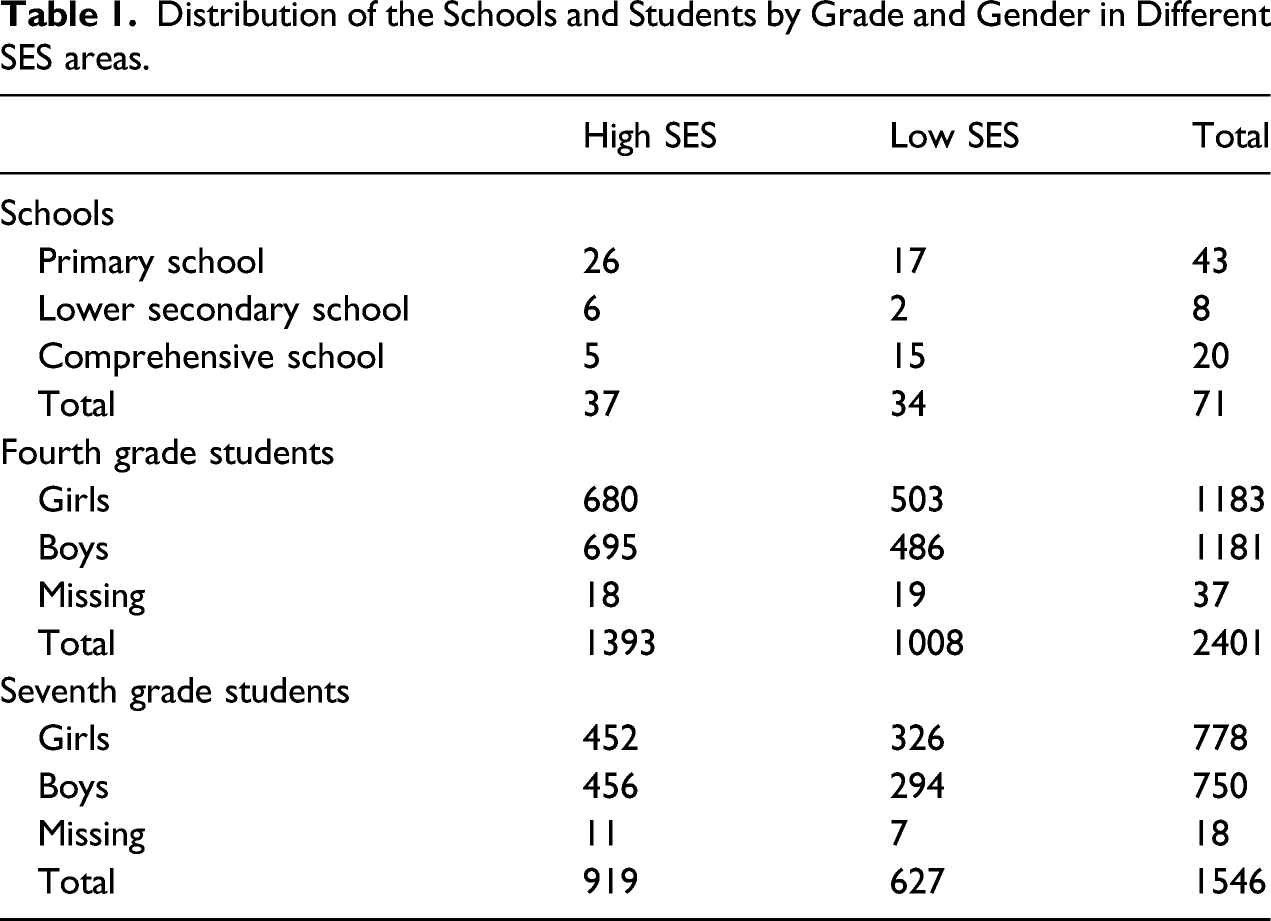
In Finland, comprehensive school is 9-year compulsory general schooling for all children aged 7–16. It comprises a primary school level (grades 1–6) and a lower secondary school level (grades 7–9). Some schools include only grades 1–6 or grades 7–9, while other schools include all grades from 1 to 9. Regardless of the school structure, students at the primary level have a class teacher who teaches most subjects and stays with the same class for several years. At the lower secondary level, a subject teacher system is applied, bringing an increase in the numbers of teachers and the diversity of peer relations.
The researchers collected the data in the schools during the students’ school day. They introduced the students to the study, instructed them to fill in the questionnaire, and collected the written questionnaires from the students. Before conducting the study, parents gave their informed consent for their children to participate in the study. The students were informed that participating in the research was voluntary, that it was not a school assignment, and that their teachers or parents would not see any individual student’s answers. The total response rate was 90% in the primary school cohort and 89% in the lower secondary school cohort.
Instrument
In this study, social support for schoolwork was examined by assessing social support from teachers and guardians and among peers (see Rautanen et al., 2020). The Social support from teachers scale assessed emotional support (i.e., respect, empathy, and care) as well as problem-focused informational support from teachers that helps in achieving learning goals (α = .94 in Grade 4 and α = .95 in Grade 7; 11 items, e.g., “My teachers give me encouragement and support,” “I often receive constructive feedback from teachers,” “The teachers are interested in my opinions”). The Social support among peers scale measured emotional and informational support that specifically targets learning activities. It comprised items concerning both giving and receiving social support for schoolwork, as well as items that describe the available support and enacted support (α = .92 in Grade 4 and α = .93 in Grade 7; 10 items, e.g., “I have the courage to offer my friends help with their studies,” “I have the courage to ask others for help with my studies,” “My classmates' encouragement inspires me in my studies”). Finally, the Social support from guardians scale assessed guardians’ emotional and informational social support for schoolwork (α = .83 in Grade 4 and α = .85 in Grade 7; 7 items, e.g., How often has an adult at home… “wanted to see what kind of homework you have,” “asked if you need help with your homework or in preparing for an exam,” “told you that school is important”) (see Lukin, 2013). Guardians are understood in this study as any adult at a student’s home including their parents. Students rated peer and teacher support using a 7-point Likert-type scale ranging from 1 (Not true at all) to 7 (Very true). Guardian support was rated using a 5-point Likert type scale ranging from 1 (Never) to 5 (Very often). In order to compare all raw mean values, guardian support was converted from a five-point scale to a seven-point scale with the same lower and upper limits (1=1, 2=2.5, 3=4, 4=5.5, and 5=7).
The Study engagement scale assessed students’ energy, dedication, and absorption in studying (α = .93 in Grade 4 and α = .94; 9 items, e.g., “When I study, I feel like I am bursting with energy,” “I find my studies to be full of meaning and purpose,” “When I am studying, I forget everything else around me”) (Salmela-Aro & Upadaya, 2012). The Study burnout scale comprised seven items assessing students’ exhaustion, cynicism, and sense of inadequacy in studying (α = .84 in Grade 4 and α = .85; 7 items, e.g., “I feel drowned by my schoolwork,” “I feel like my studies are no longer important,” “I feel inadequate in relation to my studies”) (Salmela-Aro et al., 2009). Items of study engagement and study burnout were rated on a 7-point scale ranging from 1 (Not true at all) to 7 (Very true).
Statistical Analysis
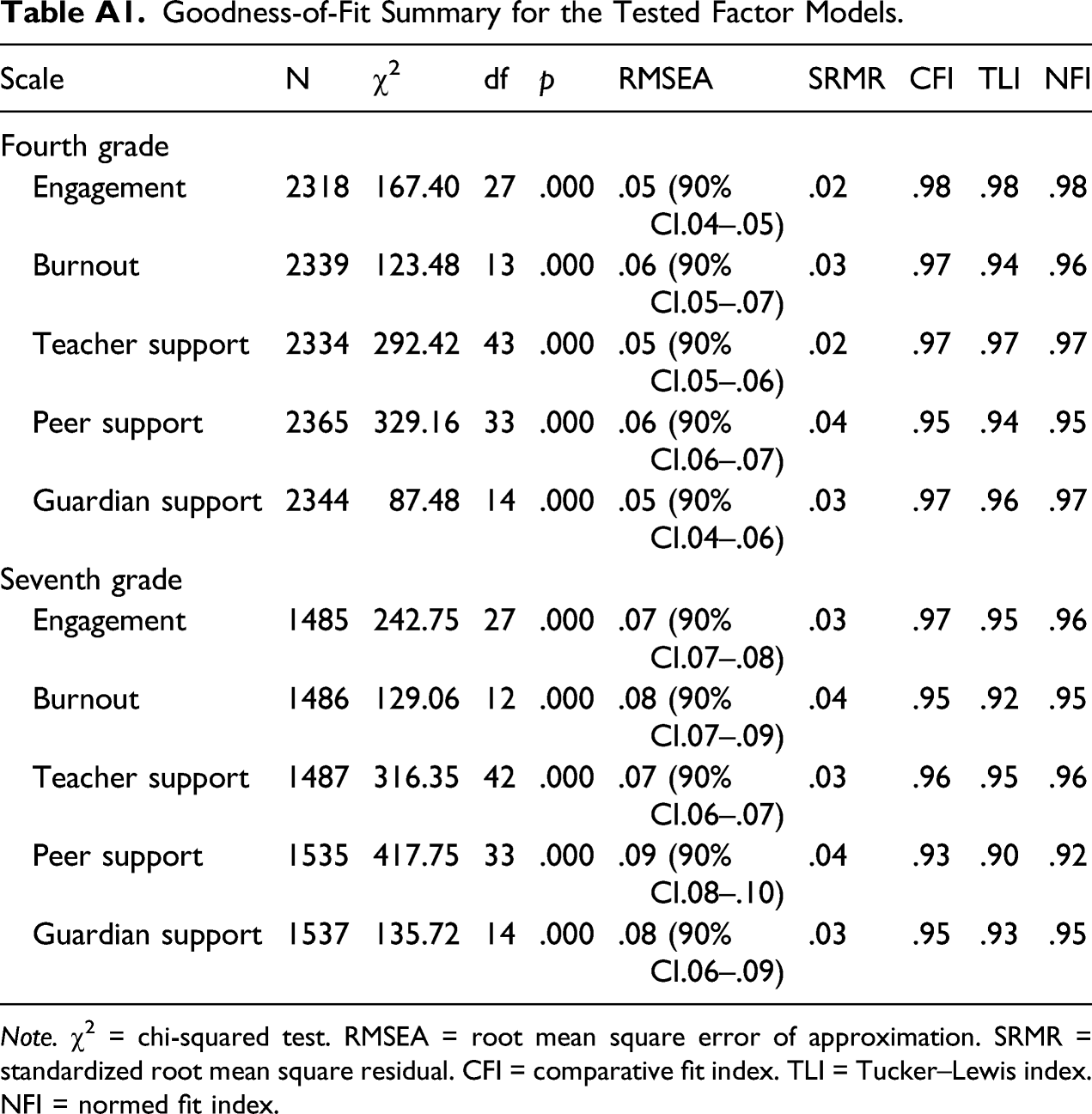
The statistical analyses were performed using Mplus 8.0 software (Muthén & Muthén, 1998–2017). The parameters of the models were estimated using the maximum likelihood robust (MLR) estimation method, which is robust to non-normality of observed variables (MLR estimator; Muthén & Muthén, 1998–2017). A confirmatory factor analysis (CFA) was conducted to examine the general factor structure of the scales used in the study separately for both age cohorts using Full Information MLR estimation (FIML) that uses all the data available to estimate the model without imputing the data. CFA for each scale achieved acceptable fit after modifications of two added residual covariances at maximum. The goodness-of-fit indices of the estimated models are presented in Appendix A in Table A1.
LPA was used to identify distinct subgroups of students based on their scores on teacher, peer, and guardian support. It served our purpose of examining the individual variation in a possible accumulation or lack of social support from different sources. LPA involves grouping individuals into latent classes based on their observed response pattern for specific variables and seeks to identify the smallest number of latent profiles that adequately describe the associations among observed continuous variables (Berlin et al., 2014). Several statistical fit indices were applied to determine the most appropriate number of latent profiles. Akaike (AIC), Bayesian (BIC), and sample-size adjusted Bayesian (aBIC) information criteria were employed to examine the goodness-of-fit of the model with the data (Nylund et al., 2007). Lower values in these fit indices indicate better model fit. However, due to the large data size, the information criteria may support the addition of new profiles without reaching the minimum value. Then, graphs formed from information criteria can be utilized in the selection of a suitable profile solution. The optimal solution can be identified at the point after which the slope flattens (“elbow plots”) (Morin et al., 2016). In addition, entropy values, which assess the accuracy with which models classify individuals into their most likely class, were examined. Entropy values ranged from 0 to 1, with higher scores representing better distinction between latent profiles. The subsequent models were also compared with the Vuong-Lo-Mendell-Rubin (VLMR) likelihood ratio test, the Lo-Mendell-Rubin adjusted likelihood ratio test (aLRT), and the bootstrapped likelihood ratio test (BLRT). A statistically significant test result (p < .05) indicates that a model with k classes fits the data better than a model with one latent class fewer, that is, k-1 classes (Nylund et al., 2007).
After identifying the most suitable latent profile solution, mean differences of outcome variables across profiles, we conducted by a BCH comparison. The BCH method is the most recommended method for examining relationships between profiles and continuous distal outcomes (in this study, engagement and study burnout) across latent profiles (Asparouhov & Muthén, 2015). Finally, the R3STEP procedure, which performs a multinomial logistic regression and provides the odds ratios describing the assumed effect of gender and SES on the likelihood of membership of each of the latent profiles compared to other profiles, was used (Asparouhov & Muthén, 2014).
Results
Descriptive Results
Latent Factor Correlations and Internal Consistencies within Grades.
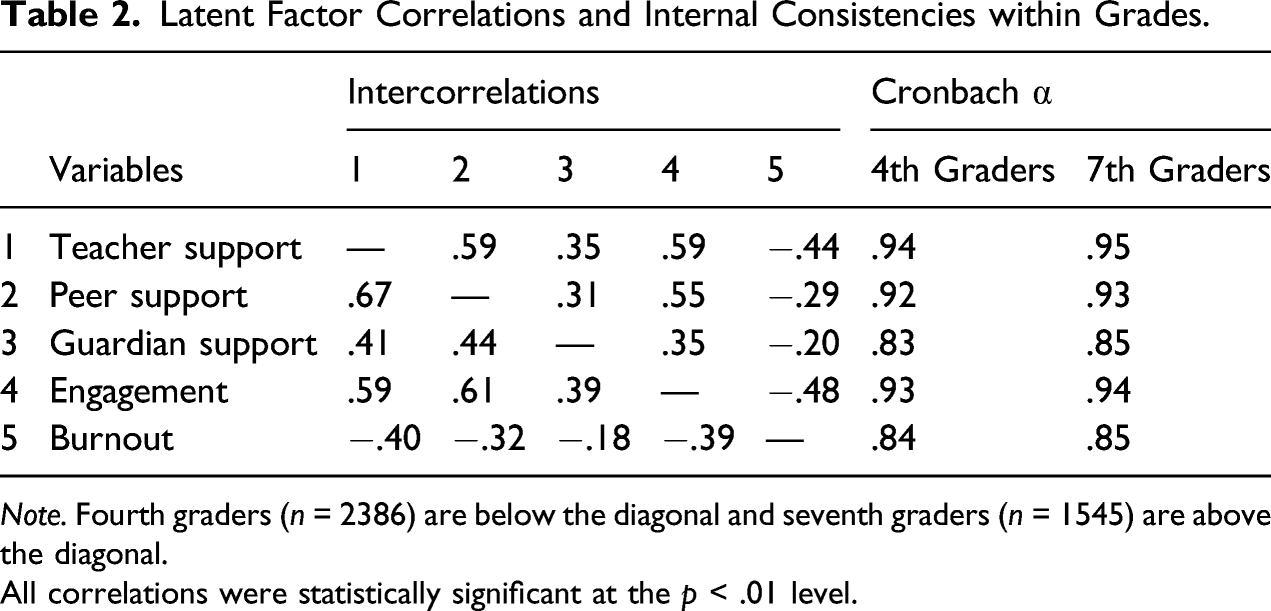
Note. Fourth graders (n = 2386) are below the diagonal and seventh graders (n = 1545) are above the diagonal.
All correlations were statistically significant at the p < .01 level.
Means, Standard Deviations, and Cohen’s d for Grade and Gender Differences in Social Support, Study Engagement, and Study Burnout.
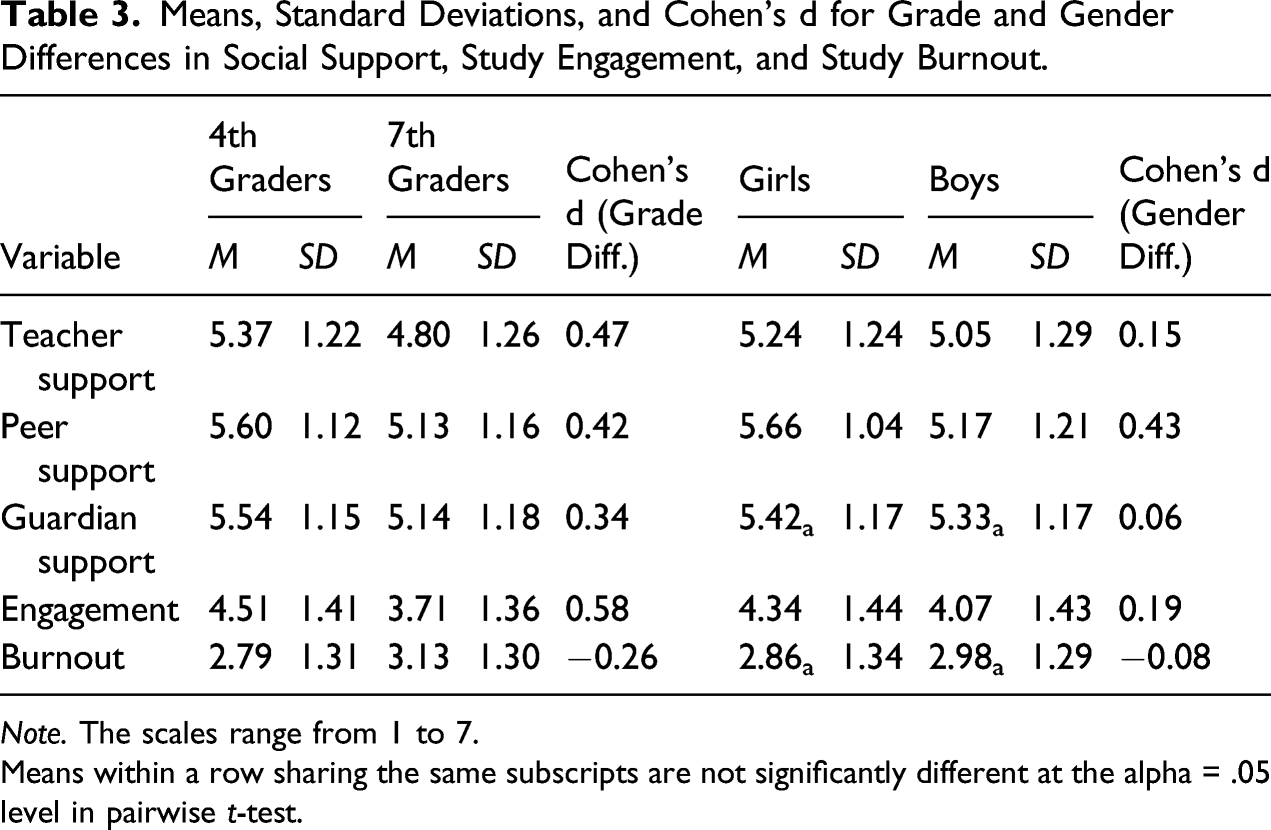
Note. The scales range from 1 to 7.
Means within a row sharing the same subscripts are not significantly different at the alpha = .05 level in pairwise t-test.
The results also showed that girls reported stronger social support and study engagement than boys. Girls reported statistically significantly more often receiving peer support than boys. However, the gender differences in teacher support and study engagement were minor (see Cohen’s d in Table 3), and differences were not found regarding the level of guardian support and study burnout.
Social Support Profiles
Determining the Social Support Profiles
Fit Indices and Class Frequencies for Latent Profile Analyses (LPA) with Different Numbers of Latent Classes.
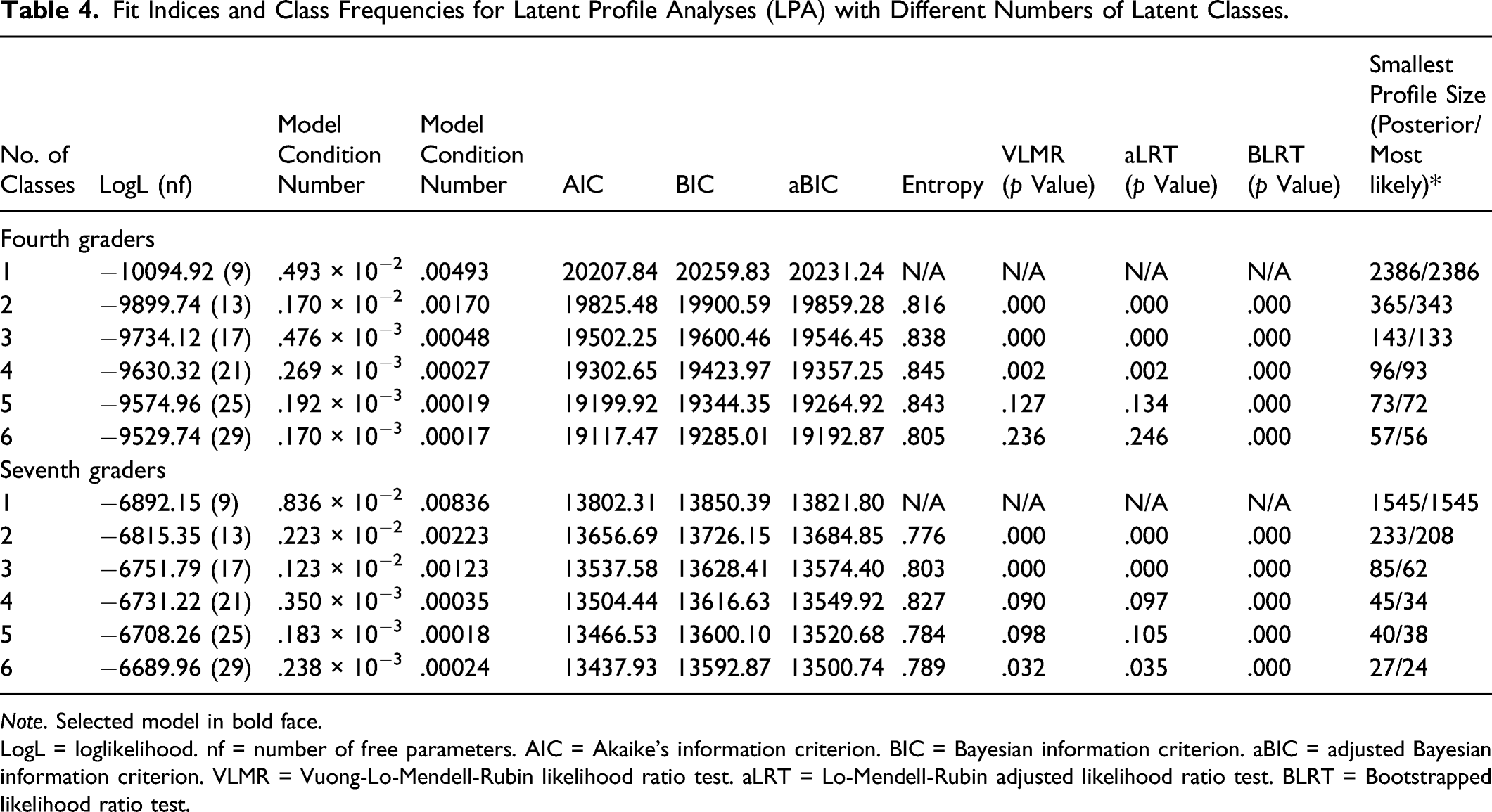
Note. Selected model in bold face.
LogL = loglikelihood. nf = number of free parameters. AIC = Akaike’s information criterion. BIC = Bayesian information criterion. aBIC = adjusted Bayesian information criterion. VLMR = Vuong-Lo-Mendell-Rubin likelihood ratio test. aLRT = Lo-Mendell-Rubin adjusted likelihood ratio test. BLRT = Bootstrapped likelihood ratio test.
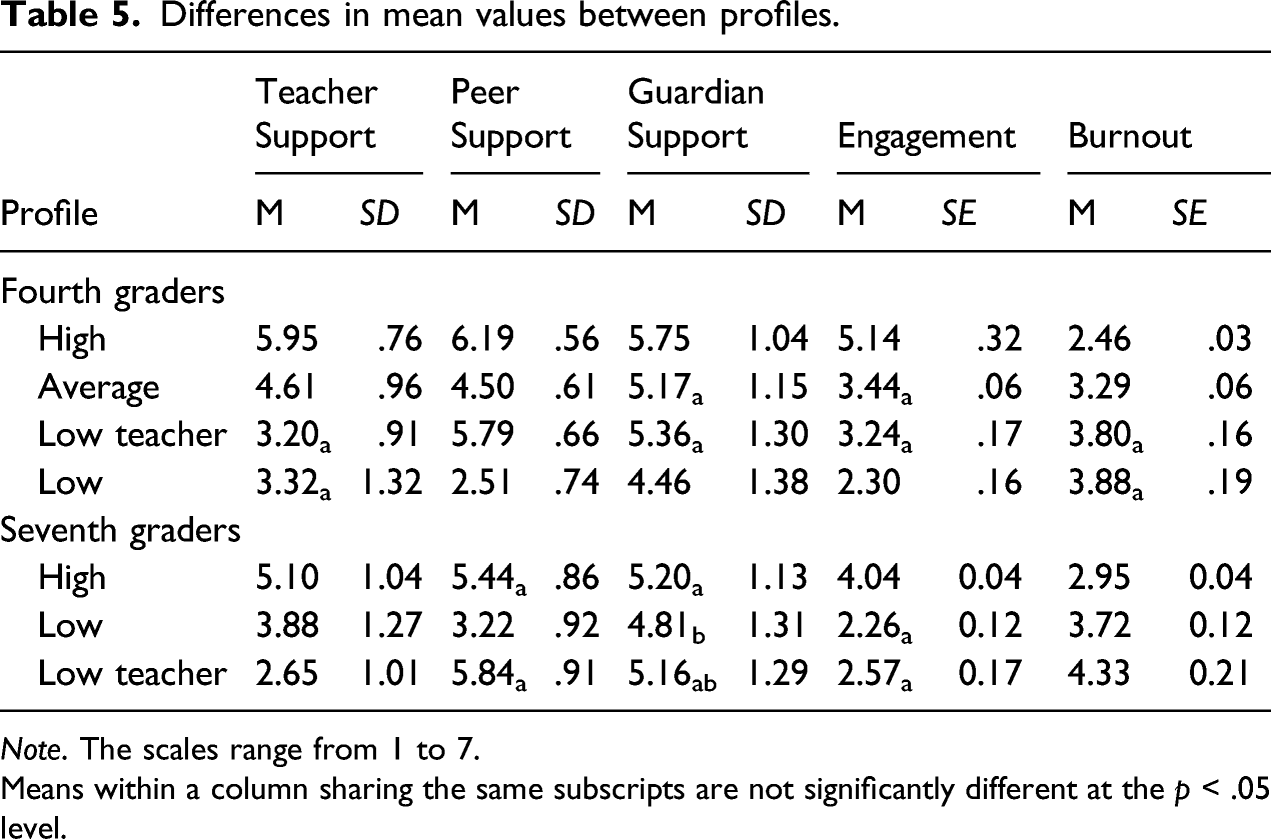
Accordingly, supporting Hypothesis 1a, the LPA results revealed various student profiles in terms of perceived teacher, peer, and guardian school-related social support in both age cohorts (see Figure 1 and Table 5). Firstly, we identified three profiles in which social support from all three sources was perceived at either a high, moderate, or low and very low level, labeled as High support, Average support, and Low support profiles. It was notably that students in the Low support profile reported especially peer support at a very low level. In addition to these, a Low teacher support profile, in which a low level of social support from teachers was combined with high levels of social support from guardians and peers, was identified. The High support, Low teacher support, and Low support profiles were identified in both age cohorts, but the Average support profile was identified only in the cohort of fourth graders. Thus, the results of the LPA partly supported Hypothesis 1b by suggesting that the structure of the profiles tends to be quite similar in both grade cohorts. Fourth and seventh grade students’ latent profiles and raw mean scores for experienced social support from different sources. Differences in mean values between profiles. Note. The scales range from 1 to 7. Means within a column sharing the same subscripts are not significantly different at the p < .05 level.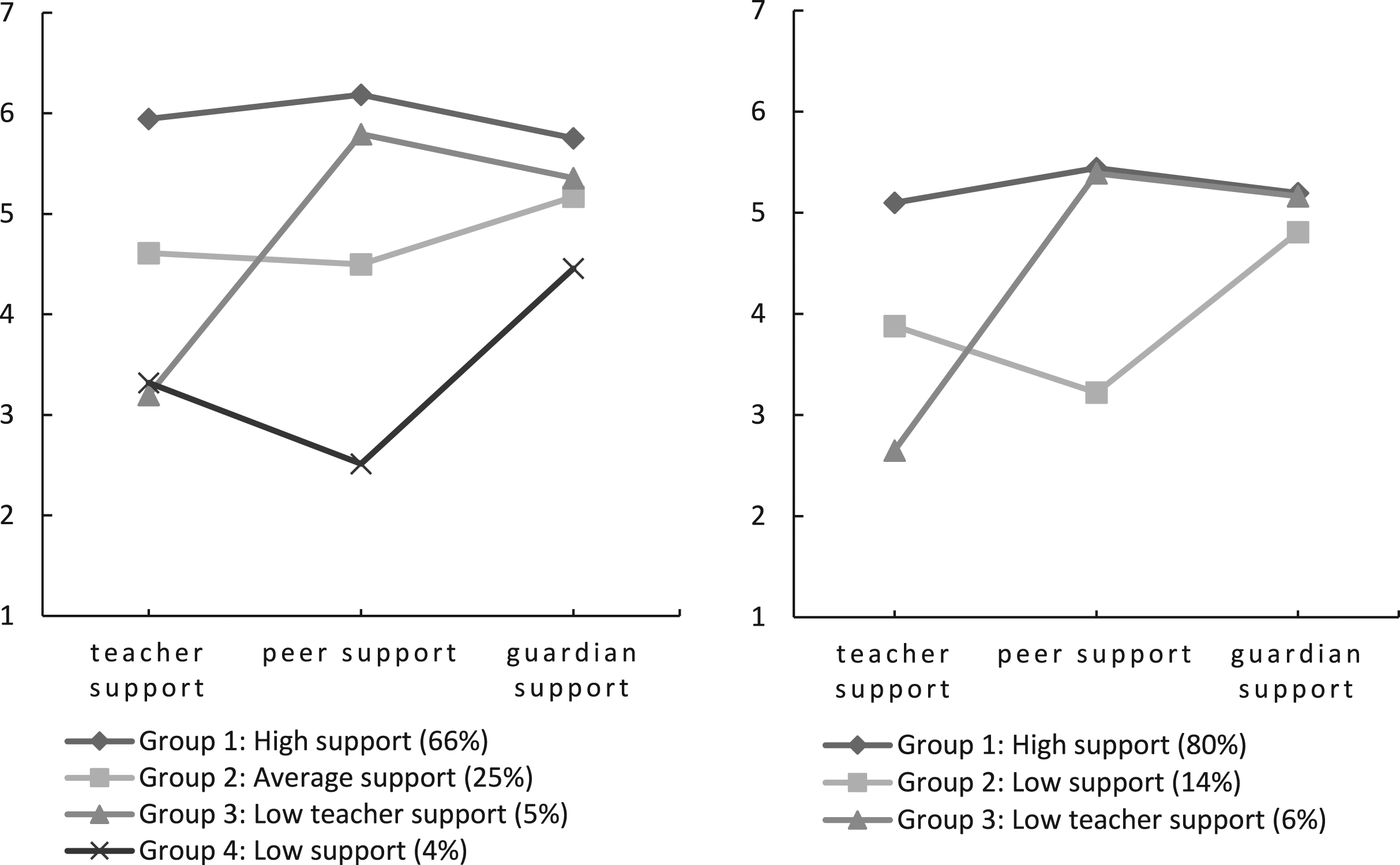
Profiles of Fourth Graders
The main profile among fourth graders was the High support profile, representing 66% of fourth grade students. Further, a quarter (25%) of fourth graders belonged to the Average support profile. The Low teacher support profile represented 5%, and Low supported profile represented 4% of the sample of fourth graders. All mean differences regarding a particular source of social support between profiles were statistically significant except for teacher support between the Low teacher and Low support profiles, and for guardian support between the Average support and Low teacher support profiles (see Figure 1 and Table 5).
Profiles of Seventh Graders
Like fourth grade students, most seventh grade students belonged to the High support profile (80%). Students in this profile perceived social support from teachers statistically significantly higher than students in the other profiles, but the levels of peer and guardian support were perceived as similar to the Low teacher support profile (see Figure 1 and Table 5). The second largest profile, Low support profile, represented 14% of seventh grade students. Students in this profile had the significantly lowest scores in peer support compared with students in other profiles. Teacher support and guardian support were also perceived as below the mean scale level in this profile (see Tables 3 and 5). Students in the Low teacher support profile had the significantly lowest scores for teacher support. Only 6% of the students fell into this profile. Table 5 shows the statistically significant mean differences in social support between profiles.
Study Engagement and Study Burnout in Different Social Support Profiles
The results supported Hypothesis 2a, indicating that students in profiles with more support will generally experience more study engagement and less study burnout than students in profiles with less support in both grade groups (see Table 5 and Figure 2). In Grade 4, the level of study engagement was highest in the High support profile, followed in order by the Average support profile and the Low teacher support profile with the lowest level observed in the Low support profile. Differences between profiles were statistically significant except for the difference between the Average support and Low teacher support profiles. Respectively, the level of study burnout was lowest in the High support profile, followed in order by the Average support and Low teacher support profiles with the highest level observed in the Low support profile. Differences between profiles were significant, except for the difference between the Low support and the Low teacher support profiles. Fourth and seventh graders’ mean scores in study burnout and study engagement according to the profiles.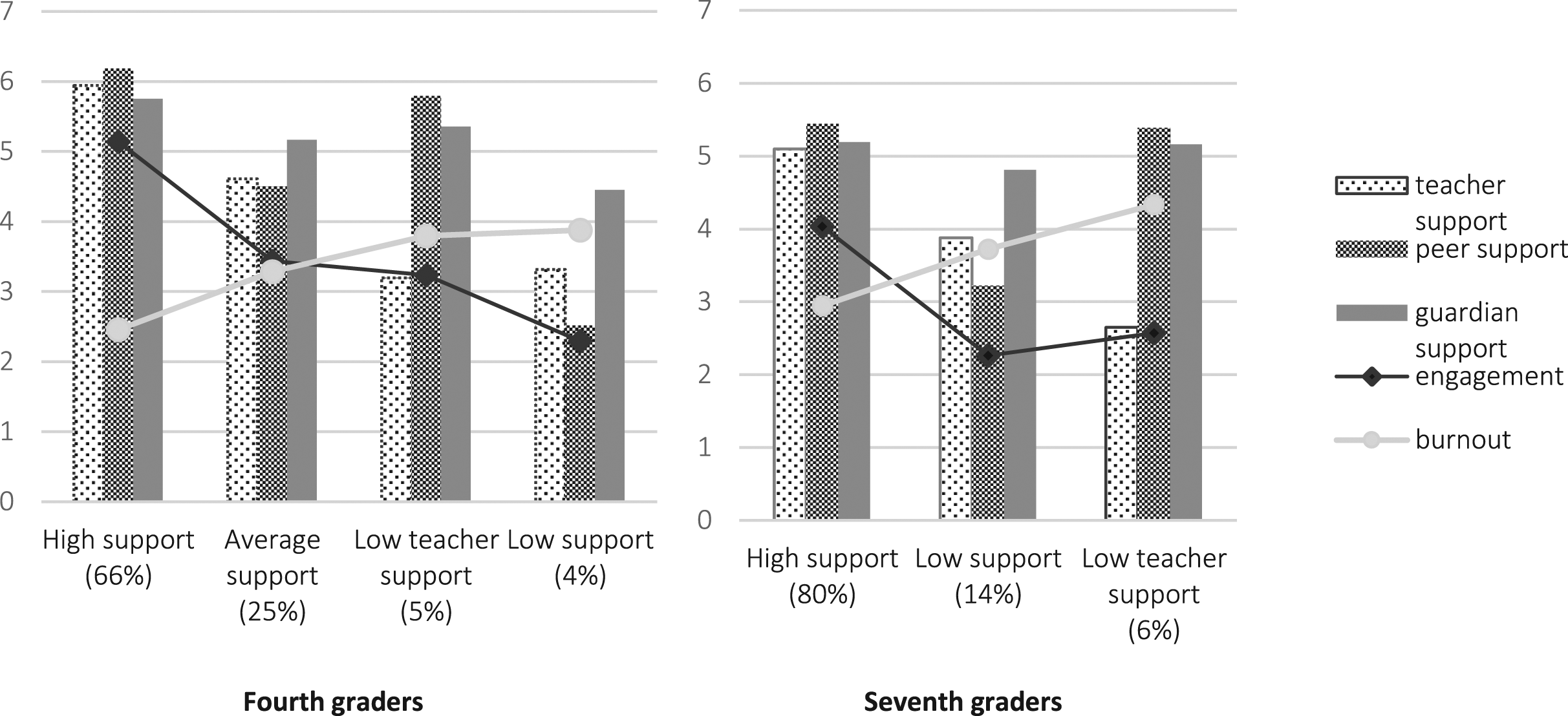
In Grade 7, the level of study engagement was highest in the High support profile, followed by the Low teacher support profile with the lowest level observed in the Low support profile. Respectively, the level of study burnout was lowest in the High support profile, followed by the Low support profile with the highest level observed in the Low teacher support profile. Differences between profiles both in the level of study engagement and study burnout were significant except for the difference between the Low support and Low teacher support profiles.
Comparison of the Low teacher support profile with the other profiles suggested that two sources is not enough to guarantee a complete school experience, but each source of support plays an important role in shaping students’ school experience (Hypothesis 2b). Firstly, comparison of the Low teacher support profile with the Low support profile suggested that despite strong peer and guardian support fourth graders in the Low teacher support profile did not differ from fourth graders in the Low support profiles in terms of study burnout but reported it at a similar level. Further, seventh graders in the Low teacher support profile reported even more study burnout symptoms than seventh graders in the Low support profile. These results showed that peer and guardian support did not compensate for a lack of teacher support in terms of study burnout, but teacher support showed to be especially crucial in protecting students against study burnout symptoms. Secondly, a comparison of the Low teacher support profile with the High support profile showed that other sources of support do not compensate for a lack of teacher support in terms of students’ study engagement and study burnout. Despite strong peer and guardian support, students in the Low teacher support profile reported a statistically significantly lower level of study engagement and higher level of study burnout than students in the High support profile in both age cohorts, indicating that high peer and guardian support alone are not sufficient determinants of a positive study experience. However, the results showed that high peer and guardian support partially compensated for a lack of teacher support in terms of study engagement among fourth graders while the level of study engagement was statistically significantly higher in the Low teacher support profile than in the Low support profile in Grade 4.
Students’ Gender and school-SES as Determinants of Belonging to a Social Support Profile
The results also supported Hypothesis 3a, that fourth-grade boys had higher odds than fourth grade girls of belonging to the Low support profile (b = 1.18, SE = .27, p = .000; OR = 3.25, 95% CI 1.90–5.54), Average support profile (b = .97, SE = .13, p = .000; OR = 2.65, 95% CI 2.06–3.40), or Low teacher support profile (b = .52, SE = .23, p = .027; OR = 1.67, 95% CI 1.06–2.65) than to the High support profile. Respectively, seventh-grade boys had higher odds than seventh grade girls of belonging to the Low support profile than to the High support profile (b = 1.32, SE = .24, p = .000; OR = 3,726, 95% CI 2.315–5.997). In addition, they had higher odds than girls of belonging to the Low support profile than to the Low teacher support profile (b = 1.61, SE = .38, p = .000; OR = 5.004, 95% CI 2.375–10.541).
Furthermore, the results partly supported Hypothesis 3b regarding SES differences by showing that fourth graders from a high SES area had higher odds of belonging to the High support profile than to the Low support profile (b = .68, SE = .25, p = .008; OR = 1.97, 95% CI 1.20–3.24). In addition, they had higher odds of belonging to the Average support profile than to the Low support profile (b = .67, SE = .28, p = .015; OR = 1.96, 95% CI 1.14–3.38). On the other words, students from a low SES area were more likely to fall into the Low support and Average support profiles than to the High support profile. However, in contrast to Hypothesis 3b, SES did not statistically significantly determinant students' belonging to a certain social support profile among seventh graders.
Discussion
The aim of this study was to explore individual differences in perceived social support from different sources and their common and compensatory effects on perceived study engagement and study burnout. As we expected, several profiles with different configurations of perceived social support from three sources were identified from the groups of primary and lower secondary school students revealing an inequality in perceived social support between students. In two grade cohorts, three equivalent profiles were identified: High support, Low teacher support, and Low support. In addition to these, the Average support profile was identified in the cohort of primary school students. The results of the similarity of the profiles in the different contexts complement our understanding that the perceived need and structure of the social support mechanism are quite similar in the different phases of students’ school career (Ciarrochi et al., 2017; Weyns et al., 2018; Özdemir & Özdemir, 2020).
Our findings suggest that perceived social support from different sources tends to be relatively similar in nature and includes low, moderate, or high levels of support from different sources. The results contributed to the theoretical assumption that students who receive respect and encouragement, as well as advice and constructive feedback, in relationships with teachers and guardians are more likely to receive it in peer relationships, as well. In contrast, students with a perceived lack of social support from adults are more likely to suffer from a lack of peer support (Ainsworth et al., 1978 (attachment theory); Ciarrochi et al., 2017; Kiuru et al., 2015; Ulmanen et al., 2016b). It might be that via supportive relationships with teachers and guardians, students adopt positive attitudes towards schoolwork (Rice et al., 2013) and socio-emotional skills (Hughes & Chen, 2011; Newton, et al., 2014) that further enhance students’ opportunities to share and receive support among peers.
However, the results also revealed opposite findings regarding the accumulation of students’ perceived social support from teachers, peers and guardians, suggesting that high support from one source does not always guarantee high support from other sources. The identified mixed social support profile suggests that relationships with teachers can diverge despite high support from guardians and peers (Ciarrochi et al., 2017; Scholte et al., 2001; Furrer & Skinner, 2003). Moreover, the results suggest that the divergence can already occur among primary school students. It might be that in such situation students’ needs are not met in relationships with teachers, for example students do not receive support appropriate to their skill level, and students’ need to seek and receive support from peers increase (Ryan & Shim, 2012). Furthermore, the result emphasizes the role of guardian support as an important basis for students’ functional social support activities among peers. Strong social support received from guardians may partly compensate for a lack of teacher support in terms of forming supportive relationships with peers (e.g., Anthony et al., 2005; Takahashi et al., 2015).
The results also suggest that the different social support profiles are related to experienced study engagement and study burnout. More specifically, the results showed that students who experienced social support from all sources as high (High support) were statistically significantly more engaged in studying than students who experienced a low level of social support from one or more sources in both grade cohorts. Those students also experienced statistically significantly lower study burnout than the students in other profiles in both grade cohorts. Furthermore, the results suggest that perceiving social support from all sources as relatively low (Low support) causes a lack of study engagement and raises the risk of study burnout symptoms. These results are in line with previous findings suggesting that students’ relationships with teachers, guardians, and peers characterized by respect, relatedness, care, and problem-focused guidance facilitate students’ study engagement (Estell & Perdue, 2013; Hughes et al., 2008; Kiefer et al., 2015) and buffer against perceived study exhaustion, cynicism and inadequacy (e.g., Salmela-Aro & Upadyaya, 2014; Skinner et al., 2008; Virtanen et al., 2018). Moreover, students who do not feel they are supported by their peers at school and do not experience being cared for and valued by their teachers and guardians are likely to have negative experiences toward studying and lower inspiration and motivation for school attendance. It is noteworthy, that the Low support profile was the only profile in which peer support was perceived at a particularly low level, indicating that a lack of peer support is especially highly related to student negative emotions regarding school (Estell & Perdue, 2013).
However, comparison of the Low teacher support profile with other profiles emphasizes the importance of teacher support for students’ study wellbeing. For example, despite strong peer and guardian support, students in the Low teacher support profile reported study burnout symptoms at a similar or even a higher level than students who perceive social support from all sources at a low level (the Low support profile). These results indicate that high peer and guardian support did not compensate for a lack of teacher support in terms of study burnout, but teacher support is especially crucial in protecting students against study burnout symptoms. The importance of teacher support was also emphasized as an activator of students’ study engagement, even if high levels of peer and guardian support seemed to slightly compensate for a lack of teacher support among primary school students.
Although the strong influence of teacher support on students’ study wellbeing is well documented in previous studies (e.g., Furrer & Skinner, 2003; Jiang et al., 2013; Virtanen et al., 2018; Wang & Eccles, 2012; Özdemir & Özdemir, 2020), this study highlights the importance of the teacher as a supporter of student study wellbeing uniquely. Previous studies have not been able to show that the lack of teacher support is almost impossible to compensate with support from other sources, such from guardians and peers. The unique role of the teacher as a student supporter may be explained by the fact that the teacher is not only responsible for constructing a supportive and positive atmosphere in the classroom, but also for setting the study goals and organizing the pedagogical practices to achieve these goals. In a well-organized learning environment where sufficient support is available, the study goals are understandable, and students are more interested in their studies and more likely to achieve these goals (e.g., Hughes et al., 2008; Kiefer et al., 2015; Roorda, Helma, Koomen, Spilt, & Oort, 2011; Skinner et al., 2008; Wang & Eccles, 2012).
The fact that the High support profile was the largest profile at both the primary and lower secondary level suggests that a typical comprehensive school student in Finland perceives social support to be available and utilized in the school from teachers and among peers, as well as at home. Moreover, they are characterized by high levels of energy, dedication, and absorption, combined with low levels of burnout symptoms (cynicism, exhaustion, and inadequacy). However, girls were more likely to belong to this profile, while boys were over-represented in the Low support profile in both grade cohorts. The result supports previous findings on gender differences that indicate that girls are typically better adjusted to the school environment (Lam et al., 2012; Liu et al., 2016; Wang & Eccles, 2012). Differences in girls’ and boys’ ways of adjusting to school might be explained by their differences in using social support. It has been found that girls are more likely than boys to seek out support. They are also more likely than boys to share personal and school-related issues in their close relationships (Blyth & Foster-Clark, 1987; Frydenberg & Lewis, 1991, 1993; Rautanen et al., 2020). Instead, relationships between boys are mostly characterized by the sharing of only instrumental support (Frydenberg & Lewis, 1993), which may mean that the aims set for studying are not shared in peer relationships. In addition, boys may receive more negative attention from teachers at school (Hamre & Pianta, 2001; Hughes et al., 2001), which may in turn increase the tension between boys and teachers (Ulmanen et al., 2016a). Given evidence that teacher support affects students’ ways of sharing and receiving support among peers, such a difference in teacher support for boys and girls may contribute to boys’ lower levels of supportive behavior and study engagement at school.
Finally, the results are in line with previous findings that students from a low SES area feel less supported and experience more problems in their study wellbeing than students from a high SES area. However, statistically significant differences between SES areas occur only among fourth graders, not among seventh graders. This indicates that the impact of regional differences on students’ perceived social support and study wellbeing decreases through the school years. In general, it is assumed that students from a low SES area probably have more problems in forming functional social relations at school with their peers, as well as with their teachers (e.g., Aronen & Kurkela, 1996), which can reduce their opportunities to seek and receive support (Ciarrochi, et al., 2017) and further to engage in studying. It might also be that students from a low SES area are more likely to feel inadequate, exhausted, and cynical (e.g., Sinha & Mishra, 2015), which may decrease their motivation to share and seek social support for schoolwork (e.g., Hughes & Chen, 2011; Rautanen et al., 2021).
Study Limitations and Conclusions
This study has several limitations. Firstly, the study is based solely on the students’ self-report questionnaire. In future studies, the use of multiple informants and multiple methodologies to assess social processes would provide a more comprehensive perspective of social support and study wellbeing. However, the validity and reliability of the scales were good, and the sample size was large. Moreover, the implementation of the study in two different grade cohorts validates the reliability of the scales and the validity of the results. It is noteworthy that the study engagement and study burnout scales demonstrated validity with such young students. We do not know of any previous studies assessing study burnout among such young students. Secondly, when interpreting the results, it must be taken into account that the profile solution regarding fourth graders included a profile (the Low support profile) that represented only 4% of the sample, which is less than the generally recommended 5%. However, given the large sample size, the profile can be considered sufficiently large enough with the class count of 96. Thirdly, this study is a cross-sectional study and does not provide evidence on the developmental trajectories of the individuals in these social support profiles. Thus, we cannot indicate to what extent the students tend to stay in the same profile throughout their school years, or whether they change profiles, for example, during the transition from primary to lower secondary school. Moreover, the causal relations between social support and study wellbeing cannot be interpreted. Future research is needed to achieve clearer understanding about the origins of the experiences of social and study wellbeing. It should be investigated whether stability or changes in social support from teachers, peers, and guardians contribute to changes in study engagement and study burnout over time. Moreover, there is a gap in the research regarding the accumulation of perceived social support. The causal relations and possible mediators (such as social competence and school-related attitudes) between different sources of support need to be studied further.
Despite the limitations, the findings of the present study contribute to a more complex picture of social support from specific social partners. To our knowledge, this is among the first studies to use LPA to examine the experiences of school-related social support from three sources (teachers, guardians, and peers) among such young students. Moreover, the finding of similar profiles in two different school phases indicates that the structure of the social support experience is constructed already at primary school (e.g., Rautanen et al., 2020), emphasizing the importance of access to social support at an early stage in the school path. Further, the results of the homogenous social support profiles (including low, average, and high social support) indicate that experiences of social support from different sources typically accumulate, and students with a lack of support from some specific partner are at risk of dropping out from other relationships, too.
Finally, the findings suggest that school-related social support promotes students’ school engagement and protects against study burnout. However, the unique effects of social support profiles on students’ engagement and burnout suggest that social support from specific partners has a somewhat different effect on the features of students’ study wellbeing. In particular, teachers seem to have a key role in supporting and affecting students’ study wellbeing. Thus, the factors that affect teachers’ abilities to provide emotional and informational support for their students should be studied further, and teachers should be supported in their work accordingly. Moreover, attention should be given to enhancing supportive behavior, especially among boys. If the teacher finds ways to promote schoolwork-related support among peers, students’ opportunities to experience study engagement will increase, and their experiences of study burnout will decrease.
Footnotes
Declaration of Conflicting Interests
The author(s) declared no potential conflicts of interest with respect to the research, authorship, and/or publication of this article.
Funding
The author(s) disclosed receipt of the following financial support for the research, authorship, and/or publication of this article: This work was supported by the Ministry of Education and Culture under Grant [6600567] and the Academy of Finland under Grant [295022].

Appendix
Goodness-of-Fit Summary for the Tested Factor Models.
| Scale | N | χ2 | df | p | RMSEA | SRMR | CFI | TLI | NFI |
|---|---|---|---|---|---|---|---|---|---|
| Fourth grade | |||||||||
| Engagement | 2318 | 167.40 | 27 | .000 | .05 (90% CI.04–.05) | .02 | .98 | .98 | .98 |
| Burnout | 2339 | 123.48 | 13 | .000 | .06 (90% CI.05–.07) | .03 | .97 | .94 | .96 |
| Teacher support | 2334 | 292.42 | 43 | .000 | .05 (90% CI.05–.06) | .02 | .97 | .97 | .97 |
| Peer support | 2365 | 329.16 | 33 | .000 | .06 (90% CI.06–.07) | .04 | .95 | .94 | .95 |
| Guardian support | 2344 | 87.48 | 14 | .000 | .05 (90% CI.04–.06) | .03 | .97 | .96 | .97 |
| Seventh grade | |||||||||
| Engagement | 1485 | 242.75 | 27 | .000 | .07 (90% CI.07–.08) | .03 | .97 | .95 | .96 |
| Burnout | 1486 | 129.06 | 12 | .000 | .08 (90% CI.07–.09) | .04 | .95 | .92 | .95 |
| Teacher support | 1487 | 316.35 | 42 | .000 | .07 (90% CI.06–.07) | .03 | .96 | .95 | .96 |
| Peer support | 1535 | 417.75 | 33 | .000 | .09 (90% CI.08–.10) | .04 | .93 | .90 | .92 |
| Guardian support | 1537 | 135.72 | 14 | .000 | .08 (90% CI.06–.09) | .03 | .95 | .93 | .95 |
Note. χ2 = chi-squared test. RMSEA = root mean square error of approximation. SRMR = standardized root mean square residual. CFI = comparative fit index. TLI = Tucker–Lewis index. NFI = normed fit index.