




Abstract
Literacy instruction has an important role in augmentative and alternative communication (AAC) because spelling and writing support precise communication. Unfortunately, few students with extensive support needs and complex communication needs (ESN/CCN) develop literacy skills at or above the first grade reading-level. Given that learning to read and write begins with extensive emergent literacy learning opportunities, limited skills may result from insufficient opportunity to learn (OTL) emergent literacy skills. This study examined the instruction provided in early U.S. childhood classrooms to students with ESN/CCN to understand OTL during this critical period. This study used a concurrent embedded mixed methods design integrating a survey of teachers of students with ESN/CCN (n = 26) with a qualitative multiple case study (n = 2). Results suggest the time teachers are devoting to instruction is not translating into increased OTL for individual students. Solutions that may increase learning opportunities and implications for future research are discussed.
Students with extensive support needs (ESN) who are unable to meet their face-to-face communication needs with speech alone are said to have complex communication needs (CCN). These students with both ESN and CCN (ESN/CCN) use non-symbolic or early symbolic means of expressive communication and benefit from having access to augmentative and alternative communication (AAC; Erickson & Geist, 2016). One result of the limited symbolic expressive communication skills is that many students with ESN/CCN are known to have extremely restricted language and literacy skills (Burnes & Clark, 2021).
Restricted literacy skills are a problem given that literacy supports precise communication in AAC as it allows individuals who use AAC to spell the exact words they wish to communicate across purposes and partners. Learning the literacy skills required to support this precise communication requires a range of opportunities to learn emergent language and literacy skills and concepts. At a minimum, this includes opportunities to develop conceptual knowledge about the functions of print; procedural knowledge related to letters, sounds, and words; oral language understanding and use; and metalinguistic skills related to phonological and syntactic awareness (National Early Literacy Panel [NELP], 2008; Sénéchal et al., 2001). Without these emergent literacy skills, students struggle to learn and apply conventional literacy skills (i.e., the ability to read independently with comprehension and write to convey meaning to others; C. M. D. Connor et al., 2006. This is especially true for students with ESN/CCN (Linder et al., 2023). Though most students acquire emergent skills and concepts before or shortly after beginning kindergarten (NELP, 2008), many students with ESN/CCN require instruction throughout their school career to acquire them (Burnes & Clark, 2021).
Students With ESN/CCN
Students with ESN/CCN compose about one-third to one-half of 1% of all students in U.S. public schools (National Center for Educational Statistics, 2020). They receive special education in a variety of Individuals with Disabilities Education Improvement Act (IDEA, 2004) eligibility categories (e.g., autism, multiple disabilities, intellectual disability; Burnes & Clark, 2021). Most students with ESN/CCN have some level of motor impairment and/or sensory loss (Erickson & Geist, 2016). Regardless, all students with ESN/CCN require: (a) extensive, repeated, and individualized instruction; (b) substantially adapted and modified materials; and (c) individualized methods of accessing information to acquire, maintain, generalize, and transfer skills across settings (Taub et al., 2017).
Educational Contexts
Approximately 90% of school-age students with ESN/CCN are educated in multi-grades classrooms (e.g., K-6, 9-12; Lazarus & Quinlan, 2003; Ruppar et al., 2015) within separate classrooms or schools (Burnes & Clark, 2021). Observations in these contexts reveal little specialized instruction with few opportunities for engagement and interaction from early childhood through adolescence (Pennington & Courtade, 2015). Additionally, there is often limited use of AAC with unconventional forms of communication (e.g., idiosyncratic gestures, vocalizations) often overlooked or misunderstood (Erickson et al., 2021).
Communication and Literacy Profiles
Most of what is known about the communication and literacy profiles of students with ESN/CCN is based on students in grades 3 to 12 who participate in their state’s alternate assessment based on alternate achievement standards. For example, Burnes and Clark (2021) reported that about half of all students with ESN (52% of 92,080) completing the alternate assessment in 19 states used non-symbolic or early symbolic means of expressive communication. This includes 14,055 students who use AAC devices but communicate using only single symbols for a restricted range of purposes. These data suggest that students with ESN/CCN require more access to AAC devices and communication interventions to address their symbolic communication needs.
Burnes and Clark (2021) also reported that regardless of age or communication profile only 14% of students with ESN read above a second-grade level and only 31% write words, phrases, or sentences without copying. Percentages are considerably lower for students with ESN/CCN who have no means of symbolic communication or use AAC in the absence of speech. Across these subgroups, only 2.5% read above the second grade level and only 1.7% write words, phrases, or sentences without copying. This is consistent with prior research demonstrating a relationship between communication and literacy skills among students with ESN/CCN (Erickson & Geist, 2016), and it suggests that most students with ESN/CCN require ongoing emergent literacy instruction well into their adolescence.
Literacy Instruction
Decades ago, the call was made for a shift away from reading-readiness models toward a continuum-based model that begins with emergent and extends through conventional literacy (Koppenhaver et al., 1991). From this perspective, literacy learning is a continuous process: wherein all children are constantly in the process of becoming increasingly literate (Erickson & Koppenhaver, 2020). This continuum extends from emergent literacy (i.e., the reading- and writing-related behaviors children engage in before they begin to read and write) to conventional literacy (i.e., reading to gain meaning and writing to convey meaning). As children progress through the period of emergent literacy, they are developing skills and understandings related to the functions and conventions of print, phonological and alphabet awareness, and a broad range of receptive and expressive language skills (Sénéchal et al., 2001). Because emergent literacy development is driven by experience and opportunity, not age, many older students with ESN remain emerging in their understandings of literacy due to limited literacy learning opportunities (Erickson & Koppenhaver, 2020).
Emergent literacy skill growth and acquisition is supported through a combination of explicit and embedded learning opportunities addressing alphabet and phonological awareness (Hunt et al., 2020), shared reading (NELP, 2008), shared writing (Koppenhaver & Williams, 2010), and opportunities for independent reading and writing (Hatch & Erickson, 2018). In contrast, conventional literacy understandings are developed through instruction that addresses, at a minimum, phonemic awareness, phonics, reading fluency, and text comprehension (National Institute for Child Health and Development [NICHD], 2000). Though students with ESN/CCN can learn conventional literacy skills in isolation, they often struggle to apply them across reading and writing tasks (D. M. Browder et al., 2006; Linder et al., 2023). This may be due to limited opportunity to establish foundational, emergent literacy skills and understandings, and it may be mitigated by increased emergent literacy instruction and learning opportunities.
Previous Descriptions of Literacy Instruction for Children With ESN/CCN
Restricted literacy learning opportunities have been reported for students with ESN/CCN for decades (Koppenhaver et al., 1991; Mike, 1995). Placement in separate special education settings (Ruppar et al., 2018), attention to functional and readiness skills (Toews & Kurth, 2019), and assumptions that students with ESN are unable to benefit from comprehensive literacy instruction (Ruppar, 2017) have all been offered as explanations for these restricted opportunities and low levels of literacy achievement. Additionally, special education teachers are unlikely to receive adequate preservice training programs related to literacy instruction for students with ESN (Griffen, 2017).
Existing reports of the literacy instruction afforded students with ESN/CCN are primarily based on descriptive, ethnographic methods in special education classrooms. These researchers have emphasized the experience of adolescents, in a small number of classrooms, school districts, and states (Kurth et al., 2016; Mike, 1995; Ruppar et al., 2015). For example, Ruppar and colleagues have made major contributions to our understanding of the literacy experiences of adolescents with ESN demonstrating that literacy learning afforded them is (a) narrowly focused (Ruppar, 2015), (b) impacted by teachers’ perceptions about their learning potential when they do and do not have CCN in addition to the ESN (Ruppar, 2017), and (c) more restricted in separate special education settings compared to inclusive settings (Ruppar et al., 2018).
Research with younger students has focused largely on general areas of instruction rather than specific instructional routines. For example, Hunt et al. (2022) reported on the business-as-usual instruction afforded 29 students with ESN in 15 general education classrooms (K-4) located in three states. They investigated broad categories of emergent (i.e., alphabet knowledge, phonological awareness, print concepts) and conventional (i.e., comprehension, phonics) literacy instruction. The authors acknowledged high levels of variation across teachers with the largest portion of literacy instruction focused on conventional areas including comprehension (29.1%), vocabulary (17.9%), and phonics (13.5%), and less time on emergent areas such as print concepts (11.4%), alphabet awareness (11.4%), and phonological awareness (10.8%).
The Current Study
The purpose of the current study was to examine the specific types of emergent literacy instruction and access to AAC afforded to young students with ESN/CCN in the separate special education classrooms where they are most often served (Burnes & Clark, 2021). The study extends prior research by combining survey and case study methods with a focus on emergent literacy instruction provided to students with ESN and CCN in separate special education preschool and elementary grades classrooms across several states.
The specific research questions were: (1) What emergent literacy instruction do special education teachers self-report providing to their students with ESN/CCN? (2) How often (i.e., ≥ 2× a day, 1× a day, ≥ 2× week, 1× a week) do special education teachers report providing emergent literacy instruction to their students with ESN/CCN? (3) What are the experiences of teachers and students in the natural context of separate special education classrooms during emergent literacy instruction? and (4) What is the relationship between the reported and observed emergent literacy practices?
Method
Conceptual Framework
The concept of opportunity to learn (OTL) serves as an important conceptual frame for the current study. OTL has been applied in various settings to understand student learning, or lack thereof, in relationship to their access to instruction (Elliott, 2015). Studies of OTL have focused on the intended curriculum (i.e., academic standards), the assessed curriculum (e.g., the content of mandated state tests), and the enacted curriculum (i.e., the actual instruction provided in the classroom; Taub et al., 2017). In U.S. public schools today, the intended and assessed curricula are mandated through state standards, legislation such as the IDEA (2004), and various Supreme Court decisions (e.g., Endrew F., 2017). However, the enacted curriculum is directly related to teacher decision-making (Ruppar, 2015), and there is evidence that teachers of students with ESN struggle to enact the intended curriculum (Ruppar et al., 2018; Taub et al., 2017).
Investigations of OTL attend to some combination of time, content, and quality of instruction. Context, supports, and instructional opportunity are fore fronted when OTL is employed in studies of disability and student learning or achievement, which is consistent with strengths-based views of disability (Wehmeyer & Kurth, 2021). Specific to students with ESN/CCN, OTL can be used to support the possibility that limited literacy skills may be related to the nature of the learning experiences the students are and are not afforded, the settings in which they are educated (Hunt et al., 2022; Ruppar et al., 2018), and their access to AAC (Erickson et al., 2021).
Applying the OTL framework within a concurrent embedded mixed methods study allowed us to go beyond providing and comparing counts and duration of reported and observed high-quality emergent literacy instructional practices. As such, it allowed us to deepen our understanding of the enacted curriculum through thematic analysis of qualitative data focused on the lived experience of teachers and students with ESN/CCN in their separate special education classrooms. Therefore, as a framework, OTL aligns with our long-term goals to promote more equitable access to comprehensive emergent literacy instruction and inform strengths-based views of disability by shining a light on what is so that we can move toward what might be.
Research Design
The current study employed a concurrent embedded mixed methods design. In this method it is presumed that one method is insufficient to answer the questions being asked (Creswell & Clark, 2018). This design specifically addressed Elliott’s (2015) call to measure the enacted curriculum, a component of OTL, using observations of classroom instruction in conjunction with teacher surveys.
Consistent with a concurrent embedded mixed methods design (Creswell & Clark, 2018), this study had two parallel research phases with data collected simultaneously and analyzed separately with a primary data set, in this case a survey, and a secondary data set, in this case, a multiple case study. This approach is helpful because it: (a) allows for the study of complex social phenomenon; (b) produces a more complete picture of the problem; and (c) assists in explaining quantitative results. In this study, the survey was designed to capture teachers’ self-reports of the type and frequency of emergent literacy instruction they provide. The multiple case study (Yin, 2017) was designed to observe and describe the literacy-related experiences of teachers and students in separate special education classrooms.
Researcher Positionality
The current study was born out of our desire to understand more about the current state of emergent literacy instruction as enacted in preschool and elementary special education classrooms for students with ESN/CCN in the United States. This desire reflects our position that students with ESN/CCN require access to a myriad of emergent literacy learning opportunities to eventually achieve meaningful conventional literacy outcomes. Furthermore, the study was predicated on the idea that by knowing what is, and beginning to understand why, the field might be better equipped to improve instruction and learning for students with ESN/CCN.
We entered this work with experience working with students with ESN/CCN as a speech-language pathologist and special education teacher. The first author worked with individuals with ESN/CCN in their homes, community, and school environments before completing a PhD focused on literacy and AAC. The second author taught students with ESN/CCN and has investigated various aspects of their literacy and communication in separate and inclusive settings for three decades. The design, analysis, and interpretation of the findings in the current study were informed by theories such as disability studies in education and their critiques of traditional medical models of disability (D. J. Connor et al., 2008), views of the discursive construction of disability (Erickson et al., 2021), and strengths-based views of disability (Wehmeyer & Kurth, 2021). However, the study was completed with the pragmatic understanding that nearly all students with ESN/CCN in the United States are educated in separate special education settings. Therefore, we are driven to improve instruction provided in these settings, while working to dismantle the systems that created them.
Procedures
All participants were part of a larger study addressing emergent literacy instruction and AAC access for students with ESN/CCN in preschool through grade 12. Data collection occurred during the baseline phase of the larger study, before teachers participated in trainings related to emergent literacy. Recruitment occurred at the level of the school system, with seven systems from five states (i.e., CA, NY, NC, OH, VA) volunteering to participate in response to announcements at conferences and direct invitations from the research team. After securing permission from both the institutional review board of the university where the authors are employed and the local education agencies, individual teachers of students with ESN/CCN were recruited to participate. After teachers consented, consent forms were distributed to the caregivers of all students with ESN/CCN in their classrooms. Demographic information regarding participants is provided for each part of the study separately.
Teacher Survey
Anonymous survey links were emailed directly through Qualtrics to the 32 preschool and elementary school special education teachers who consented to participate in the larger study. Reminders were sent 4 times to non-responders at two-week intervals. As a result of these efforts, 26 surveys were completed, which is an 81% response rate.
Survey Instrument
A survey was developed to measure teachers’ self-reported provision of emergent literacy instruction as such surveys have been shown to successfully capture the content and frequency of instructional practices (Porter, 2002). This approach to measuring the enacted curriculum has been used in general (Jordan & Bratsch-Hines, 2020) and special education contexts (Rankin-Erickson & Pressley, 2000). The survey was a modification of the survey Sturm et al. (2006) used to capture the self-reported literacy practices of first-through third-grade elementary school teachers. Items were limited to those pertaining to emergent literacy instruction (e.g., shared reading, independent reading, instruction focused on alphabet knowledge and phonological awareness). Additional item development was informed by the literature describing high-quality emergent literacy instruction for students with ESN/CCN (Erickson & Koppenhaver, 2020) and for students without disabilities (NELP, 2008). Further items were developed based on practices that are reported as frequently occurring in special education for students with a range of intellectual and developmental disabilities (D. M. Browder et al., 2006; Ruppar, 2015). The survey had 78 items across the following sections: (a) demographic information (12 items); (b) instructional practices (46 items related to reading, writing, alphabet knowledge, and phonological awareness; see Figure 1 for all instructional practices); (c) access to AAC (3 items); and (d) classroom materials and environment (17 items).
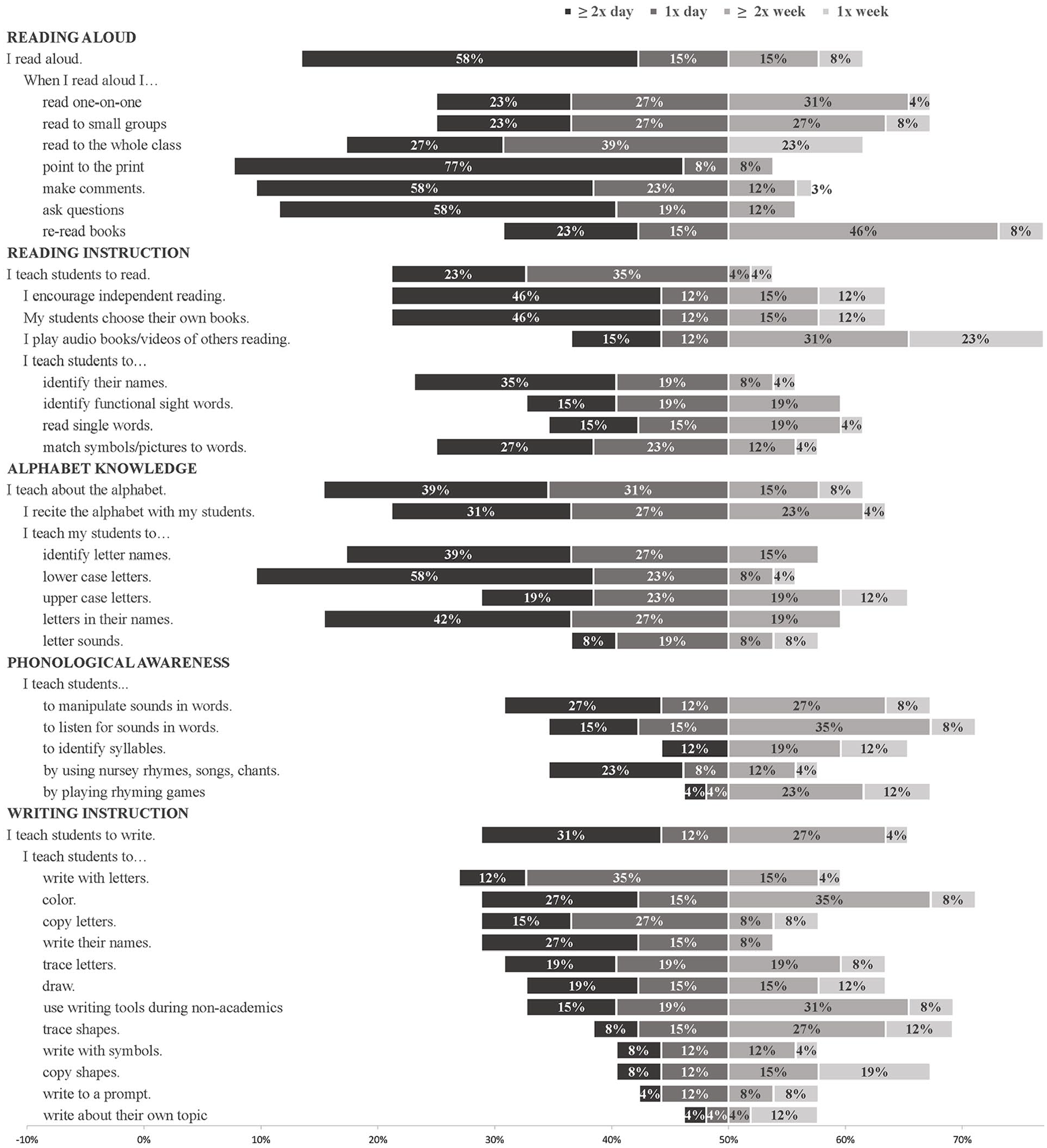
Frequency of reported instructional practices.
Items about instructional practices were presented as yes/no statements (i.e., “I read aloud to my target students”). Teachers then reported the frequency for each item with a yes response. First, they indicated whether the practice occurred daily, weekly, or yearly. Then they chose a number from a drop-down menu to indicate how frequently it happened each day, week, or year. For example, a teacher who read to their class twice a day, would respond yes to “I read aloud” and then select daily and 2. Survey responses are reported herein using descriptive statistics. All statistical analyses were completed using SPSS 29.0.1.0 for Mac OS.
Validity and Internal Consistency
To establish evidence of content validity, four PhD-level researchers with expertise in literacy and students with ESN/CCN, two in special education and two in speech-language pathology, reviewed the survey items. The final survey included their suggestions for including, excluding and revising items. Teacher reports of the number of times they used the instructional strategies within each cluster of items was used to determine the internal consistency of the survey. All clusters had high levels of internal consistency: read aloud (α = .840), reading instruction (α = .926), writing (α = .916), alphabet knowledge (α = .892), phonological awareness (α = .913), and AAC (α = .958).
Multiple Case Study
Direct observations were conducted in two K-5 self-contained special education classrooms in two general education public schools in one local education agency. The classrooms were randomly selected from a convenience sample of seven consented elementary grades teachers. Because none of the participating teachers taught in inclusive settings, it was not possible to sample outside of segregated classrooms.
Participants
The teacher participants were licensed in their state to teach special education. Pseudonyms are used throughout.
Maggie’s elementary classroom. Maggie was a White woman in her mid-20s who had been teaching students with ESN for 6 years. Maggie held a bachelor’s degree in special education and certifications in K-12 special education general and adaptive curriculum. At the time of the study Maggie had been teaching in her K-2 “life skills” classroom for 3 years. She taught five students all of whom she reported as having ESN/CCN. Maggie’s classroom was set up around an interactive board with a carpet beneath it. Her desk and a kidney-shaped table were placed on either side of the carpet. She had small tables that could each seat four students arranged throughout the rest of the room. There was a library in a back corner, with comfortable places to sit and a bookshelf with book covers facing out. Two teaching assistants worked in her room. They typically sat next to individual students at small tables.
Maggie was observed to use rotations to organize her academic instructional blocks (i.e., English Language Arts and Math), dividing the number of minutes in the block by the number of students in attendance. As a result, each student spent 10 to 15 minutes a day with Maggie working on academic skills and the remaining time working at independent workstations placed at a different table dispersed throughout the room. These stations featured worksheets, sensory bins, and file folder activities. Maggie was observed providing whole-group instruction during morning circle time.
Alice’s elementary classroom. Alice was a White woman in her mid-30s who had been teaching for 6 years and was in her second year teaching students with ESN in her K-5 “life skills” classroom. She held a bachelor’s degree in elementary education. Alice taught nine students, five of whom she reported as having ESN/CCN. Alice’s classroom had a rug centered on the floor in front of an interactive whiteboard. Students had assigned seats, with most sitting at desks grouped in the center of the room. Three students sat at carrels that faced the wall in a back corner of the classroom. One carrel was positioned in the corner and surrounded on three sides by blue athletic mats standing vertically. The three teaching assistants assigned to Alice’s room typically sat in chairs around the periphery of the classroom.
During observations, Alice worked with students one at a time at a table in the back of the classroom. When students were not with Alice, they were completing worksheets at their desks or engaging in leisure activities on iPads. When asked, Maggie said that she would like to do whole group instruction, but that she couldn’t because of student “behaviors.”
Student characteristics. All consented student participants had ESN/CCN, emergent rather than conventional literacy skills, and were on the class roster of a consenting teacher. Non-consenting students were not included in field notes or the results of this study.
Observations
The first author observed both classrooms 3 times over 4 months. Using classroom schedules provided by the teachers, initial observations were scheduled during instructional blocks most likely to include literacy learning opportunities (e.g., English language arts) as reported on classroom scheduled provided by the teachers. Subsequent observations during other academic periods (e.g., morning meetings). Observations began at the agreed-upon time and ended when instruction ended. A total of 240 minutes of instruction across the two classrooms, with observations lasting between 30 and 75 minutes (M = 48).
Data Sources
Sources of data included field notes, spontaneous conversations with teachers, memos, and photos. The first author used an observation guide, described below, to collect field notes and took photos of literacy (e.g., books and writing tools) and AAC-related artifacts (e.g., low- and high-tech AAC systems) in each classroom during initial observations. Additional photos were taken as artifacts changed or were introduced (e.g., new books, new technology).
Observation guide. Observations began by recording the teacher’s name, the names and roles of other adults, the number of students in the classroom, the names of the consenting students, and the intended instructional routine or activity listed on the classroom schedule. Subsequently, descriptive, timestamped field notes were written detailing the instruction provided in the classroom, as well as any spontaneous conversations that occurred with the teacher. Particular attention to the categories of instruction targeted in the teacher survey (i.e., reading: shared reading, independent reading, sight word instruction; writing: independent writing, teacher supported or mediated writing; alphabet and phonological awareness; and communication) and the context surrounding the instruction (e.g., materials, group size, peer interaction, and adult involvement). In the hours following each observation, field notes were promptly expanded (Bogdan & Biklen, 2016).
Data analysis. The qualitative data were analyzed thematically by the first author using constant comparative methods (Charmaz, 2014). This involved recording, classifying, and comparing the data as it was being collected. Focused coding then synthesized the codes that emerged as most important and applied them to a broader portion of the data to test their adequacy. Subsequent theoretical coding involved integrating codes by relating them to one another to identify categories. For example, initial emerging codes related to instruction (i.e., one-on-one instruction, teacher focus, student experience, teacher repeating lessons, students waiting, timed rotations) were integrated to the theoretical code of imbalance between instructional effort and OTL.
Credibility and trustworthiness. Procedures to address credibility included peer debriefing and member checking. Peer debriefing was used to gather feedback that improved the quality of the inquiry (Guba, 1981). The first author completed member checks at the end of each observation when she asked teachers if the observed session represented what typically occurred in their classroom. Their responses and ensuing conversations were added to field notes. Importantly, teacher responses indicated that the observation periods were reflective of their normal instruction. In fact, at the end of the second observation, Maggie said, “You have seen everything we do academically.”
Results
The quantitative and qualitative analysis include important patterns related to teachers’ reported and enacted emergent literacy instruction. We report the quantitative results first, followed by the qualitative results beginning with the convergence and divergence with the survey data followed by the thematic results.
Quantitative Results
The survey data represent responses from special education teachers (N = 26) who taught in 14 different schools across five states (i.e., CA, NY, NC, OH, VA). All elementary school teachers (n = 22) indicated they taught in multi-grades classrooms, with two to six grades represented in each class (e.g., K-5, 2-4; Mdn = 6) which is consistent with the educational placement of most young children with ESN/CCN in the United States (Lazarus & Quinlan, 2003) (see Table 1 for full teacher and classroom characteristics).
Teacher and Classroom Characteristics (N = 26).
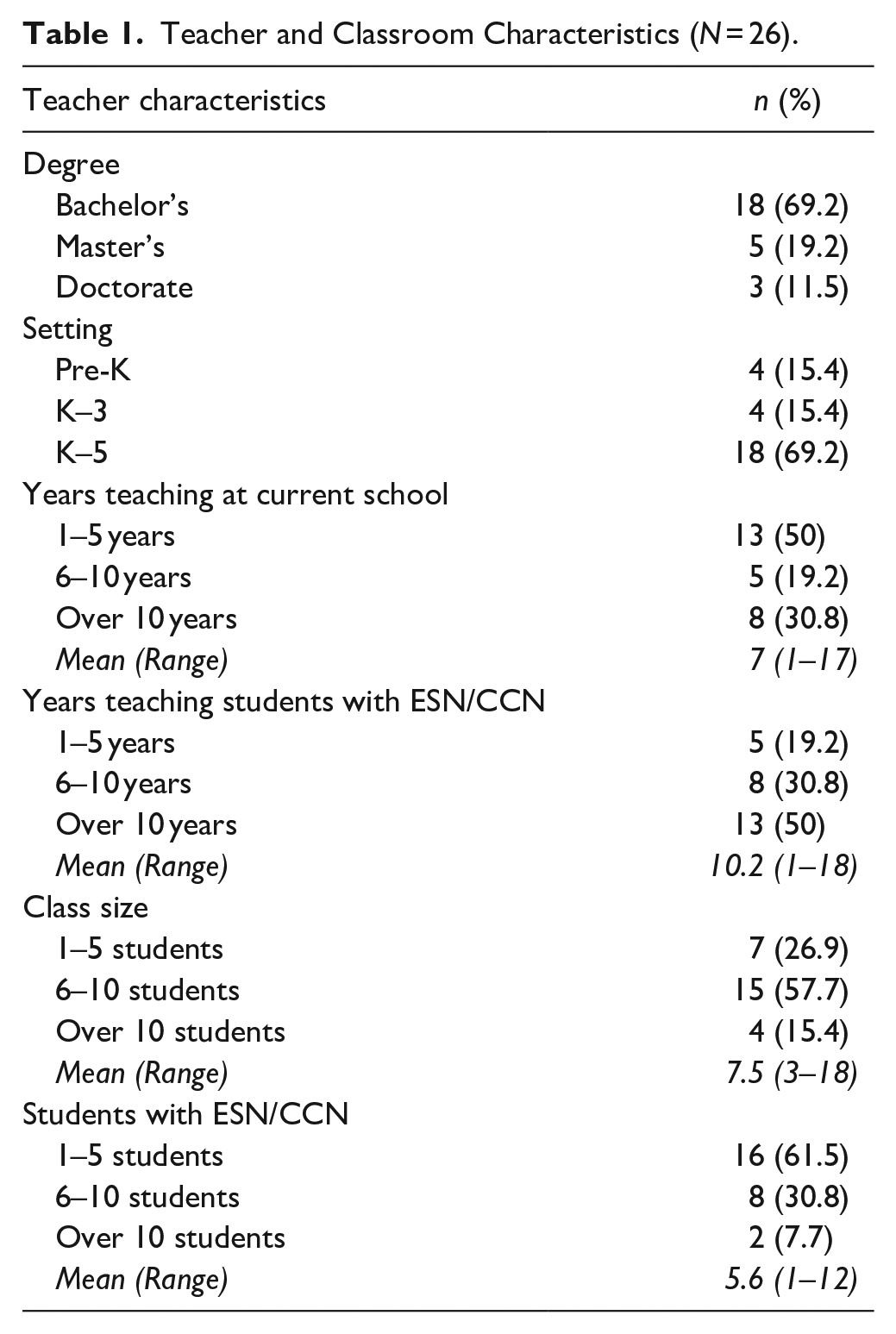
Reported Emergent Literacy Instructional Practices
Most teachers (n = 15, 57.7%) reported spending ≥120 minutes on academic instruction each day with their students with ESN/CCN. The rest reported spending between 60 and 119 minutes (n = 6, 23.1%) or <60 minutes 19.2% (n = 5) daily. Most reported that their students with ESN/CCN had access to personal AAC systems (n = 20, 76.9%), which were available to them daily during academic (n = 20, 76.9%) and non-academic (n = 19, 73.1%) periods.
Across all domains of emergent literacy (i.e., reading, writing, alphabet knowledge, phonological awareness), teachers on average reported using 65.6% (range = 26.1–93.5%) of the 46 practices. There were not any practices that all teachers reported using. Teachers were most likely to report reading aloud (n = 25, 96.2%) followed by instruction focused on the alphabet (n = 24, 92.3%), writing (n = 19, 73.1%), phonological awareness (n = 19, 73.1%), and reading (n = 17, 65.4%). Figure 1 presents the percentage of teachers who reported using each instructional practice, followed by the percentage of teachers who reported they used that practice 2 or more times each day, 1 time each day, 2 or more times each week, and once each week.
Multiple Case Study
Both Maggie and Amy completed the survey in addition to being observed for the multiple case study; however, we did not compare their individual responses to the fieldnotes, as our purpose was to understand the relationship between observations and the complete survey data. We analyzed fieldnotes from the multiple case study both in comparison to the survey results and using constant comparative methods to identify themes.
Convergence and Divergence With the Survey
The instructional routines we observed largely converged with the survey data. Specifically, the prevalence of instructional routines followed the same order, with teachers most often reading aloud to students, followed by instruction focused on alphabet knowledge, phonological awareness, writing, and reading instruction. Teachers most often provided instruction to students individually. Students also spent time completing worksheets and file folder activities many of which focused on copying and tracing individual letters or matching letters in file folders activities. This helps to explain why most teachers reported teaching about letters but less than half (n = 11, 42.3%) reported that they taught letter sounds.
Consistent with the low percentage of teachers who reported that they taught their students to write in response to prompts (n = 8; 31.1%) or about their own topics (n = 6, 23.1%), students in the observed classrooms were not given opportunities to learn to write to convey meaning. Rather, they used writing tools to color, copy, trace, and draw, which are all practices reported at relatively high rates in the survey. Unlike the 85% of survey respondents who reported that they encourage independent reading, students were not observed to have any opportunities to read independently.
We observed both teachers working with students one at a time using pre-packaged curricula and materials to provide instruction. Maggie used the Early Literacy Skill Builder (ELSB, D. Browder et al., 2007) curriculum. This meant students completed different literacy practices depending on where they were in the curriculum, but generally activities included word identification, listening comprehension, listening for sounds in words, and copying single words. Though Maggie used the lessons in ELSB, she did not apply the system of least prompts, constant time delay procedures, or corrective feedback that are recommended. Alice used Raz-Kids (Learning A-Z, 2023), an online, leveled reading program focused on listening comprehension (i.e., answering questions after listening to a text read aloud). She used materials made by other teachers for phonological awareness and explained: “I like them because they have short vowels, long vowels, blends, everything in the packet.” Consistent with the survey data, these activities mostly centered around students listening for sounds in words, rather than having opportunities to manipulate sounds themselves. Regardless of the materials, Alice encouraged students but did not use systematic prompts or other forms of systematic instruction.
Access to AAC differed dramatically between the survey data and our classroom observations. On the survey, most teachers (76.9%) reported that their students had access to personal AAC systems and that these systems were available during academic (76.9%) and non-academic (73.1%) routines. However, students in the case study were observed to have restricted access to AAC systems, though AAC devices were present in both classrooms. Unfortunately, we only observed a single use of an AAC device.
Thematic Analysis
We focused out thematic analysis on the experiences of teachers and students in the natural context of their separate special education classrooms. This resulted in myriad codes that developed into sub-themes. For example, teachers relied on curricula, worksheets, and structured lessons to provide literacy instruction with an emphasis on form (e.g., correctly formed letters and words) over function (e.g., writing to communicate with others). Further, classroom management strategies resulted in instructional formats that prioritized adult-directed routines with individual students. Comparison and synthesis of these codes and sub-themes over time led to the development of two overarching themes: (a) there were imbalances between instructional effort and student OTL, and (b) limited and restricted access to AAC that related to teacher beliefs and self-efficacy.
Imbalances Between Teacher Effort and Student OTL
Teacher’s efforts to provide individual instruction to their students were not proportional to their students’ OTL. Specifically, teacher effort outweighed student’s emergent literacy learning opportunities. This imbalance was largely explained by the teachers’ use of one-on-one instruction, which resulted in teachers repeating the same lesson(s) several times over an instructional block while students completed a variety of instructional and non-instructional tasks as they waited for their turn. As reported in one excerpt from field notes: Maggie’s class is starting their one hour of reading instruction. All five students check their schedules for the order they will rotate through stations. The stations are: completing ELSB lessons with Maggie individually; letter-matching; word-to-picture matching; coloring worksheets; and exploring a sensory bin. Maggie sets her timer for 12 minutes; when the timer goes off, the students rotate stations.
As Maggie worked with her students one-on-one, she repeated the same instructional practice multiple times. In this example, Maggie taught using the ELSB for an hour, however, after transitions, each student only received about 9 minutes of direct instruction. Similarly, during whole-group instruction, teachers provided students with opportunities in ways that preserved the one-on-one structure. For example, during one observation Maggie read aloud a picture book to the whole class. She stopped on every page of the 24-page book to ask a single student a single question, most often directing questions to students without CCN. As a result, Maggie read and asked questions 24 times, but individual students with ESN/CCN responded to few questions.
The frequency and length of instruction in Alice’s class was similarly impacted by her focus on one-on-one instruction; however, because Alice had nine students, she was unable to work with every student during the time she allotted to literacy instruction each day. Unlike Maggie, Alice did not use a timer to determine the length of the interaction. Rather, she worked with students until they completed an entire lesson on either listening comprehension or phonological awareness. For example, during one visit, we observed Alice working with only two students. She devoted an average of 12 non-consecutive minutes to each as she managed frequent interruptions (i.e., phone calls from the office; other student needs). As Alice worked with each student the rest of the students completed worksheets copying and tracing numbers, drew with markers, danced, and watched YouTube on individual iPads.
Limited and Restricted Access to AAC Related to Teacher Beliefs and Self-Efficacy
Students in both classrooms had infrequent opportunities to use AAC. Additionally, students never used any form of AAC during the academic instruction we observed.
AAC in Maggie’s classroom. During classroom observations, Maggie had a poster-sized AAC core board (i.e., a grid of 36 symbols arranged in six rows with words under each symbol) hanging in the back of her classroom. She had a set of matching, personal-sized boards stacked on her desk. However, neither students nor Maggie used these boards during observations. Students did use individual printed graphic symbols to request their lunch order and then to request a song or video during observations of morning circle time.
Students also interacted with individual graphic symbols on their visual schedules. Adults directed students to their schedules at transitions (e.g., between stations during instructional periods, before lunch, after recess), and students demonstrated understanding by moving symbols to designated locations. For example, before recess the students located the appropriate symbol on their visual schedule, removed it, placed it on a board by the classroom door, and then stood in line to leave. This suggests that the divergence between the survey data and the observational data may be due to differences in understanding what it means for students to have access to personal AAC systems. It may be that teachers perceive these opportunities to interact with picture symbols as being equivalent to having access to a personal AAC system.
AAC in Alice’s classroom. There were four individual AAC core boards (i.e., a grid of 32 symbols arranged in four rows) taped to student desks around Alice’s room, but neither Alice nor the students used them during observations. David was the only student with ESN/CCN (out of eight) observed to use any form of AAC. Most of the time Alice communicated with David by presenting two options orally while raising one and then two fingers. For example, in one observation, Alice approached David as he was drawing and asked, “Is that Mama or Grandma?” while holding up one finger for Mama and two for Grandma. David then raised either one or two fingers to respond.
David was also observed using a robust communication app on an iPad for the single purpose of requesting his lunch order. During one observation, when Alice was taking attendance and recording student lunch orders, she told David, “Get your iPad so you can tell me [your lunch order].” He tried to retrieve it, but it was locked in a charging dock he could not open so he waited for an adult to retrieve it for him. After he made his request (I want pizza chocolate milk) he was instructed to put the iPad back on the charging dock, which was then locked. Alice confirmed this was the only reason David used the app adding, “he was very good about using it to order lunch last year, but this year we use fingers for many things. He is very good at that way of communicating with me.”
In the end, there were students who had personal AAC systems, but their individual opportunities to use those systems across the day were limited and restricted. Furthermore, in completing the survey, teachers were likely providing accurate reports of the presence of materials in their classrooms, but the presence of AAC systems does not automatically translate to opportunities to access and learn how to use those systems.
Impact of teacher beliefs and self-efficacy. The discrepancy between the presence of AAC systems and students’ use of systems may be explained by teachers’ beliefs about their students’ communication and their own self-efficacy. During one observation, Maggie initiated a conversation explaining why she was not using AAC during instruction: I don’t know how to use the core boards. I have been to trainings, and I know I need to use it to talk to them, but I don’t understand how. The training said we aren’t supposed to use it for giving the students directions. She gives the researcher a pointed look. So, I am looking for times to use it. I have tried OPEN sometimes when the students are opening things. But I am just kind of stuck. I really want to do it because I have one student who is wholly nonverbal, and it would be a really good for him if I could start doing it.
Maggie suggested she did not use the core boards because of a perceived lack of knowledge of how to use them. However, she also implied that this decision was informed by her perceptions of her students dis/abilities as she identified a single student who might benefit when all her students had ESN/CCN. Maggie referenced attending trainings, mentioning a specific training that discouraged a practice (i.e., giving directives) that was central to her beliefs about how to interact with her students. Specifically, her pointed look revealed she disagreed with avoiding directives. Classroom observations support this, as Maggie predominantly used directives to communicate with her students. This misalignment between the training and her beliefs was important to understanding why she did not use the core boards or other forms of AAC during instruction.
Simultaneously, the interaction with Maggie revealed that she did know what she should be doing (i.e., avoiding directives when modeling on her students’ core boards during naturally occurring routines). Furthermore, she offered a specific example of enacting this practice by identifying a word (i.e., open) that she could use during frequently occurring routines in her classroom. In sum, Maggie demonstrated evidence that she did know “what to do,” but needed more support to translate this knowledge to practice.
Discussion
Multiple sources of data in this mixed methods study allow us to conclude that teachers in separate special education classrooms are dedicating significant time and effort to literacy instruction. This is encouraging as it suggests teachers value providing literacy instruction to their students. Unfortunately, despite these efforts, individual students with ESN/CCN continue to have insufficient emergent literacy learning opportunities and access to AAC systems to support them in becoming conventional readers, writers, and communicators. These findings support our strengths-based view of disability, which prioritizes the impact of context, supports, and opportunities on student learning (Wehmeyer & Kurth, 2021). Specifically, the results of the current study support our assertion that limited OTL poses a critical barrier that can at least partially explain why so few students with ESN/CCN develop conventional literacy skills.
Instructional Time Available
This study adds important information to our understanding of the ways teachers devote time to reading and writing instruction and the resulting OTL for students. Historically, limited instructional time (i.e., <30 minutes daily) negatively impacted literacy achievement for students with ESN/CCN (Mike, 1995). In the current study, most survey respondents (81%, n = 21) reported dedicating more than an hour a day to literacy instruction and over half (58%, n = 15) reported dedicating at least 2 hours a day. Similarly, Maggie and Alice devoted an hour each day to literacy. This increased time devoted to literacy is promising and should be celebrated.
The mixed methods approach used in the current study led us to recognize an important relationship between this increased time and individual students’ OTL. Direct observations of classrooms revealed an imbalance between the time and effort teachers devoted to literacy instruction and individual student OTL. This reflects prior assertions that classroom-level OTL cannot be generalized to individual students (C. M. D. Connor et al., 2006). Previous studies investigating this difference for individual students with disabilities in general education settings revealed the same imbalance between OTL at the classroom and individual student level (Kurz et al., 2014). Our observational data suggested that this imbalance is likely due to providing instruction to students one at a time. Therefore, we believe there is a need to revisit and further scrutinize recommended instructional practices that are conducted one-on-one or with students responding one-after-another in a group (Collins, 2022). Future research should be designed to explore the impact of varying group sizes and instructional arrangements (Winstead et al., 2019). Such arrangements might help teachers increase students’ individual OTL. Further, such studies might lead researchers to uncover additional barriers teachers face in providing such instruction.
Instructional Focus
In the current study, teachers reported reading aloud as the most frequent and enacted instructional practice for young students with ESN/CCN. Though shared reading is widely accepted as an important instructional practice for emerging readers and writers (NELP, 2008), it is insufficient alone to support students in becoming readers and writers. Therefore, it was encouraging that so many teachers also reported providing instruction related to alphabet knowledge (93%), writing (74%), and phonological awareness (74%). Exploring practices at these broad levels, as has been done in other studies of literacy instruction for students with ESN (Hunt et al., 2022), suggests that students are receiving multicomponent, if not comprehensive emergent literacy instruction. Unfortunately, teachers only report enacting some but not all of the critical practices within these broad domains. This results in instruction that is insufficient to promote the acquisition of foundational emergent literacy skills and understandings.
For example, most teachers (i.e., ≥80%) reported teaching students to recognize upper- and lower-case letter forms and names. However, only 43% reported teaching students letter-sound correspondences. Similarly, during observations, students completed activities focused on identifying and writing letters, but did not receive instruction focused on letter-sound correspondences. Research has long suggested that alphabet instruction should simultaneously focus on upper- and lower-case letter shapes, names, and sounds (Jones et al., 2013). Given the paucity of reported and observed letter-sound instruction, it is not surprising that most students with ESN/CNN read at or below the first-grade level (Burnes & Clark, 2021). Future research should explore why letter-sound correspondences are not being taught, and how to support teachers in providing this instruction that is vital for students to become readers and writers.
Similarly, it is encouraging that most teachers (66%) reported teaching their students to spell and write using letters. However, both data sets reveal that writing instruction focused primarily on forming letters via copying and tracing, rather than learning to write to convey meaning. Without opportunities to learn to write to convey meaning, students with ESN/CCN will fail to reap the benefits that literacy can provide in supporting precise communication (Koppenhaver & Williams, 2010). Future research should investigate how to support teachers in providing emergent writing instruction to students with ESN/CCN that goes beyond copying and tracing.
Access to AAC Systems
The students in the current investigation were observed to have limited access to personal AAC systems. This is despite most teachers (i.e., >70%) reporting their students had access to personal AAC systems throughout academic and non-academic parts of the school day. Future research is required to fully understand this discrepancy. However, the qualitative data suggest that teacher’s perceptions of their self-efficacy impacted their use of AAC with their students. This suggests future research might investigate teacher preparation, both pre- and in-service, to identify gaps in training as a potential barrier to implementation. Simultaneously research is needed to understand how to best support teachers in feeling confident in providing access to and use of AAC systems. For example, though Maggie referenced multiple trainings she attended related to AAC and communication instruction, they did not result in increased instruction beyond modeling language in a single routine (i.e., opening items). As such, increased attention to improving training models is warranted. Additionally, future research should investigate teachers’ understanding of what it means to have access to a personal AAC system as well as the decisions they make about the use of students’ AAC devices during instruction.
Limited and restricted access to AAC is concerning. Emerging evidence supports that students with ESN/CCN make gains in (a) emergent literacy skills when they have access to personal AAC systems during instructional and non-instructional routines (Erickson et al., 2021), and (b) expressive communication when those personal AAC systems are embedded into emergent literacy instructional routines (Benson-Goldberg et al., 2022). Education teams should work to provide access to and incorporate personal AAC devices during instruction. U.S. law indeed requires this (ADA, 2004; IDEA, 2004), but even more importantly, communication is a basic human right. This is reason enough to ensure access to and use of AAC systems for all students with ESN/CCN. Future research should focus on why this is not widely accepted or implemented in practice. This research should go beyond looking at individual teachers’ practices and investigate systemic barriers that might be limiting access, as well as the role of other related service providers (e.g., assistive technology specialists, speech-language pathologists) in providing access to AAC systems, instruction, and intervention.
Limitations
Though this study resulted in important insights regarding current practice, there are limitations. Of primary concern is that the survey relied on self-reported data from teachers. As with all self-reported data, teachers are likely to have difficulty accurately reporting their own behavior. Furthermore, self-reports introduce concerns regarding the social desirability of reporting that certain practices are occurring. Given this, some of the responses may be inflated.
The findings are also limited by the sampling technique. All respondents were part of a larger study aimed at supporting them in addressing their students’ literacy and communication needs. Given their interest in literacy and communication, their instructional practices might not be representative of the population of teachers who teach students with ESN/CCN in separate special education classrooms. The population of teachers of students with ESN/CCN may devote far less time to literacy instruction and provide less access to personal AAC. As a result, students with ESN/CCN in separate special education classrooms across the United States may have even more limited access to literacy and AAC than reported here.
Conclusion
Students with ESN/CCN require access to literacy, specifically spelling and writing, as a means of communicating precisely what they want, to whom they want, when they want. For this reason, it is of the utmost importance that students with ESN/CCN have sufficient emergent literacy learning opportunities so that they might build essential, foundational knowledge, skills, and understandings upon which they can build conventional reading and writing skills. The findings of the current study suggest that individual students have limited opportunity to learn emergent literacy, despite their teachers devoting significant instructional time and effort to providing literacy instruction each day. This suggests the need to explore grouping and other aspects of instruction that might do more to balance teacher effort with student opportunity to learn. Further, the findings suggest that although teachers are devoting time to literacy instruction, they are not providing comprehensive instruction. Rather, they are focused on just a few instructional routines. These results should not be discouraging, rather, they highlight the opportunity to provide teachers with supports to maximize the instructional time they are devoting to literacy learning so that all students with ESN/CCN receive sufficient literacy learning opportunities.
Footnotes
Declaration of Conflicting Interests
The author(s) declared no potential conflicts of interest with respect to the research, authorship, and/or publication of this article.
Funding
This document was produced in part under U.S. Department of Education, Office of Special Education Programs grants no. H327S140017 and no. H327S160005. The views expressed herein do not necessarily represent the positions or policies of the department of education. No official endorsement by the U.S. Department of Education of any product, commodity, service, or enterprise mentioned in this publication is intended or should be inferred.