




Abstract
Studies on the effective use of social media for academic purposes are not new, but limited studies exist on undergraduate students’ perceived social media use. Anchored on Grounded Theory, this study explored undergraduate student perception of social media use at two universities in the Philippines and the Kyrgyz Republic. Results show that undergraduates use social media for communication, education, awareness of current events, entertainment, self-expression, doing and engaging in business, and as a source of motivation and inspiration. Moreover, the perceived negative impact of social media use includes a negative impact on health, productivity, psychological and mental health, socialization, and information veracity. Slight differences between the two groups were noted. A reflection on the opportunities and threats of social media use deduced from the findings vis-à-vis the literature are provided.
Introduction
Perhaps one of the definitive characteristics of today's age is the use of social media. The advances and innovations made with smartphones and other information and communication technologies are also the increasing access and use of social media across races, ages, genders, and fields. This also includes the use of social media for academic purposes (Doleck & Lajoie, 2018; Doleck et al., 2017). Aichner et al. (2020) synthesized and outlined social media applications and definitions between 1994 and 2019 in a review, and among the most recent is the one by Bishop (2019), who defined social media as “any online resource that is designed to facilitate engagement between individuals (p.61).” In this study, social media use refers to the undergraduates’ perceived use of social networking applications and sites such as Facebook, Instagram, Twitter, YouTube, WhatsApp, and TikTok, not to mention professional social media platforms such as LinkedIn, ResearchGate, and Academia among others.
More than a decade ago, Kaplan and Haenlein (2010) investigated and reported the opportunities and challenges of social media, including the following categories: collaboration projects, blogs, content communities, social networking sites, and virtual games and social worlds. In the academic context, a study by Chugh and Ruhi (2018) associated the educational use of Facebook with increased teacher-student and student-student interaction, improved performance, convenience of learning, and higher engagement, as well as potential educators’ dominance and privacy concerns. Additionally, Manca (2020) explored how social media platforms are integrated into higher education teaching and learning. Although more than half of the literature is of Middle Eastern and Asian origins, most were in the context of second and foreign language learning (Manca, 2020).
Broadly, the literature reported an array of social media use, for example, in organizational adaptation as a response to natural hazards in Jiangsu Province, China (Haibo & Wu, 2022), and non-profit organizations with 355 public relations practitioners in Jordan (Albanna et al., 2022). Social media use is also explored in disaster management of underserved African-American communities in Southeast Texas (Ramakrishnan et al., 2022), urban governance, and collaborative planning (Lin, 2022). There is also a civic engagement of 6300 participants aged 18 and up from the United States, United Kingdom, France, and Canada (Boulianne, 2022). Not to mention small and medium enterprises, such as the study of Borah et al. (2022) with 549 employes of small and medium enterprises and the study of Suharto et al. (2022) with 222 e-commerce customers in Indonesia.
Moreover, the use of social media is explored along with sustainable fashion and benefits communication through analysis of 1525 images and captions and 140,000 comments from social media pages (Zhao et al., 2022). The literature also reports social media use in tourism marketing with 290 tourists visiting Banten Province, Indonesia (Juliana et al., 2022), and transportation infrastructure investment capital development of 378 Vietnamese companies (Cu et al., 2022).
Further, scholars also reported the influence of social media use along with intimate social relationships, such as romantic relationships of 373 individuals aged 18 to 35 years old (Arikewuyo et al., 2022) and individuals with up to 20 best/close friends (Sutcliffe et al., 2022). There is also an association between social media use and political participation among 410 young Pakistani voters (Tariq et al., 2022) and the well-being of passive and active social media users of mixed ages (Roberts & David, 2020). The literature also reports social media use in the context of the food wastage attitude of 525 household representatives aged 18 to 60 years old from the United Arab Emirates (Osail et al., 2022) and alcohol use and addiction among 3096 Norwegian adolescents, with a mean age of 14.3 years old (Brunborg et al., 2022). Research on social media use is also available along with the psychological needs satisfaction of 815 college students aged 17 to 23 years old from Shanxi, China (Xie et al., 2018), and fear of missing out of 565 college students from a large United States university (Roberts & David, 2020), including alexithymia, narcissism, and social anxiety of 217 young adults aged 18 to 35 years old from Queensland, Australia (Lyvers et al., 2022).
The essential antecedents to social media use reported by literature include performance and effort expectancy, facilitating conditions, social influence, and management commitment (Albanna et al., 2022). In addition, on the one hand, social media use is influenced by attitude, social norms, technical knowledge, resources, skills, and perceived reciprocal benefits (Arif et al., 2022). On the other hand, social media use is influenced by satisfaction, perceived usefulness, information quality, and social support (Khan & Saleh, 2022). Orji et al. (2022) noted that among the antecedents to the pedagogical use of social media include the adequacy of budget allocation, technical competence, a sufficient level of privacy, and an effective governance framework.
Moving on, equally important literature also reported using social media for academic purposes (Doleck & Lajoie, 2018; Doleck et al., 2017). Table 1 enumerates the use of social media for academic purposes as synthesized from the literature.
Enumeration of Social media use for Academic Purposes.
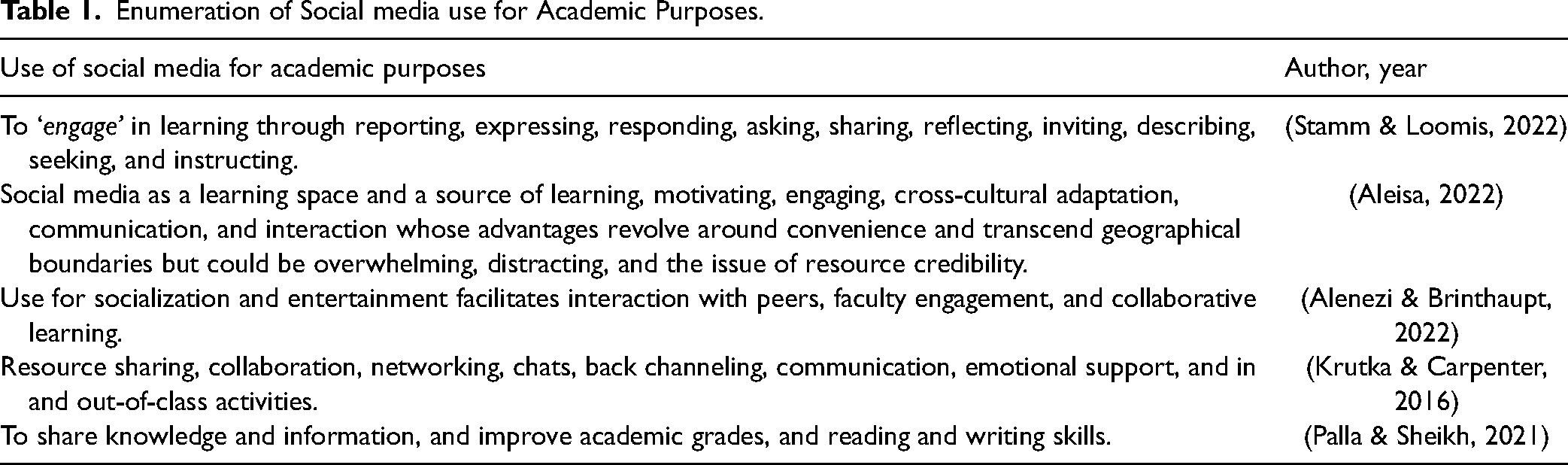
Despite the above-mentioned social media use for academic purposes, the influence of social media use on academic performance is inconsistent (Hameed et al., 2022). Various studies present diverse perspectives on the relationship between social media use and academic performance. Ahmad & Obeidallah (2019), Alshalawi (2022), Barton et al. (2021), and Feroz et al. (2022) reported a positive influence of social media use on academic performance. On the contrary, Doleck et al. (2017), Khaola et al. (2022) and Lau (2017) found that utilizing social media for academic purposes had no significant impact on academic performance. Meanwhile, Cao and Tian (2022), and Kokoç (2021) highlighted studies indicating a negative impact of social media use on academic performance. This array of findings underscores the complexity of the relationship, emphasizing the need for nuanced understanding and further research in this dynamic field.
This paper reports a Grounded Theory study that explored undergraduates’ perception of social media use and a reflection of its opportunities and threats as deduced from the findings vis-à-vis the literature. Notably, limited studies explored undergraduates’ perceptions of social media use, much more so in the Philippine and Kyrgyz contexts. The researchers hope that knowing and understanding the perceived use of social media among undergraduates may be the first step to ensuring the meaningful use of social media. It contributes to the discourse on the academic use of social media by providing baseline information regarding undergraduates’ perceptions of social media use.
Methodology
The methodology of this study was anchored on Grounded Theory from the traditions of Glaser and Strauss (1967) with slight modifications by Strauss and Corbin (1990). Grounded Theory is aimed at discovering/conceiving a theory from qualitative data systematically obtained and analyzed in the social research (Glaser & Strauss, 1967). Charmaz (2001) described Grounded Theory as an inductive research methodology that outlines a procedure of gathering, synthesizing, analyzing, and conceptualizing qualitative data to build a theory from a phenomenon under study. Grounded Theory is a qualitative research design that allows a researcher to simultaneously collect and analyze data to understand the phenomena under study (i.e., undergraduates’ perception of social media use). The complete procedure is divided into three phases, namely (a) open sampling and open coding, (b) relational/variational sampling and axial coding, and (c) discriminant sampling and selective coding. In the case of this study, the said process is depicted in Figure 1.
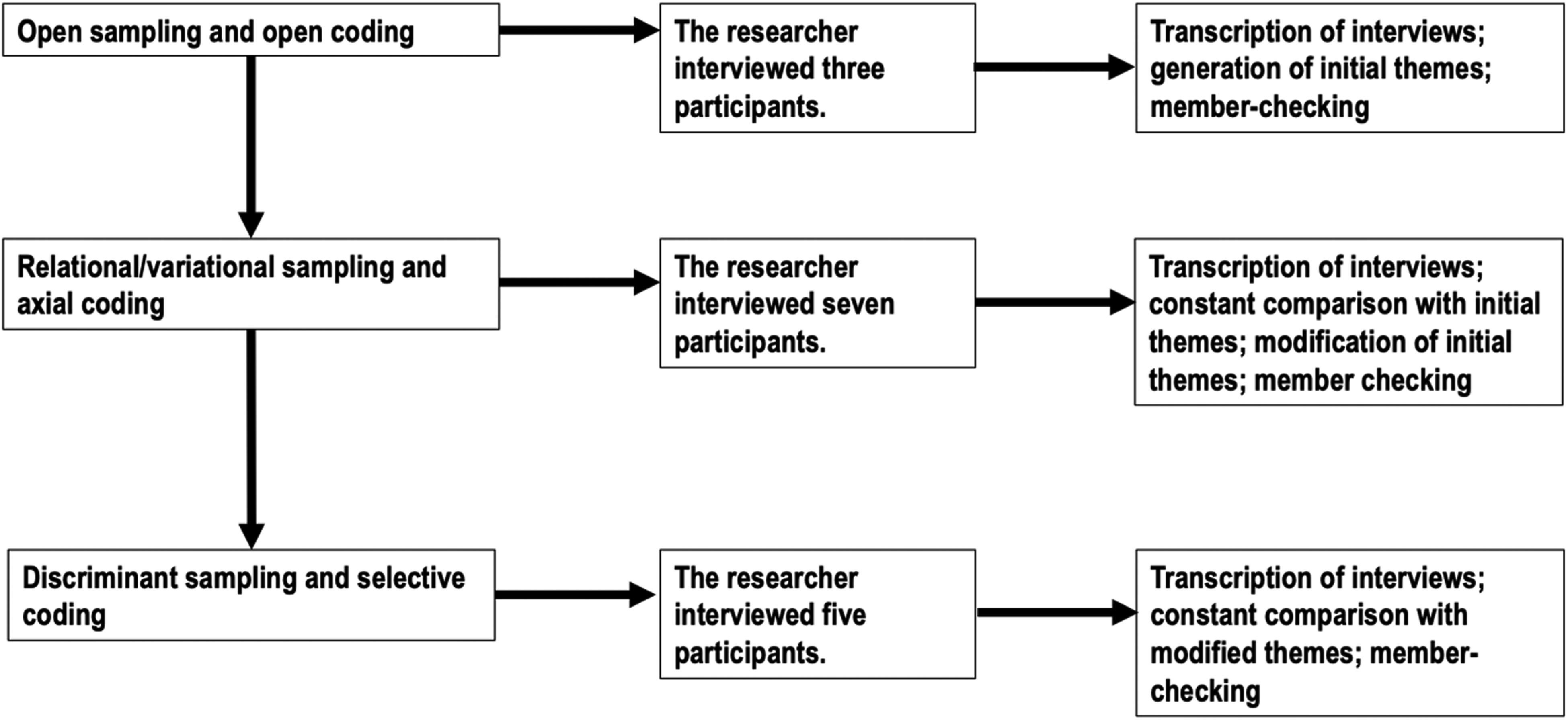
Data collection and analysis.
Open sampling and open coding were aimed at identifying and interviewing participants using strategic questions to generate preliminary emerging themes through constant comparison. Relational/variational sampling and axial coding aimed to identify and interview participants using the same, modified, or new questions to verify the preliminary emerging themes through constant comparison. In this instance, preliminary emerging themes may be modified accordingly based on newly generated data, or new themes may be formed. Finally, discriminant sampling and selective coding aimed to identify and interview participants using the same, modified, or new questions to confirm the themes generated in Phases 1 and 2. To ensure the trustworthiness and credibility of the data collected, interview notes and summaries were shown again to the participants for comments and suggestions until a consensus was reached. Meanwhile, to ensure the trustworthiness and credibility of the data analysis results, themes generated independently by the researchers in Phases 1, 2, and 3 were exchanged accordingly for member-checking and selected participants for comments and suggestions until a consensus was achieved.
The important criterion in deciding to cease the interview is when theoretical saturation is achieved. Theoretical saturation is characterized by already repeating responses, and no new codes or themes are generated. In this study, theoretical saturation was achieved after interviewing 30 informants.
Interview Questions
Three researcher-developed and content-validated strategic interview questions were used in the interview. This includes (a) Why do you use social media? (b) In what ways do social media help you? (c) In what ways does social media impact you negatively? In the Grounded Theory methodology, modifying initial questions or adding new questions may be necessary for clarifying, verifying, confirming, and affirming the responses during the interview and the themes during the constant comparison process. Nevertheless, in this study, no significant questions emerged during the interview and constant comparison process. Each interview lasted about 45 min.
Key Informants
Key informants of this study were 15 Bachelor of Science in Office Administration students from [blinded for review], the Philippines, and 15 Bachelor of Arts in Media and Communications students from the [blinded for review], Kyrgyz Republic. The participants were enrolled during the academic year 2021–2022. Note that there was no specific reason for selecting the study locales apart from them being the researchers’ home universities. Note that one of the key principles in participant selection for Grounded Theory studies is to select informants who can provide rich data and information about the phenomenon under study. This study was possible because both researchers are lecturers at the said universities. Table 2 summarizes the demographic profile of the informants from the two universities.
Age, Year Level, and Gender Distribution of the Informants.
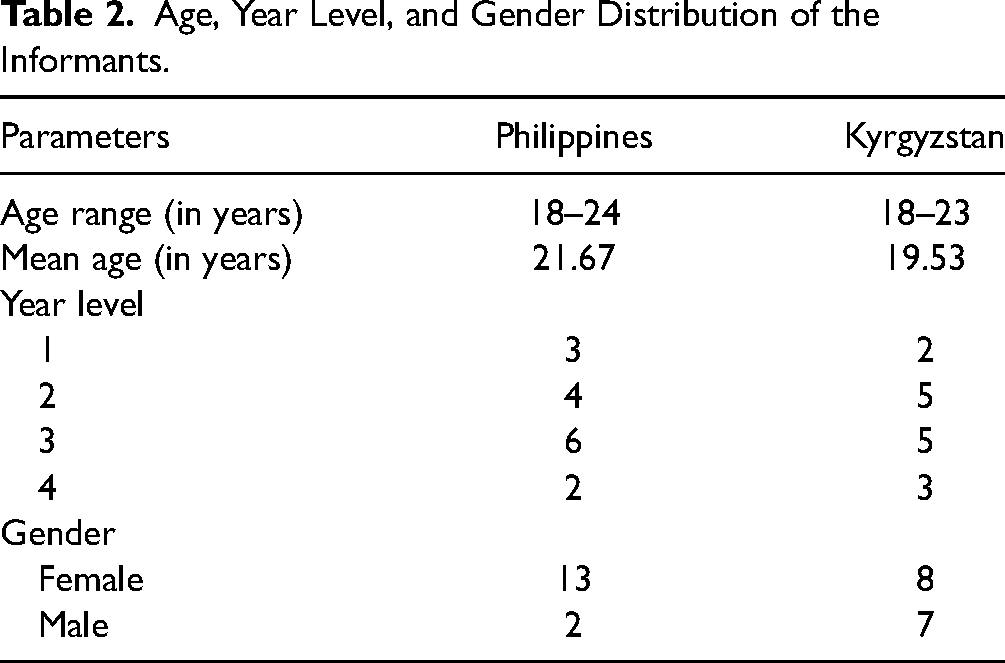
All the informants had at least five active social media accounts at the time of the data collection, such as Facebook, Instagram, VK, Viber, Telegram, YouTube, Google, and TikTok, among others.
Ethics
The ethical compliance of this study was initially reviewed and approved by the Research and Development Office of [blinded for review]. Informants were communicated regarding the importance of their participation in the study. They were assured of the confidentiality and anonymity of their responses and their freedom to skip answering the question/s or discontinue the interview at any point they felt uncomfortable. Informants were asked to sign an informed consent form before the interview.
Results
Results revealed seven emerging themes of perceived social media use among the key informants. These include the use of social media (a) for communication, (b) for education, (c) for awareness of current events, (d) for entertainment, (e) for self-expression, (f) for doing and engaging in business, and (g) as a source of motivation and inspiration. Except for the themes on doing and engaging in business and as a source of motivation and inspiration that only appeared with the Kyrgyz informants, the rest were the same for both groups. Among the most popular social media platforms used by informants include Facebook, Instagram, VK, Viber, Telegram, YouTube, Google, and TikTok.
For Communication Purposes
One important and common theme that emerged from the interviews and constant comparison of interview data is the use of social media for communication purposes, that is, getting in touch with others. The said theme encompasses the use of social media to communicate or reach out to people who are deemed significant to the informants, such as their immediate family members, relatives (e.g., cousins, aunts, uncles), friends, classmates, and teachers, regardless of location (i.e., within the town, province, region, country, or abroad). This is achieved through sending text messages and emails, making voice calls, and video calls. The following are relevant excerpts from the interviews that fall within this theme. “I also communicate to my teacher using social media whenever I have questions, or I ask some clarification on tasks.” “I use Facebook Messenger to talk to my elder sister, who is currently working in Singapore. We talk almost every day; that is why I don’t miss her that much.”
“Every evening, like after dinner, while waiting to be sleepy, I send text messages to my friends and classmates. For example, I send them ‘hi’ or ‘hello’.”
“It is even possible to communicate to people with whom you are familiar but do not know each other and eventually become friends.”
“Using social media helps me keep in touch with people by following them and liking their posts.”
“It is easy to talk to anyone wherever they are as long as you have a smartphone and internet.”
“Anytime I can send a text message or make a call. And when you make a video call, it is almost like talking to someone in person.”
“With a smartphone, communicating is so handy, that there is almost no need to schedule or find a special place to make a call.”
“Communicating is real-time as long as the other person is attentive to their smartphone.”
For Educational Purpose
Another emergent theme is the use of social media for educational purposes. The theme encompasses the use of social media to facilitate one's studies, including searching for content, accessing learning resources, collaborating with classmates, and communicating with teachers. The following are relevant excerpts from the interviews that fall within this theme. “With social media, I can easily ask my classmates about assignments and tasks.” “Most of my courses have respective group chats in Facebook Messenger. Some instructors upload learning resources there or give instructions and updates about the course on a daily or weekly basis.”
“Some lecture notes or website links are shared and uploaded in the group chat.”
“When we have a group activity, we often create a small chat group where we discuss and agree on the tasks.”
“Sometimes I can easily take a photo of my assignment, share it with my classmates or submit it to the instructor.”
“I watch educational videos from YouTube very often to understand the lesson. Some of my teachers send YouTube links to educational videos that are related to our lesson.”
“Watching tutorials on YouTube helps me a lot in understanding concepts.”
“Social media promotes free learning, there are lots of free tutorials, inspirational videos, and speeches that I found useful in my studies.”
“It is easy and convenient to communicate with teachers and classmates using social media through my smartphone.”
“I can submit tasks and assignments easily by uploading to Facebook Messenger or sending them through email.”
“I can simply send a text message or even do a video call when I have some questions to my teacher or classmates.”
“If the topic is very hard, I can easily find educational videos on YouTube that helps me understand the topic.”
For Awareness of Current Events
The third emergent theme of perceived social media use is for awareness of current events. The said theme encompasses the use of social media to get news updates on politics, showbiz, the COVID-19 pandemic, and other current events locally, nationally and globally. The following are relevant excerpts from the interviews that fall within this theme. “With social media, I easily get the latest news updates on politics or whatever is trending in showbiz.” “I follow selected government pages. I even get a notification when there are new uploads.”
“There are some pages of news agencies that I follow on Facebook and Instagram. I get the most recent updates on anything because they automatically appear on my wall whenever I browse the social media on my smartphone.”
“I get the latest events, news, and regulations on COVID-19 from Facebook or the Telegram page of the Department of Health.”
“If I get curious about one event, I can easily browse social media to get more information about it.”
“It is convenient to use social media to get news updates anywhere and anytime just by using a smartphone.”
“I subscribe and follow pages that I am interested so I get immediate notification when they upload new content.”
“It is free and also fast as long as you have the internet.”
For Entertainment
Another emergent theme of social media use, as perceived by the informants, is for entertainment. This theme encapsulates the multifaceted ways in which individuals engage with social media platforms for leisure purposes. It goes beyond mere information exchange or academic pursuits, highlighting the significant role that social media plays in providing a diverse array of recreational content and activities. Whether through engaging videos, entertaining posts, or interactive games, individuals leverage social media as a digital playground for relaxation and enjoyment, contributing to a broader spectrum of experiences beyond the academic or informational aspects. The following are relevant excerpts from the interviews that fall within this theme. “I watch video clips on Facebook or TikTok when I am bored.” “I watch movies and series on YouTube.”
“I play online mobile games.”
“When I want to relax, I play my favorite music playlist on YouTube.”
“I am so fond of watching Chinese or Korean series streamed online when I am free.”
“When I have nothing important things to do, I browse the fan page of my favorite artists. I react on each of their uploads.”
“I follow my idols on social media and I always look at what they are doing and I get to be in touch with other fans.”
“Many movies are free to access, you do not need to buy them.”
“It is so easy and convenient. You can access it anytime and anywhere. I often watch video clips while I am in bed”
“There are many choices of videos, songs, and music. I can play music or songs according to my mood any time.”
For Self-Expression
The fifth emergent theme of social media use is self-expression. This theme encompasses using social media to express oneself, including thoughts, emotions, and activities through texts, photos, or videos. The following are relevant excerpts from the interviews that fall within this theme. “With social media, I can post my photos and videos.” “I can stream live an activity that I am doing or participating in.”
“I can post my comments or opinions freely on social media.”
“I can select contents or quotes representing how I feel that moment and post it on my wall.”
“It is possible to share my whereabouts. For example, if I am traveling or if I am in a café or shopping mall, I can click check-in and I can tag my family and friends too.”
“I can share my hobbies and interests on social media.”
“I think I can share the things or perspectives I want other people to see me at the moment.”
“In many ways, social media can be used as a platform to express ideas and sell your skills.”
“I feel more confident in expressing myself through social media than when expressing myself face-to-face.”
“When sharing my whereabouts on social media, it is possible to edit and select what to post or comment on or even delete them afterward when you change your mind.”
“It is easy to express myself on social media anytime. My friends would know how I feel or what I am doing even if they are not around me physically wherever they are.”
“I feel good when I read the comments section of my Facebook posts when I get support and encouragement from my friends through their comments or smileys.”
For Doing and Engaging in Business
Another emergent theme on social media use that appeared from the responses of the Kyrgyz informants is doing and engaging in business. This theme encompasses using social media to collect and earn money, find recommendations, choose, and buy online. The following are relevant excerpts from the interviews that fall within this theme. “I can find information on products that I am interested in from social media.” “Social media helps me materially; I earn money from social media.”
“I can choose products from the recommendations through social media.”
“I collect money through social media.”
“Buying online through social media is a lot easier.”
“It is easy with your smartphone or laptop to search different products.”
“It really saves time from going to the market, less hassle.”
“It is convenient, with a smartphone you can do transactions anytime.”
Source of Motivation and Inspiration
Finally, the last emerging theme of perceived social media use that only appeared from the responses of the Kyrgyz informants is a source of motivation and inspiration. The theme encompasses using social media to get motivation and inspiration. The following are relevant excerpts from the interviews that fall within this theme. “Social media helps me get inspiration by reading inspirational quotes and watching inspirational videos posted.” “I get motivation from social media. I get inspired by some people that I follow on social media.”
“Social media gives me inspiration for my work. I am a graphic designer and I get a lot of useful information from Instagram.”
“There are various inspirational quotes and videos you can browse online. I search them depending on how I feel.”
“It is so easy to get inspired again just by opening for example Instagram, I can browse inspirational quotes and videos posted.”
“It is so convenient; you can just choose directly motivational videos that fit with what you need at the moment. For example, when I am studying, at one point I browse inspirational videos that would inspire me to study more.”
Perceived Negative Impact of Social Media Use
The key informants were also probed about their perceived negative impact of social media use. Constant comparison of interview data revealed four important themes, including the negative impact of social media use on (a) physical health, (b) productivity, (c) psychological and mental health, (d) socialization, and (e) source of misinformation. Interestingly, except for socialization, which only appeared with the Philippine informants, and source of misinformation, which only appeared with the Kyrgyz informants, the rest of the themes on the perceived negative impact of social media use were similar for both groups. Table 3 shows a summary of excerpts from interviews that relate to the said themes.
Themes and Excerpts of the Perceived Negative Impact of Social Media Use.
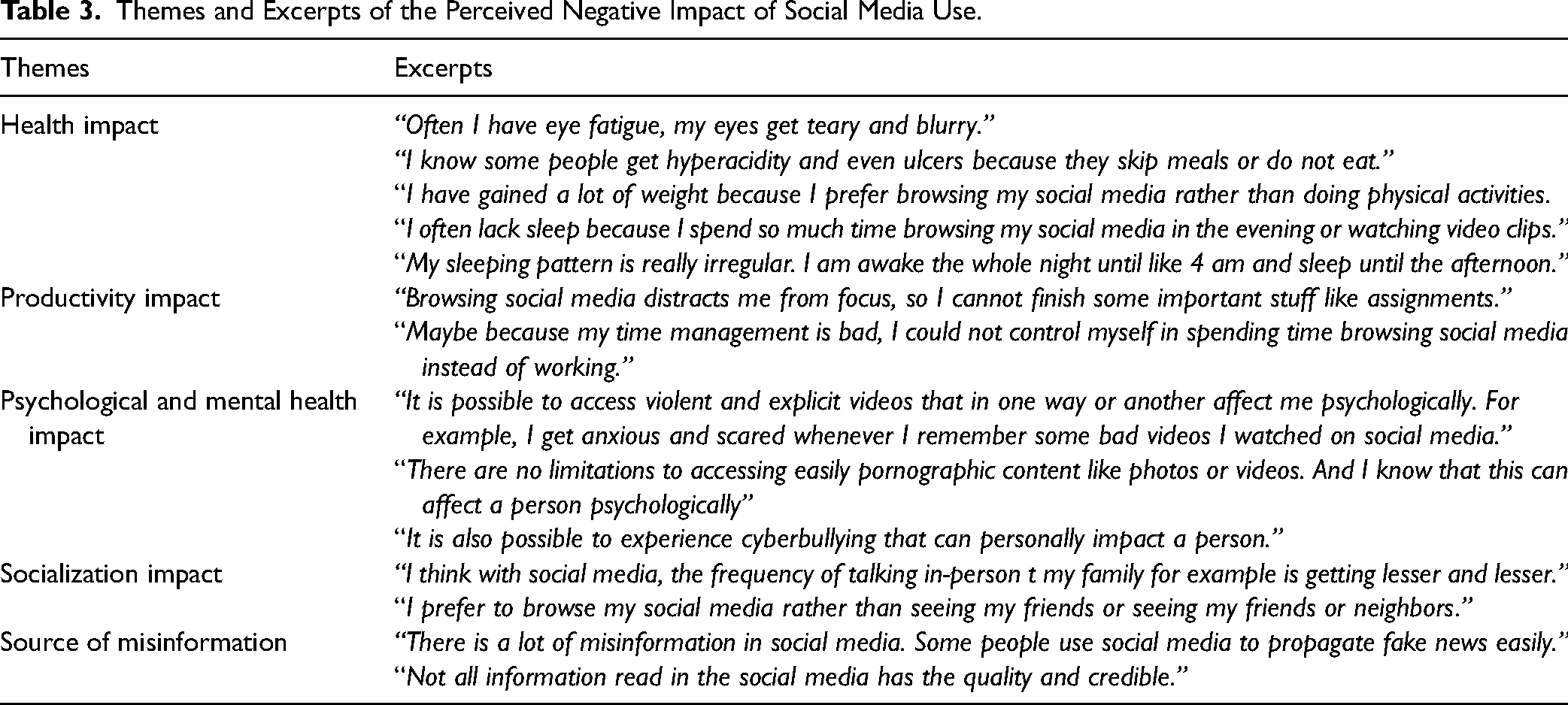
The negative health impact of social media use is associated with a lack of sleep and physical activities. Meanwhile, a negative impact on productivity is associated with the distractions caused by social media use, consequently impacting one's time management. Moreover, negative psychological and mental health impact is associated with ease of access to violent, explicit, and pornographic content and videos, as well as cyberbullying. Finally, the negative impact on socialization is associated with decreasing face-to-face interaction and communication frequency.
Discussions
The current digital era has revealed how social media has significantly influenced people's behaviors, habits, attitudes, and production and consumption patterns (Al-Mulla et al., 2022). The following sub-sections present a synthesis and reflection on social media for effective communication, information dissemination, and social media for academic purposes.
Social Media for Effective Communication and Awareness of Current Events
The use of social media for communication and awareness of current events is not new. This is reported explicitly and implicitly in several studies, such as the use of social media for collaborative planning in organizations (Lin, 2022), adaptation to natural hazards, disaster risk management (Haibo & Wu, 2022; Ramakrishnan et al., 2022), civic engagements (Boulianne, 2022), small and medium enterprises (Borah et al., 2022; Suharto et al., 2022), and tourism (Juliana et al., 2022), including communications for educational purposes (Krutka & Carpenter, 2016; Stamm & Loomis, 2022). The same is true for the use of social media for awareness of current events and important advocacies such as disaster risk reduction (Ogie et al., 2022), environmental preservation (Jones et al., 2022; Lee, 2022), biodiversity conservation (Fukano et al., 2021; Raschke et al., 2022), climate change mitigation and adaptation (Belotti et al., 2022; Rosenthal, 2022), and sustainable development (Hole et al., 2022). In addition, the use of social media for awareness of current events may also be directly or indirectly related to social media use for fear of missing out, which is extensively reported in the literature (Bui et al., 2022; Roberts & David, 2020; Xie et al., 2018).
The present study reported that among the important reasons for the use of social media in these aspects include convenience and ease of use, real-time communication, up-to-date information, and free of cost.
The researchers hypothesize that using social media for communication and awareness of current events among undergraduates may affect essential twenty-first-century skills such as communication and collaboration (Binkley et al., 2012). The availability and use of social media has increased the opportunity for effective and efficient communication and removed significant barriers (e.g., time and space) towards more inclusive collaborations. Social media has added to existing communication channels and increased collaboration opportunities (Lin, 2022; Okonkwo & Awad, 2023).
Nevertheless, informants of this study reported the negative impact of social media use on socialization. Although the researchers recognize that the data collected for this study is insufficient to go deeper into the claim, one thing is certain: social media has indeed impacted socialization. Literature has reported both positive (Alenezi & Brinthaupt, 2022) and negative (Trumello et al., 2021) impacts of social media on socialization. That being so, the researchers see a need to explore the matter further, such as, in what ways can social media strengthen socialization and how to address the negative impacts of social media on socialization.
Social Media for Academic Purposes
A significant number of studies reported the use of social media for academic purposes, including the different strategies and mechanisms used in the different aspects of teaching and learning and other educational processes, as well as its positive and negative impacts. This includes student engagement (Stamm & Loomis, 2022), increasing motivation, cross-cultural adaptation and communication (Aleisa, 2022; Maulana et al., 2019), interaction among faculty, collaborative learning (Alenezi & Brinthaupt, 2022), resource sharing (Krutka & Carpenter, 2016), and improving reading and writing skills (Palla & Sheikh, 2021). However, the literature is inconsistent regarding the impact of social media use on academic performance (Hameed et al., 2022), which suggests numerous research opportunities.
The researchers posit that the pervasive integration of social media and other ICTs into our daily lives, encompassing various facets, including academic studies, leaves little room for complete avoidance. That being said, there is a need to explore effective and efficient strategies and mechanisms that could ascertain their positive impact on academic performance. While social media is just one of the numerous existing forms of ICTs, it certainly has unique implications for teaching and learning disciplinary content and related hard and soft skills. This study revealed that the use of social media for educational purposes is like a double-edged sword; it aids in learning but may result in unproductivity as it brings distraction, consequently affecting one's management of time.
The use of social media for academic purposes and as a source of motivation and inspiration may have implications for independent and lifelong learning (Dabbagh & Castaneda, 2020; Luqman et al., 2020), as well as information and digital literacy (Atman Uslu & Yildiz Durak, 2022; Moore & Hancock, 2022). In the current digital landscape, students may favor leveraging popular social media platforms for knowledge sharing and collaboration, prompting higher education institutions to integrate the optimal features of social media and Learning Management Systems into online delivery (Turnbull et al., 2023).
Again, with certainty, the use of social media has somehow resulted in the accessibility and continuity of the educational processes during the COVID-19 pandemic (Afzal et al., 2022; Connor et al., 2022). Online and distance education may have been in existence for a few decades. However, most, if not all, educational institutions at all levels all over the world were caught off guard during the COVID-19 pandemic. At the periphery, the said experience was an eye-opener towards the lack of preparedness of the education sector for similar incidences. Therefore, there is a need to develop more effective, efficient, and inclusive mechanisms related thereto. Academic use of social media may be further explored and considered as one of the effective and efficient tools for the said purpose.
Practical Significance
The practical significance of the present study includes the need for increased awareness of effective, efficient, and meaningful use of social media and the need to explore other potential uses of social media. The findings suggest the need to increase students’ and other social media users’ awareness of the opportunities it brings and the threats it poses. Such awareness will allow a more informed and responsive use of social media. Social media has offered various forms of entertainment, such as gaming, videos, music, etc., and has become an important addition to existing venues for self-expression with less fear and anxiety (Orehek & Human, 2016) through idealistic virtual self-expression (Bailey et al., 2020). Nevertheless, social media also became a venue for cyberbullying and the propagation of fake news and propaganda (Gisondi et al., 2022). There are also pieces of evidence of cases of social media use addiction, among others (Lyvers et al., 2022; Moretta et al., 2022). Additionally, several scholars have contributed to the ongoing discourse about ethics in social media use (Mahoney et al., 2022) or the professional use of social media (Sharma, 2022; Soubra et al., 2022). In recognition of the advantages and disadvantages of social media use, it may be imperative to develop and implement policy frameworks across sectors and levels to maximize benefits and reduce the threat of social media use.
Undeniably, social media is now part of today's norm. Thus, ensuring an in-depth understanding of the responsibilities and obligations of using social media as associated with freedom of expression is imperative. Indirectly related thereto, studies revealed that their parents influence the amount of time younger users spend online (Sciacca et al., 2022). Similarly, the level of attachment of younger users towards their parents influences internet use and abuse (Belotti et al., 2022). Younger users who feel that their parents are emotionally unavailable and not supportive may resort to social media use to find comfort and social support (Trumello et al., 2021). It implies the need to incorporate information and digital literacy in existing school curricula (Minges et al., 2015) through a more systematized approach (Throuvala et al., 2021).
Along with higher education institutions, social media is increasingly used to enhance brand image and reputation (Ghorbanzadeh & Sharbatiyan, 2024) and institutional communication to disseminate content and establish interaction and dialogue with the public (Capriotti et al., 2024). There is an increasing number of literature on the academic use of social media. Higher education institutions may need to optimize its systematic use as an e-learning tool (Elenurm, 2024). A recent book by McWhirter (2024) elucidated social media in educational contexts across levels, including higher education, and presents concepts such as open-world learning, online and e-learning, digital education policy, and digital competence in educational contexts.
Notably, social media also became an avenue for fake news and misinformation, which may result in psychological stress and poor mental health and well-being (Lan & Tung, 2024; Smith & Storrs, 2023; Zhang et al., 2023). Higher education institutions may take an active role in increasing and advancing the different domains of digital literacy (i.e., procedural, technical, cognitive, and sociocultural) through integration in existing academic programs, co-curricular and/or extracurricular activities, and programs.
Finally, the researchers recognize the numerous emerging social media applications and add-ins, not to mention their everchanging nature. Therefore, exploring other potential uses of social media for more inclusive and proactive environmental and sustainability advocacies, including inclusivity and diversity across various sectors and aspects of society, may be imperative.
Conclusions, Limitations, and Recommendations
Conclusions
This study explored undergraduates’ perceptions of social media use, including its negative impact. Anchored on Grounded Theory methodology, interviews with 30 key informants from a university in the Philippines and a university in the Kyrgyz Republic revealed seven emerging themes of perceived social media use – for communication, for education, for awareness of current events, for entertainment, for self-expression, for doing and engaging in business, and as a source of motivation and inspiration and five emerging themes on perceived negative impact – negative health impact, negative productivity impact, negative psychological and mental health impact, negative impact on socialization, and source of misinformation. Slight differences between the two groups were noted. Themes on doing and engaging in business and as a source of motivation and inspiration only appeared from the responses of Kyrgyz informants. In contrast, the socialization theme only appeared in Philippine informants’ responses. Only Kyrgyz informants mentioned social media as a source of misinformation.
Limitations and Recommendations
In this study, the researchers recognize the inherent limitations of a Grounded Theory study. Hence, it may be necessary to replicate and validate the findings of this study using quantitative, mixed methods, and other relevant research designs using a larger sample size. In addition, it may be necessary to replicate the study in various contexts, considering that studies show the influence of demographic variables on social media use (Laor, 2022; Tammisalo et al., 2022).
This study was limited to the perceived use of social media among undergraduates, including its negative impacts on which emerging themes were identified and presented in this paper. Nevertheless, it may be useful to explore further in-depth the efficient, effective, inclusive, and healthy use of social media, including but not limited to communication, awareness of current events, educational purposes, entertainment, and self-expression. Moreover, considering the number of antecedents and consequences of social media use, a systematic review along this line may be valuable. Further, a study reported the use of social media for entertainment and its negative impact on psychological and mental health. That being so, it may be meaningful to explore the role of social media in improving one's mental health and well-being.
Furthermore, the study did not identify how participants’ social media accounts were used specifically. It may be essential to know how participants use it or to what purpose and extent participants use different social media accounts. Finally, literature, including this study, reported the use of social media for academic purposes; it may be interesting to explore the role of social media in education towards the 4th Industrial Revolution (Wark & Ally, 2020) as characterized by the transformations in various sectors and aspects of the society through the increasing amalgamation of the physical, biological, and digital worlds.
Footnotes
Declaration of Conflicting Interests
The authors declared no potential conflicts of interest with respect to the research, authorship, and/or publication of this article.
Funding
The authors received no financial support for the research, authorship, and/or publication of this article.
