




Abstract
Science fiction has been an inexhaustible source for the creation of technoscientific imaginary that has marked certain historical periods and influenced the production of subjectivity. This imaginary evokes complex ontological, epistemological, political, social, environmental and existential questions on the present and the future. The aim of this study was to identify and characterize the cultural productions accessed by the public to form an opinion about the genetic manipulation of human beings. A survey about sources of information that influence opinions on the genetic manipulation of human beings was applied to 360 medical students (70.8% female). Movies were the most commonly mentioned source of information, followed by books, documentaries, news programs, television series, informational videos, soap operas and videogames. Science fiction was the most frequent genre and dystopian views of the future of humanity predominated.
Introduction
Science fiction has been an inexhaustible source for the creation of technoscientific imaginary that has marked certain historical periods and influenced the production of subjectivity. Although some authors argue that science fiction began in the seventeenth century with the neo-Latin interplanetary voyages (Roberts, 2016), it is widely agreed that this literary genre emerged in Europe in the nineteenth century, within a modern society increasingly led by a scientific and technological culture, and marked by the progressive secularization of the West and the profound transformations generated by the industrial revolution, which brought with it new forms of production, work and labor organization, as well as the advent of large industrial concentrations in cities, changes in living conditions, housing and social relations. While expectations of improving the life of humanity through technoscience are being created, unknown possibilities are opened up about the functioning of future society that are likely to be represented with mistrust and reservations.
This new genre of speculative fiction integrates technoscientific elements as the essential basis of the narrative and explores how humans deal with disruptive changes, whether triggered by natural events, societal changes, technological innovations, or scientific discoveries. The works present visions that are alternative and in contrast to contemporary realities, challenging imagination, convictions and systems of attribution of meaning. While dramatizing these speculative scenarios, the public is constantly faced with philosophical issues and ethical dilemmas that stem from the possible consequences of human actions, being challenged to address hypothetical scenarios (“what if…”), to (re)visit the limits of technoscientific interventions, to (re)evaluate the pros and cons of such applications and to (re)define the framing of (in)human nature. Science fiction therefore explores the eternal anthropological question of what it means to be (post)human in a (post)modern society. For example, Mary Shelley's Frankenstein (1818), considered by many to be the first work of science fiction (Aldiss, 2007; Shattuck, 1996), represents an unscientific narrative that portrays the fascination and mastery of the Human over Nature, but it highlights, above all, the risks of scientific applications and fears of technoscientific progress with gaps in institutional regulation. These fears are embodied by the generation of a monstrous creature which finds itself isolated and rejected in its encounter with the Other, leading to a reflection on the limits of human intervention in the manipulation of life and the boundary between the human and the nonhuman.
Beyond its entertainment dimension, science fiction as a literary and cinematic genre contributes to the creation of technoscientific imaginary that influences the representations that the public has about science and scientists, as well as the fears and expectations about the use by political systems, for example, of science and technology as instruments of power. In fact, a kind of imaginary that makes us travel in time, which occurs in other spaces (underground, outer space, fantasy worlds or parallel universes), which proposes alternative political and social systems, which foresees human evolution and the future of the planet, which speculates on scientific possibilities (time travel or teleportation) and technological applications (brain-computer interface or robotics) or paranormal capabilities (telepathy or telekinesis), which puts us in contact with alien entities or creatures inspired by a fusion between human and machine (cyborgs, androids, avatars or robots) and which anticipates the possibility of improving humanity through genetic manipulation and thereby the control of progeny.
Although the topic of genetic manipulation and selection was present in science fiction literature between the 1940s and 1960s (e.g., Robert Heinlein's Beyond This Horizon, 1948; Frank Herbert's The Eyes of Heisenberg, 1966) (Kirby, 2000), it was with the development, from the 1970s onwards, of different techniques and technologies that allow organisms to be genetically manipulated and transformed effectively – the production of the first molecules through recombinant DNA technology (1972); the birth of the first baby through in vitro fertilization (1978); the production of human insulin by genetically modified bacteria (1986); the start of the ambitious Human Genome Project (1990); the announcement about Dolly the sheep, the first mammal to be cloned (1997); the isolation of human embryonic stem cells (1998); and the genetic editing of animals using the CRISPR/Cas9 technique (2012) – along with the development of computer science, that the debate on human nature and its transformative potential exploded, and in such a way that, in 1998, the Transhumanist Declaration anticipated that “humanity will be radically changed by technology in the future” and “the feasibility of redesigning the human condition” (Bostrom, 2005) will be real. More recently, the Chinese scientist He Jiankui claimed to have used the CRISPR/Cas9 technique to edit two human embryos in order to disable the CCR5 gene, which encodes a protein that allows HIV to infect cells (Cyranoski & Ledford, 2018).
The interest in the biological, as a thematic reference, emerged very early in the development of cinematographic science fiction, especially from two approaches: (1) one more focused on genetic accidents, uncontrolled and unexpected changes in species (exposure to a type of radiation which induces accidental mutations in the human genome, such as in Ishirō Honda's Godzilla, 1954, or Bert Gordon's The Amazing Colossal Man, 1957), and (2) another, more focused on the viability and utility of planned genetic modifications, i.e., changes controlled either by human or alien forces (Parker, 1984), as in Franklin Schaffner's Boys From Brazil, 1978.
However, in the 1990s, biotechnology was arousing special interest, which led to the emergence of biopunk, a subgenre of cyberpunk science fiction (McHale, 1992), marked by the emergence of a posthuman science fiction subculture based on genetic engineering (Herbe, 2012; Schmeink, 2016). Since this decade, there has been a large number of science fiction films about the use of genetic manipulation for different purposes, particularly for control over individuals, identity transformation and species enhancement. In a detailed analysis of films produced between 1956 and 2006, addressing the topic of genetics (cloning, mutations, genetic transformation, creation of new or extinct beings from DNA), Haran et al. (2008) found that, from 1990 to 2006, 71 films were produced, of which 51 were classified in the science fiction genre, far more than the 12 films produced between 1956 and 1989. These films reflect different fears about the consequences of cloning, mutation or manipulation of the genome of organisms, notably the creation of monstrous beings (Alien: Resurrection by Jean-Pierre Jeunet, 1997; or Species by Roger Donaldson, 1995), the involuntary effects of ambitious experiments and loss of control over the results of these experiments (Steven Spielberg's Jurassic Park, 1993), genetic discrimination (Andrew Niccol's GATTACA, 1997; or Michael Winterbottom's Code 46, 2003) or the problem of personal identity and relationships with otherness (Roger Spottiswoode's The 6th Day, 2000; or Michael Bay's The Island, 2005).
Science fiction has therefore contributed greatly to the creation of a genetic imaginary that generates cultural meanings for genetic manipulation (Jörg, 2003; Kirby, 2007; Nelkin & Lindee, 1995; Stacey, 2010; Van Dijck, 1998). This imaginary condenses fears, expectations, fantasies, symbols and discourses around genetic engineering, being assimilated by the public, sometimes at an unconscious level, influencing their representations of body and behavior, moral judgments about their manipulation, the attribution of meaning to human experience and the production of subjectivity.
Identifying literary and cinematographic works and elements broadcast in other media (e.g., television, internet or video games) accessed by the public in day-to-day life contributes to a greater understanding of how technoscientific imaginary influences people's opinions on the role of science and technology in their own life, in society and in the future of humanity. In this sense, the present study aimed to identify and to characterize the cultural productions accessed by medical students to formulate an opinion about the genetic manipulation of human beings.
Method
This study involved 360 medical students from the Faculty of Medicine of the University of Lisbon, 70.8% female, with an average age of 18.57 years (SD = 1.81, [17–30]).
Students completed an online questionnaire describing scenarios related to genetic manipulation of humans and asking which films, documentaries, books, news programs or other sources of information had influenced their views on such interventions.
Responses were clustered by categories of information sources, counting the number of sources and the frequency with which they were mentioned, extracting information about the year and place of production, the author/director and the literary or film genre based on Internet Movie Database rating (http://www.imdb.com). Then, the sources were classified according to (1) genetic manipulation techniques/technologies and (2) the type of beings manipulated and/or generated by them. Finally, the sources were further categorized in terms of visions of the future of humanity – utopian versus dystopian – or, alternatively, according to the precautionary principle versus the proactionary principle (Fuller & Lipinska, 2014). Sources that did not fit into either one of these categories were recorded as “not applicable” (n/a).
Results
Out of 360 students, 139 (38.6%) mentioned at least one movie, book, documentary, news programs or other informative source related to the topic. A total of 170 informative elements were mentioned, clustered in eight categories (Table 1).
Informative Elements Mentioned by Students.
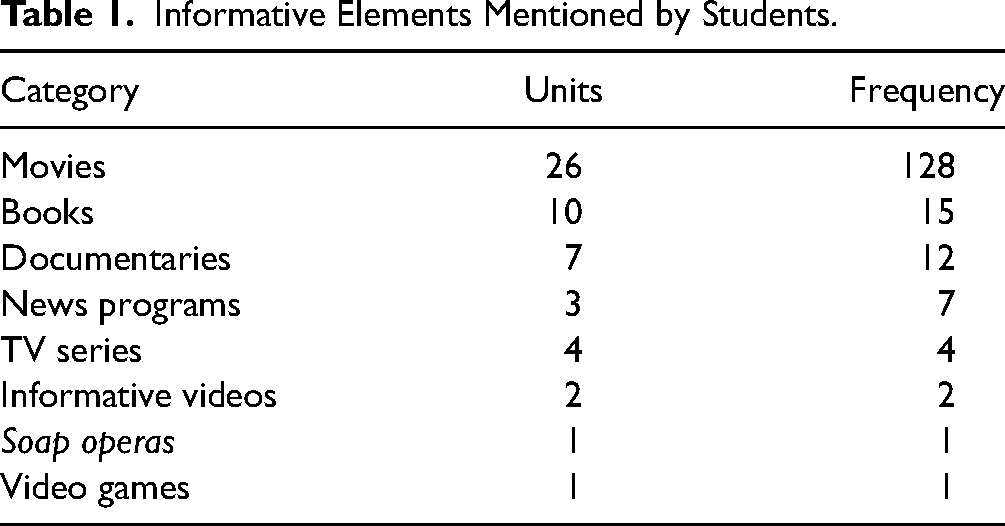
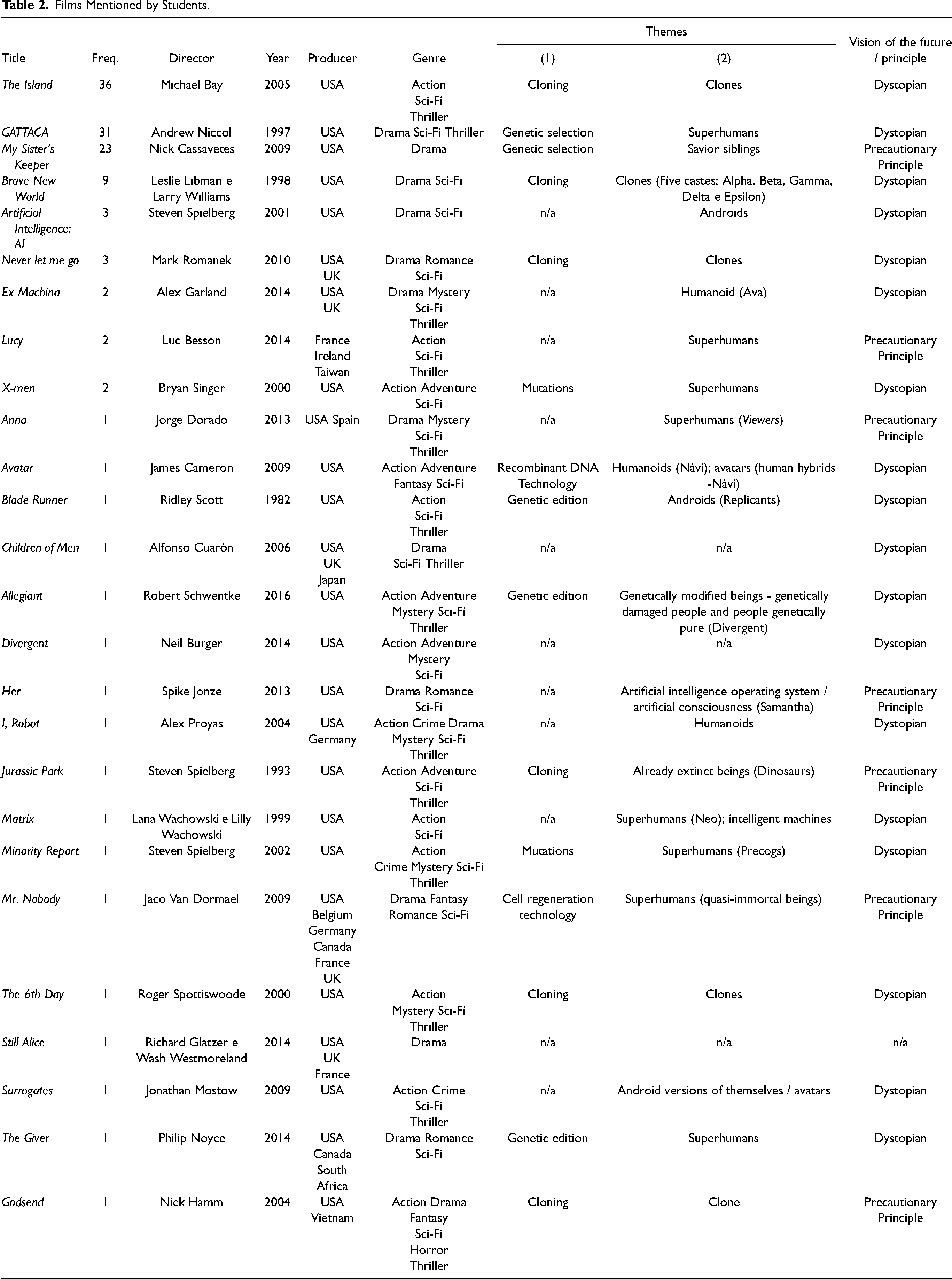
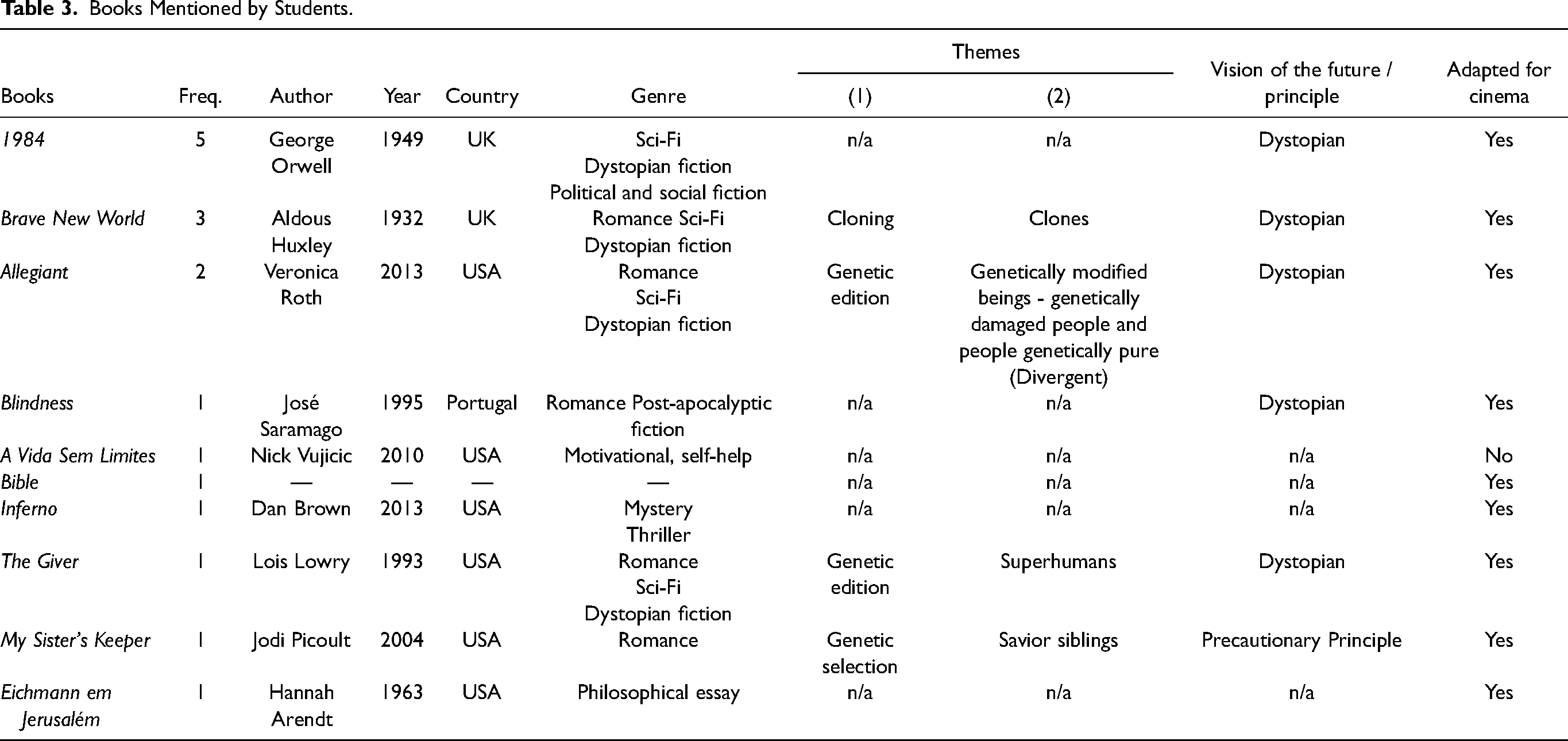
Films and books were the categories with the highest frequency, corresponding to 26 productions (Table 2) and 10 titles (Table 3), respectively, as well as the documentary category. This category included documentaries related to eugenics, particularly in the context of Nazism, to the possibility of genetic manipulation and gene editing, both in therapeutic and aesthetic or social aspects (for example, the selection of physical characteristics such as eye color), to the story of God (namely, The Story of God with Morgan Freeman, an American documentary that premiered in 2016 on the National Geographic Channel), as well as others related to the topic, but which respondents were unable to identify.
Films Mentioned by Students.
Books Mentioned by Students.
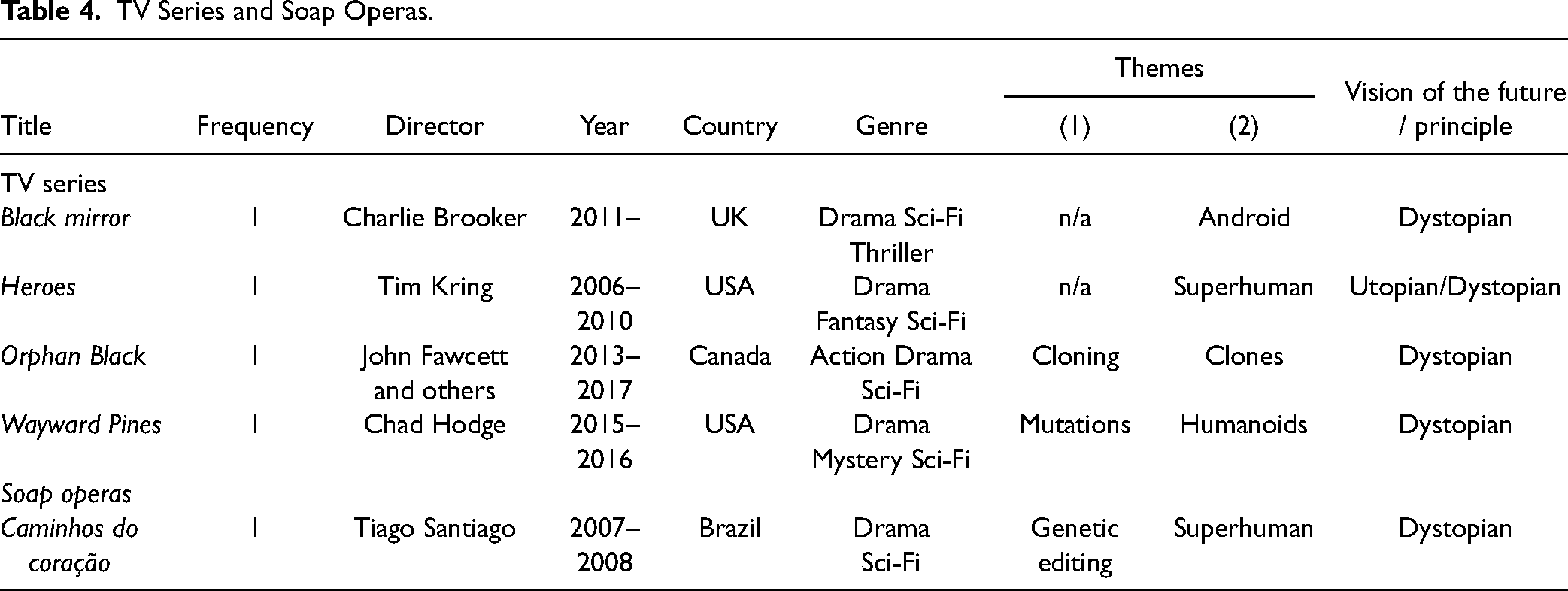
In the remaining categories, the three news programs mentioned were related to human gene editing using the CRISPR/Cas9 technique, armed conflicts and ethical issues associated with an article published in Science magazine on an event in Washington DC, in the United States of America (USA), in 2015, where scientists, doctors and ethicists debated human gene editing. In turn, the two informative videos, viewed on YouTube, were related to genetic engineering and Nick Vujicic's life. Deus Ex was the video game referred to by one of the respondents. The television series and the soap opera are shown in Table 4. Participants mentioned five key words (designer babies, genetic engineering, euthanasia, surrogate mothers, transhumanism) and one historical event (Holocaust).
TV Series and Soap Operas.
The films were mostly produced in the USA (n=15) or co-productions involving American producers (n=9) in the period between 1982 and 2016. The genetic manipulation techniques represented were cloning (n=6), gene editing (n=3), genetic selection (n=2), mutations (n=2), recombinant DNA technology (n=1) and cell regeneration technology (n=1). The manipulated or generated beings were superhuman (n=8), clones (n=5), humanoids (n=3), avatars (n=2), androids (n=2), genetically modified beings (n=1), savior siblings (n=1), artificial consciousness (n=1), intelligent machines (n=1) and extinct beings (n=1). A predominance of dystopian views (n=18) and narratives highlighting the precautionary principle (n=7) was identified.
The books were mostly published in the USA (n=6) between 1932 and 2013. The genetic manipulation techniques represented were gene editing (n=2), cloning (n=1) and genetic selection (n=1). The manipulated or generated beings were genetically modified (n=2), savior siblings (n=1) and clones (n=1). Dystopian views (n=5) and narratives highlighting the precautionary principle (n=1) predominated.
The television series were produced in the USA (n=2), Canada and the United Kingdom, and the soap opera in Brazil, between 2006 and 2017. The genetic manipulation techniques represented were cloning (n=1), gene editing (n=1) and mutations (n=1). The manipulated or generated beings were superhuman (n=2), humanoids (n=1), androids (n=1) and clones (n=1). Dystopian views (n = 4) predominated.
Discussion
This study aimed to map the sources of information accessed by medical students that influenced their genetic imaginary and their views on the use of genetic engineering for human manipulation. Although a small percentage of students mentioned at least one source of information, the lack of response from the remaining students does not allow us to understand if they consider that their opinion is not influenced by sources of information they had access to or if they never accessed sources related to this topic.
Diversity of Sources Mentioned
Films were the most prevalent source, followed by books, documentaries, news programs, television series, informational videos, soap operas and video games. The expressive predominance of films over other types of sources, namely literary sources, highlights the important contribution of this medium in the production and circulation of information. In fact, given the average age of students (18.57 years), they were born already immersed in a visual culture that, at the beginning of the twenty-first century, goes beyond the traditional movie theater, video clubs and generalist television channels, namely through new sources (YouTube, digital platforms for buying or renting movies for viewing online or by streaming, sci-fi pay television channels, etc.) and new media (computer, smart phone, tablet, etc.). This visual culture has become a condition of the present in which the image, in particular the moving image, plays an increasingly central role in the construction of a critical conscience and the production of knowledge (Tavin, 2003). The remaining categories, with the exception of one – books in their paper format – are also elements that permeate these new digital media, relieving the viewer of the work of imagining the worlds narrated by books. Alternatively, they get simplified storylines, spectacularly designed scenarios, dazzling visual effects, and exciting action, all of which captivate audiences they could scarcely capture through other means. Nevertheless, it should be noted that nine out of the 10 books mentioned were adapted for cinema and four of them were referred to in the film category (Brave New World, Allegiant, My Sister's Keeper and The Giver).
Repertoire of Gene Manipulation Techniques and Their Products
The manipulation techniques identified in the different sources indicated by the students do not differ greatly from those that have been generally used by the science fiction genre (Haran et al., 2008). Even in terms of predominance, mutations, genetic selection, and recombinant DNA technology are older genetic manipulation techniques8 and thus more familiar to respondents. Due to their age group, respondents were born at a time when cloning and gene editing were on the top of the media agenda, especially due to their therapeutic potential. However, in this context, gene editing should be understood here in its broadest sense and not merely as resulting from the application of the CRISPR/Cas9 technique in gene editing of animals.
In addition, the way in which genetic manipulation techniques/technologies are presented in these sources either appear not to be plausible or are scientifically inaccurate (e.g., implanting false memories in the Godsend clone) or focusing exclusively on applications strongly criticized by the scientific community (e.g., the unpredictability of unwanted and irreversible effects on off-target DNA sequences in the Allegiant film/book or the instrumentalization of life-saving human clones such as in The Island and Never Let Me Go) rather than scenarios of hope that highlight the benefits of science for medical treatments and respect for the human being. Consequently, they focus on entities generated to serve humans in the face of their powerlessness to cope with disease, aging, death and mourning or to substitute them in tedious tasks, but which, through system failures or self-learning, may become aware of their instrumentalization, generating an identity crisis (The Island or Never Let Me Go), developing free will and disobeying their creators (I, Robot) or becoming superhumans or posthumans, thereby threatening the social order (Lucy or X-Men). In fact, the use of genetic manipulation techniques for creating superhumans comes from many of the sources mentioned by students. Superhumans, either by exposure to radiation, their alien nature or genetic manipulation, are a recurring topic in science fiction and have been problematized in different ways by different directors. For example, Do Androids Dream of Electric Sheep? (1968) by Philip K. Dick focuses on a radical humanistic reflection on the possibility of the superhuman, while in Stanley Kubrick's 2001: A Space Odyssey (1968) there is already a tripartite dialectic between machine, human and superhuman (Freedman, 1998). These entities recurrently portray the Other as a threat of invasion and domination from which humanity must protect itself.
Cinematographic Sources and the Construction of Imaginary
Twenty-four out of the 26 films mentioned were classified in the science fiction genre, one of which premiered before 1989, with the other 23 being between 1990 and 2016, corroborating to some extent the findings of Haran et al. (2008). The fictional narratives of this genre explore the potential transformations generated by scientific and technological advances, presenting imagined spaces and entities, and diverse visions and solutions for dealing with disruptive changes. They therefore challenge the viewer to address speculative scenarios and take a stand in the face of ethical dilemmas emerging from these hypothetical realities. Such narratives become attractive by constituting fertile expressions of imagination, conditional experiences (“what would happen if”), allowing the viewer to become what he fears or aspires to be, to embody or interact with other possible forms of existence, to seek a meaning for the fracturing (fascinating and disturbing) realities presented that are experienced in exciting and suspenseful ways. In this sense, the results suggest that cinematic science fiction contributes greatly to reflection on the limits of human intervention in the human genome.
The mediatization of genetic engineering, in particular cloning, as well as the emergence of the biopunk subgenre throughout the 1990s, presented the public with the possibilities offered by science, but they also questioned the ethical and social implications of this progress. Even so, of the 24 science fiction movies mentioned, only a small number falls under the biopunk subgenre, indicating that films from other subgenres contribute to the formation of opinions on genetic manipulation in humans. Indeed, while different genetic manipulation techniques have been addressed in only 13 films, the circumstances under which manipulated/generated beings/creatures arise in most other films pose transversal ethical dilemmas related to the use and purpose of science.
Despite the diversity of underlying issues and projected imaginary, most films and series mentioned question the limits of human intervention in various aspects of human life and warn of the consequences of their actions, presenting dystopian views of the future of humanity or highlighting the precautionary principle. The imaginary of these films warns that science may be used for social control purposes (by governments or private corporations), leading to new forms of social discrimination or abusive instrumentalization of human life, generating superhumans or post-humans that threaten humanity as we know it, or generating creatures that, by imposing their own will, through system errors or technological singularity, fail to obey their human creator, thus becoming a threat to humanity itself. This result is in line with the predominance of dystopian visions in science fiction films (Bina et al., 2017), where a dark side emerges associated with technology or generated entities that lead to the dehumanization of individuals, humans being controlled by machines, the dominance of totalitarian governments, environmental disasters, alien invasions or the creation of superior human beings.
The dystopian scenarios presented in science fiction films reveal, on the one hand, deep-rooted fears about science and scientific research in the twentieth century, in particular from the end of World War II (Kirby, 2008). On the other hand, the underlying issues of these dystopian views may reflect the concerns and fears of contemporary American society. In this sense, the hegemony of American cinema in the production of technoscientific imaginary may influence public representations of science and technology from the reference of American culture (national, therefore), but with a global (thus transnational) reach. For example, according to Avilla (2006), this hegemony is marked by the concerns felt by white Americans regarding the growing visibility of the foreign Other. In the context of a changing postwar and postindustrial racial geography, urban sci-fi films offer a cultural space where suburban America can be compared with the image of the Other. However, this American cultural globalization, which is also referred to as “Hollywood”, opposes a national interpretation. But an interpretation by whom? According to Ulf Hedetoft (2000), “Hollywood” produces a form of global cinematic culture that is welcomed, interpreted and nationalized, not so much by viewers but above all by a specific category of national gatekeepers. Curiously, the apparent paradox is that the popularity of a movie, or rather its national reception, seems to depend on the extent to which it is in line with the international standard that Higson (1989) considers to be “Hollywood”.
Nine of the above films were produced by more than one country, with the US always present, except in the Lucy movie. This seems to jibe with the category of transnational modes of production, distribution and exhibition proposed by Deborah Shaw (2013), which considers expressing hegemonic power structures that favor “Hollywood” dominance of various film markets.
However, the hegemony of American culture is resisted in contexts that are dominated by other social, cultural and civilizational realities, such as Indian fiction cinema. Sometimes dubbed as an import of the “Western” science fiction genre, Indian science fiction is strongly marked by the uniqueness of its own history, namely its independence in 1947, its subsequent involvement with science and technology programs and its own imaginary fictional scientific studies (Lakkad, 2014). This brought about film narratives that gave rise to a new syntax leading to globalization in the new millennium, of Hindu nationalism and Brahmanism through the combination of Hindu traditions and myths and cutting-edge technologies (Basu, 2011). Generally, from the 1950s onwards, the Indian science fiction film repertoire mainly includes alien encounters, time travel, space adventures and travels, religious motives, visual representations of scientists and the harmful effects of the misuse of science and technology (Lakkad, 2014).
Genetics at the Service of Medicine and Power
The four most referenced films by students were The Island, GATTACA, My Sister's Keeper and Brave New World. The Island and My Sister's Keeper address the issue of therapeutic applications of biotechnology, but from different perspectives. On The Island, the clones are kept on an island, far from Earth, functioning as a human organ bank available to their original sponsors, who paid to have their clone there. However, what maintains the social order on this island is the farce, which is the fact that its inhabitants believe it is their privilege to live in that place, the only one capable of sustaining life. In the case of My Sister's Keeper, with their daughter suffering from a serious illness, her parents decide to have another child through in vitro fertilization to ensure that both children are genetically compatible. This film discusses how parents, when faced with a daughter's illness, are led to seek a medical solution for that daughter, relegating to the background the right to full life and autonomy of another daughter who, without being consulted, was conceived to be an organ donor. It is precisely at this point that both films touch each other, that they exhibit biotechnological potentialities in the therapeutic field, but at the same time problematize the applications and implications of these potentialities, namely the threat to the dignity of the human person that results from their instrumentalization for the benefit of third parties.
Based on the rhetoric of genetic determinism, GATTACA presents us with an imagined future in which the social condition of the human being is determined by their genetic code. However, this is not the result of chance, but an official program of genetic selection that aims to perfect and validate a perfect human species that does not get sick and lives longer. The “invalids”, those who were naturally generated, arise here not only as a reference to the injustice and perversion of the system itself, but also to make visible a subversive dimension that always accompanies these futuristic and dystopian societies.
GATTACA tells of an important dilemma, namely that medicine is entering a period in which genetics will change the process of diagnosis and treatment on the one hand and, on the other, the recognition that genetic manipulation will have substantial social and cultural impacts, raising new dilemmas and complex ethical, legal and social challenges, namely the sacralization of the human genome and its manipulation; accessibility to genetic information and the right to privacy or not wanting to know; the boundaries between hetero-determination of descent and individual autonomy; access to genetic testing and interventions, new forms of discrimination and the sustainability of health systems (Anderson, 2000; Barbosa, 2020).
Finally, Brave New Word, the vision of a futuristic and totalitarian society in which citizens are raised in artificial wombs, in a process known as “ectogenesis”, thus allowing genetic manipulation that, a priori, determines which caste a particular individual will belong to. Immediately after birth, citizens are subject to an intense and systematic conditioning program, whether physiological (through “soma”, a substance that induces happiness) or psychological (propagation of subliminal ideological messages during sleep), always with the aim of maintaining a social life sustained by induced and artificial happiness, domesticated even. Once again, the rhetoric of genetic determinism arises here, above all as an instrument that determines the social condition of individuals based on their degree of intelligence and productivity, but a determinism that is relative here, one that needs to be carried out through ex utero conditioning strategies in order to maintain the effectiveness of the strategy of normalization of social life.
The four films seem to support their narrative in the rhetoric of relative or absolute genetic determinism, but they nonetheless counteract it, more or less explicitly, with the freedom of individual choice that each of the films explores differently. Therefore, the genetic determinism that drives the narrative of these films stems from a lust for power – usually by a political regime, a capitalist enterprise or a social class – that operates through surveillance and medical-sanitary, moral or behavioral control of a society, thus turning it into a mass. However, this power almost always results in resistance to the political and social order, which is simultaneously an opportunity to the return to the real, through a fairer reordering of systems and the deconstruction of insinuated genetic providence. In Brave New World and GATTACA, for example, this opportunity is provided by error, by an imperfection in the manipulation and control system, functioning as a “vanishing point” that here takes on clear symbolism over the limits of determinism, be it genetic or power. In the end, individual freedom always ends up being saved.
Thus, in general, these films raise the question of human instrumentalization, authenticity, freedom, access to genetic information and the consequences of manipulation for the organization and control of “biopower” societies (Foucault, 1976). They also question the relationship with the Other that results from human creation itself or from an extension of itself. The fear of an Other that supplants the intelligence of its creator and takes over humanity on the way towards a posthuman condition. Moreover, by proposing scenarios of futuristic and totalitarian societies in which biotechnology is potentiated to the limits of imagination, science fiction also plays a regulating and somewhat critical role in the real societies of the present, their vices, their myths, their tendencies, but also their own fears, longings and expectations about a future they will most likely never know, but only imagine.
Footnotes
Declaration of Conflicting Interests
The author(s) declared no potential conflicts of interest with respect to the research, authorship, and/or publication of this article.
Funding
The author(s) disclosed receipt of the following financial support for the research, authorship, and/or publication of this article: This work was supported by the Fundação para a Ciência e a Tecnologia, (grant number PTDC/SOC-ANT/30572/2017).
