



Abstract
Recent studies on police discretion highlight inequities in access to victim–offender mediation. However, little is known about how discretion shapes pathways of both restorative and criminal justice in countries where mediation could serve as an alternative to criminal proceedings. Drawing on interviews with Finnish justice officials, this study explores the factors that may influence the decisions of police and prosecutors regarding mediation during criminal proceedings. Thematic analysis reveals varying use of discretion among justice officials referring cases to mediation and deciding whether to prosecute or divert cases from criminal proceedings. In decisions about referral, justice officials vary in how they consider the influence of a mediation agreement on further proceedings. Following mediation, they vary in their consideration of its fulfilment in decisions about diversion. Consequently, some criminal cases appear more likely than others to be denied access to mediation, or to be diverted from criminal proceedings while reparations are ongoing. Our findings imply that the use of discretion among justice officials regarding mediation could reflect their holistic consideration of justice mechanisms, which interconnectedly incorporate both criminal and restorative justice. Hence, we argue that inequities in access are not only restricted to mediation but also concern restorative outcomes and criminal justice.
Introduction
Victim–offender mediation (VOM) is increasingly used to resolve conflicts and improve the well-being of crime victims (Hoekstra, 2022; Nascimento et al., 2023; Wood and Suzuki, 2016). VOM is grounded in theories of restorative justice, which explore the reparation of crime-related harm between those involved in or affected by it (Zehr, 2015). Guided by mediation practitioners, VOM facilitates dialogue between victims and offenders. In many countries, justice officials are responsible for assessing case suitability for VOM and referring crime cases to mediation (Laxminarayan and Wolthuis, 2015; Rasmussen, 2020). Within the context of this study, justice officials include both police and prosecutors. They implement VOM-based policies using their discretion, or independent choice-making within the bounds of the law (Zhang, 2021). They serve an important role in initiating victims’ routes to justice, defined in this study as justice pathways (Lelièvre, 2017: 145–146).
However, study findings indicate that justice officials’ referrals of cases to VOM may vary based on their attitudes towards restorative justice (Banwell-Moore, 2023; Hoekstra, 2022; Holmberg et al., 2021) and punitive legal cultures (Laxminarayan and Wolthuis, 2015). Concerns have been raised about whether discretionary variations among justice officials lead to inequities in victims’ access to VOM (Rasmussen, 2020). Concerns about inequities also include justice officials’ decision making after VOM, given that restorative practices can be used as a diversion from criminal proceedings in many countries based on law or non-statutory praxis (Lehmkuhl et al., 2026). Within Northern Europe, this applies to 9 of the region’s 12 jurisdictions, including Finland, Iceland, Norway, Estonia, Latvia, England and Wales, Ireland, Northern Ireland and Scotland. 1 Little is known about how the decision making of justice officials in these countries shapes victims’ justice pathways following participation in restorative practices. This topic requires exploration given that many victims depend on justice officials for access to and information about both criminal and restorative justice (De Oliveira, 2021; Laxminarayan and Wolthuis, 2015; Murhula and Tolla, 2021). If the provision of such access is inconsistent, victims risk losing opportunities to achieve the justice they seek (D’Souza and Shapland, 2023; Sandefur, 2021).
Addressing this research gap, our study scrutinises how victims’ justice pathways are shaped by justice officials within the larger structure of justice mechanisms (Daly, 2016), including criminal and restorative justice. This study asks what factors may influence justice officials’ perceptions of and discretion about VOM during criminal proceedings. We focus on two phases of such proceedings: the pre-trial investigation and the consideration of charges. Within this context, we explore justice officials’ perceptions and discretion concerning the referral of criminal cases to VOM and their later diversion from criminal proceedings. We further ask whether the justice officials’ perceptions and discretion differ from VOM legislation and regulations, or from the law in books (Sandefur, 2021: 324–325; Silbey, 1981). Finally, we analyse the ways in which such differences might imply inequities in access to processes and outcomes of criminal and restorative justice. We address these questions from the perspective of access to justice (Hernández, 2022; Laxminarayan and Wolthuis, 2015). Theories of access to justice commonly focus on how justice is achieved fairly and equally, and whether the laws applied in practice, or ‘in action’ align with the law in books (Rhode, 2000; Sandefur, 2021: 324–325). Finland is deemed a suitable case for this study, given that its long-standing integration of VOM and the criminal justice system is recognised within the field of European restorative justice (Dünkel et al., 2026). 2
We draw on semi-structured interviews with Finnish police and prosecutors. Utilising thematic analysis, we find that factors that influence discretionary variations relate to the criminal case, its victims and offenders, and mediation outcomes. The outcomes of mediation appear to have a varying influence on the discretion of justice officials in both case referral and case diversion, implying inequities in access to VOM, its outcomes, and criminal justice. Our findings imply that the use of discretion regarding mediation exercised by justice officials is based on a holistic understanding of criminal and restorative justice as interconnected justice mechanisms. Hence, we argue that inequities concern access not only to VOM but also to restorative outcomes and the process of criminal justice.
We continue our article as follows. First, we present the context of VOM in Finland. Second, we review previous research and theoretical approaches. Third, we describe the research design and the data we used in the study. Fourth, we analyse our findings, which we then discuss along with their limitations. Finally, we discuss policy recommendations.
Victim–offender mediation in Finland
Background
Introduced in Finland in 1983, VOM was established in criminal law in 2005 with the Act on Conciliation in Criminal and Certain Civil Matters (Act on VOM). 3 Other laws and guidelines relevant to VOM explored in this study include the Criminal Investigation Act, 4 the Criminal Procedure Act, 5 the Criminal Code, 6 as well as the relevant police 7 and mediators’ guidelines (Flinck, 2013).
As stated in the Act on VOM, mediation in criminal matters is provided throughout the country by the Finnish Institute of Health and Welfare. 8 Finland’s referral rates are among the highest in Northern Europe, with approximately 13,000 criminal cases being referred for mediation every year (Elonheimo and Rimpilä, 2024).
VOM referrals are initiated by justice officials and other public officials. Although only the police and prosecutors may refer cases of domestic violence to VOM, victims and offenders, as well as representatives of social services, may initiate referrals in other cases. Given that victims in Finland may lack information about VOM (Honkatukia, 2015; Lundell, 2019), both police and prosecutors play a crucial role in enabling their access to mediation. Currently, of all cases referred to VOM per year, around 90% are referred by the police, and a further 9% by prosecutors (Elonheimo and Rimpilä, 2024).
If police and prosecutors identify a suitable criminal case for VOM, the Act requires them to inform its victims and offenders about mediation. Justice officials assessing suitability for VOM must consider the circumstances of the suspected crime and the relationship between the victim and the offender. Initiation of VOM also requires the suspect to acknowledge the harm that has been caused and that mediation is deemed to serve the victim’s interests. Prior to 2025 and at the time of this study, the only cases that were not eligible for referral were those in which the victim was underage and in need of special protection. 9 However, it was recommended in the preliminary work for the Act on VOM that cases of domestic violence be carefully considered, and that recurring domestic violence should not be mediated (Flinck, 2013). While police guidelines 10 on VOM also recommend careful consideration of domestic violence and recurring crime in general, they emphasise that referring cases of domestic violence is not precluded, as prior practice indicates positive experiences in mediating such cases. Furthermore, they state that youth crime and less serious offences are ‘especially suitable for mediation’. Roughly 60% of the annual crime cases referred to VOM concern crimes subject to public prosecution, which are more serious offences. Most of the cases referred to VOM involve violence, tort, property damage and defamation (Elonheimo and Rimpilä, 2024).
VOM and the possibility for victims to seek reparations
Following referral to VOM, the mediation officials reassess the case and decide whether to initiate the procedure. During this process, they assess the need for separate preparatory meetings with each participant and reconfirm their consent. The following mediation sessions include all participants and are usually facilitated by two mediators. During the session, the parties discuss the harm caused by the crime, and how reparations could be made based on the victims’ needs. Reparations decided by the victim and the offender are usually confirmed in the form of a signed agreement. Agreements may be conditional, meaning that victims agree to withdraw their demands for punishment only when the offender has fulfilled the conditions set out in the agreement.
Around 70% of all yearly initiated mediations end with an agreement, which usually includes an apology, monetary compensation for the victim, or a promise to engage in some form of support service (Elonheimo and Rimpilä, 2024). Some of them include a fulfilment period, which the mediation officials will monitor at the request of both victim and offender. Currently, there is a lack of academic impact studies in Finland on the extent to which the agreements are fulfilled, or whether an attended mediation session has a positive effect on the participants.
The Act on VOM requires mediation officials to inform the leading authority in the criminal case whether an agreement has been reached. They must also inform them whether or not any agreement has been fulfilled in cases involving monetary, work-related, or similar forms of compensation. Agreements involving monetary compensation may be verified by a judge during court proceedings. A verified agreement gives the victim the right to monetary compensation for damage through the national enforcement authority of Finland, which has the power to obtain the payment from the offender. The victim is also eligible to apply for compensation from the Finnish state treasury. However, such compensation tends not to cover financial or property damages related to criminal cases, and may not guarantee any or equal amounts of payment stated in the VOM agreement.
Consideration of charges for mediated VOM cases
According to the Criminal Code, a criminal case reported to the police can only be charged within its statute of limitations, which ranges between 2 and 5 years for minor offences, and 10 years or more for serious offences. The prosecutor’s statutory obligations to raise charges depend on whether the case is subject to public prosecution. Cases that are not subject to public prosecution involve less serious offences and can only be brought if the complainant demands punishment. If the victim revokes their demand for punishment, for example following a mediation agreement, the case is closed and does not proceed to the consideration of charges.
Cases subject to public prosecution may be investigated and charged regardless of the victims’ demands. They involve more serious crimes such as assault, theft, and embezzlement. Based on various grounds however, prosecutors may decide not to raise charges in such cases if the penalty and court proceedings are deemed unreasonable. Under the Criminal Procedure Act, a reconciliation between victim and offender constitutes such grounds. On this basis, the police may also issue a request to the prosecutor to restrict the pre-trial investigation under the Criminal Investigation Act. This, if approved, closes the case to further proceedings. However, while agreements reached in VOM is interpreted to constitute a type of reconciliation (Lappi-Seppälä and Storgaard, 2015), there are no legal requirements for the justice officials to acknowledge the actual fulfilment of such agreements in their decision making (Flinck, 2013).
Finally, decisions to restrict the pre-trial investigation or to abstain from prosecution cannot be appealed by the victim. 11 Instead, the victim may personally bring charges within 30 days of the decision on non-prosecution. 12 Moreover, they have the right independently to verify a VOM agreement in court through a civil lawsuit.
Discretionary variations in access to restorative justice
Access to restorative justice is often described as a ‘post-code lottery’, reflecting the discretionary variations in case referrals among justice officials (Acton, 2015: 122). Previous research has revealed that referral to restorative practices may depend on the region and the justice official to which the case is assigned (Banwell-Moore, 2023; D’Souza and Shapland, 2023; Rasmussen, 2022). Overall, previous studies point out several factors of influence that shape pathways to criminal and restorative justice in various ways. These factors commonly relate to the crime and its victims and offenders, as well as the justice officials.
A common finding related to the crime is that justice officials do not always suggest restorative justice for serious offences despite the existence of legislation enabling them to do so (Banwell-Moore, 2023; Hoekstra, 2022; Holmberg et al., 2021). It is stated in Finnish evaluation reports (Iivari, 2010) as well as international studies (D’Souza and Shapland, 2023) that some police officers consider serious offences to be suitable for restorative justice, while others do not.
With regard to the parties involved in the case, studies imply that justice officials may be less likely to refer offenders with a previous criminal history to restorative practices (Cutress, 2015; Rasmussen, 2020; Sandbye et al., 2023). There is also evidence that the police may limit case referrals for victims they perceive as overly emotional (Banwell-Moore, 2023; Sandbye et al., 2023). Notably, Banwell-Moore refers to the police as engaging in ‘protective and selective’ discretion to avoid risks such as upsetting victims by limiting their offers to ‘ideal restorative justice victims’. Banwell-Moore (2023) argued that such use of discretion deprives some victims of agency regarding their justice proceedings, indicating inequities in access to restorative justice. On the other hand, Hoekstra (2022: 180) found that the police preferred to send crimes with ‘messy victims’ to VOM – such as cases where the victim’s role overlaps with the roles of the offenders.
These factors may overlap with or be partly attributable to differences in justice officials’ perceptions of VOM. Indeed, it is suggested in studies on discretion that some police and prosecutors may limit their use of VOM due to their apprehensive attitudes towards restorative justice (Wemmers and Van Camp, 2011). Laxminarayan and Wolthuis (2015: 36) describe such attitudes among representatives of legal cultures who lack an understanding of restorative justice. It has even been argued that some police perceive VOM as an ‘optional extra’ (Banwell-Moore, 2023: 226), which Sandbye et al. (2023: 4) similarly describe as a ‘soft formality’ rather than a strict requirement. Differences in justice officials’ use of discretion may thus be grounded in varying perceptions about whether VOM-related laws and regulations are compulsory or optional.
Thus far there have been few studies exploring the discretion used by justice officials following mediation. Although limited to cases of domestic violence, a Finnish survey report (THL, 2019) revealed that some justice officials did not always wait for the fulfilment of VOM agreements before discontinuing the criminal proceedings in the case. Police respondents shared differing perceptions about whether or not waiting for the agreements to be fulfilled constituted part of their job, raising concerns about possible variation in how such differences may influence access to restorative outcomes after VOM. Overall, previous studies illustrate the shaping of justice pathways by various and often overlapping factors that may influence inequities in access to justice both prior to and after VOM.
Access to justice based on the law in books
Despite the variation in how the aims of restorative justice are defined (Ervasti and Nylund, 2014; Weitekamp and Kerner, 2012), theorists generally agree that restorative practices should endow willing victims and offenders with agency to deal personally with their own conflicts (D’Souza and Shapland, 2023; Holmberg et al., 2021). For this to happen, they should be accessible to and serve the needs of victims and offenders (Fattah, 1998).
Within the access-to-justice paradigm, access to justice means providing the means whereby individuals can effectively safeguard and exercise their rights (Cappelletti and Garth, 1977; Cappelletti, 1981). Legal rights and remedies ‘in the shadow of the law’, as well as restorative justice, are all recognised within the paradigm as various forms of justice (Adi, 2021; Galanter, 2010; Hernández, 2022; Laxminarayan, 2014:; Mnookin and Kornhauser, 1978: 20). As Daly (2016: 18) argues, criminal and restorative justice could thus be viewed as two different ‘justice mechanisms’ that victims and offenders may wish to access and derive benefit from for different reasons. Although the apparent flaws in their coexistence need to be scrutinised (Marder, 2020b), the two systems may also complement each other (Peacock, 2023). Acknowledging this, in this study we define access to justice as including access to both criminal and restorative justice.
Studies on access to justice commonly explore how laws and regulations shape the ways in which various forms of justice succeed or fail to be accessed (Storgaard, 2023: 1216). Many of these studies focus on two dimensions of access: access to process or access to outcomes (Sandefur, 2021). Studies on access to process examine barriers to accessing ‘the formal legal system or its auxiliaries’ (Sandefur, 2021: 326). Courts, mediation, as well as access to rules and to legal information (Rickard-Clarke, 2011; Roznai and Mordechay, 2015), are explored from the underlying notion that if due process is maintained, justice will follow. Studies on access to outcomes, on the other hand, focus on the results of such proceedings, and whether they can be considered just according to different definitions or measurements (Sandefur, 2021: 327).
Sandefur (2021) further distinguishes two main approaches to analysing access to justice depending on whether the focus is on ‘the law in books’ or ‘the law in action’ – a classic division in the sociology of law (cf. Pound, 1910). Law in books refers to the legislation, rules and guidelines that, combined, provide the framework for implementing a legal policy. Related research focuses on whether access to justice is achieved in ways that are consistent or inconsistent with formal laws and regulations (Sandefur, 2021: 327). The ‘law in action’ constitutes policy practice, or the implementation of the law in books. Drawing on the access-to-justice framework, we determine whether victims might gain access to processes and to specific outcomes in accordance with or in contrast to the law in books concerning VOM (Sandefur, 2021: 328).
Finally, laws and guidelines often allow for discretionary leeway when applied in practice. In this study we define discretion as the independent choice-making of justice officials within the bounds of the law in books (Zhang, 2021: 500). As mentioned, discretion may be applied ‘selectively’ in order to follow rules, and to avoid perceived risks when implementing the law in books (Banwell-Moore, 2023: 225). Discretion may also be used ‘innovatively’, exemplified in studies showing public officials pushing the bounds of laws and instructions in order to meet their clients’ needs (Cohen and Aviram, 2021; Tummers et al., 2015).
Data and methods
Collection of data
This study draws from qualitative interview data collected and analysed by the first author, and is the second article based on said data. The interviewees were selected from the Finnish police and prosecutor departments. The first author approached 10 of the existing 11 police districts in Finland, as well as all four prosecutor districts. Following contact, 10 police officers and 7 prosecutors agreed to participate in the interviews. Fifteen interviewees were suggested by staff members in the police and prosecutor districts based on their expertise, and two were selected through snowball sampling (Creswell and Poth, 2017). The study followed the general and ethical guidelines stated by the Finnish National Board on Research Integrity (Kohonen et al., 2019). 13 All interviewees were given consent forms including a short text about participants’ rights, as well as the study’s aims and data-protection plan. 14 The respondents’ signed consent forms were reconfirmed before each interview. In total, 17 justice officials were interviewed. Following the first study (Jauhiainen, 2025), fourteen of the interviewees representing seven police districts and three prosecutor districts consented to the further use of their data in the current study. The interviewee data is presented in Table 1.
Data on the interviewed police officers and prosecutors.
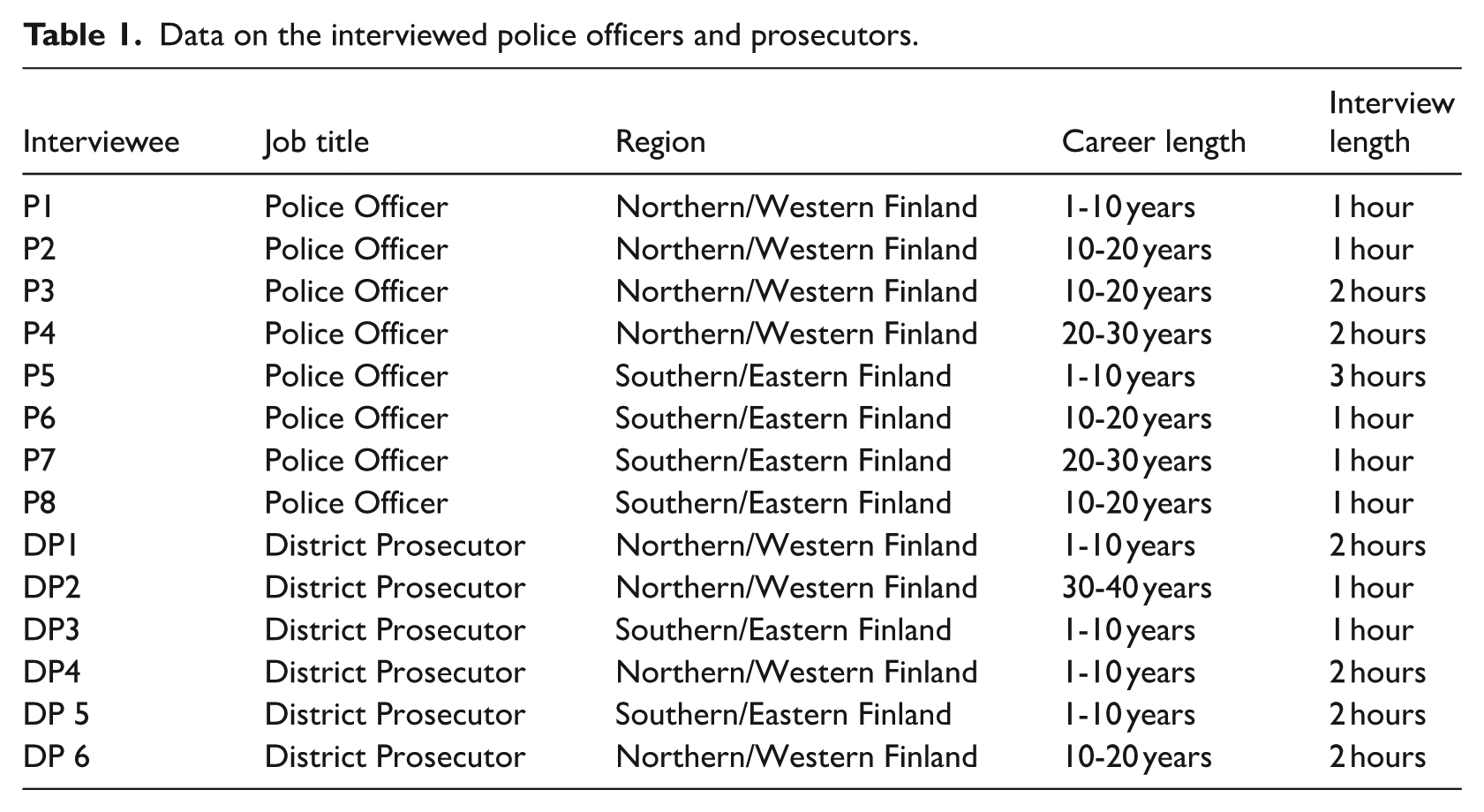
All the police and prosecutors were interviewed during 2020–2021. On average, the interviews lasted around 1.5 hours. The participants in the current study included males and females from both lower- and higher-ranking positions. To protect participant anonymity, limited background information was documented and reported using anonymised identification numbers.
Method of inquiry and rigour
The data were collected by means of semi-structured expert interviews. This method of inquiry was chosen given its efficacy in capturing knowledge broadly, guided by the structures of a thematic interview framework (Creswell and Poth, 2017). The interviewees were selected based on their expertise in implementing criminal-justice policy concerning VOM. As experts, both police and prosecutors were interviewed from a fact-based perspective (Ala and Kauhaluoma, 2003; Hirsjärvi and Hurme, 1982). Fact-based perspectives in qualitative research distinguish between the reality of the topic explored and the narratives surrounding it. As such, the assumption was that factual statements given by police and prosecutors about their use of discretion within their districts were true. Furthermore, the views the informants expressed about how to conduct their work in relation to VOM were interpreted as their personal perceptions of how criminal policy should be implemented. Although the police and prosecutors’ self-reported actions arguably provide a clearer point of comparison to the law in books, their reported perceptions may still point to practices that differ from laws and regulations.
To ensure participant safety during the Covid-19 pandemic, while maintaining interpersonal validity, the interviews were conducted by phone. This allowed the informants to choose their setting. The reasoning behind this was that police and prosecutors are used to conducting phone interviews in their work. Credibility was addressed through participant validation, whereby all participants could view and comment on an article draft prior to journal submission. 15 Finally, the rigour of the analysis was strengthened by conducting the literature review in a systematic manner. To enhance the transparency of the research process (Kapiszewski and Karcher, 2021), the documentation concerning the interview questions, as well as code categories and frequencies were included in the supplementary material.
The interviews followed a framework comprising seven categories, which also served as a category framework for coding. Atlas.ti software was used to analyse the following two of these categories in this study: Evaluation of VOM suitability and Post-VOM proceedings. Thematic analysis was applied to ensure the thorough exploration of similarities and differences in policy practice (Patton, 2015; Rivas, 2018), and inductive and deductive analysis were used in combination. The theory and the data were applied simultaneously during the analysis, partly drawing on the methodological approach from grounded theory (Bernard et al., 2016; Corbin and Strauss, 2008).
Findings
Overview
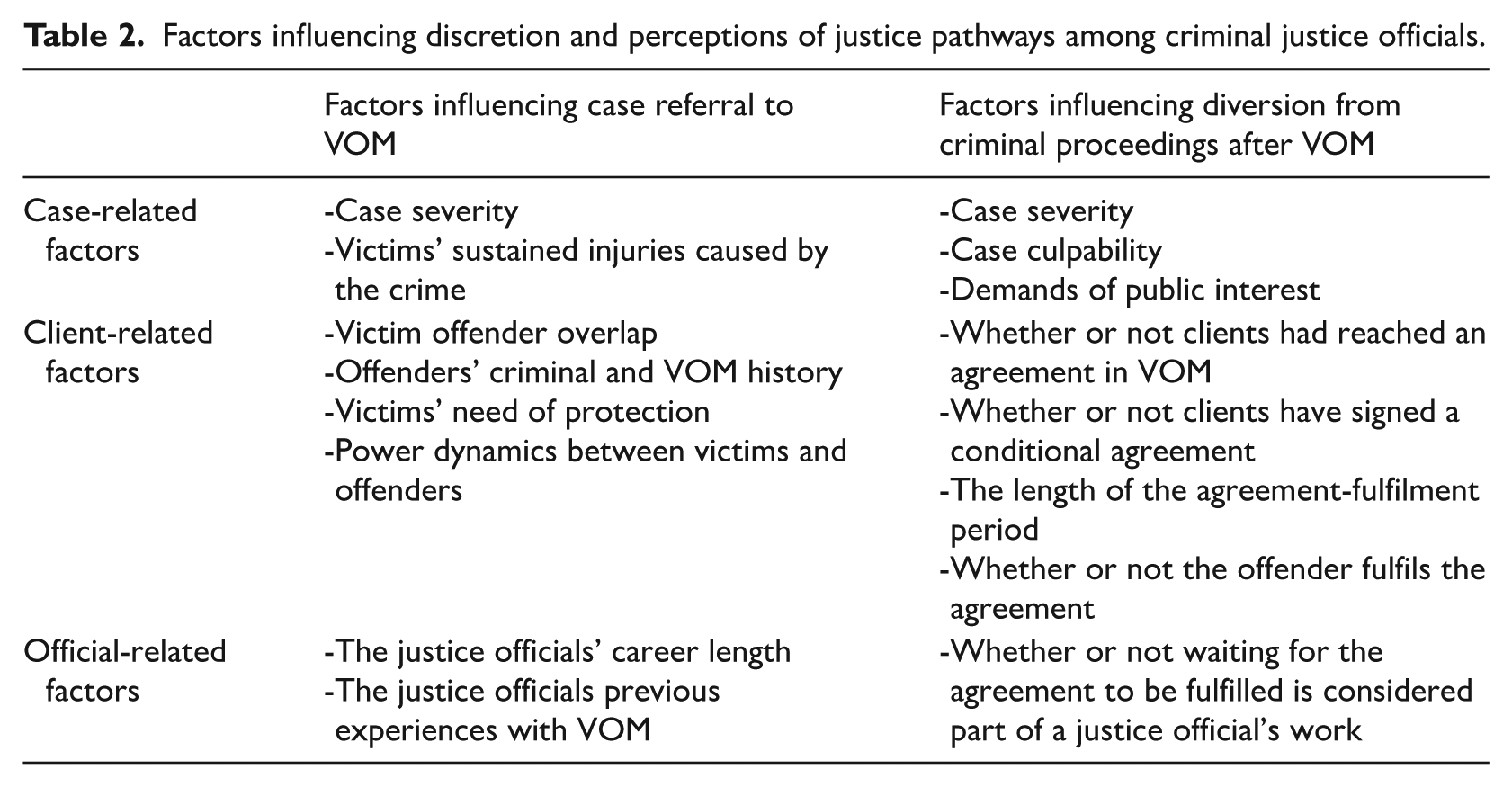
Police and prosecutors reported varying perceptions of and decision making regarding VOM. With regard to decision making before and after VOM, the justice officials’ perceptions and use of discretion were categorised in three groups of factors. Summarised in Table 2 below, these groups relate to the case, the clients and the justice officials.
Factors influencing discretion and perceptions of justice pathways among criminal justice officials.
Assessing suitability: factors related to the criminal case
Overall, the justice officials expressed similar perceptions about the types of crimes they deemed suitable for VOM. In line with police guidelines and previous findings (Banwell-Moore, 2023; D’Souza and Shapland, 2023; Hoekstra, 2022; Holmberg et al., 2021; Iivari, 2010), police and prosecutors generally considered less serious offences appropriate for VOM. When asked what they usually referred to VOM, they mentioned less serious offences such as property damage, assault, defamation and youth crime. Asked why these crime types were preferred, some police and prosecutors said that they were easy to mediate. A few police officers also emphasised the educational benefits of mediating less serious youth crime. In their view, VOM provided underage offenders with an opportunity to take responsibility for their crimes in the absence of criminal liability.
In contrast, the justice officials’ perceptions about the suitability of VOM for serious offences varied. Many of them thought that it depended on the seriousness of the offence. Others, such as DP4, drew the line at cases of violent crime involving lasting or severe injuries: DP4: If something really serious happens I do think that the public interest requires prosecution and I have to say that in cases of severe violence, the parties quite rarely agree to mediation. And somehow, I feel it’s not even something you’d consider, that there is this big fracture on the face and you’d even consider mediation for that.
DP4 remarked that the parties involved in such cases did not usually express a desire for VOM, and that it would be unusual even to consider it for cases that involved severe injuries. Motivated by public-interest requirements and a general understanding of victims’ willingness to engage in VOM, DP4’s comments indicate that criminal justice is the appropriate course of action for violent offences involving severe injuries. These perceptions may reflect a more selective use of the law in books concerning the suitability of VOM for serious offences. Such perceptions are not uncommon (Banwell-Moore, 2023; D’Souza and Shapland, 2023; Iivari, 2010; Zhang, 2021), given the expressed view among police officers that suggesting VOM in such cases would risk upsetting the victim (Hoekstra, 2022).
Justice officials considering the mediation of serious offences also contemplated the potential of VOM as a supplement or an alternative to criminal justice. Some of them varied in their perceptions of whether it made sense to mediate serious offences that would nonetheless be prosecuted. One prosecutor described referrals of such offences to VOM as ‘unnecessary’, because victims and offenders would have to go through the events of the crime ‘all over again’ in court. Meanwhile, a few other justice officials saw various benefits in referring cases to both proceedings: P3: We often talk about these severe crimes, can they be mediated, well I think everything can be mediated to some extent. And I’ve said that, for example in a case when the parties involved do not reach an agreement or an apology or anything, they could still deal with the damage compensation and get that fixed, so it means it won’t need dealing with during court proceedings, which shortens their duration.
As illustrated above, P3 viewed the mediation of serious offences as a possibility for the victim and offender to at least agree on financial compensation. This way, as P3 explained, VOM could also increase the efficacy of the court proceedings. Such use of and perceptions on VOM arguably constitute a broader interpretation of the law in books based on innovative discretion.
Aligning with previous findings (D’Souza and Shapland, 2023; Hoekstra, 2022; Iivari, 2010), these varied perceptions imply that some justice officials may be more likely than others to consider case severity a factor limiting access to VOM. The results also indicate that the likelihood of referring serious offences to VOM may vary based on whether or not justice officials consider it sensible for such cases to undergo both VOM and court proceedings.
Client-related factors
Justice officials also considered various factors related to the victims and offenders when assessing the suitability of criminal cases for VOM. Both police and prosecutors said that they generally assessed case suitability based on the offender’s criminal background. As reported in previous studies (Cutress, 2015; Rasmussen, 2020; Sandbye et al., 2023), they considered offenders with a criminal history less suitable for VOM. Similarly to prior Finnish findings (Iivari, 2010; THL, 2019), justice officials considered cases involving domestic violence suitable for mediation if the violence was less severe; cases deemed either less suitable or unsuitable reflected traits related to both offenders and victims. In compliance with the law in books, unsuitable cases involved imbalanced power dynamics or substantial age differences between victims and offenders. Both police and prosecutors also considered threats or the use of coercion towards the victim when assessing suitability, as well as the victim’s need for protection. In line with police guidelines, they also considered cases involving recurring violence by the offender towards the victim less suitable for VOM.
Supporting previous findings however (THL, 2019), definitions of the mediation history of victims and offenders differed among some prosecutors. A few prosecutors defined previous history as occurring solely between the offender and their current victim. Applying the law in books more selectively, another prosecutor included all the prior mediation history of the offenders, including other victims.
Regarding the roles of the parties involved in the criminal case, one prosecutor considered victims and offenders more suitable for VOM if both parties had engaged in violence: DP2: If there are these continuous occurrences between a couple it could be an exception, if you see that both are suspected of assaulting the other then you might think that mediation could be something to try, to get the conflict resolved. So, I see in that case that there is a more equal relation between the parties, in a way.
DP2 perceived the threat of a power imbalance in VOM as lower in cases in which the roles of perpetrator and victim overlapped, viewing them as suitable ‘exceptions’. Reflecting innovative discretion intended to push the limits of case suitability for VOM, these perceptions resemble Hoekstra’s (2022) findings. However, whereas the police in Hoekstra’s (2022: 9) study favoured ‘blurry’ or ‘messy’ victims from the standpoint of mutual blame, the prosecutor in this study appeared to favour blurry victims as less risky based on an informal conception of ‘mutual equality’.
Overall, these results indicate that access to VOM may depend on how police and prosecutors define the offenders’ previous mediation and criminal history, as well as the relationships and positions of the parties involved in the crime.
Factors related to the justice officials
Police and prosecutors were also asked directly whether or not factors such as previous working experience could influence possible discretionary variations related to VOM. Speaking generally, some police officers and prosecutors viewed that career length could either encourage justice officials to use VOM or discourage them from considering VOM an option for a criminal case. As they explained, justice officials in the early stages of their career are likely to be more careful about implementing VOM than their more experienced colleagues. This indicates that some justice officials may adopt selective discretion when implementing VOM early in their careers, whereas more innovative discretion could develop based on gained experience.
Some justice officials also discussed previous knowledge of VOM outcomes as a point of influence for discretionary variation. Reflecting D’Souza and Shapland’s (2023) findings, a few justice officials generally viewed that previous experiences of referred cases being returned without agreement could decrease their motivation to refer cases to VOM. Others stressed the importance of ‘good’ referral experiences: P2: The more positive solutions in one way or another for reducing our work or positively getting to an agreement, or even having been able to meet and talk about the event, even if they haven’t been able to reach a full agreement, this information as a positive thing increases its (mediation) use. P3: Of course, going back, considering that there have been so many incoming successful mediation cases, I have strong trust in that practice.
Whereas P2 suggested that both positive experiences and knowledge of VOM outcomes could increase referrals, P3 stressed the value of knowing which cases turned out well in fostering trust of VOM. Illustrating that the case-by-case use of discretion does not exist in a vacuum (Van Denderen et al., 2020), these results imply that access to VOM could be influenced by justice officials’ previous positive or negative experiences of its outcomes.
Post-VOM decisions
After VOM, the justice officials usually continued the criminal proceedings of cases in which no agreement had been reached in mediation. On the other hand, they acknowledged cases that had ended in agreement hade varied in their decision making.
Most justice officials generally concluded or restricted cases that had reached an agreement in VOM, which meant closing the case from further criminal proceedings. Furthermore, they usually closed cases subject to prosecution following an agreement on the grounds of reasonability. Aligning with the law in books, such decisions were made if the case was less severe, and the victim had no demands after reaching an agreement in VOM. However, some prosecutors still considered charges necessary if the crime was severe and if its potential punishment included a prison sentence: DP6: Then the evaluation of the crime’s culpability may be that, even if the case is mediated, if it’s so culpable that it would entail probation, and a bit longer probation at that, then maybe considering the culpability it has to proceed (to prosecution). And then there has to be a certain trust in our system, so that one does not get away scot-free.
As DP6 noted, prosecution in such cases was considered appropriate based on the public-interest criterion, the culpability of the crime and trust in the criminal justice system. Indicating selective discretion aligned with the law in books, these motives illustrate when VOM is perceived to be unsuitable as a diversionary alternative to criminal justice. Here, DP6 also illustrates the perception that in severe cases, a sense of justice that is ‘tough on crime’ reflects not only punitive attitudes in legal cultures (Laxminarayan and Wolthuis, 2015), but also societal views on what is considered just regarding criminal law (Kääriäinen, 2019).
Waiting for the VOM agreement to be fulfilled: Selective and innovative discretion
Justice officials also varied in how they acknowledged the fulfilment of mediation agreements in their decision making. In this context, most of the respondents mentioned agreements that included monetary compensation. Among all respondents, one police officer and two prosecutors mentioned that they did not wait for the agreements to be fulfilled before making decisions on cases following VOM. In line with prior findings (THL, 2019), one prosecutor explained that waiting was challenging due to the statute of limitations, while the other did not consider it a part of their duties: DP2: I don’t follow up, when it’s been to mediation it’s a matter that’s on the enforcement’s side. So its not a ground for my decision whether the damages have or haven’t been compensated.
For DP2, information about whether an agreement had been reached in VOM was sufficient to complete the consideration of charges in the case. Although such use of discretion aligns with the law in books, it could also be considered selective.
In contrast, most justice officials said they waited a limited time for the fulfilment of the agreements. They often proceeded with the case if their fulfilment period was considered ‘too long’, usually closing it when the first instalments of the monetary compensation had been paid to the victim. Expanding upon prior results (THL, 2019), two prosecutors and three police officers added that these practices also concerned cases in which the victim had issued a conditional agreement. Some justice officials justified this practice by stating that victims could personally seek damage reparation through a civil court. While others did consider waiting for agreements important to the victim and offender, they stressed that proceedings still needed to continue due to the statute of limitations. Furthermore, a few prosecutors had expressed a wish for mediation officials to set shorter fulfilment periods: DP6: if we have a year’s time for the consideration of charges, we literally have to have a conversation with our superior like ‘why is this case so long at consideration when it should not be’. So, if we say that we get a case with a year’s fulfilment time for the payments then that causes a problem for us, so usually we have strived or strive to express a wish for it, that if a payment time is agreed upon, its length shouldn’t extend to so many months, and usually then we wait for the payments to be completed.
Echoing DP6, many justice officials described the long fulfilment plans as a ‘problem’ or a ‘challenge’, using their discretion to wait only if the plans weren’t too long. In this case, DP6’s discretion was also used to influence the length of the agreements.
These justice officials appeared to be less selective in their use of discretion compared to those who did not wait for any agreements to be fulfilled. Nevertheless, their discretion had various limits, which they attempted to manage by shaping VOM agreements. As such, these results illustrate a range of innovative yet limited discretionary practices among justice officials even when they act beyond the law in books.
Finally, only one prosecutor said that they always waited for the fulfilment of the agreements, while another prosecutor and two police officers usually waited for the completion of conditional agreements. Among these prosecutors, DP1 pointed out that not waiting was wasteful as far as the parties in VOM were concerned: DP1: Because the mediation offices, the people there have put effort into dealing with the case, and they get a mediation agreement together and then they get the repayment schedule, then I feel like I would not honour their work if I pulled the rug from under their feet, if I have to make a decision quickly and they have not completed a single installment yet . . . the practice we have embraced here is that we let the fulfilment proceed as long as possible and we have the cases in a suspended mode, so they don’t spend time considering charges, they just wait. And I consider this important for maintaining the payer’s motivation to pay.
DP1 explained that the suspect may deem the rest of the payments unnecessary if the restriction on the case is imposed prematurely. As cases appeared not to overlap with the deadlines for the consideration of charges, DP1’s response implies a lack of consistency among prosecutors in terms of understanding how fulfilment periods affect the statute of limitations.
Another prosecutor, DP5, considered fulfilment to be part of the agreement, and thus part of their decision making after VOM. In their view, ‘the rights of the complainant get taken’ if prosecutors close the case before the damage compensation is paid. DP5 also pointed out that seeking reparations on one’s own could be burdensome, as victims may not be aware of the legal consequences that follow. In comparison to other prosecutors, both DP1 and DP5 appeared to reflect on and engage in innovative discretion by pushing the limits of the law in books to ensure victims’ access to both restorative and criminal justice.
Among some justice officials, discretionary variations also concerned cases in which the reparation payments appeared to have ceased completely. Although few justice officials usually continued the criminal proceedings in such cases, one prosecutor said that they could nonetheless close the case, explaining that the victim could continue seeking reparations through civil proceedings. According to one police officer however, there had been cases in which the suspect had discontinued their monetary compensation after the prosecutor had restricted the case: P7: If we make mediation agreements with a fulfilment period that spans over two years, for 20 euros each month, that creates difficulties for the police and for the success of the mediation. For example, we wait for two or three payments to be completed, and they have gotten going well, then we suggest that the case be restricted. And when the suspect gets the information on the third or fourth month that the police have suggested restriction and the prosecution has decided to restrict the case, the suspect stops paying and leaves it at that. There have been such problems sometimes.
Similarly to DP1, P7’s observation implies that when the prosecutor does not wait for the VOM agreement to be fulfilled, the offender may be less likely to complete the damage payments.
In sum, these discretionary variations indicate that some criminal cases may be more likely than others to be either closed or continued following mediation. Overall, the variations appeared to relate to the severity of the crime, as well as the VOM agreement and its fulfilment. Adding to a previous report focused on domestic violence (THL, 2019), such variations may also concern other types of crime, as well as cases with conditional VOM agreements.
Discussion
Previous studies have explored inequities in victims’ access to restorative processes due to the varying use of discretion among justice officials (Hoekstra, 2022; Laxminarayan and Wolthuis, 2015; Rasmussen, 2020). Contributing to this discussion, our study explored how police and prosecutors shape victims’ access to both criminal and restorative justice in Finland. We argue on the basis of our findings that concerns about inequities are not limited to access to restorative justice. In countries in which VOM may be used as a diversion from criminal proceedings, such concerns also regard access to restorative outcomes and criminal justice.
Building on earlier results, we identified differences in VOM-related discretion among justice officials throughout criminal proceedings. Factors that do appear to influence discretionary variations relate to the criminal case, its victims and offenders, and the justice officials themselves. Notably, justice officials reported varying praxis and perceptions on whether cases that will be prosecuted due to their severity should be mediated. Furthermore, not all justice officials waited for the fulfilment of VOM agreements before closing cases after mediation, while others communicated to mediation officials a preference for shorter fulfilment periods in order to wait for their completion.
Building on the work of Daly (2016), these results show, first, that justice officials’ case referrals to VOM may vary based on whether or not they consider mediation more suitable as an alternative rather than a supplemental justice mechanism. In other words, justice officials can make VOM-related decisions based on a more holistic consideration of justice mechanisms that include both criminal and restorative justice interconnectedly. As such justice mechanisms are applied in many North European jurisdictions, our results may offer useful insights for the development of international restorative justice research and practices in Northern Europe.
Second, our results recurringly illustrate that some justice officials apply VOM-related laws in books more selectively (Banwell-Moore, 2023; D’Souza and Shapland, 2023; Marder, 2020a; Rasmussen, 2022). Expanding on outcomes from prior studies, our findings also indicate that other justice officials apply VOM more broadly, engaging in what could be considered ‘innovative’ discretion to negotiate VOM use beyond the law in books.
Overall, these discretionary variations imply various risks of inequity in victims’ access to VOM, its outcomes and to criminal justice. Notably, some victims may be more likely than others not to be referred for mediation due to discretionary variations. This risk appears more prominent with regard to severe offences. In such cases, victims risk losing access to VOM because they may be underinformed about mediation (Honkatukia, 2015; Lundell, 2019). In this regard, the selective discretion identified in our study may reflect legal cultures in which criminal justice is perceived as a safer alternative to VOM for victims (Laxminarayan and Wolthuis, 2015). However, such legal cultures may uphold what D’SouZa and Shapland (2023: 71) describe as a ‘paternalistic denial’ of victims’ agency to choose their own justice pathways. This risks bypassing the potential benefits of restorative justice, as studies show that victims of both less serious (Choi et al., 2010; Nascimento et al., 2023) and more severe offences report feeling empowered by and receiving a sense of closure from participating in restorative justice practices (Bolitho, 2015; Murhula and Tolla, 2021; Umbreit and Armour, 2010; Van Camp and Wemmers, 2013).
Furthermore, victims’ access to reparations from VOM may be compromised if justice officials limit the fulfilment period of the agreements or close the case prior to the completion of the reparations. Limiting their fulfilment period arguably contradicts VOM’s restorative aim of enabling agreements to be personalised according to the victims’ and offenders’ individual needs (Iivari, 2004). Reducing the length of the mediation process may thus risk limiting victims’ options for restorative outcomes.
Closing cases prior to their completion, on the other hand, dismisses the function of conditional agreements as a safeguard whereby victims could reconsider their demand for punishment. As victims may lack the resources and the knowledge to continue seeking justice through civil courts (Honkatukia, 2011), such use of discretion may complicate victims’ options in terms of accessing criminal justice. Finally, such choices disregard the possible impact of monitored fulfilment periods as a deterrent for offenders. These risks may be grounded in the lack of a statutory requirement for justice officials to consider the fulfilment of any VOM agreements before closing a case. In this respect, Finland’s legislation contrasts with that of many other Northern European countries, such as Iceland, Norway, Estonia and Latvia, where the completion of such agreements may serve as a prerequisite for closing cases from criminal proceedings following restorative justice practices.
In contrast to the risks of selective discretion, the examples of innovative discretion identified in this study may reflect more lenient legal cultures in which the potential of VOM is considered more broadly. Such use of discretion by justice officials could facilitate a wider range of informed decision making among victims and offenders regarding their justice pathways. However, it needs to be noted that not all victims and offenders exhibit a ‘readiness’ for restorative justice (Suzuki, 2020). Thus, it is not always easy to determine whether using selective or innovative discretion constitutes the ‘right’ choice for the case in question.
What is needed to foster the coexistence of criminal and restorative justice?
In sum, the inconsistency in notions of how VOM should be applied continues to indicate that its function as a justice mechanism is considered a ‘soft formality’ (Sandbye et al., 2023: 4) or an ‘add-on’ (Banwell-Moore, 2023: 226) among some justice officials. In this regard, there is further room to integrate VOM and criminal justice as equally accessible justice mechanisms in Finland. Ideally, justice officials ought to maintain victims’ possibilities to make independent choices, yet realistically assess their readiness for restorative justice to ensure their safety (Banwell-Moore, 2023). Albeit not an easy task (Suzuki, 2020, 2023), we consider these requirements fundamental in fostering a purposeful coexistence between restorative and criminal justice systems. To this end, we offer two policy recommendations based on our findings.
First, we recommend that justice and VOM officials consider the need for clearer guidelines on VOM and more systematic communication with VOM officials across regions. As noted by Laxminarayan and Wolthuis (2015: 35–36), this may help both justice and VOM officials to develop a more cohesive understanding of case suitability for VOM. We also recommend that justice officials consider developing additional guidelines on how they should take the fulfilment of VOM agreements into account in their decision making.
To safeguard victims’ rights to informed decision making, we finally recommend developing access to VOM-related information. Currently, victims may be underinformed about VOM. Furthermore, they may not know that their case could be diverted following VOM, even as they continue to demand punishment. Finally, they may be unaware that this can occur even if VOM agreements, including those that are conditional, are yet to be fulfilled (Honkatukia, 2015). Thus, we recommend developing victims’ access to information on how the outcomes of VOM could influence criminal proceedings.
Limitations
This study is not without limitations. First, not all the participants originally interviewed agreed to the continued use of their data for this study, which lowered the participant number from 17 to 14. Although limited, the purposeful selection nonetheless provided a rich scope of knowledge about VOM-related discretion among police and prosecutors taking part in this study. Second, our exploration is limited to laws and regulations that predate recent legislative changes concerning the mediation of domestic violence in Finland. Albeit not directly applicable to Finland’s current restorative justice proceedings, in terms of scope this study nonetheless holds relevance for future comparative studies on the impact of the legislative changes. It could also provide useful insights for countries that allow the mediation of domestic violence, such as the United States and Australia (Kettrey and Reynolds, 2024), as well as Austria, Canada and Brazil (de Campos and de Oliveira, 2021).
Conclusion
Our study illustrates how research on restorative justice could benefit from drawing on the paradigm of access to justice. Going beyond findings from earlier studies, we show that inequities concern access not only to VOM but also to its outcomes and the process of criminal justice in countries in which VOM constitutes a legal ground for diversion. These results underscore the importance of scrutinising access to VOM within the larger structure of justice mechanisms.
Finally, we show that inequities in accessing both restorative and criminal justice need further exploration. Qualitative studies have provided a rich understanding of various factors that influence VOM-based discretion. Future studies should strive to assess quantitatively the extent to which discretionary variation turns access to justice into a lottery (Acton, 2015). To this end, our results indicate that variations could be based on differences among and within individual justice officials and their local legal cultures. As such, the exploration of individual and within-individual differences in future research may be just as important as the scrutiny of regional differences.
Supplemental Material
sj-docx-1-irv-10.1177_02697580261424265 – Supplemental material for Police and prosecutors’ views on victim–offender mediation in Finland: Inequities in pathways to justice?
Supplemental material, sj-docx-1-irv-10.1177_02697580261424265 for Police and prosecutors’ views on victim–offender mediation in Finland: Inequities in pathways to justice? by Aino Jauhiainen and Yaira Obstbaum in International Review of Victimology
Footnotes
Acknowledgements
I would like to thank all respondents participating in the interviews for this study. I would also like to thank Kati Rantala for providing support and guidance in the research process for this article. In addition, I thank both my colleagues and experts within the field of criminal and restorative justice who provided numerous substantive comments concerning restorative justice practices within Northern Europe. These include Ian Marder, Donata Gudeikė and Tatjana Zubare. Finally, I thank the language services of Helsinki University, who provided proofreading for this paper.
Authors’ note
Writing assistance and third-party submissions: This paper has received language proofreading assistance from the internal language services of Helsinki University.

Ethical considerations
In Finland, all regulations and requirements concerning medical research involving humans are stated in the Medical Research Act (488/1999). Research which is not medical, and involves human participants, follows the guidelines and ethical principles stated by the Finnish National Board on Research Integrity (TENK), known as The ethical principles of research with human participants and ethical review in the human sciences in Finland. Based on these guidelines, the Research Ethics Committee in the Humanities and Social and Behavioral Sciences of the University of Helsinki conducts ethical reviews of non-medical research on humans conducted at the university. Based on these guidelines, as well as the risk-assessment conducted for this study, this study did not fulfil any criteria which require an ethical review. As such, an ethical approval was not necessary for this study.
Consent to participate
The study followed the ethical guidelines stated by the Finnish National Board on Research Integrity. In compliance with these guidelines, all participants gave their informed written consent for their participation in this study, and the use of their data in this article. All interviewees were given consent forms including a short and concise description about the study’s aims and data protection plan. The consent forms also included a description on the participant’s rights concerning consent and use of their data in accordance with the Data Protection Act (1050/2018) and the General Data Protection Regulation of the EU (2016/679). The procedures for data handling and safekeeping, as well as the privacy statement and data protection risk analysis, were written in accordance with Helsinki University’s guidelines on data protection. Prior to recording each interview, the respondents’ signed consent forms were read aloud to them and reconfirmed.
Consent for publication
We confirm that all participants gave their informed written consent for the publication of this article.
Author contributions
Jauhiainen was responsible for conceiving, designing and planning the study. The data were analysed by Jauhiainen. Jauhiainen interpreted the results with intellectual commentary by Obstbaum. The analytical strategy and theoretical frame were developed by Jauhiainen and Obstbaum. Jauhiainen wrote the first draft of the article apart from one section, which was written by both Jauhiainen and but for chapter 4, where Obstbaum. Obstbaum frequently critically revised the article for important intellectual content.
Funding
The authors disclosed receipt of the following financial support for the research, authorship and/or publication of this article: This work was supported by Suomalainen Konkordia-liitto (grant number 20250318) and by Svenska Kulturfonden (grant number 212394).
Declaration of conflicting interests
The authors declared no potential conflicts of interest with respect to the research, authorship and/or publication of this article.
Data availability statement
To maintain the anonymity of the research participants, data available for this study is limited. To enhance the transparency of the research process, the documentation concerning the interview questions as well as code categories and frequencies are included in the supplemental material of this study.
Supplemental material
Supplemental material for this article is available online.