



Abstract
Online fraud poses a significant global threat with profound consequences for victims, organisations and society. Despite its high prevalence and impact, law enforcement faces challenges in effectively addressing online fraud. In addition to reporting to the police, victims can pursue civil litigation to recover financial damages. In the Netherlands, opportunities for pursuing civil action have expanded since 2021. To facilitate damage recovery, the Dutch police and financial service providers, under certain conditions, refer victims to civil legal representatives. However, no research has been devoted to the civil settlement of online fraud. Based on 50 interviews with individuals who initiated civil proceedings, this study explores victims’ motivations for pursuing civil litigation and assesses how these motivations align with online crime victims’ needs identified in previous research. Respondents primarily pursued civil action for financial reasons (to recover losses), retributive motives (to deter or punish fraudsters) and out of a primary need (to protect others from future victimisation). Motivations rooted in emotional, informational or practical needs were only marginally present or even absent. Additional types of motivation were identified, potentially related to the lack of criminal prosecution. Finally, the findings indicate a potential discrepancy between victims’ expectations and the realities of pursuing civil litigation.
Introduction
Online fraud represents a major global crime threat. By taking advantage of the increasing online presence of citizens, private companies and public institutions, online fraudsters make multi-billion profits every year (Europol, 2023). Several challenges in recording accurate statistics on online fraud, including inconsistent definitions, varying reporting methods and the dynamic nature of this crime, lead to substantial attrition in the volume of online fraud. As a result, the data often becomes outdated and insufficient, hindering accurate analysis of fraud levels and trends within and between countries (Button and Cross, 2017). However, a conservative estimate suggests that 6% to 11% of the adult population fall victim to fraud annually (Australian Bureau of Statistics, 2024; Office for National Statistics, 2025; Statistics Netherlands, 2025). Globally, investment fraud, business email compromise (BEC), advance-payment fraud and romance fraud are considered the most prevalent types of online fraud (Europol, 2023; Interpol, 2024). 1 Phishing is found to be a commonly used technique for different kinds of online fraud (Europol, 2023). 2 Online fraud is expected to further expand in the future, as fraudsters are making use of emerging technologies and methods. Particularly crime-as-a-service business models, 3 artificial intelligence and cryptocurrencies facilitate more sophisticated and cost-efficient fraud attacks (Europol, 2023; Interpol, 2024).
The impact of online fraud is profound. For victims, online fraud can cause direct financial losses (i.e. the amount of money lost) and indirect financial consequences (such as having to cut back on expenditure, losing savings or superannuation, having to pay off loans and having to sell or remortgage property) (Borwell et al., 2021; Button and Cross, 2017; Cross et al., 2016; Kerr et al., 2013). The damage from online fraud is compounded by the negative effect on victims’ physical and mental health (Europol, 2023). Victims report that they trust other people less, feel less safe, relive the incident repeatedly, have problem sleeping and experience symptoms of anxiety and/or depression (Cross et al., 2016; Kerr et al., 2013; Statistics Netherlands, 2025). Moreover, victims of online fraud suffer from feelings of guilt, shame, anger, frustration, shock, stress, powerlessness, sadness and loneliness (Cross et al., 2016; Kerr et al., 2013; Leukfeldt et al., 2019). Victimhood can also jeopardise relationships by creating stress, through secrecy around the victimisation, and due to distress caused by the loss of shared income or inheritance (Button et al., 2012; Cross et al., 2016; Kerr et al., 2013). On top of that, victim blaming attitudes lead to isolation and additional trauma (Borwell et al., 2021, 2025; Button and Cross, 2017). Online fraud can also lead to behavioural changes, such as avoiding online banking, shopping, or dating (Cross et al., 2016; Kerr et al., 2013). Beyond the individual, online fraud has increased costs of investigation by law enforcement, and recovery and reimbursement by financial service providers (Europol, 2023), and funds the criminal economy (Kerr et al., 2013; Smith et al., 2024).
Despite the high prevalence and impact, victims often refrain from reporting online fraud (Europol, 2023). This is, among other factors, due to embarrassment (Button et al., 2009, 2020; Cross, 2018a; Cross et al., 2014, 2016; De Paoli et al., 2020), self-blame (Parti and Tahir, 2023) and lack of trust in law enforcement to have the ability to pursue offenders (Cross, 2018a; De Paoli et al., 2020; Graham et al., 2020). Research indicates that, despite diverse efforts, law enforcement remains insufficiently equipped to handle online fraud cases effectively (Button et al., 2012; Cross et al., 2016; Leukfeldt et al., 2012; Poppleton et al., 2021; Ruiter et al., 2023; Smith et al., 2024). This inadequacy is due to several factors that pose challenges to the investigation, prosecution and arrest of online crime offenders. Some examples are a limited capacity (Leukfeldt et al., 2012; Poppleton et al., 2021; Ruiter et al., 2023; Shepherd, 2021), low prioritisation (De Paoli et al., 2020; Leukfeldt et al., 2012, 2013; Poppleton et al., 2021; Ruiter et al., 2023), lack of expertise among investigating officers (De Paoli et al., 2020; Ruiter et al., 2023; Shepherd, 2021; Smith et al., 2024), the transnational nature of online offences (Cross et al., 2016; Ruiter et al., 2023; Smith et al., 2024) and the volatility of digital data (Ruiter et al., 2023).
In addition to reporting to law enforcement, victims of online fraud can recover damages from alleged fraudsters through civil litigation. Victims must engage a civil legal representative for this purpose, such as a bailiff or legal expenses insurer. This representative will first try to recover the monetary loss extrajudicially by sending payment reminders to the beneficiary account holder (i.e. the person who received the funds). If reimbursement is not forthcoming, the representative may sue the beneficiary on behalf of the victim. In the Netherlands, the police and various financial service providers, under certain conditions, 4 refer victims to civil legal representatives and share the name and address details of the beneficiary account holder to facilitate this process. These conditions do not apply when victims approach a representative on their own initiative. When a suitable legal ground is invoked, the court may hold the beneficiary liable under private law and allow the claim for compensation, irrespective of the beneficiary’s personal circumstances or his or her involvement in the offence. In addition, certain legal representatives offer their services under a Conditional Fee Arrangement (no win, no fee) (Van Leuken and Van ’t Hoff-de Goede, 2024), which means civil action is no longer accessible only to victims with substantial financial resources. Several court cases have now taken place in which fraud victims’ claims for damages were granted and beneficiary account holders have been ordered to pay the losses, extrajudicial collection costs and legal costs. 5
These developments endorse the need for insight into the civil settlement of online fraud and its implications for victims, offenders and society at large. To date, however, no such research has been conducted. To assess how effectively civil proceedings meet the needs of victims of online fraud, it is essential to first examine the motivations behind victims’ decisions to pursue civil litigation. Therefore, the aim of this paper is to examine what motivates online fraud victims to initiate civil proceedings against alleged fraudsters and to what extent these motivations align with crime victims’ needs identified in previous research. The paper will focus, for example, on financial and retributive motivations for pursuing civil litigation, as well as motivation rooted in emotional, informational and practical needs. This study will be the first to conduct empirical research in this area, drawing on interviews with a substantial group of respondents (N = 50). Results of this study can help improve the settlement of online fraud.
This paper will first outline the existing knowledge about victims’ needs and motivation for pursuing civil litigation. It then presents the research methods and main findings. Finally, the practical and scientific implications of the results are discussed and the methodological choices made in this study will be reflected upon.
Theoretical background
Traditional crime victims’ needs
Research has been devoted to the needs of traditional (offline) crime victims. A systematic review (Ten Boom et al., 2008) identifies a broad range of self-reported needs, including:
- needs related to the criminal process, for example, the arrest and punishment of the offender, and opportunity for input, consent and decision making;
- emotional needs, for example, support, acknowledgement and closure;
- financial needs, for example, restitution and compensation;
- information needs, for example, details about the offence, the offender and prevention;
- practical needs, for example, assistance with tasks, medical support, translation services and crisis management;
- primary needs, for example, immediate safety, prevention of re-victimisation, protection of others and emergency requirements such as food, clothing and housing.
Subsequent research has identified similar needs, though with varying categorisations. For example, Pemberton (2009) distinguishes between procedural needs, on the one hand, such as respectful treatment, access to information and participation, and outcome needs, on the other hand, including acknowledgement, compensation, security and protection from further harm, retribution and coping. Reinders Folmer et al. (2019) differentiate between material needs, including monetary compensation, and non-material needs, including the need for accountability, interpersonal treatment, punishment and closure. There remains a limited body of research concerning the prioritisation of needs by victims, the variation in victims’ needs over time, and differences between victim groups. Nonetheless, existing studies point to heterogeneity in the nature and extent of victims’ needs, potentially influenced by the type of crime experienced, its perceived impact, individual characteristics (Borwell et al., 2024; Laxminarayan, 2012; Lens et al., 2013; Leukfeldt et al., 2019; Pemberton, 2009; Pemberton et al., 2008; Ten Boom et al., 2008), the quality of the social environment and the quality of the support provided by the police and the judiciary (Kool, 2004).
The needs of victims of traditional crimes align with basic human needs and needs that can be derived from justice-related theoretical perspectives (Ten Boom et al., 2008). For instance, the desire for punishment and the need for both material and non-material reparation relate to the human desire for justice, as described by Maslow (1943). The need for reparation by the offender is central to restorative justice theory, which is a vision on justice or conflict resolution that focuses on the repair of damage, the suffering and the social unrest caused by a crime. Restorative actions include, for example, apologies, restitution, reimbursement and compensation (Ten Boom et al., 2008). Another example of a need corresponding to needs found in theory, is the need for input, consent and decision-making power in the criminal process (Ten Boom et al., 2008). This need reflects the human need for effectiveness and control (Staub, 2004) and aligns with procedural justice theory (Lind and Tyler, 1988), which emphasises the importance of the features and experiences of a procedure in shaping individuals’ perceptions of justice – beyond just the outcome.
Online crime victims’ needs
Research on the needs of victims of online fraud is scarce. This section will therefore focus on research on the needs of online crime victims, and, where possible, specifically on victims of online fraud. Existing studies suggest that online crime victims experience needs similar to victims of traditional crimes (Bluhm et al., 2022; Borwell et al., 2024; Button and Cross, 2017; Button et al., 2009; Cross et al., 2016; Leukfeldt et al., 2019). The following section reviews the literature by the previously outlined categories.
First, regarding the criminal process, victims of online crimes including online fraud express a need for punishment and retribution, with particular emphasis on convicting the offender (Leukfeldt et al., 2019). Many Australian online fraud victims report to the Australian Competition and Consumer Commission (ACCC) out of a need for justice. This need is expressed in a desire for (a) an investigation that leads to financial recovery and a criminal sanction, (b) action that reflects condemnation, for instance punishment, deterrence and disapproval of the conduct, and/or (c) retribution or revenge (Cross, 2018b; Cross et al., 2016). According to Pemberton et al. (2017), victims’ need for retributive justice is rooted in an impaired sense of agency (i.e. a person’s striving for individuality), one of the two fundamental dimensions of victims’ experiences with justice, often referred to as the ‘Big Two’. Victimisation through crime can damage an individuals’ status and respect, leading to feelings of incompetence, inferiority, or powerlessness. This threat tends to increase agentic motives, such as the desire to feel competent, accomplished and empowered (Locke, 2015; cited in Pemberton et al., 2017). One study (Bluhm et al., 2022) found that while online crime victims (excluding purchase and sales fraud 6 ) report a significantly lower need for retribution compared to traditional crime victims, victims of purchase and sales fraud, in contrast, report a significantly higher need for retribution than traditional crime victims. This discrepancy may be due to victims of purchase and sales fraud often possessing information about the offender and, therefore, expecting the police to further investigate (Bluhm et al., 2022).
Furthermore, victims of online crimes find it important that the police register the crime, and that the initial police response is meaningful to them. This provides victims with a feeling of being taken seriously, even when successful detection of the offender seems difficult (Leukfeldt et al., 2019). These needs align with those identified for both online and offline fraud victims, namely the need to get the case investigated and for a single point of contact (Button et al., 2009). Online fraud victims emphasise the importance of prompt referral to appropriate agencies and access to clear reporting channels (Cross et al., 2016). Moreover, one study (Borwell et al., 2024) found that victims of online property crimes express a greater need for awareness of support routes compared to victims of traditional property crimes. The substantial number of agencies available to victims of fraud 7 often hinders their ability to report. Termed as the ‘merry-go-round-effect’, agencies often avoid responsibility and refer victims from one agency to another (Button et al., 2009, 2012), which can exacerbate the harm and re-traumatise victims (Button and Cross, 2017).
Second, regarding emotional needs, online crime victims need emotional support (Homburg and Van den Tillaart, 2015; Leukfeldt et al., 2019; Parti and Tahir, 2023). Victims wish to share their experiences without facing immediate condemnation or rejection (Leukfeldt et al., 2019). Both victims of online crimes in general (Leukfeldt et al., 2019) and victims of online fraud (Button and Cross, 2017; Cross, 2016; Cross et al., 2016) express a strong need for recognition as victims. Research on online fraud victims’ needs (Cross, 2016; Cross et al., 2016) shows that victims want to be listened to and treated with respect and dignity when reporting to authorities, rather than being blamed for their victimisation (Cross, 2016; Cross et al., 2016). In addition, they seek open and honest support from friends and relatives (Cross et al., 2016). Offering empathy and non-judgemental responses to online fraud victims is crucial, as their well-being and recovery are premised on the level of support they receive from their network (Button and Cross, 2017). Viewed through the framework of the Big Two, victimisation can undermine its second dimension, namely an individual’s sense of communion, that is, the desire to relate to and cooperate with others in a social context. Threats to communion may result in feelings of isolation, misunderstanding and rejection, and can activate communal motives, including the desire to be connected, understood and embraced (Locke, 2015; cited in Pemberton et al., 2017). Borwell et al. (2024) found that while victims of online and offline property crimes have a similar need to be taken seriously, victims of online property crimes express a stronger need for recognition compared to victims of traditional property crimes.
Third, victims of online crimes also have financial needs, with the need for compensation being one of the most important (Homburg and Van den Tillaart, 2015; Leukfeldt et al., 2019). Research examining the needs of both online and traditional fraud victims (Button et al., 2009) indicates that these victims place considerable importance on recovering financial losses, with ‘getting their money back’ ranked as second highest need, after ‘the fraudster being found guilty’. The study by Borwell et al. (2024) highlights a stronger need for compensation among victims of online property crimes compared to those of victims of offline property crimes. This need increases with the severity of peritraumatic stress (impact during the crime or its discovery) and the extent of the financial damage (Borwell et al., 2024). Contrarily, one study (Bluhm et al., 2022) found that victims of online crimes (excluding purchase and sales fraud) express a relatively low need for compensation compared to victims of traditional crimes. Moreover, Reinders Folmer et al. (2017) note that while material needs tend to be more prominent than immaterial needs for tort victims, higher monetary compensation can satisfy of both types of needs.
Fourth, regarding the need for information, victims of online crimes often seek information about various aspects of the crime, including details about the offender and the manner in which the offence occurred. When an investigation is initiated, victims wish to be informed of its progress and related procedures. They also seek clarity on what actions can or cannot be taken in relation to their case and why, as they are often unfamiliar with processes of the police and the judiciary (Leukfeldt et al., 2019). Focussing on victims of online fraud, research (Cross et al., 2016) shows these victims report a need for information on available support services, how to access them and any associated costs (Cross et al., 2016). They also value case-specific advice, general information about scams and updates on the progress of the investigation (Button and Cross, 2017; Button et al., 2009). Besides, in the study by Borwell et al. (2024), victims of online property crimes reported a significantly stronger need for information about the offence than victims of offline property crimes.
Fifth, studies on the practical needs of online crime victims show mixed findings. Leukfeldt et al. (2019) argue that, compared to other needs, practical needs play a role to a lesser extent among victims of online crimes. In contrast, Borwell et al. (2024) posit that victims of online property crimes express stronger practical needs than those affected by traditional property crimes, possibly due to the technical complexity of online offences and lack of clarity about where to turn for support. However, the specific practical needs identified as statistically significant in the study – compensation, information on support routes and the offence, and prevention advice – could be classified as financial or informational rather than practical. Still, online crime victims do report some practical needs, particularly related to handling formalities and recovery. These include assistance with filing a report, taking images offline, decrypting files, or blocking identification documents (Leukfeldt et al., 2019).
Finally, primary needs were identified as important by merely a few victims in the study by Leukfeldt et al. (2019), though this does not imply that these needs are entirely irrelevant in the context of online crime. For instance, a victim of online dating fraud requested assistance with housing, as the financial losses left her unable to afford her home. Furthermore, protection of oneself and others can be considered primary needs (Ten Boom et al., 2008). Although sometimes categorised as justice-related due to their connection with the need for punishment (Leukfeldt et al., 2019), these needs are reported by victims of online crimes, including victims of online fraud (see also Parti and Tahir, 2023). Alongside the desire to obtain justice, an altruistic motive to prevent future victimisation of others is found to be a significant reason for reporting to the ACCC (Cross et al., 2016, 2018b). Besides, two studies indicate that victims of online property crimes report a significantly stronger need to prevent others from being victimised compared to victims of offline property crimes (Bluhm et al., 2022; Borwell et al., 2024).
Victims’ motivations for pursuing civil litigation
Although research into the needs of general crime victims with regard to civil proceedings is scarce, studies on litigation in personal injury cases (e.g. medical errors or traffic accidents) have identified a variety of both material and non-material needs and motivations among claimants (Akkermans, 2009, 2020; Akkermans et al., 2014; Huver et al., 2007; Relis, 2017; Robbennolt and Hans, 2016). Injured persons pursuing a claim for damages seek not only reimbursement or financial compensation, but also different forms of recognition (e.g. acknowledgement of harm, admission of fault or responsibility, offering sympathy or apologies), and the prevention of reoccurrences or similar incidents affecting others. Other motives are obtaining justice or receiving information about what precisely happened. Based on experimental studies, Reinders Folmer et al. (2017) argue that, in the context of tort law, non-material needs are less prominent compared to victims’ material needs, and no more prominent in personal injury cases than in cases involving exclusively pecuniary loss. However, financial compensation is not only regarded as a means of addressing material loss, but also as a form of symbolic acknowledgement of the harm and emotional suffering endured (Akkermans, 2009, 2020; Huver et al., 2007; Reinders Folmer et al., 2017; Relis, 2017). Notably, in personal injury cases, the adversarial nature of the claims resolution process often results in the unjust neglect of victims’ non-material needs, which is negatively correlated with recovery and health outcomes (Akkermans et al., 2014; Huver et al., 2007; Ruitenbeek-Bart and Akkermans, 2025).
One study on motives for pursuing civil litigation among crime victims (Van Dongen et al., 2013) suggests that the absence of criminal action can prompt victims to pursue civil litigation. Victims may opt for civil proceedings when prosecution is not initiated, when victims are not able to join the criminal proceeding as a disadvantaged party, or when an organisation bears the costs of the civil process. The study further reveals that the most frequently cited reason for not pursuing civil action is a cost-benefit analysis, where victims weigh the anticipated excessive costs against the low likelihood of recovering compensation from the offender. In addition, victims often decide against initiating civil proceedings due to the emotional burden associated with confronting the offender, the desire for closure, and the fact that the offender was not convicted in criminal proceedings. Even in cases where victims have the formal option to seek compensation through civil litigation, they may be unaware that a civil proceeding can still be initiated without criminal conviction, nor do they fully understand what a civil proceeding entails. Victims frequently perceive pursuing damages through civil proceedings as unrealistic following an acquittal (Van Dongen et al., 2013), which is an unjustified expectation.
Overall, although the literature points to heterogeneity in victim needs, attributable to factors such as the nature of the offence and its impact, as well as individual characteristics of victims and the support victims receive, existing studies reveal that victims of online crimes, including online fraud, report similar needs to those of victims of traditional crimes. Furthermore, regarding victims in civil proceedings, claimants in personal injury cases also report comparable needs and motivations concerning the litigation process. The current study aims to provide further insight into a notable gap in knowledge, namely the motivations of victims of online fraud who pursue civil litigation.
Methodology
Data collection
The current research is part of a broader research project on the civil settlement of online fraud and its consequences for victims, offenders and society. The current paper concentrates on victims’ motivations for pursuing civil litigation. The recruitment of respondents was facilitated by the National Association of Judicial Officers (Landelijke Associatie Van Gerechtsdeurwaarders, LAVG), a Dutch organisation with close ties to victims who initiate civil proceedings. Part of LAVG’s services is specifically aimed at victims of online fraud, making it a suitable partner for this study. From November 2022 to March 2024, victims of online fraud who initiated civil proceedings against beneficiary account holders were approached by the LAVG to participate in this study. Victims were invited at natural moments of contact, such as in the establishment of a payment arrangement, the decision to pursue civil legal action, or the pronouncement of a verdict by the civil court. Along with the invitation, victims received detailed information about the research, the researchers and the research institute. Victims were asked to contact one of the researchers themselves to indicate their willingness to participate and schedule an interview.
The recruitment strategy aimed to reach a diverse group of victims, including individuals who were at different stages of the civil proceedings: those for whom the proceedings could not be initiated, those for whom the proceedings were ongoing and those for whom the proceedings had been completed, regardless of the outcome. Although all respondents filed a police report – a requirement, along with a bank debit, for initiating civil proceedings after online fraud through the civil legal representative – the status of the criminal process did not play a role in the selection of respondents. In most cases (N = 47), respondents were informed that the police would not pursue the case; 10 of them were therefore referred to a civil legal representative by the police. In other cases, criminal proceedings were either still ongoing (N = 2) or had resulted in a lawsuit in which the suspect was neither punished nor subjected to any legal measures (N = 1).
In addition, respondents were included whether or not they had previously contacted their bank. In total 36 respondents contacted their bank, for example to apply for financial compensation. In some cases (N = 5), the bank was able to recover part of the monetary loss, as the funds had either not yet been withdrawn by the recipient or had been placed ‘on hold’ by the bank on suspicion of fraud. However, none of the victims received full compensation for their losses from the bank. This is likely due to the fact that Dutch banks commonly only reimburse losses resulting from banking fraud (in which criminals gain control over victims’ payment methods), provided victims were not grossly negligent. Losses resulting from non-banking fraud, in which victims unknowingly or under false pretences transfer money to the fraudster themselves (as is the case in the current sample), are not reimbursed, except for spoofing in the form of bank helpdesk fraud. 8
A total of 104 victims were invited to participate in the study, with 61 victims initially responding to the invitation. After the first contact, some victims did not reply to follow-up emails, after which a maximum of two reminders was sent. Ultimately, 50 respondents participated in the study, yielding a response rate of 48.1%.
Procedure
All interviews were conducted in Dutch and, depending on the respondents’ preferences, were carried out in person at the respondents’ homes (N = 19), via Microsoft Teams (N = 24), or by telephone (N = 7). The average duration of the interviews was 1 hour and 20 minutes. The interviews had a semi-structured character: an interview protocol was used, but there was also room for the respondents’ own input. As this study is part of a larger research project, the interviews provided information beyond the scope of the present study. Pertaining to the current study, respondents were asked about their motivations for pursuing civil action, their desired outcomes, the factors influencing their decision to initiate the proceedings and their choice to sign up with this bailiffs’ association instead of another civil legal representative.
Ethical approval for this study was obtained through the Ethics Advisory Committee of The Hague University of Applied Sciences to ensure that this research was conducted responsibly. A total of 48 interviews were recorded with the respondents’ consent, using an encrypted audio recorder. The recordings were stored on a secured drive of the university, which is exclusively available to the researchers of the current study. Subsequently, the recordings were manually transcribed and anonymised. The transcription was conducted ‘verbatim’, adhering to the structure outlined in the interview protocol. In two cases, the interviews were not recorded: one due to the respondents’ refusal to consent to an audio recording, and another due to technical issues. During these instances, notes were taken, and anonymised reports were made. All transcripts and notes were stored in the secured drive, and, after transcription, the audio files were deleted from the recorder.
Research sample
A total of 50 interviews were conducted with victims of online fraud who, since 2021, initiated civil proceedings against beneficiary account holders (N = 47), and with family members who did so on behalf of the victim (N = 3). The main characteristics of the victims 9 in this study are presented in Table 1. Respondents were not selected based on the type of fraud they experienced. Based on Button and Cross’s (2017) amended version of the taxonomy of fraud developed by Beals et al. (2015), Table 1 shows that the victims fell victim to two different forms of online fraud: Consumer Product and Services Fraud (N = 31), and Relationship and Trust Fraud (N = 19). Most victims in the first category purchased products or services online that either did not exist or differed significantly from how they were advertised. In two cases, phishing was used during the victims’ sale of a product. These victims were tricked into clicking on a link and entering personal details, allowing fraudsters to access their bank accounts. In the Relationship and Trust Frauds cases, fraudsters exploited pre-existing relationships by posing as relatives of the victims (also known as impersonation fraud, help-request fraud or friend-in-need fraud).
Descriptive statistics of the victims (N = 50).
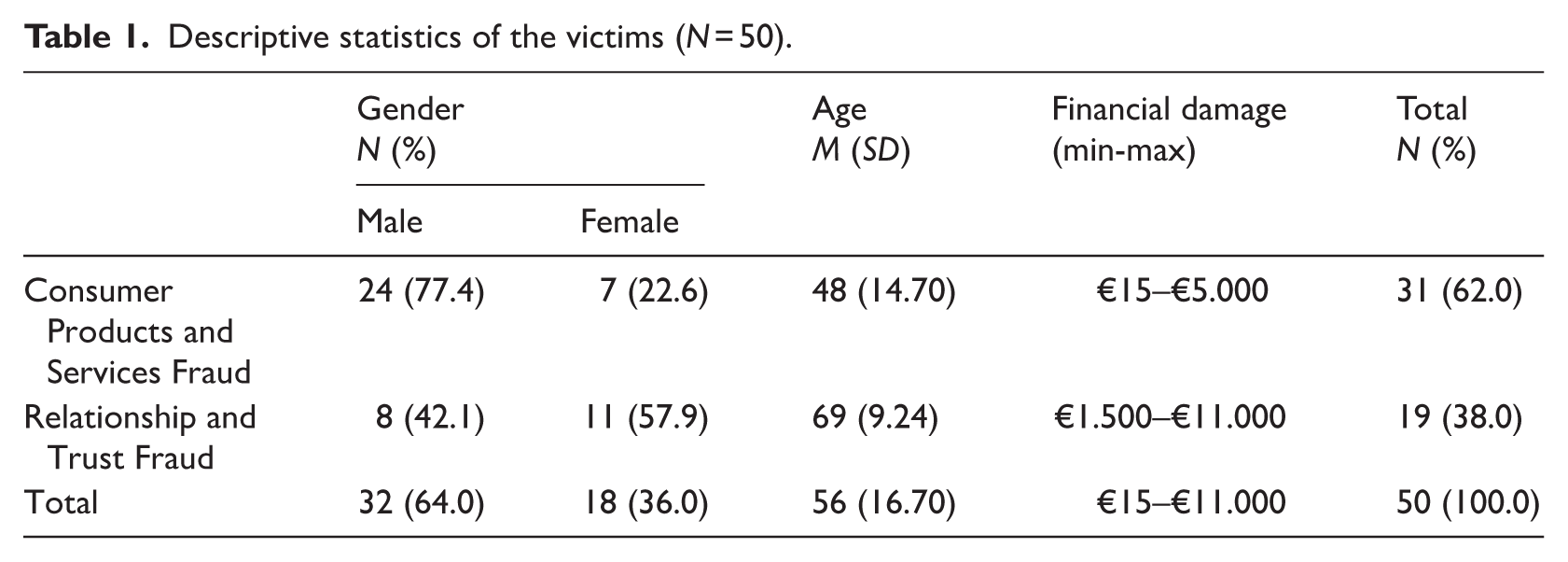
Most of the victims were identified as male (64%). On average, victims were 56 years old (SD = 16.70). Victims of Consumer Products and Services Fraud were more often male (77.4%), whereas victims of Relationship and Trust Fraud were more often female (58.9%). Victims of Relationship and Trust Fraud were on average the oldest (M = 69, SD = 9.24). Table 1 further illustrates the financial losses incurred by the victims due to the online fraud, ranging from €15 to €11.000. 10 As several participants were involved in multiple proceedings because the same instance of fraud involved transfers to different account holders, the total number of civil cases included in this study was 60. Of these, civil proceedings were no longer necessary in 7, were deemed unfeasible in 10, were ongoing in 27 and were completed in 16.
Data analysis
The data were analysed in Atlas.ti using thematic analysis, following the steps outlined by Braun and Clarke (2006). Thematic analysis is a method for identifying, analysing and reporting patterns (themes) within data, enhancing interpretation of various aspects of the research topic (Braun and Clarke, 2006). The researcher became familiar with the data by conducting and manually transcribing the interviews. Relevant data were coded into meaningful groups using an inductive, data-driven approach, with codes deriving from the data rather than existing literature. Efforts were made to ensure the coding closely reflected the content of the text. Examples of codes included motivations such as ‘recover the financial damage’, and ‘punish the fraudster’. These codes were subsequently grouped into broader themes and reviewed with other researchers involved in the current study. Overlapping codes, such as ‘punish the fraudster’ and ‘let the fraudster face consequences’, were merged. Some themes were refined to reflect overarching concepts. For instance, motivations like ‘to do at least something’ and ‘to do everything possible’ were combined under ‘other motivations’. Finally, relevant quotes were incorporated in the results section. For this paper, selected quotations were translated into English and reviewed by colleagues of the researchers to ensure reliable interpretation, given the use of Dutch expressions.
Results
This section outlines the motivations of online fraud victims (N = 47) and their relatives (N = 3) for pursuing civil litigation against the alleged fraudsters. First, the reasons they themselves attributed for initiating a proceeding are discussed, followed by further considerations that played a role in their decision to litigate.
Motivations for pursuing civil litigation
Respondents mentioned various motivations for initiating civil proceedings against the alleged fraudsters. Table 2 provides an overview structured according to the most frequently mentioned motivations. The reported motivations can be divided into financial motivations, justice-related motivations and emotional motivations. In addition, several ‘other’ motivations were reported.
Overview of the motivations mentioned by respondents (N = 50).
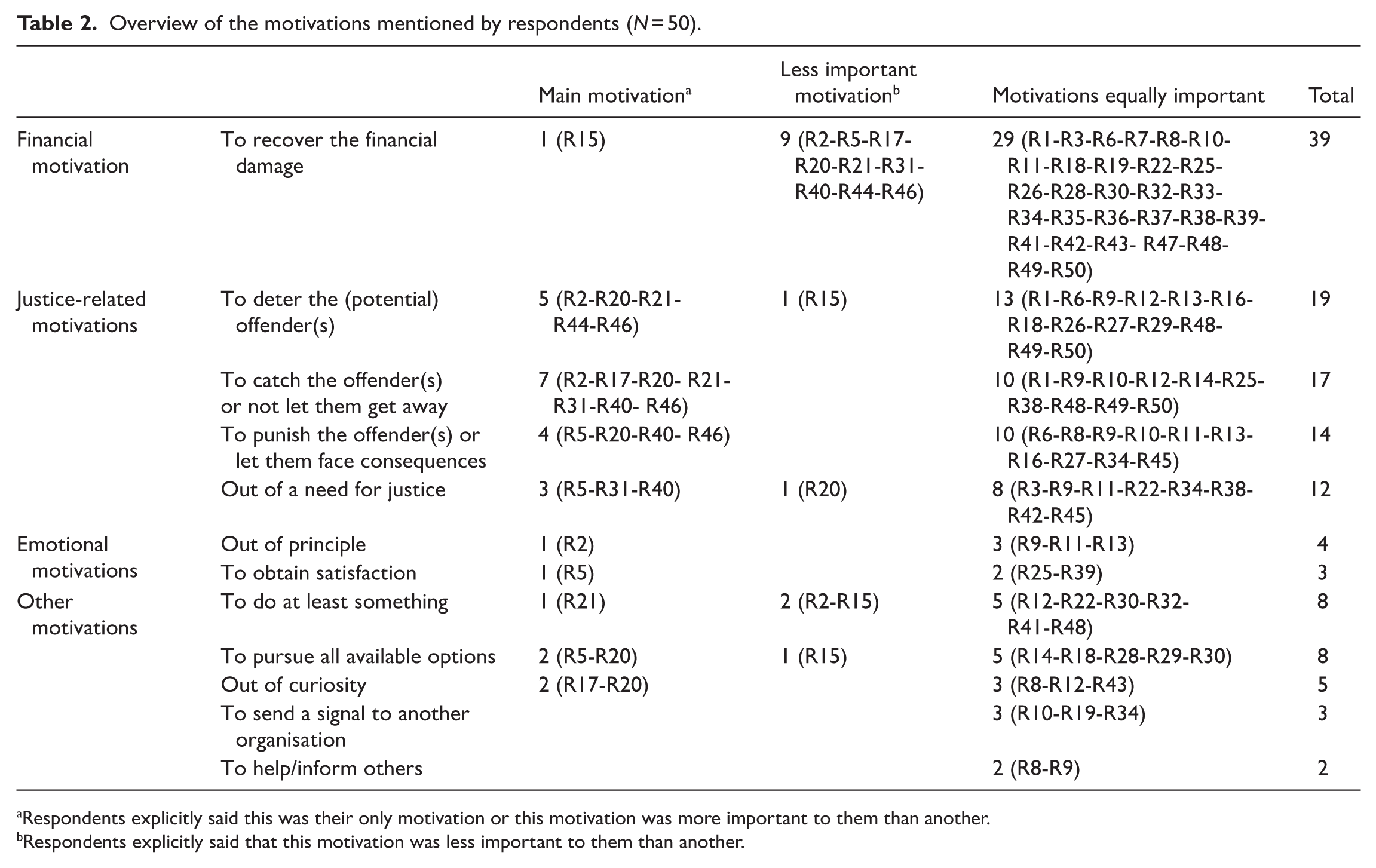
Respondents explicitly said this was their only motivation or this motivation was more important to them than another.
Respondents explicitly said that this motivation was less important to them than another.
Financial motivation
The most frequently mentioned motivation for the pursuit of civil litigation was the desire to recover the financial damage (Table 2). Thirty respondents indicated that this was an important reason or the main reason for them to start the proceeding. Among them were, for example, R10: ‘I was hoping that through [bailiff] I would at least get my money back’, R15: ‘I wanted that money back, that was the main motive’ and R37: ‘You hope to get your money back. That’s the main outcome, that’s what you hope for’. In addition, nine respondents indicated that recovering their money motivated them to initiate the proceeding, but that this was not the most important reason for them. This can be inferred from statements such as ‘In the end it is not even so much about the money, but . . . ’ (R21) and ‘For me it was not only the money, but . . . ’ (R40). In contrast, seven respondents explicitly stated that for them, recovering the financial damage was not a motivation to start the proceeding. For example, R12, R13 and R14 said ‘It was [or is] not about the money at all’. Also, R9 stated, [I hope that] eventually he will have to take responsibility for his actions and . . . pay it back, including the other costs. And I am not hoping for that because I will have my money back, I have long forgotten about that.
Justice-related motivations
The second most frequently mentioned motivations were justice related. Victims pursued civil litigation to deter the (potential) offenders, to catch the offenders or not let them get away, to punish the offenders or let them face consequences, or out of a need for justice (Table 2). First, 19 respondents initiated the proceeding because they hoped that the offender would be deterred and would refrain from committing online fraud in the future. For example, one of the respondents said, On the one hand, I was like ‘you can let it rest’, but if we all continue to think like that, then that does remain a free pass to keep doing it. See, the moment such a person realises that eventually he must pay for it, literally, that he must pay back the money anyway, then maybe he realises ‘I should stop with this’. (R6)
Deterrence played, among other things, a role in the motivation of five victims who were under the impression that the offender continued to defraud people after defrauding them. They hoped that the proceeding could prevent other people from being disadvantaged as well. The following statement gives an example: ‘That man should just be stopped, because a few weeks later he was selling [products] online again’ (R18). Another respondent made a similar statement: [I would] preferably just have that guy quit. Because I got scammed with an ad, this ad was removed, he posted another one, and so on and so forth. I saw that he also went under several names and, actually, if you wanted to buy something like that, you really had a rather good chance to buy something from that guy. And yes, I bought one of [category 251-500] euros, but I also saw things of 900 euros, 1,500 euros. Then I am thinking ‘something has to be done about it’. (R44)
Two respondents emphasised that losing a similar amount of money would potentially have more consequences for other victims than for themselves. According to these victims, this further increased the importance of deterrence. One of them referred to a moment when she sold something on a Marketplace herself and explained what this did to her: [This woman asks me . . . ]: ‘I don’t have the money at the moment, can you reserve it for me?’ I said ‘yes, sure’, but started to think ‘damn, that woman has to save for it’. That irritated me the most. I thought if she had bought that package from him, she would have lost her money she had to be so frugal for. And that is the reason I thought ‘now you are mine’. (R13)
Other respondents hoped that the proceeding would also have a deterrent effect on other fraudsters. For example, R44 said: ‘Because if you can defraud people so easily and you can also get away with it so easily, then that does not set a good example for other people who see or hear about that either’. This aligns with a statement of R9: I hope it gets propagated within – because I can imagine those people operate in a certain network – that something like this will be conveyed: ‘gosh, that idiot did that to me . . ., look what happened to me’. . . . That it does not matter how long it takes, but that eventually you must suffer the consequences of that.
Second, 14 respondents mentioned that they hoped that the alleged fraudster would be punished or face adverse consequences. They hoped this would happen due to the procedure itself, for example because the beneficiary account holder would get into financial problems. Respondent R45 said for instance: That all sounds very mean, but [I hoped] that that person would at least feel a little pain from defrauding me, even if I would not do it personally. Just like a confirmation of ‘he got caught and he suffered consequences’. . . . If only it was like ‘okay, . . . he no longer had the money to pay back and then he had to let himself be declared bankrupt’.
Third, offenders can also be punished because they – when involved in a litigation process – do not get away with the fraud. This motivated 17 respondents to litigate, including respondent R38: ‘You do not want someone to get away with that. Because then I think, “gosh, if you have two or three people every week by whom this works, wat an income you will have”. You just begrudge them’.
Finally, 12 respondents pursued civil action out of a need for justice or legal equity. Respondents (R3, R5, R22) explicitly mentioned that they were ‘seeking justice’. One of them said: ‘Also for your children, they were there too, so that you also show that when someone did you wrong, you undertake steps’. Another respondent felt the need to be vindicated: ‘That this person was wrong and that you are protected as a citizen’ (R42).
Emotional motivations
Four respondents started the proceedings as a matter of principle (Table 2). Respondent R2 explained this played a key role in her case because the fraudster showed lots of guts by sending her a text message with a smiley and wishing her good luck with her case against him. She continued: ‘That man wished me the best of luck, thinking “she will never succeed”. I thought “I will succeed, I will do everything possible”. For me it was not even about the money anymore, it was purely about the principle’. There were also three respondents who mentioned that they wanted to achieve a sense of satisfaction through initiating the proceedings. What that meant to them, varied. According to these respondents, satisfaction can be obtained by previously mentioned goals, such as recovering their money, catching the offender(s) and achieving justice, but also through ‘the victory that it worked out after all’.
Other motivations
Eight respondents did not want to leave it at that and pursued civil action under the guise of ‘nothing ventured, nothing gained’ (Table 2). One of these respondents indicated that for him it was an attempt of ‘We will just try and see where it takes us’ (R41). Eight respondents wanted to pursue all available options. For example, R5 stated: ‘I want to fight until the end to have this figured out. And if it turns out to be nothing at all, then I want to be able to say: “I did my best . . ., I feel like ‘you can’t do more’”’. Four of these respondents also mentioned that they were motivated to initiate the proceedings because they had not previously encountered a party that could help them because of the fraud. In contrast to other parties, the bailiff’s association did have ‘the capacity and attention’ to solve these kinds of cases (R14) or did take the problem seriously (R29).
Another respondent (R19) stated that he started the proceedings with the aim of sending a signal – ‘I can succeed after all’ – to his bank. Others (R10, R34) hoped that the proceedings would contribute to an increased number of police reports and/or an intensified approach by the police: [Have them] pay it back, then lock them up. . . . I was hoping that it would indeed become known who the offenders are, and yes, what they would do with that, of course I do not know, but I can imagine that from [bailiff] there will be feedback to the police. (R10)
In addition, five respondents stated that they started the proceedings out of curiosity (Table 2). One of them (R43) said: ‘It is also a kind of interest to see what happens next. . . . Curiosity about what is there and how it works’.
Finally, two respondents allegedly started the litigation process to help other victims (Table 2), such as by being able to refer others to a legal representative, for example because they may not have the resources or assertiveness to find the proceedings themselves. One of these respondents also wished to contribute to improving the litigation process so that other victims can go through it successfully: I can manage it, I can afford it, but other people might not. It may not even be financial, but there will also be people who get defrauded and lose much more money and experience desperation. I hope I can make a little bit of a difference by participating in these kinds of things.
Further considerations
Respondents highlighted several factors influencing their decision to pursue civil litigation and select this particular legal representative. First, financial considerations played a role for at least seven respondents. Five respondents stated that they appreciated the bailiffs ‘no win, no fee’ policy, where victims only had to pay court fees when they sued the beneficiary account holder, with costs recoverable from the beneficiary in the event the court granted the claim for compensation. Others emphasised the importance of cost-effectiveness, aiming to ensure the legal expenses did not exceed potential compensation. The amount lost was considered important: ‘I can imagine that people think: ‘what is the point?’ But I thought [category 251-500] euros [damage] is worth putting time and energy into that’ (R2). Second, six respondents said that positive experiences of other victims influenced their decision to pursue civil litigation or choose this legal representative. Successful stories on television or Facebook inspired them, as R39 remarked: ‘That gave me a kind of hope . . . , that you think like ‘oh, he also succeeded, who knows, maybe I can do it too’. Finally, the bailiffs’ association was chosen due to positive Google reviews, media coverage and an appealing, accessible website. Respondents furthermore preferred its specialisation in online fraud cases.
Discussion of findings
Despite the high prevalence and impact of online fraud, law enforcement agencies face challenges in tackling this crime type effectively. In addition to reporting to the police, victims can pursue civil action, yet research devoted to the civil settlement of online fraud is scarce. This paper explores the motivations of online fraud victims for pursuing civil litigation and compares these motivations to victims’ needs identified in previous research. Studies suggest that, despite the heterogeneous nature of victims’ needs, victims of online crimes and online fraud in particular, generally report needs similar to victims of traditional crimes (Bluhm et al., 2022; Borwell et al., 2024; Button and Cross, 2017; Button et al., 2009; Cross et al., 2016; Leukfeldt et al., 2019). Research also reveals comparable needs among individuals pursuing civil litigation after personal injury (Akkermans, 2009, 2020; Akkermans et al., 2014; Huver et al., 2007; Relis, 2017; Robbennolt and Hans, 2016). The current study contributes to existing knowledge by examining the specific motivations for pursuing civil litigation among victims of online fraud. Based on interviews with online fraud victims who, since 2021, initiated civil proceedings (N = 47), along with family members who did so on a victims’ behalf (N = 3), the findings highlight both similarities and differences between victims’ needs reported in previous research and the motivations for pursuing civil litigation found in this study.
The most frequently cited motivation for pursuing civil litigation was to recover financial losses. However, some respondents explicitly stated that financial recovery was not their main motivation, or even a motivation at all. This aligns with the existing literature, which considers financial needs among victims of online crime, especially fraud, to be evident (Borwell et al., 2024; Homburg and Van den Tillaart, 2015; Leukfeldt et al., 2019), but not always of primary importance (Button et al., 2009). This is notable, as civil litigation aims to recover financial damages and is therefore inherently financial in nature. Simultaneously, this corresponds with the identified need for the litigation process to more effectively respond to victims’ non-material needs to support their recovery and well-being (Akkermans et al., 2014; Huver et al., 2007; Ruitenbeek-Bart and Akkermans, 2025). In addition, respondents frequently mentioned justice-related motivations, such as to deter or punish the fraudster, or to ensure the fraudster faces consequences. These motivations reflect victims’ need for retribution, which is well documented in the literature (see Button et al., 2009; Cross, 2018b; Cross et al., 2016; Leukfeldt et al., 2019). In line with needs identified in prior studies (Bluhm et al., 2022; Borwell et al., 2024; Cross, 2018b; Cross et al., 2016), victims also initiated civil action to prevent the fraudster from reoffending and protect others from victimisation. According to Ten Boom et al. (2008), this can be considered a primary need. Again, these findings are noteworthy, given that civil proceedings are not intended to focus on deterrence, punishment, or retribution. It remains unclear how effectively these objectives can be achieved through civil litigation.
In addition to financial, retributive and primary needs, previous studies have identified emotional, informational and practical needs as prevalent among victims of online crime (Cross et al., 2016; Homburg and Van den Tillaart, 2015; Leukfeldt et al., 2019; Parti and Tahir, 2023). The current study found some evidence that emotional motivations also played a role in victims’ decision to litigate. Some respondents initiated the litigation process out of principle, or to obtain satisfaction. However, the emotional motivations observed in this study did not fully align with such needs identified in previous research. For example, no victims in the current study stated they pursued civil litigation out of a need for emotional support, or a need to be recognised as a victim. In addition, the current study found no motivations stemming from information needs, such as gaining insight into the crime that was committed, and practical needs, such as handling formalities. These findings suggest that, to address emotional, information and practical needs, victims may turn to other channels rather than pursuing civil action.
Furthermore, a subset of respondents reported ‘other’ motivations. For example, victims stated they pursued civil litigation to do at least something about the fraud, to pursue all available options, or to signal to other entities like the police or financial institutions, hoping these parties would be motivated to take further action. These motivations align with previous research on the reporting experiences of victims of online fraud. Studies (Button et al., 2009; Leukfeldt et al., 2019) show that these victims often continue seeking resolution when they feel neglected or dismissed by the organisations they approached. Respondents mentioned that the bailiff’s association was the first party that could help them, had the capacity, or took their problem seriously. Accordingly, our findings support the notion of Van Dongen et al. (2013) that the absence of criminal investigation, prosecution, or arrest can prompt victims to pursue civil action.
Limitations and future research directions
Further research should examine whether victims of online fraud who have not pursued civil action or reported the fraud to the police would have similar motivations to litigate. It should also examine whether there are differences in motivations across different types of online fraud victims, and what obstacles victims perceive, taking into account not only the type of offence and its impact, but also individual differences between victims, such as levels of vulnerability. In addition, it is important to explore the expectations of online fraud victims regarding civil action, as this study indicates a potential gap between expectations and the reality of the proceedings. For instance, contrary to some respondents’ motivations to pursue civil action to increase the chances of criminal prosecution, civil action is unlikely to lead to an intensified police approach or the criminal sanctioning of fraudsters. Addressing this expectation gap can be achieved by improving victims’ knowledge about the litigation process. Moreover, it is important to assess whether civil proceedings adequately address the needs of online fraud victims, as this is essential for developing effective policies to combat online fraud and support victims. Enhancements are needed to provide appropriate assistance to this diverse group. Offering support that aligns with victims’ needs can help them cope with their victimisation and avoid exacerbating the negative consequences they already endured (Button and Cross, 2017; Cross et al., 2016; Leukfeldt et al., 2019). To support victims’ recovery and well-being, it is essential to address both their material and non-material needs (Akkermans et al., 2014; Huver et al., 2007; Ruitenbeek-Bart and Akkermans, 2025).
Some caution is required when interpreting the results of this study. First, the retrospective nature of the data collection may lead to memory biases, as respondents may inaccurately recall their motivations. Second, the findings cannot be generalised to all victims of online fraud, as the respondents’ motivations for pursuing civil action may have been influenced by the fact that none had recovered their financial losses prior to the pursuit of civil action. At the same time, it is plausible that victims who do receive compensation, for example, through financial institutions or criminal proceedings, may not pursue civil action, as they no longer have a legal basis to do so. Third, the respondents were invited to participate by a specific legal representative, who functioned as a gatekeeper between the researchers and the participants. Consequently, the researchers had limited insight into non-response, which may have led to (unconscious) selection bias. It is therefore possible that individuals with particular motivations are overrepresented in the sample. This may be due, for example, to the legal representative offering services on a no win, no fee basis. To mitigate these potential biases, several criteria were agreed upon with the representative, including the recruitment of respondents at different stages of the proceedings. This approach resulted in a large, diverse sample of respondents with a broad range of motivations. The legal representative contributed significantly by dedicating considerable time and effort to inform victims about the study and provide them with invitations. Without this established collaboration, the recruitment process would have been considerably more challenging.
Despite these shortcomings, the current study represents an important first step towards gaining empirical insight into the motivations of victims of online fraud in the pursuit of civil litigation and lays the groundwork for further exploration of victims’ motivations for pursuing civil action, alongside their experiences of procedural aspects and outcomes of such proceedings.
Footnotes
Acknowledgements
This study was funded by the Dutch Police and a foundation focusing on Victims and Society (Stichting Achmea Slachtoffer en Samenleving, SASS). The recruitment of respondents was facilitated by Rick van der Rest of the National Association of Judicial Officers (Landelijke Associatie Van Gerechtsdeurwaarders, LAVG).

Ethical considerations
This study was approved by the Research Ethics Committee of The Hague University of Applied Sciences on 23 December 2022.
Consent to participate
Respondents gave verbal consent for using the data before starting the interviews.
Consent for publication
Not applicable.
Author contributions
Merel Anna Gerarda van Leuken: Conceptualization, Formal analysis, Investigation, Methodology, Writing – Original draft.
Maria Susanne van ’t Hoff-de Goede: Conceptualization, Methodology, Writing – Review and Editing, Supervision, Funding acquisition.
Eric Rutger Leukfeldt: Conceptualization, Supervision, Writing – Review and Editing.
Funding
The authors disclosed receipt of the following financial support for the research, authorship and/or publication of this article: This work was supported by the Dutch Police and a foundation focusing on Victims and Society (Stichting Achmea Slachtoffer en Samenleving, or SASS).
Declaration of conflicting interests
The authors declared no potential conflicts of interest with respect to the research, authorship and/or publication of this article.
Data availability statements
The data underlying this study are not publicly available due to privacy considerations, but may be shared by the authors upon reasonable request. Interested researchers should contact the corresponding author at