



Abstract
This article explores the application of Lerner’s Belief in a Just World (BJW) to online fraud. BJW finds that people tend to blame victims when their sense of justice is threatened and if there is little or no chance of obtaining compensation or justice for the victim. Specifically, BJW suggests that when victims are perceived as acting with agency, and have little chance of compensation, they are blamed for their crime. Online fraud victims are blamed by family, friends, justice agencies, and themselves, for their victimisation. Little is known about why the Fraud Justice Network (FJN), which comprises the multitude of agencies that aim to combat online fraud, blames victims. This article begins to address this gap by presenting findings of qualitative interviews with 14 FJN representatives, using thematic analysis. Three significant themes emerge about victims: ‘agency’, ‘gullibility and compensation’, and ‘deservedness of justice’. This study found that (a) victims are seen as behaviourally responsible, (b) agency is blameworthy, and (c) victims deserve justice. The study also finds evidence of BJW thinking within the FJN. Findings can inform future organisational policies on how victims of online fraud can be more effectively managed and supported, including by financial institutions or law enforcement agencies.
Introduction
Online romance and investment frauds are prolific, with the highest emotional and financial losses of any form of fraud (Modic and Anderson, 2015). The Australian Competition and Consumer Commission (ACCC) report that in 2020 alone, AUD$328 million and AUD$131 million was lost to recorded romance and investment frauds in Australia (ACCC, 2022). The nature and volume of losses of investment and romance frauds are reported to be just as high in other Western nations. In the United States, victims lost USD$3.5 billion to cybercrime in 2019 (IC3, 2020), and in 2020, in the United Kingdom, victims reported a loss of £135.1 million in investment frauds (a 42% increase on the year before), and £21.2 million in romance frauds (an increase of 17% on the year before) (UK Finance, 2021).
Online romance fraud refers to when a victim is conned out of money by an online offender, who has been posing as a genuine romantic partner (Whitty, 2015). Investment frauds are those where victims are deceitfully presented with a fake investment opportunity for which the victim sends money (ACCC, 2022). In both these frauds, the victim themselves transfers their money, but in many cases, victims are not aware that they have been defrauded until long after their money has been lost, often to an international offender (Buchanan and Whitty, 2014). In addition, a new category of fraud called ‘romance baiting’ was reported in 2021, which is a scam that involved targeting victims through a dating app, then typically moving off the app, and luring them into an investment scam, often involving cryptocurrency (ACCC, 2022). A total of AUD$15.4 million dollars was lost, as recorded by Scamwatch, which is an Australian reporting agency that takes reports of online fraud (ACCC, 2022). Romance baiting appears similar in its operation to the Chinese ‘sha zhu pan’ or ‘pig butchering scam’, which similarly involves first forming a relationship with the ‘pig’ (victim) from a dating website, and then posing an investment opportunity, providing modest initial returns and building trust, before scamming them of large sums (Wang and Zhou, 2022).
It is known that reporting these types of online frauds to police, banks, or online government sites turns into a ‘merry-go-round’ (Button et al., 2013) of reports, with no justice or retrieval of funds. Victims of online fraud experience blame from their families and loved ones, police, other agencies to which they report, and even from themselves (Cross, 2013; 2015; 2016b). As Cross (2015: 8) argues,
(T)he popular discourse surrounding online fraud victimisation is very much founded upon notions of blame and responsibility leveled towards the victims themselves for their failure to avoid victimisation in the first place.
Victim blame arising from the criminal justice system itself is not a new phenomenon. There has been much written about victim blaming attitudes from police, courts, and the legal fraternity in cases of family violence and sexual assault (Areh et al., 2009; Bedi, 2011; Greeson et al., 2016; Stewart and Maddren, 1997). In the case of online fraud, many victims suffer loneliness and depression from the financial and emotional loss experienced (Cross, 2015) and are vulnerable to repeat victimisation (Cross, 2016a; Whitty, 2013).
Much existing scholarship explains this high level of blame for victims of crime by reference to Christie’s (1986) ‘ideal victim’ theory (Cross et al., 2019; Larcombe, 2002; Meyer, 2016; Randall, 2010). This perspective posits that to be deemed an ‘ideal victim’, a person must meet the following criteria: be weak (sick, old, or very young), be carrying out a ‘respectable project’ at the time of victimisation, be victimised at a place they cannot be blamed for being in; the perpetrator must be both ‘big and bad’, and a stranger to the victim (Christie, 1986). However, recent research by Nataraj-Hansen and Richards (2022) proposed that Belief in a Just World (BJW) can offer a more persuasive theoretical explanation for the high level of blame experienced by victims of online fraud. BJW proposes two major concepts: (a) victims who are seen to have some form of responsibility are blameworthy, and (b) the victim is also considered blameworthy when they do not receive compensation for their suffering or similar. Nataraj-Hansen and Richards (2022) argue that these are both highly applicable to online fraud because (a) victims are both willing and active in transferring funds and (b) the likelihood of obtaining justice (either financial or criminal) is notoriously low and fraught with issues and obstacles (Brown, 2015; Button et al., 2018; Levi, 2017).
This article investigates if there is evidence of BJW among fraud professionals who work within the ‘Fraud Justice Network’ (a term used to refer to the myriad agencies and financial institutions to which victims report online fraud) (Button et al., 2013; 2018). Button et al. (2013) write that in England and Wales, there are over 20 agencies that take an interest in fraud, not limited to the police, Crown Prosecution Service and courts that work together in some capacity but not always in a coherent or systematic way. Some frauds are processed through the formal criminal justice system like many other volume crimes; however, the majority are not, because fraud, unlike many other crimes, relies on systems other than criminal justice (Button et al., 2013). Much like in the United Kingdom, in Australia, Cross et al. (2016b) find that there are over 20 agencies that have a role in fraud justice and can be included within a loose system of a Fraud Justice Network (hereafter FJN). Reference to the FJN is academic, rather than one that is used within professional fraud circles. There is no official institution that fraud professionals see themselves as members of. The network, in name only, is actually seen as a central issue for justice, as it is commonly found that not having an institutionalised system is an impediment for victims, who do not know where to report or are sent around a ‘merry-go-round’ to different agencies to report (Button et al., 2013; Cross et al., 2016a; 2016b; Cross, 2018; 2020a).
There is little known of how professionals within these agencies see the entire network in operation. Only a few empirical studies have been conducted with the aim of understanding how FJN professions perceive online frauds (Bossler et al., 2019; Cross, 2013). Findings from a UK sample suggest that general duty police feel more prepared to respond to online frauds with better training and clearer procedures as well as further education and exposure to victim management (Bossler et al., 2019). Another surveyed experience of Canadian victim support workers suggests that there were high rates of empathy and understanding for victims; however, victims were still the subject of pity for their loneliness which was assumed to be the driving factor to engage with online scammers (Cross, 2013).
In Australia, there has been some commentary about the difficulties victims face in identifying the appropriate reporting agency and receiving justice following fraud victimisation (Cross, 2020a; Cross and Blackshaw, 2014), and reports of some successes in policing online fraud using strategic financial intelligence methods (Cross, 2016a). However, there is no known study from the perspectives of FJN professionals about victims of romance and/or investment frauds and justice. Understanding how members of the FJN perceive victims is, however, important because their attitudes and practices can enable insight into the current state of institutional justice, and potential to improve justice responses for a growing cohort of silently suffering victims.
This article seeks to gain a deeper understanding of victim blame by FJN professionals, and more specifically, whether BJW theory can explain FJN blame towards victims of online fraud. The findings outlined below will be relevant for policymakers and criminal justice professionals to facilitate better training programmes and policies to be able to improve responses to online fraud.
With this overview of the modus operandi of romance and investment fraud, the current state of fraud justice, and research on victim blame and BJW, this article argues that the literature on victim blame and BJW, although prolific generally, is limited in its application to online fraud. The second part of this paper outlines the methods of the study and the third provides detailed findings and analysis. The last part is a brief conclusion and discussion of implications of the findings, with some suggestions for future research.
Theoretical background: BJW
BJW refers to the belief that the world is a just place as an existing condition, where everyone will normally get what they deserve, are treated fairly, and will be compensated for experiencing injustices (Dalbert, 2009; Hafer and Sutton, 2016). Generally, this idea acts as a way in which people regulate their sense of well-being. However, BJW can play out in the form of preconceived notions of flawed character if someone is seen to be suffering with no visible explanation. This is drawn from the idea that we all have an innate ‘justice motive’, so that a ‘justice threat’ (that gets larger when something extremely bad happens to someone particularly innocent) creates psychological distress in the observer (Pemberton et al., 2019).
BJW is not a fixed belief, it is a tendency (high or low) and is a cultural variable (Correia et al., 2009; Shengtao Wu and Cohen, 2017). According to Rotter’s (1966) theory of the internal locus of control scale, people have various ways in which to make sense of the world. There are four components of Rotter’s internal–external scale: belief in a difficult/easy world, a just/unjust world, a predictable/random world, and a politically responsive world (Collins, 1974). Those who score high as believers in a predictable world also tend to score highly in a BJW (Collins, 1974).
The belief that the world is a just place is derived from the psychological need to create a stable and predictable world for the observer, restoring justice in their minds by accusing the victim for their own fate or derogating the victim’s character (Loseman and van den Bos, 2012). The BJW provides a psychological buffer against this distress that arises from harsh injustices of the world, providing a sense of personal control over one’s own future (Furnham, 2003). According to this theory, victim blaming is a way to minimise the justice threat, by constructing the narrative that the victim has behavioural responsibility.
Victims are blamed if they are seen as somewhat responsible for their suffering and do not receive any form of justice or compensation for the suffering (Lerner, 1971; Lerner and Miller, 1978). However, victims who are seen to have behavioural responsibility but receive some form of justice or compensation for their suffering are blamed less (Lerner, 1971). Lerner (1971) conducted three studies (with various conditions) of observers watching a victim receiving electric shocks for errors in tasks that she is asked to perform in front of undergraduate observers. The perception of the victim is tested under different conditions. In one condition, participants are told that she is receiving the shocks reluctantly, after being told that she should for the benefit of others. In this condition, the victim was seen as most deserving of her punishments as she acquiesces into being shocked (Lerner and Miller, 1978). Lerner found, however, that when the victim is compensated with money (under two conditions of $10 and $30), regardless of how willing she is, she is derogated less. When she is not compensated, she is much more likely to be derogated (Lerner, 1971; Lerner and Simmons, 1966). This is replicated in a study that presented respondents with a report about police assaulting a man, in which respondents were more likely to derogate the victim when there was no opportunity for justice, and empathise when there was a potential for justice (Lincoln and Levinger, 1972).
Compensation (or lack thereof) plays an important role for observers of victims. The injustice of not receiving anything to compensate a wrongdoing threatens the perception that the world is just; therefore, those who have high beliefs in a just world are likely to cast doubt on the victim’s deservedness to justice. Moreover, if the victim is seen to have ‘brought on’ their own suffering by the way they have acted or not acted, they are also seen as deserving of their suffering. These concepts are relevant to studying victim blame in online fraud, as the likelihood to achieve just outcomes by law enforcement is quite low, given the complexities of fraud (Broadhurst, 2006; Brown, 2015; Holt, 2017; McQuade, 2001; Urbas, 2015; Wall, 2007). Moreover, victims’ responsibility (regardless of being under deceptive circumstances) is a feature for studying online fraud (Sorell and Whitty, 2019), because it is a crime type where victims are ostensibly willing participants, and are accordingly blamed (Cross, 2016b).
Method
This article draws from 14 semi-structured qualitative interviews with 14 participants who work within the FJN, in the policing, private investigation, finance, or legal professions in Australia. It seeks to build an understanding into FJN perspectives about victims of online fraud. Ethical clearance was obtained through the QUT Human Research Ethics Committee (Approval Number 1900000923). Additional clearances were obtained through individual police agencies in Australia.
Qualitative data were obtained through conducting semi-structured interviews with participants, with reference to two vignettes (see Appendix 1). Vignettes are written descriptions of an often fictitious, but sometimes of real-life events which relate to the central topic of study (Sampson and Johannessen, 2020). Using fictitious or fictionalised characters and situations allows the interviewer to quiz the participant on their thoughts and feelings in relation to what they think about the character, and importantly to observe the participants’ values (Jenkins et al., 2010). The vignettes used in this study featured details of a romance fraud and an investment fraud, which were drawn from real-life stories, as well as including some fictitious elements. They detail the victim’s circumstances, their interactions with the offenders, and attempts to report the crime. The vignettes were used to anchor the discussion to the form of online romance and investment fraud and facilitate discussion about participants’ thoughts, feelings, and experiences with similar cases. The vignettes also provided clarity to participants about the types of fraud within scope prior to the interview, so that all participants could reflect and focus on the same set of circumstances and crime type.
Participants were asked a series of open-ended questions designed to elucidate their views about victims of online fraud. For example, they were asked ‘how does it make you feel when you know that victims are unlikely to get the justice they are expecting?’ and ‘do you think that anyone can be a victim of online fraud?’. The semi-structured design and open-ended questions avoid forcing participants to choose from pre-determined responses and instead enable participants to take charge of discussing the topics of importance to them and allow for specific questions and discussions about their experiences and cases they have worked on. One-on-one interviews that are conducted in a semi-structured way allow for the participants to assume some control of the conversation, underpinning the ‘discovery’ principle of the study; this is to explore how the participant understands the world from their subjective experience (Ryan et al., 2009). This facilitates collection of richer data from the participant than that obtained through formally structured scheduled questions (Ryan et al., 2009).
FJN representatives were eligible to participate if they were currently or previously recently employed in any financial, commercial, or statutory body that is considered part of the FJN in Australia; were aged 18+ years; and were willing and able to voluntarily consent to participating. Interviews took place between August 2020 and April 2021. All participants were provided with an information sheet and consent form, which outlined the focus of the study. Interviews took, on average, 60 minutes but ranged from 33 to 76 minutes. Five interviews were conducted in person, eight via video conferencing, and one on the telephone. In the case of video conferencing, images were deleted, retaining the audio. Names of people and organisations are redacted to maintain anonymity of participants and/or their employers.
All five serving police participants were recruited by email, through the assistance of the relevant police force research unit that approved the research. Police officers were either self-selecting or identified as potential participants by their commanding officers (but in all cases had to agree voluntarily to take part). Three participants were referred by word of mouth of the existing professional networks of the researcher; however, none were known to the researcher. Five participants were recruited through LinkedIn, an online social network for professional development. This was by using both a ‘recruitment account’ to advertise the call out for participants and direct messages and searches for those who were considered to be suitable. One participant was directly emailed through their professional website, located via a Google Search.
Overview of participants and questions
Of the 14 participants, 2 were female and 12 were male, within five professional categories; however, many participants had diverse professional experience often overlapping in expertise, but within the field of fraud. Of the 14 participants, 5 were serving police officers and 4 were ex-police officers. There were two private investigators, with one specialising in online romance frauds. There were two financial professionals, one cyber security expert, one investment fraud expert, and one lawyer who specialised in online frauds. Overall, the sample can be seen as a fair representation of the FJN, with differing interests, levels of experience in investigating online frauds, and/or sophisticated organised scams. Years of experience of each participant was not formally asked or collected and there was no minimum requirement to participate.
The nature of semi-structured interviews does not lend itself to strict questions asked equally to all participants, in any order or with any prescribed time allocation. A general list of questions was prepared and loosely adhered to, to elicit a conversation about how participants felt about victims, offenders, and navigating the FJN to afford justice. Some questions were specifically asked to elicit participant expressions of BJW, as indicated:
How do you feel about this scenario? (refer to vignette)
In these scenarios (or in your experience), why do you think the victim did not get their money back? (BJW)
What do you think motivates victims to engage with perpetrators?
What do you think motivates these victims to send money to perpetrators?
What sort of justice do you think these victims deserve? (BJW)
Some research suggests that victims of these frauds have lower impulse control. Is that the case in your experience?
Would you consider the victim unlucky? (BJW)
How clear is the law in romance and investment fraud?
How could the offenders be brought to justice?
After money has been transferred, who is to blame for the crime? And why? (BJW)
Why do you think this sort of crime happens to only some people? (BJW)
Do you know of cases where a potential victim has reported this without losing money?
Would you still investigate these cases? Why? Why not?
Do you think that it could happen to you? (BJW)
Thematic analysis and BJW
The interview data were coded using NVivo software, first by creating open codes by thematic analysis under two headings (BJW and FJN). Thematic analysis is a method for identifying, analysing, and reporting patterns, and in doing so, it portrays the content of the text by themes (Anderson, 2007; Clarke and Braun, 2017). There are six phases of thematic analysis according to Braun and Clarke (2006), as follows:
Familiarising yourself with the data – including transcription, review, and notetaking;
Generating initial codes – organising the data into meaningful groups that are deemed relevant or interesting to the coder;
Searching for themes – this involves sorting the codes themselves into themes;
Reviewing themes – refinement of the themes, discerning those that are not actually themes, those that are sub-themes, and those that can be integrated into other codes, and so on;
Defining and naming themes – capturing the ‘essence’ of each theme, by examining and articulating the ‘story’ that each theme tells;
Producing the report – final analysis and write-up of the report (i.e. the current article).
The data were coded in an open manner for themes that emerged within the transcripts with no prior categories established. Overall, there were six major discursive themes that emerged from the open coding. These were reasoning, compensation, education, FJN issues, fraud and victims, with further sub-categories that emerged within these seven major codes. There were no a priori codes except that the interview vignettes and questions were designed with a priori themes of fraud and BJW. Figure 1 shows these six major codes, with sub-codes, and those codes in squares with a further sub-code.
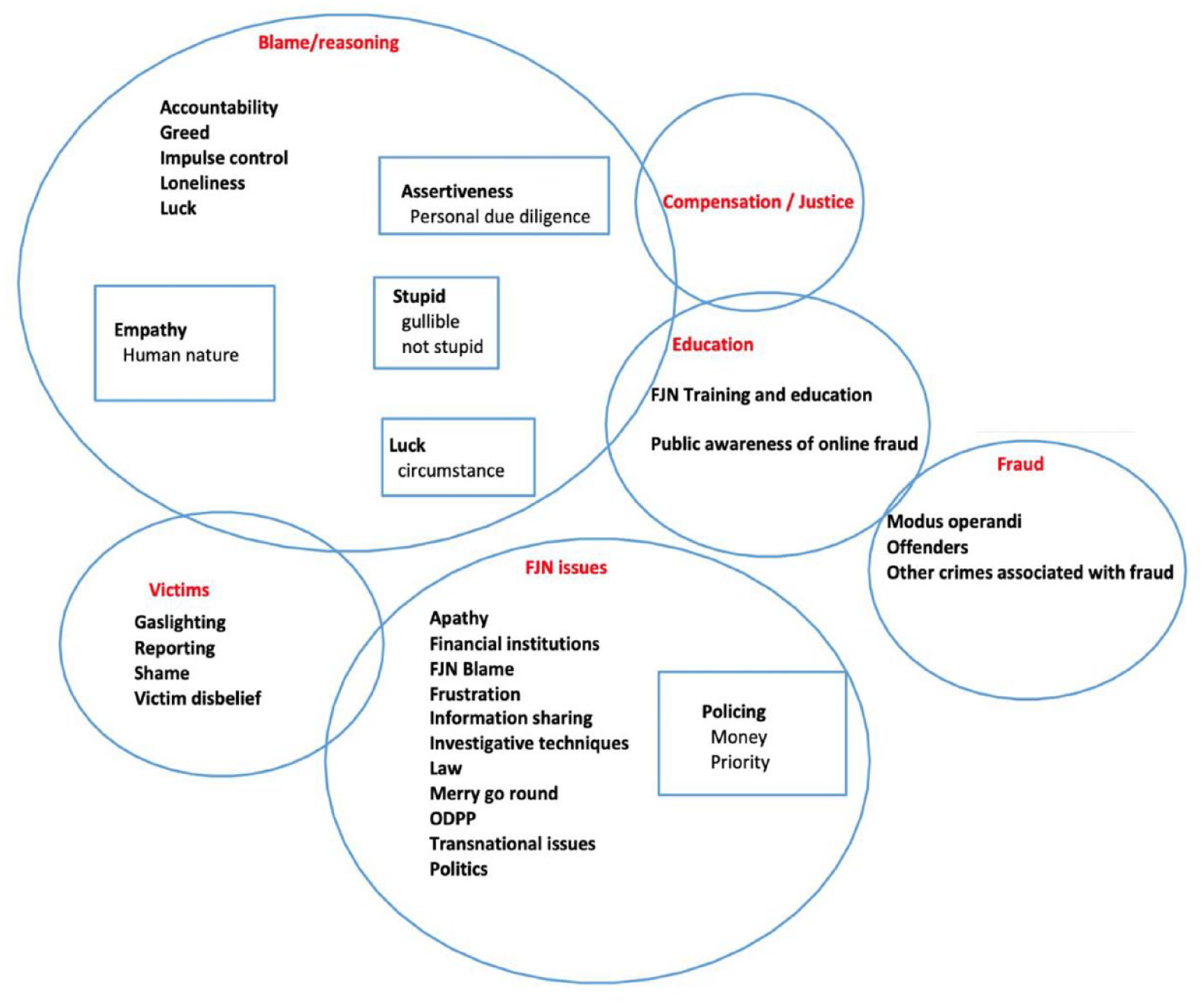
Codes from thematic analysis.
The themes that arise as a result of these categorisations are grounded within the BJW literature. Using these open codes and going back and forth between the literature, the interpretive process allows for the development of the themes presented within the results:
Agency (luck/not unlucky);
Gullibility and compensation (victim blame);
Deservedness of justice (empathy).
Interpretation is integral to thematic analysis, but the interpretation of codes into themes needs to operate in unison with the research question (Braun and Clarke, 2021); therefore, the themes with the most relevancy have been presented to address the question, ‘Is BJW expressed among fraud justice professionals in relation to victims of online romance or investment frauds, and if so, how?’
It should be noted here that the researcher did not have pre-conceived notions of how high or low on the BJW scale participants were. Indeed, levels of BJW are measured in a quantitative manner; therefore, unless the participants were asked to take a BJW test, it is impossible to know. The researcher approached the data knowing that BJW is inherent in everyone to some level, but how this plays out discursively (if at all) is of more importance to the research question. The researcher attempted to apprehend all forms of victim blame with curiosity in the context of greater cultural and systemic issues within the FJN and indeed the Australian financial and criminal justice institutions at large. These are further explained in the discussion below.
Results
The results presented are in relation to the three themes of BJW that affect levels of blame. These are participants’ observations of victims, being agency, gullibility and compensation, and deservedness of justice.
Analysis led to three major findings by the perspective of participants:
Victims of online fraud exercise behavioural responsibility/agency;
Agency is blameworthy;
Victims bear fault, but deserve justice.
These are outlined in turn below.
Victims of online fraud are seen as exercising behavioural responsibility (agency)
Behavioural responsibility was expressed in two main discourses by participants, both suggesting that the victims act with some level of agency. One was the discourse that victims are ‘not unlucky’, and the other was that the victims are gullible and impulsive.
When asked if victims were unlucky, the response was predominantly that they were not unlucky but were approached by the offender, for a specific reason. The theoretical strategy of asking if the victim was lucky or not is that if the world was not just, victimisation would be random for anyone utilising the internet to either find a partner or an investment. Respondents tended to express their opinions of victims by talking about them as ‘not unlucky’, and thereby exercising some agency, which had led them to the crime they experienced. Interestingly, although all participants were clear that they didn’t think victims unlucky, there were convoluted and unclear expressions of why they thought this.
But if you send 1,000 requests out and three of them reply, that’s not targeting. It’s who actually took the bait. (Participant 8) Um, no they’ve –their [online] profiles are ripe for targeting. (Participant 6)
Participants appeared unsure about why they thought the victim was not unlucky but were quite sure that this was the case, unambiguously avoiding framing online fraud victimisation as simply bad luck. This is consistent with Janoff-Bulman’s (1979) observations that luck is an elusive concept, where people are unable to define it well or point to particular aspects that should make someone ‘lucky’. To explain luck, participants explained it in a paradoxical manner, highlighting sometimes the randomness of online fraud victimisation, yet that they are still prime targets:
Okay, no, I wouldn’t say the person is unlucky . . . The criminal has got lucky because these criminals do millions of millions of approaches to try and scam someone. (Participant 11) It’s more of a scattergun approach . . . it’s a, it’s a numbers game. You [email] a hundred people–you get one–that’s a win. (Participant 5) Um. No, I wouldn’t say unlucky. I would say–not unlucky. Well, unfortunately they’re unlucky. No, I don’t think–oh, I don’t know what the right term for it would be. (Participant 9) I don’t think luck comes into it at all because there’s so many scammers out there contacting people, it’s just a matter of being contacted. Um, I don’t –think they’re unlucky . . . I think they’ve just been targeted . . . (Participant 1)
Participants did not appear comfortable with a term that insinuates that online fraud victimisation could befall anyone. This ostensibly might be a response consistent with those who do squarely blame victims, as they might perceive it as the shortcomings of the victim’s character that has led them to their fate, not ‘luck’. However, the unease with ‘unlucky’ was no different for participants who demonstrated high empathy for victims.
Interviewee: I’ve never heard someone say that they, that they were unlucky . . . As a victim of a romance scam. Facilitator: But how do you feel about it? Interviewee: I think they’ve just been targeted . . . and they’ve just fallen for a deception and it’s just human nature, ah, that we all fall for deceptions at some stage. (Participant 1)
We can see that although luck is not a preferred term, circumstance is commonly alluded to, especially when asked if anyone could be a victim of these frauds. Circumstance is an idea that could be psychologically comforting, because it allows the belief that it was not incontestably random. This is to suggest that a set of events led for the victim into the right psychological state to fall for the deceit.
It depends on the circumstances we’re in at that time. (Participant 11) Probably more about circumstances. (Participant 4) They may be coming off an abusive relationship, a long-term marriage, um they’re now comfortable in dating again, um and look you know what 50 year old woman or male wouldn’t want a person 20 years younger sweeting over them, um paying attention to them.(Participant 3)
Participant 3 expresses the idea behind why circumstance could be a better explanation for the victimisation. This discourse aligns with the perspective that the victim had agency over their actions, because it is incongruent that (a) it could happen to anyone, given a set of circumstances and (b) offenders have a scattergun approach without a particular target but (c) the victim is not unlucky. This discourse suggests that all participants have some level of BJW and deem victims to be behaviourally responsible for the crime, but still deserving of empathy.
Another dominant discourse was that victims were intelligent people, who had made a ‘stupid’ mistake. This is different from thinking that someone is inherently unintelligent. On the contrary, participants state that it is not low intelligence that leads to victimisation:
As I said, a lot of these people are highly educated. (Participant 8). I don’t think they’re stupid people (Participant 12) The victim was always called the fool . . . it’s just not the case. (Participant 1)
Although participants did not consider victims lacking in intelligence, they expressed that victims were gullible.
Um, well I mean they could be, um, more gullible, um, naïve. (Participant 13) And I think gullible is the word, I guess, and they see in the romance and investment scams, that they’re going to have a better life. (Participant 7) That’s gullible. That’s gullible, but she’s lonely, um, she’s lonely, you know, and she’s hoping. (Participant 13)
However, gullibility is not expressed as a trait that is only applicable to the victim. Acting on gullibility appeared to be expressed as making poor choices that can be universal. Participants, for example, expressed their own gullibility and that of others as if it were a cultural phenomenon, which could be overcome with better choices.
But yeah, I think we’re – as a nation we are gullible because we believe what we’re told. (Participant 7) There’s a general feeling that Australians . . . are the most gullible. (Participant 10) But in Europe you have the same things . . . [Some nationalities] are very easily duped, um, because they like a good deal. (Participant 2)
Having gullibility is expressed as a general cultural fault, but not one borne of arrested cognitive function. Acting on gullibility, was, on the other hand, expressed as a form of agency because it is universal, not because it is solely for the vulnerable or the manipulated victim. In this context, gullibility (acting on a poor choice) suggests that the victim is practicing agency because it is a label attached to something that the victim ‘did’, rather than the victim inherently ‘is’. Acting on a false belief is seen as the fault of the victim, because they have the agency to ask questions, or spend more time testing for truth, but did not choose to do this.
Australians are more gullible. And we–and they believe what they read on the internet, and I go but that’s–that’s a fabricated PayPal page, or that’s a fabricated custom’s document. And I had one lady who’d sent AUD$400,000 overseas to a boyfriend in Ghana, who she’d never met, um to get gold shipped to Australia. (Participant 7) In the first vignette, the 65-year-old, should’ve known better. And, he thought he was taking relatively safe precautions, but he wasn’t really testing anything. He was letting them tell him that it was working okay. (Participant 2) You know, go and, go and do the enquiries, like, but, you know I think we as Australians are fairly giving people anyway. (Participant 3)
Making gullibility a cultural trait suggests that gullibility is not seen as an individual problem, exclusively pertaining to victims. Nevertheless, the discourses imply that one can be less gullible, as an individual, choosing to take control, asking more questions or being more cynical. Being gullible is expressed as a choice.
Similarly setting out this choice is ‘not being assertive’, a common way that participants expressed the gullibility of victims. Twelve of the 14 participants interviewed expressed at least once the idea that victims of online romance and investment scams were or are not assertive enough for varying reasons. Not being assertive was again to do with not asking questions, doing research, not seeking external counsel, having security protections or naively getting into situations they did not understand. Lack of assertiveness is again not something that suggests that victims are lacking intelligence, or expressing limited cognitive function. It is simply an oversight, a lack of attention, laziness, expertise or a lack of education that could be attributed to anyone at a given time or situation. None of the responses suggested that the victim was lacking agency. Rather, participants expressed that victims have the agency to do what they wanted.
He wasn’t getting an independent person looking at it . . . And, most people are too lazy to test the system. It looks good, it smells good, it tastes good, I’m going to buy it. (Participant 2) You know, and they just don’t bother doing that research. (Participant 3)
Aligned with not being assertive is the notion of impulse control. Often those who suggested that victimisation could be avoided also suggested that assertiveness was subdued due to the impulsiveness of the victim. Impulsivity could be associated with a lack of control over one’s habits or vices. However, participants did not infer that impulsivity meant the victim had a lack of agency. Again, these were expressed as faults, not specific to victims, but broadly as a cultural issue.
There’s a culture of instant gratification. (Participant 12) I don’t know how you protect people against either issues of greed, issues of ignorance, issues of haste. (Participant 2)
There was some evidence of empathy and understanding of victims’ impulsivity, suggesting that looking for love or an investment is a natural human pursuit. This also leads to the idea that although impulsivity arrests the ability to discern a genuine partner or investment, it does not necessarily arrest agency. With empathy came discourses that we are all free agents, looking for what are rational wants and needs.
But what would be good if they actually had some kind of support, real support, where someone is there for them to say, look, don’t be ashamed, it can happen to anyone, let’s help you, what can we help you with? (Participant 12) If you’re talking about romance fraud for example . . . [they’re] looking for something new and exciting and, you know, true love, that sort of stuff. (Participant 3) The opportunity to invest and get ahead of the curve, you know, get ahead of the game . . . I want to retire early; everyone wants to retire early. (Participant 6)
The discourses of luck, gullibility and impulsivity showcase that the participants were acting with agency, even though the crime necessitates deceit. The next finding is that agency, gullibility and impulsivity are blameworthy.
Greed and gullibility are blameworthy
Agency or ‘free will’ is associated with higher levels of victim blame (Genschow and Vehlow, 2021). This finding pertains to the just world belief that responsible victims are blameworthy (Lerner and Miller, 1978). It refers to the fact that observers can find victims responsible or not responsible for their suffering. However, this article presents evidence that using agency irresponsibly is blameworthy, as opposed to just having agency. This is evident when comparing discourses of greed, loneliness and gaslighting, because greed is seen as irresponsible, whereas being gaslit is seen to diminish responsibility. Acting out of loneliness was seen to be agentic also, but not as irresponsible as acting out of greed. Gaslighting is a manipulation of the victim’s sense of truth, so that victims lose their sense of what is real and are made to feel ‘crazy’ (Sweet, 2019). This is often seen in cases of domestic violence, where perpetrators convince the victim of something, such as that they are crazy, difficult or unlovable (Sweet, 2019).
Greed was the most overtly expressed form of blame that was reserved for investment fraud victims and is found to be the highest form of agency among victims. When talking about romance fraud victims, there were discourses of arrested cognitive function due to the long-term emotional manipulation of the victim (gaslighting). Where greed is seen to be an agentic trait, being ‘gaslit’ is seen as the opposite.
[of romance fraud] It’s like someone in a domestic violence situation, if you are manipulated are you really culpable for your crimes if you’ve done something? (Participant 11) But it was a form of, um, domestic violence, essentially . . . she would . . . basically abuse him. (Participant 4)
It was clear that participants differentiated victims of investment fraud and romance fraud, but also treated them similar to cases of coercion and control within domestically violent relationships. Investment fraud victims were seen as greedy because of their pursuit of money, which is less emotionally driven, whereas the pursuit of love was seen as a more noble pursuit.
[of investment fraud] Um, it’s, it’s less, um, less emotive and more greed. (Participant 5)
Romance fraud victims were more likely to receive acclaim for their positive personal traits, while investment fraud victims received negative appraisals of why they would pursue the investments that they did.
[of romance fraud victims] They usually appear to be caring, kind hearted and trusting people. (Participant 8) Now, the romance ones, a lot of them felt they were helping someone, helping someone who had a hard life in a poor country or, you know . . . helping their family getting out of a situation. (Participant 12) The motivation of [investment] fraud is either fear or greed. (Participant 14)
Romance fraud victims overwhelmingly received the highest empathy and understanding of their situation, inciting emotional observations of sadness and frustration from the participants. This is, however, vastly different from the participants’ reactions to investment frauds, which elicited far less empathy from participants.
[of romance fraud victims] I mean, I feel absolutely devastated for them, and angry. (Participant 13) [of investment fraud victims] You know the if it, if it’s too good to be true don’t invest . . . make sure you ask the right questions. (Participant 14) [of investment fraud victims] Everyone knows if it’s too good to be true it’s too good to be true. They should know better. Um, and they’re greedy, right. (Participant 13)
These findings suggest that although participants constructed all victims as making irresponsible choices and thus as blameworthy, those whose choices were deemed to be fuelled by greed were seen as most deserving of blame.
Victims deserve justice
Despite expressing victim-blaming attitudes, participants also had high levels of empathy for victims. As stated above, it was clear that the most empathetic responses were reserved for victims of romance fraud; however, empathy was also expressed for all victims of fraud.
I suppose when you get older, you don’t go out as much. So now that online dating’s an option for them . . . [they] don’t have to trawl through the pubs and clubs. (Participant 9) We can’t always judge people according to our own standards . . . Everybody is different. (Participant 8) They don’t need you to be casting judgement on them, and it’s not for you to pass judgement on them. Your job is to take the report and if it’s got meat on the bones go and investigate the job. (Participant 3)
The empathetic responses also presented a discourse that suggested that victims were deserving of justice. This was most commonly expressed by discourses of annoyance or frustration about their lack of justice. Many participants were quite emphatic about the justice that could be achieved, with the right prioritisation, funding, information-sharing and expertise. This shows that participants were willing to work towards justice for victims because they believed justice was deserved.
I believe that Australia is up in one of the top countries in the world that fails to protect their own people. (Participant 10) But there needs to be some way of supporting a victim. (Participant 11)
The results presented indicate that although victims are seen as victims, they are also seen as agents. The following section discusses these findings and their implications.
Discussion
This paper finds three findings that pertain to the theory of BJW. Finding 1 is that all victims are seen to have some level of choice or agency. This is expressed with talking about ‘luck’ and gullibility being an actionable choice, rather than a personality trait. Finding 2 is that greed is the most blameworthy trait, and while gullibility is also blameworthy, blame is diminished when victims are overtly seen to be taken advantage of, due to their loneliness. Finding 3 is that victims, however blameworthy, still deserve justice.
Rotter’s internal and external scale allows for a comparison between the ‘belief in predictable world’ and ‘belief in a just world’, and the term ‘luck’ is presented within seven of the questions associated with the predictable/random world (Collins, 1974). Those that have high just world beliefs are more likely to be guided by notions of cause and effect, while those who believe in luck tend to have lower BJW (Janoff-Bulman, 1979). Luck (or fortune) is also the basis of 2 of 30 of the questions asked in the global BJW scale (Lipkus, 1991). Expressing that oneself or another is ‘lucky’ is used to determine those with low BJW (see, for example, Genschow and Vehlow, 2021; Lupfer et al., 1998; Wilkins and Wenger, 2014). This study finds that victims are seen as ‘not unlucky’, but described as random targets. There could be several reasons for this apparent contradiction. ‘Luck’ is not a static concept. Luck egalitarians often separate what is coined ‘brute luck’ with ‘options luck’ (see, for example, Arneson, 1997; Dworkin, 2003; Sandbu, 2004; Vallentyne, 2002). It is not unjust if some people are worse off than others, if this has arisen from the choices they have made. For example, those who chose to smoke and who develop lung cancer are deemed ‘unlucky’, but their bad luck is not just from what is called ‘brute luck’, rather it is a consequence of a chance they took, knowing the risks or ‘options luck’ (Bognar, 2019).
Thus, participants do not see fraud victims as unlucky, because they recognise that the situation would not have happened without the victim’s actions in taking a chance on their options luck (even if they are not blamed for victimisation). Participants could be acknowledging that the victim is not a subject of brute luck. This is especially salient because participants preferred to talk about the circumstances or personal situation that victims often found themselves (lonely, vulnerable etc.) suggesting that participants felt that it was a form of options luck that led to their victimisation. This varies of course with the low-empathy participants who although shared the opinion that it was a form of ‘options luck’ had the opinion that the victim is blameworthy for their circumstance because of their options.
Another potential reasoning is that explaining something through brute luck risks us losing our locus of control or taking away the concept of agency. Locus of control is central to BJW (Furnham, 2003). There is no evidence in just world studies to show that people believe in a completely random world, or a world in which there is no consistent principle of justice (Furnham, 2003; Furnham and Procter, 1989). There is a strong correlation between BJW and internal locus of control (that one is in control of one’s outcome) and external locus of control, or their fate (Furnham, 2003), but the idea that there is no control or that the world is completely random is not supported. Indeed, people have a tendency for internality or externality rather than demonstrate absolutes (Rotter, 1966).
It could be said that all participants in this study are demonstrating some form of BJW. It is therefore important to distinguish that although BJW is a theory as to why we blame, the current evidence does not necessarily suggest that having some degree of BJW necessarily leads to victim blame. Because BJW is associated with victim blame, the positive psychological effects are often forgotten. BJW serves as a protective process, by which observers can maintain positive mental health and socially adaptive functions (Dalbert, 2001). The differences found in the blame of romance fraud victims (as opposed to investment fraud victims) suggest that even though the level of blame varies, there still appears to be evidence of BJW. Therefore, this study supports the research that BJW is evident in most individuals, even if it does not necessarily serve to blame victims.
A third reason to explain the not unlucky observation is that participants could be expressing their opinion that fraud in general is quite prolific and happens to a vast number of people. ‘Luck’ is often associated with remote possibilities and high improbabilities. For example, university undergraduates blamed victims of sexual assault more when there was a higher prevalence of known sexual assaults in the same area previously, as opposed to no known incidents (Calhoun et al., 1976). It is quite possible that the more the prevalence of crime, the less unlucky it is seen to be a victim.
In finding 2, greed was expressed as a form of irresponsible agency, but being subject to gaslighting diminished this agency. Comparing the discourses on romance victims and investment victims, it is apparent that exercising irresponsible agency is blameworthy. In Lerner’s study, the condition that saw the most blame and derogation is one in which the victim expresses fear about participating but is coerced to do it for the benefit of undergraduates to finish their studies (Lerner, 1971). It would be reasonable to expect that romance victims were blamed more, given the level of emotional manipulation they face, but this was not seen in this study. Lerner (1971) finds that a victim is given a positive score when she gets a monetary reward, without her knowing about this when she accepted participation – similar to the score when participants are told the victim was a paid actor and did not suffer at all. Lerner (1971) claims that this is because the victim is seen as pathetic or gullible to be choosing to participate when the outcome leads them to suffer. This suggests that agency is not inherently blameworthy, but irresponsible agentic choices that lead to suffering are. ‘They should’ve known better’ suggests that observers see the victim’s choice as something that they know might harm them with no way to compensate that harm, and still choose to make it.
Finding 2 suggests that gullibility is seen as a form of irresponsible agency. As opposed to being unintelligent people, victims are viewed as doing unintelligent things. Moreover, as opposed to intelligent people having bad luck, they have created the situation by their actions therefore exercising agency within the crime. It is not enough that if one is unlucky to have been (a) targeted by and (b) led to believe a deceitful campaign, that they are not exercising true agency. In another condition of Lerner’s (1971) experiments, the victim is observed by video to be receiving electric shocks; however, the observers were not told that the victim was unwilling or coerced. Through this condition, the victim does not overtly demonstrate any form of agency, as she is simply being shocked against her control, and is subsequently blamed less, than where she demonstrates her choice to participate. This aligns with the current findings that what is seen to be gullible, or acquiescence, is also seen to be a responsible victim.
Finding 3 pertains to how the perception of compensation for victims affects the FJN’s understanding of their deservedness to justice. The responses suggest that participants believe more can and should be done, which is evidence of their opinion that victims are unjustly being left to suffer without reprisal or at the very least, protection and support. This finding is not consistent with Lerner’s (1971) finding that low victim compensation leads to high victim blame, but also not entirely inconsistent, as justice is seen to be within reach, but is subject to low resourcing, education and attention from upper management.
Compensation plays a very compelling role within BJW theory, in that if a victim has not and will not receive some form of reprieve for their suffering, they are seen as undeserving of it at all. As mentioned above, this a condition in which the victim is seen as the most blameworthy and the least deserving of justice (Lerner, 1971; Sullivan et al., 2016).
However, in this study, just world beliefs of unlikely compensation and its correlation to blameworthiness were not found. Victims were still derogated but are not thought of as undeserving of justice. For example, although gullibility is seen as a character flaw, participants did not necessarily suggest that the victims were not worthy of justice. Although it was clear that victims were deemed responsible for their victimisation, participants believed that justice should be sought, and that victims are deserving of governments, police forces and other FJN agencies prioritising fraud victimisation.
The current lack of consistent justice outcomes serves as a source of frustration and empathy for the victim, rather than a source of blame. This could be the case because the FJN are subject matter experts and understand what the obstacles are, and importantly, the ease with which these crimes could potentially be solved. This finding is not inconsistent with BJW however, because it shows that members of the FJN do not genuinely believe that justice is ‘unlikely’ or ‘unavailable’, but rather ‘underprioritised’ by those in power. Therefore, it could be the case that just world beliefs are upheld by those who understand that it is not the world that is unjust, but certain people and systems within it. Conversely, it could be the case that the participants in this study tended to have loosely held beliefs about a just world in general, which allow them to be empathetic to victims, knowing the low likelihood of justice for online fraud victims.
Implications and the future of fraud justice
This article presents some novel findings within the field of fraud justice that highlight that there is still a long road ahead to afford genuine support and just outcomes for victims of online fraud. It is consistent with previous research that victims of online fraud endure the stigma of being perceived as lonely, weak, greedy or gullible (Cross, 2013; 2016b). This research finds, however, that the FJN believe that victims are deserving of their focus, resources and time, and the pursuit of justice.
When comparing the challenge of destigmatising victims of domestic violence and/or sexual assault, research has taught us that pre-conceived myths about victims and their roles within society need to be busted to truly understand their support needs. Myths about these crimes include false beliefs that assault happens when women provoke their assailant, or women are most likely to be assaulted by a stranger, which leads to victim blame. For example, victims of domestic abuse are blamed more if she is seen not to act according to gender stereotypes (Capezza and Arriaga, 2008) or if they are seen to provoke the perpetrator (West and Wandrei, 2002). Observers who have greater beliefs in domestic violence myths tend to blame the victim more than those with less myths (Yamawaki et al., 2012). Similarly, those who believed ‘rape myths’ tend to blame victims more (Persson et al., 2018; Powell et al., 2013; Vonderhaar and Carmody, 2015; Yamawaki et al., 2018). Myths not only enable victim blame, but they serve to minimise the severity of the crime. Indeed, there is evidence that online fraud is seen as minor with fewer impacts than other crimes (Button et al., 2014). Yamawaki et al (2012) find that those who harbour perceptions of domestic violence myths minimised the crime more than those who did not. This is also found with sexual assault (Pollard, 1992).
Myths that relate to violence against women are based on patriarchal beliefs, cultures and institutions that perceive women as inherently unequal (see, for example, Romina et al., 2020). The current research suggests that myths about online fraud are based on neoliberal beliefs, cultures and institutions that perceive victims as rational agents. The findings of this study relate to myths that victims have agency and responsibility, which is the fuel for victim blame. This is consistent with research relating to neoliberal discourses of accountability that are placed on fraud victims (Cross, 2020b). The findings in this study demonstrate that agency is central to participant discourses of victims. Agency is central to neoliberal ideals.
Neoliberal agency emerges as conscious choices that balance alliances, responsibility, and risk using a means-ends calculus. The freedom that neoliberalism provides is to be an autonomous agent negotiating for goods and services in a context where every other agent should ideally be also acting like a business partner and competitor (Gershon, 2011).
Fraud has always been a challenging crime type to police as it operates within a moral economy that tolerates ‘everyday’ forms of fraud (Karstedt and Farrall, 2006). This is precisely why the FJN has been coined, to demonstrate the inherent challenge of fraud being such an elusive phenomenon that is not always criminal, within a market economy that involves complex financial systems, laws, codes and customs (Button et al., 2018). For victims to receive genuine support and better justice outcomes, it is essential that victims are seen as people or citizens, but not agents. A neoliberal perspective assumes that every actor uses market rationality to interpret their social relationships, responsibility and risk to continue autonomy as market actors (Gershon, 2011). Fraud victims are seen to fail as agents either because they are unable (vulnerable) or chose not to (greed/gullibility), but they are agents nonetheless. The likelihood that resources among the FJN will be prioritised and galvanised to combat this ever-growing crime is low if victims are seen through this lens.
Seeing victims as rational agents fuels the stigma, which enables blame. The FJN are a key cultural institution that can help to dismantle myths about fraud victims by changing the neoliberal discourses about victims. The impact of this change could alleviate the myths and stigmas that victims harbour about themselves. This could encourage help-seeking, reporting, and at best, early intervention. Victims often spend years trapped within the deceit before they are convinced that it is a fraud, even if they have been advised by law enforcement (Sorell and Whitty, 2019). This is sometimes because victims are not psychologically prepared to experience the shame of admitting that it is a scam (Buchanan and Whitty, 2014). By seeing these behaviours as human, financial institutions, for example, could provide support by empathetic intervention and presenting transactional evidence, as opposed to their current methods which involve in Australia simply closing the accounts. Police could also provide referrals to health care providers (as they do for sexual assault victims) or develop state-wide campaigns to debunk myths associated with fraud (as has recently been done for domestic violence). Ultimately seeing victims as people could flip the neoliberal discourse that inherently holds victims accountable for their crime and instead empower victims to speak up, seek help or even support others.
This article contributes to existing knowledge about responses to online fraud victimisation by presenting qualitative findings about BJW among FJN professionals. Its findings will be of relevance to a wide range of agencies that seek to respond to online fraud victimisation across the globe. Like any piece of research, the study presented here has a number of limitations. Chief among these is that it involved a small, self-selecting sample of professionals from the FJN. The views of participants are not necessarily generalisable to the broader FJN. Nonetheless, exploratory, qualitative studies of this nature allow for deep engagement with a small number of participants and provide a platform for future investigations with larger, representative samples. In particular, future research could investigate causal links between adherence to BJW and blame directed towards victims on online fraud.