



Abstract
The formal identification of presumed victims of human trafficking for labour exploitation remains a complex and contested process, shaped by both international and European legal frameworks. This article critically examines the definitions of trafficking, slavery, and forced labour, thereby exploring the fluidity of labour exploitation and the limitations inherent in differentiating between various forms of exploitation within the identification process. While legal systems and frameworks often attempt to create clear distinctions, the practical reality of victim identification demonstrates that such demarcations are not always possible. Moreover, the threshold for victim support in comparison to criminal proceedings needs to be approached within a human rights and victim-centred framework. We therefore expand the analysis of human trafficking for labour exploitation by integrating theoretical approaches of vulnerability and propose a conceptual model that integrates a multidimensional vulnerability framework. The model offers a dual contribution: first, it can enhance both policy implementation and victim identification, serving as a foundational basis for policy development; second, we propose it as an analytical tool for future research on human trafficking and labour exploitation.
Keywords
Introduction
Over the last 20 years, human trafficking has gained significant awareness within politics and the scientific community. While human trafficking was and still is primarily understood in terms of sex trafficking (Allan et al., 2023; Cockbain and Bowers, 2019; Villacampa, 2023), there is also a notable rise in the identification of those trafficked for labour exploitation (Eurostat, 2023; Prpic, 2022), corresponding with increased research on its nature (Villacampa et al., 2021), its legal definition (Weatherburn, 2020) and, its potential victims, as well as measures of prevention and support (Davis, 2019; Palumbo and Sciurba, 2018; Villacampa, 2023).
Formal identification of labour trafficking victims presents a significant barrier to accessing support, particularly when processes prioritise law enforcement and criminal investigations, as seen in countries like Germany (Graser and Lindner, 2020; Group of Experts on Action against Trafficking in Human Being (GRETA), 2019). This imbalance arises because related offences, such as illegal employment, are easier to prosecute, while victim identification remains challenging. Research from the United States, Ireland, Spain, and Germany highlights these challenges, with key factors including limited awareness of trafficking indicators and victims’ legal migration status, which impacts their eligibility for support (Borraccetti, 2017; Farrell et al., 2020; Shepherd and Wilkinson, 2021). When formal identification depends on stringent criminal investigation standards rather than a victim-centred approach, access to support is further restricted (Graser and Lindner, 2020; Wintermayr and Weatherburn, 2021). To overcome this barrier, more focus is needed on improving victim identification and adopting a human rights-centred approach to ensure trafficked persons receive the support they need (Davis, 2019; Gallagher, 2009; Graser and Lindner, 2020).
For the European Union (EU) and its member states, EU Directive 2011/36/EU (hereafter referred to as the EU Directive) establishes a foundational human rights framework (Davis, 2019), while the Amending Directive 2024/1712 (hereafter referred to as the Amending Directive), explicitly requires a victim-centred approach. However, the practical implementation, identification, and access to victim support for individuals trafficked for labour exploitation remain inadequate (Graser and Lindner, 2020; Healy, 2024).
By embracing a multidimensional understanding of vulnerability, recognising the continuum of exploitation, respecting the nuanced partial agency of individuals, critically assessing traditional criminology approaches, and addressing the challenges in victim identification and support, our contribution argues that one can develop a more consistent and rational approach to identifying human trafficking for labour exploitation. Therefore, the article first grounds victim support within the international and European legislations. We focus on the European and specifically the German context, where our research is situated both geographically and thematically. Second, we rethink and expand the definitions of human trafficking, slavery, and forced labour as established by international legal frameworks and current scholarly debates related to the formal requirements for identification. Third, we develop and propose a conceptual model for victim identification that expands upon existing approaches by incorporating vulnerability heuristics. In conclusion, by recognising the fluid and interconnected nature of vulnerability and exploitation, it allows us to move beyond dichotomies of passive victims and active workers within a human rights and victim-centred approach. The proposed multidimensional vulnerability model serves two key objectives: (1) to potentially improve the victim identification process by providing framework-orientated guidance for policymakers and practitioners and (2) to act as a valuable tool for future research, enabling deeper exploration of the relationship between vulnerability and exploitation in the context of human trafficking.
Formal identification and victim support: legal foundations
International legal frameworks provide the foundation for identification and victim support. However, they also leave room for individual implementation by nation states (Anderson and Rogaly, 2005). The requirements, practical challenges, and gaps are outlined and discussed below, focusing on the European context, which also serves as a central point of reference for identification practices in Germany.
Current international efforts to combat human trafficking originated with the so-called UN Palermo Protocol to Prevent, Suppress and Punish Trafficking in Persons (United Nations (UN) General Assembly, 2000) (Palermo Protocol, hereafter). This laid the foundation for the Council of Europe Convention on Action against Trafficking in Human Beings (2005 CETS) and later the EU Directive, along with the Amending Directive (EU, 2011, 2024). All documents mandate not only prosecution but also the prevention and protection of potential trafficking victims. While human trafficking was discussed by the UN Human Rights Division prior to the Palermo Protocol, it only gained political importance when recognised as transnational organised crime (Gallagher, 2009). This is also reflected in the approach of ratifying states, which prioritise law enforcement and border control strategies over protection and support within a human rights framework (Davis, 2019; Follmer-Otto, 2009; Gallagher, 2009; Graser and Lindner, 2020). While the Palermo Protocol remains ambiguous with respect to the protection of victims, the Council of Europe Convention and EU Directive are more explicit in their articulation of provisions, especially when it comes to a reflection and recovery period. They are also binding instruments for the ratifying states within Europe (Davis, 2019; Graser and Lindner, 2020). Some European countries have already established a so-called National Referral Mechanism (NRM) regulating early identification and referral of presumed victims to support, including access to a reflection and recovery period, for example, the Netherlands and the United Kingdom (formerly a member of the EU). Pursuing a victim-centred approach, indicators instead of criminal evidence are sufficient (Davis, 2019; Wintermayr and Weatherburn, 2021). Other countries like Spain and Germany have no harmonised framework or NRM yet. Here, formal identification is currently connected to police investigations and prosecutor statements (GRETA, 2019; Villacampa et al., 2021). This raises the threshold for identification compared to the standards required by the EU Directive (Graser and Lindner, 2020; Wintermayr and Weatherburn, 2021) and neglects a victim-centred approach.
Article 11 of the EU Directive and Amending Directive explicitly requires a victim-centred approach and obliges states to establish frameworks and minimum standards for the early identification and support of even presumed victims of trafficking based on reasonable grounds. Furthermore, (presumed) victims shall receive assistance and support according to their needs, including a reflection and recovery period, independent of cooperation with law enforcement. Therefore, when it comes to identifying potential victims, the primary focus should be on safeguarding, support, and protection (Davis, 2019), including access to all victim rights through formal identification of (presumed) victimhood. However, research among law enforcement and practitioners displays that identification is a persistent challenge (Farrell et al., 2020; Villacampa et al., 2021), and access to victim support is even more neglected if early identification does not lead to a formal identification through which victim support, especially a reflection and recovery period, can be accessed (Graser and Lindner, 2020; Wintermayr and Weatherburn, 2021). This is particularly evident in the case of Spain and Germany, where the granting of a reflection and recovery period relies on police and/or prosecutor statements (GRETA, 2019; Graser and Lindner, 2020; Villacampa et al., 2021)
The process of formal identification therefore needs to shift beyond relying solely on the legal and criminal definitions of human trafficking, which require high thresholds of evidence for prosecution (Wintermayr and Weatherburn, 2021). Instead, it should adopt a human rights- and victim-centred approach that aligns with the essential requirements of reasonable grounds (Davis, 2019). To achieve this shift, it is vital to develop a comprehensive understanding of how exploitation and multidimensional vulnerabilities of individuals intersect. These vulnerabilities, which limit a person’s ability to consent freely, are key factors that enable and sustain human trafficking. The EU Directive already lays a foundation for this interplay.
According to Article 2 of the EU Directive 2011, human trafficking is a process involving acts, means, and exploitation. The full definition is omitted here, with a focus on vulnerability and labour exploitation. In short, it states:
(a) [
(b) The
It is noteworthy that, while the EU Directive follows the Palermo Protocol, it provides an additional definition of the position of vulnerability: Article 2.2. A position of vulnerability means a situation in which the person concerned has no real or acceptable alternative but to submit to the abuse involved.
Although the Palermo Protocol is internationally accepted and the EU Directive is binding on member states, the definition is deemed vague and open to interpretation, particularly regarding the concepts of exploitation and vulnerability (Allain, 2019; Davis, 2019; Morano-Foadi, 2016; United Nations Office on Drugs and Crime (UNODC), 2013). In the drafting process of the Palermo Protocol, it was discussed whether the abuse of vulnerability should be incorporated at all. It found its way into the document but was not further defined, only in an explanatory note, which was taken up by the EU Directive (Gallagher and McAdam, 2019; UNODC, 2013). Different perceptions and approaches are also evident in the various ways the Protocol and EU Directive have been adopted into national law: from mirroring, to sometimes narrowing or even expanding it on the means and/or forms of exploitation (Allain, 2019; UNODC, 2013). Regarding exploitation, the phrase ‘at a minimum’ creates the opportunity for an expansive, endless list of exploitation or specific forms of exploitation. For example, Moldova has adopted a broader interpretation of exploitation and expands the list in regard to labour exploitation to ‘violation of the legal provisions connected to labour conditions, remuneration, health and security’ (Allain, 2019: 3), whereas Belgium relates labour exploitation to conditions contrary to human dignity (European Union Agency for Fundamental Rights (FRA), 2015). Other legislations are critiqued for potentially narrowing the scope; for example, Germany defines a position of vulnerability as helplessness of being in a foreign country or an economic or personal predicament, risking excluding factors like disabilities (FRA, 2015; Renzikowski, 2017).
It thus falls upon national and political decision-making bodies to define what constitutes human trafficking and exploitation within their respective legal codes (Anderson and Rogaly, 2005) and to implement measures to adequately assist victims. If victim protection is subject to the same evidentiary requirements as in criminal prosecution, this can result in potential victims not being recognised as such and being denied access to victim protection, in particular a reflection and recovery period (Graser and Lindner, 2020; Wintermayr and Weatherburn, 2021). While legal definitions are a necessary starting point, they also come with challenges to comprehend the complexity of exploitation as discussed next.
Rethinking the legal boundaries: expanding definitions of human trafficking and labour exploitation in victim identification
Despite, or perhaps because of, the extensive debates surrounding the definition and interpretation of human trafficking for labour exploitation, based on international law, its implementation in national laws and practical application by stakeholders such as police or NGOs remain contested (Allain, 2019; O’Connell Davidson, 2015). There is no overarching consensus as to what constitutes human trafficking for labour exploitation (Cockbain et al., 2018; Rijken, 2013). Although often referred to, the concept of human trafficking for labour exploitation does not even exist, as such, within international frameworks. The closest forms of labour exploitation are slavery or practices similar to slavery, forced labour, and debt bondage (Rijken, 2013).
By critically analysing the legal definitions and current academic debates on these terms, we examine how existing frameworks often fail to adequately account for the diverse experiences of victims. This analysis challenges the rigid binary between ‘victim’ and ‘worker’ and emphasises the fluid, multi-layered nature of trafficking and exploitation. Based on these findings, we propose how the legal distinctions between trafficking, slavery, forced labour, and labour exploitation can be broadened in terms of victim identification.
Slavery, forced labour, and human trafficking: legal definitions and intersections
Legally, human trafficking, forced labour, and slavery are distinct concepts. Each of these terms has its separate international convention and thus its own definition (Mantouvalou, 2018; Schilling, 2022). Human trafficking, as described above, is a process that focuses on the acts and means, with the intent of exploitation. Thus, exploitation itself does not have to take place to constitute trafficking. Forced labour and slavery can be an outcome of human trafficking but also a standalone offence (Cyrus, 2005; Rijken, 2013; Skrivankova, 2010). Despite the legal distinctions among these terms, they are often used interchangeably in academic discussions and practical contexts, sometimes as overarching terms for one another (Jordan, 2011). Consequently, these concepts are seen as fluid and interconnected, leading to potential misunderstandings about the scope of human trafficking and exploitation, which are broader in scope compared to slavery or forced labour alone (Chuang, 2015; Cyrus, 2005). In this paper, we adopt the perspective of considering human trafficking as an umbrella term, with exploitation as its intended outcome.
While the UN Palermo Protocol is the most recent international agreement, the Slavery Convention (League of Nations, 1927) and the Forced Labour Convention (International Labour Organization (ILO), 1932) are the historical reference points for today’s definition by European jurisprudence and academia (Allain and Bales, 2012; Schilling, 2022).
Slavery, which is both a possible consequence of trafficking and a crime in its own right, is, of the above-mentioned, the most severe form of exploitation (Bales et al., 2011; Chuang, 2015). This is especially evident in the European Court of Human Rights’ case law (Schilling, 2022) and debated in academia (Allain and Bales, 2012; Choi-Fitzpatrick, 2012; Cyrus, 2005; Patterson and Zhuo, 2018). The current prevailing understanding and defining elements of slavery go back to the Slavery Convention (League of Nations, 1927). Despite the rejection of the concept of slavery by scholars such as O’Connell Davidson (2016) on the grounds that it reinforces binaries between slave and worker that oversimplify the realities of exploitation, particularly its defining elements of ownership and control, the concept itself remains a contentious one within the academic domain. It is broadly accepted that the fundamental nature of slavery, as established in case law and supported by social scientists and legal scholars, is the exercise of ownership over a person (Allain and Bales, 2012; Schilling, 2022). Although no longer de jure, ownership is de facto exercised through control over a person via physical and/or psychological violence, the restriction of freedom of movement, and the transference of all will and agency to the ‘slaveholder’ for economic exploitation (Allain and Bales, 2012: 4). A ‘slave’, therefore, becomes an individual perceived without any agency and in passive submission. To distinguish slavery from other forms of exploitation on a continuum, the decisive element of slavery is not the way in which a person was enslaved but the actual state of exploitation to which they are subjected (Allain and Bales, 2012).
Following the Slavery Convention, forced labour is defined in Article 2 of the Convention (ILO, 1932) as ‘all work or service which is exacted from any person under the menace of any penalty and for which the said person has not offered himself voluntarily’. The focus is on the involuntariness and the submission of the free will. In contrast to the slavery definition, the ILO accepts more subtle means of control (Skrivankova, 2010). In recent years, the ILO outlined the definition, providing a list of indicators, which are ‘abuse of vulnerability, deception, restriction of movement, isolation, physical and sexual violence, intimidation and threats, retention of identity documents, withholding of wages, debt bondage, abusive working- and living-conditions, and excessive overtime’ (ILO, 2012: 3). These are supplemented by a detailed operational list distinguishing between strong, medium, and light means of forcing a person to work. Here, ‘the abuse of vulnerability’ becomes a medium indicator and lists actions such as ‘Abuse of illegal status’ and ‘Abuse of lack of education’ (ILO, 2009). Importantly, single indicators should not be misunderstood as evidence of human trafficking, slavery, or forced labour. Rather, the presence of two or more indicators should trigger a criminal investigation and the assessment of individual cases (Bales et al., 2011; ILO, 2009). Beyond criminal investigations, indicators can serve to identify presumed victims for safeguarding and protection (Graser and Lindner, 2020; Wintermayr and Weatherburn, 2021), thus pursuing a human rights and victim-centred approach that prioritises the needs of potential victims over the interests of law enforcement.
When discussing the concept of (modern) slavery, several scholars seek to distinguish between victims of trafficking and ‘free’ workers, even though the latter are still severely exploited (Allain, 2019; Allain and Bales, 2012; McGrath, 2023; Mende, 2019). O’Connell Davidson (2015)’ rejects traditional definitions of slavery, arguing they are rooted in outdated legal and historical frameworks that fail to capture modern forms of exploitation. She critiques the binary distinction between ‘free’ and ‘slave’. Slavery, as conventionally understood as ownership and control, is too rigid to always fit contemporary labour exploitation, even when it can be equally coercive and oppressive. Instead, she aligns with scholars advocating for viewing exploitation as a continuum, recognising varying degrees of coercion and vulnerability. This shift moves beyond rigid categories to better address the complexities of human trafficking, labour exploitation, and identification as displayed next (Cyrus, 2005; McGrath, 2023; Skrivankova, 2010).
The continuum of labour exploitation: from coercion to consent
Labour exploitation is not static but occurs on a dynamic continuum between forced labour and lesser forms of exploitation (Cyrus, 2005; McGrath, 2023; Skrivankova, 2010), as displayed by the following Figure 1.
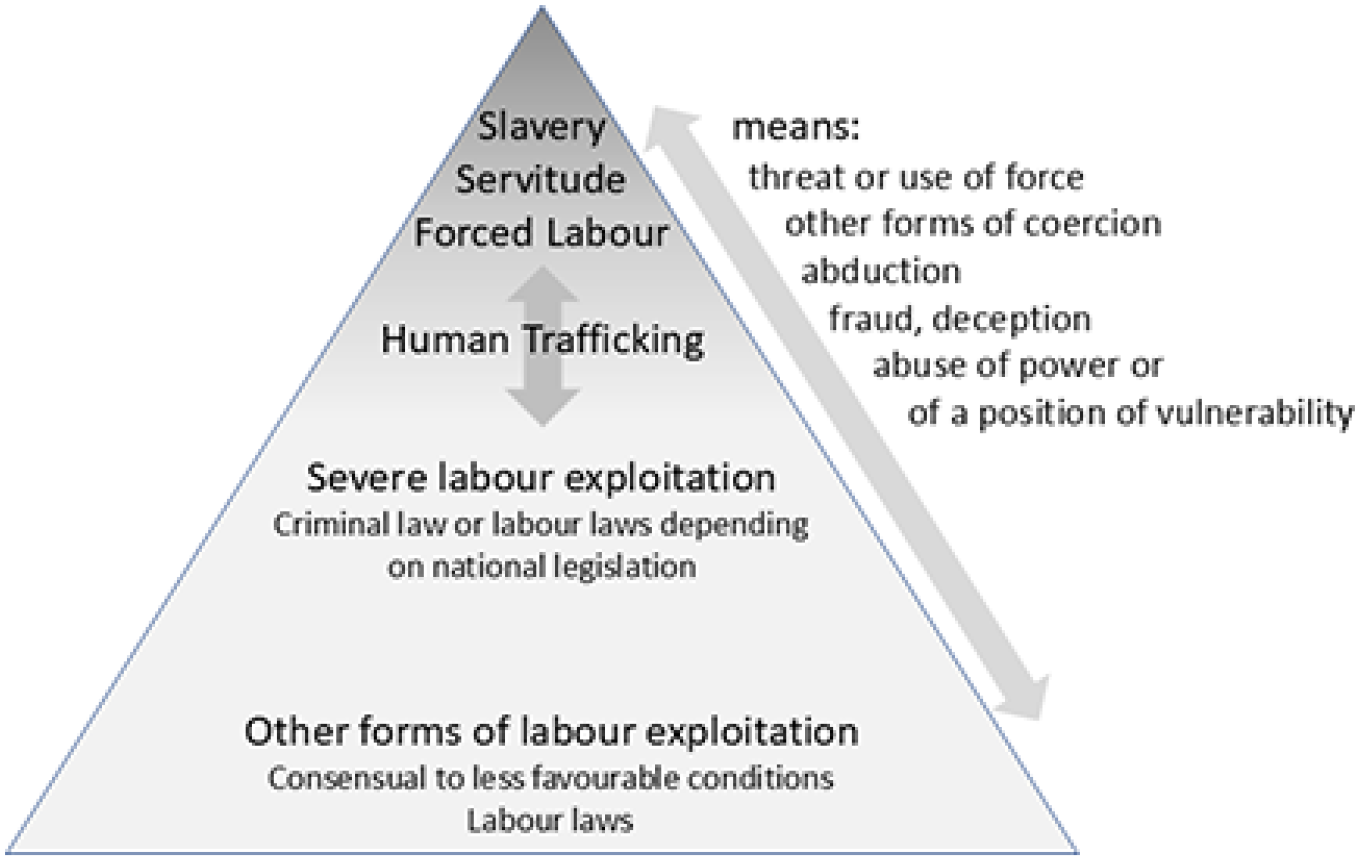
Pyramid of labour exploitation.
A pyramid structure displays this continuum, where slavery and forced labour, at the peak, are characterised by violence, force, and coercion. Below that is human trafficking (which covers slavery and forced labour). Yet there is no clear baseline along the continuum that defines the point at which labour exploitation transitions into trafficking and/or forced labour. In 2015, FRA studied severe labour exploitation to bridge the gap between criminalised human trafficking and civil law-based labour exploitation. The study found that while indicators of trafficking were present, individuals often appeared to consent to exploitation, making clear distinctions difficult. It also examined how human trafficking and forced labour are classified under criminal law across the EU, highlighting differences in definitions, prosecutions, and jurisdictions. The Belgian criminal law is broadly defined, as it relates labour exploitation to conditions contrary to human dignity. While Dutch law is more restrictive, case law applies a broader interpretation (FRA, 2015: 37). Nevertheless, Wintermayr and Weatherburn (2021) describe that in the Netherlands the burden of proof for human trafficking is high, which also impacts formal identification.
Taking the pyramid of exploitation into account, indicators of trafficking are already evident in cases of severe labour exploitation. Therefore, to meet the EU Directive’s requirements for identifying potential victims, the threshold should start at this stage. The required indicators do not need to be legally distinct or prove trafficking at this point (Graser and Lindner, 2020). While the use of force is a strong indicator for human trafficking according to the operational list (ILO, 2009), the medium indicator of ‘the abuse of vulnerability’ is often more present and contributes to exploitation along the continuum (FRA, 2015).
Furthermore, exploitation is a dynamic process that cannot be reduced to a mere liberal contractual relationship. Rather it requires a more nuanced understanding about the limits of freedom and the complex interplay of socio-economic inequalities and power relations as well as national immigration and labour policies (McGrath, 2023; O’Connell Davidson, 2015). Even if a situation began by mutual consent, the conditions are still exploitative if they involve wages below the minimum wage or excessive working hours (FRA, 2015). Furthermore, such an exploitative situation can evolve into forced labour with increasing pressure and coercion, especially if the person in question sees no possibility of resisting (Cyrus, 2005; Graser and Lindner, 2020; Lindner, 2015; Villacampa, 2023). Thus, a conflicting tension arises between a consenting, ‘free-to-leave’ worker and a potential victim of labour trafficking (Cyrus, 2005; Perkumiene et al., 2023). Vulnerabilities such as financial distress and/or migration status combined with the lack of alternatives are particularly decisive factors for exploitation limiting freedom in agency (McGrath, 2023). The extent to which we can speak of voluntariness or coercion also depends on the extent to which there is an understanding of how different forms of vulnerabilities, from personal to structural vulnerabilities, restrict individual agency and therefore are (deliberately) exploited by employers and criminal networks (Perkumiene et al., 2023).
So far, it has been argued that effective victim identification in cases of human trafficking for labour exploitation requires not only lowering the evidentiary threshold compared to criminal proceedings but also moving beyond rigid binaries towards a continuum of exploitation. This calls for a framework that incorporates the multidimensional dynamics of personal, structural, and situational vulnerabilities. The next section expands this discussion by integrating vulnerability heuristics that support a human rights- and victim-centred approach. In doing so, we develop and propose a conceptual model of multidimensional vulnerability that holds the potential to inform both policy development as well as future empirical research into labour trafficking.
Vulnerability in human trafficking: a complex and evolving concept linked to exploitation
Already within the Palermo Protocol and EU Directive, the concept of vulnerability is closely linked to exploitation. However, the concept of vulnerability, much like that of human trafficking and exploitation, presents significant challenges due to its ambiguous definition within international legal frameworks and corresponding implementation in national legislation (Gallagher and McAdam, 2019; Renzikowski, 2017; UNODC, 2013). This also raises questions such as who is considered vulnerable, how is vulnerability created and maintained, and how and if it is deliberately abused (Gallagher and McAdam, 2019; Galos et al., 2017; Palumbo and Sciurba, 2018; Renzikowski, 2017; Schwarz et al., 2019; Shepherd et al., 2022; UNODC, 2013). How and if vulnerability is not only incorporated into the criminal code but also understood and applied by stakeholders and responsible bodies such as NGOs and law enforcement also determines the outcome of early and formal identification (Palumbo, 2023; Shepherd and Wilkinson, 2021; Wintermayr and Weatherburn, 2021). Consequently, a conceptual model is needed that incorporates the multiple dimensions of vulnerability that affect an individual’s capacity to freely give consent, thereby exposing them to human trafficking and exploitation despite apparent consent.
Rethinking vulnerability: from fixed labels to relational dynamics in human trafficking
Vulnerability has become a ubiquitous concept in a wide range of research and policy areas, from disaster management, bioethics, healthcare, law, and social science (Enang et al., 2019; Fineman, 2008; Hufschmidt, 2011; Mackenzie et al., 2013; Mergen and Akpınar, 2021; Wisner and Luce, 1993). Across disciplines, vulnerability lacks a unified definition, instead encompassing diverse approaches and conceptualisations. These range from behavioural to structural and critical perspectives, each differing in how they address the individual’s relationship with broader systems (Gilodi et al., 2024; Hufschmidt, 2011). This plurality of perspectives facilitates a multifaceted understanding of vulnerability and enables us to develop a conceptual framework that links ontological vulnerability with more interdisciplinary approaches.
Social science identifies several personal factors – such as socio-economic status, homelessness, health, education, language skills, gender, and migration status – that render individuals more vulnerable to exploitation. However, vulnerability is often used uncritically as a fixed label associated with weakness, passivity, and victimhood, rather than as a relational condition. Someone
From a universal, ontological perspective, all humans are potentially vulnerable to a range of physical, economic, psychological, and political threats, including disease, natural disasters, oppression, discrimination, and exploitation as an inherent condition of our embodiment (Mackenzie et al., 2013; Schmitt, 2019).
This mutual vulnerability calls for the recognition of collective interdependencies, challenging the idea of individual autonomy. While vulnerability is an inherent part of being human, its distribution is uneven, and it is shaped by social and political conditions. From this perspective, vulnerability is not just a state of weakness; it is a shared condition that forms the basis of a collective moral and political responsibility to support those who are exposed to harm and injustice (Butler, 2004; Fineman, 2008). Instead of labelling specific groups as vulnerable, risking marginalisation and stigmatisation, it turns to the vulnerable subject in a specific context (Barnes et al., 2023; Fineman, 2010). To illustrate the concept of social responsibility and to refrain from ascribing responsibility to the individual on a fundamental level, Martha Fineman (2010) highlights the state’s responsibility. The liberal perspective on individuals as self-sufficient and autonomous actors capable of entering into contractual agreements within a free market system without being constrained by interdependencies is, in her view, a ‘myth’. These interdependencies are at play within human trafficking and exploitation. Here, ontological vulnerability offers a deeper lens through which to analyse the process of exploitation and victim identification. First, it reveals the interdependencies between systemic structures, individual characteristics, and situational factors that shape the experience of trafficking and exploitation. Second, it draws attention to institutional vulnerabilities, for example, when policies or practices prevent access to victim support mechanisms. This approach aligns with a human rights framework that challenges dominant neoliberal paradigms and affirms the responsibility of nation states to respect, protect, and fulfil human rights (Nipperess and Briskman, 2009).
While we can all be vulnerable, it is important to note that we are not all vulnerable to the same degree at the same time. Vulnerability, therefore, also needs to be recognised in a spatial, temporal, and situational context. As such, ontological vulnerability is too broad to account for the specific needs of specifically vulnerable groups (Fouladvand and Ward, 2019).
In order to better meet these specific needs, a definition of vulnerability is needed that can be applied in a more concrete and contextualised way. In general terms, being vulnerable means being susceptible to harm and suffering (Mackenzie et al., 2013) and not having the resources to prevent the risk from materialising and to respond appropriately to the risk that has occurred (Herring, 2016: 25). In the context of human trafficking, the EU Directive defines: ‘a position of vulnerability means a situation in which the person concerned has no real or acceptable alternative but to submit to the abuse involved’. If vulnerability is understood as a relational condition rooted in the interdependencies between individuals and the systems that surround them, it highlights how ‘inequalities in power, dependency, capacity, or need can render some individuals more susceptible to harm or exploitation by others’ (Mackenzie et al., 2013: 6). In this regard, the EU Directive is notable for its progressive stance, allowing for the interplay of agency and structure by emphasising the importance of real and acceptable alternatives in assessing a person’s consent to the exploitation (Palumbo, 2023).
Drawing from different theories and approaches, Mackenzie et al. (2013) present a taxonomy that captures the different sources of vulnerability (as inherent, situational, and pathogenic) and the states of vulnerability (as dispositional and occurrent). Inherent refers to intrinsic conditions such as health status, disability, age and gender, as well as the given situation into which someone is born, such as the socio-economic situation. Situational sources are more systemic, such as the general economy of a state, which then can overlap with inherent factors. Both can be dispositional, carrying a risk of vulnerability, and occurrent, manifesting in actual vulnerability, depending on the situation. Finally, they describe the pathogenic source as ‘particular ethically troubling’ (Mackenzie et al., 2013: 9). It emerges when different sources accumulate or systems that are meant to reduce vulnerability have the opposite effect. Some systems are even at odds with human rights, like current migration, asylum, and human trafficking policies, which focus on border control and deportation rather than the protection of vulnerable subjects (Degani et al., 2022). Therefore, rather than focusing only on the individual, it is essential to interrogate the broader institutional, political, and socio-economic structures that shape and often produce conditions of vulnerability (Delor and Huber, 2000; Hufschmidt, 2011). Vulnerability is better conceptualised not just as an inherent personal trait but as a relational and contextual condition arising from uneven access to resources, protection, and power. Critical paradigms further provide a lens to examine the dynamic power relations that facilitate a person’s vulnerability (Fawcett, 2009; Pease and Fook, 1999). It enables the uncovering and challenging of state and institutional responses, especially in migration and anti-trafficking regimes, which reinforce rather than mitigate vulnerability. Furthermore, it seeks to transcend binaries such as passive/active, victim/perpetrator, and legal/illegal, which can oversimplify complex realities and erase individual agency (Fawcett, 2009; Fook, 2016). This requires centring the assessment of human trafficking on the multifaceted lived experiences as well as intersecting vulnerabilities and identities such as being a migrant, being female, and being a worker. These identities are not fixed. They evolve across time and space and are influenced by intersecting systems of domination, including capitalism (Fook, 2016). Vulnerability, like human trafficking, is therefore multidimensional and processual, shaped by personal, structural, and temporal factors as outlined next.
Understanding the layers of vulnerability in human trafficking
The process of human trafficking comprises a series of stages occurring at different times, from the initial recruitment phase to the exploitation stage and the subsequent severity of exploitation. Vulnerability to trafficking is therefore discussed in multiple ways, for example, in prevention of trafficking, as risk assessment (De Stefani, 2022; Schwarz et al., 2019), within tools for identification before and during human trafficking (International Organisation for Migration, 2019), as a legal concept (Morano-Foadi, 2016; UNODC, 2013), in regard to specific, vulnerable groups to exploitation (David et al., 2019; Keast, 2017; Palumbo and Sciurba, 2018), as well as a concept to assess policies for their potential to create vulnerabilities to human trafficking (Barnes et al., 2023). However, within the Palermo Protocol and the EU Directive, ‘abuse of vulnerability’ is a means that refers only to the process of trafficking that occurs before the actual exploitation. Yet, ILO also incorporates ‘abuse of vulnerability’ into exploitation through forced labour (ILO, 2009) – a concept that even experts do not always distinguish clearly (Bartsch et al., 2021; UNODC, 2013). While vulnerability within these definitions must involve abuse, research shows it is a dynamic process that influences agency and the risk for exploitation (Palumbo, 2023). For this reason, it is crucial to extend the scope of analysis beyond the mere abuse of vulnerability to identify coercing dependencies in the trafficking process through a multidimensional framework. Within the different approaches to vulnerability, distinctions are made between structural, situational, and personal factors, which are dispositional and thus identify some groups as more vulnerable than others. Certain groups, such as irregular migrants, marginalised minorities, or homeless people, are identified as more vulnerable to trafficking and exploitation (Andrees, 2008; David et al., 2019; Keast, 2017; Poucki and Bryan, 2014). However, it is essential to recognise that vulnerability, in this context, is not just a static condition or category defined by external factors but is deeply entwined with ontological and embodied experiences. Vulnerability can emerge through the interplay of personal, structural, and relational factors, where power dynamics surrounding an individual, both external (social, economic, legal) and internal (psychological, emotional), actively shape and exacerbate a person’s vulnerability for exploitation. Furthermore, victims of trafficking themselves are identified as particularly vulnerable due to experienced trauma and exploitation and the risk for re-traumatisation and exploitation. Thus, international conventions rightly require proactively identifying presumed victims to offer special protection and support (De Stefani, 2022; vom Felde et al., 2020; Welfens, 2022). However, identification and access to support measures are limited as described above.
Victims of human trafficking experience a variety of vulnerabilities before, during, and after trafficking. The taxonomy, therefore, can serve as a valuable analytical tool, helping to systematically identify the specific vulnerabilities present in each case, which are critical for understanding the individual’s experience of exploitation. The following table is grounded in existing literature and the ILO’s (2009) operational list of indicators and illustrates how vulnerabilities of different sources can manifest across different stages of trafficking. Given the potential for overlap and complexity, Table 1 is designed to be flexible and may be adapted further to suit specific cases.
Taxonomy of vulnerability to human trafficking, own representation.
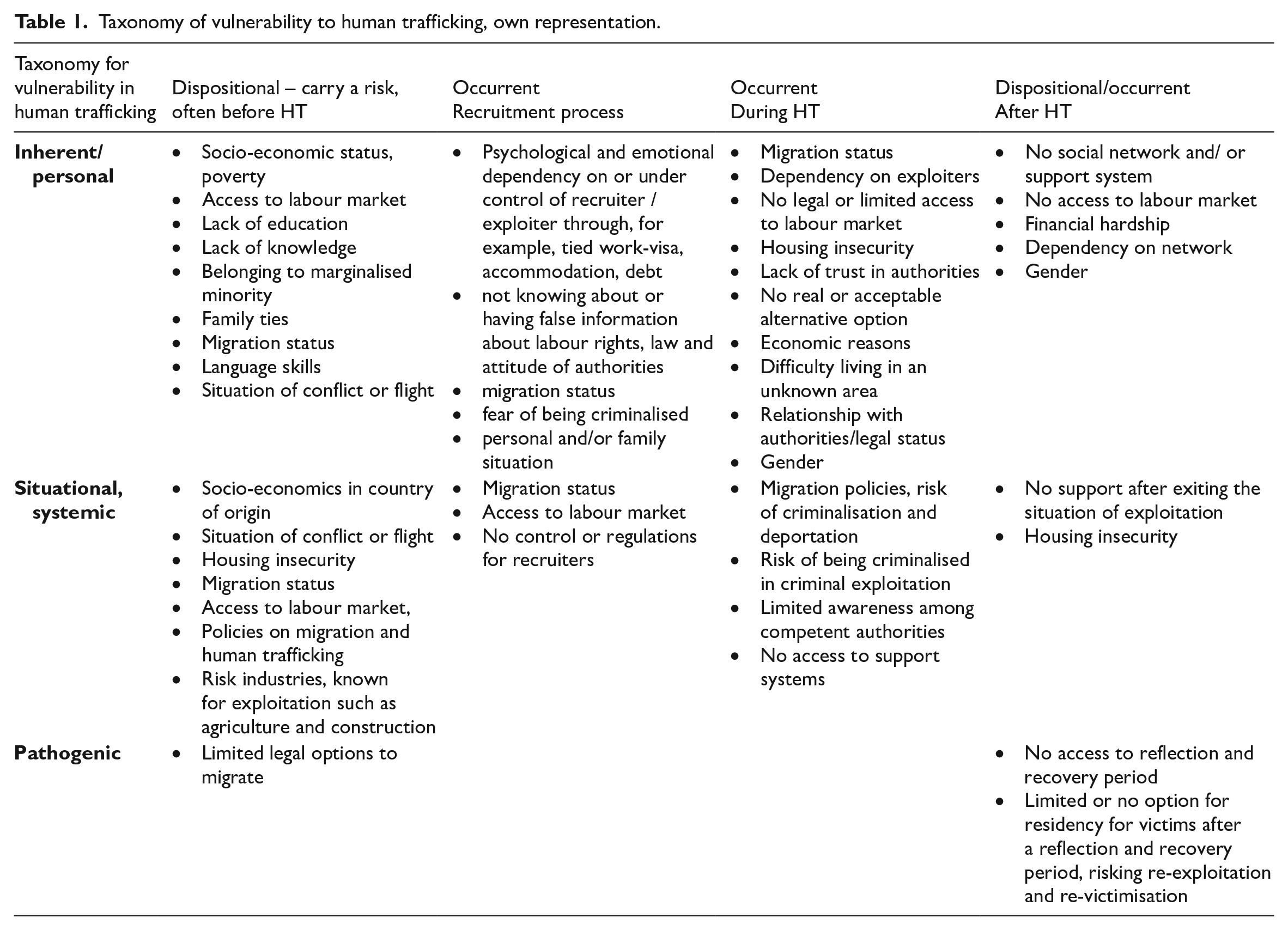
As outlined above, personal vulnerabilities encompass multifaceted levels such as health, gender, education, knowledge of the language and labour rights, legal access to the labour market, and membership of a marginalised group (Mitwalli, 2016; Schwarz et al., 2019; Villacampa, 2023). However, the taxonomy’s distinctions, while useful for analysis, may risk oversimplifying the complexity and dynamics of vulnerability, as highlighted in ontological approaches, which emphasise the relational interdependencies of personal, social, and situational factors. By focusing on these distinct categories, the taxonomy risks under-representing how vulnerabilities are shaped by systemic exclusion and marginalisation, which are context-dependent, dynamic, and fluid.
Belonging to a specific social group does not create vulnerability per se, but the way in which systems exclude and marginalise these groups can (Poucki and Bryan, 2014). The same is true for gender. Human trafficking is still primarily perceived as sexual exploitation of women (Shankley, 2023). This overlooks men and transpersons within sexual exploitation as well as other forms of exploitation (Hebert, 2016). While the field has historically prioritised female victims, particularly in the context of sexual exploitation (Hebert, 2016), there has been growing recognition of male victimisation in recent years, especially in labour trafficking contexts (Eurostat, 2023; Shankley, 2023; UNODC, 2024). Nevertheless, practical barriers to identification and assistance for male victims remain significant. Men tend to be overlooked as potential victims of trafficking, particularly due to gendered stereotypes that frame masculinity as invulnerable, independent, and self-sufficient, denying experiences of dependency and trauma, characteristics that contradict the perception of the passive victim role (Magugliani, 2022; Shankley, 2023). These stereotypes not only hinder recognition by authorities and service providers but also affect men’s own self-perception, making it less likely that they will identify or present themselves as victims of trafficking or seek support (Shankley, 2023). Women, on the other hand, risk being overlooked within the domestic and private care sector, in which they are hard to reach and where there are no workplace inspections. Furthermore, women within labour exploitation can be even more vulnerable to additionally experiencing sexual abuse and exploitation (Giammarinaro, 2022; Mitwalli, 2016; Palumbo, 2023; Palumbo and Sciurba, 2018). Furthermore, structural risk factors include poverty or economic well-being, housing insecurity, access and opportunities within the labour market, immigration policies and status, and visas, which will tie a worker to their employer, creating dependencies and limits to freedom of movement (Barnes et al., 2023; Davis, 2019; Schwarz et al., 2019; Shankley, 2023). Visa and migration policies especially are continuously under scrutiny for their potential to create and facilitate dependencies and therefore potential exploitation. Simultaneously, securitisation policies based on the premise of migration as a potential threat to the state prioritise identification of irregular migrants over protecting vulnerable subjects such as traumatised refugees or human trafficking victims (Magugliani, 2018).
Vulnerability is therefore multidimensional, arising from the intersection of inherent and personal factors with broader systemic conditions, and its manifestation depends on the specific situational context. In light of this, it is essential to explore how these intersecting vulnerabilities shape an individual’s ability to resist exploitation and therefore move beyond dichotomies.
Beyond the passive victim: understanding exploitation through vulnerability and power dynamics
As displayed, human trafficking for labour exploitation is a dynamic process, which is characterised by an interplay of inherent/personal as well as structural and situational vulnerabilities, which influence bargaining power and the imbalances therein. This limited agency and capacity make a person vulnerable to exploitation. Consequently, the extent to which one can speak of consent in an exploitative employment relationship is controversial (McGrath, 2023). It is noteworthy and a reason for concern within the definition of trafficking: consent is irrelevant when the means listed are utilised (Perkumiene et al., 2023). While force and violence are strong indicators, abuse of vulnerability is only a medium indicator and, as discussed above, more complex and less tangible. Vulnerabilities, whether economic, social, or psychological, limit the ability to make informed choices and can therefore be manipulated and abused (O’Connell Davidson, 2015).
The nexus of vulnerability and victimhood versus agency and worker within the continuum of labour exploitation is therefore critical. Often the focus is either on a passive, vulnerable victim or on an active, autonomous worker. Yet, workers navigate their constrained decision-making within forms of exploitive to unfree labour situations (McGrath, 2023). While agency is often understood as a polarity to vulnerability, the two are in fact deeply interwoven, with their relationship shifting across time and context (Schmitt, 2019). Applying the vulnerability heuristic to the continuum of labour exploitation allows to illustrate how agency is both shaped and limited by vulnerabilities (McGrath, 2023; Skrivankova, 2010).
Despite this complexity, current identification and assessment practices for human trafficking tend to rely on oversimplified, stereotypical portrayals of the passive victim. Whether and how a person demonstrates perceived agency often influences whether they are recognised as a ‘deserving victim’ entitled to support (Digidiki and Baka, 2022; Loyens and Paraciani, 2023). According to Christie’s (1986) concept of the ‘ideal victim’, individuals who appear to act with agency, such as by seemingly accepting their conditions or failing to exhibit visible signs of trauma, are less likely to be acknowledged as real or deserving victims, regardless of their exploitative circumstances. The ‘ideal victim’ is socially constructed as innocent, blameless, and dependent, thus creating a gatekeeping effect that excludes many from being identified and granted access to victim support (Digidiki and Baka, 2022; Shankley, 2023). Furthermore, victims do not necessarily identify themselves as such for several reasons. Besides fear of retaliation through traffickers, it can also be feeling responsible for the exploitation because they (initially) agreed to the conditions (Healy, 2024). Simultaneously they are unaware that the exploitation committed against them is a criminal offence because they are financially still better off (Healy, 2024). Potential victims also often lack trust in law enforcement agencies or the legal system. They fear being criminalised for undeclared work and/or illegal migration, which leads to a situation where they have nowhere to turn for help (Shankley, 2023; Shepherd and Wilkinson, 2021; Sigmon, 2008; Skrivankova, 2019). Furthermore, rather than feeling victimised or identifying with victimhood, some reject the negative associations and prefer to maintain some degree of agency (Fohring, 2018; Shankley, 2023; van Dijk, 2009) even within limited or no alternatives.
Consequently, many scholars reject the notion of victimhood (Munro and Scoular, 2012; O’Connell Davidson, 2016; Schmitt, 2019). Instead, they stress the need to address systems and institutions that facilitate exploitation and create vulnerability in the first place, rather than focusing on the individual. However, it is argued that rather than dismissing the notion of victimhood, it is crucial to understand victimisation of human trafficking and labour exploitation not within dichotomies of active/passive or deserving/undeserving but within a framework of intersecting, multidimensional vulnerabilities. Corresponding victim identification and support are therefore embedded in a complex framework based on our conceptual model, which is illustrated by the next Figure 2.
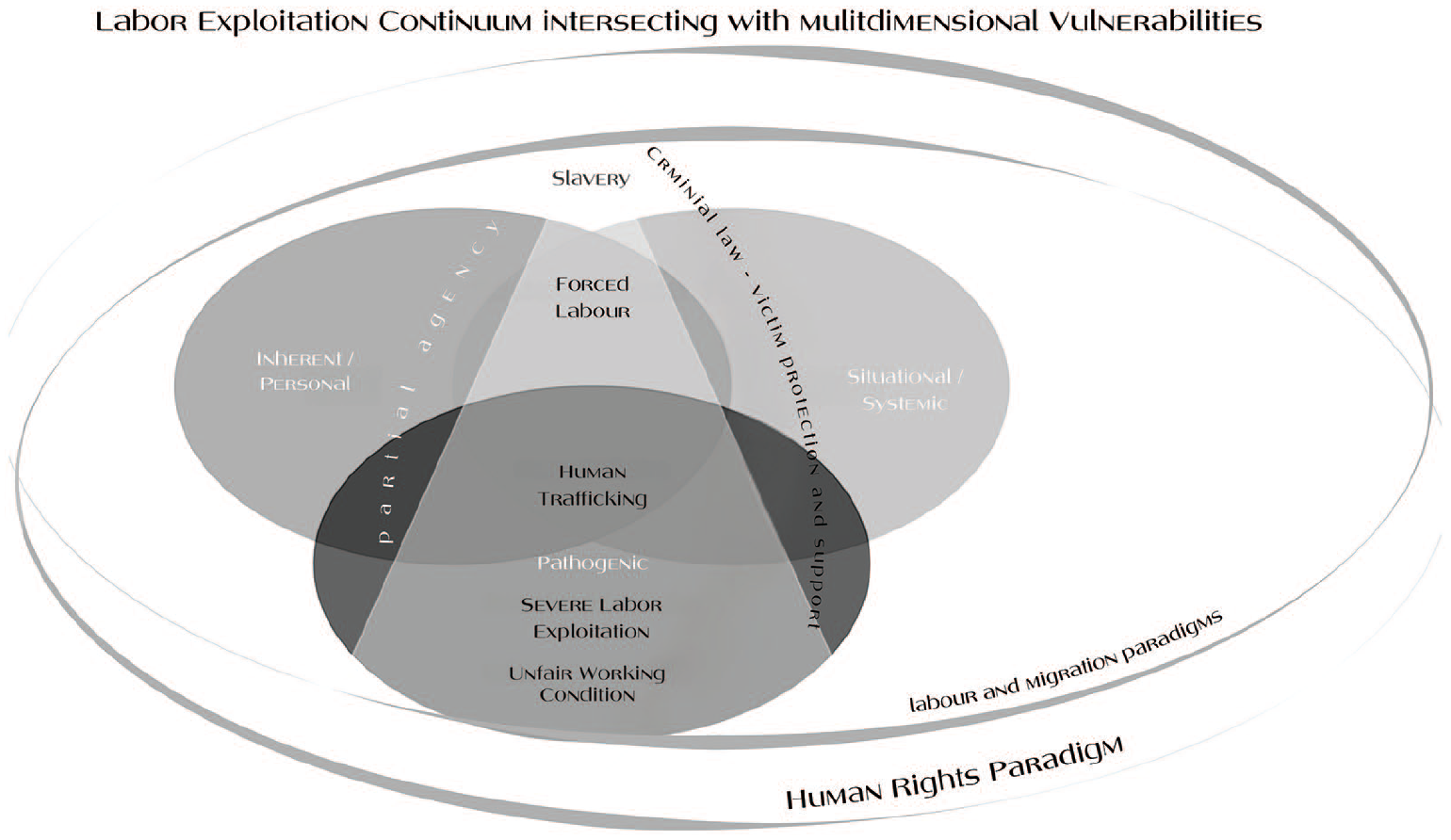
Analytical framework for trafficking for labour exploitation and identification of potential victims. Own representation based on the Pyramid of Labour Exploitation according to Cyrus and De Boer (2011).
At the core of this issue is the recognition that vulnerability is not a static or singular condition but rather a dynamic interplay of structural, personal, and situational factors. Researchers and policymakers need to approach human trafficking with a multidimensional understanding of how these vulnerabilities intersect. Poverty, migration policies, labour market deregulation, and social inequalities compound individuals’ susceptibility to exploitation. Recognising this complexity ensures that vulnerability is seen not only as an inherent trait of the person but as a multidimensional interplay shaped by external conditions. This integrated perspective upholds the dignity and rights of those affected, aligning with the core principles of a human rights framework. Our conceptual model therefore allows to move beyond reductive frameworks and adopt an approach that captures the complexity of exploitation within the identification of potential victims and its corresponding policy frameworks in a more nuanced manner.
Policy implications and recommendations: a shift towards comprehensive victim-centred approaches
As outlined above, nation-states are obliged to identify victims and provide them with protection and support. The prevailing practice of strictly distinguishing trafficking, slavery, and forced labour from other forms of exploitation reflects a law enforcement-centred criminological approach that prioritises prosecution over protection. This practice relies on the problematic binary of either passive victims or active workers. By ignoring the structural and situational constraints that shape agency, it also oversimplifies the complex dynamics of contemporary exploitation (Chuang, 2015; McGrath, 2023; O’Connell Davidson, 2016). Moreover, it draws rigid distinctions between forced and voluntary migration, trafficking and smuggling, or clandestine and legitimate labour (Brysk and Choi-Fitzpatrick, 2012; McGrath, 2023; Magugliani, 2018). Such binaries obscure the reality of the lives of people who are forced to participate in exploitative labour markets through limited choice due to systemic conditions as well as personal vulnerabilities. Simultaneously, the political migration and labour policies render them either invisible or criminal.
Beyond these dichotomies, critical social work, migration, and labour paradigms examine the consequences of oppressive systems on marginalised groups and discuss modes of resistance and emancipation of migrant workers within and beyond legal employment contracts (Gerassi et al., 2022; McGrath, 2023; Munro and Scoular, 2012; O’Connell Davidson, 2015). This does not represent free agency in the liberal sense, as people may agree to any contract under dire circumstances and without alternatives (O’Connell Davidson, 2016). To challenge the imagery of slavery and to develop a more nuanced understanding of past slavery and contemporary exploitation, O’Connell Davidson (2016) links the transatlantic slave trade to the present day. During slavery, the problem was not always that a person could not leave at will because of constant observation. For example, slaves who became overseers would have been ‘free’ to leave in the absence of their owner. However, due to the oppressive system of laws and surveillance, ‘they had nowhere and nothing to walk to’ (O’Connell Davidson, 2016: 25) – just like victims of labour trafficking today (Andrees, 2008).
This perspective highlights the complexities of identifying and supporting victims, criticising the law enforcement-centred approach for failing both analytically and in its moral obligation to protect those vulnerable to structural forces. This is central to theories of ontological vulnerability, which emphasise institutional and societal responsibility, potentially paving the way for a more just approach to combating labour trafficking.
The identification and prevention of human trafficking for labour exploitation remains a challenge for researchers, practitioners, and policymakers. Our contribution expands the analysis of labour trafficking by integrating vulnerability theories and proposing a conceptual multidimensional vulnerability model. Our model offers a dual utility: it can be used by policymakers and human rights communities as a reflective tool for existing policies, for example, in Ireland (Healy, 2024) and the Netherlands (Wintermayr and Weatherburn, 2021), and as a foundational basis for enhancing and implementing policies, as in Germany (Graser and Lindner, 2020). In addition, it can serve academia as an analytical tool for future research on human trafficking and labour exploitation.
For policymakers and practitioners, our model serves as a valuable tool in the development of more effective guidelines to protect individuals who currently fall through the gaps of existing policies and practices. We advocate shifting from an enforcement-centric to a victim-centric approach, as outlined in the EU Directive and Amending Directive in Germany. Key to this is implementing a formal referral mechanism, prioritising victim protection over prosecution, and lowering the evidence threshold to improve access to support services. Legal frameworks should be re-evaluated to incorporate a more nuanced understanding of exploitation, vulnerability, and agency, acknowledging the structural and situational vulnerabilities that affect individuals before, during, and after exploitation (Palumbo, 2023). In addition, public awareness campaigns and professional training for law enforcement and service providers are necessary to accurately comprehend and identify subtle forms of coercion and exploitation, thereby acknowledging the complex realities faced by victims (Healy, 2024; Wintermayr and Weatherburn, 2021).
In light of our discussion, we also propose our model for research. It allows a deeper systematic and multidimensional perspective, examining how various structural and personal vulnerabilities interconnect to contribute to exploitation. This approach challenges stereotypes, acknowledges the continuum of exploitation, and highlights the nuanced agency of individuals. Methodologically, interdisciplinary and participatory research, including voices of those with lived experiences, is essential to understand agency and resistance in exploitative and constrained systems. Active scholarship needs to critically assess the effectiveness of policies and institutions protecting trafficked individuals, identifying best practices and proposing improvements based on evidence (Wallerstein et al., 2021). In addition, critical social work theories (Fook, 2016) offer a transformative lens to address human trafficking, advocating for intersectional, systemic solutions and broader social transformation.
Footnotes

Funding
The authors received no financial support for the research, authorship, and/or publication of this article.
Declaration of conflicting interests
The authors declared no potential conflicts of interest with respect to the research, authorship, and/or publication of this article.