




Abstract
Reconciliation in Canada requires a deep societal transformation in which the majority population (non-Indigenous Canadians) not only recognizes the historic victimization of Indigenous peoples in Canada but also recognizes their ongoing structural victimization. However, members of the advantaged group may be reluctant to embrace change and give up their privileged position. According to System Justification Theory, people are motivated to justify the existing system (status quo) even when it produces socioeconomic inequities. In this paper, we examine the willingness of non-Indigenous Canadians (n = 58) in the province of Quebec to recognize Indigenous victimization. We then explore their attitudes toward recognizing economic autonomy and ceding control over resources to Indigenous peoples. While most respondents claim to support the economic autonomy of Indigenous peoples, a qualitative analysis of their views on what should be done to improve the economic situation paints a more nuanced picture. Some participants support the self-determination of Indigenous peoples, and others support the maintenance of the colonial status quo, whether in the form of collaboration or total control from the state.
Introduction
Reconciliation plays a crucial role in colonial victimization contexts, particularly in addressing historical and structural injustices (Maddison et al., 2016), offering ways of reparation and healing for victims (Wemmers, 2014), and establishing relationships of trust and equity between indigenous and non-indigenous populations (Nikolić-Ristanović, 2015). The Canadian context is no exception and this paper argues that reconciliation requires not only recognition of the historical victimization of Indigenous peoples but also an acknowledgment of their ongoing structural victimization. What is central in this article is the willingness of the dominant population, the non-Indigenous Canadians, to recognize these injustices and to support structural changes such as economic autonomy and resource control that help address persistent inequities. By focusing on these attitudes, the article sheds light on the power dynamics and forms of resistance that shape reconciliation effort within the colonial status quo. During the summer of 2021, Canada witnessed the horror that was thought to belong to a historic, outdated past. Anonymous remains of 751 former residential children were found mainly in British Columbia and Saskatchewan. 1 Although mortifying, that news was in no way surprising; for decades horror stories have been reported by survivors of Canada’s Indian Residential Schools and compiled in various government reports, documenting numerous physical, sexual, and psychological abuses behind the doors of the Indian Residential Schools (Truth and Reconciliation Commission of Canada (TRC), 2015).
The Indian Residential School (IRS) legacy impacts the already weakened trust between Indigenous and non-native Canadians. Today, the IRS policies are recognized as genocide (National Inquiry into Missing and Murdered Indigenous Women and Girls (NIMMIWG), 2019). The forced displacement of thousands of Indigenous children for more than a century by the government profoundly damaged families and communities. Canada’s colonial purpose ensured the acculturation of Indigenous peoples and their assimilation into Euro-Canadian religion and values, as the children were separated from their parents, not permitted to speak their language and practice their culture in church-run schools (TRC, 2015). Although the last schools closed in 1996, the survivors of the IRS system and their families continue to suffer numerous consequences of the IRS, such as post-traumatic stress disorder as well as intergenerational trauma. As a result of this trauma, Indigenous peoples have a much higher risk than non-Indigenous Canadians of victimization and especially sexual and violent victimization, as well as substance abuse (Bombay et al., 2014; Wemmers, 2017).
In 2008, 22 years after the last IRS closed, the Prime Minister of Canada offered a public apology on behalf of Canadians for the IRS system: The burden of this experience has been on your shoulders for far too long. The burden is properly ours as a Government, and as a country. There is no place in Canada for the attitudes that inspired the Indian Residential Schools system to ever prevail again. You have been working on recovering from this experience for a long time and in a very real sense, we are now joining you on this journey. The Government of Canada sincerely apologizes and asks the forgiveness of the Aboriginal peoples of this country for failing them so profoundly.
2
Since then, there have been numerous efforts to promote healing and reconciliation. Most recently, in July 2022, the Pope, on a much-anticipated visit to Canada, acknowledged the historical victimization of Indigenous peoples and communities by the Catholic Church, thus responding to a long-standing request: ‘I humbly beg forgiveness for the evil committed by so many Christians against the Indigenous peoples’. 3 Perhaps the most significant measure promoting reconciliation is the publication of the final report by the Truth and Reconciliation Commission (TRC) in 2015. This report was produced to publicly acknowledge, on behalf of the Federal government and all Canadians, the injustice suffered by Indigenous peoples. One year after its publication, about 66% of non-Indigenous Canadians had already read or heard of the TRC. In Quebec, the only French-speaking province, it was just under 5 in 10 people, which was below the national average (Environics Institute, 2016).
Despite these efforts, the structural inequities between Indigenous peoples and non-Indigenous Canadians persist today. Systemic racism in Canada extends to the education, justice, and health systems (Chartrand, 2019; Commission d’enquête sur les relations entre les autochtones et certains services publics (CERP), 2019). This systemic violence is perpetrated by economic and power structures in a society that fails to protect its vulnerable populations. According to the Institute for Socio-Economic Research and Information (IRIS), Indigenous peoples in Canada tend to be more disadvantaged when compared to the rest of the population (Posca, 2018), on numerous levels including the social level (e.g. graduation rate and placement in foster families), economic level (e.g. unemployment and poverty rate), as well as health and safety (e.g. victimization and suicide rate). For example, the adult Indigenous population represents one-twentieth of the general population in Canada but comprises almost a third of its prison population (Malakieh, 2018). The same overrepresentation is observed when it comes to youth protection: Indigenous children between the age of 15 and 18 are 10 times more likely to experience legal welfare than non-native children (Perreault, 2022). When Indigenous children are placed in foster care outside of their community, this can negatively impact the transmission of Indigenous culture to children (Fournier, 2014). On Reserves, First Nations children are also systematically discriminated against as school infrastructure on the Reserves is underfunded by government: A non-native child benefits from up to $3,000 more annually in government funding for their education than a child living on a Reserve (Talaga, 2017).
Although this article focuses on the Canadian context, parallels can be drawn with other settler-colonial countries, particularly regarding the treatment of Indigenous populations within the criminal justice system. Indeed, the phenomenon of Indigenous over-incarceration is well documented in both Australia and the United States. Native Americans and Alaska Natives experience disproportionately high rates of incarceration and face persistent barriers to justice (Fox et al., 2023). This is not a recent development: the US justice system used to historically criminalize the cultural practices and traditions of Indigenous peoples, thereby deepening structural inequalities (Bracey, 2015). In Australia, the most recent data from 2024 show that Aboriginal and Torres Strait Islander peoples account for more than 35% of the prison population, with a 15% increase in just 1 year (Australian Bureau of Statistics, 2024), despite numerous reforms and inquiries. The patterns explored in the Canadian context are thus part of a broader phenomenon rooted in the colonial status quo, across both the Americas and Oceania (Cunneen and Tauri, 2019).
The closure of the last residential schools may have signaled the end of an era, but it did not mean the end of colonial victimization and inequities in Canada. This persistence of violence is what we refer to as the colonial status quo: Indigenous peoples today remain under government control and thus undergo institutionalized suffering. As Quinn (2021) concludes: ‘In the settler colonial context, there was no “end” to colonization. The colonial structures remain in place and firmly under the control of settler communities. And the harms continue’ (p. 126). This control extends primarily to the land, as well as any natural resources contained within it. In fact, land dispossession still is the favored way to maintain the subordination of the Indigenous population (Farrell et al., 2021). In addition to the structural violence, Canada is infamous for its extractivist development activities and land dispossession (Baijius and Patrick, 2019), which are at the heart of ongoing judicial battles between Indigenous communities and the Federal government (Gobby et al., 2022). The colonial status quo persists due to the very unequal balance of power between the two parties and has an impact on the economic capacities of the communities and the livelihood of Indigenous peoples (Nagy, 2013). In general terms, Indigenous populations suffer from higher rates of poverty than non-natives, and this economic struggle seems to have a longer and larger impact on their life course from childhood through to adulthood (Joseph and Joseph, 2019).
Given the fact that there is very little qualitative research on the province of Quebec and the reconciliation with Indigenous peoples (Melançon et al., 2019), we want to meet two objectives in this paper. First, the aim is to examine whether non-indigenous Quebecers tend to recognize different kinds of indigenous victimization, and second, then to explore their attitudes concerning their tendency to justify the current structural victimization. We will begin by introducing the current situation of Indigenous peoples regarding their relationship with the colonial state. We will then explore the various definitions of the process of reconciliation and the links we make with the recognition—or the justification—of the status quo. Then, from a psychosocial perspective, we will examine the willingness of non-Indigenous people in the province of Quebec to recognize Indigenous victimization, in addition to their attitudes toward recognizing economic autonomy and ceding control over resources to them. From a criminological approach, we find it relevant to explore non-indigenous perceptions about reconciliation. Most of the research on the reconciliation process in a settler colonial context focuses on victimized groups and very little examines settlers’ participation in reconciliation (Doak, 2011; Jones et al., 2012; López et al., 2018). By not putting members of the dominant group at the center of the reconciliation, the status quo persists. When non-Indigenous peoples do not fully engage in the reconciliation process, they may be reluctant to challenge the system, which they benefit from (Regan, 2010). We conclude by analyzing the qualitative data and by proposing a form of participation in the reconciliation process with full recognition of victimization.
Reconciliation as a multidimensional process
The term ‘reconciliation’ as used in public discourse and Canadian policy is rooted in a Western legal framework and shaped by Christian values of confession and forgiveness (Saarinen, 2022; Thorlakson, 2022). Many indigenous cultures do not have a direct equivalent of the term, while having their own holistic concepts and practices of restoring harmony, unity and collective well-being (see, for example, the Cree concept of miyo-wîcêhtowin (Cardinal and Hildebrandt, 2000), or the Inuit practices of maligait 4 ).
In Canada, reconciliation has been institutionalized as essential to building positive and equitable relations between Indigenous and non-Indigenous peoples in a settler colonial context (TRC, 2015). The participation of the latter is necessary and requires recognition of both past and present victimization. Importantly, the TRC’s definition of reconciliation was developed and approved by its commissioners, two of whom were Indigenous leaders.
However, reconciliation is not a neutral concept and is strongly debated (Chong, 2018). As Dene searcher Glen Coulthard (2014) argues, initiatives led by the State often serve to rehabilitate the moral image of settler institutions, while leaving colonial power structure intact. For instance, Canada’s Truth and Reconciliation Commission has been critiqued for centering symbolic gesture such as apologies, while failing to address the ongoing dispossession of indigenous resources and territories (Monette-Tremblay, 2018; Simpson, 2017). This critique aligns with Tuck and Yang’s (2012) argument that reconciliation without land restitution is a ‘settler move to innocence’, a performative act to absolve settler’s guilt without challenging colonial sovereignty. Therefore, reconciliation cannot be described by a single action and must be considered as a process that requires the implementation of multiple upstream transformations, such as the recognition of violence, the accountability of the state, reparation to victim groups (e.g. restitution of unceded land and resources distribution), as well as the implementation of concrete measures to guarantee non-repetition of the harm (Jaccoud, 2016; López et al., 2018; Maddison et al., 2016; Paquin et al., 2007).
Similarly, in the Canadian context, indigenous scholars stress the idea that reconciliation must go hand-in-hand with decolonization, by committing to a renewed nation-to-nation relationship and returning control over ancestral territories and resources to Indigenous communities (Battiste, 2013; Stein, 2020; TRC, 2015; Tuck and Yang, 2012). According to the Mohawk intellectual and professor Taiaiake (2009), reconciliation without decolonization is only a contemporary extension of colonialism today, where the imbalanced power dynamics persist. Indigenous peoples must regain control over their political, social, and economic life, thereby gaining autonomy, self-determination and environmental sustainability (Datta, 2019; Simpson, 2014). According to the United Nations (2007) Declaration on the Rights of Indigenous Peoples, sovereignty is more than a wish; it is a human right. Hence, the sovereignty of Indigenous peoples should prevail in the process of reconciliation.
The process of reconciliation is one of ‘unlearning and relearning’ past and contemporary history (Datta, 2019; Regan, 2010). The dominant group, the so-called settlers (Regan, 2010), benefits from the status quo and may be reluctant to forego its privileged status. However, for change to happen, members of the dominant group must recognize their contribution to existing systemic inequalities (Stein, 2020). In the context of settler colonial reconciliation, it is easier for the privileged population to deny an amoral situation than to recognize it, especially because denial makes it possible to protect one’s image and identity (Cohen, 2013). To fully take part in the process of reconciliation, non-Indigenous Canadians need to surpass the anxiety-provoking feelings associated with their privileged position, such as shame and guilt and thus accept their position as settlers (Čehajić-Clancy and Brown, 2019; Govier, 2006). Those feelings may arise from an awareness of privileges and while uncomfortable, they can be productive if they lead to critical self-reflection and a willingness to support transformation (Allpress et al., 2010; Fazio, 2020).
Surpassing these feelings involves moving beyond denial and instead engaging in solidarity with Indigenous peoples, through education and dialogue (Bilali and Vollhardt, 2019; Justad, 2005). Also, ‘taking part’ in reconciliation means more than expressing support or good intentions. It requires concrete actions such as advocating for policy changes, supporting Indigenous-led initiatives, and challenging racist attitudes (TRC, 2015). For non-Indigenous Canadians, participation in reconciliation is an ongoing process of self-education, allyship, humility, and accountability, rather than a passive stance (Denis and Bailey, 2016). As Rosoux and Anstey (2017) remind us, this can be ‘a humbling process and a fearful and very difficult one’ (p. 348) for members of the dominant group. According to Canadian philosopher Trudy Govier (2006), recognition in the process of reconciliation means recognizing the victimization or suffering (e.g. sexual violence, discrimination) and the human being or victim who experiences suffering (e.g. residential school survivors, Indigenous prisoners). Thus, the current situation that maintains Indigenous victimization must be recognized before reconciliation can occur, but group interactions tend to make this recognition more difficult (Melouka, 2019; Wemmers and Van Camp, 2011). People in conflict are tempted to justify the status quo even if it causes suffering (Jost et al., 2004) and therefore do not recognize the need to oppose it.
If the settler colonialism literature sheds light on the structural violence perpetrated against Indigenous peoples and highlights the importance of recognition processes by non-Indigenous, it remains crucial not to essentialize Indigenous victimization or portraying Indigenous peoples as passive (Tuck, 2009), as their condition is often tied to the colonial status quo. Simpson (2017) moreover emphasizes that Indigenous peoples do not wait for recognition of their victimization from colonial institutions; on the contrary, she calls for a resurgence grounded in Indigenous sovereignty. Nevertheless, the way in which non-Indigenous society recognizes (or fails to do so) the structural victimization of Indigenous peoples remains important for understanding the power dynamics at play in the reconciliation process, without reducing Indigenous peoples to passive victims, but rather situating this recognition within broader struggles for justice and self-determination.
From this perspective, critical victimology invites us to consider the recognition of victim status as a socially constructed process, shaped by dominant political and institutional norms (Spencer and Walklate, 2016). The way in which this status is attributed or denied stems from stereotypes and power relations. Thus, the legitimacy granted to certain ‘ideal’ victims is shaped by institutions, whether it be the Canadian state, the media, or the justice, health, and education systems (McGarry and Walklate, 2015). Victim status is therefore subject to being instrumentalized by the state according to its own logic and interests (Coulthard, 2014), influencing how the non-Indigenous population perceives the injustices and suffering experienced by Indigenous peoples. Beyond recognition itself, the ways in which non-Indigenous Canadians perceive the responsibilities of institutions within reconciliation policies remains a relevant issue to explore.
These different sides of the reconciliation process are reflected in the attitudes of Indigenous and non-Indigenous Canadians. According to the national survey on Indigenous relations and reconciliation by the Environics Institute (2021), more than one Indigenous person in two (60%) thinks governments have not gone far enough to advance reconciliation, compared to 42% of non-Indigenous Canadians. Hence, while most non-Indigenous Canadians do not recognize the need for further change, most Indigenous peoples do.
Justify or recognize ongoing victimization 5
According to a pan-Canadian study by the Environics Institute (2019) on the attitudes of non-Indigenous Canadians toward Indigenous peoples, a large majority (75%) tend to recognize the differences in living standards between non-Indigenous Canadians and that of Indigenous peoples. However, not everyone recognizes these differences as colonial violence. When asked to identify the greatest barrier to achieving equality, two-fifths of non-Indigenous Canadians think that the current situation of Indigenous peoples is attributable to Canadian government policies, but almost one-fifth of respondents either blame Indigenous peoples themselves or the Canadian public (Environics Institute, 2021).
When exploring the dominant group’s perspective, it is essential to engage in a nuanced analysis of what reconciliation means, for whom, and under what conditions it can lead to genuine transformation and justice. Social transformation requires challenging existing power dynamics and institutional structures in order to support Indigenous self-determination and reshape relationships between Indigenous and non-Indigenous peoples (Benessaieh, 2010; Côté, 2019). Beyond institutional reforms such as redistribution of resources, non-Indigenous Canadians should be willing to deconstruct dominant narratives (Battiste, 2013).
Settler attitudes and beliefs are not neutral; they are shaped by (and may reproduce) the colonial status quo (Regan, 2010). These attitudes play a central role in shaping both the possibilities and the limits of reconciliation with Indigenous peoples. For example, recent research demonstrates that support for reconciliation policies among settlers varies according to several factors, such as racist attitudes toward Indigenous peoples and partisan or religious identities (Alcantara et al., 2025). When settlers justify the colonial status quo or resist better resources redistribution, reconciliation risks becoming a superficial process that leaves underlying power relations intact (Coulthard, 2014). The majority population in Canada holds the power either to support or resist political and social changes, thus directly influencing the effectiveness and scope of reconciliation processes. Examining these attitudes helps to better identify issues that require targeted awareness-raising and educational initiatives (Canadian Reconciliation Barometer, 2023; Melouka, 2019).
Awareness about the IRS legacy and the plight of Indigenous peoples in Canada has grown in recent years. In 2020, more non-Indigenous Canadians than in previous years were aware of Canada’s colonial past and its consequences on Indigenous populations (Environics Institute, 2021). When asked what first comes to their mind when thinking of Indigenous peoples, a little less than one-third of respondents mentioned the abuses and mistreatments perpetrated against them both by citizens and the State. However, this research did not specify whether the recognition of abuse and mistreatment concerns past or ongoing victimizations.
For Indigenous scholars, recognition of the colonial status quo is essential for facilitating the empowerment of Indigenous peoples and their communities (Hunt, 2016; Stein, 2020). In the context of Indigenous–settler relations, empowerment is tightly linked to self-determination and refers to the collective ability of communities to restore their cultural practices, process their healing, and regain control over their futures (Dudgeon et al., 2014; Smith, 2021). It requires supporting conditions where Indigenous peoples can lead decision-making processes that affect their lands, resources, and governance structures. Economic autonomy thus plays a crucial role in the process of reconciliation, as it refers to the ability of Indigenous communities to control their economic development, manage natural resources, and benefit equitably from the wealth generated on their territories (Cornell and Kalt, 2006). Importantly, such transformation of relationships cannot occur without first acknowledging and challenging the colonial status quo. As Regan (2010) and others argue, reconciliation that aspires to be meaningful must go beyond symbolic gestures. Complete reconciliation requires so-called ‘high-risk’ actions (Wohl et al., 2019), favored by deep citizen participation. Full participation in the process of reconciliation requires psychological decolonization (acknowledgment), as well as collective and political action. These actions include the recognition of individual and social responsibilities (Barlow et al., 2015). They are considered ‘high-risk’ because they risk producing a negative perception of the group and, as a result, they entail a huge moral and social cost for the group. For example, there might be a risk that the group would be perceived as evil, which could cause group members to experience feelings of guilt and shame. High-risk actions would improve the current living conditions of Indigenous populations, protecting their agency and rejecting the colonial status quo (Regan, 2010), recognizing the colonial historical past and contemporary structural victimizations.
According to Native-American professor Kyle Whyte (2018), many non-Indigenous people see the promotion of reconciliation positively, but do not invest in it personally, which indicates a desire for unification rather than social transformation. The social unification of Canadians does not reverse the colonial status quo and instead maintains the myth of ‘all is well’. This partial participation of dominant group members in reconciliation is defined as ‘low risk’: members of the dominant group are more interested in the redemption of their group, by promoting a positive image, than the transformation of the existing system (Wohl et al., 2019). Their investment in reconciliation is symbolic and does not transform the structures of violence. Examples of low-risk actions include the recognition of Indigenous peoples as semi-sovereign (not nations), the implementation of Indigenous cultural heritage protection policies, monetary reparations, and the request for forgiveness (Whyte, 2018). These actions more often demonstrate a need to rehabilitate the moral image of the majority group (Barlow et al., 2015; De Costa and Clark, 2016) than a desire to change existing power structures. Ignoring the victimization and suffering of others has a direct impact on maintaining the status quo, thereby discouraging the multidimensional process of reconciliation. Non-recognition can lead to indifference and detachment toward the other (Govier, 2006), and in the more severe cases, it becomes the bastion of violence and racism (Allport, 1954).
One of the most widely used theories in social psychology to explain the maintenance and support of the status quo is System Justification Theory (SJT) (Jost, 2019). According to SJT, individuals tend to justify, protect, and legitimize the system (with its components and structures) in which they operate, thereby perpetuating the status quo, whether social, economic, or political (Jost et al., 2004). This desire to justify can be conscious or unconscious, although more often implicit: ‘Some people enthusiastically endorse the status quo; some passively acquiesce in it; some strongly oppose it; and some are simply indifferent to it’ (Hochschild, 1981: 262). The justification of the system is thought to have a palliative psychological function as it allows the individual to feel good about themselves and their social group. By justifying the system, the person grants it legitimacy, which makes it possible to satisfy different individual and relational needs. At the same time, justifying the status quo, one is unable to recognize structural elements that create iniquities and in doing so hinders the reconciliation process (Augoustinos and Callaghan, 2019).
Non-Indigenous Quebecers in Canada
As a minority within Canada, the population of the province of Quebec, the ‘Québecois’, have forged a social identity that distinguishes them from English Canada. Their French language and culture, in addition to a desire for sovereignty, are distinguishing characteristics. Throughout the history of Canada, the Québecois have played various roles, from oppressors to victims and then bystanders. The first European settlements in Canada were French, and as colonizers they were actively involved in the violent assimilation of Indigenous peoples, which persists as the colonial status quo. Later, under English rule, the French were once victims of English colonial persecution. This led to a separatist movement, which fought for Quebec autonomy and was successful in securing recognition as a nation 6 within Canada. Today, it can be difficult to clearly distinguish the role of Quebec as a nation in the process of reconciliation. The province does have power over key areas such as education, economics, and health care, all of which are vital to ending systemic racism. However, it has no power over certain matters, such as Indigenous status, which falls exclusively under federal jurisdiction. This division of powers between governments may allow the Québecois to feel like bystanders in the reconciliation process.
Quebec’s minority status remains important to consider when addressing reconciliation. For example, with its policy of multiculturalism, Canada maintains a vision of integration of ethnocultural diversities while recognizing different groups and protecting minorities within the country (Maclure, 2016). The Canadian Multiculturalism Act of 1985 provides for the rights of the Indigenous peoples of Canada, recognized as first peoples in the country. However, Quebec rejected this policy, arguing that the Canadian vision does not represent the reality of Quebec as a linguistic minority (Macià, 2013). Since then, Quebec has developed its own distinct diversity management policy, with an interculturalist vision and no mention of Indigenous rights, which may suggest that Indigenous peoples are considered as any other ethnocultural group, just like immigrant populations are.
At the same time, Quebec’s history as victims of oppression under the English, could lead us to believe that they might be more sensitive to the needs of Indigenous peoples than other non-Indigenous Canadians. However, surveys suggest that they are not. About 6 in 10 (58%) non-Indigenous Canadians support Indigenous self-determination, and this percentage is 59% in Quebec (Environics Institute, 2019). When asked whether Canadians have a personal responsibility to engage in the process of reconciliation, 54% of non-Indigenous Canadians agreed, while in Quebec, only 46% agreed (Environics Institute, 2021). Exploring attitudes in Quebec toward reconciliation is thus relevant for better understanding the personal responsibilities and contributions of all non-Indigenous Canadians.
Methodology
To better understand possible avenues for reconciliation in Canada, this research explores the notion of recognition of victimization by non-Indigenous Canadians and how this recognition of structural victimization by members of the dominant group (Quebecers) translates into justifying or criticizing the colonial status quo. We chose to address the structural violence in the form of economic inequity between indigenous and non-indigenous Canadians.
The material presented in this article is part of a larger study on reconciliation in Canada, which focused on two Canadian provinces: Quebec and Saskatchewan. A bilingual online survey was used to probe the attitudes toward reconciliation of non-Indigenous students from the Université de Montréal and the University of Regina whose families were in Canada for three or more generations. Participants were recruited via university-wide emails and student-led social networks from both the University of Montreal and University of Regina. In all, 593 people completed the survey in June 2020, of whom 144 were from the Université de Montréal, in Quebec.
The first section of the survey included sociodemographic questions, such as age, gender, and province of residence. This was followed by a statement of apology made by the Canadian Prime Minister, containing historical information about the IRS. Based on what they just read, participants were then asked a series of Likert-type scale questions (ranging from 1 for strongly agree to 5 for strongly disagree) to assess their perceptions on reconciliation, in particular the recognition of victimization. Two scales were developed to assess the recognition of past and ongoing victimization, based on Twali et al.’s (2020) research. Each scale included three items and respondents were asked to rate their agreement with the statements. These three items are as follows: (1) Indigenous peoples have endured /continue to experience psychological pain as a result of the Indian Residential School system; (2) Indigenous peoples have endured/continue to face physical pain due to the Indian Residential School system; and (3) Indigenous peoples have endured/continue to experience economic pain because of the Indian Residential School system. Their answers were coded from 0 to 1, with 0 indicating low recognition and 1 indicating high recognition. Both scales imply good construct validity (Cronbach’s alpha 0.90 and 0.87). The quantitative data provides an overview of respondents’ attitudes toward reconciliation.
Next, a content analysis was conducted to obtain a better understanding of how respondents view reconciliation. Specifically, we use responses to the optional open question at the end of the survey: ‘What, if anything, should be done to improve the economic situation of Indigenous peoples in Canada?’. It is important to note that the answers were collected and analyzed in French but are presented here in English. The translation was done by the researchers. Content analysis was preferred because it meets the objectives of the research, and in particular, its exploratory nature. More specifically, we conducted a thematic analysis of the responses to reduce the qualitative material by grouping it into themes and sub-themes. When conducted rigorously, thematic analysis is a valuable and robust tool in qualitative research (Paillé and Mucchielli, 2012).
In total, 58 participants from the 144 answered this open-ended question and they represent the sample used for this study. The sample (n = 58) is composed entirely of respondents from Quebec whose families have been in Canada for three or more generations. In other words, their grandparents were born in Canada. Most respondents (72%) are female, and 28% are male. The average age of the participants was 24 years; the youngest was 19 and the oldest was 39 years of age.
Results
Overall, there is strong recognition of the victimization of Indigenous peoples in Canada among respondents in Quebec (n = 58) (see Table 1). However, respondents are less likely to recognize the ongoing victimization of Indigenous peoples in Canada than their historic victimization. The historical victimization of Indigenous peoples in Canada is recognized by almost all respondents: 100% recognize the psychological suffering; 100% the physical suffering; and 93.1% the economic suffering of Indigenous peoples. While most respondents do recognize the ongoing psychological suffering (93.1%) and the physical victimization (86.2%) of Indigenous peoples, they are less likely to recognize their ongoing economic victimization (77.6%). Linear regression analysis was conducted to test whether the observed difference between the variables of recognition of ongoing victimization and past victimization is statistically significant, and it was found not to be significant (t = 101, p < 0.247).
Recognition of past and present victimization by non-Indigenous Quebecers.
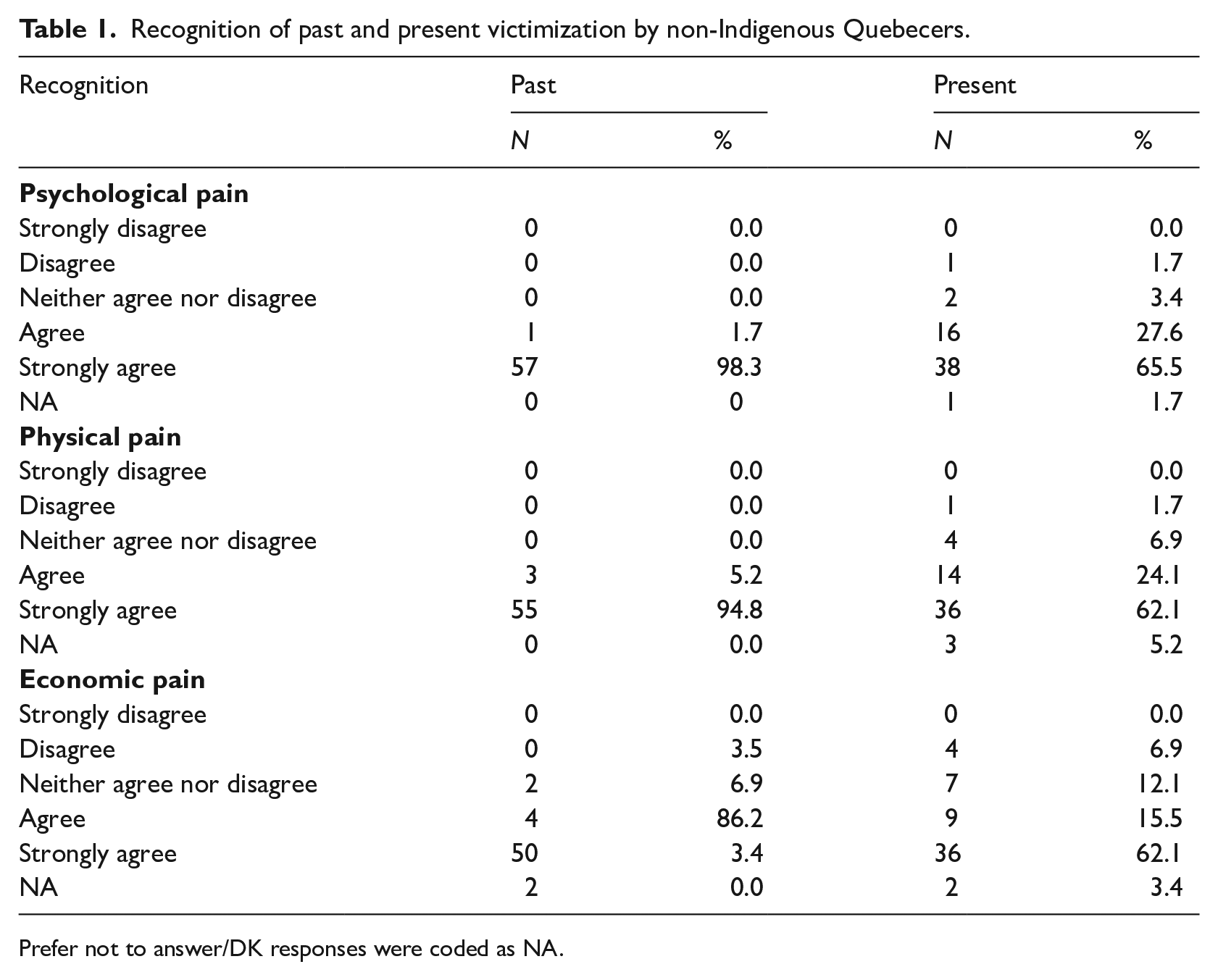
Prefer not to answer/DK responses were coded as NA.
Taking a closer look at respondents’ attitudes toward ongoing economic suffering of Indigenous peoples in Canada, three themes emerge from their responses to the question, ‘What should be done to improve the economic situation of Indigenous peoples in Canada?’. These three themes are (1) self-determination, (2) collaboration, and (3) State control. They can be viewed on a continuum: At one end, there is the self-determination of the Indigenous peoples and on the other end, State control. Between the two extremes, lies collaboration between Indigenous peoples and the State (see Figure 1). Based on their open answers, each of the respondents was grouped under one of these three themes: 17 preferred self-determination; 27 supported collaboration; and 14 favored state control. In the following, we will explore the nuances of these three positions, each distinguished with sub-themes.
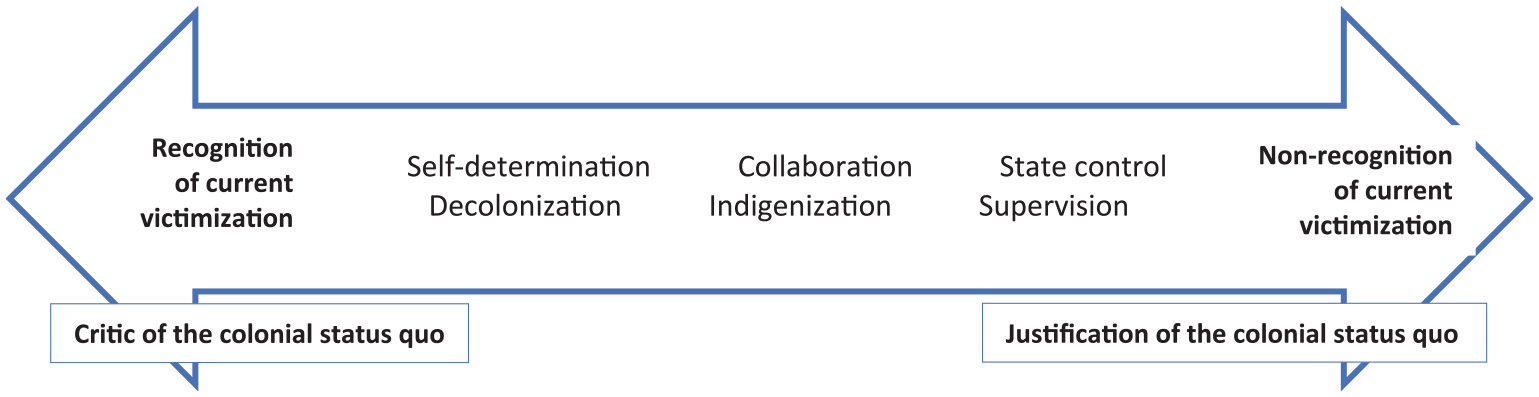
Spectrum of justification.
Self-determination: a critic of the status quo
Self-determination was emphasized in one form or another by one out of three respondents (n = 17). Some highlighted the need for greater autonomy of Indigenous peoples, while others talked about reducing government interference and yet others focused on legal reform to modify the relationship between the government of Canada and Indigenous peoples.
Participants referred to the autonomy of Indigenous peoples, putting them at the heart of initiatives to improve their economic situation. According to this view, Indigenous peoples are key actors, experts, who know what they need and are capable of leading. These respondents encouraged Indigenous economic leadership. Other words used to refer to the self-determination of Indigenous peoples are emancipation and independence. Indigenous autonomy was not limited to economic initiatives and was thought to extend beyond the economic system to other areas, such as education: I also think that the best people to answer this question . . . are the members of these communities! We, non-Indigenous peoples, need to give them space and listen to them. I believe that these peoples are best placed to tell us what they need. (Participant 16) By fostering economic leadership by Indigenous leaders for their own communities. (Participant 23) Greater economic freedom for First Nations. Giving them their sovereignty would be utopian, but in my opinion necessary. (Participant 37) To promote their independence in education and in the management of their resources and economy. (Participant 13) Allow the emancipation of Indigenous peoples and the development of economic independence. (Participant 34)
Others emphasized the need to reduce government interference in Indigenous communities. This would promote the autonomy or agency of Indigenous peoples, allow them to make their own decisions, and respect their territorial sovereignty. The reduction of non-native political control should also involve respect for territorial sovereignty and treaties, which reflect a nation-to-nation relationship: The Canadian government should reduce its influence in the economy of Indigenous peoples in order to give them much more AUTONOMY in their decisions. (Participant 19) Stop passing pipelines through their territories. (Participant 36) To really respect the territorial treaties, make recognitions, respect them at the highest level. (Participant 21)
Others emphasized fostering decolonization and the emancipation of Indigenous peoples to counter the economic difficulties experienced by Indigenous peoples. These respondents focused largely on legislative reforms, which would provide political autonomy to Indigenous peoples, and remove legal obstacles. Proposed measures include amending the Indian Act, which isolated Indigenous peoples by creating reserves: Give much more political powers to Indigenous peoples and reform their current rights and situations. (Participant 40) Amend, relax federal laws that prevent them from advancing in development. (Participant 21) Amend the Indian Act and change its name. (Participant 2) Stop specific treatments, such as reservations that put them aside. (Participant 15)
Collaboration: ambivalence toward the system
The most common theme is some form of collaboration between Indigenous peoples and the State. Half of respondents (n = 27) are in the middle of the spectrum and opt for collaborative measures to improve economic conditions. They continue to see a role for the State and propose some type of collaboration between it and Indigenous peoples. In a nuanced way, several participants suggested collaboration, consultation, and inclusion of Indigenous populations within the non-native system: COLLABORATION between the Canadian government and the leaders of Indigenous peoples. (Participant 19) By developing an economic improvement plan that corresponds to them. (Participant 8) They could be understood and then helped to implement policies that favour what they want in their territory. (Participant 6)
Several respondents suggested that the government provide support to assist Indigenous communities improve their economic situation. This could take the form of government funding, either in the form of grants or tax cuts, which Indigenous peoples could then use to stimulate economic growth and counter economic suffering: I think that the Canadian government must encourage the Indigenous economy by valuing it and giving grants, but it is up to Indigenous peoples to choose what they want to exploit and how. (Participant 47) Provide them with money so that they can develop their own system of taxes so that they can become independent in their territory. (Participant 12) Bonus and tax credits to relieve the economic distress of many who are unable to find jobs, often because of racism and fear of others. The many years of stigmatizing Indigenous peoples have unfortunately had negative impacts that still persist in 2020. (Participant 7)
Besides funding, others suggested the government provide expertise such as access to trained professionals: Provide staff trained in socio-economic development and collaborative approaches to working with members of volunteer communities. (Participant 26)
Many proponents of a collaborative approach emphasized the importance of an equal partnership: Also, the work must be done with an agreement: ‘Work WITH them’. (Participant 52) It is important that they can work in partnership and that the two do not feel neglected or abused. (Participant 48)
Several respondents emphasized the importance of consultation between leaders, including the traditional Indigenous leaders; the hereditary leaders, who are not typically recognized by the State: Let leaders meet and talk to each other and listen. (Participant 32) Listen to them. And not just band chiefs, but hereditary chiefs as well. (Participant 36) This requires listening to and understanding the needs of Indigenous peoples. (Participant 14) By learning about their realities/issues/needs. (Participant 20) Whichever solution is chosen, their needs, interests and concerns will have to be taken into consideration. (Participant 35)
Another collaborative approach focused on the inclusion of Indigenous peoples in Canadian society and institutions. Recognizing structural victimization within society, some recommended Indigenous participation in decision-making bodies, while others focused on education as a means to counter social inequalities: I believe we should include more First Nations, Inuit and Métis people on boards and decision-making positions. (Participant 16) Give them the chance to occupy key positions. (Participant 38) By including them in the governmental decision-making process. (Participant 20) Inviting them more into our governmental institutions. (Participant 29) I think it also involves adapting the education system to their special needs and working hard to combat systemic discrimination in hiring in particular. This social fight also goes through education, whether in business, universities, or elsewhere. (Participant 14)
Also, without naming it directly, many respondents talked about indigenization, a process in which the dominant group incorporates Indigenous worldviews, perspectives, voices and ways of doing while considering them equal to the mainstream ones. These participants proposed to integrate Indigenous practices into Canadian society and institutions. Valuing Indigenous knowledge and traditions would also enrich the non-native population: Integrate their practices into ours, and not just the other way around. (Participant 43) An economic plan implementing their knowledge and skills should be put in place. (Participant 34) Promote communication based on trust with them. Establish programs to integrate them into our community, while maintaining their traditions, rather than putting them on reserve. I think we could enrich each other. They have values that we could learn from. (Participant 53)
While these respondents recognize the structural victimization of Indigenous peoples, they do not appear to question the status quo, as if the suffering is not rooted in the actual colonial State. This way of thinking in evident in the following quote by one of the participants: Have negotiation and mediation to determine what the needs of the two parties are: Indigenous people as well as the federal government . . . However, Canada will never be able to fully repair what has happened in previous years, and if that is one of its mandates, I highly doubt that it will succeed. On the other hand, I believe that Indigenous peoples are deeply affected by what they have experienced (with good reason), but that they must be resilient and live in the present. (Participant 48)
Government control: justification of the status quo
At the other extreme of the continuum lies government control. These participants preferred maintaining control by the government, and thus, denied Indigenous peoples their autonomy. Almost one in four respondents (n = 14) make up this group, which is in favor of non-native, government control, whether by leading or supervising Indigenous leaders. The involvement of the government is thus never disputed by these participants and Indigenous peoples continue to be dependent upon non-Indigenous decision-making about their future.
Government leadership is perceived by some participants as essential for improving the economic situation of Indigenous peoples. These respondents do not question government involvement in Indigenous affairs and instead see it as the solution for the difficult economic situation: The Canadian government should be more involved. (Participant 50) More Government of Canada Assistance. (Participant 46)
Some favor government financial assistance; however, unlike others who would give Indigenous peoples control over spending, these respondents prefer that the government determine how the money is used. The government would provide guidance or supervision: I think we have to start by helping Indigenous peoples to equip themselves to be able to manage their own economic resources. (Participant 49) Enabling Indigenous peoples to manage their own economy but supervised by the government. (Participant 39) Indigenous peoples should receive financial compensation, but under supervision so that this compensation is used intelligently for the well-being of the community. It is better to teach a man once to fish so that he can find his own fish, than to always fish for him. (Participant 44) Maybe we should show Indigenous peoples how to manage their economic situation, not let them do it without help. Show them how to have a good economic situation, because at the moment this is not the case and they do not seem to be able to manage their own situation themselves due to lack of knowledge. (Participant 33)
For other respondents, the economic challenges facing Indigenous peoples did not require a distinct approach. Instead, treating Indigenous People differently, or ‘identity politics’, was part of the problem: They just had to work: Forcing them to work and allowing more off-reserve travel. (Participant 55) To treat Indigenous communities with important socio-economic problems in the same way as one would treat another environment with important socio-economic problems. Stop making special policies for Indigenous peoples. Instead, tackle economic, educational, or consumer problems, without always going through identity politics. (Participant 51)
Discussion
Reconciliation starts with recognition and for Indigenous scholars, recognition of ongoing victimization is essential for facilitating the empowerment of Indigenous peoples and their communities (Hunt, 2016; Stein, 2020). Hence, it is encouraging to observe that the majority of respondents recognize not only the historic but also the ongoing victimization of Indigenous peoples in Canada, including their continued economic victimization. Although recognizing historic victimization may be painful, it does not require societal transformation as the victimization is in the past and not ongoing, but recognizing ongoing victimization obliges us change and stop the violence. However, complete reconciliation requires a societal transformation, and while recognition is an important first step, we cannot assume that recognition alone will necessarily lead to change. People tend to favor the status quo and may instead try to justify observed inequalities rather than forfeit their privileged position (Jost et al., 2004).
The qualitative analysis of responses reveals that attitudes are far more nuanced and that many respondents fail to recognize the colonial status quo. The attitudes of Quebec respondents can be placed on a continuum of justification. Depending on where they are on the continuum, they proposed various ways to counter the inequitable economic situation of Indigenous peoples. Their discourse demonstrates all the subtlety surrounding the process of reconciliation, revealing that most do not favor the economic autonomy of Indigenous peoples.
One in three respondents express the importance of self-determination and the concept of decolonization as a solution to the economic difficulties of Indigenous peoples. Self-determination is considered by Indigenous authors as full control of their political, social, cultural, and economic systems (Datta, 2019; Nagy, 2013). This control is possible through the extirpation of the colonial system. The essence of colonialism is the application of domination over a given people; self-determination can be seen as the criticism and the reversal of the colonial status quo. It is stated in the United Nations Declaration on the Rights of Indigenous peoples (UNDRIP): ‘Indigenous peoples have the right to self-determination. By virtue of that right they freely determine their political status and freely pursue their economic, social and cultural development’ (Article 3). Without naming the Resolution of the General Assembly of the United States, these participants seem to agree with such a declaration. They are more likely to challenge the status quo, prioritize the expertise of Indigenous nations, and question government involvement in Indigenous affairs. These ‘high-risk’ actions promote greater recognition of structural victimization, which favors full involvement in the reconciliation process. This citizen involvement takes into account the decolonial dimension in the reconciliation, contrary to ‘low-risk’ actions. The various forms of decolonization proposed by these participants seem to reflect a deep understanding, which allows a questioning of preconceived ideas as well as ‘high-risk’ social actions.
Moreover, when non-Indigenous people criticize the involvement of the Canadian government, it is the colonial status quo that is challenged, and thus, the non-justification of the system. By stating that Indigenous peoples are masters of their decisions and experts in their economic situation, Canadian interference is seen as illegitimate if it does not allow recognition of Indigenous sovereignty. These participants seem fully involved in the process of reconciliation. On the contrary, full participation would take the form of personal actions (e.g. recognizing victimization), social actions (e.g. collaborating with indigenous associations), and political actions (e.g. electing MPs with a clear position on indigenous self-determination). All these actions must foster Indigenous sovereignty.
The largest group of respondents is those who show ambivalence toward understanding and acknowledging the ongoing economic victimization of Indigenous peoples. Unlike the first group, self-determination is not considered possible or necessary and they never question non-native authority, which they view as legitimate. Most of their suggestions involve collaborative, ‘low-risk’ actions, such as listening, meeting, and taking into account the needs of Indigenous peoples. They prefer ‘indigenization’ and the inclusion of Indigenous symbols in Canadian society. According to Melançon (2019), this practice can be emancipatory, when promoting the full decision making of Indigenous people. However, this condition is not mentioned by any of the respondents in this group. Integrating Indigenous Peoples in government bodies without reforming state institutions poses little threat to the status quo.
While these participants welcome collaborative work with Indigenous peoples, they do not perceive the self-determination of Indigenous peoples as possible, desirable, or realistic, and therefore, the involvement of governments continues to be important. Non-native governments are perceived as responsible for improving economic conditions, and their legitimacy is not questioned. For these participants, it is the duty of the government to come to the aid of the Indigenous peoples, insofar as their current situation is not unrelated to past policies. They do, however, think that the government must respect certain limits, including consultation with key figures and, hence, they attribute an advisory role to Indigenous peoples. Indigenous nations are, however, not seen as fully sovereign, and therefore, remain dependent on the Canadian government. Again, this reflects the nuanced position and the respondents in this group appear to be only partially involved in the process of reconciliation.
One in four respondents wants to see more involvement by non-native bodies in Indigenous Peoples’ economic affairs. Government supervision is preferred to ensure that the economic situation of Indigenous peoples is improved, even if this effectively means maintaining the colonial status quo. Government supervision is perceived as benevolent. The domination and power imbalance that characterizes the colonial status quo is not apparent to them. This is perhaps best reflected in one participant’s mention of the popular adage: ‘When a man is hungry, it is better to teach him to fish than to give him a fish’. Here, the non-native entity plays the role of the master, a generous actor, in terms of money and knowledge. On the other hand, Indigenous peoples, ironically, are those who do not know how to fish and cannot feed themselves. Government involvement is hence thought to be fully justified and valued. Among these respondents, there is very little questioning of the colonial paradigm, and the sovereignty of Indigenous peoples is not raised as an adequate solution. Instead of contesting the role of Canadian structures in maintaining the status quo and thus colonial oppression, participants perceived government authorities as the solution to the inequities experienced by Indigenous peoples. The abolition or reform of the existing system is, therefore, not a suggested avenue as they are for the first and second group, respectively. Unlike the other participants who recognize Indigenous self-determination or are ambivalent, these participants seem not involved in the reconciliation process.
Supervision by an external authority, such as the federal government, denotes a certain paternalism that characterizes the colonial vision. In a simplified way, it treats Indigenous peoples like children who are incapable on their own and need good parenting. By perceiving First Peoples as incapable and dependent on the system, power structures are legitimized because they are seen as essential to the recovery of a fragile economic situation. However, the economic autonomy of Indigenous peoples is an essential right. Article 4 of the UNDRIP reminds us: ‘Indigenous peoples, in exercising their right to self-determination, have the right to autonomy or self-government in matters relating to their internal and local affairs, as well as ways and means for financing their autonomous functions’. Hence, while most respondents recognize the ongoing economic victimization of Indigenous peoples in Canada, most do not recognize the importance of self-determination to end this victimization.
The findings concur with SJT, which posits that people will tend to favor the status quo. While on the surface most respondents recognize the ongoing economic victimization of Indigenous peoples in Canada, only one in three respondents is in favor of giving Indigenous peoples economic autonomy. The justification of the actual system appears to be still the norm. Low-risk actions are preferred, such as the recognition of Indigenous peoples as semi-sovereign (not nations), the establishment of a cultural heritage protection policy, consultation without decision-making authority, and symbolic inclusion within the Canadian system without targeting self-determination. Analysis of the qualitative responses suggests that most respondents want to see continued government involvement in Indigenous economic affairs, thus maintaining the status quo. As Twali et al. (2020) point out, it is easier to ignore a situation in which we do not act directly so that we can then absolve ourselves of any reaction.
If full reconciliation is one that improves the current living conditions of Indigenous groups and protects their agency, then most respondents do not seem to support it. Complete reconciliation requires a societal transformation. It must go hand-in-hand with decolonization, by returning control over ancestral territories and resources to Indigenous communities. While a majority of respondents recognize the ongoing victimization of Indigenous peoples in Canada, many remain reluctant to engage in high-risk actions and return control to Indigenous peoples. High-risk actions that end the structural victimization, improve the current living conditions of Indigenous populations, protect their agency and reject the colonial status quo would recognize the colonial historical past and contemporary structural victimizations (Regan, 2010; Wohl et al., 2019).
The fact that many non-Indigenous Canadians view the promotion of reconciliation positively, but are not fully invested in it, suggests a desire for unification rather than social transformation. This nuance is relevant, insofar as the social unification of the Canadian nation does not make it possible to reverse the colonial status quo. Indigenous people are at best invited to collaborate and voice their needs. Thus, investment is symbolic but does not transform structures of domination viewed as legitimate (Maddison and Nakata, 2020).
Many participants fail to imagine Indigenous nations being able to govern themselves, particularly by considering their current economic condition. Indeed, by not recognizing the state’s responsibility for the structural victimization of Indigenous peoples, it is rational and legitimate to take charge of various spheres of life of Indigenous peoples, both economic and social. Thus, in justifying the system, participants grant it legitimacy but are unable to recognize the structural and systemic factors that maintain and reproduce inequalities (Augoustinos and Callaghan, 2019). This echoed the results of a national survey, where 42% of non-Indigenous Quebecers had little or no confidence at all in Indigenous leaders (Environics Institute, 2021).
Conclusion
This article offers an overview of non-Indigenous justification attitudes, according to their recognition of ongoing economic victimization. By opting for qualitative analysis, we offer a rich and nuanced understanding of a sensitive and polarizing subject, namely the process of reconciliation. It is important to probe the attitudes of non-Indigenous peoples because they too have a role to play in reconciliation. It is ultimately members of the dominant group who have the greatest decision-making power by participating in the cultural, political, and economic spheres of society. Also, studying reconciliation from a social psychological perspective makes it possible to note the subtleties attached to individuals in society. In this sense, we want to reiterate the importance of not considering the narratives of the participants through a moral lens: good or bad. According to the analysis made in this article, we suggest that the most important thing is to promote discussions and especially fluidity in reflection.
Almost all the respondents are in favor of reconciliation. When taken together, decolonizing, recognizing sovereignty, offering economic support, collaborating, and coaching are all ways to counter economic inequalities in the short and medium term. When it comes to the process of reconciliation, however, studies demonstrate the importance of not limiting low-risk actions that do not allow for the abolition of colonial structures in the long term, which is the workhorse of decolonization (Wohl et al., 2019). Recognition of self-determination is necessary from the state and its population. Thus, the recognition of the status quo by the majority of non-natives, which concretely implies the acknowledgment of it, ensures support for the implementation of the articles provided in the Declaration. Also, the process of reconciliation must be tackled at both individual and structural levels. Even if Indigenous victimization arises from colonial injustices, non-indigenous peoples should be encouraged to take action in everyday life, by learning about the colonial repercussions and examining their preconceptions on the matter. Local leaders must be held accountable and non-indigenous citizens should question their views on the matter of reconciliation. Fostering respectful relations with Indigenous peoples may be a positive way to go beyond the simple fact of understanding, to acknowledging. Academic institutions and workplaces also have a role to play and can for example offer free workshops hiring local indigenous communities to encourage listening to Indigenous voices and knowledge. Ultimately, the individuals who justify the status quo should be more sensitive to issues of power and privilege, as they tend to neglect the avenue of self-determination. Nevertheless, the future seems promising, as fewer Canadians tend to blame Indigenous peoples for their economic and social situation, and more believe the State policies have a role in the inequity between Indigenous and non-Indigenous populations (Environics Institute, 2021).
Like any research, this study has limitations. First, our participants come from a population that is overrepresented in social science studies, being educated and young (Henrich et al., 2010). Nevertheless, as the objectives of this article are not related to the generalizability and reproducibility of the data, we consider the perceptions of this population to be relevant for research on reconciliation in the Canadian context. Also, the qualitative analysis cannot be exhaustive insofar as the respondents had to answer a single question. In the context of an electronic survey and without the possibility of conversing with an interlocutor, they had to issue a brief answer, which could not encourage deep reflection.
Footnotes
Acknowledgements
This study was made possible with funding from the Social Sciences and Humanities Research Council of Canada (Grant number 430-2019-00168). The authors would like to thank Professor Nicolas Jones and Amber Schick for their help with this research. We also extend our gratitude to the reviewers for their insightful comments and suggestions.
