



Abstract
The aim of this article is to explore how courts produce certain representations of victims of labor exploitation in the Nordic context based on court judgments from Denmark, Finland, Norway, and Sweden. To achieve this, we analyze and compare criminal court judgments focused on the exploitation of migrant workers by asking: How are ‘victims’ of labor exploitation represented in Nordic court judgments? What is left unproblematic and silenced? In each country, we have identified criminal court cases that have legally examined aspects of the exploitation of migrant workers, in total, 91 court judgments. Drawing on Bacchi’s ‘What’s the problem represented to be?’ (WPR) approach, we can show that the representations of victims apparent in the court judgments involve a legal construction of vulnerability that is reserved for the most marginalized migrant workers. The narrow representation silences the broader socio-economic context in which migrant workers exist. Our results also indicate that the threshold for being defined as a victim of labor exploitation is lower in some of the Nordic countries and higher in others. Thus, while there is a normative consensus that the exploitation of migrant workers should be prosecuted, in practice, the court judgments reflect substantial differences in the legal interpretations applied across the Nordic countries.
Migrant workers are an important source of labor for several sectors in the Nordic countries. At the same time, work has become more insecure, temporary and flexible, affecting the low-skilled and low-paid sectors in which many migrants work (Doellgast et al., 2018). Global economic processes have created a ‘segmented labor market’ structured by gender, citizenship and ethnicity (Likic-Brboric et al., 2013). While the Nordic countries are well known for their welfare systems, equality, and good working conditions, current research shows that migrant workers are exploited in these countries in labor-intensive sectors, such as construction, services, logistics and transport, and horticulture and agriculture (Ollus, 2016; Ollus and Jokinen, 2013; Spanger and Hvalkof, 2020; Woolfson et al., 2012).
Labor exploitation can be conceptualized as existing along a continuum, ranging from serious, criminalized practices, such as trafficking, to less severe forms of exploitation and violations of labor law (Andrees, 2008; Ollus, 2016; Skrivankova, 2010). Anti-trafficking laws, which include labor trafficking, have existed in Denmark, Finland, Norway, and Sweden since the beginning of the 2000s, 1 and are based on the UN Palermo protocol (Protocol to Prevent, Suppress and Punish Trafficking in Persons, Especially Women and Children). The criminalization of trafficking can be understood as an example of a transnational legal order, which includes the interaction between international and domestic criminal processes and the diagnostic struggles that shape the meaning of legal norms (Aaronson and Shaffer, 2021). Although there might be a high degree of normative consensus at the international level, as is the case regarding the criminalization of trafficking, there may be discord in the interpretation and implementation of legal norms at the domestic level (Aaronson and Shaffer, 2021). With regard to the Nordic countries, despite having similar legislation on human trafficking, there are significant cross-country differences in the number of both court cases for trafficking for forced labor and convictions for other forms of exploitation focused on migrant workers (such as usury and extortionate work discrimination 2 in Finland and human exploitation 3 in Sweden) (Alvesalo-Kuusi et al., 2016; Ollus, 2016; Spanger and Hvalkof, 2021).
On the other hand, there are significant similarities. With the exception of Finland, there are very few convictions overall in the Nordic countries for trafficking for forced labor as well as other forms of labor exploitation. 4 One reason for this may be that most anti-trafficking efforts have been focused on women who are trafficked into prostitution (Skilbrei, 2012), thus neglecting the identification of victims of labor exploitation, who are predominantly men. Smiragina-Ingelström (2020) argues that the invisibility of male victims stems from the way trafficking has been defined in law and from the gendered ways in which victimhood is understood and experienced. Indeed, the construction of ‘victims of trafficking’ often has a gendered dimension, viewing victims as ‘passive and childlike, and therefore the agency involved in their mobility is underestimated’ (Skilbrei, 2012: 213; see also Viuhko, 2020). The social construction of the victim reflects a range of social and cultural perceptions in society, which in cases of trafficking may be of decisive importance to whether a subject is granted the status of a plaintiff and thus certain legal protections (Åström, 2014: 251). Actors, such as police and immigration officers, labor inspectors, and trade union representatives all participate in a process of legal categorization that differentiates between ‘trafficking victims’, ‘exploited workers’, and ‘illegal migrants’ (see Strauss, 2016: 152). We would argue that these representations shape the interpretation of the problem of labor exploitation in domestic processes by means of which transnational legal norms are translated into domestic legal practice (see Aaronson and Shaffer, 2021). Drawing on the poststructuralist feminist scholar Carol Lee Bacchi’s novel concept of problem representations (Bacchi, 2009; Bacchi and Goodwin, 2016), we argue that actors involved in the identification of victims and perpetrators produce different representations of the “problem” of labor exploitation and of victims. The legal construction of victims in court cases takes place at the end of this process of identification and categorization. The aim of this article is to explore how courts produce certain representations of victims of labor exploitation in the Nordic context based on court judgments from Denmark, Finland, Norway, and Sweden. To achieve this, we analyze and compare criminal court judgments focused on the exploitation of migrant workers by asking: How are ‘victims’ of labor exploitation represented in Nordic court judgments? What is left unproblematic and silenced?
Until a criminal charge is settled, the legal category occupied by the victims of trafficking is plaintiff or aggrieved party. The settling of a criminal charge is subject to the prosecution’s ability to provide proof beyond reasonable doubt. Failure to do so does not mean that the aggrieved party was not victimized. 5 We therefore use the term victim throughout, without distinguishing between those who were legally defined as victims by the court and those who were not. This reasoning is in line with our methodological point of departure in post structural policy analysis, which seeks to question, open up, and broaden institutional categories, practices, and language (Bacchi and Goodwin, 2016: 69).
The article proceeds by first introducing previous research on the social construction of victims of trafficking and labor exploitation. It then moves on to present our theoretical and methodological approach, which is inspired by Carol Bacchi’s ‘What is the problem represented to be’, and to describe how applying this approach will contribute to new knowledge on legal representations of victims of labor exploitation. The subsequent section outlines how the court cases were selected. The article then presents our analysis of four victim representations and, finally, our conclusions.
Previous research on representations of victims of trafficking and labor exploitation
Several scholars have studied how the construction of the ‘victim ‘ not only reflects ideologies and preconceived notions of a problem but also serves to prescribe certain policy solutions to the problem in question. This research includes studies on representations of trafficking victims in general (Sharapov, 2017; Turnbull and Broad, 2020; Viuhko, 2020; Wilson and O’Brien, 2016); representations of victims of trafficking for sexual exploitation and prostitution (e.g. Agustín, 2005; Andrijasevic, 2007, 2014; Doezema, 2010; Heber, 2018; Hoyle et al., 2011; Jacobsen and Skilbrei, 2010; Kempadoo, 2005; Spanger, 2011); and representations of victims of labor exploitation (Åström et al., 2013; Smiragina-Ingelström, 2020; Spanger, 2022; Spanger and Hvalkof, 2020; Strauss, 2016; Yea, 2015). The literature on representations of the victims of trafficking for sexual exploitation and prostitution has contributed knowledge on the way representations of the trafficking victim are reliant on stereotypes about the passive and innocent woman from the global south or Central and Eastern Europe. This literature also demonstrates how this stereotype conflicts with the engagement of migrant women in the sex industry, as well as how this representation eclipses other constructions of victims within the human trafficking policy field. Since this article focuses on labor exploitation (excluding sexual exploitation), this section discusses studies on both representations of trafficking victims in general and representations of victims of labor exploitation.
These studies paint a similar picture of how trafficking policies and discourses often include examples of extreme forms of trafficking and ideal victims, which has produced a distinction between on one hand deserving, legitimate and ideal victims, and on the other hand, undeserving/non-ideal victims or even ‘illegal migrants’ (Segrave and Powell, 2015; Strauss, 2016; Viuhko, 2013; Yea, 2015). Other trafficking crimes, which lack ideal victims, such as labor trafficking, are ‘silenced’, producing a situation in which no consideration is given to discussing the economic and political human rights that underpin the issue (Wilson and O’Brien, 2016).
This has in turn resulted in a situation in which the ‘threshold for victimhood is set extremely high’ in the trafficking discourse (O’Connell Davidson, 2010: 257). Research shows that victims who fulfill the criteria for being regarded as so-called ideal victims are more readily recognized, and that victims of labor exploitation do not easily meet the criteria of ideal victimhood (Åström et al., 2013; Viuhko, 2013). The narrow representations of victims found by these studies serve to silence the broader social, political, economic, and institutional processes that surround labor exploitation (e.g. Sharapov, 2017). These studies have focused on policies in the traditional sense, as produced by governments and non-governmental organizations (NGOs), with the exception of Strauss (2016) who attended to legal characterizations of victims in the statistics from the UK’s National Referral Mechanism for identifying and supporting trafficking victims. While Matte Guilmain and Hanley (2021) and Åström et al. (2013) did adopt case law as their point of departure, they did not primarily scrutinize the representations of victims in these legal cases.
In contrast, this article focuses on problematizing representations that are generated through legal discourse. It thus expands the policy literature by producing knowledge about the way in which victims of labor exploitation are constructed in court judgments, where these constructions are at their most decisive in the sense that they categorize plaintiffs as being either victims of crime or non-victims. In addition, this study also moves beyond the representation of trafficking victims in general, since we focus on the broader category of labor exploitation. Although the construction of victims of labor exploitation appears to be fairly similar across the globe, this article analyzes and compares court judgments from the four Nordic countries and identifies certain differences.
Theoretical and methodological approach
The article draws both theoretically and methodologically on Bacchi’s (2009) ‘What’s the problem represented to be?’ (WPR) approach. The WPR approach understands policy in a broad sense, which includes ‘both the activities of state institutions and of other agencies and professionals involved in maintaining social order’ (Bacchi and Goodwin, 2016: 18). A policy text can then include, for example, organizational files, judicial decisions, interview transcripts, and so on. The WPR approach suggests that policies are created through representations of ‘problems’ that are produced via discourses. Discourses are here understood as ‘socially produced forms of knowledge’ (Bacchi and Goodwin, 2016: 35). Thus, Bacchi’s (2009) WPR approach represents a break with the idea that policies are reactions to societal problems. Bacchi’s approach aligns with Aaronson and Shaffer’s (2021) idea that diagnostic struggles regarding a “problem” shape the content of legal norms. Judges who interpret and apply the laws thus constitute part of the process of framing the problem of labor exploitation and of understanding the victims of such exploitation.
Bacchi (2009) contends that analyses should include an examination of the effects of specific problem representations and a consideration of what is left unproblematic and is thus silenced in this problem representation, how ‘subjects’ are produced within them, and the lived effects that accompany these representations. Viewing subjects, such as ‘victims of labor exploitation’ and categorizations as representations rather than as necessary and natural ‘creates an opening to consider how they are produced and how they translate into diverse lived realities’ (Bacchi and Goodwin, 2016: 6). Thus, the legal process produces subjects in a way that creates distinctions, for example, between victims of crime and ‘illegal’ migrants. From the perspective of critical victimology, it is important to investigate the processes by which victims (and non-victims) are constructed and the power involved in these processes (Miers, 1990; Walklate, 2015).
Taking our point of departure as the task of identifying ‘representations of victims’ in court judgments, and inspired by Bacchi, we pose the following analytical questions that have guided the coding of the court judgments from each country: How are victims represented by the court? What assumptions underlie this representation of the victim? Which binaries, key concepts, and categories are operating within these representations? What is left unproblematic in these representations of the victim (‘silences’)?
Based on these questions, we identify a number of representations of the victim. However, we found that the representations were predominantly based on a few key concepts and binaries: vulnerable/non-vulnerable, deception, free/forced, and credible/non-credible. This is hardly surprising, since these representations ultimately stem from the trafficking protocol formulation, which focus on the means, such as abuse of position of vulnerability and the use of deception.
We demonstrate that these key concepts, categories, and binaries operate somewhat differently in the four countries. Based on the identified representations, we examined and reflected on their underlying assumptions and silences. Our comparative approach has a major advantage here, as a particular kind of silence in one country might be exposed by the analysis in relation to a non-silence in highly comparable neighboring countries. A final step in the analysis, which is presented in the concluding discussion, involved reflecting on the effects produced by these representations.
Selection of cases
In each country, we have identified criminal court cases that have legally examined aspects of the exploitation of migrant workers. The search was conducted to include judgments issued between 2000 and 2020, but in practice, the first identified court case is from 2006. 6 We have excluded ‘non-conventional’ forms of labor exploitation, such as victims being forced to commit crime (theft, drug trafficking, etc.), forced sale of sex and begging.
We have used different methods to identify and obtain the court judgments in each country. In Sweden, the court cases were accessed via the law database Infotorg Juridik. Here, the criteria that guided the database search were that cases had been prosecuted as trafficking for forced labor, human exploitation, or usury (whereby an employer takes advantage of a victim’s vulnerable position to agree to a low salary or non-payment). In Norway, data were gathered via the database Lovdata Pro 7 and were based on an overview provided by the National Coordination Unit for Victims of Trafficking (KOM). 8 These data only include cases of human trafficking, since the usury legislation is not applied in the context of labor exploitation in Norway. A few cases that were not available via the database were collected via direct contact with the courts. In Denmark, we identified court cases related to violations of the criminal law on human trafficking using an overview of case law published by the Danish Public Prosecutor, which is updated annually. This publication provides an overview of the cases brought before the Supreme Court, appeal courts and the district courts. In addition, we made use of an overview of all court cases on human trafficking and usury in Denmark published in the journal of the 3F trade union. Based on the identified court cases, the court records were requested and received from the courts. A list of the Finnish court cases regarding human trafficking and extortionate work discrimination was acquired from a contact at the Ministry of Justice. This information was used to request the court judgment documents from the courts.
Since the data collection approach differed for each country due to national differences in the process by which court judgments are accessed, the research team has continuously discussed the process of collecting the court cases. The number of human trafficking cases in each of the four countries is very low, which means we have been able to confirm the selected cases with practitioners and other scholars in the field. However, when it comes to the extortionate work discrimination cases in Finland, our material is not exhaustive. Due to the high number of such judgments, we have only analyzed a sample of 14 judgments in which the principal offense in the indictment was extortionate work discrimination. The district courts cases were first organized in chronological order based on the date of the judgment, and then the first four from 2019, the middle four, and the six most recent cases were chosen for analysis. During the process of collecting and selecting our cases, the research team also engaged in an ongoing, critical discussion of the cases selected, particularly those we viewed as borderline cases. For example, during these discussions we decided to exclude cases classified as labor exploitation, but which only included elements of having been coerced into engaging in crime.
Table 1 presents an overview of the number of cases included for each country. The table is organized on the basis of the principal indictments in the form of either trafficking or human exploitation, extortionate work discrimination and/or usury as stand-alone charges. In the columns to the right of the indictment columns, we present the number of convictions recorded in relation to these indictments. A case that has been tried in both a district court and a court of appeal is counted as a single case. For example, if there is a conviction for trafficking for forced labor from the district court, but an acquittal from the appeal court, the case has been counted as an acquittal. If the court of appeal in the same case had issued a conviction for usury rather than trafficking, the case would still be counted as having resulted in an acquittal. If the judgments contain convictions for other offenses, this is noted in the footnotes. Similarly, in the column for convictions for human exploitation/extortionate work discrimination/usury (as stand-alone charges), convictions for other offenses, (such as fraud, assault, or violations of migration law, for example), are not included as convictions.
The number of court cases included for each country.
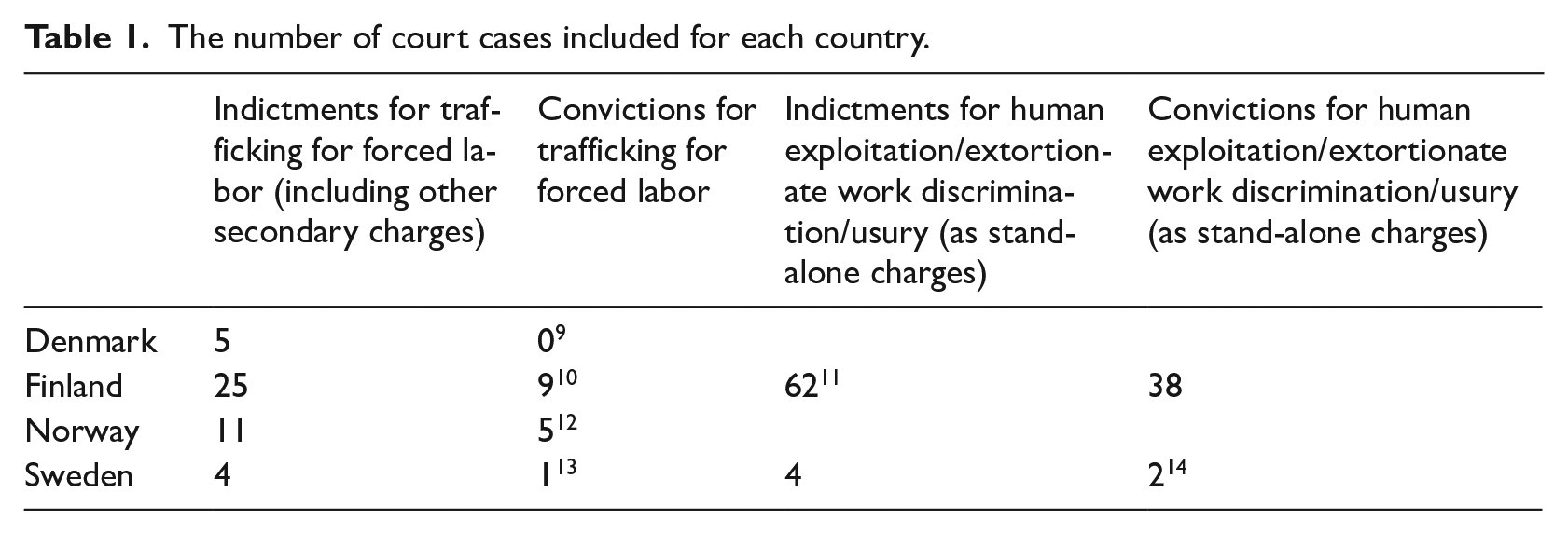
In Finland, 25 cases of trafficking for forced labor had been processed by the district courts and courts of appeal. Aggravated usury and/or extortionate work discrimination are usually included by the prosecutors as secondary charges in these trafficking cases. In 56 cases, these offenses represented the only charges in the indictment. The other three countries had very few cases of trafficking for forced labor, in total, nine in Norway, five in Denmark, and four in Sweden. When relevant cases of usury (2) and human exploitation in Sweden (2) are also included, the total number of cases from these three countries remains much smaller than the number prosecuted in Finland.
Several of the cases have been tried at more than one court level (court of first instance, appeal court, etc.), and from a discourse-analysis perspective, the court judgments published by different court levels in relation to the same case have been treated as separate documents, with potentially different representations of the victims. In total, 91 court judgments have been analyzed.
The coding process was conducted in two steps in each country. First, we created a table to provide an overview of the identified court judgments, which included the main characteristics of each case. For example: type of legal case, type of victim/offender, citizenship of both parties, industry, collaboration between authorities, the legal rule under which the prosecution was made, and the verdict in the case. From these overviews for each country, we discussed the selection of cases to ensure that we had made the same choices with regard to the inclusion and exclusion of cases. Second, the cases were coded in NVivo separately in each country, employing the same coding scheme to achieve consistency in the coding across the four countries. Drawing on the Bacchi’s ‘What’s the problem represented to be?’ analytical strategy, we coded descriptions of exploitation. For instance, we coded the use of binaries, key words, and categories that describe situations involving exploitation, as well as descriptions of both the victim and the accused. We also coded descriptions of the terms of the employment contract (the potentially exploitative terms) and descriptions of the criminal elements (e.g. violence, threat of violence, and deception) that accompanied the exploitative employment terms in accordance with the legal provisions of labor exploitation law that are common to the four countries. In addition, we coded the motivations for the courts’ verdicts, for example, their evaluation of the evidence and references to national legal precedents or international law. Finally, responses to exploitation, such as collaborations between authorities and descriptions of victim support and legal aid were also coded, since access to a system of support might, for example, affect how the vulnerability of the worker was perceived. The main body of the analysis of the coded court judgments was conducted in each country due to both language barriers and division of labor issues, but the analysis was continuously discussed within the research group to ensure that our interpretations of the data were consistent across the four countries.
The study’s comparative focus constitutes both a strength and a limitation. On one hand, as discussed earlier, the comparison of judgments from different countries provides an effective means for revealing differences and silences in victim representations. On the other hand, it is difficult to find comparative empirical data across the different countries, since the empirical contexts differ in terms of national legislations, the court judgments are formulated in a different way and ultimately the countries’ legal cultures and case law are different. Moreover, the process of identifying court judgments was different in each of the four countries. Despite these differences, we have found that the comparison of court judgments from the Nordic region has enabled us to analyze how victims of labor exploitation are represented differently within and between the countries included in the analysis.
Victim representations
Comparing representations of the victims of labor exploitation across the Nordic courts the analysis is divided into four sections on the basis of recurrent victim representations: The vulnerable victim, Not vulnerable enough, Deceived but free to leave, and The non-credible victim. These victim representations are not mutually exclusive. For example, victims can be represented both as ‘vulnerable’ and ‘deceived but free to leave’. Similarly, victims represented as ‘not vulnerable enough’ can be represented as both ‘credible’ and ‘non-credible’. Thus, the four victim representations do not represent the individual victim subjects. Rather, different aspects of the victim representations associated with labor exploitation can be identified in a single court case. For each of these four representations, we exemplify one court judgment per country to provide the reader with an idea of differences and similarities between the countries. In connection with each example, we describe the outcome of the case, since this may be of interpretational value, in Bacchi’s terms, the effects of the representations. Having said this, we cannot conclude that the way victims are represented by the court has been decisive in relation to the outcome of the case. While most of the examples of representations of vulnerable victims come from cases resulting in convictions, some do not. However, the examples in which the victims are represented as ‘not vulnerable enough’, ‘non-credible’, or ‘free to leave’ were all found among the acquittals. Thus, the analysis of victim representations enables us to analyze the predominance of the different representations across the four Nordic countries and within the Nordic region. When citing judgments where the court refers to the involved parties, we use the abbreviations ‘V’ for victim and ‘D’ for defendant followed by a number (e.g. V3 = victim number 3 and D2 = defendant number 2).
The vulnerable victim
Discussions of vulnerability constitute a significant element in the representations of victims found in the court judgments. The analysis of court judgments from the four countries identified both similarities and differences.
In the Finnish court cases, a wide range of factors have been taken into consideration, and vulnerability is often assessed in a systematic way. Following the formulations in the preparatory works (HE, 34/2004 vp.; HE, 103/2014 vp) the courts have to consider whether the victims have been in a position of dependence and/or in an insecure state, which the perpetrator has then taken advantage of or abused. Indicators of dependency include being a family member, a tenant, being in debt and being in an employment relationship, while elements, such as being young, a foreigner, or having a difficult economic situation or a physical or mental disability are indicators of an insecure state (HE, 34/2004 vp.: 93). The victims are often assessed by the courts based on these factors to consider whether they meet the criteria for either or both of these categories of vulnerability. In their considerations of these criteria, the courts often refer to the victim’s background story, focusing on their country of origin, their level of education and previous work history, and their family situation and circumstances, as a means of establishing a starting point for the assessment. Further elements that are considered are the dependency of the workers on their employer, for example, in terms of accommodation, lack of language skills, possible debts and the retention by the employer of travel documents, and other means of control. These are often considered based on binary yes/no categorizations: (1) educated–not educated, (2) being in debt–not in debt, (3) dependent on the employer due to accommodation–not dependent, and so on. In one case concerning forced labor at a wood processing plant, for example, the court deemed that the victims, who were adult men of Central Asian origin, were in an insecure state based on a list of criteria that were explicitly outlined in the conviction:
their background and life situations in their home country;
the underpayment of wages;
long working days and a blurring of the line between work and free time;
limitations on their movement, which have been strengthened by the use of sanctions;
the confiscation of passports and the duty to work;
some plaintiffs had been in debt to D1;
a lack of language skills and a lack of knowledge of Finnish society and its rules (28.1.2013 R 12/1683).
In addition, the court concluded that ‘the plaintiffs have been in a dependent position due to lack of language skills, lack of knowledge of Finnish circumstances, and for some, due to being in debt to and thus dependent on D1’ (28.1.2013 R 12/1683). The case resulted in a conviction. As in this example, the Finnish court cases encompass a rather broad understanding of vulnerability, but there are exceptions that will be discussed below when victims were not considered ‘vulnerable enough’.
As in Finland, a wide range of factors have been taken into consideration in Norway, and vulnerability is often assessed systematically in connection with the question of coercion and force, that is, whether the victim entered the work relationship in an informed and voluntary way and whether he or she had been free to leave. In the ‘Steinlegger’ case (TJARE-2008-69332), a man was convicted of trafficking for forced labor having exploited three men in the construction sector. The court found that despite the victims being employed voluntarily, and having been presented with a number of opportunities to exit the employment relationship (they had been in contact with the police on several occasions, and their work was of such a character that the employer could not keep them under constant surveillance), this was irrelevant because it was viewed in relation to their vulnerable situation. The court found that despite the fact that the victims had traveled to Norway to take up their jobs voluntarily, this had to be disregarded when the question of voluntariness was combined with the question of vulnerability. The court writes:
There is little doubt regarding the fact that the plaintiffs, who were recruited in England, consented to travel to Norway/Sweden under the working conditions that were agreed upon . . . This consent must however be considered irrelevant due to the fact that it occurred in extension to the exploitation of a vulnerable situation.
To support this argument, the court wrote: ‘several of them were recruited for the work as homeless, with no other income than what they must have received in social benefits, and in addition, several of them had severe personal problems linked to their upbringing and past’. In addition, the court described two of the victims as follows: ‘Both V1 and V2 appear in court to be young individuals with limited ability to take care of themselves’.
The framing of victims’ vulnerability and dependency is also pronounced in the court judgments from the other two countries, although these assessments are not as structured and comprehensive as in the judgments from Finland and Norway. In the Swedish cases, the victims’ socio-economic situation, in combination with dependency on the employers, lies at the center of the framing of vulnerability. The courts’ descriptions of the victims’ situation and their relation to their employers are often linked to the victims’ language skills, education, and knowledge of society. In one of the usury cases from Sweden (B179-12), which involved a tire repair company at which the defendants were convicted of aggravated usury for coercing two workers into working longer hours than permitted, and for low wages, the victims are represented as being highly dependent on their employer. ‘[T]heir lack of language skills, lack of insight into Swedish society and the absence of a social network’ had made them ‘completely dependent on their employment at [the company]’.
In contrast to the Finnish, Swedish, and Norwegian cases, most of the court cases on human trafficking and subsidiary usury in the Danish courts did not take account of the victims’ vulnerability in terms of socio-economically hardship, either in the home country or in the receiving society, as criteria for conviction for human trafficking. In contrast, in the ‘Garage’ case, two individuals were charged with trafficking for forced labor, after having employed a group of Romanian migrants within the cleaning sector. Both the district court and the appeal court found that the two individuals were not guilty of trafficking for forced labor (S098500W-TSS/JOH and 1-2738/2013). Instead, they were convicted of usury. The appeal court judgment describes how the victims were: ‘living under particularly bad economic conditions in [their home country]. They had poor language skills and little opportunities to gain knowledge about Danish working and living conditions’ (S098500W-TSS/JOH, p. 12). In the summary of the judgment, the appeal court was aware of a link between forced labor and people in vulnerable situations: ‘When assessing whether it is forced labor, it must be taken into account that human trafficking most often concerns persons in vulnerable situations, where enforcement can be complex and difficult to concretize’. (S098500W-TSS/JOH, p. 10). Despite this awareness of the complexity involving vulnerable situations, the socio-economic criteria are not included in the legal basis of the case, as the mobility of the victims—they were in possession of their ID papers and were able to go back to their country of origin on vacation—was the criterion for the acquittal for human trafficking.
The court cases examined in this study reveal a representation of victims that lies close to the description of the weak victim (Åström et al., 2013; Christie, 1986). A similar emphasis on weakness has been found among labor inspectors (Loyens and Paraciani, 2021). There are similarities here with the representation of victims of sexual exploitation as being passive, dependent and as having their origins in poor countries (see e.g. Skilbrei, 2012; Spanger, 2011). These representations are of interest, since labor migrants, in comparison to victims of sexual exploitation, are often understood as having skills and agency. As we will explore below, agency and skills can present a hindrance to being categorized as a victim of labor exploitation.
Not vulnerable enough
The representations of the vulnerable victim can be compared to representations in cases in which the courts viewed the victims as not being sufficiently vulnerable. For example, in a Finnish case involving domestic servitude of a woman of Asian origin for a period of more than a decade, both the district court and the court of appeal considered the victim’s language skills, education and the fact that she was a relative of the defendant, to mean that she was ultimately not vulnerable enough. The court of appeal analyzed her position as follows: ‘When considering her position, it must however be taken into consideration that when V1 came to Finland, she was an adult with an education and language skills. She herself has made the decision to come and stay in Finland’ (10.11.2017 R 17/74.). Since the court also found no evidence of either forced labor or aggravated usury, the courts acquitted on all charges. Therefore, while the victim was considered credible, her experience was not deemed to amount to a crime.
This Finnish case indicates that the victim’s educational background and language skills were deemed more important than the fact that she nonetheless ‘lacked information on legal working hours’, ‘had been economically dependent on the accused’, and ‘[h]er position has been made worse by the fact that she has been staying in Finland illegally’ (10.11.2017 R 17/74.). At the same time, the judgment reflects the court’s reluctance to consider domestic work as ‘real’ work. The court of appeal noted that the quality and amount of work must be considered when drawing the line between forced labor and the normal assistance that can be expected from family members or people living in the same household. The victim had herself wanted to assist the defendants with their children and had not been threatened to make her do so. ‘In exchange for her assistance, V1 had been provided with food and accommodation for free and given pocket money when needed’. The court of appeal noted that there was no evidence regarding the real number of hours the victim had worked, and that ‘she was not required to work around the clock and was free to move’. The court concluded that the remuneration that the victim received in the form of housing and food did not fall considerably below the minimum wages specified in the sector-specific collective agreement.
This Finnish case can be compared with one of the Swedish cases, in which the district court convicted the defendant for human exploitation, with the court describing the victims’ vulnerability in the following way: ‘Despite the plaintiffs being well educated and having certain assets with them, the district court has judged that they were in a difficult situation’ (B 198-19). However, the judgment was appealed, and the court of appeal considered that the victims had not been in a difficult situation when they arrived in Sweden to study, with residence permits and certain financial assets from their home country, and the restaurant owner was acquitted of human exploitation (B 4056-19), but was later convicted by the Supreme Court (B 1770-21).
In the ‘Fisherman’ case from Denmark, a man was charged with trafficking for forced labor and usury for having exploited two men from West Africa to work on his boat from 2016 to 2020 (7-2823/2020). The Danish district court did not take the social background and the poverty of the injured parties into consideration in the verdict on human trafficking for forced labor. The court’s explanation for the victims not having left their employer was:
The victims probably felt, by virtue of their culture, a greater loyalty to their employer than is common in Denmark. However, there is no basis for assuming that they were culturally incapable of breaking the relationship with an employer . . . In the case that they had chosen to return to Africa, they would have needed to apply for a new job and might therefore have risked getting into a situation where they did not have the opportunity to support their wives and children financially. In relation to this, it is noted that neither V1 nor V2 are without means, and their wives have their own income. The very fact that unemployment would for a time deprive them of the opportunity to contribute to the livelihood of the family at the previous level, is therefore not to be equated with them really having no choice but to remain in Denmark for economic reasons. (7-2823/2020: 49)
In this case, the accused was convicted of usury but not trafficking, since the court emphasized that both victims were underpaid, but had not been physically forced to stay in Denmark working for the accused.
In general, the question of vulnerability is considered when determining to what extent victims have been exploited by someone who has taken advantage of their vulnerability, either before entering a work relationship or during their employment. This means that the courts also consider the conditions in the victim’s homeland and whether they left their country and entered the work relationship voluntarily, or were coerced. In other words, it is a combination of factors that defines victims into or out of the category of vulnerable victim in the court judgments. Too much capital (economic, language, and education) or agency may disqualify an individual from being a victim of labor exploitation. In addition, if the victims are considered to have put themselves in a vulnerable position, they might not be considered vulnerable enough. In the ‘Cleaning’ case from Norway, a man was acquitted because the court of first instance (TBERG-2015-164820-3) found that the ‘force’ experienced by the three victims was mainly due to the victims’ own circumstances. The victims had limited freedom of movement, and no employment alternatives, because they had been denied asylum and had therefore lost the permit to work. It is interesting to note that in this case the court did not pay any further attention to the ways in which the defendant had taken advantage of the victims’ vulnerable status. Instead, the court states: ‘The element of force in the employment situation was therefore primarily based on the claimant having limited alternatives as long as he did not consider leaving the country as an option’. Despite the courts’ finding that the defendant had exerted a certain amount of pressure on the victims, it did not find that it was the defendant’s conduct that was the main reason for the victims’ limited freedom of movement and lack of alternatives. These cases provide examples of the limits of legal representations of vulnerability, where education, as well as some financial assets and language skills, may be enough to exclude an individual from being considered vulnerable. The legal construction of vulnerability is thus reserved for the most marginalized, which silences vulnerabilities that do not fit into the ‘ideal’ forms, and victims who are not vulnerable enough are to a degree blamed for ending up in situations of exploitation.
Deceived but free to leave
Another central element in the court judgments relates to the use of deception during the recruitment phase, and whether the victims are understood by the court as having been deceived. This aspect is often discussed in connection with the issue of what information the victim had been given about the nature of their work, terms of employment, such as wages and work duration, accommodation, whether or not this was misleading, and whether or not they had been deceived. One recurrent pattern in the court judgments from all four countries is a representation of the victims as having been deceived but nonetheless free to leave the exploitative working situation.
In a case from Sweden involving construction workers (B3573-10), for example, the court questioned the workers’ testimony that they had stayed in the labor relationship with the defendants out of fear and against their will, arguing that the workers might have ‘felt’ that they were being economically exploited. The court found that the victims had been recruited and transported, but not that the defendants had ‘control’ over the victims (a required element in the human trafficking legislation in Sweden until 2010). The court concluded that ‘of course not many would want to work under the conditions offered by the defendant’, but that the circumstances did not constitute human trafficking. The victims’ fear of leaving the job was questioned by the court. The court affirmed that other evidence in the case contradicted these claims, such as their multiple contacts with people outside of work (‘they could leave’ and ‘they could have obtained help’) and a witness’ observation of there being a good relationship between the victims and their accused employers. These representations of victims demonstrate the dichotomy between being free and forced, and at the same time manifest silence in relation to the nature of the migration regime and the precarious migration status that many temporary foreign workers face. This includes a well-founded fear that the loss of employment could result in the loss of work permits, of deportation and of then being unable to support themselves and their families. Silences regarding the unequal power relations between migrant worker and their employers are reinforced when work permits are linked to a specific employer (Mantouvalou, 2015). The migrant needs to be ‘vulnerable enough’ but must still have enough agency to leave and seek assistance to be accepted as a victim. These representations share similarities with Duggan’s (2018) reasoning on how a victim of domestic violence needs to take active steps to leave an abusive relationship to be perceived as an ideal victim.
One common reason underlying acquittals for trafficking for forced labor in Denmark is the court’s assessment of the level of freedom of movement combined with the question of whether the victims had consented to work voluntarily. Furthermore, the courts have prioritized measurable identifiers, such as the possession of identification documents, availability of cash, paid salary and the victim’s movements during the employment period when considering whether the exploitation amounted to forced labor. In the ‘Garage’ case, the appeal court states that the accused were guilty of: ‘systematic and gross exploitation of the injured parties over a longer period of time’ (1-2738/2013, p. 40). The acquittal for human trafficking for forced labor was based on the appeal court’s understanding of enforcement and control as physical actions. For instance, the appeal court noted that the victim: ‘had legal residence in the country and were in possession of ID papers, sums of money and a certain network of family and friends. They all left Denmark for periods and returned’ (S098500W-TSS/JOH, p. 11). Furthermore, the combination of being in possession of money and ID papers and being able to travel between the country of origin and Denmark was deemed by the court as an indication of freedom of movement during the period of employment. In particular, the judgment of the appeal court emphasized that one of the injured parties: ‘had the opportunity to exit the employment relation, but he stayed with the family [the employer], because his network and income opportunities back home were limited’ (1-2738/2013, p. 11). This quote reflects how the court understood his decision to stay as a free choice contingent on the victim’s financial and/or social background. Statements made in the judgments from both the appeal court and the district court reflect how the logic of the court is established through the dichotomies of voluntary versus coercive and free movement versus control during the period of employment.
In some of the acquittals from Finland, the courts have noted that the victims had been free to move despite their irregular status or other circumstances, which in addition to other factors indicated that these cases did not amount to trafficking for forced labor. For example, in an acquittal concerning the labor exploitation of a man in a restaurant, the court of appeal concluded the following:
According to V1’s bank statements, he has spent his free time playing pool. V1 has had in his possession his own travel documents. In these circumstances, it must be concluded that D1 has not limited the freedom of movement or otherwise taken control over V1 in any way. (R15/690 13.6.2016)
In the Finnish court data, the limitation of freedom of movement is interpreted in a broader sense, especially by comparison with Danish case law: individuals need not be locked in their workplace, but the courts have paid attention to other means of limitation that prevent them from moving freely, or from having the freedom to leave their employment, such as, for example, demanding overly long working hours, thus isolating the worker from society by not allowing contacts outside work.
The ‘Horticulture’ case in Norway provides an interesting example of a somewhat contrasting discourse however. Two defendants were found guilty in all three instances of aggravated human trafficking for having exploited a group of men to engage in seasonal work in the horticultural sector (TDRAM-2014-182097, LB-2015-137689, and HR-2017-1124-A). The victims had returned voluntarily to work for the defendants between 2008 and 2011, but the Supreme Court explained what they described as an ‘extreme lock-up effect’:
It is clear that the . . . seasonal [migrant] workers entered into voluntary agreements regarding employment in Norway before they arrived here, and that their first arrival in Norway was also voluntary. Moreover, they returned year after year from India voluntarily to work at the garden centers in Norway. I take it that they were not subjected to any physical force during their stay. They were not abused, locked up or directly isolated from the outside world. Nor were they threatened with any of this. . . . They were grossly under-paid, had to sustain highly strenuous working and living conditions, and had little freedom of action and freedom of movement. They had no knowledge of Norwegian society, almost no network and did not understand Norwegian. . . . Hence, terminating the work while staying in Norway was not an available option. The reality was that they had to work at the garden centers as long as they were in the country. Several circumstances stopped them from breaking free and returning to India before the end of the contract period, if they had wanted to: The employers mostly kept the workers’ passports, which they would need to return. It was the employers that kept the return tickets, with return dates in accordance with the original contract period. Since the workers, as mentioned, did not have money to spend in Norway, they were not able to buy their own return tickets. (HR-2017-1124-A)
Even though the ‘Horticulture’ case includes a broader representation of forced labor that may encompass instances of voluntary return to seasonal work, the judgment retains an emphasis on a form of physical hindrance of movement in the description of the employers having kept the victims’ passports and return tickets.
The non-credible victim
One common framing found in the court cases in which the defendants were acquitted of trafficking for forced labor involves the courts having questioned the victims’ credibility. The analysis shows that representations of credibility differ somewhat between the countries examined; while the Swedish court cases emphasize that a credible victim speaks with restraint and does not exaggerate (i.e. B 198-19; B179-12), the Finnish and Danish representations appear to be more embracing of displays of emotion (e.g. AM2018.08.16Ø; R 12/1529 30.9.2013 R 12/1529). In contrast, non-credible victims are represented as exaggerating, blameworthy and as having a questionable relationship to the defendants.
In a usury case (B2638-17) from Sweden, a restaurant owner was charged with usury and fraud due to under-par working conditions, and the manager was charged with usury, assault, unlawful threat and fraud. The court described the victims as having ‘incitements to exaggerate their vulnerability’ and stated that they ‘chose to represent themselves as victims’ and that they were working in the restaurant ‘willingly and had plenty of alternatives to support themselves’. In addition, in contrast to other courts’ framings of dependency, the district court in this usury case concluded, in relation to language skills and knowledge of society, that ‘The fact that the victims could not speak Swedish and had a lack of insight into Swedish society, however, hardly meant that they were dependent on the suspect because of this’. The victims’ low salaries were explained by reference to the fact that they were working without permits and ‘salaries in the market for illegal employment are different’, and that their employment ‘could more or less be considered internships’, since the victims did not have previous work experience from the restaurant sector. Similarly, the court’s reasoning on the long working hours referred to the victims having themselves chosen to ‘work more hours than the employer required’ since employees might ‘enjoy the work or because they want to prove themselves competent to the employer’. In addition, the court framed the reason for not paying salaries as possibly being due to the employer being ‘deeply dissatisfied with the work effort’. The court concluded that the fact that the employees had not received their salaries was more of a civil than a criminal matter and that the usury law was not ‘the most appropriate instrument’ in cases of this type. The case was thus, as in many other examples of labor exploitation, classified as ‘only’ a salary dispute’ (Yea, 2015: 1090). The discourse in this particular court case downplays the victims’ exploitation by comparing their work at the restaurant to an internship. It also reveals underlying assumptions about the victims’ blameworthiness in relation to the situation in combination with the above discussed discourse on being ‘free to leave’, which silences the conditions faced by many migrant workers. In addition, and as is noticeable in several of the court cases, the victims’ irregular status is not interpreted as a reason for considering them vulnerable. Instead, they are represented as non-credible and untrustworthy as a result of having violated residence and work permits. The difficult situation of victims is related to being ‘illegal’ residents or illegal workers, and is thus something for which, in a sense, they only have themselves to blame (see also B853-20, 10.11.2017 R 17/74. BERG-2015-164820-3). These representations include an underlying binary between ‘genuine’ and ‘deserving’ victims and ‘illegal migrants’ who are considered to be to blame for their own situation (Loyens and Paraciani, 2021; Sharapov, 2017). Exploited migrant workers then risk being identified as offenders (in breach of immigration law) rather than as victims of crime.
A discourse similar to this example from Sweden can be found in the Danish ‘Basement’ court case (1-2643/2013), in which a man was acquitted of trafficking for forced labor and usury. A family of four had been recruited from Eastern Europe to clean in Denmark. The prosecution stated that while they were living in Denmark, the defendant had housed them in a basement, had them working 18 hours a day without pay, took their passports, and threatened them with violence. However, the victims were not perceived as credible, since the court assessed the testimony given to both the police and the court as incomplete and inconsistent. For instance: the indictment does not contain any description of how the recruitment and the transportation took place . . . or how illegal enforcement in accordance with §260, deprivation of liberty in accordance with §261 or threats in accordance with §266’ took place (1·2643/2013: p. 5).
There are also examples of court judgments in which the victim is represented as non-credible because the relationship between the victim and the perpetrator has been viewed as being ‘too close’. In a case concerning forced labor involving an elderly Asian woman, the district court found that the Finnish husband had not deceived or recruited the woman, whom he had married and brought to Finland to work in his home. The woman worked long hours maintaining her husband’s properties for no pay, but the district court found that the purpose of the marriage was genuine, and that the work that V1 has engaged in has been normal household chores. Usually, no wages are paid for such work. The claim that they had agreed a daily wage is only based on the statement from V1 and cannot be confirmed.
Moreover, the court found that the husband had not prevented his wife from integrating into Finnish society and noted that the wife had been able to move freely and participate in Finnish language courses. These factors suggested that the victim had not been under her husband’s control and nor was there evidence that the husband had forced her to work in the first place or the presence of any menace of penalty. All charges in the case were therefore dismissed by the court (31.08.2018; R 16/373.).
The Norwegian court judgments include a case in which a man was convicted of trafficking for forced labor in the court of first instance for having forced a woman into domestic work and to work in a restaurant, as well as of committing a rape (19-133103 MED-OSFI). In the court of appeal, the man was acquitted of both the trafficking charge and the rape charge. The court found that the woman had traveled to Norway voluntarily, after meeting the defendant via a dating site, that the victim’s description of her working conditions was not credible, and that the amount of work and the nature of the threats made by the defendant were exaggerated. Although the court stressed that there were relevant elements of forced labor in the account, the court’s overall assessment did not support a conviction. In particular, the sexual intimacy between the victim and the accused had led to the victim being viewed as non-credible by the appeal court:
The court shows further that the contact between the partners was of a very sexual nature, that she had an expectation of having a relationship, and that the accused and the victim were to find out if they were a good match. (LH-2020-49755, 2020-12-09: 1)
These representations of victims’ relationships with the accused prompt the figure of the non-ideal victim with a close or intimate relationship with the offender (Christie, 1986). In other words, being too close to the offender casts doubts on the victims’ credibility, and in the current instance leads to them not being recognized as victims of labor exploitation. These representations of the non-credible victim silence the complexity of the context in which many migrant workers exist in and are being exploited.
Conclusion
Our analysis of the Nordic region is in line with transnational processual theory (Aaronson and Shaffer, 2021), which argues that a high degree of normative consensus at the international level is not necessarily reflected in a consensus in the domestic interpretation of the norms in question. As we have demonstrated in our analysis of the court judgments from Denmark, Finland, Norway and Sweden, respectively, there are both similarities and differences. All four countries have laws on human trafficking and usury (although usury is not applied in this context in Norway), whereas complementary laws, such as extortionate work discrimination in Finland and human exploitation in Sweden, are not found in Norway, and were not in place in Denmark prior to 2022. Thus, the legal options to prosecute cases of labor exploitation that extend beyond or do not involve human trafficking differ across the Nordic region.
Based on our analysis of judgments on human trafficking, usury, extortionate work discrimination, and human exploitation, the representations reflected in the court convictions from all four Nordic countries include a broad spectrum of vulnerability factors, and of factors perceived as indicating deceived and credible victims. At the same time, the judgments reveal a narrow representation of the victims of human trafficking for forced labor and other forms of labor exploitation in the Nordic region. Our results indicate that the threshold for being defined as a victim of labor exploitation is lower in some of the Nordic countries and higher in others. The court cases examined show that Finland, with the largest number of criminal court cases on labor exploitation, and the largest number of convictions for trafficking for forced labor, has developed a more encompassing legal understanding of labor exploitation. Norwegian case law has developed along a similar path in recent years. In Sweden, where there had not been a single prosecution for trafficking for forced labor since 2012 until a recent case that resulted in acquittal in 2022, the legal constructions of a non-victim (not sufficiently vulnerable or not credible) are more dominant than those focused on the vulnerable, deceived, and exploited victim. Finally, Denmark, without a single conviction for human trafficking for forced labor, has the narrowest understanding of what constitutes a victim of labor exploitation. However, Denmark is moving in the same direction as Sweden, with a law on human exploitation having come into effect in June 2022 (Danish Ministry of Justice, 2022).
The representations of victims apparent in the court judgments involve a legal construction of vulnerability that is reserved for the most marginalized migrant workers. These framings lack an understanding of the precarious situation of migrant workers, and in particular migrant workers who are not EU citizens, since these are often at risk of deportation. The representation of the victims as being free to leave their work silences the way that coercion in forced labor often involves the use of subtle, psychological means of control rather than requiring physical violence or the physical hindrance of movement (see also Matte Guilmain and Hanley, 2021; Yea, 2015).
This narrow representation of the vulnerable, credible, and exploited victim silences the broader socio-economic context in which migrant workers exist. These representations of victims in the criminal court judgments have an effect on the lives of those involved, in Bacchi’s terms, on the possibilities of being perceived as victims of crime and receiving reparation. In the longer term, in countries where the category ‘victim of trafficking for forced labor’ is too narrow to include anyone, this risk affects the possibility of identifying both labor exploitation and help-seeking practices among exploited migrant workers.
While labor exploitation manifests in the same way in the Nordic countries, our research shows that the legal approach taken by the Nordic countries varies in practice, despite the intention to apply the same legal norms. Victim representations reflect the approaches taken in the different countries. We would argue that a narrow approach and courts’ lack of awareness of the dynamics of human trafficking result in a large number of acquittals in cases concerning trafficking for forced labor. Moreover, there are also apparent problems in applying the extortionate work discrimination, human exploitation, and usury provisions to deal with cases involving the exploitation of migrant workers. Thus, while there is a normative consensus that labor trafficking and the exploitation of migrant workers should be prosecuted in the Nordic countries, in practice, the court judgments reflect substantial differences in the legal interpretations applied across these countries.
Our study provides empirical examples of these differences with a particular focus on victim representations. The study’s broad focus on cases of labor exploitation is both a strength and weakness. From a ‘problem representation perspective’ (Bacchi, 2009), we felt it was important to cover the different legal approaches to labor exploitation. Against this background, our findings show that the narrow representations of victims are found across countries with different criminal law provisions, and that having other legislative options in addition to human trafficking legislation does not necessarily lead to more encompassing victim representations. On the other hand, including cases of usury, human exploitation, and extortionate work discrimination (in those countries where these provisions are used) complicates the comparison across cases and countries. A narrower methodological approach focused on a comparison of court cases involving human trafficking, and on the definitions and reasoning of the courts in these cases, would constitute a logical step for further research. Furthermore, exploring victim representations in the victim identification process and in criminal investigations, for example, within authorities, such as the police, prosecutors, and labor inspectors, would be a valuable means of understanding how victim presentations are produced in other arenas across the Nordic countries.
Footnotes
Acknowledgements
This work was supported by The Nordic Research Council for Criminology (‘Law in action’—Policy and legal responses to the exploitation of migrant workers in the Nordic countries) and the Swedish Crime Victim Fund (Responses to Labor Exploitation in Sweden—Representations of Victims and Access to Justice). We would like to thank Sophia Dörffer Hvalkof for coding the Danish data and we would also like to thank the anonymous reviewers for their valuable comments and suggestions.
