




Abstract
As of 2022, over half of all trafficking victims identified globally had been exploited in their home countries. However, state approaches to the recognition of victims of domestic trafficking via administrative procedures and in judicial proceedings have not been analysed in the literature, warranting an inquiry into the determinants of inclusion of exploitation of citizens onto national anti-trafficking agendas. This article employs legislative, case law and public policy analysis to characterise national approaches to domestic trafficking in Spain, Ukraine and the United Kingdom and identify the factors conducive to the recognition of citizens as trafficking victims. The findings show that the visibility of and policies on domestic trafficking depend on the type of exploitation prioritised, the authority providing accreditation for trafficking victims, local interpretations of the offence, the intensiveness of cooperation and the congruence of interests between domestic and international actors, as well as the impact of, and national responses to, regional integration processes and international crises. The article concludes that both inclusion and rejection of national victims articulate, in different ways, the rise in socioeconomic inequality within societies, suggesting a social rights perspective on trafficking prevention.
Introduction
Although human trafficking is a crime that affects ‘persons on the move’ (Obokata, 2020: para. 26), domestic trafficking – ‘exploitation of citizens in their home country’ (UN Office on Drugs and Crime (UNODC, 2009: 11) 1 – has been recognised in international law under the principle of guaranteeing the rights of all trafficking victims without discrimination. Even if trafficking is not per se a human rights violation, states may violate their human rights obligations if they fail to take reasonable steps to prevent trafficking and protect its victims (Piotrowicz, 2009) – including those who have not crossed international borders. In 2005, the Council of Europe Convention against Trafficking in Human Beings (Warsaw Convention) specified that trafficking should be combatted ‘in all forms . . . whether national or transnational’. 2 In 2020, the European Court of Human Rights (ECtHR) argued, in SM v Croatia – the landmark judgement which ‘confirmed’ (Hughes, 2022: 1051) that domestic trafficking is covered by Article 4 of the European Convention on Human Rights (ECHR) on the prohibition of forced labour, servitude and slavery – that ‘excluding a group of victims of conduct characterised as human trafficking under the [Warsaw Convention] from the scope of protection under the [ECHR] would run counter to the object and purpose of the [ECHR] as an instrument for the protection of individual human beings’. 3 Most recently, the European Union (EU) emphasised, in Directive (EU) 2024/1712, that trafficking victims must be supported ‘irrespective of their nationality or of being stateless, of their citizenship, their place of residence or residence status, as well as of the form of their exploitation’. 4
Globally, 58% of trafficking victims identified in 2022 had been subjected to domestic trafficking (UNODC, 2024: 59) – a dramatic rise from 19% of all victims identified in 2007 (UNODC, 2012: 51). Knowledge about a certain category of trafficking victims depends not only, and so much, on the objective prevalence of a certain criminal practice, but also and above all on the anti-trafficking efforts by responsible state authorities and invested international actors (Phillips, 2018; Rossoni, 2024). This knowledge further determines whether or not such victims will continue to be detected, identified, granted access to assistance and criminal justice and/or subjected to control and disciplinary measures (Bhagat, 2023; Hamid, 2023; Mai, 2018). The increased visibility of domestic trafficking means it has been consciously, if discreetly, prioritised within international and national anti-trafficking regimes (comprised of legal and policy infrastructures, practices and discourses; its actors – governmental, international, private and civil society entities, exploiters and the exploited; and interactions between them). While the tendency towards the rise in identified domestic trafficking could be observed globally over the past decade, its preconditions, manifestations and implications for citizens exploited in their home countries have been subject to limited academic inquiry.
Since the late 2000s, the perceived surge in domestic trafficking in high-income countries has been explored in the research on the dynamics of (counteraction to) sex trafficking of nationals, mainly minors, in the United States (Goździak, 2020; Thorburn and Beddoe, 2021), Canada (Durisin and van der Meulen, 2021; Roots and Lockhart, 2021) and the United Kingdom (Arthur and Down, 2019; Krsmanović, 2021). Although other forms of exploitation of citizens remain an underexplored field, studies have been conducted in the United Kingdom into labour exploitation of British adults (Cockbain and Brayley-Morris, 2017), criminal exploitation of minors and young people in drug trafficking (Windle et al., 2020; Wroe, 2021), as well as into the experiences of British victims within the national assistance system (Heys et al., 2022; Murphy et al., 2022). Domestic trafficking is thus no longer ‘inconceivable’ for anti-trafficking actors and societies in the so-called countries ‘of destination’ for trafficking victims (Kragten-Heerdink et al., 2018: 1784).
Studies mentioning or focused on domestic trafficking victims have underscored their multiple vulnerabilities and the experiences of social exclusion preceding exploitation (Carey and Peterson, 2020; Chaffin et al., 2020; Gibbs et al., 2020; Langer et al., 2020; Poleshchuk, 2016; Sprang and Cole, 2018; Thorburn and Beddoe, 2021). It has been acknowledged that anti-trafficking frameworks are triggered selectively based on the nationality of victims and perpetrators (Oude Breuil, 2021). Yet, domestic trafficking has been assessed, if at all, against the threshold of transnational trafficking. Researchers have admitted the lack of a language barrier that adds to victims’ vulnerability in ‘usual’ cross-border situations and underscored that perpetrators of domestic trafficking face less administrative work and rely on easier transportation schemes than in transnational cases (Brubacher et al., 2021: 3; Stanojoska, 2016: 95). In the EU, attention has been drawn towards the ambiguous position of EU nationals exploited upon exercising their right to free movement. On the one hand, their susceptibility to exploitation and abuse may be similar to that of third-country nationals (EU Agency for Fundamental Rights, 2019: 43–46), especially if compounded by racialisation as ‘Eastern Europeans’ or Roma (Lewicki, 2023; Parker and López Catalán, 2014; Spanger, 2022). On the other hand, mobile EU nationals may be treated as citizens in the countries where they are exploited, which might, in contexts where domestic or EU-internal trafficking is not effectively recognised, amount to a denial of protection (European Commission, 2020: 14; Villacampa and Torres, 2014: 113). However, to date, neither the reasons behind the prioritisation of domestic trafficking (or the lack thereof) nor the approaches to victimised citizens within national anti-trafficking regimes in European countries have been analysed in the literature.
This article addresses this gap by examining the determinants of inclusion of exploitation of citizens onto national anti-trafficking agendas in Spain, Ukraine and the United Kingdom. As the first joint analysis of anti-trafficking efforts in these countries, 5 it also contributes, via a cross-regional perspective spanning Eastern, (North-)Western and Southern Europe, to the studies of interaction between domestic and international anti-trafficking actors, which have exposed ‘competing national interests’ in the implementation of transnational norms and complex relations between global discourses and local realities (Nelken, 2013: 144; Yea, 2015). Understanding if and why domestic trafficking is endorsed by local anti-trafficking actors may not only help identify the gaps in protection for national victims but also position anti-trafficking efforts within wider political objectives and social dynamics. The article proposes a tentative typology of recognition of domestic trafficking, ranging from normalisation to invisibility. To explain the differences in the state approaches to the recognition of exploited citizens as trafficking victims, the article analyses domestic laws and policies against trafficking and exploitation, judicial practice and victim assistance provisions in the three case study countries. It then discusses, using a comparative perspective, the factors that may facilitate or prevent inclusion. The article concludes that both the recognition of exploited citizens as trafficking victims and the rejection of the possibility of domestic trafficking may testify to the same processes of the erosion of the social welfare state.
Case and data selection and analysis
The novelty of the research topic guided the decision to include the case studies which would provide for as comprehensive an overview of diverse national approaches to domestic trafficking as it was sensible to aspire for within one doctoral research project, while preserving an overarching common framework. Such a legal and policy basis of comparability was provided by the European anti-trafficking regime, defined by the Warsaw Convention and monitoring activities by the Group of Experts on Action against Trafficking in Human Beings (GRETA) and the ECtHR jurisdiction, and further shaped by anti-trafficking initiatives of the Organisation for Security and Co-operation in Europe (OSCE) and the EU anti-trafficking provisions (Piotrowicz, 2017). The EU anti-trafficking regime was relevant not only to Spain as a Member State, but also to the United Kingdom (prior to its exit from the EU in 2020 and to the extent that the EU acquis as of January 2020 was part of national legislation) and to Ukraine as a neighbouring country aspiring to membership. Ukraine was chosen as a case study among non-EU European countries ‘of origin’ as the biggest and most populous state in this group. The similar sizes of population in Spain and Ukraine (as of January 2022, 47.5 million persons resided in Spain and 41.2 million in the government-controlled territories of Ukraine) 6 determined the preference for Spain to account for the particularities of anti-trafficking regimes in Southern Europe. In both cases, practical considerations, such as the author’s linguistic skills and the feasibility of gaining access to necessary sources, were also taken into account. In turn, the United Kingdom was deemed a significant case owing to the relatively high traction domestic trafficking had gained on national research and policy agendas.
This selection enabled theory-building inferences (Miller, 2018) through ensuring heterogeneity in the key aspects of the national anti-trafficking regimes:
drivers of anti-trafficking legislation in different legal systems (common law in the United Kingdom and civil law traditions in Spain and Ukraine);
policy orientations and perceptions of trafficking vis-à-vis national migration policies and the position of the country in international (anti-)trafficking geographies (two countries ‘of destination’ for trafficking victims – the United Kingdom and Spain, and one ‘of origin’ – Ukraine);
political, economic, social and cultural contexts determining what exploitative practices may be regarded as domestic trafficking (impact of global political and economic transformations since the late 20th century; characteristics of socioeconomic development; histories of participation in colonialism and slavery);
patterns of inclusion of citizens into the anti-trafficking regimes as preliminarily assessed (ranging from wide acceptance in Ukraine to de facto denial in Spain).
Constraints posed by the accessibility of comparable data in the research period of 2022–2024 7 circumscribed data collection to law and policy documentary research. Documentary analysis was chosen as an unobtrusive way to trace policy and discourse developments (Caruana, 2018; Davidson, 2021). The research was conducted without employing a specific technique of data coding, content or discourse analysis. Domestic trafficking was the main theme that guided the reading, showing points of disjuncture in national anti-trafficking infrastructures, practices and discourses. Provisions criminalising human trafficking, labour exploitation and sexual offences were analysed alongside selected case law, which provided data on judicial reasoning in domestic trafficking cases and on the types and circumstances of exploitation of citizens (un)recognised as trafficking victims. The judgements, retrieved from publicly accessible registries starting with the year of criminalisation of domestic trafficking in each country and until August 2024, 8 illustrated incremental ‘changes in legal meaning’ beyond legislative reforms (Ravid and Schneider, 2019: 244). The analysis also included a review of relevant national policies and state regulations on victim assistance, 9 publications of locally present non-governmental organisations (NGOs) and documents issued by the actors of international anti-trafficking monitoring (GRETA, OSCE, UN human rights monitoring bodies, the US Department of State). Official statistics from responsible authorities (Ministry of Social Policy (MSP) and National Social Service (NSS) in Ukraine, the Intelligence Centre for Counter-Terrorism and Organised Crime (CITCO) in Spain, National Crime Agency (NCA) and Home Office in the United Kingdom) on potential or identified victims were consulted for 2012–2023.
The term ‘victim’ is analysed throughout the article as an official designation by state authorities and as a value-laden social category. It is appreciated that ‘survivor’ conveys resistance to the objectification of trafficked persons and reaffirms their agency (Schwarz and Geng, 2018), as well as that it has been co-opted by ‘stereotypical victim narratives’ (Hu, 2019: 434) and the ‘neoliberal resilience discourse’ (Shwaikh, 2023: 10). In this article, the use of ‘victim’ to refer to persons who have experienced exploitation stands for the acknowledgement of the harm that persons identified as trafficking victims or denied this status are likely to have suffered through exploitation and, possibly, interaction with anti-trafficking actors.
Domestic (anti-)trafficking profiles of the case study countries
As of 2023, in Ukraine, 75% of identified victims were trafficked domestically; in the United Kingdom, British nationals comprised one-quarter of potential victims who entered the National Referral Mechanism (NRM); and in Spain, citizens made up just 3% of identified victims (see Table 1).
Number and percentages of domestic trafficking victims among all victims identified (Ukraine and Spain) or referred for identification (the United Kingdom) in 2012–2023.
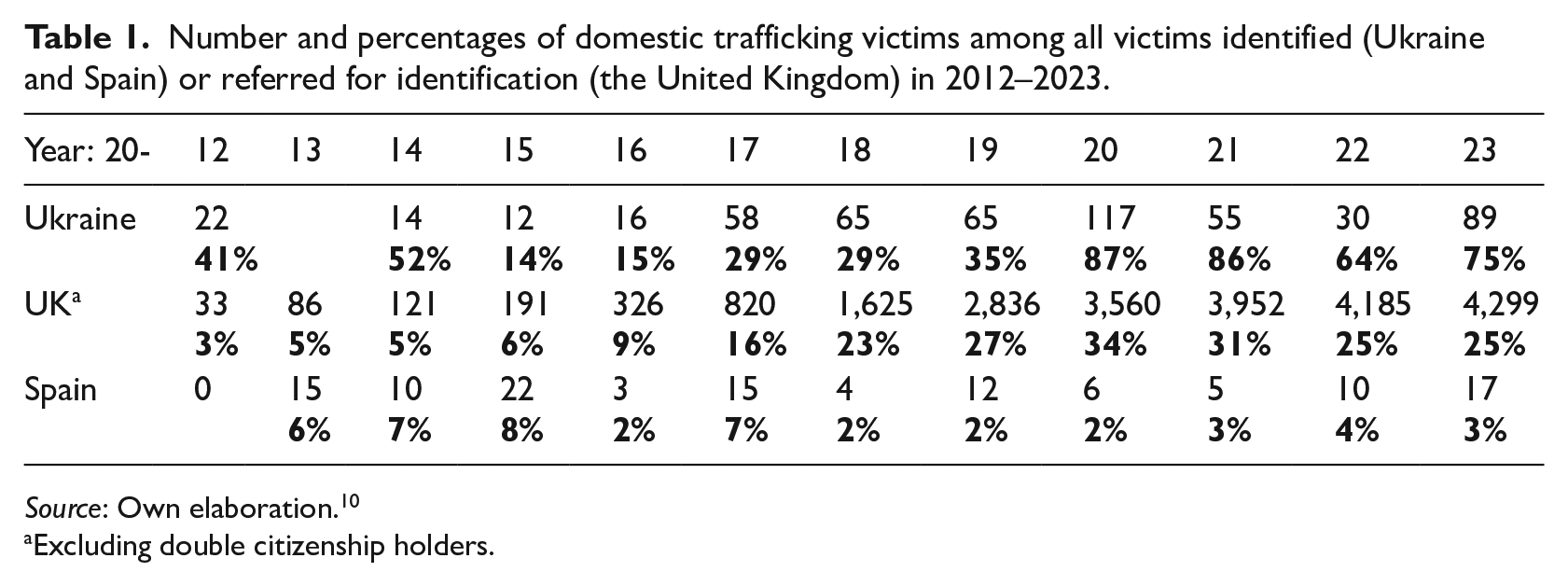
Source: Own elaboration. 10
Excluding double citizenship holders.
Domestic trafficking in Ukraine: normalisation
In Ukraine, all forms of domestic trafficking have been, since 2006, included in art. 149 of the Criminal Code. Since the 1990s, the focus of state and NGO anti-trafficking efforts had been on cross-border trafficking in the context of labour emigration and socioeconomic crisis (Chernenko, 2006; Vasyliev, 2002). By the late 2000s, researchers admitted the lack of data and expertise on trafficking within Ukraine (Akhtyrska, 2006; Sölkner, 2008). The studies of court decisions adopted in the 2000s identified no cases of domestic trafficking ‘despite recurrent notifications on it in mass media’ (Rakovska, 2012: 565; Shvab, 2007).
The anti-trafficking regime was reformed following the ratification of the Warsaw Convention and the adoption of the Law on Countering Human Trafficking in 2011, 11 as well as the launch of a state procedure for referring potential victims, coordinated by the MSP, in 2012. National standards on victim services, applicable to public entities and NGOs, were developed in 2013. According to GRETA, which in 2014 recommended Ukraine prioritise the identification of domestic trafficking victims, specialists concurred that domestic trafficking for labour exploitation, begging and criminality was grossly under-detected. Domestic trafficking for labour exploitation, mostly in agriculture but also sailing, fishing, mining, construction and services, targeting village dwellers and ‘socially unprotected’ citizens, was increasingly acknowledged throughout the 2010s (Babenko et al., 2019; Pavlenko, 2021; Rakovska, 2016). Almost 60% of labour trafficking cases investigated in 2011–2019 were domestic (Andrushko, 2020).
The need to volunteer for victim status (if detected by the police, potential victims must be informed about the possibility of applying for the status at a local state administration) was considered by GRETA (2014: 8) to unduly shift the burden onto victims. Most requests were submitted by victims’ relatives or friends, pointing at access gaps for victims deprived of support networks (Haliona, 2021). Examples of supporting documentary evidence required, as well as data elicited at the mandatory interview at a state administration unit, include proofs of cross-border movement, which reportedly may be demanded by authorities during the application, contrary to the law (Department of State, 2024). That said, since 2020, when persons exploited within Ukraine comprised 87% of all status recipients, most identified victims have been exploited within the country. National courts prosecute domestic trafficking for sexual exploitation, labour exploitation in agriculture, begging, private households and bogus rehabilitation centres, as well as instances of child sale and organ trafficking. Victims’ state of vulnerability – often described in judgements as a ‘confluence of difficult circumstances’ including unemployment, absence of steady income, lacking permanent residence, having care responsibilities, living with a disability or chronic illnesses, single marital status for women, being an orphan or an internally displaced person – has been interpreted as a key confirmation of perpetrators’ intent to exploit. Although Ukrainian anti-trafficking legislation and programmes are inclusive of foreigners and stateless persons, almost all identified victims are Ukrainian nationals. While all victims are entitled to specialised assistance and a range of state services, navigating these might require situational knowledge and local residence registration – hindering access to protection not only for foreigners but also for displaced citizens (Kuznetsova and Mikheieva, 2020; Sereda, 2023).
The start of Russia’s war against Ukraine in 2014 coincided with and intensified the rise in domestic (anti-)trafficking. A frontline at the eastern border caused an absolute decrease in foreign victims, previously detected mostly in transit to the EU, but also exploited within the country (Pozniak, 2016). Meanwhile, internally displaced persons, especially women, fleeing hostilities and the occupation, as well as children discharged or evacuated from care homes or lacking Ukrainian documents, became a new group considered vulnerable to trafficking and exploitation (Special Monitoring Mission to Ukraine, 2016; Rosenthal et al., 2022; UN Committee on the Elimination of Discrimination against Women (CEDAW, 2022). Human rights violations in the Russian-occupied territories have been equated to trafficking in case law, as well as by victim identification authorities and assistance providers and in information campaigns.
Domestic trafficking in the United Kingdom: instrumentalisation
In the United Kingdom, domestic sex trafficking was criminalised in 2003 in the Sexual Offences Act (section 58) and the Criminal Justice (Scotland) Act (section 22). The UK Action Plan on tackling human trafficking was adopted in 2007 by the bicentenary of the Slave Trade Act 1807; the ‘excessive political positivity’ of British anti-trafficking agendas observed since has been symptomatic, according to Gadd and Broad (2018: 1444–1445), of the ‘violent innocence’ of a former colonial empire. Despite its focus on the overseas origin of the crime, the Action Plan referred to ‘domestic prostitution’ and mentioned the need to address ‘potentially also the trafficking of UK national children within the UK’ (Home Office and Scottish Executive, 2007). By the 2010s, child sexual exploitation had become a governmental and public concern (Cockbain et al., 2011; Jay, 2014).
In 2009, the United Kingdom ratified the Warsaw Convention and launched the NRM for potential victims, administered by the Home Office. In the same year, offences of forced labour and slavery were introduced in England and Wales and Northern Ireland in the Coroners and Justice Act (section 71), followed by the Criminal Justice and Licensing (Scotland) Act in 2010 (section 47). This allowed drawing attention to the vulnerability of British adults to labour exploitation upon recruitment by the members of the Traveller community (Centre for Social Justice, 2013; Serious Organised Crime Agency, 2012), which in turn encouraged the criminalisation of domestic labour trafficking in section 10 of the Protection of Freedoms Act 2012 (Hansard HC Deb., 21 May 2012). 12 Concerns about exploitation of British citizens contributed to the regime transformation to the anti-modern slavery framework (Gardner, 2018), augured in the 2014 Modern Slavery Strategy and codified in 2015 in the Modern Slavery Act, Human Trafficking and Exploitation (Scotland) Act, and Human Trafficking and Exploitation (Criminal Justice and Support for Victims) Act (Northern Ireland). The inclusion of ‘non-trafficked’ exploitation has concurred with a policy initiative on curbing immigration and restricting foreigners’ rights (Broad and Turnbull, 2019; Hodkinson et al., 2021).
The number of potential British victims grew, mainly driven by profiling of youth engagement in carrying drugs via ‘county lines’ as human trafficking, until they topped the list of nationalities in the NRM, reaching over 30% of all referrals in 2020. In 2021, the Government alleged that ‘failed asylum seekers’ were ‘clogging up’ the victim assistance system (Home Office and The Rt Hon Priti Patel MP, 2021). Subsequently, the negative impact of the Nationality and Borders Act 2022 and Illegal Migration Act 2023 on the protection of potential victims, especially those without a regular administrative status, was justified by the need to ‘filter out’ the purported misuse (Home Affairs Committee, 2024). In the meantime, sexually exploited UK girls were presented as vulnerable victims abused by ‘men who hold cultural attitudes completely incompatible with British values’ (Owen, 2023).
A refusal to engage with the authorities is the most common reported reason for British nationals not to enter the system (Magugliani et al., 2024). Those citizens who nevertheless choose to be supported might do so precisely because they expect comprehensive assistance. The NRM might then be interpreted as the last resort for adult victims otherwise accessing public funds such as Universal Credit, statutory services like council housing, or eligible for support within the remit of local authority safeguarding duties (Parker, 2021). Citizens have been argued to enjoy faster and more favourable status determination within the NRM (GRETA, 2021). Nonetheless, having formal entitlements to state resources inaccessible to foreigners may act to nationals’ detriment. This can be expressed in formal restrictions – for example, receiving Universal Credit disqualifies modern slavery victims from being paid the essential living rate (Home Office, 2025) – as well as informal barriers. British victims, especially adults exiting sexual exploitation, report discrimination when accessing victim assistance services, which are perceived as attuned to serving immigrant clients (Human Trafficking Foundation, 2021; Murphy et al., 2022; STAGE Partnership, 2023). One British national recounted that they were encouraged to refuse support, including health services and legal advice, as they ‘wouldn’t get anything’ (Centre for Social Justice and Justice & Care, 2022: 22). As assessed by Magugliani et al. (2024: 44), the ‘increasing conflation of modern slavery with organised immigration crime has meant that the needs of British nationals in the NRM system have been increasingly overlooked’.
Domestic trafficking in Spain: invisibility
In Spain, the only type of trafficking recognised throughout the 2000s was cross-border trafficking of foreign citizens for sexual exploitation, criminalised in art. 318 of the Criminal Code. EU nationals were declared ineligible as victims of this crime by a Supreme Court decision of 29 May 2007. 13 The ratification of the Warsaw Convention in 2009 and the need to comply with EU anti-trafficking legislation drove the 2010 reform of the trafficking offence. The new art. 177 bis of the Criminal Code explicitly stated that trafficking could occur within Spain to foreign or national victims and include multiple types of exploitation.
The first domestic trafficking trial, 14 dealing with severe labour exploitation of four highly vulnerable Spanish men in the perpetrators’ household, concluded in 2016 and was assessed as exceptional by the Government and researchers (GRETA, 2017: 38; Rodríguez López, 2020). While this study identified only two other judgements on alleged trafficking of Spanish nationals, both on sexual exploitation charges, 15 potential domestic sex trafficking cases may be redirected to lesser sexual offences (Ministerio Fiscal, 2019).
In public policies and the political debate, the assumed societal relevance of trafficking lies in citizens’ role as consumers of services (above all, sexual), rather than the danger it poses to them as potential victims. The exceptions to this discourse include the 2022 awareness campaign of the Evangelical charity Diaconía on the trafficking and sexual exploitation risks of ‘sugar dating’ for Spanish girls and young women 16 and the campaign focusing on online child sexual exploitation, launched by the Spanish branch of the international faith-based anti-trafficking organisation A21 in cooperation with the National Police. 17 Spanish children’s vulnerability to sexual exploitation, especially in institutional care contexts, has been highlighted by researchers and in state policies (Castaño Reyero, 2022; Castaño Reyero and Pérez Adroher, 2017; Pulido and Rivas, 2019).
National standards of police-led victim identification and protection were introduced in the Referent Protocol for Protection of Victims of Human Trafficking in 2011. Even though the standards of victim protection are non-discriminatory, they draw upon trafficking-related amendments to the law regulating foreigners’ rights, 18 whereas victim identification and crime prosecution are delegated to the immigration-specialised units of the National Police and of the Prosecution Ministry. The current approach has been considered to remain overly focused on foreign victims of trafficking for sexual exploitation and fails to effectively assist all victims of all types of exploitation, including victims of trafficking for labour and criminal exploitation as well as EU citizens (Martínez Escamilla, 2024; Miranda-Ruche and Villacampa Estiarte, 2021; Red Española Contra la Trata de Personas, 2022; Villacampa, 2024; Villacampa et al., 2022; Villacampa Estiarte and Torres Ferrer, 2021).
Scholars have admitted that national victims of trafficking are less visible than foreigners and suggested that the detection of domestic trafficking might be affected by biases in victim identification (Castaño Reyero et al., 2022; López Peregrín, 2023: 8). These signs of the recognition by the Spanish academic community of the lack of prioritisation of domestic trafficking are yet to be followed by palpable policy changes. The highest share of identified citizens – at 8% of the total – was observed in 2015. Meanwhile, the share of citizens among victims of non-trafficked labour and sexual exploitation dropped from 20% in 2016 – the first year this data was collected – to 11% in 2023. The procedure of administrative accreditation for female victims of sex trafficking or sexual exploitation, allowing the beneficiaries to access specialised assistance independently from the police identification, was institutionalised in 2022. 19 No similar provision exists for victims of non-trafficked labour exploitation.
What determines the inclusion of the exploitation of citizens in national anti-trafficking regimes?
The three analysed cases represent distinct approaches to domestic trafficking:
normalisation within a citizen-oriented, emigration-focused anti-trafficking regime (Ukraine);
instrumentalisation within a primarily immigrant-oriented regime (the United Kingdom);
invisibility underpinned by denial within an expressly immigrant-oriented regime (Spain).
Why are citizens acknowledged as trafficking victims in Ukraine and the United Kingdom but not in Spain, and what factors might explain the differences? The rest of this article aims to offer an answer that would also outline broader tendencies in the national anti-trafficking regimes.
Prioritisation of labour trafficking on national anti-trafficking agendas
Countering sex trafficking was the starting point for national anti-trafficking regimes in the case study countries. By the late 2010s, the priority in victim identification shifted to other types of exploitation in Ukraine and the United Kingdom, but not in Spain. The prominence of labour exploitation in victim detection and trafficking prosecution could therefore facilitate the inclusion of citizens.
According to UNODC, domestic trafficking has no or few links to organised crime, generates smaller income for perpetrators and ‘happens everywhere’ (UNODC, 2014: 49; 2021). However, the known cases of domestic trafficking in the analysed countries show serious harm suffered by its victims. Although often confined to private households, exploitation may span from months to decades and verge on servitude in severity. While the vulnerability of victims of cross-border trafficking may stem from the conditions of their exploitation and immigration status (as acknowledged by the ECtHR in Chowdury and Others v Greece), 20 for national victims, pre-existing exclusion determines their susceptibility to being targeted by exploiters. So, in British adult force labour cases, victims’ vulnerability was assessed as a personal feature that limited their decision-making capacities, rather than a contextual factor. In the 2019 case R v Rooney (Martin Senior), which resulted in 11 convictions for conspiracy to require a person to perform forced or compulsory labour and additional offences, the perpetrators ‘had exploited their victims’ natural desire to find useful employment, somewhere to regard as home and some place in society’. 21 Characteristically, the defendants, who negated having abused the complainants or compelled them to work, claimed that conditions in which they employed their workers were ‘no different from what was going on at any Travellers’ site in this country’ (Halliday, 2017). As remarked by Cockbain and Brayley-Morris (2017: 131), prosecuted cases could ‘lie at the upper end of a spectrum’ of exploitation in a ‘purportedly long-established practice of recruiting homeless men (known as “dossers”) and exchanging food and board for their labour’.
In the countries without a separate offence of forced labour (Spain and Ukraine), trafficking may be the only route for prosecuting severe labour exploitation. In Ukraine, labour exploitation became a key anti-trafficking concern throughout the past decade – even if the commitment to labour law compliance in order to minimise and detect forced labour, mentioned in the 2016 and 2023 anti-trafficking programmes, has been matched with the ongoing neoliberal labour market reforms. 22 On the Spanish anti-trafficking agendas, trafficking-related labour exploitation remains secondary to sex trafficking in terms both of prosecution and victim identification and assistance, despite an acknowledgement of the need for a more comprehensive approach and a clearer delimitation of labour exploitation among trafficking victim service providers and criminal justice professionals (Villacampa, 2022, 2023). Although the bulk of domestic trafficking cases in the United Kingdom cannot trigger labour rights enforcement, the crime of forced labour formed a pillar of the modern slavery framework, inclusive of the exploitation of citizens. The tendency towards substitution of labour rights enforcement with criminal law provisions via the trafficking or modern slavery offences is observed across the three countries. However, when it is accompanied by the rising prominence of labour trafficking or forced labour, exploited citizens are likelier to become visible.
In contrast, the persisting centrality of sex trafficking to national policies might delay the inclusion of domestic trafficking into the national anti-trafficking regime. This might seem counterintuitive considering the rebirth of the ‘white slave trade’ rhetoric since the 2000s (Bernstein, 2018). Admittedly, child sex trafficking was the first homegrown exploitative practice to attract public attention in the United Kingdom, the focus of the OSCE-led training on domestic trafficking in Ukraine in 2009–2011, and the only form of exploitation of nationals to have gained attention in Spanish academic discourse and public policies. Nonetheless, prioritisation of child sexual exploitation does not produce an increased awareness of adult exploitation. In fact, in the United Kingdom, child sex trafficking prosecutions highlighted the perpetrators’ allegedly non-British origin, so even as the Modern Slavery Strategy of 2014 evoked protection of British girls, the idea of trafficking as a foreign threat was reinforced (Krsmanović, 2021).
Furthermore, the availability of alternative offences, such as rape or forced prostitution, and the autonomy of domestic regulation of prostitution from anti-trafficking policies reaffirm the binary of voluntary sex work versus trafficking along international borders. In the Ukrainian case law, the element of transnationality within proceedings involving multiple charges and victims may distinguish trafficking from procurement, organisation of or coercion into prostitution. 23 Likewise, in Spanish judicial practice, the alleged victim’s supposed connections in the community where they were exploited can speak against their susceptibility to trafficking. 24
Migration management policies
Back in 2008, the OSCE observed that the choice of a public authority responsible for victim identification affects the prioritisation of a certain category of victims. In this regard, the interaction of the anti-trafficking framework with border and migration policies as well as the demographic situation in the country limits practical possibilities for the detection of and service provision to citizens. On the one hand, countries ‘of origin’ of trafficking victims have higher shares of detected domestic trafficking cases. The same socioeconomic conditions may propel cross-border migration and severe labour rights violations or lack of law enforcement within the state territory. The Ukrainian case demonstrates additionally that a higher extent of recognition of domestic trafficking might also be due to the readiness of the national anti-trafficking regime to work with citizens. Even if initially aimed at dealing with returnees from abroad, existing victim assistance infrastructures serve domestic trafficking victims once the demand arises. As acknowledged by UNODC (2018: 41–42) and evidenced in Ukrainian case law on cases of intended cross-border trafficking, 25 measures of migration control, such as disruption of journeys deemed as likely to ensue in exploitation, can further increase numbers of persons identified as domestic trafficking victims.
On the other hand, the UK case shows that the acknowledgement of domestic trafficking in countries ‘of destination’ is possible when it is congruent with political rationales. Highlighting national victims in the context of the Brexit campaign and its aftermath served to adopt restrictive immigration laws and justify the reduction of assistance available to all potential victims on the premise that undeserving foreigners were abusing limited resources. In Spain, victim assistance policies were similarly designed for foreign citizens with an irregular immigration status. However, trafficking is not seen, in Spanish public policy, as a tool appropriated by irregular migration facilitators. Rather, it is a problem of extreme vulnerability of irregular migrants, whose assumed protection needs are so different from the problems faced by citizens that they do not enter a competition for funds with locals. Accordingly, the only route for identification until 2020 had been through police officers and in the context of regularising a potential victim’s immigration status. While the British and the Ukrainian referral mechanisms differ in the volume of processed cases, funding and capabilities, in both, citizens receive victim status from an authority that is neither a migration control unit nor a police force.
Offence definition and interpretations
The terminology adopted for criminalising trafficking influences the doctrinal interpretation of the offence and its popular understandings, including whether citizens can be victimised. In the case study countries, the meaning of trafficking balances between transfer as transportation and as an economic transaction. However, the possibility of recognising citizens as victims relies more on circumstances and implications of a change in status, rather than physical location, of a trafficked person.
In the Ukrainian legislation, trafficking is defined as ‘trade in persons’ (torhivlia liudmy), sidelining victims’ physical movement and placing an emphasis on perpetrators’ capacity to control them. Exploitation is not definitional to the offence, so actions characterised by deprivation of freedom or exchange of control over a person without the use of their labour can be prosecuted as trafficking. In Spain, the specificity of the term (trata de personas) also indicates commercial exchange; however, it draws explicit reference to the transatlantic slave trade. A change of a victim’s place of residence is indispensable to achieving the commodification of victims via their ‘uprooting’, absent which exploitation cannot amount to trafficking (the expectation that victims be extracted from their community and brought ‘to another place’ remains a dominant interpretation of the offence endorsed by responsible governmental units (Ministerio de Igualdad et al., 2024) despite the Supreme Court of Spain acknowledging that ‘uprooting’ is not an element of the crime). 26 In the UK jurisdictions (except for Scotland), the limitation of the trafficking offence to the transportation of a victim is resolved via the crime of forced labour and the overarching modern slavery label.
In popular discourse in Ukraine, trafficking has been seen as a problem of falling into ‘slave’ labour when looking for a better life (Sharapov, 2019); in the United Kingdom as the disgrace of traffickers committing horrendous crimes on national territory (Sharapov, 2017); and in Spain as the shame of unconsciously or immorally benefitting from the tragedy of foreign victims (Saiz Echezarreta et al., 2017). This means that, in the first case, trafficking harms citizens wherever it happens, thus ultimately the place loses significance; in the second, it remains an alien practice even if citizens are affected; and in the third, trafficking victims must be isolated from the place of their exploitation.
International (anti-trafficking) cooperation and wider contexts
There is no direct causality between the evolution of international and local anti-trafficking regimes. However, the temporality and intensity of state engagement with international and regional anti-trafficking actors positively correlate with the acceptance of burgeoning tendencies of the international anti-trafficking regime. So, detection of non-migrant exploitation and its recognition as trafficking in the case study countries was attuned to the entry into force of the Warsaw Convention in 2008 and the launch of GRETA in 2009. At the same time, the development of national anti-trafficking regimes has been dependent on national policies which reflected and reacted to wider, international and domestic, social, political and economic transformations.
Democratisation of Spain after the Francoist authoritarian regime of 1939–1975 took place under the European Community accession banner (Spain joined in 1986) in the years previous to the advent of the contemporary international anti-trafficking regime. In turn, the post-socialist transformation of Ukraine as a sovereign state since the disintegration of the Soviet Union in 1991 was part of the globalisation processes that put this regime into motion. After the demise of the Soviet production and social protection systems and the economic catastrophe this unleashed, the state has not been capable of ensuring wellbeing and preventing emigration of a considerable proportion of the population (Mikheieva and Jaroszewicz, 2023; Yurchenko, 2017). In the following decades, cooperation with the EU (in particular, within the framework of the Ukraine-EU Association Agreement of 2014) meant for Ukraine reducing irregular migration through its borders (Vasylkivska, 2017). Meanwhile, for Spain, cultivating the EU identity might have inadvertently foreclosed an approximation to exploited third-country nationals and contributed to the ambivalence towards exploited EU citizens, who are not offered a recovery and reflection period irrespective of their residence status in Spain (although it should be, under the Warsaw Convention, accessible to all identified victims). In the United Kingdom, opting out of the early EU anti-trafficking provisions in the 2000s and a progressive divorce from EU policies in the 2010s may have conditioned a singular development of the anti-trafficking discourses (Turner, 2015).
The welfare state decline has manifested in all three countries prior to and progressively since the 2008 global financial crisis. In Ukraine, economic stagnation of the early 2010s could have caused a surge in internal exploitation; meanwhile, the war-related challenges and the acceleration of neoliberal economic reforms post-2014 have facilitated acceptance of vulnerability to exploitation as an individual, even if ubiquitous, misfortune not limited to migration. In the United Kingdom, the immediate effects of the economic crisis and public spending cuts were observable through the emergence of the new category of victimised citizens out of the already present manifestations of decades-long dismantlement of social guarantees (Koch, 2018; Walke, 2001). The very logic of the NRM as a public service is attuned to social policy transformations: the principle of welfare conditionality is inbuilt into eligibility for the NRM-related benefits (Mantouvalou, 2023). To avoid nurturing dependencies, the available support is not meant to ensue in a full reintegration of a victim (Home Office, 2025).
In contrast, in Spain, the post-2010 austerity measures, surge in unemployment and economic decline (Cabrera and García-Pérez, 2023; Salmon, 2017) did not visibly affect anti-trafficking action and were not associated with vulnerability of nationals to illegal exploitation. The reforms that harmonised national legislation with international norms happened in 2009–2015, coinciding with the crisis; however, the progressive development of national policies was a later process centred around gender-based violence and gender equality policies. Spain’s EU integration trajectory had propelled a strong feminist current in national politics, favouring the conceptualisation of trafficking as a manifestation of gender inequality (Álvarez Valcárcel, 2016; Llobet Anglí, 2020; Rubio Grundell, 2022). So, Spanish governments have been receptive to the CEDAW recommendations on countering sexual exploitation. Meanwhile, when GRETA warned the Spanish Government against focusing on sex trafficking at the expense of all other victims, it was accused, by the Ministry of Equality (Ministerio de Igualdad, 2020), of gender-insensitive analysis. The emphasis on forced prostitution of third-country women could thus benefit cooperation with international actors which embrace a compatible approach, rather than with those advancing the recognition of labour and domestic trafficking.
As a space for overseas ‘prevention’ efforts by ‘destination’ countries, Ukraine is where international organisations (especially the International Organization for Migration (IOM), OSCE and the EU), foreign governments (including, but not limited to, that of the United States) and non-state entities (such as La Strada International) have been most active in promoting and directing national policies (Dean, 2017; Hrycak, 2012). In contrast, for the United Kingdom, insisting on the uniqueness of the national anti-slavery framework became a strategy masking its uneven compliance with international human rights commitments. The United Kingdom nevertheless has had a level of engagement with OSCE comparable to Ukraine’s – unlike Spain. The NRM model developed by OSCE was both piloted in Ukraine in 2009–2011 (OSCE, 2011) and used for creating the UK system (Gaitis, 2023). Similarly, while IOM has been visibly present in anti-trafficking activities in Ukraine, providing funding for victim assistance services, patronising awareness campaigns and collecting its own data, and the United Kingdom (through the regular analysis of the NRM data), it does not actively participate in Spanish anti-trafficking action.
The Covid-19 pandemic exacerbated the shortages of social security and labour rights protection while imposing unprecedented mobility restrictions (and coinciding in the United Kingdom with exit from the EU). Both in the United Kingdom and Ukraine, 2020 and 2021 were the years of the highest recorded share of detected domestic trafficking victims. In Spain, the pandemic-imposed lockdown pushed policies expanding assistance measures for victims of sex trafficking to female victims of sexual exploitation and women engaging in prostitution. However, the number of citizens detected as victims of both trafficking and exploitation remained minimal. In 2022, the full-scale Russian invasion of Ukraine had international economic and political reverberations, feeding into the ‘cost of living crisis’ in the United Kingdom and stimulating amendments to the Spanish anti-trafficking legislation. In Ukraine, the invasion affected the capacities of anti-trafficking actors and brought renewed attention to risks of exploitation in migration circumstances. However, the national anti-trafficking regime remained functional and took on new protective functions.
While deprivation and exploitation of certain groups of the population could grow more apparent following consecutive crises, state responses determined if it would be framed as trafficking. The emergence of domestic trafficking in the United Kingdom and in Ukraine, but not in Spain, attests not so much to the absence of a correlation between domestic trafficking, economic performance and social inequality in the Spanish context, as to the reluctance of anti-trafficking actors and society to associate the exploitation of citizens with trafficking.
Conclusion
This article has analysed the patterns of inclusion of domestic trafficking into national anti-trafficking regimes in three European countries. The recognition of citizens as trafficking victims seems more probable when national anti-trafficking actors actively cooperate with international organisations or other external entities promoting it. International influences are more likely to be acted upon if coinciding with internal social, economic and political developments. Other factors include prioritisation of labour rather than sexual exploitation, administrative (rather than police- or immigration-authority-managed) accreditation for trafficking victims, and local interpretations of the offence. The intensiveness of cooperation with and dependence on international and regional anti-trafficking actors, the prominence of non-sexual exploitation on the anti-trafficking agenda, as well as the decoupling of migration, police and victim status accreditation authorities, observable both in the United Kingdom and Ukraine, seem to be stronger predictors of inclusion of domestic trafficking than the levels of economic activity, migration dynamics, or the legal system.
The limited scope of the analysis in the article means that the generalisability of the results should be taken with caution. Interrogating perspectives of anti-trafficking practitioners and of persons who experienced exploitation in their countries would have offered insights transcending the picture that emerged from the documents. Further research into the recognition of national victims of trafficking in different contexts can confirm, disprove or develop the findings presented here. That said, although the anti-trafficking regime in Ukraine has evolved to adapt to unique challenges of national development throughout the past decade, the case study findings could nevertheless be applicable to countries ‘of origin’ with a comparable socioeconomic situation, geographical proximity to destination countries and a contested position in the international system. The role of national victims in the UK anti-trafficking regime could be meaningfully compared to ‘destination’ countries with a notable share of domestic trafficking, whereas the relationship between anti-immigration discourses and policies and the readiness to recognise domestic trafficking could be seen as a manifestation of (rhetorical) welfare nationalism. The Spanish case could depict a South European variety of Western European anti-trafficking regimes – or else, a context of unstable prosperity dependent on mass tourism, regional disparities, relatively recent immigration (both from third countries and from within the EU), and an equally recent semi-peripheral geopolitical standing – as well as be relevant for countries with a strong influence of the neo-abolitionist approaches to sex trafficking.
The article has also shown that the recognition of domestic trafficking in national anti-trafficking regimes has been fraught with contradictions. On the one hand, anti-trafficking measures are governed by the same logic of exception that negates exploited migrant workers’ access to social rights (Dines, 2023) and, more often than not, enables and endorses exploitation (Bravo, 2015). Trafficking victim protection frameworks are oriented at mitigating the irregularity of victims’ legal status in the country of exploitation and/or providing conditions for their repatriation and reinsertion in home societies. Therefore, ‘contingent, albeit greatly limited rights’ that victims of transnational trafficking can claim ‘though crime victimhood’ may have limited appeal for victims who are nationals or legal residents of the country of exploitation in the absence of ‘the labour-based right to be “free of exploitation”’ (Miller and Zivkovic, 2017: 337). Moreover, exploited citizens do not qualify as ideal ‘crime victims’: not only are they often part of the same communities that are blamed for the crime; but they also do require ‘modern welfare benefits’ (Simon, 2007: 76). On the other hand, exploitation of citizens is the least contentious topic to be approached as an issue of the provision of social rights, insofar as these are seen as social rights of citizenship and ‘include a right to satisfying work and human self-development’ (Stephens, 2021: 704). Since trafficking implies the transfer of control over victims and results in their forced exploitation, reasonable steps towards prevention should include guarantees of access to national welfare services, seen as ‘collective goods’ essential to ‘the very possibility of autonomy’ (Raz, 1988: 171, 207). Indeed, in 2022, the Council of Europe called for ‘the progressive realisation of social rights’ as a means that ‘shields potential victims from vulnerability’ and ‘from the risk of falling victim to trafficking’. 27 As for trafficking victim assistance measures, in the conditions of progressing deprivation of the least-protected categories of citizens, and in absence of viable social guarantees of a minimum living standard, they may only provide otherwise inaccessible emergency help. The very fact of domestic trafficking attests to the inefficiency of state social services which are supposed to prevent victimisation.
Ultimately, both inclusion and rejection of domestic trafficking are responses to 8/0/714 rising socioeconomic inequality. The quality in which citizens enter the anti-trafficking regime and the types of exploitation acknowledged depend on what social issues are seen as unacceptable and meriting criminalisation or, in contrast, are routinised alongside their victims. The lens of domestic trafficking captures the types of exploitation that are mainly low-scale and affect the least economically active part of the population. Exploitation experienced by most national victims falls outside the usual area of labour rights enforcement due to the highly informal and, at times, non-capitalist settings in which it transpires. Nevertheless, it is enabled through a wider lack of decent work and labour market inclusion for both victims and perpetrators. Domestic trafficking in industrialised societies thus testifies to the erosion of the social welfare state and should be approached from the perspective of countering social exclusion.
Supplemental Material
sj-docx-1-irv-10.1177_02697580251361936 – Supplemental material for Citizens as victims of human trafficking: Approaches to domestic trafficking in Spain, Ukraine and the United Kingdom
Supplemental material, sj-docx-1-irv-10.1177_02697580251361936 for Citizens as victims of human trafficking: Approaches to domestic trafficking in Spain, Ukraine and the United Kingdom by Yelyzaveta Monastyrova in International Review of Victimology
Supplemental Material
sj-docx-2-irv-10.1177_02697580251361936 – Supplemental material for Citizens as victims of human trafficking: Approaches to domestic trafficking in Spain, Ukraine and the United Kingdom
Supplemental material, sj-docx-2-irv-10.1177_02697580251361936 for Citizens as victims of human trafficking: Approaches to domestic trafficking in Spain, Ukraine and the United Kingdom by Yelyzaveta Monastyrova in International Review of Victimology
Footnotes
Acknowledgements
This study was supported by a PhD studentship granted to the author by the Open University for the period of February 2022–January 2025. No datasets were generated during the current study. The list of analysed judicial cases and the summary of the analysed legal and policy documents are provided as  .
.
Supplemental material
Supplemental material for this article is available online.
Notes
References
Supplementary Material
Please find the following supplemental material available below.
For Open Access articles published under a Creative Commons License, all supplemental material carries the same license as the article it is associated with.
For non-Open Access articles published, all supplemental material carries a non-exclusive license, and permission requests for re-use of supplemental material or any part of supplemental material shall be sent directly to the copyright owner as specified in the copyright notice associated with the article.
