




Abstract
Meaningful participation in criminal justice by victims of violence is an aspiration of advocates working across domestic and international jurisdictions. Researchers have examined a range of participatory activities undertaken by violence victims. However, there has been no review of research that could build shared understanding of the content and contours of ‘participation’, its benefits and disbenefits to victims, nor assess the quality of justice it delivers. This article presents the first systematic quantitative and critical review of the topic. Electronic literature databases were searched to identify empirical research of victim participation whether in domestic or international criminal justice. Searches for peer-reviewed academic English-language journal articles found 58 studies matching the selection criteria and published between 2002 and 2021. Just over half were common law-based studies that were themselves mostly conducted in the United States. Definitions of victim participation were oblique but three-quarters of the studies demonstrated victim participation in some way, mostly participation at trial. The most common form of participatory activity studied was the provision of victims’ views and concerns followed by victim impact statements. The conceptual focus of studies was largely rights-focused while a substantial number assessed offender-related outcomes. We argue for greater specificity of participatory mechanisms and outcome measures in research. Given the multiplicity of situations and procedures ascribed as victim participation, we provide a schematic to assist researchers in organising evidence for future theoretical scrutiny.
Keywords
Victim participation is essential to a functioning system of criminal justice. Whether for domestic or international criminal justice, victims participate by reporting the victimisation to authorities, providing statements, giving information, supplying evidence, appearing for questions, giving witness testimony, responding to cross-examination, making submissions for various purposes, and being present. The content of victims’ contributions may detail, among others, information about the victimisation itself and/or views on what authorities should do in response. Participatory activities may be concentrated in time or spread over years. They are dispersed over a range of criminal justice authorities – police, prosecutors, courts, and correctional authorities. Criminal justice is a complex system comprising a number of organisations, multiple decision makers, and consuming considerable time for lay participants and professionals alike. Yet the same rubric – victim participation – is given to involvement within the procedures of all these authorities. Despite the importance of victim participation, there has been no review of the empirical literature. Our study fills that gap with a review combining two approaches, a systematic quantification of the literature and critical appraisal. We first outline some key topics on victims and criminal justice to situate our approach. Then we describe the findings of this review and discuss their significance. In conclusion, we offer a schematic designed to organise research evidence which may help make future victim participation studies more precise.
Before considering victim participation in criminal justice, it is important to first acknowledge that, when victimised, proportionately few people engage with the system at all. Research into help-seeking after violence shows that while many disclose their experience to and seek help from various informal sources (for a review, see McCart et al., 2010), few do so to formal sources such as law enforcement (Van Dijk et al., 2008). Reporting to police is particularly low where physical or sexual violence is involved. One Australian survey found that only 21% of women who had experienced violence from a current partner reported to police (for a review, see Voce and Boxall, 2018), a finding similar to earlier US research (Felson and Paré, 2005). An analysis of the International Crime Victim Survey (ICVS) found that 14% of sexual assault victims reported to police (Chon, 2014). Thus, while the negative consequences of victimisation by violence are well recognised (Krug et al., 2002), it is not self-evident that victim assessment of the seriousness and wrongfulness of the victimisation is sufficient for them to turn to criminal justice authorities. Legal mobilisation is everywhere hedged by social norms, situational variables, and the legal definitions that victims must navigate (Holder, 2017).
Participation at any stage of the criminal justice process requires effort and resources from the victim including time off work, transport, and carer support (Cerulli et al., 2014). Victims can experience fear, confusion, and uncertainty when confronting an unknown and highly technical system (Bennett et al., 1999). Depending on the type of victimisation, victims may also experience intimidation, harassment, and abuse from offenders, their families or friends, and associates who deter them from participating fully or at all (for a review, see Elliott, 1998). Whether the victimisation arises from organised crime (Fyfe and Sheptycki, 2005), ‘everyday’ crime such as hate victimisation (Lantz et al., 2019) or property offences (Greenberg and Beach, 2004), or arises from the devastation of mass atrocity (Wemmers, 2010), participation in the criminal justice process requires enormous effort from victims.
When they do participate, studies consistently identify ‘common points of failure’ in authorities meeting victims’ ‘needs’ (Parsons and Bergin, 2010: 182) including a reliance on particular victim stereotypes (Muldoon et al., 2013) and routine failures that leave victims uninformed (Irazola et al., 2015). Consequently, research shows that when victims do participate they almost invariably feel let down. For example, in international criminal justice, studies involving victims of mass conflict highlight their disappointment regarding outcomes including of the sentence (Stover et al., 2011) and courts’ ability to uncover truth (De Brouwer and Ruvebana, 2013). In the domestic sphere, a review of research on victim satisfaction with criminal justice found high correlations of victim satisfaction in two areas: their treatment by and fairness of authorities, and with retributive outcomes (Laxminarayan et al., 2013: 141). Victims participating in both spheres of justice appear to value both process and outcome in criminal procedure.
A synthesis of research findings about victim involvement with criminal justice identified five consistent elements to ameliorating victims’ disappointments. Participation was one element in addition to voice, validation, vindication, and offender accountability (Daly, 2017). Recognising that ‘participation’ can apply differently depending on the justice mechanism, Daly categorised it broadly as shaping elements of the relevant justice mechanism, whether in negotiation, ratification, or implementation. More concretely, she identified that studies of victim participation used the term in three main ways: ‘being informed of the options and developments in a case, including the different types of justice mechanisms available’, having ‘the ability to address offending and victimisation in engagements with admitted offenders and others’, and having ‘the ability to ask questions and receive information about crimes (e.g. the location of bodies or the motivations for an admitted offender’s actions)’ (Daly, 2017: 115).
Depictions and debates about victim participation
These benign depictions belie the ‘heated debate’ on victim participation in criminal justice (Erez, 1994: 17). Early scholarship suggested that, within criminal proceedings, victim participation ‘could be treated as a continuous variable’ but also occur as specific ‘types’: indirect, vicarious, and personal (Sebba, 1996: 193). ‘Indirect participation’ occurs when criminal justice professionals extract information from the victim to take into account in decision-making. ‘Vicarious participation’ relies on a legal or non-legal representative of the victim that can promote their ‘needs and desires’ in an independent role. ‘Personal participation’ can provide the victim with an active and direct role in the proceedings (Sebba, 1996: Chapter 8).
When presented in the ‘language of rights’, victim participation remains both ‘novel’ (Tibori-Szabó and Hirst, 2017: 2) and ‘highly controversial’ (Pascoe and Manikis, 2020: 3, 5). The ‘righteous figure’ of the victim, it is argued, has served a punitive turn in criminal justice (Garland, 2000: 351) and their participation undermines ‘principles of rationality, consistency and objectivity’ (Edwards, 2004: 980). Nonetheless, the 1985 United Nations (UN) Declaration of Basic Principles of Justice for Victims of Crime and Abuse of Power obliged Member States to ‘[allow] the views and concerns of victims to be presented and considered at appropriate stages of the proceedings where their personal interests are affected, without prejudice to the accused and consistent with the relevant national criminal justice system’ (UN, 1985 (40/34, para. 6(b)). International criminal justice scholars consistently refer to this mandate as recognising a participatory role for victims in international criminal tribunals that is distinct to that of being a prosecution witness or a party, that is, as ‘participant’ to proceedings (Tibori-Szabó and Hirst, 2017: 4). Indeed, the 2002 Rome Statue establishing the International Criminal Court (ICC) stipulates that
Where the personal interests of the victims are affected, the Court shall permit their views and concerns to be presented and considered at stages of the proceedings determined to be appropriate by the Court and in a manner which is not prejudicial to or inconsistent with the rights of the accused and a fair and impartial trial. Such views and concerns may be presented by the legal representatives of the victims where the Court considers it appropriate, in accordance with the Rules of Procedure and Evidence (RPE). (ICC, 2011, Art. 68(3), emphasis added)
Whereas the 1985 text suggests more ambiguity with the language of ‘allowing’ where ‘appropriate’, the Rome Statute reflects stronger sentiment for victim participation. Nonetheless, both texts share the perspective that the victim (or collective of victims) has ‘views and concerns’ that are relevant to the proceedings.
In domestic jurisdictions such as the United States, Beloof (1999) elevates participation to equate it with legislated victims’ rights. He emphasises the accompanying obligations on criminal justice entities to facilitate these. Beloof (1999) argues that victim participation embodies constitutional values of fairness, respect, and dignity to and for the victim (p. 293). Comparing victim participation in domestic adversarial and non-adversarial criminal procedure, Braun (2019) observes that participatory practices are present in both system types, albeit fragmented. Variation in victim participation roles in civil legal systems of European countries has also been noted (Elbers et al., 2022).
Victim participation itself is clearly important but there is less agreement on what it is, and little on what it looks like for victims in criminal justice. In sociological and political literature, participation is ‘taking part’ (Beetham, 2005: 131) and enlarging individual and collective ‘scope for action’ (Barber, 1984: 8). It rests on ‘rules of inclusion’ in decision-making (Fung, 2013: 239). In socio-legal scholarship, participation is a communicative opportunity (Holder, 2018: 180) for providing and receiving information (Kirby, 2020: 70). On these accounts, participation is something that people do in the public sphere and that is meant to contribute and/or influence but is also constrained or enlarged by who participates, in what, and on whose agenda (Cornwall, 2008). In sum, participation is a capacious concept that encompasses activities, functions, and normative rationale.
Approach to the literature review
The present review attempts to make sense of the term and its use in two parts. First, we identify the forms of victim participation examined in previous empirical research. In this part, the specific questions are as follows: What research has been undertaken on victim participation in criminal justice, domestic, and international? What methods have been used to investigate victim participation? What are the study samples? For the second part, we analyse the definitions and conceptual frameworks through which research has been conducted. We ask what has research revealed about victim participation? How is participation conceptualised in the research?
As a methodology and analytic strategy, a systematic quantitative literature review (SQLR) is well suited to the first part. 1 Although the systematic logic of the SQLR emphasises replicability as recommended in the Preferred Reporting Items for Systematic Reviews and Meta-Analyses (PRISMA) (Moher et al., 2009), 2 its value lies in its ability to quantify ‘where there is research, [and] also where there are gaps’. Thus, ‘it is possible to highlight the boundaries around generalisations derived from the literature’ (Pickering and Byrne, 2014: 538). An SQLR is useful where methods used to examine the topic are diverse and results are not easily amenable to meta-analysis. The quantification can make transparent (for example) the geographic concentration of research, the dominance, or otherwise of methods choices and which theoretical approaches are most used. Thus, the SQLR can both minimise partiality in selection of literature and can ‘readily highlight the diversity and spread of existing research’ (Pickering and Byrne, 2014: 545). However, an SQLR provides primarily descriptive findings and, as such, the approach is less suited to the more critical and synthesising review of concepts and theory often found in the literature. The second part of the review therefore ‘takes [evaluative] stock’ of definitions and concepts identified through the SQLR (Grant and Booth, 2009: 93). The results of this combined review approach provide a platform from which we then consider some policy, operational, and research implications to victim participation in criminal justice.
Method
An SQLR comprises a number of steps summarised as (1) topic and key word definition, (2) search and screening of selections, (3) develop coding and data dictionary and database of categories and sub-categories, (4) pilot the coding and database and review, (5) all literature analysed and entered (coded) in the database, and (6) quantitative analysis and writing (Pickering and Byrne, 2014).
Eligibility criteria
Articles were assessed for inclusion if they were published from July 2002 to December 2021. We selected 2002 as it was the commencement date of the Rome Statute of the ICC and the obligations imposed on the Court. From this date, much doctrinal and some empirical international criminal justice scholarship has flowed.
Articles were eligible for review if they described original empirical findings in a single study of victim participation in one or more stage of criminal procedure, that is, pre-trial, trial, or post-trial. The criminal procedure could be within a domestic or international jurisdiction. Investigative and police interactions with crime victims, and victim participation in restorative justice were excluded. Studies in both areas are extensive. Instead, we followed the observation of an earlier review (Laxminarayan et al., 2013: 125) to focus concisely on victim participation in the routine activities of formal criminal justice through which the vast majority of criminal cases are processed. Sometimes called ‘conventional’ or ‘standard’ (Daly, 2017: 112), these routine activities include pre-trial assembling of charge documentation, criminal prosecution, trial deliberations, sentencing, and post-trial management of the offender.
In addition, inclusion required the study to examine a specific participatory activity defined broadly as a victim contribution to an aspect of criminal procedure. That contribution could be in-person or via some technology or resource. Equally, the participatory activity could be the direct or indirect focus of study. This included studies on participation whether or not the victim was the primary focus of attention. For example, included were studies that assessed the impact of victim submissions on parole decision-making on release or revocation (e.g. Caplan, 2010). However, studies without a specific participatory activity as focus were excluded. For example, excluded was an article describing the meanings that victims attributed to ‘justice’ but without anchoring in an activity in a specific adjudication process (McGlynn and Westmarland, 2019).
Empirical studies included those where the primary data were generated through quantitative, qualitative, or mixed-methods. Data could be from official or administrative sources or arise directly from human subjects. In social sciences such as criminology or psychology, empirical studies specify their methodology and data as a matter of course. In others such as law, articles tend to be more argumentative with a less obvious methodology. We included codes for common approaches in legal and socio-legal analysis such as case law, judicial remarks, and legislation. These can comprise both data and method, and may form the basis of comparative or single jurisdiction case study. However, as the review progressed, it became evident that separating these specific empirical sources as data from their use as contextual information was not a simple matter, a problem specific to case studies. Notionally, a case study is ‘an intensive study of a single case . . . to shed light on a larger class of cases (a population)’ and a case is a ‘spatially delimited phenomenon (a unit)’ that is ‘observed at a single point in time or over [a] period of time’ (Gerring, 2007: 19–20). Therefore, a location (e.g. city, region, country) or institution (e.g. a local court or specific international tribunal) might serve primarily as a kind of backdrop with little or no discussion about case selection. To illustrate the issue, for the articles in this review, a study of a population of homicide victims in a particular country could be a case (e.g. Kaufman, 2017) and the same could be said of a study of legislation mandating victim participation in parole decisions (e.g. Caplan, 2010) and also a study of victim participation in a particular court (e.g. Killean, 2016). Therefore, for this review, the coding of case studies as a particular method was deemed unhelpful and is not included here.
Search strategy and selection
This SQLR only searched peer-reviewed, English-language, academic journal articles. We excluded so-called ‘grey literature’ that is ‘produced on all levels of government, academics, business and industry’ where ‘publishing is not the primary activity of the producing body’ (Farace and Schöpfel, 2010: 1). Two search phases were conducted. The first was conducted in October 2018. For this first sweep, searches were conducted through electronic databases HeinOnline, Scopus, ProQuest (including ProQuest Criminal Justice Abstracts), JSTOR, Sociological Abstracts, PsycINFO, Web of Science, EBSCO, and Informit. The second phase searched for journal articles from October 2018 to December 2021. Building on experience from the first phase, this second search used Scopus, Web of Science, and ProQuest databases and supplemented with a Google Scholar search.
The database searches used the following keyword combination: ‘crime victim’ AND participant* AND right* AND ‘criminal justice’ NOT ‘police’ NOT ‘restorative justice’. The articles identified in these searches were first assessed by title and abstract. Those which did not directly relate to the inclusion criteria were excluded. Where there was doubt, the article was downloaded and a word search of ‘participation’ was conducted. If ‘participation’ was not proximate to ‘victim’ then, after careful examination, the article was excluded. All duplicates were excluded. Included were additional records identified from other sources and from examination of the reference list of selected articles. As this review is the first on victim participation, the selection erred on the side of inclusion. In both search phases, records were screened by downloading these in PDF format and reading for eligibility. Figure 1 shows the two phase process of identification, screening, assessment and decision, and final number of articles selected (n = 58).
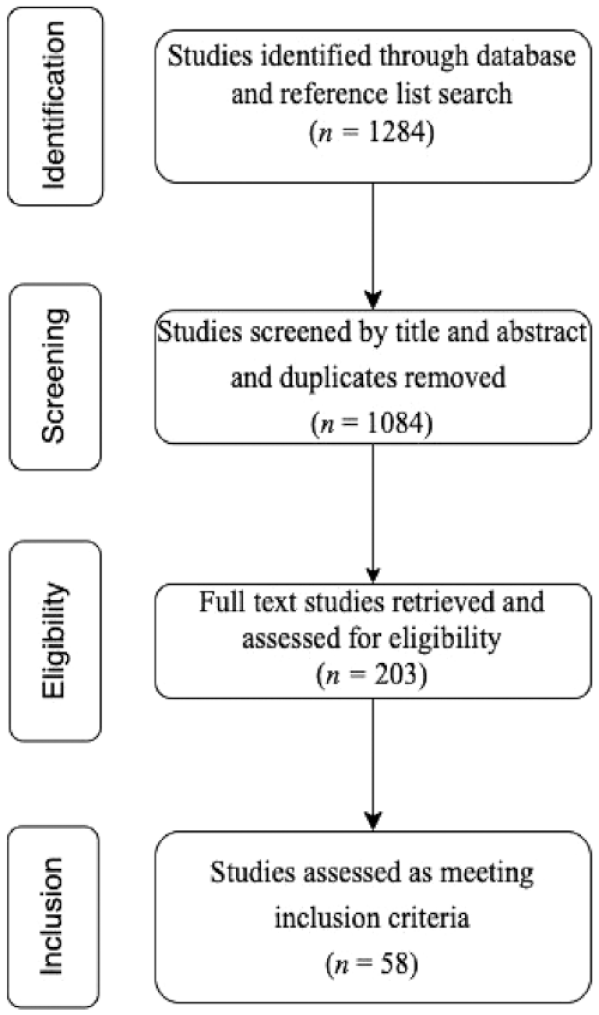
Flowchart of literature search process.
Coding selected articles
As mentioned earlier, the SQLR quantifies the literature to be reviewed. For this purpose an excel database of all articles is developed which lists the variables to be coded. The development of the database and associated data dictionary emerges in an iterative process from reading, coding, revision, re-reading, and so on until all relevant variables are identified.
In this SQLR, we drafted a data dictionary of variables and codes and adapted Excel templates developed by the method originators for the database. 3 The literature database categorised extracted information in seven key topics: subject publication, jurisdiction type and location, methodology and methods, study sample, quality assessment, participation mode, and study focus. Variables comprised the detail of these key topics including the article title, author(s), journal name, volume, commencing page number, year of publication, doi or url link, and a brief abstract (where retrievable). To pilot the data dictionary and coding sheet, both authors each selected three articles from the first search phase and separately conducted coding. Together we next reviewed our pilot decision-making and identified terms that required sharper definition and deleted redundant codes and added others. Following this, the data dictionary and coding sheet were revised. All selected articles generated from the first search phase were then coded and a preliminary analysis conducted. Following a further review, slight changes were made to the data dictionary for the second search phase. For example, the variable asking if the study used ‘mixed data sources’ (Yes/No) was changed to ‘two or more data sources’ (Yes/No). The final study database (combining studies from the first and second search phases, (n = 58) comprised the same seven topics and a total of 75 variables.
SQLR results
In presenting the results of the SQLR, it is important to note that, on specific variables, studies will receive a single code (e.g. for date of publication or country of focus) and may be coded in more than one way on others (e.g. data sources, type of participation studied). Due to space constraints, we have tabulated what we believe to be the most important results alongside the author/s (Appendix 1). All articles included in the review are listed with an asterisk in the reference list. In addition, the following narrative discussion provides some in-text citations.
The quantification approach to this part of the review produced considerable detail. It reveals bulges or concentrations in the literature as well as gaps. In summary, key results show a concentration of empirical victim participation studies in domestic criminal justice, specifically common law legal systems and with a predominant US focus. Studies mostly focused on victims of violence as the primary subjects. The majority of studies examined victim participation activities at the trial stage of criminal procedure but there were gaps in precise description of the participatory mode or activity in many studies. The implication of these results is discussed later but demonstrates the importance of greater specification of the participatory activity plus a need to expand participation research beyond common law systems.
Publication dates
From 2002, the number of empirical journal articles on victim participation averaged 1.6 per year and peaked at five studies published in 2014. We used Ulrich’s Periodicals Directory to classify the journal’s primary subject focus. 4 Most studies (40%, n = 23) were published in journals classified as law with psychology the next most common subject focus (17%, n = 10). Next was a criminology subject focus (14%, n = 8), followed by women’s studies (10%, n = 6) and social services and welfare (7%, n = 4).
Geographic location of studies
For the geographic region of the studies we used the UN M49 standard classification (UN, 1999). The geographic focus of the studies was mostly on the North American continent (45%, n = 26) with all focused on the United States alone. The next most common continent of focus was Europe with 13 studies (22%), 5 of which focused on the Netherlands, 3 on the United Kingdom, and 2 on Norway. Eight of the studies were based on events in Asia – five of which involved the Extraordinary Chambers in the Courts of Cambodia (ECCC) with one each considering Vietnam and Japan, and one located in Israel. Four focused on Oceania (three in Australia and one in New Zealand), three in Africa and two in South America. There were two comparative studies: one each of domestic jurisdictions and between international tribunals.
Nature of jurisdiction
The classification of both the jurisdiction and the type of criminal legal system in which the research was conducted was derived in the first instance from the study focus and locale. The majority of studies (88%, n = 51) focused on victim participation in domestic criminal justice, defined as the nation-state jurisdiction. The studies that focused on victim participation in criminal justice after post-mass conflict were initially all coded as being within the international criminal jurisdiction, defined as a globalised judicial response to grave human rights abuses. Thus, preliminary analysis included studies on the ICC, the ECCC, and the gacaca courts in Rwanda. However, the gacaca in Rwanda and the Victims’ Law enacted for transitional justice in Colombia are within the legal traditions of those countries. Therefore, the second phase of the review re-classified two Rwanda studies (Caparos et al., 2020; De Brouwer and Ruvebana, 2013) and one Colombian (De Waardt and Weber, 2019) as domestic jurisdiction. Although the ECCC is established within the domestic jurisdiction courts of Cambodia, it receives assistance through the UN and comprises an equal mix of national and international staff. Thus, studies on the ECCC remained coded as international jurisdiction (Hoven, 2014; Killean, 2016; Mohan, 2009; Nguyen and Sperfeldt, 2014; Stover et al., 2011) along with studies on the ICC (Killean and Moffett, 2017; Wemmers, 2010). In the final analysis, a total of seven studies were coded as falling within the international criminal jurisdiction.
We did not wish to ‘lose’ victim participation in post-conflict criminal justice and added a new code that asked, ‘Does the study examine justice activity that is post-mass conflict?’ Eleven studies fit this criterion (Caparos et al., 2020; De Brouwer and Ruvebana, 2013; De Hoven, 2014; De Waardt and Weber, 2019; Killean, 2016; Killean and Moffett, 2017; Michel and Sikkink, 2013; Mohan, 2009; Nguyen and Sperfeldt, 2014; Stover et al., 2011; Wemmers, 2010).
Legal system type
In determining the nature of the domestic legal system in which victim participation was studied, we used the terms common law, civil law, or hybrid (or mixed) for coding. For classification, we used the JuriGlobe database. 5 Most studies focused on victim participation in common law ‘monosystems’ that are ‘technically based on English common law concepts and legal organisational methods which assign a pre-eminent position to case law, as opposed to legislation, as the ordinary means of expression of general law’ (JuriGlobe, n.d.). There were 32 common law (monosystem) studies (55%) and the majority (n = 26) of these were US-focused.
Thirteen articles (22%) considered civil law monosystems, classified as having ‘drawn their inspiration largely from the Roman law heritage and which, by giving precedence to written law, have resolutely opted for a systematic codification of their general law’ (JuriGlobe, n.d.). Five articles focused on the Netherlands, two on Norway, and one each focused on Iceland, Sweden, Colombia, Japan, Spain, and Vietnam. Countries in the private prosecution comparison study (Argentina, Chile, and Uruguay) are all classified as civil law monosystems. Finally, 13 articles (22%) focused on hybrid legal systems, each a varying mix of civil, common, customary, and religious law. The countries of focus were Rwanda (two articles), Israel, Japan, Scotland, and South Africa. The remaining seven studies dealing with hybrid legal systems were in the international jurisdiction.
Study methods
All of the 58 articles reviewed described a study methodology. Half described using qualitative methods (n = 29), with 21 articles using quantitative methods (36%) and 8 articles (14%) explicitly describing using mixed-methods. We coded for 15 types of methods, most of which are common in social science research including observation, surveys, interviews, focus groups, pre- and post-testing, case/administrative data, and experiment. As mentioned earlier, the methodology and methods used in legal and some socio-legal research scholarship can be less explicit. However, text-based scholarship is standard (Van Boom et al., 2018) and we coded for document analysis. But, in order to capture the types of document in legal research, we included codes for case law analysis, procedural decisions (excluding judicial remarks), sentencing remarks, interpretive materials, legislative analysis, and treaties analysis.
Despite only eight studies specifying they used mixed-methods, 32 studies were coded as using more than one. Of the 15 types of method of data collection, the most common were interviews (52%, n = 30), document analysis (34%, n = 20), surveys (29%, n = 17), observation (24%, n = 14), and case or administrative data (24%, n = 14). All other method types were used in six or less studies.
Study populations: type of victim and type of victimisation
Three-quarters (74%, n = 43) of articles considered victims of violence, interpersonal violence, or mass atrocity. Of these, 20 studies dealt with primary victims (the person directly afflicted by the victimisation), 5 studies involved related victims (being the family and friends of the primary victim), and 4 studies focused on both primary and secondary victims. The next most common samples were criminal justice professionals (19%, n = 11). Studies also combined these populations: nine studies (16%) involved direct victims and criminal justice professionals, and three involved related victims and criminal justice professionals. Five studies focused on different populations: three on lay people (Nadler and Rose, 2003; Paternoster and Deise, 2011; Saeki, 2010), one on criminal justice professionals and parolees (Friedman and Robinson, 2014), and two on victims and others victimised by human rights abuses (De Waardt and Weber, 2019; Michel and Sikkink, 2013).
Of the 25 studies that identified the identity characteristics of their sample, most (n = 21) specified race, ethnicity, or nationality. Gender was identified in 15 studies while 9 identified the age of respondents and 1 identified that respondents had an intellectual disability.
While most of the articles discussed or examined the experience of victims of violence, this violence occurred in various forms. Most commonly discussed was homicide or mass atrocity (each comprising 19%, n = 11). The next most common types of victimisation in studies were sexual assault, violence only, and domestic violence (each comprising 12%, n = 7). Thirteen studies (22%) discussed ‘crime victims’ and did not specify a particular type of victimisation and two studies (3%) did not specify the nature of the victimisation at all.
Victim participation: when and how in criminal justice
Participation was defined in some manner in 31 studies (53%) (discussed later in this article), and most (76%, n = 44) demonstrated the mode or type of victim participation in some way in reporting the research. The majority of studies examined victim participation activities at the trial stage of criminal procedure (41%, n = 24) although this is likely to be a feature of the selection criteria for this review. Fourteen studies (24%) described victim participation in criminal procedure generally and 13 studies (22%) focused on participation at both pre-trial and trial. Six studies (10%) focused on victim participation post-trial.
All articles discussed the topic of victim participation whether as the primary or secondary focus. However, not all studies clearly specified the participatory mode or activity in the research. Four studies provided no information regarding the participatory mode or activity. For those with information, most selected articles described two or more participatory modes (74%, n = 40) with 14 articles (26%) describing just one participatory mode. For this review we listed eight variables. Some participatory modes could relate to any aspect of the criminal procedure, such as ‘provide views and concerns’ and ‘attend proceedings’. Others, such as ‘victim impact statement’ (VIS), were coded to a specific phase in criminal procedure, here the criminal trial.
Providing views and concerns (victim-initiated) was the most common participatory mode described in the selected articles (n = 32). Next were studies on VISs (n = 28) followed by studies where victims participated by attending proceedings (n = 25). Participation was also operationalised in 20 studies as system-initiated consultation (e.g. where a victim was asked their views by the prosecutor), or where victims were an observer of proceedings (n = 14). ‘Other’ participatory modes (n = 15) included participation as a legal party with or without legal representation (Antonsdóttir, 2018; Killean and Moffett, 2017; Michel and Sikkink, 2013; Mohan, 2009), contacts with prosecutors and general experience (Carr et al., 2003; Cattaneo et al., 2009; Cerulli et al., 2014; Erez et al., 2014), parole submissions (Caplan, 2010; Young, 2016), intrinsic criminal justice actions (De Brouwer and Ruvebana, 2013; Dichter et al., 2011), cognitive assessment (López et al., 2016), adding documents to the court file (Elbers et al., 2022), and participating in groups designed to distribute land restitution and reparation (De Waardt and Weber, 2019).
In most studies (74%, n = 43), the participatory actor was the victim (primary or related). In six studies the participatory actor was a third party, another seven studies described the participatory actor(s) as both the victim and a third party, and in two there was no information about who was the participant. In those studies where the victim was the direct participant, most (n = 32) also described who or what assisted the victim to do so.
Critical appraisal of conceptual focus
For the second part of our review, we take stock of the conceptual frameworks that researchers used in the review articles to assess the purpose or impact of victim participation in criminal procedure. For conceptual frameworks, we first consider the outcome focus of the research described in the reviewed articles and second their theoretical framing.
Researchers examining the involvement of victims with criminal justice have applied a range of outcome measures. By outcome we mean the intended consequence or impact of the participatory activity as envisaged by the research. Commonly used in research and policy is victim satisfaction, a dependent variable that, equally commonly, reveals extensive dissatisfaction (Sebba, 1996; Shapland et al., 1985; Wemmers, 1996). When considering factors related to victim (dis)satisfaction, researchers have examined justice outcomes (generally, police decisions to charge, decisions to prosecute, court decisions to convict and apply what sentence) and their treatment by justice officials (generally, discourtesy and disrespect, not given information, not included nor consulted). A review of research on victim satisfaction with domestic criminal justice remarked on the influence of both approaches (Laxminarayan et al., 2013). That review synthesised variables from 50 studies: four outcome variables and five procedural ones. Most of the studies in that review examined victim–police interactions, followed by issues with the system/legal processes generally. Only a few dealt with victim assessments of prosecution or the courts. The review found high correlations of victim satisfaction in two areas: their treatment by and perceived fairness of authorities, and with retributive outcomes (Laxminarayan et al., 2013: 141). Scholars have also drawn on therapeutic jurisprudence to both explain victim dissatisfaction and to examine how a better understanding of victims’ trauma could improve experiences (Erez et al., 2011). However, findings are mixed as to whether their involvement with criminal justice assists victims’ emotional recovery from victimisation (for a review, see Kunst et al., 2015). Finally, a recent systematic review of the literature sought to identify whether ‘VIS [victim impact statement] delivery may bias legal decision makers towards decisions which are disadvantageous for defendants’ (Kunst et al., 2021: 1). This also found that it was too early to draw conclusions from the literature.
Drawing on these approaches, we coded the outcome focus (i.e. the outcomes that the researchers hypothesised or envisaged would be generated by victim participation), and whether the outcome found in the research was viewed by the authors as positive, negative, or mixed.
Outcome focus
While we understood there would be overlaps between our outcome variables, we coded studies in seven ways (Table 1). The majority (n = 13) focused on rights’ enforcement as the outcome of victim participation. Nine studies focused on procedural justice-related variables as outcomes. Seven studies measured victim satisfaction as the key focus of their participation, and four studies focused on the emotional or psychological benefits/recovery aspects of participation. In the 11 articles that considered offender-related outcomes, researchers examined the influence or effect of victim participation on the sentencing processes and decisions or on parole decisions and one assessed victim-related factors on restitution decisions. Two others assessed the impact of victim video statements on an aspect of case processing. In 10 articles, researchers were focused on ‘other’ outcomes of interest (see Table 1 summary).
Outcome focus of victim participation in reviewed studies.
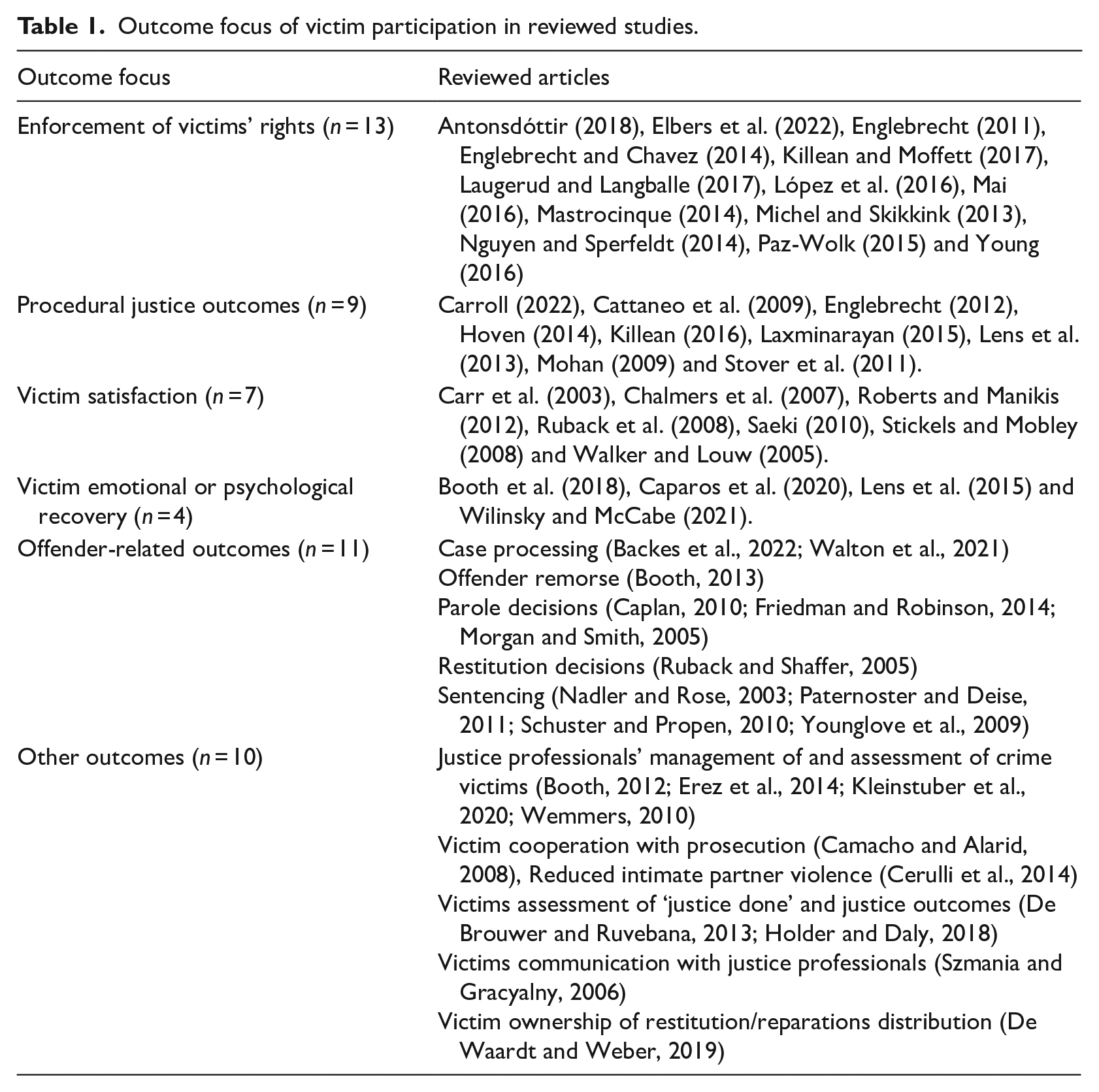
For four studies we could find no information from which we could determine what type of outcome researchers hypothesised might come from victim participation (Dichter et al., 2011; Kaufman, 2017; Laugerud, 2020; Miller, 2014).
Study assessment of victim participation
It was not always clear how authors assessed their study findings regarding the impact of the participatory mode or activity. A number of articles simply added an adjective such as ‘meaningful’ or ‘effective’ besides the word participation. We coded the authors’ evaluation in four ways: positive, negative, neutral, and as providing no information. By ‘positive’ we mean the mode of participation had some effect, even if the study authors were disquieted by that effect. For example, an article about the influence of victim participation in parole decision-making did find an effect and was coded ‘positive’ even though the authors perceived that effect (on parole determinations) unsettled an established offender focus (Morgan and Smith, 2005); another found little effect of victim participation in parole decision-making and was coded as a ‘neutral’ finding (Caplan, 2010). Similarly, a study of the participation of the Vietnamese minority in the ECCC found that it was undermined by an absence of legal representation and was coded as producing a ‘negative’ effect even though the authors commented positively about representation as a participatory mode (Nguyen and Sperfeldt, 2014). Ultimately, of 58 studies, we assessed that 36 (63%) concluded the victim participation had a positive effect on the outcome focus. Six studies (11%) were coded as finding that the victim participation did not have an effect, that is, was ‘negative’. Fifteen studies (26%) were coded as showing the effect of victim participation was neutral. We could not identify or interpret author assessment of the victim participation in one study (Wemmers, 2010).
Definitions and theoretical framing
Just over half of the studies defined victim participation in some manner. However, mostly the term was presented as self-explanatory. Instead, we identified six organising concepts to the presentation of the term (Table 2). An organising concept observes linguistic associations to the primary term that signal ways of knowing it. Some of the reviewed articles used synonyms to victim participation such as ‘input’ thus signalling social action. Others associated it with victim status such as being a ‘party’ or associated participation with rights. This concept signalled observations about the structure of the system in which victims participated and their role within it. Others defined the activity as routine in criminal justice or as victim-specific (referring to some obligation or duty imposed on or required of victims). Others used visceral terms such as to speak which signalled a behaviour.
Participation organising concepts and terms.
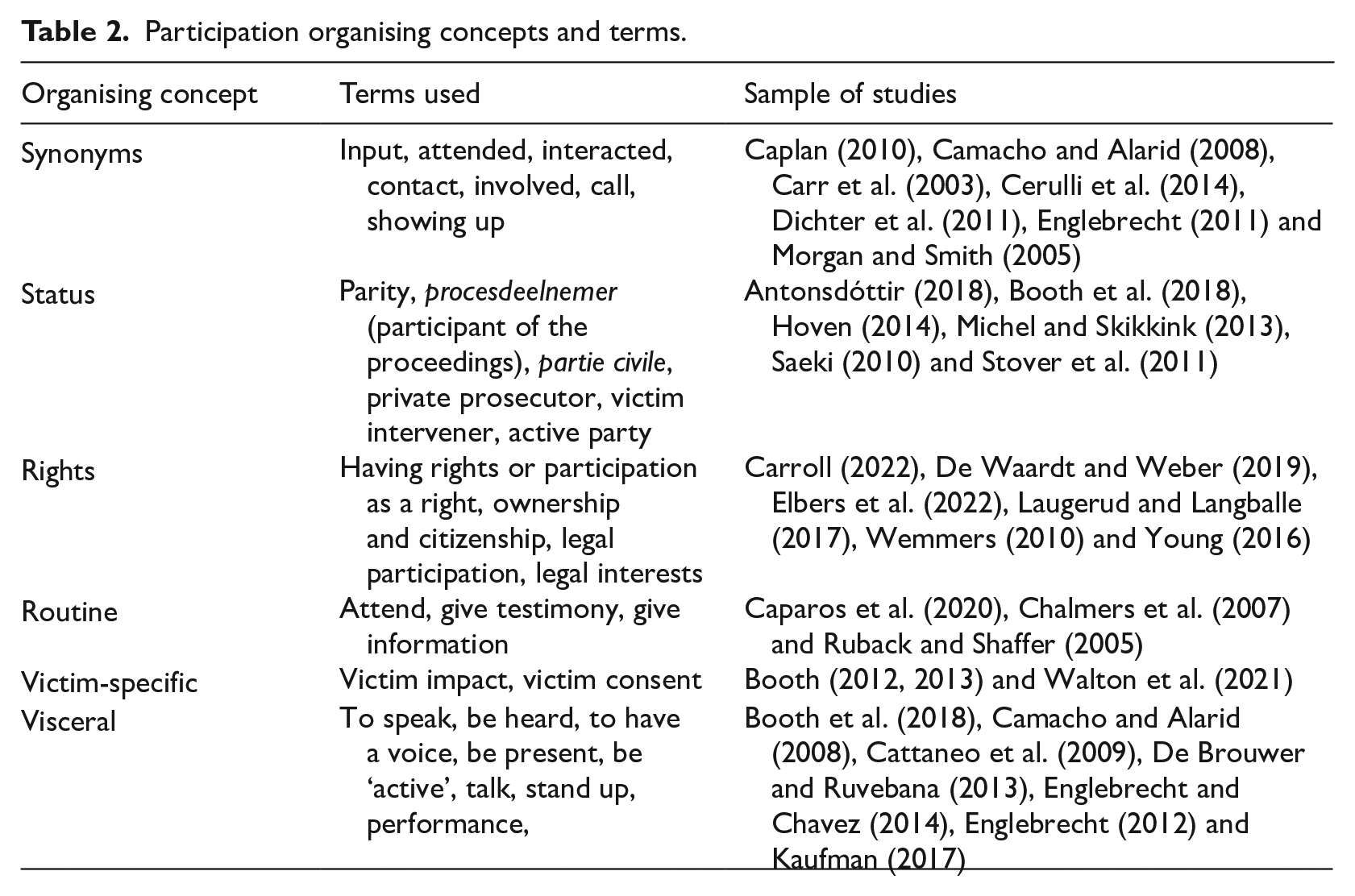
These associations identified in the reviewed articles often additionally worked to highlight the theoretical frame drawn upon by the authors. We use the term ‘framing’ because authors were not always clear in offering the theory their work employed or tested. Nonetheless, we specified four ways that victims’ participatory interests were theorised in the reviewed articles: rights theory, justice theory (broadly construed), procedural justice theory, and therapeutic theories. A final category encompassed a number of studies informed by offender-related theoretical perspectives. Of the four categories, most (33%, n = 19) were framed by rights theory. Twelve studies (21%) framed the research by the broad idea of justice, with six studies (10%) drawing on procedural justice theory, and five (9%) considered the therapeutic value of participation. Eight studies (14%) drew on offender-related theoretical concerns and the overlap with victim participation: prosecution or parole decision-making, and sentencing. Eight studies (14%) were categorised as ‘other’ and drew variously on emotion theory (Kaufman, 2017; Lens et al., 2013; Schuster and Propen, 2010), communication theory (Szmania and Gracyalny, 2006), work cultures (Dichter et al., 2011; Englebrecht and Chavez, 2014; Stickels and Mobley, 2008), and violence prevention (Cerulli et al., 2014). Appendix 1 provides the full list of articles and the identified theoretical frame.
Summary of review results
Victim participation in criminal justice is a term commonly used in policy and research literature. However, there has been no review of the empirical research literature to determine how the term has been operationalised by researchers or the conceptual or theoretical underpinnings involved. This article describes a combined approach to reviewing this literature, an SQLR, and a critical stock-take of the topic. We searched for English-language, empirical, peer-reviewed journal articles published between July 2002 and December 2021 that examined victim participation in an aspect of routine criminal procedure in either a domestic or international criminal jurisdiction.
Gaps and concentrations in research
Of the 58 selected articles, most focused on victim participation in domestic criminal jurisdictions, the majority of which were common law systems and most of these were US-focused. In just under a quarter of articles (22%, n = 13), the research was conducted in a civil law system with a further 22% focused on hybrid legal systems. Half of the research used qualitative methods and three-quarters of the articles considered victims of violence – interpersonal or mass atrocity. Defined broadly as a victim contribution to an aspect of criminal procedure, most articles examined victim participation activities at the trial stage of criminal procedure although this is likely to be a feature of our selection criteria. Of eight possible participatory modes or activities, most commonly studied in the articles in the review were victims contributing their ‘views and concerns’, followed by VISs, attending proceedings, system-initiated consultation, and victims as observer of proceedings.
While half of the studies defined participation in some manner, this was imprecise. Instead, we identified organising concepts to the presentation of the term: the use of synonyms, associations with victim status or with rights, linking the activity to routine procedure or as a victim-specific association, and finally the use of visceral terms for participation. Noticeable was the association of status and rights concepts with research focused on civil law monosystems and hybrid legal systems.
Outcomes of victim participation in research
We also attempted to identify the ways that researchers analysed the outcomes of victim participation. By this we mean the hypothesis or expected effect or impact of the victim participation anticipated in the research rather than, as recommended by Kunst (2021: 5), the intended goals of the specific activity in its location. Of seven possible outcomes, victims’ rights enforcement was identified as the most common outcome envisaged within the research articles followed by procedural justice, victim satisfaction, and the emotional or psychological benefits of participation. A substantial proportion (19%) of articles considered offender-related outcomes to victim participation. In a majority (63%) of the articles, we assessed that authors commented that victim participation had a positive effect, even when the study authors were disquieted by that effect. Unsurprisingly, given the outcome focus on victims’ rights, most articles framed their research in rights theory or a broad framing of the idea of justice or offender-related interests such as sentencing theory. A smaller number of studies drew on procedural justice theory and therapeutic theories.
Limitations
As this is the first review of empirical studies of victim participation, we defined the topic broadly as a victim contribution to an aspect of routine or standard criminal procedure. Some may find the definition too broad. Future reviews may choose a narrower scope such as only focusing on direct or active victim participation and not those mediated through resources such as advocates or lawyers; or may narrow pragmatically on specific victimisation categories such as sexual assault. Our intention was to demonstrate quantitatively where and how victim participation was studied and through what conceptual lens. The enumeration (using the SQLR) of the contours of research arising from selected articles may strike readers as pedantic. However, the level of detail is important to show concentrations and gaps in the research as well as reveal the general absence of definition of the participation mechanism and theorisation of the effect of victim participation. While we combined this quantitative review with a more common narrative stock-take of the selected literature, future reviews may choose to take the quantification further by examining patterns between variables, or only use narrative review. Future reviews could also use suitable quality assessment frameworks (for quantitative, qualitative, or mixed-methods studies) to scrutinise study quality. Finally, we are acutely aware that our review of English-language research literature raises a significant limitation. There is likely to be more research conducted in civil and hybrid legal systems and published in languages other than English. Future scholarly collaboration across languages is critical to gaining a more complete picture of victim participation across legal system types. Such collaborations can make comparative studies of participatory mechanisms easier.
Discussion and future directions
Despite its wide use by practitioners, policy-makers, and researchers, the contours of victim participation in both domestic and international criminal justice ‘are still in the process of being determined’ (International Federation for Human Rights (FIDH), 2014: 4). The term carries the weight of different meanings and associations. Too often, the literature wields victim participation as a rhetorical device that is without anchor and shifts without explanation. Our review, nonetheless, highlights the wide range of situations and procedures in which victims do participate in criminal justice. This diversity illustrates that, while researchers are looking at different things in different contexts, they are often categorised as similar. Rather than apply a straightjacket to these differences, we suggest opportunities for greater specificity in research. We propose ‘ways of seeing’ that can ‘organise the evidence’ for ‘theoretical scrutiny’ by specifying to which units of analysis research claims apply (Tilly, 1984: 80–81). 6 We observed four ways of seeing victim participation from our literature review and offer an organising schematic for use by the field (Figure 2).

Ways of seeing victim participation in criminal justice.
These ways of seeing offer choices in clarifying future directions for research – whether as single or multi-jurisdictional studies or comparisons. Here we briefly sketch where and how these ways of seeing may direct researchers’ gaze. A focus on the structural place of victim participation may explore how it is situated in the design of a jurisdictional criminal system. One obvious focus is how international criminal jurisdictions have constructed an independent organisational space for victims as part and parcel of institutions, whether permanently, such as the Office for Public Counsel for Victims at the ICC, 7 or ad hoc as in the Special Tribunal for Lebanon, 8 and if and how these developments influence domestic jurisdictions (Hoyle and Ullrich, 2014; and see De Waardt and Weber, 2019; Joutsen, 1994). Research focused on where and how the structure of criminal justice supports (or does not support) victim participation may also examine, for example, the legal instruments that require it (Friedman and Robinson, 2014). How a system is structured can incorporate critical examination of victims’ role within it (Edwards, 2004).
The structures around victim participation have obvious overlaps with its resourcing, a concept that is not restricted to finance but constitutes the ways that materially enable victim participation. For example, the provision of legal representation (see Carroll, 2022; Elbers et al., 2022; Laugerud and Langballe, 2017) or victim advocacy (see Camacho and Alarid, 2008; Cattaneo et al., 2009; Michel and Sikkink, 2013), especially for those with limited capacity (López et al., 2016), are resources. The provision of routine information that informs and assists victims to know what is available, how and when is also a critical resource enabling participation (Carr et al., 2003; Mastrocinque, 2014). Equally, the technology that assists victims to contribute are resources that need explicit examination whether, for example, as videoed testimony (Walton et al., 2021) or an automated information system (Irazola et al., 2015).
The modes or mechanisms of victim participation similarly overlap with institutional design and resourcing. Moreover, modalities readily lend themselves to research and move beyond the buzzword and beyond ‘victims’ mere presence’ (De Waardt and Weber, 2019: 209). An obvious participatory mode is the VIS (e.g., see Chalmers et al., 2007) and its different function in different legal systems (e.g. see Booth et al., 2018). Providing their views and concerns is the key term in international mandates describing a participatory mode but clearly requires differentiation as to whether this occurs at the front end of the criminal justice system (Backes et al., 2022) or at the back end (Young, 2016). Finally, the degree of involvement in participation can overlap with all the other areas of research focus. In this quadrant, research may focus on victims themselves (e.g. see Wilinsky and McCabe, 2021; Younglove et al., 2009) or on the criminal justice professionals who ‘manage’ access (e.g. see Englebrecht, 2011; Stickels and Mobley, 2008). The degree of involvement in participation by victims can be evaluated across continua of active to passive, high to low, and from direct to indirect for example.
Our review also suggests there are important future lines of enquiry on victim participation across geographic region and in both civil and hybrid legal systems. These are clear gaps, as is the paucity of comparative research. Research also needs clarity on the outcomes that are envisaged by victim participation within and across legal systems and from specific modalities. Both the 1985 Victims Declaration and the 2002 Rome Statute specify that there should be ‘consideration’ of victims’ views and concerns as well as their ‘presentation’ but for what purpose, effect, or outcome? As an example, experimental research could test the presence or absence of direct victim viewpoints on their assessment of procedural fairness. Or document analysis can elaborate the nature and content of ‘views and concerns’ identified in judicial remarks. Finally, how victims and other justice actors experience and assess the participation as ‘meaningful’ or ‘effective’ requires further exploration; a question that also goes to the purpose of victim participation and its theoretical framing. As a minimum, our hope is that the present pragmatic review will encourage practitioners, policy-makers, and researchers alike to engage with victim participation not as a single event but as a series of modalities that each carry specific meanings for people as victims of violence, and different implications for society as well as for criminal justice.
Mobilising the law and being involved in its responses is, in part, a decision by victims not to allow victimisation to remain an individualised problem. Indeed, people victimised by violence have been found to ‘become more engaged in civic and political life’ (Bateson, 2012: 570). Participation is thus a form of social, indeed, political action which adds to ‘the vocabulary of citizenship’ (Holder, 2018: 204). By participating in the public sphere of criminal justice, victims take on contributions that are demanding and that also shape their social worlds. Yet, while the literature recognises that participation is rights-enhancing and justice-seeking, it is curiously silent on this normative basis. Nearly 30 years ago, Leslie Sebba (1996) suggested that victim participation may be valued ‘for their own sake’ rather than whether it leverages satisfaction or cooperation or another particular outcome (p. 191). Exploring the nature of that value takes seriously victims’ contributions.
Footnotes
Appendix 1
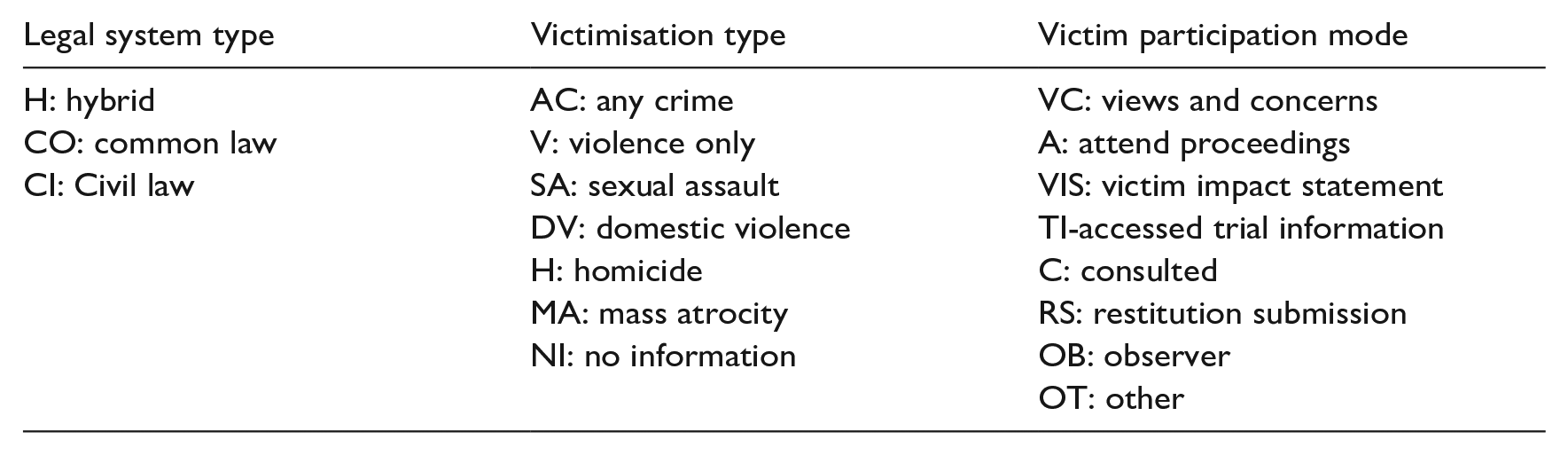
| Legal system type | Victimisation type | Victim participation mode |
|---|---|---|
| H: hybrid | AC: any crime | VC: views and concerns |
| CO: common law | V: violence only | A: attend proceedings |
| CI: Civil law | SA: sexual assault | VIS: victim impact statement |
| DV: domestic violence | TI-accessed trial information | |
| H: homicide | C: consulted | |
| MA: mass atrocity | RS: restitution submission | |
| NI: no information | OB: observer | |
| OT: other |
Acknowledgements
The authors dedicate this article to the memory and pioneering work of Professor Leslie Sebba, Founding Editor of this journal. We gratefully acknowledge assistance of library staff, Ben McCrae and Kim Kelly, Griffith University.
This review was made possible with a Research Grant (2018) from the Arts, Education and Law (AEL) Group, Griffith University.
