




Abstract
Despite an increase in the reporting of rape, convictions in England and Wales have fallen significantly in recent years. Previous research has found high rape myth acceptance among police officers. Given that the police act as gatekeepers to the criminal justice system, subscribing to rape myths may have significant effects upon victim attrition and conviction rates. This study explores police officers’ use of rape myths and how these may impact investigations and prosecutions. A total of 17 semi-structured interviews were conducted with police officers from a large English police force. The interview data were analysed using the qualitative method of thematic analysis. Although there were instances where officers demonstrated some awareness of the need to dispel or counter rape myths, rape myths were employed by most officers, with the most common relating to (1) victim fabrication (‘women lie’) and (2) victim precipitation (‘women ask for it’). Recommendations are made around screening and training for police officers.
Introduction
Rape convictions in England and Wales are at an historic low, despite significantly increased reporting, with just 1.6% of reported rapes resulting in charges (HM Government, 2021). This means that less than 1 in 100 reported rapes ends in a conviction, leading to the suggestion that rape has effectively been decriminalised (Centre for Women’s Justice et al., 2020). Victim attrition is a significant issue, with the recent government Rape Review finding that 57% of victims withdrew from the criminal justice process during 2019–2020 (HM Government, 2021). Withdrawal from the investigative process may be due to multiple reasons, such as long delays in the case (Burman and Brooks-Hay, 2020); secondary victimisation by police, the Crown Prosecution Service (CPS), or courts (Brooks and Burman, 2017; Kelly et al., 2005); rejection of evidence gathering techniques that are experienced as intrusive, such as requests from the police to give up mobile phones or other victim technology requests (Wunsch et al., 2021); and fear of repercussions from the perpetrator or the perpetrator’s ongoing exertion of coercive control over the victim (Burton et al., 2012; Hohl and Stanko, 2015; Triggs, 2018).
One of the barriers to rape being effectively dealt with by law enforcement are rape myths (Stanko and Hohl, 2018), which are commonly defined as incorrect and prejudicial beliefs regarding rape victims and perpetrators (Trottier et al., 2019). Despite being grounded in erroneous beliefs about the nature, prevalence, and causes of sexual coercion, rape myths are, albeit to a lessening extent, socially accepted, contributing to a culture that normalises and justifies sexual violence (Garza and Franklin, 2020: 553). While there are rape myths that specifically relate to sexual violence against men and boys, rape myths most frequently relate to, and justify, the sexual victimisation of women and girls (Gray and Horvath, 2018). Rape myths are enmeshed with wider gender norms and sexual scripts that naturalise male sexual aggression and position women as sexual gatekeepers responsible for evading and/or rejecting unwanted sexual advances (Gray and Horvath, 2018). Notably, as overt victim-blaming or trivialisation of sexual violence grows less culturally acceptable, the rape myths in circulation have evolved in line with contemporary attitudes and sensibilities (McMahon and Farmer, 2011). University-aged research participants are nowadays more likely to frame rape as accidental, the result of excessive drinking or sexual miscommunication, than to appeal to myths regarding women’s desire to be sexually overpowered (McMahon and Farmer, 2011). Rape myths may also impact upon victim attrition (Angiolini, 2015; Stanko and Hohl, 2018). The majority of victim attrition occurs during the police investigative stage, and is most commonly due to victim withdrawal. Following victim withdrawal, the police deciding not to proceed with a case comprises the most significant source of non-progression (Hohl and Stanko, 2015).
While there are a variety of rape myths, they can be divided into several basic narrative or functional families, which serve to attribute responsibility to the victim, exculpate the perpetrator, or minimise the perceived harmfulness of the act (Bohner et al., 2006). The literature in this area often seeks to group rape myths according to dominant themes, the most common of which relate to: (1) victim precipitation – the idea that victims ‘ask for it’ or cause rape by their behaviour or characteristics and are thus to blame for their victimisation (e.g. ‘a woman who wears revealing clothing/is intoxicated is partly or wholly responsible for her victimisation’); (2) victim fabrication – the belief that victims lie about their victimisation (e.g. ‘women cry rape’); (3) victim masochism – the idea that women actually want to be raped (e.g. ‘women secretly desire rough sex’); (4) beliefs about, and excuses for, perpetrators (e.g. ‘men can’t stop when they reach a certain point’); and (5) broad ideas about rape (e.g. ‘real rape only happens by a stranger at night, involving a weapon, victim resistance and visible trauma’) (e.g. Bohner et al., 2006; Burt, 1980; Cuklanz, 2000; Edwards et al., 2011; Estrich, 1987; Garza and Franklin, 2020; Horvath and Brown, 2013; Johnson et al., 1997; Koss et al., 1994; Murphy and Hine, 2019; Scully, 1990; Sleath and Bull, 2015).
Police and other criminal justice personnel are not immune to misperceptions about rape and subscription to rape myths. Prior studies have found, for instance, that most officers considerably overestimate the proportion of allegations which are false relative to findings in research based on case reviews (McMillan, 2018). When McMillan interviewed police officers about the prevalence of false allegations, answers varied from 5% to 95%, with a mean estimate of 53%. Rape myth acceptance (RMA) by police officers is a particularly important area as they serve as ‘gatekeepers to the criminal justice system’ (CJS), able to exercise discretion regarding key aspects of the investigation (Triggs, 2018: 62). Accordingly, there has been considerable research interest in police officers and RMA. A recent systematic review indicates that officers’ attitudes to rape are influenced by a wide range of personal, situational, and professional factors, which may vary significantly according to the individual (Parratt and Pina, 2017). Reviewed studies suggest that a previous relationship between the victim and perpetrator, as well as victim intoxication, was associated with increased victim-blaming and perceptions that the allegation is ambiguous or less legitimate (Parratt and Pina, 2017).
Studies based in the United Kingdom shed further light on how and why police RMA can shape outcomes in rape cases. Hohl and Stanko (2015) analysed a large, representative sample of rape allegations reported to the Metropolitan Police Service. They found that police decision making was influenced by rape myths and stereotypes about ‘real rape’ (Estrich, 1987), such as the assumption that ‘genuine’ victims will resist an assault, have clear and reliable recall of the event, and promptly report to the police. Victims whose stories contained inconsistencies, who had not mounted any physical resistance, or who had delayed reporting to police were judged to be less credible and experienced higher attrition rates. Furthermore, Murphy and Hine (2019), through a survey of 808 UK police officers, demonstrated that officers who evinced high levels of RMA judged victims as more responsible for their rape, perpetrators as less responsible and were more likely to make negative judgements regarding authenticity when presented with a hypothetical rape scenario (Murphy and Hine, 2019).
These findings suggest that police officer RMA can have detrimental effects regarding perceptions of victim credibility and responsibility, which in turn may affect investigative decision making. Strikingly, they suggest that counter-stereotypical rapes and/or victims – those who were assaulted by people they know or with whom they had previously engaged in consensual sex, who did not physically resist, and who may have delayed reporting – are likely to be viewed as less credible by some police officers, even though such characteristics are more reflective of most rape cases than the archetypal ‘real rape’.
The present study contributes to the growing body of research into police and rape myths, discussing themes from qualitative data collected as part of Pillars 1 and 2 of Project Bluestone. 1 The article explores the use of rape myths by detectives who investigate rape and serious sexual offences (RASSO) or have oversight of those who do, in a large English police force.
Method
Participants
Interviewees included 17 police officers (9 female, 8 male), working as front-line or senior staff. Ranks were Police Constable (PC), Detective Constable (DC), Detective Sergeant (DS), Detective Inspector (DI), Detective Superintendent (Det Supt) and Assistant Commissioner. Researchers considered this sample size large enough to reach a point of saturation, and to justify claims of patterns found in the data, requisite to valid thematic analysis (Braun and Clarke, 2022).
Materials
A one-page information sheet and a consent form were developed for potential interview participants. These documents contained details about the project, including the aim, background, and purpose of the research; the nature of participants’ involvement; advantages and disadvantages of participation; use of data; and issues surrounding anonymity and confidentiality.
A semi-structured interview schedule was devised to capture officers’ understanding of RASSO investigations and associated challenges. This contained key questions to be addressed by researchers (e.g. investigative challenges, intelligence, joint working). Although this instrument was not specifically designed to capture understandings and attitudes towards rape myths, the flexibility afforded by semi-structured interviewing allowed researchers and participants to explore and discuss this theme as it emerged organically (e.g. Noaks and Wincup, 2004). In addition, questions on investigative challenges and suspect- versus victim-focused investigations often elicited opinions on rape myths.
Procedure
This research was approved by the ethics committees at both the University of Suffolk and Bournemouth University. In order to maintain participants’ anonymity, interviews were arranged directly by Project Bluestone police leads within the force, who worked alongside the academic leads to facilitate data collection. The police leads selected participants available for interviewing; no incentives for participation were offered and officers were told they were under no obligation to take part. In this context, it is particularly important to reflect on ‘the appropriateness of allowing gatekeepers’, in this case police leads, ‘to become so involved in the research’ (Noaks and Wincup, 2004: 58), not only selecting interviewees but equally filtering the data provided. Although researchers recognise the need for such measures to be implemented (e.g. to ensure all data shared is appropriate and suitable for disclosure), there is an inherent risk of bias associated with these procedures. Nonetheless, this method ensured that researchers had no access to participants’ personal information, such as their name or contact details.
The interviews were conducted over the telephone – with the officer calling on a withheld number – in response not only to anonymity requirements but also safety concerns around COVID-19. Two researchers took part in each interview, one taking the role of interviewer and the other the note-taker.
A total of 17 interviews (with an average duration of 1 hour each) were conducted between October and December 2021. All interviews were audio recorded using a dictaphone. After the interviews, the recordings were uploaded to the secure online data sharing platform, Sharepoint, which only members of the academic team conducting the interviews had access to. Transcribing software (Trint) was then used to generate transcriptions of the interviews, which were further manually checked and edited by members of the team, to correct any errors. As soon as the transcripts had been edited and finalised, the recordings were permanently deleted.
Analysis
The data were analysed using the qualitative method of thematic analysis. This was chosen in preference to other methods of analysing textual data such as discourse analysis, as it concentrates on what was said as opposed to how it was said. A method essentially independent of epistemology and theory, thematic analysis is used to organise data into thematic sets as determined by the researcher. The process of conducting a thematic analysis that was followed in this study follows the six phases articulated by Braun and Clarke (2006). The analysis was conducted manually by the researcher within the team who conducted the interviews; the second researcher involved in interviewing then looked at the data independently, thus providing interrater reliability
In phase 1, the researcher immersed themselves in the data, reading and re-reading the transcribed interviews, recording initial ideas and possible patterns within the data. In phase 2, the researcher generated initial codes, identifying aspects within the data of interest and organising the data into meaningful sets. In phase 3, these codes were sorted into themes; both broader ‘master’ themes and narrower ‘sub-themes’. In phase 4, the themes were refined; some discarded, some merged, and some broken down further. In phase 5, the themes were given names to identify them and set out in a table. Finally, in phase 6, the themes were written into a coherent narrative, using participant quotes embedded within it, supported by literature in the area.
Results
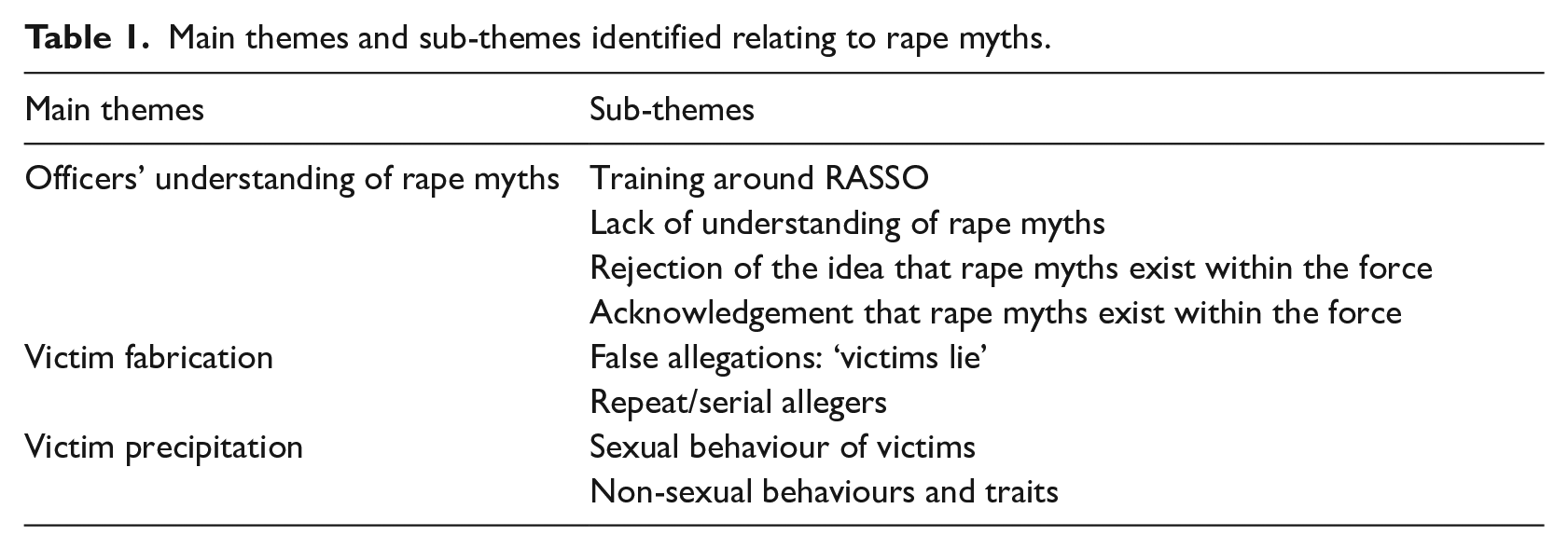
The literature in this area seeks to categorise rape myths into broad categories, according to dominant themes. This research did not find evidence for rape myths that fall under the categories of victim masochism (e.g. Garza and Franklin, 2020) or beliefs about perpetrators/excusing the man (e.g. Johnson et al., 1997; Murphy and Hine, 2019). However, there was clear evidence of rape myths that fall under the themes of victim fabrication/victims lying about their victimisation (e.g. Cuklanz, 2000; Edwards et al., 2011; Garza and Franklin, 2020; Sleath and Bull, 2015) and victim precipitation/victims causing rape by their behaviour/victim blaming attitudes (e.g. Garza and Franklin, 2020; Johnson et al., 1997; Scully, 1990; Sleath and Bull, 2015). Table 1 illustrates the main themes and sub-themes identified.
Main themes and sub-themes identified relating to rape myths.
For context, in this force, DCs conducted the day-to-day RASSO investigations, supervised by DSs and DIs, with more senior officers, such as DCIs and Det Supts, having broader oversight.
Officers’ understanding of rape myths
Training around RASSO
In this police force, detectives working on RASSO cases did not receive specialist training; simply completing generic investigators’ training. As Officer2 said,
The DCs would attend the detective course, they would pass an exam. But that wouldn’t be specific just for sexual offences, that would be standard. So they could be a detective in any and every department.
However, there was general consensus among Officers that detectives should receive specialist RASSO training, given both the seriousness of the offence and the differences between investigating sexual offences and other types of offences:
I was very surprised that I wasn’t going to get any training, because it is so different. And trying to adapt to that, I know for me and a lot of my colleagues . . . was very challenging. So why the detectives don’t get training is something of a mystery to me. (Officer9)
This was reinforced by Officer2, who said,
Rape is a serious investigation. So . . . why are DCs not getting any training to investigate rape? I think that’s a massive thing. So I think that should be something that should be implemented.
Despite this, there appeared no imminent intention of giving detectives specialist RASSO training. Such training might include, for example, information about victim services; the treatment of rape victims; the psychology behind how victims react to trauma; and common rape myths and stereotypes. As was noted by Officer16,
I don’t think we can teach culture in a week on a course, but we can highlight to people they need to think differently . . . They need to focus on rape myths and stereotypes, impacts of trauma and victim credibility.
Lack of understanding of rape myths
Many officers did not comprehend what was meant by the phrase ‘rape myths’. The following exchange, for example, took place between Officer5 and the interviewer:
What do you think about the issue of rape myths?
Issue of what, sorry?
Rape myths. Do you understand what I mean by that?
No. Sorry.
A similar conversation took place between the interviewer and Officer4:
Do you think that things like rape myths make rape investigations more difficult?
Oh, sorry, what was that word?
The fact that a significant minority of detectives working on RASSO did not understand the concept of rape myths is of considerable concern. Officer16, a senior officer, told how their recommendation for detectives to be educated on ‘rape myths, stereotypes, impact of trauma and a real focus on victim credibility’ was met with the following response: ‘The detectives don’t need it’. Officer16 concluded: ‘And actually, you know, you can almost start going, “Oh my God, no wonder we got problems”’.
Rejection of the idea that rape myths exist within the force
Other officers did understand the meaning of rape myths and thought that they had little impact on investigations; however, such statements were often qualified, equivocal, or ambivalent. For example, Officer13 said,
I don’t think [rape myths affect investigations]. I’d like to think not. I’m sure there’s maybe something in maybe some people in the back of their mind that there might be a myth. I would hope not these days . . . I think we look at the evidence rather than myths or any preconceptions. But it’s human nature that there is a small element of it.
Others – often of a higher rank (DI and above) – were stronger in their dismissal of rape myths:
There’s no rape myths. Yeah, it gets said outside of the police world, but from an investigating point of view, there’s no rape myths there. (Officer6)
However, it is notable that almost all officers – whether they did not understand the term ‘rape myths’ or said that they did not enter into their thinking – later proceeded to display various such myths in the course of their interviews (discussed further below).
Acknowledgement that rape myths exist within the force
Those participants who did acknowledge that rape myths formed part of officers’ thinking tended to be more senior (Det Supt rank/Assistant Commissioner). For example, Officer18 noted that there is ‘a problem in the terminology that people use when talking about investigations; it is a concern’. They also made the point that, in addition to police culture, officers may also be influenced by wider culture and society:
There is so much in the news, on social media, society is so quick to judge people and that is a real challenge . . . there’s a lot of toxic influence from outside . . . We say follow the facts and see where that takes you; we tell officers to believe every victim . . . but the message doesn’t get across.
Officer16 was starker in their assessment of rape myths within the police, in terms of making judgements about victims: ‘We massively pre-judge the credibility of the victim. We investigate the victim more than the offence itself’. This underlines the need for detectives working on RASSO teams to receive specialist training.
Overall, the finding that police officers have inconsistent/insufficient knowledge of rape myths, and adhere to them consciously or subconsciously to varying degrees, is concerning, given that research has found that police decision making is influenced by rape myths (Hohl and Stanko, 2015).
Victim fabrication
False allegations: ‘victims lie’
As found in previous research, the idea that victims often make ‘false allegations’, ‘lie’, and ‘make up’ reports of rape was a prominently discussed myth (e.g. Shaw et al., 2017). As Officer7 said, ‘There are people out there that make accusations that are untrue’, while Officer4 was of the opinion that fabricating rape occurs ‘more than you’d think’.
This last statement in particular supports previous research that has found that police officers overestimate the occurrence of false allegations (McMillan, 2018). However, genuinely false allegations of rape are made in a very small minority of cases, a comparable figure to false allegations in other crimes – around 3% for ‘malicious’ allegations (Kelly et al., 2005). As a senior officer acknowledged: ‘Occasionally you get cases that are made up . . . but those cases are oh so rare’ (Officer18).
In spite of this, participants specifically and repeatedly referred to victims ‘lying’, ‘not telling the truth’, or ‘not telling the whole truth’ – ‘lies’ which they claim may later be ‘provable’, that is, uncovered by evidence in the investigation or when a complaint is withdrawn by the victim. This formed the central narrative of how officers spoke of victims; not as those deserving of justice but those to be somehow caught out in a lie and their credibility undermined. As Officer5 said,
In the past, and still to this day to be honest, there are crimes that we are reviewing, and we do investigate, and that we can show, and we believe we can show, that this has not taken place.
Officer1 expanded upon this, explicitly making reference to victims lying:
Sometimes it can be frustrating because you do the work and at the end of it, they either say they’re lying, or it comes out of something like CCTV and you can see that they weren’t telling the truth. So that can be frustrating.
Officer11 introduced the idea of victims not telling the whole truth:
Sometimes there have been cases that actually they’ve just been lying about – perhaps lying’s not the word, but they haven’t been telling the whole truth – about what happened. And it’s come out via a text message, for example, that’s been found on the victim’s phone.
In reference to victim withdrawal, Officer1 said that ‘a lot of the time [victims] won’t follow through and give a VRI [visual recorded interview], for example’.
Yet the reality is considerably more complex and nuanced. Victims may sometimes give inconsistent or partial accounts, for example, which may be wrongly interpreted as evidence of falsity by the police (Hohl and Stanko, 2015). In fact, inconsistencies in accounts are entirely congruent with the literature on memory and trauma (e.g. Forest and Blanchette, 2018). Victims may also withdraw their complaints for myriad reasons, such as delays, secondary victimisation, shame, embarrassment, or coercion (e.g. Kelly et al., 2005; Sable et al., 2006; Triggs, 2018).
Such reasons were referenced, or reflected upon, by a minority of participants. For example, addressing why victims might make false allegations, Officer2 said: ‘It could have been when they were very young or they could have been made to say it was a false allegation’. Officer8 reflected on why victims might conceal certain details or make inconsistent statements:
We’re asking victims to talk about really personal, private things that they might feel ashamed about or they might, for some reason, not want to share with all sorts of people.
A senior officer went further, suggesting that to call normal inconsistencies in memory ‘provable lies’ is ‘shocking’:
Some of the things I’ve seen around some of the decision making is literally just beyond belief. One case was NFA’d
2
saying it was a provable lie. The victim said she was picked up by an Uber at X spot – she actually got in the car 50 yards down the way, so the officers said it was a provable lie that she’s got in the car a different place. I mean, some of these things are so shocking. (Officer16)
In recognition of this issue, Officer8 told how they specifically instruct first responding officers not to take statements from victims, in case they later contradict themselves:
When my uniformed colleagues first go to see victims, we will ask them not to take full statements. They normally would only be asked: What happened? Where did it happen? Who was involved? . . . The reason is, if they take a full statement and it’s in any way different to when we take our statement, with specially trained officers, the defence will say: ‘Oh, but you said this and now you said that, you’re making it up aren’t you?’ (Officer8)
Elsewhere in Project Bluestone there is evidence to suggest that approximately 10% of allegations were classified by the force as being false; 3 however, this figure includes inconsistent and mistaken accounts. There is thus an important distinction to be made – which will be explored further in the discussion – between ‘false’ allegations (purposefully fabricating accounts that are untrue) and mistaken, inconsistent, or unproven accounts (Hohl and Stanko, 2015; Kelly et al., 2005). An inconsistent account should never be presumed to be a false one.
‘Repeat/serial allegers’
Another rape myth that police officers employed was the idea that victims lie repeatedly – often making not just one, but numerous, false allegations across time. As Officer4 said, there are victims ‘who are making numerous reports, sometimes false reports’. Although there is a relative paucity of research surrounding repeat false allegations, Shaw et al.’s (2017) content analysis of police files, and Jordan’s (2019) analysis of police files and interviews with support workers and forensic doctors, found evidence to support the (erroneous) phenomenon of ‘frequent flyers’ (Jordan, 2019).
Official guidance dictates that all complaints of rape should be accepted as true, prima facie, unless/until there is evidence to the contrary. Some officers’ statements aligned with this guidance, such as that of Officer1, who said,
Serial alleges do take a lot of our time, but you just have to investigate just like any other one, because you never know. You can’t take the risk of the one that you don’t investigate being the one that was something that actually happened.
However, other officers clearly took repeat allegations as a priori evidence of falsity, which is directly contrary to the policy of initially accepting all accounts as truthful. Some spoke of victims who ‘cried wolf’ as setting off ‘alarm bells’ or ‘tainting’ the way in which victims are perceived – being seen as less credible – and thus how cases are investigated. This supports the assumption that ‘real’ rape is rare and unlikely to happen to the same person on more than one occasion, and thus may be met with scepticism from officers (Burman, 2009; Klement, 2017). For example, Officer4 said,
Making numerous reports, sometimes false reports . . . are a drain on resources . . . If you have the same person coming forward time and time again and you’re negating, you’re showing that things didn’t happen . . . We struggle to deal with the volume of work we get and then to be pulled aside with things that are dubious. Alarm bells, you know?
Officer3 admitted that a history of so-called false allegations may ‘subconsciously’ influence or ‘taint’ how the victim and case is perceived, as it is seen to undermine victim credibility:
[If a victim has made a previous allegation] I suppose subconsciously it would [influence how you see them] . . . You have got that kind of story in the back of your mind that, ’okay, you know, they’ve made a false allegation before. Why?’
This question: ‘Why?’ is addressed in further force guidance on false allegations, which states that there are numerous reasons why these may be made, including reports that are ‘malicious’, ‘mistaken’, ‘financially motivated’ or ‘inexplicable’. This reinforces the construct of women as ‘malicious’, deceitful, or vengeful liars (McMillan, 2018), and ignores the actual ‘many reasons’ as to why mistaken, unproven, or inconsistent – as opposed to false – allegations may be made, or complaints withdrawn, as discussed in the previous section.
Notably, one officer did strongly oppose disbelieving and sceptical attitudes towards so-called ‘repeat allegers’, stating,
When we put a case to the CPS for their consideration, and on the strengths, one of the things we would put routinely is: ‘Hasn’t reported a rape before’. Which is absurd when you think about it. It’s like, what’s that got to do with it? If someone’s been raped 67 times, what evidence does that have at all to do with what happened last Saturday? None, obviously. (Officer8)
However, police decision making is clearly strongly influenced by the CPS; participants held the strong belief that only the most robust RASSO cases are prosecuted. As Officer8 said: ‘The CPS are disinclined to charge stuff unless they’ve got a good chance of getting a conviction’. Cases in which there have been previous false allegations made, or allegations retracted, are seen as undermining to a victim’s credibility and may therefore affect how, and if, the CPS proceed. As Officer10 said, the CPS:
Want to know about previous allegations from the victim of a similar nature . . . when allegations are recorded where either the victim retracts or makes repeated allegations, they tend to worry about the veracity of the complainant and whether it would stand up to scrutiny in court. And it becomes a major, major hurdle towards getting a charging decision.
This issue is explored further in the discussion, as it may have a highly detrimental impact upon case progression.
Victim precipitation
There are a number of ‘victim precipitation’ factors – rape myths that suggest that victims have contributed towards, facilitated, or provoked their victimisation in some way – that research has identified, as explored in the introduction. In this study, victim precipitation myths can be broadly thematically grouped as referring to (1) the sexual behaviour of victims and (2) the non-sexual behaviour/traits of victims.
Sexual behaviour of victims
One rape myth that persists is that a victim’s general sexual behaviour, or behaviour at the time of the offence, means that she ‘is up for it’, ‘wants it’ or is ‘asking for it’ (Garza and Franklin, 2020). A particular myth that falls into this category is that sex workers are ‘unrapeable’, deserve to be raped or that no harm is done (e.g. Bohner et al., 2006; Miller and Schwartz, 1994; Page, 2010). Two officers talked about the rape of sex workers. Officer7 referenced what they believed to be an outdated culture of disbelief around sex workers involving ‘clipping’:
There was an old-fashioned saying about clipping . . . where a sex worker would shout rape if they hadn’t been paid. And that had a stigma around it, so a sex worker wouldn’t necessarily have got the best service . . . I think there would have been a cultural of disbelief maybe.
However, Officer3 was clear that such ideas are still present today and serve to undermine victim credibility and handling:
You gotta be mindful whether the allegations are being made kind of because of money payments not being made . . . obviously it’s gonna affect how that victim might see themselves or how you might treat that victim as well, unfortunately.
These statements show a misunderstanding of the term ‘clipping’. Rather than clipping being a scenario in which the sex worker ‘cries rape’ after non-payment, it conversely refers to a sex worker taking money from a client with no intention to give the service offered, which is considered fraud (Release, 2011). However, it is interesting to note that the common police (mis)understanding of the term is one that reinforces the myth that woman ‘cry rape’, rather than commit another crime.
Furthermore, victims who are sex workers may be seen as willingly and recklessly putting themselves in danger due to the very nature of their work. As Officer3 said: ‘I suppose that is always going to have an impact on the way you think . . . you know, they’re in these situations because of the job that they do’. However, what this statement fails to take into account is that sex workers may be inherently more vulnerable to not only being raped – but raped repeatedly – due to their work (Jordan, 2019).
Another myth around a victim’s sexual behaviour, that may serve to undermine the credibility of her account, is if she has had any consensual sexual contact with the suspect before, during, or after the rape (Burman, 2009). This is illustrated by a case described by Officer8:
A few days after the incident she [the complainant] was seen kissing him [the suspect]. And on that basis alone, the CPS said ‘right, we’re going to release him and you need to do more investigation’. This is a vulnerable woman – a woman sleeping rough with drug dependency issues – but because she’s kissed him, they’re making a judgement about whether this is chargeable or not. When that’s obviously happened. Whether she’s kissed him four days after the rape allegations, it’s got nothing to do with whether she was raped or not. And there’s a lot of that. There’s definitely a lot of that.
This case highlights how police thinking, investigating and decision making are intrinsically bound up with what may happen, or what officers believe may happen, later in the legal process, as CPS decision making, the portrayal of victims in court by defence barristers, and judge and jury perceptions, are also informed by rape myths (Fraser et al., 2022; Burton et al., 2012).
A complainant’s sexual history being relevant to their victimisation is another rape myth which may be used to undermine her credibility at every stage of the process (Ministry of Justice and Attorney General’s Office, 2017). One senior officer used the example of a case in which the actual rape was seen as almost incidental in comparison with the victim’s sexual history:
The entire investigation was around what the victim did prior to the events happening. And one of our ISVA
4
managers said, ‘not being funny but no one’s really mentioned the rape’ . . . It was literally pages and pages and pages about the fact that the woman might have had an affair at work once. The rape itself was a one word against the other in a disabled toilet, in a pub. It’s so lightly touched on, it’s almost not part of the thinking, which is just shocking. (Officer16)
As has been illustrated in the examples in this section, these types of rape myths are not unique to the police but extend into all areas of the CJS. As Officer16 observed of the courts, and particularly defence barristers:
Their [victims’] sexual history would be questioned, their morals will be questioned, the intimate details of their relationship – not the one in question, but other relationships as well – could be brought into that courtroom . . . I think it’s an outrage personally.
This is despite Sections 41–43 of the Youth Justice and Criminal Evidence Act 1991 providing protection for rape victims by restricting how the defence may introduce evidence about, or ask questions relating to, their sexual history. Thus, the problem is wider than simply the police, with such rape myths pervading the whole CJS and the wider public and society.
Non-sexual behaviours and traits
Rape myths pertaining to the victim’s non-sexual behaviour and personality traits may also be used to undermine their credibility and/or the credibility of the case. The principal rape myths here surround intoxication (and related memory issues) and mental illness. It is estimated that around 60% of rape cases involve alcohol (Larsen et al., 2014). Rape myths surrounding victim intoxication may take several forms, including that an intoxicated victim may consent at the time but regret it later and ‘cry rape’; intoxicated victims are responsible for their own victimisation; victims could have prevented the rape had they not been intoxicated; and intoxicated victims cannot remember the incident (Victoria Police, 2017). Victim intoxication was mentioned by several participants here. As Officer6 said: ‘Predominantly rape investigations do involve a form of some sort of alcohol at some point’.
Previous research, such as Parratt and Pina’s (2017) systematic review, has found that victim intoxication is associated with increased victim-blaming and perceptions that the allegation is ambiguous, less legitimate or false (e.g. Sleath, 2011; Sleath and Bull, 2012; Venema, 2013). There were mixed attitudes towards victim intoxication and perceived culpability in this study, with officers tending to see the complaints as more ambiguous or complex, as opposed to false.
For example, cases which involve intoxication are often seen as problematic in terms of consent. As Officer1 said: ‘There are a lot of cases where it comes to alcohol, alcohol level, and that being the issue around consent’. Officer4 expanded upon this idea:
Some areas around sex, where parties are known to one another, where there’s the influence of drink and drugs, where there’s boundary violations within sex or miscommunications or misunderstandings. It’s complicated.
Although the law in relation to consent and intoxication was not mentioned by any participants, some officers made statements which were consistent with the Sexual Offences Act 2003 (2021), the relevant legislation for rape, in which it is clear that if a victim is incapacitated due to drink or drugs then they are unable to give consent: ‘A complainant does not consent if they are incapacitated through drink . . . A complainant does not need to be unconscious through drink to lose their capacity to consent’ (CPS, 2021).
For example, Officer6 observed that:
Sometimes the levels of intoxication assist your case, due to once you get toxicology results, it kind of goes to the point where that person is that intoxicated that there’s no way they could have even consented.
Officer3 added that an intoxicated victim often equals a vulnerable one: ‘It shows how vulnerable they are, and how kind of easy they are to target for suspects’. This is supported by literature that finds that offenders are often opportunistic and take advantage of victims who are intoxicated (Wall and Quadara, 2014). However, given the aforementioned focus on the behaviour of the victim, it is likely that this level of interrogation of the suspect’s behaviour will be lost.
Venema (2013) found that although victim intoxication might lead officers to see the complaint as more ambiguous or complex, this did not have an impact upon their beliefs about the victim or how they would investigate the case. This was supported by Officer6 who said that, for an intoxicated victim:
We would still go through exactly the same process, because there are times where alcohol is involved and they don’t remember what’s gone on, and we use everything we can to try and piece together what happened.
However, the effect of intoxication on memory was seen as an additional challenge that compounds the complexity of cases:
If the victim is saying that I was so intoxicated . . . ‘I can’t remember what happened. He must have, he must have, it must have been rape’. Or you know, there’s text messages between them the next morning saying, ‘Did we have sex?’ and he’s saying, ‘Yeah’. And he says in an interview to us, ‘Well she consented fine at the time’. And she’s saying, ‘Well, I can’t remember it’. (Officer2)
In respect of intoxication and memory, the law states that not being able to recollect events due to intoxication is not prima facie evidence of rape, with case law dictating that each case should be considered individually and largely left for juries to decide: ‘Evidence of a lack of recollection of events cannot of itself be determinative of issues of consent and capacity . . . Issues of consent and capacity to consent to intercourse in cases of alleged rape should normally be left to the jury to determine’ (Sexual Offences Act 2003, 2021).
However, recent research has found ‘overwhelming evidence’ that jurors held rape myths which affected their decision making in respect of intoxication. For example, a mock rape trial involving an intoxicated complainant found that some jurors thought the victim should still have put up physical resistance (Finch and Munroe, 2005). This is another example of how rape myths extend beyond the police to the wider CJS.
Officers often talked of intoxication, or addiction, as going hand in hand with mental health issues. Research has found that rape myths surrounding mental illness include the idea that people with mental health problems often lie about their victimisation, or cannot give accurate details about the crime (Victoria Police, 2017). Mental illness was mentioned by some officers here as being particularly prevalent. Officer1, for example, said, ‘A large proportion of our cases are people suffering with mental health issues’. Officer4 expanded,
The range of reports that we do get is problematic . . . being under the influence of drink or drugs, and coming forward not knowing what’s happened. Or people with mental health issues or, you know, erratic lifestyles who are making numerous reports, sometimes false reports.
This is consistent with research that finds that complaints of rape from those with mental health problems are often dismissed as false (e.g. Shaw et al., 2017). This fails to acknowledge that this group is particularly vulnerable to victimisation (Victoria Police, 2017), with females with mental health problems being 10 times more likely to be assaulted than those without (Pettitt et al., 2014). Moreover, statistics on mental health in the general population in the UK tell us that one in four people will have a mental health problem in any given year, which rises to one in two over the course of a lifetime (Gekoski and Broome, 2014). Thus, if every complaint of rape from an individual with mental illness was taken to be false, most cases would never proceed.
Police must therefore take disclosures of rape from those with mental health issues on face value and investigate every case (Ashmore et al., 2015). Furthermore, it is important to note that while a small minority of victims with severe mental health issues may report an imagined rape, or memories of a previous rape that have been triggered/relived, this does not make them liars or the account ‘fabricated’ (Jordan, 2019). As we have seen throughout this analysis, a clear distinction needs to be made between false and mistaken accounts, which will be explored further in the discussion below, alongside other pertinent issues.
Discussion
Despite the fact that this research was not a study of rape myths, this theme emerged as a striking finding in its own right and the findings are supported by previous research. For example, studies have found that rape victims are believed to make false allegations and lie about their victimisation (Shaw et al., 2017) and that women are fundamentally deceitful and vengeful (McMillan, 2018). The present study also found support for the previous findings that there is a widely held belief that a person is unlikely to experience sexual violence more than once (Klement, 2017). The rape myths demonstrated in this study are not unique per se; what is striking is that they were held by officers specifically working on RASSO.
Despite some instances where officers demonstrated some awareness of rape myths, there were significant issues around rape myths found in our sample, with some officers not understanding the term, and others feeling that they were not an issue in the police, while simultaneously demonstrating their own adherence to them. The rape myths most commonly held by participants fell into two categories: (1) victim precipitation and (2) victim fabrication. When an officer holds such beliefs, it may affect how they carry out investigations and treat victims. For instance, if they believe a victim may be dishonest this can affect what evidence they look for, and at what point they decide there is a case to answer, or to take no further action. This goes some way to explain the 1.6% charge rate in RASSO cases in England and Wales.
In a UK context, the recent case of R vs Allen has served to reinforce police attitudes in regards to victim fabrication. The case involved ‘allegations that a woman, C, was raped and sexually assaulted by the defendant, D’ on multiple occasions (CPS London and Metropolitan Police Service, 2018: 1). The case was dropped by the CPS following the beginning of the trial due to digital evidence that had been missed during the police investigation and initial disclosure process, which was perceived to undermine the prosecution’s case – specifically, text messages between ‘C’ and a friend pertaining to her relationship with ‘D’. This case has had far-reaching repercussions for decision making in subsequent RASSO investigations, leading to a more risk-averse and victim-focused approach in both the police and CPS.
This was evidenced in this research, with officers holding the strong belief that only the strongest RASSO cases are prosecuted by the CPS; with the CPS routinely requesting evidence relating to previous complaints from victims. Cases were seen to be undermined if victims had made previous allegations of rape, which may later have been withdrawn, and as such charges were unlikely to be brought. A review of police and CPS case files (Burton et al., 2012) found that police and prosecutors often took factors such as victim retraction as evidence of a false allegations (victim fabrication). Yet retracting an allegation may be caused by many factors, such as fear of retaliation, stress, post-traumatic stress disorder (PTSD), hopelessness, and coercion (Barrow-Grint, 2016; Hester and Lilley, 2017). As such, withdrawing an allegation is far from definitive evidence of a false allegation. Furthermore, some victims are genuinely more likely to be repeatedly victimised, such as women with mental health problems or sex workers (Jordan, 2019; Pettitt et al., 2014), and once someone is victimised they are at enhanced risk of further victimisation (Farrell, 2005; Kessler et al., 2005; Pease, 1998). Thus, some women are inherently more likely to make repeat (genuine) allegations.
As we have seen throughout this study, there are definitional challenges regarding what constitutes a false allegation, as opposed to a mistaken or unproven one. For example, an inconsistent or partial account is sometimes interpreted as evidence of falsity by: the police (Hohl and Stanko, 2015; Kelly et al., 2005); the CPS (Ministry of Justice, 2012); and/or jurors (Fraser et al., 2022). A review of police and CPS case files found that police and prosecutors employed varying definitions including ‘intoxicated victims, delayed reporting, victim retraction, and lack of physical injury/medical evidence’ (Burton et al., 2012). When operating within these definitions, 12% of reviewed cases would be classified as false allegations; however, the proportion of complaints perceived to be malicious in nature was just 3%. Notably, the behaviours some police, prosecutors and jurors regard as hallmarks of falsity are equally consistent with trauma following sexual violence, which is associated with impairments in episodic memory (Forest and Blanchette, 2018). When cases are swiftly discredited as false allegations, the police are unlikely to proceed further with what may transpire to be fruitful lines of inquiry.
The findings regarding the forms and expression of RMA among interviewees also point to areas which merit further conceptual analysis and empirical investigation, for example, the coexistence of apparently dissonant beliefs or the persistence of discredited beliefs in the face of contradictory information. Such findings link to a wider body of research on the gulf between the ‘accessible and articulable’ mental states to which we might refer when asked to justify a particular conclusion and the psychological processes that subserve these states (Henderson and Horgan, 2000: 497). This may make officers more resistant to change and/or training, with some research finding that training positively affects RMA, other studies finding no difference, and others a decrease in RMA (Garza and Franklin, 2020).
Recommendations
The findings from this study paint a picture of police officers tasked with investigating one of the most serious crimes in the law of England and Wales, yet not fully understanding that crime or how to investigate it. This is despite sexual violence being one of the most traumatic things that can happen to a person (Moore, 2013).
It is therefore recommended that all detectives who apply to investigate RASSO should be screened for RMA, with identification of these attitudes built into the recruitment process. Strongly holding and endorsing rapes myths is not compatible with conducting RASSO investigations. Furthermore, all officers who are to investigate sexual offences should be properly trained in doing so and fully understand sexual violence, trauma, the effects of trauma on memory, and rape myths. This training should occur before officers undertake this work and should be ongoing. Training must be as effective as possible, targeting officers with high RMA and the most prevalent/problematic rape myths (Murphy and Hine, 2019). As training has been found to reduce in effect over time (Tidmarsh et al., 2020), providing regular, compulsory, refresher training is of paramount importance.
Experience may also play a role in RMA, with Parratt and Pina (2017) finding that more experienced/longer serving officers working with rape cases had less negative attitudes and endorsed less rape myths. This study found that the most experienced RASSO officers often only had 2–3 years’ experience, with many others being newly qualified detectives. It is thus recommended that, due to the seriousness and complexity of RASSO cases, only detectives with previous investigative experience should work on these offences, with supervision from senior officers.
It is also recommended that police investigations shift their focus from the victim to the suspect, as in other crimes. The victim focused nature of rape investigations is unique; linked to erroneous beliefs that victims have either caused, or fabricated, their own victimisation. Yet victims of burglary, robbery, or assault do not have their digital devices seized, their social media and medical records combed through, and evidence of dishonesty searched for. Thus, the fundamental starting point of any rape investigation is that victims should be believed – as they are in other offences – and it is the suspect who should be investigated, in line with official guidance.
Finally, it must be noted that the police do not work in isolation but are part of a wider CJS. As such, making changes to how the police work will have limited impact if the rest of the system remains the same. It is therefore recommended that similar steps, as outlined above, be taken within the CPS and courts.
Limitations
Although this study is unprecedented in Britain and as such provides a unique insight into police officers who carry out rape investigations, it is not without limitations. For example, it was carried out during the COVID-19 pandemic when many working practices were altered by the police, CPS, and wider CJS. The pandemic changed the types of rapes occurring as the closure of the night-time economy, universities, and free movement meant that the nature of the sexual violence occurring was very different than in recent years.
This study focuses on Phase 1 of Project Bluestone and as such only includes one police force. 5 While it is possible that the attitudes, beliefs, and working practices of this police force differ from other forces in this country or other countries, the findings are consistent with the existing evidence base, which has found high RMA among police officers (e.g. Page, 2010; Shechory Bitton and Jaeger, 2020; Sleath and Bull, 2016). It is thus unlikely that these findings are unique to this particular force or this study.
It might also be considered a limitation that RMA was not directly asked about during this study. However, one of the strengths of carrying out qualitative research using semi-structured interviews, and analysed by thematic analysis, is that the inductive and conversational nature of it allows for unexpected themes and ideas to arise spontaneously from participants. In this study, RMA was a theme that emerged naturally – and very strongly – from the interviews while discussing the challenges involved in conducting rape investigations.
Finally, the contemporary societal context must also be considered, where there is a high level of political and social scrutiny towards violence against women and girls in the United Kingdom. In particular, police have been widely criticised around their responses to women’s sexual victimisation in the wake of the murder of Sarah Everard by a serving police officer.
Conclusion
This study explores some of the challenges and difficulties in police investigations of RASSO. The paper is part of the larger study of Project Bluestone/Operation Soteria (see Note 1) which, at the time of writing, is being carried out in England and Wales in an attempt to improve RASSO conviction rates. Although this study was not specifically about RMA by police officers, this theme emerged very strongly in the interviews carried out with participants. In addition, the idea of victim fabrication and victim precipitation were also found to be strongly emerging themes. These may go part way to explaining the 1.6% conviction rate in rape that existed at the time that Project Bluestone commenced (HM Government, 2021).
There are many possible reasons for these findings. For example, it has been found that RMA among police officers may be influenced by various personal, situational, and professional factors (Parratt and Pina, 2017). They are also affected by the culture that exists within general society which normalises sexual violence and blames victims for their own victimisation (Garza and Franklin, 2020). The police are merely people within such a society and as such are potentially as affected by widely held attitudes and beliefs as anyone else. Thus, as RMA is widespread and strongly held (Aronowitz et al., 2012), it is understandable – although not acceptable – that these attitudes may also be held by officers. At present, these beliefs remain unchallenged and unaddressed due to the lack of specific training on RASSO and the absence of screening for RMA before commending work in this area. In addition to screening for RMA it is therefore recommended that officers receive ongoing, high quality training on RMA (Tidmarsh et al., 2020).
This paper aims to encourage the initiation of training where it does not currently exist and expand the current training where it does. However, it is necessary but not sufficient to merely educate officers around what rape myths are; there is also a need to measure these attitudes in officers in order to dispel particular rape myths they adhere to/believe in. Awareness is a key factor in overcoming the current problems, as it introduces the need for action to be taken if an officer holds very strong rape myths, and highlights areas of difficulty in cases where officers have some milder victim blaming beliefs. This screening and training needs to be undertaken on an ongoing basis as rape myths shift with time (McMahon and Farmer, 2011), and as such a standalone training at the beginning of an officer’s career is insufficient. By including both screening and training it may be possible to break the cycle of automatic responses based on erroneous beliefs, and may correct the problem of a highly gendered culture which is institutionally structured and is not meeting the needs of victims of sexual violence, nor punishing those who commit sexual violence.
