




Abstract
Objective
To compare upper extremity performance of ambulant children with Duchenne muscular dystrophy and typically developing peers under single- and dual-task conditions, and to examine its associations with mobility and balance.
Design
Cross-sectional observational study.
Setting
Data were collected at the Pediatric Neurology Department and the Pediatric Rehabilitation Unit of the Faculty of Physical Therapy and Rehabilitation.
Participants
Twenty ambulant boys with Duchenne muscular dystrophy (6–12 years) and 19 age-matched typically developing peers.
Intervention
Not applicable.
Main measures
Upper extremity performance was assessed using the Nine-Hole Peg Test under single-task, motor dual-task, and cognitive dual-task conditions. Functional mobility and balance, as well as clinical scales, were also evaluated.
Results
Children with Duchenne muscular dystrophy performed significantly slower than typically developing peers under cognitive dual-task conditions (p < 0.001) and under motor dual-task conditions for the left hand (p = 0.032). Slower dual-task performance was moderately associated with poorer balance and trunk control. Cognitive dual-task performance showed high diagnostic accuracy for identifying Duchenne muscular dystrophy (area under curve = 0.91–0.96).
Conclusions
Dual-task paradigms may reveal functional vulnerability in upper-limb performance in ambulant children with Duchenne muscular dystrophy that is not evident during single-task testing. Increased cognitive–motor demands appear to exacerbate functional difficulties beyond muscle weakness. These findings suggest that dual-task assessment may complement conventional clinical evaluations and provide additional insight for rehabilitation planning.
This is a visual representation of the abstract.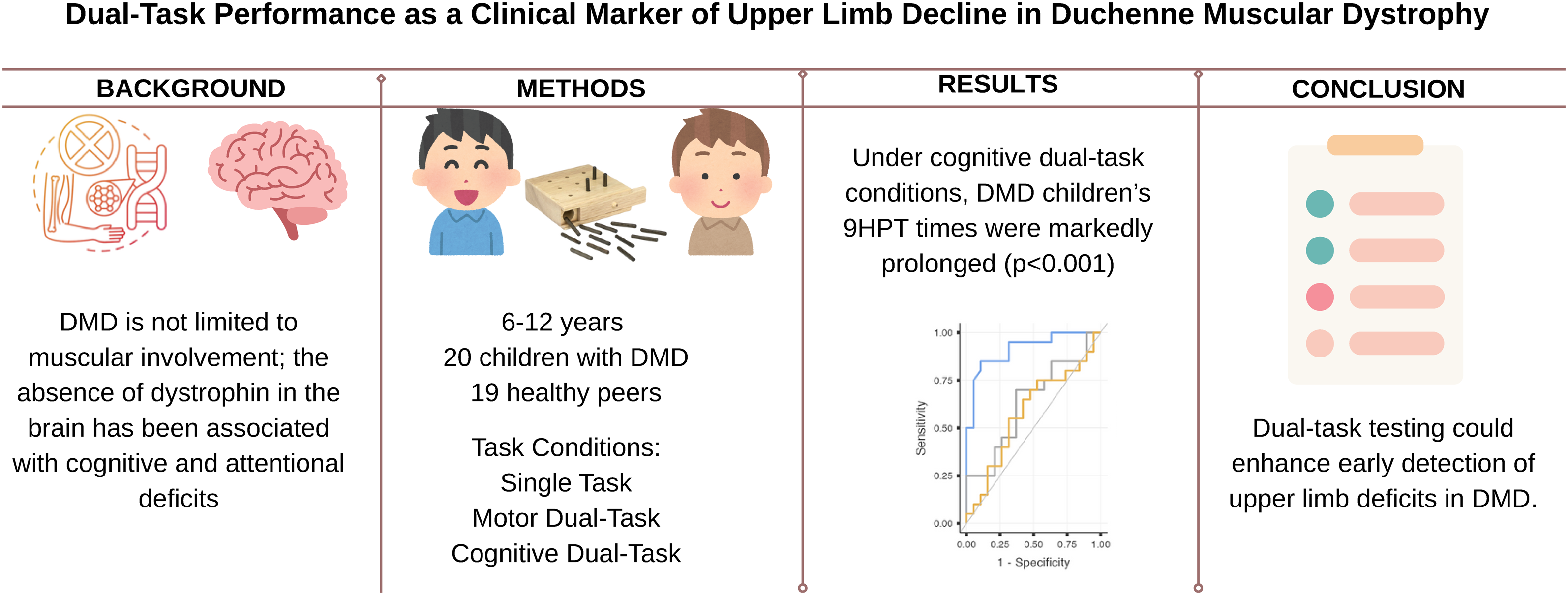
Get full access to this article
View all access options for this article.
References
Supplementary Material
Please find the following supplemental material available below.
For Open Access articles published under a Creative Commons License, all supplemental material carries the same license as the article it is associated with.
For non-Open Access articles published, all supplemental material carries a non-exclusive license, and permission requests for re-use of supplemental material or any part of supplemental material shall be sent directly to the copyright owner as specified in the copyright notice associated with the article.
