




Abstract
Objective:
To investigate patients’ and carers’ experiences of Early Supported Discharge services and inform future Early Supported Discharge service development and provision.
Design and subjects:
Semi-structured interviews were completed with 27 stroke patients and 15 carers in the Nottinghamshire region who met evidence-based Early Supported Discharge service eligibility criteria. Participants were either receiving Early Supported Discharge or conventional services.
Setting:
Community stroke services in Nottinghamshire, UK.
Results:
A thematic analysis process was applied to identify similarities and differences across datasets. Themes specific to participants receiving Early Supported Discharge services were: the home-based form of rehabilitation; speed of response; intensity and duration of therapy; respite time for the carer; rehabilitation exercises and provision of technical equipment; disjointed transition between Early Supported Discharge and ongoing rehabilitation services. Participants receiving Early Supported Discharge or conventional community services experienced difficulties related to: limited support in dealing with carer strain; lack of education and training of carers; inadequate provision and delivery of stroke-related information; disjointed transition between Early Supported Discharge and ongoing rehabilitation services.
Conclusions:
Accelerated hospital discharge and home-based rehabilitation was perceived positively by service users. The study findings highlight the need for Early Supported Discharge teams to address information and support needs of patients and carers and to monitor their impact on carers in addition to patients, using robust outcome measures.
Introduction
Early Supported Discharge services have been developed with the aim of accelerating hospital discharge and providing intensive multidisciplinary specialist rehabilitation at home at an equivalent intensity to that provided in an acute stroke unit. As healthcare provision in the patients’ home is increasingly recommended, Early Supported Discharge represents a cost-effective alternative to conventional hospital care for stroke patients. 1 Early Supported Discharge services have been implemented in regions across the UK, and internationally.
Evidence accumulating from randomized controlled trials has shown that, for a selected group of mild to moderate stroke patients, Early Supported Discharge can reduce long-term dependency and admission to institutional care. 2,3 It is likely that the physical and social home environment creates a better arena for relearning skills. This may enable both patient and carers to become more fully involved in decision making and provide greater insight and motivation. 4
The shift of care from the acute sector to the home setting however, can raise issues for both patients and their carers, as it is only once home, the full consequences of the illness are fully understood. The transition from the hospital to home setting can, therefore, be perceived as demanding and complex, leading to increased stress and burden, in addition to an adverse effect upon the psychological and physical well-being of carers. 5,6
There has been relatively little research addressing the impact of Early Supported Discharge schemes on the health and well-being of carers, producing inconsistent findings. These reflect the different services evaluated, and methods and outcome measures used across studies. Some studies have reported significantly heightened stress 2 and poorer mental health in carers receiving Early Supported Discharge. Other studies have shown no adverse impact on the subjective well-being 4 of carers and reduced caregiver burden 7 for carers of stroke patients receiving Early Supported Discharge compared with conventional services. However, none of the aforementioned studies used qualitative methodology to allow patients and carers to describe their experiences in their own words. Qualitative approaches are more appropriate if patient and carer experiences are to be more fully understood and are of value in informing future service delivery and development.
A recent review 8 of qualitative studies exploring patients and carers early discharge experiences (none of which focused specifically upon stroke Early Supported Discharge services) concluded that there has been too little post-discharge support for patients and carers. This is an area of research that has not been adequately addressed. The reviewed studies excluded patients with aphasia, were not conducted in the UK, and were longer-term studies when recollection may not have been accurate and other more recent concerns have altered the focus.
There is therefore a need for qualitative studies exploring patients and carers perceptions of Early Supported Discharge services during the early postdischarge phase in the UK. This information is of value in informing future Early Supported Discharge service development and provision.
Methods
Sample
In collaboration with hospital staff, patients who met the Early Supported Discharge selection criteria, in accordance with the Early Supported Discharge consensus 9 and Cochrane systematic review, 1 were recruited from two stroke units in the Nottinghamshire region. All patients with a confirmed diagnosis of stroke who were assessed by the medical team as requiring rehabilitation were suitable for the study according to the following Early Supported Discharge eligibility criteria: (1) Barthel Index ≥ 14/20; (2) within 14 days of stroke onset; (3) transfer independently or with assistance of one; (4) identified rehabilitation goals; (5) their hospital consultant agreed they were medically stable. Both patients (and their carers) who were referred to an Early Supported Discharge service, and patients (and carers) who met the recommended Cochrane criteria 1 but did not get referred to an Early Supported Discharge service, were recruited to the study. In this way we studied two naturally occurring groups of participants, allowing an ecologically valid exploration of patient and carer experiences of services operating in practice. The group of patients and carers not receiving Early Supported Discharge services were purposefully included to identify experiences specific to those eligible, but owing to living outside the geographical boundaries, were not able to receive Early Supported Discharge services. The cohort of participants not receiving Early Supported Discharge services were either hospital outpatients, receiving conventional community stroke services, or did not receive any rehabilitation. Patient and their carers were given an information sheet and those who wished to participate were invited to contact the researcher directly. We stressed that participation was voluntary and all information would be treated in confidence.
The study was approved by the Nottingham Research Ethics Committee 1, and written informed consent was obtained from all patients and identified carers.
Interviews
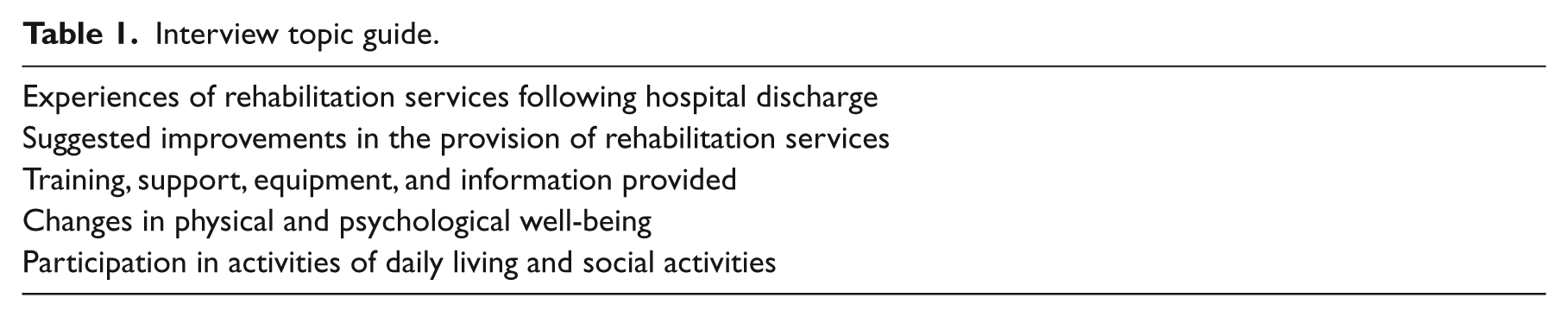
The duration of the interviews ranged from 30 to 45 minutes. The interviews were guided by a semi-structured interview framework, giving respondents a high degree of control over the conversation. Although each interview covered the same broad topics (Table 1), new topics introduced by the interviewee were discussed in detail as they arose. All interviews were conducted in the patients’ usual place of residence within one and six months of hospital discharge allowing participants to reliably comment on the services they were or had received. Interviews continued until data saturation was reached within each group. Interviews were audio recorded and transcribed verbatim with all personal identifiers removed. A qualitative data analysis software package (QSR NVivo 9) was used to organize the data efficiently and systematically.
Interview topic guide.
Analysis
Data from each group of interviews were analysed separately. A thematic analysis approach was followed to identify and report patterns (themes) within the data. 10,11 Identification of themes proceeded inductively, whereby datasets were read and codes were assigned to text segments that conveyed interesting information in relation to the research question. Through a qualitative constant comparison process, pieces of data (i.e. interviews, statements, or a theme) were continuously compared in order to identify similarities and differences. Relevant codes were grouped into subthemes and were then summarized to form main themes. The themes that emerged from each group of interviews were compared and contrasted, resulting in the identification of themes that were common across both groups and themes that were only informed by the responses of participants receiving Early Supported Discharge services. These two groups of themes are reported separately. Cases disconfirming the core themes were examined and reported. A second researcher reviewed the interview transcripts and checked the relevance of each theme. Differences in research perspective were discussed and agreement was reached.
Results
Interviews were carried out with 27 stroke patients and 15 informal carers, all of whom were spouses. The mean (SD) days of interviews completed post-hospital discharge was 69.5 ± 40.5 days. Of this sample, the cohort of participants receiving Early Supported Discharge consisted of 19 patients and nine carers. The mean (SD) age of patients after stroke was 69.85 ± 13.42 years and mean (SD) age of carers was 72.79 ± 14.10. Thirteen of the carers (87%) were women.
Early Supported Discharge specific themes
Satisfaction with rehabilitation exercises
Almost all interviewees (17 of 19) reported feeling satisfied with the various exercises they had been taught and left to complete, enabling optimal functional recovery: ‘Leaving me with the exercises to do made a massive, massive improvement’ (interview 2; patient). Patients frequently commented on the benefits of receiving therapeutic sessions both within and outside the home environment: ‘The team were encouraging and motivating and would take me on a walk to make sure I could get on a bus and that I was able to cross the road, things like that …’ (interview 12; patient).
Home as a better arena for rehabilitation
There was a consensus of preference among participants (15 of 19) for returning to their home environment as soon as possible: ‘Well, I was glad I was going home … I’m not saying the hospital was horrible, but I just didn’t like being in the hospital’ (interview 14; patient). Commonly, the home environment was described as a more private and individualized arena for rehabilitation: ‘if you’ve got any questions … you could ask them, whereas when you’re in a hospital, I feel that I can’t take up the people’s time because they haven’t really got time’ (interview 12; patient). Rehabilitation in the home environment was seen to be more cost-effective and less demanding. Furthermore, the home environment was perceived to be more focused toward rehabilitation outcomes: ‘… it was good to be given walks around the house and getting used to things that are here, such as steps and obstacles. And that has helped in that respect, getting back into the house’ (interview 3; patient).
Time not being a carer
Respite time for the carer (emerged as a significant and prominent theme), formed a core theme in the responses of carers (5 of 9) who reported that the therapeutic sessions between patient and the Early Supported Discharge (clinicians) team enabled them to engage in their own activities: ‘I could get on with the little jobs that wanted doing or I could just put my feet up and have a rest, so it made life a darn sight easier for me’ (interview 12; carer). On the contrary, two carers described feeling housebound as the team were ‘not with the patient long enough’ to enable sufficient respite time for the carer (interview 4; carer).
Speed of response
The majority (16 of 19) of patients reported feeling positively surprised with the seamless transition between hospital and home setting, with the first Early Supported Discharge home visit being made within 24 hours of hospital discharge. However, one participant reported having to wait several days for the Early Supported Discharge team to make their initial visit: ‘It was a few days of me coming from hospital. I was left without any help at all from the Thursday to the Monday I sort of had to fend for myself … I wished it could have started earlier than it did’ (interview 12; patient).
Intensity of therapy
The intensity of rehabilitation provided, of up to four visits per day, seven days per week for a duration of six weeks was received very positively by virtually every respondent (18 of 19). Participants talked about how the consistency and regularity of visits provided a sense of security during such a life-changing transitional period: ‘It was fantastic because every day I got at least two nurses or helpers to come … So you felt more secure then’ (interview 12; patient).
Satisfaction with provision and delivery of equipment
For patient safety purposes, the Early Supported Discharge teams complete an access visit to ensure all necessary equipment is in place for the patient prior to hospital discharge. There was a general consensus (10 of 19) among participants that the equipment provided was useful and delivered in a timely manner: ‘I’ve got that table and I’ve had two stools … Then I’ve got a seat in the toilet and in the shower. Then they tried them all out before they signed me off anyway. Well … I couldn’t do it without them’ (interview 13; patient). Nevertheless, one patient found the equipment provided unsuitable and one patient was disappointed at being promised aids that never materialized: ‘they’re really struggling to get these aids. So they said… ‘we’ll probably get you a sock aid to help you put your socks on,’ but I didn’t get one’ (interview 4; patient).
Disjointed transition between Early Supported Discharge and future services
Following Early Supported Discharge, if needed, patients are referred onto appropriate community services for on-going support and rehabilitation. However some patients felt that the six-week cut off from Early Supported Discharge was ‘abrupt’ and not ‘continuous enough’. Furthermore, some patients transferred onto further services did not feel that this transition was always well managed: ‘… all of a sudden it’s like, ‘Oh, we’ve referred you to the hospital again to get the physio,’ which has took, like, three months. So I’ve had intense physio for six weeks and then, for three months, I’ve had nothing’ (interview 2; patient).
Common themes in both cohorts of interviews
Limited support in dealing with carer strain
Carers are left feeling exhausted and physically strained: ‘Well I’m tired; I’ve lost such a lot of weight, it’s very demanding’ (interview 10; carer). In addition, carers reported having to undertake tasks previously the responsibility of a partner: ‘… more active me, I’ve had to be a lot more active than I used to be because he used to do well half of what I used to do’ (interview 6; carer).
Most carers (13 of 15) described suffering a reduction in time for leisure and social activities that, in turn, limited their opportunities for much needed social support: ‘Since he’s come home I’ve not really gone out very much. Normally I would just go out and do whatever, but I haven’t been able to do that since he’s come home from hospital’ (interview 5; carer). Not only had they had to respond to new roles and responsibilities in caring for the stroke survivor, but also to adapt to a new relationship with their spouse ‘I think the wife’s come more a carer than my wife now and she shouldn’t be’ (interview 17; patient).
Many respondents indicated that they felt thrown into the caring role without receiving enough support from the community stroke teams. They stressed the need for services to consider and address carers’ issues: ‘I’m very disappointed that they didn’t offer to help me, because obviously he would have had to go into a home or somewhere if I wasn’t doing it. So I mean I’m saving them a lot of money and time’ (interview 6; carer).
Lack of education and training of carers
Several (12 of 15) carers reported being poorly informed regarding the extent of support available after discharge: ‘I don’t think they told me anything, I was just left out in the cold … I didn’t have a clue what was going on …’ (interview 6; carer). They also felt neglected: ‘these health professionals forget about the carer who is looking after the sick patient’ (interview 10; carer).
The training of carers in how best to physically support the patient was described as inadequate: ‘I wasn’t physically shown the best way to support him … it was all trial and error’ (interview 8; carer). Carers also highlighted their difficulty in coping with the stroke patients’ emotional and psychological needs: ‘His depression … I just don’t know what to do. I can’t cope because I don’t know what to do to stop it. When he is continuously crying, it can be really wearing because you’re helpless’ (interview 5; carer).
Inadequate provision and delivery of information
In several interviews, both patients (15 of 26) and carers (10 of 14) expressed their concerns about their limited understanding of stroke and its causes, secondary preventative measures, and lifestyle changes: ‘I wouldn’t have a clue what was normal, what wasn’t normal … who to ask for help and advice. I mean the internet’s okay, but it only takes it so far. Sometimes you need a person to put it into terms that you understand. Because it’s stressful when you don’t know what’s going on’ (interview 8; patient).
Both patients and carers spoke of the difficulties they had encountered in accessing information concerning welfare benefits, carer allowance, statutory and informal support: ‘I thought it’d be good to talk about if you were entitled to any benefits because I’ve never been on the sick ever. I didn’t understand any of it, we had to figure it out for ourselves’ (interview 16; patient).
Many participants felt that the information was delivered in an inappropriate format: ‘It would have been nice to have somebody sit down with me and say this is what’s happened, this is why it’s happened, this is what you can expect. Okay, so it is there in the leaflets but you just kind of flick through the leaflets’ (interview 8; carer). Participants expressed their disappointment about having to wait lengthy periods before receiving some information ‘the information was good, but has come an awfully long time since my stroke’ (interview 7; patient). Many respondents described the information provided as failing to address their own needs and issues of concern: ‘You read the pamphlets, the leaflets and things, what to look for with strokes, but I mean the thing is, a lot of the things in there weren’t applicable’ (interview 12; patient).
Discussion
This study has provided insights into patient and carer experiences of Early Supported Discharge services and has highlighted areas for service development and provision. Accelerated hospital discharge and home-based rehabilitation were perceived positively and results stress the importance of exploring methods to address the information and support needs of service users. Findings also emphasize the need for current services to monitor their impact on carers and patients using standardized outcome measures. A greater understanding of the barriers to the smooth transfer of care between Early Supported Discharge and other services is also required.
Patients and their carers expressed great satisfaction about receiving rehabilitation within the home environment. This enabled patients to enjoy the benefits of life in their own home while receiving rehabilitation focused towards functional and achievable goals. Patients felt more able to undertake activities of daily living and re-achieve meaningful participation in their chosen life roles. These findings support previous research reporting domiciliary therapy as convenient, more comfortable, and allowing patient choice/decision making and greater understanding of therapy. 12 Rehabilitation commencement time and intensity, which were frequently commented on positively by respondents, are considered to be essential components of an Early Supported Discharge service and key predictors of post-stroke functional outcomes. 13
Nevertheless, carers reported feeling isolated, neglected, and excluded from the decision and discharge planning process. This is of great concern given that family involvement in rehabilitation is imperative to recovery. 14 Both patients and carers spoke of role changes and the impact of these changes on family and social relationships. Carers evidently require increased emotional support and may benefit from goal setting targeted towards their own specific needs.
Based on the study findings, we also argue the need for support and training for carers in skills essential for the day to day management of the stroke patient. Whether carer needs should be addressed by Early Supported Discharge or other community-based services remains to be investigated. We argue that the ethos of Early Supported Discharge needs to consider shifting from a patient-focused approach to a combined patient and caregiver-focused approach. It is important that Early Supported Discharge services implemented in regions other than Nottinghamshire are aware, if not already, of targeting their service inputs more specifically towards carers.
Early Supported Discharge trialists 9 failed to reach consensus on which outcome measures on carers Early Supported Discharge teams should collect. Our findings stress the importance of using carer, in addition to patient, outcome measures for the purposes of evaluating the effectiveness of a rehabilitation service and emphasize the inadequacy of using only traditional patient-centred outcome measures. 15 The contradictory findings of studies evaluating interventions to support carers, engender questions regarding the relevance and responsiveness of the measures used to assess outcome. Our findings highlight important aspects of the caregiving experience that could inform the development of a new self-rating measure of caregiver burden. 16
Both patients and their carers reported being inadequately informed regarding important aspects of stroke such as its causes and prognosis, secondary preventative measures, as well as statutory and informal support. Lack of knowledge in these areas has been identified as a source of anxiety and worry, and may contribute to patient’s failure to achieve their maximal potential. 17 Participants’ reports question the appropriateness and effectiveness of current methods of providing information to stroke patients and carers. We need to be clear about the specific information needs of patients and their carers, and further research is needed to evaluate the most timely, appropriate, and effective ways of providing such information. A recent review 18 found an active rather than a passive information provision strategy to be more effective in enhancing patient and carer knowledge, aspects of satisfaction, and depression. Another review 19 showed that patients with mild to moderate disability (i.e. those eligible for Early Supported Discharge) and their carers benefited from the input of stroke liaison workers, providing not only information but also emotional and social support to stroke patients and their families. Further research could explore the feasibility and effectiveness of a stroke liaison worker and an active information intervention as part of an Early Supported Discharge service.
A common theme among patients and carers was the dissatisfaction with the discontinuous transition between Early Supported Discharge and further rehabilitation services. Delayed transitions through the continuum of stroke care, leads to an increased risk of adverse events. 20 Close collaboration and clear communication between patients, family members, and healthcare providers is essential to ensure effective and safe transitions between Early Supported Discharge and ongoing rehabilitation services. Greater understanding is needed to identify the barriers and social processes affecting a smooth transition between services.
The use of qualitative methodology permitted the in-depth exploration of respondents’ perceptions and experiences. The constant comparison analytical process allowed the identification of similarities and differences between the two cohorts of interviews. Benefits specific to those receiving the Early Supported Discharge intervention were highlighted. We also identified challenges faced by both stroke patients and carers undergoing early rehabilitation at home. It has to be noted, however, that these qualitative comparisons do not provide information on the significance of the observed differences and consequently do not allow any assumptions on which intervention was more effective. The findings of this study are based on participants’ reports and, therefore, they are open to biases related to self-evaluation. Respondents’ willingness to provide feedback that would satisfy the researchers may have led to exaggerated and inaccurate descriptions. Although this possibility cannot be ruled out, in their narratives respondents appeared eager to provide a realistic appreciation of the programme identifying both beneficial aspects of Early Supported Discharge as well as areas of concern. The majority of interviews were conducted while patients were still receiving their rehabilitation intervention facilitating the timely and accurate recall of their experiences. It has to be noted that the majority of carers within the study were female spouses and therefore future research should address whether the identified issues are relevant to non-spousal carers such as daughters and male carers. The cross-sectional design of this study did not allow capturing changes over time. Future studies, incorporating quantitative measures, could assess the generilizability of the current findings and the sustainability of the effects of Early Supported Discharge interventions.
Using multiple qualitative data sources enhances the holistic understanding of a phenomena/ experience, 21 therefore incorporating additional methods would have enhanced the credibility of data collected. This study has provided unique insights into patients and carers experiences of Early Supported Discharge services and highlighted areas for service development and provision.
Clinical messages
Accelerated hospital discharge and intense home-based rehabilitation was perceived positively by patients and carers receiving Early Supported Discharge services.
A greater understanding of the barriers preventing smooth transfer of care between Early Supported Discharge and other services is required.
Early Supported Discharge services should consider monitoring the impact of their service on both patients and carers using robust outcome measures.
Information provision to patient and carers needs to be further addressed by services and research.
Footnotes
Acknowledgements
Grateful thanks are extended to the interviewees and to those who participated in the research.
Conflict of interest
None.
Funding
This is a CLAHRC study funded by the National Institute for Health Research. This article presents independent research commissioned by the National Institute for Health Research (NIHR). The views expressed in this article are those of the author(s) and not necessarily those of the NHS, the NIHR, or the Department of Health in England.