




Abstract
This paper concerns the role of spatial leadership in the development of the knowledge-based economy. It is argued within academic and practitioner circles that leadership of knowledge networks requires a particular non-hierarchical style that is required to establish an ambience conducive to networking and knowledge sharing across boundaries. In this paper, we explore this hypothesis at both theoretical and empirical levels. Theoretically, we propose a conceptualization of relational knowledge leadership, which is ‘nomadic’ in its capacity to travel across multiple scales and cross sectoral, thematic and geographical boundaries. We have operationalized this type of relational knowledge leadership along four key features, derived from literatures on regional learning, organizational leadership and place leadership. Two empirical case studies are then presented, one from Birmingham in the UK and one from Eindhoven in the Netherlands, exploring how these features are expressed on the sub-national level. Also conclusions are drawn regarding the status of relational knowledge leadership. It is argued that the concept of relational knowledge leadership as viewed through our analytical lens does accord with the experience of leadership in the two cases presented. The cases also show that this style of leadership is confronted with three types of tensions that play through knowledge networking. Furthermore, it is argued that the cases exhibit this style of leadership to different degrees, reflecting their different cultural and political contexts.
Introduction
In this paper, we consider the role of spatial leadership in the development of a post-industrial knowledge-based economy (KBE). Under the European Union 2020 exercise, a new generation of policies is being implemented which focuses upon promoting the KBE particularly at sub-national scales (CEC, 2010a, 2012). Over the last decade, the number of cities around the world announcing their formal intention to become ‘smarter’ in the KBE has grown significantly (Nicholds et al., forthcoming).
In this context, there is now widespread recognition in policy circles that development of the KBE depends upon cooperation, learning and knowledge sharing amongst networks of scientists, entrepreneurs, venture capitalists, firms and policymakers (Foray et al., 2009). The development of new knowledge cannot be predetermined but emerges from a mutual interaction between agency (what actors do) and structure (the organization or space in which they operate) (Grint, 2010). However, there is the tendency to ignore the complexities of the ‘human touch’ in social and economic progress (Collinge and Gibney, 2010: 380). This means we need ways of understanding how actors ‘see’ (interpret) knowledge and how they ‘do’ (enact) this through leadership (Nicholds et al., forthcoming; Sotarauta et al., 2012; Uhl Bein et al., 2007).
It is argued increasingly within the academic literature that the effectiveness of networks of varied actors depends upon a style of spatial leadership that is not confined within organizational, sectoral or spatial boundaries, but operates across and even erodes such boundaries, rendering these porous in order to facilitate expanded learning and knowledge sharing. In particular, it is suggested that such unconfined leadership can play an important role by facilitating networking and providing a ‘leadership of leadership’ – the second-order leadership, which fosters an ambience that allows specialist local leaderships to emerge and to operate within particular domains. However, this mode of leadership remains as yet underspecified at a theoretical level, and its impact upon knowledge networking and sharing at sub-national scales remains as yet under-examined at an empirical level (Sotarauta et al., 2012).
Our objective here is to contribute to the investigation of spatial leadership and the role it plays in the facilitation of the KBE, sub-nationally. Leadership that spans, disrupts and erodes established (organizational, sectorial and territorial) boundaries; that promotes networking – taking into account a multiplicity and novelty of relations and practices; and that performs a framing ‘leadership of leadership’ role is conceptualized here as Relational Knowledge Leadership (RKL).
In the organizational literature, relational leadership is often defined in the context of social exchange focusing on leader–member exchange (Dinh et al., 2014). Here we define relational as trans-territorial, derived from geographic literatures on space and place (Amin, 2004; Cresswell, 2004; Massey, 1991, 1993, 2004; Massey, 2005). These literatures consider places as nodes in networks, as points of intersection, in which the global and the local are mutually constructed and are seen in terms of connectivity. Places are thus dynamic assemblages of social relations reconfigured through processes of restructuring and continuously changing as a result of economic, institutional and cultural transformation (Woods, 2015). The local knowledge economy, being part of a wider set of relations shaped by material and ideational ordering processes, can be analysed by investigating place-shaping practices and how actors negotiate their involvement in trans-territorial networks.
Our focus here is on the capacity of leadership, how it operates in these fluid spaces and networks, able to restructure or reassemble the prevailing web of relations they are part of and stretching beyond geographical and administrative boundaries. RKL is thus positioned here as working in open dynamic contexts, as places do not have prescribed identities but ‘become’ (see also Paasi, 2010), resulting from social processes and practices which distribute people in unbounded networks. Such leadership ‘prioritizes the enabling and guiding of a more fluid, relational interaction and collaboration between a wider range of individuals, institutions, firms and other community level groups who are unlikely to share ideological views’ (Nicholds et al., forthcoming). Knowledge developments play out across a number of geographical scales, and those in leadership roles are obliged also to move between these scales (Fairtlough, 2005). RKL can be considered as ‘nomadic’ in its flexible capacity to connect and travel across multiple scales, taking into account a multiplicity of actors and novelties in ideas and practices. It promotes innovation by drawing together learning from across institutional, disciplinary, sectoral and spatial boundaries, and by facilitating dialogue between diverse stakeholders. At key moments, strategic intentions and unforeseen opportunities can coincide serendipitously, and leadership must be positioned to enable such opportunities to be recognized and exploited (Sotarauta et al., 2012).
The relevance of working across organizations and governance scales has been acknowledged in the bodies of literature on place leadership and distributed leadership, but these literatures tend to position leadership within a bounded political-administrative context. We however aim to explore how leadership can mobilize cross-functional and cross-thematic learning in horizontal networks, beyond such contexts.
Key questions are as follows: how does RKL emerge in the knowledge economy; how is it sustained across bounded administrative territories; and how do leaders build networks, human capacities and support cross-organizational learning, key to effectuate the knowledge economy.
Theoretically, we will address these questions by conceptualizing the notion of RKL along four key features. Empirically, RKL will be illustrated via a pair of case studies – Birmingham in the UK and Eindhoven in the Netherlands – with different institutional contexts. We will show how RKL emerges in these cases, supporting the KBE, and how the key features of RKL manifest itself in these cases. The cases also reflect tensions that play through knowledge networking and that allow important differences between the cases to be identified.
The paper is organized as follows. In the first section, we consider the relationship between leadership and knowledge in organizations and in places through a review of the literature. Against this background it is hypothesized that a new relational style of leadership is emerging and making an important contribution to the genesis of knowledge useful to the sub-national KBE. An operationalization of RKL is then presented that assembles – in a stylized form – a set of key features from these literatures and that is used to inform the empirical research and to guide interpretation of the data. The paper sets out the research methodology and then presents the experience of leadership in Birmingham Science City (BSC) in England, and in Brainport Eindhoven (BE) in the Netherlands, showing if and how the key features of RKL are expressed in these cases. Conclusions are then drawn regarding the value of the concept of RKL and the differences between the cases in terms of the tensions they exhibit. These differences have implications for practice as well as for future research into the role of leadership in the KBE.
RKL
Over the last decade, knowledge creation, diffusion and exploitation have emerged as important themes in the promotion of economic development in cities and regions. In this context, an interest in knowledge leadership has begun to crystallize as part of the effort to understand and to strengthen networking processes in regional innovation (Bason, 2010; Hartley and Allison, 2002; Krogh et al., 2012; Viitala, 2004; Williams and Sullivan, 2011). This interest confronts the intellectual certainties of earlier eras regarding the role of organizational hierarchies, sectoral segments and territorial boundaries, and it promotes a shift in the emphasis of leadership studies away from heroic, vertical, closed images towards modest, lateral, open images of identity and authority. In particular, it is argued that leadership in the development of the KBE at sub-national levels is no longer restricted to such bounded domains as organizations and territories, but operates with increasing flexibility across or beneath these boundaries.
This new emphasis within leadership practice requires a new conceptualization of knowledge leadership as relational – as a function that moves across boundaries in a fluid and contingent process of learning and creation. Whatever the complexity of hierarchical leadership, relational leadership is likely to be more complex, involving flows across a plurality of hierarchies, identities, territories, sectors and disciplines, without deference to the proprieties of such domains (Grint, 2010: 365). In responding to this phenomenon, however, it is important to consider how such leadership emerges and is sustained across bounded territories (both organizational and spatial hierarchies). There are a number of relevant insights concerning the dynamics of knowledge and leadership to be found within the business and public policy and organizational literatures, insights that can fruitfully be drawn upon for our purposes here.
Learning and leadership within organizations
Dinh et al. (2014) found based on an extensive qualitative review of organizational leadership theory that the context of leadership is no longer neglected in research and that ‘leading for creativity, innovation and change’ has seen significant research recently.
A key feature of knowledge leadership is the conditioning and mobilization of learning, and the literature in this field offers insights regarding leadership for the mobilization of cross-functional and cross-thematic learning in horizontal networks (Ichijo and Nonaka, 2007; Krogh et al., 2000, 2012). Krogh et al. (2000) argue that effective leadership for knowledge creation depends upon creation of an enabling environment and that leadership is a critical factor in drawing out the interdependencies between learning processes, knowledge assets and organizational contexts (Krogh et al., 2012: 240).
The purpose of cross-thematic leadership in knowledge development is described as, amongst other things, to foster a climate that supports and facilitates learning (Viitala, 2004: 538). A key message from this literature is that formal leadership is less important in knowledge creation than informal leadership amongst groups of people who share common interests, expertise and orientations (Krogh et al., 2012: 260). Successful RKL is likely to be distributed across networks of workers, to promote the exchange of energy and ideas on a reciprocal basis, and to move in a fluid manner as participants shift between leading and following (Srivastava et al., 2006). Where complex problems are to be tackled, in particular those performing leadership roles must share power across loosely structured partnerships, collaborations and impermanent (vital) coalitions (Horlings, 2010). ‘Empowering leadership’ is seen as providing the essential preconditions for learning by facilitating interactions amongst relatively autonomous agents, ideas and technologies, rather than relying ‘on a few brains at the top’ (Uhl-Bien et al., 2007: 300). Functional and professional boundaries are undermined, and prior assumptions concerning authority and deference are replaced by an emphasis upon team working and networking (Crosby and Bryson, 2005).
Learning and leadership within space and place
There has been something of a spatial turn in leadership research, with a focus particularly upon sub-national levels, and this research has added to our understanding of the relationship between leadership, knowledge and spatial economic development (Collinge et al., 2011; Gibney, 2012; Grint and Holt, 2011; Hemphill et al., 2006; Sotarauta et al., 2012). ‘Spatial’ here is a more general concept than ‘territorial’: it is an open relational domain in which territories may (or may not) be seen as politically defined, bounded spaces. In the contested setting of sub-national public policy, diverse ingredients such as politicians, pressure groups, entrepreneurial and research organizations complicate the processes of knowledge generation that are required to engender innovation. Where organization, sector and territory interact, economic development requires the adroit integration of political, economic and social dynamics, and the stewarding of networked learning and innovation. In multi-organizational, multi-disciplinary, multi-territorial settings, leadership plays a critical framing role: promoting an atmosphere of openness and trust so that effective knowledge creation and transfer can occur; ensuring the blending of individual and collective learning processes; maintaining the creative space required for spontaneous learning to occur. Although formal authority may be required to ensure that appropriate organizational arrangements are in place, trans-organizational, trans-disciplinary and trans-territorial (relational) leadership is regarded as most likely to be effective in conditioning a learning-oriented public policy (Williams and Sullivan, 2011: 16/17). The importance of the governance framework for learning and knowledge sharing in networks has been emphasized by a number of writers on public policy: Effective knowledge transfer and application within inter-organizational public service networks depends crucially on how the network is formed and sustained, how differences of perspective and conflicts of interest within the network are tackled, how knowledge is shared and applied, under what circumstances, and with what advantages and disadvantages for whom. (Hartley and Bennington, 2006: 102)
RKL promotes innovation by drawing together and focusing learning from across institutional, disciplinary, sectoral and spatial boundaries, and by facilitating dialogue between diverse stakeholders. At key moments, strategic intentions and unforeseen opportunities can coincide serendipitously, and leadership must be positioned to enable such opportunities to be recognized and exploited (Sotarauta et al., 2012). As knowledge developments play out across a number of geographical scales, leadership has to move between these scales (Fairtlough, 2005). This supplements organizational and political notions of leadership by paying greater attention to the fluid, contingent and dynamic conditions of change on cities and regions where rational/technical planning intersects with meanings, values and relationships (Nicholds et al., forthcoming).
By operating in different spaces such leadership shows a rich palette of both relational and technical attributes (Gibney et al., 2009: 8). In the context of a Smart City setting, for example, the idea of the all-powerful, individual transformational leader has little currency (Nicholds et al., forthcoming). Instead notions of shared, collaborative or distributed leadership would be more valid (Horlings, 2010; Sotarauta et al., 2012). This leads us beyond the popular obsession with the idea of heroic leadership that emphasizes the role of individuals and their alleged heroic traits in positions of formal positional power and authority (Sotarauta et al., forthcoming). Sotarauta (2016) also argues that in many sub-national settings leadership can be thought of as a more discrete form of agency, which may at times challenge wider contextual constraints and path dependency tendencies.
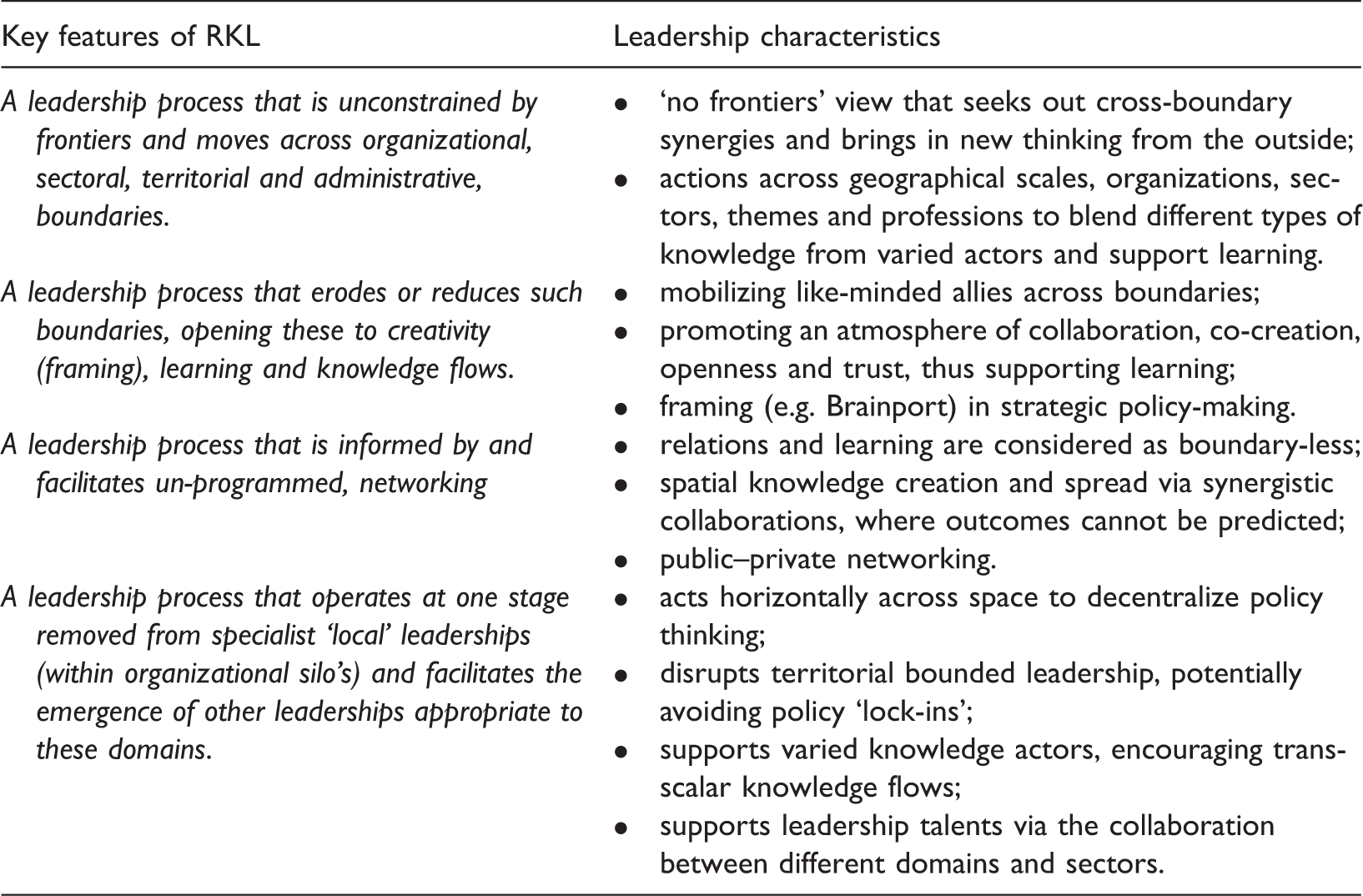
To summarize, RKL can for our purposes be conceived as having four key strategic features:
a leadership process that is unconstrained by frontiers and moves across organizational, sectoral, territorial and administrative boundaries; that erodes or reduces such boundaries, opening these to learning, creativity (framing) and knowledge flows; that is informed by and facilitates un-programmed networking; that operates at one stage removed from specialist ‘local’ leaderships (within organizations, themes, territories and scales) and facilitates the emergence of leaderships appropriate to these domains.
It is hypothesized here that this style of leadership is emerging and making an important contribution to the genesis of knowledge useful to the KBE. The four features of RKL suggest anticipated aspects that may be extant in real places and can be used to guide investigations of empirical cases. In this context, our three objectives have been as follows: first, to develop a broad picture of RKL; second, to report on qualitative case research in Birmingham and Eindhoven to assess the extent to which these key features have empirical purchase and utility; third, to elucidate certain differences between the cases in terms of three tensions uncovered in the field survey.
Methodology
The research for this paper was carried out via interviews and document analysis. Two cases, BSC in England and BE in the Netherlands, were chosen for an empirical exploration of leadership in sub-national knowledge policy environments. To ground the cases, a desk-based review of the literature on the recent economic development trajectories and strategies in both cases was undertaken. To gather expert perspectives on the leadership experience, data were collected via a combination of informal discussions and face-to-face interviews with 20 key individuals across two distinct groups. Group 1 interviewees included five board level members/senior executives in BSC and five in BE. These individuals were selected because they occupied influential roles as either strategic decision-makers or senior managers in the two core organizations. A second group of interviewees, Group 2, comprised five senior executives in each of the two case areas who were employed in other local partner or stakeholder organizations, and where these organizations were working on knowledge-oriented development projects. In this second group, we were interested in gathering information on how others were experiencing the leadership approach(es) enacted by Group 1. The 20 interviews were semi-structured to allow individuals to talk freely about their leadership approach, aspirations and experiences and on a wholly anonymous basis. Where interviewees were uncomfortable with being audio recorded, detailed written notes were taken with their permission and then reviewed immediately. Over 20 hours of interview data were collected and these data were reviewed with reference to the identified four strategic features.
Leadership in BSC and BE
BSC and BE are contemporary examples of organizational forms, tasked with supporting knowledge policy initiatives in city regions that have experienced heightening international competition, deindustrialization and economic restructuring. In both cases there are formal policies towards stimulating economic growth and employment through investment in a variety of knowledge-oriented collaborations between businesses, Universities, science parks, local authorities and other local public services. Birmingham (the UK’s second city) has experienced significant economic restructuring in the last 30 years, following decline in traditional manufacturing and growth in the retail and service sectors including knowledge and creative industries (Brown et al., 2007; Burfitt and Ferrari, 2008; Crossa et al., 2010; Gibney et al., 2009). To strengthen the city’s economy and the resilience of local communities, BSC, one of six UK Science Cities, was established in 2005 as part of the response to the collapse of the MG Rover car company in 2000, and to the loss of some 40,000 jobs in the automotive supply chain. Since then it has developed into a multi-partner initiative that draws upon the strengths of the city’s research, engineering and technological facilities, including its Universities; and to improve prosperity and quality of life by working closely with businesses and public sector entities (Birmingham Science City, 2011). BSC faces complex leadership challenges in attempting to align the city’s workforce with a science and technology based occupational structure at a time of significant demographic change.
Some 25 years ago, Eindhoven was an industrial town deeply affected by economic and social decline also due to processes of deindustrialization. In the 1990s, the bankruptcy of the DAF automobile factory and ensuing job losses, coupled with questions over the financial soundness of the electronics entity Philips, pressed the city and its surrounding region to reinvent itself as the principal high technology ‘node’ of the Netherlands (Fernandez-Maldonado and Romein, 2009). The area is now at the heart of an ambitious national knowledge policy agenda – the Brainport initiative – and has a strategic focus on investing in technology innovation across high technology systems (ICTs, micro-electronics, automotive and mechatronics), new materials (nanotechnology), the creative industries, the food industry, the life sciences and medical technology (Fernández-Malodonado, 2012). The largest concentration of high technology firms in the Netherlands is within the city of Eindhoven, which is located in the south-west of the province of Brabant, some 100 km from the Randstad and is presently considered as an example of economic and social reinvention. In 2011, the Intelligent Community Forum declared Eindhoven to be one of the ‘smartest’ regions in the world.
The strategic KBE ambitions of BE are based around a number of linked sub-strategies that include people (the development of human capital and entrepreneurship); open innovation and (public sector) support for business and technology (which includes design); integrated governance, international technology networking and quality of place (concerned with securing lifestyle and infrastructure investment so as to ensure an appropriate people-oriented climate for growth) (Brainport Region Eindhoven, 2012).
Taking the RKL features as our frame of reference, evidence from the research suggests that there is much commonality across leadership experiences in these two sites. In both BSC and BE, knowledge creation and distribution are enhanced by ‘nomadic’ leadership practices, stretching and traveling beyond geographical boundaries, that are assisted by gathering strategic narratives (verbalized at meetings, conferences and events and expressed in strategy documents) that promote the logic of knowledge sharing across boundaries (Birmingham Science City, 2011, 2013; Brainport Region Eindhoven, 2012). Board-level members and senior executives of BSC and BE have taken significant political risks in challenging policy silo mentalities and in pursuing a number of explicit priorities for the sub-national KBE. They are bringing together disparate organizations and individuals (across Universities, vocational training Colleges, public authorities and firms) in attempts to foster the integration of different types of knowledge found locally.
In the case of BSC, this has involved championing more collaborative decision-making, for example, around the allocation of new funds from EU, national and local bodies into three innovative but unproven KBE themes (translational medicine, low carbon energy futures and the digital economy), as well as stimulating dialogue in areas where local knowledge capacity has existed for some time (in the local healthcare sector, for example) but has been fragmented.
In the case of BE, conflicting interests, place-based narratives and networked politics of place all played a role in enhancing entrepreneurial synergies. Central was the market orientation and the shift from a manufacturing to a top-technology region. Short-term private projects were not captured in strategic policy plans but in operational action plans such as Horizon 2002–2006 and Brainport Navigator 2013.
Leadership played a brokerage role in cross-sector collaboration between manufacturing, design and health, supporting learning beyond the regional and national scale and bridging the worlds of knowledge, private sector and government. Leadership not only ‘strategized’ supporting the KBE, but also created formal as well as voluntary relationships within and between institutional settings and individuals, cohering knowledge assets around the collaborative storyline of Brainport (Horlings, 2014).
In both places, leadership framed an atmosphere resulting in a greater degree of trust, reciprocity, pooling of resources. Sharing of knowledge between partners has emerged over time, assisted by a leadership approach that eschews an over-reliance on top-down directing practices of vertical organizational hierarchies and that seeks instead to mobilize and combine individuals and assets across space. Leaders translated external stimuli into internal changes by acting as ‘animateurs’ (Sotarauta et al., 2012).
In both cases, much emphasis was placed on the need to nurture, maintain and exploit positive ‘personal chemistries’ across all leadership cohorts. There is also evidence of leadership practices working to break down organizational, disciplinary and sub-territorial boundaries in order to encourage power sharing and collective approaches to decision-making – through the sub-national federal governance arrangements in place at BE and through the science and technology thematic working groups that have been established by BSC.
Regarding the facilitation and prompting of other leaderships, BE displays a highly mobile ‘no frontiers’ approach to KBE promotion that extends beyond the national borders of the Netherlands. Respondents suggest that BE’s wider geographical success is underpinned by the time and energy spent on building and exploiting its transnational leader networks. This has led to BE’s involvement in a number of active trans-border collaboration projects. For example, the Mayors of Eindhoven, Leuven (Belgium) and Aachen (Germany) signed a cooperation agreement, ‘Mayors for Innovation’, and this has framed the development of a number of common ICT and healthcare projects between the three cities in the so-called ELAT trans-border Technology Triangle. An outcome of the focus on cross-thematic working adopted by BE has been the decision taken by the Technical University of Eindhoven to reorient its vocational training curriculum to accommodate a number of sectoral priorities identified in the BE strategy.
Finally, BSC and BE have both focused their efforts on stimulating collaborative science and technology projects for long-range (trans-generational) knowledge accumulation, where the scale and values of any commercial returns are not immediately evident, but where there may be long-term un-programmed and serendipitous benefits for the economy.
Relational knowledge leadership in BE and BSC.
BE: Brainport Eindhoven; BSC Birmingham Science City; RKL: relational knowledge leadership.
Tensions in knowledge networking
The two case studies (BSC and BE) illustrate the features on RKL. The cases also showed certain tensions in the operation of RKL in concrete institutional settings. In particular, our discussions with leaders suggest that the RKL ideal type is confronted by three tensions between:
Collaborative versus hierarchical knowledge leadership
Relational versus territorial knowledge leadership
Open versus bounded time frames.
In order to manage such tensions, the coordinating secretariats of BSC and BE have attempted to establish themselves as non-aligned ‘intelligent enablers’ with little formal power who facilitate open-source working between organizations, themes, sectors and territories (Collinge and Gibney, 2011). This approach has, however, encountered resistance from pre-existing institutional tendencies along the above dimensions.
Collaborative versus hierarchical knowledge leadership
Respondents in both areas described a tension between their own organizational leadership priorities on the one hand, and the pursuit of a more wider cross-boundary and collaborative working aspirations on the other. Some of those involved in middle-level leadership roles – around particular science and technology initiatives – reported in particular that there was ongoing competition between organizations over resources, competition which was in tension with their explicit commitment to cross-boundary power sharing, knowledge pooling and collaborative problem-solving.
In the case of BSC this tension was more acute and is explained in part by a nationally imposed reorganization of sub-national economic development in 2010. BSC was establishing itself at a time when the former Regional Development Agencies in England (established under the previous national Labour Administration) were being dismantled by an incoming national Conservative/Liberal coalition government. A significant strategic vacuum opened up which caused a degree of uncertainty and suspicion amongst public and private organizations across the city and regional economic development landscape. With uncertainty prevailing over the future shape of the policy and resources arrangements for sub-national economic development, local organizations tended to retrench into their respective core operational silos. Whilst its own leadership team retained a commitment to RKL practices, at times BSC struggled to extend a collaborative ambience and to stimulate a territory-wide sensibility to knowledge sharing. There has been some ongoing difficulty encountered in resolving cooperation and competition agendas, and hence knowledge sharing between partners appears to work well, but only where and when the wider policy and resource context is relatively stable and organizations are not forced into direct competition for resources and/or market share as a result of wider contextual instability beyond their control.
In contrast, the economic recession since the 2000s in the Eurozone did not seem to undermine the effects of RKL leadership practices within Eindhoven. Interviewees considered the success of BE to be the result of the increasing levels of cooperation stimulated between top scientists from a wide range of academic disciplines and fields, and producers, designers and ‘marketeers’ at the regional scale. BE’s leadership has sought to persuade people to transcend their organizational affiliations and improve local institutional cooperation with the establishment of the Eindhoven Foundation since 1993, bringing together the political and technical capacities of the city of Eindhoven and other surrounding local authorities. It has also established a territorial solidarity fund to combine resources for investment in re-industrialization and which turned out to be beneficial during the crisis in 2008. Regional cohesion appeared to have been strengthened through hands-off leadership provided by the Brainport Eindhoven Foundation and its implementation arm Brainport Development. Although local authorities had contributed financially to the BE Foundation, the leadership role around visioning, programming and implementation lay collectively with all of the actors, and power and influence over resource decision-making appeared more widely shared than in the BSC case. There appeared to be a greater ability to combine competition with cooperation for mutual benefit and a more widely anchored appreciation across the public and private sector that ‘if you share, you multiply’ (see also ESPON, 2012).
Relational versus territorial knowledge leadership
In both case areas, leadership has sought to embed the idea of improving the levels of knowledge integration for economic gain. But although RKL practices have had a beneficial integrative effect, some frictions continued. The leadership approach to knowledge creation and exploitation in BSC was described variously in the interview data as representing the idea of collaborative working and co-production across boundaries. But this idea had encountered some difficulties, for example, when dealing with competing governmental hierarchies in regard to sub-national health technology and vocational skills agendas. BSC leadership had no direct authority over National Health Service investment decisions concerning the development of new healthcare technologies – making for time-extensive negotiations around the establishment of a new Centre for Translational Medicine in Birmingham. Similarly, as integration of the vocational training curriculum was largely the remit of national education and skills policy in England, strategic national discussions bypassed any local control.
With regard to the BE case, respondents reported that an atmosphere of reciprocity, openness and trust generally prevailed that enabled the integration of knowledge resources. Here respondents reported rather than BE might become a victim of its own success, and there was an upcoming problem of leadership capacity in the future as a result of growing leadership ‘stretch’. This was associated with the rolling out of the Brainport approach across a wider territory, to include the whole southeast region of the Netherlands along with grander cross-border aspiration to increase KBE cooperation with neighbouring sub-regions in Belgium and Germany.
The interview data also raised important questions regarding knowledge ownership versus knowledge distribution in the spatial development setting. In both case study areas, the conventional business management view prevailed. Stakeholders were naturally looking to protect their intellectual property rights in order to maximize economic value. Tightly guarded IP portfolios, however, work against knowledge spillovers and RKL agendas concerned with enabling a more open-source and inclusive approach to knowledge distribution.
When it came to the question of integrating knowledge assets and capabilities across territories, the discussions with those in leadership roles in BSC and BE pointed to a leadership experience characterized by tensions between the obligation to secure knowledge ownership within territories, and the aspiration to achieve knowledge sharing across territories – echoing what has been identified elsewhere as the disclosure and secrecy issue, or the knowledge trade-off problem (Amin and Cohendet, 2004: 142). This remains a significant leadership challenge in both case areas and may be one of the most constraining influences of all on RKL practices.
Open versus bounded timeframes
In both BE and BSC, private sector partners reported a tension between the longer term spatial development perspective that the areas require and the shorter term time scales imposed by their need to demonstrate an economic return. Private sector respondents reported that, whilst they were able to negotiate a degree of creative space around their work, ultimately their head offices were concerned with securing some measurable business gain over the shorter term. If this business return was not forthcoming or experienced, then there was a significant question mark over the sustainability of the leadership investment being made by the private sector partners. At the very least there was a feeling that limited commercial returns would result in a degree of business partner (and leadership talent) ‘churn’ at both Board and project management levels. The importance of stimulating a long-term accumulation of knowledge was widely understood in both case areas, but this ambition remained confronted by short-term performance anxieties driven by the pressure on organizations to secure some commercial returns. More long range knowledge-based improvements in the sub-national economy might therefore be threatened, it was observed, and the ability to maintain, attract and develop an ever-improving stock of leadership talent was likely to be undermined.
It has taken some time to embed RKL practices in both case study areas. However, in the BE case the emergence of leadership ambitions appears rooted in the area’s industrial and economic development policy history, with a long tradition of public–private cooperation across boundaries and territories. This leadership style has therefore been developing and adapting consistently over the last 30 years despite periods of political upheaval and economic recession.
In Birmingham, however, despite the collapse of the MG Rover car company in 2000, a fully integrated approach to KBE policy was not embraced operationally until around 2004/2005, when the BSC (and its sub-regional forerunner, the West Midlands Central Technology Belt Company Ltd) was established (see further Gibney et al., 2009). In the case of BSC, there is also evidence that continuous and unpredictable nationally determined changes to the organization of sub-national economic development policy over the last decade have compromised the speed of adoption and spread of RKL-type practices. The BSC case demonstrates that time and a stable framing context are needed for leadership approaches to emerge that engender easy collaborative working and a ‘no frontiers’ worldview.
Conclusions
Acknowledgement of the importance of learning and knowledge networking is provoking a reconsideration of spatial leadership practices associated with knowledge dynamics. In this paper, we have put forward the hypothesis that a new, relational, knowledge style of leadership is emerging that, through its ability to engender creativity and cooperation, is making an important contribution to the learning that is useful to the KBE. This hypothesis has been focused and sharpened by contrasting this style of leadership with a less collaborative and more hierarchical, and geographically bounded style of leadership.
RKL has been operationalized by means of four key features. Data from two empirical case studies – BSC and BE – have been presented, and it has been concluded on this basis that these features do allow us to identify the more concrete characteristics of leadership in real places. From the evidence presented it can also be concluded that this lens enables a comparison to be made between the two cases according to their leadership of three key tensions.
We suggest that the extent and resolution of the tensions between leadership patterns varies between states and their sub-territories according to their different cultures, histories and constitutions – for example, as between a centralized unitary (UK) and a devolved federal (Netherlands) state. On this basis, it has been argued that the BE case at the time of data collection provided a closer approximation to the features of RKL than in the BSC case, and that the management of these tensions has progressed further in Eindhoven than in Birmingham.
Needless to say, these comparisons and conclusions are based on one pair of cases, and more detailed and extensive research is required to test and extend the approach presented. Through our conceptualization of RKL and the presentation of case studies that are similar but different, we have sought to move the debate about leadership forward by drawing out the dynamics of a virtual but important style of leadership that is particularly conducive to knowledge generation and that has a relational wisdom of its own.
Footnotes
Acknowledgements
This paper has been stimulated by the work of the Regional Studies Association international research network on Leadership in Urban and Regional Development. We are grateful also to Markku Sotarauta for reactions to an earlier draft and for encouragement. All the usual disclaimers apply.
Declaration of conflicting interests
The author(s) declared no potential conflicts of interest with respect to the research, authorship, and/or publication of this article.
Funding
The author(s) received no financial support for the research, authorship, and/or publication of this article.