



Abstract
In the context of globalisation, the sustainability of traditional manufacturing sectors depends on the ability of firms to modernise and diversify. To remain competitive against emerging economies in high-volume and low-technology areas, firms must engage in high-value manufacturing. This paper uses theoretical underpinnings from strategic management and place-based approaches to provide a historical account of competitive strategies of traditional manufacturing firms in the West Midlands region of the UK between 2010 and 2012 where the automotive, ceramics, glass and clothing sectors are examined. The research methodology is based on critical realist philosophy, which emphasizes an in-depth understanding of firm behaviour and acknowledges sensitivity to differences in decision-making. The paper highlights the complexity of competitive behaviour, which is influenced by enabling and constraining factors. While the evidence presented in the paper is from 2010 to 2012, it emphasizes the need for a participatory, farsighted, and proactive policy approach to retain the historic industrial character of the region.
Keywords
Introduction
Whether Brexit has served its economic purpose is debatable and when assessed purely in terms of small manufacturing firms in the supply chain, then trade barriers are less than promising (Bailey et al., 2023). To add to this, Covid-19 has further impacted the UK’s manufacturing (Harris et al., 2020). The war in Ukraine has led to heightened energy costs and manufacturers including UK’s automotive manufacturers have demanded urgent action (see Society of Motor Manufacturers and Traders, 2022). Regarding climate change, the UK is committed to achieving net zero emissions by 2050 (HM Government, 2021) and in relation to the automotive sector, this means all new cars and vans will be zero emission by 2035 (Department for International Trade, 2022). Bailey and Tomlinson (2024) have emphasised the need to focus on industrial policies and net zero to effectively compete with the United States (US), European Union (EU) and China. Against this contemporary backdrop, it becomes imperative to understand the impact of globalisation on traditional manufacturing sectors.
Globalisation can be characterised as a phenomenon of the post-1970s era (Hirst et al., 2009). In a global world, the production, distribution and consumption of goods and services become a part of a complex process (Dicken, 2015). Some important frameworks such as Global Commodity Chain (GCC) (Gereffi, 1994), Global Value Chain (GVC) (Gereffi, 1999; Gereffi et al., 2005) and Global Production Networks (GPNs) (Coe et al., 2008; Dicken, 2015) are useful in knowing how the focus has moved from a commodity to entire value chain and then networks of economic activities. This reflects the changing emphasis because of a changing context – an outcome of globalisation.
The complexity that constitutes global trade, in which most countries operate, is an interesting subject area for the academics and practitioners of both the developed and the developing worlds. Although these two worlds share a common interest in understanding globalisation, their respective areas of focus remain place-specific. For instance, competing in price-sensitive markets is no longer considered a viable strategy for the manufacturing sectors of developed countries that is justified based on their increasing reliance on low-cost destinations for manufacturing (Dicken, 2015). This ‘decoupling’ of various manufacturing activities has meant that labour-intensive activities are performed in other, cost-advantageous countries of the world, leaving more value-added activities (generally characterised in the context of inputs such as design, technology, software, branding and marketing) for higher-cost countries. The latter thus face the choice of competing either in cost by outsourcing or in high-value-added niches.
The manufacturing strategies of regions/countries are set within a context and knowledge of this changing context is essential. In this view, it becomes compelling to situate the impact of globalisation by examining the case of a traditional manufacturing region such as the UK’s West Midlands. The principal aim of this study is therefore to investigate the impact of globalisation on four traditional manufacturing sectors of the West Midlands – automotive, ceramics, glass and clothing. This is done by presenting a historical account of competitive strategies from 2010 to 2012. By doing so the paper validates the ever-changing environment, as outlined at the outset, within which traditional manufacturing operates and responds.
The paper is structured in six further sections: the first presents the regional context and the four sectors; the second outlines the theoretical foundation of the research using a combination of strategic management and place-based approaches, followed by an understanding of the critical realist conceptual framework; the third describes the chosen research methodology; the fourth discusses the empirical findings; the fifth draws out some policy implications concerning traditional manufacturing in the West Midlands; and finally, the sixth presents concluding remarks.
Regional context and the four sectors
The historical industrial identity of the West Midlands is reflected in the product-led growth of its various sub-regions, such as Birmingham, the Black Country, Coventry and North Staffordshire (Green and Berkeley, 2006). It is undoubtedly safe to claim that ‘...a study of its [West Midlands] industry is a study of its fundamental character’ (Wood, 1976: 15). In the 1960s, the region’s manufacturing accounted for over half of the total regional employment compared to 38% nationally (Smith and Collinge, 2000). The situation now is quite different. The region 1 employed 136,000 people in manufacturing in 2015 and that has reduced to 128,000 in 2022 (Office for National Statistics, 2023).
Given the contemporary challenges of globalisation and other macroenvironmental factors, it is contestable whether the industrial character of the region will be retained over the coming years. Also, the falling employment levels over the years raise valid concerns.
Despite falling employment, the West Midlands Local Industrial Strategy is built upon its manufacturing heritage and the region identifies itself as playing a leading role in the low-carbon agenda by being at the centre of transport innovation in the UK (HM Government, 2019). The region is regarded as having a highly innovative supply chain alongside a diverse and young population (HM Government, 2019). About the policy framework, the region has a combined authority (the West Midlands Combined Authority (WMCA)) which is made up of eighteen local councils and three local enterprise partnerships (LEPs) namely, Black Country, Coventry and Warwickshire and Greater Birmingham and Solihull (West Midlands Combined Authority, 2022). Another important policy stakeholder is the Midlands Engine, a pan-regional partnership (Green and Rossiter, 2019) working towards the economic interests of the Midlands.
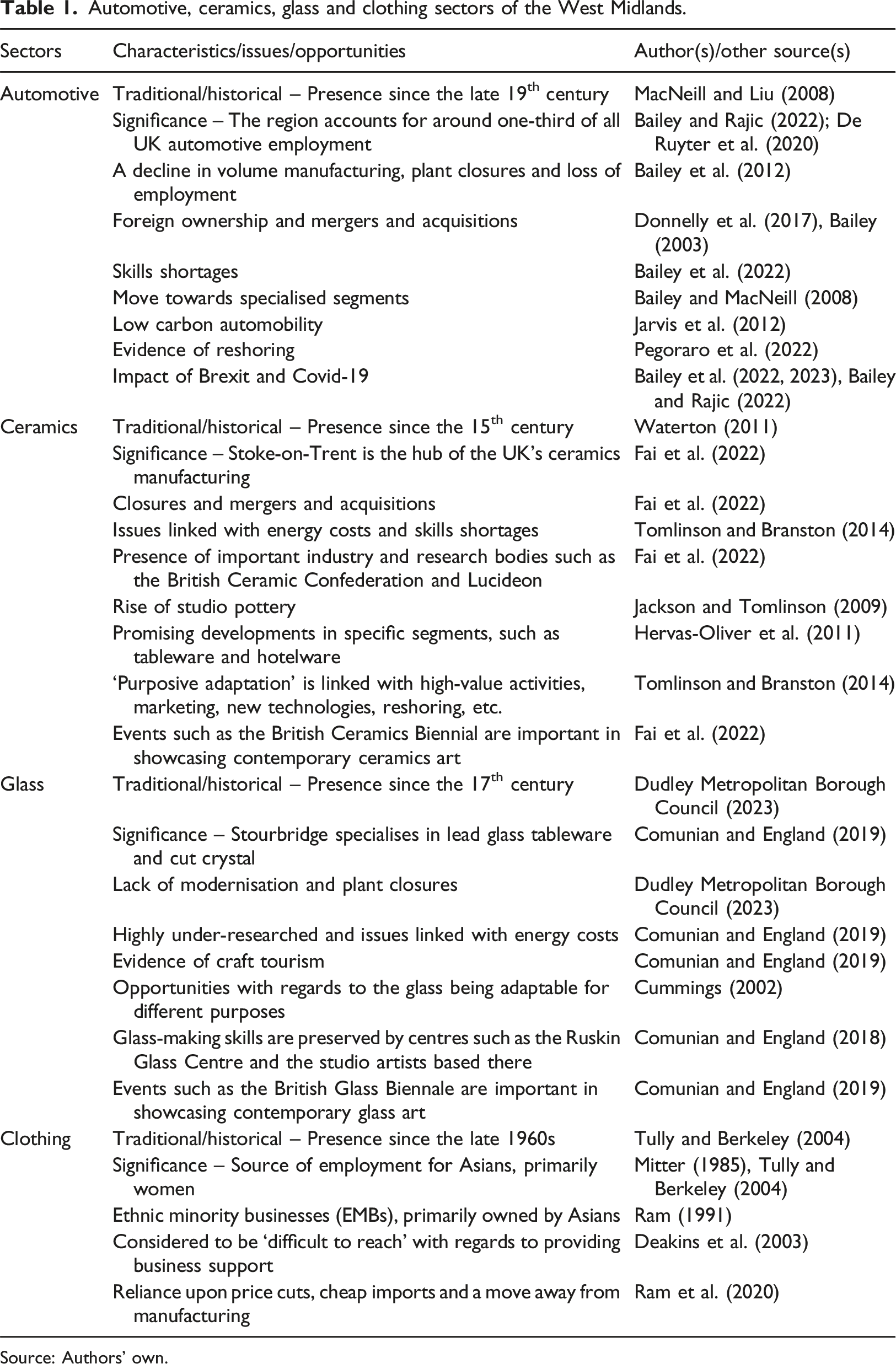
Automotive, ceramics, glass and clothing sectors of the West Midlands.
Source: Authors’ own.
The paper contributes to the regional sectoral literature (for instance, automotive – Bailey et al., 2022, Donnelly et al., 2017, Bailey et al., 2012, Jarvis et al., 2012; ceramics – Fai et al., 2022, Tomlinson and Branston, 2014; glass – Comunian and England, 2019, Comunian and England, 2018; clothing –Tully and Berkeley 2004; Ram, 1991) by highlighting a range of competitive strategies and some specific firm behaviours combined with sectoral specific policy implications.
We acknowledge the diversity in strategic options and responses thereby allowing insights from diverse disciplines namely, strategic management and place-based approaches. When viewed using a regional lens, none of the existing studies have done that. In doing so, we contribute to the literature on ‘cross-fertilization’ and associated advantages – an area that has been largely overlooked (see Bailey et al., 2020). The diverse characteristics of the four sectors and theoretical insights from strategic management and place-based approaches are accommodated and explored in a critical realist conceptual framework.
Theoretical foundation
This section of the paper provides insight into various theoretical underpinnings that are woven together to examine the evolution of competitive strategies. Bailey et al. (2020) have highlighted a lack of meaningful interaction between strategic management and place-based approaches. To bridge this gap, ideas from two diverse disciplines, strategic management and place-based approach, were combined. Strategic management, as a discipline, has overlapping interests with other disciplines namely, Economics, Sociology, Marketing, Finance and Psychology (Hambrick, 2004). This has led to different definitions but in its simplest form, strategic management can be defined as ‘the process by which a firm manages the formulation and implementation of its strategy’ (Carpenter and Sanders, 2014: 8).
For any given firm to compete successfully, it is crucial for it to execute an effective strategy. As such, the concepts of strategy and competitive strategy hold paramount significance for this study. Strategy has been defined in multiple ways, with pioneering contributions made by Chandler (1962), Ansoff (1965) and Hoefer and Schendel (1978). Ansoff, who defined strategy as a combination of product and market, named this combination the product-market matrix (Ansoff, 1965). For Chandler (1962) and Hoefer and Schendel (1978), strategy in broad terms can be viewed as a course of action in pursuit of business goals. In parallel, the concept of competitive strategy has been considerably influenced by the work of Michael Porter (Porter, 1980).
Porter’s five forces framework for industry analysis explicitly emphasises the external structures – Also, Porter’s generic strategies only provide a broad classification of the types of competitive strategies available to firms such as cost leadership, differentiation and focus (Porter, 1980, 1985). More importantly, strategies can take several forms depending upon the interaction of external forces and the availability and strength of internal resources. In contrast to Porter, the resource-based view, influenced mainly by the work of Penrose (1959) and Wernerfelt (1984), redirects attention from external industry analysis to the recognition of firms’ internal resources. The resource-based view gained only limited acceptance in academic and practitioner circles until Barney (1991) developed a framework that linked superior performance to competitive advantage through resources that were valuable, rare, inimitable and non-substitutable (VRIN) (‘non-substitutable’ was later changed to ‘organised’, and VRIN, therefore, became VRIO).
An integral part of the strategy and strategic management literature is to explain how firms can achieve sustainable competitive advantage (Pitelis and Teece, 2009). A firm can achieve sustainable competitive advantage by capturing value (or profit) more than their competitors by competitively using their resources/capabilities over time (Bailey et al., 2020). For instance, firms can capture value by differentiating their product by design, packaging, marketing or branding. A specific manufacturing strategy such as lean manufacturing can be adopted for reducing costs. With advances in automation technologies, value capture or rather value creation could then be determined by the ability of firms, especially resource-deficient small-to-medium, to engage in knowledge sharing and collaboration. Authors Teece (2014) and Pitelis and Teece (2018) argue that tangible/intangible resources/assets, either inside or outside the firm, can be organised to achieve sustainable competitive advantage. Firms can also co-create value by competing and co-operating (also known as co-opetition) at the same time in clusters and other forms of co-operation (Pitelis, 2012).
Evolving from strategic management theory situated at the firm level has been a growing interest across Europe and the US in how place features as an explanatory or determinant factor for competitive behaviour or regional competitiveness. Scholars propose that the co-creation of value (both public and private) by a network of geographically bound actors, yields wider benefits and impact beyond that of the individual firm (Bailey et al., 2020; Klein et al., 2013). Accordingly, through this period, a clear shift towards place-based policy-making across most EU member countries can be charted in part encouraged by broader processes of globalisation (Barca, 2009; Garcilazo, 2011).
Place-based policy-making requires decentralisation towards a more functional economic geography. This theory is situated in the work of Porter (1990) and the related literature on economic activity clusters; and subsequent approaches including innovation systems and entrepreneurial ecosystems (Acs et al., 2017; Coombes, 2014; Feld, 2012; Foray, 2015; Isenberg, 2011) which all argue for a place-based approach to innovation and growth. Policies including Regional Innovation Strategies (RIS), Constructed Regional Advantage (CRA) and the more granular Smart Specialisation Strategies (3S) focus on how key economic sectors within regions are able to construct new advantages (Foray, 2015) and create new futures (Benneworth, 2018).
Place-based strategies, like the Local Industrial Strategies in the West Midlands are devised to shape and create a regional ecosystem of inter-connected actors including firms, universities, government and other supporting organisations. By identifying and nurturing place-specific specialisms and capabilities (which emerge from regional geographies, histories, cultures and institutions), regions are able to generate value-creation opportunities (Barca, 2011: 223).
The governance of these connected actors, especially with regard to the degree of relational embeddedness residing within networks, is crucial to co-creating and capturing value within the regional ecosystem (Bailey et al., 2018). Governance in England has seen a shift towards a decentralised economic development policy. The Labour government in 1997 created Regional Development Agencies (RDAs) tasked with the implementation of policy across nine regions. The coalition of Conservative and Liberal Democrat parties in 2010 adopted a discourse of localism and abolished the RDAs in favour of Local Enterprise Partnerships (LEPs). Central government funding for LEPs ceased in March 2024 after government decided to shift the functions of LEPs into local government and provide support directly to upper-tier councils or combined authorities. Against the backdrop of persistent institutional flux (Pike et al., 2016) the philosophy behind the policy remains one that seeks to achieve a closer alignment between the geography of decision-making and the geography of functional economic space (Pugalis and Townsend, 2013). The formation, structure and function of these decentralized, place-based mechanisms are designed to achieve various outcomes, such as spatial economic rebalancing, political advantages, public sector reform, enhanced political accountability, and economic growth, while addressing societal challenges and contributing to deficit reduction. Scholars of place leadership emphasize the complexity of balancing diverse interests and the necessity of building consensus among local stakeholders to achieve these goals (Horlings et al., 2018). Collaborative leadership, organized around a shared vision, is deemed crucial for the long-term success of regional clusters and policy initiatives (Broadhurst et al., 2020; Kristensen et al., 2022). Additionally, the role of empowering local change agents and promoting collaborative governance has been recognized as key to fostering regional innovation and resilience (Beer et al., 2018; Hambleton, 2014).
From the above discussion, it is clear, that understanding the competitive behaviour of firms is a complex task that has led researchers to examine diverse theoretical strands. Learning from both strategic management and place-based approaches is essential – For instance, the former can help in better positioning of a place (the context within which the firms operate) and the latter in better appreciation of a place (Bailey et al., 2020: 656). This diverse abstraction is well accommodated in the following framework.
Developing the conceptual framework
The philosophy underpinning the conceptual framework is critical realism, the fundamentals of which were established by Bhaskar (1975) in his book ‘A realist theory of science’. Bhaskar (1975) postulated a layered ontology to break free from the overly rigid relationships between causal mechanisms, events and human experience. It is central within critical realist research that events arise from complex systems through the interaction of necessary and contingent relations that are uncovered empirically. Linked to this concept is the understanding that social phenomena are the outcome of complex systems that develop from many interacting causes. This view seems to resonate with the need to integrate internal firm-based factors and external contexts into a full understanding of the strategies and behaviours of traditional manufacturing firms. Here, critical realist philosophy was operationalised in the form of a conceptual framework that cogently incorporated diverse views originating from strategic management and place-based approaches (see Figure 1). The conceptualisation of firm behaviour using critical realist methodology. Source: Authors’ own.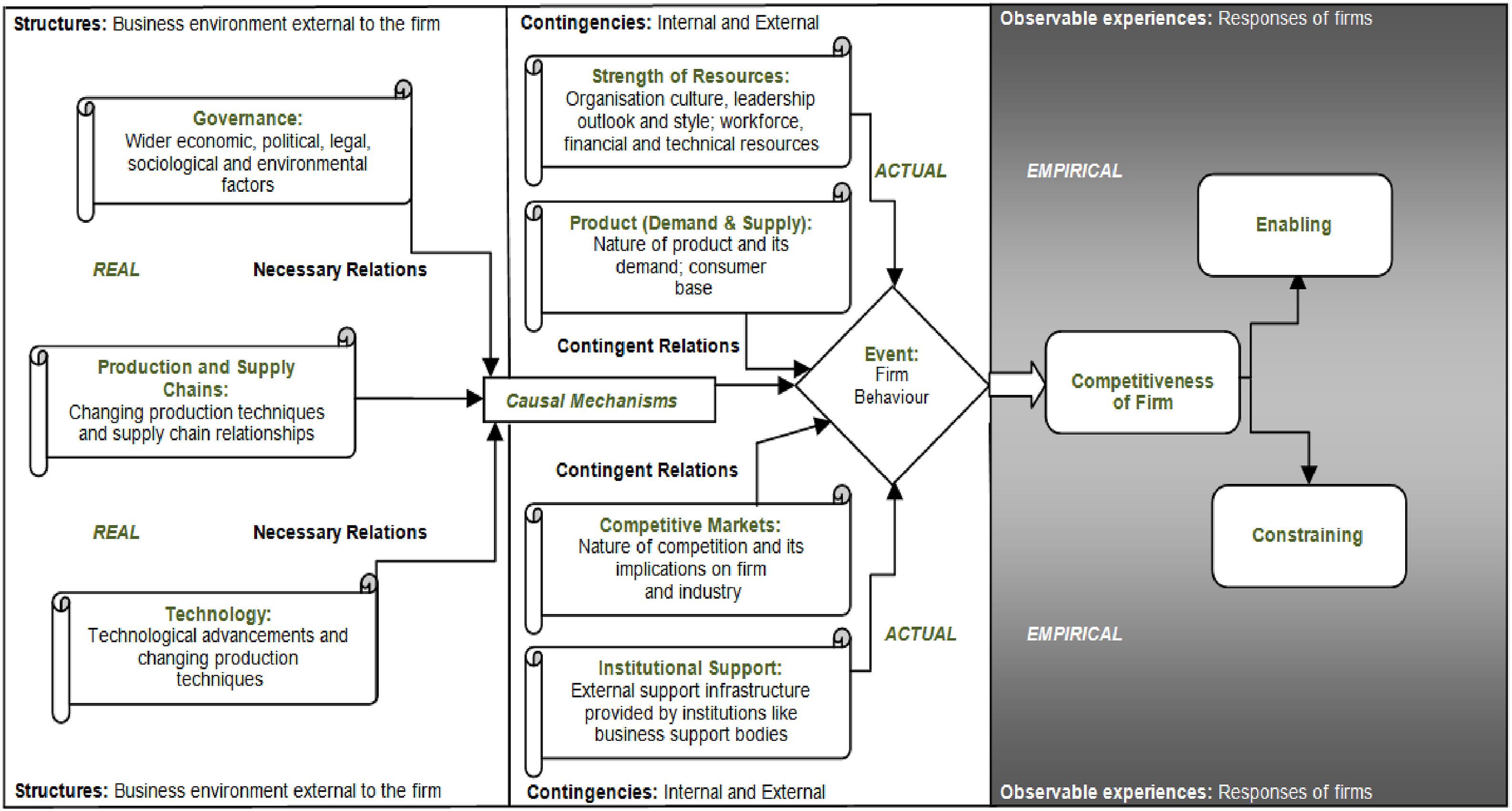
The framework posited that competitive strategies would arise from three sets of necessary relations (governance, which was taken to include wider economic, political, legal, sociological and environmental factors; production and supply chains; and technology) acting in conjunction with four sets of contingent relations (two intrinsic: strength of resources and product (demand and supply); two extrinsic: competitive markets and institutional support). The necessary relations are termed as ‘necessary’ because they are highly likely to exist in the wider macroenvironment. Government legislations typically exhibit one such necessary relation. In contrast, contingent relations or contingencies are dependent upon intrinsic and extrinsic factors such as the availability of finance and strong institutional support. In doing so, the conceptual framework is reflective of insights from strategic management (for instance, the structures and contingent resources) and place-based approaches (for instance, the institutional context). The competitiveness of firms, either enabling or constraining, will be conditioned by the interaction between necessary and contingent relations. The research findings section demonstrates how these interactions take shape in the empirical domain.
Necessary relations inevitably create a situation that can call for a change in competitive behaviour. The outcome generated because of such relations is a combination of necessary causal power and specific contingencies that can direct firms to execute a particular business strategy (Jarvis and Dunham, 2003). In the context of the research reported here, governance represents a necessary relation. Governance includes not only formal state structures but also how firms are influenced by social pressure in the way that they conduct their business. Legislation developed by the government, such as climate change legislation, can be enabling or constraining. For all four sectors, this can then reveal different competitive behaviours. As mentioned before, the automotive sector is committed to net zero emissions (Department for International Trade, 2022). The ceramics sector is all set to contribute towards net zero emissions but at the same time is requesting more support from the Government (British Ceramic Confederation, 2021). The glass sector also wants to play its role in the goal of net zero (British Glass, 2021). In the case of clothing, there are debates about sustainable fashion and reducing the impact of the fashion industry towards climate change (Independent, 2021). The degree to which such necessary relations impact firms cannot be generalised in a critical realist conceptualisation.
Production and supply chains are central to any business and thus constitute a second set of necessary relations acting upon ‘the firm’. Global supply chains are disrupted because of the war in Ukraine and production costs are likely to rise because of heightened energy costs (Guardian, 2022a). In the case of the automotive sector, the complexity of the supply chain can be intensified with a move away from petrol and diesel cars to electric cars (Pegoraro et al., 2022). More importantly, Brexit has been challenging for the UK’s manufacturing. For instance, the clothing sector is vulnerable to Brexit uncertainties because of its dependence on the European Union for both imports and exports (Tetlow and Stojanovic, 2018). The competitive behaviour of firms is thus influenced by necessary relations involving producers and suppliers and specific contingencies, such as the nature of power (high or low). This outcome is well captured in the behaviour type, ‘collaborative behaviour’, that is discussed in the research findings.
Technology is identified as a third and final set of necessary relations. Like production and supply chains, technology is viewed as an essential prerequisite existing in the external structures of businesses. Technological advances can enable the development of new business models, for instance, cleaner technologies. In the case of the automotive sector, improved battery technology could positively influence the uptake of electric vehicles (Berkeley et al., 2017; Bonsu 2020). Additionally, as can be expected because of net zero commitment, firms within the automotive sector are likely to embrace such technologies but that would also depend upon resources. In this way, a necessary relation in the form of technology and a contingency such as the strength of resources can impinge on the competitiveness of firms.
Contingent relations can enable or constrain the final outcome based on the efficacy of their interplay with necessary structures. A favourable set of contingencies (intrinsic or extrinsic) can enable firms to remain competitive and vice versa. The conceptual framework adopted here proposes four sets of contingencies: the strength of resources; product (demand and supply); competitive markets; and institutional support. The former two exist in the business environment internal to the firm and can be characterised by capabilities such as top management leadership and type of product. In contrast, the latter two, despite being contingencies, operate in the external business environment of firms; for instance, levels of competition can be varied for mass-consumption products and niche products. Additionally, institutional support can act as a facilitator in the growth of firms within a sector.
It is important to note that contingencies might operate at different levels, including firm, sectoral and regional. As such, the dichotomy of the internal and external business environment proposed by preceding studies becomes questionable. On the other hand, the place-based approaches have not been able to provide a comprehensive understanding of value-capture strategies that can be used by regional policymakers (see Bailey et al., 2020: 648). This further reiterates the need to use a critical realist conceptual framework for an in-depth understanding of competitive strategies used by firms in the chosen sectors. The research findings reported in the following section highlight the significance of the interplay of necessary and contingent relations, which are bound to capture layers of reality embedded in a particular response.
Before examining the empirical evidence, the subsequent section outlines the chosen research methodology.
Research methodology
Positivists limit investigation by linking causality to regularities that can be empirically observed, while interpretivists emphasise the reality that social actors experience through interpretation (Layder, 1998). In contrast, realist theories assume that an external reality does exist but that it should not be conflated with the investigator’s description of it. In doing so, the research methodology shaped by the critical realist conceptual framework can capture complex reality in firm responses to global challenges.
The conceptual framework was operationalised through a qualitative research method. Two distinct phases of qualitative data collection were undertaken in which 40 interviewees participated. The first phase consisted of interviews, both face-to-face and by telephone, with 25 sector stakeholders ranging from local councils, the Regional Development Body (at the time, Advantage West Midlands), sectoral bodies, business support organisations, academic institutions and new business start-ups (non-manufacturing at the time). The second phase of interviewing, again face-to-face and by telephone, with the owners or top management personnel of 15 traditional manufacturing firms engaged in the automotive (total 5), ceramics (total 6), glass (total 2) and clothing (total 2) sectors. As mentioned before, the empirical evidence presented here is from a specific time, that is, 2010 to 2012. The period marked a change in institutional framework, that is, from RDAs to LEPs – In accordance with Bailey and Tomlinson (2024: 62) this typically exhibits the ‘stop-start’ industrial approach of the UK. Therefore, though historical, the chosen period resonates with the ever-changing structures and their implications.
The interviews were semi-structured as the aim was to explore the competitive strategies of firms and how these have altered because of globalisation. Though open-ended and flexible, the interview was informed by the critical realist conceptual framework which made it possible to investigate multi-layered reality embedded in competitive strategies. The recorded data were transcribed and analysed thematically around the conceptual framework. Key findings from the analysis of the qualitative data are outlined in the following section of this paper.
Research findings
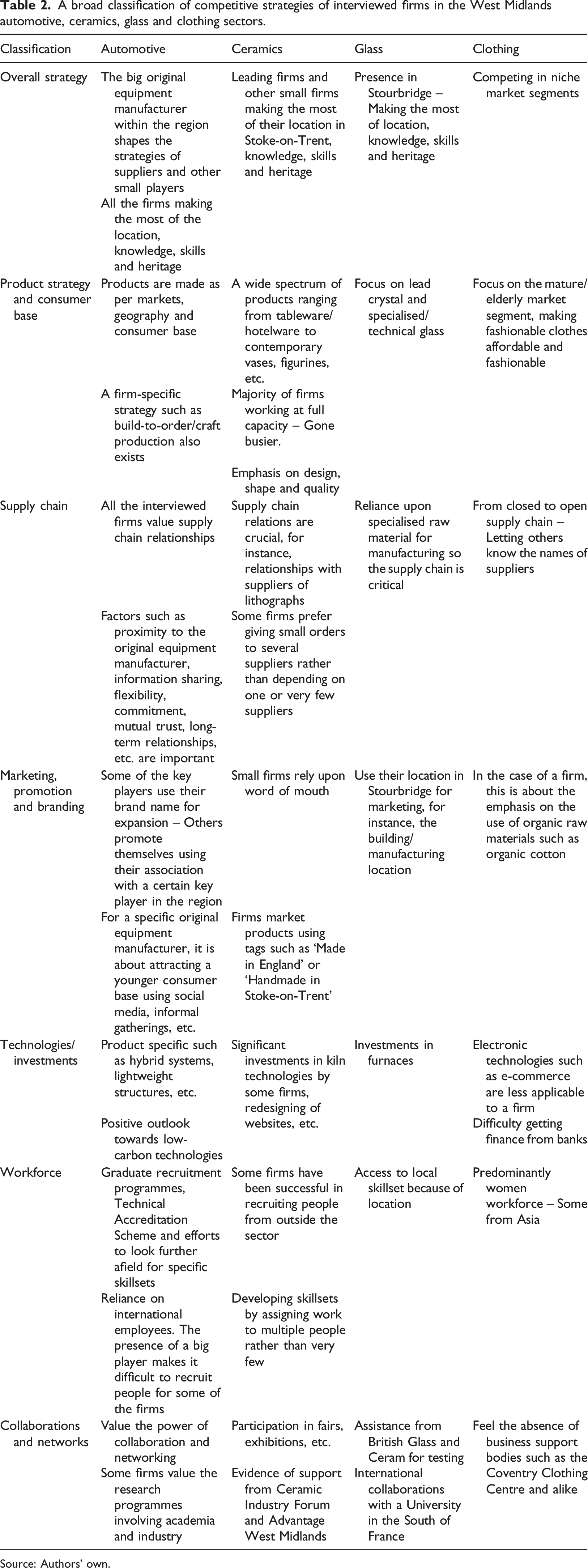
A broad classification of competitive strategies of interviewed firms in the West Midlands automotive, ceramics, glass and clothing sectors.
Source: Authors’ own.
Resilient behaviour
As can be seen from Table 2, the competitive strategies of the interviewed firms reflect a certain degree of resilience. The firms have identified ways to fight against the high-volume, low-cost manufacturing strategy – a product of globalisation – by deepening their association with original equipment manufacturers (for instance, automotive), engaging in premium/specific/niche market segments (all four sectors), relying upon locational advantages (for instance, automotive, ceramics and glass), undertaking technological improvements (for instance, automotive, ceramics and glass), engaging with sectoral bodies and academia (for instance, automotive, ceramics and glass) and having strong supply chain relations (all four sectors). When seen from the perspective of a critical realist conceptual framework, an interviewed ceramic firm
2
has presented the antithesis of globalisation by using enabling contingencies/resources. The firm does not outsource and in that sense, it has been successful in avoiding the negative implications arising out of structures that allow global trade. Though specific to this small firm, the interaction of structures and contingencies has yielded positive results, which when seen through the lens of universal reality might be completely ignored. ‘I won’t outsource…everything is manufactured on this site, using local skill, local people from whom we buy clay, we buy glaze’. [An interviewed ceramic firm]
For larger firms as in the case of an interviewed automotive firm, it is about making the best use of their brand name. The enabling contingencies allow the firm to remain resilient despite unfavourable structures as a result of globalisation. ‘We are taking our brand name across many boundaries so I would say things have improved significantly’. [Interviewed automotive firm A]
Collaborative behaviour
Collaborative behaviour across the supply chain was evident in all four sectors. In relation to small automotive firms, the relationship between the original equipment manufacturer and the supplier was highly favourable. Having said that, firms can demonstrate unique approaches to partnerships with their suppliers. The power dynamics could lead to different outcomes as seen in the case of an interviewed automotive firm. The firm has developed a collaborative relationship with its suppliers to maintain its brand of quality through craft production. This collaborative behaviour seems to be shaped by the power that the firm has as a customer of the suppliers and, in turn, the power that the suppliers have through their supplies. Reverse trends of dominance were evident where the supplier was more powerful. The status of [the powerful supplier] restricted the interviewed firm from claiming a penalty in the event of non-supply or inferior quality. In critical realist terms, a supply failure would trigger a contractual obligation for the supplier to pay a penalty. The obligation is a causal mechanism for the payment, but whether the payment event occurs depends on contingent structures, some enabling (for instance, the contractual obligation) and some inhibiting (for instance, the power dynamics between the original equipment manufacturer and the supplier): ‘Given the size of [the powerful supplier], their honour is very strong. [They] rarely let us down on their supplies, and when they do, they are deeply apologetic, but would we get a penalty out of them? No, definitely not’. [Interviewed automotive firm B]
Compliant behaviour
At the broadest level, economic activity takes place within an extensive framework of legally enshrined behaviour and practices. In this context, understanding and acceptance of regulatory compliance requirements become a business concern. One such compliance requirement is the government’s carbon emission regulation, which has been positively perceived by the interviewed automotive firms. However, this was not the case for the interviewed glass firms which see such regulations as creating an uneven playing field when compared to overseas competitors: ‘We are not playing on a level playing field (with other overseas competitors) because we (UK) are observing the rules and regulations on carbon emission and everything else about energy and nobody else is…’. [An interviewed glass firm]
When observed through the lenses of strategic management and place-based approaches, compliance with regulations can be generalised. Conversely, from a critical realist conceptualisation, the interaction between structures and contingencies at different levels determines competitive responses. In this way, sensitivity to differences is not compromised but thoroughly understood.
Persevering behaviour
In the discipline of strategic management, the sustainability of any firm is linked to its ability to derive a competitive advantage (Porter, 1985). Largely, this ability is dependent upon a firm’s ability to outperform its competitors. The philosophy of critical realism adds to this abstraction by allowing diversity and the investigation of multiple causal mechanisms in the generation of a specific response. As such, it is possible to accommodate the relatively less visible sectors such as glass and clothing of the region alongside automotive and ceramics.
As mentioned before all the interviewed firms have shown some sort of resilience towards global challenges. Having said that, it would be unfair to not showcase the perseverance of interviewed clothing firms that compete in an environment devoid of pro-clothing sectoral bodies and in addition face difficulties securing finance. These firms have identified niche areas such as the mature/elderly market segment which is typically less served by the high-street players: ‘We have gone into a more mature market and I think the high street is not particularly good at catering for the more elderly, more mature person’. [An interviewed clothing firm]
The success of the above firm, a small-to-medium-sized firm, was a result of its perseverance influenced by enabling contingencies such as leadership qualities. The owner had reservations about catering to the younger consumer base, as it was more vulnerable to fashion trends and branded clothing. The owner also has reservations about using electronic commerce but despite that, he has been able to create a place for his firm.
In summary, all four behaviour types exemplify how, using a critical realist framework, the competitive behaviours of firms in the automotive, ceramics, glass and clothing sectors can be investigated in a multi-faceted way. A comprehensive analysis of this nature, therefore, provides a useful understanding of the reasons that a competitive response can be constraining or enabling for a firm. Crucially, these behaviour types alongside the broad classification of strategies undertaken in Table 2 can inform the process of policy-making, which is highlighted in the next section.
Policy implications
The continuous institutional reshaping with the abolishment of the Regional Development Agency, that is, the Advantage West Midlands in 2012, its replacement with the Local Enterprise Partnerships and now the West Midlands Combined Authority and Midlands Engine indicates that the contingencies are ever evolving and thereby present either an enabling or constraining environment. Interestingly, when compared to the Regional Development Agencies, the Local Enterprise Partnerships and Combined Authorities lack long-term funding (Bailey and Rajic, 2022). Nevertheless, the institutions could be reshaped to become part of a causal enabling environment – An example of this could be recreating something similar to the Manufacturing Advisory Service (MAS) in the region, an invention of the Regional Development Agencies, which provided support and advice to manufacturing firms (Bailey and Rajic, 2022). Having said that, place-specific specialisms and capabilities (Barca, 2011) are not the only explanatory factors for competitive behaviour as evident from the empirical findings where contingencies also play a key role. One such finding was collaborative behaviour wherein an exclusive place-based policy approach might be less effective if other contingencies such as power dynamics between firms was not taken into consideration. Against this backdrop, the following outlines some overall and some sector-specific policy implications for the chosen sectors.
Automotive
The significance of the automotive sector both for the region and the nation is immense. It contributes £16 billion to the national economy and roughly half of that arises from the West Midlands automotive sector (Bailey and Rajic, 2022). As of 2022, the sector 3 employed 21,800 people (which is the highest when compared to the other three sectors) in the region (Office for National Statistics, 2023). When compared to 2015, there is a 27% decline in 2022 – Nevertheless, the sector has the potential but ‘it probably won’t employ as many people’ (Professor David Bailey c.f. Guardian, 2021).
The interviewed automotive firms had a positive outlook towards low-carbon technologies. This is in conjunction with the uptake of electric vehicles as evident with the rising sales figures in the UK (Guardian, 2021). The future of the region’s automotive sector depends upon electric vehicle batteries, their location of manufacturing and how these shape supply-chain relationships. The region is experiencing a transition to electric vehicle production – The West Midlands Gigafactory is a step in that direction (BBC, 2022a). Big firms such as Jaguar Land Rover can shape the future of electric vehicles in the region – As evident from the research findings, the presence of a powerful original equipment manufacturer has influenced the strategies of other firms/suppliers. In this context, the stakeholders at different levels can play a vital role in encouraging Jaguar Land Rover to manufacture electric vehicles in the region. The automotive ecosystem that surrounds Jaguar Land Rover in the form of jobs and tiers of suppliers would be severely impacted if the firm were to outsource. This would be fuel to fire to a sector which already faces challenges in relation to Brexit and subsequent trade issues with the European Union, the possibility of losing skilled workers from the European Union and supply chain issues (see Bailey et al., 2022, 2023; Bailey and Rajic, 2022; De Ruyter et al., 2020). However, at the time of writing this paper, Jaguar Land Rover announced a £15 billion investment – a welcome announcement – aimed towards speeding up electric vehicle manufacturing in the UK (Guardian, 2023).
The research findings also highlighted that some firms found it difficult to recruit people as they were absorbed by big original equipment manufacturers. Given the identification of automotive/future of mobility as a major opportunity for the region (HM Government, 2019), the availability of skilled people can be a problem. An interviewed policy stakeholder sees the role of the central leadership in enabling overseas students to be a part of the workforce: ‘Central Government has a role to play in terms of valuing the expertise of overseas students that graduate here’. [Interviewed policy stakeholder in automotive]
The development of skills within the region is a priority (Bailey et al., 2022). More so with automation – As per HM Government (2022), driverless cars could be on UK roads by 2025. The success of such technologies would require significant support from policymakers (Bailey and De Propris, 2017). The research and development needed for Connected and Autonomous Vehicles (CAVs) can be shaped by the University of Warwick and Coventry University alongside other local, regional, pan-regional and national stakeholders. This is therefore indicative of a participatory policy environment which is farsighted in its outlook, especially about future technologies and associated opportunities.
Ceramics
From the research findings, it is evident that there are signs of resilience demonstrated by interviewed ceramics firms in their marketing, product strategy – focus on design, shape and quality, investments in kiln technologies, supply-chain relations, redesigning of websites, etc. This is in accordance with what Tomlinson and Branston (2014) highlighted as ‘purposive adaptation’. Such promising competitive behaviours should be supported by the policymakers and efforts should be made to replicate such success stories across the sector. In this context, authors Fai et al. (2022) emphasise the advantages of local and global knowledge sharing. According to them if firms show the potential to gain from such efforts, then it would be hasty for policymakers to classify the sector as declining.
Some interviewed small-to-medium firms have benefited from the Ceramics Industry Forum which does not exist anymore. Closure of such sectoral bodies can be damaging for small firms that need more support. Fai et al. (2022) have highlighted how the resource deficiency of small firms can restrict their networking opportunities. Policy stakeholders, particularly at the local level, can identify ways through which resource-deficient firms collaborate and network with other ceramic firms, the British Ceramic Confederation, Lucideon, academia and other such stakeholders.
The nature of manufacturing has been a challenge for the sector: ‘Energy intensive manufacturing is one of the biggest issues that the sector is facing and it reduces their [firms’] competitiveness’. [Interviewed policy stakeholder in ceramics]
The war in Ukraine and the rise in energy prices could further exacerbate the problem – the British Ceramic Confederation has asked for support from the UK Government (BBC, 2022b). A welcome step in this direction is that both ceramics and glass sectors are granted relief by the UK Government and there is a possibility of more in the future (Department for Business, Energy & Industrial Strategy, 2022). This certainly is a pro-ceramics manufacturing initiative requested by an important sectoral stakeholder, the British Ceramic Confederation and granted by the central leadership.
The significance of the sector for the region can be understood from the fact that Stoke-on-Trent is regarded as the centre of ceramics manufacturing in the UK. Some of the interviewed firms have successfully captured this by using tags such as ‘Made in England’ or ‘Handmade in Stoke-on-Trent’. Nevertheless, in terms of employment, there has been a historical decline over the years. Having said that, the sector has seen a surge in employment – The total employment in ceramics 4 sector in the region in 2022 was 900 when compared to 500 in 2015 thereby showing a 44% increase (Office for National Statistics, 2023). This rise in employment was particularly seen in the manufacturing of clay building materials. This further reiterates the ability of the sector to adapt and the need for policymakers to be farsighted by avoiding any stigmatisation (see Tomlinson and Branston, 2014).
Glass
The interviewed glass firms, though relatively few, have identified specialised segments and lead crystal in glassmaking. If the local skills and the sector are to be preserved, then there is a need to identify strategic forms of production. As a material, glass is highly adaptable and hence there is a scope to diversify into specialised areas. More importantly, there are overlaps between ceramics and glass hence strategic insights can be borrowed from the ceramics sector. One such area is marketing and branding wherein the interviewed ceramic firms have been successful in promoting their products by associating them with Stoke-on-Trent. Perhaps, knowledge-exchange programmes that do not require a substantial amount of funding can be organised by the British Glass and British Ceramic Confederation. New technologies related to furnaces and kilns can be explored and shared through such programmes.
Important centres such as the Ruskin Glass Centre in Stourbridge host studio artists that have kept glassmaking alive in Stourbridge and the region. Nevertheless, they have expressed concerns about not getting enough support: ‘…our passion and enthusiasm have kept the sector alive in Stourbridge but I am sad that we have lost so much and the government has done nothing really nothing about it which is really sad’. [Interviewed glass engraver]
In the above context, it becomes essential to create a supportive and proactive policy environment that sees the sector as not declining but rather one that can be transformed. There are events, for instance, the British Glass Biennale wherein the sector can showcase its contemporary and artistic side and thereby promote craft tourism.
Interestingly when compared to 2015, the number of people employed in the sector 5 in the West Midlands has doubled in 2022 that is from 1250 to 2500 (Office for National Statistics, 2023). The sector holds significance for glassmaking heritage which can be preserved through the participation of local, regional and national stakeholders. Along similar lines, Comunian and England (2019: 245) have called for a ‘joined-up’ policy approach by involving key stakeholders.
Clothing
In the context of the UK’s clothing sector, authors such as Theodorakopoulos et al. (2014) have identified diversification into technical clothing as a strategy involving entrepreneurial learning and action. This showcases the significance of internal resources (Barney, 1991) such as the entrepreneurial ability to learn and act in new areas for competitiveness. According to the critical realist conceptual framework, this means that the structure is providing new forms of production such as technical clothing. However, contingencies might allow or hinder the uptake of technical clothing. From the empirical evidence, it is highlighted that some of the ethnic minority entrepreneurs in the region lack the willingness to diversify: ‘The small ethnic companies in clothing lack a well defined competitive strategy and some ethnic entrepreneurs are not willing to diversify’. [Interviewed policy stakeholder A in clothing]
Total employment in the clothing sector
6
in 2022 was 1,500 which was the same as in 2015 (Office for National Statistics, 2023). As mentioned before, the sector is vulnerable to the uncertainties of Brexit (Tetlow and Stojanovic, 2018) – a common impact on the UK’s manufacturing. The problem is likely to exacerbate in the absence of policy and business support in the region as highlighted below: ‘...there is a problem with how to co-ordinate business support programmes as there are not many public or private support bodies around for clothing’. [Interviewed policy stakeholder B in clothing]
In the above context, the persevering behaviour of the interviewed clothing firms is commendable. However, it is tricky to justify the significance of the sector for the region for full-scale policy or financial support. Historically, the sector has been a source of business and employment for Asians in the region (Mitter 1985; Ram 1991; Tully and Berkeley 2004). This is less of the case now as the next generation having been born here in the UK has wider economic opportunities compared to the first-generation migrants. It would be therefore safe to say that the sector which was started in the region by migrants from Asia faces a succession problem and therefore the downfall is likely to continue. ‘The entrepreneurs from Asia have practically run the industry for many years now but this has decreased. I mean you can imagine their children don't want to work on sewing machines’. [Interviewed policy stakeholder C in clothing]
Conclusion
The West Midlands region has traditionally been characterised as a manufacturing hub of the UK. The attribute of traditional manufacturing associated with the region is a result of the long-established presence of sectors such as automotive, ceramics and glass. The clothing sector is a comparatively late entrant and hence is less traditional. As can be expected with globalisation, all four sectors are facing a ‘context’ in which competition is ever-increasing. Though not captured in this paper’s empirical evidence, it is indicated that there is a move towards reshoring in the automotive (Pegoraro et al., 2022) and ceramics sectors (Tomlinson and Branston (2014) of the region. It remains to see if there is ‘friendshoring’ too – An American invention which means ‘moving to countries with shared values’ for manufacturing (Guardian, 2022b). This could be a potential area for future research.
The paper has contributed to the understanding of competitive strategies by combining strategic management and place-based approaches. What was missing in the existing studies was to accommodate the diversity in competitive strategies – The paper fills this gap by using a critical realist conceptual framework that can remain sensitive to differences in competitive strategies. With regard to the principal aim of this study, it is evident that firms in the chosen sectors have adopted different forms of ‘high-value manufacturing’ such as proximity to the original equipment manufacturer (for instance, automotive), emphasis on design, shape and quality (for instance, ceramics), engaging in specialised segments (for instance, glass) and identifying untapped market segments (for instance, clothing). All the interviewed firms exhibited a degree of resilience in their competitive behaviour.
For a pro-manufacturing response in relation to chosen sectors, it would be important to avoid overlap and thereby any confusion in the responsibilities of the important stakeholders. Green and Rossiter (2019) argue that the local authorities, local enterprise partnerships, West Midlands Combined Authority, Midlands Engine and other stakeholders should be clear in their responsibility and response to any opportunities (or challenges). Undoubtedly some decisions and measures would come from the central government but still, there would be some areas wherein pan-regional, regional and local stakeholders could play a significant role (Bailey et al., 2022).
A more participatory, farsighted and proactive manufacturing approach is required given the challenges of Brexit, Covid-19, the war in Ukraine, climate change and continual institutional upheavals. Replicating the success stories of previous stakeholders such as the Regional Development Agency is recommendable. The automotive sector is vital for the region but of course, its contribution to employment numbers might be limited. The ceramics sector is showing signs of adaptation and hence all care should be taken in not classifying it as declining. Glass sector has the potential to diversify into specialised segments given the adaptable nature of glass as a material. Owing to their heritage, both ceramics and glass sectors should be encouraged to showcase their contemporary and artistic sides at different events including international. The clothing sector has the potential to diversify but at the same time, the sector in the region is likely to struggle for full-scale policy or financial support. Place-based collaborative learning (Sunley et al., 2022) for automotive, ceramics and glass is possible because of their strong heritage and place-based specialisms and capabilities but less so for clothing.
It would be worth showcasing some limitations of the study and therefore the need for future research. First, the empirical evidence demonstrates the competitive behaviour of traditional manufacturing firms for a brief period, that is, 2010 to 2012. The necessary and contingent relations were different, for instance, a different institutional framework at the time than what exists today in the form of the West Midlands Combined Authority. Secondly, the purpose of the paper was to accommodate sensitivity to differences in competitive behaviour hence an extensive understanding of the scale and scope of chosen sectors was not the case. Also relative to the automotive and ceramics, the number of interviewed glass and clothing firms was less, hence care should be taken while drawing any comparison. Finally, and concerning future research, the policy implications are drawn based on a specific time. Given the volatile nature of the policy context and the move towards a greener economy, it would be desirable to investigate how firms have adapted in all four sectors.
Footnotes
Declaration of conflicting interests
The author(s) declared no potential conflicts of interest with respect to the research, authorship, and/or publication of this article.
Funding
The author(s) received no financial support for the research, authorship, and/or publication of this article.
