




Abstract
The United Nations Sustainable Development Goals (SDGs) set out to achieve the ambitious goal of addressing all forms of poverty, fighting inequality, tackling climate change, while ensuring that no one is left behind. Five years into the implementation of the SDGs, though progress has been recorded in some places, significant challenges persist globally. In 2019, the UN Secretary-General declared a “Decade of Action” commencing in 2020 until 2030. In the light of this campaign, it is important that all effort is garnered to accelerate action towards achieving the goals. The local government level is increasingly being recognized as the key locus of development effort, particularly because the SDGs are relevant to local jurisdictions and change can be tangibly measured at smaller scales. This paper contributes to the ongoing discourse on how best to localize the global goals. Reflecting on the Ghanaian context, the paper discusses guiding principles for effective communities of practice at the local government level. Overall, the paper underlines the advantages of coordination among stakeholders, which constitute essential ingredients for accelerating action towards the SDGs especially as we commence the “Decade of Action.”
Introduction
The United Nations’ Sustainable Development Goals (SDGs) are a universal call to action to end poverty, protect the planet, and ensure that all people enjoy peace and prosperity by 2030. Adopted in 2015 by UN member states, the SDGs provide a blueprint to achieve 17 interconnected goals within a 15-year timeframe in a way that ensures no one is left behind (UNCG, 2017; United Nations, 2019). Barely 5 years into its implementation, reporting on the SDGs provides a mixed picture of good progress in some critical areas. For instance, the extreme poverty rate for 2018 was about 8%, a decrease from the 2015 average of 10%. Furthermore, around the world, children are living longer and healthier lives, with the under-five mortality rate falling by 49% between 2000 and 2017—a progress that started during the era of the Millennium Development Goals. Access to electricity in poorer countries has begun to accelerate, globally, 9 out of 10 people have access to electricity, with impressive gains in renewable energy. Additionally, there is an increased global consciousness to respond to challenges relating to climate change, with a 45% increase in the number of countries that have initiated or launched National Adaptation Plans between 2015 and 2019 (UN Foundation, 2020; United Nations, 2019).
Despite these strides, available evidence suggests that the world is off track on many of the global SDGs and most goals are struggling to gain traction. For instance, extreme poverty is still endemic in low-income countries and countries affected by conflict and political upheaval. Estimates suggest that about 500 million people will still be living in extreme poverty in 2030, and the overwhelming majority of those will be in sub-Saharan Africa, affected by a warming planet and unstable societies. As well, basic literacy rates of half of the population of children remain below standard, inequality is on the rise, and lethal violence and violent crime is increasing (UN Foundation, 2020; United Nations, 2019). Given these ongoing and persistent challenges, the United Nations in September 2019 called on all sectors of society (global, national, local, and individuals) to mobilize for a “Decade of Action” on the SDGs (United Nations SDGs 2019). This call emphasizes the need for cross-sectoral coordination and collaboration in the implementation of the SDGs at the local level, which can be achieved with the adoption of the communities of practice approach. Although the concept of communities of practice has been successfully applied at national and supra-national levels of development practice, the literature provides limited examples of its implementation at the local government level, especially in developing countries (Tabira & Otieno [2017] is one of few examples). This article discusses the relevance of communities of practice at the local level, and how it can be implemented in support of the SDGs. We situate the discussion within Ghana’s local governance context to demonstrate how guiding principles and strategies for communities of practice can be implemented, and the potential gaps and challenges that may arise.
The optimism that 2020 will usher in a decade of ambitious action to achieve the SDGs suggests the need to re-strategize and mobilize resources to promote accelerated action towards achieving the goals by 2030. As highlighted by the United Nations, one of the areas where accelerated action is required is at the local level. Decentralized governance institutions are well placed to facilitate the achievement of the goals because of the nature of the services they provide and their relative proximity to local communities (Reddy, 2016). Moreover, although the SDGs were adopted by national governments, it is the local governments that have the relationships with local stakeholders to translate the international commitments into local actions in the pursuit of the broader development agenda. Underscoring the importance of local government in the implementation of SDGs, the UN Sustainable Development Solution Network (2016:15) notes that: ...as much as 65 percent of the SDG agenda may not be fully achieved without the involvement of urban and local actors (10 p. 19). Given their critical role, local governments cannot be mere implementers of a global or national SDG agenda, but must be partners in co-creating and defining policy and programmatic responses, and in the implementation and monitoring of progress against the goals and targets.
In light of this realization, it is essential for institutions at the local level to adopt workable strategies in order to be successful. Slack (2014) opines that critical areas for successful implementation of the SDGs include identification of local stakeholders; outlining and analyzing their roles, strengths, and vulnerabilities; and defining mechanisms to facilitate the implementation of stakeholder actions. In addition, the UNDP (2014) observes that achieving key objectives of the SDG agenda depends on local ownership, and implementation of local stakeholder action plans.
One significant driver of local action in this process is collaboration. Gajda (2004) identifies collaboration as the primary strategy for achieving goals that would otherwise not be attainable with entities working independently. Collaboration or networking enhances the decision-making ability of local authorities, enhances resource capacity, and fosters greater political influence through strength in numbers (Arku, 2014; Arku and Oosterbaan, 2015). By and large, there is ever-increasing need for networking among government agencies, non-profit organizations, and local communities to address complex issues confronting society. The SDGs encapsulate the challenging issues facing society today. The inclusion of Goal 17: Partnerships for the goals, demonstrates the importance of collaboration to achieving the goals. The interconnected nature of the SDGs—the indivisibility of the goals—makes it difficult for individual organizations to adequately address them. Indeed, Niklasson (2019) identifies Goal 17: Partnerships for the goals, as one of the prerequisites for the attainment of the remaining goals. It is essential to note that while collaboration is undeniably an essential tool, it needs to be used intentionally. Without a well-defined strategy for collaboration, partnerships can be used to promote individual partners’ objectives and interests rather than a collective agenda (Norris-Tirrell and Clay, 2010; INLOGOV, 2015).
The community of action, which is also referred to as a collaborative action learning network or “community of practice,” (Snyder and Briggs, 2003), is an effective approach to promoting collaboration and partnerships. According to Snyder and Briggs (2003), communities of practice combine disciplines, interests, and capabilities across geographical boundaries to address complex issues. Despite their utility, the challenge of cultivating high-performing communities of practice from “interest roundtables” continues to be a major hurdle for management, hindering the widespread adaptation of the approach in development practice. This paper explores how communities of practice can be successfully deployed at the local government level to serve as a vehicle for accelerated action towards achieving the SDGs. Using Ghana’s local governance system as an example, we discuss the defining elements of communities of practice, strategies for implementation, as well as potential challenges. In conclusion, we outline the benefits and value addition of communities of practice in addressing gaps in SDG implementation at the local level.
Defining elements of communities of practice
Communities of practice involve groups of people who share a concern or a passion for something they do and learn how to do it better as they interact regularly (Wenger-Trayner, 2015). The principal features of a community of practice include a shared domain of interest, which serves as the identity of the group; and regular interaction among members, which fosters relationships and enables practitioners to learn from each other. In addition, sustained interaction over time generates a repertoire of resources that the group draws on to support their activities (Wenger-Trayner, 2015). Similarly, Snyder and Briggs (2003) define a “community of practice” as a network that features peer-to-peer collaborative activities to build member skills as well as organizational and societal capabilities. Communities of practice operate as “social learning systems” where practitioners connect to share ideas and solve problems, set standards, and develop relationships with peers. According to Snyder and Briggs (2003), well-supported communities of practice can serve as powerful engines for achieving strategic goals.
The above definitions demonstrate three important characteristics of a community of practice that make it a useful tool in facilitating accelerated development at the local government level. Firstly, a common passion defines the identity of the group. At the local government level, the geographic location of stakeholder activities implies the localization of a common passion and agenda for development. Secondly, regular interaction of a group is necessary to qualify it as a community of practice. Indeed, Pyrko et al. (2017) contend that it is the collaborative learning process that essentially brings communities of practice to life. By engaging as a community, members of a community of practice develop relationships that enable them to learn from each other. The third element is the mutual learning that takes place in the community of practice. As noted by Wenger et al. (2002), communities of practice increase collective knowledge and skills by bridging formal organizational boundaries. They also help to encourage mutual exchange of ideas and professional trust among practitioners who serve in these organizations. This encourages knowledge mobilization across diverse organizations which is critical in developing a stock of resources to guide accelerated progress towards the SDGs. Wenger-Trayner (2015) observes that the deployment of communities of practice in international development as conveners of knowledge, represents an important recognition of the value of establishing a reservoir of knowledge in order to promote development.
Communities of practice in Ghana’s local government: Gaps and prospects
Ghana is a unitary republic with a decentralized local government administration system devolving power from the central government institutions to regional coordinating councils and further to metropolitan, municipal, and district assemblies as the basic units of governance. The 1992 Constitution of Ghana authorizes the transfer of resources and responsibilities from the central government to local government authorities to plan, initiate, coordinate, manage, and execute policies in respect of all matters affecting the people within their areas of jurisdiction (see Republic of Ghana, 1992). The Constitution further identifies the district assembly as the highest political authority in the district with deliberative, legislative, and executive powers [Article 241(3)]. Further, the decentralized national development planning system as outlined in the National Development Planning System Act 480 (1994), comprises of the district planning authorities at the district level, regional coordinating councils at the regional level, and sector agencies, and ministries as well as the National Development Planning Commission (NDPC) at the national level (Republic of Ghana, 1994). The NDPC has oversight responsibility for development planning as the national coordinating body, with direct accountability to the President of the Republic. The NDPC liaises with ministry and sector agencies at the national level to ensure that plans are compatible with national development goals (Figure 1). Ghana’s Decentralized Planning System. Adapted from Inkoom (2011)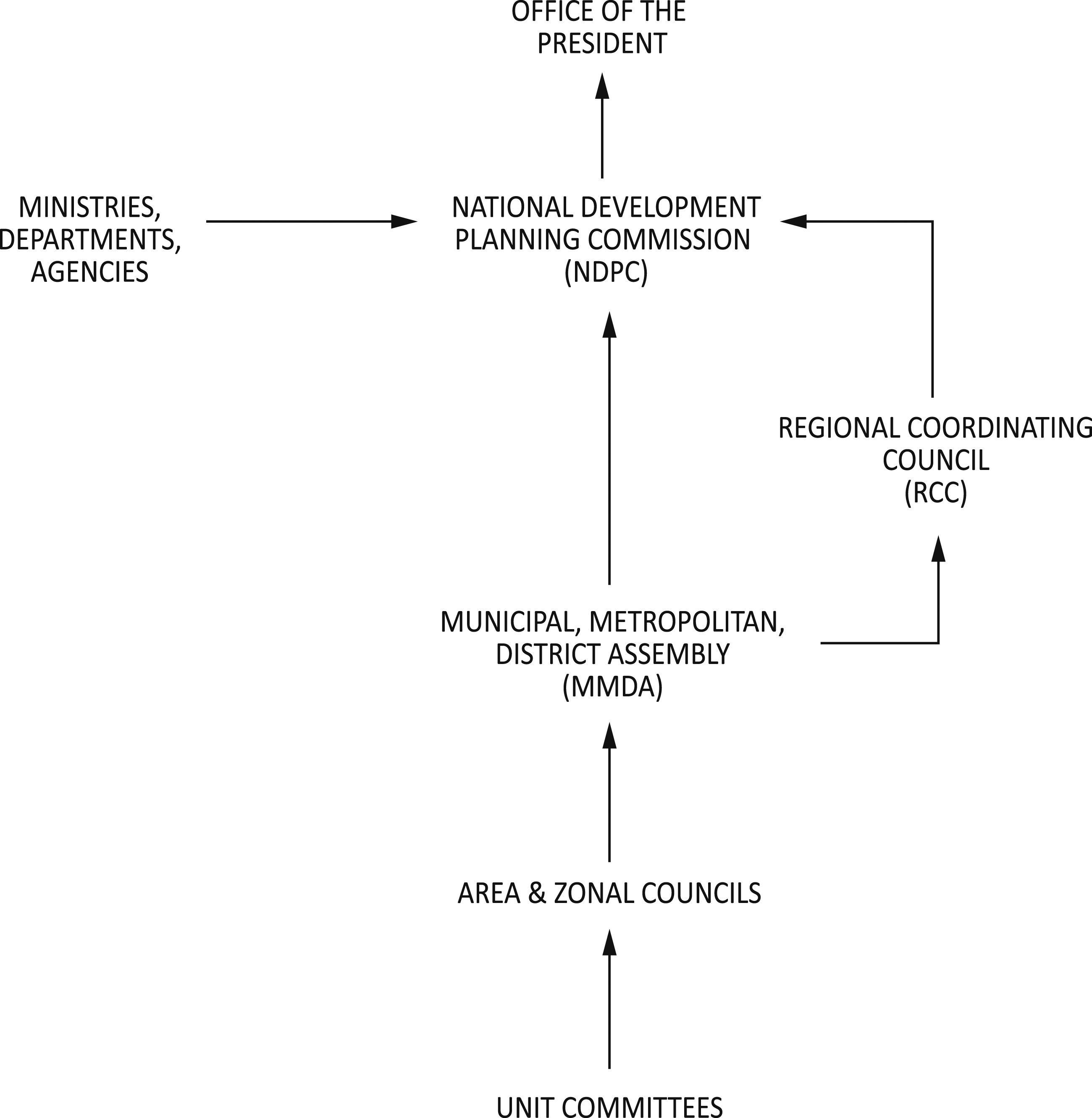
Regional Coordinating Councils coordinate the plans and programmes of district planning authorities within the region, including providing information for planning, harmonizing programmes with national development priorities, and monitoring plan implementation in the region in collaboration with the national coordination body. District planning authorities initiate and coordinate the processes of planning, programming, budgeting, and implementation of district development plans and programmes in alignment with national priorities and policies defined by the NDPC. District assemblies work in collaboration with their respective sub-units, namely, the sub-metropolitan and district councils, urban councils, town or area councils, and unit committees. District planning authorities may be designated as districts, with a minimum population of seventy-five thousand, a municipality, with a minimum population of ninety-five thousand, or a metropolis with a minimum of two hundred and fifty thousand people. There are currently 262 municipal, metropolitan, and districts assemblies (MMDAs) with 16 regional coordinating councils in Ghana.
Thus, Metropolitan, Municipal, and District Assemblies are the nerve centers of Ghana’s local development practice, with the mandate to plan, implement, and evaluate development in a way that is consistent with local development imperatives as well as the broader national development program. Emphasizing the important role of local government in development practice, INLOGOV (2015) notes that districts are particularly well placed to initiate and lead collaborative projects in support of local development plans given their constant interaction and engagement with local communities. In addition, Reddy (2016) identifies the local government as the most effective structure to facilitate and provide leadership for the mobilization of local development stakeholders, including civil society organizations (CSOs), the private sector, and local communities to promote inclusive sustainable development. Reflecting on lessons learned in the implementation of the SDGs, the Ghana CSO Platform on the SDGs (2019) acknowledges that adopting multi-stakeholder approaches would enhance local ownership and interest in the SDGs, which can promote participation and effectiveness in the implementation of the goals.
In practice, however, effective coordination of development practice in Ghana’s local government system continues to be a challenge. For instance, while it is refreshing to note several attempts at improving approaches employed in coordinating the implementation of the SDGs at the national level, there is the recognition of a capacity gap in engaging with local communities and stakeholders (NDPC, 2019). Structures for coordination in place at the national level include the Ghana CSOs Platform, established in 2015 to bring CSOs working on the SDGs under one umbrella. This platform serves as a viable vehicle for networking, coordination, and partnership between civil society organizations, the private sector, and the government on the SDGs. With a membership of more than 300 local and international CSOs, the network has set-up 18 sub-platforms (one for each of the 17 SDGs, and a sub-platform on youth issues). The CSOs Platform plays an important role in strengthening a multi-stakeholder approach to implementing the SDGs in Ghana with the representation of CSOs at various national SDG implementation committees. The successful mainstreaming of CSOs into national development implementation structures provides the opportunity for CSOs to make direct input into national policies and contribute to the development of SDG-related frameworks. For example, the production of the Civil Society Organizations’ Shadow Report on the Voluntary National Review (2019) to complement the Government’s Voluntary National Review constitutes part of efforts to promote mutual accountability in implementing the SDGs (CSO Platform, 2019). While national level coordination structures are visible and operational, in its own assessment, the CSOs Platform admits that its presence at the sub-national level requires strengthening (CSO Platform, 2019).
This paper echoes the call by Ghana’s CSO Platform on the SDGs, for coordinated approaches to implementing the SDGs at the national level to be replicated at the sub-national level. We also recognize that better outcomes are produced when stakeholders work towards shared goals (Slack, 2014; CSO Platform 2019). We acknowledge ongoing efforts including the CSO Platform’s SDGs localization initiative in Ghana, through which community-based civil society and non-governmental organizations are mobilized into district platforms and strengthened to enhance participation and contribution towards the attainment of the SDGs. Along with these strategies, we recommend a more structured and formalized interaction among actors in order to facilitate local development and contribute towards the achievement of the SDG agenda. In this regard, we further recommend expedited action to replicate the CSO platform on a broader scale, especially in the “Decade of Action.”
Guiding principles for facilitating communities of practice at the local level
Given the example of the CSO platform in the implementation of the SDGs in Ghana, we suggest that district assemblies formalize regular meetings with local stakeholders and CSOs to function as communities of practice with the objective of harnessing skills and knowledge to accelerate progress towards the SDGs. The motivations underpinning the call to devolve the community of practice approach in Ghana’s decentralization system are discussed in the ensuing section as guiding principles for communities of practice in MMDAs.
Build feedback systems
The nature of services provided by CSOs makes them important stakeholders in local government system as they represent the voices of marginalized groups and hold duty-bearers/government institutions accountable on behalf of the communities they serve (CSO Platform, 2019). In line with this principle, Ofei-Aboagye (2018) observes that partnerships with CSOs are required to monitor execution of projects and evaluate their impact on the people’s livelihood and on the local economy in general. A system of feedback within local government structures can provide an opportunity for robust internal evaluation of development plans, including the implementation of the SDGs at the local level. A platform that encourages regular interaction with local stakeholders will therefore prove valuable in accelerating action on the implementation of the SDGs. In addition, such a feedback system should be complemented with a mechanism for horizontal feedback in the form of peer learning with other local government organizations. Vertical exchanges with higher government structures such as the regional coordinating councils, and national level structures would also help to disseminate lessons.
Harmonize and coordinate development efforts
The diversity inherent in the SDGs legitimizes the involvement of multiple actors in the development space at the local level. Ironically, however, activities of local organizations, including CSOs, tend to be inspired by internal interests of the organizations and their sponsors, rather than aligned with local development agendas and vision. This results in programs that are only peripherally connected to the local development plans. Not only does this distract from the principles of sustainable development, but it also presents challenges in documenting progress on local development as the results of these activities are often not reflected in official district reports. The CSO Platform (2019) acknowledges that data collection is a challenge to integration and performance monitoring of progress on the SDGs. In the “Decade of Action,” it is necessary that all activities are properly planned and reported to inform the local story, culminating in the national story and the SDGs overall. The community of practice is a useful tool to facilitate an improved reporting process.
Communities of practice can also support harmonization of development activities by facilitating the development of a well-documented plan for local assemblies. Slack (2014) indicates that local governments should form the rallying ground for strategizing and implementing programs towards the attainment of the SDGs as they are best placed to implement inclusive development and ensure that no one is left behind in the pursuit of the SDGs. Members of the community of practice can provide professional and critical input into development plans in MMDAs given their capacity and familiarity with the context. Members can also promote local ownership by supporting the alignment of development activities with local development plans.
Furthermore, lack of coordination could also result in duplication of efforts. It is not uncommon that CSOs implement initiatives with similar objectives in close geographic proximity to each other, without being aware of the other’s presence. This practice does not enable partners to leverage each other’s capacities and successes. In the “Decade of Action,” it is imperative that each investment targets outcomes that produce inter-sectoral benefits and make maximum contribution towards the attainment of the 2030 Agenda.
Document learning curves: Best practices and low points
One of the characteristics of the community of practice is the potential to develop a repertoire of tools and resources to guide development practice (Wenger-Trayner, 2015). Through regular exchanges, the community of practice gathers best practices that enables newcomers to learn from the experiences of others, thus smoothening the learning curve. Ofei-Aboagye (2018) observes that several good initiatives do not go beyond the pilot stage due to challenges bordering on organizational ownership, management, and accountability concerns. Nonetheless, the lessons learned from the successes and failures of other members of the community of practice, could inform future initiatives, and serve as guiding principles for local CSOs. The “Decade of Action” requires that experimentation time is minimal and that development initiatives yield the optimum output. The community of practice is a vital mechanism in this regard.
Build capacity
Communities of practice facilitate capacity building in general—CSOs—and other development actors can learn from each other. That is, it can provide an important platform for exchange of knowledge and best practices. For instance, emerging community-based organizations could benefit from capacity building on effective data collection from well-established CSOs. Similarly, local government officials and CSOs can benefit from mutual skills transfer to enhance their capacities in development planning, implementation and monitoring. Knowledge transfer in the community of practice, often indirectly and unintentional, is an opportunity that can be harnessed to accelerate progress on the SDGs.
Foster trust
Through regular interaction in a community of practice, stakeholders’ appreciation of each other’s perspectives is enhanced. The CSO platform (2019) observes that emerging national level partnership between CSOs and government institutions has contributed immensely to a reduction in the usual suspicion and mistrust, and therefore has increased synergy and collaboration in the implementation of sustainable development initiatives. A similar platform for engagement at the local level—the community of practice—is extremely essential to ensure localization and sustainability of the SDGs in the “Decade of Action.”
Enhance efficiency in local development
Establishing a mechanism for sustained dialogue and collaboration can also promote effective and efficient engagement between local government officials and CSOs. For instance, both local government actors and civil societies would optimize the use of time and resources when development issues are planned, implemented, and evaluated in a community of practice instead of each CSO separately engaging local government institutions. In furtherance of cross-learning, several organizations in a community of practice can learn from other more experienced organizations on best practices in engaging decentralized government institutions. This way, only sensitive topics will be kept for bilateral meetings and discussions.
Composition of communities of practice
The mandate of MMDAs makes them better placed to serve as the conveners of communities of practice, possibly with the highest-ranked administrator/bureaucrat as the chair. Development practitioners with activities in the district could be organized by the district assembly to form a community of practice. One dominant group of practitioners at the local level are CSOs who often provide services that complement public service delivery. For instance, some CSOs operate as grass roots organizations with activities targeting underserved and vulnerable groups. In addition, given the influence of religious leaders and traditional authorities in the local setting, it is important to bring them into communities of practice. Ofei-Aboagye (2018) argues that traditional authorities and faith-based leaders provide alternative channels of representation and offers avenues for social capital. Engaging them in the community of practice (even if on an ad-hoc basis) will deepen the representation of a wide range of citizens, thus advancing the SDG objective of leaving no one behind.
Effective interaction in the community of practice can be achieved through regular meetings. For instance, quarterly meetings of stakeholders with a clear agenda will facilitate participation of local communities, improve ownership, and promote cross-learning among actors in the development space at the local level. Implementation of communities of practice should avoid expanding and complicating bureaucratic structures at the local level. In this regard, meeting settings could be made as informal as possible. This approach would also facilitate cordial information sharing and support the building of trust among members. Depending on the composition of the district, meetings could be held zonally, most practically at sub-metros and area councils. However, adequate documentation and reporting of such meetings should be made to the coordinating desk at the district, municipal, or metropolitan assemblies to ensure proper update of information on development activities.
Potential challenges
One of the key challenges for the successful implementation of communities of practice at the local level relates to group management and potential operational costs. The process of implementing communities of practice should be managed carefully to ensure that they do not introduce additional layer(s) of bureaucracy to slow down development efforts. In order to manage the operational cost of communities of practice platforms, we recommend brief action-orientated meetings to reduce the budget for hosting meetings. Ideally, the MMDAs should host meetings to demonstrate ownership, while member organizations take turns to support with logistics.
The varying capacity of civil society organizations can pose a challenge. The group process could be dominated by influential organizations to the disadvantage of emerging community-based organizations. Thus, there is the need for effective facilitation of meetings to promote participation of members and inclusiveness, ensuring that members have equal opportunity to share their views and benefit from peer experiences. Maintaining an informal setting for meetings can enhance participation and encourage comradeship.
The situation where an organization is willing to learn, yet, unwilling to share their experiences is another potential challenge. The community of practice could adopt the concept of peripheral learning introduced by Lave and Wenger (1991) as the mode of accepting new members. This approach links learning to participation in a community of practice, thus newcomers become legitimate members as they learn the formal and informal culture and values of the community.
Conclusion
In the Ghanaian context, an emerging culture of collaboration and partnership between CSOs and Government raises optimism for the successful implementation of the SDGs on the national scale. It is however important that these structures are replicated at the local government level where services are directly related to SDGs targets. A community of practice convened by the MMDAs (i.e., lower level government structure), with participation by civil society organizations operational in the district, would present opportunities for mutual learning, facilitate harmonization, and coordination of development efforts. The “Decade of Action” calls for accelerated action towards the attainment of the SDGs. Collaboration at the local level is necessary to optimize development efforts, and allow civil society organizations to leverage the successes and failures of peers. Communities of practice, particularly, at the district level, are thus essential ingredients in advancing the SDGs; especially once operational and bureaucratic challenges are addressed.
Although this article utilized Ghana as a context for the discussion, the insights and perspectives shared in this paper offer valuable lessons for policymakers and practitioners in similar socio-economic, political, and development context.
Footnotes
Declaration of conflicting interests
The author(s) declared no potential conflicts of interest with respect to the research, authorship, and/or publication of this article.
Funding
The author(s) received no financial support for the research, authorship, and/or publication of this article.
