




Abstract
The legitimation of new regional industrial paths has become a crucial issue in path development since it touches the institutional foundations of spatial evolution and fits the recent interest in agency. Neo-institutional sociology offers a wealth of insights for how agents build legitimacy. In particular, the institutional logics perspective suggests multiple material and symbolic sources of legitimacy. Seeking a deeper contextualization of paths into their socio-institutional environment, this article argues that new paths are legitimized by agents interlinking institutional logics through symbolic constructions such as visions. Empirical examples from two tourism destinations in Israel illustrate this mechanism.
Keywords
Introduction
The development of new regional industrial paths critically depends on how agents manage to legitimize them. Paths can be defined as “a set of functionally related firms and supportive actors and institutions that are established and legitimized beyond emergence” (Binz et al., 2016: p.177, emphasis added). Because new industries lack legitimacy, agents have to employ legitimation strategies to promote knowledge and acceptance (Aldrich and Fiol, 1994). Since legitimacy is a fundamental aspect of institutions (Bathelt and Glückler, 2014; Meyer and Rowan, 1977; Oliver, 1992), the strategies agents employ to legitimize an emerging new path can be understood as acts of institutional agency (DiMaggio, 1988; Gong et al., 2022; Miörner, 2020). These acts are rooted in systems of institutionalized practices and meanings known as institutional logics (Friedland and Alford, 1991; Thornton and Ocasio, 1999, 2008). When building new paths, agents will have to build their actions on an institutional logic likely to find public acceptance.
The article argues that agents can legitimize new paths by interlinking pre-existing institutional logics that are generally acknowledged as legitimate and thus create a bridge on which the legitimacy of the new path can be built. To interlink institutional logics, agents employ wider imaginaries that include forward-looking visions and backward-looking narratives (Benner, 2020a, 2022a; Jasanoff and Kim, 2009; Sotarauta, 2018; Van Lente, 2021) that justify the carrying over of legitimacy. The article goes beyond existing research that addresses the combination of multiple institutional logics on the organizational level (e.g., Besharov and Smith, 2014; Lenz and Glückler, 2021; Pache and Santos, 2013; Tracey et al., 2011) and focuses on how agents combine institutional logics to legitimize new paths by drawing on visions. By doing so, the article proposes an attempt of “deep contextualization” of spatial evolutionary processes (Martin and Sunley, 2015). The article argues that interlinking institutional logics through visions constructed by agents is an important legitimation strategy in regional industrial path development and offers a deeper institutional perspective to the current debate on agency in spatial evolution (Blažek and Květoň, 2022; Grillitsch and Sotarauta, 2020; Jolly et al., 2020), based on the expectation that this debate can benefit from a deeper engagement with neo-institutional sociology.
The article starts by reviewing the role of legitimation in the literature on path development, technological innovation systems (TIS), and socio-technical transitions. Then, the article reviews the concept of institutional logics and focuses on how new paths are legitimized in terms of their consistency with existing or emerging institutional logics. In its empirical part, the article elaborates on how agents in the two towns of Mitzpe Ramon and Yeroham in Israel’s Negev desert drew on various institutional logics to legitimize new tourism paths. The article ends by laying out conclusions and limitations.
Legitimation in path development
The evolution of regional industrial paths can be classified in different types such as path creation, diversification, branching, importation, extension, and upgrading (Grillitsch et al., 2018; Martin and Sunley, 2006; Isaksen et al., 2018, 2019; Tödtling and Trippl, 2013). Recently, a debate on the role and conceptualization of agency in path development has evolved (e.g., Benner, 2023; Blažek and Květoň, 2022; Grillitsch and Sotarauta, 2020; Jolly et al., 2020), but apart from the concepts of institutional entrepreneurship (DiMaggio, 1988) and institutional work (Lawrence and Suddaby, 2006) the engagement of this literature with neo-institutional concepts has remained limited. As path development follows a “developmental” understanding of spatial evolution that requires “deep contextualization” of evolutionary processes (Martin and Sunley, 2015), a more thorough engagement with neo-institutional concepts can advance the agency debate in path development.
As legitimacy is critical in the evolution of new industries (Gong et al., 2022), the path development literature can gain analytical depth by focusing on how agents legitimize new paths. Legitimacy is a fundamental concept in neo-institutional sociology. Pfeffer (1981) stresses how the legitimacy of organizations hinges on making their “operations and outcomes appear to be consonant with prevailing social values and useful to the larger social system” (p.22). According to Aldrich and Fiol (1994), gaining legitimacy is a specific challenge confronting entrepreneurs in new industries because a range of resources that need to be mobilized such as “access to capital, markets, and governmental protection are all partially dependent on the level of legitimacy” (p. 647). Zimmerman and Zeitz (2002) understand legitimacy simply as “a social judgment of acceptance, appropriateness, and desirability” (p.414). In Suchman’s (1995) well-known definition, legitimacy makes agents’ activities appear “desirable, proper, or appropriate within some socially constructed system of norms, values, beliefs, and definitions” (p.574). Suddaby et al. (2017) distinguish the three different views of legitimacy as an asset, as a perception, and as a meaning-related process, with the latter relating to activities of legitimation.
Aldrich and Fiol (1994) describe legitimacy as containing a cognitive aspect and a sociopolitical one, with the former referring to public knowledge about the industry and its product and the latter referring to public acceptance. Similarly, Zimmerman and Zeitz (2002) distinguish between regulative, normative, cognitive, and industry legitimacy, and Suchman (1995) distinguishes between pragmatic, moral (or normative), and cognitive legitimacy.
Legitimacy counters the “liability of newness” (Stinchcombe, 1965) that agents face when pursuing innovations (Aldrich and Fiol, 1994; Gong et al., 2022; MacKinnon et al., 2019). In the technological innovation systems (TIS) literature, legitimation has been identified as a system function (Bergek et al., 2008; Hekkert et al., 2007). For example, Hekkert et al. (2007) see legitimacy as related to overcoming resistance and to advocacy of new technologies. According to Bergek et al. (2008), “legitimacy is a matter of social acceptance and compliance with relevant institutions” (p.416) and derives from agentic processes of legitimation (Johnson et al., 2006). Building on the TIS literature, Binz et al. (2016) describe four system functions for path creation that include technology legitimation. Recently, Gong et al. (2022) sketched a research agenda on institutional conditions for emerging industries with legitimation processes at its core. Empirically, the role of legitimation in the development of new technological and industrial paths is well acknowledged, as cases from the early American automobile industry (Rao, 2004), advertising in the U.S. broadcasting industry (Leblebici et al., 1991), French nouvelle cuisine (Rao et al., 2003), or the transition from whaling to whale-watching in Canada (Lawrence and Phillips, 2004) show. Lenz et al. (2020) discuss legitimation strategies in newly emerging firm succession consulting and Harris (2021) analyzes legitimation in the emergence of software clusters in London and Singapore. In the path development literature, case studies for legitimation include self-driving cars in West Sweden (Miörner, 2020), the reused potable water industry in California and the video games industry in Hamburg (Binz and Gong, 2022), and modular water technologies in six countries (Heiberg et al., 2020).
The importance of the socio-institutional context for new path development implies that legitimation is a broader concept than technology legitimation (Jolly and Hansen, 2022). It is not only (new) technologies that have to be legitimized but new paths as such, and these new paths can be based on non-technological innovation and embedded in sectors with low degrees of strictly technological progress (Gong et al., 2022). Further, legitimation activities can span various spatial scales (Binz and Truffer, 2017; Heiberg et al., 2020; MacKinnon et al., 2019, 2022; Miörner, 2020).
Agents can employ a range of strategies to build legitimacy. For example, Aldrich and Fiol (1994) discuss legitimation strategies employed by entrepreneurs. Generally, legitimation strategies can take the form of conformance, creation, manipulation, or selection (Bergek et al., 2008; Suchman, 1995; Zimmerman and Zeitz, 2002). In a more elaborate categorization, Suddaby et al. (2017) summarize legitimation strategies identified in different streams of the literature under the headers of (i) conforming, (ii) decoupling, (iii) performing, (iv) persuasion, translation, and narration, (v) theorization, and (vi) identification and categorization. This list evokes strategies of institutional work that are intricately linked to the legitimation or delegitimation of institutions to be created, maintained, or disrupted (Lawrence and Suddaby, 2006). These strategies play an important role in (de)legitimizing different technologies and industries (Binz and Gong, 2022; MacKinnon et al., 2022; Fuenfschilling and Truffer, 2016).
Institutional logics, meaning, and legitimacy
According to Miörner (2020), legitimation is a type of institutional agency aimed at the future through “institutionalizing change directions” in path development through visions and narratives (p.286), and MacKinnon et al. (2019, 2022) similarly demonstrate the role of visions and narratives in the legitimation of new paths. Legitimation can be understood as a central function in institutional entrepreneurship (DiMaggio, 1988; Tracey et al., 2011) and in the role of visions in them (Benner, 2022a).
In neo-institutional sociology, legitimacy is acknowledged as constitutive for organizational fields (DiMaggio and Powell, 1983; Meyer and Rowan, 1977; Seo and Creed, 2002), and its loss can lead to deinstitutionalization (Oliver, 1992). In analyzing legitimation of nouvelle cuisine in the field of French gastronomy, Rao et al. (2003) use the institutional logics perspective. Friedland and Alford (1991) understand institutional logics as “material practices and symbolic constructions” (p.248) while Thornton and Ocasio propose the more elaborate definition of a “socially constructed, historical pattern of material practices, assumptions, values, beliefs, and rules” that charge social action with meaning (1999: p.804) and that “are sources of legitimacy” (2008: p.108). Institutional logics can refer to broad societal sub-systems such as politics, business, the family, or religion (Friedland and Alford, 1991) but also more specifically to the ways an industry works (Thornton and Ocasio, 1999, 2008). Institutional logics include, for example, economic or market logics, community logics, or aesthetic logics (Bækkelund, 2022; Glynn and Lounsbury, 2005; Thornton and Ocasio, 2008). Institutional logics entail “criteria of legitimacy by which role identities, strategic behaviors, organizational forms and relationships between organizations are constructed and sustained” and are thus related to sense-making (Glückler and Eckhardt, 2022: p.609). In economic geography, how institutional logics contribute to legitimation has been analyzed, for example, in the green restructuring of tourism (Bækkelund, 2022), the (de)legitimation of competing water technologies (Fuenfschilling and Truffer, 2016), or different approaches to brewing (Glückler and Eckhardt, 2022).
Different institutional logics are not isolated but interact. For example, Lenz and Glückler (2021) describe how the community logic of regional economies moderates the role of business and family logics in firm succession. Institutional logics are not mutually exclusive but can overlap, compete, complement each other, and be blended by agents (Bækkelund, 2022; Fuenfschilling and Truffer, 2016; Glynn and Lounsbury, 2005; Rao et al., 2003; Thornton and Ocasio, 2008). Within organizations, the relationship between institutional logics can engender aligned, contested, dominant, and estranged configurations within organizations (Besharov and Smith, 2014) shaped by intraorganizational strategies such as balancing, (selective) coupling, or decoupling (Pache and Santos, 2013). Further, when creating new forms of organizations, institutional logics can be bridged by agents employing institutional work (Tracey et al., 2011).
The coexistence of multiple institutional logics implies challenges for agents to cope with tensions but also opportunities for action (Besharov and Smith, 2014; Pache and Santos, 2013; Zilber, 2002). Following Seo and Creed (2002), the heterogeneity of available institutional logics and contradictions between them are selectively employed by agents (Friedland and Alford, 1991; Thornton and Ocasio, 2008) who draw on their social skills of mobilization (Fligstein, 2001). When working towards new paths, agents can rely on the legitimacy of established institutional logics and carry their meanings over to other institutional logics. This can involve “institutional folding” that includes delegitimizing one of the institutional logics (Glückler and Eckhardt, 2022) but not necessarily so.
By carrying over meanings, an institutional logic gets “endowed with some level of legitimacy by other institutionalized meaning systems within the same social boundary” (Seo and Creed, 2002: p.237). Since different institutional logics are based on different underlying meanings (Bækkelund, 2022; Friedland and Alford, 1991), combining the meanings behind different institutional logics will rely on narratives or “stories” used to create primarily sociopolitical legitimacy (Aldrich and Fiol, 1994; Glynn and Lounsbury, 2005). This argument builds on Swidler’s (1986) proposition that culturally based “symbolic vehicles of meaning” (p.273) open strategic choices for agents (Fligstein, 2001; Friedland and Alford, 1991; Lounsbury et al., 2021; Pfeffer, 1981; Thornton and Ocasio, 2008). For example, Harris (2021) and MacKinnon et al. (2022) describe how narratives serve to legitimize clusters or emerging industries and Jasanoff and Kim (2009) elaborate on socio-technical imaginaries that legitimize different nuclear power policies. Thus, when pursuing strategies to build legitimacy for new path development, agents can draw on various kinds of imaginaries, that is, “collectively available symbolic meanings and values” (Van Lente, 2021: p.23). These imaginaries have “meaning-making and world-shaping” qualities (Salazar, 2012: p.864), include narratives and visions (Sotarauta, 2018) and related expectations (Borup et al., 2006), and are used strategically by agents (Benner, 2022a). They can be understood as an expression of what Friedland and Alford (1991: p.248) call “symbolic constructions.” Among imaginaries, visions are particularly relevant for the legitimacy of new or significantly transforming paths (Baumgartinger-Seiringer et al., 2021; Steen, 2016) and their role is recognized in the debate on agency in path development (Benner, 2023; Blažek and Květoň, 2022; Grillitsch and Sotarauta, 2020; Jolly et al., 2020). Hence, visions can be seen as the knot that binds together different institutional logics.
Conceptual framework: Interlinking as a legitimation strategy in path development
The remainder of this article argues that agents build legitimacy in new path development by drawing on existing institutional logics and interlinking them through specific symbolic constructions used for meaning-making such as future-oriented visions (Pfeffer, 1981). Agents can thus carry over cognitive and sociopolitical legitimacy from existing institutional logics into new ones (Seo and Creed, 2002).
While the combination of multiple institutional logics is a well-known phenomenon (e.g., Bækkelund, 2022; Besharov and Smith, 2014; Lenz and Glückler, 2021; Pache and Santos, 2013; Tracey et al., 2011), interlinking addresses a specific case that includes the role of visions as symbolic constructions strategically employed by agents to legitimize new paths on the local and regional level (Benner, 2022a; Sotarauta, 2018; Steen, 2016). In contrast to blending (Glynn and Lounsbury, 2005) and folding (Glückler and Eckhardt, 2022), interlinking is not based on competition between institutional logics but on their complementarities. Hence, interlinking does not involve delegitimization of one logic (e.g., Fuenfschilling and Truffer, 2016; Glückler and Eckhardt, 2022) but is purely constructive. The complementarities between the institutional logics involved are what enables the carrying over of legitimacy needed for a new path to gain traction as agents create an aligned configuration of institutional logics (Besharov and Smith, 2014) but on the level of a regional industry and instead of solely within organizations. Hence, interlinking is not confined to “hybrid organizations” (Pache and Santos, 2013) and the bridging of institutional logics within them (Tracey et al., 2011) but involves spillovers of legitimacy between organizations, for example, between non-governmental organizations (NGOs) and firms, although interlinking indeed will often start with hybrid organizations. Nevertheless, complementarity does not rule out situations in which inconsistencies and contradictions between the underlying institutional logics surface (Friedland and Alford, 1991; Suchman, 1995; Thornton and Ocasio, 2008) once the new path has been legitimized and developed, thus moving towards estranged or contested configurations (Besharov and Smith, 2014).
Interlinking enables agents to strategically use the gaps in their fragmented socio-institutional environment through selection (Hinings and Greenwood, 1988; Suchman, 1995) but goes beyond by adding an act of purposeful combination of different institutional logics in a new context (Thornton and Ocasio. 2008). Interlinking works similarly to spillovers of pragmatic legitimacy within an organization (Suchman, 1995) or legitimacy spillovers between industries, sectors, or scales (Jolly and Hansen, 2022; Punt et al., 2022) but can combine different forms of legitimacy, extends beyond the confines of an individual organization, and draws on different social spheres with their specific institutional logics. Hence, following Suchman’s (1995) legitimation strategies, interlinking includes aspects of selection by drawing on the normative legitimacy of available institutional logics but also manipulation as agents employ visions to form a new basis of cognitive legitimacy (see also Aldrich and Fiol, 1994; Pfeffer, 1981; Zimmerman and Zeitz, 2002). By according a critical role to visions in interlinking institutional logics, the conceptual framework (Figure 1) sees legitimation as a process driven by agents with their particular interests and outlooks (Johnson et al., 2006), using their social skills to construct and promote specific meanings (Fligstein, 2001) and thus drawing on discourse (Suchman, 1995; Suddaby et al., 2017) by harnessing visions for path development (Baumgartinger-Seiringer et al., 2021; Steen, 2016). Conceptual framework for interlinking institutional logics. Source: author’s elaboration.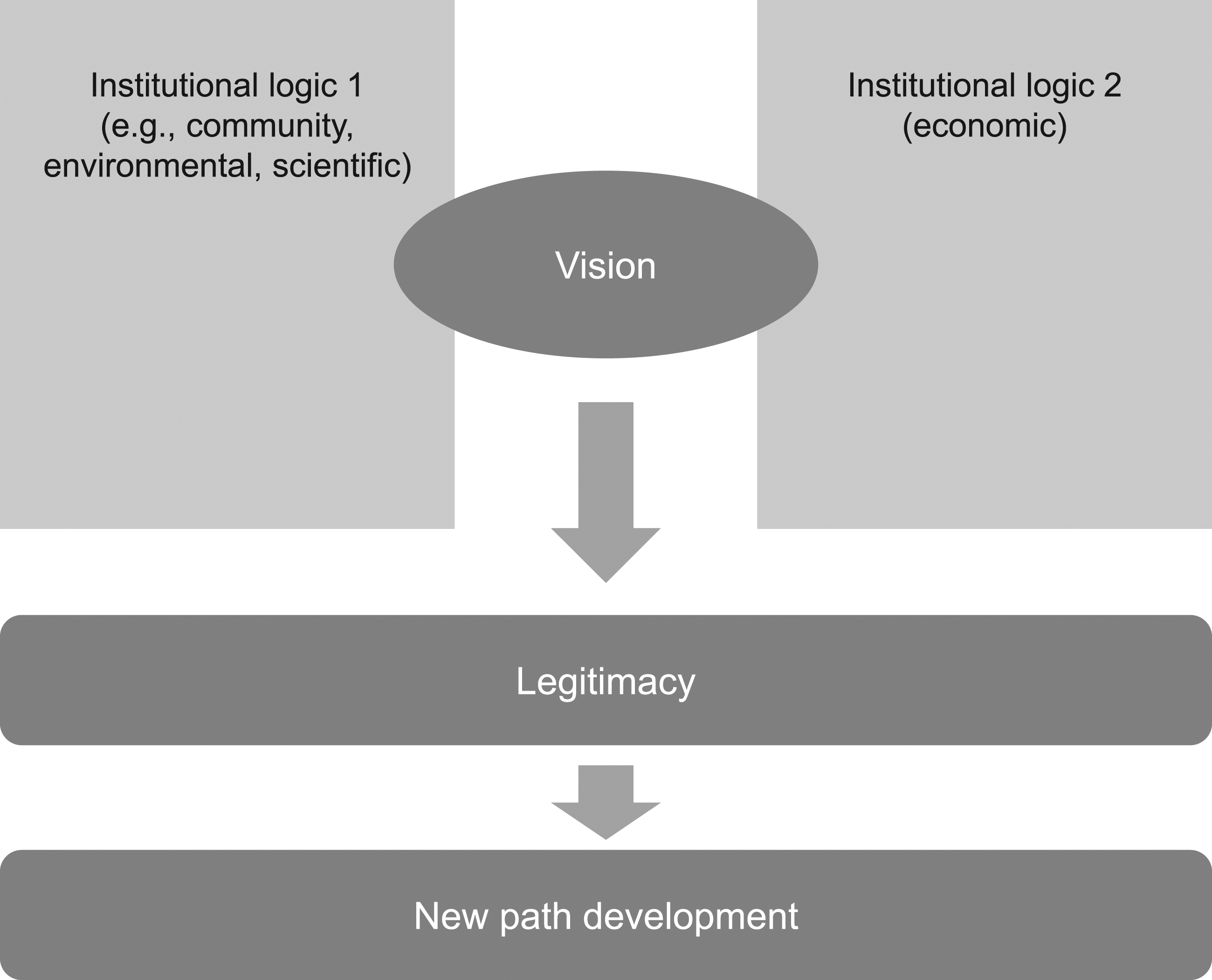
While interlinking may seem like a very specific, narrow strategy when compared to broader legitimation strategies, it is of high importance for path development because it addresses how path development as a developmental process of spatial evolution (Martin and Sunley, 2015) relates to the wider social context structured by different institutional logics. At the same time, interlinking provides a new element to the conceptualization of agency in path development (Blažek and Květoň, 2022; Grillitsch and Sotarauta, 2020; Jolly et al., 2020) and specifically to legitimizing agency (Gong et al., 2022). This is because interlinking focuses on how agents construct and employ visions to provide meaning to new paths and thereby legitimize them and drawing on institutional logics as structuring the socio-institutional context that embeds, constrains, and enables agency (Thornton and Ocasio, 2008).
Given that new paths emerge in an institutional environment that, although not necessarily outright hostile, is tenuous to them, agents will have to build their actions on the basis of an institutional logic that is likely to find public acceptance. They can do so by interlinking pre-existing institutional logics that are generally acknowledged as legitimate and thus create a bridge on which the legitimacy of the new path can be built. Wider imaginaries, visions, and narratives (Benner, 2022a; Harris, 2021; Sotarauta, 2018; Van Lente, 2021) are harnessed by agents to interlink institutional logics, and these devices explain and justify the carrying over of legitimacy between the institutional logics involved (see also Heiberg et al., 2020; Miörner, 2020). Hence, the construction of imaginaries and particularly of future-oriented visions provides a mechanism for cognitive legitimacy that makes sense of the normative legitimacy (Aldrich and Fiol, 1994; Suchman, 1995; Zimmerman and Zeitz, 2002) of one institutional logic carried over to another. For regional industrial development to succeed, this interlinking has to engender industry legitimacy (Zimmerman and Zeitz, 2002) and pragmatic legitimacy (Suchman, 1995) within an economic logic.
Drawing on Swidler (1986), Friedland and Alford (1991), and Seo and Creed (2002), both the heterogeneity and complementarity of institutional logics are assumed to enable strategic action by agents who use their social skills of mobilization (Fligstein, 2001) to legitimize a new path by interlinking institutional logics through visions. Instead of resolving contradictions (Seo and Creed, 2002), these visions serve to preventing major contradictions between institutional logics in the first place by building cognitive legitimacy.
Selected institutional logics in path development.
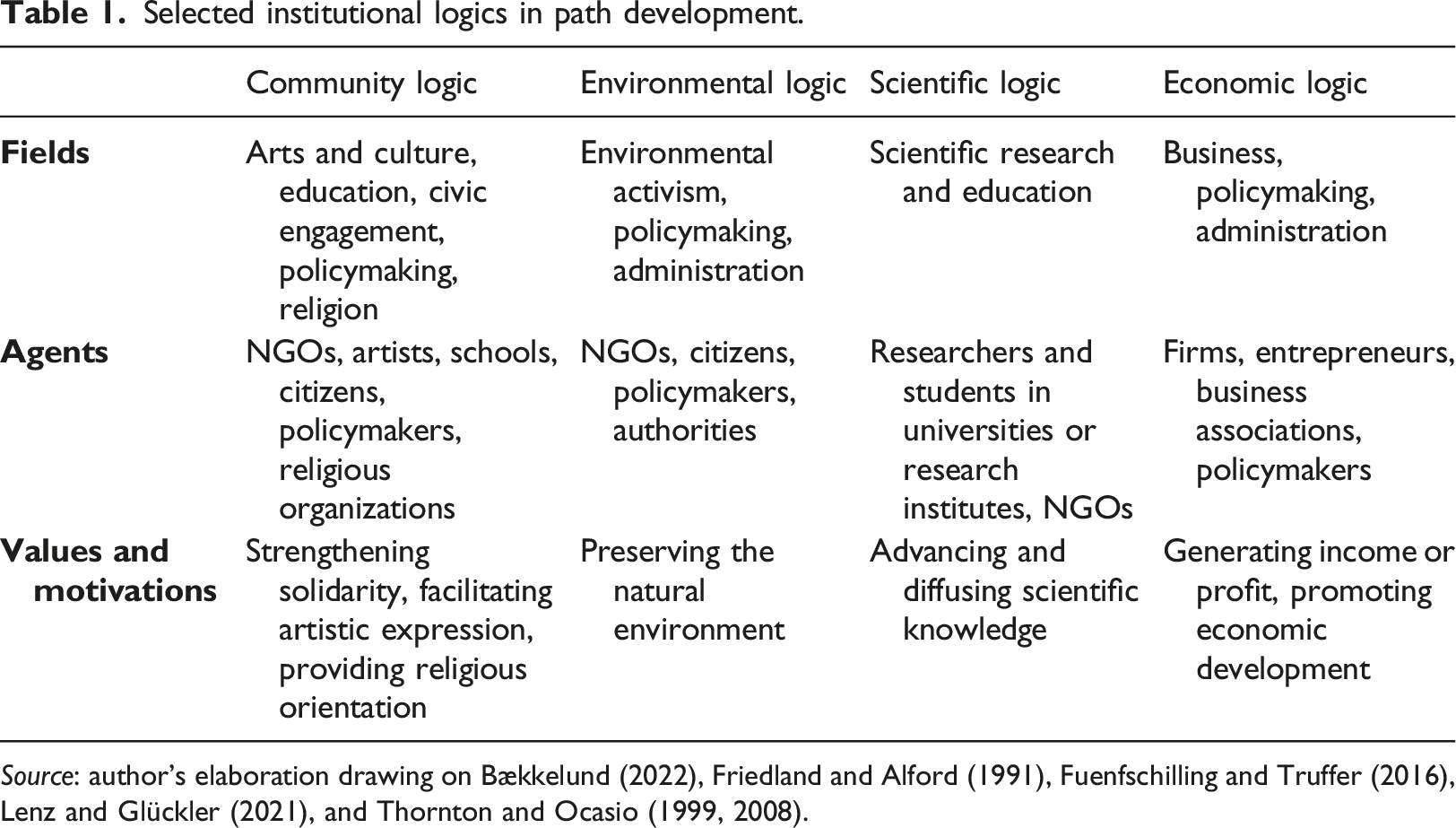
Source: author’s elaboration drawing on Bækkelund (2022), Friedland and Alford (1991), Fuenfschilling and Truffer (2016), Lenz and Glückler (2021), and Thornton and Ocasio (1999, 2008).
Desert tourism in Mitzpe Ramon and Yeroham
The empirical case of desert tourism in the small towns of Mitzpe Ramon and Yeroham (see also Benner, 2022a; Schmidt and Uriely, 2019) in Israel’s Negev desert illustrates how agents legitimize new paths by shaping the symbolic basis of institutional logics.
Overview of interviews.
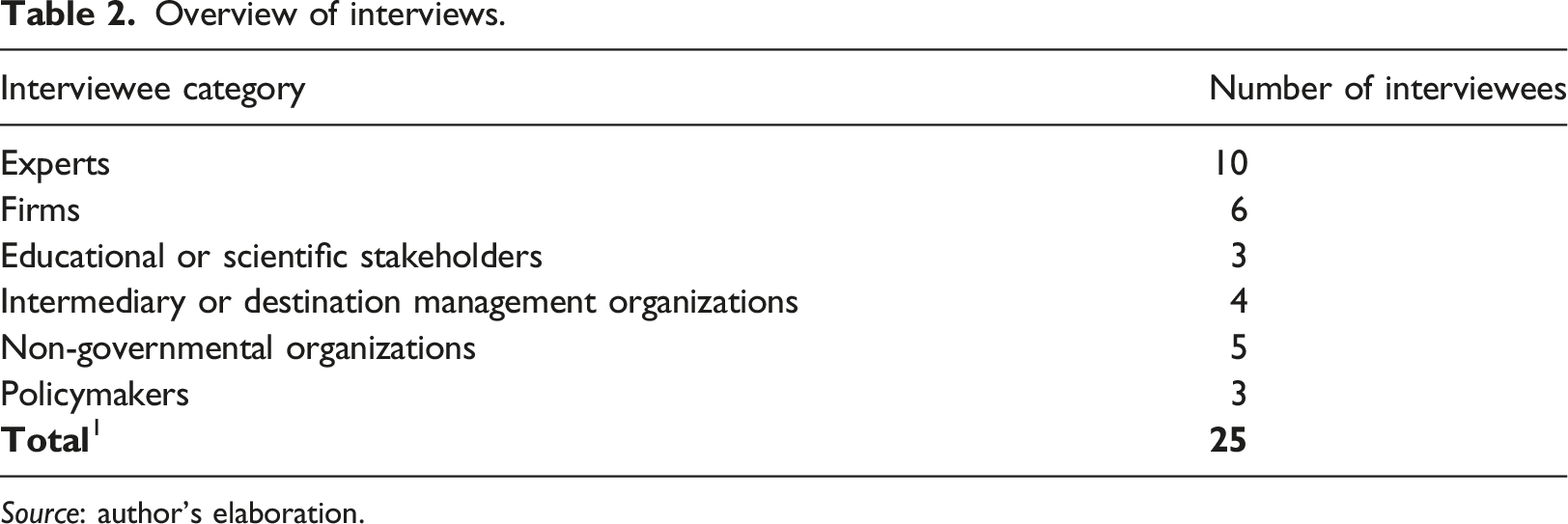
Source: author’s elaboration.
The interviews took place between February 2020 and February 2022. Primarily due to the restrictions imposed by the Covid-19 pandemic, all interviews were conducted on the phone or through online call services. The interviews resulted in a total of almost 977 min of recordings and 190 pages of transcripts. 3 All interviewees consented to recording. The transcripts were analyzed through primarily deductive coding based on the conceptual framework but also informed inductively by the course of the interviews as they were conducted (Mayring and Fenzl 2019). MaxQDA data analysis software (Kuckartz and Rädiker, 2019) was used for coding.
Context 4
As air traffic between Israel and the European Union was liberalized in the wake of an aviation agreement signed in 2013 (European Commission 2021; Reich 2015) and supported through a national subsidization policy for foreign airlines and the opening of the new Ramon airport close to the Southern city of Eilat (Ergas and Felsenstein 2012), air traffic and tourism to Israel saw a strong increase in the years before the onset of the Covid-19 pandemic (see also Benner et al., 2017).
Under these favorable conditions but starting even before this liberalization era, desert tourism in Israel became increasingly popular, reflecting changes in the symbolic meanings ascribed particularly to the Negev desert in Israel society. Zerubavel (2019) describes the development from ancient Jewish religious narratives such as the Exodus and the modern narrative of the “empty space” of “a ‘national dump’ for undesired, discredited, and dangerous elements from the populated center” (p.7) towards a space whose distance from the country’s crowded urban center is now seen more favorably by framing the Negev desert as a place for spirituality, adventure, calm, nature, recreation, and thus tourism.
The small, peripheral towns of Mitzpe Ramon and Yeroham reflect this changing symbolism. As “development towns” set up to accommodate Jewish immigrants with a lower socio-economic status and often coming from Middle Eastern and North African countries (Gradus et al., 1993; Tzfadia, 2005), both used to suffer from a long-term reputation as being desolate, marginalized, and marked by economic distress (Azaryahu, 2005; Schmidt and Uriely, 2019; Zerubavel, 2019). At the same time, both are characterized by important natural assets due to their location near spectacular desert craters recognized as UNESCO world heritage (Zerubavel, 2019). Mitzpe Ramon in particular saw an upswing in desert tourism during recent decades, fueled by a social transformation that saw both secular and religious newcomers from the center of the country settle there and develop small-scale ecotourism offers in an economic shift from mining to tourism (Schmidt and Uriely, 2019).
Arguably related to the opportunities offered by air-traffic liberalization, the Negev desert is now marketed by tourism policymakers as a “friendly desert” accessible for European tourists (MDPNG and NDA, n.d.), echoing the diversifying symbolic constructions of the desert in the Israeli discourse that are relevant for domestic tourism to the Negev.
Results 5
Within the context introduced above, retracing the development of desert tourism in both towns in its entirety is beyond the scope of this article. Instead, the case study focuses on a limited number of selected examples to elucidate how agents interlinked institutional logics to build the legitimacy of new paths.
Following Schmidt and Uriely (2019), the opening in 2011 of a landmark high-end luxury hotel in a spectacular location above the crater and operated by a national hotel chain established a path of investment-driven luxury tourism in Mitzpe Ramon. While this path is consistent with imaginaries about the desert that foreground aspects of relaxation, pristine nature, and isolation (Benner, 2022a; Zerubavel, 2019), Schmidt and Uriely find that this path evolved at some distance from the community-based tourism patterns in the rest of the town and is reinforced by plans for further luxury hotels. However, given the limited benefit of this path for community-based tourism and its environmental impact, the legitimacy of the rapid development of Mitzpe Ramon including large-scale, mostly self-contained luxury tourism during the past decade is challenged as “the ability of the town to accommodate external investment without compromising its unique character and singular natural habitat” (p.821) is questioned and worries about a loss of Mitzpe Ramon’s authenticity have surfaced (Schmidt and Uriely, 2019).
However, while the limited local impact of the luxury hotel on tourism development in Mitzpe Ramon was addressed in the interviews, some interviewees assessed the impact of the luxury tourism path more favorably. For instance, it was highlighted that the hotel brought tourists willing to pay for stargazing tours: “[The luxury hotel] started bringing tourists from a luxury level that usually didn’t come to Mitzpe Ramon, and that kind of tourism also has the money to pay for private stargazing activities and private tours.” (interview #7, 2020)
As described by Benner (2022a), the path of stargazing tourism in Mitzpe Ramon started with non-profit and scientific initiatives such as Tel Aviv University’s Wise observatory located near Ramon crater and its student astronomy club initiating a stargazing festival but later spilled over to tour guides who came to see an economic opportunity to diversify into stargazing tours: “You can definitely point at the involvement of non-profit organizations that actually have an educational agenda or scientific agenda that started these events out of their own interests and created the traffic. They created the interest, the media interest, and then eventually the public interest.” (interview #7, 2020) “Around 2010 or something like this, (…) companies that gave stargazing tourism started to pop up (…) basically, the observatory started this there at the beginning of the millennium and then people saw that (…) you can make a living out of this, so they started to (…) buy telescopes and (…) host groups for payment.” (interview #19, 2022)
With the development of stargazing tourism, the motivation changed. As the city took over the stargazing festival, “it became more a commercial thing, now since [the astronomy] students are less interested in commercial [issues], more interested in volunteering, they took a step back” (interview #19, 2022).
Driven by the Israel Nature and Parks Authority’s (NPA) motivation to protect wildlife from light pollution, Ramon crater was declared a dark-sky reserve by the International Dark-Sky Association in 2017 and the municipality invested in less polluting street lighting (Benner, 2022a). However, while the latter measure was useful for stargazing, it was at least to some degree due to economic considerations: “The move by the municipality to reduce light pollution wasn’t originally motivated from a need to reduce light pollution. It (…) originated in a need to reduce the electric bill and to reduce energy costs for the town.” (interview #7, 2020)
The relevance of less polluting street lighting for stargazing tourism shows how different motivations interacted: “Two things work[ed] together. People come to the desert to see sky. People of Mitzpe [Ramon] understood that they can make some money from that and empowered to that they start to talk with the local city hall about how to reduce the light pollution within the town itself.” (interview #14, 2021)
The application for the recognition as a dark-sky reserve combined the NPA’s motivation of protecting the nature and creating a national precedence for combating light pollution with the opportunity behind the growing interest in stargazing in Ramon crater. By integrating the stargazing aspect into the rationale, the NPA found it relatively easy to gather local support for the dark-sky application, including by the municipality and the observatory. Still, it took several years to convince policymakers of the importance of combating light pollution while the observatory had an interest in the town’s light pollution being limited. In this way, framing the dark-sky reserve application in terms of stargazing and thus linking the issue to Mitzpe Ramon’s growing recognition “as the astronomy capital of Israel” (interview #18, 2022) and its growing stargazing tourism arguably helped in aligning different agents’ interests. Today, Ramon crater has developed into a destination for astronomy tourism that has met particular interest by domestic tourists during the Covid-19 pandemic, for example, during a festival celebrating the Perseid meteor shower in Summer. Moreover, a group of volunteers from diverse fields of science education and technology established a research station to simulate life on Mars (“D-Mars”) in Ramon crater, offering educational programs for teenagers to promote interest in space exploration as well as professional space exploration training. In addition, this initiative offers visits for tourists and cooperates with stargazing tour providers.
However, tourism in Ramon crater engenders contradictions with the original nature and wildlife conservation motivation behind the dark-sky application due to noise and light emissions of events or camping, thus implying long-term inconsistencies emerging after legitimation and new path development. The designation of the dark-sky reserve did apparently lead to stargazing tourism moving to the crater and away from the observatory, thus generally ensuring the consistency with the scientific motivation of keeping light pollution at a distance from the observatory. Still, problems of light pollution around the observatory seem to have increased during the Covid-19 pandemic as domestic tourism in Ramon crater has become even more popular.
Another path that developed in Mitzpe Ramon is the music scene around the city’s well-known jazz club. This club started in a gradual process by amateur musicians who formed a jazz band. As this band became more well known nationally, the municipality furnished a venue for the band to rehearse that over time involved into a jazz club and hosted bands from other places.
6
This dynamic arguably facilitated the setup of a creative music school whose activities reinforced the emerging music scene and the establishment of more music venues: “When the school started (…), young musicians (…) practiced jazz and practiced music and they (…) brought their friends and they developed this way (…). Now the whole town is full of music all over the place (…), in bars and restaurants, and it’s like a small New Orleans.” (interview #15, 2021)
Together with other initiatives like a theater school and a dancing school, this artistic scene affected tourism also through the inflow and outflow of people attending these programs: “The default was people are coming to do hiking into the desert or to do like extreme sports in the desert or jeep tours, (…) and now it's more of (…) students, friends of students that come for the weekend and people who come for a seminar, for a workshop, people who come to a conference.” (interview #24, 2022)
In the case of Yeroham, the beginning of the tourism path was gradual and can be traced back to separate but eventually complementary developments. The first one was the setup of Midreshet Beyachad, a youth learning center and hostel, as well as the establishment of Atid, a non-governmental organization, and Bamidbar, a community center, which later merged into Atid Bamidbar, during the late 1980s and early 1990s. Atid’s original rationale was “to connect the different communities in Yeroham” (interview #16, 2022). Over time, the organization developed various forms of community-based tourism, building on the cultural diversity of the town with its different immigrant groups, starting from the idea “to use community documentation as an empowering force (…) [Atid] brought people from Yeroham’s different communities to tell their stories to visiting groups” (interview #16, 2022). For example, the “culinary queens” program (see also Hillel et al., 2013) invites tourists into the homes of women to dine and listen to their stories of immigration and cultural heritage: “You get into (…) some houses [of families] from Morocco, some houses [of families from Tunisia], (…) and you listen [to] a different story how they get to Israel, and you listen about the story from Morocco and listen to the person. I think this is the most important thing that you listen to (…) different people.” (interview #23, 2022)
These offers follow a motivation to highlight the richness of Jewish (and Bedouin) cultural diversity and at the same time to strengthen the community: “Community-based tourism is a tool for social change (…). It’s a way to empower the local community.” (interview #16, 2022)
The second development goes back to a political change with the appointment of a national-level politician as Yeroham’s mayor by the ministry of interior after the elected mayor was removed from office. The new leadership focused on developing Yeroham through education but realized that new employment opportunities as well as a new sense of pride or identification with the place were needed in the town whose economy had for long relied on mining and manufacturing industries. Both high technology and tourism were identified as promising ways to achieve these goals, and when given a piece of land formerly used as office space as a donation, the municipal foundation took the initiative to build a four-star boutique hotel for desert tourism that was operated as a social enterprise to fund the foundation’s support for education. This mix of community-based and economic motivations, according to one interviewee, makes tourists “want to stay specially in this place because you know they return something to the community (…) [so] you feel [better] to spend money there” (interview #23, 2022). The rationale behind public investment in the social hotel was “to open the horizon for tourism” (interview #17, 2022) by demonstrating its feasibility to the private sector: “Businesspeople (…) looking for good investments will not come to Yeroham and invest even one dollar unless they will have the feeling, not just a feeling but the fact that it is possible, and therefore there is a need for a public investment.” (interview #17, 2022)
Hence, the social orientation of the hotel was linked to an ultimately economic motivation to create employment, to support local businesses, and to strengthen the city’s tax base: “The municipality (…) must think economically, how to increase the income of the municipality, how to increase the income of people that live in Yeroham, by small businesses, by a lot of inventions, and people think more as an entrepreneur.” (interview #17, 2022)
In parallel and supported by a dedicated donation, a national-level philanthropic organization called Zionism 2000 whose original mission was to strengthen social cohesion and reduce socio-economic disparities after the 1995 assassination of prime minister Yitzhak Rabin and that partners with firms in corporate social responsibility initiatives assigned a manager to Yeroham to develop tourism projects and to create a new economic perspective. The program initially had the objective of educating youth but eventually was redirected towards tourism which was used as a lever “to change deeply (…) the DNA of the place” (interview #23, 2022), and while the program followed primarily an economic motivation, it was based on a wider social vision.
These different paths were complementary and, together with marketing efforts organized by an association set up by local tourism entrepreneurs, succeeded in making Yeroham increasingly visible as a tourist destination as opposed to its previously dominant reputation of a desolate development town, although these perceptions may still persist to some degree (Benner, 2022a). This motivation went beyond purely economic objectives, as the statement of a tourism entrepreneur that “the sense that we’re doing something that’s not only for our own good but also for the economic and cultural development of Yeroham” (interview #10, 2020) highlights. Currently, plans to diversify tourism offers in Yeroham include, inter alia, a glamping site, a luxury hotel, and agritourism venues.
Finally, it is remarkable that in both Mitzpe Ramon and Yeroham, those individuals who were involved in initiating these new paths strikingly often came from other parts of the country and notably from its urbanized center (see also Benner, 2022a; Schmidt and Uriely, 2019; Zerubavel, 2019). Indeed, attracting entrepreneurially minded individuals from the outside seems to have been an objective of decisionmakers that intermingled with the development of tourism: “[Policymakers] were really looking to create the movement of young people to Mitzpe Ramon, they were really worried about demographics and (…) the idea that young people would come to Mitzpe Ramon.” (interview #24, 2022) “When you start to be attractive and new people and a new community come to live in Yeroham, it changes everything.” (interview #23, 2022)
While exploring this issue in detail is beyond the scope of this article, it raises interesting questions for agency in new path development that merit further research.
Discussion
Institutional logics and visions in new path development in Mitzpe Ramon and Yeroham.
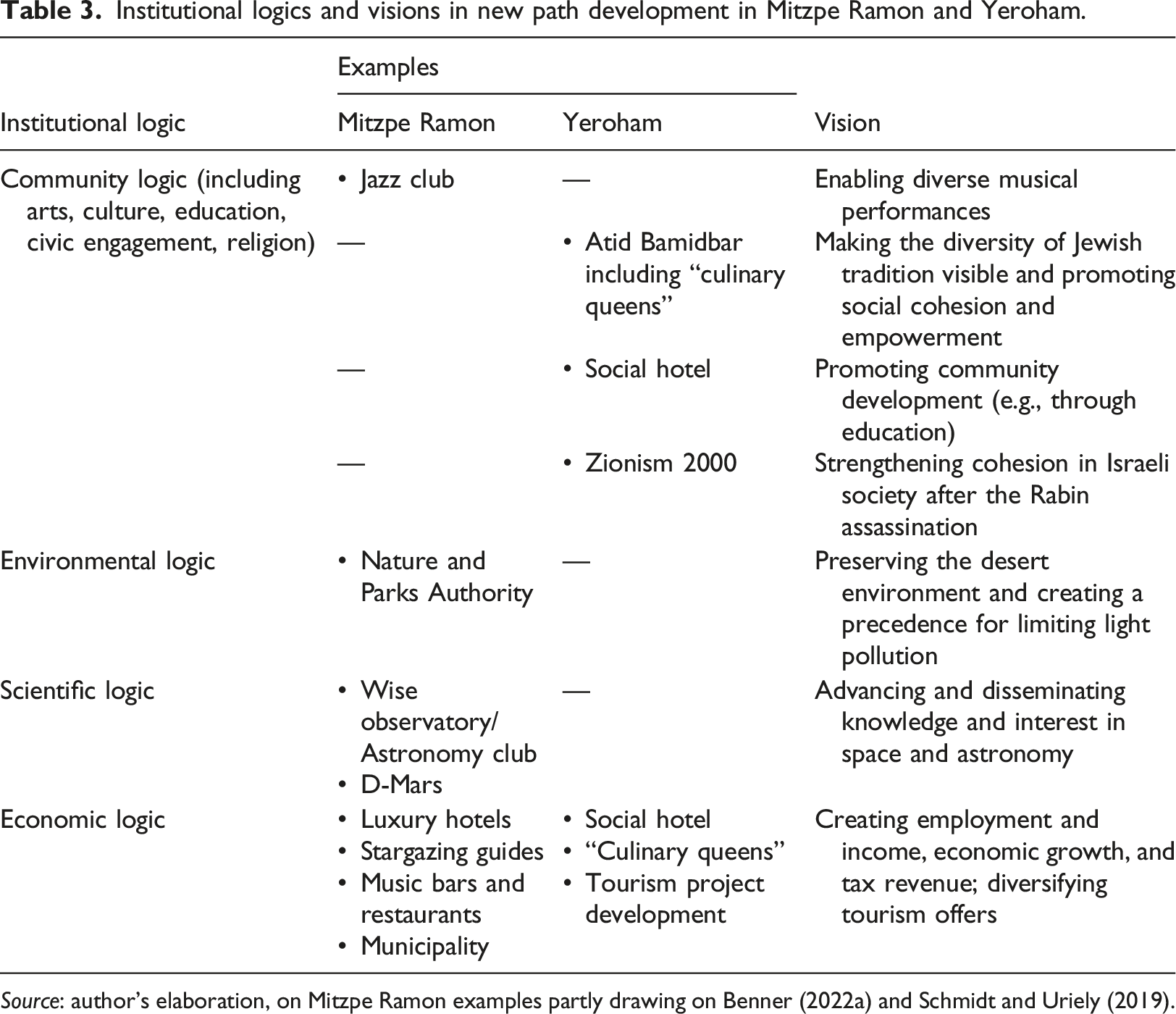
Source: author’s elaboration, on Mitzpe Ramon examples partly drawing on Benner (2022a) and Schmidt and Uriely (2019).
The examples show how interlinking is done not just within hybrid organizations (e.g., Yeroham’s social hotel) through intraorganizational coupling (Pache and Santos, 2013) but also between organizations that predominantly follow one institutional logic but define the relevant vision on the one hand (e.g., Mitzpe Ramon’s jazz club or astronomy club) and other organizations such as firms infusing an economic logic into the path on the other hand, thus confirming that interlinking is a mechanism for legitimizing a regional industrial path instead of solely achieving intraorganizational alignment (Besharov and Smith, 2014).
In the examples from Yeroham, different expressions of the community logic provide the sources of legitimacy for path diversification and branching in tourism. The social hotel offers a particularly clear example of how community and economic logics are interlinked along the visions of promoting tourism and education at the same time. The tourism activities under the roof of Atid Bamidbar, including notably the “culinary queens,” serve to provide an income for parts of the community but are primarily based on the vision of making the diversity of Jewish tradition in Yeroham visible and promoting social cohesion. Similarly, the tourism project development supported by Zionism 2000 has its roots in the overarching objective of social cohesion.
In Mitzpe Ramon, the path of music tourism around the jazz club that evolved out of an amateur jazz band shows how the legitimacy of the path was initially rooted in the community logic and over time coalesced with the economic logic represented particularly by music bars and restaurants. Given that at the outset, Mitzpe Ramon seemed an unlikely place for such a thriving music scene, this organic evolution provided a degree of normative legitimacy that would presumably have been difficult to achieve through a purely economic logic from the start.
In stargazing tourism, three institutional logics were interlinked and agents mobilized accordingly. Starting with the NPA’s environmental logic of nature preservation, the idea of the dark-sky reserve was well consistent with the scientific logic of the Wise observatory whose work would benefit from limiting light pollution, and aligned with the economic logic of promoting tourism that motivated the municipality and tourism businesses such as tour guides, thus enhancing the legitimacy of the stargazing and astronomical tourism path that was eventually reinforced by the setup of D-Mars. As an instance of path branching, this type of tourism stands in a certain contrast to the imported luxury tourism that follows a purely economic logic whose legitimacy is called into question from a community perspective (Schmidt and Uriely, 2019) but also possibly complements it. Interestingly, in the case of astronomical tourism, not only was normative legitimacy initially carried over from the scientific logic to the economic logic, but later was pragmatic legitimacy carried over in the opposite direction because the vision of promoting the economy through stargazing tourism mobilized agents around the NPA’s vision of protecting the crater’s wildlife from light pollution.
Hence, the empirical cases go beyond the conceptual framework by highlighting that legitimation can work bidirectionally when institutional logics are interlinked. Not only can the economic logic benefit from the legitimacy carried over from community, environmental, or scientific logics, but also vice versa. Thus, the original sources of legitimation in regional industrial path development can come from different agents and their different logics, including but not limited to the economic sphere.
Nevertheless, it is important to note that the outcomes of interlinking observed were not inevitable but instead fraught with uncertainty, as path development is marked by contextuality and contingency (Bathelt and Glückler, 2003). Hence, different legitimation strategies (e.g., institutional folding) could also have occurred. In particular, the emerging contradictions about stargazing tourism in Mitzpe Ramon show the dynamic nature of interlinking that includes ongoing processes of contestation and competition. 7
Conclusions
This article has proposed interlinking between institutional logics as a strategy for legitimizing new regional industrial paths and argued that agents use visions as a forward-looking form of imaginaries to interlink different institutional logics as a way of meaning-making. The empirical examples from desert tourism in Mitzpe Ramon and Yeroham demonstrated how different kinds of legitimacy are carried over from one institutional logic to another and how this contributes to new path development.
Nonetheless, different institutional logics and their underlying meanings can engender inconsistencies or contradictions (Bækkelund, 2022; Friedland and Alford, 1991; Suchman, 1995) that can over time provide an impulse for further institutional change in dialectical processes (Seo and Creed, 2002). In contrast to legitimacy spillovers from other industries, sectors, or scales that can turn around the fate of a path (Jolly and Hansen, 2022), these contradictions between the institutional logics involved are endogenous to the path itself. Exploring the role of these contradictions, for example, between economic and environmental logics, and their effects on how dialectical processes of institutional change involve changes in legitimacy and their impact on path development merits further research. For example, legitimizing tourism paths through interlinking might work only up to the point where contradictions begin curtailing legitimacy, consistent with life-cycle models in tourism (Butler, 1980) and their implications for path development (Benner, 2020b) to which the dimension of legitimacy can be added. Going beyond tourism, further elucidating the role of legitimacy and its loss in negative path development is an intriguing question. How industries lose legitimacy and how this relates to paths of decline (Blažek et al., 2020) is surprisingly little understood and few studies so far (e.g., Jolly and Hansen, 2022) address the descending course of legitimacy in path development after a certain tipping point. How and why such a tipping point is reached and which social and economic processes are at play hints at a crucial direction of research.
On a related note, as institutional logics are not stable but exhibit their own dynamics (Lounsbury et al., 2021), what it means for paths legitimized through interlinking if the underlying institutional logics change is a fascinating question for further research. In this sense, the insights presented here should be seen as a preliminary step towards more far-ranging empirical research on the multiple institutional orders that structure the environment in which spatial evolution takes place, each with their own complex inner workings (Lounsbury et al., 2021). Such research could further enhance the way in which the path development literature with its emerging focus on agency benefits from the rich repertoire of neo-institutional sociology.
By laying out how agency in path development is embedded into the wider socio-institutional context and how agents enact parts of this wider context in giving meaning to path development, the case speaks to the need for deep contextualization in evolutionary economic geography (Martin and Sunley, 2015). Such deep contextualization relates spatial evolution to institutional patterns rooted in other spheres of society such as arts, culture, education, civic engagement, religion, the environment, or science. The article assumes that interlinking institutional logics through visions may be a common legitimation strategy in path development. As a constraint, the single case presented cannot generally confirm this hypothesis. More empirical research in other contexts and in other industries will be needed to assess how widespread interlinking is empirically. For example, drawing on existing research on environmental technologies (e.g., Binz et al., 2016; Fuenfschilling and Truffer, 2016), future research should focus on analyzing how wider social meaning-making systems shape the legitimation of these paths. In any case, further research as sketched could help scholars and policymakers assess which kinds of new regional paths are socially desirable in a given context, under which conditions, and supported by which policies.
Footnotes
Acknowledgements
Empirical research reported in this paper began while the author was employed at Heidelberg University. The author is grateful to Michaela Trippl for advice. Early considerations for this article were presented at the Modul University research colloquium and at the ERSA conference, both online and in 2021, and more advanced insights were presented at the virtual AAG annual meeting and at the RSA “Regions in Recovery” e-festival in 2022. Comments made by participants are gratefully acknowledged. Further, the article benefited from helpful comments and suggestions by the editor and reviewers. Of course, all errors and omissions are the author’s alone, as are the opinions expressed.
Declaration of conflicting interests
The author(s) declared no potential conflicts of interest with respect to the research, authorship, and/or publication of this article.
Funding
The author(s) disclosed receipt of the following financial support for the research, authorship, and/or publication of this article: This research was funded in whole, or in part, by the Austrian Science Fund (FWF): M 2992-G.
