




Abstract
Given the global imperative to meet ‘net zero’, and growing interest in the potential for green jobs growth, there is an urgent need to better understand the drivers and processes underlying green structural economic transitions. How should we in fact define ‘green’ products, jobs and technologies? How do local economies transition into greener jobs – is this generally an incremental process or does it require more radical innovation? Building on nascent green definitions, recent work emerging from the literature in Evolutionary Economic Geography suggests that there is a degree of path dependency to green transitions, with regions benefiting from existing capabilities which are somehow related to newer green tasks and technologies. On the other hand, having diverse, frequently unrelated, skills and competencies also helps local economies to make the recombinations necessary for the emergence of new green activities. These drivers are moderated by factors such as the local institutional environment, IT skills and the degree of maturity of the local industrial base. This article summarises the recent literature in order to provide an overview of emerging findings of relevance to local policy delivery, while also highlighting future research directions.
Keywords
Introduction
As concerns mount as to the impact of climate change and global biodiversity loss, there is increasing interest in forms of economic development which do not negatively impact the environment or increase the amount of carbon in the atmosphere (so called ‘net zero’ growth). While national and international policy commitments towards net zero often seize the most attention, local and regional scale policymakers are also pushing for greener economic futures, and in some cases leading this process. The Sheffield City Region in northern England, for example, aims to be net-zero carbon by 2040, with a commitment to invest in clean steel and low carbon hydrogen, alongside a plan to incentivise private-sector action and commitment (see Box 1). While local green commitments must be seen as only one dimension of a broader effort to transform our national and international economies, they nevertheless have an important role to play. Local economies each host distinct forms of embedded skills, knowledge and technology, making tailored local approaches to economic transitions important. Green diversification is also likely to require employment transitions, training and upskilling at the scale of local labour markets. However, a number of barriers lie in the way of local policymakers seeking to intervene in this area, not least a lack of shared understanding about what makes for a ‘green’ economy, and about what drivers will be important to transitioning to such an economy.
Plans for the green transition in the Sheffield City Region.
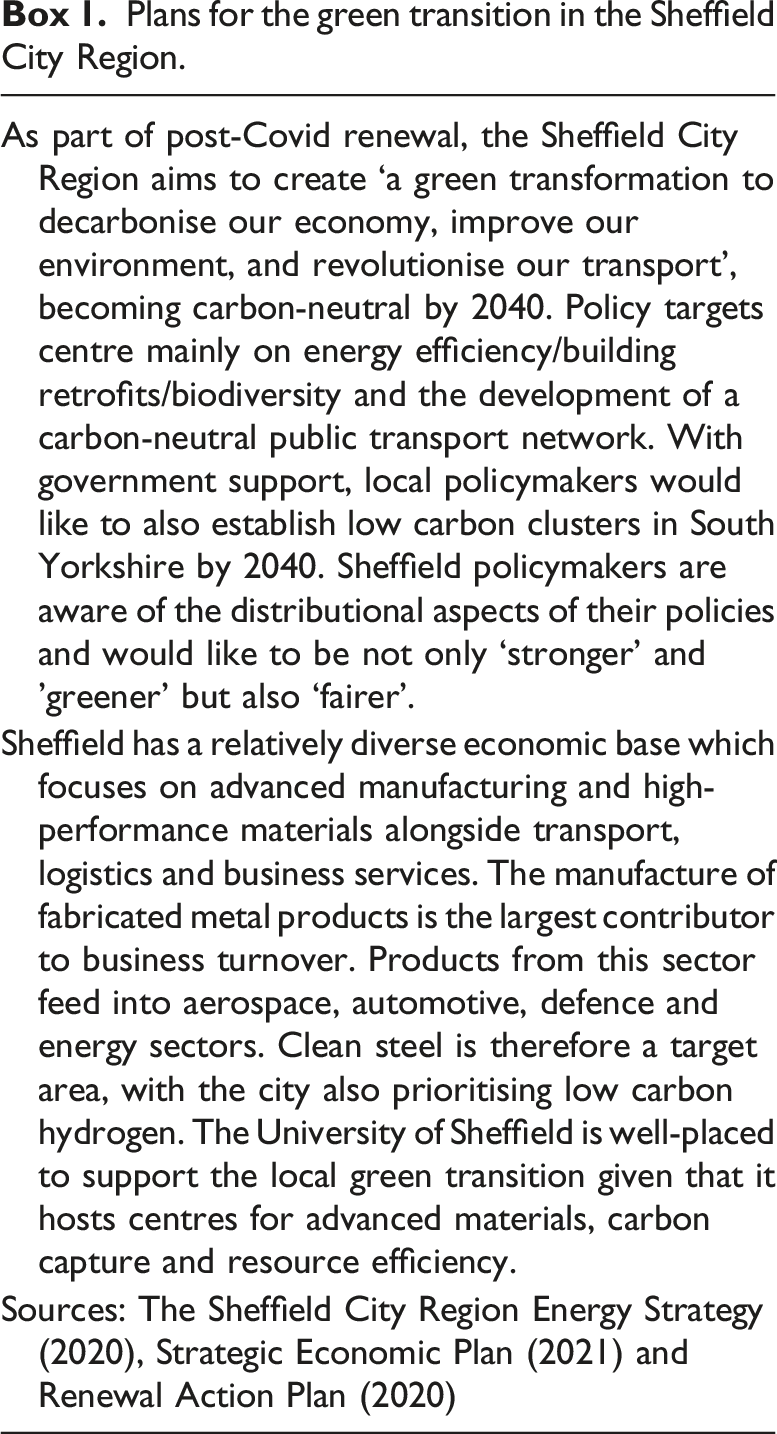
While Sheffield policymakers are hoping to green a broad range of sectors, in general local green and net-zero policies focus on a relatively narrow range of industry sectors such as construction and transport. Greener forms of construction include, for example, the retrofitting of existing buildings, while sustainable transport measures may focus on public transport provision, including rail and trams. In order to reach net-zero targets, however, there will be a need to more broadly transform local industrial structures (Mazzucato and McPherson, 2018). In turn, developing broader and more ambitious green transition approaches will require a clearer understanding of what exactly constitutes ‘green’ when it comes to jobs, tasks and technology. Consistent international definitions in this area are needed to help local policymakers to more accurately gather data on their current portfolio of green jobs and technologies, and identify areas where green transitions are most urgently needed. At the same time, a better appreciation of the drivers of broad green transitions is needed so that local policymakers can understand the opportunities and challenges associated with greening their own local economy – including the possibilities for more ‘bottom up’ and emergent forms of local green diversification which might be easier to achieve.
In this article, we provide an overview of recent efforts to accurately define green products, jobs, occupations and technological innovations. We then explore recent literature from Evolutionary Economic Geography which has built on these nascent green definitions to identify a set of key factors underlying local green structural transitions. The evolutionary strand of economic geography emphasises the importance of time and history to economic development, pointing to the way in which regions evolve differently depending on local context. There has recently been growing interest within this discipline in greener forms of economic evolution and diversification (Ferraz et al., 2021). The article reveals that not all regions will transition towards becoming greener in the same way, with some cities and regions being better positioned for a transformation than others, meaning that ‘one size fits all’ development advice is not appropriate – it will be important to take into account current industrial and occupational portfolios.
Ultimately, this preliminary work suggests that some combination of related and unrelated economic diversification is important for green transitions. On the one hand, the development of complex green technologies, occupations and industries shows some signs of path dependency (Fraccascia et al., 2018; Montresor and Quatraro, 2020; Van Den Berge and Weterings, 2014). New green innovations often develop on the basis of capabilities that are already present within a local economy. On the other hand, having diverse, frequently unrelated, skills and competencies helps local economies to make the recombinations necessary for the emergence of new green activities (Barbieri and Consoli, 2019; Barbieri et al., 2020; Mazzei et al., 2022; Talebzadehhosseini et al., 2019). Overall then, having a diverse local economy, which includes existing capabilities that are close to those required for green economic activities, is likely to help places to adapt to a greener future. However, the likelihood of a green transition will also depend on the local institutional environment, the presence of advanced technologies and IT skills, and the degree of maturity of the local industrial base (Jakobsen et al., 2022; Montresor and Quatraro, 2020; Santoalha et al., 2021).
Measuring greenness
To begin, how can the ‘greenness’ of products, jobs, tasks, skills and technologies be measured? This is an area of much recent research, but also considerable methodological fragmentation, creating a confusing picture for local policymakers seeking to understand the relative greenness of their local economies.
Identifying green products, for example, is not simple. Difficulties include the fact that products have multiple uses, some of which will not have positive environmental impacts. Several international organisations have attempted to compile lists of green products, including the World Trade Organisation (WTO), the Organisation for Economic Cooperation and Development (OECD) and the Asia-Pacific Economic Cooperation (APEC). For example, the OECD uses a ‘Combined List of Environmental Goods’ (CLEG) which features 248 products organised around a series of themes: air pollution control; cleaner or more resource efficient technologies and products; environmentally preferable products based on end use or disposal characteristics; heat and energy management; environmental monitoring, analysis and assessment equipment; natural resources protection; noise and vibration abatement; renewable energy plant; management of solid and hazardous waste and recycling systems; clean up or remediation of soil and water and; waste water management and potable water treatment (Sauvage, 2014).
There is a growing literature on the ‘embodied carbon’ present in products – that is, the carbon which has been emitted in their production, and in the production of their component materials (Sato, 2014). However, it is also recognised that some products may produce substantial emissions in production (e.g., electric vehicles), but have recognised value in the green economy due to their lower emissions intensity in use (vis a vis petrol-fuelled vehicles) (Sauvage, 2014). The interconnectedness of supply chains also produces definitional challenges – for example, the GHG Protocol (a global framework for measuring greenhouse gases) distinguishes between Scope 1 emissions (directly associated with the production process), Scope 2 emissions (associated with the purchasing of electricity, heat and steam to power the production process); and Scope 3 emissions (supply chain linkages which are not associated with energy provision). Hertwich and Wood (2018) point out that while very little is known about Scope 2 and 3 emissions, the latter emissions appear to have grown the most between 1995 and 2015, particularly in developing countries. The need to understand the greenness of interconnected supply chains has led to ‘product life-cycle approaches’ (see e.g. Wang and Gupta (2011)) which trace products from their manufacture to their disposal.
The development of new products, technologies and innovations is typically captured and analysed via patent applications which contain a host of information including technological classifications and links to other patents. In order to try to quantify the greenness of such patents, the OECD has developed an environmental technology classification system for invention related to environmental management and adaptation technologies (Haščič and Migotto, 2015). While environmental management represents the largest patent category by volume worldwide, climate change mitigation patents have increased in frequency most dramatically especially in high value inventions, 1 increasing 6-fold since 1990 (Haščič and Migotto, 2015).
These developments have allowed countries and regions to track their progress and comparative strength in green innovation. For example, from 2000 to 2019, the UK’s growth in environmental patents grew with a comparative trajectory to the sum of all OECD countries, with peak growth years in 2006 and then again in 2019. Related to the OECD average, the United Kingdom has comparative strengths within the international patent system (from the Patent Cooperation Treaty or PCT) in patents related to green energy, environmental management and climate change tech related to transport (Figure 1). Comparison of green growth and composition for patents filed in the UK/OECD. Data is available at stats.oecd.org.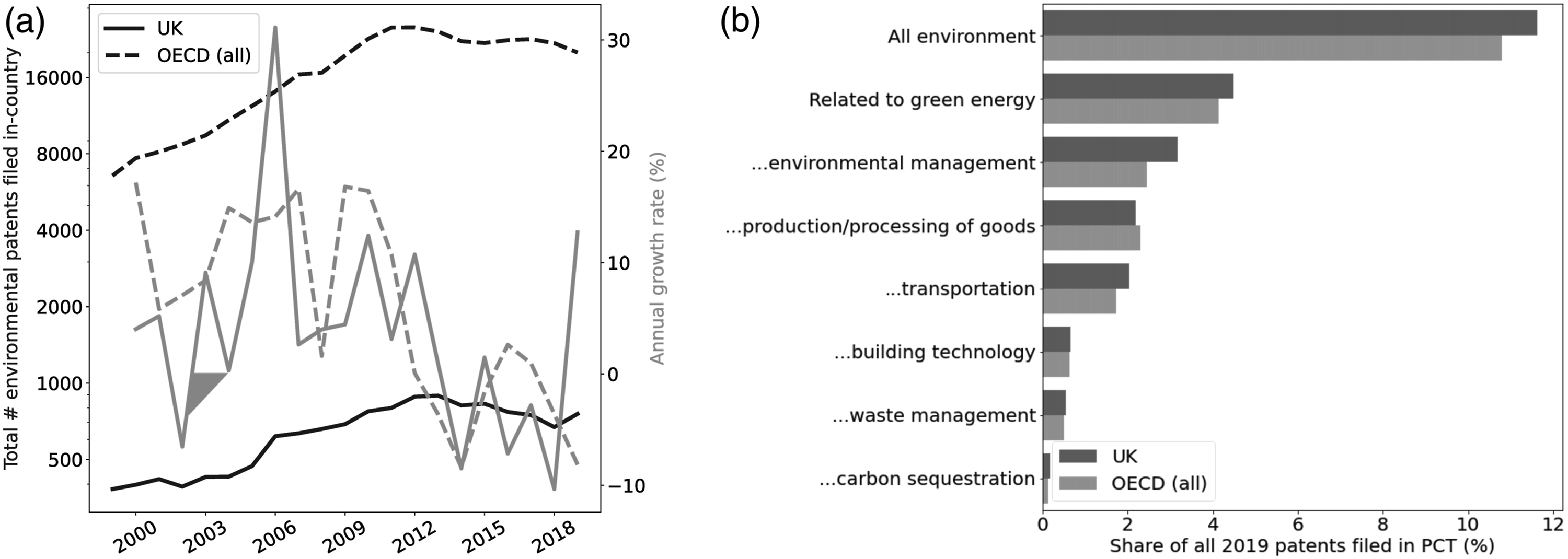
In addition to products and technologies, there are several existing classifications of green occupations or jobs, with the most prominent two coming from the United Nations System of Environmental Economic Accounting and the International Labour Organisation (ILO). According to estimates from 2018 in the United Kingdom, green jobs represent 403,000 full time equivalent labourers or nearly 85 billion pounds of output. 2 As with products, one difficulty with choosing a single set of green jobs is that these jobs will have different roles in emissions reduction. For instance, a recent effort by the UK Office for National Statistics (ONS) to collect information on ‘low carbon’ employment includes the renewable energy sector, low emission vehicle production, and other sectors but excludes the circular economy and recycling. Moreover, it is difficult to appropriately capture the suitability of workers for the green economy via job titles. For example, a farmer producing corn for consumption is by most classifications not labelled as having a green job, while it becomes a green job if the corn is used to produce ethanol. Similarly, a construction worker installing a ‘Lo-Flo’ toilet has a green job but one installing a regular toilet does not (Furchtgott-Roth, 2012).
In an effort to clarify the composition of green jobs, the O*NET database – the main source of data on occupations in the USA – has introduced a green jobs categorisation that aims to be adaptable to future green growth (Dierdorff et al., 2009). In particular, their categorisation divides jobs into ‘green increased demand’ (e.g. locomotive engineers), ‘green enhanced skills’ (e.g. environmental engineering technicians) and ‘green new and emerging’ (e.g. robotics technicians) in order to track changes to the world of green work. The first of these categories represents jobs that are not green in themselves, but that are expected to experience a rise in demand due to the requirements of a greener economy. Taken together, the three categories represent nearly 20% of all employment in the US economy (Bowen et al., 2018).
Moreover, O*Net also breaks down individual occupations into tasks and skills (National Research Council, 2010). While ‘occupations’ refer to the jobs that people are doing, ‘tasks’ refer to the specific activities that are required to carry out those occupations, while ‘skills’ are the capabilities required to complete those tasks. O*NET provide a list of tasks which are unique to green jobs. As noted by Vona et al. (2018) and Bowen et al. (2018), breaking occupations into tasks provides a method to compare them by greenness. For example, the ‘green enhanced skill’ jobs identified above require tasks that are 30.4% green, while ‘green new and emerging’ jobs involve tasks that are 59.4% green (Bowen et al., 2018). These more nuanced approaches to defining green jobs also take into account the amount of time spent on green tasks in any given occupation. Using this framework Vona et al. (2019) find that greener jobs are more pro-cyclical than other jobs, have moderately higher wages (4%), and are geographically concentrated.
It is also important to identify skills (or specific competences) that are useful to the current green economy. Via analysis of O*NET skills for green occupations, Vona et al. (2018) find that green skills can broadly be classed into engineering and technical, science, operation management, and monitoring. Consoli et al. (2016) and Vona et al. (2018) find that green jobs require overall higher levels of education, as well as more training and work experience. ‘Green enhanced skills’ and ‘green new and emerging’ jobs also involve more use of interpersonal and cognitive skills (Consoli et al., 2016) as well as less manual skills (Bowen et al., 2018). Similar results have been found via document analysis of published articles and technical reports about green jobs (Sern et al., 2018). However, ‘green increased demand’ jobs require very similar skills to what are labelled as ‘green rival’ jobs or ‘brown jobs’ (identified as being involved more in polluting industries), and so job transitions can be more easily facilitated between these categories (Bowen et al., 2018; Vona et al., 2018). Consoli et al. (2016) calculate a ‘skill distance’ measure, which indicates the extent of re-training required to transition from one job to another – which could provide a helpful indicator for local policymakers seeking to retrain people who have lost employment in declining ‘brown’ sectors.
Overall, our review of the international literature on the definition on green jobs, products and technologies reveals considerable confusion and fragmentation. While some countries are more advanced in defining green jobs and skills (for example, the United States with its O*NET classification), other countries lag behind, and a greater sharing of data classification techniques at the international level is needed. Progress is required in the United Kingdom, for example, to reach the same level of precision and depth in green economic data classification that is found in the United States. In the meantime, local policymakers in cities and regions such as Sheffield face a lack of relevant fine-grained data – such as that on workforce skills and tasks – on which to devise broad local transformation strategies. Where comprehensive data is not available, local policymakers may find it necessary to consult sector by sector on how industries perceive their transition to a greener future, as such granular data will help in reducing false assumptions and avoiding unintended policy impacts (see Braungart and McDonough (2009)).
Green structural transformation
For effective local policymaking to take place, it will also be essential that local stakeholders better understand the drivers of green transitions – what types of locality or region are most likely to become green? What is the likely role of path dependency in this process? Is the presence of local capabilities associated with ‘brown’ industries likely to be an advantage or a hindrance to the transition process? Is a strong public sector role important or is greening likely to be a more private-sector led process?
A number of recent studies have harnessed the nascent green definitions discussed above to analyse the processes involved in local green structural transformations. They help to reveal the factors or local conditions under which regions and cities move into the production of new green products and inventions, and new green jobs. In this section, we discuss the early results of this research, focusing in particular on developments within the discipline of Evolutionary Economic Geography. This discipline, which has emerged over the past 20 years, underlines the importance of historical context in how economies work. Rather than centring on exogenous forces of economic development – such as inward investment or technology transfer – the discipline focuses on the processes and mechanisms by which economies self-transform themselves from within (Boschma and Martin, 2010; Witt, 2003; 2006), pointing to the fact that different regional economies can have very different economic development paths depending on their starting conditions, economic structures and evolving local contexts. Evolutionary economic geographers also often emphasise the role of local capabilities embedded in industries and workforces in industrial diversification processes (Balland et al., 2022; Boschma and Iammarino, 2009; Frenken et al., 2007; Hidalgo et al., 2007; Hidalgo and Hausmann, 2009; Neffke et al., 2011; Neffke and Henning, 2013; Nelson and Winter 1982). From this point of view, the diversification of a place is constrained by what is already present in terms of both skills and physical inputs. The importance of considering existing local capabilities when imagining future economic transitions is often already recognised by policymakers – a strategy document developed by the Sheffield City Region, for example, points out that ‘the same capabilities that put the City Region at the heart of the world’s first industrial revolution can put us at the centre of the fourth – producing new materials, new processes, and new answers to the environmental, social, and wellbeing challenges facing the UK and the world’ (The SCR Renewal Action Plan, 2020). The importance of building on local capabilities to support economic transitions is also recognised in international policy – for example, in the importance given to ‘smart specialisation’ in European regional policies (see Balland et al., 2019). Our review of the literature reveals that diverse places with many capabilities (both green and non-green) have a particularly strong opportunity to recombine these capabilities, move into new greener economic activities and produce more complex green products.
Diversification into related green activities
A key research strand within evolutionary economic geography focuses on ‘industry relatedness’. Local and regional economies boast skills and experience that are embedded in local industrial practices, producing capabilities that are often tacit and tricky to transport (Hausmann and Neffke, 2016). Because of these embedded capabilities, cities and regions tend to diversify into ‘related’ industries and technologies, that is, those that share similar inputs, skills and occupational structures (Balland et al., 2015; Boschma and Iammarino, 2009; Rigby, 2015). Similarly when it comes to green transitions, Shutters et al. (2016) identify that ‘some technologies and skills, by their very nature, afford opportunities for adaptation and expansion into other economic activities, while some occupations do not and may even hinder transformation’ (p. 199). The concept of industry relatedness has gained traction in recent years leading to a large literature, as reviewed by Hidalgo et al. (2018), which typically deploys a network approach to modelling industrial path dependence, capturing potential industry hops via various inter-industry relatedness metrics (Hidalgo et al., 2007; Neffke et al., 2011; Neffke and Henning, 2013).
Industry relatedness has been found to be important to the emergence of new green technologies in cities and regions. Analysing the development of new green technologies in 95 regions in seven European countries during the period 2000–12, Santoalha and Boschma (2021) found that technological relatedness was a more influential factor in the emergence of new green technologies than political support for environmental policies. Mazzei et al. (2022) recently found that a stock of ‘brown’ knowledge closely related to ‘green’ knowledge was particularly valuable for technological developments towards the production of new low emissions vehicles. Several studies also confirm the importance of path dependence for the emergence of green patents, which represent the generation of frontier knowledge in green technology, albeit for a limited number of sectors. Using patent data on 63 countries over the period 1971–2012, Perruchas et al. (2020) find that having technological capabilities in related domains increases the likelihood of investing in a new-to-the-country green technology. At a more local scale, Van Den Berge and Weterings (2014) and Montresor and Quatraro (2020) find that the local presence of patents in related fields makes new green patents in a city or region more probable. Nevertheless, hosting-related technologies does not always support new green innovation – Corradini (2019) finds a U-shaped relationship between relatedness and green technological entry – high relatedness and what they call ‘cognitive proximity’ to existing technological activities offers a significant advantage in terms of new innovation and entrepreneurship. However too high a degree of relatedness can cause technological ‘lock-in’ meaning that it is difficult to innovate away from existing sectors of production.
Path dependency has also been shown to be an important factor in the manufacture of green products. Fraccascia et al. (2018) analyse 41 green products (based on the ‘Environmental goods and services sector’ definition used by EUROSTAT) in 141 countries and show that green products with the highest growth potential tend to be products that are the most related to countries’ existing export structures. Using international trade data, Mealy and Teytelboym (2020) develop a relatedness metric for product similarity and also find robust path dependence in the accumulation of green products.
There is currently a research gap when it comes to demonstrating the link between ‘skill-relatedness’ (i.e. proximity between the skills required for new greener forms of production and the skills embedded in existing industry portfolios) and green diversification. While there is a broad literature on how embedded skills within industrial portfolios help to shape economic diversification (see e.g. Neffke et al., 2011; Neffke and Henning, 2013), there has been a lack of attention to date as to how this might shape transitions into greener forms of employment. Nevertheless, Shutters et al. (2016), explore how the current occupational structures of US metropolitan areas could facilitate or hinder their transition to a green economy. They develop a city-level ‘green jobs index’, which reflects both a city’s current portfolio of (O*NET-labelled) green employment and its proximity to other forms of green employment. They show that green jobs potential is correlated to city size/wealth. They point out, however, that the transition process towards a greener economy is a ‘slow and reversible process that does not get easier as the city’s economy becomes greener’ (p. 204).
To make things more complicated, the importance of ‘relatedness’ to green transitions may depend on the type of economic sector that is under examination. Moreno and Ocampo-Corrales (2022) find, for example, that technological relatedness may be more important for renewable energy technologies compared with other green technologies because renewable energy technologies are more specific – that is, they require less diverse inputs and competencies – and so may depend more precisely on the regional skill and capabilities base.
Unrelated diversification and leapfrogging
There is also evidence that the presence of ‘unrelated’ local industry sectors may be important in driving green industrial transitions in particular places – particularly when found in combination with related local capabilities. This is not surprising, given the large literature which points to the importance of having a broad range of economically diverse sectors in a place to support adaptability, innovation and resilience in local economies, particularly in cities (Batty, 2017; Duranton and Puga, 2000; Jacobs, 1969). Jacobs (1969), for example, discusses the plethora of recombinations which take place in cities as new jobs branch from old, and as cities reinvent themselves following industrial decline. It is often difficult to predict which particular new combinations of capabilities are going to be important in producing new innovation, and recombinations often occur between seemingly unconnected sectors.
When it comes to green transitions, Barbieri and Consoli (2019) find that metropolitan statistical areas (MSAs) in the United States experienced higher green employment growth between 2006 and 2014 when they had a high variety of previously unconnected industrial ‘knowledge bases’ (in terms of industries that do not share the same 2-digit industrial category). However, the local stock of related occupations (and associated tasks and skills) remained important – meaning that relatedness and path dependency still played a role.
Interestingly, when it comes to new green technology development, pure unrelated economic diversity appears to be more important at the early stages of technology development, with related diversity then becoming important as technologies mature. These are captured in the metrics of related and unrelated variety, which respectively measure the diversity of knowledge in proximate or similar sectors; and the diversity of knowledge across all sectors. Barbieri et al. (2020) find that as US states transition into more sophisticated or mature technologies, related variety eclipses unrelated variety in importance for further green tech development. In their firm level analysis cited above, Mazzei et al. (2022) find that while related capabilities are important to the development of new local emission vehicles, firms with a broad array of different knowledge sources are more likely to take a leadership position in the technological landscape.
In the development studies literature, there is also strong interest as to how developing countries and ‘latecomer’ cities can ‘leapfrog’ current high-pollution development paradigms via more radical green innovation. Empirically, such leapfrogging transitions remain understudied (Herman, 2021). However, several authors point to the cutting edge green innovation which is occurring in some regions in the absence of mature or complex industrial and technological development (Anderson, 1996; Hidalgo et al., 2007; Hartmann et al., 2021), with case study examples including solar thermal energy innovation in Dezhou in China. One advantage to ‘latecomer economies’ is the avoidance of technological lock-in (Yu and Gibbs, 2018). Talebzadehhosseini et al. (2019) also stress the importance of non-path-dependent processes, and ‘structural jumps’ into making products that are distant from existing capabilities, focusing on 65 countries from 2007 to 2017. Investment in innovation and R&D was found to be a key factor in supporting such jumps. Again, however, more research is needed into how ‘leapfrogging’ innovations take place, and how green innovations might be similar or different to other forms of radical technological innovation.
Economic complexity
While the above section focuses on the relative importance of ‘relatedness’ to green economic transitions, another important strand of evolutionary economic geography research focuses on ‘economic complexity’. Distinct from the broad topic of Complexity Economics, economic complexity refers to the ability of a place to produce a sophisticated product or service based on the mix of capabilities available to them. Places with many and diverse capabilities can recombine them in many different ways and thus display high levels of economic complexity. Quantifying this idea via an iterative algorithm, the Economic Complexity Index (Hidalgo and Hausmann, 2009) infers the diversity and rarity of capabilities present in a location based on international patterns of export production, and is highly correlated with GDP growth. A range of alternative metrics aiming to infer the economic complexity of places (countries/cities/regions) and economic activities (products/industries/technologies) have subsequently been proposed (Castañeda et al., 2022; Hausmann et al., 2011; 2014; Kline and Boyd, 2010; Tacchella et al., 2012), and the topic remains an active field of research.
There is also a burgeoning field of research into how economic complexity may contribute either favourably or unfavourably to the green transition. Some authors point to the lower emissions intensity associated with economically complex economies (Mealy and Teytelboym, 2020; Romero and Gramkow, 2021). Based on sub-national research in Brazil, Dordmond et al. (2021) also show that more economically complex regions are likely to have a higher number of green jobs (with their green job definition being based on O*Net classifications). However, other authors stress the environmental problems associated with producing complex products which combine and blend many different materials, as they are harder to disassemble and reuse (Braungart and McDonough, 2009; Tam et al., 2019; Vanegas et al., 2018).
There is also disagreement about whether increasing economic complexity reduces a country’s negative environmental impact over longer periods of development. For European countries between 1995 and 2017, for example, Neagu (2019), find that CO2 emissions increased when countries started to grow the complexity of their export base between 1995 and 2017, and then decreased after a turning point. However, for a similar period, Demiral and Akça (2022) find that continuing high levels of pollution at later stages of development, suggesting that additional policy measures will continue to be needed in countries with greater economic complexity.
To better identify the likely impact of economic complexity on green transitions, some researchers have sought to specifically identify which complex products are also classified elsewhere as ‘green products’. Mealy and Teytelboym (2020) compute the relative complexity of a list of 293 green products (using a list compiled on the basis of the green product rankings carried out by the World Trade Organisation, the OECD and APEC described above). They then develop a ‘Green Complexity Index’ (which compares countries in terms of their ability to export more complex green products), and a ‘Green Complexity Potential’ (which identifies the extent to which countries are likely to diversify into new green complex products based on their existing capabilities). This approach has also been extended to the local and regional scale – for example, in Mexico, Pérez-Hernández et al. (2021) draw on data from 2004 to 1028 to identify regions that are becoming more complex today, and those that have the potential to produce more complex green products in the future, and in which particular sectors. There is scope for making such mapping of future green economic complexity potential available to many more localities and regions. This would help policymakers from the city of Sheffield, for example, to identify which of their proximate complex products (in the field of metal working, for example) would also move them towards greener forms of production. While there is an impressive level of city-level data now available publicly and accessible for comprehensive analysis, the state of the art tools are not directed appropriately towards identifying proximate green and complex products. For instance, we can use the recently developed Metroverse tool (Neffke et al., 2021) developed by Harvard’s growth lab (see Figure 2) to view and analyse Sheffield’s breadth of manufacturing strengths and the general portfolio of industries in which it is competitive. More impressively, the tool can be used to identify industries that are related to those it is competitive in, which could in theory be transformative for identifying targets for green industry growth. However, the tool does not currently segregate or classify green/brown industries, and so its efficacy is currently limited in terms of identifying green growth targets. Sheffield’s industry composition and potential growth targets as identified via the Metroverse tool (Neffke et al., 2021). In Figure 2a, larger nodes represent industries which have high relative presence in the city, while smaller nodes represent industries which do not. Proximity in space is correlated with relatedness, so hence smaller nodes nearby larger nodes can represent a feasible growth target. In Figure 2b, these industries are plotted with respect to their technological distance to Sheffield’s industry portfolio, and with respect to their relative presence in the city. For instance, Sheffield could grow its presence in machinery manufacturing, which has both an above average technical fit and a below average presence in the city.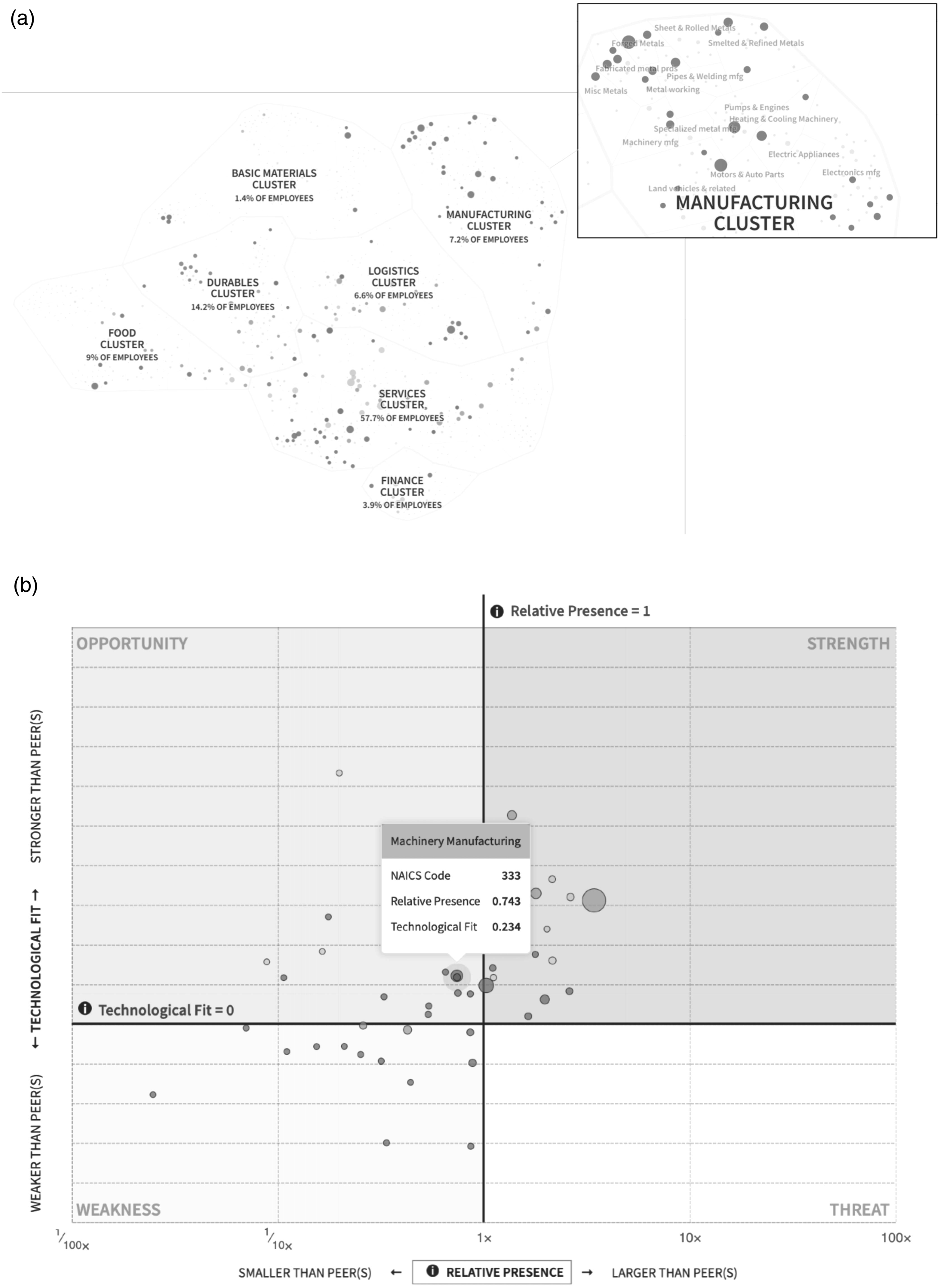
It should also be noted that not all theorists agree that focusing economic complexity growth on a limited subset of ’green’ products is the best way to reduce overall emissions. Çınar et al. (2022) have disputed the fact that specifically steering growth towards identified ‘green complex products’ will have the desired environmental impacts at the regional scale. For the United States, they find an insignificant correlation between green product complexity in US states and levels of carbon dioxide (CO2), particulate matter (PM10), and sulphur dioxide (SO2), although they do find a significant relationship between total economic complexity and positive environmental outcomes. This is an area requiring further investigation.
Overall, it is clear that research on the importance of economic complexity for green transitions is at an early stage, and more work is needed to develop findings that can be translated into clear recommendations for local policy delivery. For those seeking to further explore the literature on economic complexity and sustainability, Ferraz et al. (2021) provide a useful more in-depth review of the literature, although new articles are appearing in this field at a rapid rate.
Moderating factors and the importance of institutional context
To further complicate the picture for local policy delivery, there are also a number of factors which moderate the relationship between relatedness, complexity and green innovation, either increasing or decreasing the importance of these former factors in local green transitions. For example, Montresor and Quatraro (2020) find that general purpose technologies or ‘key enabling technologies’ (KETS) allow European regions to explore more distant green technologies that are less related to their existing capabilities. This is perhaps not surprising, given that the European Commission has identified that six KETS in particular – industrial biotechnology, nanotechnology, micro- and nanoelectronics, photonics, advanced materials, and advanced manufacturing technologies – act as building blocks for a wide array of products and industrial processes. Broader digital skills may also open up new pathways. Santoalha et al. (2021) use panel data on 142 European regions for the period 2006–2013 to show that local digital skills also reduce the importance of relatedness, and enlarge a region’s diversification ‘search space’ to encompass more distant green technologies.
There is also a large body of research which focuses on the institutional factors which support green transitions at the local scale. Scholars who focus their research on regional innovation systems have long stressed the importance of social and institutional contexts for innovation and entrepreneurial activities (Cooke et al., 1997). Regions differ in their regional support systems for innovation and entrepreneurship, for instance in terms of their knowledge generation infrastructure of universities, research institutions and intermediaries, and this differential endowment or set of preconditions also shapes different pathways for green industry development (Cooke, 2010; Grillitsch and Hansen, 2019; Trippl et al., 2020).
A number of recent studies have recommended combining insights from evolutionary economic geography and transition studies to better understand the way in which local and regional economies diversify and evolve (see e.g. Boschma et al. (2018)). While our article has focused on recent research from the field of evolutionary economic geography, therefore, sociotechnical transitions research will also be relevant in guiding local policy approaches – see, for example, Geels and Kemp (2007). Geels and Kemp explore how ‘niches’, ‘regimes’ and ‘landscapes’ interact to explain how transitions come about. Regimes are established processes, technologies, skills, embedded in institutions and infrastructures. Landscape is the slow-to-change external structure or context for interactions such as cultural norms, environmental problems or economic or political shift. Niches are new and unstable configurations with the potential to radically alter the incumbent regime. Geels and Kemp argue that green innovations (niches) are initially very vulnerable and require a ‘protective space’ that nurtures them and shields them from strong competition from existing and dominant technological solutions (regime). Combining evolutionary economic geography and transition studies offers, according to Boschma et al. (2018), the possibility of bringing together two key dependencies in evolutionary processes, namely, place dependence (arising from localised knowledge, interests and institutions embedded in places) and path dependence (arising from ’cognitive frames, standards and institutions embedded in global sociotechnical regimes’). Combining these two types of dependency, the authors identify four different forms of diversification, according to whether regions diversify in a related or in an unrelated way and whether they diversify within an existing sociotechnical global regime, or create a niche that can lead to regime change.
More recently, Jakobsen et al. (2022) identify four key ways in which policy can have an influence in green diversification: 1) the reconfiguration of existing resources and capabilities; 2) policy experimentation (for example, in terms of taxes, incentives and regulations); 3) market nurturing (through for example, public procurement) and 4) policy coordination (including across different levels of government). Point 1 in their framework is closest to the evolutionary economic geography approaches we have been exploring here. Jakobsen et al. (2022) reveal how a combination of these drivers, for example, was important to the development of battery powered vessels in western Norway. They also point out that different types of regions will present different preconditions and opportunities for green diversification. Former industrial regions, for example, often host R&D institutions and support systems that are closely aligned with ‘brown industries’, which means that it can be more effective to focus on the greening of existing local industries, as opposed to encouraging more radical innovation (see also Grillitsch and Hansen (2019)).
Finally, it is important to recognise that local and urban economies are influenced by broader policy mixes at regional, national and international levels, in terms of, for example, taxes, financial incentives and regulatory environments, that can either support or hinder green transitions (Matti et al., 2017; Uyarra and Flanagan, 2010). Strategic attempts to green local economies are therefore constrained by the number of policy levers at the disposal of regional and local authorities, with localities in more decentralised political structures having more powers to intervene (see e.g. Sun et al. (2022)).
Conclusions
This article started by providing an overview of current research aiming to define green products, jobs, occupations, skills and technologies. It notes that there is progress to be made in building a coherent framework that would enable policymakers to better understand the extent to which their current local economies can be considered green, or not green, and the scope and potential for local green transitions. It is often difficult to classify products and technologies according to how green they are given the complexities of considering emissions in production and in use. Life-cycle approaches are useful in considering how products lead to environmental effects across supply chains. By breaking down occupations into tasks and skills, recent research also points towards a more sophisticated understanding of green employment, which suggests that local and regional policymakers should be focusing on greening across their local economic structure, as opposed to focusing in on a specialised set of niche green jobs.
Moving on to consider the drivers of local green transitions, our review reveals that cities and regions will face different opportunities and constraints when it comes to the green transition, meaning that ‘one size fits all’ development advice will be inappropriate (Hidalgo, 2022). The studies reviewed here reveal the importance of both embedded local capabilities and unrelated diversity in offering good potential for green structural transformation. Green transitions show a degree of path dependency, with regions being most likely to support green innovation and new green jobs in fields that are related to their existing economic base. As pointed out by Hidalgo (2022), such analysis can reveal latent potentials in local economies which can reveal ‘paths that may be easier to climb’. As identified above, a recognition of the importance of such latent potentials is already embedded in regional policies in some parts of the world, including in Europe as part of the ‘smart specialisation’ agenda, with policymakers and theorists starting to consider the green dimensions of such smart specialisation (Montresor and Quatraro, 2020). However this review also highlights the importance of unrelated variety as a source of new ‘recombinant’ innovation, in addition to exciting possibilities for localities and regions to ‘leap frog’ into new forms of production where there is already strong investment in innovation. Recently Jakobsen et al. (2022) have shown the value of combining evolutionary economic geography approaches (such as the ones reviewed here) with sociotechnical transitions-based research on innovation. This latter research has revealed the importance of institutional factors that favour green transitions – including the importance of ‘landscapes, niches and regimes’, and the need for policies which provide ‘protection spaces’ for new unstable green technologies.
As identified above, an important institutional factor will be the extent to which local and regional governments have the right levers to actively encourage greener forms of economic development, with policymakers in more flexible and decentralised governance arrangements having more direct power to act. However, by identifying their local potentials for economic transformation, local policymakers can also better inform national and international net-zero policies, while identifying their own specific potential to act within multilevel governance arrangements. This potential lies in the powers that local policymakers have to map and steer local economic diversification processes – building on local capabilities, supporting local labour market transitions, and directly incentivising activities which will contribute to a greener future. At the same time, it is clear that greening economic production processes at the local scale (such as through innovation in metals production in Sheffield) is likely to have more far-reaching effects, particularly where firms are exporting materials and products into global supply chains. Ongoing actions will be necessary at all geographical scales if the goal of developing a more environmentally sensitive, net-zero global economy is to be achieved.
Our article uncovers a number of possible future research directions. There is still scope for better definitions of green jobs, technologies and products that take into account the interconnectedness of production, and the fact that what might represent ‘green’ when it comes to production does not necessarily translate into green during product use. New machine learning techniques and web-crawling techniques may provide a useful additional source of information when it comes to classifying green activities. In terms of the theory around the drivers of green transitions, this literature review has identified an important research gap when it comes to the importance of skills-relatedness (as opposed to research on technological relatedness which is more prevalent). More broadly, there is a need for greater methodological coherence within evolutionary economic geography research into the relative importance of ‘related’ and ‘unrelated’ forms of variety for green transitions – currently authors do not always agree on the right methodologies to quantify what being ‘related’ or ‘unrelated’ means in practice. More research is also needed into the potential downsides of increasing product complexity as a means towards a greener economic future – not least because of the difficulty in disassembling, repairing and reusing the materials embedded within complex products. Overall, the importance of ensuring greater circularity in production processes (where industry by-products become inputs into new industrial processes, see Braungart and McDonough (2009)) is not fully captured in the analysis of local green transition processes thus far. At the same time, more qualitative, firm level analysis would be helpful in identifying how green activities emerge in local contexts, and in clarifying the relationship between green and non-green capabilities – that is, how easy will it be for workers in ‘brown’ industries to move into greener jobs and tasks. It could also be further considered what role artificial intelligence and automation will have in such employment transition processes. Finally, there is a need to bring the insights gained from recent research to policymakers in a more accessible way. Given the identified importance of path dependency for green transition processes, widely available digital tools to help local policymakers to more effectively map their own most likely green transition pathways could be a game changer.
Footnotes
Declaration of conflicting interests
The author(s) declared no potential conflicts of interest with respect to the research, authorship, and/or publication of this article.
Funding
The author(s) disclosed receipt of the following financial support for the research, authorship, and/or publication of this article: Neave O’Clery and Francesca Froy acknowledge funding from the Alan Turing Institute Urban Analytics project ‘Connecting up embedded knowledge across Northern Powerhouse cities’. Neave O’Clery and Samuel Heroy acknowledge funding from the PEAK Urban programme, funded by UKRI’s Global Challenge Research Fund, grant no. Ref.: PES/P011055/1.