



Abstract
Whilst the COVID-19 pandemic and ‘cost of living’ crisis revealed and intensified the United Kingdom’s (UK) socio-spatial inequalities, these crises did not emerge into a vacuum. Long-term trends of deindustrialisation and austerity have meant many places particularly the former industrial areas across the North and Midlands have been ‘left behind’. The current crises have exposed the structural fault-lines created by austerity across 2010/20 especially comprising significant cuts to welfare and local government services, with the outcome being sizable parts of the UK’s post-industrial landscape experiencing poverty and destitution. In this paper, we focus upon deindustrialised Stoke-on-Trent in the North Midlands of England. Enduring long-term deindustrialisation and suffering from austerity, the article draws on qualitative and quantitative data to outline how the city contains a panoply of embedded structural problems including low-paid jobs, welfare retrenchment, poverty and destitution. Given it is a possibility that austerity will be reimposed after the next UK general election in December 2024, the paper concludes by briefly discussing the implications of these structural problems for UK government policy, indicating the urgent need for alternative policies to adequately address structural issues in places like Stoke.
Introduction
Following the re-election of the Conservative Government in 2019, the COVID-19 crisis has been followed by the cost-of-living crisis and a recessionary economic environment. Whilst Boris Johnson emphasised the need to Level Up the nation to remedy the UK’s deep-rooted socio-spatial inequalities (Telford and Wistow, 2022), this was followed by Liz Truss’s strategy for economic growth (Etherington et al., 2022a) before she was abruptly ousted from Number 10 primarily for rapidly losing all economic credibility. The subsequent election of Rishi Sunak as the UK Prime Minister in October 2022 put austerity back on the political agenda, signalled by the 2022 Autumn statement to ‘rebalance’ the UK economy (HM Treasury, 2022). Such conflicting approaches highlight how there is no consensus on a core political strategy within the Conservative Party. Nonetheless, although Conservative’s plans for spending cuts have been delayed until after the next general election in December 2024 (Elliott and Crerar, 2022), the Labour Party have also emphasised the need for ‘fiscal discipline’ if they are elected (Crerar, 2023).
This potentially ‘heralds another phase of fiscal austerity, possibly more exacting than that introduced following the Financial Crisis of 2007-08’ (Martin et al., 2022: 795). While the social damage caused by austerity across 2010/20 was profound including an intensification of poverty and destitution (see: Bambra et al., 2021; Etherington, 2020; Gray and Barford, 2018; Koch, 2021; Patrick et al., 2022), there are ongoing and significant tensions around the impact of the current cost-of-living crisis on wages, low pay and poverty reflected by the series of intensifying strikes across most sectors of the economy. Austerity cuts would aggravate these problems, intensifying the ongoing ‘biggest hit to living standards on record’ (Elliott and Crerar, 2022) in the UK. As Callinicos (Callinicos, 2012: 67) outlined, austerity is: ‘an economic policy regime whose objective is to secure monetary and fiscal stability and that is legitimised by an ideology that holds markets are best treated as self-regulating. This has allowed not merely the ‘restoration of class power’ analysed by Harvey, but also a dramatic redistribution of wealth and income in favour of the rich.’
In this paper, we explore the interlocking disadvantages of poverty and destitution in the context of deindustrialisation, austerity and the COVID crisis in Stoke-on-Trent (hereafter Stoke), a city in the North Midlands of England. Located in the county of Staffordshire, Manchester lies around 44 miles North of Stoke, Birmingham approximately 45 miles to the South and London is around 150 miles Southeast of the city. Stoke’s economic history lies in industrial work especially innovation in the ceramic and advanced materials industry (Jayne, 2004; Mattinson, 2020). As the city manufactured 90% of British pottery by the middle of the 19th century and ‘produced some of the finest ceramics in the world’ (Jayne, 2004: 201), it became defined by its core manufacturing base. Branded as The Potteries (MacLeod and Jones, 2018), employment in the ceramics, mining, engineering, and steel industries characterised the local economy in the first half of the 20th century (Etherington et al., 2022a). However, from the mid-1950s onwards, the city endured waves of deindustrialisation (MacLeod and Jones, 2018; Mattinson, 2020), including the closure of coalfields and the loss of 10,059 pottery jobs across 1978–1981 alone (Etherington et al., 2022a).
Now existing as an archetypical ‘left behind’ place (Etherington et al., 2022b), Stoke is the 14th most deprived district in England (out of 317 districts) and possesses one of the highest rates of people on low-pay, low-skills and in poverty. It regularly features in the bottom 10 UK cities for the number of inhabitants with high qualifications, low property values and number of businesses (Etherington et al., 2022a). It is also one of the cities that has been central to what scholars cast as the UK’s geography of discontent (McCann and Ortega-Argiles, 2021). Whilst it voted for Brexit in 2016 by 69.4% (see: MacLeod and Jones, 2018), many residents’ political discontent erupted again in 2019 with the partial collapse of the ‘Red Wall’. This is where many areas from North Wales to Northeast England that had historically elected a Labour MP voted Conservative for the first time in modern electoral history (Mattinson, 2020; Telford and Wistow, 2022), with the Conservative Party taking full political control of Stoke’s three parliamentary constituencies.
Drawing upon a unique dataset provided by Citizens Advice Staffordshire North & Stoke (CASNS) during the COVID-19 pandemic through analysing data on enquiries and advice and support, this article elucidates the experiences of residents who are experiencing poverty and destitution. CASNS has produced anonymised stories, which represent different situations of individuals and families coping with low-income, poor health and poverty. 1 These stories are typical of thousands of people living in Stoke and beyond and are not isolated examples (see: Bambra et al., 2021; Etherington et al., 2022b; Koch, 2021; O’Hara, 2016; Patrick et al., 2022; Spring et al., 2022). The paper is organised as follows. Firstly, it outlines a brief political economic discussion of austerity to provide the article’s contextual backdrop. The exploration of Stoke’s structural problems is then structured into three key sections, (a) low-pay and in-work poverty, (b) social and health impacts of austerity and (c) the welfare system: disciplining the poor. The article closes with a discussion of the implications of these structural problems for UK government policy in light of the potential reintroduction of austerity after the next general election, outlining the urgent need to enact alternative policies to adequately remedy these issues in places like Stoke.
The political economy of austerity
Part of the scholarly discussion on austerity and the implications for subnational government has been framed around ‘austerity states’, involving the restructuring of institutions and the reconfiguration of local actor’s roles in the enforcement of neoliberal market driven policies (Gray and Barford, 2018; Jones, 2019; Pike et al., 2018). Some claim the analysis of austerity has been overly focused on the national level, overlooking the processes of uneven geographical development and the role of the state in its making (see MacLeod and Jones, 2018; Pike et al., 2018; Telford and Wistow, 2022). How austerity has played out at the local level and particularly how it is interwoven within local policy interventions, as well as its social and economic impacts, requires further theoretical and empirical analysis (Etherington, 2020). Hasting’s (2015) work is particularly interesting regarding the focus on cuts to local government and the distributional impacts of local government spending and services upon the urban poor and marginalised. Moreover, recent work on poverty in cities explicated the way growth policies have distributional outcomes (Pike et al., 2017), though the impact of austerity on poverty in cities is less understood.
Massey (1984) demonstrated that the economic and social structures of cities and regions can be best understood through analysing the spatial organisation of production. Traditional industrial places – such as Stoke – originate from their proximity to raw materials and sources of power which historically engendered the growth of steel and coal industrial regions (also see: Beynon and Hudson, 2021). Massey sees their decline in relation to the combination of global competition and the capacity for capital, due to technological and processes of concentration/centralisation, to organise production and distribution through geographical and spatial selectivity. In Meegan’s (Meegan’s, 2017: 1288) tribute essay to Massey, he draws out the key element to the spatial restructuring of social and class relations: ‘Spatial divisions of labour’ are constructed and reconstructed over time with rounds or waves of investment … [which] incorporate the social relations – of ownership, control, function and status – of production embodied in ‘spatial structures of production’. Not only may aggregate investment be distributed unevenly over space but also the various ownership, control and production tasks associated with it. It is a geography of power relationships and, explicitly, of class relations.
Beatty and Fothergill (2017) (also see: Martin, 1986; Martin et al., 2021; Telford and Wistow, 2022) demonstrate how the long-running trend of deindustrialisation served to aggravate the harmful impacts of austerity. They argue the cause of high levels of economically inactive
2
claimant rates in the older industrial areas lies with the job loss from an employment base in manufacturing industries of 8.9 million in 1966 to just 2.9 million in 2016. They purport that the uneven geographical impacts of deindustrialisation combined with welfare cuts compounded regional and urban inequality: ‘our argument is that the destruction of industrial jobs, which was so marked in the 1980s and early 90s but has continued on and off ever since, fuelled spending on welfare benefits which in turn has compounded the budgetary problems of successive governments. And with the present government set on welfare reform, the places that bore the brunt of job destruction some years ago are now generally facing the biggest reductions in household incomes. There is a continuous thread linking what happened to British industry in the 1980s, via the Treasury’s budgetary calculations, to what is today happening on the ground in so many hard-pressed communities (Beatty and Fothergill, 2017: 3).’
Other research also highlighted how welfare cuts disproportionately impacted upon the more deprived areas in the North and Midlands and that similar patterns of spending reductions have occurred in local government (Bambra et al., 2021; Gray and Barford, 2018; Jones, 2019; O’Hara, 2016; Wistow, 2022). The highest dependency upon welfare and thus biggest spending cuts tended to exist in cities. This is clear in many London boroughs, towns, and cities such as Liverpool, Manchester, Birmingham, Portsmouth, Oldham, Middlesbrough, Newcastle, Nottingham and Doncaster; all received a high proportion of their funding from the central grant – the key funding from central to local government – and experienced cuts of over 25% to total service spending. Gray and Barford (2018: 541) argue local authorities that have the least ‘economic resilience’, particularly those in the former industrial areas that have been most impacted by the cuts have endured ‘exacerbating territorial injustice’. Such an argument is supported by the Institute for Fiscal Studies (IFS) (2021), highlighting that many Government departments will receive relatively less funding in 2025 than in 2010, intensifying place-based problems.
It is important to factor in cuts to local government, which majorly impacted upon the UK’s former industrial places like Stoke. Lowndes and Gardner (2016) contend that local government have borne the brunt of what they term super-austerity. Changes to the grant distribution system, whereby local authorities face a ‘flat rate’ percentage cut to grant funding, results in spending cuts continuing to impact more heavily in absolute terms on those authorities who receive a higher proportion of their funding through central grants. Moreover, the Centre for Cities (2019: 13) suggest the austerity era was not equally shared out across government – ‘it has been local government in England that has borne the biggest burden, with its budget being cut by more than half between its peak in 2009/10 and 2015/16’. These combined and connected processes – deindustrialisation and austerity – have led to increasing poverty in post-industrial locales particularly in Stoke, which is the subject of the next sections.
Austerity and destitution in Stoke
Low-pay and in-work poverty
Gregory (2022) elucidated how Stoke’s economy has not recovered from the long-term impact of deindustrialisation, with manufacturing employment falling from 25% to 10% of total employment today (Etherington et al., 2022a). Whilst its ceramics industry was once envied for its global reputation and reach (Jayne, 2004), it has diminished and been replaced by a predominantly low-wage, low-skill economy (Etherington et al., 2022b; Jones, 2019). Gregory argues that the process of financialisation undermined sustainable economic growth in Stoke. Employer strategies towards flexibilisation are predicated on the requirement of international market competition involving wage compression (D’Arcy, 2019). Financialisation possesses structural implications as ‘back office’ investment including economic activity, which supports business development such as professional services, solicitors and accountants has undergone spatial restructuring and tended to be moved abroad or concentrated in the metropolitan areas. This has left Stoke’s economy populated primarily with sectors and businesses which offer lower grade employment; indeed, deindustrialisation has collapsed employment in supply chains that were linked to the ceramics and other core industries that historically provided Stoke’s raison d'être (Gregory, 2022; MacLeod and Jones, 2018).
This is reflected in average wages in the city. While the average weekly earnings of an employee in South-East cities like London and Reading stands at £751 and £671 respectively, in Stoke it is £465. Therefore, wages are well below the UK average of £555 and one of the lowest across Britain (Etherington et al., 2022a). Barriers to childcare because of its high cost has been cited as a major cause of inactivity for both women and in-work poverty (Institute of Employment Studies, 2022). The average cost per week for a childminder is around £133 and £185 for a Nursery. While these are lower rates than the national average – in relation to average wages and particularly with the ongoing cost-of-living crisis – accessing affordable childcare for low-income families and individuals is a major challenge (City of Stoke-on-Trent, 2021c).
CASNS data revealed that many enquiries during the COVID-19 pandemic were due to problems at work. This included workers worried about job stability and security, employment rights and their risk of redundancy. The case of Hamid illustrates how being in poorly paid, full time employment results in a precarious financial situation: Hamid is having an operation which meant he will be off work for 3 months. Hamid’s employer doesn’t pay contractual sick pay, so he has used his remaining 2 weeks holiday to receive full pay but then will get statutory sick pay (SSP). Hamid was worried about how he could afford to live. His outgoings on bills and rent of £684.50, he then must buy food/clothing etc. from what is left. Hamid told us he has no savings as most of his money goes on outgoings. Hamid will only be eligible to receive £362.97 a month in Universal Credit
3
(UC) in addition to his £430.52 a month in SSP only leaving him with £108.99 a month for all his other expenses.
Life on a low-income in post-industrial Stoke often results in significant levels of stress and poor mental wellbeing, with people like Hamid struggling to get by. This is exacerbated when periods of illness arise since low-income employers often do not pay a sufficient level of sick pay to meet basic living standards, aggravated by the welfare state, which as we will see, is also woefully insufficient (O’Hara, 2016; Patrick et al., 2022). An accompanying problem here is significant skills gaps due to the reluctance of employers to invest in skills; for example, in apprenticeships at the required rate to level up growth outcomes (Etherington et al., 2022b; Payne, 2018). Apprenticeships are viewed by the Government as the key vehicle for developing employer-led training. A recent employer skills survey in Stoke and Staffordshire found barriers to providing training to staff were largely to do with the inability to spare staff time and the cost of training, with only 28% of businesses offering apprenticeship training (Metro Dynamics, 2022). The IFS (2021) observed that although apprenticeship spending has increased it will hardly compensate for cuts enacted during the austerity era. According to a skills survey by Metro Dynamics (2022: 22) in Staffordshire, between 2013/14 and 2017/18 there has been a 16% decline in engineering and manufacturing technologies apprenticeship start-ups in the city, with only 1610 starts in 2017/18 which was double the 8% decline seen nationally. Such a stagnating localised economic environment has been intensified by austerity.
Social and health impacts of austerity
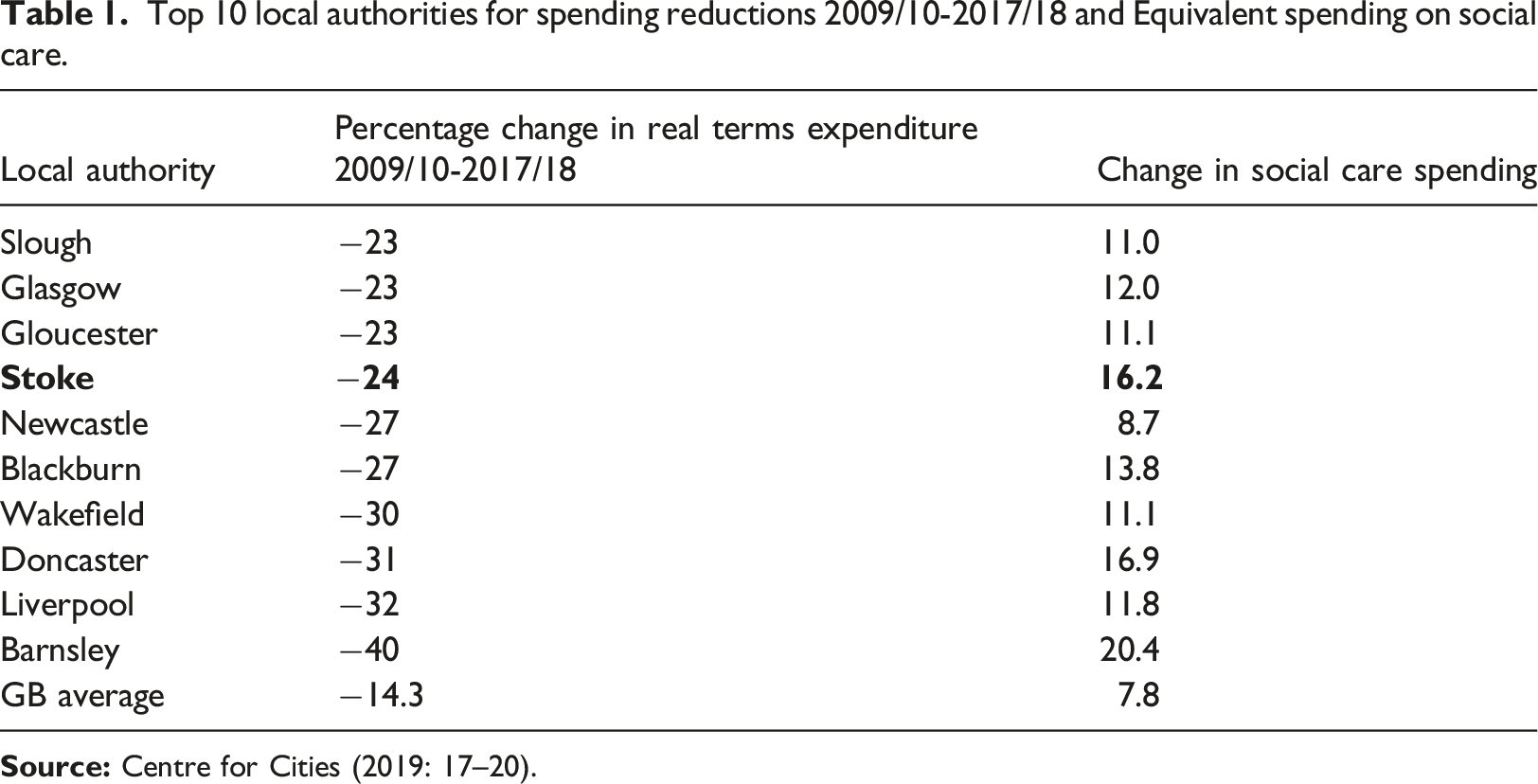
Top 10 local authorities for spending reductions 2009/10-2017/18 and Equivalent spending on social care.
Key health/Disadvantage indicators in Stoke.
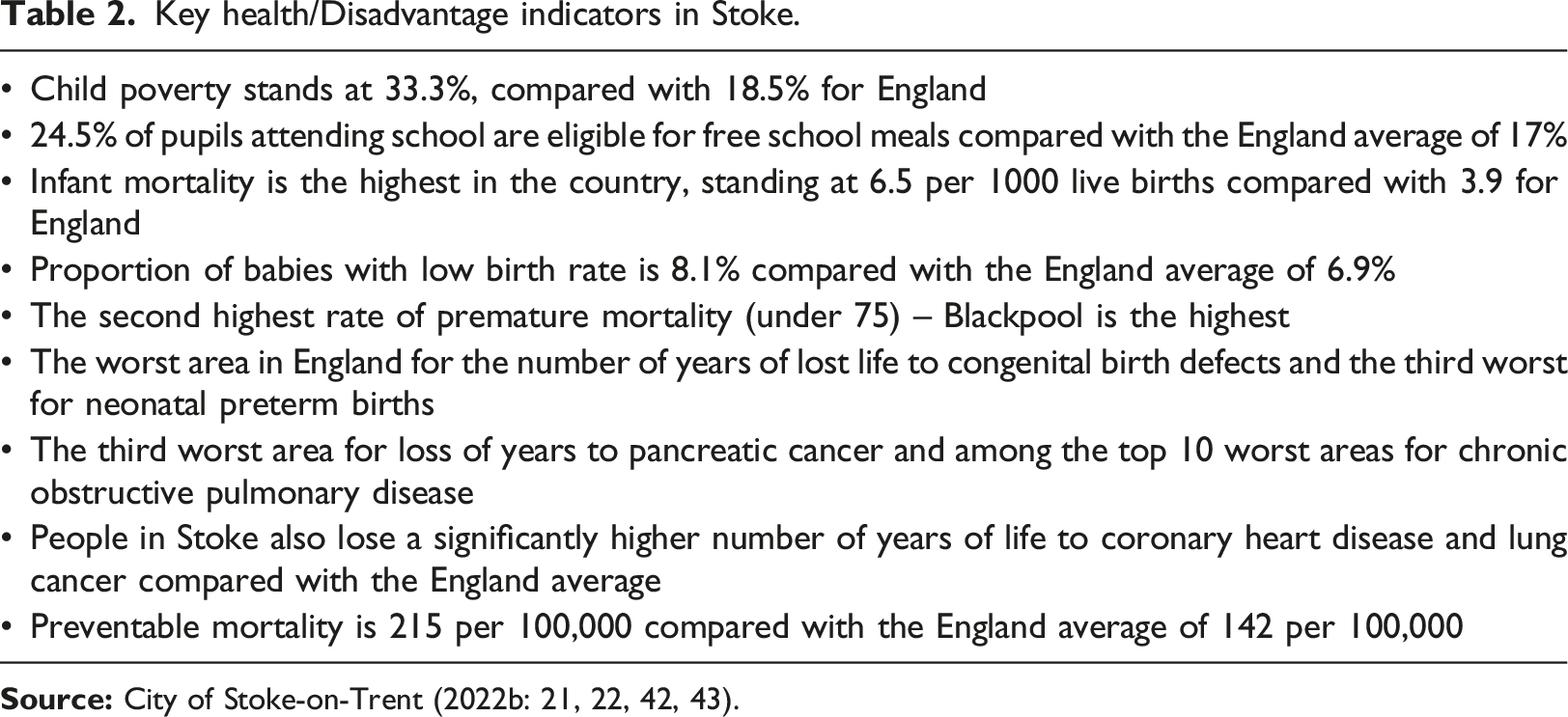
These health inequalities were heightened due to the COVID-19 pandemic. For instance, infection rates in Stoke were 5220 per 100,000 and death rates were 182 per 100,000 compared with 3430 infections and 92 deaths per 100,000 in the South-East of England (Beatty and Fothergill, 2021: 24, 26, 30). The austerity-driven reduction in real terms health spending and acute staff shortages contributed to increasing numbers of people on the NHS waiting list, with Staffordshire and Stoke-on-Trent NHS trust having the seventh highest levels (1196 per 10,000 population) in England. Fogden et al. (2022) outlined how The Centre for Health Economics found the economic cost of poverty to hospital inpatient care alone was £4.8 billion annually, while the Joseph Rowntree Foundation (JRF) reported that poverty had myriad financial implications for the NHS too, costing around £29 billion annually.
Growing numbers of people in Stoke and Staffordshire are also classified as economically inactive. Rates continue to increase at just over 21% of the working age population, which is significantly above pre-pandemic levels and has resulted in overall employment decline (Staffordshire and Stoke-on-Trent LEP, 2022). Reasons for this include people waiting longer for health treatments; a deterioration of general health during the pandemic; the impacts of long-COVID; a lack of access to appropriate employment support; and changes in workplace practice or employer attitudes around health and disability (Institute of Employment Studies, 2022). Pressures on health services have disproportionate impacts upon disabled people as this CASNS story illuminates: Jakob lives with his wife and two dependent children in their mortgaged property, their mortgage still has £75,000 outstanding. Their monthly payments £800 p/m and they are currently in arrears of £1500. Jakob’s wife has recently become severely ill, and he has had to give up work to look after her and their two children. Jakob’s wife is receiving disability benefits and Jakob has claimed carers allowance for looking after her, in total they receive £1586.73 per calendar month in benefits, although their mortgage payments alone take up more than 50% of their income. All the savings have been used and all the household income goes on paying their debt.
Deficient welfare payments mean Jakob’s family are experiencing destitution, intensifying their household distress. Experiencing poverty, economic insecurity, indebtedness, and possessing no savings impacts detrimentally upon the development of their children, especially in their early formative years. Jakob’s family is not alone, though, as around a quarter of UK adults have less than £100 in savings (Peachey, 2022a). Given the above, it is unsurprising that the NHS Stoke Clinical Commissioning Group revealed that the life expectancy of the most deprived residents in Staffordshire is about 8 years lower than the least deprived citizens (City of Stoke-on-Trent, 2022b). In Stoke, the difference is around 9 years. Reducing this gap will have a major impact on health outcomes for the population and will significantly reduce the demand for health and care services. Early childhood indicators, however, are poor. Stoke possesses amongst the highest infant mortality rates in England, while rates in Staffordshire are also significantly higher than the England average (City of Stoke-on-Trent, 2022b). These localised problems are exacerbated by cuts to what is a profoundly inadequate welfare state.
The welfare system: disciplining the poor
The COVID crisis brought about a rise in the numbers of residents claiming UC – with the current claimant amount still exceeding the pre-COVID period – meaning there are a significant number of people subjected to welfare conditionality in Stoke. For example, in October 2022, there were just over 30,000 in receipt of UC and in total there were 48,867 (30.6%) of the working age population in receipt of one or more benefit – considerably higher than the 37,733 in November 2019 (26.3%) before the pandemic (Johnston, 2022). This includes just over 10,000 claiming Employment Support Allowance (ESA), 4 indicating relatively high numbers on long-term sickness benefits. The number of people in work claiming UC amounts to just over 11,000 (Johnston, 2022). Relatedly, research on the impact of welfare reforms found welfare cuts disproportionately impacted on individuals and families on low incomes (Bambra et al., 2021; Spring, et al., 2022), with the loss of incomes greater in those Northern areas that suffered long-term economic decline. Stoke is positioned 18th in the top 50 local authorities in terms of the amount of benefit loss due to welfare reforms (Beatty and Fothergill, 2017). These cuts included benefit income that did not cover basic household needs even before the current crises. For example, as the Trades Union Congress (2022b) outline, the basic rate of UC for a single person over 25 – known as the standard allowance – is around £78 per week (£334.91 per month) which is a seventh of the average weekly pay. The rate is the same for those on legacy benefits (Jobseekers Allowance and Employment Support Allowance) and is lower for those aged under 25 at £265.31 per month.
This is exacerbated by benefit sanctions. As Johnston (2022) outlines, the number of people sanctioned in Stoke increased from a low rate of 17 people in May 2021 to a rate of 629 people in May 2022, making it the 37th highest rate in England. As working life in low-paying sectors becomes even more insecure (Etherington, 2020; Lloyd, 2018), there is evidence that the movement between work and welfare becomes more common. With many businesses shifting the risks of the market on to workers the ‘exit of qualified//skilled benefit claimants into low-paying, precarious jobs is uniformly considered a sub-optimal result of activation’ (Raffass, 2017: 356). In-work conditionality also places pressure upon claimants to increase their earnings. The case of Martyn illustrates the problems of achieving this: Martyn lives alone in a one bed apartment, and his rent and council tax payments are currently up to date. Martyn works 20 hours a week and is currently claiming UC to top up his low wages. He has asked for more hours at work, but currently there are none available. Martyn contacted Citizens Advice, as he wanted to see if he was eligible for any additional benefits. Martyn is claiming the single person discount on his Council Tax liability but is not eligible for any Council Tax Support.
Although UC operates as in-work earnings top up (replacing Working Tax Credit), it is evident in Martyn’s case that it is inadequate to support a sustainable income and that there are few opportunities for people in low-paid employment to ‘progress’ to higher earnings. Despite being employed many people in Martyn’s position are vulnerable to debt and destitution (Etherington et al., 2022b; Lloyd, 2018), exacerbated by recent increases in the cost-of-living. Indeed, a CASNS report (2022: 9) highlighted the marked increase in the numbers of people seeking advice in relation to fuel and utility bills (also see Table 3): ‘When the average bill rises to £3,549 in October 2022 then the increase from April 2021 will be £47.19 a week and even the support package for people on means tested benefits will only amount to £23.08 p.w. leaving a shortfall of £24.11 a week or £104.48 p.c.m. or £1,253.84 p.a, or nearly 30% more than the total annual bill for a typical user in the summer of 2020.’ Top seven CASNS Enquiries 2022.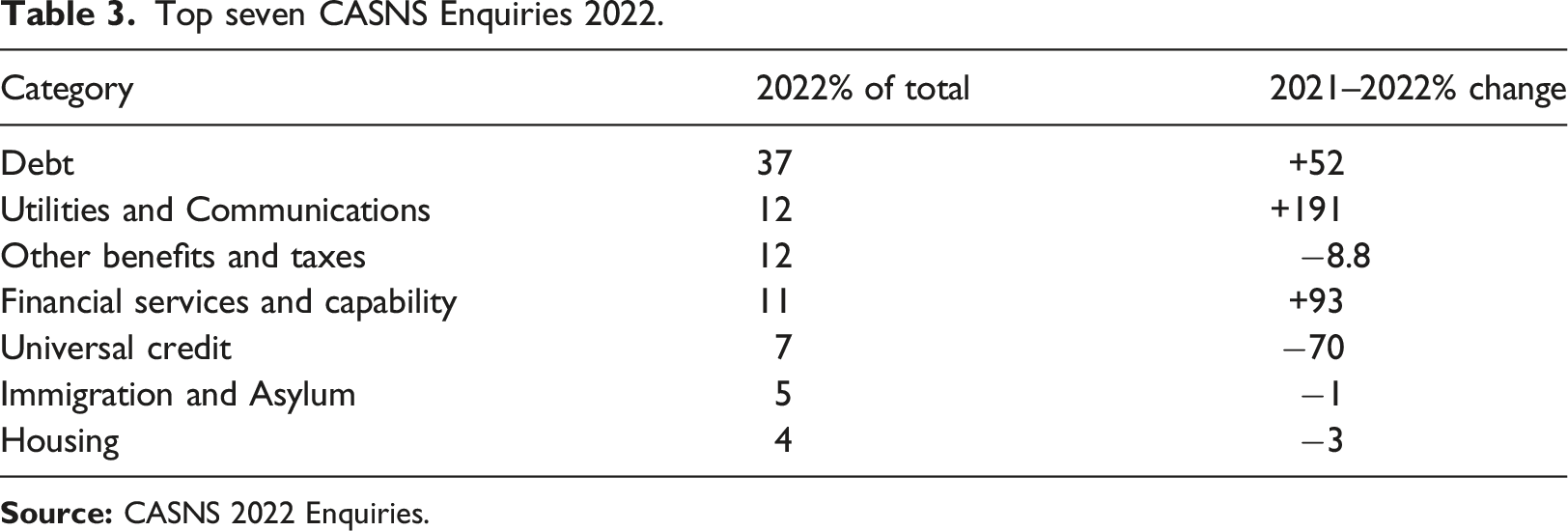
Table 3 shows the increasing numbers of enquiries relating to debt and advice on fuel payments because of the inadequate financial support systems from both the welfare state as well as wages.
A myriad increase in struggling to pay the utility bills is evidenced here. Social groups such as lone parents, the self-employed and renters are more likely to encounter such precarity as they often possess higher levels of debt, lacking the financial capacity to absorb economic pressures associated with the cost-of-living crisis (Peachey, 2022b). Concerns about indebtedness have also inevitably increased, with Stoke branded as the debt capital in 2018 since it possessed the highest insolvency rates in England and Wales (Etherington et al., 2022a). Moreover, the recent reduction in advice sought on UC is largely due to the shift in focus on its impact in terms of debt, though it is also shaped by claimants being referred to a nationally based advice system set up jointly by the DWP and Citizens Advice. This is illustrated in the case of Bethany: ‘Bethany’ lives alone in a 2-bedroom private rented property, her rent is £425 p/m. Bethany is in receipt of UC. As Bethany is 23, she is only entitled to the Shared Accommodation rate of UC, leaving her with a significant shortfall in her housing costs. After Bethany has paid her rent she only has £235 left for the rest of the month to meet all of her utility bills, her council tax shortfall of £3.99 a week and to buy food and clothing. Bethany has mental health issues, which means that she cannot work and her financial situation is causing her lots of stress which in turn is increasing her mental health issues. Bethany contacted us as she has no money to buy food or top her pre-payment meter up, she also disclosed debts of £230 to Severn Trent and £460 to her electric company.
The interlinkages between unemployment, insufficient welfare payments, personal indebtedness and mental ill health are evidenced again here (Bambra et al., 2021; Patrick et al., 2022). Such precariousness means Bethany cannot meet her basic human needs, compelling her to contact CASNS regarding food insecurity which is representative of the state’s outsourcing of responsibility for its citizen’s human needs including the right to food in the austerity era (Spring et al., 2022). This is not an isolated case, though, as more people are now using food banks in the UK than ever before (Bryant and Ungoed-Thomas, 2023). Relatedly, lone parents in particular have been struggling to manage the low-level of benefits for many years and the current economic crisis is pushing many families over the edge. The CASNS story below offers a case in point: “Janice” is a council tenant, single parent with one dependent child. She receives UC and has rent arrears of £1,670. She has a spare bedroom in her house and the UC rent element has been reduced by 14%. This has contributed to the arrears situation. When we advised on an affordable weekly budget she had £32.50 available to offer towards those arrears. However, her landlord has applied to the DWP for an amount to be paid directly to them from “Janice’s” UC. The standard 20% deduction will amount to £183 p.c.m or £42 p.w. This is more than she can afford and will leave her unable to contribute towards her Council Tax arrears or cover her essential expenses.
Economic and social insecurity often results in destitution and indebtedness. Mirroring the other CASNS stories outlined above, Janice is unable to pay the bills and cannot meet her most basic human needs, resulting in a palpable state of subjective crisis. Having explored low-pay, in-work poverty and destitution in Stoke, generally in the context of industrial job loss austerity and COVID, the final section closes with a discussion of the implications of these problems in relation to austerity politics.
Conclusions: the need to shift away from austerity politics
The evolution of Stoke since the 1960s has meant the city has emerged as a core left behind locality (Etherington et al., 2022a; Jones, 2019; MacLeod and Jones, 2018). Deindustrialisation and austerity, in particular, have formed key drivers of localised problems which have been exacerbated by the current economic climate. In late 2022, Stoke City Council endured ‘emerging and growing financial pressure driven by the rapidly rising levels of inflation, with inflation now running at over 9% and set to rise higher in the coming months. This is a global phenomenon with a mix of causes which disproportionately impacts on those local authority areas with a relatively low wage economy such as Stoke-on-Trent’ (City of Stoke-on-Trent, 2022a). Such a disproportionate impact, though, is caused by the long-term impacts of industrial decline and the reductions in resources allocated to the Council brought by the austerity era. As elucidated above, there are a plethora of interlocking structural disadvantages in the city particularly low-paid work, inadequate welfare provision, poverty and destitution (Etherington et al., 2022a; MacLeod and Jones, 2018).
Whilst the Levelling Up of Stoke has been explicated elsewhere (see: Etherington et al., 2022a), Gregory (2022) highlights the potential for raising productivity in the area through the scaling-up of an emerging digital and creative sector, stemming from the strong supply of computing and games graduates from the local Staffordshire University and the growth of online companies such as Bet365 Group Ltd. Stoke is, however, some distance off from developing a new economic growth strategy to capitalise on this, not least as more radical changes are required to complement the various exogenous and endogenous strategies for local and regional economic development (see: Driffield et al., 2021; Jones, 2019). Such strategies for economic growth will also be undermined by the potential intensification of austerity after the next UK general election in December 2024. HM Treasury (2022: 12) recently suggested the current UK governmental emphasis upon fiscal sensibility and sustainability is essential to put ‘the public finances on a sustainable path, requiring that debt falls as a share of the economy over the forecast, while providing space for the economy to recover’. If the Conservative Party win the next general election, they plan to implement £30 billion in spending cuts and £25 billion in tax hikes (Elliott and Crerar, 2022). Such austerity is diametrically opposed to the unprecedented and sustained level of investment required to ameliorate structural problems in places like Stoke (see: Martin et al., 2022; Telford and Wistow, 2022). As this article outlined, it is essential that austerity is avoided as it will aggravate local place-based problems and the associated social distress.
Indeed, the ongoing policy emphasis upon localisation and fiscal sensibility can be viewed as attempts to sustain austerity politics. One of the key elements of this is the role of depoliticization. As Etherington and Jones (2018) remarked, this involves the narrowing of the boundaries of democratic politics, the displacement strategies used by the state to frame engagement, restricting or foreclosing debate around alternative and critical discourses, thereby preserving the UK economy’s structural configuration with all the harmful implications for places like Stoke. Depoliticization of the causes and effects of austerity are interwoven into national and local growth agendas, with Stoke’s political elites promoting a ‘powering up’ narrative claiming that the city is ‘on the up’ (City of Stoke-on-Trent, 2021a). This is despite the evidence presented in this paper, which highlights that this hegemonic view is not representative of reality of local people’s lives. The language of ‘powering up’ or ‘levelling up’ as Hudson (2022: 11) states ‘is a political slogan rather than a realistic spatial economic policy objective, one seen as electorally and politically necessary’ by the Conservative Government ‘as they seek to ensure the continuing support of those first-time Tory voters in the 2019 general election’ (also see: Etherington et al., 2022a; Martin et al., 2021; Telford and Wistow, 2022).
As outlined, the fiscal retrenchment of both national and local services particularly the health service and welfare to work programmes in post-industrial Stoke is deeply problematic, yet the Government announced plans during the 2022 Autumn Statement to roll out a tougher conditionality regime for claimants in 2023 (HM Treasury, 2022). This includes intensifying the use of benefit sanctions whereby the time allowed for jobseekers to move to their preferred job is reduced. Rather than possessing 3 months, claimants will have only 4 weeks. After those 4 weeks, changes brought in under the ‘Way to Work’ campaign mean that UC jobseekers need to apply for and accept any job they can. Anybody deemed non-compliant will face sanctions and reduced income. The sharpening of sanctions can be related to various forms of non-compliance such as failure to attend an interview. As documented, significant numbers of people are currently enduring sanctions in Stoke, engendering myriad stress, economic insecurity and often compelling them to acquire low-paid employment. Whilst plans to intensify the sanction regime will aggravate a structural sense of localised insecurity and uncertainty, it shifts attention away from Stoke’s long-running problem of low-pay and in-work poverty towards individual behaviours, thereby engaging in the further depoliticization of structural problems. The threat and use of sanctions as a disciplinary measure has eased the transition from welfare to work, since claimants have nowhere to go but dispiritingly comply (Etherington et al., 2022a; Lloyd, 2018; O’Hara, 2016). Rubery et al. (Rubery et al., 2018: 521) elaborates upon this: …. activation strategies influence the potential pool of labour available for precarious work through combinations of sanctions and financial support. The consequence is a blurring of the unemployed/employed divide and a normalisation of the take up of fragmented, low paid and short-term jobs.
There is an urgent need for an Independent Economic Review of Stoke-on-Trent, where the implications of this paper can be discussed, and alternative economic development pathways and interventions assessed. The importance of skills and training is emphasised, for instance, in local growth policy documents, but there is little analysis of who will directly benefit. Green (2021) suggests the main impacts of the COVID crisis and shift into an economic recession were that major increases in the claimant count placed excessive pressures on the employment and skills system. The increase in the propensity towards insecure and precarious work is one result, as well as a marked decline in training. This exacerbates the structural problems of the labour market as the requirement for reskilling increases in the face of rising unemployment, with the disadvantaged locked out of this process (Green, 2021). As Keep (2022) argues, skills policies have little impact if they are not integrated into a strategy which secures sustainable and higher quality jobs. Both the supply and demand side aspects need to be more closely matched, recognising that austerity will negatively impact upon the capacity for workers to access and retain employment.
Politically recognising both austerity’s role in reinforcing labour market inequalities and the importance of alternative policies that would help to ameliorate some of the structural problems outlined above is essential (see: Etherington et al., 2022a 2022b; Jones, 2019). Such alternatives include campaigns to bolster welfare and employment rights (CASNS, 2022), promoting well-paid work; and investing in affordable childcare. An alternative ‘inclusive’ labour market model also needs to be debated, which is tried and tested in Denmark, comprising job retention and rotation. Job Rotation (JR) involves a planned approach whereby unemployed people are provided with employment experience and training, enabling unskilled/low skilled workers to access relevant vocational training. Such an approach not only matches demand and supply but is implemented within a framework of social dialogue involving equal representation of employers, government institutions and trade unions (for details, see Etherington and Jones 2004). Stoke-on-Trent City Council’s ‘Employment and Skills Strategy’ of 2017 recognised the importance of exploring ‘the potential to work with partners to design and deliver a JR programme in Stoke-on-Trent to support longer-term unemployed adults into temporary work and enable them to gain vital skills and experience’ (City of Stoke-on-Trent 2017: 32). Local political changes and portfolio reshuffles resulted in the action plan for 2017-20 not happening. The national policy debate on JR, however, remains increasingly relevant, with the Employment Related Services Association (ESRA) publishing a policy blog by Professor Etherington and Professor Jones in 2022, 5 which led to meetings in 2022 between the blog authors and North Staffordshire TUC to discuss applying JR to Stoke-on-Trent. Ultimately as Telford and Wistow (Trades Union Congress¸ 2022a: 126) assert, without bold and radical national and local policy changes such as this ‘the UK economy will in all likelihood continue to leave places behind’, resulting in the continuation of poverty, destitution and myriad social distress in Stoke and beyond.
Footnotes
Declaration of conflicting interests
The author(s) declared no potential conflicts of interest with respect to the research, authorship, and/or publication of this article.
Funding
The author(s) received no financial support for the research, authorship, and/or publication of this article.
