




Abstract
This paper seeks to learn lessons about the role of the private sector in subnational governance by analysing the UK’s Local Enterprise Partnerships (LEPs). The paper outlines the public justifications for LEPs using documentary analysis, and then considers these against findings from interviews and network analysis, concluding that the justifications are problematic. LEPs were established on the assumption that civic and business leaders needed to be brought together in business-led institutions. However, network analysis shows most civic leaders also hold private sector roles, undermining the assumed need for a ‘bringing together’. Three further justifications of the LEP model are also challenged. Firstly, business leaders were supposed to enable knowledge flows, but analysis shows that this knowledge is skewed by unrepresentative LEP boards. Secondly, it was assumed that LEPs would catalyse networks, but the networks have been built around individual interests, without transparency. Finally, LEPs were meant to mirror business structures, but this has undermined democratic accountability. Taken together, these findings suggest that the creation of LEPs has attempted to solve the wrong problem in the wrong way. The paper concludes by proposing guiding principles for the role of the private sector in the Levelling Up agenda: representation, transparency and accountability.
Keywords
Introduction
In February 2022, the UK government launched its ‘Levelling Up White Paper’, a plan to address place-based inequality in the UK. The promise to ‘level up’ had been central to the Conservative Party’s 2019 election win, as the counterpart to its ‘get Brexit done’ slogan (Newman, 2021). The place-based approach indicated by the Levelling Up agenda raises questions about the governance mechanisms that will be used to tackle place-based inequalities. Given the Conservative Party’s repeated emphasis on partnerships with business, the subnational relationships between the public and private sectors are likely to be crucial. Since the abolition of the nine Regional Development Agencies in 2010, much of England’s subnational development has been delivered through 38 Local Enterprise Partnerships (LEPs), which are boards of civic and business leaders operating at a smaller subregional scale. While there are now signs that LEPs are being subsumed under new ‘city and county deals’, they offer important lessons for researchers and policymakers, both in the UK and elsewhere, about how the private sector is institutionalised in subnational governance.
LEPs were created on the basis of an assumed distinction between local civic leaders and local business leaders, and the assumption that the balance between them needed to shift in favour of the latter. Business leaders were brought into subnational governance for their knowledge of the local economy and their professional networks. However, our mixed-methods research conducted across eight case-study LEPs shows the reality is more complex, with a blurring of the local public and private sectors. We show that many LEP board members had one foot in both the public and the private sectors, combining roles such as local authority councillor with director of an SME. Moreover, those board members with private sector interests were as a group untypical of local business and industry. The LEP experience shows that importing private sector knowledge and practices into the public sector is not itself difficult; the problem is to do so in a way that is transparent, accountable and representative.
The paper begins with the existing literature, which considers the place of the private sector within subnational governance, and specifically the place of LEPs within England’s political devolution and local economic development. Among this literature, there is insufficient focus on the internal relations of LEPs, despite those relations being central to their original justification. The paper then outlines its theoretical foundation and mixed-methods approach. The main body of the argument is made over three sections, one relating to each of the three methods used: document analysis, interview analysis and social network analysis. The discussion and argument are built up over these sections, leading to a conclusion that public-private relations within LEPs lack transparency, accountability and representation.
Local enterprise partnerships
In the late 1990s, under the reforming drive of the newly elected Labour Party, the UK government sought to devolve power to the English regions by creating Regional Development Agencies (RDAs). They were established by the RDA Act (1998), which declared that ‘England shall be divided into [nine regions] and for each such region there shall be a development agency’. In 2010–11, 38 LEPs replaced the RDAs as the institutions of regional governance in England, operating at a smaller ‘subregional’ scale. Rather than declaring the territories of these new institutions in law, the Conservative-led government instead invited ‘local groups of councillors and business leaders to come together … to form local enterprise partnerships’ (BIS and DCLG, 2010). This approach indicated a concern with fostering organic partnerships at the subregional level between public and private sector leaders (Deas et al., 2013). The White Paper that followed stated that the government was creating LEPs ‘to bring together business and civic leaders to set the strategy – and take the decisions – that will allow their area to prosper’ (BIS, 2010: 3).
The consequences of this approach included a lack of clarity about the role and purpose of LEPs, and a messy map of subnational boundaries that entailed overlapping and non-coterminous territories. For example, some LEPs sit within combined authorities, some within county councils, some overlap these institutions, and some relate to neither. These complexities link to broader problems of territorial governance in the UK, particularly within England. LEPs sit within a wider system in which intergovernmental arrangements ‘are often fragile, tentative and rely on inter-personal links, rather than formal institutional arrangements’ (Ayres and Pearce, 2013: 812). In terms of the purpose of LEPs, Britton and Woodman (2014: 631) argue that because they are ‘driven by a traditional economic development emphasis on key sectors’, they tend to focus on isolated ‘big ticket’ projects at the expense of longer-term transformations to ‘deliver multiple economic, environmental, and social objectives’.
Although LEPs operate at a smaller scale than RDAs, and although they are more independent of the centre, Bentley and Pugalis (2013) point to a continued legacy of centralisation, with Whitehall absorbing many of the RDAs’ important functions. They argue that LEPs represent a ‘weak variety of localism’ in which the centre plays off ‘winners and losers’ against one another, maintaining power through funding competitions in a context of resource-scarcity (Bentley and Pugalis, 2013). More recently, Gheres et al. (2020: 1021) have argued that the ‘new localism’ created ‘an illusion (of power) as the new arrangements have failed to empower local actors’. This leads to a concern that LEPs lack the resources and powers to ‘take the decisions that will allow their area to prosper’ (BIS, 2010: 3). The nine RDAs had together received around £2 billion a year (Larkin, 2009), peaking in 2007–08 at £2.3 billion or an average of £256 million per institution (Bowden and Liddle, 2017). Over the 2010s, LEPs received only £1.2 billion a year, around £32 million per institution (Institute for Government, 2021). Furthermore, LEP money was spread much more unequally and inefficiently through a greater reliance of competitive funding pots rather than single pot budgets (Newman et al., 2021).
In more recent years, LEPs have been overlayed by ‘mayoral combined authorities’, groupings of local authorities led by an elected mayor. These bodies have received new powers and more substantial funding, but there remain major concerns that the centre continues to retain substantial control (Bailey and Wood 2017; Newman et al., 2021; Tomaney, 2016). Because of these problems and the changing political climate, at the time of writing LEPs are facing reforms as part of the Levelling Up agenda. The literature already identifies their ‘deficits and limitations in authority, accountability, capability and resources’ (Pike et al., 2015: 201). However, the problems of LEPs go even further. Even though ‘the relationships which are the foundations of LEPs are of utmost importance to their efficacy’ (Doyle, 2013: 925), it has been argued that they have failed to ‘foster the horizontal coordination of local actors’ (Gheres et al., 2020: 1021). Given that their primary aim has been to bring together ‘business and civic leaders to set the strategy’ (BIS, 2010: 3), horizontal coordination between stakeholders should have been a strength, rather than a weakness.
There are important lessons to learn here about the precise role of the private sector in subnational governance. Syrett and Bertotti (2012) looked at previous attempts to engage the private sector in the UK’s local economic development. They found that policies had been built on a ‘limited understanding of processes of private sector engagement and misconceptions over what it can achieve’, leading to a model that was focused on larger corporate interests ‘largely unfettered by some of the traditional requirements of democratic accountability, transparency, and scrutiny’ (Syrett and Bertotti, 2012: 2311–12). Over the last decade, these issues have become more important as local development strategies have been increasingly driven by non-state actors (Harrison, 2014). In the era of ‘business orchestrated regionalism’ (Harrison, 2021), public-private relations are increasingly driven by the make-up of the local private sector and its interaction with global economic processes (d’Albergo et al., 2018). However, the dynamics of multi-level political systems remain an important factor (d’Albergo et al., 2018), and their design are within the control of national policymakers. It is therefore desirable to learn lessons from previous attempts at subnational private sector engagement, and to avoid repeating the same mistakes while the Levelling Up agenda is pursued.
Theory and methods
This paper builds from a critical realist social theory (Archer, 1995; Elder-Vass, 2010; Newman, 2020). At a basic level, critical realism offers a middle path between positivist quantitative-driven approaches, and interpretivist qualitative-driven approaches, providing a theoretical foundation for mixed-methods research. A key pillar of critical realism is the idea that all entities are defined by their unique causal capacities, and that every entity is composed of parts (other entities) that are arranged (or ‘structured’) in a particular way (Elder-Vass, 2010). This basic theory of entities allows for a layered ontology, in which social reality can be said to comprise ‘emergent strata’: the ‘physical’, ‘agential’, ‘ideational’ and ‘relational’ (Newman, 2020).
The ‘physical’ stratum includes all entities that have a physical existence, including natural resources, landscapes and the built environment. While physical structures, such as territory and infrastructure, are particularly important for the study of LEPS, they are not a primary focus of this paper; our project has engaged with these issues elsewhere (Seaford et al., 2021). The ‘agential’ includes individual perspectives and the unique creative and strategic powers of the agent, which is particularly important when analysing people in positions of relative power. Our methodology therefore includes interviews with the individuals in and around LEPs. The ‘ideational’ includes language, texts and structured thought; in this case, the laws and policy encompassing LEPs, and the discourse they produce. Our methodology therefore includes a document analysis focused on the justification for LEPs. The ‘relational’ includes all relations between people, from friendships to power inequalities, and particularly job roles and professional networks, including linkages between local civic and business leaders. Our methodology includes a social network analysis to examine this layer.
The research has focused on eight case-study LEPs, chosen to represent a range of economic and institutional conditions (Hoole and Collinson, 2020). These case-study ‘subregions’ are not referred to by name in the analysis below to preserve a degree of anonymity, but are listed here: Birmingham and Solihull, Black Country, Coventry and Warwickshire, Enterprise M3, Humber, North East, Tees Valley and Worcestershire. Our wider project has also included Cardiff Capital Region, but this is excluded here given that the paper is focused on LEPs, which are institutions specific to England.
To identify the justifications for the creation and structuring of LEPs, government policy documents from the 2010s have been analysed. Documents were selected through an engagement with the academic and policy literature to identify the main texts in the formation and ongoing review of LEPs. Analysis was conducted using ‘critical discourse analysis’ (Fairclough, 2003), an approach that aims to analyse how ‘social structures are maintained and transformed in and through various forms of languages and discourses’ (Jones, 2004: 43). The practical analysis looked for themes and patterns in the documents, based around the identification of underlying assumptions (Fairclough, 2003).
Within the eight case-study subregions, 50 interviews were conducted with board members and staff employees within LEPs, as well as those from businesses, local authorities, trade unions and educational institutions. All interview transcripts were analysed in NVivo, with coding identifying and grouping similar pieces of text within and between interviews (Fielding and Thomas, 2001). The analysis was based on a critical realist approach to ‘grounded theory’ (Belfrage and Hauf, 2016), in which proto-theories, developed during the coding process, are linked to existing domain-specific theories, which in turn are increasingly abstracted to identify the wider agential, ideational and relational processes. Findings were then extracted from this organised data on the basis of the questions that arose from the document analysis.
Finally, this paper also builds on data from social network analysis, an approach ‘that aims to describe and explore the patterns apparent in … social relationships’ (Scott, 2017: 2). Deas et al. (2013) explain that the study of LEPs needs to be complemented with social network analysis to understand the ‘constellation of actors’ who make up these institutions. This involves identifying members of a network (nodes) and the relationships between them (links). In each of our case-study subregions, analysis covered all the LEP’s boards and committees. The members of these boards were manually identified within the Companies House database. Using R Studio to access the database 1 , we gathered data on all the directorships they held, checking for multiple entries in the system using their postcodes and months of birth. Further data was gathered on their position within wider networks of interlocking directorships. Using manual data scraping of professional profiles (particularly LinkedIn), members of selected LEP boards were also categorised according to their various roles. Time restrictions prevented full manual data collection for all LEPs.
Document analysis
Document analysis showed that within a government-driven shift towards private sector structures and practices, LEPs were created with an overriding objective to deliver growth. This distanced them from the multifaceted social and environmental aims usually associated with subnational governance, and aligned them with a singular economic aim. The policy mechanism to deliver this aim was the influx of ‘business leaders’ into subnational governance. This raised two problems: who counted as a business leader and how would power be balanced. The first question remained unanswered, but it was clear that ‘business leaders’ were assumed to be distinct from ‘civic leaders’, a distinction fundamental to the justification for bringing them in at all. With regard to the balance of power, LEPs were required to include equal proportions of ‘civic’ and ‘business’ leaders on their boards, and to have business leaders as chairs.
Therefore, the idea was that LEPs would deliver local growth by being business-led. This policy mechanism was thought to work in three ways. Firstly, business leaders would bring in knowledge of the local economy. Secondly, LEPs would bring people together to cataylse partnership-working. Thirdly, LEPs would be structured like businesses to motivate private sector behaviours. Underpinning all of this is the assumption that the public and private sectors are fundamentally different in terms of their knowledge, networks and behaviours.
From public to private
LEPs were created and justified within the government’s broader aim to ‘rebalance the economy towards the private sector’ (BIS, 2010: p. 1). The Local Growth White Paper argued that ‘for economic growth to be sustainable in the medium term, it must be based on private sector investment and enterprise’ (BIS, 2010: p. 6). Therefore, the decisions made in the creation of LEPs were underpinned by an essential proclivity for the private sector, and particularly its supposed capacity to deliver local investment. As explained in the Heseltine Report (the blueprint for the 2013 LEP reforms), this position rested on the belief that ‘the public sector has a poor record of empowering the individuals in its ranks [because] by its nature it tends to constrain the essential entrepreneurial spirit within us all’ (Heseltine, 2012: p. 8). This is evident in the naming of LEPs as partnerships of ‘enterprise’, a word that is a synonym both for ‘business’ and for ‘entrepreneurialism’, the risk-taking activity of profit-seeking individuals.
It is within this private sector shift that LEPs were given their purpose. They were ‘equipped to promote private sector growth and create jobs locally’ (BIS, 2010: p. 3), and this was crucially differentiated from the previous RDA approach, which supposedly ‘went against the grain of markets, [stifling] natural and healthy competition between places’ (BIS, 2010: p. 7). The aim of ‘growth’ generated secondary aims, such as ‘ensuring that local [skills] provision meets the needs of local employers’ (HM Treasury, 2013: p. 42) and ‘levering other sources of co-investment’ (Heseltine, 2012: p. 33).
The balance of power
The invitation to create LEPs (BIS and DCLG, 2010) and the Local Growth White Paper (BIS, 2010) provided the framework within which they would operate. The documents stated that ‘it is vital that business and civic leaders work together’ (BIS and DCLG, 2010: p. 1), clarifying that this would mean ‘equal representation on the boards of these partnerships’ (BIS and DCLG, 2010: p. 2). This equality of representation meant that ‘the Government [would] expect to see business representatives form half the [leadership] board’ (BIS, 2010: p. 14). Perhaps of greater significance was the requirement that ‘a prominent business leader should chair the board’ (BIS and DCLG, 2010: p. 2), with the aim of ‘putting local business leadership at the helm’ (BIS, 2010: p. 11). The focus on leadership was reinforced by the argument that ‘we cannot overstate the essential role of the individual and leadership - show me a problem and I will ask first who is in charge’. (Heseltine, 2012: p. 8). Therefore, the balance of power within LEPs depends on the proportional equality between civic and business representatives, but also the prioritisation of business representatives in leadership roles and the wider focus on individual leadership itself.
Knowledge flows
In their efforts ‘to bring together business and civic leaders’ (BIS, 2010: p. 3), the government were seeking a flow of knowledge from private to public, ‘harnessing the private sector expertise of Non-Executive Directors’ (HM Treasury, 2013: p. 11). The prioritising of private sector expertise can be seen in the shift from RDAs to LEPs. The government wanted to ensure that ‘the relevant knowledge built up by the RDAs over the years is not lost’, but rather than seek to retain any of the ‘3000 RDA staff’, they instead instigated a ‘knowledge management handover’ (BIS, 2010: p. 19). In other words, the RDAs would pass on their expertise to LEPs through the transfer of information rather than the transfer of personnel. This approach was followed through, and 5 years later, McGurk and Meredith (2018) found that of all 616 members of LEP leadership boards, only four had held a similar role in the RDAs. This stands in contrast to the import of private sector knowledge, which was seen to be possible only if local business leaders took seats and chairs on LEP boards. This implies that the value placed on business expertise was much higher than the value placed on existing public sector expertise of local economic development.
Individual networks
As with the flow of knowledge, the attempt to create collaboration and partnerships between local institutions was about ‘encouraging businesses to develop and share their capacity for growth’ (HM Treasury, 2013: p. 7). Much of the concern about building partnerships was to enable knowledge transfer, and specifically ‘closer ties and interactions with businesses [to] obtain the necessary commercial skills to deliver pro-growth policies’ (HM Treasury, 2013: p. 14). Network-building was also thought to ‘provide confidence and spur business investment’ (HM Treasury, 2013: p. 17), invoking a general focus on business confidence and more specifically on leveraging private sector investment. Another aim of partnership-working has been in the creation and implementation of ‘strategic growth plans’ (HM Treasury, 2013: p. 44), on which ‘LEPs and local authority members [are] expected to work with all relevant local partners, including the local chambers of commerce, other business bodies and the wider business community’ (HM Treasury, 2013: p. 44).
Therefore, rather than seeking to forge time-limited and project-specific partnerships between public and private institutions, commonly referred to as ‘public-private partnerships’ (Wang et al., 2018), LEPs are best described as a form of ‘collaborative governance’, whereby state and non-state individual participants ‘engage directly in decision making’ within an organised forum (Ansell and Gash, 2008: p. 544). There are two important consequences of this ‘collaborative governance’ approach. Firstly, projects, strategies and decisions are not made between institutions each with its own interests, but between individuals who derive their private interests from roles in various institutions. Secondly, cooperation between different institutions is seen to derive from pre-existing ‘personal networks and ties which link business, the public sector and civil society’, rather than vice versa (Johnston and Blenkinsopp, 2017: 94).
LEP structures
By giving LEPs the overriding aim of ‘growth’, the government closely aligned LEP structure with the organisational structure of a private business. This alignment allowed policymakers to apply business practices and strategies within LEPs, simply swapping out the drive for profit with the drive for growth. This underpins other policy aims, such as ‘using competitive tension to strengthen incentives on LEPs and their partners to generate growth’ (MHCLG, 2018: p. 12). Thus, LEPs had competitors (other LEPs) within a marketplace (subnational economies). The alignment is further embedded through the institutional structures of LEPs themselves, which match those of private companies, having ‘boards of directors’, ‘chairs’ and ‘CEOs’, rather than ‘councils’, ‘cabinets’ and ‘mayors’.
In spite of an otherwise laissez faire approach to LEP governance, policy documents insisted that ‘LEPs should remain small, responsive, business-led organisations’ (MHCLG, 2018: p. 12). Bringing in business leaders to run LEPs was both a cause and an effect of this approach: as a cause, the business leaders were part of the attempt to make LEPs like businesses; as an effect, the LEPs, as business-like institutions, began to need the kinds of expertise that business leaders held. One consequence has been that LEPs are lacking in mechanisms of democratic accountability. Although LEPs ‘are primarily accountable to the communities within their area’ (MHCLG, 2018: 19), they are only ‘democratically accountable through their local authority members’ (HM Treasury, 2013: p. 46).
Summary of document analysis
The establishment of LEPs was justified by a number of key assumptions. Firstly, there was a broad distinction between the public and private sector, and a view that the economy needed to shift from the former to the latter. Secondly, there was a specific distinction between local civic leaders and local business leaders, which underpinned the central policy mechanism of making LEPs business-led. Thirdly, private sector expertise was privileged to justify the influx of business leaders. Fourthly, individuals’ networks were prioritised within a collaborative governance approach. Finally, it was thought that making LEPs look like businesses would make them better able to achieve growth. This framework of assumptions will now be considered against the findings from our interviews and network analysis.
Interview findings
The relationship between the public and private sector within LEPs was a key theme in our interview findings. An important issue was the balance of power within LEPs between businesses and local authorities, with a range of perspectives on whether they are and should be business-led. While there were few direct comments about the distinction between civic and business leaders, this distinction was implicitly reinforced in the disagreements about the balance of power. On knowledge flows, LEPs were seen to facilitate a flow of information about the ‘real’ local economy, but this was challenged because they were said to only represent particular perspectives. On individual networks, these were seen to be effective for convening partnerships, but there were major concerns about their transparency. Finally, on LEP structures, a few interviewees celebrated them as ‘unbureaucratic’ but this was outweighed by widespread criticisms of their lack of accountability.
The balance of power
In relation to the distinction between the public and private sectors within LEPs, the main theme in our interview data was the balance of power between businesses and local authorities.
Some thought that LEPs should be business-led and that the current arrangements were working well. For example, there was the claim that ‘LEPs are a business-led organisation’, and this makes them ‘agile’ and able to ‘create a collaboration between private, public and academic sectors’ (Subregion 1, 2 LEP CEO). These comments echo government policy documents, especially in the view that LEPs ‘are business-led organisations [that have a] business nose and culture within them’ (Subregion 6, LEP Staff). However, others who agreed that LEPs should be business-led, felt that this had not been realised. One complained that ‘the LEP is meant to be business-led’ but has ‘struggled [to be] business-led because of the political differences’ (Subregion 1, LEP Member). Another went further, arguing that LEPs were ‘effectively controlled by councils in their area’ (Subregion 1, Local Chamber of Commerce). Similar claims were made about national politicians, with the ‘business orientated [approach] subsumed by the way the bureaucracy has to respond to massive requests from Whitehall’ (Subregion 7, Civic Organisation).
In contrast, other interviewees opposed the business-led approach. Some believed that LEPs were ‘accountable to businesses’ (Subregion 1, LEP) at the expense of the interests of ‘the millions of working people’ (Subregion 1, Trade Union). This led to concerns that LEPs were ‘not democratically accountable’ (Subregion 3, Local Politician) because, although they ‘have local representatives from the local authorities, it tends to be business-led’ (Subregion 7, Local Authority). Others thought that LEPs ‘were meant to be business, led [but] they were never going to be business, led, and the good LEPs … don’t pretend to be the voice of business’ (Subregion 8, LEP). Interviewees in combined authority areas emphasised that LEPs had lost much of their power to the combined authority, which engaged ‘LEPs as commissioned bodies to conduct activity’ and did not allow them to set strategy (Subregion 7, Combined Authority).
These various perspectives show two intersecting disagreements about the balance of power in LEPs: whether they are business-led, and whether they should be business-led. Both point to ongoing struggles over the basic structure and purpose of these institutions. More importantly, both disagreements reinforce the assumed distinction between a local business leadership and a local civic leadership. This was also apparent in relation to the issues of knowledge flows, individual networks and institutional structure.
Knowledge flows
Reflected in the interviews was the government’s assumption that knowledge would flow into subnational bodies through business leaders. ‘The LEP is becoming an information gatherer’ (Subregion 3, Local Politician), which ‘can offer a lot of advice [and] intelligence’ (Subregion 6, LEP Staff). Interviewees spoke of LEPs acting as a ‘conduit’ between the local economy and local government, suggesting that there ‘is a really good presence and feed in from business’ (Subregion 1, Councillor), which shares ‘information so that [the LEP] can make well-informed decisions’ (Subregion 1, LEP Staff). LEP members appreciated having ‘a whole network of businesses … who can articulate what the barriers are or where the opportunities are’ (Subregion 8, LEP).
A recurring theme across multiple subregions was the suggestion that business leaders were giving a ‘real’ insight into the economy; ‘[it’s] a mix of local authority and local businesspeople, [so] you get a political angle, but you also get what I might call the real’ (Subregion 6, Local Politician). Similar language was replicated in most subregions, with the claim that business leaders knew what was ‘really happening in the economy’ (Subregion 1, LEP Staff) and provided ‘real time tracking of what’s actually going on’ (Subregion 8, LEP). However, the suggestion that businesses provide insights into the ‘real’ economy underplays the extent to which they hold positioned perspectives. This was underscored by comments highlighting the unrepresentativeness of LEP boards. One respondent noted ‘a bias by the LEP to focus on big business and established businesses [and] people who are … networked into the regional set-up’ (Subregion 3, Local Politician). Furthermore, businesses represented on LEPs tended ‘to be the large accountancy firms or … lawyers … rather than people that actually have a full understanding of what’s going on’ (Subregion 7, Local Authority). Existing research on place leadership shows major differences between sectors, not just in terms of the requirements of leadership, but also in terms of the relationships between public and private (Anderton, 2017).
Individual networks
The initial justification for LEPs emphasised the importance of networks between business leaders and civic leaders. Similarly, LEPs themselves claimed to be ‘the go-between, the catalyst [to] encourage collaboration at local level and encourage better relations between business and local politicians’ (Subregion 1, LEP Chair). They were seen to have an ‘important role [as] conveners in their local areas, bringing people together to enable things to happen’ (Subregion 6, LEP Staff). Where LEPs are positioned in combined authorities, interviewees reported that they ‘have got civic leaders and business leaders speaking with one voice’ (Subregion 5, CA Staff). In other areas, LEPs were seen to ‘lead and facilitate’ to create ‘partnership arrangements’ that enable people to ‘work together’ (Subregion 3, CA Staff).
However, there were also reports of tensions between (and among) civic and business leaders. In one subregion, before the ‘chair was ditched’, ‘the local authority leaders refused to turn up to the LEP’ because ‘it got that bad in terms of trying to agree a strategy’ (Subregion 3, Local Politician). In another, there were reports that ‘parochial interest … sometimes come out in … petty squabbles’ (Subregion 1, LEP Member). The question of ‘interests’ reflects a broader concern that ‘LEPs are the product of entangled interests, including the central and local state, business interests and other actors that combine territorial politics and relational networks’ (Pugalis and Townsend, 2013: 713).
Some interviewees argued that because ‘people have different stakes and interests, [they] are not coming together for the collective good’ (Subregion 1, LEP Member). There were concerns around ‘individual companies and their own agendas [meaning that] there are conflicts of interest everywhere and at each point’ (Subregion 1, Local Chambers of Commerce). These concerns link to the transparency of decision making, with complaints that ‘a lot of the decisions take place out of the rooms that are minuted’, so that ‘none of us know where decisions are being made’ (Subregion 8, Local Chambers of Commerce). Transparency was said to be a particular problem for appointments; ‘they must all go to the same golf club because there’s a remarkable pattern there about where they all come from’ (Subregion 7, Civic Organisation). In another subregion, there was a complaint that although ‘LEP chairs should be genuinely private sector’, the LEP had ‘just appointed a Conservative [local authority] leader of 25 years standing as the LEP chair’ (Subregion 1, Local Chambers of Commerce). The same person was also revealed by our network analysis to be director of the largest employer in the area.
LEP structures
The final issue to consider is the extent to which a LEP mirrors the structure of a private company. The central issue among all interviewees was accountability. One respondent explained that LEP structures ‘can be equally accountable, [because] we operate very much like companies [with] financial responsibility of the directors’ (Subregion 1, LEP). The same person also warned against ‘the bureaucracy being created … on the back of accountability’ (Subregion 1, LEP). These comments were not representative of most interviews, but they go to the heart of a problem in the LEP model: to be ‘lean’ and ‘agile’ organisations that replicate the ‘entrepreneurial spirit’ of the private sector, LEPs are structured like businesses, but as public governance institutions, they need a form of democratic accountability. This means that there will always be a compromise between private sector structures and public sector accountability. ‘The opportunity for LEPs is more about how you get a coordinated, commercial and private sector voice [without giving] power to people who are ultimately not accountable’ (Subregion 3, Council Staff).
Summary of interview analysis
The disagreements among interviewees about public-private relations within LEPs raised several important issues. There were disagreements about who held the balance of power on LEP boards, which reinforced the assumed distinction between business and civic leaders. This also linked to wider shifts in power away from LEPs and towards combined authorities, as part of the continual jockeying for power among different local governance institutions (Shutt and Liddle, 2020). Knowledge flows were widely thought to give insights into the ‘real economy’, but this was challenged by concerns about unrepresentative LEP boards. LEPs were considered to be effective facilitators of networks, but these networks were seen to be opaque and containing multiple conflicts of interest. Finally, there were some who defended the business-like structures of LEPs, but there were widespread concerns that they lacked democratic accountability.
Network analysis
This section presents an analysis of the composition of LEP boards and the business networks that surround them. The findings are presented in relation to the three issues raised above. Firstly, there is the distinction between civic and business leaders, which links to questions about conflicts of interest and transparency. Secondly, there is the balance of power on LEP boards and what this means for their democratic accountability. Finally, there is the question of whether LEP boards are representative of the local economy and therefore able to provide comprehensive local economic knowledge.
Transparency and the civic-business distinction
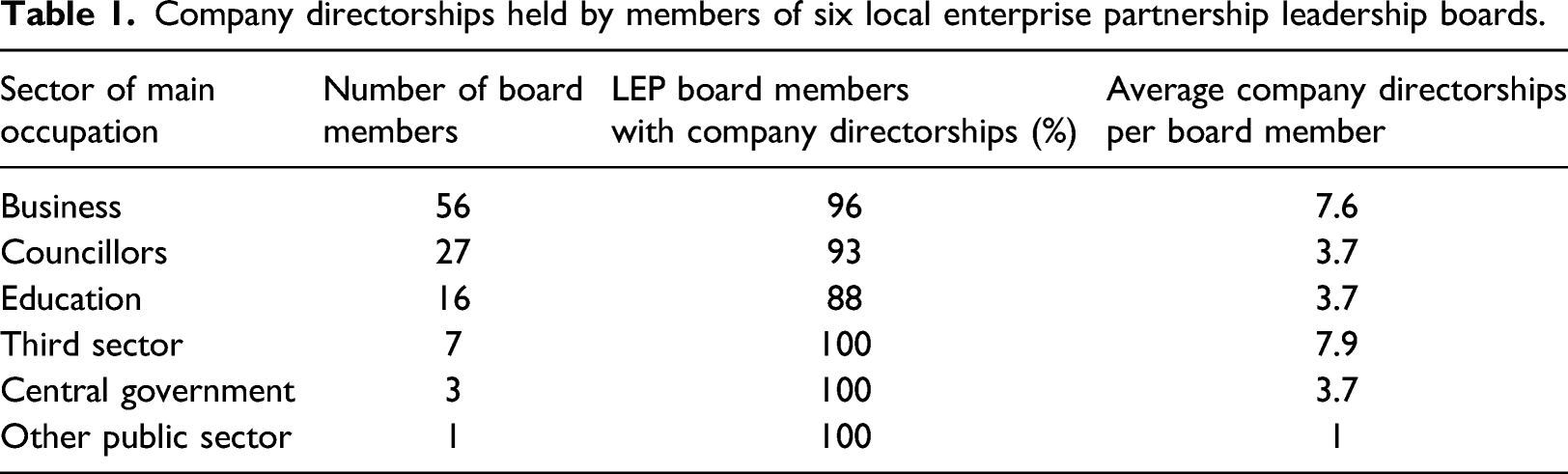
As shown in the document and interview analysis, a distinction between ‘civic leaders’ and ‘business leaders’ is crucial to the justifications for the creation of LEPs and the decisions about their structure. However, our network analysis challenges this basic premise of LEPs by showing that many ‘civic leaders’ can also be considered to be in the private sector. 3 This is important not just because the government emphasised the unique expertise, connections and practices of the private sector, but also because individual personnel were seen to be central to each of these unique attributes. If civic leaders also hold important and varied positions in the private sector, then it would seem that they already have access to such attributes.
Company directorships held by members of six local enterprise partnership leadership boards.
The connections of local enterprise partnership board members.

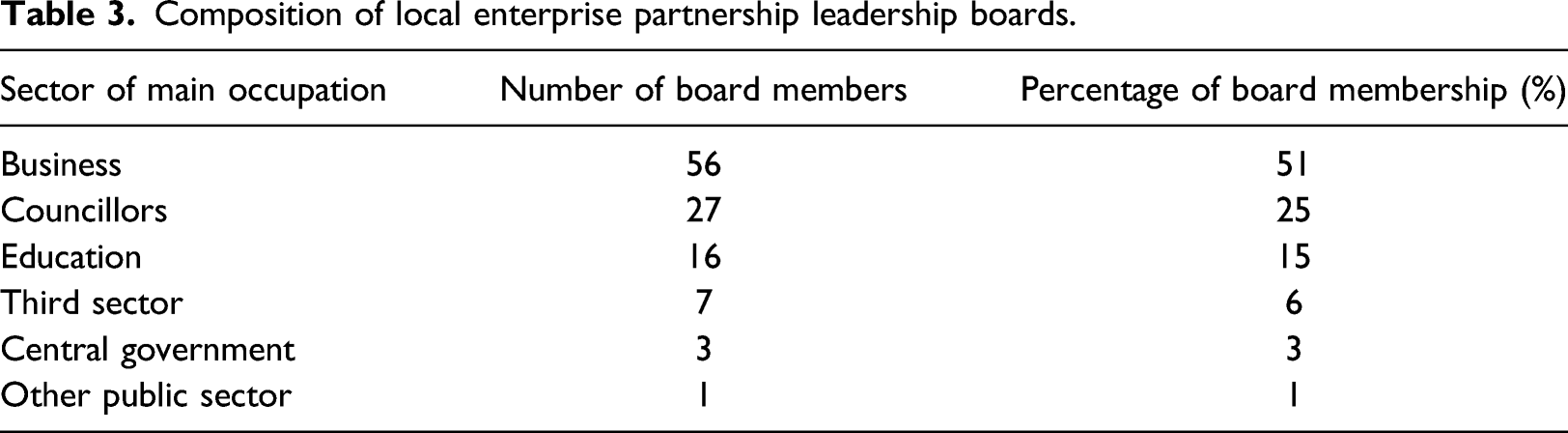
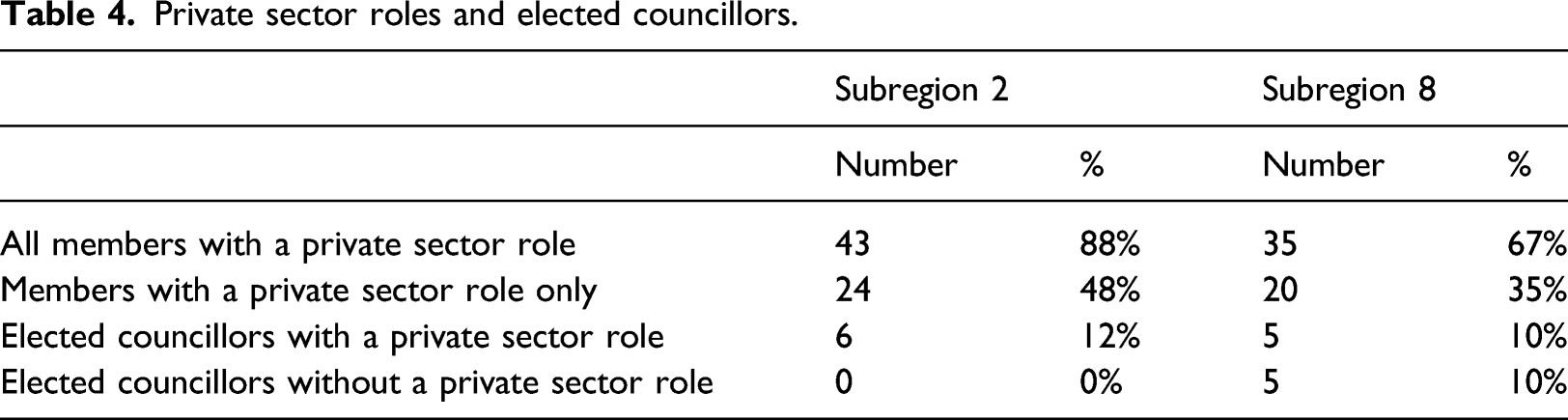
Accountability and the balance of power
Composition of local enterprise partnership leadership boards.
Private sector roles and elected councillors.
Representation of the local economy
McGurk and Meredith (2018) analysed all 38 LEP leadership boards in the UK, finding an over-representation of ‘Finance’, ‘Transport and Communications’ and ‘Manufacturing’. By focussing on a smaller number of case-study LEPs, the data we collected was narrower but deeper in that it included all LEP boards (not just the leadership board), all LEP board members (not just the private sector members), and all the companies where they sit as directors (not just their main occupation). The data also covered the wider networks in which these companies were located; that is, all companies connected via director interlocks (Mizruchi, 1996). Crucially, sector representation is considered at the subregional level, allowing us to determine how representative each LEP was of the local economy.
Representativeness of all local enterprise partnership boards.
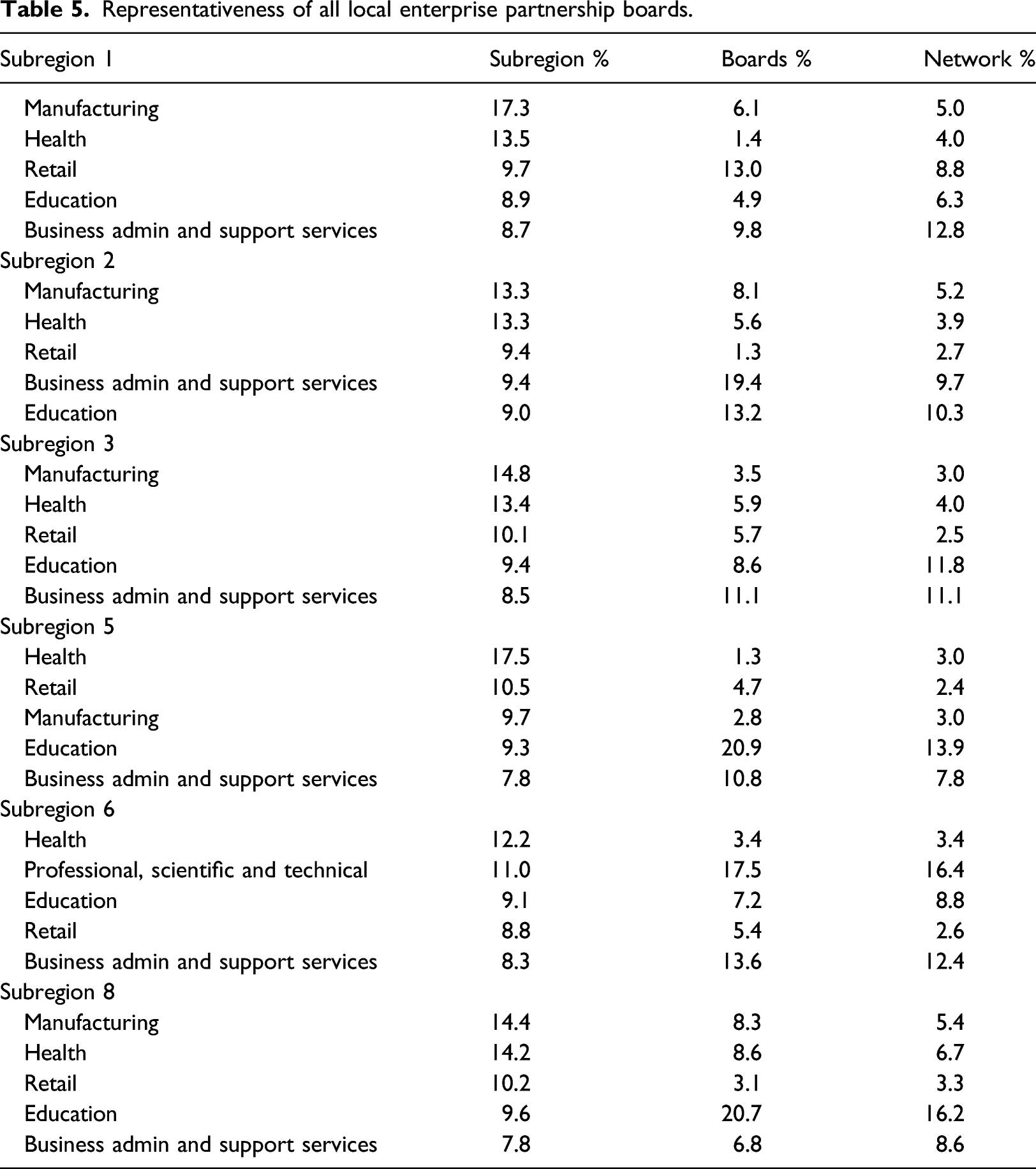
The health sector was also under-represented. It is important to note that this data only includes health-oriented businesses registered on the Companies House database, whereas many of those in the health sector are employed within the NHS. However, the data collected on board composition showed that only one member of the six leadership boards was from the NHS. In contrast, education was well represented in most subregions, reflecting the place of education leaders on LEP leadership boards (shown above in Table 3). The difference between health and education here can be explained by LEPs having ‘skills boards’ but not ‘health boards’. This perhaps underscores the lack of concern about public health and wellbeing within LEPs, linked to their focus on ‘economic development’ rather than ‘social growth’ (Doyle, 2013).
Summary of network analysis
The network analysis has offered insights into issues raised by the interviewees. Firstly, there is no clear distinction between business and civic leaders, because the latter hold a range of roles within businesses. This supports concerns among interviewees about transparency and conflicts of interest. Secondly, our findings suggest that businesses are represented by at least 50%, and by some measures nearly 90%, of the seats on LEP leadership boards. Of those designated ‘civic leaders’, only half are elected representatives, and many of those hold private interests. These findings raise concerns about the accountability of LEPs. Thirdly, with regard to knowledge flows, we considered the representativeness of the sectors on LEP boards and their wider networks. This adds further weight to the argument that LEPs only access partial knowledge of the local economy, and do not provide a window on the ‘real situation’ as implied by some interviewees.
Conclusion
This paper has identified the assumptions underpinning the public justification of LEPs and considered these against qualitative and quantitative data from eight case-study subregions. The methodological approach used critical realism’s ‘layered’ social theory, with a particular focus on the agential, ideational and relational aspects of social reality. In this concluding section, we will return to these three aspects to help summarise the paper’s main findings.
The justification for LEPs assumed a cleavage between two relational contexts, civic organisational structures and the organisational structures of business. Each relational context was assumed to give rise to different ideational contexts, with civic organisations and business organisations containing different stocks of knowledge. The business context was assumed to be more suited to local governance and local economic development, but civic leaders were thought to lack the agency to replicate these benefits because of their own relational and ideational contexts. Therefore, LEPs sought to bridge this gap in a number of ways: firstly, by bringing individual agents from the business context into the civic context, LEPs would engage individuals who brought with them the ideational assets and relational practices of business; secondly, by bringing business and civic actors together, LEPs would knit together the relational structures of the business and civic contexts, and consequently allow ideational assets to flow between them; thirdly, LEPs would be civic organisations that mirror the relational structure of businesses (e.g. CEOs, boards and a single economic motive).
Therefore, at the heart of the justification for the creation of LEPs was the assumption that business leaders and civic leaders were distinct groups of agents, with distinct relational structures, and distinct ideational assets. However, our network analysis shows that this is not the case. Elected councillors, education leaders and other public sector employees also hold multiple company directorships and other roles within the private sector. This challenges the assumed cleavage between the business context and civic context. This central finding suggests that the policies that created LEPs set out to solve the wrong problem.
Three further justifications of LEPs were also challenged in this paper, and these are perhaps of greater importance for learning lessons about the role of the private sector in subnational governance. Each justification points towards a missing principle in local public-private collaboration.
Firstly, while LEPs were expected to import private sector knowledge about the local economy, our interview and network analysis show that they instead imported partial perspectives that were problematically interpreted by local leaders as ‘real insights’. This indicates that the businesses involved in subnational governance need to be representative of the local economy, especially in terms of company sector and company size. Alternatively, there is also a clear possibility that this knowledge could instead be gathered with greater neutrality and validity by professional researchers and analysts. There are also questions about the representativeness of LEP boards in terms of gender, race, disability and other social characteristics. While these questions were beyond the scope of the current paper, with its focus on the business-civic distinction, the importance of these issues add further weight to the argument for representativeness as a central principle in the design of subnational governance.
Secondly, an important justification for LEPs was their connections to business networks. On the one hand, our findings do show this connectedness, but on the other, interviewees raised concerns about the consequential conflicts of interest and opaque decision-making. Partnerships between the public and private sector need to prioritise the transparency of interests and decisions. When collaboration is based on individuals’ personal networks, transparency will inevitably be limited. The situation could be significantly improved if collaboration were always based on official institutional partnerships, and not networks of individual local leaders.
Thirdly, LEPs were designed to be organised like private businesses, both in terms of their institutional structures and their singular economic objective. However, our findings show that this results in a significant deficit in democratic accountability. To deliver accountability, there is a need for a more substantial contingent of elected officials in subregional bodies. Given that the mere presence of local councillors does not amount to accountability, it could be argued that it is only possible for an institution to be democratically accountable if it is led by an elected body.
The identification of these three principles – representativeness, transparency and accountability – reinforces the conclusions of existing literature on private sector engagement (e.g. Syrett and Bertotti, 2012) and on the structure of the UK’s subnational governance (e.g. Sandford, 2017). However, this paper has gone further by specifying the precise ways in which the principles are currently unmet by England’s LEPs. The novelty of the approach lies in its systematic application of a mixed-methods framework that uncovers the underlying assumptions of the LEP policy design and shows how these assumptions are problematic in the actual functioning of LEPs.
Overall, it is clear that a business-led model of subnational governance tends to deviate from representativeness, transparency and accountability, creating challenges for institutional design. To deliver the multifaceted aims implied by Levelling Up (Newman et al., 2021), subnational institutions will need alternative approaches to gathering local economic knowledge, building local partnerships and securing capable leadership. Rather than see businesses as the solution to all three challenges, subnational institutions should seek separate solutions to each problem within an uncompromised framework of representative, transparent and accountable governance.
Footnotes
Acknowledgements
We would like to thank project contributors: Charles Seaford, Ben Glover, and James Sweetland (Demos); Professor Simon Collinson, Dr Charlotte Hoole, Dr Anastasios Kitsos, and Dr Diana Gutierrez Posada (University of Birmingham); Dr Helen Tilley and Dr Ananya Mukherjee (University of Cardiff); Professor Nigel Driffield (Warwick); and Lisa Fletcher and Gail Deason (University of Surrey). In enabling the network data collection, we owe a special thanks to Will Langdale (HMRC), Matthew Smith (Edinburgh Napier), and Hyungseo Kim (University of Nottingham).
Declaration of conflicting interests
The author(s) declared no potential conflicts of interest with respect to the research, authorship, and/or publication of this article.
Funding
The author(s) disclosed receipt of the following financial support for the research, authorship, and/or publication of this article: This work was supported by the ESRC (Economic and Social Research Council) with Grant ES/T002468/1 from September 2019 to October 2021 as a joint project between the Universities of Birmingham, Cardiff, Surrey and Warwick and the think tank Demos.
Author’s note
This paper is based on research produced by the Local Institutions, Productivity, Sustainability, and Inclusivity Trade-offs (LIPSIT) project.
