




Abstract
Rural enterprise hubs are physical infrastructures designed to help rural businesses access tangible and intangible benefits. They generally operate within two main business models: ‘Honey Pots’ (i.e. targeting business-to-customer tenants) and ‘Hives’ (i.e. targeting business‐to‐business tenants). This paper focuses on the former type, Honey Pot hubs, which are best suited to tenants who sell their products/services directly to the general public, such as some creative sectors, retail and tourism. Honey Pot hubs are designed to cater to such needs by attracting footfall to the space, providing cafes and facilities for the general public and hosting events. This paper explores how these Honey Pot hubs contribute to rural and regional development, through the creative practices of their tenants. The paper draws on qualitative interviews with Honey Pot managers and tenants in remote rural locations of the North East of England. The findings are useful for Hub practitioners, policy makers and rural creative businesses who want to develop similar initiatives in their locales.
Introduction
Despite the contribution of the rural economy to the global GDP (Organisation for Economic Cooperartion and Development, 2018), a notion persists that the key industries in rural areas are the ‘traditional’ resource-based activities of agriculture, forestry, mining, fishing and tourism. Ongoing work in a range of disciplines are dispelling these myths, demonstrating that rural businesses are as competitive and productive as their urban counterparts (Phillipson et al., 2019), can introduce new innovative products/services/processes (Shearmur, 2015) and have a role to play in territorial innovation systems (Dubois et al., 2017). Additionally, research is demonstrating the vital role of the art and craft sectors in rural development and the distinct style of products that are being produced in these locations
(Blichfeldt and Halkier, 2014; Fois et al., 2019). Yet there is still a gap in knowledge in terms of their rural location and characteristics (Bell and Jayne, 2010): the place-based contributions and support needs of the arts and crafts sectors are seldomly discussed in academic scholarship and are regularly overlooked in spatial policy beyond urban contexts.
Discourses in regional development have long pointed towards the importance of agglomeration and proximity as the main driver of competitiveness (Porter, 1996; Marshall, 1920) and innovation (Schumpeter, 1934; Saxenian, 1994; Henry and Pinch, 2000). Bringing businesses closer together – physically, organisationally, institutionally, socially and/or cognitively (see Boschma, 2005) – to share knowledge and human capital, increases the likelihood of innovation occurring. Physical infrastructures can facilitate this clustering by providing workspaces, meeting rooms, research facilities, shared equipment and places to informally meet new people (Cumbers and MacKinnon, 2004). Enterprise Hubs are one such example (alongside similar concepts such as ‘enterprise parks’, ‘accelerators’, ‘clusters’, ‘incubators’ and ‘co-working spaces’), which provide services and facilities to support a range of enterprises. Physical infrastructures specifically designed to support creative businesses, have proven to have a valuable role in knowledge exchange (Sheridan et al., 2014), entrepreneurial process (Van Holm, 2015) and wider community cohesion (Taylor et al., 2016).
Typically, these infrastructures (and agglomeration policy more widely) have largely been an urban phenomenon (Glaeser, 2011; Shearmur, 2012). However, Rural enterprise hubs (REHs) are now being developed across rural areas of Europe and beyond. There are two distinctive models of REHs: Honey Pot hubs, which specialise in fostering business-to-customer tenants (the focus of this paper); and Hive hubs, which foster business-to-business tenants (Cowie et al., 2013). The two models each have their own distinct management strategies, means of supporting their tenants (through the choice of support services) and facilities they provide (Merrell, 2019). Honey Pot hubs largely attract tenants from the arts and crafts, retail, food and drink and/or tourism sectors who sell their products/services directly to the general public, whilst Hives specialise in attracting office-based business-to-business service providers such as financial services or consultancy firms.
REHs, and particularly Honey Pot hubs, appear to be prime examples of Siepel et al.’s (2020) ‘micro-clusters’, which are located in ‘neighbourhoods, streets, or sometimes within buildings’ that can be ‘identified in towns, rural areas or villages with higher than expected concentrations of creative businesses’ (p.4). Siepel et al. (2020) discovered 709 creative micro-clusters after a finer-grained analysis of clustering in the UK, many of which resided outside places previously identified as creative hotspots. They demonstrated quantitatively how creative practitioners outside of recognised creative clusters find great benefit from being within a micro-cluster. Similarly to Merrell (2019), they point to the importance of new knowledge sources, access to new customers and access to new skills for members of the micro-cluster.
This paper focuses on the role that Honey Pot hubs play in rural development and particularly the development of the arts and crafts sectors. While rural enterprise hubs could be seen as an expansion of the enterprise hub concept first identified in urban areas, this paper is not a comparison of rural and urban enterprise hubs. Rather, it is an in-depth analysis of the nature of rural enterprise hubs and their role in fostering rural development.
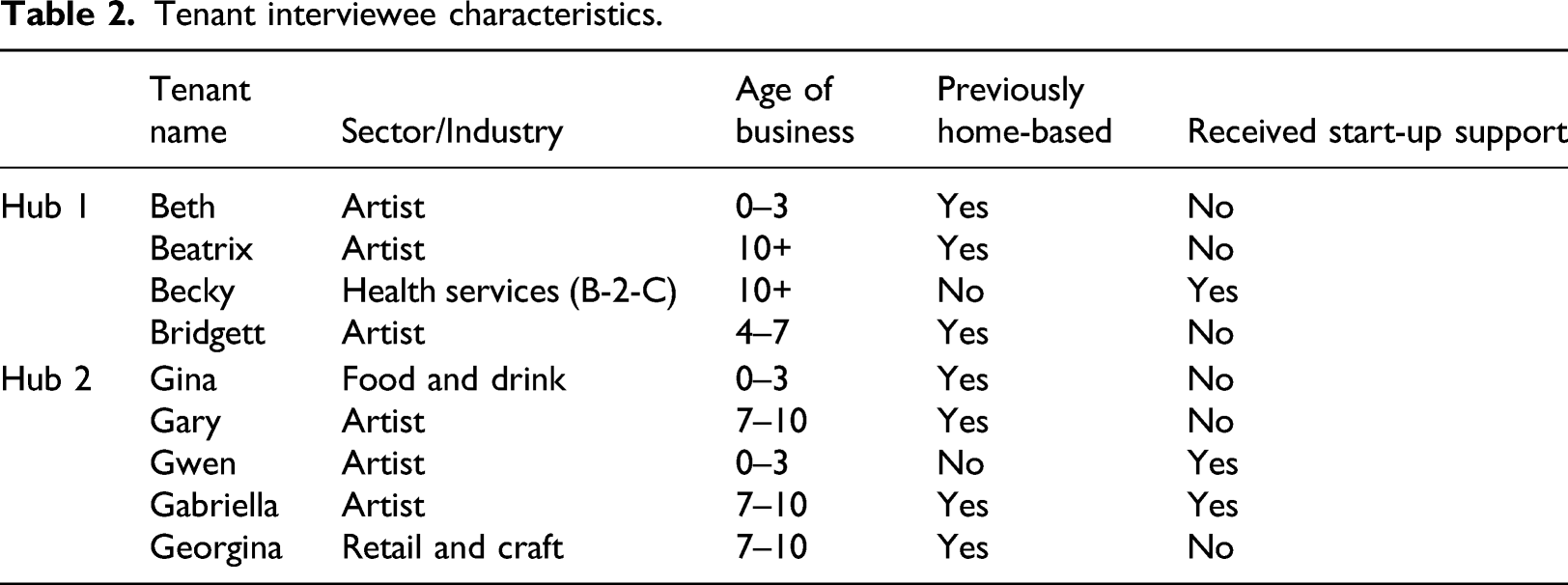
As such, specifically in this paper, we ask: What are the perceived benefits of moving into a Honey Pot hub? What services do managers offer to encourage collaboration, facilitate networking and increase footfall, and thus enable creative businesses to realise the benefits of proximity? It addresses a gap in the literature about the complex interactivity of creative enterprise hubs in a rural context thereby extending Siepel et al.’s thinking on creative micro-clusters into rural areas (Pratt, 2021; Siepel et al., 2020). As such, it offers potential for place-based policies for supporting creative industries outside cities (Jones-Hall, 2021). The research is based in the North East of England – a particularly rural and remote part of the UK, which was framed by Marsden et al. (2012) as typifying the ‘paternalistic countryside’ in their typology of differentiated countryside’s, due to presence of large (private) land estates as well as fragile rural economies – compared to other rural areas in the UK – in need of economic diversification. Empirically, the paper involves an in-depth study of two case study Honey Pot hubs, based on qualitative interviews with the two Honey Pot managers and 11 of their tenants.
The paper begins by reviewing the literature on the role of creative industries in rural economies before considering what we currently know about REHs and ‘micro-clusters’. The methodology and case study hubs are then presented, followed by the main findings of the research. A discussion on Honey Pot hubs related to the literature follows, before concluding remarks for policy implications and a future research agenda.
Literature review
Creative industries in rural development
Over the last decade, there has been growing interest in the role of the creative industries in rural development, including the contribution of ‘creative originals’ such as artists and craft producers (Argent, 2019; Mahroum et al., 2007; Crawshaw and Gkartzios, 2016). Cultural products based on the valorising of place-based rural assets (e.g. landscapes, nature, rural traditions) such as traditional foods, crafts and arts, have been a cornerstone of ‘bottom up’ endogenous development models, embodied in the concept of ‘culture economies’ (Ray, 2001) and incorporated in local development policies and strategies (e.g. the LEADER model under Pillar two of the CAP) (Dargan and Shucksmith, 2008).
By contrast, another strand of interest in rural creativity has responded to the perceived bias towards urban development models such as Florida’s (2002) Creative Class and Landry’s (2012) Creative Cities that have become widespread in urban regeneration contexts (Argent, 2019; Bell and Jayne, 2010; Woods, 2012). Authors have since argued – and Florida (2018) has subsequently agreed – that rurally distinctive variants exist and are important for local development strategies: for example, the attraction of a rural ‘creative class’ linked to the availability of outdoor amenities that persuade creative professionals to trade-off city ‘buzz’ for rural life
(McGranahan and Wojan, 2007; Verdich, 2010; McGranahan et al., 2011; Luckman, 2012), and specific initiatives on nurturing creative businesses in place-based, sub national contexts (Bell and Jayne, 2010).
Within this broad paradigm of urban-derived models based on proximity, rural creative clusters are largely absent from the literature and development approaches. Partly this is a question of data – such as the challenges of analysing rurally specific patterns of creative development at small scale geographies (Jones-Hall, 2021; Siepel et al., 2020), and relatedly, a matter of perception in that proximity is an urban economic phenomenon (Glaeser, 2011; Shearmur, 2012). However, disparate studies have hinted at the potential for rural creative clusters to be part of a complex, relational ecology of local creative sectors locating in close proximity to one another attracting other creative businesses and acting as incubators to ignite a ‘Creative Fire’ (Balfour et al., 2018; Harvey et al., 2012). These clusters also foster connections to extra-local networks and markets (Ray, 2006; Atterton et al., 2011; Bathelt et al., 2004). For the purposes of this paper, our interest is focussed on arts and crafts enterprises and their experience of being and acting within a REH, as an exemplar of a rural micro-cluster (Hall et al., 2006).
Within a wider definition of the rural creative industries, artists and craft makers, musicians and performers are a small sub-set of cultural enterprises identified by policy makers as those ‘which have their origin in individual creativity, skill and talent and which have a potential for wealth and job creation through the generation and exploitation of intellectual property’ (Department for Digital Culture Media & Sport, 2019). There are many distinctions between artistic and craft production (that we will not explore in this paper) but conceptually both are underpinned by creativity – the ideas, inventions and practices of individuals that produce art and craft products or cultural services for sale and consumption through markets (Varbanova, 2016; Prince, 2017). These creative individuals and the enterprises they interact with, or businesses they create, may be perceived as ‘lifestyle’, with little or no interest in growth (Bosworth, 2012). However, studies have shown that such creatives contribute to processes of rural resilience and innovation (Mahon and Hyyryläinen, 2019; Hardey, 2020; Cockshut et al., 2020), social cohesion and wellbeing (Duxbury and Campbell, 2011; Scott et al., 2018) and may well be entrepreneurial and willing to grow their enterprises (Prince, 2017; Varbanova, 2016). For Woods (2012), these cultural entrepreneurs are essential in demonstrating rural creativity in an endogenous sense, recognising the possibilities of the countryside as a place that fosters creativity. In the UK, the arts and crafts sector has exhibited strong growth over the last decade (pre-Covid-19), as have the creative industries overall (Department for Digital Culture Media & Sport, 2019). A number of reports have pointed to its significance to rural economies and subsequent policy neglect (Rural Cultural Forum, 2010). Nevertheless, current gaps in knowledge about the distinctive opportunities and challenges faced by rural creative businesses and a lack of evidence about their spatially specific entrepreneurial responses can make them invisible to policy geared to high growth creative clusters in cities (Gibson and Kong, 2005; Gibson, 2010; Mahon et al., 2018a). This risks overlooking their potential for rural development, and distinctive needs as rural creative clusters.
Rural enterprise hubs/micro-clusters
Physical infrastructures that aim to increase innovation and growth amongst groups of colocated businesses are a well-established concept, dating back to Marshall (1920) and tested empirically through Porter’s (1998) work on clusters and Industrial Districts (Markusen, 1996). Research on clusters, coworking spaces and enterprise hubs has typically had an urban focus, although they are now beginning to spread to rural areas (Avdikos and Merkel, 2020). REHs are beneficial to their rural tenants, by providing crucial access to new networking opportunities and knowledge sources, and contribute to increased wellbeing (Merrell, 2019; Merrell et al (This Issue)).
Clusters are designed to bring businesses into closer proximity, to encourage knowledge exchange and networking. Initially, proximity was considered strictly in the geographic sense, however, it is now understood to be multi-faceted (Boschma, 2005) and also includes social (close ties based around kinship and trust), cognitive (similar knowledge bases), institutional (cultural norms as well as the ‘hard’ institutions that govern and promote growth and innovation) and organisational (internal firm dynamics) forms of proximity (Klimas, 2020).
Recently, the concept of ‘micro-clusters’ has emerged (Capdevila, 2013) as a means of viewing clusters through a reduced scale of analysis, such as a neighbourhood, a street or even an individual building. Research on rural coworking spaces (a similar concept to REH, but with large open-plan spaces that businesses share, see also Gandini, 2015) has emphasised the importance of the management in brokering collaborations and creating cohesion within the infrastructures (Fuzi, 2015) and their role in stimulating local growth (Knapp and Sawy, 2021). Using this reduced scale, Siepel et al. (2020) uncovered several creative clusters in the UK that previous quantitative methodologies failed to identify. Their report confirms that creative businesses do benefit from (micro)clustering effects and, more importantly for this research, businesses who reside outside of traditional creative clusters (such as London and Bristol) but inside of a micro-cluster feel ‘substantive’ (p.13) benefits. Businesses in micro-clusters are more likely to want to grow and achieve this growth, as well as accessing new knowledge, skills, customers and amenities. We argue here that Honey Pot hubs are exemplary cases of micro-clusters, fostering the growth of the arts and crafts sector in rural areas outside of traditional creative clusters.
Whilst this research demonstrates promising findings and provides a new lens to view the development of the creative sector in rural areas, there are still gaps in our understanding of the complex dynamics of micro-clusters, exemplified in this case through the operation of two Honey Pot Hubs focussed on creative enterprises. Our qualitative methodology brings the voices of micro-cluster tenants and managers into the discourse, thereby ‘offering an insight into the diverse motivations and rationalities that drive both users/creatives and hub managers’ (Pratt, 2021). This could provide a richer account to complement the findings of Siepel et al.’s (2020) research and deepen understanding of rural creative micro-clusters as an emerging object of interest to research and policy.
Methodology
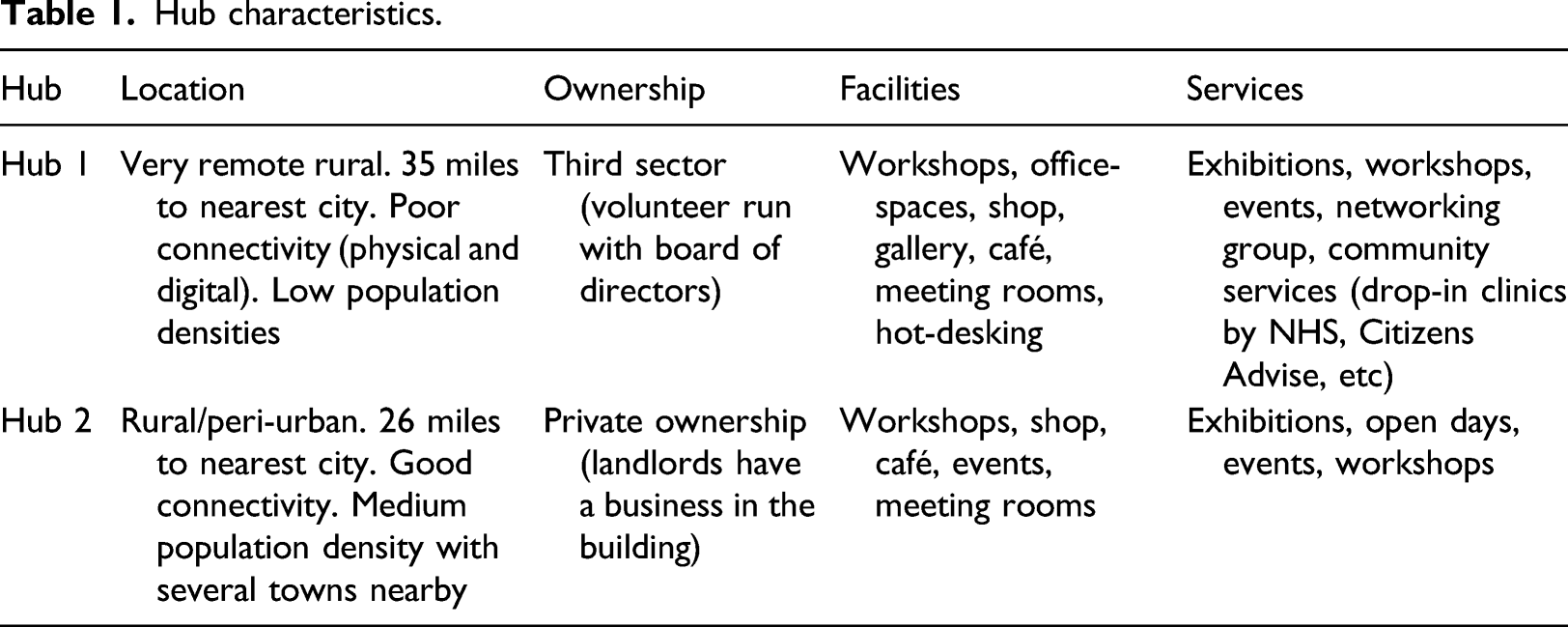
Hub characteristics.
Tenant interviewee characteristics.
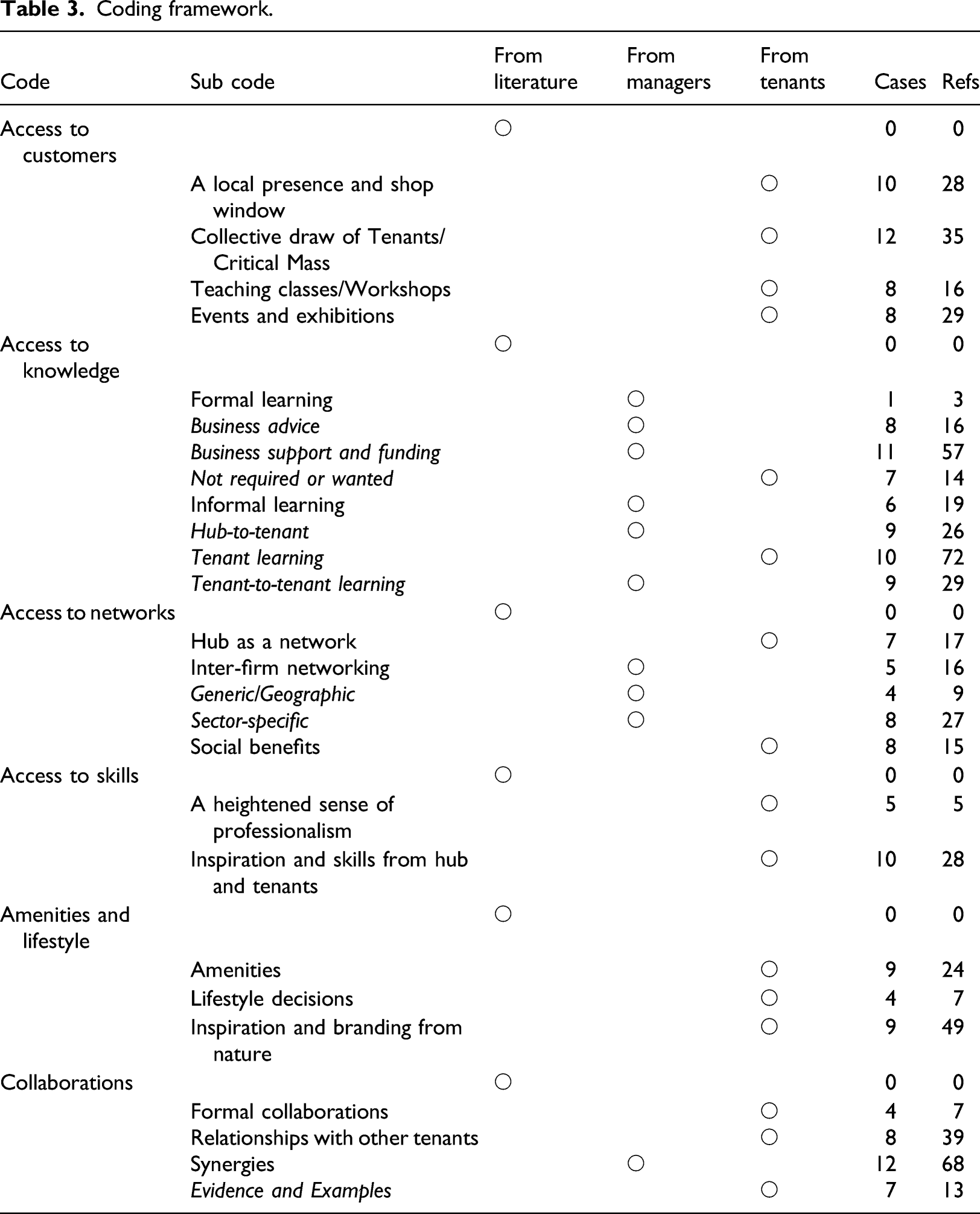
Coding framework.
Pen portraits
They did not intend to become an Enterprise hub and it was the demand that made them reassess. The decision was made that each artist would be responsible for personalising and renovating their own space in lieu of rent. The hub provides studio space for eight artists, the majority of which have remained to date.
The owners have the advantage of gaining an income from the shop and café (their own business) so they only aim to cover costs as landlords of the hub, therefore the rent is low. All of the utilities (heating, electricity, Wi-Fi, cleaning and business rates) are provided within the rent. There is a large room which is available for hire – the artists run public workshops in the space and the managers put on music concerts.
Findings
Findings are discussed according to the coding framework and cover the following six sections: access to customers, networks, knowledge, skills, collaborations and amenities and lifestyle decisions.
Access to customers
The strongest theme related to how the Honey Pot hubs helped tenants access new customers. This was found to be multifaceted with four key subthemes emerging as discussed below.
Exhibitions and events
Exhibitions and events are means of increasing the footfall of the hub, providing the tenants with a larger customer-base. From the tenant’s perspective, hosting rolling exhibitions in the hub was very important to them. They bring in new crowds periodically, are a chance for the artists themselves to display their work, a chance to meet new artists and a source of inspiration. Hub 1 has a member of the team responsible for organising, promoting and running the exhibitions, with the idea of ‘getting some artists with a wider appeal who pull people in’ (Hub Manager 1). Some tenants use the exhibitions as a shop window to ‘signpost’ (Beth) visitors towards their studio.
Having a programme of other events also increases footfall to the site. Hub managers were found to host a variety of events, including: music concerts, poetry readings, summer/Christmas fairs, artist talks/lectures, ‘craft-ernoons’ and theatre. These provided the hub with another income avenue, but also increased the presence and draw of the hub. Tenants also host their own events which have the same effects as hub-hosted events, but the revenue goes to the tenant: “So that’s built up: the workshops I do throughout the year (I produce a leaflet for that and things). So yeah … it has actually been quite a busy environment a lot of the time” – Gwen
A local presence/shop window
The hub provided facilities that benefited tenants’ sales and their visibility, helping them to create a local presence for themselves. In this sense, the hub acted as a shop window for the services and products of the tenants. “And actually, doing things like cakes on the bar there *points to café* people can actually come in and try my cakes and go “oh, she bakes!” So that has helped me from the point of view that I get different customers that wouldn’t necessarily go on Facebook” – Gina
Related to this point, if the hub has a gift shop attached to it, the tenants found great benefit from displaying their products here. Hub 1 has an interesting mechanism whereby all tenants are required to work a weekly shift manning the shop, which some tenants perceived as a big benefit: “I decided to have a stand in the shop … I’d started making products/gifts from my images. So I started showing those here. And then it grew from that.”– Beatrix “Well I quite like sitting here in the shop because it gives me a chance to tell people who I am and what I do and specifically point out my pitch which increases sales”– Bridgett
In the case of one of the two hubs, the hub manager provided a ‘front-of-house’ service which included typical receptionist services like taking phone calls/messages, accepting parcels, showing people around etc. Many tenants (especially those that worked flexible and/or out-of-office hours) appreciated this service: “I think purely from a practical view; I’m only here 3 days a week, my post gets delivered here and I can have parcels delivered when I’m not here. I think downstairs will also let people in - if somebody comes who is desperate for something and knows what they want. So I can occasionally still get a sale even though I’m not here” - Georgina
Tenants were also grateful for the hub providing workspaces and access that suit their time schedules. Some of the businesses offering services to the public preferred to do this in evenings when the hub was largely empty, others worked secondary part-time jobs to support their artist pursuits and would instead work weekends in the hub: “I potentially have access to all of that out-of-hours. But they are very laid back about that. Because if I’m in here (sometimes) if I am trying to produce something to a deadline I am in here funny hours”– Gwen
These two themes (exhibitions/events and a local presence/shop window) were both provided to tenants by the hub management. The following two themes revolving around acquiring new customers were created by the tenants themselves.
Collective draw of the tenants/critical mass
The collective draw of several tenants operating under the same roof is greater than what would be achievable acting alone. This builds the critical mass and ‘draw’ (Hub 2 Manager) of the hub as a ‘destination’ (Hub 1 Manager) to visit: “Well, the mix: there are so many different things here. Not everything is art, there is a lot of craftier as well ... So those who are looking for art can find really beautiful things and those who are looking for crafty things like home-made soaps, silks, scarfs and things like this … So everything comes together, creates an interesting mix that changes because people put different stuff on the shelves. – Bridgett “I think the big advantage that we have … is that we have a lot of other things going on. So we have the café which brings in a lot of people on a regular basis” – Beatrix
Importantly, a number of tenants who were earlier in their professional development stated this critical mass was particularly important to them, as they grew their visibility and presence: “The biggest benefit is that a lot of people are attracted by other artists; people who don’t know me yet.”– Bridgett “I think there are huge benefits actually. For me, I think even though we are all open at different times, there’s no doubt that people come across me because they come to visit other businesses.” – Georgina
Teaching classes/workshops
As Honey Pot hubs allow (and actively encourage) members of the public into the hub, tenants can use the space as a place to teach their own classes or workshops from: “And I remember [owner] saying ‘If you ever want to do a [class]?’ … Since I’ve been here, I’ve taught a couple of classes.”- Gina
These classes/workshops provide the practitioners with a diversified revenue stream as well as increasing their visibility and presence. Teaching workshops raises the footfall of the hub, and other tenants could benefit from this passing trade.
Access to networks
The hubs provide tenants with new networking opportunities, as they are in more contact with other practitioners and customers. Networking is a conduit for tenants to gain access to knowledge and skills (discussed below), new customers (discussed above) and social benefits. The hub itself acts as a networking opportunity, but interviewees also gave examples of trade fairs, art tours and a regionally governed ‘Women’s network’ as other examples of networking opportunities.
The two hubs have a strong sectoral focus on arts and crafts (rather than a heterogenous mix of business-to-client businesses) and provided exciting networking opportunities for their tenants. Hub 2 performed very strongly in this regard, having tenants who all shared commonalities and knowledge bases. Additionally, Hub 1 had a network of practitioners which extended beyond the hub itself. In this case, network members were allowed to display their work in the giftshop, put on exhibitions and become involved in knowledge exchange for a small annual fee. Importantly, this wider external network was perceived as a substantial benefit to tenants of Hub 1: “I suppose when you think it’s 100’s [of network members], you don’t see that. 80% of them feel invisible at first. But right from the beginning I think the business of coming into a pre-established place that has lot of links and people was massive. It was massive for our confidence and it was massive to feel your popping yourself in there” - Beth
Tenants described also the social benefits attached to entering the hub. Acting as a sole practitioner can be a lonely pursuit, especially working from home in a rural area. Many interviewees commented how the social networks of the hubs improved their wellbeing (discussed in full in Merrell et al., This Issue).
Access to knowledge
Entering into the hub gave tenants access to information and advice through knowledge exchange with other tenants. A creative practitioner’s main skill is producing art or a craft to an exceptional standard, however, it is not necessarily running a business. Both sector specific and generic business advice were gained from entering the hub, but due to the artistic nature of their trade, much sector specific knowledge overlapped with acquiring new skills (techniques etc.) and this will be discussed in the next section. Learning and accessing knowledge were found to occur both formally (through business support services) and informally (ad hoc from other tenants and managers).
Regarding formal training, some of the hubs have themselves become known locally as a source of business support and advice: “There is a business workshop happening here next week and that will be very useful I think for everybody and that is something that the [Hub 1] just provides” – Becky
Other research suggests that public REH also perform well in this regard (Merrell, 2019; Talbot, 2016).
Opportunities for informal learning emerged from being around other active practitioners and acquiring new business hints and tips: “You might just have a two-minute conversation when you come in the morning, but it’s great because you are talking to vibrant practitioners who are maybe involved in different things – so that’s worked really well.” - Beth “I was trying to find a product of boxes to show my work in. … I asked somebody else who exhibited here who had them and I said ‘where did you get them from?’. So, you can get information through it.” - Beatrix
Other examples included learning about trade fairs, events and exhibitions from other tenants, help with finances and pricing structures and tips on suppliers and framing services. Hub Managers were also perceived to play a role in this knowledge exchange, as they are often knowledgeable in business and have large networks of contacts.
Access to skills
The tenants also learnt new skills and techniques from other practitioners, especially those who practice fine art and crafts: “Sometimes just talking to people can just make you think of something that you might like to do in the future. And it’s not necessarily tangible, but there is something about when you speak to people and socialise with people and have conversations, it makes you think” – Gwen
These skills can also be passed (or provide inspiration) to those in related yet varied disciplines: “I quite like the idea that it is leather downstairs, there’s a print maker, there’s a baker. So that diversity, at the moment, is an interesting idea” – Gary
The hub provides the tenants with an extra degree of professionalism – both to their clients and themselves. This finding could just have easily been considered an intangible benefit, but we include it here as it does appear to have a direct tangible benefit. The tenants who were artists stated how being in a studio and attached to a gallery gave them credibility in the eyes of their clients: “People like to know you have a working base and they love to think that you are in a studio. So, in a funny way that gives you a bit of status.” - Beth “In the nature of being an artist, if you don’t have an open studio (or a studio base) you’re seen as being less professional … So then, to be homebased, is not good. So, actually having a presence attached to a gallery gives you a [advantage].” – Gabriella
Some of the tenants earlier in their development stated how entering the hub had increased their own confidence: “At the time I didn’t have the confidence … since I’ve been here, I’ve taught a couple of classes.” – Gina
All of the benefits mentioned above have tangibly helped the tenants improve their businesses, through increased sales, productivity, profitability and/or diversification. However, equally important were less tangible aspects such as inspiration from the hub or other tenants. For example, having rolling exhibitions in the gallery, inspired some tenants: “I think whether you realise it or not you are influenced by everything aren’t you? And even going to one of the exhibitions downstairs you might just think ‘Oh, I love the way that person has used those colours’. So yeah for sure. It’s really good that they have this changing monthly exhibition there” – Beth
For others, their fellow tenants provided them with inspiration, making them more creative and experimental: “So it was coming here and the vibe of the place and the fact that there are other artists, so I got the sense that creatively it would be better if I was somewhere like this” – Gina
Access to new collaborations
The main examples of formal collaborations were through joint exhibitions and events. Some tenants stated how they were able to form collaborations and give workshops that might not have considered doing alone: “We would discuss creative process, jointly work together. I’ve worked with [Gwen] with children workshops a little bit. So collaborative working is lovely if it will work.” – Gabriella “[Gwen] does [crafts] and I can do cupcake decorating. So we were thinking of going into business together; offering something a bit different for a hen party” – Gina
Overall however, levels of collaboration tended to be low in the Honey Pot hubs. More could be done by the management to facilitate this; however, due to irregular working hours, the practicalities of forming collaborations were the biggest hurdle to overcome.
Adopting new ‘rural’ lifestyles
The social and cultural construction of rurality is not irrelevant to the operation of the Honey Pot hubs, and certain narratives confirm expectations attached to the rural, commonly discussed in rural studies research in relation to the English ‘rural idyll’ (Marsden et al., 2012). A number of tenants for example described how they were inspired creatively by their rural surroundings and created art ‘unique to this area’ (Hub 1 Manager): “But when we do fairs down in the South they absolutely adore it! … And they buy into the idea of the freedom and all of those other association that come with it.” - Beth
One tenant even suggested their move to the hub was consciously to disassociate themselves with the city’s art scene: “So there are studio spaces in [City] where people are contemporary fine artists – but I was interested to not be on the same page as that and locate my work in a different context … I quite like working in a space where what I do isn’t being confirmed by others around me” – Gary
Many of the interviewees established their business for lifestyle decisions – that they would prefer to pursue their artistic practice over maximising income, it fit in with other life commitments, or as a means of supplementing household income. “I’m making other investments here: pursuing what is important to me, investment that then feeds into family life too” – Gary “I run this as a lifestyle business, for instance I just tend to work half days. I’m usually in every day but maybe not all day because I have other things to do” – Becky “Most of our business, they also have work outside the hub. Some of them have jobs and some of them, they’re constantly re-sourcing other work, so they’re not here all of the time … So a lot of people take commissions and that takes them away from the building, using that space to still do their work from but they might be out several times a week. Growing their own businesses and getting the income that they can from the different streams that they can” - Hub 2 Manager
For some, the hub actually helped them to turn their hobby into a full-time (or at least part-time) business: “So I got the studio knowing that I wanted to do the ceramics but not really thinking that little bit of business would then become something that I would look at doing full-time – which has been terrifying (laughs).” - Beth
Discussion
The findings have highlighted various interesting lines of enquiry. Firstly, footfall is essential, which differs from typical hubs and clusters, especially in rural areas that have lower overall levels of footfall compared to urban centres. Tenants of Honey Pot hubs are business-to-client who sell their products or services directly to the public. Typically for rural practitioners, footfall would come from (physically attending) art fairs and exhibitions – examples of ‘temporary’ proximity (Torre, 2008; Growe, 2019). However, the hubs can provide tenants with closer and more permanent proximity to potential customers (Menzel, 2015). Additional benefits are gained if the hub has an established footfall due to being a destination that already attracts visitors. A synergistic relationship can occur whereby the destination attracts footfall, but also the critical mass of multiple artists becomes a draw, in and of itself. All parties’ benefits from this (the destination gets more visitors, tenants get more customers, visitors have a more enjoyable visit). Hub managers have a role in actively encouraging footfall, through events and exhibitions, but interestingly, this was also found to be the impetus of tenants, who found benefits in co-hosting events and workshops with other tenants and saw value in collectively increasing the draw of the hub.
Secondly, the hubs have shown to be important in supporting the sometimes precarious livelihoods of rural practitioners (Baines and Wheelock, 2003; Mahon et al., 2018b), with examples provided of how tenants could still gain sales without being present and how they supported flexible working patterns. Here the hubs are acting as an anchor for rural creatives, supporting the pluri-working characteristic of practitioners in creative sectors, one third of whom are self-employed freelancers (Henry et al., 2021; Mahon et al., 2018b). These freelancers may also experience ‘constrained autonomy’ in that the freedoms and values to pursue a creative livelihood, including being rurally located – may be offset by income insecurity and low earnings (Luckman, 2020; Mahon et al., 2018a; Henry et al., 2021). Hence, in a rural context, it can be argued that hubs are important to rural creative entrepreneurs, acting as a bulwark against creative precarity through anchoring their freelance activities, facilitating networking and innovation, and supporting business development (Henry et al., 2021; Mahon et al., 2018a).
This ties into discussions around the growth aspirations of rural businesses, which are typically viewed as lower than their urban equivalents (Phillipson et al., 2017). Many artists pursue their creative path as a ‘lifestyle’ choice, and in many cases such ‘lifestyles’ are connected with rural transitions, commonly discussed in England (Champion and Brown, 2012). However, this does not necessarily equate to them not wishing to be successful and grow, with the tenants of the Honey Pot hubs showcasing this.
Lastly, we return to the concepts of proximity (Boschma, 2005; Klimas, 2020) and micro-clusters (Siepel et al., 2020). We have already suggested that Honey Pot hubs can provide permanent proximity to new customers (as opposed to temporary trade fairs), and that the hubs provide typical ‘spill-over’ benefits (Petrov, 2011) associated with colocation and agglomeration (access to networks, knowledge and collaborators). The hub provides both the physical node in the networks and the social space within which the various forms of proximity can flourish which in turn generate the micro-agglomeration and micro-clustering affects that are often overlooked in rural areas. This research has outlined the mechanisms by which this proximity is created through the REHs and their activities. It is not just the physical space that is critical. There has always been rural workspaces of one type or another to accommodate creative activity. What is different about REHs is the additional attention to the other forms of proximity Boschma (2005) identifies as being critical to creating spill-over and cluster benefits. The access to skills and training, the fostering of collaboration and the networking opportunities that are part and parcel of REH are novel and, as has been outlined in this paper, are fostering a growing cohort of rural creative businesses.
Siepel et al. (2020) suggest that those businesses who reside outside of established creative clusters, but inside a micro-cluster find substantial benefits of colocation. Overall, we agree with these findings, with Honey Pot tenants finding the greatest benefit in access to new customers. However, we also wish to extend this thinking by suggesting that some businesses find additional benefits from avoiding established (urban) clusters – whether deliberately as a lifestyle choice/for inspiration, or out of necessity due to their location. Operating in a rural micro-cluster still provides the social and professional benefits of an urban cluster, whilst allowing artists and makers to live and operate from these remoter locations.
Conclusion
Honey Pots as REH are an exemplary case of creative micro-clusters, with a particular need to maximise footfall. Tenants use the hub as a shop window, granting them more visibility and additional opportunities to sell their goods and services, as well as several softer benefits around networking, accessing knowledge and forming collaborations. Our research has provided a qualitative exploration to Honey Pot hubs, as a form of creative micro-clusters, and the benefits these bring to rural creative practitioners. We have shown the key services and functions that provide tenants with greater access to customers, networking opportunities, new knowledge, skills and collaborations.
Local and regional policy makers looking to stimulate growth in rural areas could consider Honey Pot hubs in their suite of tools. These could be owned and managed by the public sector (as a means of supporting local businesses and generating additional revenue streams) or support measures provided to managers of private or third sector in establishing new Honey Pots. Place-based policies will be particularly salient if there is a pre-existing vibrant creative community and/or destinations with pre-established footfall (e.g. popular tourist attractions rich in culture, heritage and natural capital).
Future research could also investigate the economic spill-over benefits Honey Pot hubs have in their surrounding locales and how they interact with current initiatives, policies and programmes that aim to support the rise of the rural creative sectors. Such research could help identify the conditions whereby REH could maximise their potential for rural development and help inform policies for Levelling Up. Future research could also investigate the similarities and differences between urban and rural creative micro-clusters at a more macro level, as well as comparing the differences between honey pot and hive models. Lastly, data presented here was captured prior to the COVID-19 pandemic – the effects the pandemic has had on these infrastructures, in terms of the management and tenants remain to be investigated.
Footnotes
Declaration of conflicting interests
The author(s) declared no potential conflicts of interest with respect to the research, authorship, and/or publication of this article.
Funding
The author(s) disclosed receipt of the following financial support for the research, authorship, and/or publication of this article: This work was supported by the Economic and Social Research Council (ES/J500082/1 1506282).
Acknowledgements
This work was supported by the Economic and Social Research Council, North East Rural Growth Network and Research England. The authors thank participants who kindly agreed to be interviewed for this study. Thanks also to Prof Jeremy Phillipson (Newcastle University-Centre for Rural Economy) and Prof Matthew Gorton (Newcastle University Business School) for their supervision and input to the research.
