




Abstract
The transition to a digitally inclusive and knowledge-based rural society can be challenging. Digital hubs are often proposed as a way of overcoming digital exclusion in rural and small-town contexts, yet studies into how to set up such a hub in these challenging contexts are scarce. While hubs are usually associated with an urban environment, this case study deals with the development of a rural digital hub over several years in a small town in East Groningen (NL). In the context of an Interreg project, observations during project meetings, in-depth interviews and document analysis were conducted to closely monitor the hub’s development process. Initially, the hub initiators aimed at stimulating business activities and innovation linked to digital technologies. Thereby, an originally urban digital hub concept was copied into a rural context without a rural translation. Along the way, they were forced to adapt and scale down the scope of the project while at the same time, a broader target group had to be formulated. Moreover, the municipality lacked an overarching digital strategy, which compromised demand aggregation and supply synchronisation – two essential ingredients for rural digital hubs.
Introduction
Digitalisation receives attention from governments around the globe, and also the European Union stresses its importance, for example, by calling out a ‘Digital Decade’, aiming for digital transformation until 2030 (European Commission, 2021). Rural areas, while found to be very diverse (e.g. Esparcia, 2014), are all affected by digitalisation, both positively and negatively. The OECD (2020) stresses the opportunities these developments can offer rural areas, for example, regarding employment; however, participating in the fast-changing, increasingly digitalised economy can also be a challenge. Therefore, addressing the digital divide by providing the essential capabilities, resources and infrastructure is important for socio-economic welfare and to ensure that rural areas do not miss out (OECD, 2020).
One straightforward way of increasing activities related to digitalisation is to provide a dedicated physical space for businesses, citizens or both to access digital technology. Either pre-existing, publicly accessible buildings can be used or stand-alone solutions can be created, for example, a shared business space for entrepreneurs working with various digital technologies. Rundel et al. (2020) provided insights into various types of so-called rural digital hub setups, which establish and assist in gaining knowledge, forming networks and exploring business opportunities regarding digital technologies in different ways. This, in the end, can foster digital developments and digital inclusion in rural areas. However, a case study can further improve our knowledge regarding the planning and setup of such a space when confronted with circumstances and issues especially occurring in a disadvantaged area. Therefore, we pose the following research question: How are place-specific characteristics and different stakeholders influencing the process of establishing a rural digital hub?
By closely following the process of setting up the hub in relation to accompanying (policy) approaches in a Dutch municipality over several years, a rich set of data was collected and analysed. Key stakeholders were interviewed, various meetings were attended and a range of relevant documents was analysed. Since digitalisation is a broad term and setting it as a goal as such can be problematic, we were also interested in how local and regional actors approach this topic as a whole. Studies focusing on digitalisation initiatives specifically in rural areas are underrepresented, and for example, Meyn (2020) recommends more research into rural communities dealing with digitalisation. Our in-depth research findings contribute to improving initiatives aiming at fostering digital adoption in rural regions facing various challenges. The changing definition of a rural digital hub is presented, contributing to the wider rural hub debate.
This paper is structured as follows: First, the literature review covers digital developments in rural areas, rural (digital) hubs and digital strategies. The section Methodology and Introduction to Case Study Area introduces the methodology, followed by the results section, structured according to the emerged main themes. The final sections provide a scientific discussion and general conclusions.
Literature review
Digital developments in rural areas
Major global trends and changes such as those caused by digitalisation are also influencing rural areas, requiring adaptation and the development of suitable approaches. While digital technologies can have a role in fostering innovation in the rural, there can be specific constraints like a limited pool of available employees, accessibility issues and fewer knowledge networks (Cowie et al., 2019). Digital technologies can even have negative effects on rural businesses and communities, for example, by introducing increased competition (Bürgin and Mayer, 2020). This supports the conclusion of Cowie et al. (2020), stating that rural areas do not necessarily profit from, and may actually be further disadvantaged by, the fourth industrial revolution.
Digital developments are also triggering positive change for rural communities. For example, digital technologies can enable distance learning at remote places (Kolehmainen et al., 2016) and strengthen connections between rural actors (Birnbaum et al., 2021). Meyn (2020) argued that, when accompanied by a holistic strategy, digitalisation can empower rural areas. Yet, digitalisation is an abstract concept with varying definitions; therefore, rural communities have to first discover how digital technologies can be of service to them as they increasingly become part of the knowledge society. Kolehmainen et al. (2016) argue that action needs to be taken to realise the desired future and that ‘Knowledge-based development of remote, rural and less-favoured regions is very challenging, as the preconditions are not naturally inclined into that line of development’ (p. 28). This inspires our investigation into the initiation of a rural digital hub.
Hub characteristics and their appearance in rural areas
First, we want to define a hub and its possible functions in broader terms. The term ‘hub’ tends to be associated with urban areas (Derudder et al., 2014; Neal, 2014) and it can take many forms. In this context, we understand it as a central place to meet (Merrell, 2019) or to share knowledge (Derudder et al., 2014). Examples of such places can be schools, libraries, community centres and cafes. Seen more from an economic perspective, innovation and co-working spaces can be added (Rundel et al., 2020).
The discussed hub types can also be found in rural areas, like village schools as important community hubs (Cedering and Wihlborg, 2020) or rural enterprise hubs (Cowie et al., 2019). Rural enterprise hubs have the purpose to improve networking since knowledge flows are crucial for rural innovation. In these examples, the infrastructure may simply take the form of an appropriate space being provided. Moreover, rural enterprise hubs can be seen as bringing an urban concept to the rural and as innovation in itself (Cowie et al., 2019) since coworking spaces and similar enterprise hubs are usually found in an urban context.
Especially for rural areas, places to meet and interact are of importance. The closure of a rural school or local sports hall can result in losing one of the few meeting places in a rural area (Christiaanse and Haartsen, 2020; Tieken, 2014) and other research has highlighted the community well-being function of rural pubs (Cabras and Mount, 2017). Economically speaking, hubs can support networking among entrepreneurs, potentially fostering economic activities. A successful example is the establishment of a high-technology sector in Twente, stimulated by the regional university (Benneworth and Hospers, 2007). Remote and socio-economically struggling regions have also recognised the potential of digital technologies to attract location-independent workers (Bürgin et al., 2021).
In rural areas with a dispersed population, it can be a challenge to reach the desired user thresholds for sustainable hub spaces. Cowie et al. (2019) show the vulnerability of a rural enterprise hub and that these spaces are sometimes in need of support. Therefore, it can become necessary to diversify and include multiple purposes. A suitable example for this is rural transport hubs serving several community needs, for example, by providing digital services, a space for social interaction or co-working spaces next to bundling transport services (Bosworth et al., 2020). The question then arises, though, whether a multiple service hub is still appealing to all the potential users targeted since differing interests can conflict (Salemink and Bosworth, 2014).
From this theoretical perspective about (rural) hubs, we now take a closer look specifically at rural digital hubs.
Rural digital hubs
Rural digital hubs can be seen as one possible initiative to support digitalisation processes in rural areas. Recently, across the European Union, increasing attention is being paid to these spaces, for example, in an ‘EU Rural Review’ by the ENRD (2017b).
While there are several definitions for rural digital hubs (e.g. Ashmore and Price, 2019), we use the following by the ENRD (2017a): ‘Rural digital hubs offer physical spaces with fast, reliable internet access that provide a whole range of business and community support services in rural areas. The activities offered by digital hubs depend both on whether their target is businesses, the community, or both and whether they provide space or also specific services to their target groups. Most digital hubs cannot be categorised within a single category of activity, but carry out a combination of these’. We add to the definition that a digital hub should specifically lay focus on digital technologies, for example, by aiming at the improvement of digital literacy levels or offering better internet connectivity (Rundel et al., 2020).
Overall, we can broadly distinguish three types of rural digital hubs, targeting businesses, the community or both simultaneously. The European Network for Rural Development (ENRD) (2017a) introduced three rural digital hub examples in Ireland, Scotland and France. Different sub-categories can be distinguished: enterprise hubs, innovation hubs, public internet access points (PIAPs), training hubs, fab labs and more (Rundel et al., 2020). This mostly aligns with the types discussed by Ashmore and Price (2019), adding sector-specific hubs as a possible type and presenting the building blocks necessary to establish a rural digital hub. After defining the aim of a hub, the topics space, service, scale, skills and anticipated outcomes should be reflected. The following conditions should be met: an adequate internet connection, a suitable building/physical space and a clear target audience. Additionally, committed initiators/leaders and financial, technical and human resources were discussed as playing a role as well (Ashmore and Price, 2019). These steps and factors listed partly overlap with ENRD (2017a), mentioning the following main steps for setting up a rural digital hub: securing necessary conditions such as the internet connectivity, a suitable building and the attractiveness of the location, a committed initiator next to securing the involvement of the community and finally ensuring the necessary resources (financial, technical and human). Based on that, we create Figure 1. Crucial conditions for setting up a rural digital hub.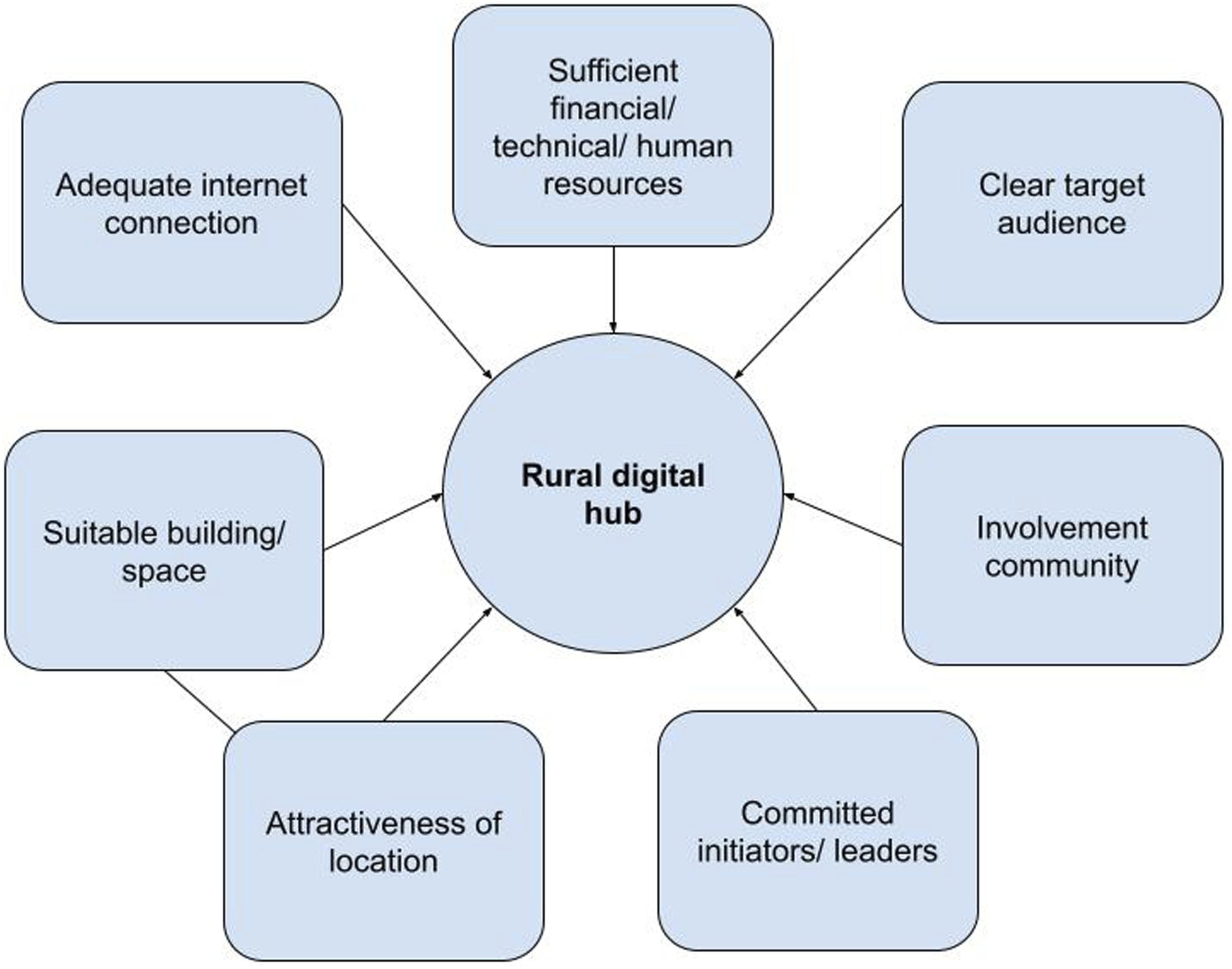
Various potential benefits of a rural digital hub have been discussed (ENRD, 2017b; Rundel et al., 2020). These possible contributions can be subdivided into social and community impacts, economic and business impacts and skill development opportunities. However, challenges can arise as well when starting and operating a rural digital hub, such as limited financial resources and usage/acceptance issues (Ashmore and Price, 2019).
Rural digital strategies
In the broader context of rural digital development, the effect of related local and regional policies should be taken into account, a point we return to in the development of our case study. Previously, Walterova and Tveit (2012) discussed the importance of a digital local strategy, but found it was sometimes missing, especially in smaller municipalities. A Swedish municipality developed a digital strategy focused on supply-side policy to foster broadband development (Magnusson and Hermelin, 2019). Attention on the demand-side was limited to internal processes of local administration, potentially missing out on opportunities to engage more users in the process of expanding the uptake of digital technologies. Park et al. (2015) noted the importance of locally based rural digital inclusion policies and recommended a multi-faceted approach for rural communities. No strategic vision in place may show that local authorities have a limited understanding of digitalisation possibilities and benefits (De Mello and Ter-Minassian, 2020). For example, the national digital strategy of Hungary showed to be mainly focused on potential benefits for the economy while insufficiently acknowledging local capacities and knowledge (Varró, 2020). In the Netherlands, while there are national digital policies in place, the rural broadband development and actions at the municipal level were sometimes slow and insufficient (Salemink and Strijker, 2018).
Methodology and introduction to case study area
For this research, we applied the methodology of a longitudinal case study (Baxter, 2016), following a linear-analytical approach (Yin, 2014). The case study is located in the North of the Netherlands, a municipality called Oldambt in the Eastern part of the province of Groningen (see Figure 2). The area borders Germany and the biggest nearby city, Groningen, is approximately 35 km away. The pilot itself is located in the market town Winschoten with less than 20,000 inhabitants, fitting the characteristics of a low tech town (Meili and Mayer, 2017). The region of East Groningen is classified as a depopulating area (−1.4% inhabitants from 2015–2019) with a predominantly older population (Van Dantzig et al., 2020). The population density is also lower than the average of the Netherlands Centraal Bureau voor de Statistiek (CBS, 2021a). Moreover, the average income per household is lower when compared to the average of the whole country and the whole region of Groningen (Provincie Groningen, 2017). For Dutch standards, it can therefore be classified as a predominantly rural municipality with a smaller market town serving as the centre (CBS, 2021b). Compared to the average figures of the Netherlands, the province of Groningen had a strong industry and energy sector, and also jobs in the healthcare and public sector were on average higher for 2019 (Centraal Bureau voor De Statistiek, 2020). Concerning the focus of our study, glass fibre connectivity is low. Only up to 20% of the households had access to it in the third quarter of 2020 (Stratix, 2021). Additionally, it was estimated that around 117,000 inhabitants in Groningen are digitally illiterate, meaning that they lack basic digital competences (Digital Literacy Coalition, 2021). Position of case study area in the Netherlands and the province of Groningen.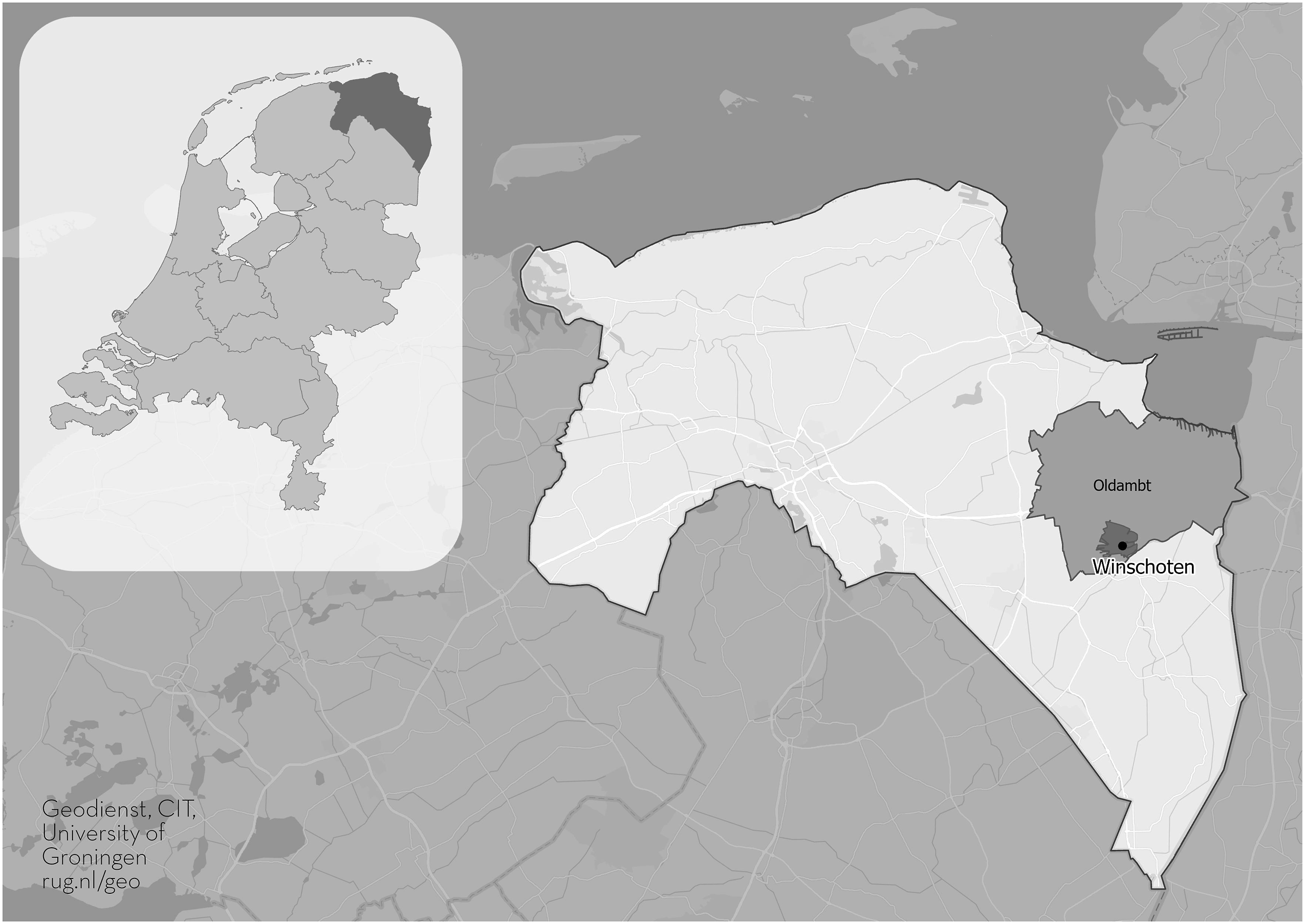
For several years (2017–2020), the authors were closely following and monitoring the development of the case study in its regional context. Being active partners of the project consortium of which the pilot in Oldambt was one of several initiatives, the researchers were regularly in contact with the key stakeholders. The methodological approach was participatory observation (Kearns, 2016), best suiting the category of observer-as-participant (Gold, 1958). While the researchers were monitoring the pilot for years, no active involvement took place. The researchers were not consulted for any decision making and no direct influence can be claimed.
The researchers received insider information and got the chance to participate in informal and closed meetings linked to the pilot. In more detail, the pilot was part of the Interreg North Sea Region project CORA which focused on digital developments in rural areas, resulting in multiple sources of evidence being available to the researchers and enabling document analysis: All documents created within the project, means the original application document, progress reports, presentations, emails, news articles, survey results and notes taken during various project meetings. Additionally, various publicly available policy documents on local and regional levels and available documentation from earlier activities, mainly related to broadband development, were sighted to set the case study in context.
The starting date of the case study is set for the beginning of November 2017, when the kick-off meeting of the Interreg project took place. The end date is set for the end of November 2020, as the final pilot summary was received from the responsible CORA project partner. All in all, seven multi-day CORA conferences were attended and several additional (online) meetings had taken place with the respective pilot partners while also keeping in touch per email. By doing so, we ensured that we were updated about all significant pilot developments. Accompanying our participatory approach, in-depth interviews were another part of our research approach. As mainly two people were responsible for setting up the hub, from here on called the ‘hub initiators’, semi-structured (prolonged) case study interviews were conducted with them. With the public servant responsible for the project, two interviews were conducted online (begin of April and end of May 2020). From here on, we will call him policy advisor, as this was his main job function. Another interview was held with the project partner from an organisation called GN-IX (from here on called GN-IX project leader) at the end of September 2020, following the COVID-19 safety measures in place. Relying on multiple sources increases the validity of the findings of this single-case study and the key informants had the opportunity to review the draft of this research article (Yin, 2014). Additionally, the researchers were invited for the subsequent initiative to develop a regional digital strategy getting insights into the process by observing, while also being an active participant (Kearns, 2016). This was not the main focus of this study but demonstrates how the hub led to follow-up activities.
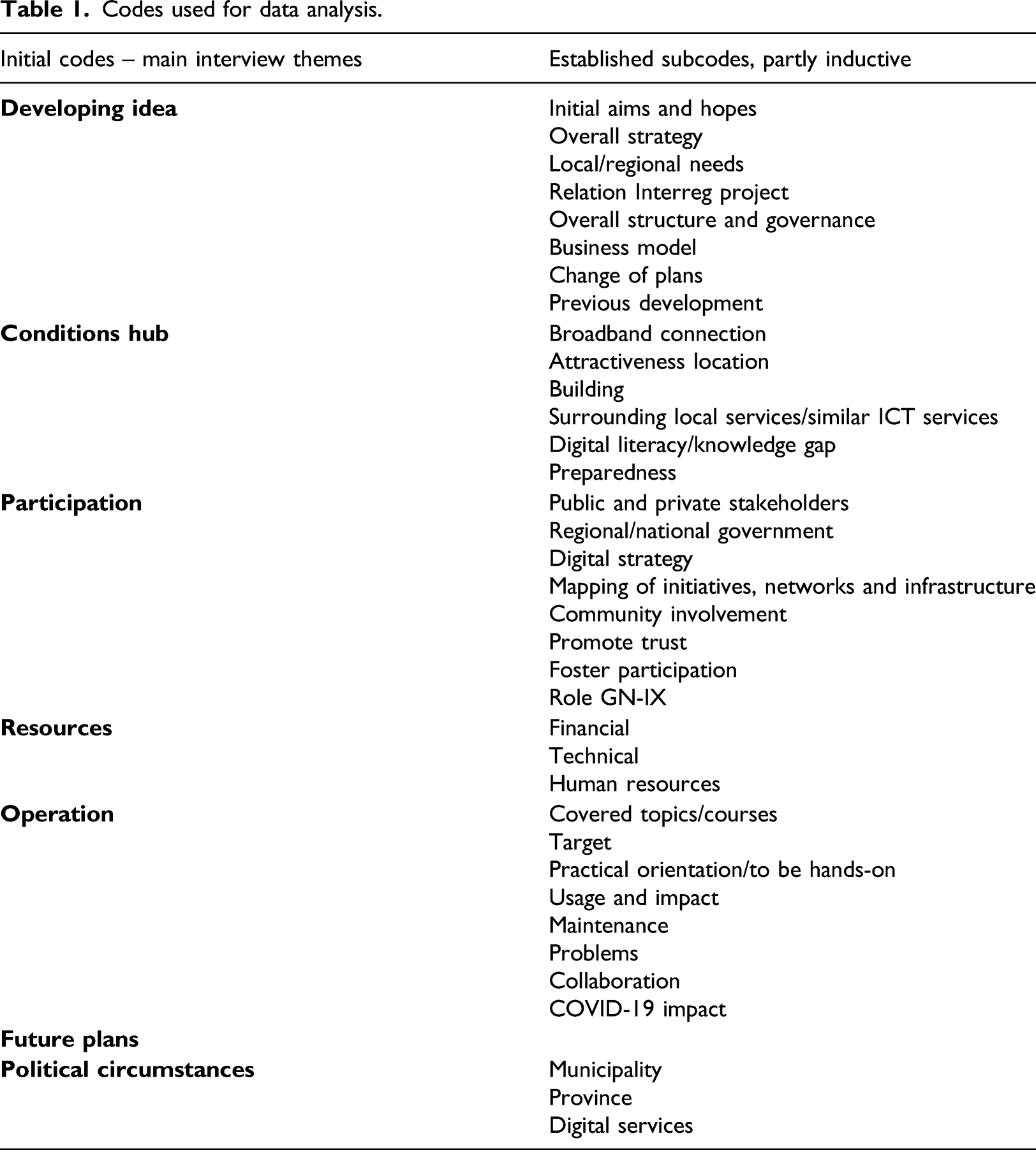
Codes used for data analysis.
Documents referred to in this research paper.
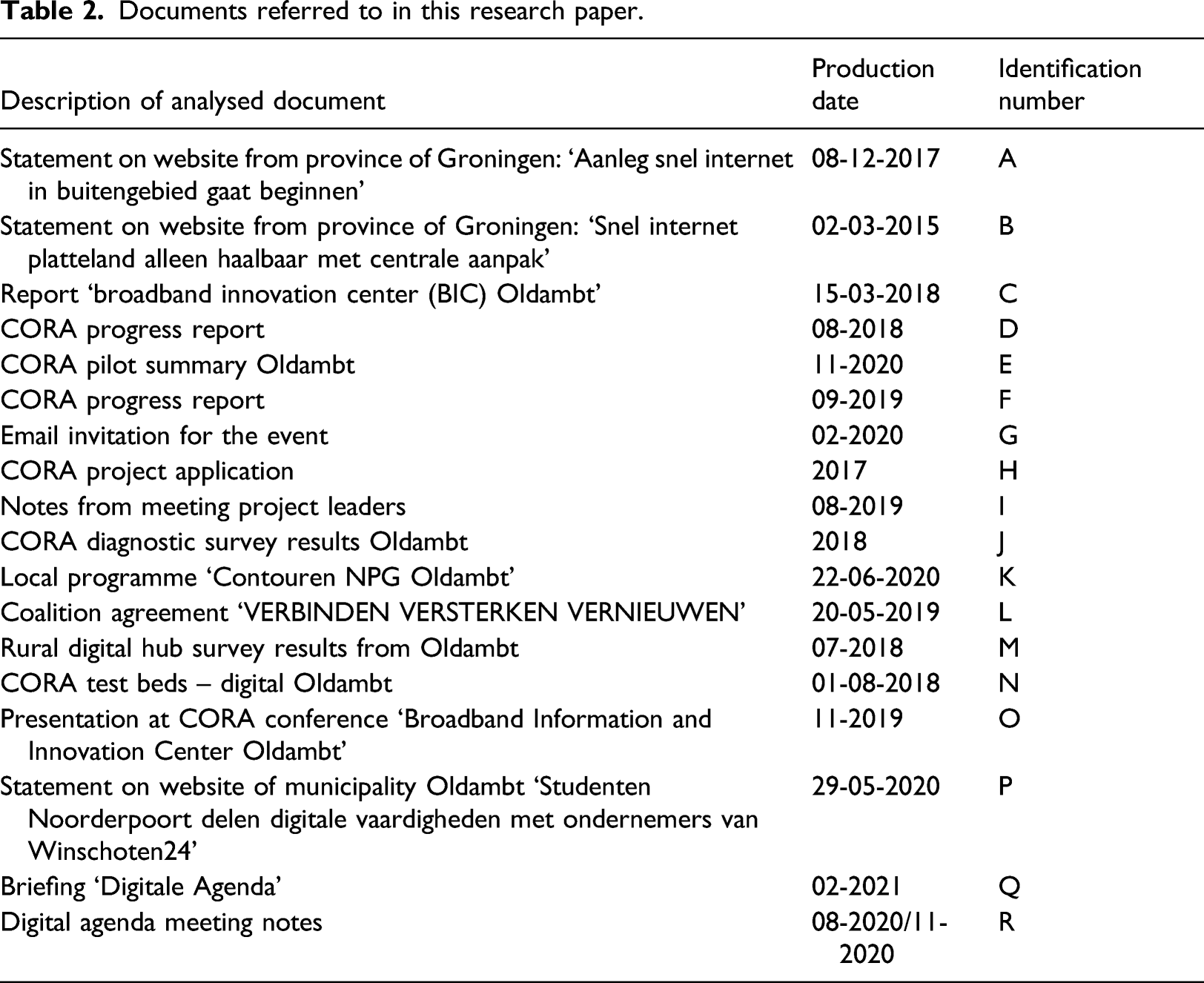
In total, 31 documents were analysed; however, some were not cited here directly. These are represented in Supplemental Table 3.
Results
The development of a rural digital hub: From innovation to information hub
Before the idea of the rural digital hub was born, the development of high-speed internet was a crucial topic on the political agenda of the municipality and region we focus on in this case study. A citizen initiative called ‘Oldambt Verbindt’ was active (Salemink and Strijker, 2018), trying to speed up the required infrastructural development. Eventually, the regional government intervened and launched a project to install glass fibre developments in the so-called white market areas (defined as areas without private broadband investments) in a fast way and the whole region (A, B). When our case study timespan ended in 2021, this project was behind schedule and the municipality of Oldambt was still waiting for the glass fibre development in its white areas.
To stimulate the uptake and development of digital technologies and the soon to come improved internet connectivity, it was decided in 2017 to develop a rural digital hub focused on innovation (innovation hub) in the main town of the municipality called Winschoten. This pilot formed part of the Interreg North Sea Region project CORA. Throughout the project, the responsible stakeholders recognised that before establishing an innovation hub, an information hub should be created first. The reasons for establishing such hubs and for changing the original plans will be discussed in more detail in the following chapters. A chronological overview of the case study developments can be found in Figure 3. Chronological overview of the case study development.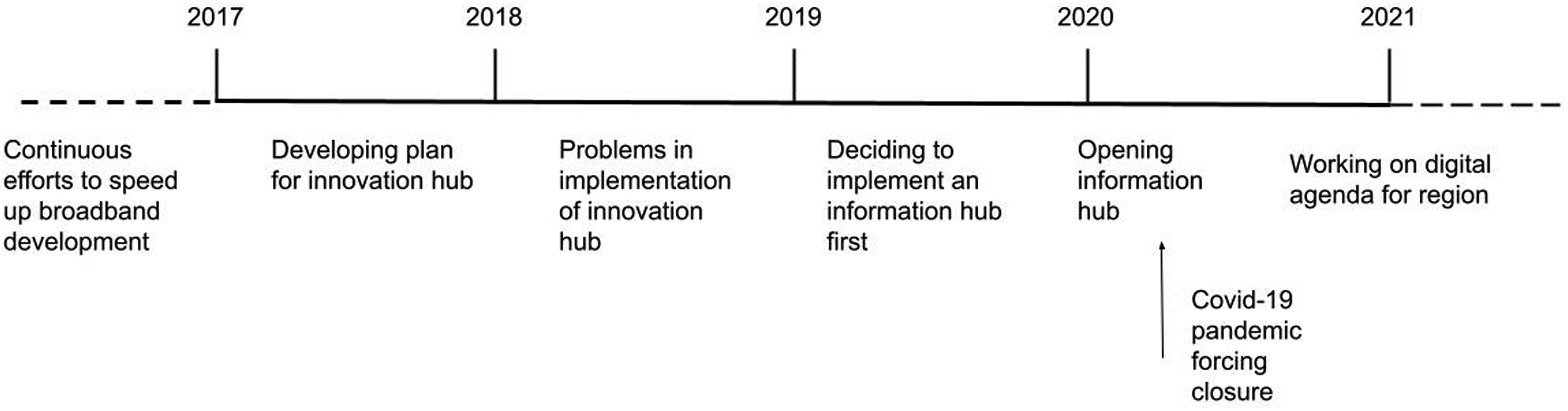
Initial plans for the innovation hub
Initially, the plan was mainly to deliver internet access and meeting or networking places in the innovation hub, for local individuals, businesses and also for project teams from higher education. ‘Emphasis is on facilitating and supporting various innovative projects and start-ups in relation to Information and Communication Technology(ICT), the Internet, Gaming and Media’. (C)
Other activities envisioned by the hub initiators were supporting start-ups, hosting events, offering office space, providing financial advice and ICT training. At least for certain of the aforementioned services, users would have had to pay. The ambition was to facilitate an exchange of initiatives and networking and to develop new business activities. Thus, the initial target groups were businesses with a special focus on start-ups, scaleups and educational institutes to get students involved as well.
Regarding the surroundings, the plan was to create a centrally located innovation hub with an attractive environment that was easily reached by public transport and car. Furthermore, the ambition was to establish links to other, existing innovation projects, as well as a good connection with the educational institutes of the region (D, E). The plans stressed that connecting the hub with students would be crucial as futuristic topics were to be promoted there.
Therefore, it was also the plan to locate the hub close to education institutes and to create a vibe or environment in the hub which is appealing to young people. ‘It has to be accessible, not too far away from the schools and then I am talking especially about higher educational institutes [MBO and HBO level in Dutch]’ (GN-IX project leader)
Based on these determined preconditions, the harbour area of Winschoten was chosen as a suitable location by the hub initiators.
Towards an information hub
Due to some difficulties we elaborate on in the next sections, it was eventually decided in 2019 to adapt the plan for the implementation of an innovation hub and to create an information hub first. The main aim was amended to stimulating the use and demonstrating opportunities with fast internet speeds first, for example, by providing information about 5G and presenting virtual reality applications in the information hub. It was stated to offer seminars and training for the inhabitants in and beyond the municipality to enhance the knowledge and raise awareness about (new) digital technologies.
Moreover, it was the ambition to connect initiatives such as a smart home initiative for elderly to the hub (F). All in all, it was pursued to enable co-creation, dialogue and interactive possibilities, suiting an information hub. The citizens who would become involved were also seen as potential local users of products introduced or even developed in the hub.
The target group of the information hub was formulated to include all inhabitants from East Groningen. This broad targeting was considered necessary to reach the full range of stakeholder groups (farmers, unemployed etc.). Furthermore, that the hub initiators hoped that students and businesses, in particular, would get involved in the hub. The policy advisor stated that in the end, (starting) businesses are indirectly targeted by fostering their interest via student projects connected to the hub and established in cooperation with local businesses. ‘so our target will still be starting entrepreneurs, supporting them, but we approach it from a completely different angle. We try to lure them’. (Policy advisor)
Therefore, it was outlined in the amended plans to provide a work and study room for students and equipment (e.g. 3D printer, green screen). The hub initiators hoped that due to this initiative, a stronger local partnership could be formed, especially between students and local businesses.
The information hub was eventually established in the cultural centre and library of Winschoten, in 2020. At the time of the interviews, the space was already rented and located on the first floor. The policy advisor claimed that it has the advantage to be located in a building accessible for everyone, and he described it as being modern and full of life. Hence, it was hoped that it can attract older and younger people at the same time and that the participation in the information hub is stimulated by the fact that it is located next to the library and in the cultural centre. Moreover, computer courses have been taking place in the cultural centre, which is seen as a suitable link to the information hub. ‘ In the [cultural centre] there is already a library where meetings and courses are organised, these activities suit the goals of the new broadband information centre well’. (I)
One event was already hosted in the information hub before the COVID-19 crisis: Shop owners in the municipality were invited to get insights about online retail (G). During the interviews, two public servants from the municipality, including one of the hub initiators, were responsible for setting up and operating the information hub.
The next chapters give an overview of the main emerging topics throughout the case study. The last chapter shows the most recent developments and gives an outlook on planned future developments.
The endeavour to bring the urban concept of an innovation hub to the rural
As it was hoped that glass fibre would soon be installed in Oldambt, the initial plan of the municipality was to develop pilots to stimulate its usage. When the municipality decided to participate in the Interreg project CORA for that, GN-IX was consulted to support the development of a pilot, resulting in the plans for the innovation hub in 2017 (H). The GN-IX project leader already had experience with a similar, successful project called ‘the big building’ in the city of Groningen used as the main inspiration source; thus, it was the aim to copy an urban concept to the case study region. The organisation GN-IX itself mainly delivers expertise regarding ICT projects, putting innovation and entrepreneurship central. It is a non-profit organisation with partnerships, for example, working together with the city of Groningen and the university.
However, it showed that mainly the policy advisor himself was enthusiastic about the pilot project. From the municipality and its alderman, at least in the beginning phase of the project, not enough support was experienced by the two hub initiators, from which one is associated with GN-IX and the other with Oldambt municipality. ‘Within the municipality of Oldambt was- well the vision and support for digitalisation absent. Actually, only one person was enthusiastic about it and that was [policy advisor]’ (GN-IX project leader)
When the hub initiators searched together for a suitable building, they found one owned by the municipality and even buyable for the symbolic amount of one Euro. However, the policy advisor was for some time not able to work and therefore, his tasks were taken over by colleagues. It was claimed by the interviewees that the other public servants did not see the urgency to realise the innovation hub and that in general, support for the innovation hub was missing. Hence, the desired building was sold to someone else in the meantime.
When the policy advisor eventually returned to office, the hub initiators started the discussion with local and regional authorities to convince them of the hub plans. It was argued that the newly elected representative (alderman) changed the situation, as he saw that digitalisation should indeed receive more attention within the municipality (I). In 2019, it was eventually agreed to first create an information hub and later go for an innovation hub instead. The policy advisor added that the exchange happening within the Interreg project, for example, during talks with project partners from other regions at meetings, also helped to realise that the region was not ready yet for an innovation hub. ‘But as we progressed in the process and also thanks to the gatherings we had within CORA we realized that we are not yet ready at all for an innovation centre, but that we first need to start with an information centre!’ (Policy advisor)
The idea of a new ‘big building’ was put aside by the hub initiators as they realised that first, the preparedness for an innovation hub was to be created and the awareness for digital developments to be raised among targeted businesses and citizens. Digital literacy levels were found to be low on average in the region and training needs were especially noted for elderly and low-income households (J).
As shown, a lot depended on the awareness and prioritisation of the people in charge within the municipality. Consequently, both hub initiators stressed the importance of having at least a convinced municipal board to count on that would take over responsibility, for example, by making budget available, when working on such a project. They recommended raising awareness internally before planning activities to support the adoption of digital technologies within the wider community. Public servants were found to be occupied with solving more urgent problems and it was discussed that Dutch municipalities already have a lot of tasks to be fulfilled, especially smaller ones and in a place where the economic development is scoring low. For example, it was claimed that the social domain requires more resources, leading to extra pressure. ‘After a lack of vision among the most public servants and management, as they are mainly busy with solving problems, but also the feel for urgency was missing as well, like this is an important file’ (GN-IX project leader)
Another issue raised was the influence of contemporary digitalisation on all kinds of fields and areas, making it difficult to find the ‘right’ strategies. Many possibilities are given, making the development in the eye of the interviewed policy advisor harder to grasp. It was understood that people need time to adapt and make use of new digital tools. Related to that, the speed of digital development was discussed as an issue, requiring frequent adaptations, also within the public sector. Therefore, it was proposed to develop an overarching digital strategy for the municipality.
At least at the beginning of the project period, the policy advisor experienced insufficient support from the regional level, showing little interest in the CORA project participation. However, one should note here that digitalisation has already received attention to a certain extent in regional plans. In the local programme ‘Contouren NPG Oldambt’, the role of digital literacy, next to lifelong learning in the context of well-being, work and development were discussed (K). The programme stressed the importance of fast internet and the stimulation of its usage (among businesses and citizens). ‘Thereby, the special attention lies on lifelong development, sustainable employability and digital literacy. With good education and a suitable job, citizens from the Groningen region get the chance to develop themselves and boost their well-being’ (K)
The same goes for the regional coalition agreement, setting high regional aspirations regarding digital development. Good digital infrastructure was found to be crucial for increased digital activities in its rural areas. Altogether, digitalisation and fast internet were among the main topics laid focus on in the agreement (L).
High expectations and struggles for a region in decline
It was the intention that the hub(s) supported several broader goals set for the region. As outlined in the section Methodology and Introduction to Case Study Area, the case study area faces several socio-economic struggles. Initially, the GN-IX project leader hoped that something similar to the big building could be created to get the ‘dynamic vibe’ from the city of Groningen to the region and create a space to support start-ups, business development and innovation. In particular, the plan was to stimulate business activities linked to ICT and media and to foster the exchange of ideas between students and entrepreneurs. It was hoped that this can stimulate economic growth, employment possibilities and subsequently increase the liveability in the area (D, M). The innovation hub was seen as a chance to change the image of the region by creating more work possibilities, especially in the ‘higher segment’. By doing so, it was aimed at influencing other aspects in the region, e.g. boosting cultural activities. It was stated that the region is too dependent on old industries and that therefore, business activities linking to the new economy are needed. ‘Maintaining employment, regional labour market policy, maintaining social participation, good and affordable healthcare and the quality of life in the rural areas are all under pressure’. (N)
It was also the plan to target young people and attract them to the region, thereby improving the connection to the bigger city and stimulating the ‘flow’. Eventually, it was hoped for fast internet connectivity stimulating settlement at place, for example, by an increasing share of people enabled to work from home and businesses recognising rural business opportunities supported by fast broadband. This again should improve the attractiveness of Oldambt as a business location.
While some of these aims were still valid for the information hub, some other aims were added. As mentioned before, awareness and preparedness were to be fostered with the information hub. The main aims were the improvement of digital literacy levels and introducing digital technologies such as smart public welfare solutions to the citizens (O). Digital citizenship was to be facilitated as well, next to the uptake of fast internet connections by businesses and citizens. With the support of a physical hub, the initiators wanted to demonstrate what is seen as an important topic by the municipality and beyond, aiming at presenting the municipality as ambitious and improving its image. ‘I believe in a physical visual centre as a sort of statement that you find this topic important … yes, that is what I think of a hub, a hub is, in fact, a visual representation of … this is what the municipality considers to be important’. (GN-IX project leader)
As shown, it was the intention to tackle many different aspirations with both rural digital hubs. The ambitions were thereby set high, hoping for an improvement of the local socio-economic situation as a whole.
Regarding the availability of spaces for potential new economic developments in the respective region, this case study demonstrates that it can prove challenging to find such a place, even in an area with many vacant buildings. Because some were planned to be eventually demolished, the policy advisor suggested that the municipality was hesitant to let these be used, while also not understanding the need for or the purpose of such a hub. Often, electricity cables and gas/water pipes were already disconnected, requiring substantial refurbishments before such buildings would have been suitable for the project. ‘[GN-IX project leader] had some ideas regarding the location and we from the municipality had, of course, some locations to offer but these were all old […] then you already get the problem, you say you have a lot of empty buildings, but if there is no connectivity to gas, no connection to the electricity grid, the room is too big or too small then there are no suitable spaces … Additionally, it should also be an interesting place for students’. (Policy advisor)
The GN-IX project leader initially expected that there are suitable buildings available within the municipality, as there were plenty found to be empty. However, some were also not considered attractive enough for students or the size was not suiting. To sum up, many of the vacant buildings were not suitable. The search was thereby based on the big building concept, looking for a ‘characteristic’ building in Winschoten as the municipal centre. After considering the vacant buildings, it was decided to integrate the innovation hub into a redevelopment plan of the harbour area. A joint venture should have taken over the real estate matters, planning to buy three buildings in total, with the option to cooperate with the municipality regarding the usage of the available space (C). In the end, finding and purchasing the right space slowed down the pilot substantially, since the chosen real estate was sold to someone else, also due to missing support by involved public servants.
Operating an information hub and towards a digital strategy
The intention was to start the information hub activities in the first quarter of 2020. Little can be said about the actual usage, as it was closed directly after the opening due to the COVID-19 crisis. However, some student projects were already connected to the hub and it provided the frame for an initiative by students for businesses in the region: If needed, students assisted entrepreneurs to get on the local retail platform to reach customers online during the pandemic (P).
The GN-IX project leader still aimed at setting up the innovation hub for start-ups at a later stage. Yet, a suitable building still had to be found.
To raise awareness about the scale and potential of digitalisation, also among public authorities, our study interviewees suggested incorporating it in plans and programs. The hope was that drafting a digital strategy helps to bridge knowledge gaps among public servants and citizens alike. Here, it was suggested that the location can play a role in that as well, compared to the campus in the city of Groningen, where one might rather be confronted with digital developments, it can still feel far away in the respective municipality. ‘it is mainly in a surrounding such as in that municipality, that is what I learned from it- you need to integrate it much more in programs, in plans to reach various societal groups in this kind of processes which are for many people still kind of far away. Here [city campus], you are constantly confronted with digitalisation …’ (GN-IX project leader)
The hub initiators described a lack of vision for future possibilities for the region. Even if colleagues recognised the importance of digitalisation, the policy advisor claimed, there was no room or time to take care of it. As stated beforehand, municipal elections brought positive change with a new representative. The hub initiators had a meeting with the alderman in 2019 where an example of a digital strategy was introduced to him, advising to make one for the region as well. The alderman agreed with the idea, although the financial resources available for it are limited. Here, it was found that also similar interests and a good relationship between the GN-IX project leader and the alderman contributed to the decision making. When the interviews with the policy advisor were conducted, the digital strategy was under development. Various local and regional stakeholders were part of its development (Q, R).
Discussion
Our findings confirm that the transformation towards a knowledge-based and digitally included society can be challenging, especially in an already disadvantaged region (Kolehmainen et al., 2016). Preconditions in rural areas can significantly differ from urban areas, especially finding sufficient potential participants in initiatives like rural digital hubs can be a substantial barrier. In our case, the relative remoteness to the more digitally advanced university city was addressed. Hence, we argue that at least in that case, distances to centres still matter, even if digital solutions are getting adopted. Remarkably, the hub initiators associated digital progress only with positive expectations. The initial main aim of the innovation hub was to create a ‘digital sector’, hoping that this subsequently stimulates wider positive development patterns as also discussed by Meyn (2020), impacting various challenges the region is struggling with.
This case study demonstrated several barriers impeding the implementation and altering the setup of a rural digital hub. First of all, preparedness and awareness for a (rural) digital hub project are important, a topic rather neglected in the scientific debate so far. This goes hand in hand with the respective digital literacy levels of a community. For the rural digital hub developed in Oldambt, the initial focus was mainly on boosting the economy, something also observed by Varró (2020) when looking at a national digital strategy. The responsible stakeholders of our case study realised throughout the project that an information and awareness hub should be more suitable first, resulting in adapting the plans accordingly and taking a step in between. Thereby, the main aim of the rural digital hub was changed from stimulating innovation to providing and exchanging information, adapting the target group as well. A possible reason for neglecting the preparedness for and awareness of digital technologies at first could be that addressing primarily the supply side was assumed to be sufficient, something also reported by Magnusson and Hermelin (2019).
Accompanying that, in our case study it was decided that a digital strategy should be developed for the municipality, starting as a local and eventually becoming a regional initiative. Concrete steps and aims will be determined to define a common outlook, also for the local authority. As Hanna (2016) elaborated, digital technology in itself is neutral until one defines how and for what it should be applied. To align and clarify the digitalisation aims of a region sufficiently showed in our case to be something to consider before starting a rural digital hub. Thereby, these aims should be adapted to the respective regional conditions. This indicates that a rural digital hub should be seen as an instrument rather than a solution in itself. Moreover, one can argue that local and regional authorities should ensure the effective communication of its digitalisation core themes to raise awareness and preparedness internally too.
Something already discussed (Ashmore and Price, 2019; ENRD, 2017a) is to find a suitable space for a hub beforehand. Interestingly, this was also a crucial factor in our case. The attractiveness of the space was important to get people interested and create flows/spokes, but difficult to find in such a region. From this we can derive that just a vacant space is not enough: what previously worked in, for example, an old industrial region supported by a university somewhere else as outlined by Benneworth and Hospers (2007), does not automatically lead to a similar outcome in a more rural context.
Moreover, the realisation of a digital hub depends on committed leaders/initiators (Ashmore and Price, 2019). In this study, these were two stakeholders, a public policy advisor setting the general (economic) regional development in the focus, while the GN-IX project leader tried to bring an urban concept to the rural to support these regional development targets. However, our study demonstrated that committed initiators are not enough. This hub pilot triggered governmental versus governance clashes as presented by Böcher (2008) and as discussed by Willi et al. (2018), the responsible policy advisor in the Oldambt case found himself confronted with little support by his colleagues; thus, broad interdepartmental support was missing. Such support is partly fate of coincidence. For example, Jonathan (2020) mentioned, political circumstances can result in sudden shifts like money stripped away from IT projects. In our case study, the opposite was the case – with the change of the alderman, the project got the beforehand missing attention and support. Moreover, this project resulted in the formation of a stakeholder network in the region to formulate a digital strategy together.
Following, the conditions for a rural digital hub can be complemented as shown in Figure 4. Additional conditions found to be crucial when setting up a rural digital hub.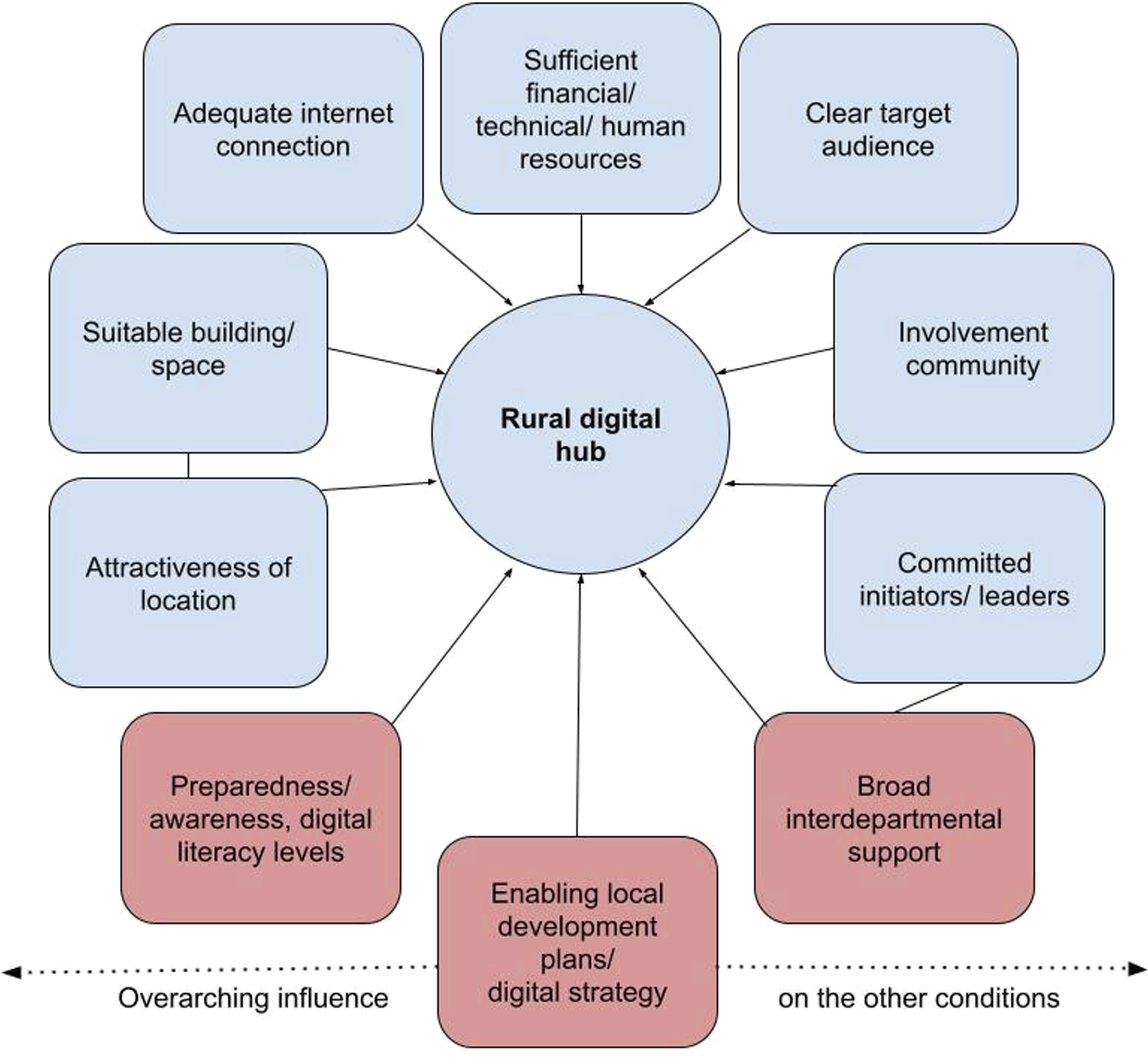
For similar efforts elsewhere, it can be recommended to pay attention to all factors presented from the start. One factor might be more important than another, depending on the specific circumstances at place.
Suiting to that, we argue that the translation of the concept from the urban to the rural was insufficiently considered. Our findings reveal that usage issues can occur, aligning with Cowie et al. (2019) showing the vulnerability of a hub in the rural. By offering a place to innovate and collaborate, it was even the aim that our rural digital hub pilot helped to tackle socio-economic regional struggles such as youth outmigration (Bürgin et al., 2021). In the end, the established hub of our case study had a wide-ranging target group. One can assume that to get the flow going in such a place, this is also needed, as there is a lack of entrepreneurs specified in and readily getting engaged with digital technologies. Yet, it is not known whether a multipurpose hub or defining a broad target contradicts with expectations of certain user groups. While there was no chance yet to observe the actual impact of the information hub, the support structure established and connected to the hub when the COVID-19 pandemic resulted in disruption for businesses indicates that a digital hub can have an important function. A contact point and network can be created, assisting businesses and citizens and thereby ideally strengthen the collaboration, for example, between students and local retailers.
The municipality was found under pressure and probably also due to that, the future perspective tended to be neglected. Especially for smaller municipalities, it can be a challenge to keep constantly up to date with digital developments when they are already understaffed and underfunded (Rundel and Salemink, 2021). Thus, better support of municipalities to raise their capability to master digital adoption processes both within and beyond their organisational structure can be recommended. As digitalisation was nevertheless already mentioned in local and regional policies, we suggest that the main problem lays in getting people involved with such plans. Otherwise, the practical implementation of such policies is hindered, resulting in a clash of policy aspirations and reality.
Conclusion
This study set the hub concept in a rural and small-town context and highlighted the changing definition for a rural digital hub. From this regional study focusing on a predominantly rural area with a low-tech town serving as the centre, we can learn that a rural digital hub should not be treated as a solution in itself, but as an instrument. In this case, the provision of a physical space stimulated crucial discussions and collaborations regarding digital developments, including digitalisation of the local government itself. Therefore, a rural digital hub should only be implemented when adapted to and suiting the local assets rather than to build on existing trends (Pires et al., 2014), like formulating digitalisation as a general aim without envisioning the effects and how that should be implemented. Strengths and weaknesses of a place should be taken into account, analysing the needed prerequisites for a rural digital hub. This was, probably also due to a lack of time, insufficiently done by the hub initiators and led to various struggles.
We found that not only the availability of empty spaces for a rural digital hub is a crucial ingredient but also the attractiveness of it. Especially in an area already facing population decline, this means that even if there are sufficient vacant buildings, these are not necessarily suitable. Another important finding of this study is that the awareness and preparedness for digital technologies and their potential should be investigated and supported, as these are not to be taken for granted. The case study especially showed that an urban concept should not just be copied into a rural surrounding. High expectations, for example, that such a space can create similar dynamics as in a bigger city, are likely to fail when the pre-conditions are not met. Low population densities and a lack of demand by local businesses are likely to act as a barrier, demanding a broad target group. In how far a broader scope can be a successful concept and which trade-offs are the consequence should still be explored. We can conclude that, rather than expecting too much of it, an adapted digital strategy can at least limit the disadvantages rural areas and small towns can be confronted with. Future research should take a closer look at how policymakers and practitioners try to create this ‘rural policy fit’ when implementing projects aiming at fostering digital developments. Moreover, observations of the actual usage and perspectives of the users of rural digital hubs will provide us with information about possible trade-offs.
Supplemental Material
sj-pdf-1-lec-10.1177_02690942221077120 – Supplemental Material for Hubs, hopes and high stakes for a relatively disadvantaged low tech place
Supplemental Material, sj-pdf-1-lec-10.1177_02690942221077120 for Hubs, hopes and high stakes for a relatively disadvantaged low tech place by Christina Rundel and Koen Salemink in Local Economy
Footnotes
Acknowledgements
We would like to thank our study participants and we are very grateful for the valuable comments received by the reviewers and editors.
Declaration of conflicting interests
The author(s) declared no potential conflicts of interest with respect to the research, authorship, and/or publication of this article.
Funding
The author(s) disclosed receipt of the following financial support for the research, authorship, and/or publication of this article: This research would not have been possible without the funding we received from the EU Interreg VB North Sea Region Programme (CORA and COM3 project).

Supplemental material
Supplemental material for this article is available online.
References
Supplementary Material
Please find the following supplemental material available below.
For Open Access articles published under a Creative Commons License, all supplemental material carries the same license as the article it is associated with.
For non-Open Access articles published, all supplemental material carries a non-exclusive license, and permission requests for re-use of supplemental material or any part of supplemental material shall be sent directly to the copyright owner as specified in the copyright notice associated with the article.
