




Abstract
Population sustainability is a prevalent yet nebulous concept within academic and policy debates surrounding the nature and consequences of demographic and economic change. This research seeks to add nuance to understandings of population sustainability in ageing societies. The fiscal challenges posed by population ageing mean that more and more states are implementing specific policies in response to it, with limited degrees of success thus far. This investigation examines place-based understandings of population sustainability on the part of local stakeholders in a region of Scotland, a country facing significant demographic challenges and which is enacting policy measures specifically aimed at promoting population sustainability. The findings suggest that the on-the-ground realities of population sustainability are nuanced and complex. As such, there is scope for greater attention to the diversity and complexities of population and economic change at the sub-national scale in broader academic conceptualisations of and policy responses to the increasingly pressing issue of population sustainability.
Keywords
Introduction
Scholars and policy analysts have long been preoccupied with the relationship between population change and various aspects of economic, social and environmental sustainability (Daily and Ehrlich, 1994; Hummel et al., 2013). The foci of these concerns have been debates around (a) whether population growth rates (largely in the so-called Global South) are unsustainably high in environmental terms (Bartlett, 2006) and (b) whether the shift towards ageing populations (currently mainly in the Global North) is unsustainable in economic terms (Valkonen and Barslund, 2019). Whilst polemics about overpopulation have gained popular currency, they have nonetheless been criticised for deflecting responsibility for the environmental damage created by economic systems in the global north to the supposed ill of higher fertility levels in the global south (Fletcher et al., 2014; Okyere-Manu, 2016). Another oft neglected point in debates about unsustainable demographic growth is that global rates of population increase are already declining and are set to plateau by the end of the current century. The latest United Nations (2019) estimates put peak population at nearly 11 billion by 2100, whilst some demographic experts suggest that population will peak even earlier than that and at a much lower level (Nature, 2021).
In the longer term, therefore, the concerns surrounding the sustainability of population ageing that are currently facing higher income countries will become ever more prominent at the global scale (Lutz et al., 2008). Indeed, the Lancet (Vollset et al., 2020) controversially has recently proclaimed a largely universal shift towards falling fertility rates and ageing populations, and warned of the attendant economic, social, environmental, and geopolitical consequences of such a shift. For example, until recently China enacted strict measures to restrict population growth but now faces considerable challenges around population ageing (Huang, 2020). In Europe alone, the total cost of ageing, which stood at 24 per cent of GDP in 2019, is projected to rise by 1.9 percentage points of GDP in the EU by 2070 (Economic Commission, 2021, 7).
It is for these reasons that this analysis focuses on population sustainability in the context of concerns around population ageing and/or decline. This is a fundamental shift which is already underway or will occur in most countries in the relatively near future. The current evidence base is centred on the fiscal and other economic implications of these changes (Bloom et al., 2010; Kotschy and Sunde, 2018) and many states have consequently already implemented policies in response to this or will have to do so soon (United Nations, 2020). Population sustainability in this context is usually defined in terms of population size and structure and assessed in statistical terms and at the macro, national scale. This study takes a place-based approach and focuses on Scotland, a country which is facing these challenges and which has tried to enact policy measures in response to them. The contribution of this research is that it involves in-depth qualitative work with stakeholders ‘on the ground’ in a specific region in order to elucidate the nature and implications of demographic and economic change in shaping the sustainability of places in population terms. It is hoped that such an approach can inform more nuanced scholarly conceptualisations of population sustainability and more spatially sensitive responses to it in the policy realm. The following section provides a brief review of academic and policy framings of population sustainability and considers the case for a place-based approach to the analysis of demographic and economic change. This is followed by an explanation of the methodological approach employed in the study, a discussion of the empirical findings and finally consideration of their wider significance.
Framings of population sustainability
Consideration of the sustainability of places in demographic terms can be viewed as part of a wider societal and scholarly shift towards concern about the relationship between populations and the maintenance of satisfactory living conditions over the longer-term. As discussed above, most framings of population sustainability are dichotomous in the sense that they emphasise unease relating to either growth in the global south or ageing in the global north. A broader important point, which sits beyond the scope of this analysis, relates to the utility of the wider notion of ‘sustainability’ as a means of enacting positive change with regards to conventional development paradigms. Some contend that the ubiquity and ambiguity of the term dilutes its efficacy in this respect (Prudham, 2009), whilst others point towards various environmental and non-environmental benefits of the growing emphasis on sustainability (Boar et al., 2020). Returning to the issue of population sustainability specifically, Bergaglio’s (2017) call for a transcalar perspective and emphasis on global ‘growing spots’ and ‘ageing spots’ is refreshing as it is one of the few analyses which recognise the co-occurrence of high fertility and ageing demographic trends within a population sustainability framework.
In terms of framings and assessments of population sustainability associated with ageing, these perspectives predominantly define it in statistical terms and proceed to assess its pecuniary implications through macro, national level quantitative analyses of demographic and fiscal data. A typical example of how demographic sustainability is defined according to the ratio between the working age and older population is Staern’s (2013) analysis of the prospects for rural development of settlements in northern Israel. According to this perspective, a population is sustainable when it is stable over time and maintains a bell-shaped age distribution. Dependency ratios also play a prominent role in Roca and Roca’s (2014) assessment of the demographic sustainability of the almost 300 municipalities in Portugal. However, their typology of the population sustainability of places also incorporates some qualitative elements. As such they develop a model in which sustainability is assessed quantitatively according to the size and age and sex distribution of the population, but also in more qualitative terms in relation to their socio-economic characteristics. This human capital approach considers the balance of education and qualification levels within the population as well as the distribution of various forms of economic activity. The, ultimately largely statistical, investigation concludes that most areas of Portugal can be regarded as having weak or even non-existent demographic sustainability, and that this inability to retain population and attract skilled, working age incomers poses a significant threat to their economic and social vitality. This, more holistic conceptualisation of what population sustainability is, serves as inspiration for our focus on similar issues within the context of Fife, an historic county on the east coast of Scotland. However, this analysis does not seek to go about defining sustainability based on reasonable assumptions and classifying places based on these criteria accordingly. Instead, the approach is novel in the sense that it allows the stakeholders that are ultimately actively involved in trying to promote the sustainability of local places to define what it actually means, which factors are essential to achieving it and to reflect critically on what this means for the measures that are implemented to try and promote it.
An important prompt for this research was the publication of the Scottish Government’s policy paper A Scotland for the Future (2021), which highlighted the significant demographic challenges that Scotland faces and proposed a series of responses to them. Key demographic concerns are slowing population growth and an ageing population and a reliance on immigration for demographic stability and growth. Whilst a national challenge, these demographic issues are particularly acute in some parts of the country (see National Records of Scotland, 2020 for detailed account of Scotland’s demography). This analysis focuses on the region of Fife, as it typifies the demographic challenges that Scotland, and many other countries, face. Importantly, the Scottish Government emphasises their pledge to take ‘a place-based approach to demography’ (2021, 8) in order to strive towards geographically sensitive thinking and equitable decision making in relation to policy arenas such as regional economic development, housing supply, transport infrastructure and public services. The report also provides a relatively wide ranging, qualitative definition of population sustainability and specifies four policy areas which are essential to achieving it. These are depicted in Figure 1 below. A useful contribution of our research is that it interrogates local stakeholders about their interpretations of demographic challenges and sustainability and the extent to which they believe these ‘fit’ with those depicted in the national plan for Scotland. This, it is hoped, can lead to more nuanced conceptualisations of population sustainability than those which dominate the literature and can promote more focused national policies to the demographic challenges currently faced by most higher income countries. Scottish Government vision of population sustainability, as illustrated in A Scotland for the Future.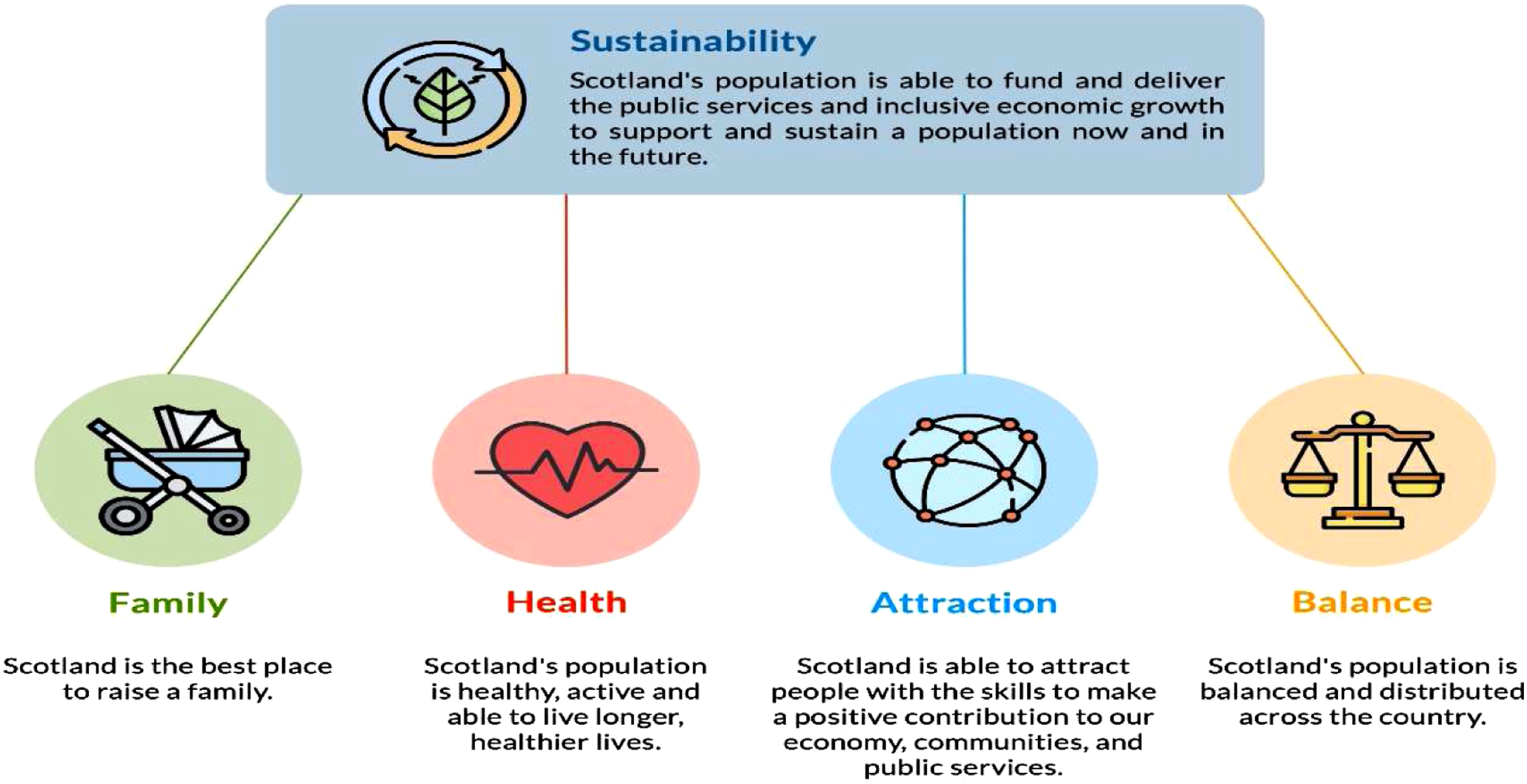
The policy report discussed above is totemic of a wider set of international policy efforts to respond to the challenges of population ageing. These measures have had limited success thus far and tend to focus on boosting fertility rates, increasing immigration and promoting active ageing. For some time, fertility rates in relatively high-income countries have been on a general downwards trajectory. For example, at the time of writing it has been announced that in 2020 Scotland experienced its lowest ever number of births since records began in 1855 (National Records of Scotland, 2021a). This represents the significant challenges facing pro-natalist policies as a response to population ageing (Brainerd, 2014). Encouraging immigration is another possible policy response. In the Scottish case, negative levels of natural change mean that the nation is entirely reliant upon inward migration for demographic stability and growth. However, the challenge facing Scotland and others in this respect is that high levels of immigration would be needed in order to counteract the effects of population ageing, such moves would face public hostility and immigration alone is not a sustainable long-term solution since immigrants also age (Bijak et al., 2013). These issues are compounded in Scotland’s case as it, controversially, has very little direct control over immigration policy as this is ‘reserved’ to the UK government. Finally, there are tentative steps towards the promotion of active ageing, which effectively seeks to extend working lives as a means of promoting demographic sustainability in the era of extended life expectancies (Camarinha-Matos and Afsarmanesh, 2012). However, there have been few dramatic policy changes in this respect given the political sensitivity of extending retirement ages, reforming the pension system or the funding of older age social care (Foster, 2018). The applicability of these responses in a specific regional context is considered in this analysis.
The themes discussed in the paper in relation to population sustainability also speak to wider questions of demographic and economic change and how it relates to questions of regional development and competitiveness. The shrinkage literature, for example, can help to contextualise the processes of deindustrialisation and associated selective migration and ageing that have impacted on many parts of the global north (Döringer et al., 2020; Wolff and Wiechmann, 2018), including the case study site (Phillips, 2015). Likewise, the concept of smart decline encourages an emphasis on how these processes can be managed in an equitable manner (Hollander and Németh, 2011; Popper and Popper, 2002). Finally, emerging discourses surrounding ‘building back better’ from the Covid-19 pandemic and the ‘levelling up’ agenda (HM Government, 2021) also present promising opportunities to put place at the centrepiece of debates about population sustainability and economic prosperity (Maclennan, 2021).
As was hinted at in the preceding paragraph, policy and political questions of population decline and regional inequalities are inherently bound up with processes of uneven geographical development. Often framed from Marxist political economy perspectives, scholarship on place-based differences in the economic and demographic experiences and prospects of locales is often attributed to the inherently spatial unevenness of capitalism (Das, 2017; Harvey, 1982). Whilst this paper does not seek to directly engage with these polemics, it is noteworthy that the advocacy of place-based population approaches by institutions such as the Scottish Government acknowledges, at least implicitly, the spatially inequitable effects of economic development. The geographer Tony Fielding’s (2012, 101) conceptual framework of the economic drivers of migration in higher income countries is pertinent here as it emphasises the role of both short-term phenomena such as business cycles and longer-term processes such as economic restructuring and cultural change in shaping the demographic features of places. Such a temporally and spatially sensitive perspective could usefully be adopted by researchers and policymakers when seeking to understand and respond to population change. As is discussed in the empirical section of the paper, changes in working practices and residential preferences are potentially reshaping geographies of home and work in places such as Fife. However, these dynamics need to be seen through the lens of much deeper structural shifts in the economic geography of the UK and the extent to which they have produced so-called ‘winning and losing regions’ (Rodríguez-Pose and Vilalta-Bufí, 2005, 560).
Methodology
This research takes a mixed methods approach and focuses on how local stakeholder interpretations of demographic and economic change can inform scholarly and policy understandings of population sustainability. Fife is a historic county in eastern Scotland and is the country’s third most populous local authority. It has an extensive coastline and contains a blend of rural landscapes (mainly to the north and east) and more densely populated and semi- and ex-industrial areas (mainly in the south and west). Coal mining, metal manufacturing, mechanical and marine engineering, shipbuilding, textiles and fishing have traditionally been the dominant industries in the region and their changing fortunes have played an instrumental role in shaping the demography of Fife over the past few centuries (Anderson, 2018). Population growth, largely through inward migration from other parts of Scotland, was most pronounced between the mid-19th and mid-20th centuries. However, many of the parts of the region most associated with the industries listed above have experienced economic and demographic stagnation post WWII. Significant sectors within Fife are now renewables, manufacturing, business and financial services and tourism (Fife Economy Partnership, 2017). About a third of the population of Fife resides within its three main towns Kirkcaldy, Glenrothes and Dunfermline. Proximity to Edinburgh has resulted in the expansion of many settlements in south-west Fife, whilst the eastern coast consists of picturesque fishing villages which are popular tourist destinations (see NatureScot, 2019 for a detailed account of the human and natural landscape of Fife).
According to Office for National Statistics (2021) data, Fife’s population in 2020 was 374,000, growing by a modest 26,000 in the preceding two decades. As is discussed in the findings section, this overall trend masks differing sub-regional changes in population size and composition. The working age population in Fife, and share of it which is economically active, is similar to Scotland overall (62% and 64% and 76% and 77%, respectively). The ageing of the workforce in Fife is a cause for concern (Egdell et al., 2017), as it is in Scotland (Callander et al., 2018). Fife’s occupational profile is very similar to Scotland’s, but it has fewer people in employment (employees and self-employed) and a higher share of retirees, long-term sick and student residents. The region only has slightly lower earnings than the Scottish average but a much lower jobs density (ratio of jobs to working age population). Population estimates from the National Records for Scotland (2021b) illustrate many of the similarities between Fife and Scotland in terms of population change. Fife’s population grew by 7.8 per cent 1998–2019 whilst Scotland’s increased 7.9 per cent. Life expectancy for both males and females is the same in Fife and Scotland (77 and 81, respectively). Birth, death and net migration rates are also remarkably similar between Fife and Scotland (9.7 vs. 9.1; 10.6 vs. 10.6 and 6.2 vs. 5.5, respectively). The demographic similarities between Fife and Scotland is a point emphasised by other scholars (e.g. Egdell et al., 2021) and indeed by the participants in this study.
I mean, it's always been remarkable how Fife so closely mirrors the averages of Scotland, in about almost everything.
Mark, third sector, Buckhaven, Methil and Wemyss Villages
The research focused on six specific Electoral Wards as case studies within Fife. These were Rosyth; Inverkeithing and Dalgety Bay; Buckhaven, Methil and Wemyss Villages; East Neuk and Landward; St Andrews; and Tay Bridgehead. As well as broadly reflecting Scotland, the local authority of Fife is also internally diverse in terms of its demographic and socio-economic profile. The six case studies were thus specifically selected, via a convenience sample approach, to capture this heterogeneity. The samples heterogeneity was validated using the Typology of Scottish Coastal Communities (Duffy and Stojanovic, 2018; Marine Scotland, 2020), where all five categories of localities from this classification are represented within the six selected electoral wards. The case study areas and their corresponding Scottish Index of Multiple Deprivation (SIMD) scores are visible in Figure 2 below. The SIMD is a comprehensive relative measure of deprivation across 6976 small areas in Scotland (Scottish Government, 2020). An SIMD score closer to 1 indicates higher deprivation. As is discussed in the findings section, the older industrial areas of mid-Fife have relatively high levels of socio-economic deprivation compared to most of South-West and North-East Fife. The issue of transport infrastructure and commuting to nearby cities is also discussed in the empirical part of the paper. The case study areas to the north-east of Fife are within convenient road, rail and bus travel to Dundee (typically less than 30 miles and less than an hour travel time). The south-west of Fife serves as a commuter zone for neighbouring Edinburgh. Travel distances are similar but times are longer here, owing to more congested transport networks (over an hour in peak times). Location of Fife and SIMD score (per datazone) of the case study areas*, 2020. *Note that the boundaries of datazones do not correspond exactly with those of electoral wards.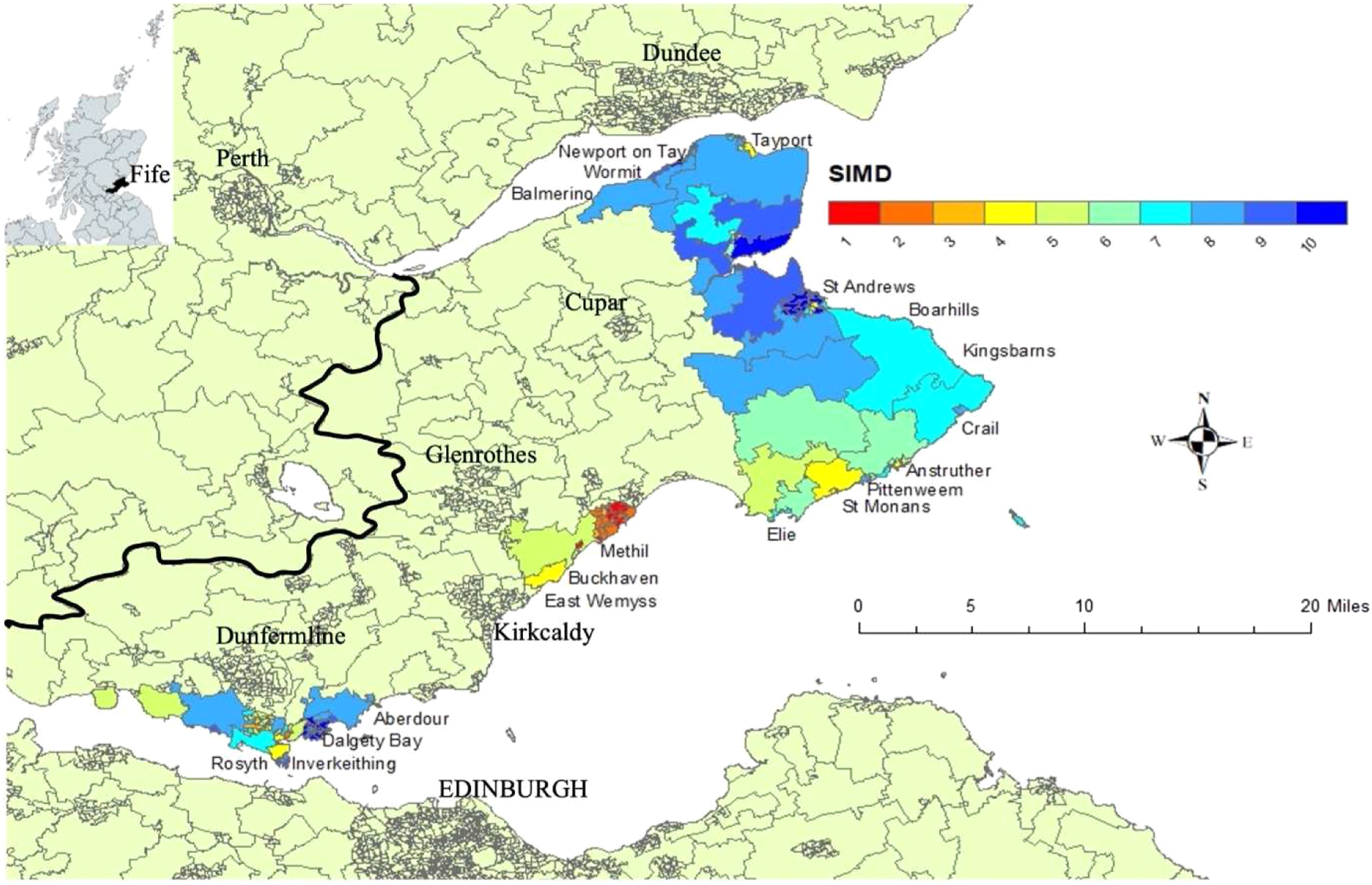
Profile of stakeholders interviewed.
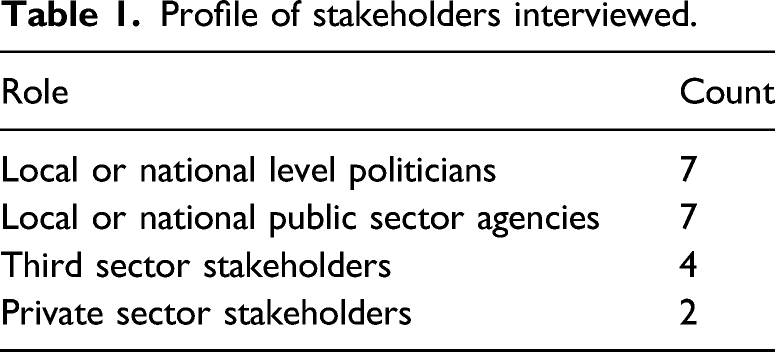
Relevant interviewees were identified through online searches of key public, private and third sector stakeholders across the six Electoral Wards. Stakeholders from these organisations and sectors were chosen as they are either involved in shaping or directly impacted by the demographics of the area. All stakeholders had a great deal of experience working with communities in the region and as such were able to speak with some authority about the nature and effects of demographic changes at this scale. The interviews focused in the following themes: • Population change: Historic and expected future changes. •Population sustainability: What it is, how is it cultivated and how these understandings compare with the recent Scottish Government (2021) definition of it. • Population projections: Accuracy and what might explain their predictions. •Policy implications.
Owing to Covid-19 restrictions, the interviews took place through video-conferencing software. To help stimulate discussion, the population projections pyramids were sent to the participants prior to the interview. These pyramids can be found at https://fifecoastalzone.org/projects/people-and-fife/futures/. As discussed above, the strategy was to visually illustrate to participants how the population within their area was expected to change in the next decade, and to gauge their responses to this. Additionally, during the interview, the sharing screen function was used to share the Scottish Government’s schema of population sustainability (Figure 1). This occurred after the participant’s perception of a sustainable population was initially discussed, to allow for the participant to develop their own idea of a sustainable population and then compare it with that of the Scottish Government. At the request of interviewees, four of the interviews took place via telephone. The interviews typically lasted one hour and were recorded and transcribed immediately afterwards. They were analysed thematically using NVivo software. Pseudonyms are used in the section below to try and protect respondent’s anonymity.
Results
Key demographic and economic changes and implications for sustainability prospects
This section provides an overview of what the stakeholders felt were the main higher-level demographic and economic shifts that had shaped the population profile of the region in recent decades and their effects. The following sections go on to consider meanings of population sustainability and the policy implications of these interpretations.
Macro level demographic and economic structural shifts that have been underway across most higher income countries for at least the past half century were, perhaps unsurprisingly, seen by interviewees as being the chief drivers of population change at the local level in Fife. In terms of demographic change, longer life expectancies, selective in and out migration and later childbearing and smaller family sizes were regarded as the main components of population change in the region. Longer lives meant a growing retiree population and concerns around the age dependency ratio. This was exacerbated by selective migration trends, which meant younger people leaving and older people moving into many parts of the region. Falling fertility rates translated into concerns around the viability of service provision and the wider general vitality of the region.
These structural demographic changes were regarded as being closely connected to the processes of economic restructuring which have reshaped the employment landscape of places like Fife. The decline of industrial and manufacturing employment bases and their partial replacement with services based (often lower paid and seasonal) related jobs was posited as resulting in not necessarily fewer jobs within the region but a paucity of relatively well paying and secure jobs. A consequence of this is a decline in the overall prosperity of the region since the economic restructuring of the 1980s and the establishment of local concentrations of socio-economic disadvantage in old industrial areas (see the red coloured areas in Figure 2). The growing concentration of higher level employment opportunities in some service sector occupations and in larger urban centres meant that Fife has been able to attract higher socio-economic status residents in the form of commuters to the cities of Edinburgh and to a lesser extent Dundee (some of the blue coloured areas in Figure 2).
These demographic and economic structural shifts were seen by participants as representing a number of challenges but also opportunities in terms of the population sustainability of the region. The increasing retiree population (via ageing of existing residents plus retiree in-migrants) and the rapid growth in second homeownership in the more aesthetically appealing parts of the region poses significant challenges around service provision and housing affordability. On the other hand, many areas are growing in the sense of having an expanding population of younger, relatively higher socio-economic status commuters. Furthermore, potential changes in residential preferences brought about by the Covid-19 pandemic were seen as representing an opportunity in terms of attracting and retaining the younger and higher skilled residents that were regarded as essential to the longer-term sustainability of the region. The nuances of these developments and their implications for population sustainability are considered in the following section.
The meaning of population sustainability
Interviewee articulations of population sustainability often echoed the familiar notion that for a population of a region to be viable in the longer-term then it needs to have an appropriate ‘balance’ between various age cohorts, especially a favourable ratio between the working age and retiree population. However, as the quote from Mark below hints at, balance of population means much more than a straightforward age or sex ratio.
What does it mean to be sustainable? So you're talking about, it is like biodiversity isn’t it. You need a balance of ages, you need a balance of gender obviously. Balance in social housing, private housing, rented, owned, that would be probably an ideal.
Mark, third sector, Buckhaven, Methil and Wemyss Villages
Most research participants, when asked about population sustainability, gave detailed descriptions of what they saw as the factors that were central to achieving it. These perspectives are of value as they provide rich and nuanced accounts of how population sustainability is actually understood by stakeholders on the ground, as opposed to the more prevalent but crude age and sex ratio calculations, which mask the complexities of population composition and change. What really matters in population sustainability, according to the analysis of the stakeholder narratives, is the intersection between employment opportunities, service provision and housing affordability and how these in turn interact with wider demographic and economic structural shifts. These issues are considered in more detail below. Following this, attention turns to the extent that these local stakeholder insights relate to national level policy formulations of population sustainability in Scotland and the lessons that can be drawn from such a comparison.
A sufficient quantity and quality of employment opportunities was the most widely cited factor with regards to maintaining a sustainable population within a place. This is because relatively younger and more skilled people, motivated by quality of life factors, will not remain within or move to an area without there being underpinning earning potential.
To be sustainable in population terms you need to feel it's a good place to give birth to children and knowing that if you bring them up that it's an area that, if they wish to, they can find careers … so the community was sustainable in that sense, providing, well let’s say my children and my grandchildren the opportunity to live and work and enjoy what's a glorious part of the world... the biggest issue, and one of Scotland's biggest issues is that we have an ageing population. And it means we do need to encourage our younger people to want to live and stay here, because they will be the taxpayers of the future. We've got agriculture, fishing, the local trade companies. But we need a bit more in terms of employment prospects really for young people, because it's only through employment that you get folk to stay in the area. Otherwise, they will feel the need to move away.
Bob, politician, East Neuk and Landward
Interviewees noted that it was not necessarily a paucity of jobs per se which was creating population sustainability challenges for the region, but an imbalanced occupational profile, meaning that they have struggled to attract and retain younger and more skilled residents. As Bob goes on to state;
For the younger population, it's about trying to create jobs in the area so that people stay… if you've got jobs and skills in the region, then obviously, there are the things that fall in behind – somebody earning a good wage because they've got a higher skill level can therefore buy a house, can bring a family up… you've got a bunch of students in St. Andrews, who don't tend to stay in St. Andrews after they've graduated. But that would offset those who go into the East Neuk to retire… I guess that's always been the case though, students have always left and gone somewhere else.
Bob, politician, East Neuk and Landward
One important and recurring theme was that the constrained nature of employment opportunities was presenting significant challenges around housing affordability for many residents, thus posing practical barriers to many families remaining in the area.
Most of the jobs are either university, tourism, bit of services, the public sector, so they're not all necessarily well paid. So you have that massive gap between the affordable housing and the average wage. And actually, the average wage hides it. The real worker’s wage is much more temperamental, short term work… so I get lots of people coming to me desperate for housing. And there aren’t a lot of options. So that, to me, that’s what sustainability means - the ability of everyone to actually have a decent home and be able to access the services that they need. That's what sustainability means.
Robert, politician, North East Fife
The difficulties faced by those on modest incomes in accessing housing are not unique to Fife and are related to well documented, but poorly addressed, structural flaws in housing markets (Anacker, 2019). An issue that is perhaps more specific to coastal and rural areas such as much of Fife is that younger people and/or those on lower incomes are increasingly being priced out of housing by retirees and second homeowners. As such parts of Fife, and many other places further afield, find themselves in the paradoxical situation of simultaneously having a housing affordability crisis and a stable or even declining population.
Tourism has driven some hotspots in terms of second home ownership, particularly in the East Neuk – inflated prices, which make it more difficult for people with families potentially looking to stay. There has been an impact on the diversity of the different economies that exist locally as well... it needs to have a housing market that's not overheated. And it does feel like that for a particular couple of our communities, you know, the housing market is a real issue. There isn't an opportunity for people to even step onto the housing ladder, let alone progress. Housing is absolutely critical, if you can give people security about a roof over their head, a lot of good things will come from that.
Catherine, politician, North East Fife
The combination of a lack of better paying jobs and housing unaffordability was referred to by many stakeholders as a vicious cycle, whereby young people and families struggle to remain in or move to the area, the amenities and services orientated towards them thus deteriorate or disappear, which in turn further skews the population towards an older and transitory second homeowner profile. A further key factor that was frequently highlighted by interviewees was the importance of adequate infrastructure as a prerequisite to retaining and attracting skilled workers and businesses to the region. Views regarding the extent to which transport links were satisfactory varied, but there was a universal consensus that standards of internet connectivity (broadband reach and speeds) needed to improve.
What is important is infrastructure. How quick can I get from A to B? And I think the road infrastructure, maybe also train and all the rest of it, in Scotland is not that great if you compare it to other countries… And with covid and working from home – that is kind of normalised now, what will happen is that there will be people looking for a quality of life, and they might be interested in working and living in the coastal villages. And that will be a good move, but that means that internet connections need to be up to speed. They need to be first class because there are people who can choose wherever to live, as long as there is a good internet connection. So the jobs might not be there. But basically, the jobs are there, because it's made possible by the internet. And the money that is earned is going to be spent in those areas.
Nick, private sector, St Andrews
Much of the discussion thus far has been rather downbeat, in that it has focused on the significant challenges posed to population sustainability in many parts of Fife by its occupational profile and housing market. However, as the quotation from Nick points to, shifts in working practices and residential preferences brought about by the Covid-19 pandemic potentially pose opportunities to coastal and mainly rural environs such as much of Fife. This could result in more people moving to and spending more of their time (and money) in the area, as opposed to working in and commuting to larger urban centres. Another, related, possible opportunity is the propensity of some parts of the region to attract relatively high socio-economic status workers, who reside in Fife but work in the neighbouring Edinburgh, Dundee and Perth city-regions. Attracting commuters and Covid-19 motivated relocators both represent positives in terms of sustainability as they boost the overall size and the age and socio-economic status balance of the population. However, most stakeholders expressed ambivalence about the possible consequences of these changes, with worry about lower income residents being displaced by incomers and the effects of a large commuter population on the vibrancy of local communities. These views are typified in the quotation from Matthew below.
It [incomers to the area] is just people escaping cities. And it's going to be times ten with covid. So every house that comes up [for sale], has gone, it has just been bought up by people selling in Edinburgh or London... it's a shame because there was a lot of local culture that will just go to the wall, and not just in places like Fife… so it just dies a death… Dunfermline has become just a dormitory of Edinburgh, where people still go to Edinburgh and, out with the covid, they go to Edinburgh to shop, to play, to see shows, to socialise and they sleep in Fife… so the middle of Dunfermline is dying. It is absolutely a desert of a town centre. And the people who come in don't have an affinity to Dunfermline.
Matthew, third sector, Fife-wide
The inward movement of population has many demographic and economic benefits, and is therefore justifiably promoted for this reason, however as Matthew’s quotation illustrates, it should not be uncritically regarded as a panacea to the complex population challenges that places such as Fife face. The selective in-migration of relatively high socio-economic status professionals and wealthier retirees can create inequalities between the localities and population sub-groups which benefit from these trends and those which do not. As is discussed in a subsequent section, parts of the region are performing well in terms of aggregate demographic and economic indicators. However, this arguably masks wealth inequalities between newer and existing residents. Likewise, older industrial parts of the region are facing longstanding economic and demographic challenges, attract far fewer high socio-economic status incomers and are falling further behind in terms of spatial inequalities. One way in which these patterns of selective migration manifest themselves in the form of spatial inequalities is in the ability of communities to be able to respond the challenges that have been discussed in this paper. Take the differing perceived capacities in affluent and deprived communities as articulated by Robert and Mark below.
There tends to be a lot of people who, being in reasonably decent earning jobs, tend to be leaders in their work anyway. So, when they come into these communities they provide a good leadership role. So you find a lot of people who’ve moved in, are very active, and a lot of them are really smart people who know how to handle things with sensitivity.
Robert, politician, North East Fife
Moving on to the sustainability question, this whole civic engagement part. And you might say people make communities, but we feel we struggle here. Because there isn't so much of a civic awareness, which you might say is a nice middle-class value. It's not really here. It maybe was here, once in the mining communities, but that obviously collapsed… we need two types of volunteers. We need the fit, able, preferably young ones who would help plant trees, do gardening. But, we also need professional ones who can do a strategic level. And we're struggling for both here. So, there is I think, a certain apathy that's more common here, because you don't have the sharp elbows of the middle class.
Mark, third sector, Buckhaven, Methil and Wemyss Villages
The multifaceted and complex nature of population sustainability as discussed in this section underscores the fallacy of a reliance on crude age-sex ratios to assess the demographic viability of particular places. The discussion now turns to how a general policy framework for population sustainability can usefully be interpreted and implemented at the sub-national scale.
National policy formulations of population sustainability: Local interpretations
Summary of interviewee perceptions of Scottish Government sustainability criteria.
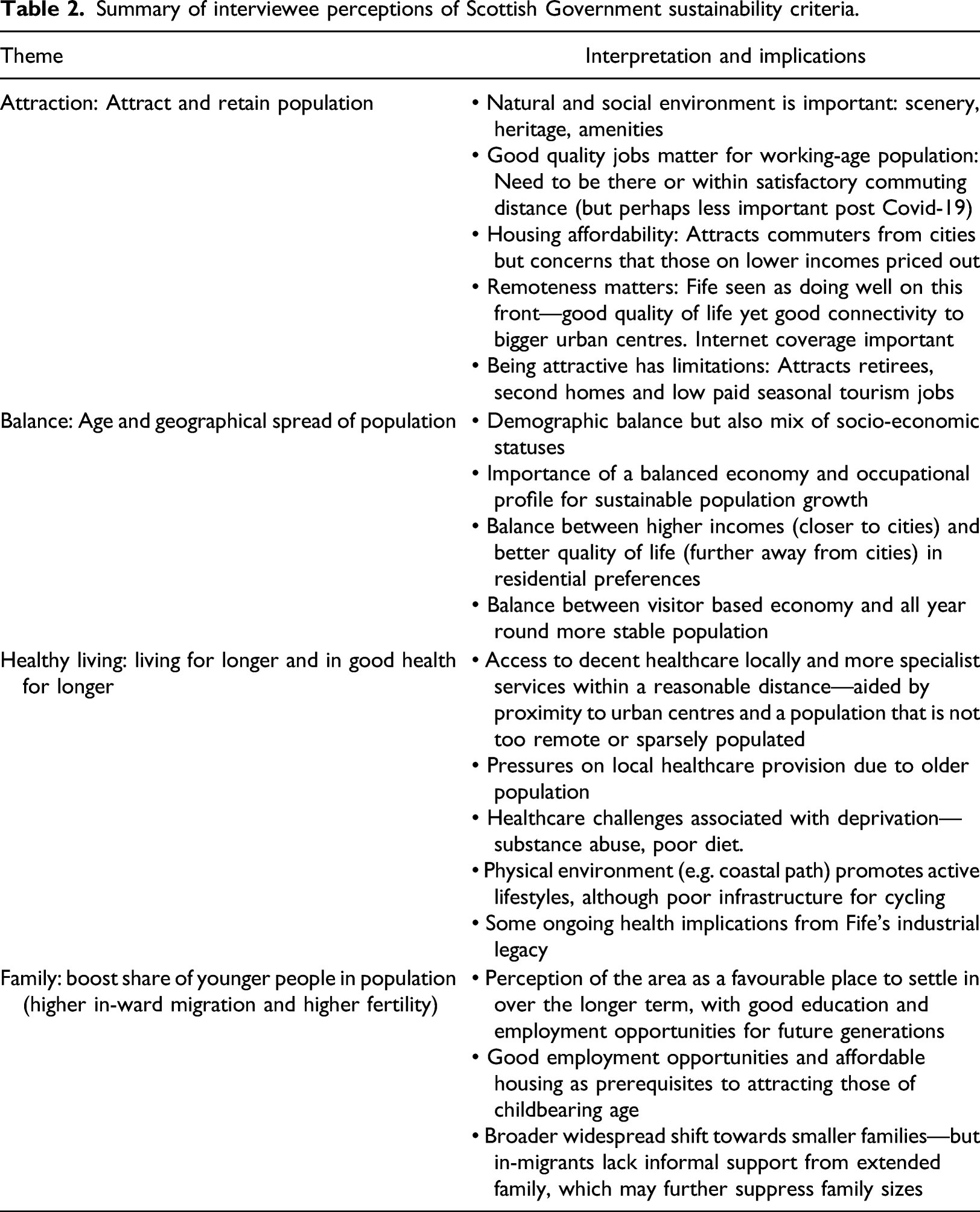
The content of Table 2 demonstrates how an enhanced understanding of how the macro and more localised components of population change shape the population sustainability prospects of places in specific contexts can better inform national policy efforts to promote it. As noted by the Scottish Government in their A Scotland for the Future report ‘Scotland’s population change is, crucially, not a monolith’ (2021, 4). Therefore these types of perspectives, with their emphasis on the multiscalar dimensions of population change, have applicability to Scotland more widely and potentially also further afield.
Policy implications
Sub-regions of Fife and interviewee characterisations of their demographic and socio-economic profile.
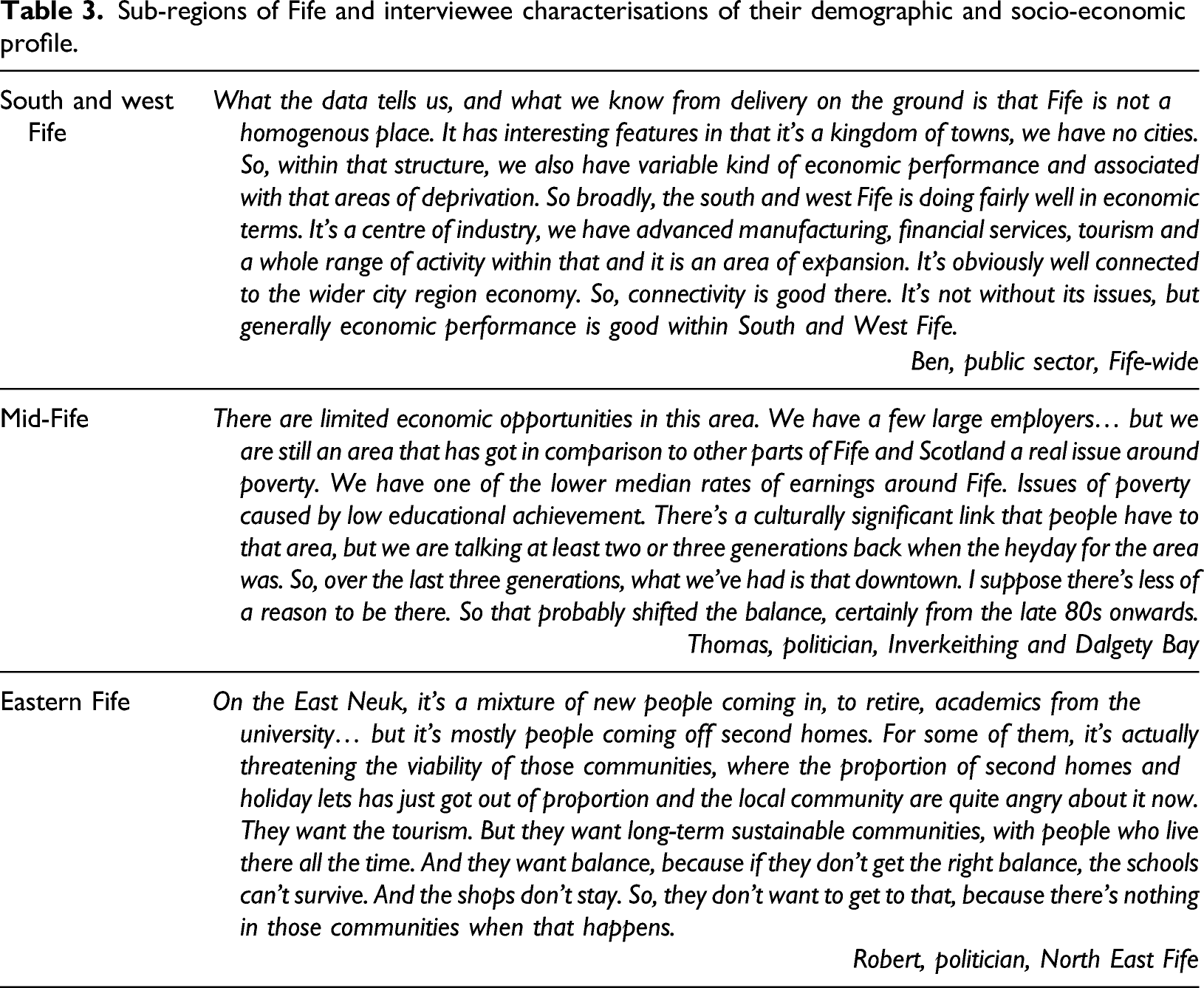
As Table 3 illustrates, proximate places can face very different opportunities and challenges with regards to population sustainability. Approaches which generalise regions or even countries, or which base considerations of population sustainability upon an overly narrow set of criteria, risk overlooking these nuances and thus failing to adequately comprehend and promote it. Instances of such complexities in the present case include: varying levels of community resilience in the face of demographic and economic change, the detrimental effects of second homeownership in rural areas and the effects of selective in and out migration on the cohesion of communities. These intricacies are often overlooked in debates about population sustainability. For example, encouraging people to move to and remain in demographically and economically challenged areas has been a key policy goal of the Scottish Government and other administrations. On balance, this is justifiable given the boost that this provides in terms of population size and age and socio-economic profile. However, the potentially counterproductive nature of such changes, for example, in terms of housing affordability, must also be recognised. Moreover, just as bringing the ‘right people’ into an area will not necessarily solve its demographic challenges, improved employment prospects will only work as a catalyst to enhanced population sustainability if local people are able to benefit from them (a longstanding challenge facing many older industrial locales). These kinds of insights demonstrate the utility of local stakeholder perspectives in wider conversations about population sustainability.
A final but significant lesson that emerges from this investigation relates to a critique of an underlying assumption that underpins much of the debate surrounding population ageing and its impact on sustainability, and indeed this study. Unprompted, some of the interviewees questioned the often implicit notion that a growing older age population in an area was automatically a negative development in fiscal terms. For example, Catherine was a strong advocate of active ageing and the benefits that it can bring, whilst also acknowledging the differing ability of communities to draw upon this resource.
If I'm quite blunt, I think part of it is actually harnessing the benefits of the older population that are there. A retired professional, older population, in relatively good health, looking to give back to the communities and being quite proactive and maybe knowing the people to ask and where to go. So can we make that part of a wider strategy? But on the other hand, how do we enable all communities to have that as well? That's one of the key challenges, in particular from a socio-economic perspective.
Catherine, politician, North East Fife
Likewise, James astutely sought to shift the emphasis away from a focus on the characteristics of places and their inhabitants towards broader debates concerning inter-generational justice.
I think, perhaps that, what is the nature of the problem that we're worried about? To me, perhaps the biggest problem at the moment is the intergenerational distribution of wealth and resources. And it's fine being old. But the real problem seems to be young people having decent jobs and being able to find somewhere to live. Yeah, so I'm less worried about an ageing population than I am about how we transfer some resources fairly to the next generation.
James, politician, Tay Bridgehead
Conclusion
This analysis has examined place-based perspectives on population sustainability and argued for the value of local stakeholder perspectives in these approaches. In doing so, it aims to contribute to a more nuanced approach to how demographic and economic change is perceived and responded to. An obvious but often overlooked lesson in this respect is that ‘balance’ is indeed a critical component of population sustainability, but that this involves much more than straightforward considerations of the age and sex structures of populations. In this sense, it is important to broaden the terms of the debate surrounding population sustainability beyond concerns with the working age population relative to retirees and encouraging incomers (via internal and international migration) into areas. As James insightfully probed: ‘what is the nature of the problem that we’re worried about?’ Significant and entrenched inequalities between and within generations (of which housing wealth is a major component) within Scotland and elsewhere arguably pose as much of a threat to population sustainability as the simple ageing of the population. As has been documented in this analysis, many of those of working age are constrained in their ability to remain within or move to areas facing demographic challenges by being priced out of the housing market by retirees and second homeowners. These processes in turn further distort the age and socio-economic balance of places, since the services and amenities that are geared towards families and younger people become untenable. For a place to be sustainable in population terms, it therefore needs to be possible for younger residents and those with fewer financial resources at their disposal to be able to afford to live there. Addressing this issue involves significant practical and political difficulties, not least the thorny issue of how the concentration of wealth in particular places and higher socio-economic groups (including many retirees) can be more fairly distributed amongst the population and across the country. In the interviews and in wider public discourse, there is much discussion of framing an ageing population as an asset. The pressing challenge now is to turn this into practical measures which more effectively translate this sentiment into reality.
Another issue that merits more attention in debates about population sustainability is the policy assumption that, if the quantity and quality of livelihood opportunities in an area can be improved, then this will automatically retain and grow its population. As this analysis demonstrated, this is indeed logical, and changing working practices and residential preferences brought about by the Covid-19 pandemic represent important opportunities in this respect. However, such a stance is arguably blind to place-based difference, as it was also noted that many residents of older industrial regions remain detached from existing proximate employment opportunities. As such, population sustainability in the places that have arguably ‘lost out’ through economic restructuring is about more than increasing employment opportunities in them. This will involve sustained and spatially sensitive efforts to address deprivation and the complex drivers of it. Without this, improving earning potential in many places will grow the population and attract higher socio-economic status residents, but it will not solve and may even exacerbate existing local inequalities. Migration is also an important component of population change and thus sustainability. International migration in the Scottish context is and will remain a prominent feature of policy debates, especially given the simultaneous lack of legislative control over immigration yet reliance on it for demographic and economic stability and growth. Immigration, often to areas of lower housing demand, has been key to sustaining population stability in many parts of Fife over the past two decades. Internal migration, as has been discussed here, brings opportunities in the form of population growth and residents with higher qualifications and spending power. However, the issues highlighted in relation to housing affordability require greater policy attention than they have received thus far.
The structural housing and labour market disequilibria touched upon here are just some of the wider demographic opportunities and challenges that have been identified in this analysis and which fundamentally shape the population sustainability of places. Addressing these wider societal issues may therefore have the added side effect of making the population of places like Scotland and the regions within it more balanced and thus sustainable over the longer term. A decade and a half ago, the well-known Scottish playwright David Greig mused;
Travelling through Fife and the old mining villages there and realising that the trains didn’t stop there anymore – they just went whizzing by. I suddenly thought: the really violent places aren’t the inner cities but these deserted towns. I then tried to imagine myself living in them: I thought it would be intolerable. Why did these places exist, why did people still stay here?
Greig, in Bellingham (2007) , 77
Since then, the types of places he refers to have been further buffeted by the great recession, the austerity which followed it, Brexit and latterly the Covid-19 pandemic. Aggregate level policies aimed at population sustainability (via higher fertility, inward migration or active ageing) will surely therefore only be of limited efficacy unless they are incorporated into a more holistic approach geared towards tackling the persistent spatial and inter and intra generational inequalities that lead to the question of why certain types of places (just about) still exist.
Footnotes
Acknowledgments
Thank you to the ESRC Centre for Population Change for access to the PopGroup software.
Declaration of Conflicting Interests
The authors declared no potential conflicts of interest with respect to the research, authorship, and/or publication of this article.
Funding
The authors disclosed receipt of the following financial support for the research, authorship, and/or publication of this article: This research was funded by the University of St Andrews Restarting Research Funding Scheme (SARRF).
