




Abstract
Many nations have committed to midcentury net zero carbon emissions targets in line with the 2015 Paris Agreement. These require systemic transition in how people live and do business in different local areas and regions within nations. Indeed, in recognition of the climate challenge, many regional and city authorities have set their own net zero targets. What is missing is a grounded principles framework to support what will inevitably be a range of broader public policy actions, which must in turn consider pathways that are not only technically, but economically, socially and politically feasible. Here, we attempt to stimulate discussion on this issue. We do so by making an initial proposition around a set of generic questions that should challenge any decarbonisation action, using the example of carbon capture and storage to illustrate the importance and complexity of ensuring feasibility of actions in a political economy arena. We argue that this gives rise to five fundamental ‘Net Zero Principles’ around understanding of who really pays and gains, identifying pathways that deliver growing and equitable prosperity, some of which can deliver near-term economic returns, while avoiding outcomes that simply involve ‘off-shoring’ of emissions, jobs and gross domestic product.
Introduction – The emerging ‘net zero’ policy and ‘just transition’ arena
The necessity of transitioning to ‘net zero’ carbon emission economies in line with the more ambitious aims of the 2015 Paris Agreement to limit global warming to below 1.5 degrees Celsius by the middle of this century is widely recognised by the wider scientific (including social science) community, policymakers, business and the wider public. In response to advice from its statutory advisory board, the Committee on Climate Change (CCC, 2019), the UK Government – holder of the United Nations Framework Convention on Climate Change (UNFCCC) Conference of the Parties (COP) Presidency in the run up to COP26 in Glasgow (November 2021) – took a global lead in legislating on a target to deliver a net zero carbon economy by 2050 (UK Legislation, 2019a). Aligned targets set by the governments of the UK’s devolved nations reflect the CCC (2019) consideration of different resource bases and capacity across the UK nations in terms of capability to deliver both rapid reduction in emissions going into the atmosphere and ability to sequester carbon via natural and manmade ‘capture’ techniques. For example, the devolved government of Scotland (where low-carbon renewable energy sources are plentiful and extensive landmass and offshore capacity and infrastructure to enable carbon sequestration exists) has responded with an earlier 2045 net zero target (UK Legislation, 2019b). In Wales (where the industrial base may present a greater challenge), the devolved government has committed to a 95% reduction in emissions to the atmosphere by 2050 (Welsh Cabinet Statement, 2019).
Ambitious and multifaceted policy programmes have emerged at both central and devolved government levels. Of particular recent prominence in the UK is the Prime Minister’s ‘Ten Point Plan for a Green Industrial Revolution’, which cites anticipated creation of 250,000 jobs (HM Government, 2020). This ambitious agenda clearly links to delivery of net zero targets to the Clean Growth Grand Challenges’ of the established but evolving UK Industrial Strategy (Department of Business, Energy and Industrial Strategy (BEIS), 2017–2020), retaining and emphasising its spatial focus. This is in terms of regional locations of energy intensive manufacturing clusters, as well as capacity to manufacture equipment like electric vehicles and deliver low-carbon energy supply. The ‘Ten Point Plan’ is also explicitly set in the context of very current economic policy focus, most prominently the need to ‘build back better’ from the current COVID-19 crisis, with the UK’s exit from the EU providing additional timely context. More generally, the UK’s net zero legislation is currently subject to economic and fiscal policy appraisal via HM Treasury’s response to a specific recommendation within the CCC (2019) advice regarding the need for a Net Zero Review of how the net zero transition may be funded and to assess options for where the costs will fall (HM Treasury, 2019). There is, however, clear focus from HM Treasury’s perspective to establish clear principles for decision making that are not context-specific and, thus, more stable over the three-decade time frame to 2050.
The need to identify clear principles for considering net zero policy clear crystallises in a wider international context. While the UK arguably took the lead in establishing net zero legislation (the first G7 nation to do so), by June 2020, 18 other individual nations plus the European Union have already adopted net zero targets in law, and a further 120 countries have committed to establishing on net zero targets through the Climate Ambition Alliance (Levin et al., 2020).
However, it is not only nations and devolved regions with legislative powers that have committed to net zero. At the 2019 UN Climate Action Summit, more than 100 cities around the world made commitments to net zero by 2050 (SDG Knowledge Hub, 2020). In the UK, cities with net zero commitments include London, Manchester, Coventry, Leicester, Bournemouth and Glasgow. However, at this level, the meaning of ‘net zero’ commitment becomes less clear, where the local economies that much achieve such outcomes are very open with flows of people, goods and services in and out of city boundaries on a daily basis adding to the complexity of emissions ultimately generated in delivering activity conducted therein.
Another important, but also potentially variable, framing for transition commitments and policy is the ‘Just Transition’ initiative established by the International Labour Organisation (ILO, 2015). This is gaining increasing focus and attention, having been cited in the 2015 Paris Agreement (UNFCCC, 2015) in the context of recognising nationally defined priorities on transitioning workforces. In 2019, at COP25, 46 nations made Just Transition commitments in this regard (ILO, 2019). Just Transition concerns are commonly set in terms of regional and/or industrial challenges within nations, such as coal mining and power generation within Spain (Government of Spain, 2019). The European Parliament responded to the growing recognition of the need for frameworks and funding to support net zero transitions without growing regional disparities in the July 2020 announcement of a Just Transition Fund (European Parliament, 2020). In Europe, the Scottish Government took a proactive early step in establishing a Just Transition Commission in early 2020, charging that body to advise Ministers on actions that will enable the ambitions of the Scottish Climate Change Bill to be realised while maximising economic and social opportunities. This involves particular focus on the need to mitigate risks around regional cohesion, inequality, poverty and the sustainability of current economic and workforce capacity and capability (Scottish Government, 2020a).
A challenge for policy and research communities
In practice, meeting net zero emissions reduction commitments alongside a range of wider socio-economic, industrial and other public policy objectives requires extensive cooperation and communication. Delivery in any geopolitical context will require that different departments of national, devolved and local governments can effectively work both with each other, and with diverse industry, public and research communities, to determine how best to achieve what equate to systemic transitions in how economies function and how people live and do business. Moreover, while national ‘net zero’ targets set within the UNFCCC framework focus on (territorial) emissions generated within national borders, the overarching objective of limiting global warming requires that emissions do not simply relocate across countries. Indeed, this is not only a concern of multilateral global climate policy. Rather, general economic policy framing and the specific focus on ‘Just Transitions’ – initially set within the UNFCCC framework in recognition of the need for countries to continue to focus on nationally defined development priorities, with emphasis on jobs and workforces (UNFCCC, 2015, p. 5) – reflects national concerns around a broader set of ‘offshoring’ risks. That is, policymakers, businesses and citizens within nations recognise that geographical displacement of carbon emissions is associated with/driven by relocation of investment and jobs, often where competitive routes to decarbonisation cannot be realised at current production locations.
For the research community, all of this in turn presents the challenge to deliver an evidence and knowledge base to support net zero transition decision making across the government-industry-third sector space. This will necessarily cut across many disciplines, involving engagement and impact with a diversity of expert and stakeholder communities, where multiple technical ‘languages’ are used, and different perspectives taken in setting and addressing questions. Thus, there is an urgent need to establish common frameworks and languages in setting and addressing the multitude of research requirements in an integrated and informative way. What might such a ‘Net Zero Principles Framework’ look like? Is it likely to differ across nations and even perspectives regarding the nature of the net zero challenge therein?
The need to focus on policy, political economy and societal consequences
One of the key challenges for net zero decision making is the need to understand what the policy, political economy and societal consequences of any decarbonisation action or ‘pathway’ may be. If negative, these give rise to the ‘barriers’ so often cited as preventing deployment of technically feasible decarbonisation solutions. Identifying and understanding such consequences and pulling through solutions that can deliver politically and socially acceptable outcomes is in effect the means by which the required policy, regulatory and financial environment can be structured and aligned in a way that enables net zero transitions. In the spirit of stimulating debate and opening dialogue, we focus our own initial consideration from the political economy perspective of our own expertise and research base, using this initial proposition as an invitation for colleagues across academic and policy stakeholder communities to contribute through further commentary and research.
We took early steps in this process in the first six months of 2020, drawing on evidence from our own research to set out and apply a provisional Net Zero Principles Framework (see Turner et al., 2020a, 2020b). We used this to inform dialogue with a range of UK bodies, including HM Treasury, BEIS, the Scottish Just Transition Commission and various industry actors. A range of recurring and fundamental questions emerged: Who pays and who gains, how and when? To what extent can gains be used to balance/compensate who ultimately pays? Are there opportunities for net zero pathways to generate and sustain wider economy expansion and maximise gains within transitioning economies? To what extent does taking first or early mover steps in deploying particularly large-scale low-carbon solutions risk the competitiveness of domestic industry? Is it better to effectively import emissions reducing capacity to enable faster emissions reductions, or to invest in building ‘green’ supply chain capacity at home? What are the fiscal and distributional consequences of evolving wider economy impacts of transition pathways in different time frames? How does this impact the required timing of benefits to justify and/or enable action by different individuals, groups and sectors across the economy and society? A crucial recurring theme arising through dialogue with policy stakeholders is how societal consensus (or a lack thereof) for different actions will be affected by and/or can be gained as a result of effectively consulting on and communicating the questions posed, and using this as a basis to identify politically feasible and ultimately wider public policy actions and pathways.
Setting the foundations for a Net Zero Principles Framework
Our proposition for a Net Zero Principles Framework to support policy analysis and development involves focussing and refining the above questions in the context of two interacting stages that are likely to be involved in any decarbonisation action or pathway:
Enabling stage: Before any emissions reductions can begin, there is a need to invest in, install and facilitate operation of new equipment, infrastructure and/or systems capability to enable emissions reduction. Realising stage: With invested capacity and capability in place, emissions reductions can be realised through changes in how by working with new capacity in how people live and work.
Table 1 suggests how these two stages will of course interact, not just in terms of the first facilitating the second, but in terms of enabling actor confidence in positive and sustainable outcomes at either to justify or to reduce the risk involved in the other.
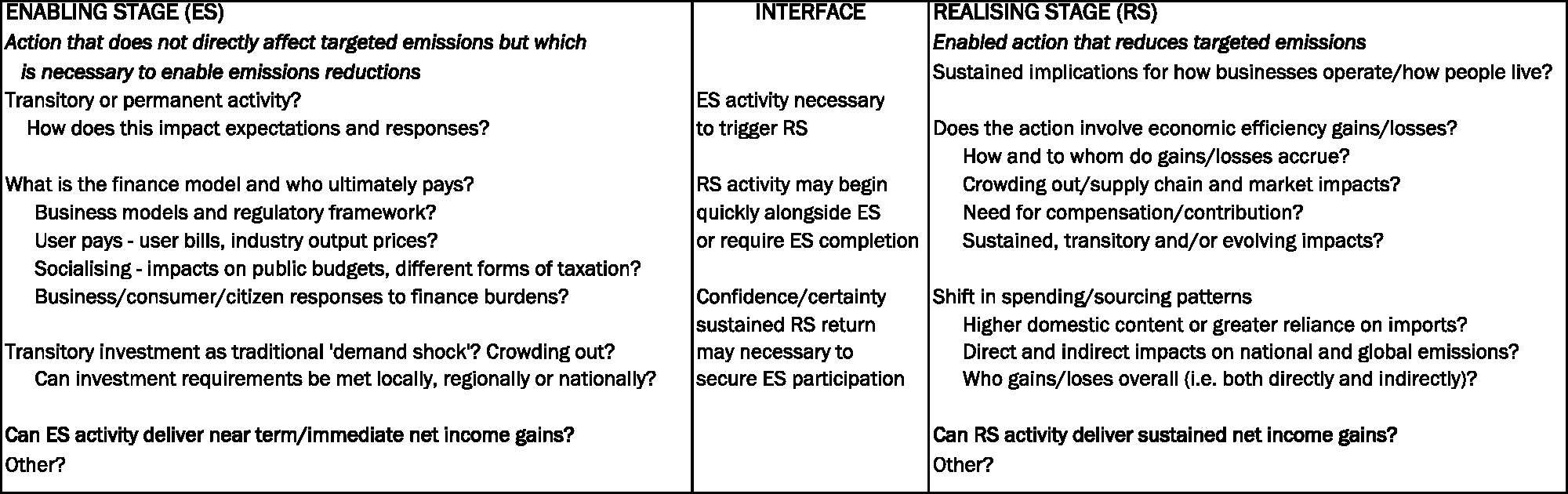
A provisional proposition for a ‘Net Zero Principles Framework’ for analyses of individual/combinations of net zero actions.
How might this framework be applied? Let us consider the example of carbon capture, utilisation and storage (CCUS), a large-scale decarbonisation solution gaining prominence in net zero debates. In the UK context, CCUS has gained particular prominence in regional transition debates, with the UK Government setting its ‘CCUS Action Plan’ (BEIS, 2018) in the context of the need to decarbonise and sustain energy and (currently) emissions intensive manufacturing activity through carbon capture capability at a number of regional industrial clusters. The Scottish Government (2020b) links a stated need for CCUS to its policy on sustaining and evolving the existing oil and gas extraction industry and supply chain, which could deliver transport and storage capacity and capability, thereby sustaining tens of thousands of jobs, concentrated in and linking to the north east region around the city of Aberdeen.
The enabling stage of deploying CCUS as a net zero solution would certainly involve investment in both carbon capture equipment for large-scale intractable emitters (most likely in energy intensive manufacturing and/or thermal power generation) and in infrastructure to then transport and store CO2 (but with not all nations having capacity to deliver storage). Initial investments may provide a transitory stimulus to the deploying economy. However, this will depend very much on supply chain capacity and on ‘who pays’ and when.
Crucially, any government support will ultimately have public budget/taxpayer implications, while investment risk is very much linked to the need for a high degree of certainty that operation of both the capture and transport/storage sides would function and balance effectively, potentially involving international interactions, which in turn would have regulatory implications. Construction requirements may be substantial, which could have shorter-term capacity implications. On the other hand, particularly in nations with existing oil and gas production and distribution capacity, this could involve repurposing existing assets that may offset near-term need for decommissioning in a mature industry context.
However, the realising stage (and the aforementioned interface with the enabling stage) of CCUS, with its ongoing operational requirements, could be more challenging, not least in nations (like the UK) where CCUS strategy is built around industrial decarbonisation. In contrast to decarbonisation actions such as energy efficiency, where increased operational productivity in delivering heating services in particular may be anticipated, industrial emitters are likely to have concerns around capital efficiency and associated investor/shareholder returns where carbon capture activity fundamentally involves using more equipment to produce the same level of output.
This is likely to be challenging for producers of internationally traded intermediate products such as chemicals, petrochemicals, iron and steel, where markets for ‘green’ products do not yet exist (and would be complex due to the range of final uses that the largely intermediate outputs of such industries ultimately serve). It will be particularly challenging where countries like the UK or Norway are considering what would equate to ‘first mover’ roles in establishing CCUS systems based on their existing capacity and capability to transport and store CO2 offshore. The core problem is that prospective capture industries would need to incur additional capital/equipment costs not similarly borne by/reflected in carbon costs of international competitors. This then raises challenges around the ability of government to provide public funding to sustain competitiveness on a reducing basis linked to the evolution of complex international markets (for both evolving products and carbon) and in alignment with state aid/subsidy rules associated with trade agreements, etc., as well as being politically feasible at home.
In short, this CCUS example illustrates the complex challenge of examining any decarbonisation or net zero solution through a broader public policy lens. While an increasing number of cities, regional authorities and national governments have moved relatively quickly in making net zero commitments, it is not clear that sufficient attention has been given to grounding decision making in the need to respond to the challenges faced by different actors in society who ultimately need to take action.
Conclusion
The aim of this viewpoint piece has been to raise the challenge of developing broader public policy foundations to support the delivery of ambitious net zero commitments. It has involved setting out an initial proposition of a Net Zero Principles Framework, with the aim of stimulating discussion across research, policy, industry and wider net zero stakeholder communities as to how the required public policy decision making can actually roll out. Our perspective in setting out our initial proposition of a framework is very much a political economy one. While not the only perspective that must be taken in net zero discourse, it is an increasingly important lens through which to view and interrogate decarbonisation problems, given increased concern over the ‘Just Transition’ and broader fiscal and distributional challenges associated with net zero ambitions across nations. On this basis, our initial proposition is built around what are largely socio-economic questions likely to arise at the stages of both enabling and realising different decarbonisation and pathways. In considering this initial framing, and the commentary offered above, we propose that five key Net Zero Principles emerging can be identified as follows:
Understanding who really pays for any given action/pathway or combination thereof, how and when, and what gains can be used to balance this is fundamental; Policymakers and stakeholder communities need to find and build consensus around pathways that allow regions and nations to sustain and grow the prosperity of populations in an equitable way; Not least in contexts where economic conditions are currently challenging, finding options and pathways that can deliver near-term economic returns is crucial; ‘Off-shoring’ is not the answer in regional/national or global contexts if it only shifts emissions, jobs and gross domestic product overseas and Net zero is a societal and public policy challenge more than it is a technological one.
Footnotes
Acknowledgements
We are grateful to colleagues at the UK Department of Business, Energy and Industrial Strategy (BEIS), HM Treasury, Scottish Government, INEOS, the Chemical Council for the Regions, Scottish Power Energy Networks (SPEN) and Scottish and Southern Energy (SSE) for engagement in developing the framework discussed here. However, all opinions expressed here remain the responsibility of the authors.
Declaration of Conflicting Interests
The author(s) declared no potential conflicts of interest with respect to the research, authorship, and/or publication of this article.
Funding
The author(s) disclosed receipt of the following financial support for the research, authorship, and/or publication of this article: The research and stakeholder engagement informing this commentary has been supported by the Bellona Foundation, with funding from the Children’s Investment Fund Foundation, and by the UK Engineering and Physical Sciences Research Council via Impact Acceleration Projects linked to two earlier grants (EPSRC Grant References: EP/M00760X/1 and EP/J016454/1).
