




Abstract
Academics and policy makers have increasingly recognised the importance of mundane economic activities – variously termed foundational or everyday. The foundational or everyday economy is now featuring in local industrial strategy and economic action plans, because the desirable high-tech sectors on the ‘frontier’ cannot diffuse prosperity within and between regions. This article aims to distinguish between several different approaches to the foundational or everyday economy and argues that a constructive approach needs to break with the preoccupation about improving productivity. This argument is developed in three stages. First, we distinguish between a social approach and a more technical economic approach to delimiting this other mundane economy; the defining feature of the foundational in the social approach is contribution to wellbeing and in the technical economic approach it is low productivity. The second section presents and explores productivity evidence on output per worker hour across a range of foundational activities and by region. Drawing out the implications of observed diversity and heterogeneity, the third section develops an argument about how productivity has limited relevance as measure and target in foundational activities.
Keywords
Introduction
Academics, policy makers and politicians have increasingly recognised the limits of traditional industrial policy focused on the tradable goods and services sectors, especially ‘frontier’ industries. This emphasis ignores the larger, ‘other’ mundane part of most economies, including industries providing essential goods and services variously termed the foundational or everyday economy. If these other sectors have demand and supply side importance, industrial policy needs to be about more than promoting early stage innovation and supporting growth in exciting and high-tech sectors. At the same time, the latest incarnation of UK industrial strategy retains the traditional concern with improving productivity (Business, Energy and Industrial Strategy (BEIS), 2017). This is now a response to the so-called productivity puzzle in the UK economy (Haldane, 2018), and the UK’s relatively poor productivity performance compared with other countries, especially since the 2008 financial crisis (Mason et al., 2018). And the objective of improving productivity across the economy does now highlight the large, low wage sectors of retail and hospitality (Forth and Rincon Aznar, 2018; Institute for Public Policy Research (IPPR), 2018; ONS, 2017), alongside a broader place-based focus on what are considered as under-performing regions (Teow and Reilly, 2019).
This article responds to these developments by distinguishing between different understandings of the other economy as everyday or foundational, and by questioning the relevance of industrial or regional policy focused on productivity in mundane activities. If we are to identify distinctive activities of the economy that are important for everyday life, and develop policies to support and sustain them, this requires some clarity about how we define and characterise these sectors both collectively and individually. The original definition of the foundational broke with the idea of a singular economy (the economy) and argued there are multiple economies or zones of activities with different characteristics. The foundational economy is the zone that produces the daily essential services that are the infrastructure of civilised life (Bentham et al., 2013; Foundational Economy Collective, 2018). These include both material services that provide housing, transport, food, energy, water and telecoms; and providential services providing, health, care and education. The term ‘everyday economy’ has subsequently been used in related but distinctive ways to mean either important every day and local services (Reeves, 2018) or more narrowly, low wage sectors including retail, hospitality and care (IPPR, 2018).
The differences in definition are important because they reflect distinct underlying conceptualisations of the ‘other’ mundane economy and how it matters: specifically is the categorisation to be based on social value (i.e. essential services) or economic performance (i.e. low wage, low productivity)? This category distinction is relevant because it spills over into policy differences: does the everyday or foundational economy require radical new policy levers to address new objects, or a more incremental approach that transposes old policy levers and objects into a new activity domain? We can observe this difference of approach in the UK. The Welsh Government has explicit foundational economy policies which directly target liveability and sustainability through better essential services provided by local grounded firms (Waters, 2020). While Greater Manchester’s local industrial strategy (Greater Manchester Combined Authority (GMCA), 2019a) aims to work indirectly through raising productivity to allow higher wages and living standards, especially in ‘low wage’ sectors like retail and care.
This article contributes to the debate in this emerging area and has two aims. First, the aim is to clarify and organise understanding of the differences in how the foundational and everyday economies are defined and delimited in current debate. Second, the aim is to evaluate the assumption made in some of the literature and policy that foundational/everyday activities are characterised by low productivity; this critical evaluation of evidence leads to argument about the limited relevance of productivity measures in foundational activities. The article has three sections: the first focuses on the categories through which the foundational/everyday economy categories and their policy relevance are understood; the second focuses on the empirics of foundational productivity, exploring the patterns of difference between activities and regions; and the third critically discusses the utility and relevance of higher productivity as a focus for industrial and regional policy on the foundational/everyday economy.
The foundational economy as a focus for industrial policy
Since Peter Mandelson resurrected the idea of industrial policy in the UK after the great financial crisis, the focus of Westminster government policy has been on exciting, high-tech, innovative, tradeable sectors, described by Stanley (2020) as the ‘fetish of the frontier’. The UK’s 2017 White Paper on industrial strategy (BEIS, 2017) included sector deals and the encouragement of early stage innovation in activities like life sciences, aerospace and automotive. At the same time, there has been growing awareness that industrial and regional strategy focused on high-tech and innovative sectors offers limited leverage over output and employment because the numbers employed in these activities are relatively small (Bentham et al., 2013). This observation leads to the issues addressed in this section of the article: what is the ‘other’ economy, i.e. what lies beyond these tradable goods and services sectors; how can this part of the economy be characterised and how can public policy be used to support these sectors.
Taking the UK economy as a whole, 44% of employment is the tradeable goods and services sectors (Foundational Economy Collective, 2018). This total includes activities like automotive, pharmaceuticals, IT and digital, etc.; but, within this large and diverse group, a relatively small part is accounted for by high tech and innovative sectors. As noted by Fothergill et al. (2017), only 10.9% of British manufacturing employment (and 1.4% of all employment) would be covered by industrial strategy challenge funds announced in 2017. It should not be a surprise that the economy of the UK comprises much more than tradeable goods and services; but it is only recently that there have been attempts to understand and explore the characteristics and nature of this other economy and its relevance to policy.
We can highlight several distinctive approaches to what is referred to variously as the foundational or the everyday economy. To do so requires some discussion of the categories and policy focus which define new objects; and this is useful because it also focuses questions about problem definitions and policy. An important emerging point of difference is about the extent to which diagnosis and remedy should focus on productivity in the foundational/everyday economy as an enabler of higher wages and living standards. By way of contrast, a more direct approach focuses on the social value of the services produced by the foundational economy and their contribution to well-being.
The term foundational economy was originally introduced by Bentham et al. (2013) to propose and develop a new policy object and radical approach. The foundational economy is defined as the group of heterogeneous activities delivering goods and services which meet essential citizen needs and provide the infrastructure of everyday life. The activities that comprise this foundational economy 1 are manifestly heterogeneous and will change at the margins over time as both needs and context evolve. For example, the internet is now essential for access to many services and, for some, to access their ‘work’, just as transportation systems allow others to access physical work and leisure spaces. The broad range of foundational services can be organised into distinctive material activities (utilities and other networks) and providential activities (health, education and care; Foundational Economy Collective, 2018).
Not only do these serve essential daily household needs, they are often collectively provided and individuals may not be able to easily or efficiently secure them through individual consumption. If the foundational economy has this central relevance in demand and supply side terms, the policy issues raised relate to how the supply of essential goods and services is shaped not only by activity specifics – such as requirement for capital investment – but also by business models driven by capital market requirements for financial returns. Here, a distinctive approach to business analysis draws on reports on adult care (Burns et al., 2016a, 2016b) with case studies of retail banking, telecoms and broadband and supermarkets/dairy (Bowman et al., 2014). Such studies help explain – though do not justify – low wages and poor conditions in some of these activities.
In the context of Covid-19, this foundational economy overlaps to a large extent with those activities where ‘key workers’ have been required to keep working, regardless of additional risk to themselves, because of the essential nature of the services delivered (Farquharson et al., 2020). From this point of view, the Foundational Economy Collective also identifies an outer, external zone – an overlooked economy – providing culturally important goods and services which, while not essential for daily life, are occasionally purchased while important to well-being and largely overlooked by industrial policy. These activities – such as hairdressing, takeaways and tourist accommodation and attractions – are large employers at the national level though their expansion can also be the object of citizen complaint. After the first wave of the pandemic initially passed in mid-2020, much of the concern has been about whether and how large parts of the over-looked economy – in personal services like hairdressing or gyms, or the hospitality and visitor economy – could be reopened to meet demand and prevent massive loss of jobs and small businesses in these sectors.
Even before Covid-19 spotlighted key workers, the foundational economy analysis has had policy resonance in Wales. After twenty years of devolved government, the Welsh Government had failed in its declared objective of closing the gross value added (GVA) gap with England (Stokes, 2019) and inward investment has not resulted in a new, tradeable sectors to compensate for the collapse of coal, steel and light manufacturing (Brill et al., 2015). Over time, this has been reflected in an increased willingness by Welsh Government to try new policies. This began in a limited way with an Economic Action Plan in 2017 which continued Welsh Government’s sectoral approach to economic policy and added four ‘foundation sectors’ of tourism, food, retail and care (Welsh Government, 2017a). This was also reflected in the Valleys Task Force delivery plan (Welsh Government, 2017b).
Under a new Deputy Minister for Economy and Transport, Lee Waters (2019), the approach was broadened and connected with the Well-being of Future Generations (Wales) Act (2015) commitment to well-being, so that policy was refocused on liveability and sustainability through the improved supply of essential goods and services delivered by grounded firms. The new minister explicitly challenged any idea of a Foundational Economy ‘being characterised by low skills and productivity’ adding that ‘we don’t simply want to grow these parts of the economy, we want to disrupt them – to change and improve how they work’ (Waters, 2020). The Welsh (2020) interventions so far are cautious: mainstream economic policies have not been renounced, while new policies are about experimental learning by doing. For example: a challenge fund is sponsoring 52 experiments with the ambition of building communities of practice; a purchasing for social value initiative is being organised through the Public Service Boards, with local authorities under pressure to develop relational procurement; and small business support is being rethought and reorganised (Business Wales, 2019).
In a parallel development to this emerging policy in Wales, Reeves (2018, 2019) and Stanley (2020) in a pamphlet for Nesta have set out arguments about recognising the significance of foundational economy sectors for both employment and community well-being reasons. Reeves’ (2018) starting point is explicitly social in a Polanyian way when she argues that ‘capitalism has been allowed to expand into sectors of society where markets should not belong’ (p. 26). Stanley (2020) is concerned with ‘reproductive labour’, provides a critique of financialised business models and envisages a reform of care which is less about bio-medical needs and more about meeting the social needs of the workforce. From this point of view, Reeves and Stanley operate with a similar long list of activities as the Foundational Economy Collective (2018). Reeves (2018) adds the supplementary that some of these foundational activities are low wage: ‘core (foundational) activities include transport, child care and adult care, health, education, utilities, broadband, social benefits and the low-wage sectors of hospitality, retail, food processing and distribution’ (p. 10). For both Reeves and Stanley, the activities they highlight are defined as complex in social and economic terms: the goods and services produced have intrinsic social value, especially in a local context and work is about quality and dignity as much as an input–output ratio.
In contrast, there has also been development of interest in another ‘everyday economy’, where inclusion of the activity in the everyday category is based not on the essential nature of the services provided but on their characterisation as low productivity. Here, the singular economy survives and the view is more orthodox. The economy is not a social body beset by financialisation or a complex place-based set of local, essential services; in the orthodox view the economy is a machine where low productivity activities are a problem because they lead to low wages. This framing reflects the long-established concerns of some economists who have, since the Anglo-American Council on Productivity in the early 1950s, problematised the UK’s national productivity gap first in comparison with the USA and later with France and Germany (Broadberry and O'Mahony, 2004). These concerns have been recently reinforced by a mainstream panic about productivity after the stalling of productivity gains (and stagnation of labour productivity) since 2008 (see, for example, Haldane, 2018; ONS, 2018). This fed into the UK Industrial Strategy White Paper and its concerns to strengthen the ‘five foundations’ of productivity to allow a ‘transformation of the economy’ (BEIS, 2017: 14). While the UK industrial strategy reflects general concerns about productivity, other publications have carried over the productivity challenge into the outer, foundational and overlooked areas of the economy.
The low productivity characterisation of foundational/everyday activities can be seen in several places. As part of the IPPR Economic Justice Commission, Jacobs et al. (2017) introduced the distinction between ‘frontier sectors’ and ‘the everyday economy where the vast majority of low productivity and low wage firms are to be found’. This list includes ‘retail and wholesale, social care, tourism and hospitality, food and drink and light manufacturing’. Notably, the foundational activities of utility supply, retail banking, health and education are not included so that the ‘everyday’ is defined in a narrower way compared with Reeves (2018). A similar framing has been incorporated into formal designs for city region industrial strategy in Greater Manchester: in 2019, the Local Industrial Strategy insisted that the central policy measure of success was higher productivity which ‘should continue to be the key to future evaluation and monitoring of progress towards Industrial Strategy goals’ (GMCA, 2019a). The Greater Manchester strategy reiterates the distinction between frontier and foundational sectors and declares the aim is ‘to raise productivity and pay’ in retail, care, hospitality and tourism. There are no specifics about what to do in these sectors, which differ from each other in every respect except low pay. The recommendation is for long term ‘efforts to support the development of new business models and more effective service integration and management practice’; and short-term voluntary adherence to GM’s ‘good employment charter’ (GMCA, 2019a).
This difference of framing raises a question: is the other economy of mundane activities to be viewed primarily as socially important or economically deficient? The answer is policy relevant because it has implications for thinking about ends and means. For example, should the priority be direct service improvement, including through new policies of social licensing for corporate providers (Bowman et al., 2014; Reeves, 2018), or should policy aim to raise productivity and increase wages as the way to higher living standards? Of course, the approaches are not necessarily mutually exclusive: for example, in the care sector, service improvements could involve re-organising work in ways that also improved pay and conditions. But there is a choice here because, for example, productivity improvements could be pursued through limiting personal contact time of workers with users and delivering inferior service as a consequence.
Given the intellectual and political support for reading the mundane other economy through the lens of a pre-existing productivity problem definition, it is important to understand the productivity performance of the heterogeneous activities within the foundational economy. This provides an empirical basis for discussing the relevance of policy geared to raising productivity in that other economy. The next section of the article explores the first of these issues: what is the mix of high, low and middling productivity activities in the foundational economy activities; and what is the extent of regional variation? This allows informed discussion of the relevance of productivity to the foundational in the final section of the article.
The productivity of foundational activities
The recent concern about the UK’s productivity problem is manifest in reports that outline patterns of underperformance on either a regional (Teow and Reilly, 2019, for PWC) or an industry (IPPR, 2018) basis. A study by Forth and Rincon Aznar (2018) for the Joseph Rowntree Foundation provides some in-depth analysis which discloses heterogeneity even within ‘low wage’ sectors; the authors note for example that productivity in retail has been rising. Forth and Rincon Aznar’s conclusions are a caution against loose generalisation about sectors. Hence the importance of the granular evidence in this section about levels and differences in productivity by activity and region within the UK’s (broadly defined) foundational economy sectors.
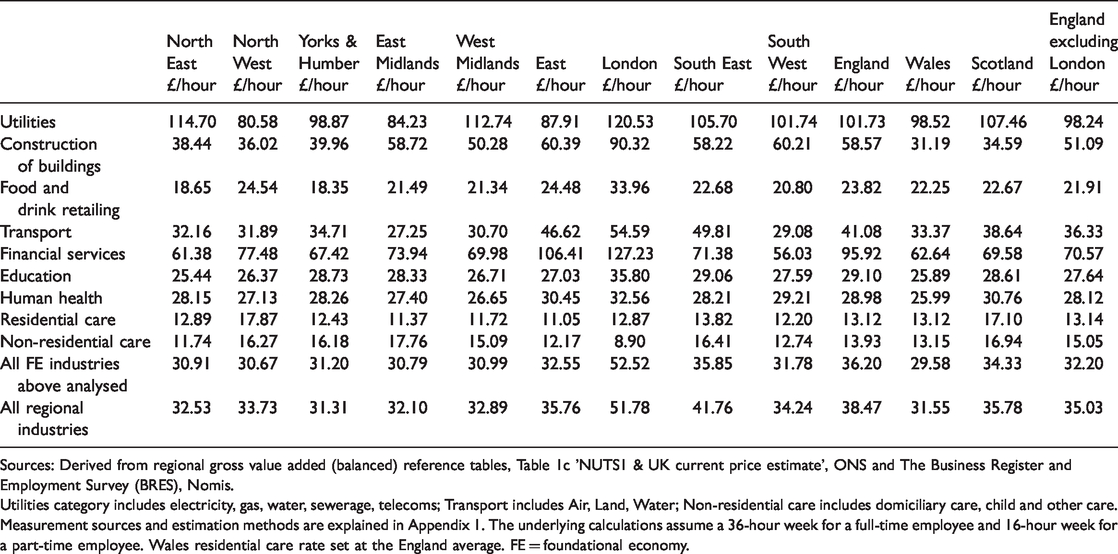
Productivity is commonly measured as output (GVA) per worker hour. In this section, we use UK data from the Office for National Statistics (ONS) which provides a breakdown of productivity by activity and by region. This is the standard source, used inter alia by GMCA (2019b) 2 and Jacobs et al. (2017) to compare sectors and by McCann (2020) amongst others to compare regions. 3 Table 1 presents productivity per worker hour for a sample of foundational economy activities by region and nation in 2017; this includes material activities – utilities, construction, food & drink retailing and transport – and providential activities – education, health and care (residential and non-residential care) – with a benchmark of all industries. The table does not cover all foundational activities, with some – like the postal service and retail pharmacies – excluded; hospitality is also excluded because that is an overlooked activity which is more difficult to measure using SIC codes as it is dispersed over several categories.
Output (GVA) per full time equivalent employee's worked hour, 2017.
Sources: Derived from regional gross value added (balanced) reference tables, Table 1c 'NUTS1 & UK current price estimate', ONS and The Business Register and Employment Survey (BRES), Nomis.
Utilities category includes electricity, gas, water, sewerage, telecoms; Transport includes Air, Land, Water; Non-residential care includes domiciliary care, child and other care. Measurement sources and estimation methods are explained in Appendix 1. The underlying calculations assume a 36-hour week for a full-time employee and 16-hour week for a part-time employee. Wales residential care rate set at the England average. FE = foundational economy.
The sample of activities included is large enough to cover 75% of foundational employment in England and 66% in Wales and Scotland. Some of the figures have been estimated as the ONS does not provide a sufficient disaggregation by sector to match the foundational economy categories. In two cases – banking and food & drink retailing – we have subdivided ONS categories; and in two other cases – utilities and transport – we have amalgamated ONS categories. The estimation methods used in these cases are explained in Appendix 1. The complication of hours worked is dealt with by crediting all full-time workers (including the self-employed) with a 36-hour week and part-time workers with a 16-hour week, over a 52-week year; the short hours allow for holidays and statutory days. Productivity estimations require choices; those made here are applied consistently to all activities and allow comparison of productivity between sectors.
From Table 1 several observations can be made. First, this sample of foundational activities cannot be fairly characterised as low productivity overall because output per worker hour is only fractionally behind the all-industry average. In the case of England (including London), mean output per worker hour is £36.20 for the foundational activities, against £38.47 for all industries. In terms of spatial differences, the gap is 5–11% in the case of Wales, Scotland and English regions, with the exception of the south east; in London, the high value added activity mix ensures that there is no productivity gap at all and output per worker hour in this group of foundational activities is almost exactly equal to the London all economy figure.
Of course, an average can hide many differences and these foundational sectors are heterogeneous in terms of productivity. Taking the figures for England, for example, the two largest foundational activities in terms of employment and output are health and education, which separately account for 5–6% of all English GVA and 7–8% of all English employment. 4 Both health and education have below average productivity with output of around £29 per hour against £38 per worked hour for all English activities (Table 1). Beyond this, the range from high to low is quite spectacular: from £102 per worker hour in utilities to £13 per worker hour in residential care in England; in between, there is banking at £96 per hour, construction at £59 per hour and transport at £41 per hour. In terms of productivity, as in so many other respects, foundational economy activities are a mosaic and, as a group, they cannot be assigned to one side of a binary division between high and low productivity.
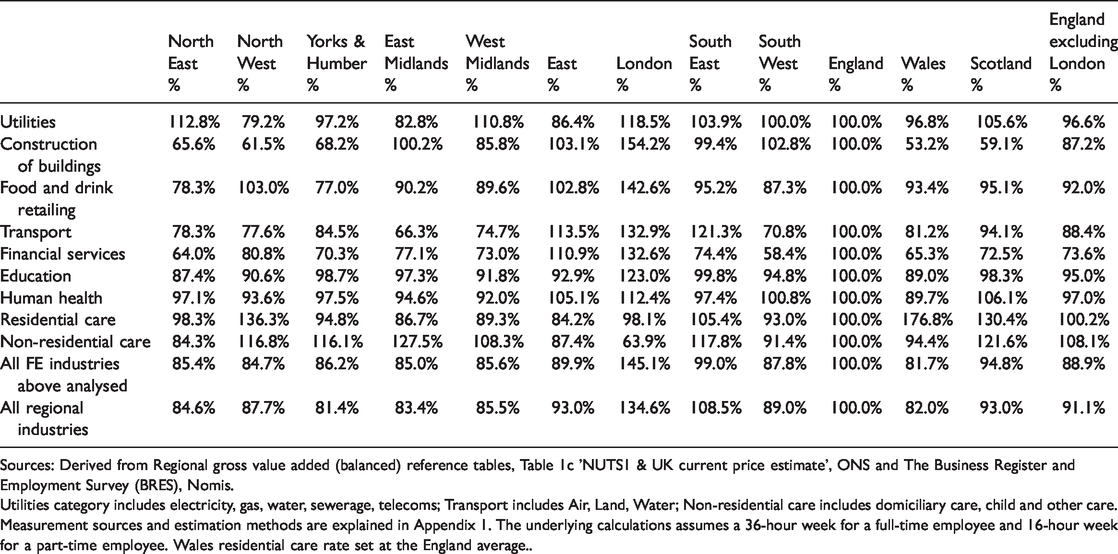
Second, in many of the large foundational economy activities, there is no large productivity gap on average between deindustrialised regions of the North East, North West and West Midlands and the all-England average (including London). To demonstrate, we can compare all-England productivity performance in a range of foundational activities with productivity levels in the North East, Yorkshire & Humberside and Wales (Table 2). This is an exacting test because the all-England total includes London, which is in many ways unlike the rest of the UK. In six out of nine foundational activities in Wales, output per worker hour is 88% or more of the all-England performance; 5 for Yorkshire & Humberside it is five of nine sectors and in the North East four of nine. Large numbers are employed in education, health and care where there is no regional gap; these activities account for 28.5% of the total Welsh workforce, 22.1% of the total Yorkshire & Humberside workforce and 21.7% of the total North East workforce. 6
Output (GVA) per full time equivalent employee's worked hour relative to England, 2017.
Sources: Derived from Regional gross value added (balanced) reference tables, Table 1c 'NUTS1 & UK current price estimate', ONS and The Business Register and Employment Survey (BRES), Nomis.
Utilities category includes electricity, gas, water, sewerage, telecoms; Transport includes Air, Land, Water; Non-residential care includes domiciliary care, child and other care. Measurement sources and estimation methods are explained in Appendix 1. The underlying calculations assumes a 36-hour week for a full-time employee and 16-hour week for a part-time employee. Wales residential care rate set at the England average..
The absence of a regional productivity gap in such activities is not surprising when many private and public foundational activities like food retailing, health and care are organised in much the same way across the UK. Tax funded activities such as health and education have financial inputs allocated according to per capita formulae which have a rough equalising effect. The position in care reflects the widespread misery of underfunding as care expenditure grows to claim an ever-increasing share of local authority spend. Any discussion of regional productivity differences (such as that produced by Teow and Reilly, 2019) should start by acknowledging the absence of any regional gap in so many foundational activities; subsequent inquiry could then usefully focus on the foundational activities where a gap exists and also on the activity characteristics and drivers of productivity in overlooked services and tradeable goods.
While there is no regional productivity gap in most foundational activities in Table 1, there is a large gap in some sectors, supporting the characterisation of foundational activities as heterogeneous in terms of narrow economic performance. In four foundational activities there is a large productivity gap between London and the outer deindustrialised regions of the North and West. In these activities – financial services, construction, food and drink retailing and transport – London’s productivity per worker hour is between 55% and 185% higher than in Wales, the North East or Yorkshire & Humberside. In construction and financial services, London’s productivity per worker hour is consistently around twice as high as in any of these regions.
Why should there be such a large gap? In at least three of these activities (finance, transport and construction), the nature of the activity varies regionally, unlike education and health where task and organisation are similar across the UK. For example, London is a national and international transport hub and a city dependent on radial commuting, so that it accounts for 31% of GB value added in transport. In construction, London accounts for 27% of GB value added and London construction jobs, trade organisation and property values are very different from those in Wales or North East England. The activity differences here are such that a productivity gap in these activities is inevitable and emulation of London is not a relevant, sensible objective for the North East or Wales. The more important point is that, in these activities, there is little or no productivity gap against relevant comparators like Scotland or various English regions.
This section has considered productivity in the foundational economy and demonstrated the heterogeneity of activity characteristics and productivity performance. Some activities – such as care and food retailing – are characterised by low output per worker but there is no simple story here about low productivity in all foundational activities. Nor is there any simple story about a regional productivity gap in foundational activities against London and the South East. Against this empirical background, the next section contributes to constructive industrial policy debate by questioning the relevance of productivity targets and measures in heterogeneous foundational activities, before focusing on the specific issue of low pay in some activities.
The (ir)relevance of higher productivity in foundational activities
Productivity calculations (using physical and financial measures) certainly have a place in benchmarking and improving competitive activities like tradeable manufacturing. Productivity levels and gains are relevant to competitivity, while substitution of capital for labour and/or improved process flow are recognised firm-level levers for increased labour productivity which will maintain or improve competitivity. There is then a distributive question about who captures the gains from increasing productivity and whether higher wages will necessarily follow from improved productivity. The outcomes depend on the nature and extent of market power at different points in supply chains: for example, product market competition amongst final producers generally ensures that cost reduction pressures are passed down the supply chain and the benefits will be shared with consumers through lower prices.
If all this is straightforward, outside manufacturing things quickly become more complicated for policy makers who want to use productivity measures and targets as way of levering activity improvements. If they want to make effective and appropriate interventions outside manufacturing, they must understand activity differences and how they can limit the relevance and usefulness of productivity measures and targets in services, which dominate in the everyday and foundational economies, however, they are defined. It is also important to understand, when considering the low wage sectors, that there is no direct and automatic link between increased productivity and higher wages in some of the low pay activities.
If we consider the literature on productivity in services, the classic contribution comes from Baumol, who highlighted the inherent difficulty of raising productivity over time. Drawing on their analysis of the performing arts, Baumol and Bowen (1966) argued that it was unrealistic to expect productivity gains over time in many areas of personal services. While marginal technical improvements can help, in activities like live musical performance ‘the work of the performer is an end in itself, not a means for the production of some good’ (p. 166) so that labour is not just an input but also the output. In such activities, Baumol and Bowen (1966) argue that salaries increase despite the absence of productivity gains, reflecting higher wages in other industries where productivity has been improved, the so-called ‘cost disease’. This has led to a large literature about the extent to which some services fit the Baumol stereotype and others do not; and matters are complicated by Baumol’s (1996) subsequent restatement. The UK evidence base is relatively limited: as Forth and Rincon Aznar (2018) note, until recently most of the efforts have been directed toward measurement of productivity in higher paid financial and business services. But there is clearly a difference between, for example, activities like care and those like food retailing where significant technological improvements in logistics systems and in-store have created the potential for productivity gains.
The story is more complicated if we consider activities in detail because, as Griffiths and Harmgart (2005) caution, there are large differences in productivity levels within an activity like food retailing. Newer stores tend to be more productive than older ones, but size is also relevant, as is catchment area and other local factors. This raises the question of whether the overall service productivity problem is as much about a tail of low productivity firms within sectors as it is about low productivity sectors (and clearly size of sector here becomes especially important).
Thus, the ONS (2017) highlights the fact that much of the ‘tail’ of low productivity firms is comprised of (mainly) small firms in the large hospitality and retail sectors providing services for ‘local’ people. A report from the BEIS Committee (2019) on the current industrial strategy argues that sectors like hospitality should be the focus of so-called sector deals because even a very small improvement in productivity would have a large aggregate effect given their scale. The Centre for Cities (2018) argues, however, that these observations are a ‘red herring’ (p. 16) because it does not lead to policy intervention. Centre for Cities contends that many of the firms that make up the tail – such as hairdressers and restaurants – cannot improve their productivity because they serve local markets with below average incomes. If so, they argue that the national productivity problem lies substantially with tradeable goods sectors, which show a more significant variation in performance across the UK. This specific point is supported by Forth and Rincon Aznar (2018) who note that the largest productivity gaps between the UK and competitors are in high wage services sectors which are more likely to be tradeable (pp. 21–22).
Against this background of complexities, the conclusion must be that it is easier to measure productivity performance (and to attribute underperformance to deficient factor inputs or management quality) than it is to find policy levers that raise physical or financial productivity at firm and sector level. At this point, it is worth remembering historian Jim Tomlinson’s verdict on the Anglo-American Council on Productivity. This was the first UK government programme for productivity improvement which was focused on manufacturing where productivity was measurable and relevant. The programme failed despite considerable resources from the 1945–1951 Atlee Government. Tomlinson (1991) argues failure was the consequence of a stalemate between ‘the desire of the government to do and to be seen to be doing something on productivity, whilst having little idea of what to do and … the desire of employers to be seen to be doing something, whilst changing their practices as little as possible’ (p. 90). In services we might add, there are more fundamental questions about whether productivity comparisons are meaningful and, if higher productivity is desirable, whether productivity can be raised in laggard firms or activities.
The heterogeneity of foundational or everyday activities complicates generalisation, limits the scope to change productivity outcomes and ensures that standard policy interventions may have perverse consequences that complicate the idea of ‘improvement’. The heterogeneity reflects basic activity characteristics, business models and the broader social, economic and regulatory context. For example, the foundational economy includes, at one extreme, capital intensive pipe and cable utilities with high productivity per worker, because product flows easily down pipes and cables after heavy initial investment. At the other extreme, we have labour intensive personal services with low productivity per worker because of the nature of the service and/or the social value we attach to it. And, even within the subset of low wage/low productivity activities, radical differences of organisation and business model complicate the scope for policy intervention and the relevance of a higher productivity objective.
This heterogeneity has implications for whether higher output or value added per worker is a meaningful and unambiguous indicator of improvement in foundational activities such as retail banking, food or utilities supply. For example, in mature retail businesses, output per worker hour can be improved by working on the numerator and/or denominator to improve the efficiency ratio, while also leaving unserved or mis-sold customers and dissatisfied workers providing worse service with no regard for social needs. Sales revenue can be boosted by confusion marketing which makes price comparisons difficult, as in supermarket special offers or multiple tariffs in utilities; or mis-selling and cross-selling of mortgages, pensions and personal protection insurance in high street banking, with closure of retail branches or the pruning of product lines to save costs (Bowman et al., 2014). Many of these perverse effects are enforced by oligopolistic competition around shared business models as in banking or supermarkets (Bowman et al., 2014). Similar effects arise through competitive bidding in activities like prison services or care when they are outsourced to financialised providers (Bowman et al., 2015). Whether through business model or bidding for contracts, taking labour time and cost out can become an end in itself, regardless of consequences for workforce or citizen service users.
In foundational activities delivering personal service, the problems multiply. In some activities the aim of improving productivity is strictly meaningless because the observed ratio reflects a mix of technical, social and political characteristics that cannot practically be untangled. Furthermore, the numerator/denominator ratio is a matter of quantities without regard for service quality and its drivers, as observed by Stanley (2020) and Himmelweit (2019).
If we consider the gap between low productivity residential or home care and middling productivity health and education, the technical cannot be isolated from its social and political conditions in different regimes of state funding and workforce organisation. GVA output per worker is much higher in health than in care for three reasons which have little to do with process organisation or management capability. First, health workers are credentialised, but care workers are under-qualified in a society which rewards educational credentials with higher pay and devalues the skills of caring. Second, the health workforce is unionised and dealing with a large employer in ways that give bargaining power that the dispersed, disorganised care workforce does not have. And, third, during a decade of austerity cuts the NHS health budget has been relatively protected and allowed to grow – albeit more slowly than in the past – while austerity cuts have severely limited local government funding of care. Here, existing providers depend on local authorities as the monopsony purchasers who cannot afford to pay more because statutory care is being rationed after decade of austerity cuts, even while demand for care has been rising (Localis, 2018).
Quality adds further complications to the idea of improving productivity. Where quality of one-on-one or small group personal relations are crucial to service, and continuity of service worker is important, the use of supply teachers or home care visits by many different workers has a negative value for service quality, which is not captured in calculations of time and cost necessary to deliver the service. Baumol’s argument are highly relevant in care because labour remains the output as well as the input. As Himmelweit (2007) argues, care is a relational activity and the quality of the relationship deteriorates if it is spread over too many people. Moreover, it may also be relevant to consider the way that services are organised and managed. For example, in residential care homes, labour could be taken out albeit at large capital cost by rebuilding older homes. Floor layout is a significant determinant of labour input; a well laid out new build requires fewer labour hours per bed than a converted Victorian mansion. But quality of residential service delivered day by day is much more dependent on the commitment of the manager than floor layout and new homes do not necessarily have better managers (Burns et al., 2013). Improving labour productivity here can be both self-defeating and largely irrelevant if we are concerned with the quality of care provided.
Equally, productivity calculations made at a point in time and space in health, education and care will often be misleading because they do not capture effects down the chain or over time. Upstream preventive intervention against chronic illness or school failure may be cost effective as a way of preventing demands for remedial treatment; so that providing ever more efficient downstream treatment may hit the target and miss the point. Efficient high flow systems at one point often have perverse and unintended consequences in terms of limited resilience. Thus, the NHS hospital system is in semi-permanent crisis because half the acute beds have been closed in the past 30 years and a highly efficient flow system is stressed and always at the edge of collapse (Froud et al., 2020b).
In sum, the aim of higher productivity in many foundational economy sectors is not necessarily meaningful. It remains attractive as a policy goal because many assume that increased productivity will bring higher wages: this, for example, is an assumption in the Greater Manchester Local Industrial Strategy (GMCA, 2019a). This view is challenged by authors reviewing the recent experience of the UK. Across the whole UK economy in the period 2011–2015, Ciarli et al. (2018) found ‘little evidence of a strong relationship effect’ between increasing productivity at firm, sector or local labour market level and rising nominal wages. There are many factors that could contribute to this finding, including labour market (de)regulation and high levels of workforce participation (pre covid-19). Moreover, research on the introduction of the national minimum wage in the UK in 1999 suggests that the causal arrow may work in the opposite direction from wages to productivity. Riley and Bondibene (2015) show that the minimum wage increased labour costs, especially in low wage firms, and that firms responded by raising productivity both after the initial introduction and again after the 2008 financial crisis. Productivity enhancements appear to have come from improved training and reorganisation, rather than substituting capital for labour. Such findings suggest that improving pay alongside other measures that cover management and workforce skills might provide an alternative route to the virtuous pay–productivity relation.
The most relevant consideration here is about magnitudes not relationships. How many foundational economy activities have a value added per worker which can support a living wage? We can use the data on output per head in Table 1 to explore this. The Living Wage Foundation sets the benchmark genuine living wage at £9.30 across the UK and £10.75 in London in 2020, 7 significantly higher than the legal minimum wage of £8.20. How much output per hour is required to pay a £10 per hour wage plus additional costs for employers’ national insurance (13.8% of gross pay) and a contribution to pensions (which could range from a minimum 3% of pay for auto-enrolled pensions to considerably more for a generous scheme), as well as sick pay, holiday pay and parental leave? The share of labour costs in value added averages 55% across the whole UK economy and varies according to business model, capital intensity of the activity and the relative bargaining power of capital and labour; thus the labour share is substantially higher in public sector activities. Overall, productivity levels of just under £20 per worker hour or higher should allow the payment of a genuine living wage and significant employer pension and other contributions. A large part of foundational activity, including food and drink retailing at £21 per hour, has productivity levels above this threshold; only care in our sample – accounting for around 5% of the English workforce and around 6% in Scotland and Wales – has productivity levels below £20 in terms of GVA per worker hour.
At a slightly lower threshold of £18/hour (living wage with lower employer pension contribution), our activity sample includes 25% of the total English workforce engaged in foundational employment above that threshold which could support decent wages and income-based liveability. For example, food and drink retailing, which accounts for 3.6% of English employment, could just about offer a living wage; it often does not because casualisation of a flexible workforce is encouraged by a deregulated labour market and a business model which is hostile to suppliers and workforce. Equally, activities like health and education which have high labour share of value added and output per hour are well above any threshold. Education and health have no excuse for paying less than the living wage to anyone employed in the sector directly or indirectly through subcontract or outsourcing.
Ensuring responsible employment in activities that can afford to pay a genuine living wage should be one of the first priorities of public policy and suggests that industrial policy that can make a difference to living standards needs a wider focus than productivity, as explored in the concluding section. The BEIS Committee (2019) report does acknowledge the importance of structural factors and accepts that improving productivity in low wage sectors is likely to require policy and sectoral interventions in addition to skills development (p. 3, 22–26). This may help to explain why, despite an original intention to have a broad base of sector deals in the 2017 Industrial Strategy White Paper (and interest in this from the retail and hospitality sectors), the deals agreed have mainly been outside the everyday economy. Until some of the structural and business model issues outlined in this section have been addressed, raising productivity in low wage service activities is unlikely to be successful.
Conclusion
This article has explored the relevance of productivity for the foundational or everyday economy. Starting with categorisations of this ‘other’ economy, a distinction has been drawn between approaches that identify the importance of everyday or foundational sectors in terms of their contribution to well-being and to the economy, and approaches that identify these sectors primarily as deficient in terms of their productivity. The article has presented data on productivity by sector and region which highlights the heterogeneity of foundational activities and the variability of their productivity outcomes. These outcomes are then set in their broader social and economic context. While productivity measures have their place in judging the tradeable and competitive sectors, all kinds of problems are encountered when they are applied to foundational activities and the objective of raising productivity in low wage occupations needs to be reappraised.
In considering performance and objectives we need to be more imaginative about thinking through what constitutes social value in each activity and what this implies for policy approaches. For example, in residential and home care for older people, the social value aims of reform and process improvement could be three-fold: paying genuine living wages; building a stock of capable enterprises with responsible, sustainable business models; and, treating older people as social beings not bio-medical problems. These objectives would then need to be translated into simple performance indicators that provided metrics against which policy would be judged. Labour productivity (physical and financial), like cost of capital and much else, would be relevant background information understood through business model analysis, not a decision principle. In other activities, the social value objectives would of course be different.
The low wage/low productivity definition of the everyday or foundational economy imports tautology and circularity into the definition; it also encourages the assumption that efficiency-generated increases in output will be captured by labour, which is not always the case over the past decade in the UK. In policy terms it directs attention towards increasing productivity but without a very clear sense of how this will be done beyond generic supply side measures like training or infrastructure. This is not to deny that low wages are a significant problem: the foundational economy, like the other zones of the economy, has large pockets of low wages, employment insecurity and labour churn. But the financial security of low wage households depends not just on the hourly wage but on employment conditions, social security systems, the availability and cost of housing, a key component of the foundational economy (Froud et al., 2020a). Liveability also depends on the collective provision of essential services and social infrastructure (Calafati et al., 2019).
A more imaginative industrial policy could focus on delivering social value, that is, delivering what matters to households while improving quality of life and sustainability for more households; and try to get this done by grounded firms with responsible business models paying decent wages. The Covid-19 crisis has highlighted the importance of the foundational economy in keeping citizens safe and secure in normal and abnormal times. Industrial policy that focuses on the renewal of and support for these sectors requires a radical rethinking of public policy at all levels and a process of experiment around new objectives and metrics which is more like Roberto Unger’s (2015) social innovation than the UK Treasury’s idea of economic policy. Making a difference to living standards requires a broad set of policy tools including regulatory frameworks and social licences (Froud and Williams, 2019) for employers in the foundational economy.
Footnotes
Declaration of Conflicting Interests
The author(s) declared no potential conflicts of interest with respect to the research, authorship, and/or publication of this article.
Funding
The author(s) received no financial support for the research, authorship, and/or publication of this article.
