




Abstract
Will the UK Industrial Strategy deliver anything substantial to the North of England? This article examines the faltering steps taken to develop Local Industrial Strategies by Local Enterprise Partnerships and Mayoral Combined Authorities and argues Place Leadership and Industrial Strategy will both need to be substantially re-galvanised after COVID 19. It is also still not clear if a significant step change can be made by the Johnson Conservative government of 2019, which will have a major impact on Northern economies. Agencies’ capacity to intervene in the Northern economy and deliver is a major issue, alongside stronger leadership. Analytically the paper uses theory on Multi-Sectoral Collaboration and Place Leadership to show how uniqueness of place, past and current interpersonal connections and networks can facilitate or frustrate economic development. Place leaders must create institutional arrangements, seek agreement over visions, objectives and strategies, otherwise the lack of shared information, resources, activities and capabilities lead to ‘contestation’ over space and action. We analyse the levels of cohesion or contestation in four different localities as each develops a Local Industrial Strategy.
Keywords
Introduction
Within the field of economic development, traditionally local authorities were, and are still, legitimate organisational players. However, the creation (then abolition) of Regional Development Agencies (RDAs) and Government Offices (GOs), all with inherently bureaucratic hierarchies, logics and rigidity, and the replacement of RDAs and GOs with more flexible and fluid arrangements in 2010 with the 39 Local Enterprise Partnerships (LEPs) in England (now 38) and the 10 devolved mayoral and non-mayoral Combined Authorities (CAs), have created many more ‘contested spaces’, particularly in England (Liddle and Shutt, 2019; Shutt and Liddle, 2019). The question of who takes the lead in the Local Industrial Strategy (LIS), LEPs or mayoral CA, illustrates recent tensions. We argue that the continual flux beyond organisational boundaries between LEPs and mayoral CAs to drive growth needs new insights and clarification on how place leaders are working together to develop their LIS strategies within the UK National Industrial Strategy (NIS) framework.
Place-based development of LISs places an imperative on closer working between state, non-state and businesses/other agencies to work across organisational boundaries as they navigate complex sets of vertical, legal authority structures within fragmented, horizontal and largely informal, ‘contested spaces’ of interaction.
In this paper we use the development of the nascent LISs across the Northern Powerhouse (NP) to demonstrate how each locality is operationalising the NIS and developing a unique place-based approach within seemingly similar devolutionary processes and administrative/governance arrangements in very different places. The key objective is to reveal that ‘contestation’ is a historical and ‘locked in’ feature of Place Leadership processes and practices as identified in the orchestrated regionalism identified by Harrison (2008) and the interaction inherent between local institutional structures and successive ‘rounds’ of central government regulation (Peck, 1998).
The findings demonstrate that prior enmeshed relationships act as a significant constraint on transforming ‘places’, as each geographical ‘space’ has a different history, leadership culture and socio-economic profile. Consequentially, these factors lead to varied social constructs, values and belief systems that govern behaviours and determine how new organisational forms evolve. We argue that very different types of LISs were being produced, given the variable shape of leadership, governance and administrative landscapes but that there is still too much central government diktat and insufficient local discussion on LISs, within a national strategy.
The link between leadership and place is crucial to our understanding of theory and practice, because existing social and power relationships, roles and responsibilities, evolving administrative and political arrangements, hierarchical assumptions on accountability and reporting mechanisms, have created certain styles and types of Place Leadership. Moreover, CAs or LEPs are taking the lead on developing LISs and transforming local economies, but competing agendas between local authorities, LEPs and CAs illustrate on-going contestation of socially and politically acceptable ways of leading, and competing views on the appropriateness of place-based LISs to bring about the necessary long-term changes. Contestation and power relationships are crucial in understanding how the organisational landscapes of ‘places’ are shaped and strategies for action determined, due to their embeddedness in daily practices. Findings from each case illustrate a continual jockeying for power and leadership between prominent local authority leaders, LEP chairs, mayoral CAs and city-region mayors, and (in some cases) universities, health or civic organisations, in assuming and sharing the role of leadership of place. This jockeying and continuing fuzzy boundary spaces may now be counterproductive for the challenges faced post COVID 19.
Methodology
Methodologically the authors used deep participant observation in each of the case study ‘places’, (anonymised) interview data, documentary source data, NIS/LIS and Strategic Economic Plans (SEPs) to sense-make the discourses, day to day activities and lived experiences across the Greater Manchester (GM), North East (NE), Tees Valley and West Yorkshire CA areas. Empirical data were matched against literature on Place Leadership and the changing architecture of sub-national governance. The researchers attended separate sub-national workshops, seminars and conferences, with key informants across the city regions throughout 2018–20; those involving policymakers, advisors and practitioners occupying formal roles and closely involved in sub-national economic development. Both authors have many years of experience working, researching and commentating on local and regional development in all four research sites.
Theoretical framework
Multi-Sectoral Collaboration is a useful framework to analyse collaborations between statutory and non-state governance partnerships in dealing with ‘wicked’ issues (Ansell and Gash, 2018) and the effects of Place Leadership on social and economic development (Sotarauta and Beer, 2017: 188). Scholars suggest that to achieve multi-sectoral collaboration there must be evidence of (i) various actors seeking to solve joint problems, (ii) exchange of information to inform visions, strategies and actions, (iii) co-ordination of relationships and actions between actors, and (iv) strategic synthesis and enduring relationships based on trust, equality and common missions (Bryson et al., 2016).
Such explicit patterns of Place Leadership develop in different types of regions (Sotarauta et al., 2020) as multi-sector actors attempt to unlock negative path dependencies and create conditions for new paths to emerge (Neffke et al., 2011: 241). This is by coupling strategically regional and extra-regional assets to the mechanisms shaping and directing path development in a specific place (MacKinnon et al., 2019). Place Leadership is therefore mobilisation and coordination of diverse groups of actors to achieve collective effort for enhancement of the development of a place. It works across institutional, organisational, geographical and/or sectoral boundaries to amplify the local power base for strengthening the capacity to influence those with great powers (Sotarauta et al., 2020).
Leadership is regarded as critical to growth of places (Beer and Clower, 2014) and the re-insertion of agency has enabled deeper examination of what people do to influence other people, formally and informally. Place Leadership therefore shows how institutions, strategies, capacities and actions to shape places are developed, in response to ambiguous, turbulent and diverse global, national, regional and local environmental forces. As a multi-agency and multi-level activity (Horlings et al., 2018) Place Leadership facilitates the creation and development of various institutional arrangements in different settings (Rodríguez-Pose, 2013). The uniqueness of places results from the fact that each place relates to different geographical levels (from neighbourhoods to regions or even states) and various social and economic relations, which define functional areas (Beer et al., 2019; Collinge and Gibney, 2010a). Moreover, established interpersonal connections and networks can enable or frustrate changes in place development (Collinge and Gibney, 2010b; Sotarauta and Mustikkamäki, 2012).
The NIS
In the aftermath of the 2008–9 Global Financial Crisis, debates began to shift towards perspectives on the ‘rebalancing’ of mature economies with an emphasis on promoting more sustainable productive activities. In the UK, this led to an initial acceptance, among some policymakers, that the state could and should utilise ‘industrial policy’ to revitalise manufacturing. However, while some of the 2010 Coalition Government’s early industrial policy initiatives, such as the Automotive Council and the Catapults were promising (Cable, 2015) the May and Johnson Conservative governments’ stance on industrial policy has been described as ‘muddled’ or ‘empty rhetoric’ (Bailey et al., 2019).
There is no single definition of industrial strategy, as it still means different things in different contexts and its meaning has altered over time (IPPR, 2016; Vanguard Initiative, 2019). Prior to the 1980s across European countries it traditionally meant state intervention, subsidies for manufacturing, agreements with large firms on either investment commitments or taking other firms into public ownership (Coates, 2015). From a UK perspective, these interventions were considered as failures (Aranguren et al., 2017), and since 2010 the UK Government has continued its ‘liberal capitalism’ approach to nurturing a dynamic, productive economy (Peck and Theodore, 2007). By minimising red tape, providing a stable, low-tax environment and focusing on horizontal policies, such as investment in infrastructure and education – in theory at least – governments should not favour one activity, industry or region over another. The NIS in the UK is a tool to convince manufacturers to stay in a post-Brexit UK, to generate good jobs and rebalance economic activity more evenly across the country. Including IS in the title of a ministerial department (Department for Business, Energy and Industrial Strategy), the Conservative Government signalled its intention to step up its intervention in the UK economy (IPPR, 2016).
LISs followed a phased approach, thus:
In November 2018, the Government set up an NIS Council to evaluate progress on this strategy with Andy Haldane (Chief Economist at the Bank of England) as chair. Its first annual (independent) report argued: Based on the commitments set out in the NIS White Paper, the Council has identified 142 distinct policies covering the five Foundations of the Industrial Strategy (Ideas, Infrastructure, Places, Business Environment and People) and the Grand Challenges (covering such mega-trends as climate change, ageing society and automation) … most of the 142 policies in the NIS have very limited, and in some cases no funding associated with them. As a result, they are very unlikely to be operating at a scale necessary to have a material impact on the economy. Regional disparities played a central role in the NIS White Paper. Since 2017, some policy progress has been made, with seven regions publishing LISs. But the target for every LEP and Mayoral CA in England to publish their LISs by early 2020 looks unlikely to be met. And it remains unclear how these strategies will be taken forward and brought together. Historically, UK regional policy has chopped and changed. To be successful, regional policies need to be consistent over time, operated at scale and appropriately financed. (Haldane NISC Annual Report, 2019)
Boris Johnson’s election victory in December 2019 heralded much debate about regional inequalities and a determination to ‘level up’ Britain’s left-behind regions with a massive programme of infrastructure and R&D spending. There is much to commend the new government’s early intent in this area given the UK’s high levels of regional inequality compared to other advanced economies, but talking about ‘levelling up’ also conveniently allows the parking of a difficult debate around inequality (Pitt, 2019), and the Government’s agenda is driven more by electoral calculation rather than a real engagement with a policy for tackling deep inequalities of income and wealth and spatial inequalities (Tomaney and Pike, 2020).
The north of England languished during most of the 20th century, as old industries and clusters declined and the region saw limited growth of innovation-intensive sectors, and particularly weak investment in the more research and development intensive parts of those sectors (Charles, 2019). Public policy interventions over a protracted period had limited impact, and despite a recent growth in new industries, the gap between northern and southern regions of the UK is growing, with the former still over-reliant on public service employment and export-oriented manufacturing industries subject to Brexit uncertainties. This is why the NIS has been aimed at allowing local areas to develop their own LIS, and as we shall see, place leaders across NP localities are pursuing unique LIS strategies, coordinated by the LEP Eleven,1 but with insufficient attention to how LISs fit with the longer term Employment Plans (which are now in need major of reassessment due to COVID 19).
Place Leadership – How local leadership has shaped LISs across the NP
Place Leadership is important to city and regional development, and mayoral and non-mayoral CAs and/or LEPs have been given the responsibility for developing LISs through extensive local consultation with key public and civic partners. They are required to coordinate local economic policy with national funding streams to (i) build on unique local strengths, (ii) ensure that places reach their economic potential and (iii) create high quality jobs.
At this point in time in England, mayoral and non-mayoral CAs are strategic bodies dealing with cross-cutting issues such as transport and economic regeneration, housing and skills, but their introduction has added to an already complex local government system. ‘Super mayors’ are expected to provide city regions with a greater voice on national and international stages and improve accountability, but they must work in collaboration with other public leaders to have a real chance of transforming places, delivering on promises and achieving outcomes. However, across some Northern urban conurbations with mayoral and non-mayoral governance in place, some counties and independent towns tend to be left outside devolution deals, although progress has recently been made in the Borderlands Initiative embracing Cumbria and Northumberland.
Brexit has highlighted that seismic shifts in all policy fields are shaping ‘places’, altering social and economic attitudes, and forcing leaders to work more collaboratively in partnership to rethink their future strategies (Liddle, 2010; Liddle, 2018; Shutt and Liddle, 2019). Place Leadership can also overcome local economic isolationism (Beer et al., 2019; Bowden and Liddle, 2017; Liddle, 2010; Sotaurata, 2016; Sotaurata et al., 2012, 2017). In a global, post Brexit and post COVID 19 world there is an even greater imperative for Britain’s cities and towns to adopt better and stronger global and more local strategies.
An amalgam of democratically elected political leaders and appointed multi-agency professional leaders navigate their way through a multitude of contradictory and competing agendas, issues and goals within very volatile, uncertain, complex and ambiguous contexts to create agreed, valued outcomes because formal authority is insufficient as a basis for action (Hartley, 2018: 203). They collaborate within resource constrained situations to identify unmet social needs (Gibney et al., 2020; Hartley and Fletcher, 2008; Liddle, 2018). Understanding leadership of place requires a sensitive understanding of tacit knowledge, as well as the context, people and situations. In the sections that follow, the authors present an analysis of the fast-changing and fragmented governance arrangements introduced across England for economic and social development in the NP areas of GM, the NE, Tees Valley and West Yorkshire.
Findings and discussion on territories within the NP
Greater Manchester CA (GMCA) was the lead CA in Wave 1 of LISs with West Midlands and Cambridge. Its premier position was self-designated by GM city leaders, and in following sections we examine how progress was much different in the NE region with the North East Local Enterprise Partnership (NELEP) leading the LIS and two new CAs – Tees Valley (Wave 2) and North of Tyne (late to the scene), and then in West Yorkshire and Leeds (Wave 3) having been hindered by COVID 19 as the momentum for the NIS as a whole was overtaken by pandemic events. Moreover, COVID 19 exposed the weakness of UK manufacturing, over-reliance on global supply chains and lack of local economic capacity, thereby strengthening the need for better LISs. Figure 1 illustrates the four case study areas in governance context. Two of the CAs have strong mayors (GM (Labour) and Teesside (Conservative)), and both have been in existence for the longest period. The remaining two have rather weaker governance frameworks. West Yorkshire has avoided the mayoral model so far in favour of a rotating leader model (currently Bradford takes the lead), and North of Tyne has a mayor only elected in 2019, and therefore still relatively weak.
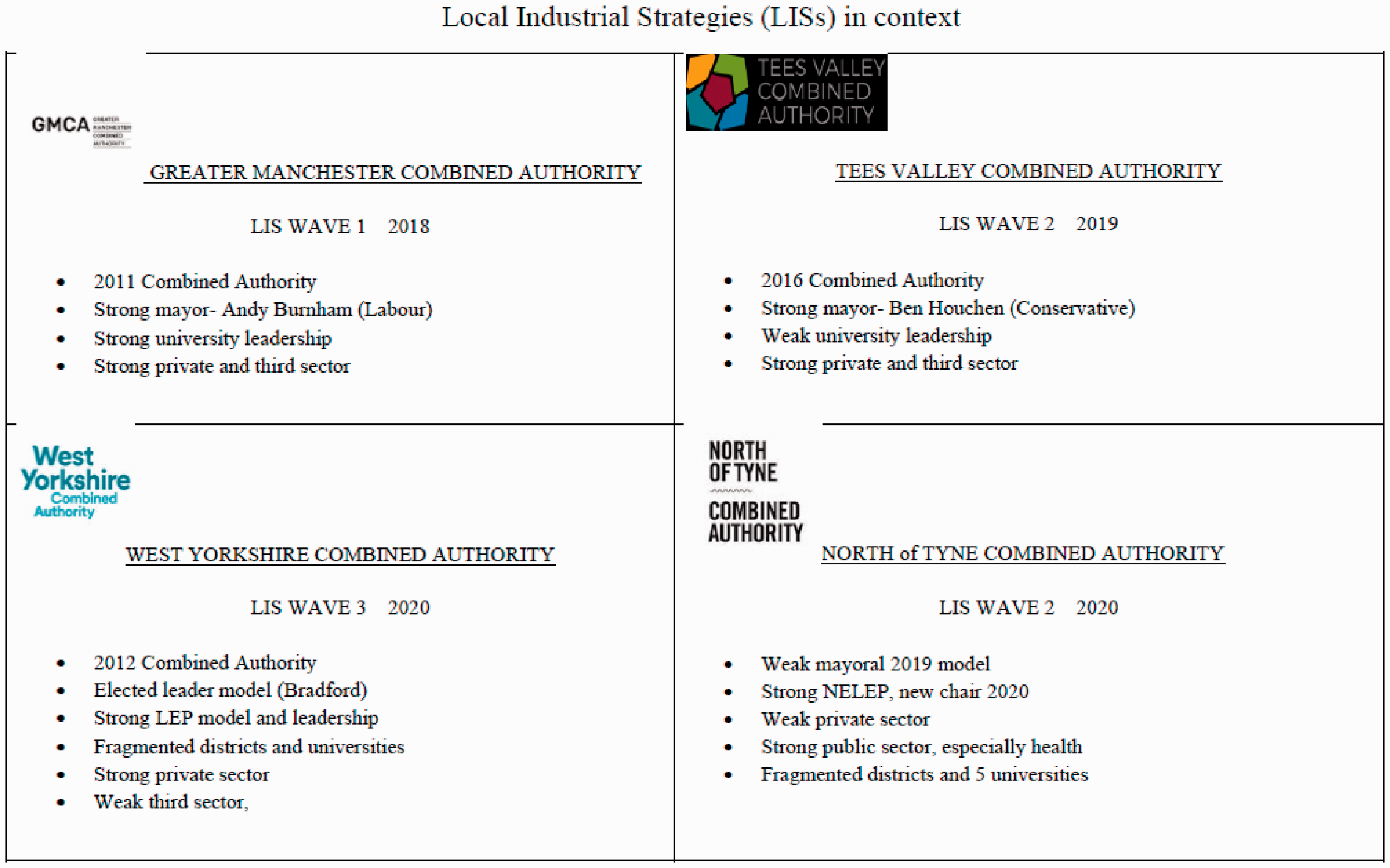
LISs in context. LIS: Local Industrial Strategy.
GM
In GM after a comprehensive, six-week formal consultation, GM LEP in agreement with central government published the first modern LISs to identify long-term industrial development priorities for growth. LIS was co-designed with business, the community, the voluntary and social enterprise sector and citizens. ‘Our People, Our Place’ (Greater Manchester Combined Authority Strategy, 2020) identified five foundations of productivity – Ideas, People, Infrastructure, Business Environment and Places, and was grouped under four Grand Challenges – Artificial Intelligence and Data, the Ageing Society, Future of Mobility and Clean Growth. All exemplified the foundations of productivity contained in the Grand Challenges of the NIS.
The LIS was developed to capitalise on the city-region’s unique assets and opportunities over the long-term to position GM as a global leader on health and care innovation and advanced manufacturing materials, and to become a leading European city region in media/creative and digital, cyber security; and carbon neutral living by 2038. Place leaders have the ambition that GM will become the UK’s first city-region with a clean growth mission and an advanced materials city facilitated through the pioneering Graphene, Advanced Materials and Manufacturing Alliance which will address gaps in the commercialisation and diffusion ecosystem for graphene, advanced materials and industrial biotechnologies. There is a long history of joint working in GM, and leaders effectively grafted devolved powers on to existing joint working arrangements. Its longevity has enabled the mayor, Andy Burnham (Labour) to achieve a high profile regionally and nationally, and to capitalise on existing strong relationships with city leaderships across university, local government, other public/private sector and voluntary/third sector organisations.
Not all other local authority areas across the NP had the capacities and resources to drive sustainable change on the GM model (which has long been regarded as the ‘ideal’ CA). Undoubtedly, from a central government perspective at least, the GMCA model set the pattern for other territories to follow and attention is turned next on the NE, an area with a highly fragmented governance map; one that significantly lags behind its counterparts, not least as city leadership has largely failed to engage in crucial pan-regional NP decision making forums, which remain dominated by GM, Liverpool and West Yorkshire.
The NE – Two sub-national territories within one region
The NE region now has a highly fragmented governance map with a Labour mayoral CA in North of Tyneside, a Conservative mayoral CA in Tees Valley and a middle void where a mixture of different politically represented local authorities across the remaining territory is far from clear about its long-term local government and sub-regional future. Figure 2 illustrates the complex and fragmented nature of NE governance and leadership.
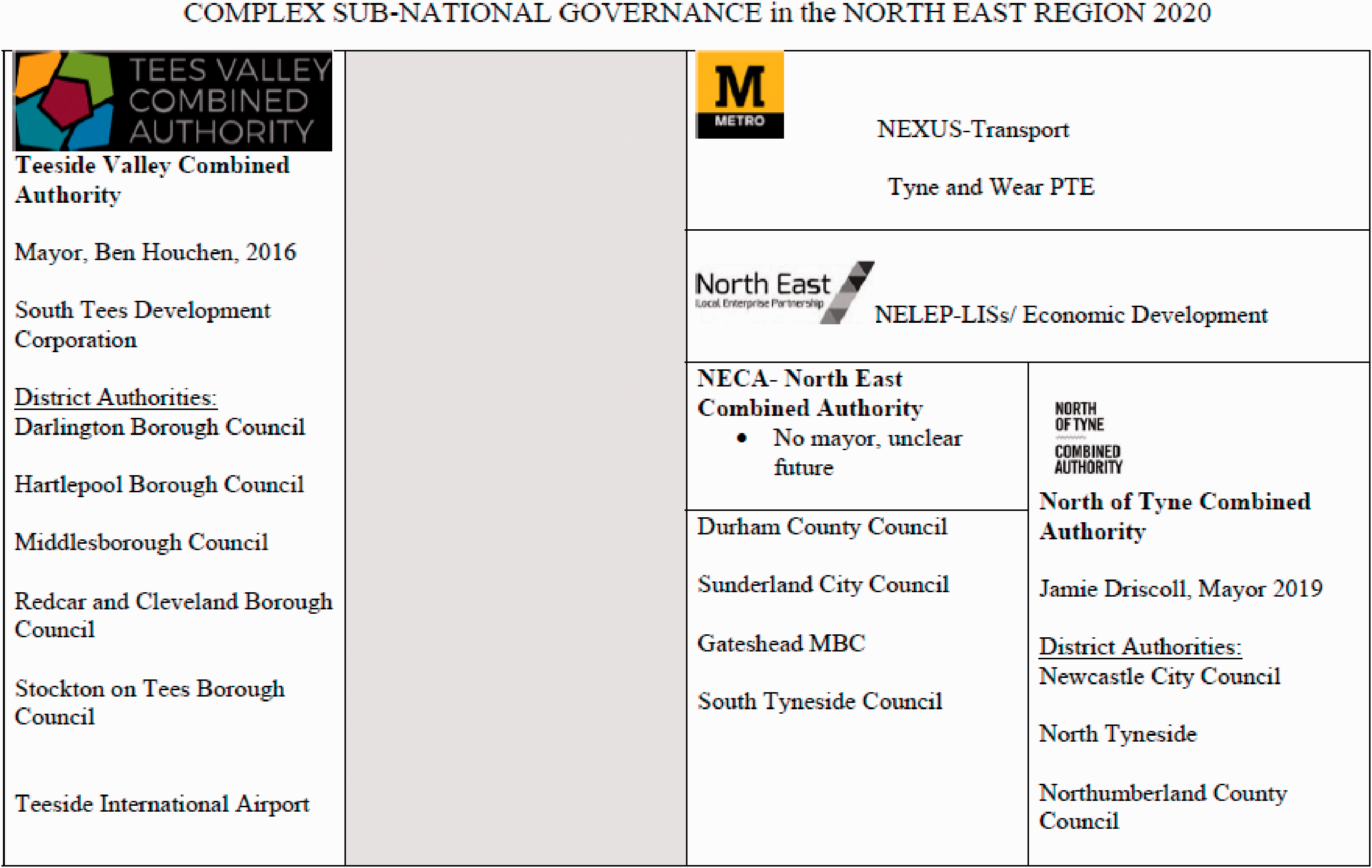
Complex sub-national governance in the NE Region 2020. MBC: metropolitan borough council; NELEP-LIS: North East Local Enterprise Partnership-Local Industrial Strategy; PTE: passenger transport executive.
Far from resolving some of the confusion on governance, these weak governance arrangements were exacerbated by the 2019 General Election, and added to the problems of developing economic development objectives through a LIS. Central government’s reliance on a growth model embodied in the NIS, and uncertainty on a stalled consultation on the shape of the UK Shared Prosperity Fund as a replacement for EU Funds, added to confusion. They also reduced the capacity for city leaders to deal with on-going and deep seated ‘wicked issues’ and environmental legacies of a former industrial past, right across the region. The NELEP is in the driving seat for the northern part of the NE LIS but its consultation has not advanced far and is slowly developing relationships with North of Tyne CA (NOTCA) and its Teesside equivalent in the southern part of the NE (Tees Valley CA (TVCA)). The doughnut middle territory between the Rivers Tyne and Tees, not currently part of any CA (though part of LEPs) but notionally operating under the North East Combined Authority (NECA) framework, makes it an even more difficult task for the public in understanding current governance arrangements, as the following examination demonstrates.
North of Tyne
In the northern part of the NE, NELEP, the body responsible for developing the LIS Strategy, is chaired by a board led by a former Chief Executive Officer (CEO) of a local manufacturing company and supported by 18 further representatives from public, private and educational sectors (including universities and FE colleges), as well as the leaders and elected mayors from the seven local authorities and one CA (NOTCA, Newcastle, North Tyneside, South Tyneside, Northumberland, Gateshead, Durham and Sunderland). The board is supported by officers responsible for strategy, policy and research, business growth, skills, innovation and communications and for developing the SEP. NELEP’s annual performance review was undertaken by Ministry of Housing, Communities and Local Government at the end of 2019 and regarded as good on governance and delivery, plus exceptional on strategy. The current SEP was based on a 2015 independent economic review and evidence base (2015) that identified four growth areas – digital, advanced manufacturing, health and life sciences, and energy, but also recognised key sectors in education, financial, professional and business services, transport, logistics and construction which were seen to offer potential for skills development and better jobs to facilitate economic growth. The SEP’s ambitions are being delivered through programmes in business growth, innovation, skills, employment, inclusion and progression, transport connectivity, investment and infrastructure.
Although Durham, Sunderland, South Tyneside and Gateshead local authorities are all represented on NELEP through the leaders’ LA 7 Group, the NOTCA led by the mayor (Driscoll) only represents the interests of local authorities north of the river Tyne (Newcastle, North Tyneside and Northumberland). The local authorities south of the river Tyne (South Tyneside, Sunderland, Gateshead and Durham) voted against having a NECA for the whole of the NE (thereby excluding Tees Valley where there is a separate mayoral CA – to be discussed in more detail later in the paper) and what was considered to be the imposition of a mayor as part of the agreed devolution deal.
NOTCA was established in May 2019 and the mayor is supported by a cabinet of all leaders and Deputy leaders from Newcastle, North Tyneside (which has its own local authority
In terms of governance and accountability, NOTCA has a constitution outlining all roles, responsibilities and decision making processes, and has committees (with representatives of all local authorities, NELEP, and the voluntary and community sector) devoted to transparency on spending, due diligence, audit and standards (in line with CIPFA auditing standards), overview and scrutiny, and produces an Annual Governance Statement and Annual Review and Assurance Framework. The first Annual Review was signed off by the mayor and the leader of Newcastle City Council in December 2019, but this CA’s short existence renders the mayor lacking the strength of Manchester’s mayor Burnham or Tees Valley’s mayor Houchen. Moreover, mayor Driscoll has nowhere near the same level of resources and capacity for intervention as his Manchester counterpart, nor the same level of longevity, business/third sector or university support, or high media profile as mayor Ben Houchen in Tees Valley, as will now be discussed.
Tees Valley
In the south of the NE, the mayoral TVCA was created in April 2016, and the high-profile Conservative mayor was elected on 4 May 2017, thereby stealing a three-year march on his NOTCA counterpart. He achieved prominence as the youngest and charismatic leader of a Northern sub-national territory while Prime Minister Teresa May was in power; indeed, he claimed to have a direct and open-door entrée into Downing Street (interview, 2018). Like other mayors, he was elected on a mandate to drive economic growth and job creation in the area. TVCA is a partnership of five local authorities – Darlington, Hartlepool, Middlesbrough, Redcar & Cleveland and Stockton on Tees – who work closely with Tees Valley LEP, the wider business community and other civic partners on transport, infrastructure, skills, business investment, housing, culture and tourism.
The mayor chairs the cabinet which contains leaders and other councillors from districts and unitary authorities, and includes the newly elected mayor of Middlesbrough Council (but not the other mayors, who are ceremonial rather than elected; however, one does serve on the Overview and Scrutiny Committee). The chair of the TVLEP is a local businessperson who is a cabinet member of TVCA, and after the 2020 local elections, the cabinet composition changed to include more independent councillors. As well as having a constitution outlining the governance arrangements based on Nolan principles, there are overview and scrutiny, audit and governance, and transport committees, and the LEP. However, the LEP is chaired by a business person and has a broad membership of private and public sector representation from education, health, voluntary sector and the port authority, but all other committees have membership consisting of councillors from all major parties (with independents mostly sharing a one-third of all committee seats). TVLEP was the first one of the LEPs across England to have a female, voluntary sector board member (interview, 2011).
All LEP business is supported by a large secretariat (in comparison to NELEP) with officers from finance, housing, resources, culture and tourism, communications and marketing, skills, education and enterprise, commercial and delivery, transport and infrastructure. In addition to a SEP, TVCA must produce an Annual Statement, Investment Plan and Budget, Audit Plan, Risk Assessment Plan and Assurance Framework, based on CIPFA standards. All projects and programme plans must be submitted to the Overview and Scrutiny Committee and/or the Audit and Governance Committee. Two notable 2018/9 reports identified the close relationship between the mayor’s dual roles as chair of TVCA and chair of South Tees Development Corporation (STDC), and the links between STDC, TVCA and Goosepool (external auditor), but minutes confirm that due processes had been followed (Tees Valley Combined Authority, Committee minutes, 2018–2019–2020, TVCA).
TVCA launched a Mayoral Development Corporation (MDC), STDC in August 2017, covering 4500 acres of land south of the River Tees, including the former SSI steelworks site. It is the only MDC outside London, and home to numerous companies: the Port Authority, British Steel, Northumbria Water and Redcar Bulk Chemicals, and the deep-water Tees Port. MDC is one of the North’s future Freeports under the current Conservative Government plans and will come to fruition with an expected autumn Treasury 2020 announcement, prior to Brexit. As chair of TVCA and STDC the mayor has very ambitious plans for the area, as shown in the TVCA SEP (2019). TDCA has also acquired Durham Tees Airport and renamed it Teesside International Airport and the mayor was in negotiations (prior to the coronavirus lockdown and associated air travel problems) with a variety of air passenger and freight companies. This acquisition is now the largest and financially riskiest investment project in the TVCA portfolio, particularly given the COVID impacts on aerospace and air passengers, yet it is not entirely clear how the resources of the LIS are to be brought to bear on unlocking the airport investment and how this is to be linked to the Freeport proposals and strategy.
Historically Tees Valley has flourishing business and civic sector leadership relationships, and this is a major reason for the rapid establishment of TVU, the LEP (then Tees Valley Unlimited) and TVCA, in comparison with its Tyneside equivalent. There is political in-fighting, as in other territories, but nowhere near as prevalent as in local authorities in the northern parts of the region. Moreover, Teesside’s long commitment to strategic planning through TV Joint Strategy Unit (TVJSU) and Tees Valley Regeneration and Tees Valley Development Corporation; arms-length bodies of the then Cleveland County Council (abolished in 1986) were already renowned for the capacity to collect excellent data across the territory and produce excellent strategic reports (Liddle and Ormston, 2012).
The legacies of TVJSU are still apparent in the more recently established governance arrangements, so path dependency is evident. In the Tees Valley, place leaders have attempted to unlock negative path dependencies and create conditions for new paths to emerge, and mayor Ben Houchen is the latest in a long line (Neffke et al., 2011: 241). Conversely in the North of the Tyne territory, path dependencies and entrenched political in-fighting act as a significant constraint on action. Despite the usual political skirmishes evident in other sub-national localities across England, in comparison to the northern local authorities in the NE, there does apparently appear to be more political cohesion, despite differences in political ideology. Indeed, at the 2020 General Election, as the ‘red wall’ fell across the NE, many newly elected Conservative MPs credited their success at the ballot box from the ‘Ben Houchen effect’. TVCA and TVU work on a jointly published Draft Industrial Strategy (Tees Valley Combined Authority, 2019), focused on transforming economic performance and increasing productivity. This was in the process of submission for central government sign off in the week prior to the COVD 19 lockdown, but is now in abeyance (interview, 7 April 2020). It builds on a distinctive local economy, around the niche offer of clean energy, low carbon and hydrogen. At the heart of the framework is an overarching ambition for Tees Valley to be a global leader in clean energy, with a net zero carbon industrial cluster in place by 2040. The strategy aimed at establishing the cross-cutting foundations of ideas, people, business environment, infrastructure and place and involved a very broad cocktail of place leaders (including business, university, public and voluntary sectors).
So at least two LISs are largely being developed independently across the NE; in Tyneside by NELEP (including the territories in between, i.e. Durham, Sunderland, South Tyneside, Gateshead, who are members of the NELEP) and in TV by TVCA. Neither of these LISs has the capacity to knit together the Newcastle–Gateshead or Middlesbrough urban regions, the coalfield towns and villages, cities and rural local communities in-between into a cohesive whole. Also absent is a united voice for the region, and the fixation on current growth models is not entirely appropriate to the socio-economic profile of the region and may further damage its future. Multi-spatial levels of deprivation are accelerating, particularly in the Tees Valley area and there needs to be a better assessment of some of the crucial issues facing leaders at pan-Northern, city-regional, and community and neighbourhood multiple scales of delivery. As previously stated, NELEP and TVCA were in Wave 2 of the LISs, but the level of consultation does not appear to have been all that substantial. We now turn our attention to West Yorkshire and the development of its LIS which was in Wave 3, and where substantial consultation was evident.
West Yorkshire
In West Yorkshire the CA is a leader-led organisation (leaders take it in turn to be the chair – the current leader for the CA is the leader of Bradford City Council), therefore the Leeds LEP is the formal organisation taking the lead on the LIS. The ‘strong mayor’ model does not exist here yet. Consultation started in October 2019. The LIS is a long-term plan for Leeds City Region, developed in partnership, to harness the strengths of the local area. Leeds LEP must work closely with the West Yorkshire CA and the leaders and CEOs and tensions arise between elected leaders of local authorities and what is perceived to be an undemocratic and un-elected, nominated LEP board. In Leeds City Region as a whole, however, a lot of work has been done in the past on bringing the key partners together and looking at the role of anchor organisations in the labour market as a whole (Devins et al., 2017). There is strong partnership working across the City Region, with five active universities and exemplified by the bid and campaign to bring Channel 4 to Leeds City and success in developing the cultural industries. The LIS is designed to boost productivity and transform the City Region, building on strengths, improving people’s skills and helping businesses grow while tackling the climate emergency, so everyone can benefit from a strong economy. In developing the evidence and policies, Leeds LEP worked in partnership with the West Yorkshire Combined Authority (WYCA) and engaged with over 750 people at more than 50 events, working with regional, national and international stakeholders, as well as with schools and youth groups (Leeds City Region, 2019).
West Yorkshire has ambitions to build on sectors like healthcare. In developing the LIS, the LEP identified a unique position as a world leader in healthcare technologies. The LIS claims that Leeds City Region has the UK’s largest concentration of medical device companies, is a world leading life sciences cluster and at the centre of public healthcare in the UK. £130 billion funding for NHS Commissioning, leadership development and digital advancement has facilitated the development of crucial public and private sector healthcare data platforms. Roger Marsh OBE, chair of both the Leeds LEP Partnership Board and the new LEP Eleven Northern Partnership LEPs argues Our unique concentration of healthcare assets and expertise gives us unparalleled opportunity. Harnessing these distinctive assets could address the health issues people in our region face, lead to new treatments, and help us play a full role in solving global and national challenges like the ageing population.
Leeds LEP, like the other LEPs was on track to submit its LIS to BEIS and central government for the March 2020 budget and subsequent discussions for a constructive conversation with the new Boris Johnson Government. There is no way of knowing if the comprehensive consultation exercise did produce genuine reflection of the city-region’s economy and resulted in a clear set of local priorities developed by local leaders, because like other city regions under investigation, the LIS process was suddenly overtaken by the COVID 19 and changes surrounding Rishi Sunak’s appointment as Chancellor. All CAs and LEPs were expected to hastily produce individual recovery action plans for their localities during 2020, and the work on LISs has been side-lined.
Discussion
There is limited comparative analysis of LISs either across England or beyond in Europe, or major global economies. The findings in this paper reveal that LISs were a central government imposition, and although the templates on which they were based held potential for shaping new local economies, many were forced and stilted and some, as the cases illustrate, barely achieved a local airing. In reality, the scope for local discretion was constrained because despite LISs being part of central government’s devolutionary processes, in fact the fragmentation and blurred boundaries of governance in all cases militated against real and effective discussion of local priorities. Significantly there was no real engagement of Members of Parliament in any of the case study areas with regards to identifying or shaping local priorities.
Each locality placed certain priorities on the LIS agenda but all responded to a massive volume of challenges within a very uncertain global and national context, not least with the uncertainty of Brexit and now the COVID 19 challenge overtaking and threatening to severely weaken many local economies.
The findings show that despite apparently similar trajectories in response to NIS through the need to develop LISs, in fact the concept of ‘contestation’ is a historical and ‘locked in’ feature of city leadership processes and practices. Prior, enmeshed relationships act as a significant constraint on transforming ‘places’, as each geographical ‘space’ has a different history, leadership culture and socio-economic profile. Consequentially, these factors lead to varied social constructs, values and determine how new organisational forms evolve.
In developing LISs, local authority leaders often felt too detached, despite being aware that local economies urgently need an overhaul beyond the next initiative and deal. They had only a tangential or arms-length role, played out through their representative role on CAs and LEPs. The mayors of GM and Tees Valley seem to be the most advanced in their thinking on transformation, whereas in West Yorkshire and remainder of the NE, the LEP was the predominant agency, drawing in other agency and business leaders as and when needed.
With respect to civic organisations, in all cases, business voices were articulated through various means; some were engaged in their individual capacity, others through their company role, but many became involved through business organisations (such as Chambers of Commerce, or business forums). The strength and weakness of the business voice was shaped historically, as in the case of GM and Tees Valley, where business had much longer engagement in Place Leadership, whereas in West Yorkshire and North of Tyne business is more fragmented and lacking a cohesive approach. Despite manufacturing and services being crucial elements in growth, and skills development a primary concern, the role of universities in Place Leadership was variable across all four cases, as was the role of the third and voluntary sectors (with Tees Valley claiming to have the first third sector LEP member in the country). Anchor institutions such as universities are even more significant place leaders in some of the weaker and fragmented regions, because COVID 19 exposed the weaknesses of both the UK’s manufacturing economy and services within a global economy. Public spending across the whole NP region fell in real terms (by much more than southern regions), so there is a dire need for investment in skills and the social infrastructure which is long overdue. This is where the role of further and higher education requires much more specification in both the LISs, and in the ‘Levelling up’ processes. The proposed Knowledge Exchange Framework (KEF) could possibly help universities think through their strategies better and the work of the Civic Universities Commission is also trying to strengthen this element but their role requires far more recognition in the ‘place shaping’ agenda.
The role of voluntary and third sectors has taken a central position in supporting local authorities in responding to COVID 19 in deprived areas of the country. It is vital that the Recovery Plans begin to take stock of what is changing and set about the huge task of re-shaping their localities but there is little point in embarking on new plans without effective and collaborative place shaping and Place Leadership.
Conclusions
The four cases illustrate how explicit patterns of Place Leadership developed in different places, as each is a product of its own socio-economic and political path dependency and history. Also, all the cases provide evidence of varying levels of conflict and cohesive strategic approaches to developing LISs. Furthermore, GM as the first Wave 1 locality had been in existence much longer than the Wave 2 and Wave 3 LISs, and therefore continues to be held up as the ‘ideal’ model for other places to aspire to. Clearly, city leaders in GM, and supported by a strong mayor (Andy Burnham) who has ministerial experience in Westminster, were able to lobby central government more strongly to draw down funds and powers to facilitate their growth model. As Haldane’s NISC Annual Report, 2019 found, most of the other LISs had very limited, and in some cases no, funding associated with them. This lack of funding and powers has constrained an equally rapid development of Wave 2 and Wave 3 LISs.
The LIS process had not been universally effective, prior to COVID 19, in clarifying local priorities and in allowing leaders to think through how they wish consultation and conversations to proceed. Outside of GM and West Yorkshire City Regions the framework for conducting the negotiations appears inadequate with clearer specification required of what is being delivered at NP meso regional level and what is being delivered in devolved CAs and rural County areas. Moreover, now because of COVID 19 mayoral leaders of CAs need a much clearer view of priorities and how to harness key anchor organisations including both the health sector and universities as well as the private and civic sectors. In the NE there is a concern that conversations are stilted and that CAs need more support and resources to match their big city counterparts in Leeds and GM. Far from focusing on productivity, inward investment and the economic models of growth, across the NP, place leaders need to be capable of delivering economic and social justice, including what matters to local communities, such as health and wellbeing, and inclusive growth embedded in LISs. In this respect, cohesive Place Leadership across the whole of the NP will be an imperative for a post Brexit and post COVID 19 future.
The imminent Northern Powerhouse Refreshed Strategy also needs much wider debate and to be more inclusive if it is to deliver benefits for all its component parts across the very diverse northern geographies and economies, with quite different economic and social histories, governance frameworks and place leadership approaches. The current governance fragmentation and obsession with large transport, police and NHS expenditure plans cannot solve the deep-rooted economic and social problems evident in local communities where a much better neighbourhood focus is required on education, training and local transport and social policy services. Furthermore, the COVID 19 epidemic has re-emphasised just how unprepared the northern regions are to respond to such externally driven crises without further investment in the social fabric, as the following quote indicates: Do bear in mind that LISs were based on an assessment of our economic base pre-Covid 19, and many of our declared priorities are now up ‘in the air’, due to the imperative to develop rapid Recovery Plans for assessing the current devastating and catastrophic threats to local businesses and local communities. (interview LEP representative, 7 April 2020)
Footnotes
Declaration of Conflicting Interests
The author(s) declared no potential conflicts of interest with respect to the research, authorship, and/or publication of this article.
Funding
The author(s) received no financial support for the research, authorship, and/or publication of this article.

Note
1. The NPLEP 11 is made up of the 11 Northern Powerhouse LEPs and was established in 2019 to coordinate the Northern LEPs. It is led by the Chair of the Leeds City- Region LEP Roger Marsh OBE DL.