




Abstract
Temporary public art sculpture trails (T-Pasts) have been used for over 20 years around the world to fulfil a number of objectives. They can help to generate revenue for host towns and cities; they can contribute to place branding; they can provide entertainment for residents and visitors; and they can raise funds for designated charitable causes. They typically feature object characters that have a relevance for the host place and they invariably utilise the same operational model. They receive significant local publicity and various claims are made concerning their economic, social and aesthetic impact. But there is a case to be made that they are ‘hidden in plain sight’ as some people will walk or drive past exhibits without ever seeing them. In this article, we track the history of T-Pasts, categorise them into different types, examine their value for different stakeholders, discuss their various impacts and offer a conceptual impact model. We conclude the article with a discussion that contextualises T-Pasts in relevant themes, including place enabling and place building, and also the significance of the temporary element.
Keywords
Introduction
One means by which some town and city centres seek to increase their cultural and aesthetic impact for local residents and (non-local) visitors to the location is permanent artworks and sculptures; where space permits, one can find permanent built sculpture trails. Commissioned street art in general – as well as non-sanctioned street art (graffiti) – makes a complementary contribution. These, together with other temporary events, can attract large numbers of visitors (both local and from outside the location) and generate spending. The display or the event, be it temporary, semi-permanent or permanent, generates various outputs and outcomes relevant for a variety of interested stakeholders, each of whom will see their significance and impact through a lens that is most relevant for them. This lens could have a local, national or even international focus; it could be fundamentally economic, social or cultural.
This article analyses the nature, outputs, outcomes and impact of an alternative, but complementary event, which is place building, place celebrating, place promoting, place enabled, place enabling and place exploiting: namely Temporary Public Arts Sculpture Trails – a description we choose to shorten to T-Past. Whilst growing in popularity year-on-year, research into T-Pasts is limited, something we seek to remedy with this article. Although individual T-Pasts are associated with specific locations – the host town or city – the accruing benefits need to be evaluated across a much wider canvas. From a tourism perspective, the host town is a destination – which would be looking to increase its attractiveness and sell itself (Mordue, 2017, 2018). T-Pasts feature various (and sometimes distinctive) themes whilst applying mostly the same underlying operational business model.
One key common feature is that all the sculptures involved in an individual T-Past use the same 3D blank shape and model, but then each one is decorated individually to create artistic difference. In some cases, very high profile professionals and celebrity figures have been prominent supporters and artistic contributors. The sculptures are arranged along a predominantly outdoor trail. Physical and online trail guides will be available to guide people to the various locations and to draw attention to the whole collection. Many T-Pasts offer themed memorabilia to the event visitors. The theme, together with any subtle elements of distinctiveness, will influence the interest, reactions and engagement from the media, the general public and any specifically targeted individuals; related charitable causes (when relevant) will have some effect on the fund raising potential. At the end of the time-constrained events (the period of time when the pieces are on public display), the sculptures are auctioned to raise money for a designated charitable cause (or causes) – which may or may not have any direct association with either the event theme or the host location. The community in which the art is displayed may not be the stakeholder that benefits most from the money raised. That said, the community interest and engagement may be motivated more by social and cultural factors, though a positive revenue stream will clearly matter.
In the context of today’s society, we question whether the lack of investigation might be a seriously missed opportunity. Social media behaviour (witness the popularity of Instagram and Snapchat) and fast fashion are two other examples of the popularity of transience as distinct from permanence for many people. We might further draw a parallel with temporary exhibitions in galleries and museums, which can generate serious revenue, in part by attracting new visitors who might well return to enjoy something else, creating a snowball effect.
The inclusion of the word ‘public’ is deliberate as there are outcomes which are relevant for the general public, even though the event itself is not owned by the public at large. Reflecting and building on earlier work on space and place (see Hudson, 2001) we use the word ‘place’ extensively in the paragraphs above, in part to allow consistency, when an argument might be made that ‘space’ might sometimes be more accurate. Because the sculpture trails are temporary and non-permanent (in their host space) the underlying issue is the impact (again temporary or lasting) they have had on the sense of place pertinent to the space. We distinguish place enabled and place enabling as follows. Enabled acknowledges that a location (which will have a history and have become a recognised place) exists, that it can be used and the ‘owner’ of the space is supportive of it being used – with the assumption there will be a positive effect of the perception (and hence value) of the place. The place owner will benefit, as well as those who are using it. By definition, as there is always a host location, every T-Past is enabled when it is given permission to go ahead. Enabling is about making a place more attractive (see Florida, 2002) and thus contributing to place building; it acknowledges that as a result of the event happening, there is some likelihood the sense of place will be changed. The T-Past will have created a change of perception; in this way, the T-Past has itself been an enabler. The term place enabling is used to explain this latter process. The assumption of the owner will be that the new sense of place will attract new people.
To add a layer of complexity: realistically every key stakeholder is exploiting the existing place for different reasons, although these can be complementary. We separate the term exploiting to capture the intent and motivation of the stakeholders who are using the place deliberately to generate economic, social or aesthetic value. This can include the host local authority, of course, and it would certainly embrace some engaged charities and organising businesses. In each and every case, the individual focus of any stakeholder can be single-minded and maybe even selfish, such that their interest in the benefits that matter to people other than themselves might be very secondary. There is some element of exploiting the other stakeholders. Clearly, then, there are overlaps and subtle nuances here, but we believe the differences need to be identified. As examples of these points: an Elephant Parade in a shopping mall in Hong Kong helped promote the centre and clearly benefitted the organisers and the relevant charities (Kok and Francis, 2014). The Bee in the City (Manchester) T-Past had a serious local connection and monies raised went to the Lord Mayor’s charity – We Love MCR (Wild in Art, 2018). The busy worker bee is featured on the Manchester Coat of Arms as a symbol of the Industrial Revolution, and thus the T-Past celebrated Manchester’s history; it drew on the existing place brand (see Boisen et al., 2018). Subsequently to the bombing following her 2017 concert at the Manchester Arena, Ariana Grande had a tattoo of the bee which drew wider and younger public attention to the motif. A few of the sculptures were left on display after the T-Past.
These events will all deliver some benefit to their locality, however small, possibly transient and qualitative that contribution might be, and so, place branding and culture-led regeneration are also relevant for understanding the context. The focus of this article, though, is on value created, outcomes and impact.
T-Pasts: A brief explanation and history
The most recognisable T-Pasts are probably Cow Parades (the first acknowledged T-Past was actually Cow Parade in Zurich in 1998) and Elephant Parades, both themes having been used on more than one occasion in various locations worldwide. The (approximately) 80 parades worldwide make Cow Parade the largest of a type; and the organisation behind them is also a significant organising business; and they have been followed by T-Pasts featuring a wide range of other animals, objects and characters. Naturally, within individual host localities, any visible and locally popular T-Past will receive most of its publicity locally. There is an established supply chain, with Wild in Art the most significant UK business involved; it provides blank models, helps with promotion and is willing to organise the whole event for any commissioning town or city. Many other (often small) businesses offer specialist support and receive benefits. T-Pasts are now well-established in the UK but the level of public awareness generally (and reliant on media support and promotion) might be seen as disappointing for their organizers. In fact, one might argue that they are ‘hidden in plain sight’.
In the following narrative, we offer a number of alternative classification possibilities in a search for the most appropriate taxonomy (without suggesting one definitive answer). We first focus our discussion on the T-Pasts introduced in Table 1; we separate these into two broad types, to show the subtle variations in their business models. Later we: offer an insight into a surprisingly complex supply chain by comparing and contrasting the motives and expectations of the participating and benefitting stakeholder communities involved; and later contextualise the tangible/intangible and direct/indirect benefits accrued by the various stakeholders and use these to build a framework for a conceptual impact model. Appendix 1 illustrates sculptures from five T-Pasts.
A selection of important T-Pasts, 1998–2018.
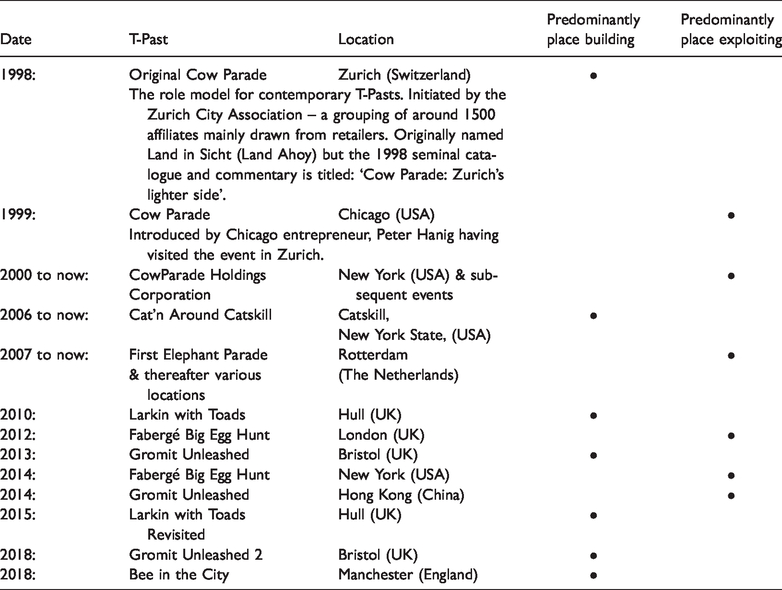
Table 1, which lists seven notable examples (from many more) in date order, separates two broad types of T-Pasts. The ones in the right column are described as ‘place exploiting’ because there is no automatic link between the host town or city and the theme of the event. The Elephant Parades have always been more strongly associated with the charitable beneficiaries than their locations, although there will be some benefit from being a host. Elephant Family (linked to Elephant Parade and other T-Pasts) is a smart and well-regarded charity and social enterprise caring for Asian Elephants, but they have a sharp and effective commercial approach. The two Big Egg Hunts have direct links to Fabergé (which has been ‘under new ownership’ since 2007) but these T-Pasts were both fund-raisers for Elephant Family.
Other T-Pasts are ‘place building’ having themes with clear local relevance in promoting that area whilst raising money for mainly local charitable causes. The first Cow Parade is listed here as it had a strong direct link to Zurich, but subsequent worldwide events have been more place exploiting. Cow Parade now boasts the attributes of the market leader; it is a commercial operation that has generated millions of dollars for social causes. Cat’n Around Catskill in New York State is well established but intentionally has very local objectives. Larkin with Toads (Hull, UK) celebrated their local poet Philip Larkin 25 years after his death; two of his most celebrated poems feature toads. Gromit Unleashed is relevant for Bristol, as the home of Aardman Animations Studio which made all the Wallace and Gromit animated films.
In every case, the causal factors, the effects and the outcomes need to be considered. The direct causal factors are the physical event itself (which might be termed a space-related input) and the people and organisations attracted to support it and become directly engaged. The visitors, local and from further afield, then make an indirect (uncontrolled) input. There are a variety of outputs, some, but not all, financial, and some more easily quantified than others. These all have an impact, which constitutes the outcomes for the various stakeholders. This is, in effect, the result of the place created within the space; it reflects what the event means to people. We explain below how these outcomes are perceived differently by the various interested stakeholders. The fact that the different stakeholders have their own reasons for choosing to engage and participate, and different priorities for the outcomes, does not matter in our opinion, as long as they can all feel satisfied with the overall achievements. That said, it does matter that all those engaged in the event have some appreciation of what others are looking for – and that it is important to help others achieve their expectations.
There is potentially going to be a different ‘feel’ (and sense of place) if a T-Past is organised by either an experienced national charity or a professional event management business as distinct from a local organiser – which might even be learning as the event unfolds. National charities might be expected to have an underlying business lens, whilst a local charity might simply see itself as a fortunate beneficiary. A local authority is likely to have an interest in everything: the commercial, social and cultural outcomes and impacts. However, for different T-pasts in different locations, the emphasis on each of these might vary markedly.
Most of the outcomes will logically be examined at the public or community level, but there can be private beneficiaries. This happens when a sculpture is bought at auction for display, or as an investment, by an individual. Whilst T-Pasts have a very public face (for a constrained period of time) they also reflect the popularity for certain individuals, namely those who seek out several of the displayed sculptures, of collecting something that has some element of scarcity and challenge. For some events these are appreciated sources of secondary impact and branding; for others, such as Cow Parade, merchandising revenue is at the heart of the business model.
Method
This article has largely been written using a mix of secondary data and personal observations and interviews. T-Pasts attract press releases, media articles and social media traffic. There will be an inevitable subjectivity in some of this reporting. With some events there has been documented evaluation, where quantitative measurements have been utilised; these, though, will not uncover a comprehensive impact assessment. The money raised for good causes from auctions, for example, is normally published – but some of this may be used to offset certain costs and so is not automatically the amount actually handed over to the charities. In addition, the authors have visited a number of T-Pasts in the UK and overseas, especially America, and drawn their own conclusions from observing visitor behaviour and sampling trail guides and merchandising materials. They have personal views of particular artefacts and recognise ‘beauty is in the eye of the beholder’ when it comes to the chosen theme. Finally, there have been interviews with certain individuals who had a direct insight into aspects of the 2012 Fabergé Big Egg Hunt in London, which have clarified a number of issues.
Relevant underpinning literature
Decker (2002) is the seminal work, and having set out the history of the originating Zurich Cow Parade, considers the 30 (or so) American events in the two years subsequent to the 1999 Chicago Cow Parade. It is both a useful history and a critical evaluation of stakeholders, the meaning and authenticity of art, and business and marketing themes. The Zurich, Chicago and New York, Cow Parades all had illustrated commentaries that similarly offer insight into the aspirations of the stakeholders (respectively: Baumann and Weren, 1998; Craughwell and CowParade Holdings Corporation, 2000; Sullivan et al., 1999). Keyes and Barker (2007) illustrate and describe the 85 T-Pasts (out of the 200 local events across 38 states) inspired by Chicago, seeing them as a ‘tribute to creativity, collaboration and compassion’. Woodland and Shaw (2008) consider a major UK T-Past in Liverpool – Go Super Lambananas that was an integral part of the Liverpool 2008 European Capital of Culture programme.
Hanig (in Sullivan et al., 1999: 10) writing about the Chicago Cows on Parade concluded that ‘art is about breaking down barriers. It gets people to feel, to think, to react. So, when you come across life-sized cow sculptures covered in mirrors or gumdrops, cows that have been painted with elaborate themes or transformed into something else entirely, you can’t help but stop and think about what it means. All your preconceived ideas go out the window. Suddenly people see that art can be fun and that art can be interesting to everyone, not just people who frequent museums.’
Zottarelli et al. (2011) considered American events and conducted 90 interviews with organisers and 15 with artists in late 2002 and early 2003. Their central thesis was to consider how the creative tension between artists and the organisers was resolved. Organisers would most likely seek commercial safety in uniformity (of sculpture mould, marketing, etc.) and eschew controversy whilst artists would seek either artistic licence and push the boundaries, such as adding features to the basic shape, or, be accepting of the implicit compromises.
CowParade themselves argue that ‘there is something magical about the cow that transcends throughout the world’ (CowParade, n.d.). Császi and Gluck (2011) illustrated in their detailed study of the 2006 Budapest Cow Parade how the potential tension between such universality and the specific artistic/cultural/social/physical landscape in which stakeholders are located, will bring uniqueness to an event. Especially when there is, for some stakeholders, one particularly controversial interpretation of the artistic brief.
Pett (2015) considers the views of stakeholder groups and reports on the Gromit Unleashed Public Art Trail in Bristol in 2013. Stakeholders clearly enjoyed the event and despite the accompanying trail map many of them devised their own routes and encounters around the city. Pett was able to compare the differing preferences for favourite statues between those collectors buying at the final auction and those just visually consuming the trail. Pett also discusses the emotional attachment that people had to the statues by their reaction to the few cases of vandalism.
Palmer and Lester (2013) considered how individuals engage in tourism and how maps and brochures, etc. signal where to find the experience and which is then made ‘real’ by the physical and emotional interaction with those objects and places. They talk about their experience and engagement with the 2012 Fabergé Big Egg Hunt in London. Pinkhasov and Nair (2014) commented upon the appropriateness of the fit between the charity and the company in respect of increasing their customer engagement, so raising a general debate about the balance of commercial and altruistic motivations for such commercial sponsors.
Whilst there has been more extensive coverage of T-Pasts in social media and local newspapers, the reported research into their impact is limited. However, the literature on cultural artefacts more generally is extensive. By artefacts we mean something that has a physical presence within a defined space for a period of time, is alleged to make some contribution to culture whether it be popular or high-brow and may, or may not, spill over from the host community to the wider community. As with T-Pasts, it may exploit and complement an existing local culture or deliver new cultural experiences. We have identified six relevant themes and for each we offer a set of indicative references.
Theme One: The consideration of culture, cultural engagement and a sense of place and their interlinking: Andres and Golubchikov (2016); Bagiran and Kurgun (2016); Bassett et al. (2002); Bobadilla et al. (2019); Calinao and Lin (2017); Di Lascio et al. (2011); Etemad and Motaghi (2018); Jepson et al. (2013); Kang et al. (2018); Li et al. (2018); Nunes (2019); Sharp et al. (2005). Theme Two: The interaction of tourists and local residents and those residents themselves as visitors, and, the synergies and potential tensions between the two groups: Buch et al. (2013); Camprubí and Coromina (2019); Han et al. (2017); Pérez and Bernal (2017); Woosnam and Aleshinloye (2018). Theme Three: Reflecting upon lessons that can be learnt from permanent public art sculpture and trails and other forms of potential public art such as graffiti: Cant and Morris (2006); du Cros and Jolliffe (2017); Frost et al. (2015); Hansen (2016); McAuliffe (2012); Ross et al. (2017). Theme Four: Benefits flowing over time either from initiatives such as ‘city of culture’ or from the built environment: Campbell (2011); Gomes and Librero-Cano (2018); Jones and Ponzini (2018); Lazarević et al. (2016); Liu (2019); McCarthy (2006); McManus and Carruthers (2014); Pollock and Paddison (2014); Srakar and Vecco (2017). Theme Five: Economic benefits from events: Aharon-Gutman (2018); Arnegger and Herz (2016); Babu and Munjal (2015); Comunian (2017); Dzupká and Sebova (2016); Gibson et al. (2010); Hall and Robertson (2001); Herrero et al. (2011); O’Sullivan and Jackson (2002); Rahbarianyazd and Doratli (2017). Theme Six: Public and consumer fun and interest in comparable events: Andron (2018); Brida et al. (2017); Jahn et al. (2018); Kim et al. (2016); Park et al. (2008); Troisi et al. (2019); Vesci and Botti (2019); Yoon et al. (2010).
The nature of T-Pasts – Leading towards a typology
Developing the point made earlier, the motives and aspirations of the various stakeholders – and their relative influence over events – will affect how we might categorise an individual T-Past. Those with a predominant commercial lens would see a business opportunity the most convenient perspective; resources have to be provided and allocated, and securing a return in excess of all costs (direct and indirect) is a key measure of success. Once we factor in social and cultural considerations we might, though, feel more comfortable using the term social business. It is being run as a business, but its raison d’être is support of a particular charity or cause. If we were to assume that all surpluses go to good causes, then it might be possible to describe T-Pasts as social enterprises. That said, one complication here is that key members of the supply chain – such as the providers of the basic (unpainted) artefacts – are likely to be conventional businesses with shareholders and a driving profit orientation. The true motivation of sponsors may be commercial, although there may still be a valuable outcome for charitable causes. Charities may actually be the organisations that run a T-Past, rather than (simply) benefitting from the event, and so this could imply the T-Past is fundamentally a charitable event. The relevant business model, then, tends to be more diverse than the operational model.
Answering ‘what’ a particular T-Past is, and evaluating how successful it has been, is driven by an appreciation of why it is happening. Is it to promote a location/destination, a sponsoring organisation or a charitable cause? Or all of them; and, if so, who is the most important stakeholder? The target audience could literally be anybody who might be persuaded to become engaged and support a cause, ideally with some financial contribution. But the T-Past would also be expected to appeal to (and in some way be targeted at) people who are likely to be attracted by the sponsor and their brand; ideally, at some point, they will buy the sponsor’s product or service, although direct tracking of this link will inevitably be fraught with difficulty. The different stakeholders, and their perceptions (lenses) affect both our suggested typology and (later) our conceptual impact model.
Table 2 represents T-Pasts in the context of the different lenses prioritised by the various stakeholders. The diagram has three bands (rows) running horizontally. The Central band implies a focus on the event itself; the story of the T-past itself, and the theme chosen, is seen as significant in itself and it may not have any obvious connection to either the host town or city, or to any charitable beneficiaries.
Stakeholder lenses.
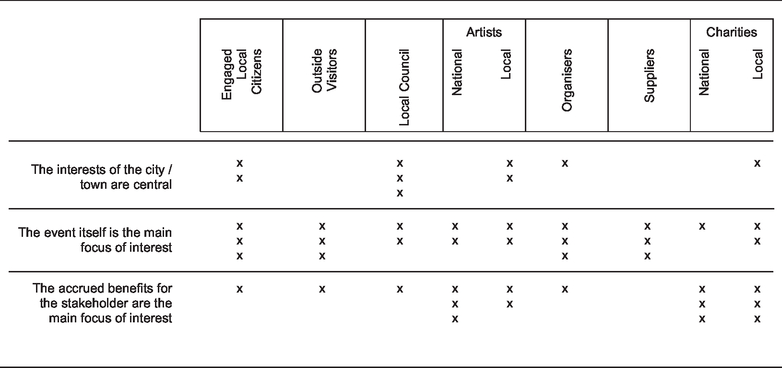
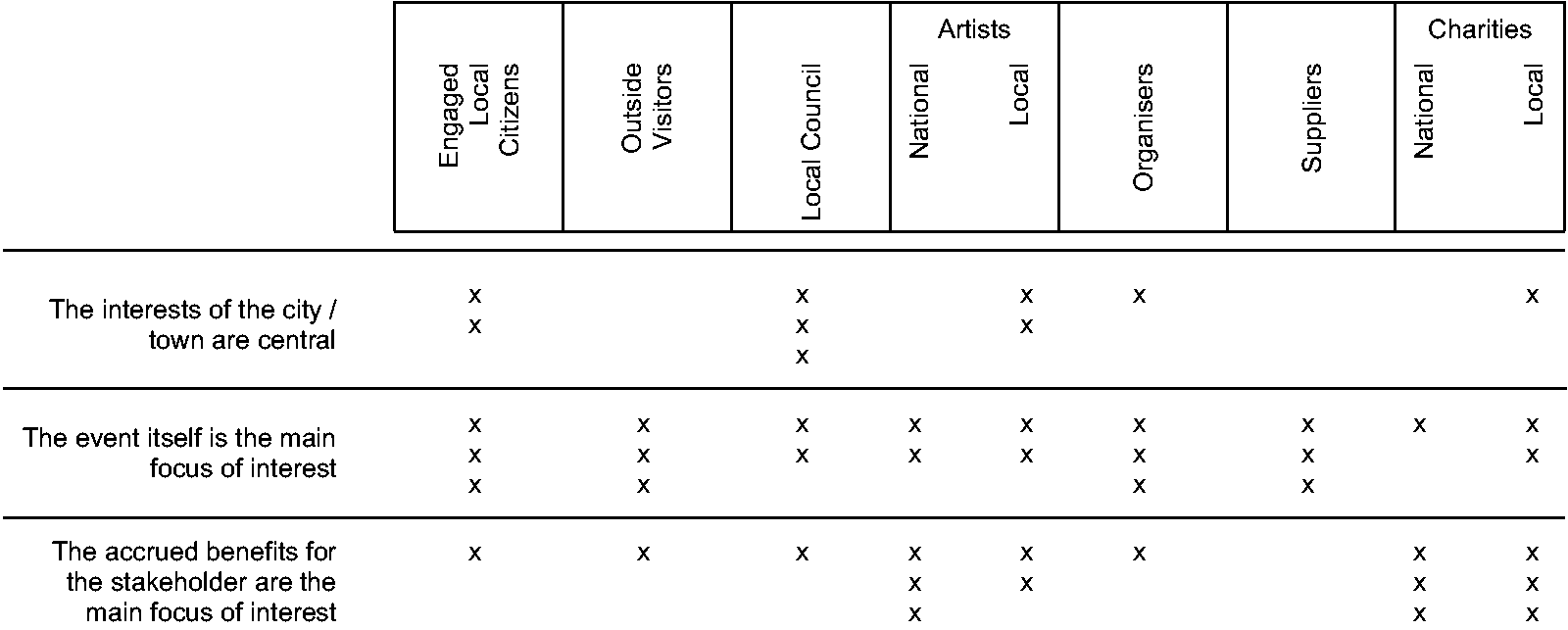
The top band implies the T-Past is focused on drawing attention, visitors and revenue to the locality; relevant examples are featured in the left column of Table 1. A specific host location may, of course, decide to run a number of promotional T-Past events and change the theme each time. Realistically the possibilities are boundless. Go SuperLambananas (Liverpool, 2008) showcased 100 customised replicas of an original 1998 sculpture by Taro Chiezo, namely a banana-shaped lamb to embrace that Liverpool had once been an exporter of lamb and an importer of bananas (Woodland and Shaw, 2008).
The bottom band is where the host city and the T-Past itself are both really vehicles for charitable fund raising and/or sponsor brand promotion. The theme of the London Big Egg Hunt for many seemed to have had little direct relevance for the adopted charities, in particular, the protection of Asian elephants (Elephant Family). Similarly, there was no obvious connection to London as a host city – but there was an obvious relevance for Fabergé, whose new owners were concerned with the brand building potential. Elephant Parades are an example of T-Pasts that have been organised in different venues around the world, but generally related to elephant charities; elephants have, in fact, proved to be very transferable. The same sponsors have sometimes been involved, but this does not always happen; equally different (and maybe secondary) charitable beneficiaries may be targeted each time.
Various stakeholders are featured in the columns, with the number of X’s representing their level of interest (as we perceive it) – with the number increasing with the perceived importance. Loosely we might see the top band as being focused on place building, place promoting and place celebrating, the middle band as essentially place enabled and the bottom band as place enabling and place exploiting. In reality, we cannot offer this as a definitive separation.
T-Pasts can clearly be viewed through a commercial, social and/or cultural (artistic) lens, depending on who is making the judgment, each of which we discuss in more detail later. We choose to add a fourth lens – fun. We see this as significant for attracting visitors, and is also a reflection of the sense of place that is being created around the T-Past.
To conclude this section, we offer our simple ‘top-level’ typology to explain the various T-Pasts:
Some are location-related; they are place celebrating, place building, place enabling and thus place promoting. Others are cause-related – essentially place exploiting on behalf of a charity, although clearly the T-Past is place enabled. The final group are sponsor-related by one or limited key players (Big Egg Hunts; Emeralds for Elephants) – again place exploiting and place enabled.
We judge that by number, and driven by the Cow Parades, location-related T-Pasts are the most populous – but these are not necessarily the most successful fund-raising T-Pasts when they are analysed individually. The 2010 London Elephant Parade raised £4 million for charitable causes and the two Big Egg Hunts (London 2012 and New York 2014) raised £1 million and $2.7 million, respectively. In New York, one egg sculpture was sold for $900,000 at auction. Of course, in some way or another, the host location will always benefit from a successful T-Past. And, again as we will argue, the overall effectiveness is not just about the money raised, however important the relevant cause might be.
Documented outputs
We summarise a selection of documented outputs in Tables 3 and 4, separating them into comments relating to cultural, economic, fun and social impacts, to illustrate possible evaluation measures. These can be used as indicators of relative success. In Table 4 we also include published figures for money raised on behalf of various charitable causes. Whilst not often published widely, there will typically be data on visitor interest and engagement, such as the number of people who buy the trail guides and who register that they have seen a particular artefact (as they attempt to build their ‘collection’). There is also evidence of social media interest such as tweets and other social media pages. There is the quantified fund raising from relevant merchandising and the final auctions. These all tend to be immediate and short-term impacts. Whether people’s perceptions and feelings about a host city or a charity or a sponsor brand have been affected over the longer term is a quite different issue. Some individuals may well have been more interested in the specific contribution being made by a celebrity figure who has decorated an artefact, than by either the theme or the cause. From the perspective of sponsors, it will always be challenging to ascertain the true impact on their brand image and sales. Documented outputs, therefore, are not in themselves a convincing summary of relative success.
Impact measures: Indicative ‘Highlights’.
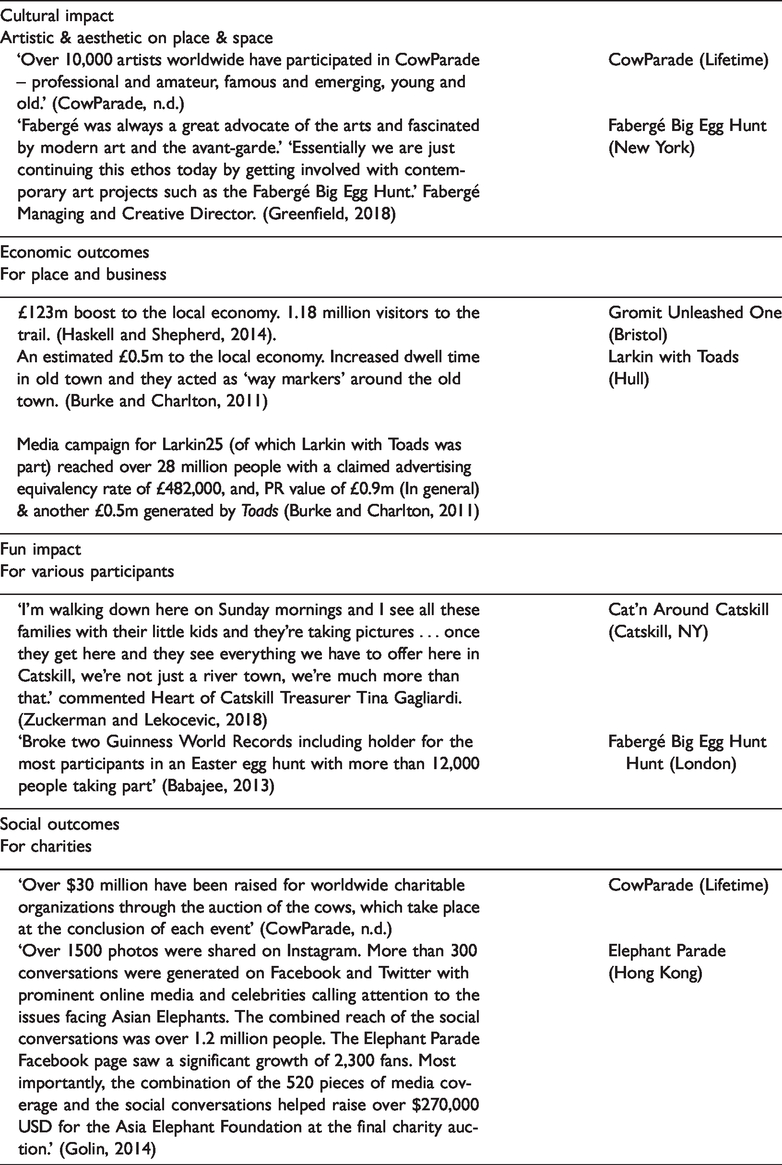
Funds raised for the charities.
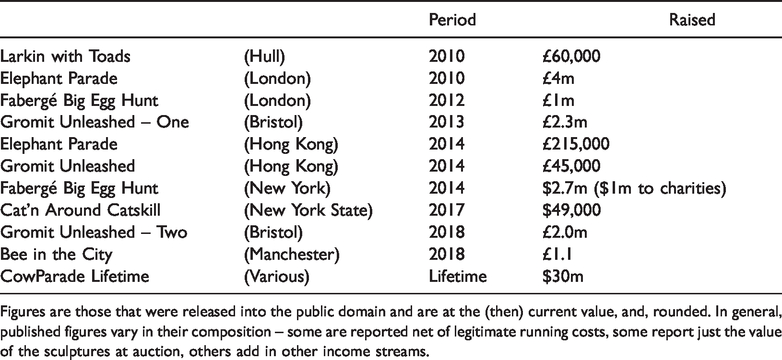
Figures are those that were released into the public domain and are at the (then) current value, and, rounded. In general, published figures vary in their composition – some are reported net of legitimate running costs, some report just the value of the sculptures at auction, others add in other income streams.
Reinforcing the comment that T-Pasts are sometimes ‘hidden in plain sight’, our personal experiences and observations suggest some people will walk past a particular display and never actually register it is there. Others will notice but pay only scant attention. Whilst some people may read about a T-Past and are persuaded to seek it out, others will stumble across them and then be stimulated to become involved in some way. Once an event is finished, though, one might wonder how many people will actually miss the artefacts and wish they were more permanent with a lasting impact on the aesthetic appeal of an area.
Impact and outcomes
Contemplating what constitutes a successful T-Past, and applying the Attention, Interest, Desire, Action (AIDA) model created originally by Lewis (1908), the first requirement of any T-Past is to attract the attention of a specific target audience, which might, as we have argued above, be very broad or much narrower in scope. The sculptures, and the accompanying publicity and social media traffic, need to be ‘attention grabbing’. From this realisation that ‘something is going on’, certain individuals need to become engaged; their follow-up action then may possibly be as collectors (who attempt to track down a number of the sculptures), purchasers of trail guides and memorabilia, possibly as ultimate buyers at the final auction – or just as people who spread the word and persuade others to get involved, or who make a straightforward donation to the charitable cause. This is influenced by how relevant and desirable the theme or the cause, or both of these, are to each individual.
There is both a short- and a long-term element here as well. Their action may also be to buy the sponsor’s products, in some respects unrelated to the actual T-Past.
Different stakeholders seek different outcomes (vis-à-vis footfall to a place, media coverage, visitor spending on related memorabilia, sponsor brand recognition and expenditure on the sponsors’ products), so when it comes to an overall conclusion on ‘success’ we cannot realistically expect everyone to agree. But that does not prohibit a general conclusion. We might also surmise that if an event is repeated it will have been seen as successful by someone. We suggest that different stakeholders will have (declared and undeclared) targets for impact – which will be personal to and relevant for them – and judge success accordingly.
Developing a conceptual impact model
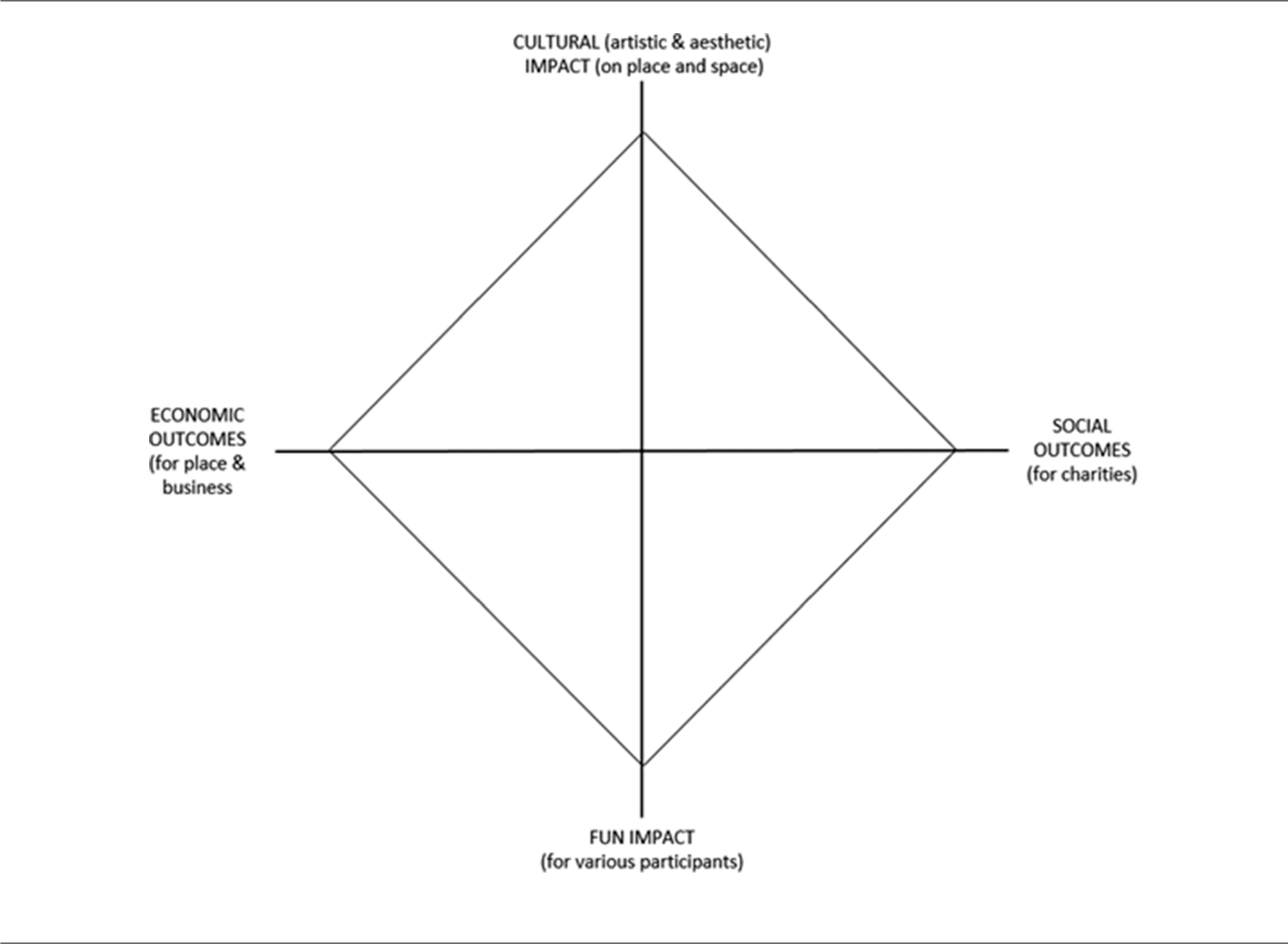
We have categorised the outcomes and impact as cultural, economic, fun and social; and present these as a framework in Tables 5 and 6. The two horizontal arms are fundamentally (but not exclusively) quantitative, whilst the vertical arms are more typically qualitative. All low scores are placed closer to the centre of the frame with all higher scores at the extremities, such that ideally the T-Past impact would be represented by as large a resulting shape as possible. We might surmise that as a general measure we are looking for high scores on all of the four arms in the framework. The outcomes can represent an immediate or a longer-term impact, although in this article we are mainly focusing on the short-term. In reality, the trail disappears when the artefacts are recovered and auctioned off. However, people will continue to talk about the event and this will have a (sense of) place impact into the future – and this may be the cause of a follow-up T-Past. Similarly, because the revenue impact on sponsor brands may be delayed and so longer term, any decisions by sponsors regarding participation in future events will involve some element of judgment.
A conceptual impact model.
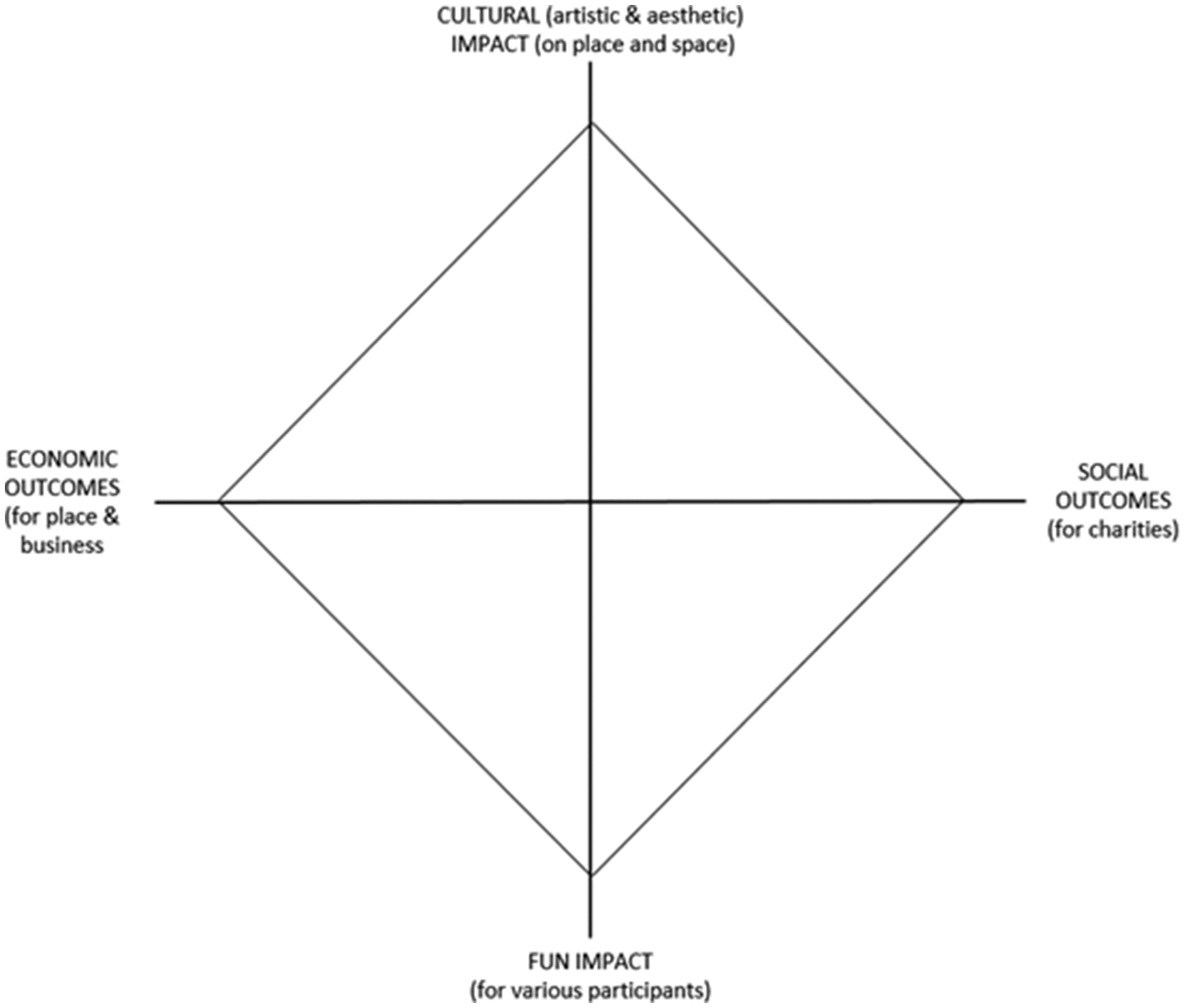
The model applied to Bee in the City (Manchester).
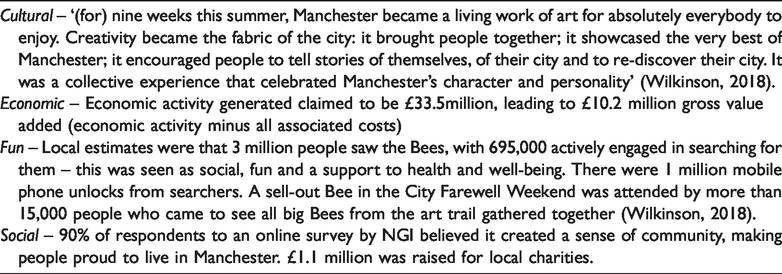
Measuring all the benefits from a T-Past is problematic as some are not directly quantifiable. Whilst many of the economic outcomes, together with some of the social outcomes (the money handed over to charitable causes), can be estimated – if not measured accurately – there is a subjective and intangible element in respect of some cultural outcomes and the aesthetic and fun impact. Our conceptual impact model, therefore, will be affected by perceived biases and judgement, but we argue it provides a framework through which an interested stakeholder can evaluate a T-Past, especially if they had specific targets for comparison. Equally, one T-Past can be compared with another, although in reality each one – and its relevant context – is different. Further, individual perceptions will vary, and different stakeholders might reach different conclusions. The model can, however, inform decisions on (a) whether the investment of time, energy and money was ‘worth it’ and (b) whether similar or repeat events should be considered seriously.
The cultural impact is most relevant for the host location as it involves a new sense of place (see, for example, Department of Culture, Media and Sport, 2004; Pratt, 2009), but there will also be artistic value inherent in the sculptures that, once removed from their setting, people buy at the final auctions. We argue: cultural value is, in essence, what the T-Past ‘says’ about the place, and the extent to which people retain a favourable sense of place. This comprises two related elements: aesthetic value which comes from the visible impact, the noticeability as an attraction for the host location and how the general public reacts and responds; this aesthetic impact depends on the perceived artistic value of the creative designs, but the two are different. The art must be attractive to people (however we might define this) in order to stimulate their interest; it will help if it is relevant for the host town and if it stimulates people’s imagination. Bees were important for Manchester; Wallace and Gromit proved relevant for Bristol as their animation studio is located there; and toads had a particular intellectual resonance for Hull.
The economic outcomes are those received by the host location, the sponsors and the various organisations that are involved in the supply chain, whilst the social outcomes arm includes the monetary and other benefits for the charitable causes. Many T-Pasts use organisers to market and manage the event with the charity receiving the net proceeds, but in some cases the charity/social enterprise itself is the organiser. The economic outcomes can be split. Primary economic outcomes will include sponsorship money raised, the sales revenue from memorabilia and trail guides, and the receipts from auctioning the sculptures; then there are secondary economic outcomes from visitor spending on parking, public transport and refreshments – both during the event and later if there are further visits to the host town or city. If, as is clearly possible in a minority of cases, the auctioned artefacts have an investment as well as an artistic value linked to the celebrity or artist who created the unique design, then this would also be a beneficial long-term economic outcome for certain stakeholders.
Other factors, which we would categorise as social, cultural and fun, are key visitor-draws and so they also influence and drive the economic outcomes. They are not always capable of being monetarised into a market value, but this could be attempted should organisers, planners and commentators seek a quantitative rather than a qualitative metric. Such outcomes can be claimed immediately after the event has closed (for example, increased community involvement and pride) whilst others, such as an increase in future visits triggered by their visit to the T-Past, will be longer term. Relevant examples would include:
The qualitative value of the celebrity and sponsor names attracted. The impact on local pride and the feel-good factor for people interested in the place. The reputational enhancement (relating to creativity, culture and aesthetic appeal) for the place that comes from hosting the event; these two place-related benefits relate to human interest. Any relevant reputational value for both the sponsors and the charitable causes from their association with the T-Past. Media and social media coverage – supported by organiser and sponsor press releases.
Whilst media and social media coverage will have an impact on visibility and public attention (the A in the AIDA framework) this realistically has to generate actions and other outcomes for it to be genuinely beneficial. Of course, direct links may be difficult to find.
The fun impact stems from the public interest and engagement of various people which affect the relevant ‘feel good factor’ and help to identify a place (see for example, Kavaratzis, 2018). The fun outcomes embrace the artists, the ‘collectors’ (who set out to see as many artefacts as they can find) and general observers (who are aware but only interested at a peripheral level) as well as the individuals who buy items at auction. Some members of the general public will make a single visit whilst others will become enthusiastic collectors of the experience – and perhaps, as a result, spend more on merchandise. Some purchases will be driven by a desire to support the relevant charity rather than the aesthetic or investment appeal of the artefact – but, regardless, there is a degree of personal satisfaction from the buyer from their involvement. The cultural outcomes are more tangible than the fun outcomes – and this will affect the ease of assessing their impact.
Clearly there are inter-dependencies between the four. The social outcomes are directly dependent upon the economic value generated. The aesthetic and artistic values have a large impact on the fun enjoyed by the general public.
We would suggest that high scores on both vertical arms (aesthetic and fun) are needed to justify repeating a T-Past in either the same or a different place. The relative impact scores for economic and social benefits will make a repeat event more or less attractive to the different stakeholder groups who are most affected by these impacts. Social benefits will always have an attraction at a general level, as well as for the direct beneficiaries, but unless there are economic benefits for those organisations that make up the supply chain it would be hard to justify a repeat.
Conceptually this analytical framework is useful for capturing the relative significance of the outcomes from an event, but data reliability will mean it is less useful for comparing one event with another across all dimensions. This framework will help with a subjective view on an event, but some element of judgement will be required to draw comparisons and contrasts.
Commentary
It can be readily appreciated how various things contribute to making a space (a town or city) distinctive in some way and thus helping it to exploit its potential and thrive via the generation of economic wealth, as well as, and in part through, its artistic and cultural wealth and its ability to provide enjoyment (fun) for visitors to that space be they local or external (see Department of Environment, Transport and Regions, 1998; Landry, 2000; Landry and Bianchini, 1995; Vickery, 2007). This distinctiveness is the changing sense of place created, which ultimately affects the quality of life of the people who occupy the space.
Architectural infrastructure (bridges and iconic buildings), natural features (rivers), what might seem to be natural features (canals in Venice) and permanent sculptures (The Angel of the North) are all relevant contributors to distinctiveness. T-Pasts are more recent artistic contributors here (see Miles, 1997) and they are being exploited more and more; however, T-Pasts bring an important additional benefit in that they raise money for charitable causes.
Individual stakeholders might be highly satisfied or disappointed with the outcomes of a particular event, and, given that what ‘works well for one’ might disappoint another, this is understandable. One further complication is the timing of the evaluation. Some measured outcomes (such as visitor numbers and auction sales) are immediate, whilst others (say visitors who have come to a host town, perhaps for the first time, and who decide to come back later and spend time and money) contribute over an extended, maybe indefinite, period of time. It is possible for an event to have high impact whilst it is happening but be largely forgotten afterwards, whilst others are recorded better and talked about for years to come. In addition, all of the outcomes from a particular event simply cannot be captured because they are not understood.
In some ways this is linked to the temporal element. T-Pasts are events that reflect modern society; they are not alone in doing this, and this distinguishes them from more permanent contributions. Some people keep (and re-read) books; others pass them on once they have read them. Some people (still) collect CDs in an era of streaming. Some people enjoy watching the same movie repeatedly, encouraging broadcasters to re-run them to a point where other viewers are annoyed. We have committed collectors of almost anything, which helps a whole variety of artefacts to retain economic value; but this is something that others fail to understand. Like fixed sculptures on display in a space, some people will always notice them whilst others will be oblivious to their presence. We might extend this point and argue the end-of-event auctions both generate money for charity whilst solving the problem of waste in a (for some) throw-away world. In a sense, public goods are being re-generated as private goods. Limited-time exhibitions in a museum or gallery will attract back regular visitors whilst also bringing in newcomers; the question then is, do the newcomers become regulars? And do some visitors want more permanent records of their visit and buy catalogues and other related merchandise? Simply, different people have different attention spans, allowing T-Pasts to play a particular and distinctive role.
T-Pasts are an opportunity for entrepreneurs and entrepreneurship. As examples: Cow Parade and Wild in Art are entrepreneurial businesses that have seen and created lucrative opportunities; Elephant Parade is a clever charity that has used networks to gain the support of others to raise money for their cause. The temporary nature of a T-Past provides an opportunity for entrepreneurially minded people to take limited risks and learn from their mistakes and successes to create further opportunities. They also provide opportunities for host towns and cities (see Mordue, 2017, 2018). Spaces are being used to create a new sense of place, which might be strictly temporary or more lasting. This can be valuable as local authorities strive to find the appropriate balance between what we might term an authentic portrayal of the past (that has been instrumental in defining a place) and the need to attract fresh interest from visitors whose interests are more in the present than the past and whose attention span is more transient. T-Pasts can be seen as an opportunity to experiment with something that can subsequently be taken down readily or built upon.
Conclusion
The number of T-Pasts in the UK and internationally continues to rise, even though in many cases they still remain ‘hidden in plain sight’. T-Pasts can be evaluated as individual events and in the wider context of regeneration. As temporary events, they can be compared and contrasted with more permanent contributions. The published reports and (social) media traffic suggest positive outcomes, although the lack of comprehensive and rigorous research requires subjective judgment regarding the overall impact. This article has introduced a conceptual impact framework which could help in evaluating the potential contribution of a T-Past.
There is a clear case for further research and a number of opportunities. One theme is planning decisions, where the interest of various stakeholders is key: is the T-Past to be focused mainly on the interests of a location, a charitable cause or a sponsor? And how does this affect the design? Another is progress monitoring as plans are implemented: is interest being translated into action? Are targets being met? A third theme is clearly impact, where the framework in Tables 5 and 6 could be tested more rigorously. Research might be concentrated around the time of the event, or more longitudinal, tracking the residual impact well after the T-Past has finished. As we have mentioned, comparative studies might be relevant, but these have to embrace that all T-Pasts have an element of individuality and cultural nuance.
Might we, then, expect to see more T-Pasts in the future, especially as the entry barriers for new events seem relatively low? Good ideas can be copied if not replicated. It should be possible to trademark or copyright the names of local events and individual designs (if the artist demands this) but the use of a particular generic animal, figure or shape – such as an elephant or an egg – appears not to be protected. Hence certain ones will prove more popular over time and help T-Pasts become more obvious to pedestrians whilst emphasising the value of innovative new ideas for distinctive themes.
Footnotes
Declaration of Conflicting Interests
The author(s) declared no potential conflicts of interest with respect to the research, authorship, and/or publication of this article.
Funding
The author(s) received no financial support for the research, authorship, and/or publication of this article.

Appendix 1: Seven examples of T-Past sculptures.
Heidi (Artist: Heinz Blum) one of the original Zurich Cow Parade cows, a permanent feature at the Adler Hotel in Zurich, temporarily decked out as a Christmas Angel in 2015. Frank Loin Wright, Spectrum Brands Inc., CowParade, WI, 2006. Cat’n Around Catskill sculpture, Catskill, New York State, 2010.
The Singing Butler Rides Again, Jack Vettriano, Elephant Parade, London, 2010. Tree of Life, Diana Francis, Pacific Place, Hong Kong, Elephant Parade, 2014.
Display of four of the eggs at the New York Fabergé Big Egg Hunt Auction. From left to right, Untitled, Retina with Nikolai Bismark; Untitled, Kelsey Brooks; Leela, Antonio Murado; Fish Egg, Frank Hyder for Rebecca Hossack Gallery (https://www.faberge.com/news/faberge-hosts-the-big-egg-hunt-s-live-auction-at-sotheby-s-new-york-174).
SuperBee, Adam Pekr-Inkversion, Bee in the City, Manchester, 2018.