




Abstract
In the social sciences, certain academic journals brand themselves as local to some geographical nation – ‘American’, ‘British’, ‘Canadian’, or ‘Chinese’. However, some of these journals aim to publish research not only about the domestic society indicated in their name but also research about another individual society, multiple societies, or society in general. Despite this editorial aspiration, for over 60 years, scholars have regularly critiqued the ‘American’ branded journals as being overly ‘ethnocentric’, ‘parochial’, or ‘provincial’ – in a word, too local and not truly cosmopolitan. Yet hardly any of these critiques systematically compares how local ‘American’ journals are compared to other nation-branded journals. In this article, I conduct a content analysis of all articles published in nation-branded political science and sociology journals from 2019 until 2023 to show what percentage their articles each year are about their local society, how many are about a single foreign society, and how much are about multiple societies or society in general. I show how ‘Canadian’ and ‘Chinese’ branded journals are more locally focused and the ‘British’ branded journals are less locally focused than the ‘American’ branded journals, and nation-branded sociology journals remain far more local in their focus than nation-branded political science journals.
Introduction
In the social sciences, certain journals have been identifiably local in incorporating the names of nations into their name – ‘American’, ‘British’, ‘Canadian’, or ‘Chinese’. At the same time, many of these journals due to the prestige and productivity of their host society in the social sciences may be viewed to different degrees as ‘local’ or ‘international’/‘cosmopolitan’. When founded, many of these journals in branding themselves by a specific nationality may have aimed to merely signify that they would be primarily by and for the society designated in their title. Over time, however, many of these journals became highly influential and impactful for their national scholarly communities given how they publish research about a range of topics – making them in their orientation ‘generalist’ – in contrast to most journals that focus more on specific fields or topics.
Yet the terms in these journals’ titles that refer to a specific nation-state in some ways are in tension with a long-standing ambition of social science to be generalizable to all societies and not only relevant to a particular society. Although some of these journals like Chinese Journal of Sociology and Canadian Journal of Political Science explicitly limit their aim and scope to publishing articles only about the local society designated in their name, others like Chinese Sociological Review or Canadian Review of Sociology/Revue Canadienne de sociologie welcome research about all societies, aiming to be more international or cosmopolitan in what they publish. Some such journals like American Sociological Review or British Journal of Sociology have such a large audience and high impact on their discipline that many arguably no longer perceive them as having any specific bias toward publishing work about US society. Instead, many producers and consumers of social scientific research perceive these journals as a cosmopolitan venue for excellent social science research articles, regardless of the society on which they focus.
Nonetheless, a certain perennial tension between the local and cosmopolitan persists in many of these nation-branded journals. For 60 years, social scientists have lamented how their colleagues have drawn disproportionately upon the case of the United States, and to a lesser degree European societies, as empirical examples to develop a theory that they presume to apply to other societies. These social scientists have periodically raised this critique in disciplines as diverse as geography (Kaplan and Mapes, 2015: 36–37; Koelsch, 2001: 269), history (Chakrabarty, 2007; Manning, 2003), political science (Hull, 1999; Munck and Snyder, 2007; Sigelman and Gadbois, 1983), psychology (Arnett, 2008; Henrich et al., 2010), and sociology (Armer, 1987; Hughes, 1961; Jacobs and Mizrachi, 2020; Kennedy, 2020; Kurien, 2016; Kurzman, 2017; Lie, 1995; Poulson and Campbell, 2010; Webber, 1981). These scholars point out that many nation-branded journals emerge in Western, educated, industrialized, rich, and democratic (WEIRD) societies (Henrich et al., 2010). Such WEIRD societies constitute only 12% of the world’s human population and are quite different from most societies. Considering this, this concern about what these scholars refer to as ‘parochialism’/’provincialism’ or what less pejoratively could be referred to as localism reflects a worry that the empirical discoveries and the theories social scientists in WEIRD countries develop from studies of their society are not generalizable to other very different cultures. This may be especially the case in cultures where phenomena like peer relations, gender relations, family, and health behaviors are often quite different from WEIRD societies (Arnett, 2008).
Some of the above-cited meta-analyses also observe how many social scientists as editors and reviewers usually consider empirical cases outside of these contexts as reflecting only the society they represent, rather than that of other societies or even a problem of global society. Such persisting localist attitudes may slow down global progress in social science. They also arguably limit the ability of scholars to contribute to and expand our knowledge about these non-WEIRD societies and what WEIRD societies can learn from non-WEIRD societies.
However, almost all the above-cited meta-analyses and critiques of social science research publications are overly localist in their own way because they draw their conclusions from empirical data of only US journals. Therefore, in terms of their analytical focus, most of the critiques are insufficiently international or ‘cosmopolitan’ in that they lack a comparative focus, with no analysis of nation-branded journals other than those produced by the US. The one exception in this regard is Armer’s (1987) study that compares the degree to which the leading US nation-branded and British nation-branded sociology journals focus on their domestic society rather than a foreign society. Even based on this simple comparison, Armer concluded that nation-branded British journals are far less localist and arguably more cosmopolitan than the US nation-branded journals. This suggests that a more extensive analysis of such nation-branded journals of a more diverse range of societies would be even more fruitful (Armer 1987).
In the years since many of these older meta-analyses, many more nation-branded journals have emerged. We can compare their output with that of the US nation-branded journals. Even if US nation-branded academic journals may seem overly local and parochial in the view of so many US scholars in the prior decades, how can we be sure they are any more local than the coverage of the generalist nation-branded journals of other countries if we do not systematically and empirically assess the output of such journals? In sum, we can only critically assess the extent of localism and cosmopolitanism in any given journal by comparing them to those of other countries in a standard, systematic way.
In this article, I quantitatively examine the extent to which nation-branded journals that in their ‘aims and scopes’ do not restrict their focus to only publishing research about their own society in fact do so. In particular, I assess the number of articles each year these journals publish about their own domestic society, one foreign society, and multiple societies or society in general. In this way, I offer a more global and comparative analysis of the extent to which these influential journals are converging or diverging from a cosmopolitan standard of excellent general social science that is not limited to focusing upon any specific locality. I confirm that the US nation-branded journals are less locally focused than British nation-branded journals and that nation-branded sociology journals are more local than nation-branded political science journals. However, I also find which the US nation-branded journals are less local in their focus than both Chinese journals and a Canadian journal. Tracking this convergence toward or divergence from a cosmopolitan editorial objective where each nation-branded journal publishes research from any society is important because it helps us understand how local and cosmopolitan these nation-branded journals have become relative to each other as general conduits for globally circulating social science knowledge. In sum, my results offer an empirical basis for systematically and empirically assessing the degree to which many nation-branded journals with the ostensible objective of publishing the most excellent generalizable social science research from anywhere resolve the tension between their local foundation of their origins and their cosmopolitan ambitions to be world-class journals.
A perennial concern among US-based social scientists: are we excessively local?
I begin by addressing a common critical reflex that many post-1960s intellectuals have toward the common term generalizability, the more ambitious term universality, and the more high-brow term nomothetic (as opposed to idiographic). All these terms refer to the extent to which a finding from a particular society is relevant to other different societies and true across societies. One critique is that such terms are a synonym for dominant. Often what claims to be or is valorized to be universal is not so. Many sociologists from societies outside of the United States may find that they and their students do not find the theories and empirical knowledge from sociological studies of US society culturally relatable, appropriate, or applicable for insightfully understanding other societies. Despite this, many recognize that they often have to find a way to ‘frame’ (Kurien, 2016) their research in terms of US-based theoretical frameworks, so that they can publish in the journals that ‘matter’ (Jacobs and Mizrachi, 2020). Loveman (2014), for example, has argued that conducting research in other countries with cognitive maps ‘made in the USA’ can lead to erroneous conclusions about the behavior of research participants in field sites outside the US because such maps make little cognitive sense to such participants. They do not accept the cognitive and moral assumptions of those maps, and such subjects given their marginality in the world system of social science production rarely have an opportunity to challenge and refute them.
Increasingly empirical research demonstrates that scholars, reviewers, and editors of social science research implicitly perpetuate this tendency toward interpreting claims from WEIRD societies as universal and those from non-WEIRD societies as specific only to that society. For example, quantitative analyses of over a half million social science research articles in Scopus (published from 1996 to 2020) showed that articles that examine the “global North” are significantly less likely to mention the name of the country they study in their title compared to articles about societies in the “global South” (Torres and Alburez-Gutierrez 2022). This leads scholars – and particularly those with a junior and relatively insecure rank – to hesitate in making claims of generalizability if they are studying a case that is a non-WEIRD society. However, this would be acceptable to do if their case were a WEIRD society. In other words, we observe a double standard with regards to how cosmopolitan we understand research from the United States – and perhaps to a lesser extent, any WEIRD society – to be, and how we evaluate comparable research from any non-WEIRD society. Such practices potentially imply an unwarranted claim that studies about WEIRD societies are more ‘universal’ and recognize studies about non-WEIRD societies less due to the greater interest that consumers of social science have in discoveries about society in general rather than ‘local’ discoveries that only pertain to a specific society. This potentially leads readers to view WEIRD societies as ‘cosmopolitan’, and non-WEIRD societies as merely ‘local’ – a bias that is both ironically localist but has a deceptive aura of faux and superficial ‘cosmopolitanism’. This potentially can both perpetuate discursive relations of dominance by scholars in WEIRD societies over those in non-WEIRD societies and discourage scholars of societies in non-WEIRD societies from contributing generalizable scientific knowledge or building a general theory with empirical data from a non-WEIRD society.
One can extend this finding to how national signifiers in the title of a journal may carry different meanings to both prospective contributors and readers depending on which nation it refers to. This has significant consequences for the composition and quality of work in the journal, as well as for what scholars consider legitimate societies and subjects to research, and thus the knowledge they produce. Many sociologists have written normative editorial critiques of how infrequently the most influential US social science journals and textbooks cover societies other than the United States. For example, in the most recent meta-analysis, Jacobs and Mizrachi (2020) have found that articles published in the US generalist journals are produced almost exclusively for the US market, incentivizing US-trained social scientists abroad to conduct research with tools often alien to the subjects in their field who often reject the cognitive and moral assumptions of US sociology. In his article, Kurzman (2017) illustrated this with a striking graph (Figure 1) that shows that even as the US has become increasingly more globally connected between 1970 and 2010, social science studies of societies other than the US have not increased in terms of equivalent amounts of percentage change.

Internationalization in the United States: social science and other arenas, 1960–2010.
Furthermore, Jacobs and Mizrachi (2020) found differences in how often social scientists in different disciplines publish research about societies outside the United States. For example, they found that American Educational Research publishes the lowest percentage of articles about other societies, followed by American Journal of Sociology and American Sociological Review. Demography publishes more research about foreign societies than these other sociology journals, whereas American Economic Review and American Political Science Review publish the largest percentage of articles about societies outside the US. Kurzman (2017) found that anthropology and history journals have a much more international focus than psychology and sociology journals, with other disciplines falling in between. Armer (1987) found that US political science, economics, history, and geography journals had more content about foreign societies than sociology. Armer also found that sociological research published in US nation-branded academic journals was substantially more localist than that published by British journals.
Social scientists have offered many reasons why US social scientists are so focused on US society and its consequences (Hughes, 1961; Jacobs and Mizrachi, 2020; Kurien, 2016; Kurzman, 2017; Lie, 1995). First, US scholars’ disproportionate focus on the United States may limit the sociological imagination and lead to an impoverished understanding of the diverse and divided societies in the world. Second, a global belief that US journals produce scholarship of higher quality than other nation-branded journals and how this leads to an advance in the career of social scientists outside the US leads to many of them trying to publish in the US nation-branded journals. Third, this may restrain the range of topics and research questions, as Zougris (2019) has empirically demonstrated that US nation-branded and British nation-branded sociology journals focus on different topical concerns. Fourth, Bhambra and De Sousa Santos (2017) and Cornell (1997) have noted that US sociological knowledge has historically excluded non-White and non-Western thinkers, particularly those in the non-liberal and decolonized world. Kurzman (2017), Kennedy and Centeno (2007), Hull (1999), Munck and Snyder (2007), and Sigelman and Gadbois (1983) all found that most of the internationally oriented research has focused on Western Europe (primarily Britain, France, and Germany), followed by Latin America, and with only a small recent increase in research about the Middle East and East Asia as their importance in the global economy has increased and increasing numbers of Asian-American students in US universities (Chang, 1999). In organizational studies, Aldrich (2009) found that 88% of recent publications about organizations only focused on those in the US. Finally, periodic analyses by government agencies like a presidential commission (Perkins, 1979) and the National Research Council (O’Connell and Norwood, 2007) agree that a lack of knowledge about foreign societies and languages threatens the national security of the US. Due to the above, Jacobs and Mizrachi (2020) argue that ‘foreignism’ is an important but neglected or even excluded variable in sociological topics, authors, and research questions. As a result, those who read the top US journals and elsewhere learn more about US sociological concerns and acquire fewer sociological insights from other countries.
Jacobs and Mizrachi (2020) suggest that the primary source of the problem is the lack of exposure among US sociologists to ideas, concepts, and empirical studies originating outside the bounds of assumptions held by US sociologists. As they point out, this lack of exposure limits the creation of sociological knowledge about societies outside the US, especially societies that are illiberal, non-White, and decolonized. This also constrains the ability of US sociologists to expand their perspectives and learn from societies outside of the US, thereby establishing the foundations of a more generalizable sociological knowledge than we currently possess. This implies that other national communities of sociologists are not as localist in the research they produce.
Jacobs and Mizrachi (2020) may be justified in pointing out that the contributors, editors, and reviewers of US social science qua hegemonic gatekeepers bear primary responsibility for expanding its generalizability. However, their analysis, and that of most others, is limited in that it only focuses on US journals and therefore does not enable us to understand the extent to which ‘US’ social sciences are more or less localist than social science of other nations. This also does not critically assess the important agency of their counterparts in other nations in advancing this important project of building an international and cosmopolitan social science. In this article, I assess how much those counterparts in manufacturing of nation-branded journals that aim to publish research about other societies have collectively taken on the task of publishing papers that research societies other than those designated in their journal’s name.
Theoretical framework
Nation-branded journals are not necessarily obligated to produce generalizable knowledge from cases outside their local territory. Many restrict their focus to their domestic society. However, the editorial boards of some nation-branded journals in their ‘aims and scopes’ claim that they aim to publish research about any society. The idea that ‘US’ journals should not focus only on any society other than the United States itself probably has only become an issue for many scholars (Hughes, 1961; Jacobs and Mizrachi, 2020; Kurien, 2016; Kurzman, 2017; Lie, 1995) because they believe that US nation-branded journals are so impactful and often cited that many readers may come to take them as cosmopolitan platforms for publishing excellent research about all societies and societies in general, not only about the US. For example, many of them may agree that American Sociological Review (ASR) should only publish research about a society outside of the US if the author, reviewer, and editors of the research collectively agree that the research is of sufficiently high quality. Jacobs and Mizrachi (2020) suggest that this still statistically happens less frequently for research articles about societies outside the US than research articles about the US.
However, I would hypothesize that other nation-branded journals may exhibit the same localist bias for studying their own society over that of foreign societies and that this is not necessarily unique to US nation-branded journals. Yet, I would anticipate that this bias is even more severe in nation-branded Chinese journals, and that many view social science in non-WEIRD as more ‘local’ and less potentially ‘cosmopolitan’ and generalizable to other non-WEIRD societies. In sum, I hypothesize that journals that contain the term ‘American’, ‘British’, ‘Canadian’, or ‘Swiss’ in their title will have more articles that focus on foreign societies and society in general relative to journals with ‘Chinese’ in their title.
Why should we care how cosmopolitan/international or local the coverage of nation-branded journals is? I see three analytical reasons why this bias of nation-branded journals is consequential for progress in the social sciences. First, one critical way to understand what society is in general, as articulated once by the US demographer Donald Treiman, is to study a society distinct from your own and assess how the two are both similar and different from each other. Without any point of comparison or reference, humans tend to take certain practices in society as ‘natural’ and not distinguish assumptions relevant to a specific society from those applicable to society in general. Therefore, the extent to which nation-branded journals produce research about foreign societies or comparative/general research is at least one important measure of how developed social science is in that country. Second, as scholars increasingly recognize that WEIRD societies in many ways are provincial and unrepresentative of societies in general and Eurocentrism and Americentrism decline as a legitimate normative basis for being able to make claims of generalizability, such claims will increasingly depend on empirical evidence from non-WEIRD societies that constitute most of the global population. Finally, for social scientists of China and other non-WEIRD societies to truly gain as much respect and recognition as that typically received by scholars of WEIRD societies, scholars in non-WEIRD societies will likely benefit from producing empirical findings not only about their specific society but societies in general, including many foreign societies. This may also more strongly encourage scholars of foreign societies to submit work to journals based in the non-WEIRD societies, raising their prestige.
Materials and methods
This article draws upon a quantitative content analysis of coded data gathered from all original research articles published in ten generalist nation-branded English language journals over 2019-2023 in their aims and scope remain open to publishing research about any society (N = 2,111): (1) American Sociological Review, (2) American Journal of Sociology, (3) Chinese Sociological Review, (4) Canadian Review of Sociology, (5) American Political Science Review, (6) American Journal of Political Science, (7) Chinese Political Science Review, (8) British Journal of Sociology, (9) British Journal of Political Science, and (10) Swiss Political Science Review. I chose 5-year periods because this is typically longer than the length of an editorial board’s term and can offer insight into how the composition of articles changed over this period. I focus on journals rather than books or dissertations because Kurzman (2017) has noted that whereas the percentage of geo-identified social science books focusing on societies outside of the US rose from 33% from 43% and dissertations 43% to 49% in the initial years of this century, the percentage fell slightly among social science journal articles. I focus on journals in English because they generally have a much more diverse audience of scholarly contributors and consumers than journals that publish articles in other languages.
I comparatively analyze all original research articles published in political science and sociology that invite research about all societies because previous research shows that political science journals publish more research about foreign societies than sociology journals (Jacobs and Mizrachi, 2020). The US nation-branded generalist journals are frequently considered to be the most influential in terms of the number of citations received and publishing research in these journals often determines not only whether social scientists receive promotion and attention in fields of social science within WEIRD societies, but also non-WEIRD societies through prevalent practices of ‘institutional isomorphism’ (DiMaggio and Powell, 1983), ‘emulation’ (Simmons et al., 2006), and ‘benchmarking’ (Moriarty, 2011). Other Organization of Economic Cooperation and Development (OECD) member nation-branded journals are less influential globally but still have considerable influence in deciding who can advance within their national institutions.
China is widely regarded in international relations scholarship as a rising economic and political competitor to the hegemony of the United States in many fields due to the rapid growth of its economy and human capital in its enormous population. Yet due to its overall substantially lower gross domestic product (GDP) per capita and autocratic government, China is also a non-WEIRD society. As China’s social science research productivity is likely developing alongside its economy, we may therefore expect the output of its journals to become increasingly international and cosmopolitan but still relatively more local than other nation-branded journals.
The scholarly conventions of China are also distinct from other OECD countries in many ways that lend it well to an analytically profitable comparison from a design perspective. For example, a key distinction that may explain the differing orientation of the US and China is how the US – predominantly colonized and founded by idealistic settler colonial immigrants from Europe – is culturally and intellectually very much a cultural descendent of the European Enlightenment and imperialism. In contrast, the population of China has long considered itself the center and core of global humanity but also considers itself to be special. Many Chinese intellectuals have historically focused on emphasizing not their commonalities with foreign societies but Chinese civilization’s uniqueness and exceptionalism. This may explain why Chinese scholars often focus not on confirming many social theories from WEIRD societies in the Chinese context but instead empirically demonstrating the many ways China is culturally, economically, and politically an exception to empirical findings and theories developed from data collected in WEIRD societies. The case of China therefore often challenges the generalizability of such presumably ‘universal’ theories, or at least reveals anthropologically how Western-originated concepts or constructs like ‘neoliberalism’ stand in ambivalent tension with the practices of Chinese societies (Ong, 2006). When Chinese scholars do occasionally and astutely demonstrate the generalizability of the Chinese case, they often do so to show that is due to the enormous transnational influence of certain Chinese ideologies and cultural traditions that other East Asian societies like South Korea and Japan have inherited from Chinese culture like patriarchy, filial piety, and very low rates of divorce and out-of-wedlock births – resulting in a common phenomenon that many claims to empirical discoveries by demographers of East Asia outside of China earlier scholars of China have already previously discovered (Choi and Qian, 2023).
To assess the relative extent to which each journal covers its domestic society, a particular foreign society, and multiple societies or society in general, I assemble counts of the number of articles for each year in these respective categories. Specifically, for reasons of parsimony and interpretability of results I provide counts for the number of articles published that focus (a) only the domestic society (e.g. China for the ‘Chinese’ journals, Britain for ‘British’ journals, the US for the ‘American’ journals), (b) another society, and (c) multiple societies or society in general 1 during the past 5 years of issues in the following two major peer-review ‘Chinese’ journals whose editors do not explicitly restrict the scope of what they publish to research about China: (1) Chinese Sociological Review and (2) Chinese Political Science Review. I then do the same for several US nation-branded journals that also have a reputation for being generalist journals that publish research about one or more societies other than the US despite having the word ‘American’ in their title: (1) American Sociological Review, (2) American Journal of Sociology, (3) American Political Science Review, and (4) American Journal of Political Science. Finally, for point of reference, I also include some other nation-branded generalist journals that aim to publish research about society in general: (1) British Journal of Sociology, (2) British Journal of Political Science, (3) Canadian Review of Sociology, and (4) Swiss Political Science Review. I exclude any journals that explicitly only state in their aims and scopes that they only publish research about their domestic society (e.g. Chinese Journal of Sociology, Australian Journal of Political Science, Canadian Journal of Political Science, Czech Sociological Review) and those that have regrettably stopped publishing at some point during the period of analysis (e.g. French Sociological Review, Canadian Journal of Sociology, Mexican Journal of Sociology (Revista Mexicana de Sociologia)). For simplicity and comparability, I also exclude nation-branded journals focusing on disciplines other than sociology and political science (e.g. Canadian Public Policy, European Journal of Public Health, Canadian Geography), those focused on areas larger than a single nation-state (e.g. European Sociological Review), and those covering dyadic relations between countries (e.g. British Journal of Politics and International Relations). I chose to include generalist nation-branded journals of political science as well as sociology because Jacobs and Mizrachi (2020) found that political science journals – likely due to the relatively greater importance of international relations to politics and power relations – include far more studies of foreign societies than sociology journals. In contrast to most previous meta-analyses of how ‘local’ nation-branded journals are in their coverage of domestic and foreign societies, this comparative method enables me to compare the relative extent to which the US nation-branded journals cover foreign societies versus their society when compared to other nation-branded journals.
Results of quantitative content analysis
Figure 2 reveals my results for the years 2019–2023 for all journals. As hypothesized, US nation-branded journals generally published a lower proportion of articles about their domestic society than the ‘Chinese’ journals do. However, the gap was not as substantial as I had anticipated and declined substantially in 2013. For example, the percentage of articles in American Journal of Sociology focused on only US society during 2019–2023 ranged from 63% to 73% and was on average 70% during 2019–2023. The percentage of articles in American Sociological Review focused on only US society during 2019–2023 ranged from 55% to 74% and was on average 67% during 2019–2023. In contrast, between 2019 and 2023, the percentage of articles in Chinese Sociological Review that focused only on Chinese society 2 ranged from 84% to 86% and was on average 86% during 2019-2023. Therefore, the leading generalist Chinese sociology journal that is open to publishing articles about foreign societies still has more of a localist bias in its publishing than the leading US nation-branded journals.
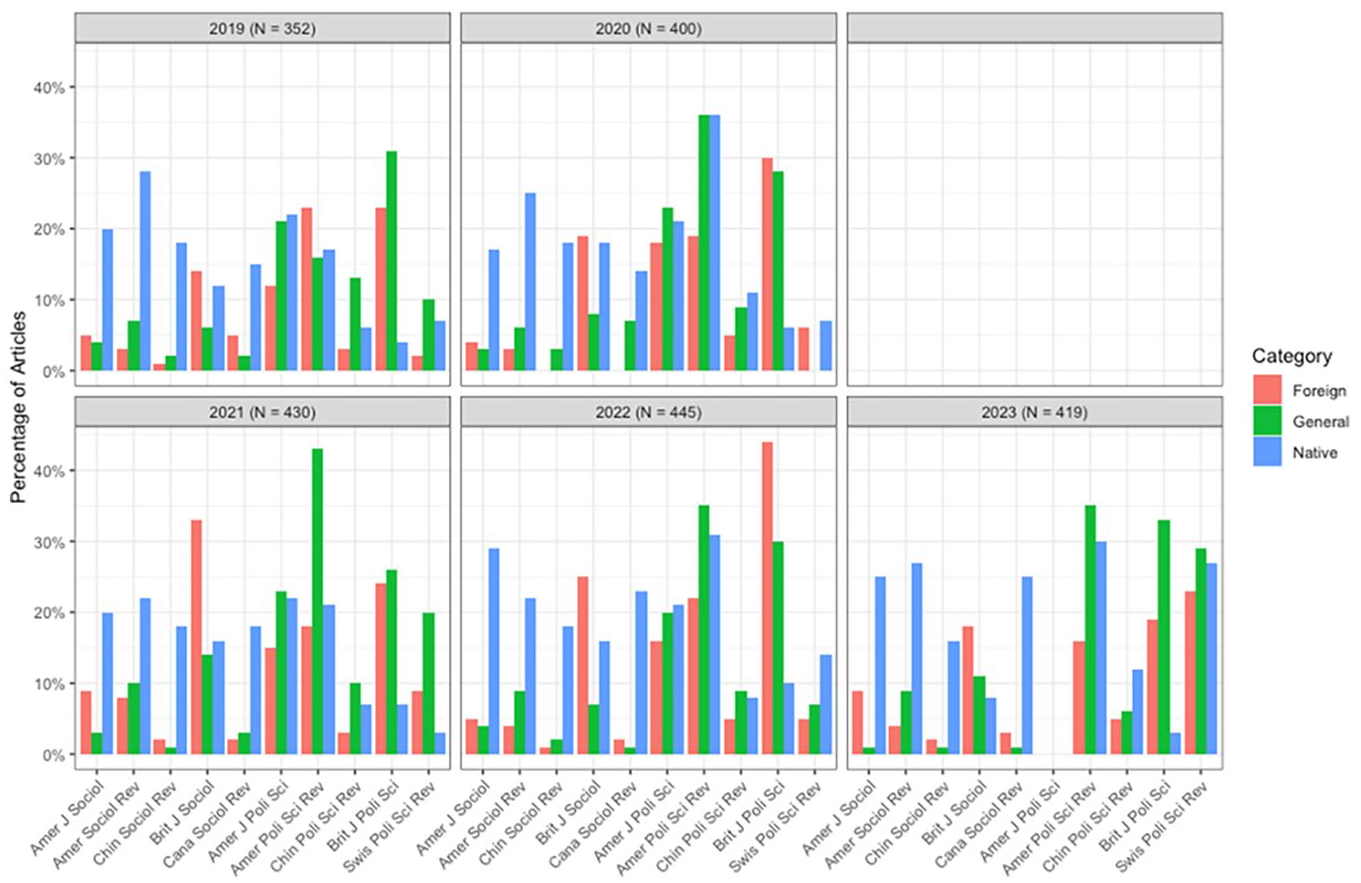
Percentage of articles in nation-branded journals analyzing domestic society, a foreign society, and many societies or society in general.
As found by several of the above-mentioned scholars and as I hypothesized, nation-branded political science journals focus less on the domestic societies indicated in their title than the nation-branded sociology journals on average. The gap between the US nation-branded journals and the Chinese journals of political science in the coverage of their domestic societies was not as large as it was in their counterpart sociology journals. For example, in American Journal of Political Science, the percentage of articles that focused on US society ranged from 34% to 51% and overall was on average 40% of all articles during 2019–2023. In American Political Science Review, the percentage of articles that focused on US society ranged from 26% to 40%, and was on average 34% during 2019–2023. In contrast, the percentage of articles in Chinese Political Science Review that focused on China ranged from 27% to 52%, and was on average 37% during 2019–2023. In sum, Chinese political science journals are not as localist or domestically focused as Chinese sociology journals and are comparable in this regard to their US counterparts.
The more striking contrast case is with the British journals.These are far less localist than other journals. For example, the percentage of articles in British Journal of Sociology about only British society ranged from 22% to 40%, and was on average 32% during 2019–2023. Therefore, the most-cited nation-branded British sociology journal seems substantially less localist than its counterparts in the United States and China. However, Canadian Review of Sociology is more like its US counterparts in being more localist, with the percentage of its Canada-focused articles ranging from 67% to 86%. It was on average 77.4% during 2019–2023.
The political science journals of other OECD countries are even less locally oriented than their US and Chinese counterparts. The percentage of articles that focused only on British society in British Journal of Political Science ranged from 7% to 12% and was on average 9% during 2019–2023, whereas the percentage of articles that focused only on Swiss politics in Swiss Political Science Review ranged from 29% to 54% and was on average 37% during 2019–2023. Hence even within a discipline found to be more internationally oriented and cosmopolitan, British nation-branded journals are more so compared to US nation-branded and Swiss nation-branded journals.
For the sake of parsimony, one can measure the extent to which these journals focus on non-domestic societies in two ways. In terms of how much these different nation-branded journals focus on foreign society, we can analytically distinguish between (1) the percentage of their articles focused on a single foreign society and (2) the percentage of their articles that focus on more than one foreign society or society in general (or in terms of theory which is not related to any specific empirical society). Although the combined percentage of these two types of articles that these journals publish cover both these categories can be understood as the remaining percentage of articles that are not focused only on the domestic society, distinguishing between these two categories yields some important heterogeneities. For example, among the sociology journals, American Journal of Sociology has over the years had a much higher proportion of its articles focus on a single foreign society than American Sociological Review. The annual percentage of American Journal of Sociology articles that focused on a single foreign society ranged from 17% to 28% and was on average 20% during 2019–2023. The annual percentage of American Sociological Review articles that focused on a single foreign society ranged from 8% to 20% and was on average 11.6% during 2019–2023. In contrast, a higher percentage of the articles American Sociological Review has published about foreign societies tend to focus on many societies or society in general than American Journal of Sociology. The annual percentage of articles in American Sociological Review that focused on society in general or many societies ranged from 18% to 26%, and was on average 22% during 2019–2023. The annual percentage of articles in American Journal of Sociology that focused on society in general or many societies ranged from 3% to 14%, and on average 10% over during 2019-2023. The annual percentage of articles that focused on a single foreign society in British Journal of Sociology ranged from 42% to 52% and was on average 47% during 2019–2023. Therefore, British Journal of Sociology was more similar to American Journal of Sociology than American Sociological Review. In contrast, Chinese Sociological Review focused more of its fewer non-domestic articles on many foreign societies or society in general (10% on average during 2019–2023) than on a single foreign society (6.2% on average during 2019–2023).
Compared to the sociology journals, the political science journals publish more articles about multiple foreign societies or society in general, corroborating earlier findings of other scholars. Journals exhibit no major national differences between them: This seems to be the case with American Political Science Review, in which the percentage of articles published about multiple foreign societies or society in general ranged from 29% to 43% and was on average 41% during 2019–2023. This also was the case for Chinese Political Science Review, in which the percentage of articles about multiple foreign societies or society in general ranged from 26% to 59%, and was on average 42% during 2019–2023. In British Journal of Political Science the percentage of articles about multiple foreign societies or society in general ranged from 36% to 60% and was on average 48% during 2019–2023; and in Swiss Political Science Review, the percentage of articles about multiple foreign societies or society in general ranged from 9% to 54% and on average 36% during 2019–2023.
For British journals, the sociology–political science disciplinary local-cosmopolitan divide in the US emphasized by Jacobs and Mizrachi (2020) is not as wide as the respective divide between British journals and all other journals in this regard: Even in British Journal of Sociology, the annual percentage of articles about one foreign society ranged from 42% to 52%, and was on average 48% during 2019–2023. This was not much lower than the percentage of articles about one foreign society in British Journal of Political Science, which ranged from 36% to 60%, and was on average 48% during 2019–2023. This corroborates the findings of Mizrachi and Jacobs (2020) that political science is a more cosmopolitan and international discipline than sociology. The anxiety related to the localism of sociology among US scholars is not generalizable to British nation-branded jouranls.
In sum, when compared to all counterparts in other countries other than the British journals, the US nation-branded journals do not appear to be so excessively local as prior scholars have criticized them for being. The proportion of articles published in generalist Chinese sociology journals that focus on China’s domestic society has consistently been higher than the percentage of articles about US society published in US nation-branded journals. However, Canadian Review of Sociology is as locally focused as its Chinese counterpart. The British journals are less locally focused than all other nation-branded journals. These stark differences are not as apparent between the nation-branded journals in political science, complementing Jacobs and Mizrachi’s (2020) finding that US nation-branded political science journals tend to be considerably more international than their sociology counterparts. Finally, the character of journals’ cosmopolitan or international varies in terms of whether their publications either focus upon only one foreign society or focus on many foreign societies or society in general.
Discussion
Despite perennial complaints over the past 60 years about the excessively local, ‘parochial’ or ‘provincial’ orientation of US social science, my quantitative analysis showed the extent to which such localism is not a problem unique to US sociology journals. However, they also are not outliers in terms of either being especially local or cosmopolitan relative to their nation-branded journal peers. I conclude that US nation-branded sociology journals publish far more articles about the US than either one or more foreign societies or society in general. However, the leading Chinese sociology journal that is open to publishing research about societies other than China continues to publish an even higher percentage of articles only about its domestic society than the US nation-branded journals. This may not be due to its status as one of the more academically productive societies among non-WEIRD societies because I observe that a Canadian nation-branded journal also publishes a higher percentage of its articles about its domestic society than the US nation-branded journals. Therefore, the tendency of nation-branded journals to publish research about domestic or local society more than foreign societies is a general tendency in sociology. The British nation-branded journals appear to be the only journals that are consistently less local and more cosmopolitan in their orientation, and this holds regardless of the discipline. Confirming the work of Jacobs and Mizrachi (2020) found that nation-branded political science journals tend to be more cosmopolitan than their counterparts in sociology, I conclude from my quantitative results that this disciplinary gap also exists for Chinese nation-branded and other OECD country journals as well. From the above results, we can conclude that despite dozens of previous content analyses that highlight how excessively local the focus of US-nation-branded journals is, this is more generally the case among these nation-branded journals and that the US nation-branded journals are less local than some nation-branded journals (e.g. Canadian Review of Sociology, Chinese Sociological Review) and more local than others (e.g. British Journal of Sociology).
One limitation and critique of my results is that they are focusing on very differently sized societies that based upon the varied quantity and severity of their social and political problems may be deserving of more publications. In that sense, someone may judge that I am comparing apples and oranges. However, relative to the society of the US, the society of China has a much larger population whereas Canada has a much smaller population – and yet both show a very strong bias for publishing a higher percentage of articles about their domestic society than the US nation-branded journals. Furthermore, Britain has a population that is twice the size of Canada, and its nation-branded sociology journals have a far lower percentage of articles about their domestic society than their counterparts in other countries. As Armer (1987) has noted, many of the articles published in British nation-branded journals are also not about Europe, so that, even if you re-classify all European articles as domestic, British nation-branded journals are still much less localist than US nation-branded journals.
One may also surmise that a large proportion of immigrant scholars from other countries publishing in US journals may be one reason why US journals might contain more articles about non-domestic society than the Chinese journals. They after all have the language skills and cultural knowledge and sometimes a bias toward conducting research about their society of origin, internationalizing the global coverage of publications in US journals. However, my results suggest that may not be as consequential of a variable, given that immigrants comprise a higher percentage of Canadian society than US society, yet the Canadian journal published more articles about Canada than either a single foreign society or many foreign societies. Furthermore, immigrants consist of a lower proportion of British society than either Canadian or US society, and yet a lower proportion of articles in British journals focus on domestic society than even US and Canadian journals.
Another limitation of this article is that it does not explain why we observe so much variability in the extent to which different journals publish research about foreign societies. Lie (1995) and Kurien (2016) have proposed many reasons including US tradition of pragmatism and problem-solving, a bias toward quantitative research and the unavailability of such large data sets in most societies, a lack of institutionalization of comparative and international research, ideas of how societies develop in a unilinear way, the isolationism and superiority complex of US scholars, the high cost of conducting cross-national research and a lack of grant funding, and a lack of positions for faculty with an international portfolio.
However, I think that future qualitative research may help us better uncover which of these social forces is most influential in leading scholars, reviewers, and editors to collectively make decisions that lead to the low percentage of research about foreign societies in nation-branded journals. I also conducted some exploratory interviews with the editors of some major Chinese journals. They gave some additional reasons why some editors may not publish so much research about foreign societies. First, smaller journals may need to have a narrow focus due to limited resources, a problem that many small-scale organizations confront. Therefore, many of these journals may narrow and specialize their focus to increase their citation count for articles published in those specific fields and therefore gain a higher market share of the scholarly public’s attention. Second, the editors also explained that both they and those they have in their pool of reviewers lack expertise about many societies covered in submitted papers, and so they have trouble identifying a reviewer that can verify the empirical claims or understand the empirical context enough to review a paper. Third, they noted how in general the academic training of many scholars in the non-WEIRD societies who submit articles about their society has not reached a level of sufficient quality to warrant publication of their papers. Fourth, although one might suspect that the reason Chinese journals do not have such a cosmopolitan scope is that they have a much smaller and less diverse stream of immigrant scholars than universities in the US, Britain, Canada, and Switzerland. However, we see great variability in how many published articles in journals from these societies focus on local, foreign, or multiple societies. Fifth, the editors of journals may differ on whether they feel that their knowledge about their own society is inadequate or they feel they already know more about their own society and so desire to learn more about other societies. Finally, editors may not receive as many submissions from scholars that hail from societies other than those with predominantly Chinese populations. Those unfamiliar with the journals’ aims and scope may assume that they only publish research about predominantly Chinese societies, in contrast to journals that are known to publish research about a diverse range of societies like American Journal of Political Science or British Journal of Sociology.
Of course, all these hypotheses point to directions for future research that draw upon discourse analysis of editorial board statements and digital records of discussions in the scholarly community responding to such statements, as well as further interviews and focus groups with editors that could help us illuminate the mechanisms at work in the changes of the quantitative results here. I hope that this more comparative quantitative approach than previous studies demonstrates that such a qualitative study would be even more revealing and insightful if it draws not only qualitative data from US nation-branded journals but also a range of nation-branded journals for which I have shown quantitatively vary much (e.g. Chinese journals, Canadian journals, British journals).
Conclusion
This study has demonstrated how the parochial and local focus of nation-branded journals that many US sociologists have lamented in the past is not unique to US nationbranded journals but is common among many nation-branded journals both in non-WEIRD societies (China) and WEIRD societies (Canada) that are even more local. If scholars continue to consider these US journals to be ‘too local’ in their focus (a normative question), the British journals and the political science journals in general could serve as an important ideal benchmark or model for what journals should aspire towards and strive to achieve. In doing so, they could evolve into publication venues that do not so much locally reflect the nationality in their name, but instead a cosmopolitan and international excellence in social science scholarship about whatever society in the world the best scholars choose appropriate to study.
Footnotes
Declaration of conflicting interests
The author declared no potential conflicts of interest with respect to the research, authorship, and/or publication of this article.
Funding
The author received no financial support for the research, authorship, and/or publication of this article.
