




Abstract
In the first quarter of the twenty-first century, the entangled pathologies of late modernity are increasingly revealing themselves in a simultaneous: (1) emergence of authoritarianism in the South and Right populism in the North that is gaining momentum year after year; (2) rising trends of inequality, precarity, and exclusion; and (3) hierarchical social polarizations are emerging in more and more societies. How do, and how should, the social sciences, and particularly sociology, react to these pathologies of late modernity? I would argue that the bulk of the responses of the social sciences and/or sociology to these pathologies are defined as being classically liberal but politically illiberal – I call this peculiar combination ‘Symbolic Liberalism’. To address the inherent problems with Symbolic Liberalism and as an alternative to it, I propose Dialogical Sociology as a form of balance between collective and individual political liberal project.
Introduction
It was the best of times, it was the worst of times, it was the age of wisdom, it was the age of foolishness, it was the epoch of belief, it was the epoch of incredulity, it was the season of Light, it was the season of Darkness, it was the spring of hope, it was the winter of despair, we had everything before us, we had nothing before us . . .
This is how Charles Dickens began his 1859 historical novel, A Tale of Two Cities. I have the same ambivalent feelings and mixed judgments about the present conditions of late modernity, a situation that can be described as suffering from an entangled set of pathologies in various spheres.
In the political sphere, there is a simultaneous emergence of authoritarianism in the South and Right populism in the North that has been gaining momentum for at least the past two decades. This trend takes many shapes. In the North, conservative parties have become more socially liberal; social-democratic parties have become more market-friendly; and the parties to the Right and left of them are growing while the electoral bases of the established parties on the left-right political spectrum are shrinking (Grindheim, 2019). Despite all these developments, however, the right-leaning populist parties deserve particular attention, because, as Jan Erik Grindheim (2019) shows in a comparative study, the support for these kinds of parties has gone up between 2003 and 2018 in eight well-established European democracies (except for Norway).
In non-democratic regimes, such as some Arab countries where free elections were allowed, the bulk of the popular votes were cast in support of religious parties, rather than the political ‘leftist’ groups.
In the socioeconomic sphere, there are rising levels of inequality, precarity, and exclusion, resulting in the undermining of the political system and a growing sense of vulnerability. What is noteworthy about these recent trends of rising inequality is that they have largely affected segments of populations who were previously part of the growing middle class. These groups increasingly feel that they are being left behind, that what one leaves for his or her offspring is less than what their parents left for them, that living off of a salary and being a law-abiding citizen do not guarantee survival; all resulting in a sense of resentment and anger. Such a feeling paves the way for a subscription to violence (examples of which surfaced in France during the ‘yellow vests’ movement in November 2018, the objections to the pension reforms in March–April 2023, and the protest against police violence in July 2023).
In the cultural sphere, there is a hierarchical polarization in various societies, manifested by the widening of the space between different elites. Many examples can be cited from The USA with the defeat of Trump in the 2020 election, to Israel after the last election in 2022 and in Turkey in its June 2023 election. The political failure of the Arab Spring reflects this polarization as we saw, for instance, the mistrust between secular versus religious elites.
There have been three main forces behind the above developments: neoliberalism, emotional capitalism, and the crisis of liberal democracy. Below, I will briefly discuss the first two, but will spend more time on the last one.
Neoliberalism and emotional capitalism
What I mean by neoliberalism here is the withdrawal of the state from guiding and regulating the economic domain, and the growing role of the finance sector in the economy (‘financialization’). At the global level, barriers to the free movement of capital, goods, and services (but not people) have been increasingly removed. The marketization of health, education, and all other public services have increased not only the commodification of services globally but also the citizens’ private lives.
This process was deeply contradictory and led to the fragmentation of political, cultural, family, and private spaces. Consumption and neoliberal individualism became the only measures of socioeconomic success and cultural achievement, while shifting the responsibility for failure from the state to the individual citizens.
The fragmentation resulting from neoliberal marketization affected the social and political forms of collective action. Trade unions and political parties, for example, began to be viewed as entities of the past. Socialization is no longer done in large collective bodies, but more through opinion-making and position-taking, as opposed to debates; exchanges are now increasingly happening among individuals who are not representing any collectivities. Given the individualistic foundations of the Internet and the web, virtual social networks have further reinforced this fragmentation (Bernstein, 2023).
Emotional capitalism, on the other hand, is the commodification of emotions and intrusion of capitalism into the private sphere. Eva Illouz (2019: 15) has eloquently described this process: Emotional uncertainty in the realm of love, romance, and sex is the direct sociological effect of the ways in which the consumer market, therapeutic industry, and the technology of the Internet have been assembled and embedded by the ideology of individual choice that has become the main cultural frame organizing personal freedom. Sociology has an immense contribution to make in its insistence that psychological experiences – needs, compulsions, inner conflicts, desires, or anxiety – play and replay the dramas of collective life, and that our subjective experience reflects and prolongs social structures, are, in fact, concrete, embodied, lived structures. (Illouz, 2019: 15)
Some have tried to theorize the cultural legitimation of sexual choice by arguing that it is based on purely subjective emotional and hedonic grounds. But is it really subjective? Raymond Williams, a British socialist writer, academic, and novelist, has forged the concept of ‘the structure of feeling’ to allude to a historical understanding of ‘affective elements of consciousness and relationships’: the need to understand emotions, moods, and atmospheres as historical and social phenomena, a dynamics that has only become more acute in an era of social networking, artificial intelligence, and ubiquitous media, all permeated by commodities and advertisement culture.
After briefly discussing the two main forces behind the above developments, neoliberalism and emotional capitalism, the core of my article will deal with the crisis of liberal democracy.
Problematic
How has sociology reacted to the above-mentioned pathologies of late modernity?
I am an Arab, Palestinian, and French sociologist and, hence, my reflections on this topic and the examples I will use are related, one way or another, to my experience as someone who has studied in France and lived in different locations in the Middle East.
I will argue that much of sociology’s responses can be characterized as classically liberal but politically illiberal. In short, I call this ‘Symbolic Liberalism’ or the ‘Symbolic Liberal project’ (SL). This is an ideal type in Weberian sense of the word, and not a description of the characteristics of some sociologists; so, one may never find a pure ‘Symbolic Liberal’, but each of us may carry some of its features. While I am discussing Symbolic Liberalism in the context of sociology and sociologists, it is important to bear in mind that SL is not the product of sociology alone; rather, it reflects changes in every sector of public life, including media, politics, law, and education. As well, these changes have occurred not only in the Global North but also in the Global South, reflecting some kind of global convergence. As an alternative to SL, I propose the concept of Dialogical Sociology (DS), which revolves around a kind of balance between collective and individual political liberal projects and acts seriously against social inequality and in favor of the conception of justice while allowing the plurality of the conception of the good.
Before delving into the details of what the SL and DS projects are, however, I should note the difficulty of engaging in this debate, due to the dominance of a general atmosphere of intolerance shown not only within the university campuses but also through media and the public sphere in general. This issue deserves some elaboration.
Intolerance in the debates on political, cultural, and social issues
Today, the hierarchical polarization of societies is present everywhere including university campuses and the media. This is showing itself through a high degree of intolerance in debates surrounding political, cultural, and social issues, in which taking sides and positions has taken priority over making sound and explanatory arguments. Interestingly, such intolerance is shown by both Left and Right, as it is evident in subscription to what is known as ‘cancel culture’ by both camps. This phenomenon has taken such an unprecedented level that it alarmed many scholars and led to the signing of the ‘Letter on Justice and Open Debate’ (Harper, 2020). For the signatories, Cancel Culture is defined as ‘an intolerance of opposing views, a vogue for public shaming and ostracism, and the tendency to dissolve complex policy issues in a blinding moral certainty’. 1 Disqualification and diabolism (such as virus, illness, pandemic, Islamo-leftists, and infiltrators) are heavily and easily used in reference to those opposing views. This has resulted in the subscription to a greater risk aversion by many academics, artists, and journalists who fear for their livelihoods if they depart from the apparent consensus within their camp, or even lack sufficient zeal in agreement. Atlani-Duault and Dufoix (2014) have noticed that the increasing cases of suing researchers for defamation in courts have posed a tremendous challenge to the autonomy of the academic professions and have put the researchers who are working on some sensitive topics in dangerous situations. This also undermines the freedom of inquiry and speech that are indispensable to universities, not to mention that it coddles the mind of students (Lukianoff and Haidt, 2018).
The spread of the ‘culture of safetyism’ among administrators has resulted in their delivery of hasty decisions and disproportionate punishments against some professors, sometimes for simple quoting of the works of literature in classrooms or for not giving advance warnings to students, all in a spirit of panicked damage control. To illustrate this, I will give two examples not from the Arab world, where academic freedom is catastrophic, but from two liberal democratic countries, the United States and France, to show how such Cancel Culture has spread widely in places that actually pride themselves on their academic freedom.
In the case of the United States, the statistics provided by The Foundation for Individual Rights and Expression (FIRE) indicate that 149 professors were targeted for their speeches in 2022 (up from 30 in 2015) by being subjected to warnings, investigations, suspension, and termination. Scholars were also likely to be targeted for the expression of their views on issues such as partisanship (25% of incidents) or gender (23%), or for their views on institutional policies (25%). According to FIRE, two-thirds of the incidents came from those to the political Left of the targeted scholar. 2 Incidents also involve canceling talks on American campuses about the Palestinian-Israeli conflict, with the justification that such talks would upset the ‘sensitivity’ of some students, without mentioning who those students were nor saying anything about many others whose feelings were not hurt.
In the case of France, I refer to the intolerance shown toward the decolonial turn in the social sciences. There is relentless literature about the continuity of the colonial legacy in education and research, 3 including Anibal Quijano (1989), Gurminder Bhambra and John Holmwood (2021), Ali Meghji (2020), and Stéphane Dufoix (2023). While one can critically engage with this scholarship (e.g. Hanafi, 2019), a witch-hunt was waged in France against what was called ‘décolonialisme’ and labeled it as pseudo-science. There was little argument or debate, only position-taking. Seventy-six academics, writers, and journalists signed a petition against decolonialism and then established an ‘Observatoire du décolonialisme’ against ‘pseudo-science’. In 2023, the name of the observatory was changed to ‘Observatoire des idéologies identitaires’. On 7–8 January 2022, an international workshop ‘After deconstruction: reconstructing science and culture’ was held in Sorbonne, organized by the Collège de philosophie, the Observatoire du décolonialisme, and the Comité Laïcité République, and inaugurated by the French Ministry of Education, Jean-Michel Blanquer.
A few months earlier, the same participants in this workshop had signed a petition that qualified as anti-Semitic the analysis of Amnesty International, Human Rights Watch, and French scholars who had considered the Israeli practice in the Palestinian Territories as apartheid. 4 Later on, those who criticized the Israeli colonial practices in the territories were labeled as ‘Islamo-leftists’ and were under heavy attacks, orchestrated by the government and duly amplified by the mainstream media, using some apologetic academics such as Gilles Kepel and Florence Bergeaud-Blackler. The United Kingdom, Germany, Belgium, and other European countries timidly and mostly ineffectively emulated this trend.
In such context, those who are classically liberal but politically illiberal – Symbolic liberals – operate actively but what is symbolic liberalism?
Locating symbolic liberalism
To locate symbolic liberals, let me first explain what I mean by classical liberalism and political liberalism.
Classical liberalism
As we know, classical liberalism since John Locke refers to values such as individual freedom, and substantive economic rights but also an acknowledgment of government’s economic regulatory authority. It considers human rights as fundamental and universal, emphasizing civil and individual liberties, freedom of religion, speech, press, and assembly, as well as the value of individual autonomy. Later on, the liberals defended the groups and minority rights. Thus, classical liberalism is not about economic views, as French scholars often understand, but more about social views.
Classical liberalism does not only celebrate civil and individual liberties but also promotes a sense of justice for society. In his A Theory of Justice, John Rawls (1971) argued in favor of the objectivity of practical reason (veil of ignorance) and to the centrality of fairness to justice. By balancing basic liberties and equality, he offered two principles: the allocation of equal material goods to all members of society (strict egalitarian principle) and the primary goods to the greatest benefit of the least-advantaged members of society (the difference principle). This Rawlsian conception of justice has important features. First, the insistence on ‘fair equality of opportunities’, which enriches the literature on inequality; second, the need for special attention to the worst-off people; and finally, the way in which primary goods are conceived, which gives people the opportunity to do what they would like with their own lives (conception of the good) (Maffettone, 2011).
The conception of the good is a set of ‘final ends and aims which specifies a person’s conception of what is of value in human life or, alternatively, of what is regarded as a fully worthwhile life’ (Rawls, 2001: 19). It includes one’s preferences and desires regarding dress, food, using spare time, ideals of personal character, friendship and family, and so on. One should notice that in this classical liberalism, the emphasis is more on individual human rights (conceived more as universal and with little input from culture) and less on social justice. See Figure 1.
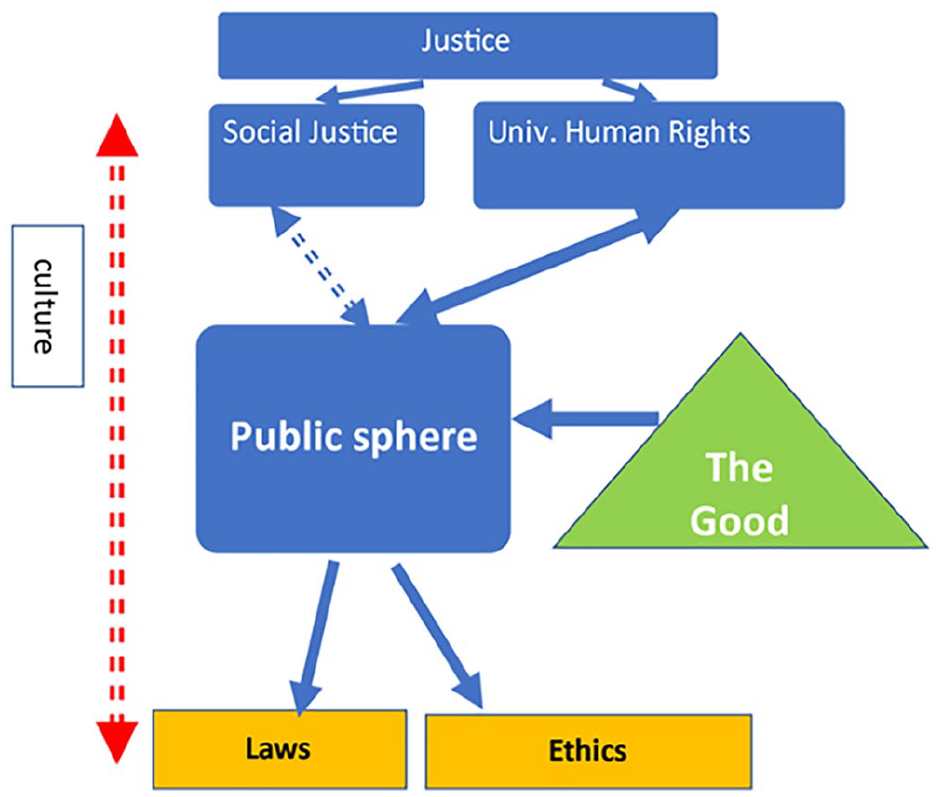
Classical liberalism.
Political liberalism
Many authors altered classical liberalism, and the chief of them is John Rawls, who developed what he calls political liberalism, revising his preliminary thought on Justice. Starting from the mid-1980s, Rawls argued that primary goods (health, education, human rights) are only one part of goods, and society should keep diversity and pluralistic conceptions of the good while ensuring cohesion. Rawls argues that the competing conceptions of justice and of the goods should be debated using public reason. The liberal state will ensure that society reaches one unified conception of justice that would be neutral concerning people’s conceptions of the good. By having such conceptualization, the people’s culture and subcultures are important for contextualizing the conception of justice but yet neoliberal and emotional capitalism is there seeking to undermine some parts of the process of political liberalism. See Figure 2.
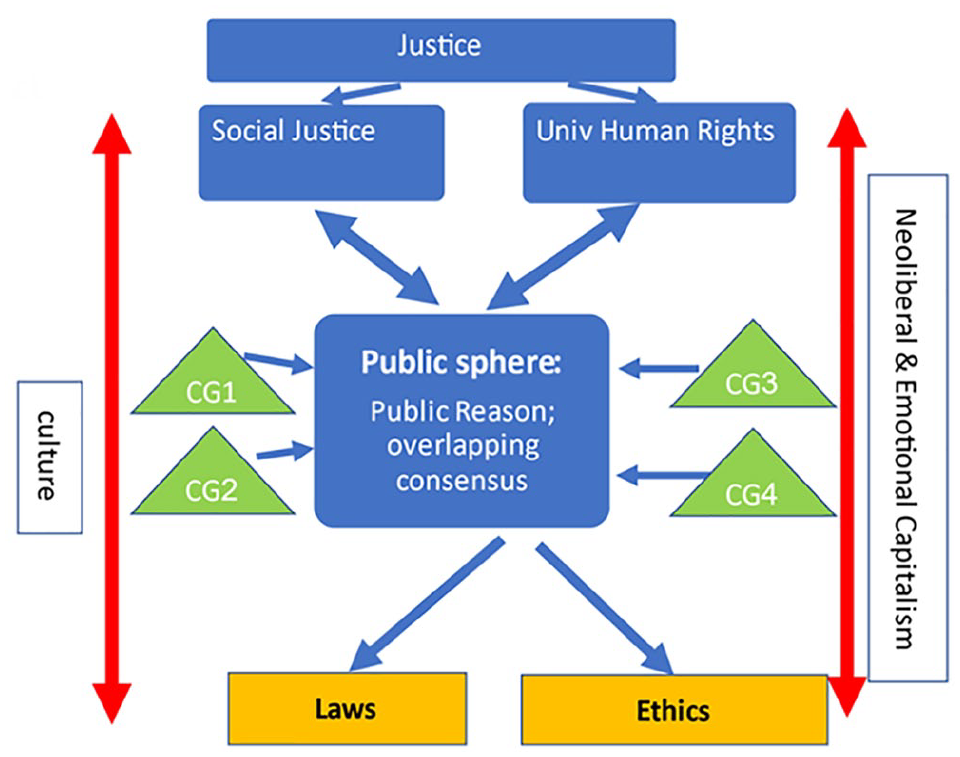
Political liberalism.
Political liberal project: Enhancing and amending Rawls Political Liberalism
Rawlsian liberalism has its own problems. But since the publication of his book in 1993, this political liberal project has been enhanced and amended by many scholars who have been working on different aspects of the Rawlsian project. For feminists, the question of care is central for understanding cooperation between individuals (e.g. Pulcini, 2021), and they problematize what is private versus public (e.g. by the state’s intervention into the private sphere concerning domestic violence). Jürgen Habermas (2006) and Maeve Cooke (2005, 2007) show the tensions between dogmatism and open-mindedness and the danger of shutting down the public sphere from the debate and opening it to a variety of reasonable and accessible opinions, including religious arguments. In the same vein, by theorizing secularism as a mechanism and not a value in itself, Cecile Laborde (2017) brings back religion in the public sphere, albeit with some conditions. Raja Bahlul (2003) problematizes public reason, arguing that it is liberal reason presenting itself as ‘public’. Amartya Sen (2011) criticizes Rawls’s theory of justice, emphasizing the importance of capabilities instead of the primary goods proposed by Rawls.
The excessively individualistic conception of Rawls’s political liberalism was redressed by some liberal communitarianists such as Michael Sandel, Nassif Nassar, Charles Tylor, Amitai Etzioni, Michael Walzer, and Abdie Kazemipur who all struck a balance between autonomy and dependency, freedom and relating to collective and emphasis responsibility before freedom.
Symbolic liberal project
The question that I now raise is this: does sociology’s response to pathologies of late modernity respect these debates, that is, amended versions of political liberalism? My answer is: No! Indeed, while sociology’s response respects classical liberalism, it is politically illiberal, or it adopts what I call the Symbolic Liberal project (SL). This project distorts the definition of justice by deflating the concept of social justice and inflating the conception of the universality of human rights and considers only one possible conception of the good as being an inherent part of the conception of justice.
Deflating the concept of social justice
Symbolic liberals are less interested in the effects of inequalities than in defending the question of rights. Some like Jan-Christoph Heilinger (2019) criticize the downplay of class analysis at the nation-state and global level. In fact, little interest is shown in global issues such as world poverty and the unjust dynamics in the global economy. The conception of justice is only conceived within the confines of the nation-state.
SLs have power as they are part of ‘symbolic capitalism’ and are active actors in a polarized society. The African-American sociologist Musa Al-Gharb in his book We Have Never Been Woke: Social Justice Discourse, Inequality and the Rise of a New Elite (Al-Gharb, Forthcoming) defines symbolic capitalism as a new class of social elites who have not attained their social position by owning material assets, nor by developing or trading material goods or services. Instead, they traffic in symbols and rhetoric, images and narratives, data and analysis, ideas and abstractions.
He offers some thoughts on the American context by saying that: Despite their expressed commitments to egalitarianism, [symbolic capitalists’] idiosyncratic lifestyles are fundamentally premised on exclusion, exploitation and condescension. The communities they live in, and the institutions they dominate, are among the most unequal in American society [. . .]. That is, [they] are among the primary beneficiaries of the very inequalities they condemn, including [. . .] racialized and gendered inequalities. And we are not just passive beneficiaries. We are active participants in exploiting and reproducing states of affairs we expressly condemn.
5
This elite uses symbolic politics, conceptualized as driven primarily by emotions and intuitions. Emotions are shaped by the predispositions of the actors: ideological beliefs, normative values, and prejudice. In the context of war, belligerents use emotional rhetoric very strongly not to appeal rationally to followers’ interests but to appeal emotionally to the predispositions (Kaufman, 2017). In the framework of symbolic politics, in the time of peace, emotions provoke agreement among followers.
In that manner, the broader issues of economic inequality and social justice are lost. The Cultural Left focuses on identity politics and cannot create a unified vision that can appeal to a broad range of people. In The Death of the Left – Why We Must Begin from the Beginning Again, Simon Winlow and Steve Hall (2022) identify the root causes of the Left’s maladies in how new cultural obsessions displaced core unifying principles such as social class struggles. The Left, more than the Right, formulates policies ‘strictly as a means of gaining votes’, rather than seeking to gain votes ‘in order to carry out certain preconceived policies’. As a result, voters start looking for alternatives among competing groups that use the same tactics, and the electorate becomes polarized (Downs, 1957). Elections become arenas of competing groups disconnected from the issues related to social structures, reflecting individual choices. A good example of the effects of such political change is the transformation of the Socialist Party in France, which changed from a strongly ideological party to a ‘party of elected people’ and not anymore a party of militants (Lefebvre and Sawicki, 2006).
Inflate the conception of the universality of the human rights
Concerning human rights, the SL project stress ‘identities’ as the locus of rights or defend individualistic choices, both assumed to be universal. Despite the fragmentation of identities under subcultures politics, the SL project considers their conception of the good above all conceptions and enforces it into society by extending norms and deculturizing it. But simultaneously, their conceptions are too insular and self-referential to be connected to the broader public and mainstream culture.
Let’s pause and reflect on two issues here: the universality of human rights and identity politics. Concerning the first, the most important universal values which are documented with the greatest global consensus are the ones described in the Universal Declaration of Human Rights. This Declaration was understood not as a constellation of abstract concepts but as a set of concrete legal axioms. Specific cultures were not considered as having a part in defining any of these concepts, nor could these principles could suffer from adaptations to local conditions. Our late modernity has emphasized formal legality rather than more subtle moral judgments. By separating the legal norms from actual living conditions, these concepts become formal and in this legalistic approach, human rights become a tool for both the weak and the powerful. Rights are brandished as weapons – to use the title of Clifford Bob’s (2019) great book – and camouflage strategies designed to cover up ulterior motives that further marginalize religious minorities (when, for example, blasphemy, a legitimate right, becomes a duty), and deprive vulnerable populations of social services (denial of public schooling for veiled students in France and Quebec 6 ). In the same vein, Azmi Bishara (2023) argues that personal liberties as basic human and civil rights in parts of Western societies triggered the wish to impose them on societies that still live under authoritarian regimes functions as a defense from cynicism and nihilism under authoritarianism and can be seen as practicing paternalism that can deteriorate into cultural imperialism.
As for identity politics, many changes are happening at a dizzying speed. In the past, identity relied on national or religious allegiance and concerned a large population. Nowadays, identities rely on subcultures, defined by a limited and external set of traits (race, sexual preferences, eating habits) often against internal ‘other’. Olivier Roy’s (2022) seminal book ‘L’aplatissement du monde’ (‘The Flattening of the World’) confirms the increasing reference to ‘identity’ in the political discourse, both on the left and on the right. The current crisis is not a crisis of cultural change, but a crisis of the very notion of culture. Identities are now fragmented and don’t create a society but a collection of subcultures that are looking for safe spaces, either on the left (campuses) or on the right (from gated communities to national borders) (Roy, 2022). These new identity groups seek protection by law and international conventions without taking into account how some of their rights can enter into tension with other groups.
A hegemonic conception of the good
Because of their highly symbolic capital, some SLs are capable of pushing their conception of the good into the (republican) public sphere, thanks to their domination in this sphere and their ability to use of law to enforce it in society. In doing so, they commit two errors: first, some SL groups sell their conception of the good as a universalistic conception of justice. Second, their individualism is ontological in the sense that society is built up from only individuals and nothing but individuals and, hence, it is nothing more than the sum of individuals and their properties. This will prevent the SLs from envisaging any evaluation of social structures and societal properties. For example, family and community are not viewed as important, even if they are salient to the individual well-being (Maffettone, 2011). It is against this ontological individualism that Amartya Sen calls for ethical individualism.
A prime example of the above problem can be found in the case of Muslim headscarves in France. Wearing a headscarf is an inherent part of some pious women’s conception of the good (what to dress). Banning this headscarf in the name of the conception of justice (gender discrimination) or in the name of violation of the principle of neutrality of the public school vis-à-vis religions is a violation of the will of many French Muslims to have their conception of the good and even the conception of freedom of religion. The same arguments should be addressed to the Iranian authorities, which impose one conception of the good on its population by forcing all women to wear a headscarf in public spaces. In both cases, because dressing does not harm others, it should be considered a ‘right’, and particularly so in the first case, where the veil is considered part of a comprehensive doctrine.
While a hegemonic conception of good is formally allowed to be debated in the formal public sphere, SLs, like their opponents – the Conservatives – now tend to move the debate in the direction of issuing regulations and laws while neglecting the fluidity of moral accommodations that people use in order to resolve tensions. A beautiful concept such as tolerance which embodies the relationship between different conceptions of the good becomes a site of dislike, disapproval, and regulation. In her seminal book, Regulating Aversion: Tolerance in the Age of Identity and Empire, Wendy Brown (2008) painstakingly points out how tolerance is heavy with norms that consolidate the dominance of the powerful and sustain the abjection of the tolerated and equate the intolerant with the barbaric. The erection of cultural silos may create rather than break down such differences. This politics of identity, which has seen the rights of disadvantaged groups pitted against one another, can be, according to Brown, regressive, questionable subcultures that hide social class wrongs and dynamics.
While ethics and law must be a daily labor of restraining negative feelings, for some SL actors disgust can be trusted as a basis for law-making (again, like their opponents, the conservatives), as this has been shown in the work of Martha Nussbaum (2009). Do the French of cultural majoritarianism disgust the burkini on the beach and this is why they ban it? This is a similar situation to the Lebanese Muslim-majority city of Saida, where the municipality is attempting to ban bikinis in the public beach and some conservative WhatsApp groups label it as ‘disgusting’ and ‘not taking into account the culture of the people of Saida’.
Extension of the deculturized norms
Olivier Roy (2022) shows us how the extension of individual freedom (political and sexual) since the Sixties led to a paradoxical extension of normative systems: inflation of laws and regulations concerning both the social life (workplace, garbage sorting, terms of address, health issues, etc.) and the intimate life. For him, the nature of the emancipation project has changed over time from being based on reason to becoming based on desire. This project enhances individual liberties and particularly gender equality and allows the control of one’s own body (‘My body is my business!’). But “what next?” As Nassif Nassar wonders, linking this to the dignity of the self, which possesses the body as an integral part of it. Certainly, plastic sexuality and the transformation of intimacy (as theorized and even celebrated by Anthony Giddens) will produce many contradiction and abuse of freedom and this is why the movement of Me Too was so important. However, for Roy, this emancipatory project went too far in the direction of establishing norms while undermining what culture it used to regulate.
For him, the term ‘culture’ has a variety of meanings, but all revolve around two poles: first, culture in the anthropological sense is the common horizon of meaning and representation specific to a given society or community. Second, culture as corpus, that is, haute couture and a body of intellectual or artistic production selected and considered good to know or practice. The former is implicit and must therefore be decoded by society itself or by the anthropologist who studies it. The latter is explicit and therefore requires selection and transmission. Today, according to Roy, there is more than just a crisis of culture: an erasure of anthropological culture. A crisis of the ‘implicit’, that is of a supposedly shared culture. When there is no longer a shared culture, everything must be turned into an explicit code of how to speak and how to act.
Identity politics, victimhood, and trauma become very important and with it the attempt to judicialize them. For Roy, this normativity does not have the axiological purpose of the good. A norm without value but with a price to pay – this is the paradox of neoliberalism. A classic example is that you will sue a transportation company for delaying your trip even if this did not cause you a major disruption. Litigation replaces what historically was a negotiation between different social actors to reach fluid reasonable accommodations that take into account culture and human relationships. Now, litigation is part of a broader process where control, discipline, and surveillance occur in which not only are we accountable vis-a-vis the state but also a plethora of bureaucratic instances. The work of Béatrice Hibou (2012) is particularly insightful with his notion of Neoliberal bureaucracy, which is a vector of discipline and control, of continuously filling forms, producing social and political indifference. Under the pretext of depoliticization, this trend cannot hide the exercise of normalizing and excluding power. Operating as it does through individuals, bureaucratization does not come ‘from above’: it is a much wider process of ‘bureaucratic participation’, a response to the need to voice material and vested interests and give answers to legitimate demands, as well as expressing the quest for efficiency, but it also reflects day-to-day conflicts and negotiations between actors.
Second public sphere
As consequence of the dynamics described above, the formal public sphere will be contested and will force those who felt marginalized and lacked access to it to create an alternative public sphere. This alternative sphere takes the shape of a collective/communitarian project in the liberal states, and the virtual community in authoritarian states; and it will privilege the cooperation between communitarian actors more through moral accommodation than through formal laws. See Figure 3.
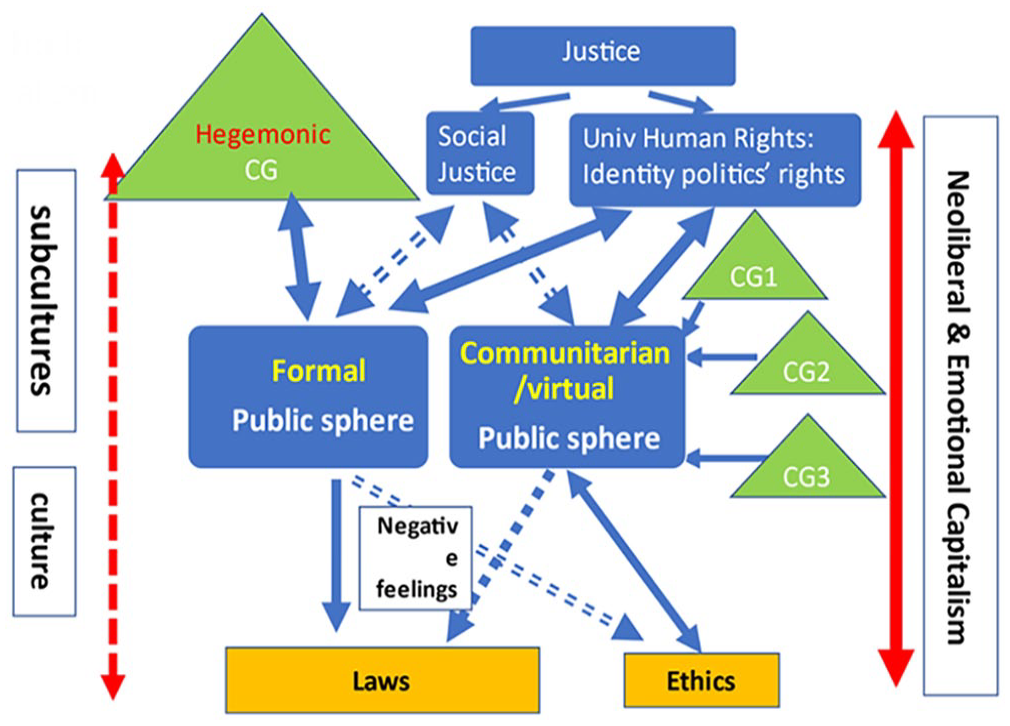
Symbolic liberalism.
The contours of the dialogical political liberal project
As the Symbolic Liberal project becomes itself a contributing factor in the pathologies of late modernity, we are in multiple crises now; and this requires rethinking our normativity to establish what I call a Dialogical political Liberal Project (in short Dialogical liberal project) which echoes Dialogical Sociology. This project has the following four features:
First, it rehabilitates social justice by more commitment to social class analysis and gives it the overarching position in any intersectional analysis. Of course, this will be context-sensitive, but I will say, in the footsteps of Michel Wieviorka (2022), we should not lose sight that race, ethnicity, gender, and sexuality should complement an analysis of class and not the other way around.
Second, when it comes to the question of human rights, the Dialogical liberal project distinguishes, as Mohamad Fadel (2022) points out, between the universality of the Universal Declaration of Human Rights and the cultural particularity of each system of human rights. The right to culture is an inherent part of this declaration and should be balanced with the promotion and protection of all human rights and fundamental freedoms. We always need processes of cultural mediation of human rights, which involve the risk of having to accept a prioritization, or reprioritization, of social values that one believes to be contrary to universal human rights values. (An-Na‘im, 2013)
Yet this cultural particularity, which is the basis of diversity, was often taken as an essence. What is needed is to transform this particularity from barricades we hide behind to an inexhaustible specificity not limited to us, to become rather a dangling fruit ready to quench the thirst of anyone desiring this sweet resource. Neither tradition nor cultural particularity is a domain that is neutrally valid; rather both are loaded with ideology.
Third, beyond the singular conception of justice, how can we go back to reasonable pluralistic conceptions of the good without imposing a hegemonic one? The dialogical liberal project is not only sensitive to culture but also to power. To hinder a conception of the good from being hegemonic and to reach the best policy of social justice, it should be first a deliberation in the public sphere, before a consensus around it may emerge. However, it is often important that an opposition remain capable of forming social movements as a mechanism of balancing power and making their voice heard, as in the case of last month’s movement in France against the new law of retirement or the Tunisian movement against the authoritarianism of the president Qais Saeed, or The USA’s Black Lives Matter. Sometimes a revolution (defined as an attempt to change the political system from outside of its norms 7 ) is needed as in the case of protracted brutalizing despotic regimes in Syria, Bahrain, and so on.
Fourth, the Dialogical liberal project does not rely only on the liberal institutional arrangements as Rawls heavily does, but rehabilitates the fluidity of moral argumentations in society, including how individuals and communities exercise Montesquieu’s ‘doux commerce’ in their societal everyday arrangement. Against individualistic political liberalism, dialogical sociology rehabilitates care and connects itself to the convivialist movement (Caillé, 2015), to Gennaro Iorio’s and Silvia Cataldi’s conception of social love (Cataldi, 2020) and Hartmut Rosa’s (2019) conception of resonance and relational approach to well-being.
Feminist scholars such as Elena Pulcini insist on a double operation of critique and deconstruction of how care can be worked as altruism while gendering family as a social structure: on the one hand, we need to examine the figure of the sovereign subject, from the Cartesian subject to the Homo economicus of liberal tradition, and reveal the unilateral nature of what has been referred to, appropriately, as the ‘disengaged self’, a masculine and patriarchal Self separated from any relationship; on the other hand, we need to restore dignity to the notions of dependency and relationship by freeing them from the self-sacrifice and abnegation which have always been associated with the feminine. (Pulcini, 2021)
Rehabilitating care implies thinking of the subject in a way that transcends the dichotomy between the priority of the Self and the priority of the Other, since it combines autonomy and dependency, freedom and the capacity to relate. Women can transform their traditional condition of being enslaved to caring (and to giving) by acting willingly and voluntarily as subjects who give care (and gifts) (Pulcini, 2021). See Figure 4.
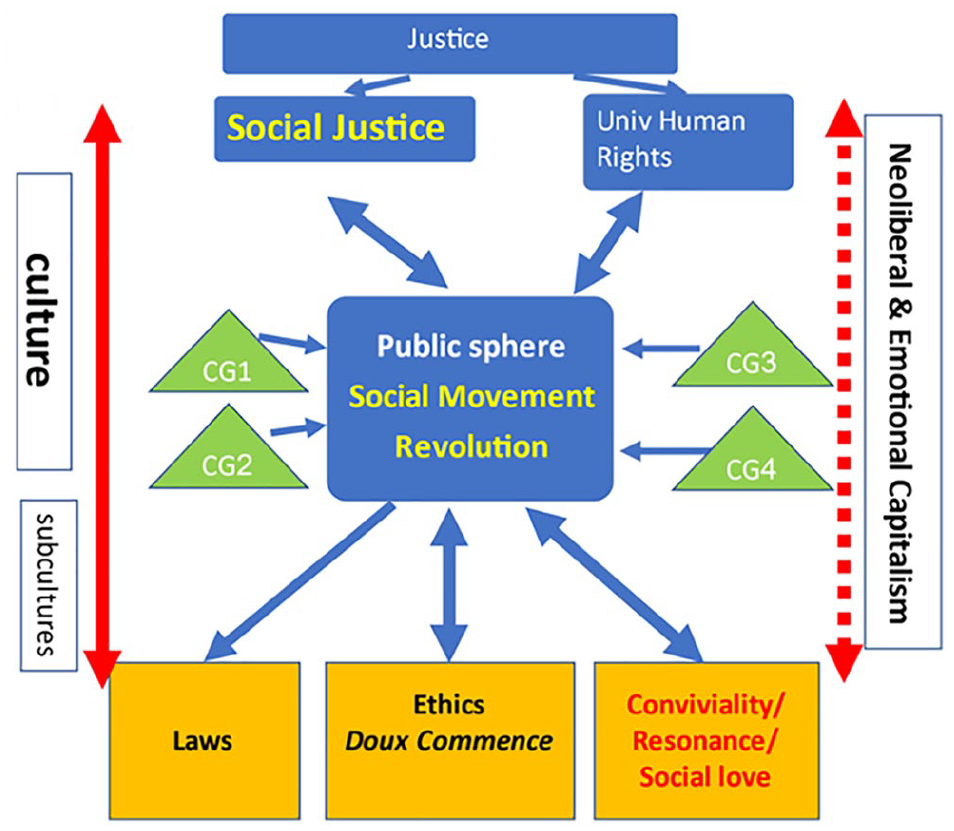
Dialogical political liberal project.
Some applications of the dialogical liberal project
I would like to bring examples of how to apply this project to some salient issues related to the social organizations of society and to the question of identity. In each case, there is an issue of how to reinforce the unified conception of justice and leave space for the pluralistic conceptions of the good, and sometimes how to submit the competing conception of the good to the interest of the common good.
Social organization/social classes
Here, we need to ensure a Universal Minimum Income (UMI) – that has been advocated by Thomas Piketty and the convivialism movement and many other scholars – and affordable education and health for all the population. Some issues will be controversial, such as whether to give priority to work to nationals compared to migrants or whether we should raise the retirement age to fill the state budget but also deal with individual choice, particularly taking into account different types of works (e.g. manual vs intellectual). What about higher education? Should we have two systems: one sophisticated for those who merit and one for the rest? Is the current system, which divides those who can afford high tuition from those who cannot, at odds with the principle of social justice? All these issues are matters of negotiation/deliberation/social protests within each given society.
Social organization/nature
The struggle for the environment is inseparable from our choice of the conception of justice and particularly in its relation to political economy, and from the nature of our desired economic system – and these connections between human beings and nature have never been as intimate as they are now. Past decades saw rapid growth that was based on the assumption of long-term stability of the fixed costs of raw materials and energy. But this is no longer the case. More recently, financial speculation intensified and profits shrunk, generating distributional conflicts between workers, management, owners, and tax authorities. We cannot conceive a society without its relation to nature: society is indeed society-nature.
As part of the conception of justice, we need to move to a slow-growth economy and its corollaries (including the need for cheap and low-carbon public transportation, seeing public services as investments rather than liabilities, and increasing the security of labor markets).
However, part of the conceptions of good is to allow people to conceive their Buen vivir (‘good living’ or ‘well living’) as it is conceptualized by Eduardo Gudynas: Harmony between human beings, and also between human beings and nature, a related theme is a sense of the common. Gudynas has for long inspired social movements in South America.
What is important to me is how to rehabilitate the question of common space and impede what really hinders the sustainability of our development project such as excessive carbon footprints, and consumerism. These issues should not be part of the conception of the good but they should be moved up to be part of Environmental justice.
Social organization/secularism
Secularism is extremely important for the success of any liberal project. I define it, echoing Cecile Laborde (2017) minimally as a conception of justice as follows: a safe distance between religion and state and minimal neutrality of state. Secularism as such is a mechanism to ensure reaching a political liberal project and not a value by itself. 8 With the modern trap of dichotomous thought of science versus religion, religion versus politics, the social sciences for long saw religion as a foundational barrier to progress. 9 Let me focus particularly on the case of France where its laicity was conceived by symbolic liberals in the last two decades as civic religion [inspired by the dominant religion] against some other ‘foreign’ religions.
French secularism has taken religion in the Christian manner, more specifically in the manner of the Protestant Reformation by reducing it to individual belief and freedom of conscience and confining it to private spaces such as the home and the church. As a result, rituals or any other public forms of religious affirmation (such as the wearing of the Islamic headscarf) tend to be considered an unacceptable form of proselytism. In the name of defending the ideals of the French secular left, symbolic liberals have no hesitation in transforming themselves into ‘faqih’ (Muslim jurist) or ‘mufti’ to ‘prove’ that the veil ‘is not part of Islam’, or that it is a ‘symbol of the slavery of women’. In a totally ethnocentric display, they project onto Muslim societies meaning and cultural interpretation that emanates only from European culture. Such arguments clearly violate the most basic freedoms since it is up to each individual to define and give meaning to their social behavior.
The French new secularism has deemed itself an authority for passing restrictive legislation against minority religions. In place of any public debate on what is common in French culture, minorities with different lifestyles (including all religious practices and rituals forming the ‘good life’) are legislated against unliterally. After its legislation on the headscarf, France adopted one specifically against the burka, then yet another against the burkini, even though it is very difficult to establish that these practices in any way harm the majority or the social contract.
Family authority: Conflicting conceptions of the good
Family in multiple forms is an inherent part of the conception of justice that society should take into account as part of the social changes of our late modernity. Alas, I come from a region where the plurality of forms is still neither socially nor legally fully accepted. Yet many scholars have argued that family authority is being eroded by both the liberal state and the forces of neoliberal and emotional capitalism. For a while, both attempted to facilitate cheap mobile labor through undemanding family as a salient social structure. Later on, countries like Sweden, Denmark, Canada, and Australia became known for removing kids from specific aboriginal and migrant families and placing them in culturally advanced families. Beyond this historical argument, current research and human right reports showed how much families in Sweden are alienated from the bureaucratic power of the Swedish Board of Health and Welfare in Sweden, which has been acting without due legal process. In Sweden, in 2020, 3,486 children and adolescents were taken from their families and rehomed in the care sector without the consent of their family, what is called compulsory care under the Act on Care of Young People (LVU)*.
In Sweden, in 2020, 35,300 individuals were taken from their families and rehomed in the care sector. The most common form of rehoming was with foster families – 19,400 children and adolescents were placed with foster families, according to the report published in August 2021 by the Social Welfare Council in Sweden, which monitored Social’s statistics and performance with children and youth in 2020.
After three protests/rallies in three cities in Sweden, followed by a social media campaign under #kidnappingkidsinsweeden, the Swedish authorities replied on 6 February 2023 accusing that social media accounts are linked to violent Islamist organizations, warning of disinformation, violent threats made against the social services, and a possible risk of terror attacks in their wake. 10 Is it really a ‘campaign by violent Islamist organizations’? By scrutinizing this issue, it was clear that heavy criticism of the Swedish system comes from the UN Children’s Committee report 11 and the Nordic Committee for Human Rights (NCHR) for the protection of Family Rights in the Nordic countries and particularly from an internationally recognized lawyer who won eight cases at the European Court of Human Rights against Swedish social services, Siv Westerberg, as well as a report by Elisabeth Dahlin, Ombudsman for Children to the Swedish government. 12
Here are four conclusions I want to draw from it. First, I want to show the extent to which there is intolerance in the current debates on the importance of family and how such critique has been reported as a plot of ‘violent Islamist organizations’, although I admit that the debate in the Arab and Muslim world is very emotional and consider this as Islamophobic kidnapping.
Second, the way in which the neoliberal state uses its authority and that of the school over the family authority, instead of complementing it, is problematic. Of course, not all the family authority is eroded and it depends on which family (national vs migrant one; urban vs rural one).
Third, I am not fetishizing the family as a social structure. One can be glad that the feminist movement has pushed the state into the private sphere by making it regulate and deal with domestic violence. Yet, to be dialogical, we need to see how people are anxious about the family in all its forms. I do believe that because we are in the neoliberal age, the family is a salient social structure for protecting individuals vis-à-vis the coercion of the state and the market and for providing individual material support but also emotional support.
Fourth, should Republican schools replace the family in this function? No, they should not. They should complement it. An example of this ‘replacement’ one can find in several countries is how schools allow kids to transit sexually and start hormonal treatment without family consent. Again, the work of Eva Illouz (2019) and Habib (2021) about these issues is important to realize that behind that is not only a personal choice but capitalist forces and a pharmaceutical lobby.
In a nutshell, what I criticize is that extending individual rights to children means protecting them not FROM the family but WITH the family.
Sexual/gender identity: LGBTQ+
I am so glad that LGBTQ+ movements in Western Europe, North America, and some other regions of the world are becoming increasingly successful at awarding LGBTQ+ people rights, especially institutional recognition for same-sex couples and their families. Yet one should distinguish between what is related to the conception of justice (acceptance, social and institutional recognitions) and that of the pluralistic conception of the good. Some countries gladly reach all forms of full visibility of all sexual orientations in the public sphere. However, others do not. Visibility is indeed part of the conceptions of the good and how this will be regulated in the public sphere.
Take the case of the World Cup in Qatar. Everyone who cares about the conception of justice should denounce the criminalization by Qatari authorities of the LGBTQ+ community. However, some argue that carrying the Rainbow flag promoting LGBTQ+ is part of the conflicting conceptions of the good that Qatari society should debate in the public sphere, and by that they denounce how some foreigners wanted to impose in Qatari society their conception of the good and see this as cultural imperialism.
In this regard, Joseph Massad’s (2008) Desiring Arabs is particularly interesting. Disciple of Edward Said and a professor at Colombia University, he argued against any institutional recognition and public visibility of LGBTQ in the specific context in the Arab world. He criticized Western-driven activism constructing ‘homosexuality’ in societies that traditionally did not see sexual desire as fitting neatly into binary categories on the basis of the gender of the sexual object-choice and did not envision sexual preferences as the basis for social identity. For him, all too often gay activists simply dismiss this as false consciousness and ‘homosexual homophobia’. The effects are pernicious, since activism is creating a backlash against what is often seen as the spread of Western prurience and shamelessness. State persecution, often spurred by an aroused public opinion, is intensified, replacing more traditional and benign notions of tolerating private sexual idiosyncrasies as long as they are carried out discreetly.
While I don’t fully agree with him, I find his position interesting in arguing for a culturally driven model of application of non-discrimination on the basis of sexual orientation. In the same vein, one can question whether gender fluidity and the delinking of gender roles from sex roles should be celebrated in all regions and whether pleasure and desire can be deculturalized. Pleasure is indeed part of the conception of the good. Can parents claim the right to educate their kids on what constitutes the good life for them? If a community wants to celebrate heterosexual normativity, is this against the conception of justice (i.e. no discrimination against queer community)? Can one argue that behind gender fluidity a conception of the good that has its own metaphysics celebrating ephemeral gender identity based on absolute pleasure? In the name of absolute pleasure, can a society tolerate polygamy and polyandry? Again, I don’t mean here to essentialize any culture nor to assume uniformity of each ‘culture’. What I tried to argue is that if one considers that cultures change and are not set in stone, then we should reflect on the power and emotion as a structure of feelings (influenced by social media) behind recognizing some aspects of gender fluidity.
Conclusion
I am not sure that all the pathologies of our late modernity are related exclusively to the bad implementation of the political liberal project or to its theory. We need to have a critical assessment of both. I am not fetishizing any conception, whether Rawlsian or else, but I see humanity in a conversation about some universal conceptions and values and it comes together to forge them. These conceptions are thin in their abstract form but become thick when each society has the freedom and capacity to debate them in light of its own circumstances. This is what I call soft universalism. By ‘soft’ I do not mean absolute relativism, which can lead to the myth of uniqueness as I see it in some Arab and Israeli sociology. Differentiating between ‘thick’ and ‘thin’ moral terms is very important: Michael Walzer argues that a thin set of universal principles should be adapted or elaborated thickly to historical circumstances in order to give sense to what we mean by specific principles (e.g. social democracy) in a given context where other thick principles (e.g. distributive justice) are into play. In this meaning, these thick moral arguments often are more legitimate and useful ones. Yet this minimal thin morality is very important, both for the sake of criticism and for the sake of international solidarity (Walzer, 2019).
Dialogical Sociology seeks to circumvent the conservative critique of individual freedom and the libertarian view that freedom trumps all other values. Rather, it rehabilitates the pluralistic conceptions of the good, balancing individual, and collective rights.
Dialogical Sociology is built on an amended version of Rawlsian political liberalism that accommodates culture and communities and not only autonomous individuals. It starts not from metaphysical assumptions or abstract ideals but from the world as it operates, namely, as cultures in motion rather than cultures as fixed, homogeneous, eternal entities. Social statistics reveal that people in all societies express significant support for religion, family, and community, as well as individual liberty and equality. However, there are trade-offs between these values. In particular, greater support for liberty and equality comes at a cost to religion, family, and community (and vice versa). That being said, such trade-offs are not all-or-nothing affairs. Rather, they are matters of degree. Different societies strike different balances between values, and these balances shift over time (Nakissa, 2021). For a long time, World Happiness Index has neglected to inquire about the concepts of balance and harmony, whose saliency became evident, particularly through studies from the Global South. The 10th version of this Index (Helliwell et al., 2022) reveals that this matters to people’s happiness worldwide: Balance/harmony have highly significant linkages to life evaluations and create dynamics at the heart of well-being.
Dialogical Sociology’s utopia/project starts in the reality of existing social and political arrangements but also how individuals, collectives, and communities exercise Montesquieu’s ‘doux commerce’. Thus, it is rather a compass that connects sociology to moral and political philosophy. It considers values that sociology, as science with normative claims, defends as sociological and not (only) simply philosophical themes, meaning that these values cannot be reasoned independently of how we experience them (Bamyeh, 2019). Thus, Morality and ethics are not a fixed set of values but more structured and structuring structures. This sociology corrects then its positivist tendency by proposing explicit methods, normative presuppositions, and forms of engagement. This approach is dear to some convivialists, such as Frédéric Vandenberghe (2018) and an inherent part of my program at the International Sociological Association as president, namely connecting moral and political philosophy to sociology (see Hanafi, 2021).
Again let me be clear, Dialogical Sociology does not undermine the critical energy of approaches like Marxism, feminism, race studies, critical theory, and intersectionality, but is a call for more situated criticism; one that, while criticizing powers, is also able to simultaneously open up a dialogue with the very forces it critiques. Those who know my scholarship on the Palestinian-Israeli conflict know how I can strongly criticize the current Israeli settler colonial project in the Palestinian territories and engage in dialogue with Israeli scholars. Here, the question of power is very important: you cannot dialogue with a powerful group/entity if you don’t have a minimal weight: social movements, resistance, and revolution are sometimes necessary before the dialogue.
Should we dialogue with settlers in the Occupied West Bank or Far-Right? In principle, no! We need to establish a minimum of rules for debating in the public sphere. Yet it is not anymore acceptable to exclude from debate and dialogue those who don’t agree with our social vision because of their religiosity, conservatism, or nationalism, as Symbolic Liberals used to do. For a long time and by allying with civil society, radical criticism preempts our scholarship to establish a dialogue with the civic sphere in the sense of Jeffrey Alexander. He reminds us that civil society is only one sphere among others within a broader social system, in which the family, religious groups, scientific and corporate associations, and geographically bounded regional communities should be incorporated, as they all produce goods and organize their social relations according to different ideals and constraints (Alexander, 2008). This means it is not enough to simply support those who have liberal democratic ideals. We also need to listen attentively to those who refuse to embrace, partially or totally, these ideals. Let us remember the excellent work of Arlie Russell Hochschild (2016) about rural White Americans in Louisiana. They have turned into Trump supporters, expressing their discontent vis-a-vis globalization and their experience with social inequalities. In the same vein, before judging them, let us listen, for example, to those who have fears of Syrian and African migrants coming to Europe. In this sense, dialogical sociology is building on Luc Boltanski’s pragmatic sociology, Michael Burawoy’s (2021) Public sociology, and South African’s Critical Engagement (Bezuidenhout et al., 2022) and takes them further in engaging with different public(s).
While our sociological endeavor may provide salient knowledge on poverty, social inequality, or forced migration, it should mobilize emotions and moral impulses, compassion, altruism, solidarity, and activism. The aim is to go beyond describing and criticizing social life, toward intellectually constructing a framework for a communicative society; a society that incorporates all its citizens while respecting all forms of pluralism, without pushing the ‘others’ into assimilation to cultural majoritarianism.
Footnotes
Acknowledgements
I would like to thank all of those with whom I engaged in discussion about this paper and helped mature my ideas: Mohamad Bamyeh, Rigas Arvanitis, Abdie Kazemipur, Frédéric Vandenberghe, Bashar Haydar, and Mounir Kchaou.

Author’s Note
This is an expanded version of the Presidential address at the XX World Congress of the International Sociological Association, Melbourne, 25 June–1 July 2023.
Declaration of conflicting interests
The author declared no potential conflicts of interest with respect to the research, authorship, and/or publication of this article.
Funding
The author received no financial support for the research, authorship, and/or publication of this article.