




Abstract
Based on a comparative analysis of seven youth movements, this article shows the rise of a rhetoric of intergenerational injustice over the past decade, increasingly associated with a direct accusation of older generations and with a generational and global ‘we’. Theoritically, we propose to approach the ‘generational voice’ – rather than the generational ‘presence’ – to shed light on the generational grievances, emotions and identities carried within movements. We draw on the textual analysis of protest slogans (n = 1914) collected directly from: the Indignados (2011), the student movements in Chile and Quebec (2011–2012), the Paris ‘Nuit Debout’ movement (2016), the Hong Kong pro-democracy movements (2014 and 2019), and the Montreal pro-climate march (2019). Using mixed methods, the article shows the existence of four major rhetorics of generational injustice – be it economic, social, political or environmental – associated with an increasingly radical critique of a legacy, deemed too heavy for ‘future generations’.
Introduction
From the Arab Spring to the pro-climate movement, most of the protests during the 2010s were initiated and driven by younger generations, particularly students and young graduates. This strong generational presence raises new questions about the emergence of younger generations as ‘global’ political actors in this decade (Bessant et al., 2017; Dufour et al., 2016; Van de Velde, 2022a): young people are known to have participated strongly in the cross-national diffusion of ideas and repertoires of action, both through social media and face-to-face encounters (Castells, 2015; Della Porta and Mattoni, 2015; Romanos, 2016). This phenomenon has even prompted some comparisons with the ‘68 movements’: while the latter had marked the advent of a new generation of middle-class students defending anti-authoritarian values, the different waves of 2010 would have in common that they were carried by a new generation of students affected by neoliberal education and austerity, and driven by pro-democratic values (Della Porta, 2019).
Although the participation and role of young people in these social movements is now well established (Bessant and Pickard, 2018), little is known about how this massive presence is reflected – or not – in the claims themselves: how is the generational question taken up and politicised in the protests? What are the main generational narratives, and what do they reveal about shared grievances and the construction of a generational ‘we’? Can we identify an overriding and common discourse emerging at the global level? In response to this challenge, this article takes a comparative and generational approach to the claims of post-2011 youth movements. While the generational approach to social movements has mainly focussed on the presence of young people, we propose in this article to shift the focus to the generational voice – that is, the generational grievances, identities, and emotions – carried within protests: theoretically, this concept allows us to bridge the gap between the sociology of generations and that of social movements. We rely on a large-scale analysis of slogans and signs (n = 1914) directly collected in different types of youth movements of the last decade – pro-education, anti-austerity, pro-democracy, and pro-environment – that have taken place on multiple continents and carried by various profiles of youth: ‘Los Indignados’ in Madrid (2011), the student movement in Santiago de Chile (2011), the ‘Printemps Érable’ in Montréal (2012), the ‘Umbrella Revolution’ in Hong Kong (2014), the ‘Nuit Debout’ movement in Paris (2016), the pro-democracy movement in Hong Kong (2019) and the « Friday for Future » movement in Montréal (2019). Drawing on the comparative analysis of these movements, this article shows the rise of a common discourse of intergenerational injustice at the global level, with an increasingly radical critique of a legacy – be it economic, social, political, or environmental – considered too heavy for ‘future generations’.
The generational dimension in social movements: Three faces of youth anger
To date, the generational dimension of social movements has largely focussed on the presence and action repertoires of young people in the movements, rather than on the discourses themselves. Indeed, these specifically generational claims have been eclipsed by other more general, pro-democracy, and multigenerational claims (Glasius and Pleyers, 2013). As different waves of protest have surfaced, research has identified several generational groups involved. This in turn has suggested three different facets of the younger generations: (1) ‘activists 2.0’, (2) unemployed graduates, and (3) students against educational reforms.
The ‘empowered’ generation: Young activists 2.0 and generational innovations
The first group to attract researchers’ attention has been young ‘activists 2.0’. Starting with the first movements in 2011, studies were quick to assert the central role of social media in the emergence of a new global wave of movements (Castells, 2015; Gerbaudo, 2012) and in the transnational diffusion of this ‘global justice movement’ (Della Porta and Mattoni, 2015; Flesher Fominaya, 2014). The generational component of the protests was mainly analysed from the perspective of the ‘digital activism’ that empowered a generation (Elliott and Earl, 2018); studies point to the rise of a whole cohort of connected and mobile activists, both locally anchored and active transnationally (Romanos, 2016). This group includes ‘rooted cosmopolitans’ whose emergence had been observed in the decade before (Della Porta and Tarrow, 2005; Pleyers, 2010). This generational renewal would induce a wave of ‘innovations’ in action repertoires (Della Porta, 2019), marked by a more systematic practice of direct democracy, use of assemblies, and the rejection of leaders. These characteristics come under the term ‘horizontalism’ or ‘horizontal democracy’ (Maeckelbergh, 2012).
The ‘precarious’ generation: The ‘unemployed graduates’ in Europe and the Mediterranean countries
In the wake of the Mediterranean movements of 2011 and 2012, researchers quickly distinguished another generational figure: that of the ‘unemployed graduate’ or ‘vulnerable graduate’, whose role appears to be decisive in the massification of the movements. The generational dimension was analysed from the angle of crisis and its effects on the social destiny of younger generations. Whether focussing on the Arab Spring (Blavier, 2016), Los Indignados in southern Europe (Feixa and Nofre, 2013; Van de Velde, 2011), or the Tents movement in Israel (Rosenhek and Shalev, 2014), studies have examined the massive presence of young people experiencing precarious circumstances. In Europe and around the Mediterranean, such resonances are considered to herald a ‘precarious generation’ who, though increasingly qualified, are confronted with a radical shrinking of perspectives (Bessant et al., 2017) and in turn become a ‘political generation’ (Zamponi and Fernández González, 2017). This profile corresponds to an important fringe of the ‘precariat’ analysed by Guy Standing (2014): composed mostly of educated young people ‘being denied a future’, this fringe tends to develop progressive values of equality and freedom, playing a central role in the indignation movements. Based on a study conducted in several European countries, Donatella Della Porta (2019) shows that protesting millennials define themselves as a ‘screwed generation’ that is socially vulnerable, culturally isolated, threatened by the state, and betrayed by the institutional left.
The ‘resistant’ generation: Global student struggles and neoliberalism
Finally, in the course of the decade’s many pro-educational movements, high school and university students are another generational figure that has drawn researchers’ attention. The generational dimension is thus addressed through the construction of a generation ‘fighting’ educational reforms and, more broadly, the consequences of neoliberalism. Several studies highlight the common educational problems that fuel otherwise disconnected student conflicts, such as those in Chile, Quebec, Britain, and South Africa (Cini and Guzmán-Concha, 2017; Luescher et al., 2016; Peñafiel and Doran, 2018). Although claims emerge from within different welfare states and national political histories (Brooks, 2017), they nonetheless support the hypothesis of global student resistance against a new educational world order (Bessant and Pickard, 2018; Brooks, 2017; Della Porta et al., 2020; Klemenčič, 2014). This generational figure takes on a more youthful character at the end of the decade, with the pro-environment movements, which were marked by the presence of high school students, young adolescents, and even children (Wahlström et al., 2019), and by the rise of more radical discourse (Pickard et al., 2020).
From generational presence to generational voice
In this article, we propose to approach the ‘generational voice’ – rather than the generational ‘presence’ – to shed light on a less explored facet of the generational dimension of these movements: that of its political formulation over the course of the decade. Compared to the literature, its originality is twofold: first, it does not focus on the presence of young activists, but rather on the generational discourses expressed during demonstrations through slogans and protest writings; second, it uses a broad comparative approach to seven movements, thus allowing comparison between different periods and different types of movements.
Generational voice
This concept of generational voice aims to capture multiple forms of politicisation of the generational question within social movements – not only claims but also shared identities or grievances. The concept of ‘voice’ refers initially to Hirschman’s (1970) theory, but we draw more specifically on the concept of ‘student voice’ which has been developed more recently in the educational sciences: initially associated with the most marginalised, this concept invites us not to restrict the analysis to the message carried but also to uncover the dimensions of power and participation that are associated with speaking out (Cook-Sather, 2006; McLeod, 2011; Taylor and Robinson, 2009). By extension, the concept of ‘youth voice’ has recently been used in research on pro-environmental movements to analyse the multiplicity of discourses related to climate change (Zummo et al., 2020), but we favour the term ‘generational voice’ to emphasise the generational dimension of these discourses: we hypothesise that these discourses do not only correspond to an age effect but also and above all to a generation effect. As emphasised in the work on the ‘global generation’ (Edmunds and Turner, 2005; Sukarieh and Tannock, 2015), young people have found themselves on the front lines of the major global shocks that have marked the decade – socio-economic, political, and environmental. Even if they take different forms depending on the country, these shocks reactivate the political question of generation and shift it to a global scale (Bessant et al., 2017). In many countries, they have led to a deepening of inter- and intra-generational socio-economic inequalities (Chauvel and Schroder, 2014) and have favoured the development of a relationship to the time marked by precariousness and acceleration (Leccardi, 2012). At the same time, new forms of generational politicisation have emerged, marked both by a distancing from parties and voting (Tiberj, 2017), a growing involvement in social movements and democratic demands (Feixa and Nofre, 2013; Norris, 2002; Peñafiel and Doran, 2018), and the rise of a more personal and creative relationship to politics – the ‘Do-It-Ourselves’ politics (Pickard, 2022). These dynamics could create shared generational demands from around the world (Beck and Beck-Gernsheim, 2009): in this context, the concept of generational voice allows us to grasp on which social discourses a generational ‘we’ will become claimed in the public space, and thus overcome other lines of social inequalities. In particular, we focus on three essential dimensions of the subjective forms of generational politicisation within demonstrations: grievances, identities, and emotions (Van Stekelenburg et al., 2013).
Grievances: Generational injustice and alternative futures
The first dimension of generational ‘grievances’ refers to the social experiences and feelings of injustice that spark mobilisation. In particular, we seek to identify in which cases these grievances mobilise a rhetoric of intergenerational injustice, and how it can conduct to different generational aspirations and visions of alternatives futures (Schulz, 2016). At the theoretical level, this concept of intergenerational injustice has been the subject of growing interest for more than a decade, first in terms of its socio-economic dimensions, then in terms of its environmental dimensions (Gosseries, 2008; Meyer, 2012; Tremmel, 2006): compared to other forms of social injustice, it includes the dimension of time, by contrasting ‘past’ and ‘future’ generations, and tends to call for structural solutions at the global level (Balduzzi and Favretto, 2020). An important question is whether there are shared grievances and rhetorics of generational injustice across borders.
Identities: The politicisation of a generational ‘we’
The second dimension of generational ‘identities’ has to do with the generational affiliations claimed and the opposition figures targeted in the protest, whether it be generational identities (such as ‘youth’) or infragenerational identities (such as ‘students’ or other social groups) (Simon and Klandermans, 2001); they clarify the ‘us’ and ‘them’ erected in these protests, often in the form of power struggles. Indeed, a major challenge facing the sociology of generations is to analyse how one moves from a common ‘generational condition’ to a ‘consciousness’ of belonging, and how this sense of belonging can be articulated with other social identities – generational, social, ethnic, and so on – especially on a global scale (Aboim and Vasconcelos, 2014; Edmunds and Turner, 2005; Philipps, 2018). This is a criticism very frequently made of ‘generationalism’ by Bourdieu (1980): ‘generation’ must not become an optical illusion hiding strong intra-generational inequalities (Purhonen, 2016). Moreover, it is still very difficult to verify empirically the existence of a ‘generation consciousness’ (Thorpe and Inglis, 2019), as its operationalisation is difficult on an international scale: to date, research on this issue has focussed on a targeted sample of youth activists (Della Porta, 2019; Zamponi, 2019).
Emotions: Voicing anger, fear, or hope
Finally, the third dimension, that of ‘emotions’, refers to the emotional feelings publicly expressed or mobilised in the protest writings to for the sake of generational mobilisation. By exploring them, we aim to better grasp the political role of major emotions identified in the youth movements of recent years, such as anger, indignation, hope, or fear (Benski and Langman, 2013; Jasper, 2018; Zummo et al., 2020). While the main research on the issue focusses on the emotions felt by activists in the demonstration, we focus on the publicised and voiced emotions within slogans: we know that slogans and protest writings are also political performances that respond to different political functions (Van de Velde, 2022b), and we want to understand in which cases certain emotions will be claimed within slogans and associated with rhetoric of intergenerational injustice.
Deconstructing the concept of ‘global generation’: A comparative approach
We defend the idea that a comparative approach is necessary to better identify both the common discourses that emerge at the global level, and the main differences between types of movements. Our comprehensive comparative framework aims to take into account both the local and global dynamics at play in the emergence of these generational narratives, and the way in which they interplay (Beck and Beck-Gernsheim, 2009). In particular, in constructing a coherent comparative panel, we rely on two major dimensions.
On the one hand, our comparative device brings together different types of youth movements of the decade, which have so far been approached separately in comparisons: student conflicts, anti-austerity movements, pro-democracy movements, and environmental movements. Drawing on seven cases, this panel seeks to take into account some of the main global dynamics that have recently marked the ‘generational condition’ (Mannheim, 1952), and that have given rise to a diversity of national and international youth movements. These dynamics have affected differently young people depending on the way in which welfare regimes structure the youth condition and generational inequalities (Dufour et al., 2016; Chauvel and Schroder, 2014). First, the marketisation of higher education and the increase in indebtedness – linked to a global « liberal zeitgeist » (Bessant et al., 2017) – have been particularly marked in certain liberal regimes and have led to student movements in different parts of the world (Brooks, 2017), including the Chilean Winter and the Maple Spring present in this panel. Second, the austerity policies that followed the 2008 crisis led to a growing denunciation of social inequalities and neoliberal policies, particularly in the Occupy and European indignation movements, including the Indignados and Nuit debout movements studied in this comparison. Moreover, the decade has been marked by a rise in democratic questions and issues of collective sovereignty: perceptible in many post-2008 social movements (Glasius and Pleyers, 2013), this demand is particularly evident in protests, such as the Arab Spring and the two Hong Kong movements – the latters included in our sample. Finally, the global environmental crisis has given rise to national and transnational youth movements, such as the ‘Fridays for future’ movement, present in our panel, and marked by the international influence of Greta Thunberg’s speeches.
On the other hand, beyond these global trends, this comparative panel takes into account the way in which these multiple movements are also the fruit of national contexts, political histories, and local dynamics: these elements will influence, for example, their modes of institutionalisation, the transmission of certain repertoires of action, and references to former movements. In particular, the identities – ‘us’ and ‘them’ – and the very way in which generational demands are articulated will be shaped by the place of trade unions, links to political parties, and the social groups present within the protest (Bessant and Pickard, 2018; Klemenčič, 2014). Therefore, this study relies on a comparative panel that presents a diversity of social movements, both in terms of topic and internal structuring. The frame below presents some of these elements of contextualisation: this presentation is necessarily succinct and focusses on certain dimensions of the history and repertoires of action of these movements to introduce generational analysis, without emphasising other potential dimensions of analysis, such as the role of territory or the gender dynamics.
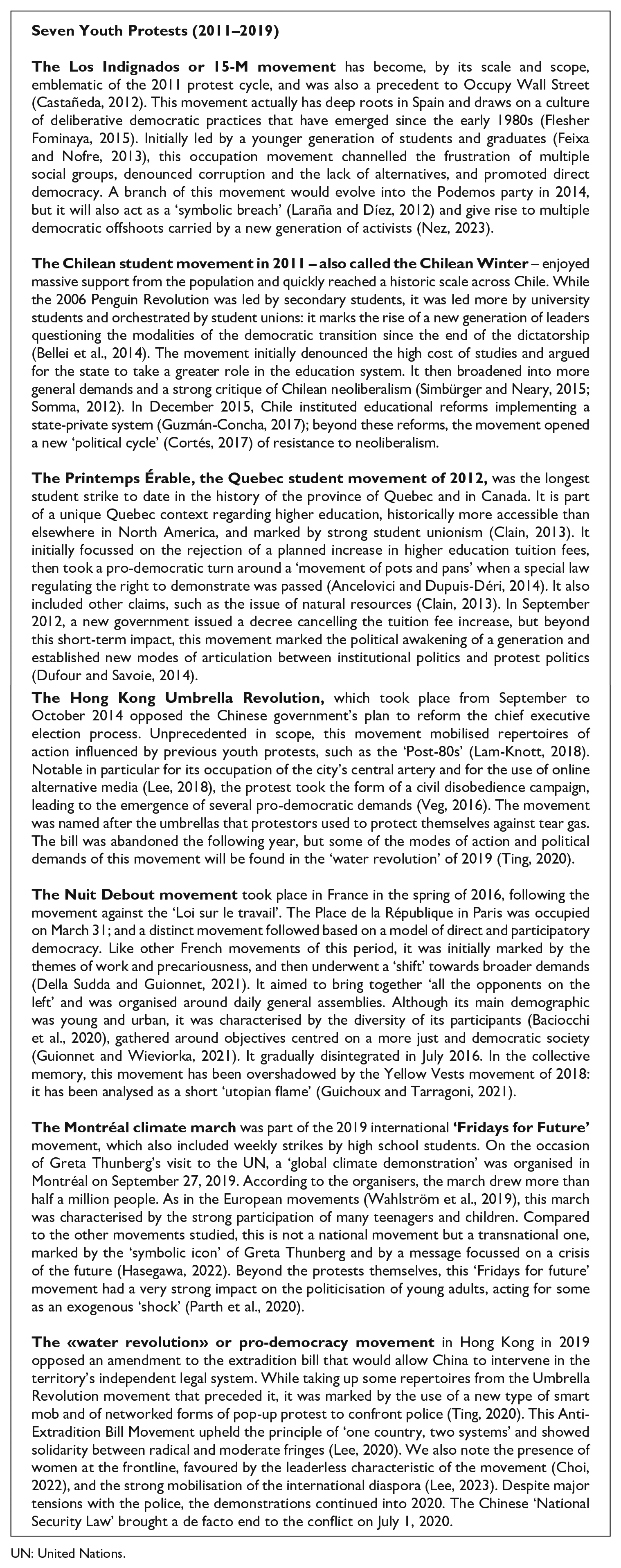
UN: United Nations.
Methodology: A discourse-based approach on slogans and protests writings
To capture these generational voices, we favour a discursive approach based on the textual and lexical analysis of generational discourses within the protests: this article proposes a comparative analysis of ‘words of anger’, that is, the protest writings – slogans, posters, and placards – used at demonstrations. Theoretically, these are approached as ‘acts of writing’ (Fraenkel, 2007) that make readable the multiple ‘targets and claims’ of a social movement (Tilly and Wood, 2013; Van de Velde, 2022b). We take into account not only the most widely disseminated collective slogans but also the individual writings which are more numerous at every demonstration. The inclusion of a wide variety of slogans casts the sociological net beyond militant circles and official discourse to take into account a multitude of individualised claims, often differing from institutional slogans. It allows us to identify generational claims that have as of yet been difficult to circumscribe.
This study relies on the direct and systematic collection of protest writings during the seven social movements analysed. The collection took place by direct observation, by going in person to each of the movements, and taking photographs at various points of the protest. I conducted my survey during large-scale demonstrations and focussed on their epicentres where the most people were gathered (i.e. downtown Montréal and Santiago for the marches in these two cities) and in the main occupied locations in Hong Kong (Queensway), Paris (Place de la République), and Madrid (Puerto del Sol Square). I made my observations at three different times of each social movement, which corresponded to some of the movements’ ‘key moments’, with massive calls for gathering. For ethic reasons, I asked for the demonstrators’ permission before taking any photographs, either by gesturing (showing my camera and waiting for their nod of agreement) or by verbally explaining my profession and the purpose of my research. In making these observations, we took into account the greatest possible diversity of slogans, whether collective or individual, printed or handwritten, and appearing on placards, posters, or walls.
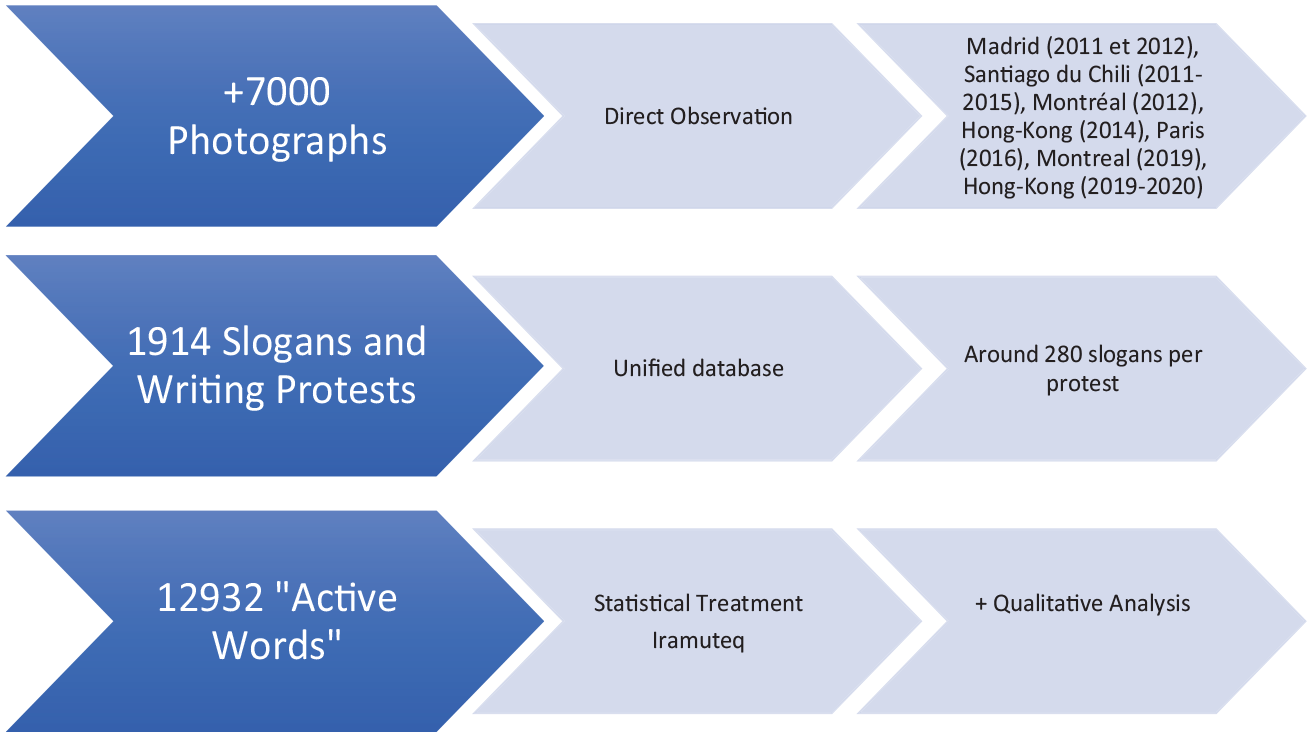
As Figure 1 sums up, several thousand photographs were taken directly at the demonstrations, and a database was created. Some 1914 slogans were entered textually in their original language, that is around 280 by protest. The entire corpus was translated into English to create a uniform and comparable database.
Data and analysis: a summary.
This corpus has been subjected to a mixed textual analysis, both statistical and qualitative. This began with a statistical and textual analysis, using the IRAMUTEQ software, which made it possible to compare the word clouds of each protest and to identify the convergent repertoires between movements. In the 1914 slogans collected during the seven movements, the software analysed 12,932 ‘active’ words (i.e. excluding small words, such as prepositions) and then identified word occurrences, categories, and correlations. The second step involved a qualitative analysis aimed at capturing more precisely the way the generational issue is formulated in each of the movements, and their possible convergences.
A global voice, four main repertoires
First of all, can we identify a ‘global voice’ from all these movements? Beyond their differences, the discourses come together around the same basic thread, which articulates three fundamental issues all related to each other: the value of education, the injustice of debt, and democratic renewal.
Education, person, democracy: Generational identities and societal values
Let us first highlight two fundamental characteristics of these protests: they appear carried by primarily generational identities, and mainly oriented towards the defence of societal values. A general word cloud of all of these protest writings (Figure 2) makes it possible to underline its generational character: it lists the most frequent words, all protests combined, and gives them a size proportional to their frequency. It shows that the slogans are marked by the presence of ‘us’ primarily associated with juvenile and student identities. It is above all the figure of the ‘student’ that appears most frequently, but we also note the presence of other juvenile identities (‘young’, ‘youth’). These generational identities are juxtaposed with other broader identities (‘popular’, ‘country’, ‘universal’). Interestingly, there is little evidence of other identities that have become central to recent movements, such as gender or racialised identities. Note also that the main emotions that emerge refer to anger and indignation (‘outrage’, ‘anger’).
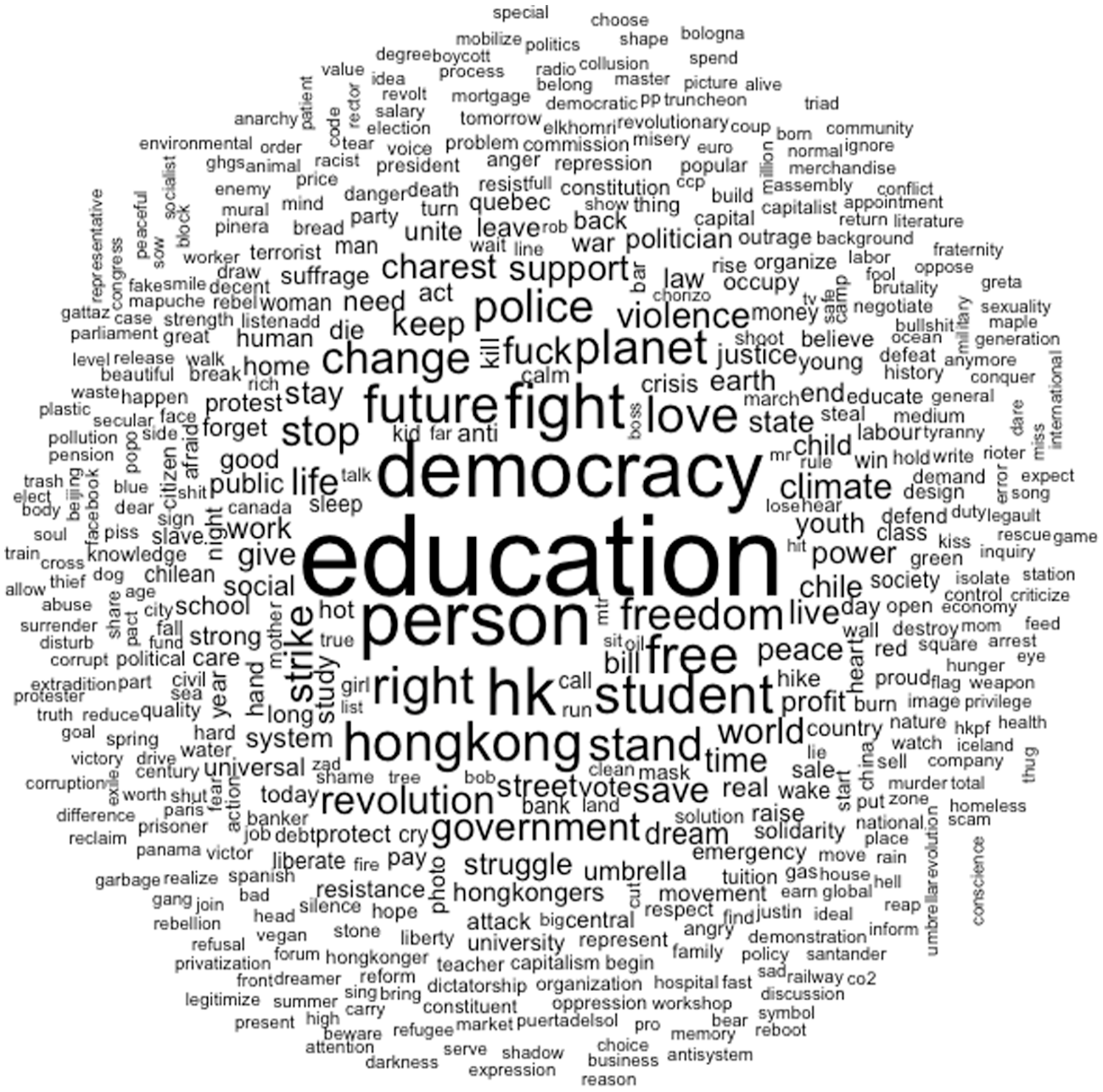
Word cloud of the seven movements put together.
Second, the word cloud suggests that these post-2008 movements are more ‘pro’ than ‘anti’ movements, focussed on the defence of major principles present in the words ‘education’, ‘person’, and ‘democracy’. This presence of great fundamental principles goes hand-in-hand with references to the future and to time which are found throughout the word cloud (‘future’, ‘dream’, ‘change’, ‘time’, ‘Life’).
Moreover, these common values and aspirations are interrelated: Figure 3 gives a visualisation of these fundamental aspirations carried within these youth protests and shows a ‘tree’ of correlations between the most used words – democracy, person, education, planet – within all the protest writings. We can see that the word ‘democracy’ is associated not only with the word ‘freedom’ but also with the words ‘violence’ and ‘fight’. Likewise, the defence of the ‘person’ is correlated with the words ‘power’ and ‘young’, while being opposed to the word ‘government’. Finally, it is interesting to note the links between ‘education’ and ‘future’ – the latter word being itself associated with ‘planet’: here, we see an obvious link between the pro-education and pro-environment movements, linked by this word ‘future’.
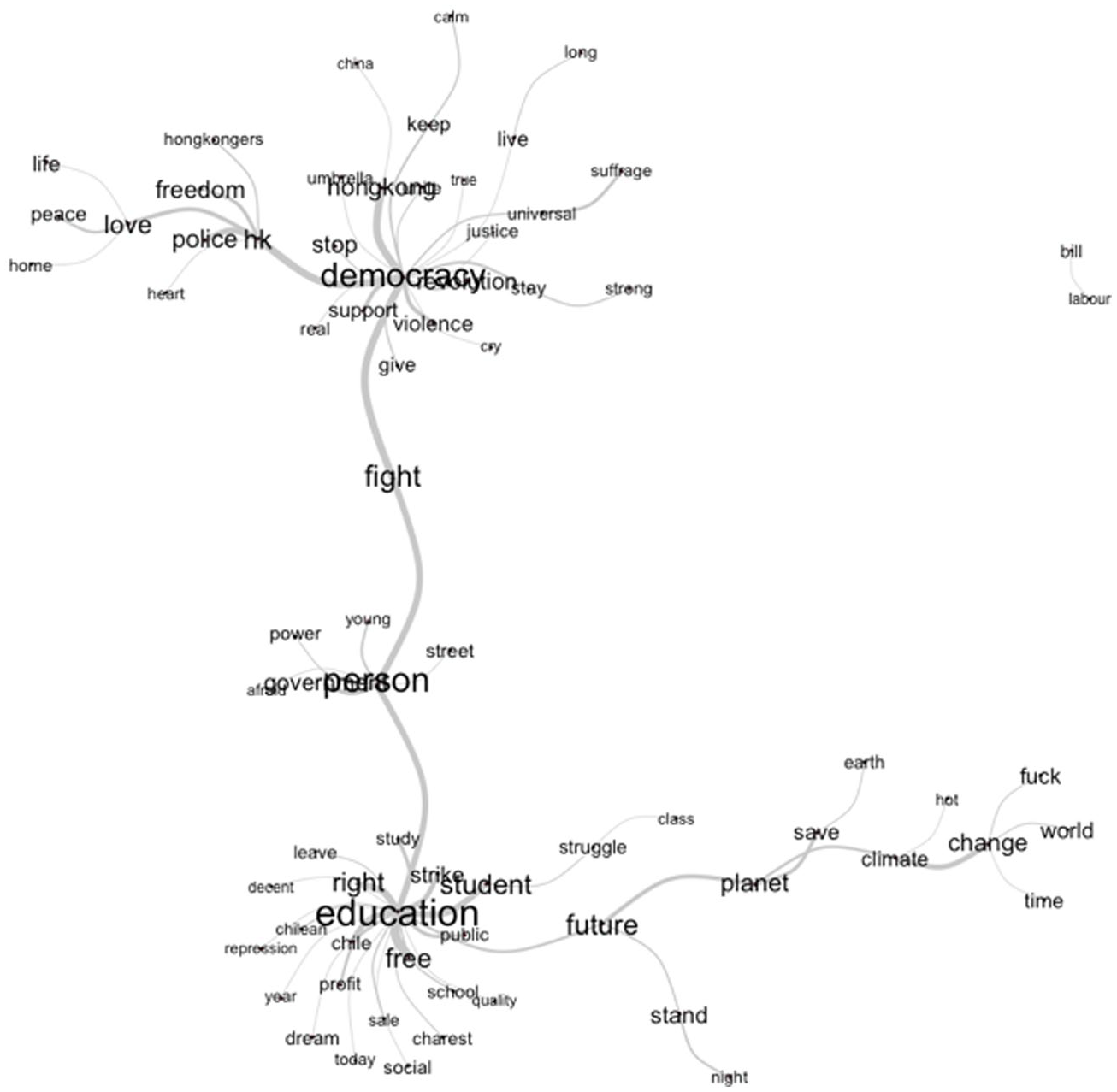
Tree of correlations between the main words within the seven movements analysed.
Behind these commonalities, four types of repertoires
However, beyond these transversal characteristics, we can distinguish different types of repertoires carried within the movements. If we implement a hierarchical ascending classification to group the main categories of words, it makes it possible to identify four main lexical repertoires among all the movements (Figure 4). By projecting them in a factorial plan, we can see some convergences between different movements. The movements of Santiago de Chile and Montreal gather around what we can call an ‘educational repertoire’, in which the distinctive words evoke the denunciation of the commodification of knowledge and a power relationship with government (‘education’, ‘quality’, ‘reform’, ‘merchandising’, ‘public’, ‘repression’, etc.). The protests of Paris and Madrid mobilise a more ‘systemic repertoire’, apparently close to the educational repertoire, but which distinguishes itself by multiples of social and political claims and the critique of ‘the system’ as a whole (‘state’, ‘street’, ‘salary’, ‘dictatorship’, ‘emergency’, ‘dream’, etc.). The two Hong Kong movements mobilise a pro-democratic repertoire, built around defending democracy and upholding collective solidarity (‘democracy’, ‘universal’, ‘suffrage’, ‘freedom’, ‘support’, etc.). Finally, the pro-climate march of Montreal distinguishes itself by an environmental repertoire centred on the denunciation of the planet’s destruction and the urge of change (‘planet’, ‘climate’, ‘earth’, ‘change’, ‘future’, etc.). While textual analysis allowed us to draw out the prominent lexical registers, only a qualitative analysis enables us to see the coherence in the meaning of these slogans from one movement to the next. In the following sections, we will further explore the different generational rhetorics present in these repertoires.
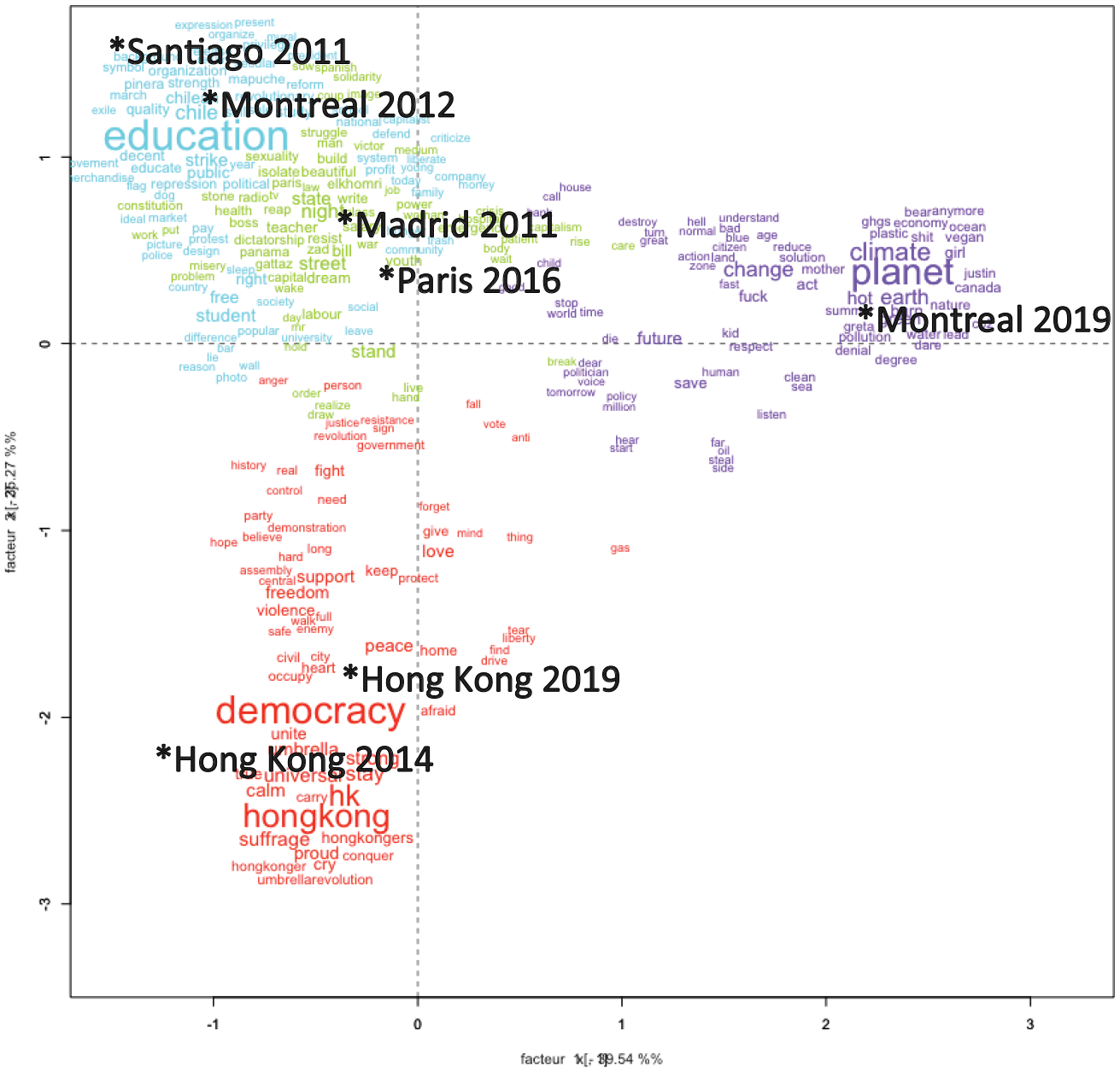
Factorial projection of the hierarchical ascending classification of words from the seven social movements.
Higher education and neoliberalism: A generation ‘under threat’
Although geographically distant from each other, the student movements of Santiago de Chile and Montréal both denounce a growing financial pressure on students, and present a common generational rhetoric rooted in intergenerational economic injustice. It is rather the feeling of threat that dominates here: beyond their differences, they both denounce the emergence of a generation under financial pressure, threatened by ever-increasing education costs and the burden of lifelong student debt. With regard to this study, the generational question takes on thus specific forms in liberalised education systems: while student debt has already been identified as a major social problem in liberal educational systems (Pérez-Roa, 2019), we can see that it destabilises people’s belief in the future and leads to the rise of a generational doubt.
The burden of debt
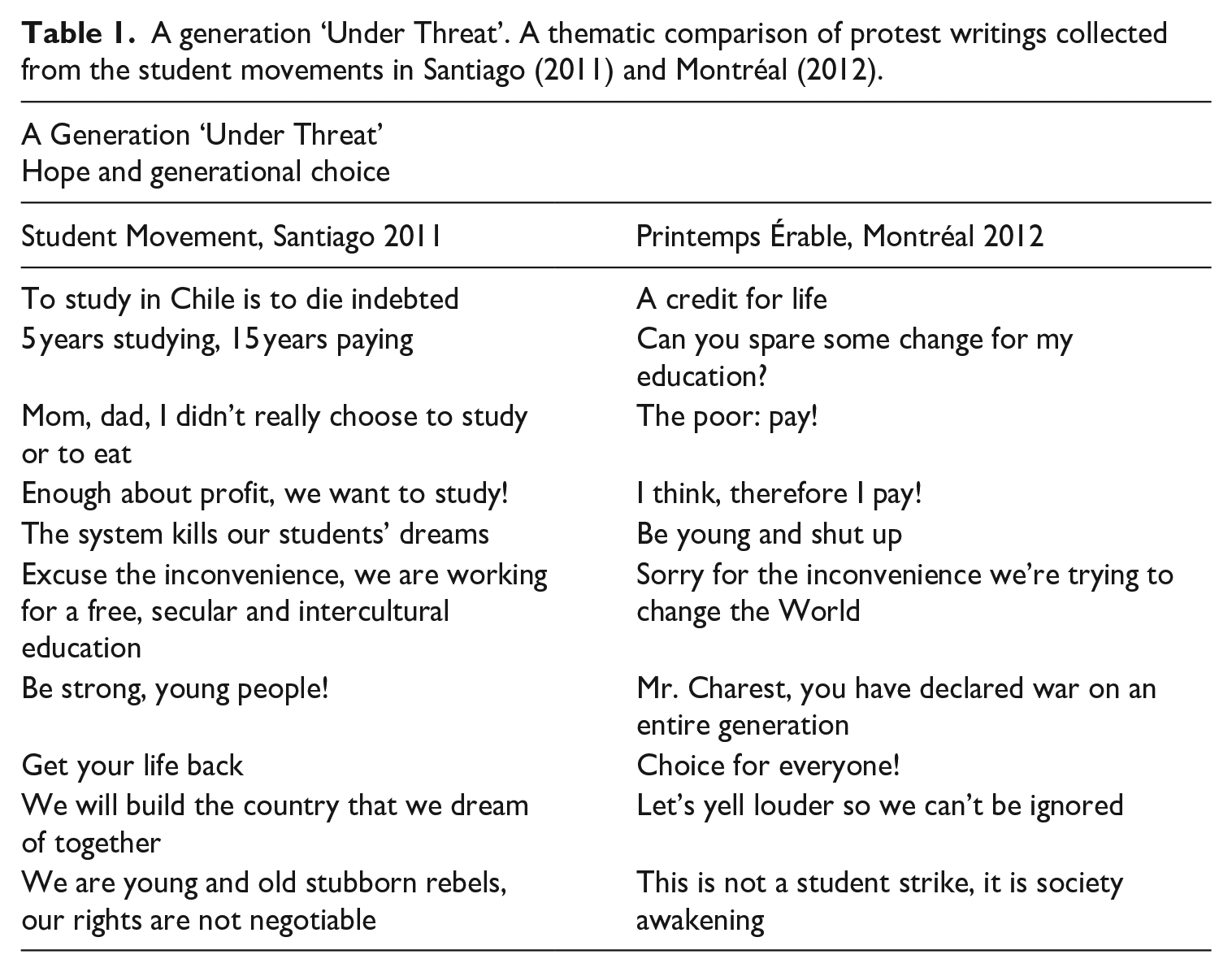
‘To study in Chile is to die indebted’ in Santiago; ‘A credit for life’ in Montréal: in both movements, the slogans feature individuals mortally threatened by credit or suffocated by the burden of debt. Indeed, student debt is the cornerstone of this rhetoric of generational injustice: the slogans point to the transfer of public debt to the private debt of a generation, thereby ‘making them pay’ the heavy price of austerity. Contrary to the European movements, here, the generational ‘we’ is limited to young students and graduates, presented as a generation threatened by excessive economic contribution. As shown in Table 1, the two movements share the same main arguments: that this pressure not only threatens their collective future but also deepens intra-generational inequalities by hindering access to higher education. It is also the subject of direct political criticism, condemning the ongoing commodification of knowledge that depreciates its non-monetary ‘value’, as in the slogans ‘Enough about profit, we want to study!’ in Santiago or ‘I think, therefore I pay!’ in Montréal.
A generation ‘Under Threat’. A thematic comparison of protest writings collected from the student movements in Santiago (2011) and Montréal (2012).
Hope and generational choice
Compared to the other movements under study, the main publicised emotion in these slogans is hope. Despite strong criticism of representative democracy in both cases, there is an expectation of democratic renewal within the system itself. More than a radical rupture, the slogans claim a right to speak and a more legitimate place in collective choices, in a direct power relationship with governments (Table 1). The slogans focus on themes of contempt and the need for listening, as well as individual and collective sovereignty (‘Take back power over your life!’ in Santiago or ‘Choice for all!’ in Montréal). The main divergences concern the targets of anger. While the Santiago movement denounces the power of banks and private companies in the education system, the Montréal movement is distinguished by its more directly governmental target. The protest writings highlight the need for a generational counter-movement to take a different path in society (‘Be strong, young people’ or ‘Mr. Charest, you have declared war on an entire generation’) in a call for mobilisation that extends to other social groups.
European crises and generational pessimism: A ‘sacrificed’ generation
In the European movements included in the study (Los Indignados and Nuit Debout), the generational criticism was more radical, unfolding at the social, political, and systemic levels. Occurring 5 years apart, these movements are dominated by another type of generational rhetoric: that of a social injustice between the generations. The similarity is somewhat surprising since these movements were as different in their demands as in their scope. However, they both denounced the advent of a generation ‘sacrificed’ by poor crisis management and austerity imposed on young people. It is built on criticism of the lack of post-graduate perspectives and the loss of human and social ‘value’ that results. Such radicalisation of social defiance is fundamentally embedded in the Southern European context, which is marked by strong inequalities between generations (Chauvel and Schroder, 2014).
A degree. . . but no future
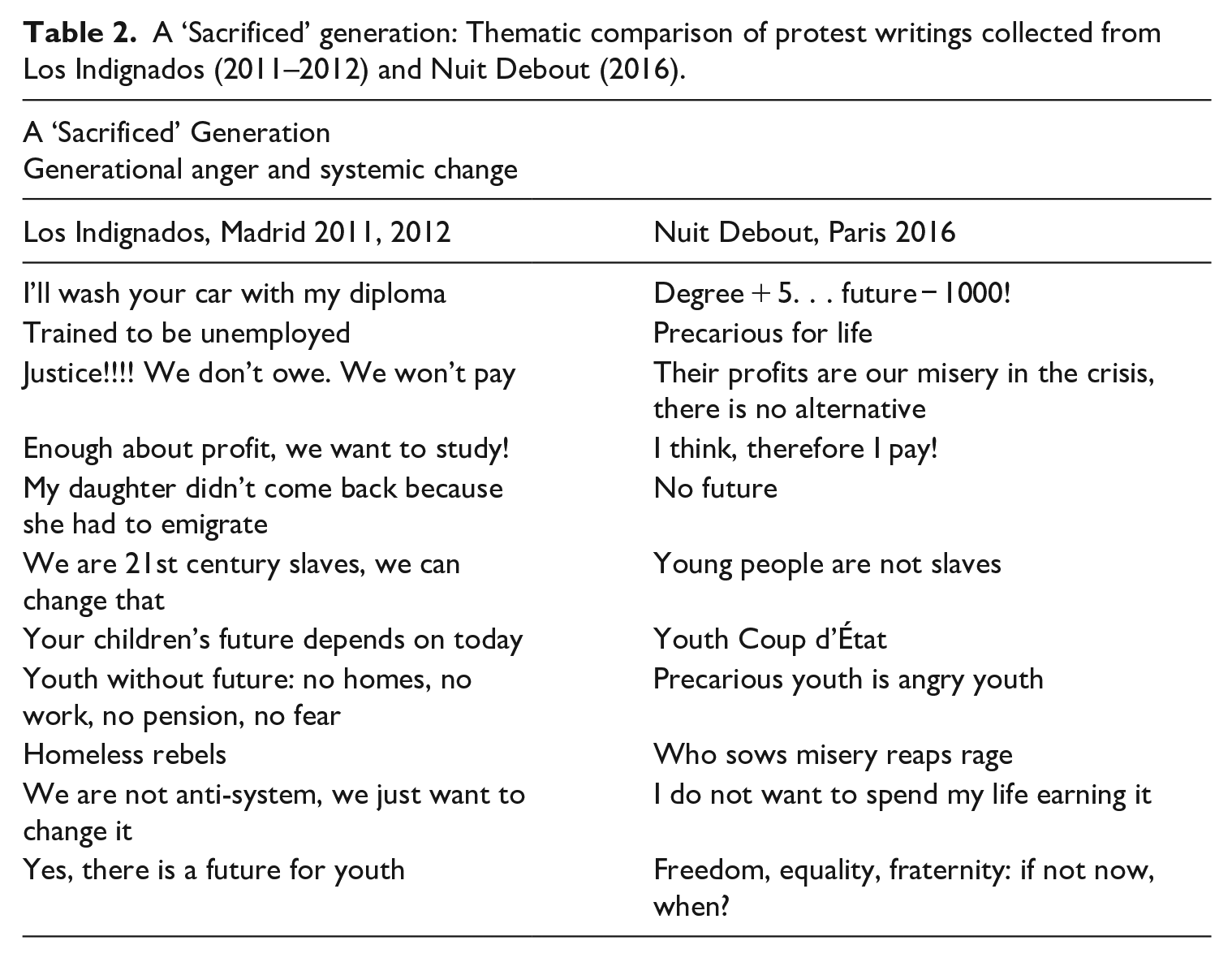
‘I’ll wash your car with my diploma’, ‘Degree + 5 = Future − 1000’: these slogans point to individuals being downgraded in spite of their education, confronted with a precarious future. The demands here focus not on the question of access to studies but rather on the post-graduate situation. They denounce the unjust fate of young people who, after investing in their studies, find themselves hit hard by the post-2008 crisis and austerity. ‘Justice! ‘We don’t owe. We won’t pay’: this rhetoric of social injustice points to the collective dispossession of a generation having to pay, through its living conditions, the debt a ‘crisis’ for which it is not responsible, while the guilty are protected. The generational ‘we’ here encompasses a generation as a whole, even if it primarily applies to students and graduates. As Table 2 suggests, the claims are more focussed on the devaluation of the degree among Los Indignados and on dehumanisation at work among the Nuit Debout protestors. However, both movements include a radical distrust of meritocracy and a central theme of ‘generational slavery’ (Table 2).
A ‘Sacrificed’ generation: Thematic comparison of protest writings collected from Los Indignados (2011–2012) and Nuit Debout (2016).
Generational anger and systemic change
The predominant emotion is anger, more than indignation, among a generation that feels it has nothing left to lose (‘Homeless rebels’ in Madrid and ‘Precarious youth is angry youth’ in Paris). This anger is the basis for a revolutionary rhetoric that speaks of rupture and division. As Table 2 shows, the slogans insist on the need to reject the status quo, and instead to take back control of the collective destiny. For example, we find the theme of a ‘fearless generation’ in Madrid, and that of the ‘youth coup’ in Paris. These put forward the idea of leaders’ lies and guilt. For Los Indignados, this is mainly linked to corruption, while for Nuit Debout protestors, it relates to laws that are considered unjust. However, the focus of this rhetoric goes beyond leaders themselves. In a more systemic criticism, it denounces the complicity of several figures of power – in particular, the triad formed by capitalist, political, and (secondarily) media powers. Faced with a perceived denial of democracy, the young protestors call for new, alternative, and direct democratic spaces to reappropriate their own life choices and democratic ideals.
Historical decisions and democratic representation: A ‘betrayed’ generation
This research shows that the theme of generational injustice is not limited to student conflicts or movements based on indignation but can also affect pro-democracy movements. Beyond their internal differences, Hong Kong movements bear a third form of generational rhetoric, based on political injustice between generations: they portray a generation ‘betrayed’ by a decision that determines their futures and undermines the original promise of democracy, even though they were not able to take part in this choice. Through the discourse, we gain a better understanding of generational rhetoric and its use within political systems whose decisions are seen as historically determinant. Such narratives could be found, for example, in the post-Brexit ‘youthquake’ in the United Kingdom (Sloam et al., 2018).
A broken promise
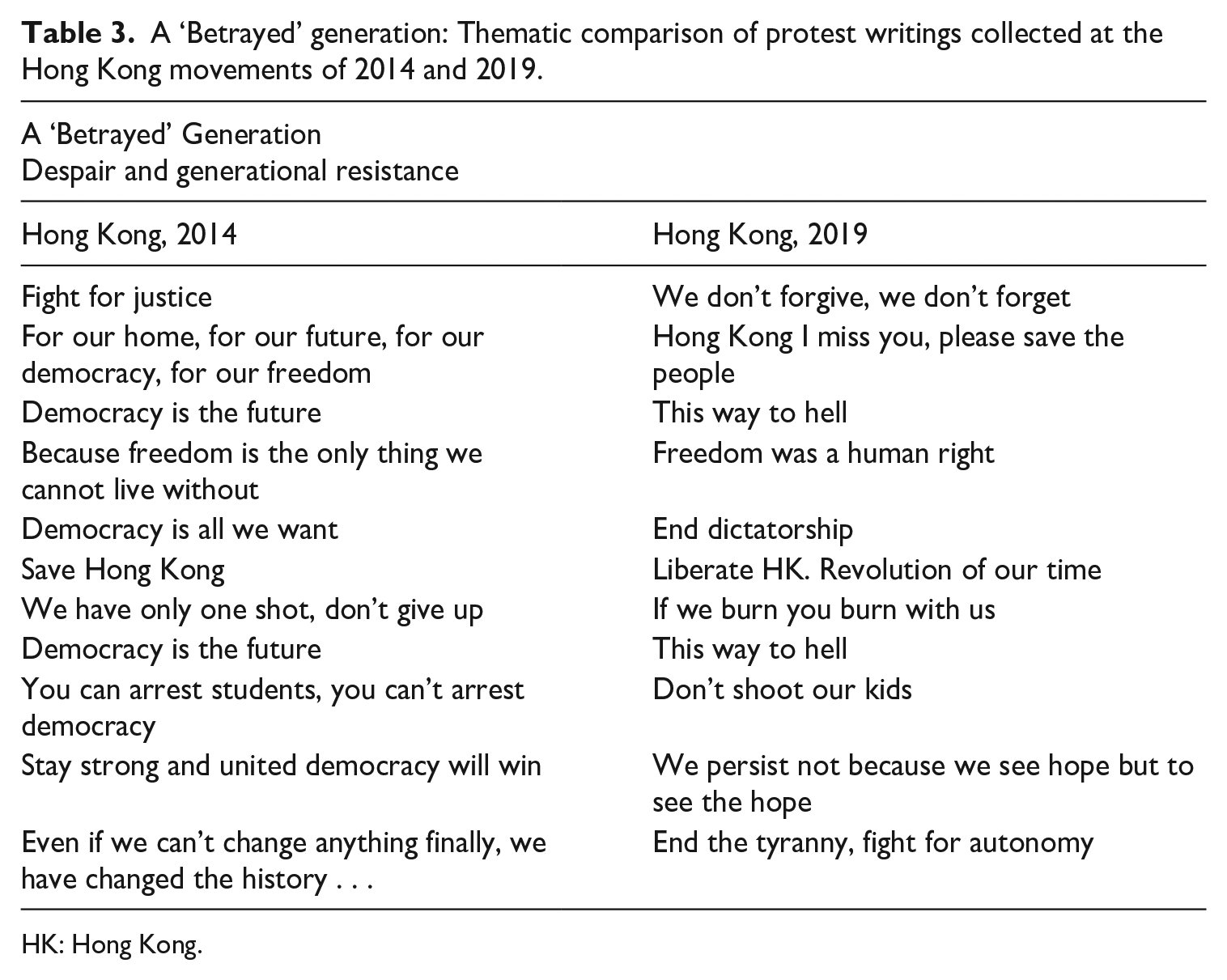
‘My parents are crying for me, I’m crying for the future’ or ‘This way to hell’: the slogans of both movements depict a generation robbed of the future it was promised, and mourning the loss of principles it holds essential, namely freedom, sovereignty, and democracy. As Table 3 shows, this collective mourning is expressed as an explicit attachment to the Hong Kong they knew, associated with ‘home’. These themes of dispossession and nostalgia grew sharper during the 2019 movement, through the repeated denunciation of a lost freedom. The generational ‘we’ refers primarily to the students, seen here as the enlightened vanguard of a broader generational and civic struggle. ‘Fight for justice!’: the slogans stress the deep injustice of younger generations having to bear the long-term consequences of a decision they had no say in. This restriction goes against the promise of sovereignty and freedom young people have grown up with: the weakening of democracy is associated with an immeasurable loss and an unforgivable decision (‘We don’t forgive, we don’t forget’).
A ‘Betrayed’ generation: Thematic comparison of protest writings collected at the Hong Kong movements of 2014 and 2019.
HK: Hong Kong.
Despair and generational resistance
‘Saving’ or ‘liberating’ Hong Kong: faced with this historical challenge, mobilisation took the form of a revolutionary struggle against oppression. As Table 3 illustrates, despair and anger dominate in the slogans. Although its outcome appears uncertain, the ‘struggle’ is deemed a historical necessity, with reference made to other decisive struggles, such as the French Revolution. Compared to other movements, this generational opposition does not aim to ‘renew’ a tired democratic system but instead represents an (almost desperate) attempt to ‘save’ representative democracy from what threatens it and to collectively safeguard a decent future. This struggle is mounted against ‘enemies’ that are almost invisible, yet present through their authority or repression. They multiply across several political strata (decision-making or police) and at different levels of power in Hong Kong and China. Many slogans thus aim to limit police repression by appealing internally to the tenacity of the demonstrators and externally to international solidarity (‘We only have one shot, don’t give up’, ‘Stay strong and united, democracy will win’).
Pro-climate movement: A ‘condemned’ generation
Compared to other movements, the Montréal climate march in 2019 is marked by a broadening of the theme of intergenerational injustice: fundamentally based on environmental injustice between generation, it actually articulates different dimensions of injustice present in other movements – not only environmental but also social, economic, and political. This generational rhetoric criticises the existential condemnation of a generation deprived of time and of the quality of life they are entitled to. It is distinguished by the rise of the theme of generational conflict, with a direct indictment of past generations, and the claim of a generational and global ‘us’.
An existential theft
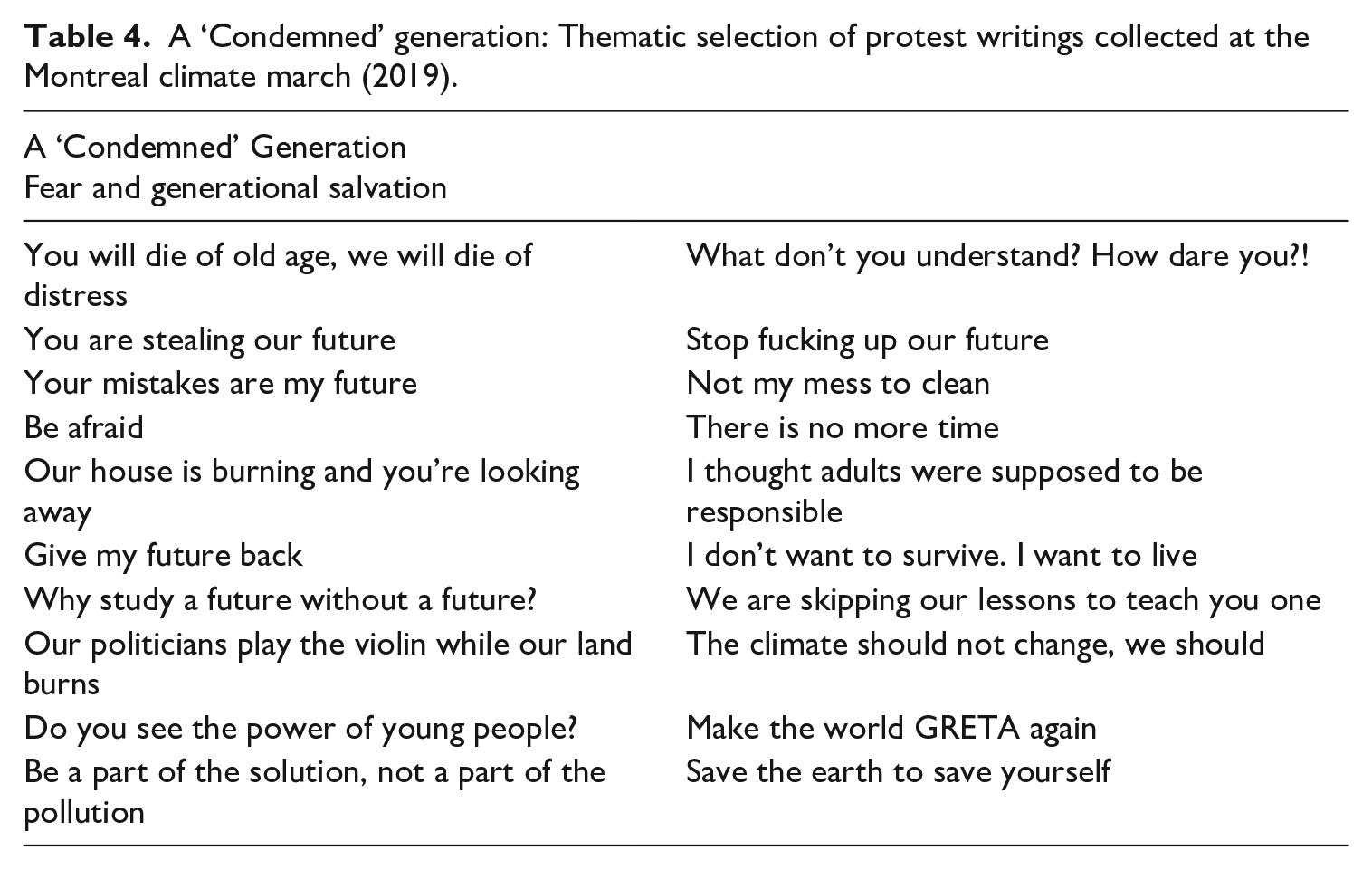
The accusation is direct and radical: ‘You are stealing our future’, ‘You will die of old age and we will die of distress’. This rhetoric has a particular gravity since it depicts the literal death sentence of a generation. The slogans bear themes of collective finitude and the acceleration of time. We thus find a reactivation of the Apocalypse in the form of the death of ‘Mother’ Earth and her children. As Table 4 shows, this rhetoric directly evokes generational conflict: it sets older generations, guilty of murderous inaction, against a generational and global ‘us’, as well as similarly condemned ‘future’ generations. The generational injustice denounced here is both environmental and existential, underpinned by the unjust legacy of an unredeemable situation. This in turn represents a breach of the fundamental contract between generations – that of the transmission of life. The slogans also evoke the ironic inversion of roles between children and adults, by which young generations are burdened with premature responsibility as a result of the negligence of their elders: ‘I thought adults were supposed to be responsible’, ‘How dare you!’.
A ‘Condemned’ generation: Thematic selection of protest writings collected at the Montreal climate march (2019).
Fear and generational salvation
Faced with this state of emergency, generational mobilisation is seen as an emergency jump-start that aims to save future generations before it is too late. The dominant emotion is fear, mobilised here both as a legitimate emotion given the seismic changes underway but also in a new way, as a catalyst for change (‘Be afraid!’). Indeed, salvation is seen to come only from the younger generations, who claim truth and legitimacy of speech, again with a rhetoric of role reversal (‘To teach you a lesson’). If these young generations are the only hope, it is because they face what is seen as the complete failure of a system; no help is expected from a political world accused of favouring short-term economic interests and ignoring danger (‘Politicians play the violin while the boat sinks’). Aside from a few calls for the green vote, the majority of slogans push for generational change among citizens, in the form of a holistic revolution. As Table 4 shows, mobilisation bears the seal of individual and collective ‘care’ and invites everyone to change their way of life (food, practices, awareness, etc.).
Discussion. The refusal of a legacy: A global discourse of generation
We can conclude that these movements of the second decade of the twenty-first century constitute a ‘generational moment’ marked by a strong politicisation of intergenerational inequalities and by the rise of the theme of intergenerational injustice. By taking into account a greater diversity of slogans in our study, we have identified generational claims hitherto eclipsed by other, more general claims in the protests of the decade.
From a reactive post-crisis rhetoric to a generational conflict
In all the movements studied, this generational denunciation is underpinned by criticism of a ‘legacy’ – whether economic, social, political or environmental – that is too heavy a burden for younger generations and that has been unfairly passed on them. What is transversally criticised is the unjust weight of a past that hampers younger generations’ futures, forcing them to suffer the consequences of decisions they did not make.
If we compare these forms of generational rhetoric over time, we can also understand how this discourse of generational injustice has solidified over the decade: from a reactive post-crisis rhetoric in the first waves of protest in 2011, it then shifted towards a generational conflict in the climate marches of 2019, associated with a generational ‘we’ now asserted at the global level. Compared to other movements, the pro-climate rhetoric of 2019 marks a double shift: not only does it rely on a unified ‘we’ claimed primarily by young, educated, and urban generations but it also reveals an increasingly direct accusation of the older generations. It shows the intersection, within generational claims, of several ‘crises’ present in previous militant discourses: the environmental crisis, the economic crisis, and the political crisis. The phenomenon of generational identification that Donatella Della Porta (2019) has noted among young European activists extends in fact far beyond Europe.
It becomes possible to qualify this generational voice compared to previous waves: initially born in reaction to the various crises – economic, social, democratic, and environmental – that mark the decade, it goes beyond this initially defensive character to carry very expressive claims and tend to be more ‘pro’ than ‘anti’, focussed on the valorisation of great societal principles – education, democracy, and person. We note a strong presence of alternative visions of the future, which constitutes an interesting indicator for questions about the constructive vibrancy at the grassroots.
A global voice, different generation portraits, and emotions
Threat, sacrifice, betrayal, or condemnation: our analysis identified four rhetorical themes of intergenerational injustice present in the movements under study, associated with different generation portraits. Table 5 provides a summary of these main differences. These rhetorics shed light on the links between global crises, local youth movements, and generational narratives: as we have shown, the denunciation of generational injustice is more economic in the student protests with a dominant narrative of a ‘generation under threat’, more social in European movements (such as Los Indignados and Nuit Debout) with a dominant narrative of a ‘sacrificed generation’, political and decision-making in the Hong Kong pro-democracy movements with a dominant narrative of a ‘betrayed generation’, or environmental in the climate movement in Montreal with a narrative of an existentially ‘condemned generation’.
Four major generational narratives: A comparison.
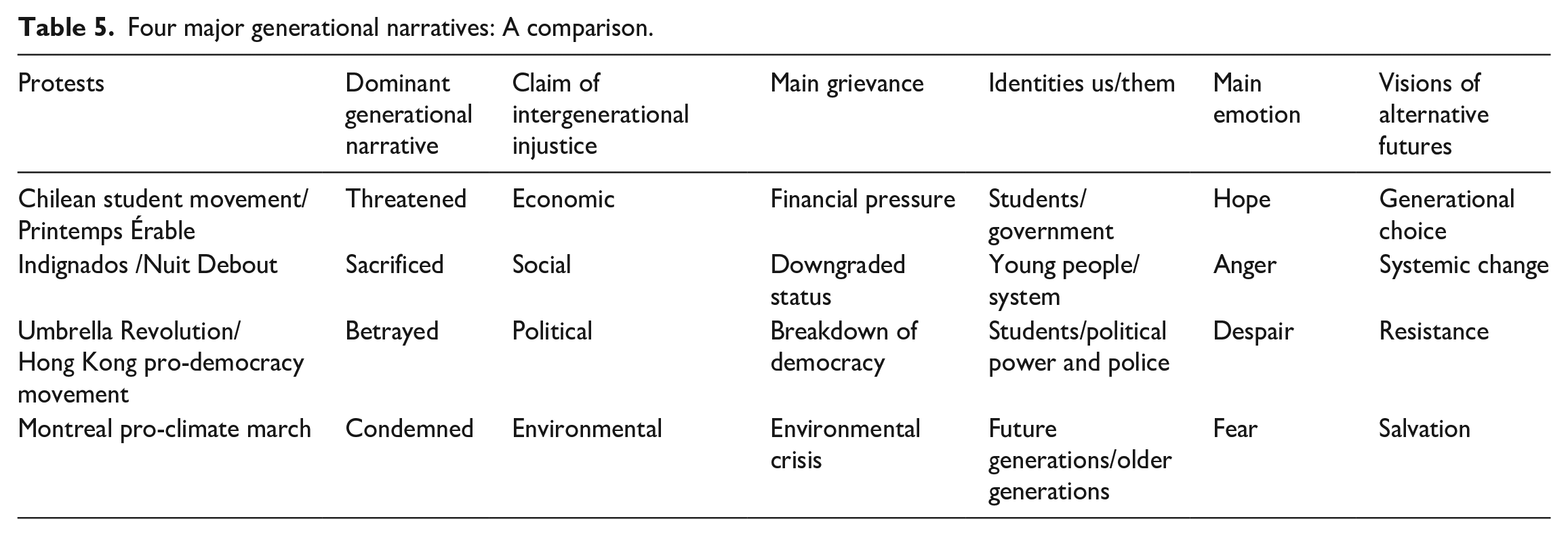
Each of these narratives also refer to different dominant emotions (hope, anger, despair, or fear) and carry multiple visions of an alternative future; they mobilise multiple generational identities (students, young people, or future generations) and are directed against different ‘enemies’ (government, system, police, or older generations). While we can identify dominant rhetorics by movement type, each protest includes other rhetorics of injustice in a secondary way. We can find, for example, mentions of a political injustice rhetoric in student movements and European movements, or words of economic injustice in environmental movements. These convergences can be attributed both to global ‘resonances’ in generational conditions and to the role of a strong cross-national diffusion of ideas and tactics. However, it should be remembered that our analysis is based on seven case studies and that an extension with other case studies would be necessary to confirm this global pattern.
Pandemic, global generational injustice, and societies: Avenues of research
In this article, we have shown the value of crossing perspectives between youth studies and social movements to better understand the generational dimension of social movements and the emergence of a generational voice at the global level. This analysis invites further research to better understand how this generational voice will change in the wake of the health crisis. First of all, we invite the development of qualitative and statistical research on the evolution of the discourse of injustice between generations in different parts of the planet. The global health crisis is updating the question of a ‘global generation’: we know that the younger generations will be particularly affected by the economic and social consequences of the crisis (Organisation for Economic Co-operation and Development (OECD), 2020), and it may therefore induce a process of radicalisation of anger among young generations.
It is also important to develop comparative research to understand how these generational grammars will evolve differently depending on the types of movements, socio-political contexts, and welfare states. In the light of this study, it appears particularly interesting to analyse how the place of ‘debt’ in the generational demands within liberal regimes evolves (Zaloom, 2019), and how the theme of the ‘sacrificed generation’ is spreading – or not – in European countries, where young people already appeared to be particularly pessimistic and where intergenerational inequalities are already particularly marked (Peugny and Van de Velde, 2013). Another avenue of comparative research invites us to dwell on how the health crisis reformulates the idea of the ‘betrayed generation’ by a decision that determines their futures, which we had spotted in Hong Kong or in the United Kingdom.
Finally, the question is whether the health crisis heralds a strengthening of the theme of generational conflict, already present before the pandemic. The pro-climate movement constitutes an important research laboratory to better understand the evolution of this rhetoric, which could be central in the construction of a global ‘we’ of one whole generation in the post-pandemic context.
Footnotes
Declaration of conflicting interests
The author declared no potential conflicts of interest with respect to the research, authorship, and/or publication of this article.
Funding
The author disclosed receipt of the following financial support for the research, authorship, and/or publication of this article: This work was supported by the Canada Research Chair Programme.
