




Abstract
The current shift of regulations for animal welfare from public to private standards allows dairies and retailers to improve their position on the market. However, for easy communication and control they tend to reduce the multifaceted societal demands for animal welfare to freedom of movement, that is, to free stalls with or without access to pasture. Taking a farmers perspective, this contribution examines the situation in Austria, where structure and practices of dairy farming differ greatly between more favourable, arable, and mountainous regions. The theoretical concept of farming styles uncovers fundamental positions grounded in different understandings of how farming practices are supposed to be organized. Private standards privilege rationalized, large-scale dairy farms in advantaged regions over family-owned traditional farms in mountain areas. This may have unintended negative consequences on farming structure, land use and cultural landscape.
Introduction
Over the last decades, we have witnessed a trend of moving the governance of animal welfare from government regulations to private standards by market actors and consumer organizations. Even current Action Plans of the European Commission support a move away from public to private standards in order to enable consumers making an informed choice for the purchase of ‘welfare-friendly’ products based on transparency and adequacy of information (More et al., 2017). Consequently, farmers have to meet public animal welfare legislations and on top private standards in order to be able to market their products. Different stakeholders in the food chain, especially the processing industry and retailer chains, have introduced private animal welfare standards, which ‘have evolved in response to regulatory developments and, more directly, consumer concerns, and as a means of competitive positioning in markets for high-value agricultural and food products’ (Henson and Reardon, 2005: 242).
In scientific literature on private standards, the producer’s perspective so far seems to represent largely a blind spot (Arnold, 2019) in general and concerning animal welfare in particular (Lundmark et al., 2018). There are several studies, which describe the effects of private standards on the marginalization of certain groups of farmers, but mainly for the developing world and predominantly in economic terms, focusing on the costs of compliance (Reardon et al., 2009), on their economic livelihood (Hansen and Trifcovic, 2014) or on organizational consequences (Arnold, 2019). However, little is known about the impact of private standards on farming structure, land use, and changes of the cultural landscape, especially in the Global North.
This article contributes to fill this gap. It argues that dairy farmers evaluate the compatibility of private animal welfare standards with their practices based on values and not on purely rationalist economic considerations. The article further assesses non-intended consequences on farm structure, structural change, and land use, and in consequence, on the cultural landscape in Austria.
Austria provides a good case as it has highly productive arable areas in the northern and eastern plains and less favoured mountainous areas in the central and western parts, which cover about 70% of the agricultural area. Currently, still 75 % of all dairy farms are located in mountainous areas, but there is an ongoing structural change, concentrating large dairy operations in more advantaged areas. However, Austria builds its national image of food production still mainly on small-scale traditional farming (Schermer, 2015), as on national average dairy farmers keep only 20 cows (BMLRT, 2020). One of the prime features of traditional farming practices in mountain areas is alpine pasturing. Alpine pastures are an integral part of the cultural landscape and in particular important for summer tourism, one of the major economic sectors of Austria. Retail brands exploit this idyllic image in their commercials and policy actors in their rhetoric. However, this contribution argues that the implementation of private animal welfare standards may jeopardize the preservation of this idyll.
The article is structured as follows: After a general overview over different understandings of animal welfare by scientists and consumers, I present the current state of private standards for dairy farming in Austria, implemented by processors and retailers, who reduce animal welfare to the freedom to move. Following van der Ploeg (2012), I argue that farmers’ practices are a co-production of their material and social environment and express themselves in specific farming styles. Following an introduction into this theoretical concept, the next section describes the attitudes of Austrian farmers towards animal welfare in connection to husbandry systems, the spatial distribution of barn systems and the associated practices. This allows discerning corresponding farming styles and assessing their compatibility with private standards as introduced by retail. After an outlook on the consequences on land use, I conclude more broadly on the impact of reductionist private standards on the sustainability of small-scale mountain farming systems.
Understandings of animal welfare in dairy farming
So far, a unanimous scientific definition of animal welfare is still missing (Carenzi and Verga, 2009). Scientific literature distinguishes three avenues to animal welfare (Fraser, 2008): basic health and biological functioning, the affective state (understood as living without negative emotions), and the possibility to exert natural behaviour. Furthermore, the British Farm Animal Welfare Council (FAWC, 2009) postulated already in 1979 the concept of ‘five freedoms’, which constitute important aspects of species-related, appropriate behaviour and the physical and psychical integrity of farm animals: Freedom from thirst, hunger, and malnutrition, freedom from discomfort, freedom from pain, injury, and disease, freedom to express normal behaviour, and freedom from fear and distress. While these concepts are widely accepted, animal welfare cannot be reduced to an additive function of positive or negative conditions alone. As animal welfare implies societal values, cultural and historic concepts of nature and animal husbandry as well as ethical and moral standards have to be taken into consideration (Alonso et al., 2020).
European and North American consumers expect food produced under consideration of animal welfare to be healthier, tastier, more hygienic, and safer, but at the same time also more authentic, environmentally friendly, and traditional (Buller and Morris, 2003; Cardoso et al., 2016; De Graaf et al., 2016). This list exhibits already very different and contradictory consumer expectations, the common denominator being to reject further unspecified industrial modes of production. However, unanimously consumers demand a better welfare-oriented husbandry of farm animals. According to a pan-European survey (European Commission, 2016), 57% of the respondents think that animal welfare considerations are presently not sufficiently taken into consideration.
The image of the dairy industry is not as negative as the image of the meat industry (Schleyer et al., 2013) because consumers observe dairy cattle at least sometimes grazing on pastures. Pasturing or at least an access to the outside is an important criterion for most consumers (Deimel et al., 2012). Cardoso et al. (2016) conducted a survey among consumers in the United States to elicit criteria for the welfare of cows on an ‘ideal dairy farm’, which raised the following aspects: freedom of movement, pasture, feed without hormones and antibiotics, health and moral sentiments like respect, fairness, and dignity. The most important criteria were freedom of movement and pasture. This corresponds with European research results (Boogaard et al., 2006, 2010; Ellis et al., 2009; Miele et al., 2011). A representative survey in Germany (Weinrich et al., 2014) reveals that about half of the respondents consider fully housed dairy systems without pasture problematic. Grazing cows seem to be firmly anchored images in the perception of consumers. Zuliani et al. (2018), who conducted focus groups on consumer perception of animal welfare on mountain dairy farms in Italy, found a difference between urban and rural consumers. Persons with an urban background focussed on climatic conditions in the barn, freedom of movement, and pasture, while rural participants in the focus groups perceived small-scale operations more important. There they expected human–animal relations to be better and the orientation on profit maximization less prominent.
Concerning the specific Austrian situation, according to a press release of March 2021 issued by the Austrian association for animal protection (Tierschutz Austria), a survey among consumers showed that for more than 70% of the respondents animal welfare means permanent access to the open (APA, 2021). Furthermore, consumers demanded husbandry systems that provide sufficient space and bedding. Austrian civil society organizations for animal protection have a more differentiated agenda for the welfare of dairy cattle than consumers. In addition to the barn conditions, they feature on their homepages the contact between cow and calf, the transport situation to export or slaughter, dehorning practices, and species-appropriate feeding (Tierschutzverein, 2021).
Standards for dairy cows in Austria
From 1985 onwards, the so-called Animal Needs Index (Tiergerechtheitsindex) served as an encompassing concept for animal welfare (Bartussek, 2001). It was endorsed by some regional states in their Animal Welfare Acts and veterinary offices. On a national scale, it was included in the Codex Alimentarius for organic farming. The Animal Needs Index reflects five aspects of the animals environment: the possibility of mobility, social contact, the condition of flooring for lying, standing, and walking, ambient climate (including ventilation, light, and noise), and the quality of human care. Within each field, several criteria are graded. Poor conditions in one field can be compensated by a better situation in another area (Bartussek, 2001). The Animal Needs Index is today widely accepted as a basis for measuring animal welfare by non-governmental animal welfare organizations and even private controlling firms. However, it is not mentioned in the federal law on animal welfare.
Until 2004, in Austria, regional states regulated animal welfare by Animal Welfare Acts. Then a federal animal welfare law was introduced. It requests that cattle have sufficient space to move freely within the barn, or have access to the open or to a pasture on at least 90 days per year (RIS, 2004). This refers essentially to free stalls or tie stalls with at least 90 days pasture. While free stalls indicate that cows may move freely within the barn, tie stalls denote tethered housing. This second mode of husbandry for dairy cows is traditional still prevailing in mountain areas of Austria, Bavaria, and South Tyrol/Italy. There, due to climatic conditions, farmers keep cows traditionally indoors during wintertime, and move them to (alpine) pastures in summer, a husbandry system recently termed ‘combination husbandry’.
All large dairy companies have introduced animal welfare standards for their supplying farmers above this legal threshold. Their standards again refer to the freedom to move and distinguish free stalls and tie stalls. The largest Austrian dairy company, Berglandmilch, increases the price up to one cent per litre to the standard milk price, according to the provision of animal welfare on top of the legal standards. They distinguish three different layers in the bonus system. In the lowest, farmers have their cows tethered during winter, but keep them pastured for at least 120 days during the vegetation period. In the medium one, cows are kept in free stall barns or, if tethered, have daily access to a paved area outside. In the top layer, cows are kept in free stall barns with a paved yard outside or pasture for at least 120 days. Other major dairies have similar agreements, albeit not so differentiated. Both, the second and the third largest Austrian dairy processors demand free stalls or a minimum of 120 days pasture. The regulations on feeding prohibit genetically modified organism (GMO) feed, and palm oil as ingredient, thus referring rather to sustainability than to animal welfare.
Retail in Austria exhibits a high degree of concentration: The two major retail chains (Spar and Rewe) comprise together with the biggest discounter (Hofer) more than 80% of the food market. Their retail brands adopt in the case of conventional dairy products largely the standards introduced by dairy processors. For their organic brands, they have introduced higher standards, generally again referring to the freedom of movement. Therefore, they require most often free stalling, partly combined with pasture on 120 days. If they still provide exceptions for tie stalls on small farms, retailers request farmers to switch to free stalls if they build new barns.
These private regulations seem to guide in turn again the government support programmes. In November 2020, the federal agricultural minister signed a so-called ‘pact for more animal welfare’ with major agricultural stakeholders. These included the umbrella association for sustainable animal husbandry Austria (Nachhaltige Tierhaltung Österreich, (NTOe)), which assembles the major animal producer organizations, and the national Chamber of Agriculture as well as the provincial agricultural administrative offices. Among others, this agreement abolishes from 2021 onwards subsiding the new construction of tie stall barns.
In general, processors, retailers, and even farmers’ interest groups seem to favour free stall dairy barns, even without pasturing and most of their standards consider a paved run in the open equally sufficient. Thus, the private standards for animal friendly dairy husbandry reduce the multifaceted expectations of science, consumers, and animal welfare non-governmental organizations (NGOs) to the freedom to move and influence public support systems accordingly. In order to operationalize animal welfare, they focus on the distinction between free stall dairy barn systems (with or without access to pasture) and tie stalls.
Theoretical frame: Farming styles
Farmers have to comply with these private standards to stay in the market and they have to adapt their practices accordingly. In order to understand better their attitudes towards animal welfare, husbandry systems and practices in general, we apply the concept of farming styles. The Dutch rural sociologist Jan Douwe van der Ploeg developed this theoretical concept out of empirical observations of farm development trajectories in the Netherlands. The modernization paradigm of the late 1960s had proposed that farm development would converge to large industrialized enterprises or disappear (as suggested by the so-called ‘Mansholt Plan’, named after the Dutch European Commissioner for Agriculture. However, according to van der Ploeg (2012), empirical evidence shows that considerable differences in the farm trajectories had emerged between 1969 and 1981. Van der Ploeg (2012) sees this as ‘an indication of how farmers interpreted one and the same set of parameters (related to markets, technological development and agrarian policy) differently and actively translated them into different courses of action’ (p. 429). According to van der Ploeg, the different trajectories represent different worldviews, which find their expression in farming styles. They result in different economic, social, and technical practices and have different impacts on land use and landscape.
Van der Ploeg and Roep described farming styles initially in 1990 as ‘different opinions how farming ought to be organized and the associated differences in the practice of farming’ (van der Ploeg, 2012: 430). A farming style is something internally defined by the farmers themselves and represents a specific way of farming that is shared by a larger group of farmers. Farming styles are therefore collective interpretations by specific groups of farmers how to do farming right. These normative positions act as ordering principles ‘tying together land, labour, animals, machines, knowledge, expectations and activities’ (van der Ploeg, 2012: 431). They are structuring practices as a co-production of the material and the social world. Therefore, farming styles evolve over time with changing conditions of environment, market, policy, technology, and so on.
Van der Ploeg presents different formalized definitions of the concept of farming styles, which have evolved over time. In 1994, he defined them as representing “first. . . a specific [. . .] discourse. Second [they] entail a specific structuration of labour processes, of the organization of time and space [. . .] and consequently farming styles result in a particular organization of the process of production [. . .] Thirdly, styles of farming represent specific connections between economic, social, political, ecological and technological dimensions”.
In 2003, he described them as a ‘mode of ordering: a systematic and continuous attempt to create congruence within [and between] those domains in which farmers and their families have to operate’. Distinguishing four levels, he presented farming styles as (1) a ‘coherent set of strategic notions about the way in which farming should be practiced’, (2) a particular practice as ‘an internally consistent, congruous way of farming’, (3) as translating ‘into particular relations between markets, technology supply and farming’, and (4) as ‘strategic positions vis-à-vis government policy’. As a last definition, van der Ploeg described in 2008, farming styles as ‘material, relational and symbolic outcomes of strategically ordered flows through time’ (van der Ploeg, 2012: 431). However, the development of each farming style follows a certain path dependency, not only due to natural conditions and financial investments, but also due to the collectively shared value system. In the following sections, I deduct farming styles associated with husbandry systems as value systems based on structural conditions and associated them with certain practices.
Farmer’s perspectives on husbandry systems and animal welfare
Over the past 100 years, dairy farmers have made changes in livestock husbandry for animal well-being, health, reproduction, milk quality, and farm profitability (Bewley et al., 2017). Galama et al. (2020) argue that the development of different housing systems has been driven primarily by technical innovations. Before the 1970s, tie stalls were common as this system fitted bucket milking or milk pipeline systems as well as individual feeding. Furthermore, it made it relatively easy to keep the animals clean. The transition to free stalls is connected to the development of parlour milking systems, cooling milk in a tank, feeding grass silage, and other innovations, thereby increasing labour efficiency. While higher labour efficiency allowed farms to be scaled up, large herds made grazing difficult for farmers with insufficient land surrounding the farm. So sufficient space to move inside the barn often replaced the pasture. Over the last decades milk production increased through improvements in genetics, technology, and management of milking and feeding (Khanal et al., 2010). At the same time animal welfare and environmental issues, like minimizing ammonia emissions during field manure application gained increasing importance (Galama et al., 2020). Dairy housing systems have developed accordingly as a co-evolution of technical, economic, ecological, and social factors.
Free stalls seem to create a win–win situation, as they are labour efficient and animal friendly husbandry systems. However, in practice, we find hot debates for and against them. In March 2017, a TV documentary on husbandry systems sparked in Austria an online discussion forum of the agricultural magazine Landwirt.com with 156 contributions. In autumn 2018, under the heading ‘animal welfare because cows have names’, 57 entries were posted. This second forum was a reaction on the announcement of the organic retail brand ‘Zurück zum Ursprung’ to apply stricter standards and to make free stalls obligatory in the near future. In the following, I summarize the arguments.
Farmers arguing in favour of free stalls perceive them as market necessity to remain competitive, especially in view of exporting dairy products. They demand that in future public support measures for new barns should be restricted to free stalls. Proponents highlight further, their labour efficiency and claim to achieve higher milk yields, as cows have permanent access to feed. Thus, in general they follow the line of argumentation that free stalls are a win–win solution due to economic advantages as presented above.
The arguments against free stalls follow quite a different line: farmers claim that the high costs for free stalls are hardly covered by the increase of revenues through participation in the respective brand programmes. They suspect economic interests behind the call for free stalls. Retailers want to strengthen their market position by animal welfare argumentations and to differentiate themselves from competitors on the expense of farmers. Processors would profit from increased structural change as it reduces the logistic costs. An obligatory switch to free stalling would speed up the ongoing structural change and eliminate small-scale farms, although they have a positive image with consumers due to better human–animal relations. Thus, free stalls would not correspond to expectations of consumers, who primarily oppose industrial farming and associate free stalls with large-scale operations keeping ‘turbo’ cows.
Opponents of free stalls argue furthermore that milk quality would be better in tie stalls as cows are less prone to inflammations of the udder. In respect to animal welfare, they argue that a year-round free stalling on concrete and fully slatted floors without pasture would be more problematic than tie stalling in winter and pasturing during the vegetation period. Finally, they fear that traditional practices in mountain regions, like alpine pasturing, which is in their understanding also decisive for animal welfare, will be on stake if the trend to free stalls continues. They dispute the feasibility of free stalling in mountain areas altogether, as free stalls demand more space, which is scarce in steep terrain.
In essence, the supporters of free stalls argue on economic reasons of efficiency, while the opponents want to conserve the present traditional structures and highlight the consequences for mountain regions. This last argument, referring to geographical difference, suggests examining the spatial distribution of the two husbandry systems.
Spatial distribution and associated practices
Geographically, agricultural production regions in Austria are broadly divided into arable areas in the northern and eastern plains, especially along the Danube and mountains in the central and western parts. Differences in natural conditions (soil, gradient, and climate) have historically resulted in different farm structure. During agricultural modernization, characterized by specialization, mechanization, and rationalization after World War 2, the gap widened. While farmers in the more favoured parts followed the paradigm of economies of scale (‘get big or get out’), farmers in the mountain regions opted rather for income diversification and pluri-activity, often taking advantage of the opportunities provided by the incipient tourism industry.
The recent structural development of dairy farming mirrors this: the number of dairy farms has decreased dramatically over the last 20 years, from 72,358 farms in 1999 to 25,608 farms in 2019 (AMA, 2020). However, at the same time, farms with more than 50 dairy cows have multiplied tenfold from 111 farms in 2000 up to 1091 farms in 2018 (ZAR, 2019). Most of those farms, which keep more than 50 cows are concentrated in one corner of the country (see Figure 1).
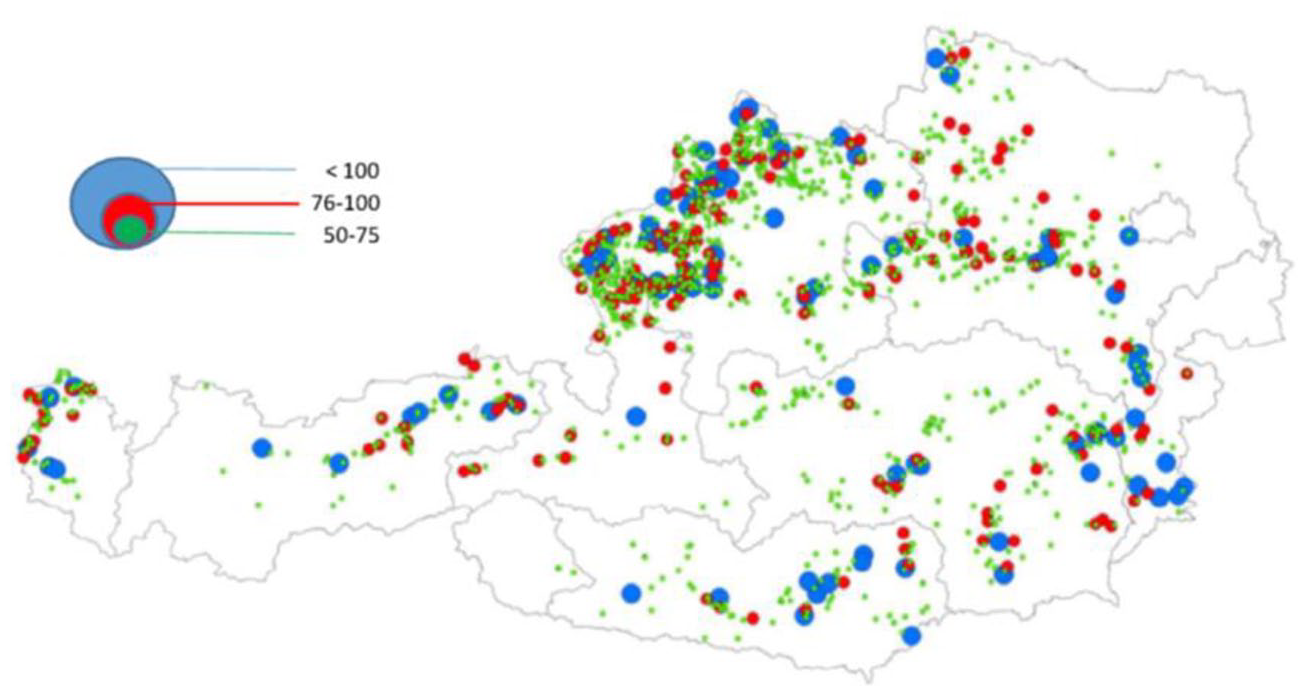
Distribution of farms with more than 50 dairy cows 2017.
In 2012, already 85.8% of farms with more than 50 dairy cows operated free stall (Rosenwirth et al., 2013). The periodical survey of the agricultural structure by the statistical office showed that in 2016 highest percentages of free stalls among all farms were found in the two north-eastern provinces of Upper Austria (53%) and Lower Austria (57%), whereas in the mountain provinces far less free stalls were found. In Tyrol, for instance, 66% of all farms used tie stalls, whereas the Austrian average was 42% (Statistik Austria, 2018). These figures display an obvious connection between the size of the herd, the husbandry system, and its geographical distribution.
The regional structural differences are mirrored in farm practices: only 8.3% of the farms with more than 50 dairy cows, mainly located in the western provinces, graze them on alpine pastures during summer (Statistik Austria, 2018). Figure 2 shows the distribution of alpine pastures where cattle older than 2 years (i.e. mostly cows) graze.
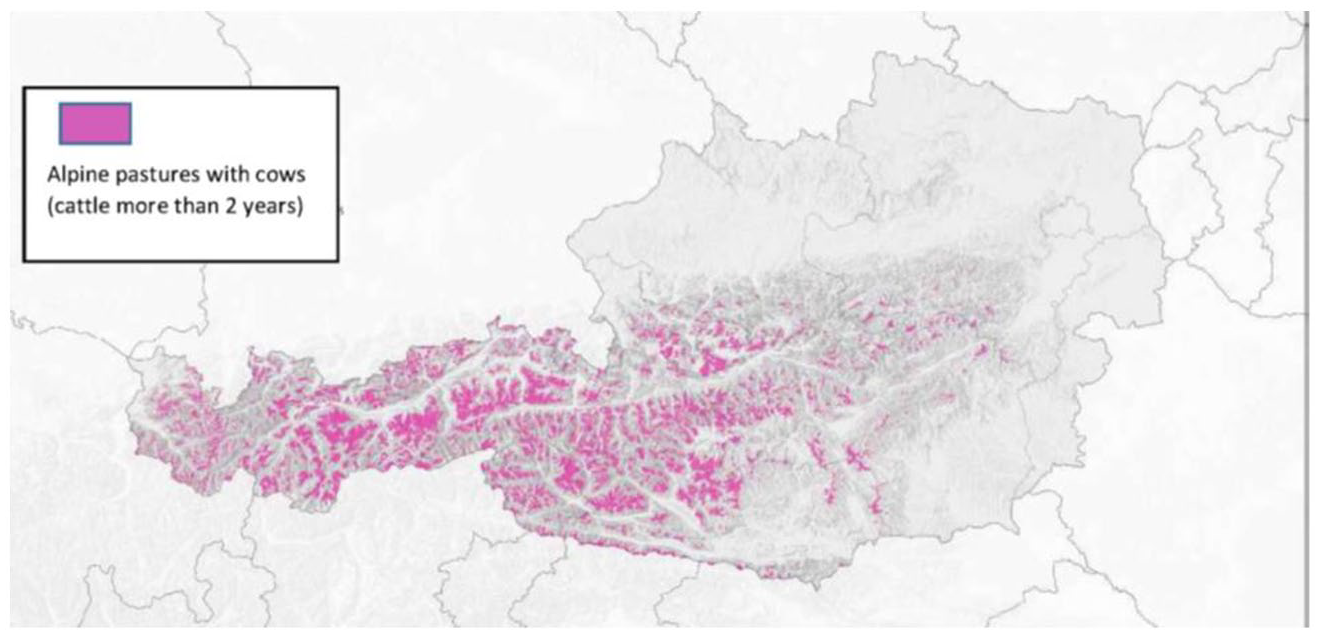
Alpine pastures grazed by cows (cattle > 2 years).
Comparing the distribution of large farms (Figure 1) with the distribution of alpine pastures grazed by cows (Figure 2), the connection becomes visible. Whereas in the mountainous province of Tyrol, for instance, two thirds of all dairy cows are on alpine pastures during summer, the national average is only around 10% (Schlatzer and Lindenthal, 2018). Cows kept in free stall systems in general graze less on pastures. A study in Lower Austria revealed that 46% of the respondents with free stalls do not pasture their cows at all (Kalteis, 2020). A study on dairy systems in Trento (Sturaro et al., 2013) underpins this trend with similar findings.
Differences in farms structure and development trajectory materialize further in a different fertilizer regime. The agricultural survey of 2010 (Statistik Austria, 2013) shows that 71% of smaller farms with less than 20 livestock units (LSU) use solid manure, in contrast to 30% among farms with more than 20 LSU. Farms with free stalls are operating a great deal more often with slurry (liquid manure) because of labour efficiency. Intensive use of liquid manure is connected to a higher number of cuts on the meadow and an increase of area productivity, but also to a reduction of agrobiodiversity (Uekötter, 2010).
Styles of dairyfarmers and cowfarmers
As earlier described, farming styles are ordering principles that structure practices as a co-production of the material and the social world. Therefore, the combination of development trajectories, farm structure, and associated practices allows deducting two different farming styles aligned around their attitudes towards free stalls and combination husbandry.
We have already seen that farmers operating free stalls are situated in more favourable parts of the country and specialize in milk production. They seem to be more entrepreneurial oriented, perceive investments as positive, especially if connected to technical rationalization and increase of milk yield, and follow a strategy of economic growth (‘get big or get out’). We can term them as following a market-oriented style of dairyfarmers.
The opposite position is represented by farmers who practice the traditional combination husbandry system with tie stalling in winter and pasturing (often on alpine pastures) during the vegetation period. They build on pluri-active, multifunctional family farming structures to survive economically. They are rather found in less favourable and mountainous parts of the country and connect dairy farming more often with breeding. We call their farming style cowfarmers.
A recent survey among 1698 dairy farms in the province of Tyrol by Gstrein (2019) reveals that cowfarmers (practising combination husbandry) keep an average of 9.9 cows, while farms with free stalls (dairyfarmers) keep an average of 19.7 cows. Cowfarmers are more often pluri-active than dairyfarmers (67.4% versus 52.5%). Furthermore, cowfarmers are the backbone of breeding associations. The cattle breeders’ association in Tyrol has most members of all Austrian breeders’ associations and counts more than 80% of all dairy farmers as members.
At the same time, the survey of Gstrein (2019) shows differences in the understanding of animal welfare according to farming style: Dairyfarmers exhibit a rather technical understanding. Without much difference, they mention the aspects of human–animal relation (10.7%), barn climate (9.6%), animal health (87%), sufficient space to move (84%), adequate water (80%), and alpine pasturing (7.8%) as more or less equally important for animal welfare. This list belongs to aspects of biological functioning (Fraser, 2008). In contrast, cowfarmers highlight alpine pasturing with 13.4% and human–animal relations in small-scale farming ( ‘animals with names’) with 12.8% as most important. They mention that the biggest advantages of combination husbandry are better human–animal relations (27.5%), better animal observation (17.4%), and better individual care for the animal (15.7%). These factors can be understood rather as an approach of natural living or affective state. In a similar vein, Spigarelli et al. (2021) confirm that in mountain areas the relationship between human, animals, and the environment is stronger.
Whether farmers favour tie stall or free stall husbandry systems, it is therefore not only a matter of financial considerations or path dependency (if they just recently have built a new barn), but expresses a distinct understanding of animal welfare and farming as a whole. While dairyfarmers follow the logic of economies of scale, cowfarmers follow traditional peasant trajectories and aim to make a living by diversification. Thus, the two farming styles fulfil different functions the society demands from farming: While dairyfarmers focus on the production function, cowfarmers stand for multifunctional farming with rather closed nutrient cycles.
The complexity of farming styles is not reflected in private animal welfare standards. On the contrary, the focus on free stalls discriminates diversified and multifunctional small-scale farms of cowfarmers and favours dairyfarmers, thus enhancing structural change. This teleological path of modernization ultimately undermines the image retail brands create in their communication. While the private standards of retailers are encouraging economies of scale, their advertisements draw idyllic pictures of grazing cows on alpine pastures. For instance, the homepage of the organic retail brand ‘Zurück zum Ursprung’ (meaning: back to the origin) mentions regionality among their core values and asks rhetorically: ‘Did you know that alpine pasturing of dairy cows is not only a long tradition in mountain farming regions, but essentially ensures the preservation of the alpine cultural landscape?’ (HOFER, 2022, own translation). In autumn 2018, ‘Zurück zum Ursprung’ announced that with immediate effect they only accept milk from farms that provide their cows the possibility to roam freely every day for at least 2 hours. In the province of Tyrol, the new standard forced more than 120 small-scale farms in rather extreme geographical conditions with steep slopes to step out of the brand (Pixner, 2018).
Moreover, the brand managers announced that from 2021 onward they would accept milk only from farms with free stalls (Pixner, 2018). In response, regional agricultural institutions publicly supported the position of cowfarmers: The Tyrolean breeders association deemed combination husbandry indispensable for the preservation of alpine pastures and demanded a more encompassing perspective on animal welfare, including human–animal relations, herd size, care of animals and animal observation, grazing, and alpine pasturing (Rinderzucht Tirol, 2018). A member of the conservative farmers union in the regional parliament was quoted in the weekly farmer’s magazine; she doubts the retail beliefs in traditional small-scale farming: factory farms with 7000 dairy cows can comply with the criteria of retail if they have a free stall barn. However, a peasant farm family, who knows their cows by name and grazes them during summer on alpine pastures, but keeps them in tie stalls during winter, does not fulfil the criteria (Pixner, 2018, own translation).
The president of the Tyrolean Chamber of Agriculture, the regional legal representative institution, asked in the same issue if ‘marketing divisions of retail chains are determining now the future of agriculture’ (Pixner, 2018, own translation).
However, a year later the equation ‘animal welfare = free stall barn’ seemed to have already received general acceptance, even within regional farming institutions. When the Tyrolean Chamber of Agriculture offered for the first time a reward for animal welfare in 2019, only one out of seven farms awarded operated with combination husbandry, all others had free stalls.
Consequences for alpine pastures
On a microeconomic scale, alpine summer farms provide additional fodder with larger part of herbal plants important for animal health. Alpine summer pasturing provides further positive effects on animal health, such as fertility and general fitness (Herzog and Seidl, 2018). On a macro level, alpine summer farming has created a highly fragmented alpine forest area, in effect a landscape, which is of particular interest to tourism (Wrbka et al., 2004). Extensively utilized mountain grasslands in the Alps are among the biodiversity hotspots of the world (Casazza et al., 2008). Moreover, alpine pasture management reduces natural hazards such as avalanches, mudslides, and erosion (Hellebart, 2006; Newesely et al., 2000).
Favouring free stalls, allegedly a win–win situation for animal welfare and economic farm efficiency, may result in negative consequences on alpine pasture management. As already shown, dairyfarmers with free stalls will graze their dairy cows to a lesser extent on alpine pastures. If alpine summer farms are not grazed by dairy cows anymore, but only by young cattle or sheep instead, the management changes fundamentally. While dairy cows require twice daily milking and thus permanent presence of personnel, the supervision of sheep and young stock is reduced to an occasional visit. This implies that animals are not actively herded to graze the entire alpine pasture evenly, but remain close to roads and huts damaging soil coverage where they stand and graze more often and leaving unbrowsed the remaining land. The number of dairy cows on Austrian alpine summer farms decreased by 7000 cows (i.e. 12%) between 2000 and 2016. This reduction was not compensated by an increase of young stock and sheep, goats or horses. On the contrary, their numbers remained rather stable, with slight downwards tendency, which resulted in a decrease of the total utilized alpine pasture area by more than 40% (Obweger, 2018). The most important consequences are according to Egger et al. (2018) a concentration of pasture use on well accessible and productive areas and an extensification of management and abandonment in marginal areas, which results in an increase of bush encroachment or forest area at the expense of pastureland.
Already in 1991, the Mountain Farming Protocol of the Alpine Convention (EUR-Lex, 2006) called for a multifunctional agriculture as the backbone of living in alpine areas. It defined its functions by the production of high-quality food, maintenance and care of alpine natural and cultural landscape, protection against erosion, avalanches and flooding and a vivid cultural and traditional life as basis for living and working in and with alpine nature. The utilization and preservation of alpine pastures is a central cornerstone to fulfil these societal claims, but may be further endangered by reductionist private standards on top of the ongoing structural change.
According to the survey of Gstrein (2019), in case of a compulsory shift to free stalls within the next 15 years, 85% of those farmers who operate presently with combination husbandry (i.e. cowfarmers) think of abandoning dairy farming or closing the farm altogether. Considering that 70% of the dairy cows on alpine pastures are kept in combination husbandry, this would have serious consequences on the future of alpine summer farms and the cultural landscape associated to them.
Private standards and animal welfare
This account has demonstrated how privatization of standards results in a reduction of the requirements of dairy cows from five freedoms (FAWC, 2009) to the freedom of movement. Encompassing concepts like the Animal Needs Index (Bartussek, 2001) may be useful for veterinary inspection and private control bodies, but not for easy communication towards consumers. There the housing system remains decisive as Lundmark et al. (2018) confirm, ‘. . . there is a risk that a private standard created with the aim of selling a premium product may focus on images and messages that are easy to communicate and appealing to consumers rather than on actual animal welfare improvements’ (p. 9 of 16).
According to a comparative study on opportunities and risks of private standards in animal welfare across Europe (Lundmark et al., 2018), farmers evaluate private standards positively as opportunities to gain quality assurance of their production and the possibility to sell their products at a premium price. On the negative side, farmers perceive standards unavoidable in order to stay in the market, in spite of increasing the burden of inspection and the administrative costs, providing little reward and resulting in an increased power asymmetry. The evaluation of Lundmark et al. does not include the compatibility of standards with the value system of farmers. Farmers decide for or against free stalls not only due to financial or utilitarian considerations, but understand the husbandry system as an integral part of their farming style. However, the private standards on animal welfare take into account neither cultural differences of farm structure and practices nor geographical diversity. Privileging dairyfarmers over cowfarmers by private standards focusing on certain aspects of animal welfare while neglecting others (such as the expression of natural behaviour by grazing, human–animal relationship, etc.) entails consequences for wider sustainability targets.
Conclusion: Effects of private standards on sustainable mountain farming
Standards organize farming practices (Ransom, 2006). Favouring free stalls accelerates the ongoing structural change. The main advantage of free stalls for farmers is labour efficiency, which can be realized best on large-scale specialized dairy farms. The preference for dairyfarmers may be regarded positive by some agricultural interest groups as it increases the competitiveness of the dairy industry in the global market. They opt mainly for specialization and a growth trajectory and intensify their management practices in respect to fertilization, reduce pasture utilization, and increase overall input needs. They use liquid manure to increase the frequency of grass cuts and pasture their animals less frequently.
As the value system of cowfarmers is less compatible with the requirements of the private standards, they are marginalized and forced to leave premium brands. If a considerable percentage of cowfarmers really abandons dairy farming or closes down the farm altogether in case of a compulsory shift to free stalls, as indicated in the survey of Gstrein (2019), this will have serious consequences for the general development of mountainous regions where cowfarming prevails. Negative effects on environmental sustainability resulting from intensification are already visible in the lower lying regions, but the effects play out more seriously on alpine pastures. The abandonment or extensification of pasture management, resulting in bush encroachment or afforestation, homogenizes the landscape and reduces ecosystem services (Schermer et al., 2016) with ultimate negative effects on summer tourism (Scolozzi et al., 2015). Climate change amplifies such effects further (Schirpke et al., 2013; Strasser et al., 2019).
The introduction of private standards pose a twofold problem for farmers: first, as private standards have to be per se reductionist, they cannot embrace the complexity of specific conditions on individual farms. Second, actors in long supply chains, including the end consumers usually have only limited knowledge of farmer’s working conditions and the values informing their practices. Private standards have become formative for the public debate on animal welfare. They are not only a reaction to the claims for animal welfare by consumers, but they inform in turn again the understanding of consumers. The results of the already earlier cited survey commissioned by animal welfare organization (APA, 2021), where more than 70% of respondents equalled animal welfare with permanent access to the open, suggest this.
Moreover, reductionist private standards influence the public domain. The reduction to housing systems has become formative for public subsidy policy, as exemplified by the ‘pact for more animal welfare’, and the internal communication to farmers, as demonstrated by the prize for animal welfare offered by the regional Chamber of Agriculture in Tyrol. The Animal Needs Index did not become part of the new federal law on animal protection although various Animal Welfare Acts in regional states had included it before. Instead, the public regulation, congruent with the interpretation of private standards, refers mainly to the possibility of mobility, in effect the housing system.
The European Union (EU) commission aims within the frame of their farm to fork strategy to revise the current animal welfare legislation and to consider options for animal welfare labelling (EC, 2020). The commission aims to support a shift towards sustainable food systems, to reverse biodiversity loss and to ensure animal welfare among many other objectives. Whether the result will be reductionist, like private animal welfare standards, or encompassing, like the Animal Needs Index (Bartussek, 2001) will be decisive to preserve small-scale mountain farming systems.
Footnotes
Declaration of conflicting interests
The author declared no potential conflicts of interest with respect to the research, authorship, and/or publication of this article.
Funding
The author received no financial support for the research, authorship, and/or publication of this article.
