




Abstract
While blockchain technologies are widely portrayed as a decentralising force, enterprise blockchains tend to reproduce centralised governance structures. To explain this paradox, we conducted a deductive, explanatory, multi-case study of four enterprise blockchains during their formative stage: Walmart DL Freight, Contour, Chronicled MediLedger, and Cardossier. We examine how variations in platform openness (the breadth of access to governance arenas) and participant inclusiveness (the depth of stakeholder influence on governance decisions) shape decentralisation trajectories as imprinting mechanisms: formative conditions that embed power asymmetries into sociotechnical infrastructures, constraining subsequent governance evolution. Empirically, we find that high openness and high inclusiveness supported decentralisation, low levels of both reinforced centralisation, and asymmetric configurations resulted in hybrid, semi-decentralised arrangements. Theoretically, we contribute a variance model that explains how early governance configurations shape decentralisation trajectories in enterprise blockchains. These contributions have practical implications for organisations designing blockchain governance: formative decisions around openness and inclusiveness can cast long institutional shadows, making early strategic alignment critical for realising blockchain’s decentralisation potential.
Keywords
Introduction
Balancing centralisation and decentralisation has become a defining governance challenge in digital platforms (Chen et al., 2021; Hanisch et al., 2025). Dominant platforms such as Meta and Alphabet are efficient and scalable but raise persistent concerns about power concentration and anti-competitive conduct (Allen et al., 2020; Horwitz, 2021). In response, blockchain has been hailed for its potential to disintermediate control and redistribute decision-making authority (Kannengießer et al., 2020; Pfister et al., 2022).
However, this promise contrasts with the empirical reality of enterprise blockchain, where governance arrangements tend to replicate the centralised structures they were meant to disrupt (Beck et al., 2018; Hanisch et al., 2025; Sunyaev et al., 2021). This paradox recalls the early promise of the Internet, where platforms like Google and Facebook were initially celebrated as liberating forces, only to then consolidate control over global-scale digital infrastructures (Ciriello et al., 2025). Such trajectories were not solely the outcome of market dynamics but were also shaped by formative governance decisions, institutional ideologies, and founder-led control regimes. Dual-class shareholding structure entrenches founder dominance at Alphabet (Bebchuk and Kastiel, 2017), and grants near-total control over Meta to Mark Zuckerberg (Ciriello et al., 2025; Horwitz, 2021). These examples illustrate how early decisions around participation, access, and control can cast long institutional shadows.
To avoid reproducing these patterns in blockchain governance, the Information Systems (IS) community needs to revisit assumptions about decentralisation, especially in contexts involving diverse stakeholders and contested consensus-building (Lacity, 2018; Pfister et al., 2022). This need is amplified by blockchain’s rigidity: governance rules encoded in smart contracts and consensus protocols are difficult to revise once enacted (Miranda et al., 2022). As a result, formative governance structures become entrenched, limiting the scope for later reform. Focussing analytically on the formative stage is thus essential: early governance choices, especially around smart contracts, platform architecture, and consensus mechanisms, tend to become entrenched and constrain future governance trajectories (Dalziel and Basir, 2024; Dias et al., 2023; Marquis and Tilcsik, 2013; Miranda et al., 2022).
Against this backdrop, we examine the formative stage of enterprise blockchain governance by analysing the imprint of (1) platform openness: the degree to which an enterprise blockchain is accessible to a broad range of stakeholders and receptive to their involvement in governance decisions, and (2) participant inclusiveness: the degree to which participants can meaningfully influence and control governance decisions. These constructs capture orthogonal dimensions of power sharing: platform openness captures the breadth of access to governance arenas, while participant inclusiveness denotes the depth of influence of those with access. We focus on these variables because they shape how power and control are distributed in enterprise blockchain governance. Alas, they function as imprinting mechanisms: formative conditions that embed enduring patterns of control and participation into sociotechnical infrastructures (Dalziel and Basir, 2024; Marquis and Tilcsik, 2013; Miranda et al., 2022). While external influences, such as regulation or market forces, also matter, our focus is on how internal governance decisions distribute power (or not). Our key research question is: How do variations in platform openness and participant inclusiveness influence decentralisation of governance in the formative stage of enterprise blockchain implementation?
To address this question, we conducted a deductive, explanatory, multi-case study of four enterprise blockchain implementations: Walmart DL Freight, Contour, Chronicled MediLedger, and Cardossier. These cases, each combining platform openness and participant inclusiveness in distinct ways, illustrate how early governance configurations shape later decentralisation outcomes. Extending the archetypes of Goldsby and Hanisch (2022), we identify four distinct governance archetypes – Chief, Clan, Custodian, and Consortium – each reflecting a different blend of platform openness and participant inclusiveness. Empirically, we find that high openness combined with high inclusiveness fostered decentralisation, low values on both reinforced centralisation, and contrasting levels gave rise to semi-decentralised governance. Theoretically, we contribute to the IS literature a variance model (Burton-Jones et al., 2015; Burton-Jones and Grange, 2013) grounded in the empirical insights, explaining how platform openness and participant inclusiveness act as imprinting mechanisms during the formative stage of enterprise blockchain governance. Practically, we highlight that early configuration decisions can entrench governance patterns, making it essential to align platform openness and participant inclusiveness with strategic objectives from the outset.
The paper proceeds with presenting the theoretical foundations of decentralisation, platform openness, and participant inclusiveness in the theoretical foundation section. The research methods section describes our research design and methodology. The empirical analyses section presents the case studies. The discussion section highlights our contributions to the literature and offers practical implications for blockchain governance in enterprise settings.
Theoretical foundation
We introduce our variance model (Figure 1) and the associated propositions, which explain how the interplay between platform openness and participant inclusiveness shapes decentralisation in enterprise blockchain governance. Focussing on these two governance variables provides a basis for understanding variations in decentralisation across settings. Variance model of decentralisation in enterprise blockchain governance.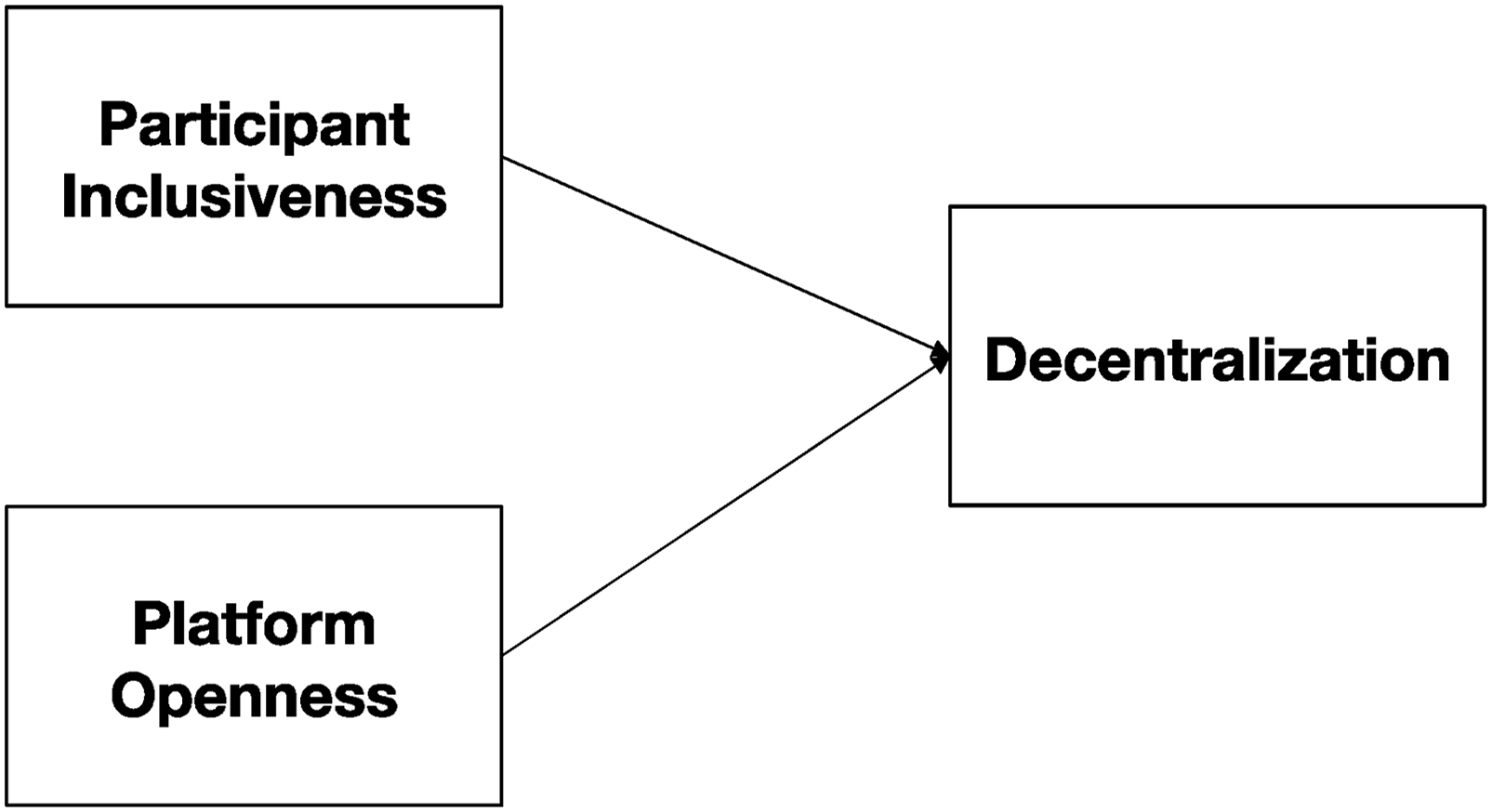
Decentralisation
The discourse on blockchain governance has emerged as a response to the limitations of traditional, centralised governance (Ciriello et al., 2025; Kannengießer et al., 2020; Sunyaev et al., 2021). Initially conceived with Bitcoin, blockchain technology sought to circumvent the dominance of financial intermediaries by enabling collaboration among anonymous actors through consensus algorithms (Nakamoto, 2009). This represented a shift toward decentralised governance, characterised by algorithmic decision-making and distributed consensus (Beck et al., 2018; Hacker et al., 2023; Lacity, 2022; Lumineau et al., 2021).
Although often associated with decentralised design, blockchain architectures simultaneously enable and constrain decentralisation (Hanisch et al., 2025). Smart contracts are widely seen as tools for automating governance by executing pre-defined rules without human discretion (Gregory et al., 2022; Lumineau et al., 2021). Yet their ‘smartness’ depends on how well they encode complex stakeholder relationships, contingencies, and enforcement logic (Drummer and Neumann, 2020). In open systems, a broader and more diverse participant base complicates consensus-building, especially for protocol changes, often resulting in stalemates or forks when no single actor can resolve disputes (Andersen and Bogusz, 2019; Ciriello et al., 2025). Consensus mechanisms such as Proof-of-Work and Proof-of-Stake may formalise distributed agreement, but they do not replace the political negotiations that underpin sociotechnical change (Mueller-Bloch et al., 2024). As in democracies, decentralisation can enhance resilience and legitimacy but also slow and complicate decision-making (Diefenbach, 2019; O'Mahony and Ferraro, 2007).
Contrary to intuition, decentralisation does not imply equality. Even in open systems, power imbalances arise through asymmetries in capital, access, or skill (Diefenbach, 2019; Hall et al., 2025). Without deliberate power balancing (e.g. through voting caps, rotating leadership, or control redistribution), decentralised governance can reproduce elite capture under the guise of openness (Ciriello et al., 2025; O'Mahony and Ferraro, 2007). Thus, decentralisation is not a static endpoint but an ongoing struggle for negotiating access, influence, and control within evolving sociotechnical infrastructures.
Decentralisation is also often conflated with distribution, though the two concepts differ. Decentralisation concerns the dispersion of decision-making authority across autonomous actors, whereas distribution refers to the geographical or structural spread of system components (Vergne, 2020; Walch, 2019; Zetzsche et al., 2018). In centralised governance, decision rights and communications are tightly controlled by a central authority (Vergne, 2020). In contrast, decentralised systems like Bitcoin allow nodes to independently validate transactions while maintaining a shared, collectively maintained ledger (Walch, 2019; Zetzsche et al., 2018). Nakamoto’s (2009) iconic white paper does not use the term ‘decentralisation’, but its proposed removal of central control through a peer-to-peer network implicitly enacts the principle. By distributing record-keeping and transaction validation across nodes, Bitcoin achieves both distribution and decentralisation: transaction information is distributed, and decision-making authority is decentralised (Rossi and Sørensen, 2019).
Nonetheless, decentralisation in practice often reverts toward centralisation (Ciriello et al., 2025; Diefenbach, 2019; Walch, 2019). Unbeknownst to many, even in ostensibly ‘decentralised’ systems like Bitcoin, few large token holders hold a disproportionate amount of the total cryptocurrency supply. As of July 2024, about 2% of Bitcoin wallets control over 90% of the total Bitcoin supply (Katte, 2024). Such imbalances also emerge across different consensus mechanisms, where mining power or staking dominance can concentrate control (Ciriello et al., 2025; Mueller-Bloch et al., 2024).
These dynamics are even more pronounced in enterprise settings, where blockchain implementations frequently re-centralise governance (Hanisch et al., 2025; Ziolkowski et al., 2020). Contrary to narratives that frame blockchain as a neutral force, it is introduced into existing sociotechnical arrangements comprising legacy systems, institutional routines, power structures, regulatory mandates, and resource asymmetries. Enterprise actors often prioritise business goals such as data confidentiality, managerial control, or regulatory compliance, all of which tend to centralise power (Lacity, 2018; Pedersen et al., 2019). This leads to a governance puzzle: while blockchain’s technical architecture may support decentralisation, enterprise implementations often converge toward centralisation to align with business imperatives (Ciriello et al., 2025; Currie et al., 2018). Understanding these decentralisation dynamics thus requires attention not only to technical architecture but also to the broader sociotechnical configurations that mediate governance (Rauchs et al., 2018; Vergne, 2020).
In this light, the formative stage of enterprise blockchain governance is especially consequential. Decisions made during this period can set long-term trajectories toward either centralisation or decentralisation (Hanisch et al., 2025; Miranda et al., 2022). As with platforms like Meta and Alphabet, early governance choices can embed path dependencies that shape institutional evolution (Ciriello et al., 2025; Dias et al., 2023; Pfister et al., 2022). Our case studies show that early-stage configurations decisively influence whether decentralisation is realised or undermined.
The formative stage is critical because it imprints durable patterns of access and control (Dias et al., 2023; Marquis and Tilcsik 2013; Miranda et al., 2022). In enterprise blockchain settings, these mechanisms are encoded in validator rules, consensus protocols, and smart contracts (Drummer and Neumann, 2020; Lumineau et al., 2021). Unlike more malleable digital commons such as Wikipedia or Linux (Aaltonen and Lanzara, 2015; Mindel et al., 2018), enterprise blockchains are characterised by high technological rigidity: once governance rules are enacted, they are difficult to change, which makes these systems especially susceptible to imprinting effects. Early decisions often become entrenched and resistant to later reform.
Drawing on organisational imprinting theory (Becker, 2025; Dias et al., 2023; Marquis and Tilcsik, 2013; Miranda et al., 2022), we conceptualise decentralisation not as a fixed attribute but as a process shaped by early imprints. Platform openness and participant inclusiveness serve as imprinting mechanisms that structure how access, control, and influence are distributed. While some governance aspects may continue to evolve, the encoded rules of enterprise blockchains limit the scope for meaningful transformation. This helps explain why many systems struggle to shift from initially centralised structures toward more decentralised arrangements.
Platform openness
Platform openness denotes the degree to which an enterprise blockchain is accessible to a broad range of participants. This dimension captures the breadth of stakeholders permitted to access the governance arena. High platform openness enables diverse actors to contribute to decision-making, potentially enhancing innovation, legitimacy, and resilience (Schlagwein et al., 2017; Shaikh and Vaast, 2016). Conversely, low platform openness restricts access to a narrow group, which may yield short-term efficiencies but risks power concentration, reduced trust, and undermined legitimacy (Andersen and Bogusz, 2019; Mueller-Bloch et al., 2022).
Openness is only meaningful when accompanied by institutional mechanisms that confer legitimacy to governance power (Almeida et al., 2024; Suchman, 1995). In most organisational settings, whether in corporations, public institutions, or voluntary collectives, authority is unequally distributed but legitimised through formal delegation, professional norms, and accountability mechanisms. Hence, enterprise blockchains require legitimacy safeguards to prevent governance drift toward oligarchic control (Diefenbach, 2019; Hanisch et al., 2025). Technical openness alone does not ensure democratic governance (Hall et al., 2025); it must be reinforced by institutional procedures that legitimise power (Almeida et al., 2024).
The decision to implement platform openness during the formative stage of blockchain governance is particularly consequential. Early choices shape subsequent organisational dynamics, often embedding structures that are difficult to revise (Ondrus et al., 2015). While centralised governance can promote strategic alignment and operational efficiency (Ciriello et al., 2025), it may also reduce responsiveness to emerging stakeholder needs, particularly in fast-changing environments (Boudreau, 2010; O'Mahony and Ferraro, 2007). By contrast, high platform openness can mitigate these limitations by distributing power, reducing barriers to entry, and enabling more inclusive deliberation. As Boudreau (2010) argues, platform owners must often relinquish control to sustain trust and legitimacy, particularly when seeking to establish industry-wide standards.
Limited openness, whether by restricting access or by failing to engage stakeholders meaningfully in governance, tends to concentrate authority within a select group (Ciriello et al., 2025; Hall et al., 2025). Although centralised platforms may retain some responsiveness to user needs in a transactional sense (O'Mahony and Ferraro, 2007), responsiveness alone does not confer legitimacy (Hall et al., 2025). For platforms aspiring to become industry standards, stakeholder-centric governance is therefore essential. This may include formal structures for incorporating stakeholder input, such as advisory boards, community referendums, rotating representation, and transparent feedback loops (Tiwana et al., 2010). Without this, openness may become performative and exclusionary even when nominal access is granted (Hall et al., 2025).
Enterprise blockchains typically span a spectrum from public to private and from permissionless to permissioned (Beck et al., 2018), but even private blockchains can exhibit varying degrees of openness. High openness is characterised by accessibility to a wide range of stakeholders, potentially enabling the distribution of authority (Constantinides et al., 2018; Schlagwein et al., 2017; Tiwana et al., 2010). Conversely, low openness often leads to centralised governance, where a small group retains control over key decisions, constraining collaboration, reducing trust, and limiting innovation (Mueller-Bloch et al., 2024; O'Mahony and Ferraro, 2007). Therefore, we propose:
High platform openness in the formation of enterprise blockchains leads to decentralisation, whereas low platform openness leads to centralisation.
Overall, the relationship between enterprise blockchain and decentralised governance is complex and dynamic. Platform openness can act as a decentralising force, but only when institutional safeguards ensure that openness translates into legitimate and inclusive governance. A strategic approach is therefore required, going beyond nominal access to meaningful participation. For enterprise blockchains to realise their decentralisation potential, openness must support not just system entry but the co-evolution of governance structures capable of leveraging diverse contributions.
Participant inclusiveness
Participant inclusiveness denotes the degree to which stakeholders within an enterprise blockchain can exert meaningful influence and control over governance decisions. It captures the depth of participation, beyond mere access or symbolic consultation (Hall et al., 2025). In highly inclusive systems, governance authority is shared with stakeholders who are actively involved in decision-making processes, enabling participatory rule-making and more democratic governance (Berente et al., 2019; O'Mahony and Ferraro, 2007; Reimers et al., 2014). Inclusiveness fosters decentralisation by ensuring that engaged stakeholders can meaningfully shape the platform’s rules, priorities, and structures. Conversely, low participant inclusiveness tends to concentrate control among a few dominant stakeholders, typically due to market power, gatekeeping, or entrenched relationships (Zachariadis et al., 2019). Thus, participant inclusiveness works as an imprinting mechanism that configures early distributions of decision-making authority. These patterns become structurally embedded, shaping governance evolution and delimiting the scope for decentralisation.
Blockchain was originally conceived as a means to decentralise control by removing intermediaries and enabling more egalitarian forms of participation (Gomber et al., 2018; Zachariadis et al., 2019). Yet in enterprise contexts, pre-existing hierarchies and institutional power often reassert themselves (Gomber et al., 2018), reinforcing centralised governance structures even within ostensibly decentralised systems (Berente et al., 2019; Reimers et al., 2014). This occurs when dominant actors leverage their strategic position to influence consensus mechanisms, rule-setting, or platform operations, particularly in early-stage projects shaped by founder-led control (Rauchs et al., 2019). Algorithmic consensus, though framed as impartial, can often be co-opted or selectively implemented, reinforcing asymmetric influence (Ansell and Gash, 2007; Ciriello et al., 2025).
These dynamics echo the ‘iron law of oligarchy’ (Michels, 1911), which posits that even organisations founded on democratic ideals tend to consolidate power over time. While not deterministic, this tendency represents a persistent structural threat to decentralisation: As power concentrates, systems risk degenerating into unaccountable oligarchies (Diefenbach, 2019), undermining legitimacy and contradicting the decentralisation ethos at blockchain’s core. Avoiding such oligarchic drift requires institutional safeguards that uphold participant inclusiveness as a condition for legitimacy (Almeida et al., 2024; Diefenbach, 2019).
The level of participant inclusiveness during the formative stage is especially significant. High inclusiveness distributes authority early, building trust and collaborative capacity across a diverse stakeholder base (Reimers et al., 2014). Low inclusiveness, by contrast, entrenches hierarchical control and limits future adaptability (Rauchs et al., 2018). Once power is consolidated, it is rarely relinquished voluntarily. This dynamic is evident in cryptocurrencies like Bitcoin, where early adopters benefit disproportionately (Katte, 2024). As in broader socio-political contexts, those excluded from governance typically gain influence only through institutional redesign or political struggle. Thus, early-stage exclusion tends to entrench asymmetries, shaping the long-term trajectory of governance and limiting the system’s capacity for decentralised evolution.
This contrast between the decentralising potential of blockchain and the centralising dynamics of enterprise stakeholders is central in shaping governance outcomes. Inclusive participation supports decentralisation by enabling pluralistic rule-making. Conversely, low inclusiveness tends toward centralisation by reinforcing the dominance of a few. Accordingly, we propose:
High participant inclusiveness in the formation of enterprise blockchains leads to decentralisation, whereas low participant inclusiveness leads to centralisation.
Overall, while blockchain may offer technical features for decentralisation, organisational structures and power dynamics often pull in the opposite direction. Participant inclusiveness functions as a decentralising force, whereas its absence strengthens centralising tendencies.
Interplay between platform openness and participant inclusiveness
Variations in enterprise blockchain governance.
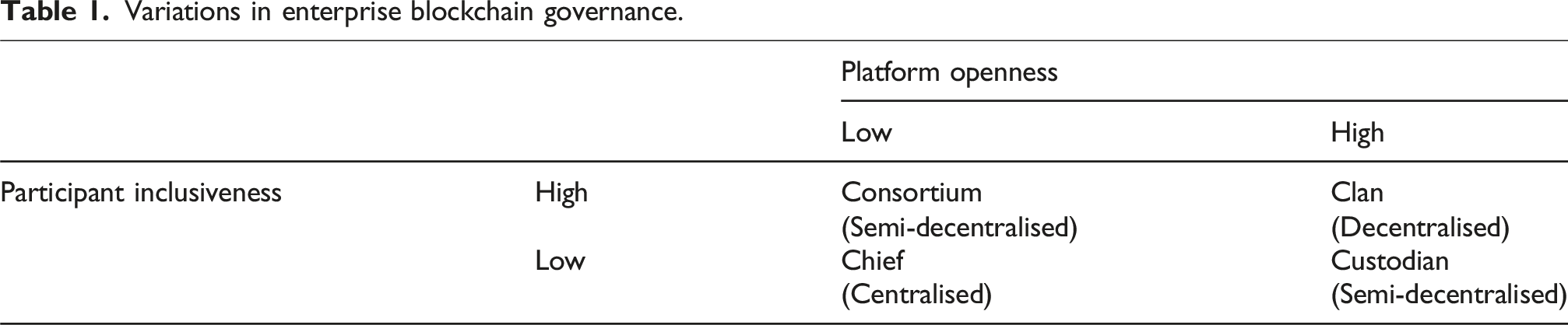
The Chief archetype exemplifies centralised governance characterised by unequal power relations, where one or a few dominant actors exert exclusive control over a closed platform. This configuration may be adopted in the early stages of enterprise blockchain development to enable rapid decision-making and minimise coordination overhead. It may also apply when implementations are designed around narrow business objectives, where broader inclusion is seen as unnecessary or risky (Ciriello et al., 2025).
As a polar opposite, the Clan archetype exemplifies decentralised governance. It features an open platform with inclusive rights, enabling broad and diverse participation in decision-making. This arrangement promotes stakeholder legitimacy and trust but introduces coordination complexity, which can slow decisions and strain performance (Ciriello et al., 2025; Ellinger et al., 2024). Similar tensions arise in participatory systems such as Wikipedia, where institutional mechanisms, ranging from algorithmic moderation to dispute resolution, are needed to maintain legitimacy (Aaltonen and Lanzara, 2015; Arazy et al., 2016).
The Custodian archetype reflects a semi-decentralised model with an open platform overseen by a limited group of influential actors who act as ‘benevolent dictators’. Although decision-making authority is concentrated, it remains accountable to the broader community, often through soft consensus or shared norms. This model depends on trust in the custodian’s credibility and alignment with collective goals. However, as participant diversity grows or interests diverge, cohesion may erode, requiring more formal safeguards (Hanisch et al., 2025).
Lastly, the Consortium archetype also represents a semi-decentralised configuration but with high participant inclusiveness and low platform openness. Governance authority is distributed among a closed group of participants, often convened to solve a shared problem or coordinate across organisational boundaries. Early on, decision rights may be delegated to a core group to accelerate development and contain governance costs. Over time, however, legitimacy pressures may prompt broader inclusion to support adoption and legitimacy. In such contexts, success hinges on the quality of initial leadership and the platform’s capacity to evolve its governance structure as participation expands (Bauer et al., 2022; Zavolokina et al., 2020).
Together, these archetypes offer a foundation for explaining how different combinations of platform openness and participant inclusiveness shape decentralisation outcomes. Low inclusiveness often fosters centralisation, particularly in the early stages when coordination efficiency is prioritised. As implementations mature, however, openness can introduce decentralising pressures that compel broader participation and shared governance. This leads to our third proposition:
Contrasting degrees of platform openness and participant inclusiveness in the formation of enterprise blockchains lead to semi-decentralisation.
Semi-decentralised arrangements offer a compromise between control and participation, balancing the efficiency of concentrated leadership with the legitimacy and adaptability conferred by broader engagement. They are especially salient in enterprise contexts, where governance must reconcile competing institutional logics, stakeholder interests, and operational constraints (Lindgren et al., 2021). By accounting for the interaction of platform openness and participant inclusiveness, our variance model (Figure 1), together with Propositions P1–P3 and the governance archetypes in Table 1, provides a theoretical explanation for why some enterprise blockchains decentralise, others remain centralised, and many adopt hybrid forms. In the following, we demonstrate the empirical utility of this model by analysing four enterprise blockchain cases that exemplify these archetypal configurations.
Research methods
Deductive, explanatory, multi-case study
To address our research question, we conducted a deductive, explanatory, multi-case study. This design is well established in IS research for examining complex sociotechnical phenomena in their real-life contexts (Benbasat et al., 1987; Yin, 2009). Multi-case studies are particularly useful for identifying patterns, similarities, and differences across cases (Eisenhardt, 1989), allowing us to explore how variations in platform openness and participant inclusiveness shape decentralisation outcomes in enterprise blockchains.
Our approach is deductive in that we apply a theoretically developed variance model to empirical data, and explanatory in that we seek to clarify how and why specific governance outcomes emerge. We use the model to analyse the interplay between platform openness, participant inclusiveness, and the resulting degrees of decentralisation across cases (Yin, 2009). This enables us to trace how sociotechnical interactions between governance structures, stakeholder configurations, and encoded rules shape blockchain governance trajectories.
We selected four enterprise blockchain cases, each corresponding to one of the governance archetypes in our variance model (Table 1), to explain how organisations structured governance during the formative stage. The cases reveal how variations in platform openness and participant inclusiveness led to different decentralisation outcomes, reflecting the strategic objectives and institutional logics of the organisations involved.
Data collection
We used purposeful sampling (Eisenhardt, 1989) to identify four enterprise blockchain cases that could collectively illustrate the workings of our theoretical model. All cases met three selection criteria: (1) they involved enterprise blockchain implementations, (2) had completed their formative stage, and (3) had established discernible governance arrangements. We further ensured variation across the two theoretical dimensions of platform openness and participant inclusiveness to support robust cross-case comparison (Eisenhardt, 1989).
Overview of interviews.
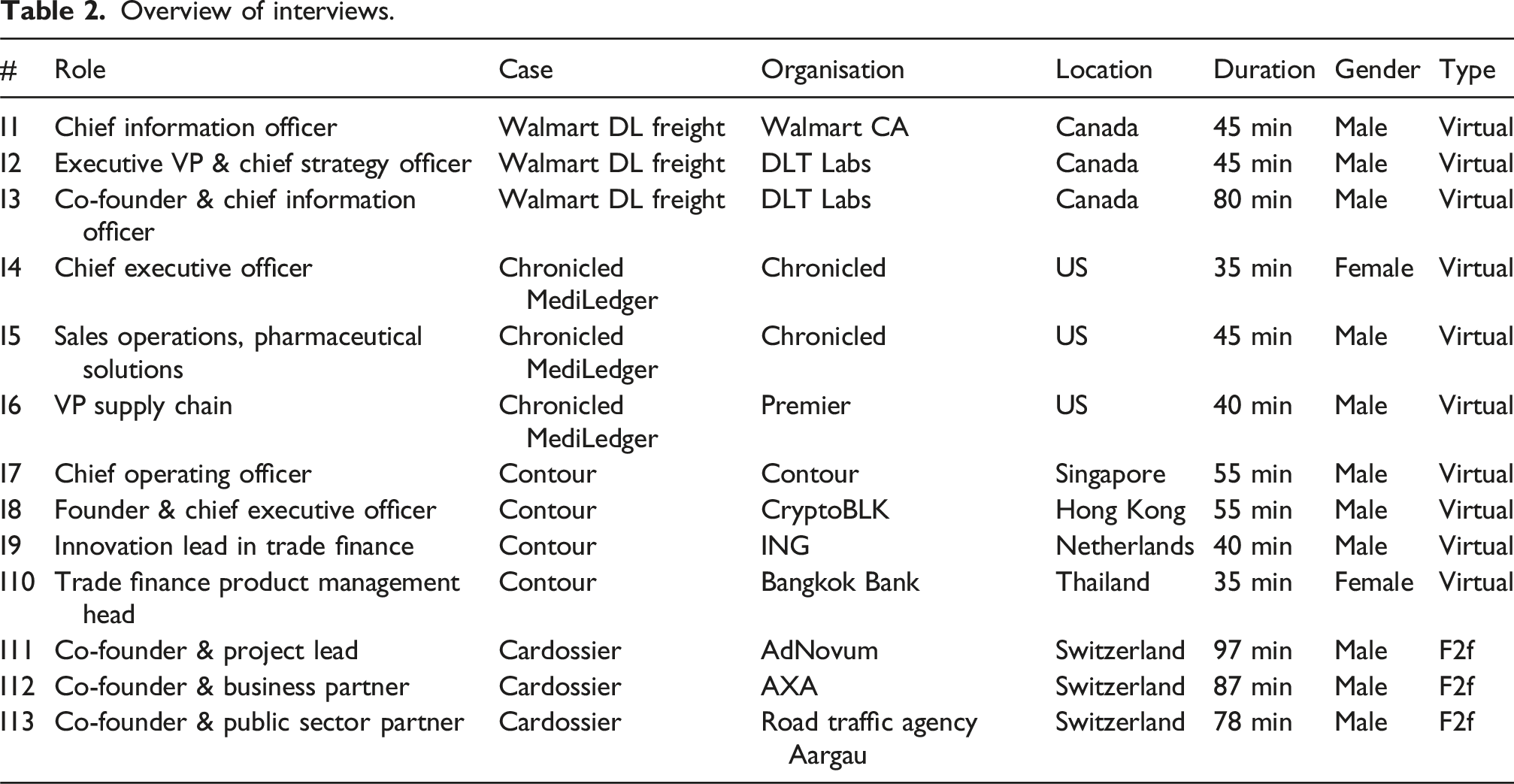
We adopted a multi-stage data collection approach that combined longitudinal observation, laddering interviews, and document analysis. Our goal was to trace how formative-stage configurations of openness and inclusiveness imprinted on later governance outcomes. Engagement with the cases began through academic and industry networks, which provided early access to governance developments complemented by secondary data. Between 2021 and 2022, we conducted thirteen interviews: three in person and ten via video conferencing, each lasting between 35 and 97 minutes.
To surface participants’ underlying beliefs and value systems, we applied laddering interview techniques (Schultze and Avital, 2011). This approach elicited subjective sensemaking about governance preferences, revealing how organisational actors understood, justified, and evaluated the governance arrangements in which they participated. Interview prompts were anchored in four core objectives that guided both data collection and subsequent coding: (1) understanding the participant’s governance role; (2) assessing platform openness; (3) evaluating participant inclusiveness; and (4) appraising the extent of decentralisation. We treated interviews not as neutral instruments but as co-constructed, reflexive encounters. The laddering structure facilitated thematic focus while allowing adaptive probing of emerging concepts (Schultze and Avital, 2011). This approach acknowledged the relational dynamics of the interview process and the situated nature of governance narratives.
Following the interviews, we continued to trace the four cases through secondary sources until late 2024. These materials provided evidence of ongoing governance evolution and allowed us to validate and extend insights from the interviews. For instance, we revised our interpretation of the Contour case after the platform filed for bankruptcy and ceased operations in October 2023 (Patel and Canup, 2023). Likewise, our understanding of Cardossier was refined through additional documentation and community feedback shared in 2024. Preliminary findings were presented at academic workshops during that year, allowing for iterative critique and refinement prior to journal submission.
While we did not undertake direct ethnographic observation, the near-longitudinal scope of our engagement, spanning early observation, retrospective interviewing, and subsequent document analysis, enabled reconstruction of governance trajectories. Our data collection thus combined within-case depth and cross-case breadth, allowing us to explain how early decisions around openness and inclusiveness left durable governance imprints.
Data analysis
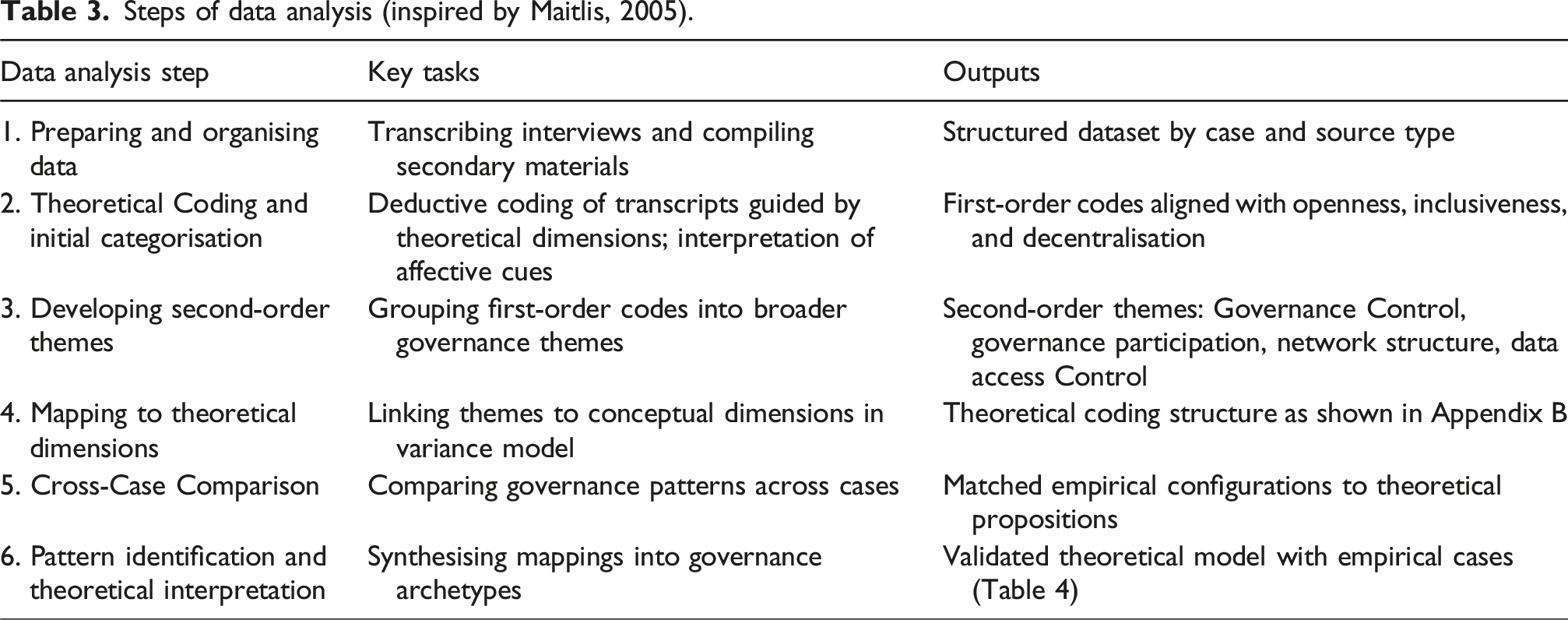
Our data analysis followed a six-step iterative process, adapted from Maitlis (2005), to develop empirically grounded theoretical insights. Combining deductive coding with iterative refinement, we sought to explain how variations in platform openness and participant inclusiveness imprinted decentralisation outcomes across the four cases. While data analysis and collection were intertwined, our overall approach moved from theoretical propositions to validated empirical insights (Lee and Baskerville, 2003). Table 3 outlines each step. Steps of data analysis (inspired by Maitlis, 2005).
Mapping empirical cases to theoretical archetypes.

Empirical analyses
Walmart DL freight: Centralised governance (chief)
Key objectives
Launched in 2020 by DLT Labs for Walmart Canada, the DL Freight blockchain aimed to streamline invoice reconciliation with logistics carriers. The platform was designed to reduce the high rate of invoice disputes that had resulted from heterogeneous IT systems and manual data entry across the supply chain (Lacity and Van Hoek, 2021). Within 8 months of its implementation, Walmart reported a drop in invoice disputes from approximately 70% to below 1%, signalling a dramatic efficiency gain (Vitasek et al., 2022). The core mechanism for this improvement was a shared ledger that allowed parties to collaboratively generate and validate invoice records in near-real time (Hyperledger Foundation, 2020).
Low platform openness
DL Freight was implemented as a permissioned blockchain using Hyperledger Fabric (Hyperledger Foundation, 2020). Access to the platform was strictly controlled: ‘DL Freight runs on a private blockchain and access to the system is invite-based, therefore the platform is both closed and permissioned’ (I1). Only authorised carriers could join, and onboarding was overseen directly by Walmart: ‘We onboarded participants in batches, making sure their systems met Walmart’s requirements’ (I2). All data access was restricted based on predefined roles: ‘Only specific roles could see shipment updates. Everything was role-based’ (I1). This closed architecture reinforced Walmart’s structural control over the network and insulated it from broader stakeholder participation. The permissioned architecture meant that governance decisions remained off-chain, embedded in bilateral contracts between Walmart and its carriers. As one participant explained: ‘Off-chain governance is about business rules governed by business contracts, and those are not dependent on the network. It would have been the same whether the system was based on any other protocol’ (I2). The blockchain served primarily as a technical tool for enforcing pre-existing business arrangements, rather than as a medium for power sharing.
Low participant inclusiveness
Governance decisions were tightly controlled by Walmart. Key actors described Walmart as ‘the leader entity that dominates governance’ (I2), noting that ‘Walmart was driving the decisions. We aligned development based on their inputs’ (I1). DLT Labs implemented the system according to Walmart’s business objectives, with carriers having negligible influence over platform design, rules, or roadmap decisions. Interviewees noted that all rules ‘about data fields, formats, timing’ were defined upfront by Walmart, and that carriers ‘didn’t have a seat at the table’ (I1). The system was positioned as a de facto standard in Walmart’s Canadian logistics operations: ‘The new solution became the new national standard for Walmart Canada transportation management. Then, we started the process of onboarding the other sixty-nine carriers’ (I1). Carriers had no room to negotiate or shape the platform; instead, their involvement was conditional on accepting Walmart’s terms. Affective cues in interviewee responses, such as phrases like ‘we followed what was implemented’ (I1) and ‘limited ability to participate’ (I2), revealed a tone of resignation, further evidencing the marginalised position of non-Walmart actors.
Centralised governance
Despite its technical sophistication and operational efficiency, DL Freight reflects a highly centralised governance model. Both platform openness and participant inclusiveness were low: Walmart controlled access, defined smart contract terms, and unilaterally set rules for interaction. While the system enhanced transaction efficiency and reduced friction, it did so by entrenching Walmart’s dominance and limiting opportunities for broader co-governance or stakeholder input, defeating blockchain’s decentralisation ethos. As such, the governance structure of DL Freight aligns with the Chief archetype, characterised by centralised authority, exclusive participation, and closed platform architecture.
Contour: Decentralised governance (clan)
Key objectives
Launched in 2019 by R3 in collaboration with several major banks, Contour aimed to digitise and streamline the issuance of letters of credit (LCs) using the Corda blockchain. The initiative sought to improve the speed, transparency, and security of trade finance, replacing traditionally cumbersome, paper-based processes (Sunderman, 2020). According to a participant (I10), ‘The key benefits of Corda blockchain are transparency, immutability, and a robust privacy around transactions, which makes it perfect for the financial industry’. By implementing Corda’s privacy-preserving architecture, Contour reduced LC processing times by over 90% (R3, 2021). As one participant explained, ‘We took a highly manual, complex transaction and made it more secure and efficient’ (I7). Despite these technical achievements, Contour ceased operations in October 2023, citing insufficient funding and the inability to reconcile divergent shareholder interests (Patel and Canup, 2023).
High platform openness
Contour configured a broadly open platform. Any financial institution compliant with SWIFT standards could technically integrate, and onboarding was standardised through APIs and compliance checks: ‘If you’re compliant and pass basic validation, you can connect’ (I8). Members controlled access to their own data: ‘We don’t own the data. Each participant controls access to their transaction data’ (I8). Governance rules were encoded in smart contracts developed through shared processes: ‘The rulebook and smart contracts are shared and agreed on by all members’ (I9). Contour’s openness was both technical and institutional: ‘The absence of a dominant player is recognised as an essential condition for the platform to attract a diverse range of potential customers’ (I7).
High participant inclusiveness
Contour’s governance was designed to prevent dominance and promote collaborative decision-making. Shareholder banks appointed the leadership team and jointly developed a model based on equal voting rights: ‘The Board consists of representatives from the shareholder banks and is rotated annually to avoid dominance’ (I9). No shareholder had veto power: ‘We try to avoid any one institution having too much power’ (I9). Participatory structures extended beyond shareholders, with advisory groups incorporating user feedback on product development: ‘We have advisory groups where different users participate to give input on roadmap decisions’ (I10). One participant reflected, ‘Contour’s governance structure promotes a balanced decision-making process, facilitated by the collaborative approach adopted by the Contour management’ (I7).
Decentralised governance
Contour exemplifies the Clan archetype: a decentralised governance model rooted in shared authority and broad access. Its platform openness, via standardised APIs and transparent rulebooks, combined with inclusive control structures, enabled diverse stakeholders to co-develop and co-govern the platform. The governance approach blended legal and technical consensus: ‘The network consensus is really a legal consensus… legal contracts create confidence for companies to use the system’ (I7). However, the same decentralised architecture that ensured balanced participation also posed coordination challenges. In the absence of a dominant sponsor, the platform struggled to consolidate resources and strategic alignment among its many members. Ultimately, this tension between collaborative governance and operational sustainability contributed to its shutdown in 2023 (Patel and Canup, 2023). Nonetheless, Contour provides a rare empirical instance of a fully decentralised enterprise blockchain governance structure, and a cautionary tale of its fragility.
Chronicled MediLedger: Semi-decentralised governance (custodian)
Key objectives
Launched in 2017 by Chronicled, MediLedger aimed to support medicine verification and track-and-trace compliance under new U.S. FDA regulations (Mattke et al., 2019). The platform brought together major pharmaceutical stakeholders (e.g. manufacturers, wholesalers, and service providers) into a shared infrastructure intended to streamline regulatory adherence and industry-wide collaboration. As a participant said, ‘The MediLedger consortium is made of leading pharmaceutical manufacturers, wholesale distributors, group purchasing organisations, solution providers and supply chain management experts’ (I5).
High platform openness
MediLedger is characterised by an open platform architecture combined with a permissioned governance model. The platform welcomes a broad spectrum of pharmaceutical stakeholders who can join through a standardised onboarding process: ‘We assign roles to companies… any company that aligns with one of these roles can participate’ (I5). Participants operate their own nodes and control access to their data: ‘Each company decides who gets permission to their data’ (I4). While Chronicled runs the onboarding gateway, the underlying infrastructure supports distributed node operation and standards-based integration. By mid-2020, MediLedger had verified a substantial share of U.S. pharmaceutical transactions (Somerville, 2020), signalling its traction as a commercial and regulatory infrastructure. Governance is defined in the MediLedger Charter (2020), which codifies industry-wide rules and a commitment to vendor neutrality, fostering trust and fairness: ‘The neutrality of the network operator creates a foundational element of trust… they know they will receive a fair treatment’ (I6). Although Chronicled retains final authority, proposed changes by the Advisory Board undergo community review, supporting participatory rule evolution: ‘The whole idea is to come together and build a network that is supposed to be a single source of truth’ (I6). This structure reflects a commitment to user-centric governance.
Low participant inclusiveness
Despite MediLedger’s open platform architecture, governance remained centralised under Chronicled. This arrangement stemmed from pharmaceutical stakeholders’ unwillingness to assume liability in a high-stakes regulatory environment. As one participant recalled, ‘Back in November 2017, at Pfizer headquarters in New York City, all companies involved were told “You should own this.” And the answer was “We can’t own this… we cannot be liable if the system cannot work, and companies cannot ship their products”’ (I4). In response, Chronicled assumed custodial responsibility, operating the platform and charging service fees: ‘The companies pay us service fees to run our software’ (I4). Chronicled’s authority encompassed both technical operations and governance oversight, codified in the MediLedger Charter.
Participants could propose changes via industry working groups, but decision-making authority remained with Chronicled: ‘Participants can suggest some modifications; we will review them and ultimately decide whether they align with the industry standard or not’ (I4). While the Charter established participatory mechanisms, these served primarily an advisory function. Chronicled’s leadership role ensured legal compliance, system coherence, and operational continuity, balancing the need for community input with the practical demands of a regulated industry. This custodial governance model addressed risk aversion while consolidating platform control.
Semi-decentralised governance
MediLedger represents the Custodian archetype with a semi-decentralised governance model in which a central actor retains decision rights while enabling broad access. Chronicled’s stewardship balanced user engagement with managerial control, leveraging trust in its neutrality to enrol stakeholders and coordinate rule-setting across a fragmented industry. As one participant put it, ‘Chronicled plays the role of gatekeeper. We onboard participants and ensure the rules are met’ (I4). This custodial governance structure enabled regulatory compliance and platform stability without fully devolving authority to network participants. While not decentralised in the democratic sense, MediLedger’s architecture reflects a deliberate compromise between decentralisation ideals and industry realities, anchored by a central custodian tasked with aligning diverse interests under a shared technical and legal framework.
Cardossier: Semi-decentralised governance
Key objectives
Cardossier, originally developed on the private blockchain Corda, was initiated in 2016 to improve inter-organisational processes in the Swiss car market. The platform brought together diverse actors (e.g. road traffic authorities, insurers, leasing firms, importers) whose interactions were historically marked by fragmentation and mistrust. Blockchain was seen as a mechanism for fostering trust, increasing transparency, and streamlining processes. Originally launched as a university-led research project, Cardossier emphasised incentive alignment, participant accountability, and regulatory integration (Bauer et al., 2022; Zavolokina et al., 2020). A project lead reflected, ‘I was convinced that you can only build such a system if you involve those who should use it from day one’ (I11). Participants recognised the need for gradual, consensus-based development: ‘It is a slow process to find a common view and a common solution with so many stakeholders, but… it is simply a necessary step on this path’ (I11). By embedding co-development into its core design, Cardossier aimed to create a shared digital infrastructure with shared institutional legitimacy. The platform’s formative trajectory thus reflects a sociotechnical effort to translate distributed trust into coordinated inter-organisational governance.
Low platform openness
Cardossier operates under a permissioned and private model, combining technical selectivity with pragmatic governance. This structure was initially adopted to ensure operational efficiency and manage the risks associated with a cross-sectoral data-sharing platform. In its early stage, governance was centralised: a legal entity was formed to formalise relationships and manage competing interests, with a board-appointed CEO authorised to coordinate member engagement (Zavolokina et al., 2020). The platform was built on Corda, a choice driven by privacy imperatives: ‘What I would never have dared to do is to distribute personal data like addresses and phone numbers or even movement profiles, encrypted in a Hyperledger Fabric on all the nodes’ (I11). Cardossier’s technical architecture prioritised selective data visibility and node-specific storage: ‘The data is only stored in the nodes of those people who are involved in the process’ (I12), and ‘The data belongs to the stakeholders, so the individual companies or owners’ (I11). Participants were onboarded according to predefined roles to ensure coherence. While the implementation partner retained technical oversight, data access remained decentralised: ‘The architecture is mainly with us at Adnovum’ (I11). These design decisions reflected a flexible, risk-aware response to legal, commercial, and technical constraints (Bauer et al., 2022).
High participant inclusiveness
From its inception, Cardossier placed strong emphasis on stakeholder inclusion and democratic governance (Zavolokina et al., 2024). A project lead explained, ‘Having the right participants from day one is key to success… Initially, I wouldn’t include competitors… In the end, we partnered with seven entities, which was just right’ (I11). The platform’s formative group included state agencies, insurers, leasing companies, and vehicle importers – that is, organisations with overlapping interests but low competitive friction. The deliberate exclusion of direct competitors allowed the group to coalesce around shared goals and avoid conflict during early development. Over time, Cardossier formalised this inclusive ethos by establishing a non-profit association: ‘We opted for a non-profit association, so that was also a sign… to build an open ecosystem and include regulators’ (I12). This organisational form enabled the equal representation of members and aligned with the governance preferences of public sector partners: ‘It becomes difficult to argue with a capital company’ (I13), noted a representative from the road traffic agency. The association model offered flexibility in defining voting rights, roles, and contributions, while signalling a commitment to openness and public value. Participant inclusiveness was thus both a normative goal and a pragmatic necessity to ensure platform legitimacy and multi-stakeholder coordination.
Semi-decentralised governance
The governance of Cardossier represents the Consortium archetype, marked by inclusive participation within a controlled governance framework. Initially, the consortium was steered by a board-appointed CEO who coordinated technical development and stakeholder engagement. This centralised leadership was necessary during the early stages to maintain momentum and manage heterogeneity (Zavolokina et al., 2020). Yet the long-term vision was more decentralised. As one business partner explained, ‘We have now founded a non-profit association (…) as the holding company for this platform where you actually steer the further development and governance’ (I12). The association was designed to be ‘non-profit, self-sustaining and financed through revenues from data sales’ (I12), while explicitly not owning any data itself. Another participant noted, ‘We have now chosen an organisational form in which everyone has a voice’ (I13). Although governance remained slow and consensus-driven, this model fostered co-ownership and distributed responsibility: ‘We have, of course, spent a lot of time on stakeholder management… to involve everyone and find solutions’ (I11). Governance was thus semi-decentralised: coordinated by a legal entity, guided by inclusive principles, and operationalised through structured, but participatory, mechanisms. Cardossier’s governance trajectory illustrates how blockchain platforms can transition from centralised leadership to a shared governance structure grounded in mutual accountability.
Discussion
Empirical contributions
Overview of key findings.
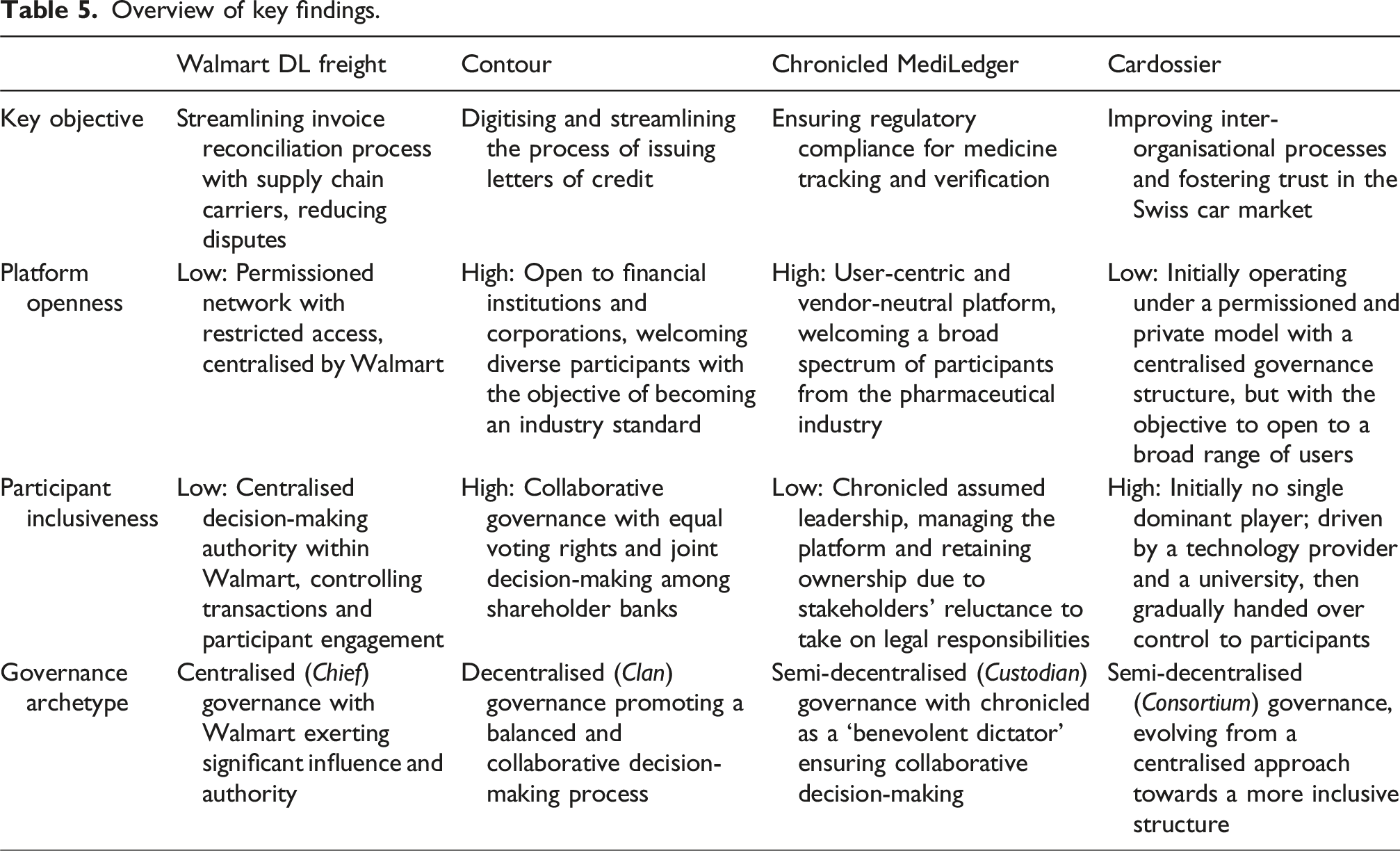
The Walmart DL Freight case exemplifies how low platform openness and low participant inclusiveness produce a highly centralised governance arrangement. Walmart’s dominance, underpinned by its market position and technical control, shaped rules, norms, and platform trajectory in line with corporate standards. This outcome confirms formative-stage imprinting and reflects the Chief archetype. Platform access was tightly restricted, while governance was embedded in rigid contracts, leaving little scope for meaningful stakeholder influence. In such configurations, platform openness and participant inclusiveness act not independently but as reinforcing mechanisms that intensify centralisation. This supports Propositions P1 and P2.
Conversely, Contour illustrates how high levels of platform openness and participant inclusiveness foster decentralised governance. The platform enabled wide stakeholder access through standardised APIs and equitable onboarding, while governance was shared among shareholder banks via rotating board appointments and equal voting rights. This inclusive architecture actively resisted power concentration and promoted legitimacy, aligning with the decentralised Clan archetype. Contour thus shows how strategic prioritisation of openness and inclusiveness can counteract centralising tendencies, institutionalise participatory governance, and support the decentralisation ethos of blockchain (Constantinides et al., 2018; Tiwana et al., 2010). As such, the case exemplifies how high openness and inclusiveness jointly enable decentralisation, consistent with Propositions P1 and P2.
The Chronicled MediLedger and Cardossier cases show how asymmetric configurations of platform openness and participant inclusiveness can lead to semi-decentralised governance. These cases illustrate that centralisation and decentralisation are not binary states but layered, negotiated outcomes. Rather than constituting two ends of a continuum, platform openness (breadth) and participant inclusiveness (depth) represent orthogonal dimensions whose interplay shapes hybrid governance forms. This highlights the non-linearity of decentralisation in enterprise blockchain implementations and the importance of sociotechnical alignment between architecture, organisational capacity, and stakeholder configuration.
In Chronicled MediLedger, platform openness was high. Chronicled built a vendor-neutral infrastructure that enabled broad industry access. However, participant inclusiveness remained low due to stakeholders’ reluctance to assume legal responsibility. As a result, Chronicled retained central governance authority while maintaining transparency and incorporating advisory feedback. This Custodian model was shaped by pragmatic concerns: in a high-risk, compliance-intensive environment, decentralised authority was seen as unviable. The governance outcome reflects a deliberate trade-off: open access moderated by custodial control. This supports Proposition P3 by illustrating how high openness and low inclusiveness can stabilise semi-decentralised arrangements.
Conversely, Cardossier prioritised inclusive participation from the outset, co-developing the platform with public and private stakeholders and formalising governance via a non-profit association. Yet platform openness was initially limited: a permissioned model was chosen to manage operational risk and maintain coherence. This cautious approach reflected both regulatory concerns and the early need for consistency. Over time, platform access was broadened, aligning with the consortium’s long-term vision of shared infrastructure and institutional trust. The result was a Consortium archetype: participatory, evolving, and mutually accountable. This case further validates Proposition P3 by demonstrating how high inclusiveness and low openness can still produce a semi-decentralised model that accommodates complex stakeholder needs (Bauer et al., 2022; Zavolokina et al., 2020).
Together, our four cases provide empirical validation for the proposed variance model. They show that decentralisation is not a built-in property of blockchain implementations but a constrained trajectory, imprinted by early choices around openness and inclusion. The governance arrangements observed, from centralised to decentralised and hybrid, reveal the institutional consequences of these design decisions. Strategic alignment between platform openness and participant inclusiveness during the formative stage is thus essential for realising blockchain’s decentralisation potential and avoiding path-dependent centralisation.
Theoretical contributions
Our study of four enterprise blockchain cases foregrounds the formative stage as a critical juncture in shaping long-term governance evolution. Drawing lessons from the historical trajectories of today’s digital giants, we show that early decisions around platform openness (who can access governance arenas) and participant inclusiveness (how much influence can stakeholders exert) cast long institutional shadows over how enterprise blockchains are governed. These findings advance theoretical understanding of decentralisation not as an inherent outcome of blockchain architecture, but as an imprinted trajectory shaped by sociotechnical choices made during formative-stage system configuration.
Decentralisation is often assumed to be primarily driven by blockchain’s technical architecture. However, our findings challenge this assumption by demonstrating that decentralisation is critically shaped by sociotechnical mechanisms, namely, how openness and inclusiveness are configured from the outset. These governance choices are not temporary or neutral but operate as imprinting mechanisms (Dias et al., 2023; Miranda et al., 2022): they codify early power dynamics into later governance arrangements (e.g. membership criteria, voting rights, consensus structures), that are difficult to revise later on. These early choices shape not only who governs but also how governance can evolve, entrenching or constraining decentralisation.
For instance, in Walmart DL Freight and Chronicled MediLedger, constrained participant inclusiveness entrenched centralised authority, which was later formalised in both software rules and off-chain governance processes. In contrast, Cardossier adopted pluralistic stakeholder involvement from the beginning, embedding deliberative procedures and collaborative norms that continued beyond the initial design stage. These empirical contrasts illustrate that formative decisions are not simply strategic artefacts but structural inflection points that shape how decentralisation is enabled, or foreclosed, over time (Ellinger et al., 2024; Hanisch et al., 2025; Zachariadis et al., 2019).
Our core theoretical contribution is to clarify how platform openness and participant inclusiveness jointly serve as imprinting mechanisms that constrain decentralisation trajectories in enterprise blockchains. As orthogonal dimensions – openness reflecting the breadth of access, inclusiveness the depth of influence – they can reinforce or counterbalance one another. Strategic increases in either dimension may shift governance towards decentralisation: openness can mitigate elite control by lowering entry barriers (Constantinides et al., 2018; Tiwana et al., 2010), while inclusiveness can compensate for limited access by enhancing participatory authority (Schlagwein et al., 2017; Shaikh and Vaast, 2016). Our study substantiates these dynamics and confirms the explanatory value of these constructs through cross-case comparison. Our variance model (Figure 1; Table 1; propositions P1–P3) extends prior theory by offering a structured explanation for decentralisation dynamics in enterprise blockchain governance. Rather than treating decentralisation as an ideal type or outcome of technical design, we show that it emerges through the interplay of sociotechnical variables, specifically, the formative imprint of openness and inclusiveness. This reframing offers an important corrective to technologically deterministic accounts, highlighting the institutional and participatory dimensions of blockchain governance.
More broadly, our theorising provides a foundation for studying hybrid governance configurations that increasingly characterise enterprise blockchains. By distinguishing between centralised, decentralised, and semi-decentralised archetypes, we provide a lens for analysing how blockchain governance structures evolve through dynamic recalibrations of access and influence. Future research can build on this by exploring how external pressures, such as regulation, market forces, or legitimacy crises, interact with formative imprints to reshape governance over time.
In sum, we contribute to IS governance theory by explicating how decentralisation in enterprise blockchain is not only constrained or enabled by technology (Hanisch et al., 2025), but also institutionally imprinted through early configurations of platform openness and participant inclusiveness. These imprinting mechanisms structure not only who governs, but how governance adapts over time, laying the groundwork for future scholarship on institutional path dependence and governance flexibility in open systems.
Practical implications
Our contributions also hold valuable practical implications for enterprise blockchain managers. While it may be tempting to treat platform openness and participant inclusiveness as adjustable levers, in practice these governance dimensions are shaped through a complex negotiation. Early-stage design decisions are particularly consequential, as they tend to imprint governance structures that become increasingly difficult to change over time. While later adjustments are possible, institutional routines, technical architectures, and stakeholder expectations often solidify initial configurations, limiting the scope for meaningful redesign. Moreover, access does not guarantee participation: organisations may open their platforms but still encounter limited engagement due to capability gaps, coordination costs, or trust deficits (Hall et al., 2025). Therefore, rather than assuming these dimensions can be tuned at will, managers should treat them as contested and evolving, requiring sustained attention to stakeholder alignment, governance legitimacy, and the adaptive capacities of the underlying infrastructure. Recognising this complexity is critical to avoiding governance drift and to realising the decentralisation potential of enterprise blockchain implementations.
Second, managers should consider strategically opening the platform and empowering participants. Open platforms and participatory governance can democratise decision-making and enhance trust among users. This can be particularly effective in industries or use cases where collaboration across different entities is necessary. In such scenarios, maintaining a degree of openness and participation in governance can invite diverse participants and drive innovation. Clear governance rules and structures are also vital, especially in hybrid models. Managers should ensure that roles, responsibilities, and decision-making processes are transparent and well-documented. This clarity is essential for maintaining trust and efficiency, particularly in consortia or multi-stakeholder environments.
Third, managers should regularly monitor the governance arrangement and respond to changes swiftly. Managers need to be aware of how power dynamics within the platform can shift and affect governance. In cases where a single entity begins to exert excessive influence, measures should be taken to rebalance power dynamics to prevent centralisation that could undermine the platform’s objectives. Especially in decentralised or semi-decentralised models, achieving consensus among diverse stakeholders is key. Managers should facilitate open dialogue and negotiation to ensure that decisions reflect the collective interests of all participants. Tools like smart contracts can be leveraged to automate and enforce agreed-upon rules and decisions. Given the technical complexity and evolving nature of blockchain technology, continuous education and training for all stakeholders are essential. Understanding the technology and its governance implications is vital for informed decision-making and effective participation. As the blockchain grows, managers should plan for scalability in both technical and social terms. This includes anticipating how the addition of new participants or changes in market conditions might impact the governance structure and preparing strategies to accommodate these changes.
Overall, managing enterprise blockchains requires a nuanced understanding of the interplay between platform openness and participant inclusiveness. Managers should adopt a dynamic approach to governance, balancing the interplay to achieve the desired level of decentralisation that aligns with the organisation’s goals and the needs of its stakeholders.
Limitation and future research
As with all research, our study has limitations that present opportunities for future research. Our findings are grounded in four carefully selected cases, chosen for their varied combinations of platform openness and participant inclusiveness, spanning across different industries. However, this selection also presents a limitation. The diversity in industry sectors – logistics, finance, pharmaceuticals, and automotive – while beneficial for a broad perspective, may not capture the nuances specific to other sectors. The chosen cases, although representative, do not exhaust the spectrum of enterprise blockchain governance. Future research might explore additional cases across other sectors to validate or extend our findings.
Also, the inherent nature of enterprise blockchains implies that their governance structures are not static but evolve dynamically. The closure of Contour in 2023 serves as a stark reminder of the dynamic and turbulent nature of these governance arrangements. This highlights a limitation in our study: the reliance on the formative stage of governance structures without a long-term perspective. Future research could adopt a longitudinal approach to capture the evolution of governance structures over time, especially considering how early-stage developments cast long shadows over future trajectories.
Moreover, our inquiry relied exclusively on qualitative analysis, drawing on interviews and document-based reconstruction to generate rich, contextualised insights into the governance configurations of the selected cases. While this approach enabled an in-depth examination of formative-stage dynamics, it has inherent limitations. In particular, the absence of direct participant observation and the reliance on one-off interviews restrict our ability to capture evolving practices, informal negotiations, and emergent governance shifts in real time. Although we mitigated this limitation through quasi-longitudinal analysis of secondary data including public records, news articles, and platform communications, future studies could benefit from more longitudinal engagement with field sites. Complementing qualitative insights with quantitative indicators of participation, influence, or decision-making outcomes could help test and refine the propositions developed in this study, thereby enhancing the generalisability and robustness of our variance model.
Finally, our study focused on key stakeholders identified within each case, typically those with direct influence over governance structures and decision-making processes. This analytical choice allowed us to examine how core actors shape platform openness and participant inclusiveness during the formative stage. However, it may have led to the omission of peripheral but potentially valuable voices, such as end-users, regulatory bodies, or external technology experts. These groups often exert indirect influence through compliance pressures, public scrutiny, or infrastructural dependencies that can shape governance dynamics over time. While our focus on central actors was appropriate for analysing early-stage governance imprinting, future research should consider triangulating with broader stakeholder perspectives to capture the full sociotechnical assemblage within which enterprise blockchain governance unfolds.
Conclusion
This study demonstrates that the decentralisation potential of enterprise blockchains is not inherently realised through its technical architecture, but rather imprinted through formative governance configurations, particularly variations in platform openness and participant inclusiveness. Through a comparative analysis of four cases – Walmart DL Freight, Contour, Chronicled MediLedger, and Cardossier – we show that the formative stage is a decisive period during which foundational sociotechnical arrangements are imprinted. These arrangements constrain or enable decentralisation as blockchain governance evolves.
Our findings demonstrate that high levels of platform openness and participant inclusiveness support decentralised governance, while low levels of both reinforce centralisation. Asymmetric configurations, where one construct is high and the other low, give rise to hybrid, semi-decentralised models. These dynamics can be explained through a variance model that conceptualises openness and inclusiveness as distinct yet interacting imprinting mechanisms. This model contributes to IS governance theory by clarifying how decentralisation emerges not simply from protocol design but from sociotechnical decisions that distribute authority, participation, and control.
Practically, the study offers guidance for organisations designing blockchain governance: decisions around who has access (openness) and who has influence (inclusiveness) are not easily reversible and can entrench governance trajectories over time. Aligning these dimensions with organisational goals at the outset is therefore critical. For firms seeking to build participatory or industry-wide infrastructures, decentralisation requires deliberate institutional design, not just technological deployment.
Future research should examine how these imprinting mechanisms unfold over time, particularly as platforms scale or face legitimacy challenges. A longitudinal, cross-sectoral research agenda can further scrutinise how governance recalibrations occur and whether decentralisation can be meaningfully recovered once lost. By foregrounding the interplay of platform openness and participant inclusiveness, this study advances a more nuanced and tractable account of enterprise blockchain governance.
Supplemental material
Supplemental Material – Explaining decentralisation in enterprise blockchain governance: The imprint of platform openness and participant inclusiveness
Supplemental Material for Explaining decentralisation in enterprise blockchain governance: The imprint of platform openness and participant inclusiveness by Christophe Viguerie, Raffaele F. Ciriello, Liudmila Zavolokina, Lars Mathiassen in Journal of Information Technology.
Footnotes
Funding
The authors received no financial support for the research, authorship, and/or publication of this article.
Declaration of conflicting interests
The authors declared no potential conflicts of interest with respect to the research, authorship, and/or publication of this article.
Supplemental material
Supplemental material for this article is available online.
Author biographies
 .
.
References
Supplementary Material
Please find the following supplemental material available below.
For Open Access articles published under a Creative Commons License, all supplemental material carries the same license as the article it is associated with.
For non-Open Access articles published, all supplemental material carries a non-exclusive license, and permission requests for re-use of supplemental material or any part of supplemental material shall be sent directly to the copyright owner as specified in the copyright notice associated with the article.
