




Abstract
Decentralized autonomous organizations (DAOs) represent an innovation in the design of organizations by creating blockchain-based human-machine systems that are governed based on the collective decisions of their participants. Although this new form of organizing promises to sustain participation and foster decentralized governance, many existing DAOs have failed to achieve the intended degrees of decentralization. This study aims to understand how DAOs can fulfill their potential for decentralization by empowering individuals to participate in governance. Using an abductive approach guided by the empowerment theory, this research identifies three key practices underpinning empowerment in DAOs: promoting autonomy, ensuring transparency, and fostering communication. A configurational approach is used to identify complementarities among these practices that lead to three distinct governance archetypes associated with varying degrees of decentralization. Based on fuzzy-set qualitative comparative analysis (fsQCA) of 30 DAO cases, we introduce “deliberative democracy” as a DAO governance archetype that allows for increasingly decentralized governance. Our findings demonstrate that, although a high degree of autonomy is needed to sustain decentralization, there needs to be sufficient communication among autonomous actors to facilitate the collective management of DAOs. These findings advance the understanding of decentralization in information systems research and highlight the governance mechanisms that foster decentralization in blockchain-based systems.
Keywords
Introduction
“Can new technologies liberate us? Can we design organizations and institutions that will allow technology to be implemented in a democratic and empowering way?” (Davis, 2015: 316). There has been a longstanding vision throughout the history of the Internet that decentralized and distributed digital technologies would pave the way for innovative and revolutionary forms of organizing, where technologically empowered individuals would create self-governing communities (Bodo and Giannopoulou, 2019). The latest manifestation of this vision is represented in decentralized autonomous organizations (DAOs), which are a new way of organizing enabled by emerging technologies, especially blockchain technology and smart contracts (Lumineau et al., 2021). “DAOs are collectively owned human-machine systems deployed on a blockchain that self-govern through smart contracts and the voluntary contributions of autonomous community members” (Ellinger et al., 2024: 245).
The total value of assets held in DAO treasuries experienced a significant surge in 2021, increasing 40 times from $380 million to $16 billion (World Economic Forum, 2023). DAOs are part of the emerging “Web 3.0,” which is the idea of a World Wide Web that is decentralized and communally controlled by its users (McKinsey and Company, 2023). Unlike Web 2.0 platforms, where users are vulnerable to platform operators’ unilateral decisions, such as increasing transaction fees (Vergne, 2020), DAOs decrease dependencies on central actors (Pfister et al., 2022) and consider the interests of all stakeholders by allowing them to participate in governance (Pereira et al., 2019). This model of governance promises to sustain participation and foster collaboration without the need for a central authority, thereby enabling decentralized governance. Such decentralized governance is desirable in DAOs (Beck et al., 2018; Jensen et al., 2021; Lumineau et al., 2021) because having few actors dominate governance allows them to undermine the DAO’s integrity and steer outcomes in self-serving ways.
Despite the aim of achieving decentralization, DAO governance does not inherently lead to decentralization in practice. Although DAOs exhibit a distinctive organizing form that distinguishes them from centrally owned platforms or organizations (Chen et al., 2021; Ellinger et al., 2024; Hsieh and Vergne, 2023), the extent of their decentralization can vary along a continuum (Fritsch et al., 2022; Lumineau et al., 2021; Zhang et al., 2022). Empirical evidence suggests that many existing DAOs have failed to achieve fully decentralized or community-based governance despite being explicitly designed to do so (Fritsch et al., 2022; Santana and Albareda, 2022). Case studies of multiple DAOs show very low governance participation rates, with fewer than 1% of token holders participating in governance proceedings (Barbereau et al., 2023; Faqir-Rhazoui et al., 2021a), which leads to the emergence of centralized decision making.
Decentralization is not a guaranteed feature of DAO organizing but a highly desired outcome (Mueller-Bloch et al., 2024). Yet it remains unclear how this new form of organizing might realize its envisioned potential for decentralization. Most existing studies have investigated the consequences of decentralization in blockchain governance rather than its antecedents (Halaburda and Mueller-Bloch, 2020). Additionally, decentralization is often treated as a synonym for the distribution of power (Barbereau et al., 2023; Vergne, 2020) or as a structural feature manifested in the formal design of an organization (Hsieh and Vergne, 2023). Even though DAOs implement decentralized governance structures and distribute decision-making power, a substantial gap exists between the intended forms and degrees of decentralization outlined in their design and the practical ways it manifests in different DAOs. Inspired by this friction between DAOs’ design and how they function in practice, we examine the governance of multiple DAOs to address the following research question: How can the new form of organizing in DAOs fulfill its potential for decentralization?
“Decentralization can only emerge as a potential outcome of free individual decisions” (Bakos et al., 2021: 22). Thus, we refer to decentralization as a potential outcome of DAO organizing that emerges when the collective decisions of many individuals shape organizational governance (King, 1983). Accordingly, DAOs can maintain decentralization only if a sufficient proportion of members participate in organizational decision making (Fan et al., 2024). Therefore, in this paper, we measure decentralization as a socially constructed outcome existing along a spectrum where different DAOs exhibit different degrees of decentralization based on their governance participation metrics.
To examine how DAOs empower their members to participate in governance, we build on the literature on organizational empowerment (Blanchard et al., 1999; Zimmerman, 2000) and blockchain governance (Ellinger et al., 2024; Lumineau et al., 2021). Unlike traditional organizations, DAOs achieve governance through a combination of human and machine agency (Murray et al., 2021b) by utilizing the community’s collective actions and technological means (Ellinger et al., 2024). Therefore, DAOs create new forms of empowerment by leveraging their decentralized governance structures and technical infrastructures. Following an abductive approach, this study identifies key practices underpinning the new forms of “technology-enabled empowerment” in DAOs. The three primary empowerment practices in DAOs include promoting autonomy, ensuring transparency, and fostering communication. These practices produce different configurations of how DAOs’ governance structures and technical infrastructures work together to enable decentralized governance.
We conduct fuzzy-set qualitative comparative analysis (fsQCA) of 30 DAOs to explore how empowerment practices interact in complementary ways as part of unique empowerment configurations. FsQCA is a set-theoretic research methodology well-suited for theory building and elaboration in social science and organizational research (Fiss, 2007). By analyzing set-theoretic relationships between factors, the findings reveal three distinct empowerment configurations associated with different degrees of decentralization. These configurations correspond to three DAO governance archetypes: deliberative, aggregative, and representative democracy. The archetypes emerge from complementarities that empower DAO members in ways that lead to varying degrees of decentralization. The first archetype, deliberative democracy, allows for increasingly decentralized governance by inserting mechanisms that would resist centralization tendencies in the governance process. In contrast, aggregative and representative democracy archetypes allow for lower degrees of decentralization in DAO governance.
This study makes several contributions to research on decentralized information systems and emerging literature on blockchain-enabled forms of organizing (e.g., Beck et al., 2018; Ellinger et al., 2024). First, in contrast to prior literature that often conceptualizes decentralization as a structurally determined attribute, this study reframes it as an emergent outcome of individual decisions. By applying a configurational approach, this research uncovers the complex causality underlying decentralization (Fiss, 2007; Misangyi et al., 2017), demonstrating that it can emerge through multiple causal pathways. Second, it extends empowerment theory into the digital realm by introducing the concept of technology-enabled empowerment and examining how emerging technologies can empower individuals in novel ways not previously explored in traditional organizations. These contributions deepen our understanding of how governance mechanisms can be designed to support meaningful participation in decentralized systems, offering practical insights for entrepreneurs, business leaders, and policymakers navigating the increasingly decentralized landscape of Web 3.0.
Conceptual background
Decentralized autonomous organizations
New technologies often facilitate and promote the development of new organizational forms (Davis, 2015). Decentralized autonomous organizations (DAOs) are a new form of organizing enabled by emerging technologies, especially blockchain technology and smart contracts (Ellinger et al., 2024; Lumineau et al., 2021). A blockchain is a distributed ledger technology that verifies and stores transactions among members of a peer-to-peer network, using a consensus mechanism to ensure database consistency (Beck et al., 2018; Gregory et al., 2024; Nakamoto, 2008). Blockchain technology was initially closely associated with cryptocurrencies but has since evolved to serve as a versatile infrastructure for managing transactions across various fields (Lumineau et al., 2021). This shift from purely financial blockchain applications, such as Bitcoin, was enabled by deploying “smart contracts” on blockchains (Halaburda et al., 2024). Smart contracts are software programs that automate processes, such as moving digital assets based on predefined rules (Buterin, 2014). Smart contracts can automate the enforcement of decisions made within DAO communities (Ellinger et al., 2024; Zhao et al., 2022).
DAOs distribute decision-making power through tokenization by issuing governance tokens that grant holders governance power (Jensen et al., 2021; Santana and Albareda, 2022). The token also functions like a share price tied to the long-term success of the DAO (Liu et al., 2022). DAO members can gain from this success through dividends or by the increase in token value, which in turn aligns their interests and motivates their participation in DAO governance (Ellinger et al., 2024; Tse, 2020). DAO members can contribute to the organization’s goals by participating in making strategic and operational decisions (Zhao et al., 2022). They can propose modifications to the DAO protocols or governance frameworks by submitting improvement proposals in specific online forums. These proposals could address various issues, such as the design of new features, fund allocations, and code modifications (Faqir-Rhazoui et al., 2021a). All members can discuss proposals using different methods, including text, video, or telephone conferences. To reach a decentralized consensus on these proposals, decisions are typically made through voting, with token-weighted voting being the most common approach (Zhao et al., 2022).
DAOs can implement on-chain or off-chain governance. In on-chain governance, holders of governance tokens sign votes as transactions that are directly recorded on the blockchain. Smart contracts can automatically execute proposals approved through on-chain votes, removing the need for a third party or core team to implement decisions manually. DAOs deploy governance frameworks (e.g., Compound or OpenZeppeline Governor) to enable the autonomous execution of proposals via on-chain voting. These governor contracts are open-source code templates that allow for the specification of governance parameters, such as the minimum threshold of voting participation for approving proposals (World Economic Forum, 2023).
In off-chain governance, voting takes place using governance tools such as Snapshot that allow community members to vote on proposals without submitting votes as blockchain transactions. Snapshot-based governance is often known as “soft” governance because the vote’s outcome does not automatically lead to implementation. The platform treasury and funds are typically held in a multi-signature wallet shared by a small group of trusted community members who sign transactions and are bound to execute the community’s decision based on vote results (World Economic Forum, 2023). In some DAOs, the governance procedure begins with off-chain voting to estimate community sentiment and proceeds to on-chain voting for the formal ratification of proposals.
Decentralization
Decentralization is an inherently political concept that originated during the 1789 French Revolution (Schneider, 2019; Vergne, 2020) and has since been interpreted in various ways, including the removal of centralized authorities, the realization of democratic socio-political values, and the technical distribution of data and communication (Barbereau et al., 2023; Sunyaev et al., 2021). The current literature on blockchain decentralization explores the effects of decentralization across different blockchain layers without clearly defining the meaning of decentralization (Zhang et al., 2022). Chen et al. (2021) differentiate between infrastructure-layer blockchain platforms, such as Ethereum, which operate on their own independent ledgers and have their native coins, and application-layer platforms, which are built on existing blockchains and utilize tokens. Research on the infrastructure layer has primarily focused on “consensus decentralization,” defined as the evenness in the distribution of power that determines who generates blocks (Beikverdi and Song, 2015; Li and Palanisamy, 2020; Lin et al., 2021). However, insights from these studies do not readily transfer to application-layer platforms.
Decentralization holds significantly different meanings for the infrastructure layer, which focuses on the security of the blockchain protocol, and the application layer, which is more concerned with the distribution of usage and wealth (Zhang et al., 2022). Application-layer platforms like DAOs are more prone to centralization because they often cater to specific stakeholders with targeted goals, enabling platform owners to negotiate for increased governance rights and control (Chen et al., 2021). Thus, the more complex and centralized tendencies of application-layer platforms warrant additional theorizing and empirical analysis. However, extant studies on application-layer blockchain platforms have two common implicit assumptions that limit our understanding of decentralization: a conceptual assumption and an ideological assumption.
The conceptual assumption refers to the idea that simply granting individuals the formal power to make decisions will automatically result in decentralization. Most existing research conceptualizes decentralization as synonymous with the “distribution of power” (Barbereau et al., 2023; Vergne, 2020) or treats it as a “structural feature” (Hsieh and Vergne, 2023). This view assumes that an organization’s decentralization (or centralization) is determined by whether power is distributed (or concentrated) and whether formal governance structures are decentralized (or centralized). As a result, most studies assess DAO decentralization by examining the distribution of voting power (Jensen et al., 2021; Kusmierz and Overko, 2022) or by evaluating their governance frameworks (Chen et al., 2021; Nguyen and Nguyen, 2022). However, the distribution of governance tokens means that everyone can potentially participate in a project. In practice, though, governance can still become centralized if many token holders abstain from voting, leaving decision making concentrated in the hands of a small minority (Barbereau et al., 2023; Kostakis and Giotitsas, 2014). Similarly, an organization with decentralized formal structures can be more or less decentralized (Hsieh and Vergne, 2023). It is crucial to differentiate between the way governance is envisioned and how it is enacted (Bakos et al., 2021). In practice, DAO communities do not participate in governance equally, and decentralization can only emerge when the collective decisions of many individual participants shape governance.
Benkler (2006: 62) defines a peer-to-peer (p2p) system as decentralized whenever “the actions of many agents cohere and are effective despite the fact that they do not rely on reducing the number of people whose will counts to direct effective action.” Accordingly, the fewer people participating in governance, the less decentralization in practice (Bakos et al., 2021; Fan et al., 2024). Many empirical studies report governance participation metrics in DAOs (Barbereau et al., 2023; Bellavitis et al., 2023; Faqir-Rhazoui et al., 2021b; Fritsch et al., 2022), but little research explores the factors that facilitate participation or offers deep theoretical insights into the mechanisms that foster decentralized governance. Most studies investigate the consequences of decentralization in blockchain governance rather than its antecedents (Halaburda and Mueller-Bloch, 2020). This gap reflects an underlying ideological assumption in the literature suggesting that decentralization is primarily valuable for achieving other goals, such as market capitalization or growth. However, in the realm of blockchain systems, decentralization is not a means to an end; it is a goal in itself (Mueller-Bloch et al., 2024).
Centralization in blockchain systems undermines their main value proposition, as the technology is designed to eliminate the need for trusted third parties with centralized decision-making authority (Liu et al., 2022; Mueller-Bloch et al., 2024; Santana and Albareda, 2022). Decentralization is the core feature of blockchain governance that sets it apart from traditional forms of organizing collaborations, such as relational and contractual governance (Lumineau et al., 2021). Therefore, this research investigates the antecedents of decentralization in DAO governance, which deserves more attention in the literature (Halaburda and Mueller-Bloch, 2020). So far, most of the literature on DAO governance consists primarily of descriptive case studies or conceptual frameworks. For example, the qualitative case study by Ellinger et al. (2024) on MakerDAO identifies transformational mechanisms facilitating collective action in DAOs. The qualitative case study by Beck et al. (2018) on Swarm City DAO develops a governance framework that provides insights into decision rights, accountability, and incentive structures in DAOs. Additionally, research by Fan et al. (2024) and Zhang et al. (2022) conceptually analyzes key aspects of decentralization in DAOs and blockchains, respectively. Despite these notable contributions, the empirical micro-foundations of decentralized governance remain insufficiently examined.
A recent exception is Zhang and Ramesh’s (2024) use of fsQCA to identify design configurations that foster governance engagement in 14 blockchain platforms with on-chain governance. Our analysis extends this work by examining the impact of both on-chain and off-chain governance on participation, using a broader sample of 30 DAOs. In doing so, this study highlights significant differences in how these distinct governance modes influence participation behavior and offers a more comprehensive understanding of real-world governance configurations, given that off-chain voting remains the dominant form of governance among DAOs (Dursun and Üstündağ, 2021). Additionally, Zhang and Ramesh (2024) measure governance engagement using platform-level metrics, such as the total number of proposals submitted. In contrast, we measure governance participation using community-level metrics, such as the percentage of token holders who have submitted proposals. This distinction allows us to assess whether governance engagement is concentrated among a few individuals or is broadly distributed across the community, providing a more nuanced picture of how participation reflects decentralization in practice.
Theoretical background
Empowerment theory
Empowerment is a central phenomenon of interest in community psychology (Rappaport, 1987). It is a widely discussed construct in several social science fields, and its definition differs across these disciplines (Page and Czuba, 1999). In general, empowerment theory is concerned with processes and environments in which individuals gain more control over their lives (Perkins and Zimmerman, 1995; Zimmerman et al., 1992) and describes social processes that occur at individual, organizational, and community levels (Page and Czuba, 1999; Perkins and Zimmerman, 1995). For example, at the individual level, empowerment manifests through a sense of perceived control or self-efficacy (Zimmerman et al., 1992); within organizations, empowerment entails member participation through practices like shared decision making (Zimmerman, 2000); and community empowerment includes collective actions to access shared resources for improving the quality of community life (Perkins and Zimmerman, 1995).
In the field of management, the concept of empowerment originated from studies on employee participation performed over six decades ago, as well as Kanter’s (1977) seminal work on the origins of power and powerlessness in organizations (Maynard et al., 2012). Over the years, two dominant conceptualizations of empowerment have emerged in the literature: psychological and structural (Maynard et al., 2012). Psychological empowerment focuses on individuals’ perceptions of empowerment and investigates whether employees interpret their work environment as empowering (Spreitzer, 1996). The structural approach explores structural aspects of work and organizational policies aimed at sharing power with employees (Kanter, 1977).
Power sharing is the basic assumption of structural empowerment (Amundsen and Martinsen, 2014). Accordingly, many view empowerment as “giving people the power to make decisions” or “getting people involved in a participatory way” (Randolph, 1995). Although organizations providing opportunities for member participation in decision making could be considered empowering organizations (Robbins et al., 2002), the movement from hierarchy to empowerment calls for changes in most aspects of an organization (Blanchard et al., 1996). Creating a culture of empowerment in organizations means allowing teams to replace the hierarchy by taking over the management decision-making process (Randolph, 1995). A notable degree of consensus exists in the literature regarding the organizational structures and policies associated with empowerment. Based on substantial experience with organizations implementing empowerment strategies, Blanchard and his colleagues (Blanchard et al., 1996, 1999; Randolph, 1995) have identified three widely recognized empowerment practices: promoting autonomy through structures, sharing sensitive information, and creating self-managed teams.
Autonomy refers to organizational practices that promote autonomous action, allowing individuals to make decisions independently and reducing their reliance on the hierarchy (Blanchard et al., 1999). Autonomy increases intrinsic motivation as individuals feel greater responsibility for outcomes (Hackman and Oldham, 1976; Konczak et al., 2000). Although delegating authority to make autonomous decisions is a key element of empowerment, prior research emphasizes that empowerment is about “enabling” individuals to act autonomously rather than merely “delegating” authority (Conger and Kanungo, 1988; Yukl and Fu, 1999). Autonomy is ineffective unless individuals have access to sensitive information and understand how the organization is performing and whether their actions are making an impact. Access to information about an organization’s strategies, financial performance, and productivity is inherently empowering (Kanter, 1977) and allows individuals to increase their contributions by making optimal decisions (Konczak et al., 2000). Another benefit of information sharing is raising the level of trust in the organization, which boosts individuals’ willingness to take on more decision-making responsibilities (Randolph, 1995). However, individuals alone are not effective in making important decisions. Teams gather input from a collection of people and provide support mechanisms for making critical decisions. Enhancing communication among individuals and team building encourages collective decision making and accountability (Blanchard et al., 1996, 1999; Randolph, 1995). Therefore, organizations with open communications systems that create networking opportunities are anticipated to be more empowering (Conger and Kanungo, 1988; Zimmerman, 2000).
Empowerment in DAOs
According to the existing body of knowledge on organizational empowerment, the key organizational practices associated with empowerment include giving people autonomy, sharing information transparently, and creating self-managed teams to replace the hierarchy (Blanchard et al., 1996, 1999; Randolph, 1995). Unlike traditional organizations, DAOs achieve governance through a combination of human and machine agency (Murray et al., 2021b) by leveraging the community’s collective actions and technological means. The new form of organizing in DAOs enables empowering practices via its unique governance structure and technical infrastructure, incorporating both humans and technology. Thus, DAOs create new forms of “technology-enabled empowerment” in which token holders gain more control over decisions that impact their interests. Technology-enabled empowerment in DAOs increases member participation in achieving organizational goals, thereby enabling decentralized governance. This section outlines the key practices associated with empowerment within DAOs.
Promoting autonomy
Autonomy is rooted in the operational mechanisms of DAO protocols that grant members the independence to enact their collective decisions through predetermined algorithms and rules governing the protocol (Liu et al., 2022). These mechanisms ensure that key decisions related to the evolution of DAO protocols align with the collective interests of the members (Ellinger et al., 2024), thereby reducing dependence on central decision-making entities. To promote autonomy among their participants, DAOs implement various voting mechanisms and execute all decisions agreed upon through voting (Tse, 2020). Traditional organizations primarily depend on human actors to execute decisions, but DAOs place humans at the periphery and automation at the core (Hsieh et al., 2018; Lumineau et al., 2021). This automation is further amplified by using smart contracts (Lumineau et al., 2021), which are automatically executed when triggered by blockchain transactions—typically initiated by a user or another contract—and carried out according to rules embedded in the protocol. By ensuring that decisions are enforced algorithmically, smart contracts prevent the risk of individual humans deviating from the rules and imposing their preferences on the DAO (Reijers et al., 2021). Accordingly, DAO governance processes should ideally occur entirely on chain (Zhao et al., 2022) to guarantee that automated processes reflect collective interests and that private interests cannot use off-chain mechanisms to usurp the system of governance (Reijers et al., 2021). Therefore, on-chain governance that enables members to enact their collective decisions autonomously without relying on central actors is more empowering than off-chain governance, in which the structures do not allow people as much control.
Ensuring transparency
Transparency is the act of openly revealing the work behind a DAO (Cai et al., 2024). A high degree of transparency allows any user to monitor and review a DAO’s activities at any time, which can lead token holders to perceive greater trust and foster a sense of reciprocity toward the DAO (Cai et al., 2024; Zhao et al., 2022). Compared to traditional organizations, DAOs provide more access to information by migrating parts of their operational data and processes from centralized servers to public blockchains, allowing DAOs to inherit the transparency feature of blockchain technology (Badr et al., 2018). Additionally, most projects are open source, which means the source code of smart contracts is available for verification. These technological traits contribute to a new form of technology-supported user trust in the operational processes of DAOs. However, transparency is not limited to the operational processes of DAOs; it also applies to their management activities (Zhao et al., 2022). DAOs utilize technology-supported channels, such as Medium, Telegram, and dedicated blogs, to transparently share their management activities and efforts with their members. For example, many DAOs publish regular reports that describe the treasury, expenditure status, and future development plans. These practices eliminate barriers to participation (World Economic Forum, 2023) and encourage user engagement in governance proceedings (Zhang and Ramesh, 2024).
Fostering communication
Communication refers to the inclusive exchange of ideas among all members through technology-enabled discussion platforms that foster collective decision making over the direction of the DAO (Ellinger et al., 2024). Although voting can be an effective method for group decision making, it is generally not a strong means of communication (Zhao et al., 2022). Therefore, DAOs provide tools and channels for members to achieve meaningful consensus over decisions and establish connections for collaborative efforts. For example, most DAOs host regular live-stream meetings on Twitter. DAOs have multiple communication channels, with Discord being the predominant social platform for holding community discussions. Discord channels serve as deliberative spaces in which DAO members engage in open dialogue, enabling them to voice their opinions, ask questions, and actively contribute to discussions. Communication in DAOs can lead to what empowerment literature describes as creating self-managed teams that operate autonomously, make decisions, implement them, and take accountability due to a strong sense of ownership (Blanchard et al., 1999). Communication in DAOs, with technology as the discussion vehicle, fosters the development of self-governing communities in which autonomous members co-govern the organizations they collectively own (Ellinger et al., 2024). Unlike self-managed teams, which function within the boundaries of a larger hierarchical organization, self-governing communities run the entire organization and utilize communication to facilitate the collective management of the DAO.
Research model and approach
This study follows the pragmatic empirical theorizing approach, which promotes abductive reasoning (Shepherd and Suddaby, 2017) and “assigns primacy to the empirical world, but in the service of theorizing” (Van Maanen et al., 2007: 1149). We selected and refined theoretical concepts about empowerment and DAOs based on existing theories of organizational empowerment and context-specific knowledge of DAOs. Then we devised a preliminary theoretical model that shaped the study’s empirical data collection. Through an iterative dialogue between ideas and evidence (Ragin and Amoroso, 2011), this model further guided theory elaboration about how empowering practices relate to decentralization.
The figure provides an overview of the theoretical framework. By conceptualizing decentralization as the outcome of empowerment, we distinguish between DAOs’ decentralized design versus the degree of decentralization they achieve in practice. DAOs are designed with a “decentralized governance structure” that operates on the top of their “decentralized technical infrastructure” (i.e., blockchain protocol and smart contracts). The decentralized governance structure is enabled through tokenization, as DAO governance frameworks outline a set of rules and procedures for organizational decision making, where holders of governance tokens vote on decisions. Despite their decentralized design, many DAOs fail to achieve decentralized governance in practice. To maintain decentralization, DAO members must replace central decision-making entities by participating in governance. The literature has established that implementing an empowerment approach can increase member participation (Zimmerman, 2000), enabling them to replace the hierarchy by taking over organizational decision making (Randolph, 1995). Therefore, DAOs foster technology-enabled empowerment to sustain the active participation of their members (Figure 1). Theoretical framework.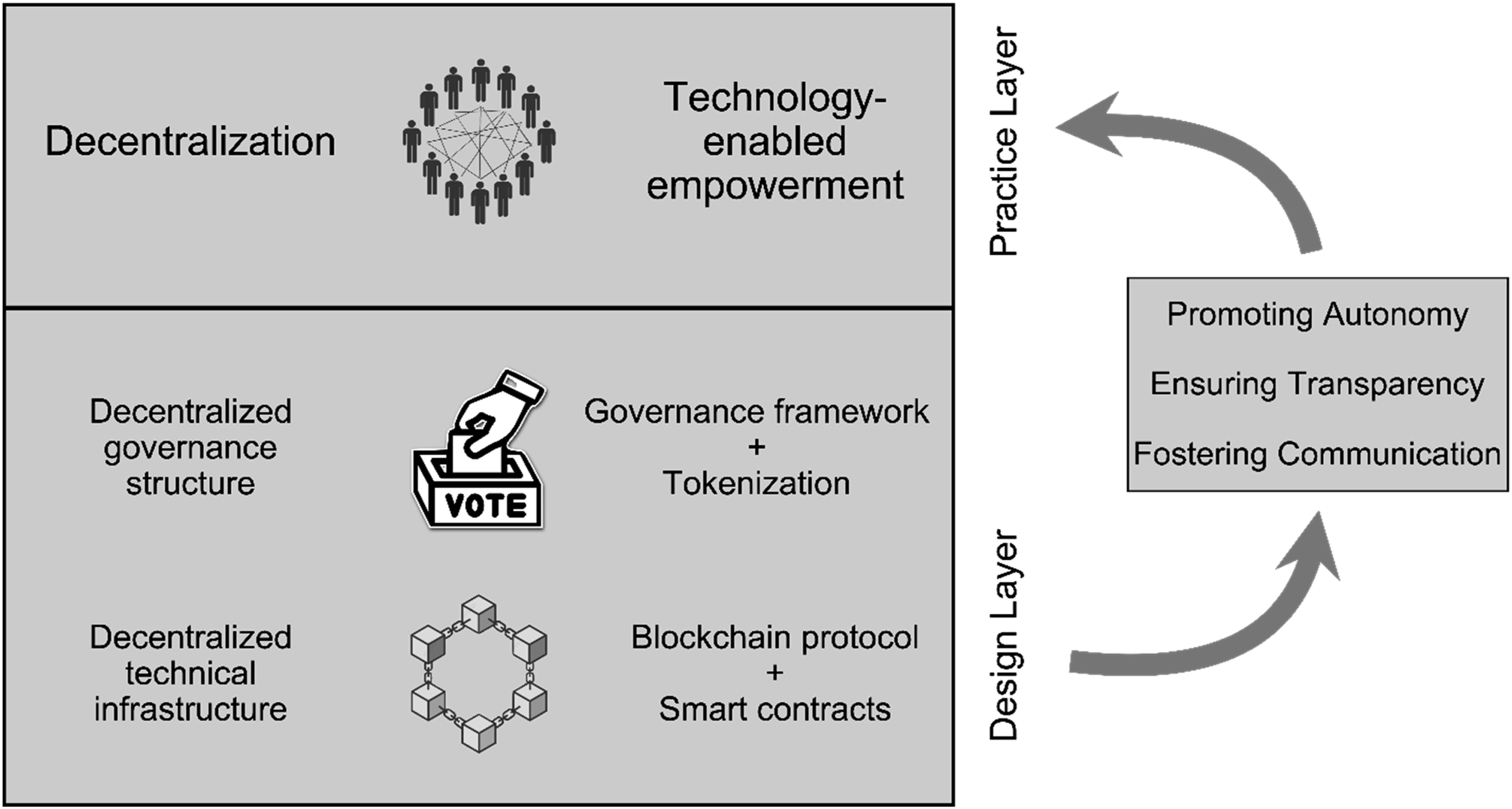
Technology-enabled empowerment in DAOs is achieved by leveraging their decentralized design, incorporating both the governance structure and the technical infrastructure. For example, DAOs leverage their technical infrastructure (smart contracts) and governance structure (tokenization) to enable autonomous decision making. Similarly, DAOs are transparent because they rely on the decentralized infrastructure of public blockchains and open-source smart contracts. Moreover, empowering practices are established in DAO governance frameworks; for example, many DAOs have rules that necessitate publishing transparency reports or holding regular community meetings. These empowerment practices produce different configurations of how the governance structure and technical infrastructure of DAOs might work together to enable decentralized governance.
Methods
We applied a configurational approach to build an empirically grounded middle-range theory about the role of empowerment in enabling decentralization. Thus, we adopted a corresponding research methodology—fuzzy-set qualitative comparative analysis (fsQCA). In fsQCA, a configurational approach is used to investigate causal links between a set of conditions and an outcome (Ragin, 2008). Because most statements regarding social phenomena are set relations rather than correlations, fsQCA is a valuable set-theoretic method that goes beyond traditional linear relationships and is suitable for uncovering complex causality (Fiss, 2007; Misangyi et al., 2017).
We adopted configurational comparative methods due to their theoretical and empirical advantages for studying emerging phenomena such as decentralized governance (Zhang and Ramesh, 2024). A configurational approach allows for “conjunctural causation,” accounting for scenarios where the effect of one condition unfolds in combination with others, and is consistent with “equifinality,” recognizing that the same outcome might occur in response to different causes (Schneider and Wagemann, 2012). Moreover, fsQCA acknowledges “causal asymmetry,” thus demonstrating how combinations of conditions that lead to an outcome’s occurrence may not be the opposite of those that lead to its nonoccurrence (Fiss, 2011). Therefore, fsQCA allowed us to analyze what configurations of empowerment practices evoke high decentralization separately from what configurations evoke low decentralization.
Furthermore, measuring decentralization with fuzzy sets provides a more nuanced representation by blending quantitative and qualitative measurement approaches (Hsieh and Vergne, 2023). Although DAOs exhibit clear qualitative differences from centralized organizations, the degree of decentralization within DAOs can vary along a continuum (Ellinger et al., 2024; Lumineau et al., 2021). To account for this variability, we utilized fuzzy sets, which effectively capture “differences in degree” (Greckhamer et al., 2013). This approach moves beyond the traditional view that decentralization is a binary concept—the opposite of centralization—and offers a more nuanced understanding of decentralization within DAOs.
Data collection
We explored DAOs that were published on the DeepDAO.io website. This website ranks over 19,000 decentralized organizations using several key metrics, such as membership and assets under management. We established two inclusion criteria to focus the analysis: (1) the DAO must be among the top 200 organizations in terms of treasury size and (2) the DAO must utilize a token-based membership structure, which means anyone can buy governance tokens and thus hold voting power. A purposive sample of 30 DAOs was selected from organizations that met the inclusion criteria in the year 2023 (Greckhamer et al., 2013). The sample represents a variety of DAO protocols, such as finance services, marketplaces, and decentralized applications, launched between 2018 and 2021. This sample size allows for substantive within-case analysis while also providing variance to establish patterns that hold across cases. Each DAO’s website, whitepaper, GitBook documentation, governance forum, and Discord server were analyzed. Up-to-date token, treasury, membership, and voting statistics were collected from DeepDAO to assess governance performance.
Fuzzy-set design and calibration
FsQCA represents the outcome and the conditions as set membership scores, ranging from 0 to 1, that indicate the degree to which a case belongs to the set of cases that possess a particular condition or outcome (Rihoux and Ragin, 2009). Researchers must establish qualitative anchors for transforming data into set membership scores. Following best practices (Misangyi et al., 2017; Ragin, 2008; Schneider and Wagemann, 2012), we established calibration anchors using a combination of conceptual and empirical knowledge. The qualitative data were calibrated into set membership scores based on theoretical and substantive knowledge of the cases (Basurto and Speer, 2012; Misangyi et al., 2017). For quantitative data, we used the sample-based transformation to create fuzzy membership scores (Anton et al., 2022; Misangyi et al., 2017).
The fsQCA software uses a logistic function to produce continuous fuzzy scores by fitting the data between three designated anchors. We defined an anchor to classify values as low (fully out of a set), an anchor to classify values as high (fully in the set), and additionally a point of maximum ambiguity, which represents the crossover point for a case membership to become “more in” or “more out” of a given set (Mattke et al., 2022). Ideally, these anchors are theoretically informed and supported by prior literature (Ragin, 2008). However, in the absence of such knowledge, researchers often use empirical measures of central tendency and dispersion of the study’s sample distribution to establish these qualitative anchors (Anton et al., 2022; Misangyi et al., 2017; Thiem, 2010).
We established measurement calibration rules for one outcome, decentralization, and three explanatory conditions: autonomy, transparency, and communication. Appendix A provides an overview of the calibration rules, analyses of sensitivity to calibration anchors, and the data sources used. The calibrated dataset is reported in Appendix B.
Decentralization
Using data on the percentage of token holders who participated in voting and proposal creation, we developed two fuzzy sets to capture decentralization. Participation rates can only be interpreted in a qualitative manner when compared to their distribution among cases; therefore, we computed percentiles of base values to define three qualitative anchors for each set (Thiem, 2010). Since the participation data are skewed, we used the 80th percentile to represent full membership, the 20th percentile to represent full non-membership, and the median value to indicate the crossover point (Pappas and Woodside, 2021). Values between the anchors were calibrated using the fsQCA’s log-link function. Given that users’ engagement in voting and proposal creation are equally important indicators of participation, we aggregated the two fuzzy sets using the arithmetic mean-based compensatory fuzzy logic (AMBCFL) operator. AMBCFL considers both conceptual properties of membership and similarity; thus, it is the best operator for aggregating fuzzy scores of conditions with multiple attributes (Veri, 2020).
Autonomy
For each case, the calibration of autonomy reflects whether DAO members are independent of central actors (e.g., DAO teams or working groups) in enacting their collective decisions autonomously. Depending on the governance mechanism (on-chain or off-chain), proposal implementation is either automatic (using smart contracts) or members of the working groups must execute proposals. A DAO’s treasury can be controlled by a governance system (i.e., governor contracts), a group of elected members (i.e., multi-sig signers), or a mix of both. In off-chain governance, certain members like multi-sig signers gain significant power, leaving DAO governance susceptible to personal sovereignty (De Filippi et al., 2020; Sharma et al., 2024). However, on-chain governance leverages the autonomy provided by the technological infrastructure to prevent any group of people from imposing their preferences on the DAO (Reijers et al., 2021). Therefore, DAOs with off-chain governance receive a membership score of 0. In contrast, a DAO has full membership in the set of autonomy if it features automatic proposal execution using smart contracts and on-chain voting.
Transparency
The calibration of transparency reflects the number of transparency practices adopted by each DAO. Common practices include publishing reports on a blog or newspaper, maintaining online channels such as Medium or Telegram, and releasing whitepapers, which provide detailed technical information about blockchain projects (DeepDAO, nd). These practices make a DAO’s operations and management activities more accessible to its token holders. We constructed a fuzzy set with four levels (0, 0.33, 0.66, and 1) and assigned the membership level based on the number of transparency practices each DAO engaged in. Higher membership scores correspond to DAOs with more extensive use of these practices, indicating a greater commitment to openly revealing the work behind the DAO.
Communication
We measured communication using DAO activity on two widely used governance discussion platforms: Discord and Twitter (DeepDAO, nd). For Discord, we calculated the ratio of Discord followers to the number of token holders. For Twitter, we calculated the average number of tweets per year since the DAO joined Twitter. These ratios capture the extent to which communication channels are active and accessible relative to the size of the DAO’s community. For both ratios, we established three qualitative anchors based on the distribution of values in the dataset, with the 80th percentile representing full membership, the 20th percentile indicating full non-membership, and the median serving as the crossover point (Pappas and Woodside, 2021). The fsQCA log-link function was applied to calibrate values between these anchors. Since both Twitter and Discord play significant roles in fostering communication, we computed the aggregated membership score for communication using the AMBCFL operator (Veri, 2020).
Analytical procedures
FSQCA analysis derives solution terms, which represent different configurations of conditions, by looking for similarity among cases to determine the necessity and sufficiency of conditions for the outcome. The solution terms are evaluated based on measures of consistency and coverage (Misangyi et al., 2017). Consistency measures the degree to which membership in each condition or solution term is a subset of the outcome (Thiem, 2010). Coverage explains the empirical relevance of the configurations (Ragin, 2008); it measures the extent to which a solution term captures all cases that display the outcome (Russo and Confente, 2019).
Truth table.
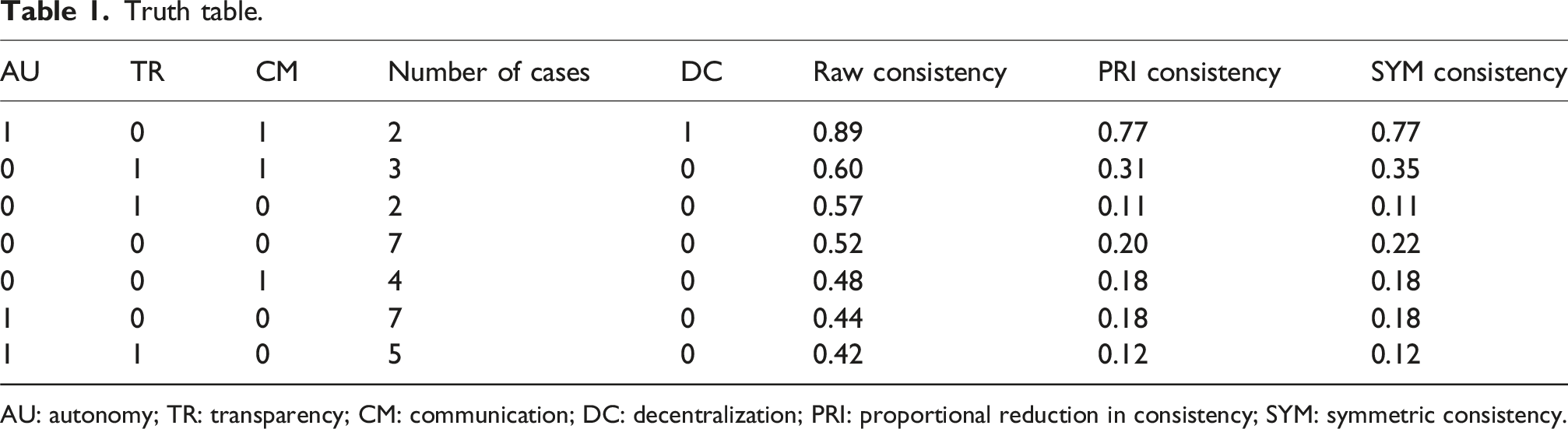
AU: autonomy; TR: transparency; CM: communication; DC: decentralization; PRI: proportional reduction in consistency; SYM: symmetric consistency.
A consistency threshold must be set to determine which configurations in the truth table prove sufficient to evoke the outcome (i.e., which configurations of the three empowerment practices always lead to high decentralization). The consistency threshold is a value that reflects a noticeable gap in the distribution of raw consistency scores and exceeds the accepted threshold (0.75) (Rihoux and Ragin, 2009), which occurs at 0.89 in our data. The truth table also reports the proportional reduction of inconsistency (PRI), which indicates the degree to which a configuration does not simultaneously constitute a sufficient configuration for the same outcome at both the high and low levels (Mattke et al., 2022). PRI consistency should be close to the raw consistency score and is recommended to be above a 0.7 value (Pappas and Woodside, 2021).
Configurations sufficient for high and low decentralization.
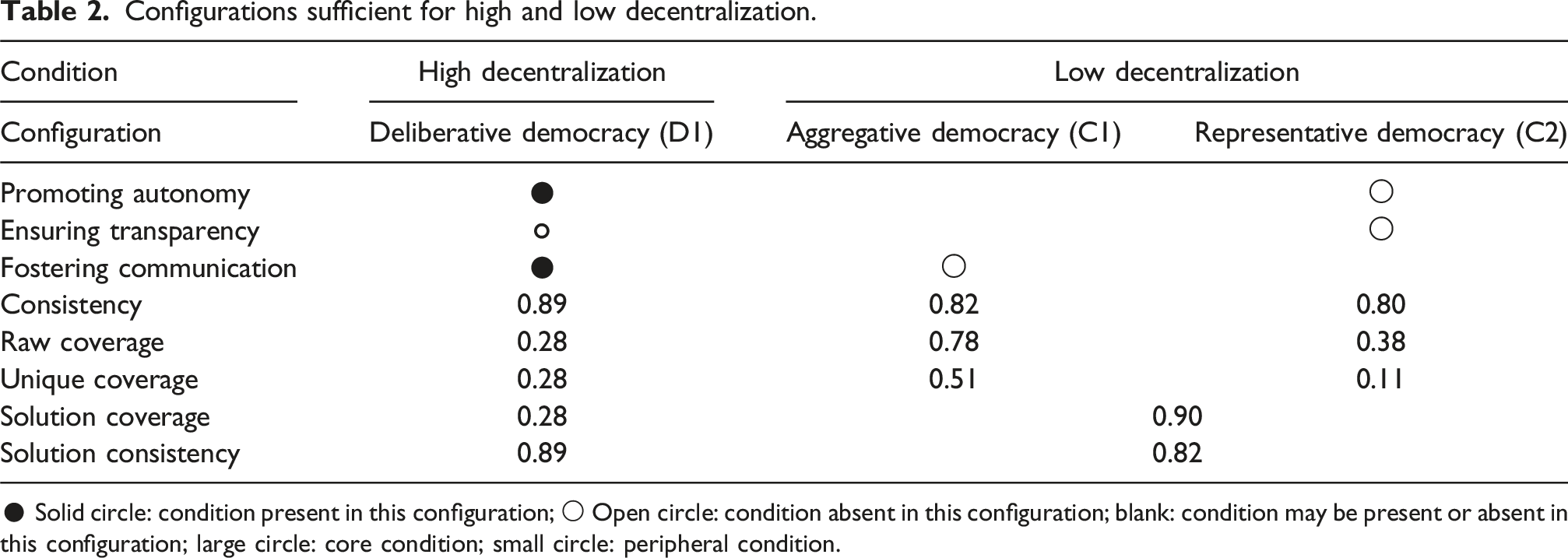
● Solid circle: condition present in this configuration;
Because fsQCA does not assume causal asymmetry, the final step of analysis includes searching for combinations of conditions that result in low decentralization (Fiss, 2011). After confirming that there were no necessary conditions, we performed the sufficiency analysis to find configurations that evoke low degrees of decentralization. We used a frequency threshold of 1 and established the consistency cutoff based on the point at which a break in the raw consistencies was observed (0.82). Table 2 indicates that two equifinal configurations (C1 and C2) lead to low decentralization.
DAO governance configurations
Configurations leading to high decentralization
In the configuration sufficient for high decentralization (D1), DAOs promote autonomy and foster communication among token holders. These DAOs, such as PoolTogether and DopeWars, employ automatic smart contract governance and on-chain voting in their decision-making processes. However, not all DAOs with on-chain governance have high degrees of decentralization. For example, consistent with previous research on Compound and Uniswap, the results show that their governance is extremely centralized, although they have similar governance practices to more decentralized communities such as ENS (Fritsch et al., 2022).
In addition to autonomy, another critical condition for decentralization is fostering communication. We refer to DAOs that feature the configuration sufficient for high decentralization as “deliberative democracies.” Deliberation is a form of communication that seeks to generate informed and rational opinions through debate and discussion (Chambers, 2003; Dryzek, 2009). Deliberation is a “talk-centric” approach to democracy (Chambers, 2003: 308) that emphasizes the importance of decision-making discussions grounded in reason. DAOs facilitate deliberative decision making through communicative social media platforms such as Discord that enable members to engage, exchange ideas, and discuss. In deliberative democracies, participants engage in discourse by offering evidence that shapes group preferences, leading to choices they can collectively accept (Lee and Romano, 2013; Wright and Fung, 2001). This deliberative design increases participation by engaging stakeholders in decision making as “co-creators of change” (Lee and Romano, 2013).
Configurations leading to low decentralization
The results indicate two equifinal configurations that result in low decentralization. The first configuration (C1) demonstrates DAOs, such as Compound, Aave, Lucidao, Radicle, Uniswap, and BitDAO, where communication among token holders is not actively fostered. These DAOs resemble “aggregative democracies” in which collective decisions are based on combining the individual preferences of participants (Wright and Fung, 2001). Due to the lack of communication, collective decisions are reached without members deliberating or discussing the content of those decisions (Dryzek, 2009). The critical distinction between aggregative and deliberative voting is that individuals in aggregative voting typically cast their votes based on their self-interest, whereas deliberative voting involves intense conversations in which participants exchange ideas and arguments that may alter their preferences and result in mutually acceptable options for collective action (Wright and Fung, 2001). Unlike deliberative models, aggregative democracies place less emphasis on the channels of communication involved in formulating opinions before casting a vote, which leads to decreased participation (Chambers, 2003).
In the second configuration (C2), DAOs do not promote autonomy or ensure transparency. C2 represents DAOs that have a multi-signature treasury management structure and use off-chain governance. These DAOs are a form of “representative democracy” in which a small number of elected members wield substantial decision-making authority. Specific members must approve proposals before formal voting, and a small group of people, to varying degrees, act as the final decision-makers who use their discretion to implement changes through the multi-sig wallet (Sharma et al., 2024). DAOs promote autonomy as a core value, which is why on-chain governance is widely regarded as the gold standard of decentralization. In contrast, off-chain governance gives elected members significant discretion, which necessitates trust in these actors (De Filippi et al., 2020). However, the lack of transparency in this configuration makes it hard for members to trust network actors, leading to decreased participation from the larger community.
Discussion
This study examines how DAOs can fulfill their potential for decentralization by empowering individuals to participate in governance. As shown, DAOs follow a variety of empowerment trajectories that produce different DAO governance archetypes. These archetypes—deliberative, aggregative, and representative democracy—align with established models of social choice in democratic theories (Chambers, 2003; Wright and Fung, 2001). The first archetype, deliberative democracy, allows for increasingly decentralized governance by inserting mechanisms that would resist centralization tendencies in the governance process. In contrast, aggregative and representative democracy archetypes allow for lower degrees of decentralization in DAO governance.
In the aggregative democracy archetype, collective decisions are made by aggregating the preferences of individual token holders. Voting is the primary mechanism of governance in these DAOs. Members vote according to personal preferences without necessarily considering the reasonableness, fairness, or broader acceptability of the decision to the community. Although voting does not disappear in the deliberative democracy archetype, it is enriched by the communicative processes that precede it, leading to choices that participants can collectively accept. In the representative democracy archetype, decision-making power is vested in core teams, developers, or specialized working groups responsible for acting in the collective interest of the community. Core teams and developers are also present in the deliberative democracy archetype, but the key difference is that the community retains greater autonomy in enacting collective decisions independently. Thus, deliberative democracy does not function as an alternative to representative democracy but rather expands on it by incorporating autonomy and member-driven discussions into the governance process.
The deliberative democracy archetype features two main conditions that reinforce decentralization. First, a high degree of autonomy is needed to sustain voluntary participation (Ellinger et al., 2024). DAOs utilizing on-chain governance promote greater autonomy by encoding the voting, consensus-building, and implementation processes directly onto the blockchain protocol. In contrast, off-chain governance requires a manual conversion of community consensus to on-chain actions, typically carried out by specific agents who gain control over the governance process. Therefore, limited autonomy is a bottleneck for achieving high decentralization (Sharma et al., 2024). In terms of explaining low decentralization, our findings demonstrate “conjunctural causation,” meaning that lack of autonomy doesn’t display an effect on its own but in combination with the lack of transparency. Thus, in the absence of autonomy, higher transparency is required to foster trust in the system and human agents maintaining it.
Second, sufficient communication among autonomous actors is required to facilitate the collective management of DAOs (Ellinger et al., 2024; Tse, 2020). Off-chain processes, such as discussions on online channels, set the stage for on-chain voting by building consensus and aligning members around proposals (Zhao et al., 2022). DAOs that encourage participants to use technology-enabled discussion platforms to express their ideas, concerns, and proposals facilitate thoughtful deliberation on how the organization should grow, allowing members to shape the direction of the organization collaboratively. These activities are essential for fostering empowerment in the deliberative democracy archetype, where off-chain and on-chain mechanisms work together to sustain decentralized governance.
Unveiling decentralization
Decentralization is often viewed as the primary advantage of blockchain applications like DAOs (Jensen et al., 2021; Lin et al., 2021). Decentralization reduces traditional agency problems by eliminating the division between capital and labor (Tse, 2020). Because token holders act as owner-managers who make decisions collectively through democratic voting, the conflicts between ownership and control are reduced (Murray et al., 2021a). Distributing decision-making authority throughout the community of token holders can also enhance resilience by avoiding single points of failure (Tse, 2020). Additionally, decentralized systems governed by smart contracts prevent opportunistic behavior by eliminating the need for ex-post adjustments, as decisions are automatically executed based on pre-set rules (Halaburda et al., 2024). However, decentralization introduces its own set of challenges, such as voter apathy, which can cause coordination issues for businesses (Tse, 2020). Smart contracts’ rigidity can also be problematic, as they lack the flexibility to adapt to changing circumstances, potentially leading to disputes or inefficiencies (Halaburda et al., 2024). Moreover, the absence of centralized managers can be a disadvantage during crises, as the inability to respond quickly exacerbates damage (Murray et al., 2021a).
Our empirical analysis reveals how DAOs navigate these competing dynamics. The findings indicate that, despite the ideals promoted by blockchain communities, DAOs are not fully decentralized in practice. In many DAOs in our sample, less than 20% of token holders participate in the governance, demonstrating that, although the decentralized infrastructure of blockchain technology can facilitate less hierarchical coordination, the internal operations of DAOs are never entirely decentralized (Ellinger et al., 2024). Instead, DAOs purposefully balance sophisticated mechanisms to maintain a certain degree of decentralization. For example, some DAOs rely on off-chain governance, which helps address smart contract inflexibility but introduces centralized decision-making dynamics. Specifically, the representative democracy archetype illustrates that DAO governance allows for the development of decision-making centers and centralized managers. The three governance archetypes identified in our analysis suggest that DAOs tend to fluctuate between higher and lower degrees of decentralization. As such, decentralization emerges not as a fixed design feature but as a fragile equilibrium that requires careful balancing to maintain (Hsieh and Vergne, 2023).
Contributions
The new organizing form in DAOs poses a fundamental challenge to our traditional scholarly understanding of organizations (Murray et al., 2021a). This research proposes that empowerment theory offers a novel lens to better understand the governance of decentralized organizations. By conceptualizing decentralization as the outcome of empowerment, we distinguish between how system governance is framed and the actual behavior of social actors within that framework. We have built an empirically grounded theory that explains how DAOs leverage their decentralized design to empower individuals, thereby fulfilling their potential for decentralization. By developing a midrange theory that bridges the theory of empowerment and descriptions of DAOs, this paper makes several contributions to the emerging literature on blockchain-enabled forms of organizing (e.g., Beck et al., 2018; Ellinger et al., 2024).
First, this study contributes to blockchain research by refining the concept of decentralization. Contrary to the common view that giving individuals decision-making power will automatically lead to decentralization, this research demonstrates the importance of conceptualizing decentralization as a potential outcome of individual decisions. We distinguish between the intended forms of decentralization embedded in DAO design and the actual degree of decentralization observed in practice. To capture this distinction, we have measured decentralization as a “fuzzy” and relational attribute (Hsieh and Vergne, 2023) that is shaped by individual participation (Bakos et al., 2021; Benkler, 2006). By using continuous fuzzy sets, our analysis captures differences in the degree of decentralization within DAOs while acknowledging that they are qualitatively different from centrally owned organizations (Chen et al., 2021; Ellinger et al., 2024; Hsieh and Vergne, 2023). This approach offers a more nuanced understanding of decentralization as a non-binary and emergent phenomenon that exists on a spectrum.
Second, our results show that decentralization can emerge from asymmetric and equifinal causal pathways, contributing to the advancement of the “neo-configurational” perspective in information systems research (Pappas and Woodside, 2021). The use of configurational logic enables richer theorizing about the complex causality underlying decentralization (Misangyi et al., 2017). Specifically, our findings reveal that multiple complementarities or substitutions among empowering practices can lead to high or low degrees of decentralization. These insights offer a middle-range theory of decentralization, outlining configurational propositions that future research can apply for theory building and testing. In doing so, this study challenges the ideological assumption in the literature that decentralization is primarily relevant in terms of its performance outcomes by advocating for research on examining the antecedents of decentralization (Alvesson and Sandberg, 2011).
Additionally, this study contributes to empowerment literature by introducing the concept of technology-enabled empowerment. Although empowerment theory has been applied to explain participation in traditional organizations, this study extends its application to decentralized organizations. We have examined empowering practices within a novel sociotechnical context, where autonomy, transparency, and communication are embedded not only in organizational policies but also in technical protocols. In such settings, empowerment is no longer mediated by roles or hierarchies but by technical mechanisms such as smart contracts. This raises important questions about how empowerment operates in pseudonymous environments and how organizational theories must evolve to reflect these dynamics. This research takes an important step toward theorizing empowerment in decentralized settings by advancing our understanding of how technology enables new forms of organizational empowerment.
Finally, this study contributes to practice by offering actionable insights for the design and management of DAOs. Our findings can help practitioners navigate key trade-offs in DAO governance, such as the balance between on-chain and off-chain voting and its implications for decentralization outcomes. Even though off-chain governance offers greater flexibility, it is not as conducive to decentralization as on-chain governance (Halaburda et al., 2024). Our findings suggest that DAOs can manage this trade-off by combining empowerment practices in complementary ways to support decentralization. For example, the governance archetypes identified in our analysis suggest that higher transparency can offset the negative impact of limited autonomy on decentralization. Thus, in cases where decision making takes place off chain, transparent processes, such as public documentation of decisions and clear rationales for moderator actions, can act as a counterbalancing mechanism for limited autonomy. These insights can guide DAO stakeholders in developing governance systems that are both flexible and more resilient to centralization tendencies.
Limitations and future research
This research is not without limitations, as it sheds light on multiple aspects of DAO governance, each deserving deeper investigation than could be achieved within the scope of a single paper. First, we used participation metrics to measure decentralization and did not account for the distribution of token ownership, which may also impact decentralized decision making. However, participation can serve as a proxy for distribution, as DAOs require a quorum, typically around 4% to 10% of the total token supply, for proposals to pass. Low participation suggests that a small group of token holders has reached the quorum, indicating concentrated token ownership. In essence, low participation suggests that a minority can exert significant influence, highlighting a concentration of power. While participation metrics effectively reflect decentralization, future studies might develop measures that incorporate both participation and token distribution to better capture the full spectrum of decentralization.
Second, while fsQCA is valuable for understanding complex causality, its results are sensitive to calibration decisions. To mitigate this, we conducted robustness checks to ensure that our findings were not sensitive to specific calibrations. Third, in measuring transparency, we focused on the presence of transparency practices such as whitepapers, Medium/Telegram channels, and blogs. This approach effectively captures variance across cases and provides a practical measure of transparency, but it does not fully reflect the depth or quality of the information provided through these channels. Future research might combine fsQCA with qualitative methods, such as interviews or archival document analysis, to provide a more comprehensive evaluation of transparency within the DAO ecosystem.
Finally, we examined voting participation by retrieving the wallet addresses of votes cast, which is a common approach used in studies on DAO governance (e.g., Barbereau et al., 2023; Kusmierz and Overko, 2022). However, cryptocurrency wallet identities are pseudonymous and not explicitly tied to real-world individuals or organizations. Despite the inherent limitations of de-anonymizing crypto wallets (Ron and Shamir, 2013), participation rates of cryptocurrency wallets remain relevant because, in DAOs, the basis of identity systems often relies on wallets. Thus, analyzing the participation rates of wallet addresses provides valuable insights into the power and influence dynamics within these systems.
Several avenues remain for future research, particularly in exploring alternative governance models that move beyond traditional token-based voting. For instance, some DAOs have implemented delegated voting systems, enabling members to assign their voting power to representatives who vote on their behalf. Others are experimenting with novel voting mechanisms, such as holographic consensus, which uses prediction markets to filter and prioritize proposals for voting (Faqir-Rhazoui et al., 2021b). Additionally, quadratic voting, which allocates voting power based on the square root of token holdings, has been adopted in some DAOs to reduce the disproportionate influence of large token holders (i.e., whales). DAO governance is still developing, and many DAOs are experimenting with new forms of governance. We suggest that future research seek to shed light on the potential consequences of these new developments and investigate whether they mitigate or exacerbate internal challenges in DAO governance, such as whale dominance and voter apathy (Ellinger et al., 2024).
Conclusions
DAOs and their decentralized governance structures and technological infrastructures have the potential to empower individuals by introducing a new way of organizing that promotes greater decentralization. DAOs can revolutionize startup financing by enabling founders to raise capital directly from communities, transform many industries from finance to media by removing intermediaries, and disrupt corporate governance by giving stakeholders direct influence over the organizations they are involved in. However, “even the most apparently decentralized systems have shown the capacity to produce economically and structurally centralized outcomes” (Schneider, 2019: 266). The history of the Internet is a demonstration of this fact (Tse, 2020). Despite its promises of freedom and autonomy, the Internet network grew increasingly centralized as a few large operators became powerful over time (De Filippi, 2019; Sunyaev et al., 2021). With blockchain technology, we have a chance to avoid a dystopian future in which a small number of giant online actors control everything (Vergne, 2020). Yet, without proper interventions, systems based on blockchain may gravitate toward centralization (De Filippi, 2019; Sunyaev et al., 2021). This study takes a step toward understanding how blockchain-based systems can fulfill their promise of decentralization and proposes “deliberative democracy” as a governance model through which the vision of empowering people with blockchains can be realized.
Footnotes

Funding
The authors received no financial support for the research, authorship, and/or publication of this article.
Correction (December 2025):
Table 2 has been updated to include a small circle for Ensuring transparency.
Declaration of conflicting interests
The authors declared no potential conflicts of interest with respect to the research, authorship, and/or publication of this article.