



Abstract
People visit virtual communities to find trusted information (i.e. verifiable, accurate and reliable information) during disasters. Virtual communities are open spaces where people interact and share information. However, virtual communities often suffer from information pollution (including too much information and false or contradictory information) which decreases peoples’ ability to find trusted information. Oddly, some virtual communities will develop useful practices for combatting information pollution during one disaster, but subsequently fail to effectively employ the same practices or adapt them in subsequent disasters. We conducted a longitudinal, exploratory cross-case study to better understand how and why this occurs. Using the lenses of organisational mindfulness/mindlessness, we find three factors: (i) organisational forgetting, (ii) blaming, and (iii) social fracturing that may cause virtual communities to act mindlessly and prevent them from containing information pollution during a disaster. Practically, virtual communities may avoid mindlessness by (i) codifying past successful practices and adapting them, (ii) monitoring the rhetoric of blame and building trust in authorities, and (iii) avoiding inconsequential debates and promoting shared values.
Introduction
Disasters are increasing in frequency (Ogie et al., 2022; Tim et al., 2017). Disasters are human mediated environmental (e.g. earthquakes, flood) or human manufactured (e.g. terrorist attack, riot, oil spill) phenomena that impede the normal functioning of society. Disasters can cause loss of life, injury or other health impacts and material damage (Davies and Davies, 2018; Kelman, 2020). Environmental phenomena are not inherently disastrous in themselves (Hartman and Squires, 2006), but the extent to which they become disasters is closely tied to human decisions, actions, and policies (Kelman, 2020; Mileti, 1999). For example, rain is an environmental phenomenon that is not always problematic. However, human decisions to build houses in a flood-prone area can cause loss of life and property.
During disasters, informational needs change significantly due to high levels of fear and uncertainty (Jurgens and Helsloot, 2018). People need to obtain trusted information (i.e. verifiable, accurate and reliable information) quickly as their lives might be in danger (Hasan et al., 2025; Son et al., 2020). They tend to seek this information from fellow disaster victims on the ground as well as from official sources. Many people (both from disaster and non-disaster-affected areas) turn to virtual communities to seek disaster-related information (Li et al., 2021; Tim et al., 2017; Yuan et al., 2021). However, most virtual communities are not designed for responding to disasters (Nan and Lu, 2014; Qu et al., 2009; Reuter and Kaufhold, 2018), instead being designed for activities such as discussing hobbies or current events.
Although virtual communities serve as a source of useful disaster information, they are not a panacea. They can amplify fear and increase uncertainty during disasters. One problem during disasters is the rise of information pollution in virtual communities (Hasan et al., 2025; Oh et al., 2013; Tanaka, 2021). Information pollution refers to an overabundance of information, including trusted and false or contradictory information (Scheufele et al., 2021a; Stieglitz et al., 2022). Virtual communities can adversely affect disaster victims in myriad ways. First, the person spreading a falsehood may not know the falsehood is false. These falsehoods can cause social problems (e.g. irrational panic buying or taking dangerous remedies) and put disaster victims at risk (Luna and Pennock, 2018; Oh et al., 2013; Silver and Matthews, 2017). For example, during Hurricane Irma in 2017, false claims arose on virtual communities that cracking windows a little at home could prevent them from breaking under wind pressure. Second, an overabundance of information (which may or may not be false) can make it difficult for people to find reliable guidance when they need it (Scheufele et al., 2021b). To counteract the problems associated with information pollution, the literature has suggested different ways to facilitate the management of virtual communities, including adapting routine practices and developing new, disaster-specific practices (Hasan et al., 2025; Qu et al., 2009).
However, the literature also documents cases where the best or past disaster management practices do not seem to apply consistently across different disasters. For instance, the disaster management literature strongly advocates for appointed leadership and clearly assigned roles (Schneider, 1992; Waugh and Streib, 2006). Nevertheless, Majchrzak et al. (2007) demonstrate that during Hurricane Katrina in 2005, many issues were resolved not through appointed leadership but through the emergence of informal, situational leaders operating outside formal hierarchies. Nan and Lu (2014) also found that, during the Sichuan earthquake in 2008, ordinary virtual community members demonstrated emergent leadership and successfully fulfilled emergent informational needs. Substantial evidence exists where best practices were either ineffective or failed to materialise altogether during disasters (Kapucu, 2006; U.S. Fire Administration, 2015). For example, Community Notes on X (formerly Twitter) is a crowdsourced fact-checking system where virtual community participants collaboratively add context to misleading posts. It helped counter vaccine misinformation during the COVID-19 pandemic with accurate, credible responses (Allen et al., 2024). However, it struggled to keep up during the 2023 Maui wildfires, where much misinformation went unaddressed or wrongly addressed (O’Sullivan, 2025).
This poses an interesting question: why do widely supported disaster management practices sometimes fail? We posit that these practices must be enacted mindfully (Vogus and Sutcliffe, 2012) during disasters. When enacted mindlessly, these practices can cause more harm rather than good, such as allowing information pollution to return to virtual communities. This further raises a deeper question: why do virtual communities (including its leadership), even with a history of effective disaster management, act mindlessly and fail to control information pollution in a different disaster? To our best knowledge, this problem is not well understood. Therefore, the purpose of this article is to answer the following research question: How and why do virtual communities that develop successful information dissemination practices to contain information pollution during one disaster struggle in a different disaster?
This paper answers this question through a longitudinal, exploratory cross-case analysis of a virtual community, the r/Houston Reddit group, under two short-lived disaster scenarios: Hurricane Harvey, 2017 and the Great Texas Freeze Out, 2021. Drawing on organisational mindfulness/mindlessness theory (Fiol and O’Connor, 2003; Vogus and Sutcliffe, 2012; Weick and Sutcliffe, 2015), we contribute to virtual community discourse on disaster response and organisational mindfulness/mindlessness by revealing three factors which prevent virtual communities from containing information pollution, even if they have a history of successful disaster containment. These factors are (i) organisational forgetting, (ii) blaming and (iii) social fracturing, which give rise to organisational mindlessness. Organisational forgetting is a temporal condition which prevents the community from recalling and applying or adapting past successful practices effectively. Blaming is a rhetorical device that disrupts the flow of trusted information when directed at authorities rather than the uncontrollable external force (i.e. the disaster itself). Finally, social fracturing emerges at the communal level, marked by a breakdown in shared values and a sense of shared fate, leading to conflict and tension. Practically, our findings suggest that virtual communities may avoid organisational mindlessness by (i) codifying past successful practices and adapting them based on the specificity of each disaster, (ii) monitoring the rhetoric of blame and building trust in authorities, and (iii) avoiding inconsequential debates and promoting shared values and a sense of common purpose early in a disaster.
The remainder of this paper proceeds as follows. The next section reviews the literature on virtual communities in disaster situations and the limits of reusing past successful practices in disaster management. We then discuss our theoretical foundations of organisational mindfulness/mindlessness. This is followed by a discussion of our research method. After the presentation of our findings, the final two sections are the discussion and conclusion.
Literature review
Virtual communities are open, self-organising, voluntary participation systems that bring a diverse group of individuals from different geographic areas together (Faraj et al., 2016; Lu and Yang, 2011). All types of virtual communities, including message boards, chat rooms and social networking sites, encourage individuals to interact and build social relationships with acquaintances or strangers (Huang et al., 2019). Virtual communities are used for various purposes including knowledge-sharing, entertainment, health, crowdsourcing, business and marketing (Faraj et al., 2011; Kim et al., 2012; Wu and Bernardi, 2021).
Virtual communities are organisations. An organisation is a social entity (i.e. formed by a group of people) that is purposive and often structured (Daft, 2001). Organisations can be structured in many ways, depending on their size and purpose. A virtual community exhibits the organisational traits of a clear purpose, established rules and regulations, and leadership structure (Kuo, 2003; Porter, 2004). For example, online forums (e.g. diabetes.co.uk) or discussion boards (e.g. Mumsnet, Student Doctor Network) have well-defined purposes, administrators, moderators, and established rules to manage and regulate community activities. While all virtual communities have rules, regulations and a leadership structure, these may not be formal. Rules can be unwritten, and roles may not be explicitly defined (Faraj et al., 2011). Leadership authority likewise can emerge organically through open interactions (Faraj et al., 2015).
Virtual communities during disasters: Shifts in information dissemination practices
Disasters are generally marked by ‘high levels of information need and low levels of information availability’ (Shklovski et al., 2010). In response to a disaster’s sudden onset, people often gather on social media or other web platforms to learn about the situation or take protective measures (Li et al., 2021; Nan and Lu, 2014; Qu et al., 2009; Tim et al., 2017). People also provide social support (either tangible aid or emotional) to disaster victims and praise each other’s efforts (LaLone et al., 2020; Li et al., 2021; Nan and Lu, 2014). These people typically come from diverse geographic locations and backgrounds, including disaster response professionals, volunteers, and concerned citizens.
People use virtual communities during disasters (e.g. hurricane, earthquake, disease outbreak, riot, terrorist attack). For example, during Hurricane Cindy in 2017 (Kim et al., 2018), the Sichuan earthquake in 2008 (Nan and Lu, 2014), the Chennai floods in 2015 (Bhuvana and Aram, 2019), the Virginia tech shooting tragedy in 2007 (Vieweg et al., 2008), and the Mumbai terrorist attack in 2008 (Oh et al., 2013), people created or appropriated virtual communities for real-time communication and to exchange disaster-related information. More recently, during the COVID-19 outbreak, people used virtual communities to stay socially connected, and to share information on symptoms, vaccines, and travel routes (Vogel et al., 2021).
Obtaining trusted information in a timely manner is critical during disasters, as people need to make fast decisions in high-stress situations (Jurgens and Helsloot, 2018). But virtual communities often suffer from information pollution, which includes widespread falsehoods (e.g. fake news, misinformation, and disinformation) and overwhelming volumes of information (Luna and Pennock, 2018; Oh et al., 2013; Rai, 2020). For instance, during Hurricane Helene in September 2024, AI-generated images like a girl in floodwaters with a puppy were disseminated deliberately on virtual communities (Ibrahim, 2024). While falsehoods are always a concern, the stakes are much higher during disasters (Mirbabaie et al., 2021). Furthermore, disseminated information often overlaps and is contradictory (Rao et al., 2017). Disaster victims can struggle to differentiate between reliable and unreliable information, which can delay disaster response and effective decision-making (Scheufele et al., 2021b; Simon et al., 2015). These problems can have serious, even life-threatening consequences, such as going to the wrong shelter or missing help.
Recent IS research suggests that to combat the issues mentioned above, virtual communities operating during disasters must function differently from normal times (Hasan et al., 2025). Information dissemination practices must shift to facilitate the provision of trusted information. Routine practices created for normalcy may fail or not be the most needed during a disaster. For example, virtual communities protect privacy during normalcy by restricting the posting of personal information. However, during disasters, members can be allowed to post personal information such as their address so they can get help. Other useful practices include pinning real-time updates, listing important emergency contacts, and assigning local moderators to oversee different tasks (Hasan et al., 2025).
Limits of using past successful practices in disaster management
Practices that work well during a disaster are usually institutionalised by formal organisations for future disasters (Argote, 2012; Korin et al., 2023; Rice and Jahn, 2020). Research generally argues using best practices within an organisation enhances its performance and guide future decision-making (Argote, 2012; Korin et al., 2023; Winter and Szulanski, 2002). However, research also suggests that achieving the initial success may not always be possible (D’Adderio, 2014; Szulanski and Winter, 2002) due to staff turnover and organisational restructuring (Rice and Jahn, 2020). This limitation also applies to the disaster management context, where standardised procedures and lessons learned from previous events are frequently used for new events. A report commissioned by the Federal Emergency Management Agency (FEMA) notes that ‘the complex, chaotic and negative effects of disasters should provide sufficient inducement to learn and translate the lessons into behavioural change, but for some profound reason, that is not the case’ (U.S. Fire Administration, 2015: p. 36).
Furthermore, there are multiple documented examples where organisations reuse routine or past disaster management practices without critically adapting them to the present situation. For instance, during Hurricane Katrina in 2005, emergency response agencies relied on outdated protocols that were inadequate for the scale of the disaster, leading to widespread suffering and loss of life (The White House, 2006). A similar issue arose during the 2010 Haiti earthquake when international aid organisations used standardised relief templates drawn from prior global disasters without considering Haiti’s unique conditions. As a result, aid arrived in waves, but many supplies, including water and shelters, did not reach those in need due to delays and poor coordination (Salam and Khan, 2020).
There are underlying reasons that restrain the successful adaptation of disaster management practices. First, disasters are not identical. An approach that worked in one disaster may be inapplicable in another. For instance, Cyclone Sidr, 2007 and Aila, 2009 in Bangladesh were very different, particularly in terms of receding water levels. During Cyclone Sidr, water levels receded quickly, while during Cyclone Aila, it took a prolonged amount of time (The New Humanitarian, 2009). As a result, the same humanitarian efforts used during Sidr could not be fully adapted for Aila. For instance, Hurricane Aila victims faced overcrowding in the makeshift shelters for prolonged periods as they could not resume life in their villages due to high water levels. As a result, the surrounding support at makeshift shelters (e.g. clean water, food, and sanitation facilities) was stretched (Yee, 2013).
Second, resource shortfalls and logistical complexities may materialise, particularly when two or more disasters occur within a very short period (Rodriguez and Mora, 2020). This was the case for the 2017 hurricanes Harvey, Irma and Maria that subsequently made landfall within a span of 1 month. As a result, disaster victims of Hurricane Maria not only received delayed support (Murphy, 2021), but the situation was exacerbated by the fact that Puerto Rico is more than 1000 miles from the mainland US, making it logistically a complex endeavour (Einbinder, 2018; Mason, 2023). FEMA was stretched thin in terms of resources and personnel, limiting its ability to effectively assist Hurricane Maria victims.
Taken together, the above discussion reveals that practices from one disaster can be uncritically applied in the next disaster, typically when it involves formal organisational structures in an offline context. However, growing evidence shows that virtual communities in an online context face similar challenges, particularly when it involves managing information pollution during disasters. In one disaster, virtual communities might develop effective practices to contain information pollution (Hasan et al., 2025), but in a subsequent event, they might fail to contain it. For example, during the early COVID-19 pandemic, the r/Coronavirus Reddit community effectively used strict moderation and verified information to limit misinformation (Dave, 2021). However, during the 2023 Monkeypox outbreak, many false claims and stigma-related misinformation remained in the same community.
To date, we do not fully understand how and why virtual communities that develop successful practices to contain information pollution during one disaster struggle to do the same in a different disaster. To answer this question, we apply the theoretical lens of organisational mindfulness/mindlessness, which we discuss next.
Theoretical foundations: Organisational mindfulness/mindlessness
Organisational mindfulness is the extent to which an organisation can assess emerging threats and capture discriminatory detail to respond in a timely manner (Vogus and Sutcliffe, 2012; Weick and Sutcliffe, 2015). In contrast, organisational mindlessness refers to a state of reduced attention and alertness (Chen et al., 2022; Dernbecher and Beck, 2017; Fiol and O’Connor, 2003). Next, we discuss the symptoms of organisational mindful/mindlessness.
Organisational mindfulness
Organisational mindfulness reflects a state where an organisation is fully alert and conscious of the present situation (Chen et al., 2022; Levinthal and Rerup, 2006). A mindful organisation has various ways to solve problems and reduce encountered threats. Research has found leveraging organisational mindfulness can ensure high quality IT innovation (Fichman, 2004; Swanson and Ramiller, 2004) and better operational performance (Madsen et al., 2006; Nwankpa and Roumani, 2014). As there have been calls for further research regarding the link between disaster management and mindfulness/mindlessness (Williams et al., 2017), our paper provides one answer to this call by focusing on the disaster information management process in virtual communities.
Organisational mindfulness is a five-dimensional concept comprising: (1) Preoccupation with failure involves the organisation’s willingness to encourage the open discussion of problems, reporting errors, and developing effective ideas or ways of looking at things (Ray et al., 2011; Weick and Sutcliffe, 2015). Preoccupation with failure also refers to deliberate and active attention to notice and deal with potential threats (Vendelø and Rerup, 2020; Vogus and Sutcliffe, 2012). A mindful organisation believes the current system is flawed and unexpected events are preventable (Weick et al., 1999). It treats any failure (e.g. all failures and near-failures) as indicators of potentially larger problems (Butler and Gray, 2006). (2) Reluctance to simplify interpretations means an organisation resists jumping to simple conclusions (Weick and Sutcliffe, 2015). It refers to an organisation-wide awareness the unique characteristics of a problem should be considered before employing a solution (Hales and Chakravorty, 2016). A mindful organisation that demonstrates a reluctance to simplify interpretations questions how things are usually done, challenges the status quo, and appreciates scepticism (McAvoy et al., 2013). It stays focused on the present moment and discourages a ‘one size fits all’ approach (i.e. maintaining routines) to all problems. Instead, it identifies the root causes of a problem (Chen et al., 2022). (3) Sensitivity to operations refers to an organisation’s vigilant attention to the circumstances it faces and efforts to build situational awareness of an operation (Jahn, 2019; Klockner, 2017; Weick and Sutcliffe, 2015). A mindful organisation does not passively receive information. Instead, it proactively strives to understand what is happening (Klockner, 2017). When an organisation demonstrates sensitivity to operations, it adapts current behaviour to take advantage of changing circumstances. (4) A commitment to resilience refers to developing organisational capabilities to adapt and learn to respond and recover from errors and unexpected events (Klockner, 2017; Vendelø and Rerup, 2020). These capabilities form when the organisation is able to improvise solutions (i.e. create new or adjust existing solutions) to deal with them (Jahn, 2019; Weick and Sutcliffe, 2015). (5) Deference to expertise refers to an organisation’s commitment to empower those who possess relevant expertise about an issue or problem to have authority over it, regardless of hierarchical position (Jahn, 2019; Ray et al., 2011; Weick and Sutcliffe, 2015). A mindful organisation discourages excessive formal rank in an emergency because the ranking individual may not be available or have the requisite knowledge and skills (Hales and Chakravorty, 2016).
Organisational mindlessness
In contrast, organisational mindlessness occurs when an organisation demonstrates ignorance of failure and tries oversimplifying and normalising events which can lead to unreliable outcomes (Chen et al., 2022; Dernbecher and Beck, 2017; Weick et al., 1999). Organisational mindlessness restricts the ability of an organisation to react in a flexible manner (Weick et al., 1999). The three dimensions of organisational mindlessness are: (1) Entrapment in past categories: A mindless organisation uses the same routines regardless of their appropriateness to the present conditions (Levinthal and Rerup, 2006). It looks for shortcuts by overusing existing categories and becomes unwilling to change existing ways of doing things (Rerup, 2005). It often uses familiar or historical solutions that were successful in the past without taking their current effectiveness into account. (2) Automatic action: A mindless organisation acts without conscious thought because of assumed familiarity with the task being performed. Automatic actions differ from being entrapped in past categories in that these are unconscious/automatic behaviours and not taken from tradition (Chen et al., 2022; Fiol and O’Connor, 2003). A mindless organisation automatically performs the same actions in the same way without considering the present situation. It strictly follows every step of a bureaucratic process, although it may not be useful. Being in a mindless state, its awareness of the present situation is clouded, which eventually results in adopting ineffective solutions for the current situation (Dernbecher and Beck, 2017). (3) Fixated on a single perspective: A mindless organisation is often reluctant to consider other possible perspectives (Eastburn and Boland, 2015; Fiol and O’Connor, 2003; Rerup, 2005; Weick et al., 1999). It ignores negative feedback. Fixation on a single perspective occurs when an organisation enacts an action knowing that the action will worsen the situation.
We argue that when a virtual community exhibits the symptoms of organisational mindlessness, it may struggle to contain information pollution across different disasters. A mindless virtual community tends to uncritically reuse past practices and overlook the unique characteristics of each disaster (Weick and Sutcliffe, 2015). Consequently, this pushes the virtual community to fall into a ‘success trap’ – a situation that encourages the community to trust past success unquestioningly and prevents it from adapting to changing needs (Wang et al., 2015). Although organisational mindfulness is valued and widely studied in different contexts (Hales and Chakravorty, 2016; Sutcliffe et al., 2016), how and why it may break down during disasters is little understood. Particularly, what causes a virtual community that acted mindfully in one disaster to contain information pollution but then act mindlessly in the next? This research aims to answer this question and explore the factors that give rise to organisational mindlessness in virtual communities across different disasters. The insights discussed above are synthesised in the research framework shown in Figure 1. Research framework.
Methodology
We conducted a longitudinal, exploratory cross-case analysis (Miles and Huberman, 1994) of a virtual community, the r/Houston subreddit, looking at what caused this community to succeed or fail in containing information pollution and providing trusted information in two short-lived disaster scenarios. The first scenario (i.e. Hurricane Harvey in 2017) is an example of successful containment of information pollution and provision of trusted information. The second (i.e. the Great Texas Freeze Out in 2021) is an example of failure.
Since 2018, our research team has monitored the r/Houston subreddit due to its significance within a disaster-prone, high-population region. Texas is the most disaster-affected state in the United States (Inman, 2021), and Houston, located on the Gulf Coast, is particularly susceptible to hurricanes. Its flat topography and clay-based soils contribute to poor drainage and frequent flooding (Willow Waterhole Greenspace Conservancy, nd). As a result, the r/Houston virtual community is highly active and regularly transitions from a typical forum focused on hobbies, cultural sites, and everyday topics to one that facilitates disaster management.
Hurricane Harvey in 2017 and the 2021 Great Texas Freeze Out disasters were selected as critical incidents in this community based on the following selection criteria. First, we began our research with the 2017 Hurricane Harvey case and found the r/Houston community was successful in containing information pollution and provisioning trusted information. However, we also noticed the success was not deliberate. Instead, the community underwent a transition from failure to success. We consider the Harvey case a successful one for disseminating trusted information due to emerging virtual community practices, such as moderator actions (e.g. banning), that tackle misinformation and community members attaching evidence from trustworthy sources to ensure the integrity of the information being shared. User comments indicated that people found r/Houston to be a reliable space for finding disaster-related information. The findings from the Hurricane Harvey case were published elsewhere (redacted) as a success story of disseminating trusted disaster information which gave us further confidence in selecting it for our study. In that study, we suggested ways in which virtual communities, emergency authorities and system designers could learn from the successful measures taken by r/Houston virtual community. Second, the 2021 Great Texas Freeze Out was chosen serendipitously. To our surprise, when the Great Texas Freezeout occurred, this very same virtual community failed to respond effectively and could not contain information pollution. User comments indicated dissatisfaction with the inability to distinguish between trusted and false information during the Freeze Out. User comments also suggested that they felt overwhelmed by the amount of information being shared. Previous successful practices were not adequately applied to tackle these problems. There was also friction between moderators and community members. This misalignment led to people leaving the community as it could not serve their informational needs. How could a virtual community, held up as an exemplar of how to effectively respond to a disaster (citation blinded), become so ineffective in responding to a disaster just 4 years later? This situation intrigued us and motivated us to investigate further to better understand how and why they struggled to contain information pollution during the Freeze Out. We chose the Great Texas Freeze Out as comparative case as it has strong similarities to the hurricane – it was a predicted, acute disaster, and lasted for a relatively short time. These similarities allowed us to explore and better understand the key obstacles in virtual community-led effective disaster response within the same virtual community.
Research site
We chose the r/Houston subreddit (i.e. a virtual community) as our research site for four reasons. First, it was disaster-prone and had an active community. This community has encountered several disasters, thereby allowing us to compare the differences and similarities in containing information pollution and trusted information provision over time. Second, people can participate anonymously (e.g. using pseudonyms or not revealing real identity) from anywhere in the world and freely discuss various topics without fear of repercussions. It is thus possible to observe information pollution in this community. Third, the moderation team remained the same across both disasters. This is an important aspect as it would allow us to examine whether the tenure of the moderation team impacts the containment of information pollution across different disasters. Finally, Reddit data is archived and open to the public, making data collection straightforward.
Data sources
Community-generated archival data in Reddit was our main data source. Reddit is a social news aggregation and discussion platform of self-governed virtual communities. Reddit ranks in the top 10 most-visited sites in the USA and top 20 globally. Unlike other discussion platforms (e.g. Twitter), Reddit naturally divides into subreddits (i.e. self-created communities, united by a certain topic). Registered Reddit users can create threads containing a title and description box where they either attach an external link or a self-written piece of content. They can choose to create threads in a specific subreddit which becomes available to other registered users for voting and commenting. Users express their positive and negative opinions about the threads and comments by using an upvote or downvote, respectively. The comments in a thread are structured as a discussion tree where users can either reply to the thread itself or add other comments.
Reddit offers several technical features that help maintain community unity in a subreddit. Examples of technical features include mod tools, a voting system and user reporting. Mod tools offer various functionalities that help moderators handle tasks such as setting community rules and guidelines, managing community members, and taking actions like banning community members, removing content, etc. Moderators play a crucial role in resolving conflicts, removing irrelevant content and problematic members, and ensuring the community remains cohesive. Members can use the voting system to collectively curate content. They can express their positive and negative opinions about the threads and comments by using an upvote or downvote, respectively. Members can also use reporting features to identify posts or comments violating community guidelines. If content is repeatedly reported, it is usually reviewed by subreddit moderators. This reporting mechanism helps maintain order and allows moderators to address issues promptly. The use of mod tools, voting system and user reporting tools vary across subreddits. Tools provided by the Reddit platform can be customised and add-ons (e.g. moderation bots) are frequently employed. Figure 2 illustrates the schematic structure of a subreddit. Schematic structure of a subreddit.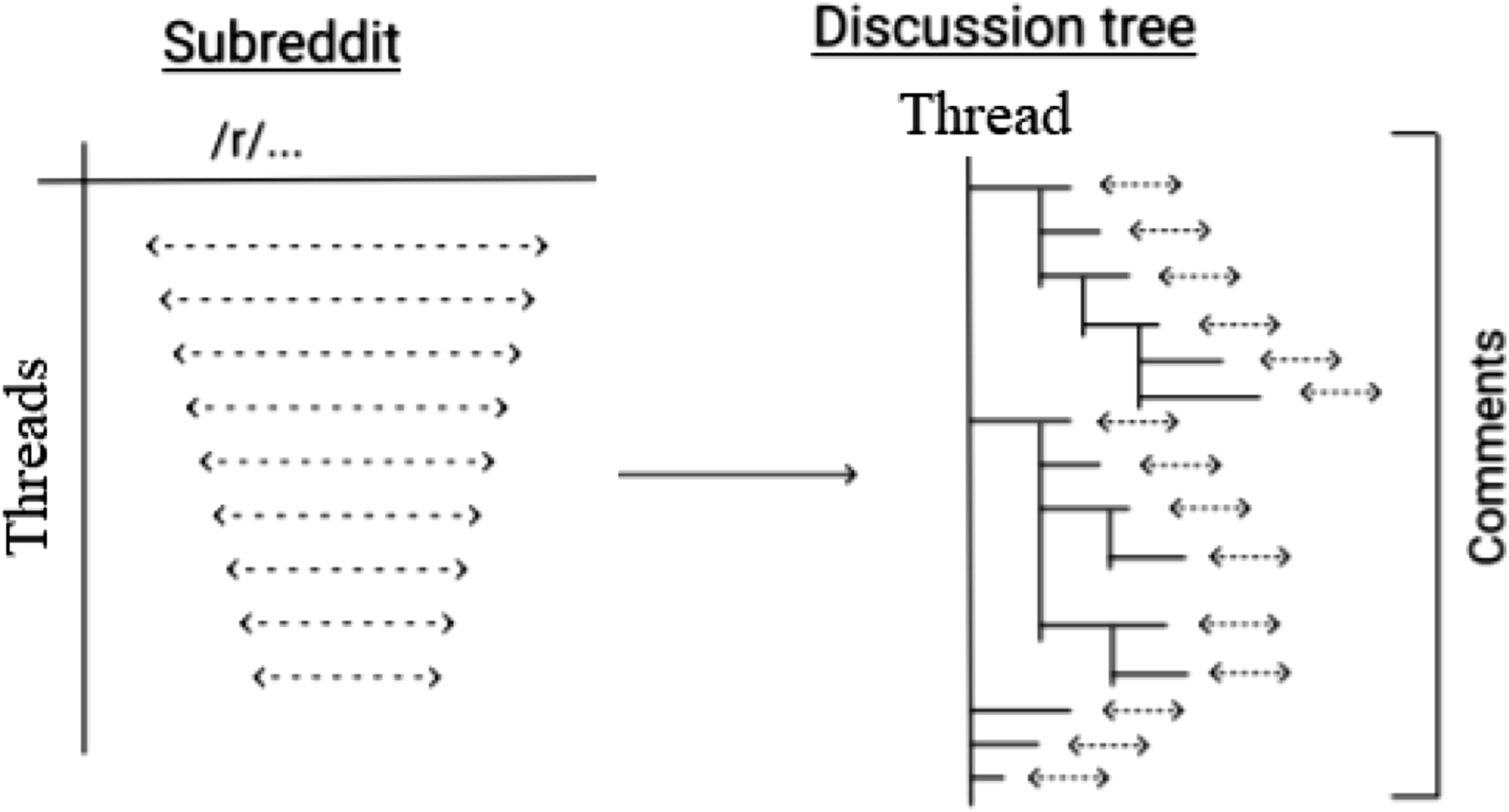
Data collection
Summary of the r/Houston subreddit data.

Data analysis
Data were collected and analysed iteratively. To analyse the data, we first performed a within-case analysis for each disaster and then searched for emergent cross-case patterns (Eisenhardt, 1989). Our analysis was guided by the logic of constant comparative analysis (Charmaz, 2000) to find initial concepts using open coding, link these concepts to higher-level categories, and then identify relationships between categories as appropriate (Sarker et al., 2012). In practice, we followed a two-phase approach combining computational and grounded methods (Hasan et al., 2025; McKenna et al., 2017). Figure 3 summarises our data analysis process. Data analysis process.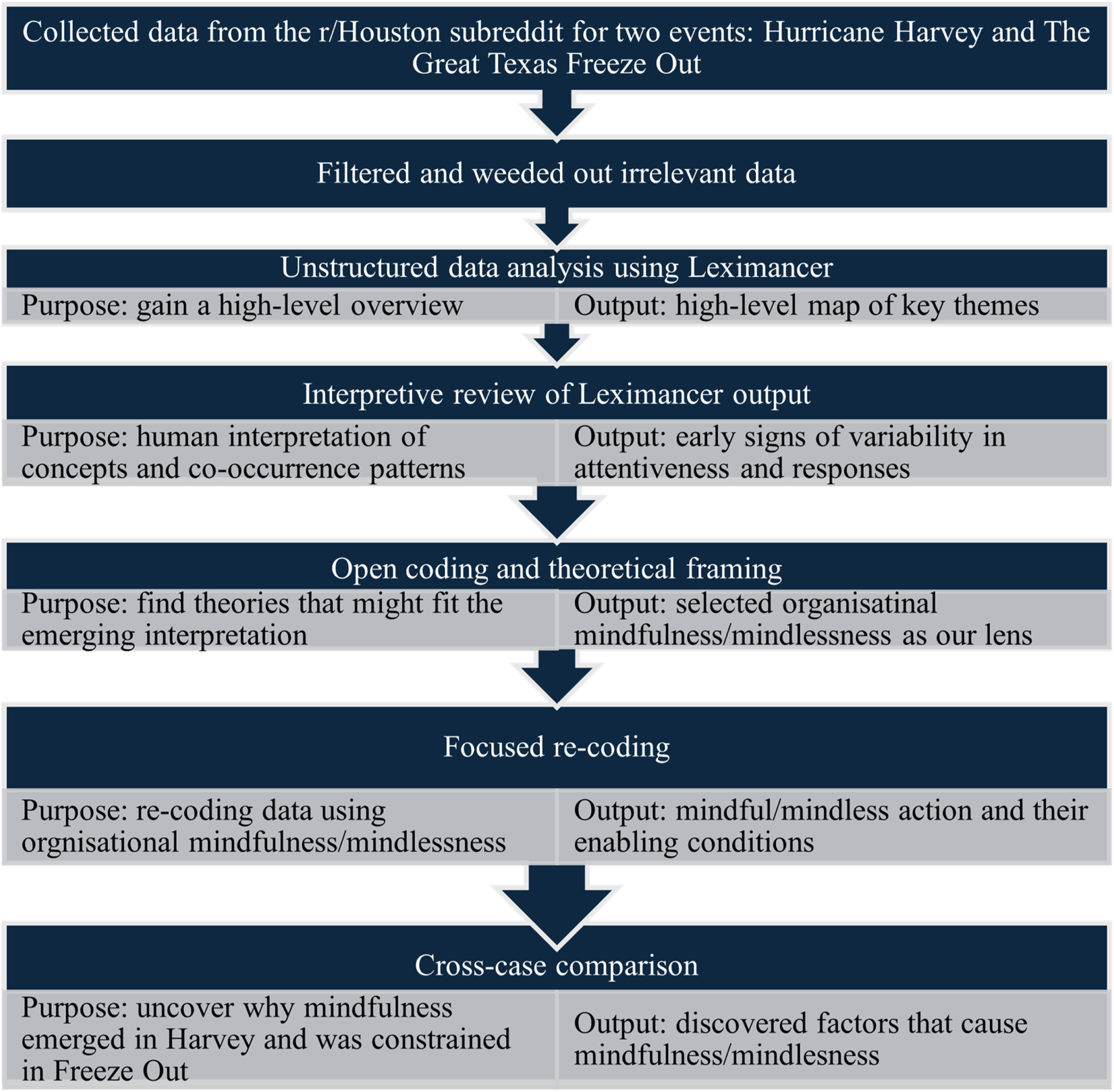
Our analysis began with exploratory, unstructured analysis using Leximancer. This text analytics software surfaced high-level themes and co-occurrence patterns (e.g. Houston, need, help, safe, faucets, water) in the dataset. We then interpreted the initial themes generated by Leximancer by reading the underlying threads and comments associated with each theme. While Leximancer did not directly identify theoretical constructs, our interpretation of the output revealed early signs of contrasting behaviours. Specifically, across several themes, a consistent storyline emerged in which community members and moderators either engaged attentively (i.e. community members proposing changes in routine practices and norms such as allowing to disclose personal information) to contain information pollution or responded in more automatic, inattentive ways (e.g. enacting routine practices, moderators ignoring feedback from community members). Subsequently, these observations guided our open coding, followed by constant comparative analysis across cases.
In the Hurricane Harvey case, we observed a clear shift from high to low information pollution as community participants and moderators increasingly demonstrated corrective behaviours. These behaviours included seeking evidence-based information, or downvoting false or misleading information. These behaviours became more common as the disaster progressed, thus reinforcing norms of correcting falsehoods. In contrast, during the Freeze Out case, the community experienced high information pollution and did not exhibit similar corrective behaviour. Misinformation, fake news and irrelevant content persisted throughout the Freeze Out case. The contrast between the two cases points to a change in collective response across the two disaster events despite similar conditions.
After establishing the above outcome patterns, we identified a correlation between the level of information pollution and themes consistent with organisational mindfulness and organisational mindlessness. We found these concepts useful for exploring the underlying mechanisms behind the observed differences. We then re-coded data based on the definitions of organisational mindfulness/mindlessness.
We confirmed our observation of organisational mindful/mindlessness based on definitions from the literature. Evidence was coded as mindful if it satisfied at least one of the five dimensions: preoccupation with failure, reluctance to simplify interpretations, sensitivity to operations, commitment to resilience, or deference to expertise. Organisational mindlessness was similarly identified if the action satisfied at least one of its three dimensions: entrapped in past categories, automatic action, or fixate on a single perspective. Although one piece of evidence could map to multiple dimensions, we focused on identifying evidence mapping to one dimension rather than finding dimensional overlap. In our coding, we also observed that during Hurricane Harvey, the r/Houston community adapted its Reddit usage practices (i.e. the appropriation of different features of the Reddit platform) to disseminate trusted information. For example, moderators used ‘highlighting’ features to make important information prominent. Hence, we also explored how different Reddit features were applied during Hurricane Harvey. Appendix A presents coding rules for organisational mindfulness/mindlessness.
After our theoretical coding, we further interrogated our data through a cross-case comparative analysis. Three common themes emerged from this interrogation: (1) organisational forgetting, (2) blaming, and (3) social fracturing, which are elaborated on in the discussion section.
Findings
Our findings explain how and why attempts to contain information pollution in virtual communities can fail across different disasters. For each case, we present (1) what the problem was, that is, information pollution, (2) how the r/Houston community tried to address and cope with the problem. Finally, we compare the two cases to illustrate why they were successful/not successful to contain information pollution and facilitate the provision of trusted information.
Case I: Hurricane Harvey
Hurricane Harvey made landfall near Corpus Christi, Texas on August 25, 2017. The Category 4 hurricane threatened millions of residents with 130 mile/h winds, heavy rains, and left people without power. Later, Harvey moved slowly inland towards Houston where it remained for 4 days and caused extreme flooding. Residents staying in the area ran low on food, safe drinking water and gas. The official emergency number, 911, was overloaded and victims turned to virtual communities to request help (Luna and Pennock, 2018). The National Hurricane Center ceased tracking Harvey’s remnants on August 31.
During the Hurricane, people from Houston and outside of Houston visited the r/Houston community. They made multiple requests for information by creating individual threads or commenting on existing threads in the r/Houston subreddit. Many others posted offers of service, and messages of assurance such as ‘stay safe’.
The problem: Information pollution
During Hurricane Harvey, the multitude of generated threads made it difficult to obtain specific useful information as such information was scattered across multiple threads. For example, a disaster victim was unable to find a disaster map that someone shared earlier. ‘I know they had a map showing where the water will be heading. Unfortunately, can't find it on here’.
Information pollution further perpetuated as a large number of threads asked for the same information, and many responded to these threads with conflicting, false or erroneous information. This made it difficult for people to make informed decisions. The following quote illustrates this problem: ‘I was looking for a list of emergency shelters. I found multiple posts [threads] mentioning different locations that are not even in Houston. Where can I find verified information?’
When people visited the r/Houston community they could not see new information (thread or comment) first. This is because the default configuration on Reddit (which r/Houston used) sorts threads based on popularity and sorts comments in a thread based on the ratio of upvotes to downvotes. ‘People vote for visibility in situations as this, that way important information goes to the top’.
The r/Houston users also sought and failed to find list information (e.g. list of emergency numbers, list of shelters, list of places seeking volunteers). They urged the moderators to compile such information in a single thread and pin it. ‘Mods, can we get a volunteer opportunities thread stickied? We really need a sticky or megathread for volunteer opportunities’.
However, the moderators ignored feedback and were not proactive in solving the information pollution problem. They argued that the constraints of the Reddit platform prevented them from organising the information in a better way. ‘Reddit only allows for two stickied [pinned] posts. Complain to the [Reddit] admins, not the moderators’.
While disaster victims continued expressing frustration, one mindful self-identified Houstonian suggested a solution: he requested moderators create a special single thread (called a megathread). The vision was the megathread would be on top of the pile of threads, so all information would be collated in a central place. Several others voiced support for the suggested solution. ‘Fun times ahead. Hopefully the mod [moderator] team can create a megathread for the tropical storm?’
Following suggestions from community members, the r/Houston moderators mindlessly created a megathread that was not fit for purpose, nor did it signal to the community that this is a centralised hub for disaster-specific information. Its title (‘Yeah, this weekend is looking wet for Texas’) failed to clearly articulate that it was a megathread. This compromised the utility of the megathread. As a result, the initial megathread was not very successful to address information pollution.
Tackling information pollution by enacting organisational mindfulness
The original requester showed a preoccupation with failure by actively noticing and highlighting the problems of the megathread. He took the initiative to create new practices, norms and rules that were relevant to the current disaster. ‘Mods [moderators], can you please create a megathread? This one [wrong titled megathread] is confusing’.
As both moderators were outside Houston during the hurricane, they demonstrated deference to expertise by appointing this person as a guest moderator. He was thus empowered to create and manage new megathreads that were fit for purpose. ‘It was always the understanding that I was going to be a guest mod [moderator]…that way, I could sticky the megathreads and delete trolling comments in those megathreads’.
Every megathread on Reddit follows particular characteristics. First, only moderators can create a megathread. Second, a megathread requires a title, a description box (to describe what the megathread is about) and an initial comment (optional).
The guest moderator showed commitment to resilience by adapting the megathread to offer up-to-date, valuable information that was readily accessible for disaster victims. New practices, norms and emerged, as megathreads were improvised for each day of the hurricane and were titled Hurricane Harvey Megathread (Day X). The common name of the megathreads made them easy to search for. The description box of every megathread contained links to the official sources. The initial comment contained the current public service announcements issued by authorities as well as other useful information such emergency numbers, a list of open shelters, volunteer opportunities and evacuation routes.
The guest moderator was sensitive to operations and used Reddit’s ‘sticky’ feature. This feature allows moderators to pin a thread or comment so that it appears at the top of a pile of threads or comments regardless of its popularity or time since posting. The guest moderator pinned the megathread for that specific day, so users knew where to look for critical information. As such, the guest moderator was vigilant regarding the current problem of information overload during Harvey and used the sticky feature to guide community members to useful disaster information. ‘I [guest moderator] edited and linked to a bunch of stuff in my comment so this megathread will be more useful. :)’
The moderation team returned to Houston on day 3 and took over creation of the megathreads. They followed the new emergent practices until the hurricane was over.
These moderators showed their commitment to resilience by changing the default configuration of comment sorting to ‘new’ so people could see recent information first. This emergent practice ensured disaster victims could find timely information to cope with the uncertain situation. Thus, the moderators showed adaptation and improvisation to make the megathread useful for acquiring timely information. ‘Not, true. In this thread [megathread], sorting is done so that people see newer stuff first. Downvotes, upvotes don't matter much in this instance’.
The moderators also demonstrated sensitivity to operations and a reluctance to simplify interpretations by proactively using available features in Reddit in an innovative way. One such feature is ‘highlighting’ information by changing the background colour of text in a post. Moderators highlighted comments in green in the megathreads that they perceived contained useful information. As a result of this emergent practice, people could quickly distinguish useful and not so useful information while reading voluminous comments in the megathread. As such, the moderators were vigilant about the current problem of information overload and evaluated the unique characteristics of the problem to devise specific solutions. ‘We have 2 spots to sticky things, that's it and there’s a lot of stuff that would be great as stickies. That's why we’re highlighting important lists green’.
The creation of megathreads did not solve all problems related to information pollution. New problems emerged. There was an overabundance of information in the r/Houston community, some accurate and some not. Since r/Houston supports open participation and anonymity (i.e. users can join from anywhere and can use pseudonyms to maintain privacy), people could easily share inaccurate and false information without fear of repercussion.
As a result, many self-identified Houstonians showed a preoccupation with failure because they noticed the spread of falsehoods and felt a moral obligation to act in favour of a safer community (i.e. community that provides trusted information). They demonstrated awareness of the negative impacts these falsehoods could have on disaster victims. For example, they spotted a person from outside Houston who posted false evacuation information and blamed Houston officials for not issuing evacuation notices. They reported this issue to moderators and requested unwanted users be removed as highlighted in the quote below. ‘If you’re not from Houston really not cool of you judging our posters [individuals from Houston] at our most vulnerable time...Mods, can you remove this moron?’
In addition, the self-identified Houstonians were reluctant to simplify interpretations by developing a consensus that moderators should introduce new ‘user flairs’ to identify people who lived in Houston (i.e. location of information seeker and provider). On Reddit, it is possible to put a mark beside a user’s identity (called a user flair) that carries information about the person. As such, they suggested an innovative solution that catered for disaster victims: people could receive relief and rescue support if they were willing to share their location. ‘Mods [moderators], can you create new flairs? We need to know who these people are!’
In response, the r/Houston moderators were sensitive to operations and listened to the self-identified Houstonians’ requests and created new flairs to indicate the location of individuals seeking or providing help. Below is an example of flair moderators created to indicate a neighbourhood (i.e. Meyerland) in Houston.

People recognised the value of flairs as they could identify who belonged to Houston. For example, a person from the energy corridor explained the rescue situation in highway 6 without mentioning the exact area name. However, others identified the area via his flair. ‘Judging by their flair, they're talking about the area by 6 and I-10’.
To combat the spread of falsehoods, the community showed commitment to resilience as self-identified Houstonians suggested all claims be backed by evidence (e.g. a picture or a video) or a link to official sources. They started utilising Reddit’s voting feature (i.e. upvote/downvote) to identify reliable information. Evidence-based claims received many ‘upvotes’, and those deemed unworthy or false were ‘downvoted’. For example, when a person claimed there was water in certain areas that were actually dry, the person received the following response: ‘If that’s true take a picture and report it. If it's not true stop spreading fake news’.
They further reinforced their commitment to resilience by actively patrolling the site and reporting fake news to the moderators. ‘Please report comments you think warrant removing. Mods [moderators] can’t be everywhere at once, especially right now’.
Moderators were sensitive to operations and learned from self-identified Houstonians to build situational awareness and guard the site from antisocial behaviours and false content. They adapted their behaviour by banning troublesome members from r/Houston. They also removed fake and irrelevant content. Moreover, the moderators actively policed non-megathreads and advised people to redirect their questions to the appropriate megathread. ‘Hey /r/houston, we’ve been cleaning out a lot of stuff from the subreddit to try to keep more important info at the front page… General questions are still best posted in the megathread discussion! It's super active and sorted by new so your stuff gets seen’.
A sense of unity in the r/Houston subreddit developed. Helpful outsiders were sensitive to operations and contributed to building situational awareness of the Hurricane. For example, a helpful meteorologist from Virginia shared real-time weather updates and shared disaster models with the r/Houston community. ‘Heads Up- Radar is showing a band E of Houston, S of Houston and W of Houston possibly converging, bring very heavy rains again to Houston proper and all points N, S, E and W’.
Community members demonstrated commitment to resilience by proactively preventing political debates from dragging the community’s efforts in the wrong direction. People strived to install a sense of unity. ‘We’re not democrats or republicans right now. We're goddamn Houstonians. And above that we are Texans. We'll all get through this together. Please don't update the Houston thread with the fight at this time’.
The r/Houston showed more commitment to resilience by focusing on and improvising ways the community could channel meaningful response efforts. Instead of blaming authorities (e.g. politicians), community members directed their blame toward nature. When the focus shifts to nature as the cause, it fosters a sense of shared fate, encouraging mutual support and collective resilience in facing the Hurricane. For example, one person said they should not blame authorities but nature for the disaster. ‘Who are they? mother nature is the one you should be blaming, not the people trying to help make the situation more bearable’.
Another person directed the blame to Mother Nature and encouraged everyone to be vigilant in not spreading fake news, reminding everyone that they are all in the same boat. ‘Mother Nature is dangerous. Do not to spread fake news, keep safe at all costs!’
Case II: Great Texas Freeze Out
From February 10-20, 2021, Texas was hit by three storms. Temperatures in Texas dropped to -2 F/-19C – the coldest on record in 72 years (Vaughan, 2021). As a result of the record low temperatures, the Texas electricity grid failed. Many power generators, especially those located in the southern and eastern areas, were not designed to withstand freezing temperatures, given those areas of Texas normally have milder climates. The record freezing temperatures simultaneously increased demand for energy and caused more than 30 power plants to fail (Fowler, 2021). The Texas power grid was deliberately designed to be isolated from the rest of the American electricity grid to avoid Federal Government oversight (Douglas et al., 2021). This meant additional power could not be brought in from neighbouring states. Water pipes across Texas also froze and burst. As a result, 4.5 million Texan homes, which were not designed to insulate against the cold, were without both power and running water (Busby et al., 2021; Douglas et al., 2021). In total, the Freeze Out caused 246 deaths and over $18 billion of damage (Scism, 2021).
During the Freeze Out, self-identified people from Houston came to the r/Houston virtual community to seek help. The tenor of the community, however, was noticeably different from that during Hurricane Harvey.
The problem: Information pollution
During the Great Texas Freeze Out, r/Houston experienced a spike in activity as self-identified Houstonians who were unfamiliar with dealing with extreme cold weather sought information on what to do: ‘I’m worried about the water pipes in my attic my water heater is also in the attic. Should running some faucets be enough to help prevent any frozen pipes or would it be best to just shut off water to the house tonight?’
However, information pollution occurred as there was a jumble of information, some reliable while much as false. In practice, although some individuals were well-intentioned, their advice was potentially harmful to people living in Houston. For example, people living outside of Houston, familiar with freezing weather, advised people living in Houston to open their taps a little to keep the water running. ‘I believe it’s most important to drip your faucets- keeping some movement in the pipes prevents bursting’.
This advice was not good for Houston. Cities used to winter freezes typically employ aboveground water tanks; the siting of tanks above ground helps maintain water pressure. In contrast, Houston’s water tanks are below ground such that if the water supply runs low (because everyone is dripping their faucets), water pressure decreases (Bugenhagen, 2025). Also, low water pressure allows underground contaminants to enter the water system, thereby polluting the drinking water supply.
Information pollution was perpetuated due to the sheer volume of information, as people shared contradictory information about whether to drip faucets. Multiple individual threads were created seeking the same information, and no constructive discussion materialised, leaving disaster victims confused as shown in the below quote: ‘Ok this is very confusing. Some people say drip. Others say don’t drip. I can’t afford my pipes to bust right now I’m not in a very good situation’.
As a result, Houston officials released several public announcements for disaster victims, warning residents of Houston not to drip faucets. ‘Please do NOT drip faucets, this will cause lower water pressure. Houston’s water system is different than other systems in that we don’t use water towers to provide pressure to the system. We use ground storage tanks and pumps. Some of this equipment is damaged by the weather’.
However, people started to criticise and debunk trusted information shared by the authorities, thus maintaining information pollution and further fostering panic and confusion in the virtual community. ‘It’s crazy that the City of Houston apparently can’t handle people dripping their faucets like every other major city. Never in my life have I heard that you should not drip faucets during a hard freeze’.
Inability to attain past success due to organisational mindlessness
A number of people, both within and outside Houston, rejected statements by Houston authorities and encouraged others to reject such statements. A section of the community was entrapped in past categories. They believed that dripping faucets was the right approach based on evidence from other contexts, without acknowledging whether it is appropriate to the current situation in Houston. ‘The mayor is a moron. Drip your faucets. Somehow, every other city, insurance company, plumber, electric company, etc. recommends dripping water but the city of Houston says it's a no go because our water system can’t handle it’.
However, other members supported the authorities and made statements in opposition to those who were advocating dripping faucets. This disagreement perpetuated conflict in the community. ‘City of Houston and other sources say that dripping doesn’t do anything with our plumbing system compared to that of up north…literally says do not drip faucets on the city’s emergency website’.
Some people from outside Houston were entrapped in past categories, thinking that the situation Houston was facing was similar to those that they experienced in their own state. As a result, some outsiders started to make fun of and insult self-identified Houstonians during the Freeze Out. ‘Midwesterners here. You Houstonians are stupid. We get this every year. Chill the [expletive word] out’.
People continued to have conflicts and disunity regarding the cause of Freeze Out. For example, one common misconception was that windmills could not function in freezing weather, and the failure of the windmills caused the Freeze Out. To counter this, people posted images taken from the National Science Foundation showing the three windmills used to generate power in Antarctica.
In response, some people said such images were photoshopped. They were reluctant to acknowledge alternative perspectives. ‘Photoshop. Wind turbines are fake news. They’re props for fake liberal narratives. They don't even generate power’.
People appeared fixated on a single perspective for political reasons. Conflating politics with natural disasters fuels divisive opinions and thus, encourages people to take a side and have biased views. On the r/Houston subreddit , people started blaming political leaders for the disaster. For example, a member quoted below mocks the Democrat former president Obama and the energy policy of the Obama administration. ‘Thanks to Obama’s ugly windmills we are out of power’.
In response, many pointed out the misdirection in blaming renewables. ‘Get your facts correct! only 4 GWs were lost from turbines and most from coal/natural gas, [expletive word] happened to those plants?’
People started blaming the governor for politicising the Freeze Out disaster and for not acting for the care and well-being of the citizens. Several authority figures made knowingly false statements about the disaster, for example, falsely blaming clean energy power systems for failing when in fact multiple kinds of power systems across Texas failed. ‘Governor Abbott and Rep. Crenshaw both immediately pulled the culture war nonsense, blaming windmills and the green new deal WHILE nuclear, coal, and natural gas generators were offline from the weather. THAT is over the top’.
As such, people lost confidence in authority figures and started to be fixated on a single perspective that information from authorities is questionable, and the authorities have hidden agendas. ‘Don’t trust these politicians, they’ve been openly hostile on twitter. Follow what the OP [original poster] said to do so’.
To minimise information pollution, the r/Houston moderators decided to create a megathread following lessons learned from past disasters (e.g. Hurricane Harvey). They created one megathread for every day of power outage. However, although the creation of the megathread was an important lesson worth replicating, the mechanisms required to manage it were inadequate.
Notably, the moderators engaged in automatic action in managing the megathread. They encouraged users to post irrelevant content such as pictures of dogs/opossums in a sweater, chili recipes and pictures of the skyline. Although during routine times these kinds of content increase community participation, these were not appropriate during the Freeze Out. ‘Some things to post: Pic of your dog in a sweater, Pic of your opossum in a sweater, Chilli Recipes, Pictures of our beautiful skyline in this gloomy weather’.
As it became obvious the Freeze Out was going to be a prolonged event, the tone of the megathreads began to become more serious. Some previous learnings from the Hurricane disaster were applied. However, the moderators were entrapped in past categories without evaluating whether these past actions during a different disaster may be relevant to the current one. Hyperlinks to official sources in the description box of the megathreads were added. A link to a power outage tracker for Houston, links to boil water notices, a link to a list of disaster resources (e.g. donations) and links to warming shelters were also included. Moderators encouraged r/Houston users to post power outage information (including location), location of warming shelters and road conditions. This simply duplicated the idea of the megathread. ‘Added helpful links up here…some things to post: If you lost power or got it back post time and zip, pictures of full grocery stores / empty shelves, any warming centers, road conditions’.
Many r/Houston users expressed their frustration towards megathreads. The moderators continued using the same solution, thus fixating on a single perspective that megathreads are the right solution to handle information pollution without considering alternative perspectives. Users now preferred creating individual threads rather than seeking information from the megathreads. ‘[Expletive word] off. This is life or death information, it doesn’t need to be buried in a [expletive word] megathread. God forbid a redundant post or two stays up in the middle of a weather emergency you piece of [expletive word]’.
Moderators had some basis for their continuation of using megathreads as they were successful during the hurricane. It became an established norm in the community that for major events they would create a megathread to keep all the information in a single place. The following quote is an example of a user supporting moderators for creating megathreads. ‘For major events the mods [moderators] will create a megathread to keep all the important links, information and discussion in one place pinned to the top of the feed. Like this one [link to a megathread]’.
However, the moderators did not draw on their previous experience in managing the megathread adequately. Unlike during Hurricane Harvey, moderators did nothing to exclude harmful outsiders. Their awareness of the needs of disaster victims was clouded, which constrained their ability to take adequate measures. Such automatic action led to diverse and conflicting statements of facts and opinions. Many community members complained about conflicting information on the megathreads. ‘I’ve read so much conflicting information here [in megathreads]; what should I do?’
People complained about the r/Houston moderators and blamed them for not taking any actions against problematic users, convincing some to leave the community. ‘This sub is full of people bitching and mods do nothing. I’m out’.
In addition, unlike during Hurricane Harvey, moderators failed to police the non-megathreads. As a result, people blamed the moderators for the ineffective management of r/Houston. ‘Hey mods: what's the point of this megathread if you are allowing all these snow pics in their own threads [individual threads]?’
Case comparison
Case comparison.
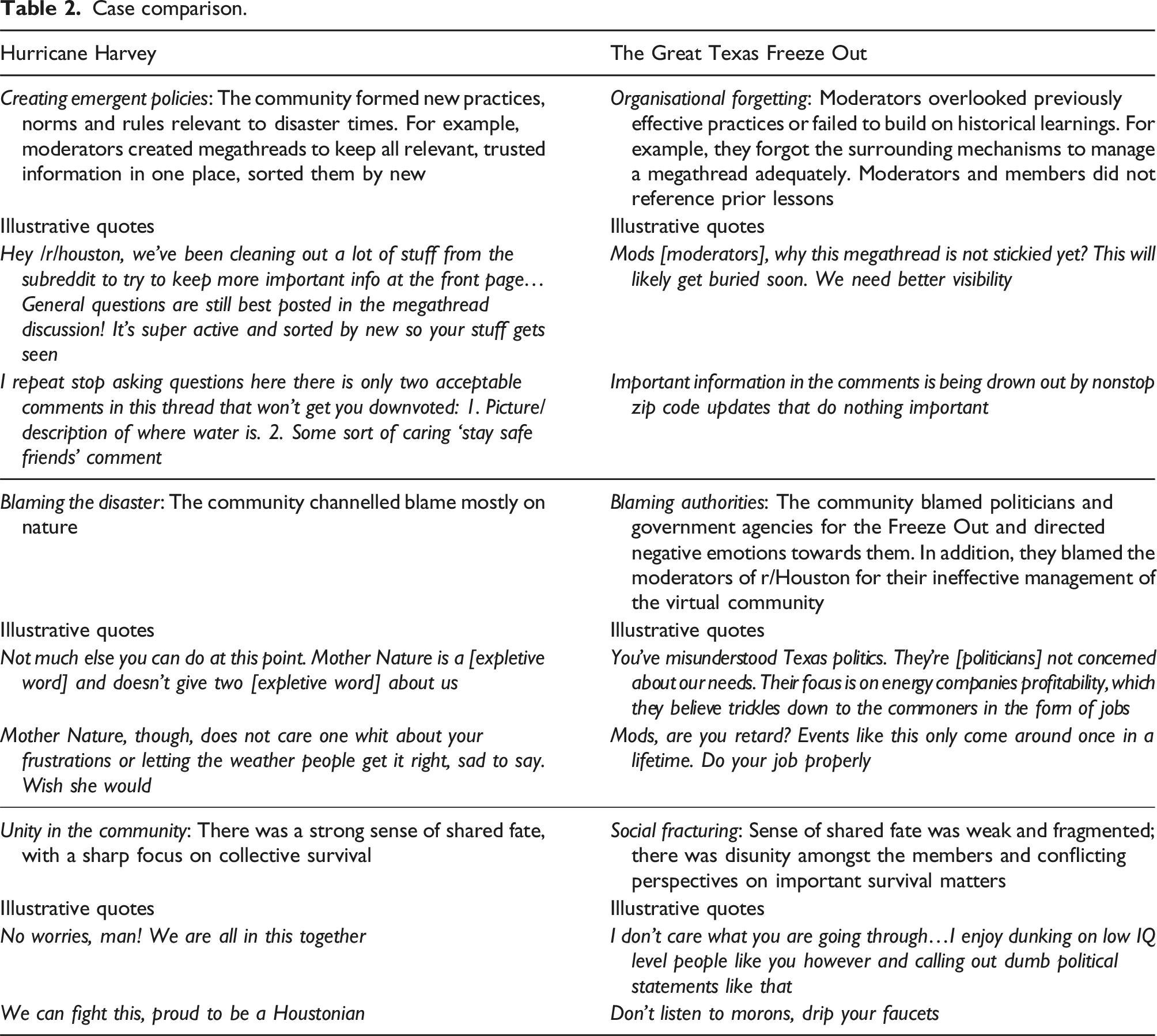
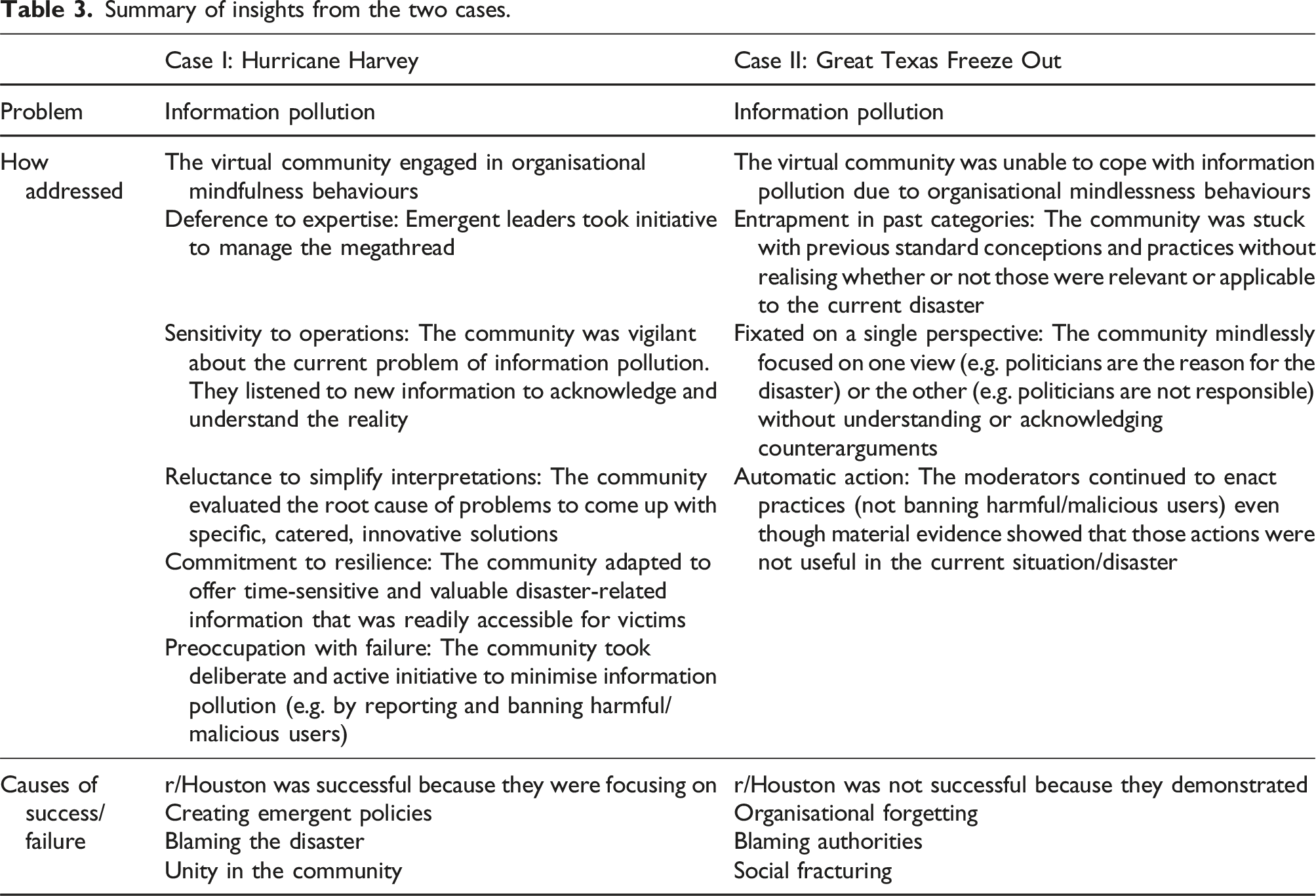
During Hurricane Harvey, the r/Houston subreddit created emergent policies by implementing new practices, norms and rules focused on the needs of the disaster victims. The virtual community reconfigured itself to adapt to the uncertain situation by formalising the megathread. However, the megathread alone was not sufficient for addressing disaster victim needs. Instead, the virtual community came up with surrounding mechanisms for the megathread to serve as a centralised hub for trusted information, such as banning or muting problematic members who spread falsehoods. In addition, there was a sense of unity in r/Houston as people supported and cared for each other’s well-being. This created a positive environment and brought out the best in people by channelling their efforts to help disaster victims. Finally, there was a rhetoric of blame towards nature, which shifted people’s motivation towards collective survival. Blaming nature brought people closer together, fostering a sense that everyone is in the same boat. Taken together, these factors encouraged organisational mindfulness as r/Houston channelled their efforts to combat information pollution. The virtual community came up with innovative solutions to address this problem.
In contrast, during the Freeze Out, r/Houston experienced social fracturing, as there were high levels of disunity, which undermined the survival efforts of disaster victims. For instance, there was conflict about the logic behind dripping faucets, based on whether to accept or deny the advice from the authorities. People focused on mocking self-identified Houstonians, rather than showing empathy and understanding. There were conflicts regarding the cause of the Freeze Out, such as whether windmills were the reason for the disaster. The rhetoric of blame was directed towards authorities (e.g. governors and politicians) as the leading cause of the disaster, which skewed the direction of conversations from survival to partisan noise. Blame was also directed towards moderators for their ineffective management of r/Houston during the Freeze Out.
Summary of insights from the two cases.
Discussion
In times of disaster, virtual communities face the problem of information pollution (Oh et al., 2013; Tanaka, 2021), comprising a jumble of trusted and false information perpetuated in the virtual community. To address and cope with this problem and facilitate the provision of trusted information, virtual communities, like other organisations, have the option to apply or adapt successful practices from the past (Argote, 2012; Korin et al., 2023). However, how and why virtual communities may fail to apply or adapt past successful practices to contain information pollution remained unanswered. Hence, this research has sought to answer the following research question: How and why do virtual communities that develop successful information dissemination practices to contain information pollution during one disaster struggle in a different disaster?
Drawing on organisational mindfulness/mindlessness theory (Vogus and Sutcliffe, 2012; Weick and Sutcliffe, 2015; Fiol and O’Connor, 2003), we developed a conceptual framework (see Figure 4) that outlines three reasons which inform this failure: (i) organisational forgetting, (ii) blaming, and (iii) social fracturing. These factors give rise to organisational mindlessness, which causes unsuccessful containment of information pollution in virtual communities during disasters. Although organisational mindfulness/mindlessness is valued and widely studied (Hales and Chakravorty, 2016; Sutcliffe et al., 2016), there is limited understanding of how and why it may break down (or emerge), particularly in under-studied contexts like virtual communities responding to disasters. Addressing this limitation, we identified the factors that can cause organisational mindlessness in virtual communities. By doing so, our study responds to calls for further research on the link between disaster management and organisational mindfulness (Williams et al., 2017) by examining how and why mindfulness breaks down during disaster response in virtual communities, even in communities with prior success. We now discuss these three factors in greater detail. Conceptual framework.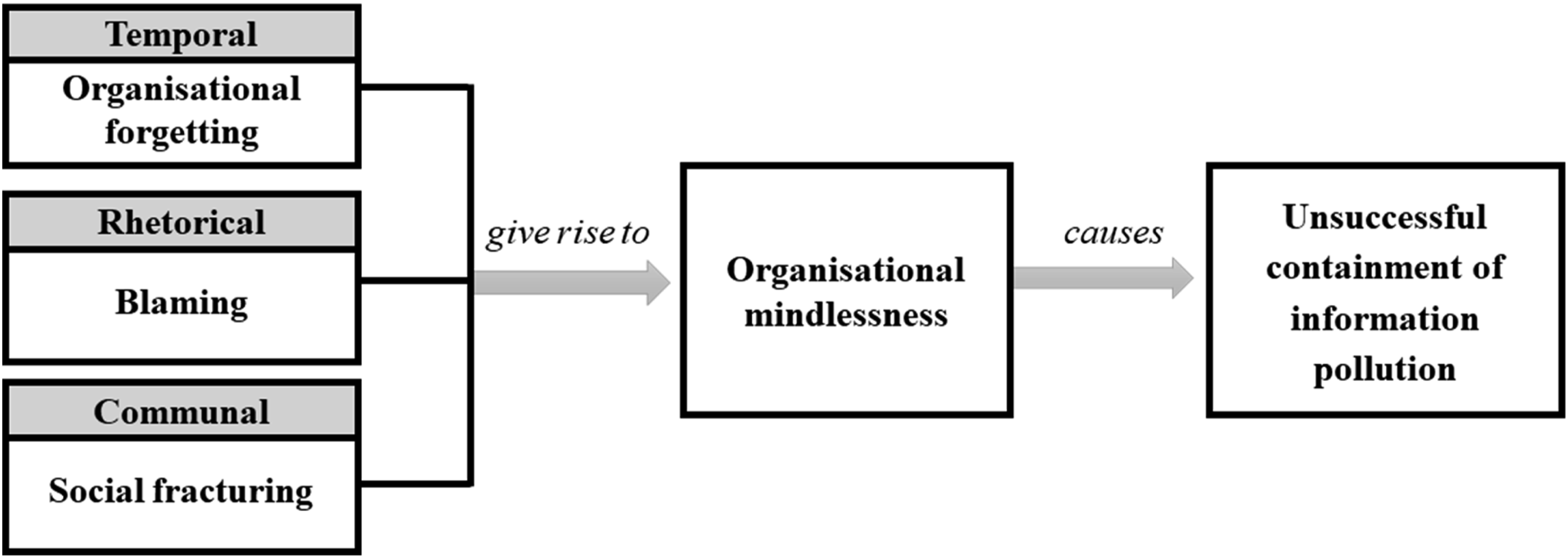
Organisational forgetting is the temporal component in our conceptual framework, defined as ‘deterioration […] and loss of the organisation’s memory due to certain routines that cease to be put into practice after a period of success’ (Carmona and Perez-Casanova, 1993: p. 31). Temporality is relevant in this study because Hurricane Harvey occurred in 2017, while the Great Texas Freeze Out took place in 2021. Prior studies have viewed organisational forgetting as both detrimental and beneficial. One stream suggests that when an organisation accidentally forgets its learning or best practices, it diminishes organisational capabilities (De Holan et al., 2004; Garcias et al., 2024). Another stream argues that organisations should intentionally forget to enable flexibility and innovation by discarding outdated routines (De Holan and Phillips, 2004; Kluge and Gronau, 2018). Our findings resonate with the first view, demonstrating how organisational forgetting can undermine mindfulness in virtual communities responding to disasters. In our case, although the r/Houston subreddit implemented new policies (e.g. norms, rules, and practices) during Hurricane Harvey and thus learnt how to manage information pollution, those practices, norms and rules were not adequately adapted during the Freeze Out. Primarily, r/Houston forgot how to manage a megathread adequately. Despite the same moderation team, those lessons were not adequately retained or adapted in the Freeze Out case. For instance, banning or muting problematic members who spread falsehoods became a regular practice during Hurricane Harvey; similarly, evidence-based information sharing was an emergent practice. However, these useful practices in managing a megathread were not effectively utilised during the Freeze Out disaster.
We theorise the temporal distance between successive disasters may influence organisational forgetting in virtual communities. When disasters occur close together, communities may successfully contain information pollution. In contrast, longer gaps (e.g. several years) increase the risk of forgetting. We further theorise that organisational forgetting occurred because the moderators did not codify the learnings from the successful disaster response, that is, during Hurricane Harvey. Codification relates to ‘codifying knowledge into electronic repositories that are made accessible to all’ people in the organisation for future use (Liu et al., 2010: p. 892). Research suggests that the codification approach is a useful way to ensure knowledge is not lost or forgotten (Hansen et al., 1999; Zack, 1999). In our case, if moderators used memory tools such as pinned summaries or standard operating procedure logs, they could prevent organisational forgetting and ensure successful practices are adapted in future disasters. However, such codification practices were absent in r/Houston, thwarting the community’s efforts to adapt previous practices in a meaningful way.
Blaming is the rhetorical component in our conceptual framework. It refers to a ‘social account used to assign cause to a negative event’ (Drummond, 2005: p. 174). A key difference in blame attribution between the two cases was the target of blame. During Hurricane Harvey, blame was put onto nature (i.e. the disaster). People attributed responsibility to an exogenous event for the cause of their suffering. Thus, the blame narrative fostered a sense of shared fate amongst the virtual community members. As such, even though blame is typically regarded as a negative social aspect inciting negativity and disruption (Keil et al., 2007; Malle et al., 2014), it was utilised positively during Hurricane Harvey. We find that if a virtual community blames an exogenous event (e.g. a hurricane), there is less emphasis on internal conflicts (e.g. blaming each other). As a result, the virtual community will develop a growing sense of belonging, empathy, and togetherness, which will encourage them to offer support and help to one another.
In contrast, during the Freeze Out, the rhetoric of blame was towards authorities (e.g. moderators, politicians and government agencies). The narrative changed from nature’s unpredictability to human culpability. People blamed the authorities for the inadequate energy policy and the use of windmills for contributing to the disaster. People also blamed the r/Houston moderators for their ineffective management of the virtual community. As such, our research shows that blaming authorities can trigger mindless behaviour, thus leading the virtual community to become ineffective in responding to the disaster.
We theorise the underlying reason why blame can have a positive or negative impact hinges on the notion of trust in authorities. During disasters, people need to be able to trust central authorities (Malesic, 2019). Lack of trust will lead to people not following the guidelines and corrective measures suggested by those authorities (Kirschenbaum et al., 2017). When blame is directed towards nature, people are more open to trusting authorities, as those authorities are seen as fellow victims trying their best to manage a crisis. Our case evidence indicates that during Hurricane Harvey, community members and moderators worked together to foster trust in the authorities, that is, the moderators of r/Houston. For instance, community members policed the megathread to signpost users who were engaging in antisocial behaviour, so that the moderators could ban them. In addition, community members suggested the norm of attaching evidence to posts, which the moderators formalised. Additionally, moderators adapted the features of the megathread to make it more beneficial for community members, for example, by changing the default configuration of comment sorting to ‘new’ so people could see recent information first. In contrast, when blame is directed towards authorities, people distrust them, do not support them, and are less likely to work together. Our evidence indicates that during the Great Texas Freeze Out, community members and moderators often clashed and disagreed about the usefulness of megathreads. They put in less effort in policing the megathread, which fuelled antisocial behaviours and the spread of misleading information.
Social fracturing is the communal aspect of our conceptual framework. It suggests ‘the erosion of established social structures, values, and norms’ (Kossowska et al., 2023: p. 2). In other words, virtual communities can experience a breakdown of solidarity and unity (Bramson et al., 2017). During Hurricane Harvey, the community experienced a strong sense of shared fate, which fostered a ‘we’ environment, often referring to themselves collectively as ‘Houstonians’. It helped channel people’s motivation towards collective survival and encouraged community members to be more inclusive, to set aside their differences, and to focus on helping one another. However, the opposite occurred during the Freeze Out. The sense of shared fate was weak and fragmented. As a result, a breakdown in unity was evident as members emphasised differences in values, political views, and responsibilities. For example, people living outside Houston were not empathetic about the gravity of the suffering that self-identified Houstonians were facing. Instead, they engaged in mockery and downplayed the severity of the problem. Additionally, there was conflict among members within Houston regarding the cause of Freeze Out and the precautionary measures to be taken during disasters (e.g. dripping faucets).
We theorise that social fracturing occurs because it diverts people’s time and energy towards issues that are inconsequential to the disaster, such as political debates. Instead of channelling people’s energy towards addressing information pollution, the focus drifts towards debates that do not focus on disseminating trusted information. For example, there was an ongoing discussion on r/Houston about whether the failure of windmills caused the Freeze Out. Although prior studies on virtual communities suggest that moderators can foster unity in virtual communities through routine practices such as setting shared goals, enforcing norms, and encouraging prosocial behaviour (Ivaturi and Chua, 2019; Petrič and Petrovčič, 2014; Seraj, 2012), in our study, moderation by the same group of people was inconsistent across events. In Hurricane Harvey, moderators reinforced a shared fate and values of collective survival by banning or muting problematic individuals and removing irrelevant and inconsequential posts. However, in the Freeze Out case, moderators allowed conflicting information in the community discussion and did not intervene to reframe competing narratives. This contributed to a breakdown in unity among the community members.
Our findings show that together these three factors – organisational forgetting, blaming and social fracturing – are the reason why organisational mindlessness occurs in virtual communities. For instance, organisational forgetting to attach evidence and ensure trusted information, as well as reporting and banning harmful individuals during disasters, is the reason why unthinking automatic action took place. These automatic behaviours, such as allowing everyone, regardless of their harmful intent, to engage in information sharing, were not only inconsiderate of the present reality, but also did not align with traditional practices learnt in previous disasters. Blaming authorities is the basis of fixation on a single perspective, as members took sides on who was to blame for the disaster. At the same time, social fracturing encouraged members to be entrapped in past categories (e.g. dripping faucets) without realising whether it is appropriate for Houston. Social fracturing is also the reason for fixation on a single perspective, as conflicts created divisions among community members and encouraged them to support one perspective without adequately analysing counterarguments. As such, organisational mindlessness led to the unsuccessful adaptation of trusted information dissemination practices. The virtual community struggled with the high volume of scattered information, making it challenging to distinguish between trusted and false information. Disaster victims were unable to locate actionable information effectively. . As a result, confusion and anxiety were evident in the virtual community and information pollution remained an unresolved problem.
Overall, although prior work has often conceptualised mindfulness as a relatively stable organisational trait, particularly within high-reliability organisations (Fraher et al., 2017; Hales and Chakravorty, 2016; Kelemen et al., 2020; Ray et al., 2011), our findings suggest that in virtual communities, mindfulness and mindlessness are not fixed traits, but emergent and reversible states. It is possible for the same virtual community to demonstrate mindfulness in one disaster (Hurricane Harvey) but act mindlessly in subsequent disasters (The Great Texas Freeze Out).
Conclusion
During a disaster, people need to obtain trusted information quickly. Nowadays, they seek this information from both official and unofficial sources, the latter often from virtual communities. However, virtual communities are open spaces where diverse individuals interact and share information (including trusted and false information) regardless of their geographic boundaries. As a result, virtual communities often suffer from information pollution, which can put people’s lives at risk during a disaster. We show how and why virtual communities fail to contain information pollution, thereby being unable to facilitate the provision of trusted information across different disasters. Our findings reveal that organisational forgetting, blaming and social fracturing are the root causes of organisational mindlessness, which prevents virtual communities from containing information pollution despite a history of effective disaster management. When communities forget past successful practices, blame authorities for failures, and do not experience a sense of shared fate and values, they are unable to disseminate trusted information across different disasters.
Our findings offer important suggestions for practice. We find that even experienced virtual communities can fail to adapt past lessons in subsequent disasters without mechanisms for retaining and recalling prior knowledge. Moderators should consider implementing codification practices (e.g. pinned summaries or standard operating procedure logs). However, what worked well in one disaster may not translate directly to others. Therefore, we encourage virtual community moderators to monitor for warning signs and continually adapt codified practices based on specific characteristics of each disaster; moderators should not be blindsided by the success of prior moderation practices. Instead, they should mindfully reflect on the usefulness of those practices to the current context and adapt.
Furthermore, we suggest that blame must be managed with care. Blame can unify or fracture a community depending on how it is framed. Moderators should actively monitor emerging narratives and, where appropriate, externalise blame toward an uncontrollable threat such as a disaster or steer blame toward shared challenges rather than scapegoating individuals or organisations for failures. Another approach to managing blame is to build trust in authorities (i.e. the virtual community moderators). Community members and moderators should collaborate to create the surrounding mechanisms required to disseminate trusted information in virtual communities. This will lead people to trust the moderators for managing the virtual community adequately. Finally, community members and moderators should collaborate to reinforce a sense of shared fate and values that promote collective survival. This can be achieved by ensuring that time and energy are not wasted on inconsequential debates (e.g. partisan politics). Rather, the focus should be on creating a positive environment that is useful for finding reliable and timely disaster information.
We acknowledge various limitations of our research. First, we have studied one virtual community only and acknowledge that each disaster is unique. Second, we have only focused on two short-lived disasters. Our findings might be inapplicable to prolonged disasters (e.g. COVID-19). Third, we identified some signs and outcomes of organisational forgetting but not the mechanisms by which knowledge is lost, ignored, or devalued over time. Future research should explore how organisational forgetting unfolds in virtual communities, including how platform design, member or moderator turnover, or changing norms and rules contribute to the erosion of memory and practices. Finally, we only explored the disaster response phase of each disaster. It is possible our findings are inapplicable to other disaster phases (e.g. mitigation, recovery). Despite these limitations, we hope our findings might be useful for both practitioners and researchers.
Footnotes
Declaration of conflicting interests
The authors declared no potential conflicts of interest with respect to the research, authorship, and/or publication of this article.
Funding
The authors received no financial support for the research, authorship, and/or publication of this article.
