



Abstract
Organizations can use data in various ways to create business value. However, many firms struggle to use data as an integral part of their information systems (IS) and business strategies to innovate their business model and increase business value. As approaches for data-based value creation are still nascent or in development, conceptual work reflecting the diversity of data-based value-creation strategies within organizational settings is scarce. Based on a sample of 75 ventures, we develop a data strategy taxonomy to manifest the key characteristics of data-based strategy-making. We use the taxonomy and conduct a cluster analysis to derive four strategic types of data-based value creation: data for efficiency, data for complements, data for niche innovations, and data for attention and market control. Based on an evaluation of 12 firms where we conducted interviews, the four strategic types of data-based value creation provide a more thorough understanding of how organizations strategically integrate data into their business and IS strategy. The “data for attention and market control” strategic type extends classic findings on IS and business strategies arising from the pervasive market power and leadership position derived from data. As a practical implication, our results guide decision-makers to plan, communicate, and seize their data strategy ambitions.
Introduction
With the increasing availability of data, firms can seize and integrate this information to create and deliver customer value (Grover et al., 2018; Hartmann et al., 2016). However, firms’ strategic focus and capacity to create data-based value can vary (Günther et al., 2017; Schryen, 2013). Established firms, such as the renowned ski manufacturer Atomic, have used data to gradually automate highly manual production tasks, supporting their business model and defending their market position amidst low-cost competition (Lassnig et al., 2017). Conversely, new entrants like Olery use data as a central resource to offer tourism businesses innovative insights into guest reputations, thereby penetrating existing markets with new business models (Hartmann et al., 2016). These examples demonstrate that firms can adopt diverse strategies to harness data-based value (Bharadwaj et al., 2013; Grover et al., 2018).
New executive roles such as “Chief Data Officer” and “Head of Data” underpin that business leaders are shifting their focus to the potential value of their data. In line with this development, companies seek data strategies (DalleMule and Davenport, 2017) as a proxy for a comprehensive view of their diverse data resources, orchestration approaches, and value targets. Building on this notion, we define an organizational data strategy as a synthesis of an organization's strategic data initiatives—competitive moves that depend on digital data resources to create and appropriate economic value (Piccoli et al., 2022). It involves carefully identifying and selecting data resources, planning orchestration mechanisms, and considering intended value targets (Schüritz et al., 2017).
Although opportunities for data initiatives are abundant (Gillon et al., 2014; Trabucchi et al., 2017), especially managers of incumbent companies face the challenge of developing coherent and effective data strategies (Baesens et al., 2016; Günther et al., 2017; Mirbagherimarvili et al., 2022). For instance, despite access to extensive operational data, the traditional car manufacturer AUDI had to align fragmented initiatives across departments, define meaningful targets, and connect data efforts to broader business goals highlighting the organizational complexity involved in turning data into strategic value (Dremel et al., 2017). Similar dynamics can be observed in many incumbent firms, where abundant data alone does not automatically translate into a clear strategic direction (Aaltonen et al., 2021).
Extant research highlights the strategic value of data by emphasizing its digital, dematerialized nature—being editable, portable, and recontextualizable—allowing for simultaneous use across multiple applications (Aaltonen et al., 2021; Alaimo et al., 2020; Günther et al., 2022). Organizations continuously reconstruct and repurpose data to develop novel value propositions, with outcomes ranging from, depending on the organizational context and use case (Grover et al., 2018; Günther et al., 2022). However, despite substantial advances in understanding data as a resource and its orchestration, the strategic integration of these practices into overarching business goals remains insufficiently theorized (Grover et al., 2018; Medeiros et al., 2020; Talaoui et al., 2023).
This fragmentation across perspectives on organizational data resources, orchestration mechanisms, and outcome realization limits the ability of extant theory to guide how data strategies can effectively support business strategies such as differentiation or cost leadership (Günther et al., 2022; Zeng and Glaister, 2018). Addressing this gap requires answering two interrelated questions: What are the key characteristics that define a data strategy, from data identification to orchestration and outcome realization? And how do these characteristics manifest in recurring strategic patterns that reflect distinct business orientations?
To address these questions, we conducted a meta-analysis of 75 firm-level cases showcasing contemporary applications of data-based value creation, complemented by 12 expert interviews to evaluate our results. Our research approach followed a two-stage design. In the first stage, we employed an iterative taxonomy development method (Nickerson et al., 2013) to identify key characteristics of organizational data, orchestration logics, and targeted value outcomes from a strategic management perspective. In the second stage, we applied cluster analysis (Punj and Stewart, 1983) to detect patterns of strategic behavior across firms, thereby uncovering empirically grounded strategic types of data-based value creation. Finally, our findings were evaluated through interviews with data executives across 12 organizations, ensuring alignment with contemporary data strategy practice and enhancing construct validity (Kundisch et al., 2021). Through 12 expert interviews with 12 firms to ensure our findings’ robustness and practical relevance.
The resulting data strategy taxonomy reflects key characteristics of organizational data, orchestration, and business value. Subsequently, we derived four strategic types that resemble recurring strategic patterns. First, data for efficiency seeks purposeful data usage to support specific parts of a core business model with valuable partnerships. Second, data for niche innovations requires high analytical expertise to utilize data for particular customer segments. Third, data for complements creates new data-based offerings and services along a range of core products while equally targeting internal improvements. Fourth, data for attention and market control forms the heart of data-based innovation and generates disruptive, analytical solutions at the forefront of data-based value creation with high market impact.
The four strategic types increase our understanding of organizational data strategy by extending the recently discussed dichotomy of “offensive” and “defensive” data strategies (DalleMule and Davenport, 2017; Medeiros et al., 2020). Our findings suggest the need for a more nuanced framework beyond this dyadic categorization. In this regard, each strategic type applies unique analytical activities to reach differentiation or cost leadership to strengthen competitiveness (Grover et al., 2018; Sirmon et al., 2007). Thereby, our findings further contribute to our understanding of strategic organizational types (Greenwood and Hinings, 1993; Miles et al., 1978; Sabherwal and Chan, 2001) within the specific context of data usage and promote further research on market interactions and relationships. Our developed taxonomy provides an integrated structure for consistently characterizing key elements of a data strategy to support managerial planning (DalleMule and Davenport, 2017; Grover et al., 2018).
Theoretical background
We first introduce extant literature on firm resources and strategic types that explain how firms orchestrate resources to gain a competitive advantage. We then examine data as a novel type of strategic resource and illustrate how it differs from traditional strategic resources. Last, we conceptualize the research gap in light of resource orchestration and strategic data types.
Resource orchestration and strategic types
Resource-based theory (RBT) has been widely used to explain differences in organizational performance (Barney, 1991; Wernerfelt, 1984). The fundamental premise of RBT is that a company can achieve and maintain a competitive advantage through its resources and capabilities (Chadwick et al., 2015). However, since companies “do not inherently know how to leverage resources” (Shollo et al., 2022: 4), the mere possession of valuable and rare resources is insufficient for effective value creation (Chadwick et al., 2015; Zeng and Glaister, 2018). Accordingly, managers must develop strategies for structuring a firm’s resources, bundling resources to build capabilities, and leveraging both to gain a competitive advantage (Sirmon et al., 2007). As all competitive advantages remain temporary, managers must find effective strategies to orchestrate resources in light of changing environments (Sirmon et al., 2011). Such management strategies, which encompass the resource orchestration of a firm’s entire breadth (Sirmon et al., 2011), cover corporate strategy (i.e., product or geographical diversification), business strategy (i.e., differentiation or cost leadership), or competitive dynamics (i.e., pioneering innovation and strategic alliances in highly competitive markets or incremental but well-considered adjustments in stable or regulated markets). Therefore, only the combination of resources, capabilities, and managerial acumen leads to effective firm performance over time (Chadwick et al., 2015; Sirmon et al., 2011).
In the literature on strategic management, strategic types emerged as salient adaptations of resources, their orchestration within firms, and the value they generate to explain organizational performance and market interactions (Greenwood and Hinings, 1993; Miles et al., 1978). As such, the concept of strategic types is associated with the central “idea of coherence between the elements of organizational arrangements” and the classification of similarities among overall organizational patterns (Greenwood and Hinings, 1993: 1054). In this regard, Miles et al. (1978) specified three strategic types and a complementary one that reflects dynamic market interactions. Each strategic organizational type has several fundamental characteristics.
First, the defender seeks organizational stability and operational efficiency to maintain a specific market segment. Based on stable resources, the defender remains within the boundaries of low product development, focusing on standard economic actions such as competitive pricing. Second, the prospector seeks change and is committed to continuously finding new products and market opportunities. Therefore, resources often cover multiple technologies and human talent that are decentrally managed to maintain flexibility even at the risk of lower profitability. Third, the analyzer takes actions falling between the defender and prospector, combining their strengths into one organization. The analyzer balances new market opportunities and a fundament of core resources, products, and customer segments to maximize profit while minimizing the risk of product innovation failure. Finally, the reactor arises as a residual “when one of the other three strategies is improperly pursued.” It lacks capable mechanisms for responding to its changing environment, leading to (nearly) permanent instability (Miles et al., 1978: 557).
Shifting these observations about strategic organizational types to the context of IS resources (such as operational support systems or decision support systems), Sabherwal and Chan (2001) analyzed various attributes of the business and IS strategies to align both concepts. Their findings suggest relationships among the different business and IS strategies of the strategic types: defenders, prospectors, and analyzers. Thus, defenders are linked to an IS strategy oriented toward efficiency, prospectors toward flexibility, and analyzers toward comprehensiveness. Their extensive analysis provides valuable insights into the correlations between strategic alignment and perceived business performance, paving the way to examine further emerging digital resources.
Data as a novel strategic resource
As IT-based innovations in organizations have generated increasing volumes of various data at high velocity (Russom, 2011), scholars have followed RBT to examine data as a strategic organizational resource to generate new forms of value creation (Grover et al., 2018; Gupta and George, 2016; Mikalef et al., 2018).
Data resources
Several studies have declared data a strategic resource for supporting and maintaining firm performance (Constantiou and Kallinikos, 2015; Hartmann et al., 2016; Lycett, 2013). For example, new entrants, such as Olery, leverage online reputations from the Internet to provide innovative analytical insights for tourism businesses. Olery collects external data beyond its business boundaries and repurposes them in a new context to create novel business value (Hartmann et al., 2016). These exemplary characteristics of data are grounded in theory. Accordingly, data are “editable, portable, and recontextualizable entities” and, therefore, different from traditional firm resources (Aaltonen et al., 2021: 404). In this regard, editable refers to the ability for data to be “updated, amended, combined, deleted, or rearranged at almost no cost.” Furthermore, data are portable across settings, platforms, and organizations and recontextualizable beyond their initial use case (Aaltonen et al., 2021: 404). As data are never really consumed, they are infinitely reusable by different users simultaneously (Alaimo et al., 2020; Günther et al., 2022).
In line with these inherent data characteristics, scholars have further examined their organizational attributes. Accordingly, several studies distinguish between internal and external data sources (Hartmann et al., 2016; Hunke et al., 2019; Zeng and Glaister, 2018), referring to different sourcing mechanisms (e.g., self-generated or open data) and business applications (e.g., customer transactions) of organizational data resources (Hartmann et al., 2016; Hashem et al., 2015; Hunke et al., 2019; Lindman et al., 2014; Otto and Aier, 2013). Further findings mainly support the technical lens on organizational data, covering tools (e.g., different databases), roles (e.g., database admins), and processes, such as those for extracting, transforming, and loading data (i.e., ETL processes), in an organizational application (Abbasi et al., 2016; Faroukhi et al., 2020; Hashem et al., 2015). Other studies highlight the induced complexity depending on the data format (i.e., structured or unstructured data) used in analytical applications (Grover et al., 2018). Overall, there is a thorough understanding of data resources’ abstract characteristics and organizational attributes.
Data orchestration mechanisms
Based on data’s inherent characteristics (editable, portable, and recontextualizable), scholars have further theorized the organizational mechanisms for effectively processing data resources. Günther et al. (2022) explore two types of resourcing actions within organizations. The first, reconstructing, involves modifying and reconfiguring data to suit a new use case. The second, repurposing, entails using data in a novel, value-adding context. Similarly, scholars refer to the abstract process of repurposing data as the contextualization of data (Zeng and Glaister, 2018). Scholars theorized that to achieve valuable data orchestration, further organizational actions can be taken. Therefore, the democratization of data helps promote the multifaceted internal and external applications of data (Hopf et al., 2023; Zeng and Glaister, 2018). In addition, experimentation emphasizes the explorative inquiry of data analysis (Grover et al., 2018; Zeng and Glaister, 2018). Finally, the execution of data-based insights considers the ability to translate them into actual valuable actions (Hopf et al., 2023; Zeng and Glaister, 2018).
Extant research has further determined organizational configurations that characterize data orchestration in practical settings. According to Günther et al. (2017), organizations pursue different work practices to leverage their data resources successfully. Accordingly, centralized analytical capabilities (e.g., abilities to integrate databases or design data analysis; cf. (Grover et al., 2018; Gupta and George, 2016; Mikalef et al., 2018)) can “help overcome issues of resource shortage and data handling” (Günther et al., 2017: 194). Conversely, decentralized capability structures connect domain and analytical expertise. Further findings cover the focus of the analytical work in the form of its explorative quality (i.e., new trends and insights vs sharp focus on business cases) or the scope of analytical adjustments to the business (e.g., metrics production, data-based improvisations, or advanced analytics) depending on organizational maturity (Aaltonen et al., 2021; Günther et al., 2017). Finally, more technical results relate to analytical methods (e.g., aggregation, distribution, or visualization) and tooling (e.g., business intelligence (BI)/analytics tools, data pipelines, or enterprise machine learning), which are used by dedicated experts in the company (Abbasi et al., 2016; Faroukhi et al., 2020; Hartmann et al., 2016). Apart from these valuable findings, it remains to be answered which elements remain relevant for formulating strategic data initiatives from a management perspective and whether strategic elements (e.g., external cooperation) are missing.
Data-based value
Given the complexity of data resources and orchestration models, theory highlights value outcomes to possess multiple (often latent) value paths at the same time (Grover et al., 2018; Günther et al., 2022; Piccoli et al., 2022). First, an organization’s data resources can yield many outcomes for both internal and external contexts. Second, data value is a matter of time; hence, data resources that initially had limited value may find new applications for valuable actions over time. Thus, as “data without action is useless,” managers are responsible for maintaining ongoing efforts to identify, orchestrate, and value their data resources for various business contexts conceivable (Zeng and Glaister, 2018: 122).
On an organizational level, Grover et al. (2018) addressed the distinction between the functional and symbolic value of data-based business value. Firms can gain functional value from the direct performance gains coming from data usage (such as cost reductions due to more efficient processes). In addition, firms can gain symbolic value through signaling effects that arise from data-based value creation (Grover et al., 2018). While many valuable studies have focused on particular aspects or industries of data-based value creation, little emphasis has been placed on theorizing the perspective of an integrated organizational data strategy—comprising data, orchestration, and resulting value—and even less on the impact of the latter on a corresponding business strategy (Grover et al., 2018; Medeiros et al., 2020).
Data and business strategy
As organizational data resources multiply “the shaping of enterprise strategy processes” (Bhimani, 2015: 3), new forms of strategy-making are required (Constantiou and Kallinikos, 2015). With a few valuable exceptions, there is little evidence of generalized data strategies companies pursue to gain a competitive advantage (Grover et al., 2018; Medeiros et al., 2020; Talaoui et al., 2023). Medeiros et al. (2020) analyze the impact of defensive (i.e., high regulatory compliance and data control) or offensive (i.e., high flexibility in data management and creating new data-based offerings) data strategies on competitive advantage. Their findings suggest that both strategies positively impact the creation of competitive advantage, as both “require a considerable investment of organizational resources” into analytical technologies and capabilities (Medeiros et al., 2020: 212). Hunke et al. (2022) abstract general strategic types for the application of analytics-based services from several startup companies. The study particularly highlights and differentiates customer value creation from data by this firm type (i.e., providing recommendations or enabling novel ways for business). DalleMule and Davenport (2017) theorize about defensive and offensive data strategies and their core activities (such as control vs flexibility of centralized/decentralized data management). Based on several firm examples, the authors suggest finding the right “balance” between offensive and defensive strategies based on a company’s competitive environment.
Depending on the amount of functional and symbolic value a firm creates through data, Grover et al. (2018) propose four strategic firm roles (see Figure 1): strategic transformer, image builder, performance enhancer, and reactive defender. Strategic roles for data-cased value creation (adapted from Grover et al., 2018).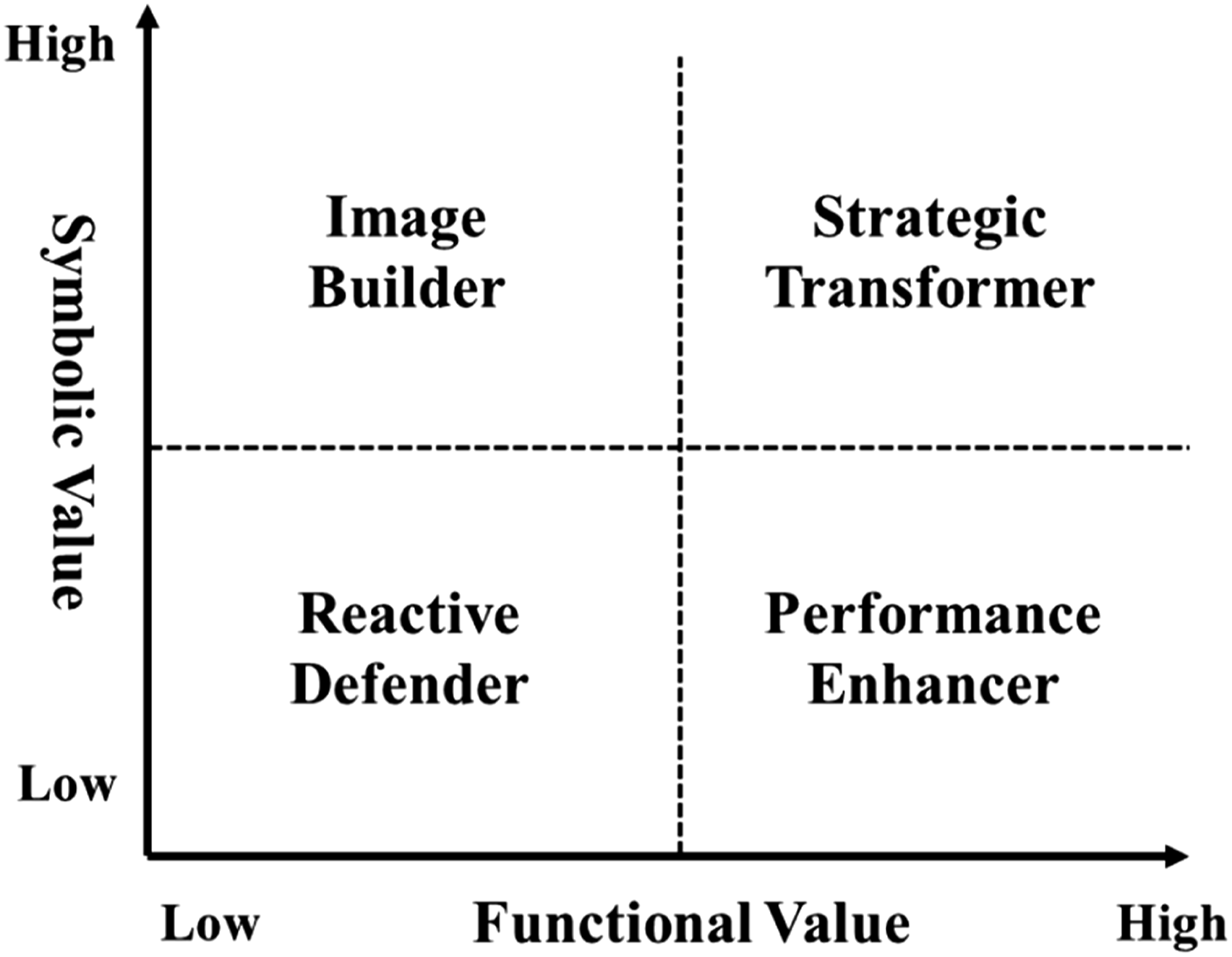
These generic roles reflect the strategic direction of data-based value for organizational performance. In the case of high functional and symbolic value, data-based value creation may act as a strategic transformer for the organization. Increased productivity and operational efficiency act as a performance enhancer and describe firms that largely anticipate high functional value. Firms that utilize high symbolic value through data-based value creation act as image builders by utilizing strong signaling effects. Finally, if both functional and symbolic value is low, an organization adopts a reactive and defensive role in an increasingly data-driven environment.
While much work has been conducted to examine key characteristics of data in organizational environments and various application domains, the strategic lens on this phenomenon has been largely neglected (Medeiros et al., 2020; Talaoui et al., 2023). More specifically, it is the relationship between viable adoptions for data-based value creation and their corresponding value targets of a business strategy for differentiation (e.g., through data-based innovation) or cost leadership (e.g., through process efficiency) that create “a persuasive vision for their firm’s use of those assets” (Chadwick et al., 2015: 362). Research needs to elaborate on this relationship to support managers in orchestrating their data resources (Mikalef et al., 2020). Furthermore, recent studies use vague terms such as “superstar firms” due to a lack of terminology for strategic types of data-based value creation (Fast et al., 2023: 202–203). Thus, theoretically grounded conceptualizations help to provide both a thorough understanding of strategic manifestations of contemporary data use within organizations and consistency in the scientific discourse.
Research design
In this study, we apply a two-stage qualitative research approach (see Figure 2). In the first stage, we develop a data strategy taxonomy
1
to reveal and structure the strategic elements of data-based value creation (Kundisch et al., 2021; Nickerson et al., 2013). This stage combines deductive (i.e., direct derivation of taxonomy characteristics from extant research contributions) and inductive (i.e., open and axial coding (Miles et al., 2013) based on empirical episodes to derive new characteristics) steps for taxonomy development. In the second stage, we use this taxonomy to derive four strategic types by employing a cluster analysis (Punj and Stewart, 1983), each type representing a strategic combination of the organizational attributes of our developed data strategy taxonomy. Finally, we evaluate our findings based on 12 expert interviews with 12 different firms. Our research approach aligns with an interpretivist paradigm because it emphasizes understanding the meanings and contexts of data-based value creation strategies, prioritizes qualitative enrichment of case studies, and relies on expert insights to validate findings, reflecting a focus on the interpretive and contextual nature of social phenomena (Sarker et al., 2018). Two-stage research approach.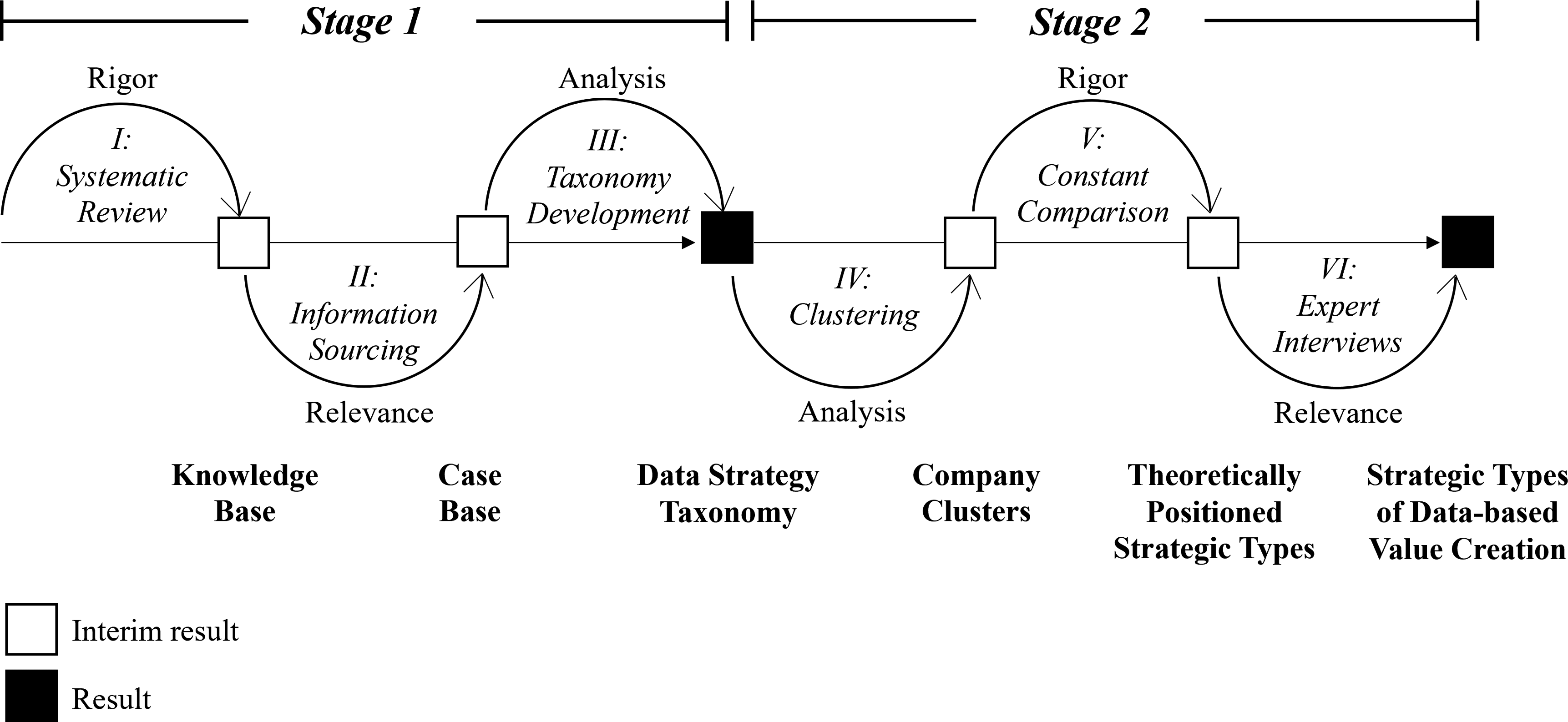
Stage 1: Taxonomy development
Systematic review
In the first conceptual stage, we created the theoretical and empirical foundation for our research approach, as illustrated in Figure 3. First, to build upon and position our findings, we targeted top IS journals to identify seminal works on data strategy and data-based value creation. Using the more general search term data ensured that our hits were not limited to cases of massive volume, variety, or velocity data occurring beneath the contemporary phenomenon of big data (Russom, 2011). We identified important theoretical contributions debating data-based value creation in organizations, such as Günther et al. (2017), or existing frameworks such as the big data information value chain introduced by Abbasi et al. (2016). We excluded publications with a predominantly technical focus, such as those centered on specific algorithms or system architectures. Utilizing the key articles identified, we conducted both backward and forward analyses to expand our understanding of the theoretical landscape (Webster and Watson, 2002). A total of 17 theoretical contributions and frameworks broadened our knowledge base, informed us during the later coding process, and guided our theoretical positioning. Overview of the systematic review.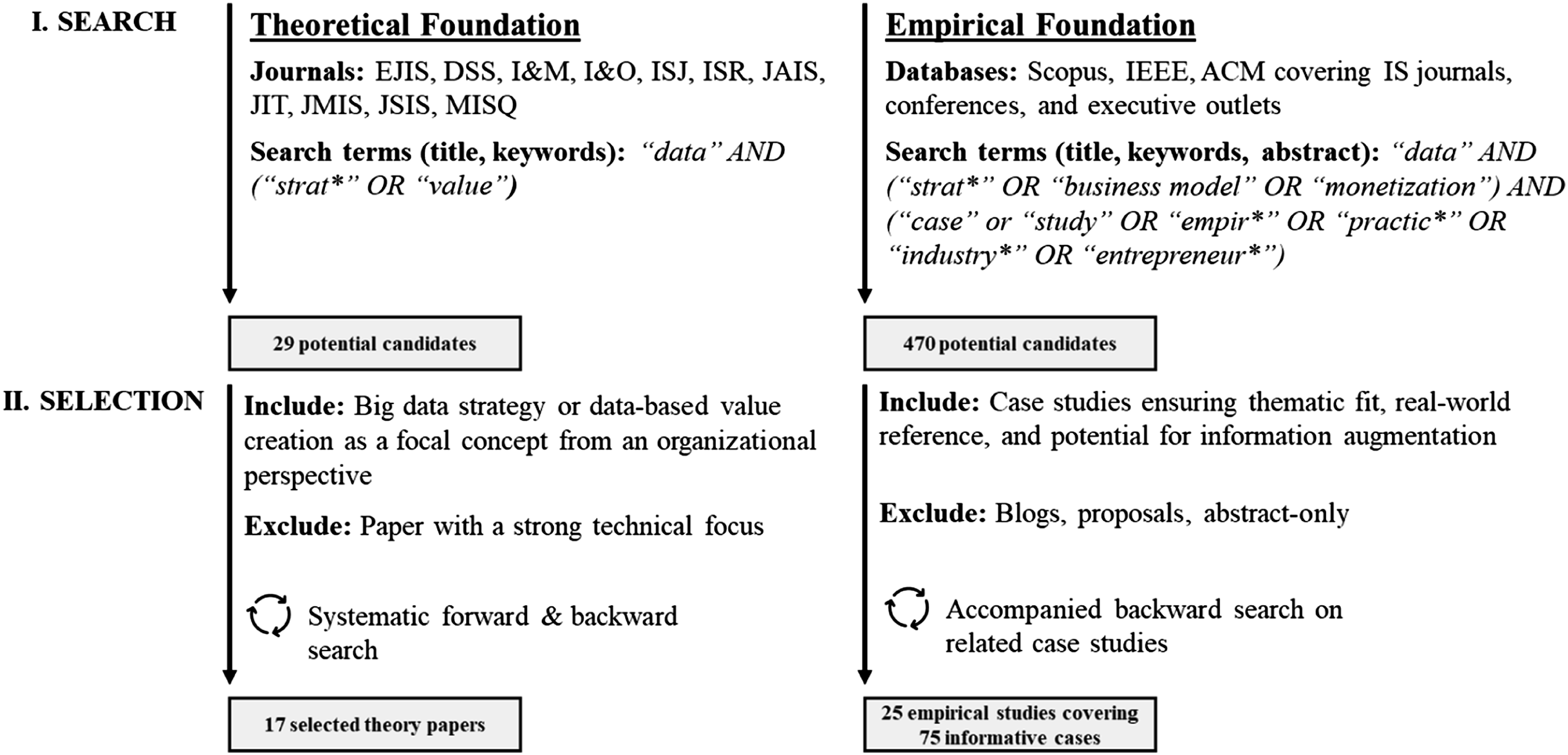
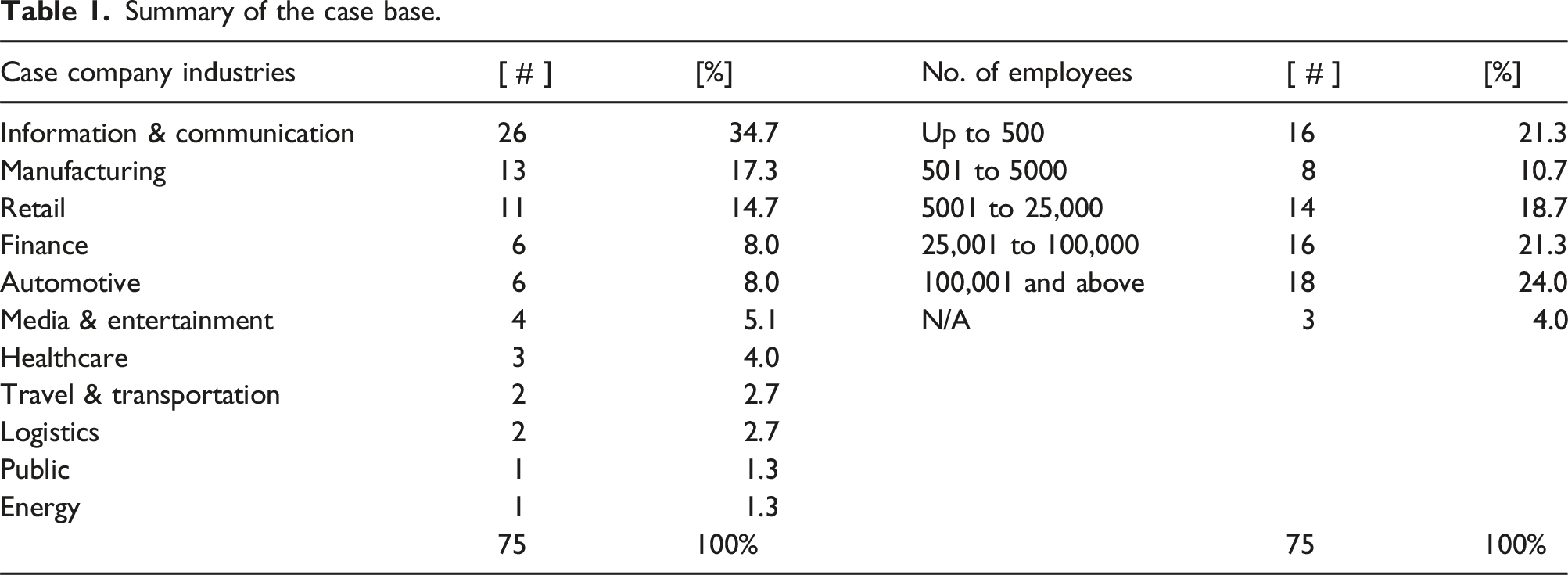
Second, to explore real-world instances of data strategy applications and data-based value creation in organizations, we broadened our search to encompass adjacent research areas and terminologies. We systematically searched databases such as Scopus, IEEE Xplore, and ACM Digital Library, which allowed us to include the latest publications from IS conferences like ICIS, ECIS, AMCIS, as well as executive journals like MIS Quarterly Executive. We obtained several studies within big data and other relevant contexts, such as data-driven business models or data monetization (Schüritz and Satzger, 2016; Sorescu, 2017; Wixom and Ross, 2017). Thereby, these studies provided insights, for example, on evolutionary approaches to implementing data-based value creation in organizational settings (Dremel et al., 2017; Najjar and Kettinger, 2013) or the specific requirements and implementations in incumbent SMEs (Lassnig et al., 2017). In this phase, we identified cases relevant subject to one or more strategic data initiatives grounded in a real business application. We assessed each case covered in an article according to the following three inclusion criteria (Larsson, 1993): thematic fit, real-world reference, and potential for information augmentation. First, the case focused on value created from data, analytics, or related subjects in an organizational context. The focus on leading IS and executive outlets ensured the strategic relevance of the presented aspects of the underlying cases. Second, the case provided shared reality information (Sarker et al., 2018) on the data resources used, the orchestration model applied, or value outcomes resulting in a real application for the organization. Third, the paper either stated the name of the case companies for additional information augmentation (Yin, 2014) or contained information sufficient for further consideration. An example would be the paper of Chen et al. (2017), which focuses on data-based business model innovation through personalized customer experiences or the handling of irregular situations at Lufthansa.
Summary of the case base.
Information sourcing
We divided our case base into information-specific categories: Category A contained 37 cases of rich information about the underlying data, orchestration, and value used for data-based value creation resulting from the main empirical study from the review process included for taxonomy development. Category B consisted of the remaining 38 cases, each providing more specific information on particular parts (data, orchestration, or value) of organizations’ data-based value creation used for taxonomy validation. We completed the case base by collecting archival data about category A cases, which helped us derive additional information from the actual environment and support data triangulation (Yin, 2014). Thus, we searched the official website for initial information concerning renamings, takeovers, terminations, and the overall integrity of cases. In addition, we collected publicly available information such as whitepapers, articles, press releases, interviews, podcasts, and blog posts published, each of which was counted as a single archival source, to augment the data. In total, we derived 54 sources for the category A cases to provide additional information on the companies’ data initiatives.
Taxonomy development cycles
We started the taxonomy development process based on the category A cases from the case base, including the additional information from archival data. Following Nickerson et al. (2013), we define a taxonomy
We agreed on eight objective (O) and five subjective (S) conditions for ending the development process (Nickerson et al., 2013): O1—all cases were examined; O2—no case was merged or split in the last iteration; O3—each characteristic is represented by at least one case; O4/O5—no new dimension or characteristic occurred or was merged or split in the last iteration; and O6/O7/O8—there is no dimension, characteristic, or cell duplication. Furthermore, the taxonomy must be concise (S1), robust (S2), comprehensive (S3), extendible (S4), and explanatory (S5).
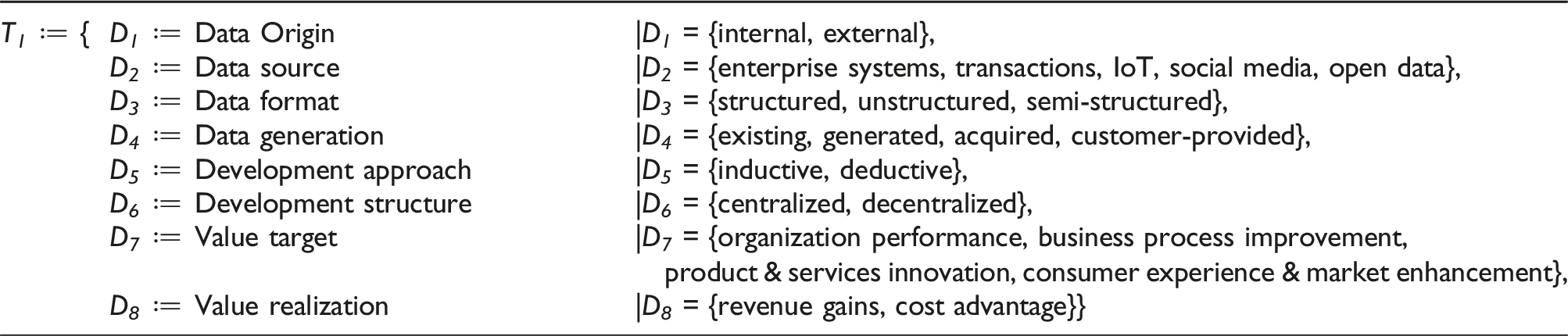
Illustration of the coding process in the case of Walmart.
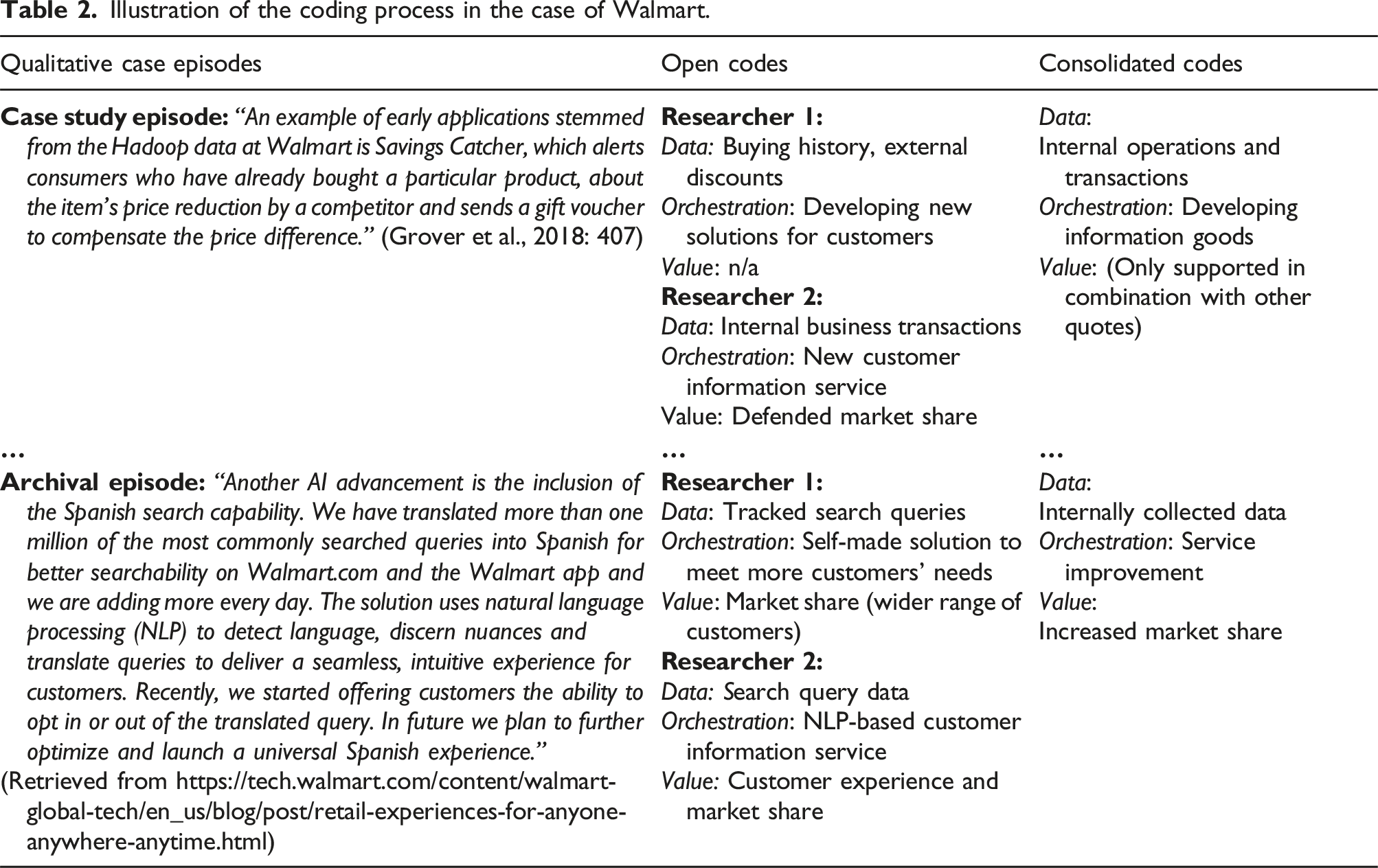
Next, for taxonomy development, we classified all codes derived from the category A cases as follows: First, the team iteratively chose the consolidated codes of each case and checked all dimensions of the current state of the taxonomy for applicability. Second, in the case of a matching dimension, all existing characteristics were assessed for suitability. Conversely, we added dimensions and characteristics with initial labels, which we further refined throughout the coding process. New dimensions and characteristics were added in consensus among the coding team to keep the taxonomy concise without losing discriminative power. In cases of differing assessments, we held team discussions to evaluate conflicting viewpoints and reached a consensus through structured argumentation and, if necessary, revisiting the underlying data. This process consisted of iterative cycles applying all category A cases for taxonomy refinement until the eight objective and five subjective conditions were met (Nickerson et al., 2013).
Finally, we used the remaining category B cases for validation. For this purpose, we applied the consolidated codes of all 38 cases to different parts of the final taxonomy depending on the information available for each case. All available (partial) information could be mapped to the existing dimensions and characteristics of the taxonomy, ensuring that all 75 cases from categories A and B were included in the subsequent clustering process. From all taxonomy development cycles, we kept representative case examples to confirm and illustrate all resulting characteristics of the taxonomy.
Stage 2: Development of strategic types
Clustering
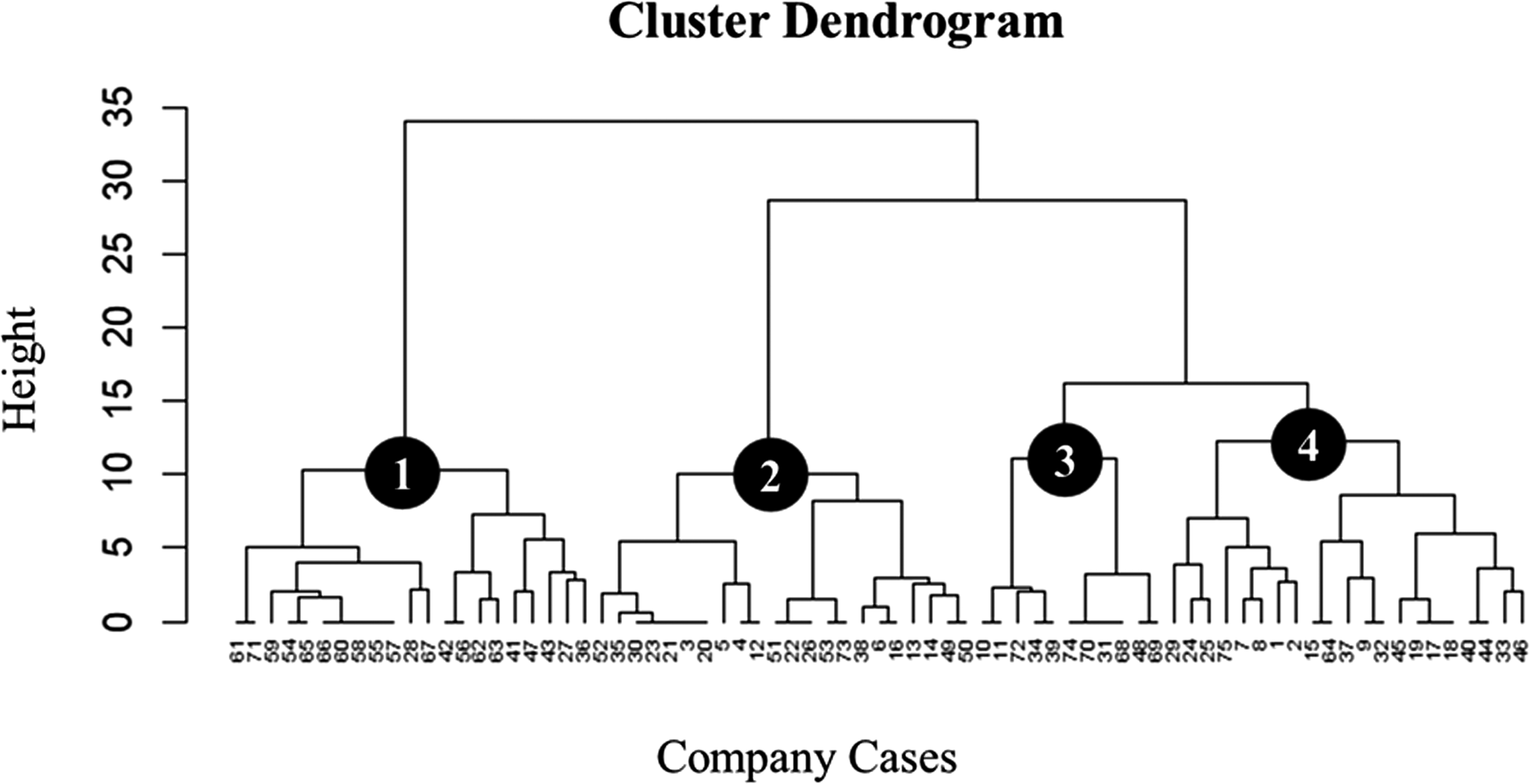
In the second stage, we aimed to develop strategic types of data-based value creation that emerge as salient manifestations of the key characteristics of a data strategy. To this end, we build upon the final data strategy taxonomy developed in the first stage to make use of its key characteristics. We transformed the case base into dichotomous dummy vectors specifying each characteristic for the underlying cases. We assigned a “1” to each vector entry if a characteristic was fulfilled in the respective case. We supplemented the vectors with the corresponding text passages or further references from secondary sources to increase transparency and facilitate team collaboration. Likewise, we assigned a “0” to the vector if a characteristic was not met or left the entry empty if the underlying data did not offer sufficient information. Finally, based on all entries, we set up a matrix of 75 rows representing the case companies and 41 columns for all characteristics drawn from the taxonomy.
Next, we performed a cluster analysis (Punj and Stewart, 1983) based on the final matrix. We determined a distance table and used Ward’s method for hierarchical agglomerative clustering. Due to the need for an a priori definition of the number of clusters and the different levels of case information, we employed a qualitative approach for assessing the different numbers of clusters: we agreed on adding an additional cluster based on a team consensus depending on significant distinctions within the characteristics of data-based value creation. More specifically, for considering a new cluster, we analyzed the following intra-cluster support Illustration of the case clustering.
Constant comparison
Based on the predominant characteristics of the resulting clusters, we summarized the four strategic types of data-based value creation referencing examples on the initial case companies. We engaged in constant comparison cycles (Birks et al., 2013; Glaser and Strauss, 2017) by placing the emerging strategic types in the existing literature on strategic organizational types (Greenwood and Hinings, 1993; Miles et al., 1978; Sabherwal and Chan, 2001) and the corresponding literature on data-based value creation and strategy-making (DalleMule and Davenport, 2017; Grover et al., 2018; Günther et al., 2022).
Expert interviews
Overview of interview partners.
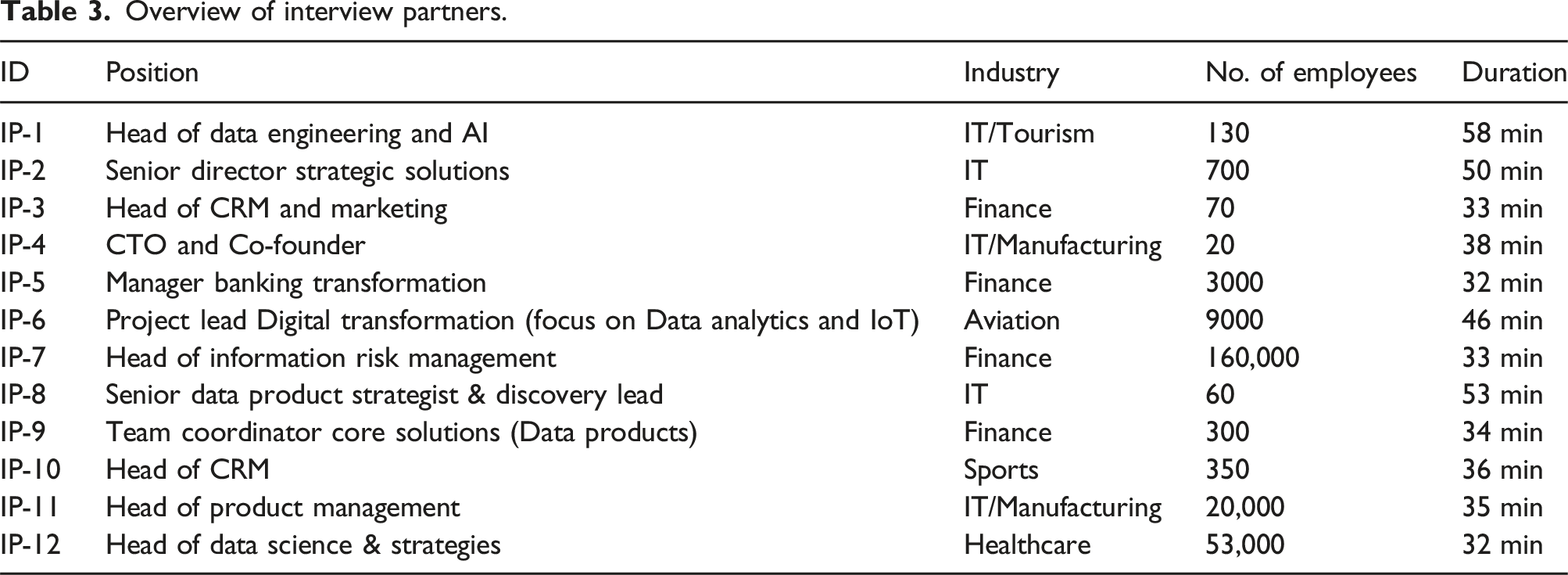
We divided all interviews into four parts: (1) open question about their current strategy for using data to create value; (2) a presentation of the research results, that is, (2.1) a short explanation of all dimensions and characteristics of the data strategy taxonomy with company examples and (2.2) introduction of all strategic types of data-based value creation based on their primary characteristics from the taxonomy; (3) feedback on the research results regarding comprehensibility, accuracy, and completeness of the dimensions; (4) questions on further practical applications of the research results. We phrased all result presentations, questions, and potential clarifications in an unobtrusive and non-directive manner.
In the last step, we transcribed and coded the data to finalize and validate our results (Miles et al., 2013). Similar to the case analysis approach, we rephrased existing characteristics to clarify their application or added characteristics to the taxonomy as needed based on a clearly articulated case scenario from the experts. For example, the taxonomy contained the dimension “Development Structure” with the characteristics “Centralization” and “Managed Decentralization.” In this context, IP-2 provided further information from the perspective of their business to enrich our results: “Everyone [here: business unit] is cooking their own soup [here: everyone is doing their own thing], so without sharing, without it being managed - I don't want to say shadow structures - but each business unit was able to do it [here: data-based value creation] themselves” (IP-2).
Based on this feedback, we added a missing characteristic, “Decentralization,” to the corresponding dimension, which helps to assess organizational structures on data-based value creation strategically. In total, we added two and rephrased five existing characteristics of the taxonomy based on the expert feedback. A comprehensive overview of our interview evaluation scheme is included in the appendix.
Results
Our analysis uncovered a data strategy taxonomy comprising three meta-dimensions—data resources, data orchestration, and data-based value—and 12 dimensions that reveal how firms create data-based value for their business. Based on this taxonomy, we derive four clusters of firms that show how companies strategically align their data-based value creation.
A taxonomy for data-based value creation
The following data strategy taxonomy (see Figure 5) presents our findings from extant theoretical contributions and code-based empirical analyses (Baecker et al., 2021). It lays out the structural and contextual bases for subsequent strategic types. We obtained 12 dimensions arranged along the three meta-dimensions: data resources, data orchestration, and data-based value. The 41 resulting characteristics describe the discovered instances of each dimension. They represent a strategic reflection of data-based value creation based on the case studies examined—for example, focusing on strategic aspects such as the induced complexity of unstructured data formats instead of attention to specific formats. The following sections detail all the characteristics and provide illustrative case examples (Baecker et al., 2021). A data strategy taxonomy (following and extending Baecker et al. (2021)).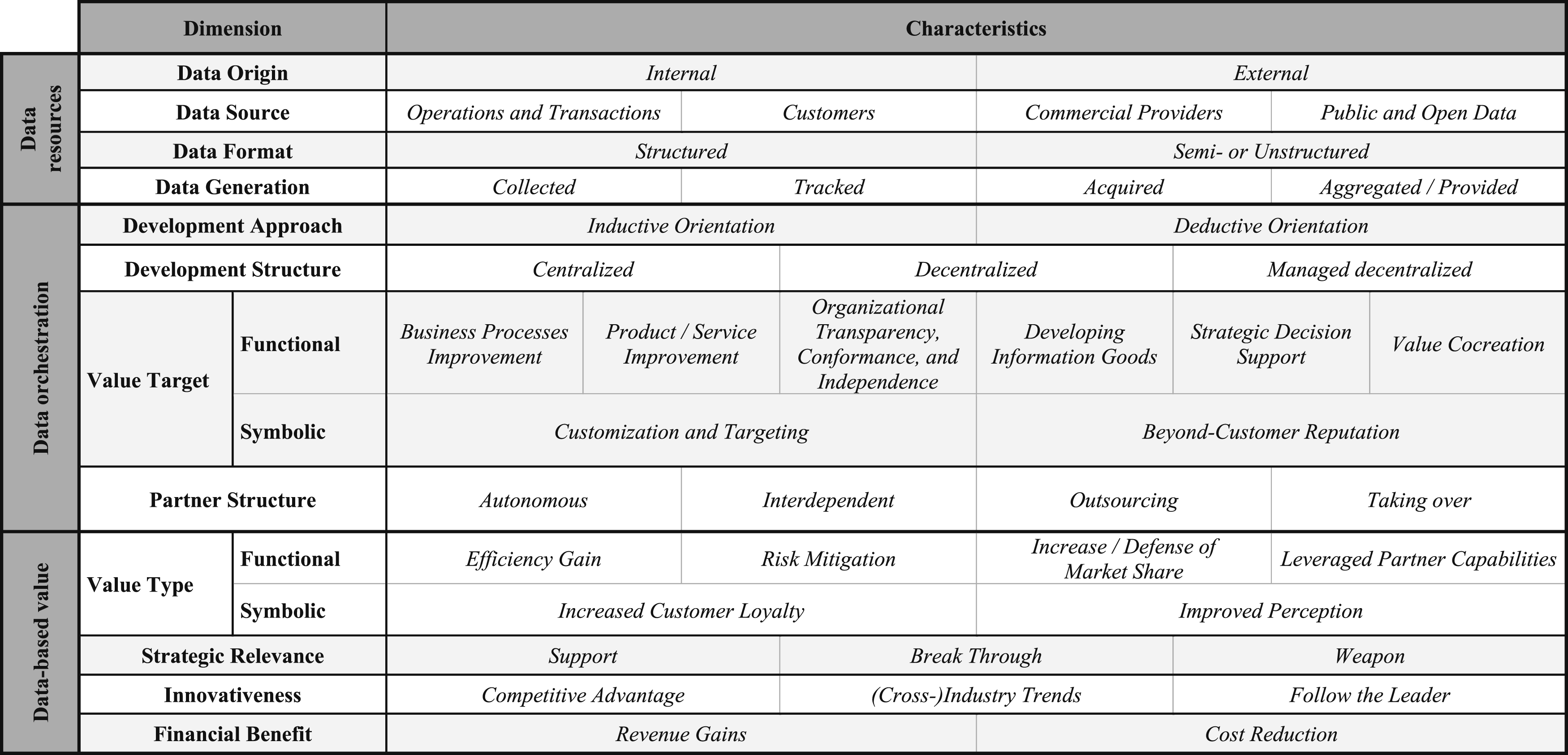
Data resources
The first dimension concerns the data origin, distinguishing the organizations’ focus of data-based value creation on internally available or externally sourced data (or combinations of both). Walmart, for example, analyzes its internal sales data to find purchase patterns (Grover et al., 2018). In contrast, Lufthansa includes external information like social media data to personalize customer experience (Chen et al., 2017). The main data sources of data-based value creation from an organizational perspective we observed in the cases are operations and transactions, customers, commercial providers, and public or open data. Suofeiya Home Collection, for instance, uses massive amounts of operational data from supply chain management to improve customer interaction (Cheah and Wang, 2017). Based on sensor technology built into tires sold to customers, Pirelli records usage-related data for product improvements and condition monitoring (Schaefer et al., 2017). Customers of Wolters Kluwer pay for accessing legal or business information offerings (Pellegrini et al., 2014), while 7-Eleven Japan incorporates free available data like weather trends into store inventory planning (Woerner and Wixom, 2015). As a certain indicator of the complexity of the underlying approach for data-based value creation, data formats range from structured data to usually more sophisticated semi- or unstructured data. Lufthansa, for example, intends to link structured data from its data warehouse to semistructured and unstructured data from social networks to increase customer understanding (Chen et al., 2016). Finally, we observed different ways of data generation distinguishing the (additional) expenditures for internally and externally sourced data. First, collected data is passively recorded and stored in regular business. Verizon Wireless, for example, uses collected customer data from its core business to develop new data-based service offerings (Schüritz and Satzger, 2016). Second, tracked data requires up-front investments to actively generate data for particular purposes. As such, Southwest Airlines records conversations between their service team and customers to improve the training of service personnel (Yu and Yang, 2016). Third, acquired data is purchased from or traded with external providers. Zara, for example, purchases fashion-related data from third-party vendors serving its fast-fashion business model (Sorescu, 2017). Fourth, aggregated data can be actively sourced from external sources with the additional workload but without (data-related) costs. For example, start-ups like Olery crawl massive amounts of data from the Internet as the cornerstone of their business model (Hartmann et al., 2016).
Data orchestration
The development approach reflects the exploratory degree of an approach for data-based value creation. It concerns whether an approach is more inductively oriented, starting from the data to identify new and unknown insights and patterns, or more deductively oriented, moving within the boundaries of a specific, predefined business case. TrendSpottr, for example, analyzes multiple web data sources to exploratively determine new trends for their customers (Hartmann et al., 2016), while Saarstahl AG largely tracks production data to detect faster (and exclude) scrap material (Schüritz and Satzger, 2016). IP-12 complemented the inductive focus from a research and development (R&D) perspective to support the generation of new patents in healthcare: “We use data […] for approaches in the context of research & development and clinical studies. […] We will lose our patent at some point. We can only survive by constantly bringing new products onto the market…” (IP-12).
The development structure specifies if an organization employs a central unit housing the necessary capabilities for providing its expertise as a service to other units or manages capabilities decentrally to foster close business interaction. BBVA, for example, established an independent data science center to act as a central expert unit for in-house projects (Alfaro et al., 2019). Thyssenkrupp, in contrast, launched several strategic initiatives and lighthouse projects throughout different business areas of the organization close to operational expertise that is only monitored centrally (Herterich et al., 2016). Furthermore, IP-1 added a complementary approach of decentralization without centralized governance: “We currently have this data work somewhat distributed, but not really managed centrally; it's more of a ‘patchwork.’ It's definitely decentralized, and I have to say it's also bad. […] At the moment, we rather have an ‘unmanaged’ decentralization.” (IP-1).
In the case studies, we observed numerous functional and symbolic value targets. Functional value targets regularly lie in the improvement of existing operational processes. Microsoft, for instance, developed a data-based solution for actively supporting salespeople with detailed information and suggestions on corporate customers (Wixom and Ross, 2017). Product or service improvements target improving existing (usually non-data) offerings, for example, through quality enhancements. Ford analyzes customer usage data to continuously improve the voice-recognition system installed in the cars (Yu and Yang, 2016). Further data-based value emerges through a deeper understanding of internal actions (e.g., transparency gained from process mining) or handling irregular externalities (e.g., fraud or anomaly detection). Online retailers such as Zalando analyze customer usage data to detect fraudulent behavior (Pousttchi and Hufenbach, 2013). In addition, companies can strive for greater independence from commercial providers by collecting the necessary data themselves: “But you usually have to get that from external data providers. And what we thought […] is tap into all possible sources of information that exist, store the data, be it any files, newspaper articles or other publicly available data, then run a machine learning over it for a clustering of the companies.” (IP-9).
Firms must create the corresponding prerequisites for developing new information goods within their existing value-creation processes. Accordingly, General Electric invested significantly in an analytics center to develop additional data-based solutions for industrial customers (Davenport, 2013). Besides incremental or repetitive decisions created through data in standardized operational processes (cf. business process improvement), organizations leverage data for strategic decisions in complex (often one-time) situations that significantly impact organizational performance. BBVA, for example, used insights from a dedicated analytics project to optimize the placements of bank branches for significant cost reductions (Alfaro et al., 2019). Furthermore, firms pursue strategies to co-create (data-based) value, particularly by utilizing business partner capabilities. For example, APIbank, an (anonymized) global bank, launched an open platform to offer some of the bank’s data to third-party developers striving for collaboration and innovation (Schreieck and Wiesche, 2017).
Concerning symbolic value, we observed that most companies target customization, for example, by addressing customers individually to (sustainably) change perception and trigger loyalty. For instance, Lufthansa aims to anticipate several customer preferences to optimize all interactions based on data and analytics to improve the brand perception with each customer and build sustainable relationships (Chen et al., 2016). Finally, we observed some organizations targeting a more fundamental, beyond-customer reputation. AUDI strives to be perceived as the most progressive premium brand, promoting its technical ambitions to a general leadership role impacting several stakeholders (e.g., partners through economic strength or talented graduates with an innovative working environment) (Dremel et al., 2017).
We found different partner structures within the processes of data-based value creation. Value can be created autonomously without the involvement of (and dependency on) external expertise. Start-ups like Olery build on data as their key resource and create corresponding value for customers (Hartmann et al., 2016). Building on valuable partnerships, organizations can interdependently create value based on their data resources. BBVA, for example, established several partnerships to develop innovative solutions (Alfaro et al., 2019). In some cases, (partial) stages of data-based value creation are permanently outsourced to third parties. Sift, for instance, completely takes over payment fraud detection for their customers with their data-based solution. Finally, companies can take over data-based value creation externally for competitive purposes: “Quite a lot of competitors who also have information that companies could do something with [here: data-based value creation] are either bought up so that the competition doesn't get it or bought up because I want to benefit from it myself.” (IP-2).
Data-based value
The value type reflects the resulting value gains for the organization. Functional value occurs through efficiency gains (e.g., savings by reducing times, failures, and necessary resources) within operational processes. For example, Suning Commerce Group used past production data to improve product development cycles, leading to lower lead times and operational costs (Cheah and Wang, 2017). Purposefully using data, organizations can mitigate (or avoid) several risks concerning their business (e.g., operational, fraudulent, security, or legal risks). For instance, Lufthansa uses aircraft data to monitor and predict the failure of parts to ensure optimal maintenance while increasing the safety of crew members and passengers (Chen et al., 2016). Furthermore, firms can mitigate the risk of dependency on external providers through data-based value created: “It was intended as an internal idea to see how we could make ourselves less dependent on external providers [here: commercial data providers].” (IP-9).
In addition, organizations derive value through increased or defended market shares based on new (or recurring/more stable) customers in existing market segments (e.g., through improved product quality) or by entering new market segments (e.g., based on new information goods). For example, Zara’s fast-fashion business model relies on real-time analytics to maintain and increase sales over competitors in fashion retail (Sorescu, 2017).
Sharing (business-related) data with partners or third parties can co-create value through further innovations and novel insights based on leveraged partner capabilities, thereby avoiding organizational blindness. For instance, Drug Co, an anonymized US-based drug retailer, benefits from a broad network of suppliers leveraging their analytical capabilities for insights and predictions around its retail business, avoiding high analytical costs (Najjar and Kettinger, 2013). In addition, organizations gain increased customer loyalty concerning symbolic value as customers are more strongly and positively connected with or even locked into a company’s offerings or status. DHL, for example, continuously tracks the shipment processes of its delivery items to offer customers real-time information about the delivery process to meet customer expectations, increase loyalty, and gain higher retention (Anand et al., 2016). Beyond customer reputation, value can occur through accompanying signaling effects (such as workforce satisfaction, increased pressure on competitors, or more rewarding and trustful partnerships). In addition to the functional benefits, the challenging projects and great learning opportunities at BBVA positively impacted skilled data scientists, resulting in low attrition while signaling to the outside world that BBVA is an innovative workplace (Alfaro et al., 2019).
The value created can be of different strategic relevance to the organization. First, it can support single parts or stages of the (co)existing primary value creation. Atomic, for example, automates some manual stages of its ski production process with the help of analytical solutions (Lassnig et al., 2017). More profoundly, the data-based value can break through an organization’s predominant value creation, significantly contributing to its financial performance. Owens & Minor, traditionally distributing medical supplies, established an information-based business around its traded products, accounting for significant portions of its financial performance (Woerner and Wixom, 2015). Finally, the value received from data forms the heart and central weapon of an organization’s business model and turnover. Olery’s data-driven business model stands and falls with its created value, drawing on massive volumes of web-based review datasets (Hartmann et al., 2016; Sorescu, 2017).
The market perception of the degree of innovativeness of data-based value may vary. Innovativeness can represent a competitive advantage if competitors cannot replicate the value (due to particular data, partner structures, or company characteristics). For example, Drug Co. created a unique ecosystem of hundreds of business partners around their data platform to co-create value (Najjar and Kettinger, 2013). More frequently, (domain-)specific pioneer value is similarly created by (leading) competitors setting trends within or across industries. Leading competitors like Pirelli or Caterpillar, for example, develop organizational conditions to (individually) create maintenance solutions around their products and processes (Schaefer et al., 2017). Complementing this, value can be created to defend a market position, usually by following technological leaders, often caused by environmental pressure from low-cost competitors. Firms like Atomic leverage data to increase efficiency and reduce process-related costs (Lassnig et al., 2017). In the final stage, data-based value creation aims to increase financial benefits for the organization. On the one hand, revenue gains represented by increased sales or optimized margins can boost financial performance. Walmart, for example, analyzes several data sources from sales, social media, or the website to increase (repeated) sales based on individualized product recommendations (Grover et al., 2018). On the other hand, a reduction in corporate costs can result from improved processes and higher efficiency. Lufthansa analyzes various data sources to minimize delays and save fuel, human resources, and, thus, costs (Chen et al., 2016).
Four strategic types
Strategic organizational types.
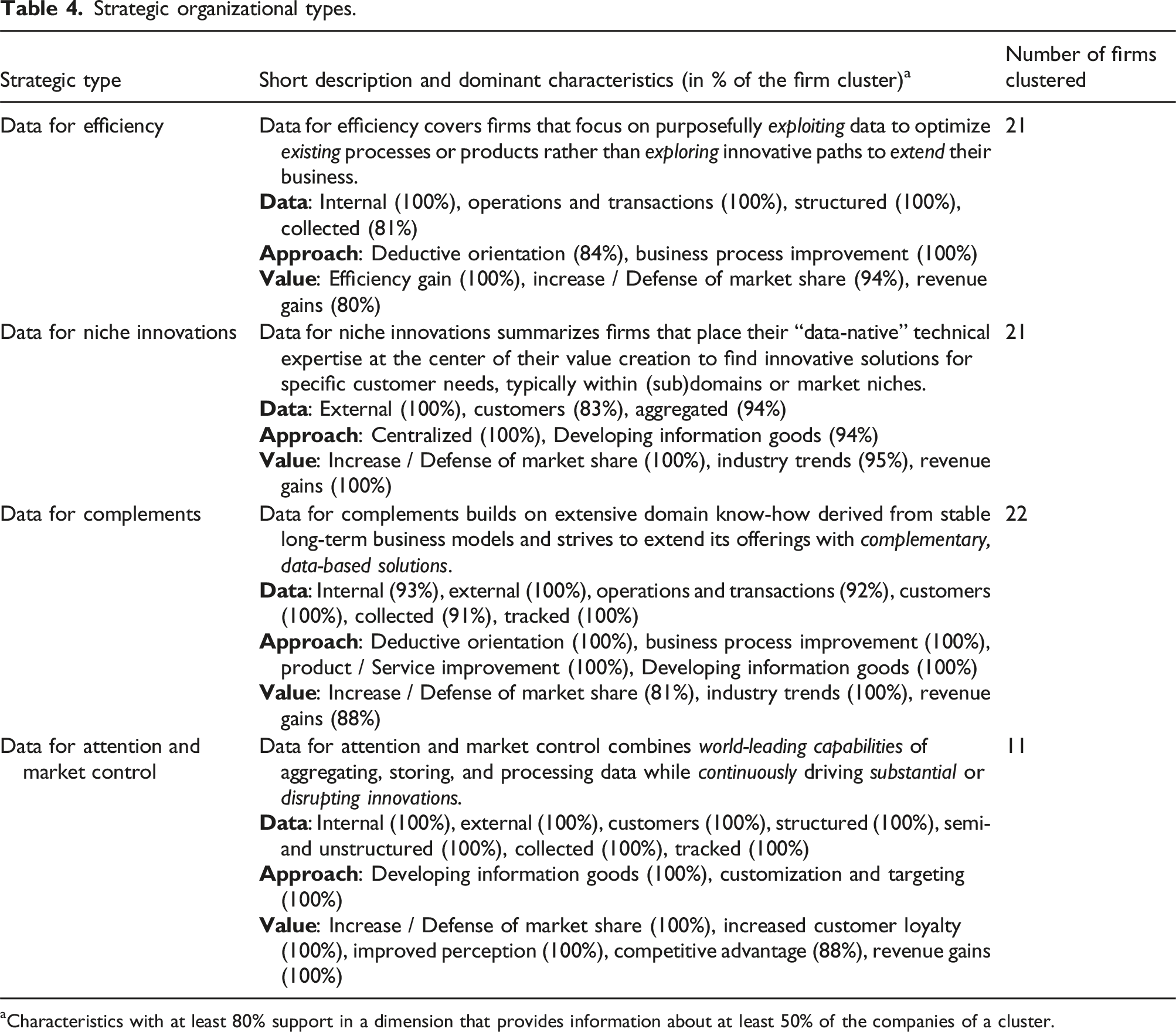
aCharacteristics with at least 80% support in a dimension that provides information about at least 50% of the companies of a cluster.
Data for efficiency
Data for efficiency covers firms that purposefully exploit data to optimize existing processes or products rather than exploring innovative trails for extending their business. Firms leverage their data resources to actively support their predominant and persistent core business. This strategic type typically strongly involves partners for analytical expertise and largely builds upon internally sourced data (e.g., from business processes or machinery) or self-generated data (e.g., gathered customer feedback). The main value targets are efficiency gains for maintaining competitiveness by reducing costs and defending market share based on higher product quality. It strives for purposeful adjustments of vital aspects of the core business and initially avoids (externally oriented) data-based objectives.
Examples of this strategic type are traditional manufacturers that use data to improve how products are manufactured, but typically without changing the firm’s products. Saarstahl AG (Schüritz and Satzger, 2016) or Atomic Austria (Lassnig et al., 2017), for example, increasingly incorporate data into their production processes to raise efficiency by reducing scrap or automating manual processes while keeping their core offerings (steel and skis) unchanged. Moreover, firms of this strategic type optimize their offerings without making the data part of the resulting offering. For instance, Suning Commerce Group (Cheah and Wang, 2017) and NBCUniversal (Woerner and Wixom, 2015) use data-based insights to increase the quality of their core offerings without changing the offerings’ nature or adding “smart” service solutions. For instance, to improve product quality, Suning uses extensive user feedback insights captured from its crowdsourcing platform to optimize the functionality and design of a cooker hood according to customer needs (Cheah and Wang, 2017). Likewise, NBCUniversal exploits customer sentiment data for faster television programming changes (Woerner and Wixom, 2015).
Data for niche innovations
Data for niche innovations summarizes firms that place their “data-native” technical expertise at the center of their value creation to find innovative solutions for specific customer needs, typically within (sub) domains or market niches. Driven by the increasing availability of publicly accessible data, these new players arise in different industries and aggregate data resources from the Internet or are openly shared by businesses to target customer demands in a novel way. For this strategic type, data-based value creation is the core business and includes the ability to combine structured and unstructured data autonomously and perform advanced analytics or visualizations. This often allows for great scalability of the (generic) solutions, which can be similarly plugged into the data of many customers to achieve rapid increases in market share. Nevertheless, these firms often depend on externally sourced data, without which the business becomes impractical. Conversely, high technical expertise and little entrenched structures allow high adaptability to change.
Olery, for example, aggregates massive volumes of tourist review data from the Internet to provide firms in the hospitality industry with insights into their business (Hartmann et al., 2016; Sorescu, 2017). Olery’s analytical expertise enables a new service solution that most of its customers would not be able to achieve independently. As a result, Olery can take advantage of economies of scale to offer its solutions to many potential customers. While Olery largely builds upon available data from the Internet, firms like Sift or Granify focus on specific customer data that can fuel their solutions (Hartmann et al., 2016). This includes, for example, fraud detection solutions or web-shop analytics, where the models are trained on a customer’s unique data resources.
Data for complements
Data for complements builds on extensive domain know-how derived from stable long-term business models and strives to extend its offerings with complementary, data-based solutions. This strategic type shows similar prerequisites as the first one. Hence, it maintains a lasting core business model at the center of the firm’s operations and leads to specialized domain expertise and high volumes of business-related data. These conditions enable this type to supplement its existing value propositions by embedding data into new complementary information solutions. Providing additional solutions may target new revenue streams, enhanced customer loyalty, or even service-related lock-in effects. However, such ventures are tied to high up-front investments and pursuing a long-term data strategy to build and maintain the necessary infrastructure and capabilities. Accordingly, most firms approach such complex development by taking gradual evolution stages that focus on internal projects and gaining functional experience before using this expertise to develop data-based customer solutions (Alfaro et al., 2019; Herterich et al., 2016; Tiefenbacher and Olbrich, 2015).
Logistic firms like DHL, for example, use shipment data, which is continuously tracked at every checkpoint in their global network, to inform customers about their shipments (Anand et al., 2016). Besides internal improvements such as shipment monitoring or process optimizations, DHL has created a complementary data-based service that meets growing customer expectations (Anand et al., 2016). Other incumbent enterprises like the Bosch Group or General Electric have specialized in using advanced analytics integrated into intelligent B2B service offerings like fleet management, energy management, or optimization applications for manufacturing operations (Davenport, 2013). High investments (up to $2 billion at General Electric) in innovation hubs or analytics centers pave the way for this innovation-oriented expansion. Similarly, Pirelli and Caterpillar develop new data-based maintenance solutions to create additional value around their core products (Schaefer et al., 2017). In 2019, Pirelli introduced its “Cyber Fleet” solutions for fleet management (e.g., for regional transport firms or car rental businesses). These solutions use tire sensor data to improve safety on the road, save fuel costs, and increase tire life (Pirelli, 2019).
Data for attention and market control
At the forefront of technological innovation, data for attention and market control firms combine world-leading capabilities of aggregating, storing, and processing data while continuously driving substantial or even disrupting innovations. Their leadership position enables firms of this strategic type to gain data from unique business settings while maintaining unrivaled capabilities to leverage them. Moreover, they define the benchmark of competitiveness by regularly setting new standards in creating value based on data. As a result, these firms benefit from high signaling effects promoting their brand and image in addition to functional value, such as an increase in market share or cost-efficient processes. Signaling effects (Grover et al., 2018) not only affect customers but also impact partners (e.g., high level of reliability), competitors (e.g., pressure for action), and the most talented applicants (e.g., innovative working environment and challenging tasks), boosting the company’s public perception.
Examples are world-leading technology giants such as Amazon, Google, and Facebook that combine a unique user and customer community whose data serves as an essential basis to drive business and ongoing innovations (Bühler et al., 2015; Pousttchi and Hufenbach, 2013; Trabucchi et al., 2017). They are champions at performing various forms of personalization and targeting and using their customer knowledge to generate corresponding added value for their business (e.g., personalized content or advertising), strive for customers’ attention, or influence them. Furthermore, they regularly demonstrate and communicate their expertise along various channels (e.g., AI showcases and leading publications). In addition, firms of this type, such as Walmart, profit from a unique leadership position in the online and offline retail business by collecting petabytes of data every hour (Grover et al., 2018). Walmart established leading capabilities in combining hundreds of different data sources and created the world’s largest private cloud and analytics hub for driving innovations at any desired part of its operations. With the help of its data-based solutions, Walmart discovers trending products or pushes targeted marketing activities, resulting in significant sales increases (Grover et al., 2018).
Discussion
The findings of this study, including the four strategic types of data-based value creation (data for efficiency, niche innovations, complements, and market control), build on and extend prior research on data value creation mechanisms (Grover et al., 2018; Günther et al., 2022; Shollo et al., 2022; Zeng and Glaister, 2018). While earlier studies made significant strides in uncovering specific facets of data utilization—such as the operational mechanisms of data reconstruction and repurposing (Günther et al., 2022) or the contextual dynamics and managerial capabilities underpinning external data integration (Zeng and Glaister, 2018)—their focus remained on discrete processes or contextual insights.
In contrast, our study advances these contributions by presenting an integrated taxonomy that connects three overarching meta-dimensions—data resources, orchestration mechanisms, and value outcomes—to strategic manifestations across diverse organizational contexts. This broader framework enables a comprehensive understanding of how data-driven strategies align with distinct organizational goals. Moreover, building on the primary focus of previous contributions, which predominantly emphasize intra-organizational mechanisms of data-based value creation (Günther et al., 2017, 2022; Shollo et al., 2022; Zeng and Glaister, 2018), our strategic types extend beyond organizational mechanisms. They shift the perspective outward, highlighting strategic configurations that reveal indications of data-enabled market positioning, ranging from defensive strategies primarily focused on efficiency gains for retaining market share to offensive strategies aimed at niche exploitation or market share disruption through data utilization.
Data strategy in the context of information systems and business strategy
Drawing on a meta-analysis of empirical cases, we uncover connections between our identified strategic types for data-based value creation and established research on business and IS strategies. Additionally, we identify a novel type that demonstrates how data can empower organizations to redefine their market positioning altogether (see Figure 6). Data strategy in the context of IS and business strategy.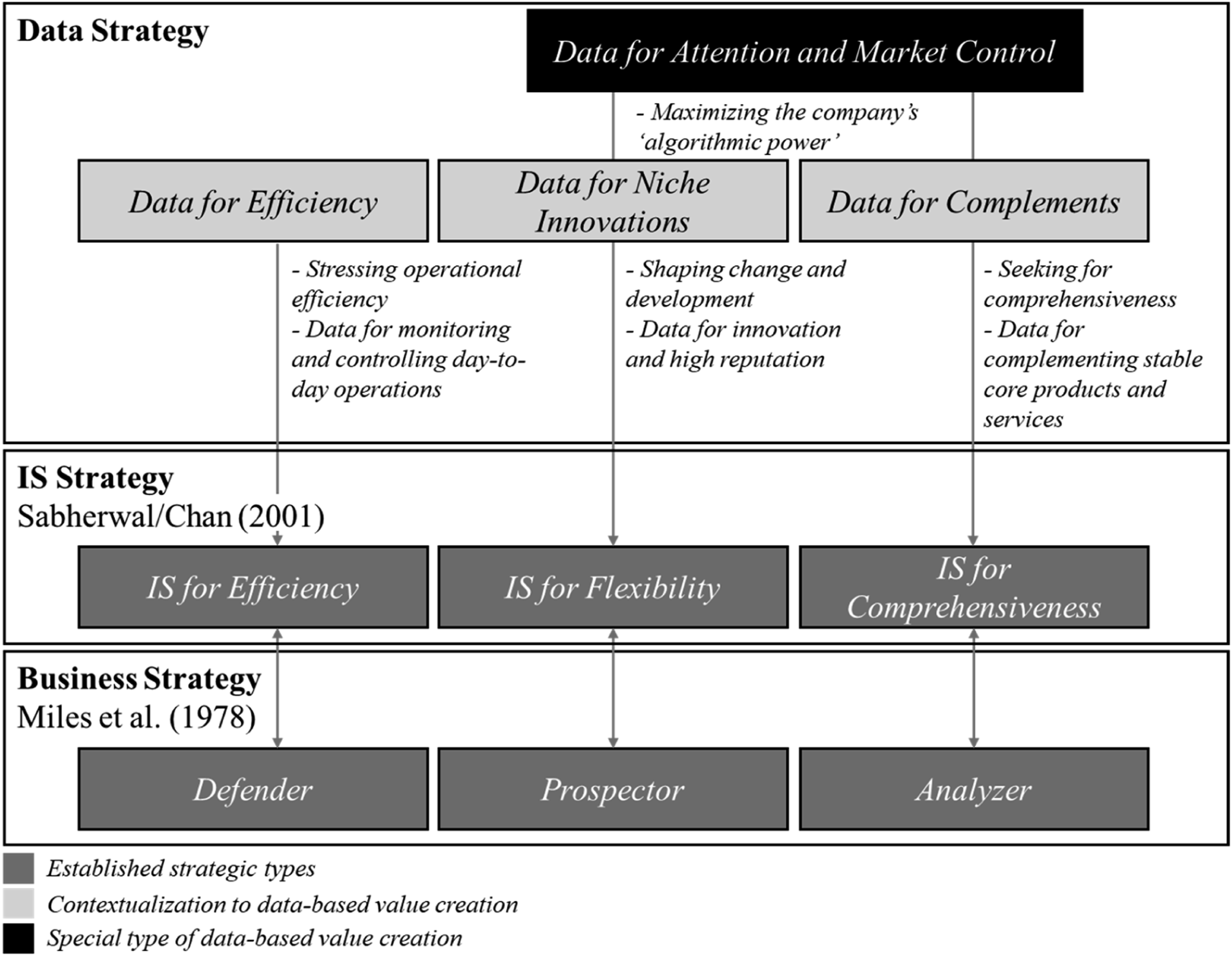
Coherence between data, IS and business strategy
First, we observed organizations largely using data for efficiency to pursue a more efficiency-oriented IS strategy (Sabherwal and Chan, 2001), exhibiting defensive characteristics (Miles et al., 1978). More specifically, this concerns using data for operational support, such as monitoring and controlling day-to-day business and operations or efficiency gains in the interchange with a more stable customer and supplier base rather than for market analysis and fast innovations (Sabherwal and Chan, 2001). Thereby, our cases reveal how the systematic use of internal operational data resources (e.g., production metrics) is deeply intertwined with orchestration mechanisms that prioritize process standardization and automation to achieve value outcomes focused on cost leadership. For example, Saarstahl AG (Schüritz and Satzger, 2016) demonstrates how integrating real-time sensor data into manufacturing workflows not only reduces costs but also ensures operational predictability, showcasing how data-driven efficiency supports stability in highly competitive industrial markets. From a strategic perspective, the data strategy of this strategic type combines internally available data with deductively oriented mechanisms of business process improvements to defend its market positioning, primarily serving the cost leadership targets of an overarching business strategy (Sirmon et al., 2011).
Second, data for niche innovation organizations pursue flexibility, differentiation, and fast adoption to change. This type relates to a more flexible-oriented IS strategy and is characterized by high monitoring of product and market trends and rapid, proactive decision-making (Sabherwal and Chan, 2001). In this regard, the primary focus of its data-based value creation is on increasing market share rather than on efficiency gains, serving its more proactive yet continuously developing way of business (Miles et al., 1978). Our cases show that organizations of this type leveraging external and dynamic data resources (e.g., customer preferences or market trends) rely on adaptive orchestration mechanisms that emphasize rapid experimentation and iterative innovation to create value outcomes centered on market differentiation (Sirmon et al., 2011). Olery (Hartmann et al., 2016) exemplifies this by harnessing customer sentiment data from the internet to develop domain-specific innovations, showing how agility in orchestration enables responsiveness to niche demands, creating a distinct competitive edge. Strategically, rapid data-based innovations characterizing this data strategy primarily contribute to the differentiation goals of this type’s general business strategy (Sirmon et al., 2011).
Third, organizations that rely on data for complements strive for comprehensiveness, yielding a business with a (market)-analyzing nature (Sabherwal and Chan, 2001). This strategic type uses data-based solutions in strategic decision-making, enabling comprehensive decisions and rapid responses to market changes (Sabherwal and Chan, 2001). These companies combine the strengths of the former two types by complementing a core of traditional products with data-driven services after their viability has been generally demonstrated in the market (Miles et al., 1978). Our analysis highlights how a combination of internal and external data resources (e.g., operational insights or customer usage data) supports hybrid orchestration mechanisms that integrate predictive analytics with cross-functional collaboration to produce value outcomes, balancing efficiency, and differentiation. Pirelli’s use of tire performance data (Schaefer et al., 2017) to offer predictive maintenance services illustrates this interplay, as it not only enhances operational cost-efficiency but also delivers new customer-centric value, redefining market positioning through comprehensive solutions. Accordingly, the data strategy balances support for differentiation (e.g., fast adaption to useful data-based innovation) and cost leadership (e.g., mature solutions for process optimization and decision-making) targets of a general business strategy.
Fourth, several aspects of data for attention and market control also relate to high degrees of market analysis and the pursuit of IS for comprehensiveness through new data-based offerings (Sabherwal and Chan, 2001). Firms of this strategic type balance innovation opportunities with their core business model to “minimize risk while maximizing the opportunity of profit” (Miles et al., 1978: p. 553), which again combines the strengths of the former two types. For example, similar to Pirelli, firms such as Google or Amazon maintain a core business model while developing new customer products and services (Pousttchi and Hufenbach, 2013; Trabucchi et al., 2017). However, we still observed these firms successfully go beyond using data for complements in terms of two particular characteristics.
Shifting paradigms: Data for attention and market control
Market control
First, while analyzer companies adapt quickly and successfully to promising key innovations, they do not create that change on an algorithmic or analytical level (Miles et al., 1978; Sabherwal and Chan, 2001). Conversely, as firms like Google and Amazon combine their world-leading expertise to drive unprecedented innovation and an inimitable data basis from their core business, they drive data-based innovation. From a data strategy perspective, this innovative behavior may correspond with the ultimate goal of maximizing the “algorithmic power” of the company (Constantiou and Kallinikos, 2015; Gillespie, 2014). More specifically, it combines unique data assets with unrivaled algorithmic capabilities to predict customer needs on a micro-behavioral to impact their customers’ decision-making via digital channels (Boldyreva et al., 2018; Gilbert et al., 2023). The data basis is characterized by strong elements of “haphazardness” (Constantiou and Kallinikos, 2015; Yoo, 2015) adopting an “all-you-can-collect” approach to inductively create powerful instruments to actively “shape” the reality of their customers (Yoo, 2015).
The resulting market insights upend conventional tacit versus explicit knowledge balances in the market in favor of these companies (Bhimani, 2015). Facebook, for example, leverages its sophisticated data infrastructure to tailor user experiences through personalized content and targeted advertising, subtly guiding user behavior and preferences on products or general trends. The scope of influence even extends into decisions outside the actual product and business context, such as shaping public opinion, influencing political discourse, and altering social interactions (Boldyreva et al., 2018; Kramer et al., 2014). This ability of one specific type of company “will redefine lines of authority, influence and organizational power” (Bhimani, 2015: 68). By establishing new norms and practices, these companies redefine competition and set the stage for new regulatory frameworks to emerge (Fast et al., 2023). Their pervasive presence throughout all layers of society and global reach is contributing to an unprecedented concentration of power, representing a paradigm shift in terms of a company’s market control based on their strategic data usage. This shift challenges traditional economic models and the understanding of market participants (Constantiou and Kallinikos, 2015; Yoo, 2015) and raises fundamental questions about fairness, consumer autonomy, and the ethical use of data-based insights.
Attention
Second, besides seeking functional value through innovative products and services, data for attention and market control firms are characterized by signaling effects from communicating innovativeness and technological leadership (Grover et al., 2018). Therefore, driving innovation and maintaining a reputation as a leading innovator are central parts of their data strategy, which also relate to the core characteristics of prospector companies (Miles et al., 1978; Sabherwal and Chan, 2001). Firms like Google and Amazon set new standards by being at the center of innovation and change, proactively “signaling” their achievements into the market while simultaneously managing a stable product and core customer base. In this regard, our findings indicate new forms of symbolic value that particularly correspond to a company’s data usage. First, for customers, the algorithmic power of such firms creates highly visible signals of technological leadership and innovation, shaping not only consumer expectations but also fostering trust and permanent engagement. These signals help reach and attract customers on a deeper level, as they perceive the firm as a pioneer in delivering cutting-edge, data-driven products and services. Second, this symbolic value extends beyond customers to influence broader stakeholders, including potential employees, investors, and business partners. On the labor market, firms project an image of technological excellence, positioning themselves as attractive employers for top talent. For investors, signaling innovation reinforces confidence in the firm’s future growth potential and market dominance. Similarly, for partners, these signals underscore the firm’s capability as a reliable and forward-thinking collaborator, further cementing its role in the broader ecosystem of inter-organizational relations. Overall, the global signaling power of companies like Facebook or Google goes far beyond traditional marketing strategies. It establishes them as central players in shaping perceptions of technological progress and innovation, influencing not only customer choices but also attracting top talent or positioning themselves as indispensable partners within broader economic and technological ecosystems.
Implications for theory
To sharpen our understanding of data strategy and “the strategic implications of today’s complex systems,” IS researchers need to “chart the entire constellation of participating stakeholders” (Markus, 2017: 237). In this regard, recent contributions have elaborated on the difference between offensive and defensive data strategies (DalleMule and Davenport, 2017; Medeiros et al., 2020). Among their valuable findings on data management and key objectives, our results, however, suggest further differences in the constitution of companies’ strategic behavior on setting up and applying strategic data initiatives. According to the theory, an offensive data strategy focuses on “supporting business objectives such as increasing revenue, profitability, and customer satisfaction” (DalleMule and Davenport, 2017: 2). It offers high levels of flexibility in data management and responds quickly to competitors and market changes. Vice versa, a defensive data strategy focuses on reducing operational costs and streamlining business processes based on a high level of data integrity among internal systems (DalleMule and Davenport, 2017; Medeiros et al., 2020). This is generally consistent with our findings, yet we found that this dyadic view may not capture the full complexity of this phenomenon. More specifically, we found a striking difference in the offensive orientation of companies that, for example, develop complementary information goods from internal data resources out of an existing core business model compared to new market entrants that identify analytical solutions as the primary core of their business model by aggregating external data from specific business contexts. Such differences cover data usage (e.g., transactional vs customer-oriented), orchestration (e.g., different forms of autonomy and partnering), and resulting value types and relevances (e.g., complementary vs vital). Thereby, our clustering approach considering the intra-cluster support of all data strategy characteristics found creates a dedicated view on such offensive variations of different company types. This is important as our results suggest that there is no “one size fits all” strategy for this complex phenomenon and our findings reveal the interrelated perspective of data, orchestration and resulting value for those individual types. Thus, in systemizing both the key characteristics of modern data strategies as well as salient adoptions in the form of strategic types helps sharpening the constellation of big data stakeholders and their strategic value targets in the market (Grover et al., 2018; Markus, 2017). Thereby, our findings draw on existing research on data strategy (DalleMule and Davenport, 2017; Medeiros et al., 2020; Talaoui et al., 2023), building upon and refining its insights.
Second, from a strategic lens, our findings contribute to the ongoing research on strategic organizational types (Greenwood and Hinings, 1993; Miles et al., 1978) and related IS strategies (Sabherwal and Chan, 2001). Thereby, our strategic types and their various functions—efficiency, niche innovations, and complements—contextualize extant findings on organizational IS and business strategies within the current context of data-based value creation. While the literature provides initial thoughts on strategic types with a focus on particular characteristics, such as the extent of functional and symbolic value (Grover et al., 2018) or specific company types (Hunke et al., 2022), we offer an integrated perspective to understand this phenomenon more thoroughly. More specifically, for each strategic type, we show how specific data strategy characteristics influence differentiation or cost leadership targets related to a company’s business strategy (Sirmon et al., 2011). This relationship is important for managerial decisions as data continues to increase in relevance in today’s value-creation processes (Abbasi et al., 2016; Constantiou and Kallinikos, 2015; Mirbagherimarvili et al., 2022) and its successful implementation depends on the inclusion of data and analytics “in a firm’s long-term business strategy, and the mechanisms in place to facilitate business alignment with this strategy” (Grover et al., 2018: 394). Thus, in abstracting from a body of concrete business cases, our strategic types elaborate on this intersection between data and business strategy to enlighten the strategic key characteristics of today’s business approaches for effectively orchestrating companies’ data resources (Chadwick et al., 2015; Sirmon et al., 2007, 2011).
Along these lines, we identified a fourth strategic type of data-based value creation, that is, data for attention and market control, which enriches classical findings. More specifically, it appears that world-leading technical capabilities combined with tremendous amounts of appropriate data can lead to unseen corporate supremacies in our globalized world, which may go beyond the classical image of prospectors or analyzers (Miles et al., 1978). In this regard, technical giants such as Facebook are already conspicuous for their ability to influence and manipulate user sentiment with unprecedented effects on a massive scale (Kramer et al., 2014). Here, data plays the central role, providing such companies with crucial insights about their users (Fast et al., 2023), which extends to political and social relevance “beyond the traditional economic role” of these companies (Lindman et al., 2023: 150). From a theoretical lens, this type defines the practical implementation of theoretical reflections on the optimal application of autonomous data strategy mechanisms (Constantiou and Kallinikos, 2015). More concrete, this type is the real manifestation of organizations that are in the position to handle unstructured, haphazard, trans-semiotic data for the purpose of inductively setting new standards for algorithmic developments and data-based value targets (Constantiou and Kallinikos, 2015; Yoo, 2015). By bridging such conceptual insights with empirical evidence, our research advances the discourse on big data strategy and analytical maturity (Bhimani, 2015; Constantiou and Kallinikos, 2015; Günther et al., 2022; Markus, 2017; Shollo et al., 2022; Yoo, 2015) and provides a structured framework for understanding the diverse ways organizations harness data in pursuit of strategic goals. For this specific type of company, the resulting market power from their data is causing new forms of required regulation (Fast et al., 2023; Kang and Isaac, 2020), making this strategic type a multifaceted yet complex research object on the balance between “insights obtained due to access to big data and the infringement such access results in” (Abbasi et al., 2016: 10). Thus, as scholars already use this strategic type in the literature (so-called “superstar firms” (Fast et al., 2023)), theorizing strategic types for data-based value creation makes these manifestations more accessible, creates consistency in terminology, and promotes the examination of the subject matter in this important research area.
Third, our findings further expand the perspective of theoretical studies on value-creation mechanisms from data (Günther et al., 2022; Shollo et al., 2022; Zeng and Glaister, 2018). These studies reveal complex interrelationships of intra-organizational data use, such as the democratization of data in the organization (Hopf et al., 2023; Zeng and Glaister, 2018), the recontextualization of data by an organization (Aaltonen et al., 2021; Günther et al., 2022; Zeng and Glaister, 2018) or the organizational conditions and value creation mechanisms of specific technologies (Shollo et al., 2022) or company types (Hartmann et al., 2016; Hunke et al., 2022). Building upon these results, our findings suggest viable combinations among data, orchestration, and resulting value (e.g., the aggregation of external data combined with the centralized development of novel information goods to disrupt existing markets in specific industries). In this regard, we validate and enrich these abstract mechanisms by examining their combined application in practice, which bridges the gap between theoretical conceptualizations and their practical realizations. Our strategic types illustrate how these mechanisms interact in real-world scenarios, offering evidence of how data-based value creation is operationalized across various organizational and market contexts. Importantly, our study transcends the predominant intra-organizational perspective by introducing new dimensions that extend into inter-organizational and market dynamics. For instance, we highlight how data-driven value creation unfolds in diverse partner structures, where collaboration and competition between organizations play a crucial role. Additionally, we account for external market perceptions, such as how the innovativeness of data-based offerings is viewed by other market stakeholders, creating new forms of symbolic signaling effects where data strategies convey strategic intent or market positioning. This focus on symbolic effects beyond customers is novel, as no prior study on data strategies or data-based value creation has explored their impact on broader stakeholders, such as employees, investors, or partners. Especially in the light of current developments in the field of AI, these effects are set to become even more critical, shaping perceptions of technological leadership and driving systemic shifts across industries. Finally, our strategic types distinguish themselves from existing theories on organizational mechanisms by enabling a shift toward analyzing market positioning through data. This perspective paves the way for novel systemic and dynamic analyses of inter-organizational collaboration and competition. As data ecosystems become increasingly interconnected and competition over data intensifies (Constantiou and Kallinikos, 2015), these strategic considerations are likely to increase in relevance in the future.
Fourth, our results also contribute to the ongoing discourse on data-based value creation and data monetization (Grover et al., 2018; Günther et al., 2022; Wixom et al., 2021; Zhang et al., 2023). Today’s organizations increasingly seek data monetization targets such as wrapping information around products or selling data assets (Wixom et al., 2021; Zhang et al., 2023), which represent major organizational and value-related challenges (Mirbagherimarvili et al., 2022). Findings suggest that data monetization targets particularly benefit from digital elements along the (existing) value chain (Parvinen, 2020). Therefore, an integrated view of data strategies–comprising data, orchestration, and value outcomes–provides the conceptual framework for investigating multidimensional relationships (e.g., data types, orchestration models, or realized value types groundbreaking for selling data assets) to more thoroughly address such challenges. Moreover, as academics have hardly examined how data can lead to strategic business value and competitive advantage (Grover et al., 2018), our taxonomy provides an empirically validated structure of key characteristics for creating different forms of functional and symbolic value (Grover et al., 2018), deepening the understanding of organizational value gained from data. This is of high topicality, as realizing strategic business value is the “ultimate success” of any (big) data and analytics project (Grover et al., 2018: 390) that today’s companies are equally striving for.
Practical contribution
Understanding the key characteristics of data-based value creation is essential for entrepreneurial planning (Grover et al., 2018). Thus, our findings contribute to practice with an easy-to-use tool to assess and communicate own ambitions in strategic decision-making. More specifically, our interview partners emphasized several applications from practical perspectives.
First, formulating a data strategy is not a one-time task. The dependence on context and timing requires managers to recurrently review existing and additional value paths. For example, in the course of its analytical evolution, AUDI’s management gradually replaced external analytical consultancies with the development of a centrally hosted innovation hub (Dremel et al., 2017). Thus, different aspects of their data strategy (i.e., partner structure and development structure) were refined over time. As generalized by IP-12, “[…] you can use a taxonomy like this to challenge organizations like the one I run to see if there are any gaps […] and whether there are still areas where there may be options for action [here: regarding data-based value creation].” (IP-12).
Thus, the dimensions of our data strategy taxonomy help to systemize this managerial challenge of constantly looking for gaps or useful adjustments along existing and potential value paths in exchange with internal business units, external service providers, and consultancies.
Second, our results can help sharpen companies’ internal evolution toward data-based value creation early on. For example, IP-3 highlighted the specific case of fast-growing start-up companies, where organizational structures tend to evolve out of day-to-day operations. “[…] if you grow and connect new data at some point, you will have to think about it [here: development structure, partner structure, and value targets] because it is unclear who is doing what.” (IP-3).
In this situation, our findings can help managers rethink the organizational evolution from potential targets from scratch (e.g., centralized vs decentralized approaches or to focus on explicit value targets).
Third, our case analysis further allows for inspiration apart from one’s own organizational restrictions and provides empirical illustrations from several real-world cases. In this regard, IP-11 pointed to both the taxonomy and case studies that can help companies “ask the right questions” to rethink existing or identify and embrace new ways of creating data-based value. “Do we even know what we need to do for risk mitigation? Can we determine the indicators required? Afterwards, we can think about what data we need to collect for this.” (IP-11).
In this way, the dimensions of the taxonomy can help managers structure their reflections on new initiatives and draw inspiration from them.
Finally, our findings on strategic types can help sharpen the strategic focus and “persuasive vision” of organizational data initiatives along the corporate culture (Chadwick et al., 2015: 362). For example, IP-6 emphasized the potential of articulating a strategic “narrative” to foster a sense of purpose and shared understanding among employees for driving innovation: “[…] it is a key message for the company because I think it's incredibly difficult to explain to people [here: workforce] who have little to do with the topic “data” what we're doing this for and what companies you can perhaps compare yourself with […] to clarify where our common focus is.” (IP-6).
Thus, it is crucial to engage the entire workforce, especially in incumbent companies, with a clear and compelling mission to align them with and gain their support for implementing a (new) data strategy.
Limitations and future research
Our study is subject to two main limitations. First, building on empirical studies, our case sampling may be biased toward findings worth publishing. For example, our types of data-based value creation only represent firms already employing forms of data-based value creation. Thus, similarly to prior examinations, there might be a reactive “residual” strategy unable to respond to environmental change (cf. Miles et al., 1978). Second, the paper forming our case base often focused on different research subjects (such as big data, data-driven business models, or data monetization). Therefore, we were highly challenged to handle the varying degrees and emphases of information from both main and supplemental sources. Nevertheless, we argue that the large overall quantity of processed information underlying this study provides sufficient support that the developed results can serve as a reliable basis for further studies.
Based on our findings, we see fruitful avenues for future research. First, research may concern potential interactions between different strategic types of data-based value creation and their long-term implications. Such interactions may be commercial (e.g., vendor-customer relationship), synergetic (e.g., co-creating new types of data-based business value), or competitive (e.g., disruptive data-based solutions or services). In this regard, we particularly pay attention to the fourth type of data-based value creation, data for attention and market control, observing its unique, data-based market position and the societal handling of this market power (in terms of regulation and data privacy). Second, we observed rather little attention to the symbolic data-based value created by organizations. Thus, we encourage future work to elaborate on the specific values emerging toward different stakeholders (e.g., customers, competitors, business partners, and the workforce). Finally, building on the taxonomy developed, future examinations could extend the value-related dimensions with metrics used in organizations to quantify the emerging impact (e.g., for assessing functional outcomes or symbolic benefits). Such quantifications would further promote research on assessing and comparing the actual success of data-based value creation for different ventures.
Conclusion
This article presented a contemporary snapshot of how far we have come in organizational value creation based on data. The developed data strategy taxonomy yields valuable insights and a profound structure for the broad range of approaches to data-based value creation evident in practice. The four strategic types of data-based value creation strengthen the understanding of the strategies of organizations applied in this context. Due to the rapid development of this phenomenon, we hope our findings to assist researchers in diving deeper into data-based value creation in organizational settings and support practitioners in driving their own ambitions.
Supplemental Material
Supplemental Material - Organizational data strategy: Unveiling key elements and strategic types
Supplemental Material for Organizational data strategy: Unveiling key elements and strategic types by Julius Baecker, Jörg Weking and Andreas Hein and Helmut Krcmar in Journal of Information Technology
Footnotes
Declaration of conflicting interests
The author(s) declared no potential conflicts of interest with respect to the research, authorship, and/or publication of this article.
Funding
The author(s) received no financial support for the research, authorship, and/or publication of this article.

Supplemental Material
Supplemental material for this article is available online.
Note
Author biographies
Notes
References
Supplementary Material
Please find the following supplemental material available below.
For Open Access articles published under a Creative Commons License, all supplemental material carries the same license as the article it is associated with.
For non-Open Access articles published, all supplemental material carries a non-exclusive license, and permission requests for re-use of supplemental material or any part of supplemental material shall be sent directly to the copyright owner as specified in the copyright notice associated with the article.
